
Only 45% Of Cuban Teens Watch National Television / 14ymedio

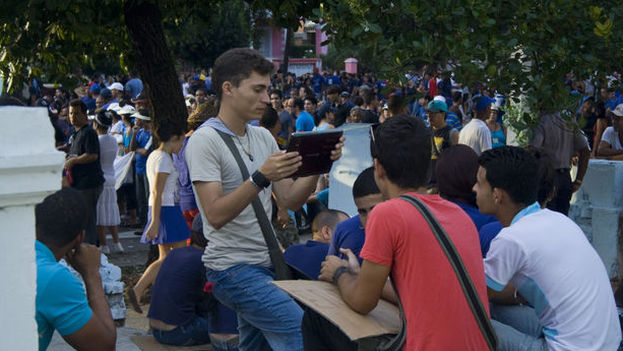
Cuban teens feel superior when they acquire a device that allows them to access new technologies. (14ymedio)

14ymedio bigger14ymedio, Havana, 23 January 2016 — New technology and the consumption of audiovisual material a la carte are gaining ground among Cuban teenagers. Only 45% of teenagers claim to watch national television, according to a study conducted in November 2015, which the official Press has reported on this week.

Research was conducted through a questionnaire administered to 2,051 individuals and personal or group interviews to another thousand, a representative sample of the 1,381,135 people that are between the ages of 10 and 19, roughly 12% of the population, according to the Cuba 2015 Statistical Yearbook. continue reading

Keyla Estévez García, a researcher from the Center for Youth Studies who lead the study, stressed the importance of this study and pointed out that these adolescents’ behavior definitely “resembles the Cuba of today, transformation, changes; and needs to be understood from this new context.”

Study participants were chosen from two municipalities in each territory. About 59% are residents in provincial capitals and 13.5% live in municipalities of Havana, especially from Plaza of the Revolution, Old Havana, Arroyo Naranjo and Boyeros. Of the study group, 44% are female and 54% are male.

More than half of the participants want to enroll in University and obtain a high-level degree, while one-fifth of the study sample will settle for finishing college preparatory training.

Close to 10% only aspire to finish high school, prepare to work as a skilled laborer or work as a mid-level technician.

At least 27.6% of participants chose not to respond or was unsure as to which profession they would like to pursue. Medical science was at the forefront of professional aspirations, followed by the hard sciences with the humanities in last place. This scenario may represent a vocational reorientation implemented in schools.

However, students’ opinions about their schools were very negative. Only a few respondents believe that school is a place where they feel happy, their rights are respected or where they can defend their beliefs. Only 11% opined that schools taught them what they needed to know.

The official press says that a “not so insignificant” share of these teenagers sees school as a boring place, where they do not want to be but are obliged to go. They classify school as a dogmatic, closed and uncreative place.

A “not so insignificant” share of teenagers sees school as a boring, dogmatic, closed and uncreative place.

As for having fun, they like to listen to music, go to the beach, pool or rivers, visit family and friends and consume audiovisual products, but they read little and hardly visit museums. The national television programs fail to attract more than half of those who prefer other options like the “weekly packet” (for which there is no data in the questionnaire), content shared through USB or mobile phones.

The majority of respondents said they had computers, internet access, music players and mobile phones, in that order. “A high number of adolescents can access the internet from Wi-Fi zones, which implies expenditures, generally covered by their family,” indicates the official press.

For these adolescents, the main use of information and communication technologies is photo exchange, music, videos and games, although they are also used to study. These technologies generate happiness and many develop a sense of superiority when they acquire one of these technologies

As far as consumption habits, 12% of adolescents’ surveyed smoke and 36% of them drink alcoholic beverages, while 2% of them admitted to using toxic substances. The age of onset for these habits is between 14 and 15.

Sexual relations begin early, especially in urban zones. Close to half of the study sample began having sexual relations between the ages of 14 and 15.

These adolescents’ idols have little to do with political figures or with those associated with the official ideological discourse. In sports, predilections point to Cristiano Ronaldo and Lionel Messi, while in the artistic world preferences are for Jennifer Lopez, Justin Bieber and Selena Gómez. Among national artists, Reggeaton singers Yomil, el Chacal or el Príncipe take precedence over other artists.

The absence of questions about political preferences, immigration and their perception on the rest of the world, in a survey conducted one year after the reestablishment of relations with the United States, is striking. Nevertheless, the report did not provide direct access to the study itself and its complete data.

Translated by Chavely Garcia
Belkis Cantillo, Leader Of The Dignity Movement Released / 14ymedio, Luz Escobar

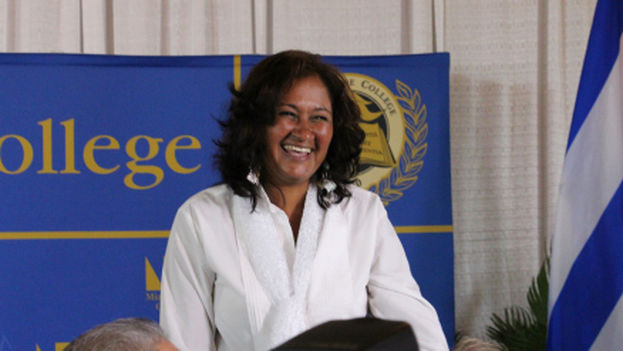
Belkis Cantillo, leader of the Dignity Movement. (Courtesy)

14ymedio bigger14ymedio, Luz Escobar, Havana, 23 January 2017 — The leader of the Dignity Movement, Belkis Cantillo, who was arrested last Thursday was released Monday afternoon, as confirmed to 14ymedio by Moraima Diaz, an activist of the same movement.

Shortly after being released, in a telephone conversation with this newspaper, Cantillo explained that she was given a warning letter that he refused to sign.

According to the activist, the document stated that she could not “meet with anyone” or be visited by “counterrevolutionaries.” The police also prevented her from carrying out “public demonstrations.” continue reading

About her days in custody, she says that they removed the mattress and that she was “sleeping on the cement” which caused an “increase of the pain she already suffered due to renal colic.” The activist reports that, after insisting, she was visited by a lawyer.

After her release she was summoned to appear next Saturday before the offices of the State Security in the municipality Julio A. Mella.

According to Moraima Díaz, members of the Dignity Movement cannot leave their homes without State Security agents “persecuting them.”

“We have agents at every corner of the house. It is a police siege to which we are subjected,” she adds.

Moraima Díaz: “We have been told that if we leave the house, our families will be the ones who will pay the consequences”

“We have been told that if we leave the house, our families will be the ones who will pay the consequences,” she says from Palmarito de Cauto, a town in the province of Santiago de Cuba.

“The situation here is extreme. The police have taken the town so that there are no dissident demonstrations,” says the activist.

The women of the Dignity Movement have experienced days of intense repression since they created their movement in the Sanctuary of the Virgin of Charity of Cobre on Saturday, January 14. They call for, among other things, immediate and unconditional amnesty for all those who today are serving prison sentences for “pre-criminal dangerousness” and for this concept which they consider to be “arbitrary” to be eliminated from the Penal Code.

Amel Carlos Oliva, youth leader of the Patriotic Union of Cuba, told 14ymedio that in the early hours of the morning the police raided the house of Thomas Madariaga Nunez, 66, an active member of his organization.

Right now, Madariaga is in custody.

Donald Trump: A Peronist in the White House? / 14ymedio, Carlos Malamud

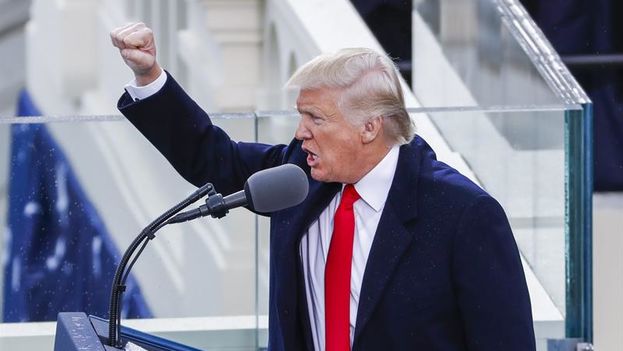
Donald J. Trump, delivers his speech after swearing-in as the 45th president of the United States. (EFE / Michael Reynolds)

14ymedio bigger14ymedio, Carlos Malamud, Madrid, 23 January 2017 — Guillermo Moreno, former Secretary of Domestic Trade under both presidents Kirchner in Argentina, and responsible for the manipulation of Argentinean official statistics during the so-called “won decade,” said after the inaugural address of Donald Trump that the new president “is a Peronist.” Without the slightest blush and with no nuance Moreno justified his favorable opinion of the new occupant of the White House for his defense of national industry and the slogan “America first.” Hence his optimism: “When we return to power, we will not have the world against us.”

When analyzing Friday’s speech on Capitol Hill, Ines Capdevilla, in a more sophisticated way, linked Trump’s Adamism – starting from scratch with a clean slate – with the best traditions of certain Latin American presidents predestined to re-found their countries. A circular phenomenon that appears to have no end. continue reading

Nothing and no one should stand between him and the embrace of his people, the great subject of the national transformation that he himself will lead

In his inaugural speech Trump turned his back on the past of the United States. It was not a lack of memory or historical ignorance, but a pure reconfiguration of reality in his own image and likeness.

Almost nothing from the past is useful, none of his predecessors did anything salvageable and the explicit mention of some author to reinforce his ideas could sound like elitism, a caste. Nothing and no one should stand between him and the embrace of his people, the great subject of the national transformation that he himself will lead.

The only thing missing for Trump to situate himself as the height of the best exemplar of the hemisphere was to promise a new constitution starting with a constitutional assembly. In this way his imprint on the national history would be indelible, but it seems that Trump knows something about his limits and this is precisely one of them.

Much has been said about his populist and nationalist tone. Nevertheless, I would like to emphasize the Peronist component mentioned by Moreno. Beyond the outdated protectionism he wants to impose on the United States he has some other signs like the direct relation between the leader and the masses, bypassing the troublesome intermediaries of the establishment and the political parties.

In his speech Trump said, “What really matters is not which party controls our government but whether our government is controlled by the people.” Even the intermediation of his own party, the Republican, could distort his messianic message. For that Twitter comes as a perfect fit, to keep open privileged communication channels that even now he can access without controls of any kind.

Many Latin American politicians are enriched in the exercise of their functions. It does not seem to be the case with Trump, who comes to the presidency already rich. However, the lack of clear boundaries between the management of public affairs and his private businesses both inside and outside the United States could generate significant conflicts of interest and a new point of convergence across the continent. Not only that, nepotism, expressed in the increasingly starring role of some of his direct family members in the management of the government, is another matter to keep in mind.

The values ​​that Vladimir Putin claims to defend are the same as those claimed by European xenophobic parties

European xenophobic populisms have expressed their desire to incorporate the new president and the values ​​expressed by him to his field of play. We have already seen Nigel Farage make the pilgrimage to Trump Tower and also the zealous demonstrations of Marine Le Pen and Geert Wilders at the meeting that the far-right continent just held in Koblenz. While promising a “patriotic spring,” Wilders said, “Yesterday, a new America, today, Koblenz, and tomorrow, a new Europe.”

The rejection of liberal democracy and the free market, complemented by a visceral hatred for everything that Barack Obama might represent, starting with the defense of liberties and human rights, is not only a response to the strategic interest of turning Russia into a great power. The values ​​that Vladimir Putin claims to defend are the same as those claimed by European xenophobic parties, although the political support and economic aid that some receive from Moscow facilitates the convergence. But these are not exclusive phenomena of old Europe, since in Latin America it is possible to observe similar opinions, although in a self-referential way and these tend to be located at the other end of the political spectrum.

Venezuelan President Nicolás Maduro undertook an undisguised defense of the new leader: “I do not join the world’s campaigns of hatred against Donald Trump… I ask myself, about what, because we know a lot about dirty wars.” These statements are the result of comparing the new president to the “nefarious” Obama, Venezuela’s biggest enemy, the most interventionist and interfering in Latin America and the direct promoter of three coups: Honduras, Paraguay and Brazil. Maduro argued that under no circumstances could Trump be any worse than Obama.

The Cuban government tried to stay true to its style and Josefina Vidal said that under no circumstances would they accept pressure from Trump and that “aggression does not work with Cuba”

Evo Morales, through Twitter, also showed relative optimism about Trump, his isolationist policy and the possibility of reestablishing normal bilateral relations, with the exchange of ambassadors. In a second message he went further: “Hopefully, with the new president of the United States, there will be an end to the interventions and military bases in the world to guarantee peace with social justice.”

For its part, the Cuban government tried to stay true to its style and Josefina Vidal, the Foreign Ministry Director for the United States said that under no circumstances would they accept pressure from Trump and that “aggression does not work with Cuba.” Despite the forcefulness of these statements, Raul Castro has maintained a significant silence on the subject. Some malicious person might think that he has done it so as not to counter Putin, but that is pure speculation.

Peronism, like the recent Latin American populisms, has tended to polarize its societies. Nationalism was used to mobilize the faithful in defense of the project, to the point that whoever was not with Peron or with Chavez was a traitor to the country. It seems that Trump has decided to follow the same path, a path which, as the recent experience of Latin America has shown, only leads to discouragement, frustration and the impoverishment of the society as a whole.

Rationing Says Goodbye To “Chicken For Fish” / 14ymedio, Zunilda Mata

A ration market slaughterhouse (14ymedio)

14ymedio bigger14ymedio, Zunilda Mata, Havana, 23 January 2017 — The news has appeared quietly in the official media: since the beginning of this year the share of the so-called “chicken for fish*” has been eliminated from the rationed market. The measure is part of the process of the “rearrangement of the basic market basket,” as confirmed by the Camagüey newspaper Adelante in its Saturday edition.

As of January 1st of this year the distribution of chicken in rationing networks is governed by new quotas. The meat companies of each province will be responsible for the subsidized distribution of chicken meat, including the six ounces that, until last December, was arranged the Fishery Industry to replace fish. continue reading

Kenya Medina Monesti, director of the Meat Company of Camagüey, said that with this measure the population living in urban areas will receive 12 ounces of chicken per person nine times a year, while in December they will get only 8 ounces.

The distribution will be more widely spaced in rural areas, where consumers will be able to purchase the product only four times a year

In February and September there will be deliveries in urban areas only, and only for children under six years old, who will be entitled to six ounces of chicken in each of these two months.

The distribution will be spaced out more widely in rural areas, where consumers will be able to purchase the product only four times a year, “in an amount equivalent to 10.6 ounces,” according to the report.

Each consumer would receive 7 pounds and 4 ounces of chicken a year, of which 6 ounces a month would replace fish (the so-called “chicken for fish”). Consumers will now receive 1 pound and three quarts of chicken a month for adults, and 11 ounces for children under the age of 14. In this way, each person gets three quarters of a pound of chicken more than before.

In 2014 the official press confirmed that the fishing crisis, which reduced fish consumption by 75%, would be very difficult to overcome

In 2014 the official press confirmed that the fishing crisis, which reduced fish consumption by 75%, would be very difficult to overcome, so seafood would continue to be missing from the ration card.

“Today, as a practical matter, we have only the fish from our own catches and from aquaculture, which together total just over 37,000 tonnes of fish,” said industry officials cited by the newspaper Granma. This amount is well below 200,000 tonnes, mainly of mackerel from the Soviet Union, which was consumed in the 1980s on the island.

*Translator’s note: The ration market has historically provided both chicken and fish to Cubans as a part of their monthly food ration. However, for years, fish has been scarce, to the ration markets routinely substituted “chicken for fish.”

The Punk Who Didn’t Cry For Fidel / 14ymedio, Pablo De LLano

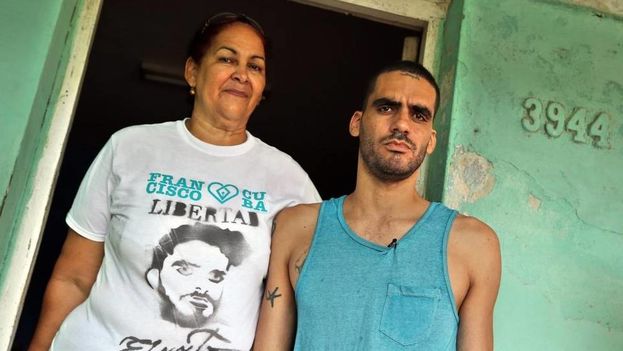
Cuban graffiti artist Danilo Maldonado, El Sexto, poses with his mother, Maria Victoria Machado, at her home in Havana. (EFE)

14ymedio bigger14ymedio, Pablo de Llano, Miami, 22 January 2017 — Minutes after the announcement of the death of Fidel Castro, last November 25, Danilo Maldonado Machado passed by his mother’s house and knocked on the window of her room. Maria Victoria Machado opened and her son asked: “Mom, are you afraid?” She, who had heard the news, told him no: “You know this is my bedtime.” He continued: “Well, I’m going to warm up the track.” Mrs. Machado assumed that her son was going to paint some anti-Castro slogan in a city, Havana, that that night had been mute, silent, empty. Free for the cats and for the crazies.

“Have you ever asked him not to expose himself so much?”

“No,” said the mother from Havana. “I admire my son.” continue reading

El Sexto, the artistic alias of Maldonado, left and reappeared a while later at the side of the Habana Libre Hotel. With a mobile phone, he broadcast live on Faceboo, speaking directly to the screen and mocking Fidel and Raul Castro, recalling dead regime opponents, moving through the desolate streets: “Nobody it outside,” he said. “Rare,” he scoffed. “Nobody wants to talk. But how long will you not want to talk, gentlemen?”

He was an eccentric doing a comic-political show in an empty but guarded theater. The most risky sitcom of the year in Havana

He wore a white Panama hat. Sunglasses hanging from his shirt. Under the right eyelid, tattooed barbed wire. Headphones around his neck. He was an eccentric putting on a comedian-politician show in an empty but guarded theater. The most risky sitcom of the year in Havana. Then he asked some squire, “Papi, where’s my can?”

El Sexto took out a spray can and on a side wall of the Habana Libre, the former Havana Hilton and the hotel where the father of the Cuban revolution had immediately taken possession of to set up his first headquarters after conquering the capital, he scrawled: “He left.”

Live. His face in the picture. Risk level one hundred.

He enjoyed it. He looked at the camera and said, “I see panic in their faces.” Six feet five-and-a-half inches tall, thin, bearded, exultant. A Don Quixote crossing the line.

Hours later, according to the reconstruction of his mother, he was forcibly removed from his apartment by a group of police and locked up in the maximum security prison Combinado del Este, outside Havana, accused of damage to state property. Only this Saturday, two months later, was he released.

“They gave me my identity card and said I would have no problem traveling outside the country,” the artist told 14ymedio a few hours after he was released without charges. “I am in good health and I am very grateful for the solidarity of all those who were aware of my situation.”

During the time he was imprisoned, Amnesty International declared him a prisoner of conscience. A campaign on Change.org collected about 14,000 signatures for his release. Kimberley Motley, an African American lawyer specializing in human rights, traveled to Cuba in December to try to visit him in prison, but was detained and returned to the United States. The vice-president of the German Parliament, the Social Democrat Ulla Schmidt, declared herself his “political godmother.”

This was his second time in prison. In 2015 he spent 10 months locked up for planning a performance art piece with two pigs painted with the names of Fidel and Raul. In his 33 years El Sexto has become a heterodox figure of dissent. More a provocateur than an activist, he is essentially a natural punk, a creative thug who in another country would only have paid a fine for painting a wall, but to whom 21st century Cuba dedicates the punitive treatment it considers appropriate to a threat to the security of the State.

When they released him in 2015, after a hunger strike, El Sexto traveled through different countries and explained in a talk that in the beginning he defined his political stance as that of an artist in response to the official propaganda so abundant on the island: “If they have the right to violate my visual space, I also have the right to violate their visual space,” he maintained.

Years earlier Cuban government proclamations were calling for the return of five Cubans imprisoned in the United States for espionage. They were called The Five Heroes. It was then that Maldonado adopted his nickname “El Sexto” – the Sixth – and emerged as a graffit artist.

“Danilo says that art has to be brave and try to impact people,” explains his girlfriend, Alexandra Martinez, a Cuban-American journalist he met in Miami. She says that El Sexto is a fan of Estopa, a Spanish rock/rumba duo, and Joan Manuel Serrat, a Spanish singer-songwriter. She tells how impressed he was when he went to New York and visited the studio of artist Julian Schnabel, director of Before Night Falls, the film about Reinaldo Arenas, a Cuban poet who died of AIDS in exile, and also the director of Basquiat, about the artist who began is career using the tag SAMO (for Same Old), on his graffiti in the streets of Manhattan.

Mrs. Machado says that in the case file the cost of erasing her child’s graffiti at Havana Libre was recorded as 27 Cuban pesos

Martinez likes a drawing he has done in his current prison stay, titled Cemetery of living men. It’s a three-level bunk with a man in the bottom, the middle bunk empty and a cockroach in the upper bunk. “Someone,” his mother says, has been sneaking out of prison the pages he painted and publishing them on his Facebook page. They have a surreal style.

He also writes. He talks about his nightmares – zoomorphic guards who mistreat him; he takes notes of the language of the prisoners – “fucking: synonymous with food”; and directs messages to his audience – “I still have not received news of my case,” “I draw little because of my allergy, the excessive dampness and the lack of light, “ “the boss of my unit beat me,” “only the cosmic knows the true purpose of this ordeal.”

Mrs. Machado says that in the case file the cost of erasing her child’s graffiti at Havana Libre was recorded as 27 Cuban pesos, the equivalent of one dollar and one cent US. “But they do not forgive what he painted,” she says. Maldonado has written from prison: “Imagine how many people laugh about me. I’m already famous in jails and prisons.” Fidel Castro left. The bars remain.

_______

Editor’s note:  This text is reproduced here with the permission of El País, which published it today.

Obama Left, Trump Arrived, the Repression Continues / 14ymedio, Reinaldo Escobar

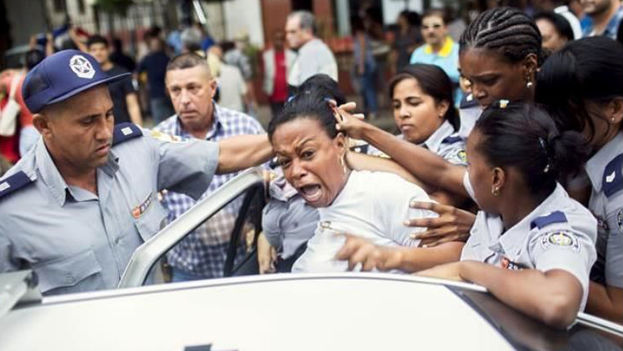
The political police detained more than 60 members of the Ladies in White Movement in Havana, Matanzas, Santa Clara and Ciego de Avila. (EFE / Archive)

14ymedio bigger14ymedio, Reinaldo Escobar, Havana, 23 January 2017 — Within 48 hours of Donald Trump being declared President of the United States, the political police maintained their repression against opponents unchanged. The hard hand of State Security begins to contradict the claim that “Barack Obama’s concessions” to the Plaza of the Revolution fueled the repressive character of Raúl Castro’s government.

According to partial reports issued on Sunday, the political police detained more than 60 members of the Ladies in White Movement in Havana, Matanzas, Santa Clara and Ciego de Ávila. Berta Soler and her husband, the former Black Spring prisoner Angel Moya, were arrested along with 23 women as they prepared to leave the organization’s headquarters in the Lawton neighborhood of Havana. continue reading

The repressors did not shake their hands in the face of the scenario of a new tenant in the White House. They were not even frightened by the warning issued by the mogul weeks before in his Twitter account, when he clarified that “if Cuba is not willing to offer a better agreement for Cubans, Cuban Americans and the American people in general,” he would liquidate the diplomatic normalization.

With the thaw or without the thaw, the repressive nature of the Cuban system remains unchanged

Despite the hopes of some and the threats of others, the repression continues and on this Sunday morning more than 30 Ladies in White in Matanzas were prevented from attending Mass. Some were taken to police stations, while others were driven to the outskirts of the city and put out of the cars to find their own way home, and other were driven home. Two arrests were reported in the city of Santa Clara and another in Ciego de Ávila.

If there really is any relationship between what the new president says and does and how the Cuban government decides to treat its opponents, the next few weeks will have to prove it.

With the thaw or without the thaw, the repressive nature of the Cuban system remains unchanged. Obama does not seem to be responsible for the twist in the oppression experienced in the past two years, as perhaps Trump also fails to alleviate the rigors of a regime that could not exist where liberties flourish.


The Unhealthy Public / Rebeca Monzo

“19th of April” Policlinic in Havana

Rebeca Monzo, 20 January 2017 — Our media are filled with praise for the Cuban public health system. This is a subject that foreigners who visit our country pay a lot of attention to, due to the government propaganda and official statistics provided to international organizations, which tourists also show a lot of interest in.

There are two or three hospitals and policlinics shown off to visitors, which are “duly prepared.” Even so, and I know from experience, they are not in the optimal conditions that they should be.

I felt “fortunate,” when for the first time in all those years, I had to go to one of these “model” centers to receive physiotherapy treatment, due to two tremendous falls I took, thanks to the broken streets and sidewalks and in a terrible state, which proliferate in our city. continue reading

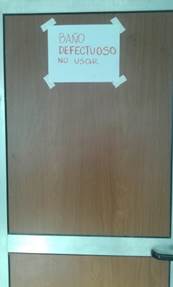
“Defective bathroom, don’t use.”

The staff in attendance in this department is good, friendly and prepared, but the conditions for delivering the best treatment don’t really exist. Numerous people come to this department, having suffered some kind of accident or simply suffering from the passage of years.

From the waiting room to the physiotherapy department there is a hallway through which all the patients have to pass, most of them old people with crutches or canes, and they must avoid a perennial puddle of water, where even the policlinic’s pets come to drink. Also, of the two bathrooms for the waiting room, only one is working, the ladies, which the gentlemen also have to use.

The different cubicles where physiotherapy happens are adorned with ragged and dirty curtains, some of them half off. Also, the furniture in the rooms is mostly covered in dust. It seems there are no cleaners or, simply, they are paid so little they don’t do a good job.

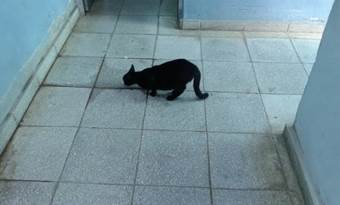
A cat drinking from a puddle in the hallway of the clinic

And if that wasn’t enough, the biological wastes are deposited directly into trash collectors, without being put in closed trash bags or incinerated as they should be.

Imagine, if this is the policlinic they show foreigners (only the best areas), you can imagine what the rest of the ones we ordinary citizens have to use are like. And don’t even talk about the hospitals, they’re worse.

Granada, 1983, the Hidden Cuban Martyrology / Somos+, Pedro Acosta

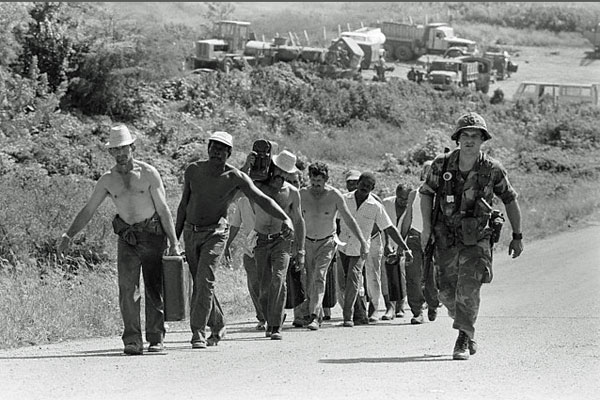
US soldiers taking Cubans to a prison camp

Somos+, Pedro Acosta, 19 January 2017 — Thirty-three years later, I talked to more than 60 people under age 40 and with more than a 9th grade education; none of them knew exactly what I was talking about.

I asked them: Do you know what happened on the island of Granada in 1983? Most of them looked at me like I was asking them to solve a riddle. Some, the oldest, without being sure what I was talking about, said they thought there had been a military intervention there. Only one explained it to me, with middling clarity, because he had heard about it from his family. continue reading

A little history lesson, well hidden! In October of 1983, the Chief of the Armed Forces of that country, at the request of the party in power, “The New Jewel,” staged a coup d’etat and assassinated Prime Minister Maurice Bishop and his entire family. The United States threatened, and days later invaded the island.

A group of Cuban construction workers were there building an airport along with a small group of Colonels sent by Fidel in its presidential plane, AN-24 (el patico), had to confront the elite troops of the US 82nd Airborne Division.  You, who went to build, without the slightest right, without the simplest analysis and for the absurd chimera of someone looking for a military victory over his eternal enemies, is there weapons in hand and in mortal danger.

They did not have the right, nor the reason, nor the recurrent and often false, Internationalism!

I wonder, in a spectacular maneuver of my fantasy, and if, in the face of an uncontainable push of the builders, the elite American troops would have withdrawn: Who were we going to hand over power to? How long would we have remained in that territory? What role would we play there in the meantime?

We, like the ancestral custom of the regime, learned what happened through foreign radio stations and, first of all, those of the “enemy.” Despite there having been Cuban builders there, and Maurice Bishop was a great friend of Fidel, it was not until three days did we offficially here what happened there, when the entire Cuban people had a different version of the events.

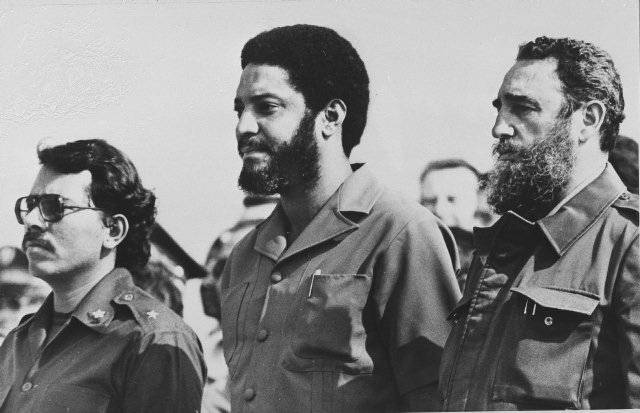
Maurice Bishop and Fidel Castro

The officers were meant to block the US troops from taking control of the airport under construction, with the help of the builders. But the undesirable things happened. When confronted with the American troops, the immense majority of those who fought back were the construction workers, while the military experts and “warriors” sent by the Commander, Fidel Castro, including the chief of the troops, turned tail and left the field to the civilians. Those Colonels, some of whom were stations at the USSR embassy on this island, and others, wandering the mountains and the city, were detained by US forces.

The Cuban military were cowards for not confronting the big boss and telling him that they weren’t willing to commit suicide as they were being asked to do, and much less demand that others do it. And they were traitors for allowing those inexpert builders to do it. They should never have asked someone to fight. This was not their battle, and what’s more, incredibly unequal. They were asked to immolate themselves, and in whose name? By whom and for what?

While our soldiers were fleeing the news was alienating. The disgrace that was happening was also oversized, huge and fallacious. The last thing they put in the mouth of a brilliant figure on Cuban radio and television was that Cubans, defending their last redoubt, had offered their lives, embracing the Cuban flag.

What really happened in Granada is know only to the Cubans who returned with their lives from there, and they are the only ones who know the US military committed with the Cuban officials. Speaking correctly, they are not the only ones who know what happened, the international press played up the Cuban disgrace.

Because in Cuba it is taboo to talk about Granada, it has not been possible to get figures or data of any kind, I have only written what I remember. I don’t want to resort to foreign data.

There is no mention of Granada because, more than what is said, it was the greatest blunder, among all the orders, of the now deceased comrade Fidel, then Commander-in-Chief.

Also, the position and honor of a man, the head of the Cuban “troops,” has come to be talked of and he is compared with the Bronze Titan: “Emulator of Maceo.” What a crime and how embarrassing!

In Granada, Fidel suffered his hardest, saddest and most sobering defeat. But those who really suffered and felt it were the people of Cuba, and particularly the families of those who uselessly gave their lives and shed their blood in the land of others.

When will anyone ask forgiveness, publicly, to the mothers, wives and children of the martyrs of Granada? When will the people of Cuba get an explanation for such decisions. For the martyrs of Granada, there has been no minute of silence, only suspicion and slyness, that has lasted for more than thirty years.

Cuba Makes Its First Export To The US In Half A Century / EFE, 14ymedio

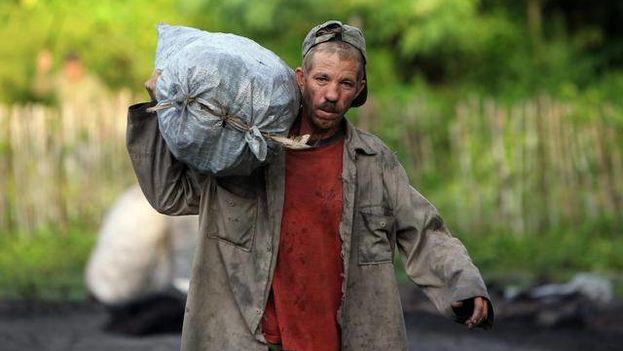
A charcoal worker performs his work with the marabou in Cuba. (Alejandro Ernesto / EFE)

EFE (via 14ymedio), Havana, 20 January 2017 — Cuba sent two containers with 40 tons of charcoal to the United States in the first export of a product of the Caribbean island to the US in more than half a century.

This is the first shipment of charcoal made under the purchase agreement signed earlier this month between Cuba’s state-owned company Cubaexport and the US company Trading LLC, a subsidiary of Reneo Consulting.

The cargo of $16,800 worth of charcoal made from the invasive marabou weed was sent through the western Cuba Port of Mariel on a boat from the Crowley Latin America Services Company to the US Port Everglades in Florida, according to a report from Cubaexport in local media. continue reading

Filling the containers with 12,526 sacks of charcoal took place in the Jocuma settlement of the southern central province of Cienfuegos, one of the points in Cuba where the product is made, according to Cubanexport director Isabel O’Reilly.

With the commercial agreement signed last January in Havana, it is expected that coal made from marabou will now start to reach the US market through Fogo Charcoal, a subsidiary of the firm Susshi International.

This contract between Cuba and the US has entered into force as the governments of both nations accelerated the signing of bilateral agreements and visits to advance the process of the thaw between the two countries as far as possible before the arrival of Donald Trump to the White House, given that he is openly opposed to the policy undertaken by Barack Obama’s administration.

The outgoing leader has eased the embargo through a series of executive measures that have allowed, among other things, the reestablishment of commercial flights and investments in sectors such as technology, but the lifting of the embargo is in the hands of Congress, where there is a Republican majority opposed to doing so.

The Cuban charcoal route for export begins in private agricultural cooperatives that harvest and process marabou, a plant of African origin considered an invasive species on the island, and then sell it to another company that prepares it for final commercialization.

The company CubaExport is responsible for the sale, processing and shipping out of the country the coal, which is marketed by the companies Cimex, Cítricos Caribes and Alcona.

The leading Cuban company for the export of coal made from Marabou is Agroindustrial Ceballos, which in the last eleven years has produced 204,323 tonnes of this product for the international market, according to recently released figures.

Cuba annually exports about 80,000 tonnes, mainly to European countries and also to Saudi Arabia, Syria, Turkey and Israel.

Marabou charcoal has a high energy power and is produced in handmade furnaces in a natural way; its production is not a cause of deforestation.

The Learned Illiterates of the Revolution / Cubanet, Miriam Celaya

Poster on Avenida de los Presidentes, Havana (albertoyoan.com)

cubanet square logoCubanet, Miriam Celaya, Havana, 10 January 2017 — – I have often heard or read about the supposed Cuban “culture and education,” a fabulous academic record based on official Cuban statistics and, of course, the Cuban Revolution and its (literally) ashen leader.

A few weeks ago, during the prolonged funerals of the Deceased in Chief, while walking through some streets of Centro Habana in the company of a foreign colleague – one of those who, either because of her gullibility or her sympathy, has swallowed the story of “the most educated island in the world” — I had occasion to show her several categorical examples of the very renown solid and expansive Cuban culture.

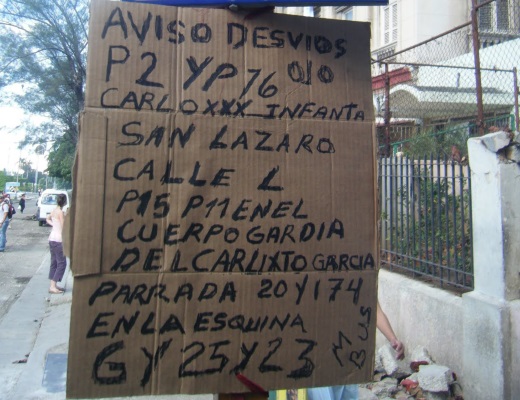
Beyond the filthy and cracked streets, the mounds of rubble and the containers of overflowing debris, which by themselves speak of the peculiar conception of the hygiene and health culture in the Cuban capital, posters everywhere overflowed, plagued by spelling mistakes: “we have striped coconut” [rayado means striped, rallado, grated] read a sign at a market on Sites street; “Mixed coffee” [misspelled mesclado, should be mezclado] offered another ad on a menu board in a private coffee shop; “forbidden to throw papers on the floor” [proibido instead of prohibido] on a sign a bit further on. continue reading

The menus at restaurants, both privately and state-owned, also abound in terrorist attacks on the Spanish language that would have the illustrious Miguel de Cervantes shaking in his grave. “Fried Garbansos“, [garbanzos] “smoked tenderloin” [aumado for ahumado], “breaded fillet” [enpanisado for empanizado], “paella valensiana” [instead of valenciana] and other such similarities have become so common that no one seems to notice them.

The “Weekly Packet,” by far the most popular cultural entertainment product and the one most available among the people, is ailing from the same malady. There, among the video title archives, one can find misspelled jewels of colossal stature, such as “Parasitos acesinos,” [for Parásitos Asesinos], “Guerreros del Pasifico,” [instead of the correct Guerreros del Pacífico], “Humbrales al Mas Alla” [correct spelling: Umbrales al Más Allá] and many more.

There are those who consider the correct use of language as superfluous, especially in a country where daily survival consumes most of one’s time and energy, and where there are not many options for recreation within the reach of the population’s purses. Cubans read less and less every day, which contributes to a significant drop in vocabulary and the deterioration of spelling. In any case, say many, who cares if the word garbanzo is written with an “s” or a “z”, when the important thing is having the money to be able to eat them? What is more essential, that a video file has a correctly spelled title, or that the video itself is enjoyable?

It would be necessary to argue against this vulgar logic that language constitutes a capital element of the culture of a nation or of its population, not only as a vehicle of social communication for the transmission and exchange of feelings, experiences and ideas, but as an identifying trait of those people. Furthermore, language is even related to national independence and sovereignty, so, when language is neglected, culture is impoverished; hence, truly cultured people demand the correct use of their language.

The systematic destruction of language in Cuba is manifested both verbally and in writing, and among individuals at all educational levels, including not a few language professionals. Thus, it has become commonplace to find essays of journalistic analysis where unusual nonsense appears in common words and is frequently used in the media, such as “distención” for distensión or “suspención” instead of suspensión.

The relationship could be extensive, but these two cases are enough to illustrate how deeply the Spanish language culture has eroded among us, to the point that it also shows up among sectors that, at least in theory, are made up of people versed in the correct use of language.

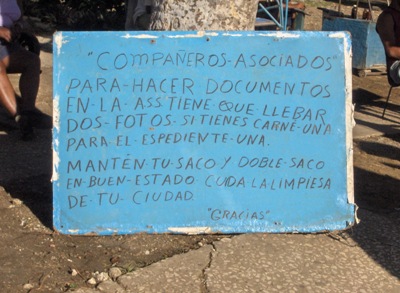
Llebar for llevar, carné for carnet, espediente for expediente, limpiesa for limpieza (Author’s photo)

What is worse is that a pattern of the systematic destruction of language stems from the national education system itself, since spelling mastery has been eliminated from the curriculum of skills to be acquired by students from the elementary levels of education. In fact, the very posters and murals of numerous state institutions and official organizations exhibit, without the least modesty, the greatest errors imaginable, both in syntax and in spelling.

This is the case of an official notice on the door of a state-owned office in the neighborhood of Pueblo Nuevo – on calle Peñalver, between Subirana and Árbol Seco — whose image is reproduced in this article. On a poster written by hand on wrinkled paper, in atrocious penmanship, the neighbors were summoned to resort to that sort of mournful collective spell, the so-called “Ratification of the Revolution Concept,” which all Cubans were asked to sign an oath to, after the death of Fidel. The poster reads:

Call for the ratification of the concept of the Revolution (Author’s photo)

Of course, it is understood that the notice contained information about times and places where the revolutionary mourners should come to shield with their rubrics the “concept” of the spectral utopia (so-called “revolution”) that died decades before its maker finally met his. Which may be “politically correct”, but the poster is linguistically atrocious without a doubt.

Paradoxically, one of the locations mentioned in the notice, the Carlos III Library (incidentally, the first library founded in Cuba, dating as far back as the 1700’s), is — more or less — the official headquarters of The Cuban Academy of the Language, whose functions, far from ensuring its knowledge and protection, are reduced to the eminently bureaucratic-symbolic and, above all, the reception of monetary and other benefits sent from the central headquarters of that international institution, in Spain th Royal Academy of the Spanish Language.

The truth is that people in this country increasingly speak and write worse, given the absolute official indifference of institutions supposedly responsible for watching over the language. What really matters to the authorities is that they remain faithful to the ideology of the Power, the rest is nonsense.

Meanwhile, the lack of freedoms impoverishes thinking, and along with it, language, its material casing and an essential part of cultural identity, is also ruined. Although the official media, the international organizations and many bargain–basement pimps insist on parroting that Cubans are one of the most educated peoples on the Planet.

Translated by Norma Whiting

Cuba: Skepticism Beats Hope / Iván García

Havana cafe. From Juan Suárez’ photo journal entitled La Habana Profunda, Havana Times, September 9, 2016

Ivan Garcia, 4 January 2017 — Like a metaphorical invisible hand, moving to place a ouija or bet on Russian roulette, David, a young writer, considers that the coming year will be unpredictable for the island.

In the hope that the Ifá priests (Yoruba mystics) will spread around their Letters of the Year, the necromancers predict the future, and a woman dressed as a gipsy, furiously blowing out cheap tobacco smoke, turns up various clues after tossing a pack of cards on the table. David suspects that 2017 will throw up more bad news than good. continue reading

“Forecasting is a maddening activity. All sorts of things can happen, but few of them will help the Cuban in the street. The economy is getting worse, Venezuela, which gave us free oil, is holding out the begging bowl, and now we have a weirdo like Donald Trump at the White House. In this situation, I don’t think anything good is going to happen for our country,” is David’s sceptical comment.

People in Havana said the same kind of thing when polled by the Diario Las Américas.

Sergio, an economist “sees the future as grey with black stitches. The countries which gave us credit for nothing, like Brazil and Venezuela, are swamped by their own internal crises. Cuba’s finances are in the red and have far less purchasing power.

“Insufficient exports and imports which are almost doubling the balance of payments. In most areas of production, whether agricultural or industrial, we are either stuck, or going backwards. Forced cutbacks on fuel are affecting and paralysing a variety of development plans, as well as infrastructure, highways, railway lines, and ports which are in urgent need of investment.

“All we have left is tourism and the export of medical services, which, because of domestic conditions in Venezuela and Brazil, may fall by 40 per cent. And, of course, family remittances, which, although the government will not publicise it, are now the second national industry and the country’s biggest contributor of new money.”

Rubén, a social researcher, sees three possible scenarios, but makes it clear that there could be other variants. “First scenario: Donald Trump tears up all the agreements reached with Cuba. If you then factored in the difficult economic situations in Brazil and Venezuela, the best allies the government had, and Putin looking for a rapprochement with the White House, the economic reversal would be serious. I don’t think as bad as the Special Period, but nearly.

Second scenario: If Trump does not move the counters about, there would still be effects for Cuba, which is crying out for investments and credits from anywhere in the world, but, because of geography and history, the United States is the most appropriate. Third scenario: Trump negotiates a major agreement with the government. But, in order to achieve this, Raúl Castro has to give ground in political and human rights terms. It is a complicated context”. To that he adds that Raúl and the historic generation has only one more year to govern.

For most people, the future is a dirty word. It’s senseless and not worth giving yourself a headache thinking about it. “Put simply, we have to live from day to day here.  Try to make four pesos, look up girls’ skirts, and think how you can get away from Cuba”, says an internet user in Mónaco Park, in the south of Cuba.

People usually shrug their shoulders, smile nervously, and churn out rehashed remarks they have learned through many years of media and ideological indoctrination.

“I hope our leaders have some answers, because things look grim”, says a woman queueing to buy oranges in the Mónaco farmers’ market.

“If they”ve planned what’s going to happen in 2017, up to now they’ve said nothing. I think they’re just like the rest of us — no way out and shit scared. Like they’ve always said, “No one can bury it, but no one can fix it either,” says a man in the same line at the market.

And, on the question of what would be the best options for riding out the probable economic storm, Yandy, a high school graduate, is unequivocal. “Get the hell out of Cuba. Or, have a business, making lots of money, so that you can dodge the economic crisis which will be with us for decades”.

Lisandra, a prostitute, is more optimistic “As long as the American tourists come, you can make money. And if there aren’t many of those, the only thing to do is to make out with Cuban wheeler-dealers. But the best choice is get out of Cuba.”

But most Cubans, drinking their breakfast coffee black instead of with milk as they would prefer it, don’t bother themselves too much about the future.

José, a street sweeper, takes the view that “in Cuba things don’t change. Hardly ever up and and nearly always down.  The people who need to worry are the bosses in government. If things go badly, they are the ones with most to lose.”

Translated by GH

Urinals ‘Out of Order’ in Cuba’s Largest Airport / 14ymedio, Marcelo Hernandez

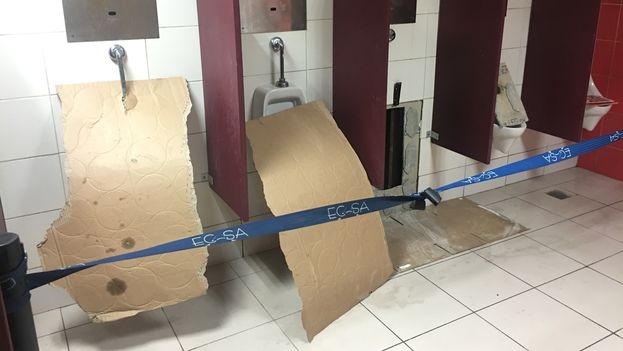
Urinals in the men’s room in Terminal 3 of Havana’s Jose Marti International Airport (14ymedio)

14ymedio bigger14ymedio, Marcelo Hernandez, Havana, 22 January 2017 — A Canadian tourist thought he had seen everything in Cuba, but just a few minutes before boarding his flight he decided to use the bathroom in Terminal 3 of Havana’s Jose Marti International Airport. There, like a realist stage set to represent the indolence that runs the Island, he found that no urinals were available.

For months the bathrooms of the main air terminal of the country have suffered a gradual and unstoppable deterioration. A situation that is exacerbated by the increase in travelers who passed through during 2016, when a world record was reached for the growth rate in passenger arrivals on commercial flights. Technical breakdowns include water supply problems, a lack of toilet paper and attempts by employees to charge customers a fee, not legally established, for the use of the service.

Some 50% more international travelers arrived through the famous airport in a year that also set a new record for tourism, more than four million visitors. They were able to obtain, first-hand, an advance view of what they would find in the country, or a last look, in the best style of Cuban inefficiency.

Three Days Without Fidel / Regina Coyula

Regina Coyula, 20 January 2017 — I was asked for this by a press agency, and they didn’t publish it. Then came the official reaction and we couldn’t have much time without his image. It’s like what a wise lady said in line at the pharmacy, “It would be preferable that the (National) Assembly approved an enormous monument, and not this Fidel that comes at us from all sides and doesn’t just die.”

Friday, already late in the evening, in front of the TV, idly I switch it on. Raul Castro is talking. A good part of the city was sleeping when the phones began to ring.

Perhaps for those who loved him, the reaction was emotional, but there is no surprise in the death of an old man who’s been sick for more than ten years. Yes, there is the irony that he was killed so many times, and now his death takes us all by surprise. continue reading

The programming continues and they even start playing a film, American of course. It was not until the movie was well along that they interrupted it to replace it with images from the documentary Fidel from Estela Bravo. It gives the impression that the TV directors never dared to make a plan for this moment; and on receiving directions “from above” that they began to look for film materials for the new days of “history and patriotism.”

It’s already dawn and groups of young people are coming from the Art Factory, their party having been interrupted. The drunkest obey the “on your feet!” that they learned in military or farming encampments, and add to the amusements and loquacious, “Turn on the TV, Fifo died!” These heralds continue on their way and others camp out in the park in front of the Acapulco Cinema; two girls dance little skip steps to their own music. It is a group without tears, these displaced from the Art Factory.

Saturday. A clueless man raised his eyebrows on hearing the news in the Tulipan agricultural market and continues on. Full as ever, the market is quiet without the loudspeakers; the buyers are very discreet moving quickly among the stalls to get a few vegetables at import prices.

In the morning there are still shops that haven’t received instructions to suspend sales of alcoholic beverages; a dry law and nine days of national mourning will be a tough test for those who live between hits of rum and reggaeton. I don’t see sad faces, rather serious ones. Or cautious.

Sunday. The television broadcasts endless materials about Fidel. Fidel at the UN, at a school, at a market, with Garcia Marquez, omnipresent Fidel.  Now he is a bigger star than ever, such a focus in the media, he who spent hours at the microphone on the national channel and on Radio Havana Cuba.

On the news, the announcers are dressed in black, they provide information about the funeral rites in the Plaza of the Revolution, the journey of the ashes to Santiago, the closing of the streets. On TV there are tears, but there is no children’s programming. And no one talks about causes of death.

My neighbor in the back, who has been so worried, talks with someone on the phone about the pills she has to take for the disgust. A woman is interviewed under the marquee of the Yara cinema, at the corner of 23rd and L. She is dressed in white and wears a black mourning band on her arm. She reads a poem about her soul being torn apart at the news.

Behind her, on the wall of the Habana Libre Hotel, you can see the enormous graffiti by El Sexto. “He left,” it says on the wall, and El Sexto is in prison for this graffiti with seconds of posterity on camera.

Monday. The buses are like always, going by full. Nothing seems to have changed, but in the workplaces and schools activities are suspended so people can go to the Plaza of the Revolution. At the base of the José Martí monument that have arranged sites with flowers and huge photo and the people file by.

No one stops in front of the photo where there are no ashes. The ashes are under control of the Ministy of the Armed Forces and the people don’t file past there. Many cellphones film the flowers and the photo. The real mourning does not happen on camera.

There is disgust and angry protests from those who spend hours in line and see groups of soldiers and people from other work centers who are allowed up the ramp to the base of the monument as soon as they arrive. A note of social indiscipline without public order to order it. The solution: to extend the hours of the line and people parading by until midnight so people can pay their respects.

In a country where saying yes while thinking something else has been a practice for years, we won’t know how many bottles were uncorrked, how many complicit hugs were given. But even those legitimately struck by the loss understand the before and after.

Fidel was in charge of embodying the Revolution. It doesn’t mater how many commitments we Cubans are invited to sign*, in an illusion of continuity. His phrase, “To change everything that should be changed,” will recur in the immediate future.

*Translator’s note: At the time Fidel died, the government asked all Cubans to sign a loyalty oath to his socialist ideology.

El Sexto Released, After Almost Two Months Detention / 14ymedio

Graffiti artist Danilo Maldonado, known as El Sexto, talks to the press during a trip abroad. (EFE)

14ymedio bigger14ymedio, Havana, 21 January 2017 — Danilo Maldonado, known as El Sexto, was released this Saturday after spending nearly two months in prison after being arrested on 26 November of last year for painting graffiti with the phrase “He left” on a wall of the hotel Habana Libre, a few hours after the announcement of the death of former President Fidel Castro.

The artist was never brought to trial and was released without charge. “They gave my identity card and told me I would have no problem traveling outside the country,” the artist 14ymedio within hours of being released. “I am in good health and I am very grateful for the solidarity of all those who were aware of my situation.” continue reading

El Sexto said that tomorrow he will try to leave the country and that they gave him “a telephone number in case he had problems in immigration,” he said.

Initially the investigators who took their case told the family that the graffiti artist would be accused of damaging state property, an offense “that is not included in the Penal Code,” according to a post published on Cubalex’s online site. “Painting the walls or facades of a hotel is an infraction against public adornment. Inspectors of the communal system are entitled to impose fines of 100 pesos national currency in these cases,” the text explains.

In 2015, El Sexto received the Václav Havel International Award for creative dissent

El Sexto, 32, was also imprisoned for nearly 10 months at the end of 2014 when he was arrested for painting the words “Raúl” and “Fidel,” in reference to the Castro brothers, on the side of two living pigs as part of an artistic action entitled Animal Farm. The artist planned to release the animals in Havana’s Central Park, when he was intercepted.

On that occasion the artist was accused of contempt, a crime that is imputed to those who lack respect for public officials.

In 2015, El Sexto received the Václav Havel International Award for creative dissent, awarded by the Human Rights Foundation.

Mexico Deports 91 Cuban Migrants / 14ymedio, Mario Penton

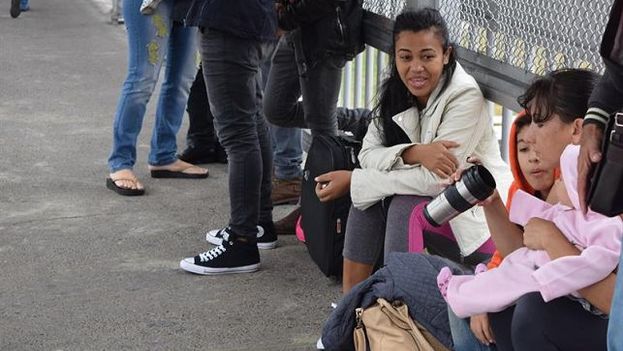
Cuban migrants on the border between Mexico and the United States. (Networks)

14ymedio bigger14ymedio, Mario Penton, Chiapas, 20 January 2017 — The Mexican National Institute of Migration (INM) issued a press release Friday stating that 91 Cubans had been repatriated to the island after the end of the wet foot/dry foot policy that would have allowed them to obtain asylum on reaching the United States.

“In compliance with the provisions of the Law of Migration, 91 foreigners of Cuban origin were sent this morning, from the airport of Tapachula, Chiapas, to their country, after Cuban authorities granted them recognition of their nationality*,” explains the press release.

The group was composed of 20 women and 71 men who, according to the INM, were waiting for the departure office to allow them to reach the US border. continue reading

González fears that on his return, life in Havana, where he is from, will become “a hell”

Yadel Gonzalez Sagre is one of those Cubans. He had been interned in Tapachula for 19 days, waiting for the document to continue to the United States, but in the early hours of this Friday he was forcibly removed from the “21st Century Immigration Station.”

“Suddenly they told us that they were going to deport us and they took us all out of there. It was terrible, they beat us and threatened us. Then they shoved us into vans and from there we were taken directly to the airport and they have been sending us on airplanes in small groups,” he says through the app Messenger.

González fears that on his return, life in Havana, where he is from, will become “a hell.”

“We live in a country with no rights,” he says.

According to the INM, the 91 Cubans “were returned to their country of origin in a plane belonging to the Federal Police.” However, both González and other Cuban migrants claim that they have been transferred in civilian aircraft, which could indicate an even greater number of returnees.

Since the end of the policy dry feet / wet feet, hundreds of Cubans have been stranded in Mexico when they tried to reach the United States

The INM notes that the departure office, provided for in the Migration Law, “is a facilitation measure that is provided to foreigners who do not have their nationality recognized by the authorities of their countries. It gives them permission to travel legally in the national territory for 20 days so that they can [have time to] regularize their migratory situation in Mexico or leave the country.”

In the case of Cubans, the consulate general of that country agreed to recognize the nationality of 91 of its citizens, applied for by the Mexican immigration authority to facilitate the return.

Since the end of the wet foot/dry foot policy, hundreds of Cubans have been stranded in Mexico when they tried to reach the United States. According to unofficial data, there are 300 Cubans at the “21st Century Migration Station” in Chiapas in southern Mexico and several hundred more in the cities bordering the United States.

*Translator’s note: Cuba refuses to automatically recognize the Cuban nationally of people who leave the country illegally.