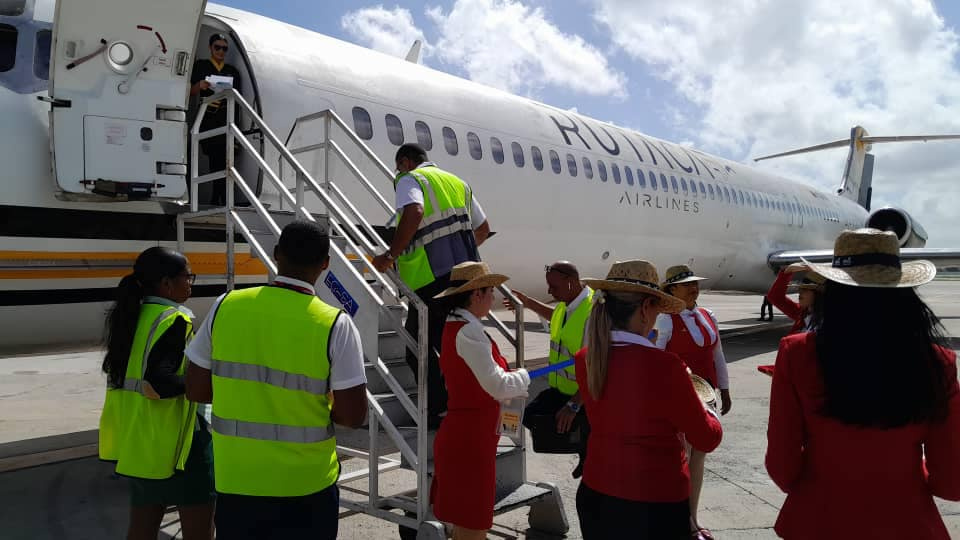
Rutaca Airlines inaugurated its Havana-Valencia connection on Friday, and Turpial Airlines will launch its Caracas-Varadero connection on the 28th.
 14ymedio, Madrid, 24 July 2025 — While major international airlines are suspending their routes to Cuba due to a lack of travelers, smaller Venezuelan airlines are moving in the opposite direction. Two of them, Turpial and Rutaca, have announced new direct flights to the island in recent days.
The latter launched a twice-weekly service between Havana and the provincial city of Valencia last Friday, as Havana’s José Martí International Airport itself celebrated on Facebook. The company advertised on its social media platforms the July offer of two suitcases of up to 23 kilograms each and one carry-on bag of up to 8 kg at no additional cost.
The fact that the airline is offering, even “for a limited time,” free double baggage allowance demonstrates its interest in promoting the travel of Cuban ’mules’, just as the tourism crisis continues to deepen. The same is evident in the low cost of tickets: $450 round-trip.
The official press, which boasted about the new routes, alludes to none of this. On the contrary, they refer to the visit to several Venezuelan cities by executives from the Cuban Ministry of Tourism who “presented the country’s attractions.”
The island signed agreements with Caracas at a meeting of tourism ministers from the ALBA (National Tourism Association) to “boost the development of the sector.”
Sol de Cuba highlighted that last May, the island signed agreements with Caracas at a meeting of tourism ministers of the Bolivarian Alliance for the Peoples of the Americas (ALBA) to “boost the development of the sector.”
Turpial Airlines, which markets itself as the main airline for the state of Carabobo in northern Venezuela, will begin operating routes between Caracas and Varadero, Matanzas, on July 28. Its flights to Juan Gualberto Gómez Airport will be weekly, and the return to Caracas can be made from any of the company’s other destinations, including Havana (three flights a week) and Santiago de Cuba (one).
As Sol de Cuba reports, Turpial was founded in 2016 and with Panama as its first international destination and began operating routes to Cuba three years ago. What it doesn’t mention is that the airline, which has three aircraft, is owned by former Chavista colonel Pedro del Valle Cestari Navarro, something revealed by the Colombian magazine El Tiempo in 2022. At that time, Turpial made headlines for receiving permission from Colombia to fly to its territory, instead of Conviasa, which was sanctioned by the US Office of Foreign Assets Control (OFAC).
Venezuela is one of the destinations Cubans choose to purchase items they later resell within the island. Margarita Island is a major destination, with a program in place since 2022 to encourage commercial tourism. In the first year alone, Cubans spent approximately $17 million there for “the purchase of various items,” said José Gregorio Rodríguez, president of the Nueva Esparta Chamber of Commerce, who estimated the number of visitors from the island at 5,000 by August 2023. The success was such that the organizers decided to begin chartering cargo planes to increase the volume of passenger purchases.
According to data released by the Venezuelan Ministry of Tourism last February, nearly 30,000 Cubans had visited Margarita Island by that date. The requirement to apply for a tourist visa, which costs $50, does not deter Cubans.
Meanwhile, international tourism in Cuba is languishing hopelessly—this year, as of June, it hasn’t even reached one million travelers —and this is reflected in the withdrawal of major airlines.
United Airlines, the only US airline connecting Havana with Houston (Texas), announced this week that it will suspend flights starting September 2 and at least until the summer of 2026, something that American Airlines had already decided in early June. Similarly, Colombian airline Avianca announced it would abandon its Bogotá-Havana route starting August 31, just before the start of the peak tourist season. The reason is the same one that has led other operators to abandon travel to Cuba: low flight occupancy.
____________
COLLABORATE WITH OUR WORK: The 14ymedio team is committed to practicing serious journalism that reflects Cuba’s reality in all its depth. Thank you for joining us on this long journey. We invite you to continue supporting us by becoming a member of 14ymedio now. Together we can continue transforming journalism in Cuba.