The Government Needs More Than Four Million Yes Votes

DIIE officials can calculate that the illegal operation of omitting the names of travelers will go unpunished, among other reasons because the eliminated will not be on the island to demand their presence on the list. (Heriberto González)

14ymedio bigger14ymedio, Reinaldo Escobar, Havana, February 15, 2019 — The referendum on February 24 is not a formality, it is a requisite for the new Constitution of the Republic, approved by parliament on December 22, to come into force. And the rules of this popular consultation do not protect the government from a possible surprise.

Unlike other electoral processes in which district representatives or members of parliament are chosen, the will of the electorate is not determined in referendums exclusively counting valid votes. According to what is established by article 137 of the constitution, still in force, reforming the constitution requires “the ratification by favorable vote of the majority of citizens with the right to vote,” or what is equal to more than 50% of those registered in the electoral register.

So the Yes option could only triumph if it exceeds the combined number of those who opt for No, blank ballots, annulments, or abstentions. For example, if on the register there were eight million voters with the right to vote (there were 8,639,989 voters authorized in the March 2018 parliamentary elections), they would need four million plus one for Yes for the approval of the new constitution and its entrance into force. continue reading

The campaign #YoVotoNo (I’m Voting No), initiated in the middle of last year, has managed to surpass any other that has been carried out from the environment of the opposition. No banging on pots and pans (cacerolazo, in Spanish), request to strike, call to march or to not participate in activities promoted by the government has found an echo as massive as the invitation to mark a civilized little cross in the square that indicates that the voter does not wish to ratify this new constitution.

For the first time, the opposition, or even better, “the oppositions,” have a single and agreed-upon candidate. It has as its name a monosyllable of two letters: No. Evangelicals who believe that the new constitutional text opens the doors to marriage equality are going to vote for that “candidate.” Along with them, paradoxically, those who identify with the LGBTI community, and believe that an opportunity has been wasted postponing for two years the possibility of legalizing marriage between persons of the same sex, will do the same.

People aspiring to start a business, those who are not happy with the acceptance of private property and see in the new text more limitations than openings, will vote No. Believers unhappy with the absence of a true freedom of religion that allows a more widespread evangelization will do the same. Those who aspire to one day live outside the country and have the right to double nationality: No. Those who want a union to demand their rights or to associate freely to share customs and ways of living: No.

Obviously those who have had the clarity to realize that it is unacceptable to institutionalize the dictatorship of a party that intends to keep being the one and only one and impose an irrevocable system will vote No.

For more worldly motives it would be necessary to add those who have spent years waiting for the housing issue to be solved, those whose salary isn’t enough, those who are daily driven to despair waiting for the bus to come to take them to work. The thousands of Average Joes who have by now lost their patience.

Those voters mean many votes and could be rounded to 20% of the hypothetical figure of eight million. Or what is equal to 1,600,000 citizens.

In parallel, and for similar motives to those who will vote No in the referendum, there is a considerable number of Cubans who will opt to not visit the polls, whether out of indifference or because they think that their simple presence in what they consider to be a farce only serves to legitimize the process. Of course, only those who are enrolled in the electoral register can be considered as abstentionists. That group could amount to another 20% of the electorate.

Recently Alina Balseiro, president of the National voting Commission (CEN), confirmed that Cubans who are temporarily out of the country for personal reasons will not be able to exercise their right to vote in the 1,051 polling places that will be set up abroad for the use of those who are fulfilling an official mission of the government. However, she affirmed that these citizens could vote in their country on February 24 because if less than 24 months have passed since their leaving the country, all their rights remain intact.

It is difficult to calculate the number of people with the right to vote (over 16 years old) who left the island between February 25, 2017 and February 23, 2019, and who have not yet returned. Since their names must appear on the voting register, they will swell the number of abstentions. They could be around 2% of the electoral register.

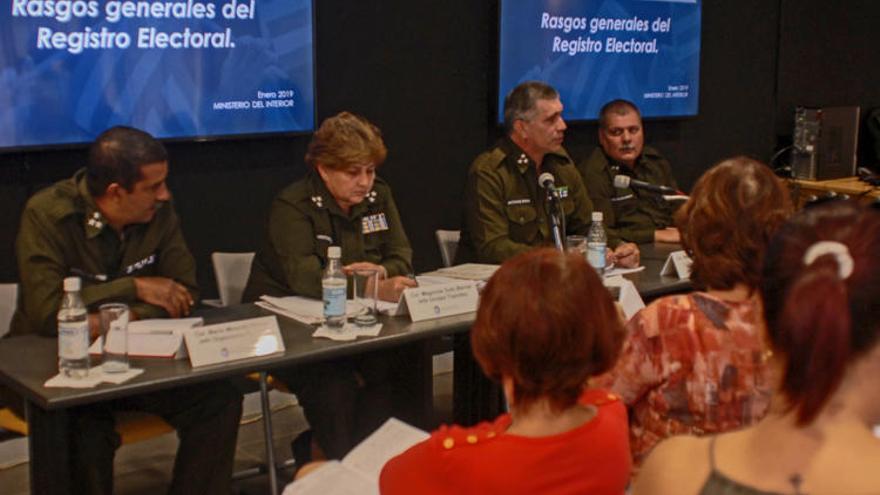
It’s necessary to warn that this figure is easy to cover up, because the responsible body for the voting register is precisely the Office of Identification, Immigration, and Alien Status (DIIE) of the Ministry of the Interior, which has a thorough control over the entries and exits of the country. The DIIE officials can calculate that the illegal operation of omitting the names of travelers will remain unpunished, among other reasons because those eliminated will not be on the island to demand their presence on the list.

To facilitate these exclusions they rely on the argument that any voter who does not appear on the registry, having a right to it, can be added in an almost immediate manner by showing their identity card at the appropriate polling place.

Finally there are the undecided who leave the ballot blank, and the nonconformists who wait for the opportunity to send a message to power by writing an anti-government slogan on the ballot or by drawing something like an obscenity. If added up they reach 800,000, a worrying balance opposite the positive vote could be produced, one that could only be hidden by resorting to a crude fraudulent operation.

Although the champions of No would not win independently, those who propose abstention, annulers, and undecideds could celebrate together the defeat, unimaginable for many, of Yes.

It goes without saying that the government has a wide margin to manipulate the results. However, they could not get rid of the fact that they remain in power supported by a minority.

Translated by: Sheilagh Carey

_______________________

The 14ymedio team is committed to serious journalism that reflects the reality of deep Cuba. Thank you for joining us on this long road. We invite you to continue supporting us, but this time by becoming a member of 14ymedio. Together we can continue to transform journalism in Cuba.

"There’s No Cement"

Some bulk sales places for construction materials, such as La Timba, are closed to the public and are only serving victims of the tornado. (14ymedio)

14ymedio bigger14ymedio, Zunilda Mata, Havana, 11 February 2019 — The winds of the tornado that affected Havana just 15 days ago have not only left thousands of damaged homes and hundreds of families that lost everything, but have also deepened the shortage of building materials in the retail network, where cement, bathroom fixtures and slabs are all unavailable.

“We had planned to renovate the kitchen and got the money to buy everything we need,” Osmel Rodríguez tells 14ymedio. Rodríguez, 58, lives in the Havana municipality of Cerro, an area that suffered no significant damage from the tornado. “Now we have to hold off on the work because there is no cement,” he laments.

In the hard currency stores a sack of type P350 cement, used to set roof tiles and kitchen counters, costs about 6 CUC. Despite the price, which is the equivalent of a week’s salary for an average professional, the demand for this product is still very high in a country where 40% of the housing stock is in fair or poor condition. continue reading

“Last week we ran out of cement and they have not resupplied,” explains an employee in the area that sells heavy hardware in the centrally located Plaza de Carlos III in Havana. “We still do not know when we will have it again, because they are prioritizing the bulk sales places in the areas most affected by the tornado,” he says.

“We also have problems with bathroom fixtures, plastic tanks for storing water, floor slabs and tiles for bathrooms,” he adds. “The problem with cement started before the tornado, because for two years the supply has been very unstable and when the product comes in the quantities are low, but in this last week it has simply disappeared.”

The same scene is repeated in the most important hardware stores throughout the Cuban capital.

Since the passage of the tornado on January 27, the State is guaranteeing a 50% subsidy on the cost of construction materials for people with homes damaged by the disaster in the neighborhoods of Luyanó, Regla, Guanabacoa and Santos Suárez, and 70% of the amount of water deposits, according to Lourdes Rodríguez, general director of Institutional Care, of the Ministry of Finance and Prices.

But the volume of damage far exceeds the pace at which the country can produce or import many of these materials. The latest official figures put 3,513 properties damaged by the tornado, although the number grows every day as families sign onto the damage registry that is being prepared in several offices open for the occasion.

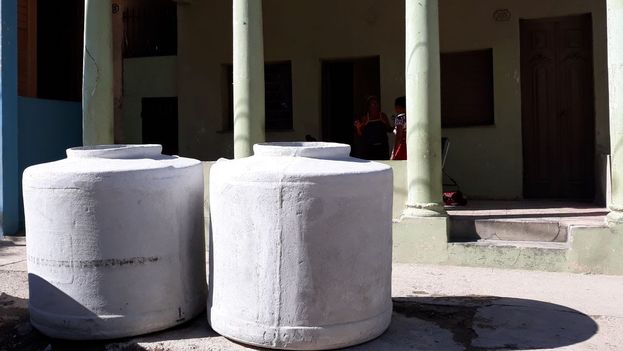
The tanks to store water among the product most in demand after the tornado. (14ymedia)

The national cement industry has been operating at half speed for decades, after the fall of the socialist camp and the end of the Soviet subsidies in the early 1990s. In 2016, only slightly more than 1.4 million tons of gray cement were produced, a figure that is far from the 5.2 million reached that same year in the Dominican Republic, according to a report by the Association of Producers.

“They gave me a subsidy to buy sand, steel bars, cement and a water tank,” says Moraima, who owns a house that lost part of its roof and the wall of the facade in La Colonia, a neighborhood in the municipality of Regla on Havana Bay. “We went to the bulk sales place and they have the materials, but all the workers told me to rush to buy them and move them to my house because there is instability in the supply.”

“Now the problem will be to watch over all this,” says Moraima. “Because the need is great and having all these materials outside the house will be a headache.” In the block where this Regla resident lives, the neighbors take turns to guard the blocks, the piles of cement and the metal windows that have been arriving for the reconstruction.

“We are praying that it does not rain because if it does much of this material can be lost and they have already clarified that there will be no second round in the deliveries; whatever is lost or damaged has no replenishment subsidy,” she explains.

In the vicinity of the ironworks on Reina Street at the corner of Lealtad, informal vendors whisper their merchandise. One of them, wearing a cap that says “100% Cuban” explains the list of products on offer. “Sinks, adjustable showers, vinyl paint, sand, gravel and cement.” But the price of a bag of the P350 cement that could previously be bought for between 6 and 8 CUC on the black market is now around 10.

“I can not lower the price,” he responds to a customer who tries to bargain.” There’s no cement and right now moving a bag is a tremendous danger,” he says. It is common that after the damages caused by the passage of hurricanes and tropical storms, the Police reinforce controls on the informal sale of construction materials.

“They are searching the trucks and even the pedicabs they see with bags that could be cement, sand and gravel,” the informal vendor tells this newspaper. “They have already fined two friends of mine who are also engaged in this business and confiscated all their merchandise.” Most of these “thick” materials sold in illegal networks come from the bulk sales centers.

The merchants buy them wholesale in these places, and then repackage them and resell them at retail taking a good slice. “But now things have gotten bad at the bulk sales places and they are only selling to people who come with the papers showing they were affected by the tornado,” he says.

List of materials “subsidized” by 50% by the State for sale to people with homes affected by the tornado. (14ymedio)

“We are closed to the public and we are only taking care of the victims,” the employee of the bulk sales outlet located in La Timba neighborhood, a few meters from the Plaza of the Revolution and far from the areas where the tornado passed, repeated in tone that brooked no argument on Friday. His statement set off expressions of dissatisfaction among customers who came to stock materials for their domestic renovations.

“And now those of us who are already building, what we are to do?” protests a young man who had come to buy some sand and cement. “My work is paralyzed, the contracted bricklayers and all the work of months without being able to finish because I am lacking some sacks of cement.” An informal vendor approaches, speaks to him in a low voice and, after a few minutes of conversation, they both leave in a small tricycle towards a nearby house.

In 2017, a network for the resale of building materials in Pinar del Río was uncovered and seven people were convicted of the crimes of hoarding and illegal sale of cement and steel bars, among other products. Three of them received one year prison sentences and four spent 10 months in prison.

“This business has its risks, especially when there is an emergency,” says a cement and steel vendor.” It is the moment when we profit the most but also when it is most dangerous to do it.”

_____________________________________

The 14ymedio team is committed to serious journalism that reflects the reality of deep Cuba. Thank you for joining us on this long road. We invite you to continue supporting us, but this time by becoming a member of 14ymedio. Together we can continue to transform journalism in Cuba.

Justin Trudeau’s Hornet’s Nest*

Justin Trudeau, Prime Minister of Canada, in the Palace of the Revolution with Raul Castro during his visit to Cuba. (EFE / Enrique de la Osa)

14ymedio bigger14ymedio, Antonio Tang Baez, Montreal, 13 February 2019 — When the acoustic attacks suffered by American and Canadian diplomats in Havana were made public, Washington evacuated most of its diplomatic personnel. Ottawa, on the other hand, withdrew only — and even that reluctantly — those affected and understated the suffering and damage to diplomats and their families.

The Ministry of Foreign Affairs even continued to send relatives and children, regardless of the damage to health, while those already affected back in Canada were not provided with the medical attention they required.

The Cuban Ministry of the Interior was the first to launch the theory that the noise was the sounds of crickets, which reappeared later in an obscure study published in the United States. The Royal Canadian Mounted Police (RCMP) agents sent to Cuba accepted that theory and said they had not found anything abnormal. continue reading

The disaster came a few days ago with a lawsuit against the Government of Ottawa by some of the affected diplomats, who demanded compensation from the state of 28 million Canadian dollars. The prime minister said that his country is seriously examining the situation.

“There is no doubt that the impact on the health of diplomats in Cuba has been visible and real,” said Trudeau. “We continue to collaborate with local authorities and with the RCMP to determine the source of these sounds and the problems they are facing.”

The only thing lacking for a total collapse in relations between Canada and Cuba is for a Canadian tourist to suffer a headache because of a cricket, and the entire Canadian tourist industry centered on Cuba will collapse.

Trudeau acted irresponsibly by not withdrawing diplomatic personnel in time, as did the Ministry of Foreign Affairs when it sent back whole families, including children, to Havana, with full knowledge and proof that unexplained situations were occurring that were affecting the health of the diplomats.

It seemed like a well-deserved vacation for Josefina Vidal, the brand new Cuban ambassador in Ottawa, a friendly country and the largest source of tourists to the island, with a welcoming prime minister. But everything fell apart. Trudeau can not justify the attacks against his diplomats in Havana, the RCMP has shown its inability to prevent further attacks or to recommend an evacuation of personnel, and, incidentally, has left the prime minister in a ridiculous situation.

Translator’s note: The original title of this article in Spanish is: “La olla de grillos de Justin Trudeau.” Olla de grillos — literally “pot of crickets” — is a Cuban expression that can be translated as “madhouse,” “pandemonium,” or, in this case, “hornet’s nest,” which keeps the idea but simply changes the insect.

_________________________________

The 14ymedio team is committed to serious journalism that reflects the reality of deep Cuba. Thank you for joining us on this long road. We invite you to continue supporting us, but this time by becoming a member of 14ymedio. Together we can continue to transform journalism in Cuba.

The Venezuelan Panorama Seen From Cuba

“It is possible that the end of Venezuelan tyranny will affect Nicaragua, Bolivia and Cuba,” says Carlos Alberto Montaner. Miguel Diaz-Cael and Nicolas Maduro. (EFE)

14ymedio bigger14ymedio, Carlos Alberto Montaner, Miami, 17 February 2019 — The Central Committee of the Communist Party of Cuba (that is, Raúl Castro) is very concerned. It has published in Granma, the Party’s newspaper, a Declaration of the Revolutionary Government with the objective of “stopping the imperialist military adventure against Venezuela.” [Link to Spanish text.]

Cuban political operatives based in Venezuela know (and they have told Havana) that Nicolás Maduro is liquidated with no recourse. They have no way of saving him. Juan Guaidó had the backing of 87% of Venezuelans, but, according to the polls, in the last days he increased that by more than 3 points. He now has the backing of 90.08% compared to 3.75% who are satisfied with Maduro.

On the other hand, 51 of the largest and most accredited democracies on the planet recognize Guaidó. He is also the legitimate ruler according to the country’s Constitution, while the National Assembly, the country’s only internationally accepted official institution, has made him “interim president.” continue reading

The hypothesis that everyone assumes (including the Cuban regime) is that on February 23, or before, when they bring humanitarian aid to Venezuelans, the minimum support Maduro has will fall apart.

At that point, the Cuban dictatorship will be able to give its colony the order to use violence, but the United States, Brazil, Colombia and other Latin American free nations will enter into combat with the Venezuelan democrats and will quickly prevent victory for Maduro’s coup plotters. This would put an end to the infrastructure of the FARC, the ELN and the Islamists.

A US squadron that includes an aircraft carrier is already sailing near Venezuela, while in Cartagena (Colombia) dozens of warships and several submarines are anchored. After all, it is essential to put an end to the exodus of Venezuelans to Colombia and Brazil, and that will not be achieved as long as Maduro continues to hijack power and hyperinflation destroys the country’s economy.

Raúl Castro does not know what to do. Useless resistance seems a bloody idiocy, but the whirlwind may swallow him, as happened to Cuba in Granada in 1983. The Russians can not give Maduro real protection. They will be limited to rhetorical declarations that will be used by the comrades of all countries to recruit naive or disorganized pacifists waving the ghost of a world war.

There will be no such a conflict. The tacit agreement between Moscow and Washington is that “the Russians” act in Ukraine or the Caucasus and “the Americans” in their immediate area of influence, that is, in Venezuela and Latin America. The only thing the Chinese are interested in is collecting the 65 billion dollars they advanced to the useless Maduro and ensuring their continued supply of raw materials. If they succeed with Guaidó, excellent. For buying and selliing, anyone will do.

Raúl Castro’s and Miguel Díaz-Canel’s troubles don’t end there. On February 24, Cuba will adopt a new Constitution through a referendum scheduled for that day. The electoral consultation has already been totally delegitimized by Transparencia Electoral, an institution led by the Argentine political scientist Leandro Querido, and by the internal opposition, including — among others — Rosa María Payá, José Daniel Ferrer and Guillermo Toledo.

All of them, despite having no access to the media, have asked Cubans to vote NO on a Constitution that consecrates the single party and has legal padlocks that make it impossible to change this absurd regime. The Castroist apparatus, on the other hand, by means of a triple system of constant polls, has managed to learn that a substantial share of Cubans are willing to vote NO, and the response has been brutal: carrot and stick.

How have they managed to outwit the propaganda gate-keepers of the regime? Because of something that Yoani Sánchez said at one time: because the digital revolution is almost impossible to stop, even in Cuba. A simple “smart” phone is enough to penetrate with a thousand messages, Facebook, Twitter, Instagram and the rest of the tools that serve to silence the propaganda of totalitarian regimes. And a simple mistake is enough for the walls to fall and the liberating “springs” to emerge without anyone knowing how and without anyone knowing when.

It is possible that the end of Venezuelan tyranny will affect Nicaragua, Bolivia and Cuba. These are the remnants of Socialism of the 21st Century. Will Raúl Castro and Miguel Díaz-Canel immolate themselves defending the lost cause of Nicolás Maduro? The last paragraph of the analysis-warning published in Granma ensures that they will do so. I thought them smarter.

____________________________________

The 14ymedio team is committed to serious journalism that reflects the reality of deep Cuba. Thank you for joining us on this long road. We invite you to continue supporting us, but this time by becoming a member of 14ymedio. Together we can continue to transform journalism in Cuba.

Brazil in Cuba, When Pragmatism Overcomes Ideology

Former Brazilian president Dilma Rouseff and former Cuban president Raul Castro at the opening of the Mariel Special Development Zone in Cuba.

14ymedio bigger14ymedio, Yoani Sanchez, Havana, 16 February 2019 — A enormous crane lifting a container filled the TV screens of millions of Cubans in January 2014, during the inauguration of the first part of the Mariel Special Development Zone, west of Havana. In the official photo, Dilma Rousseff smiled with Raúl Castro; but five years later, that port has not managed to get the island out of its economic crisis and the former Brazilian president is a political corpse.

Mariel, the coastal area from where, in 1980, tens of thousands of Cubans, fed up with the Communist model, left for Florida, has become the “white elephant” of Castroism in the last decade. All the hopes of the nation were placed in that pharaonic work, financed thanks to the support of Brazil’s Workers’ Party (PT).

The construction of the “commercial emporium” was carried out by Odebrecht, the Brazilian conglomerate that shortly after the inauguration became the centerpiece of a corruption scandal that touches several Latin American governments, numerous political parties and hundreds of officials. continue reading

However, the main problem has been trying to make Mariel a kind of laboratory of capitalism in a nationalized country led by a group of octogenarians who distrust the market.

When Rousseff and Castro cut the tape to open that first part of the Mariel container terminal, they were also sending a message. Those were the times when starring in the family photo of Latin American presidents were the faces of the representatives of 21st Century Socialism. A brotherhood of comrades who supported each other in international forums and helped hide – reciprocally – their authoritarian excesses.

So the Cuban port, financed with a loan from Brazil’s National Bank of Economic and Social Development (BNDES), was not only part of a strategy of solidarity with the Plaza of the Revolution in Havana, to alleviate its chronic inability to produce riches, but also an ideological intention to make viable a model that, in half a century, had given more than sufficient evidence of its failure.

As the subsidy from the Soviet Union had once sustained the deliriums of Fidel Castro and, later, Hugo Chavez’s patronage allowed him to pass power to his younger brother Raúl, Brazil wanted to lend a shoulder to keep alive “the flame” of the Cuban Revolution. It was an almost archaeological rescue task, an effort to make it seem that a regime was still breathing through its own lungs, though it was incapable of surviving without outside resources.

In January of 2014 several months still remained before the announcement of the diplomatic thaw between Cuba and the United States, but without a doubt the entire port of Mariel was designed to accommodate ships that, having stopped on the island, would end in US ports and vice versa. After five years, the thaw cooled again due to Havana’s inability quickly respond to the opening promoted by Barack Obama in his relationship with the island, and Donald Trump’s arrival in the Oval Office.

Nor does the PT remain in power in Brazil and little remains of that family portrait of the region where you could see faces like Rafael Correa, Rousseff herself or Michelle Bachelet. From those “golden times” Cuba was left with a debt that it can barely pay its former South American partner and a port that is becoming a theme park of the past every day that it fails to attract ships loaded with merchandise or investors willing to settle in its commercial area.

But the Brazilian withdrawal from the island has not stopped there. At the end of 2018 an angry diplomatic dispute between the regime of Miguel Diaz-Canel and Brazil’s then president-elect Jair Bolsonaro, ended in the untimely departure of thousands of Cuban health professionals from the Mais Médicos program.

Bolsonaro accused Havana of practicing modern slavery with its doctors on mission and demanded that they be paid the full amount of their salary, because the Cuban government was keeping 75% of the $3,300 that Brazil paid for each doctor. He also demanded that the doctors pass tests to validate their titles and demonstrate their knowledge, but the Island’s Ministry of Public Health did not accept these terms and slammed the door.

Behind the headlines and the clash between the two administrations, the small stories of thousands of Cubans who are now trying to reconstruct their hopes to improve their lives and that of their families were omitted. Many of them had arrived in Brazil not only moved by the humanitarian instinct inherent in all health personnel, but also driven by their economic needs.

Doctors in Cuba are the best paid of all professionals, however, their monthly salary does not exceed the equivalent of 60 dollars. That is why it is not uncommon to see a doctor with broken shoes, who has not been able to eat breakfast because he does not have the resources to do so, or who has to wait two-hours for a public bus before arriving at an operating room to perform a complicated brain surgery.

Official missions abroad have always been an opportunity for these doctors to access greater financial resources, despite the high percentage of their salary retained by the authorities. But, above all, it is a propitious stage to establish human relationships that allow them to marry, create friendships or contacts to stay in another country or to return later in a private way.

With the vertiginous departure from Brazil, the dreams of many of those doctors were shattered. The same happened with the Port of Mariel that had filled with illusions the inhabitants of the small town in that coastal area west of Havana, as it had many Cubans who for decades have expected the island’s economy to rise so that they might live more decently and not have to watch their children leave for exile.

For all that, right now, to say “Brazil” in Cuba is to mention a dream, the illusion of what could have been and was not; but it is also evidence of the failure of a strategy and the fall from grace of a support that was more ideological than pragmatic.

_____________________

Note: A Portuguese version of this text has been published in the Brazilian magazine Crusoé  and is reproduced in this newspaper with the authorization of the author.

The 14ymedio team is committed to serious journalism that reflects the reality of deep Cuba. Thank you for joining us on this long road. We invite you to continue supporting us, but this time by becoming a member of 14ymedio. Together we can continue to transform journalism in Cuba.

“If Maduro Falls, in Cuba We’ll Return to the Special Period” / Ivan Garcia

Stove similar to that used by many Cuban families during the s0-called Special Period in the 1990’s. Taken from the blog Vertientes Camaguey.

Ivan Garcia, 7 February 2019 — John Bolton, Donald Trump’s National Security advisor, is asking autocrat Nicolas Maduro to renounce power in Miraflores and to enjoy a political retirement on a Caribbean beach.  Otherwise, he forecasts a terrorist prison cell for him at the United States’ Guantanamo Naval Base, more than 1000 kilometers east of Havana.

So far, forty nations have stopped recognizing Maduro.  The European Union gave him an ultimatum to carry out free elections, and Juan Guaidó, the self-proclaimed president, is trying to flip the last Maduro bastion: the armed forces.

“I believe that it is necessary for the military to cede and leave Maduro all alone and thus to avoid greater ills, at least the mid-level commanders, because those higher are corrupt and very committed, and they know that their heads will roll next to the president’s.  Let’s hope that is not delayed much because Maduro is already considering the idea of new elections, though not presidential elections, but to restore the National Assembly, and we already know how elections are there, the same as here.

“In fact, that company that was in charge of the technical side of the elections, and was paid money for it, denounced the filth of the process.  Maduro intends a new election in order to manipulate and erase the opposition as usual.  For Venezuelans, it is NOW or NEVER,” says Reinaldo, a retired former history teacher who has followed the events in Simon Bolivar’s homeland since the first coup attempt on February 4, 1992. continue reading

With exceptions, like that of the former history teacher, in Cuba the Venezuelan soap opera is watched without much passion.  The Castro brothers were always allied unconditionally to Hugo Chavez, and currently the neo-Castroite Miguel Diaz-Canel keeps offering military and intelligence advice to Nicolas Maduro.  But there are other political actors involved in Venezuela.  Each one seeks to guard its interests, like Russia, Turkey and China, who have invested billions of dollars in the mining and energy sectors.

In the cases of Turkey and China, if the opposition guarantees a slice of the future economic pie, it does not matter to them how Maduro’s luck may run.  Putin has other interests.  He is looking to establish Russia as a center of world power and in geopolitical strategy to create a conflict in a United States zone of influence.  But if the Trump administration promises to lift economic sanctions on Russia after the annexation of the Crimea or to guarantee it will not lose its investments in Venezuela, the Russian president wouldn’t mind changing his posture.

Several Caribbean islands back Maduro because he guarantees them oil for the price of peanuts.  The US and the EU are counting on a democratic system and on having a partner and not an enemy in Miraflores, for political and economic reasons:  Venezuela has 25% of the world’s oil reserves, in addition to tantalite, gold and fresh water sources.  Cuba supports Venezuela for the simple reason that the late Fidel Castro was the progenitor of Chavismo.

The Cuban dictatorship paved the way to Miraflores without firing a shot or causing a coup.  With absurd ideological prescriptions and erroneous political doctrines, Fidel Castro and Hugo Chavez drove the country to its current precipice.

Maduro’s Venezuela is the best example of what not to do in political and economic terms.  Submerged in poverty, the United Socialist Party of Venezuela (PSUV), the governing party, is incapable of producing enough petroleum to permit feeding a population that, thanks to the “Maduro diet,” has lost on average from 22 to 33 pounds  each due to lack of food.

It’s too much.  An oil country with constant blackouts.  If Venezuela does not change, it will suddenly enter a primitive stage, plagued by criminal gangs.  Startled, the world has seen how a nation that used to have inequalities but was immensely rich, after the arrival of Chavez and Maduro has retreated to the extreme of shared misery, turning survival into a way of life with hyperinflation that raises the price of food every three days.

What is happening in Venezuela is not a priority among ordinary Cubans who have spent decades subsisting on the ration booklet, surrounded by penury and limitations.  In spite of the state media’s deployment of its campaigns and panegyrics to rescue its soldier Maduro, Cubans haven’t been aware of the Venezuelan context.

According to the German newspaper Deutsche Welle, “Thanks to the arrival of the internet to mobile phones, in Cuba citizens can more immediately compare the news about Venezuela published by the foreign and independent outlets, reports quite distinct from the triumphalist and totally biased fanfare of the official press.  The Telesur channel, controlled by the PSUV and broadcast on the Island, has shown a pathological blindness when it comes to counting demonstrators and protests.”

Roger, a nurse who worked in Caracas a year ago, insists that he is better informed than most Cubans.  “The Venezuela that Telesur and [Cuba’s state newspaper] Granma describe is not what I knew.  Eighty percent of Venezuelans demand Maduro’s head, they are fed up with a guy fatter than a mother-in-law, always shouting, insulting and accusing everyone of plotting to assassinate him.  Every time he speaks on television people grab some rum, go out on the street and hit the bottle.  Cuba is very bad, but Venezuela is much worse.”

Jaime, a state taxi driver, asserts that he is more or less up to date on what is happening in Venezuela from listening to international radio stations on short wave.  In his opinion, “The western democracies have rushed to support the claims of Juan Guaidó, a guy very well know in his home.  I don’t like Maduro, nor do I like Trump, but both, although we don’t like them, they are official presidents until they leave or they ‘go’ legally.”

Dagoberto, a baker, does not understand the role of the two presidents.  “Why doesn’t Maduro put the other one in jail?  Didn’t he win an election?  In Cuba no one elects the president, and no one opens fire on us.  The Cuban government supports him because he gives it oil.  Maduro thinks he’s the hottest thing on the planet, but if Venezuela is fucked, in Cuba we’re going to be living in the dark.”

Laritza, employed in a private cafe, says that her mother spent two years on a mission on Venezuela.  “She said it was in flames.  Teens with machine guns on the corners in the poor neighborhoods and at night you can’t go out in the street.  If you drive a car, you can’t stop at the lights.  In Venezuela, everything is lacking, but they have industrial quantities of petroleum:  Give it a kick anywhere, and it spouts black gold.  If they knock Maduro off his horse, in Cuba we’ll return to the Special Period.”

Orlando, a private hairdresser, comments:  “Maduro is a shit cocktail; fat and gaudy, he is unbearable when he speaks and disgraceful when he starts dancing with his wife, who looks older since she dyed her hair blonde.  If they get him out of there, he will surely come here.  I imagine him driving a bus in Havana,” and he lets out a laugh. [Ed. note: in Maduro’s pre-political life he was a busdriver.]

Analysts and economic experts predict that Cuba will enter a cycle of economic decline if Maduro steps down.  “But never like in the Special Period of the ’90’s, when the GDP fell some 35 percent.  Now the economy is more diversified and in spite of the obstacles and regulations, self-employment has been consolidated (recently the Ministry of Labor reported that more than 1.4 million Cubans work in the private sector, 13% of the population).

“Anyway, with or without Maduro, the country is going to enter a recession because there is no substitute for Venezuelan oil obtained by barter.  The Cuban government does not have enough liquidity to spend two or three billion on buying oil on the international market,” underscores a Havana economist.

Occupied in the odyssey of getting food and solving daily problems, with few exceptions Cubans do not have the time or the opportunity to be informed about Nicolas Maduro and Juan Guaidó through foreign or independent media outlets.  With other undertones, Venezuela seems to them too much like what they have experienced.  A deja vu.

Translated by Mary Lou Keel

Cuba: Constitutional Referendum, Food Shortage And Social Unrest / Ivan Garcia

Food market. Source: Diario Las Americas

Iván García, 28 January 2019 – When they saw that a ramshackle GAZ 52 Soviet-era truck was parked at the entrance to the Monaco market, in the neighborhood of La Víbora, south of Havana, and began unloading boxes of eggs, a long line quickly formed. The crowd, made up of housewives, retirees, workers in the area who take advantage of their working hours to buy food, business owners and retailers, tried to organize the line.

Mirta, a housewife, was there all afternoon, but in the end she couldn’t even buy an egg. “Do you think I can vote Yes in the upcoming election to ratify the Constitution? With such a deficient government, many of us from Havana are going to vote No, although we know that this will not change the situation.”

Alfredo, owner of a sandwiches and juices café, annoyed, does not understand “why the government does not put a note in Granma newspaper that says the People of Cuba are incapable. Then, they resign en masse and call for elections where the population can choose another model of a country. Self-employed people lack access to wholesale markets and now the State has rationed the products they sell in the unrationed market. You could only buy one carton of eggs per person. Those of us who have business, what do we do?” continue reading

Mercedes, a teacher, has been trying to get bags of liquid natural yogurt for two weeks. “I suffer from colitis and I have a medical recommendation to eat yogurt. In all of Havana, whether in foreign currency or in national currency, you do not find natural yogurt. But if only that was all. A lemon costs 4 pesos. And to buy fresh bread outside the rationed market you have to stand in line for an hour. In the search for food I lose two hours daily. To the problem of the food I can also add that the building’s water pump is broken, taking a bus is an ordeal and the salary they pay you is an insult. With that list of calamities, one must be very opportunistic to vote for socialism to be perpetuated in Cuba.”

Yania Suárez, an independent journalist, says: “From the people I’ve talked to, especially with young people, they still do not understand the content of what is being voted on, much less the importance of the vote. For them it is a hypocritical process that will perpetuate the state of affairs. They see it as something incomprehensible, boring and useless that those “up there” are doing behind the people’s back for their own benefit, as always. Apathy is what I have seen the most.”

Daniel, who works in a state cafeteria, affirms that in Cuba young people are not for the Constitution or anything. “They say that everything about the government is a lie and they do not believe in the leaders. Many young people talk like that, but they attend the events and go to vote. I do not talk so much, but I do not participate or collaborate with these people (the regime).”

Gerald, a Cuban who lives in Florida and often visits his family in Cuba, alarmed, refers to “the tremendous shortages in all the provinces. Even with enough money you can’t buy what you need. If there is no fraud in the next elections, I am sure that among those who will vote No, leave the ballot blank or not vote at all, you can reach 30 percent or more of the votes. If the almost three million Cubans living abroad could vote, that number would double. ”

Ramón, another Cuban resident in the United States, very active in social networks, confesses that “in all the forums I have put VOTE NO. At least that action will give Cubans the possibility of morally empowering themselves. They will know that they can oppose something, directly and openly, even in the privacy of an electoral booth.

“Mariela Castro said that Voting NO was sabotage and for me that indicates they are shaking in their boots. Millions of NO votes would give the world, and in particular Cubans, the confirmation that there are millions that do not support Castroism.

“No one on the island can bear another ‘Special Period’ and that is what Cuba is heading for if the regime does not change the rules of the game, even if it is in the economy like China or Vietnam. And it does not seem that they intend to do it, so they will continue heading over the cliff.”

Norge, a professor of political science, believes that “for the first time in the 60 years of the Revolution, the ruling caste feels the breath of discontent on their necks. I think there is a terrible fear. Perhaps many regime bigwigs are wondering why the hell they came up with this plebiscite. If they play cleanly, the percentage of negative votes, voided ballots and abstentions could be surprising.”

Luisa, a lawyer, points out that the statistics do not play in favor of the government. “In the last two elections, that of neighborhood delegates and candidates for the National Assembly, even with the symbolism represented by the recent death of Fidel, the number of people who did not vote or annulled their ballot was around 20 percent, plus or minus two million Cubans. Those figures have been increasing in each election. It would not be unreasonable that on February 24, votes against, abstentions and blank ballots exceed three million, an amount to take into account.”

Carlos, a sociologist, believes that there is a lot of fear within the government itself. “Otherwise you can’t understand the fierce campaign that all official media are carrying out to tip the vote in their favor. In social networks, there have been cases such as that of President Miguel Díaz-Canel, who called Cubans who think differently ‘sons-of-bitches’, or the unpresentable Yusuam Palacios, president of the Marti Youth Movement, who, because he lacked the capacity to establish a civilized debate with Internet users, uses threats and offenses. If the promoters of the NO vote had space in the national and provincial press and if the Cubans residing in other nations could vote, the government would lose the referendum on February 24.”

While the debate for or against the future Constitution takes place on social networks and independent and alternative media, in Cuba the regime deploys broad propaganda to win supporters.

“Something that is illegal, because according to the regulations in force, neither the State nor the Communist Party can use electoral propaganda, is on every program at all times,” notes the retired sociologist Carlos Eloísa. “Whether it’s a ball game or a Brazilian telenovela, in the background on the screen that have ‘I’m Voting Yes.’ It’s exhausting. If it’s like this with a whole month left, if they keep up with the same onslaught imagine when there are just a few days before the vote you won’t be able to turn on the radio or TV.”

The same a ball game or during the Brazilian novel. You hang on the back of the screen I vote YES. It is harrowing. If you still have a month left and they’re giving you the same matraquilla, I suppose that when there are a few days left you can not turn on the radio or watch TV. ”

Olga Lidia, a doctor, says “It remains to be seen what the voting intentions are of the indifferent or the zombies, the segment of the citizenry that usually goes to vote and pretends to support the Government, the Party and the Revolution.”

Edgar, a communications specialist, believes that “the government should temper that campaign, because it is counterproductive. The opinions that come out in the news, most of the time do not reflect the diversity of points of view nor the dissatisfaction among ordinary people. In the absence of economic results, what they promote are details, such as the arrival of 450 Russian microbuses and 89 Chinese buses to improve transport in the capital.

“Messages that try to sell optimism. On the street, people say that this is a drop of water in the ocean, because in Havana, for the urban transport service to work, more than 3 thousand buses and 5 thousand taxis are needed. Not the 700 buses that are currently circulating. Many people, in a whisper, recognize that the sate media are manipulative and no doubt when they go to vote, they’ll mark their ballots with a No.”

Paraphrasing Lincoln, you can fool the people one time. But not all the time.

Building After the Tornado

Yudelmis Urquiza with her young son, six months old. (14ymedio)

14ymedio bigger14ymedio, Luz Escobar, Havana, February 14, 2019 — Diana Curbelo has spent 15 days sleeping in her neighbor’s entryway. She passes the hours seated on a red armchair that she has put out on the sidewalk of Teresa Blanco street and at nighttime she goes into the entryway to be under a roof. A resident of the housing complex at number 118, Curbelo shares an address with another ten families.

In the building, where a month ago there were precarious little rooms, the majority of them with a light roof, piled up on one side of a hallway are the construction materials that the government provides, and on the other side the debris that they are taking out.

“The materials have come quickly, they brought everything, a brigade of workers who came here the other day and who already have everything needed. They’ve moved a lot. In total there are 11 apartments here, I live with my son and a nephew with his wife and they have a three-year-old son. They haven’t yet told me to pay anything, I haven’t signed a single paper, I only know that they are fixing my house,” says the woman. continue reading

Diana Curbelo observes the work on her house and helps where she can. (14ymedio)

At her side, one of the workers, who wears an olive green T-shirt, rests a few minutes leaning on the railing to take in a little shade. “Here they have given us all the materials we need: tools, boots, hard hats, rope. We also have everything we need for security, we cannot complain. We have on site 70% of the materials we need, and we are going forward. I think that by April we will have this finished,” he maintains.

The brigade working on the complex comes and goes through the narrow passageway that leads to the place where they are building the apartments. “They are going to build apartments with everything: bathroom, kitchen, living room, bedrooms…” explains the worker before returning to work. “The objective is that each one of these victims has their new house as soon as possible,” he adds, convinced that his labor will mean a “great improvement for all the residents” who before were living in very bad conditions.

Diana Curbelo remains seated in front of the entrance, watching the coming and going of the builders and helping where she can. “All the neighbors have been worried, they have even offered to have me stay in their houses to sleep but I have to take care of my own. If I don’t do it, who will?” she says.

The tornado surprised her family outside, celebrating the birthday of one of the children. “We were all in the middle of the party when it began to sound. We went to run to the back of the passageway and we went into the house of a neighbor who has a roof and we stayed there until everything passed. I wanted to die when I went out and saw everything destroyed. I lost the mattresses, the fans, and the kitchen. The rest I was able to recover,” she remembers.

Curbelo explains that they have not yet passed through her street to bring the new mattresses. “They tell me that I have to save the old one but imagine, I have it there among the debris. If they take it, what can I do?” she asks.

Solange Faizan and her family have also not managed to get new mattresses and the only one that survived they have lent to an elderly lady. (14ymedio)

Turning from Teresa Blanco and entering through Pedro Perna street, the view is the same. In the middle of the street are mountains of blocks, gravel, sand, steel bars, roof beams, and water tanks. On the same corner, an enormous crane demolishes a building while a man plasters a wall, another, shovel in hand, prepares the mixture and bends some steel bars.

Luck has been unequal in the distribution of materials and labor force. On Armenteros street, between Luyanó and the railroad tracks, lives Solange Faizen with her family. After the tornado their home suffered partial damages, which left the house without a roof and some walls in a bad state. Meanwhile, in the kitchen they have put down some tiles that they have been finding but explain that it is a provisional solution to be able to be in the house. “We want to put on the roof as soon as possible, because we have a little girl here with asthma and a bedridden elderly lady,” she says.

“We already have the roof, you can see it there. The architects passed by, measured, and with the paperwork they prepared for us we were able to buy the tiles and beams, the problem is that they didn’t give us cement or sand, and the builder that I contracted told me that to put down the tiles he needed those materials because he couldn’t attach those tiles without materials.

“The architects returned yesterday to see an affected wall that they hadn’t included in the report. I complained and they told me to go today at eight in the morning to the Processing Office, but now my forms don’t show up and I have to finish putting on the roof, because rainy days are coming. We told them everything, but I don’t know what they wrote down on their paper,” she explains.

Solange Faizan and her family have also been unable to get new mattresses and the only one that survived they have lent to an elderly woman, who is the one who needs it most. “I have saved here the two old and stinking mattresses, waiting to see if finally they come with the new ones they promised.”

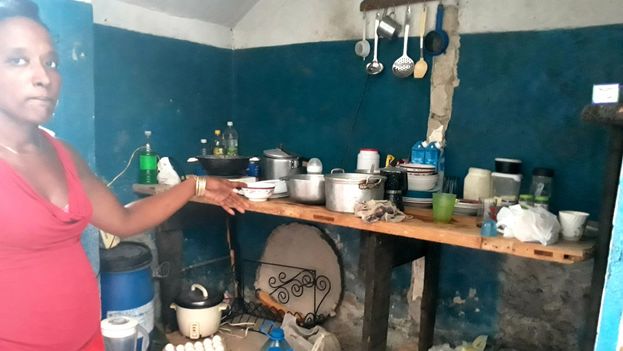
Yudelmis Urquiza has prepared a space to be able to cook in her new home. (14ymedio)

The worst, with everything that has happened, is going from one place to another without resolving the necessary procedure. “What bothers me most is going back and forth. I don’t want them to give me anything extra, I want them to give me what I’m meant to have, but without having such a hard time. In the processing office they make you go from one table to another and you always hear the same thing: ’that is nothing to do with me’ and they pass you from one person to another without anyone resolving anything.”

The EF4 category tornado that passed through several municipalities of Havana on January 27 with winds of around 300 km/h left a toll of six dead, some 200 wounded, and around 10,000 displaced. According to the latest official figures, more than 7,700 homes were affected, including 730 total collapses; among the damage to roofs, 1,109 were total and 1,950 partial.

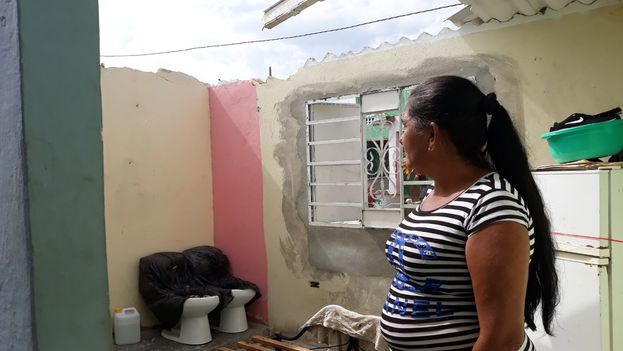
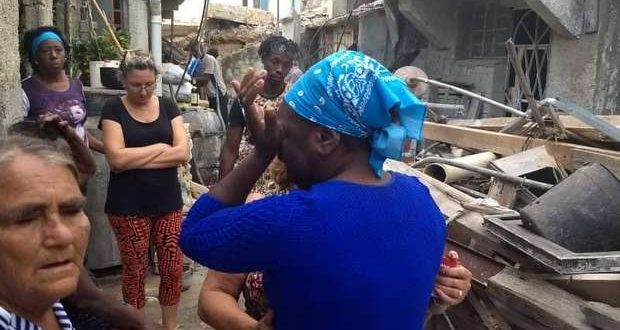
One of the Havanans who suffered the total collapse of her home was Yudelmis Urquiza Fernández, a young woman of 29, with two children of 11 and 6 months, respectively, on Concha street, between Infanzón and Pedro Perna. “I lived here at 909, but everything collapsed, only this part was left,” she says, pointing out what was a few days ago her house and now is only a few walls without a roof.

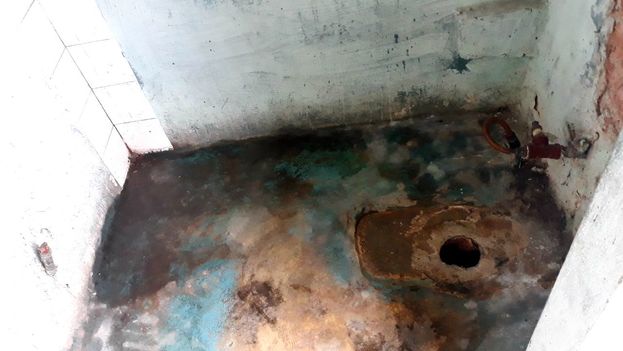
Bathroom of Yudelmis Urquiza’s improvised home. (14ymedio)

“It’s been more than fifteen days and nothing has happened, we’re still on the street. Many people have come and written things on paper, but they don’t give any reponse. Not Bárbara [Agón Fernández, president of the Municipal Assembly of Popular Power of the Tenth of October], not anybody. They haven’t even given us shelter,” she laments.

The first days, she says while holding the baby in her arms, she slept in front of what was her house, in a doorway. “That was only one time, because I couldn’t stay there. On the other block I found a place to go, in a business that was also affected, but the manager there allowed me to be there a few days.”

The place doesn’t fulfill even the most minimal conditions of hygiene and protection necessary to accommodate a mother with two young children. “Only a person who is in a lot of need like me would go there, what I cannot do is sleep in the street with my children. If they let me stay and they give me what I need to fix it and create the conditions for ’self-help’ I will arrange it, or if not let them give me a shelter, but it can’t go on this way,” denounces the young woman, annoyed with the institutional lack of support.

“Bárbara, every time I go to see her, tells me to stay here and not worry, that she will come to see me. But I’ve spent two weeks like that and nothing. Until when?”

Translated by: Sheilagh Carey

__________________

The 14ymedio team is committed to serious journalism that reflects the reality of deep Cuba. Thank you for joining us on this long road. We invite you to continue supporting us, but this time by becoming a member of 14ymedio. Together we can continue to transform journalism in Cuba.

Lazaro Bruzon Wants "Cuban Sports to be Divorced from Politics"

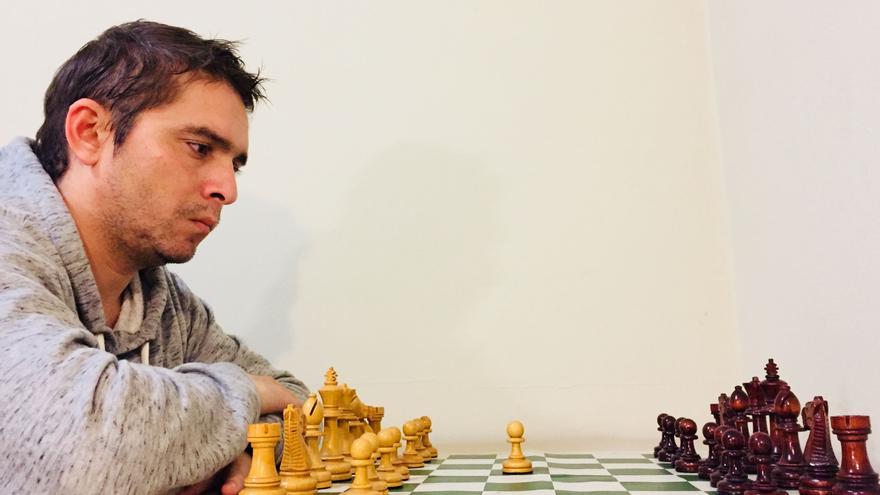
Lázaro Bruzón is currently on the payroll of the chess team at Webster University, in the United States, in a program directed by former world champion Susan Polgar. (Courtesy)

14ymedio bigger14ymedio, Julia Mézenov, Villa Clara, 9 February 2019 —  Although Lázaro Bruzón is one of the most important Cuban chess players, his name is no longer on the national team’s roster. This 36-year-old from Las Tunas, who enjoys every victory to the fullest and is extremely upset with the defeats, has taken his separation from the island without drama in international events.

While the specialists speculate about his future, Bruzón continues to dedicate himself to moving the pieces, something he has not stopped doing since he was enthusiastic about chess at the age of seven. “It was very hard, but I understood that it was the right thing to progress and I always had many dreams of improving to help my family,” he tells 14ymedio now.

In 1999 he was part of the Cuba team for the first time and returned to Las Tunas with his title of Grand Master. At just 18 years of age, he was world youth champion, but despite his laurels and the fact that his name ws heard more and more in sports media, he had to continue going through many everyday problems such as the difficulties of travel. continue reading

“There was a time when we received more support but then everything got complicated until the help was practically nil,” he recalls. “Many times they invite us to tournaments and help us with the expenses, but everything depends on the level of the player and his Elo.” That reality ends up hitting many young chess players who “if they can’t afford these trips and no one pays for them… how do they do it?”

When he reflects on the possibility of sustaining himself economically playing chess in Cuba, Bruzón talks about the different moments he has lived through. “For a short time, in the Capablanca Tournament, Cubans have been awarded prizes. Before the payments were only for foreigners, and in international events the prizes vary a lot.”

Last September, Bruzón was officially expelled from the national chess preselection for refusing to return to the country. In spite of this incident, he affirms that he does not have any “personal” problem against anyone specific to the Cuban Chess Federation and insists that throughout his career “this is the first time such a controversy has been created.”

“They have erroneously taught us that everyone who leaves Cuba becomes a kind of enemy. I left with great optimism that good relations could be maintained based on communication and mutual respect with all the intentions of the world to continue playing for my country, but in practice it is difficult,” he laments. “I wish that Cuban sports could divorce itself from politics a little. I hope one day it does not matter where a person resides in order to represent their country.”

Currently, half of the Grand Masters of Cuban chess reside abroad. Regarding this reality, Bruzón believes that “progressing beyond a point while in Cuba” is complicated because it collides with “a ceiling beyond which you can no longer climb.” He also has talked several times about the lack of connectivity. “I’ve talked about the importance of the internet for chess.”

His presence in the United States began with a study opportunity. “In my plans I was not leaving Cuba but the possibility of coming to a prestigious university, such as Webster, with a chess program led by former world champion Susan Polgar, motivated me a lot,” he says. “It’s where they see everything differently, here there are many great teachers who study and come from different countries, but they do not break with their federations or with their countries because they are here. ”

This week Bruzón was involved in an intense controversy when he posted on his Facebook account several criticisms of the text of the new Cuba Constitution that will be voted on in a referendum on February 24. The chess player questioned that in the preamble of the Magna Carta says that “only in socialism and communism the human being reaches his full dignity.”

“I have been looking for the definition of dignity in all places, I have also inquired about the importance of the Constitutions to countries and what they should be, and there is no way to understand that this approach is correct.”

With his traditional moderate tone, Bruzón defined as a “long path” the one that remains for Cubans “to travel” to “learn that the other person can think differently from us and that does not mean that he is wrong, we are not possessors of the absolute truth, although they have taught us otherwise,” he added.

In the conversation with 14ymedio he reiterates these concepts when he points out that migratory restrictions have affected chess. “Many athletes would still be in Cuba representing their country if they could come and go without so many obstacles. And it’s not only in chess. I think we have to fight for the right things and break old schemes that only serve to create disunity among Cubans.”

____________________________________

The 14ymedio team is committed to serious journalism that reflects the reality of deep Cuba. Thank you for joining us on this long road. We invite you to continue supporting us, but this time by becoming a member of 14ymedio. Together we can continue to transform journalism in Cuba.

Thousands of People Need Urgent Help in Havana (and the Names of the Deceased) / Ivan Garcia

Luyanó  residents the day after the tornado, which ravished that Havana neighborhood. Taken by the independent journalist Yosmany Mayeta for Cubanet.

Iván García, 2 February 2019 — “An organized society, a planned economy, a socialist government, will always have reserves so that no one is left homeless,” President Miguel Diaz-Canel wrote in his Twitter account.

Nobody in Cuba is left homeless after a natural catastrophe, tragic accident or serious illness, said Fidel and Raul Castro in the almost six decades that held power. The reality is very different.

For example, there are hundreds of Cubans who lost their homes or were seriously damaged by hurricanes that have hit the island in the last seven years and are still waiting for repairs or to be given a home. In Havana, dozens of families, also affected by cyclones, have been housed for more than twenty years, waiting for someone to remember them and provide them with an apartment or a house to live in with dignity. continue reading

According to specialists in meteorology, the tornado that hit the capital at 8:30 on Sunday night, January 27, was formed in the Casino Deportivo neighborhood, located on the border of the Cerro and Diez de Octubre municipalities and extended to Regla, Guanabacoa, San Miguel del Padrón and Habana del Este.

A night guard who was on duty at that time, relates it this way: “A slight fog made it difficult to see on the First Ring of the Port road that leads to the town of Regla. A pile of tiles and work tools flew off to the bay. The brutal force of the wind overturned cargo trucks as if they were toys. One of them was dragged to a corner and turned over. Whatever they say happened, reality was worse.”

The warehouses, workshops and the José Antonio Echevarría wheat mill  were hit by the fury of the tornado winds that in 16 minutes traveled eleven kilometers and crossed five municipalities of Havana. The grass in that industrial zone looks like it was burned by a powerful blowtorch.

Dinorah, a housewife, crosses herself and says that in the Casino Deportivo neighborhood there wasn’t much damage. “But there was a thunderous noise, as if it were something supernatural. Then we learned that it was the tornado on its way.”

Despite the rain and bad weather, there were people connecting to the internet in the Wifi zone of the Monaco park. One of them, Pablo, a university student, says that suddenly the sky changed color, “it became reddish and the buzz was similar to that of the aircraft turbines. The wind storm devastated everything. It pulled a tree from the corner of Santa Catalina and Mayía Rodríguez and put it in the doorway of a house. It broke stoplight as if it were a pencil. When you walk through the places where the tornado passed, it looks like a war zone. ”

The meteorological phenomenon had a radius of from 500 meters to a kilometer in its exit to the sea. Its winds between 275 and 320 kilometers per hour devastated what was in its way. “Terrible, worse than a hurricane. In the area of the Paradero de la Víbora did no damage, but nearby towns such as Santos Suárez and Luyanó were destroyed. It seemed that the mother of all the bombs had fallen to us, recalls Rogelio, a meter reader who lives in Luyanó.

Antonio was at a party at his sister’s house in Santos Suarez when they suddenly felt a bestial howl. “I nevertheless can not believe that. My sister’s house was newly repaired and remained strong and solid, it looked like a bunker. But from a plume the wind destroyed the entire wall of the entrance, threw giant trees at thirty or fifty meters and crushed the cars parked in the block as if King Kong had stepped on them.”

Rosa, her sister, confesses that the problems start now. “Now comes the good part. The stage of recovering losses and rebuilding what is damaged. But I have money and cement bags, when they appear on the black market, sell for 300 pesos. On television, all this chitchat of the government, of municipal micro-industries to make construction materials, but when you need them, they do not appear, not even in the stores that sell in hard currency.”

Aida, a housewife, says she lost part of the roof from rooms in her house. “Some government authorities have come and they give you encouragement, because they have the gift of the gab. But in the real world the help is delayed, until it disappears and nobody remembers your tragedy. People are upset and can’t take anymore. We want them to finish fixing the electricity and start selling, at reasonable prices or in installments, construction materials and household goods for the families that need them.”

In the affected areas, the government began selling bags of cookies, food and some canned goods. In the newspaper Granma, it was announced that the Union of Commerce and Gastronomy of Havana set up 17 tents for the sale of prepared processed foods, in the municipalities Diez de Octubre (eight tents), Regla (four), Guanabacoa (three) and San Miguel del Padrón (two). “If you are careless, that is all that they will give to the victims in terms of food. Luckily the tornado did not cause damage in our humble home, “says Carlos Manuel, retired.

Osvaldo, an accountant for a textile company, affirms that “these people (the regime) have to understand that most people do not have a penny. No one is to blame for that disaster. The best they can do is donate or give away those things. They say that along the Calzada de Luyanó they saw some pinchos (leaders), as fat as pigs, but where I live, no one has come by.

“Diaz-Canel spoke at a Council of Ministers and said that we must shorten recovery times and have a lot of sensitivity. But as always happens in Cuba, the words mean nothing and when they do something, they do it badly. Did you see what Raúl Castro did? He joined the March of the Torches, but he does not deign to tour the neighborhoods damaged by the tornado. And he is the first party secretary.”

In a bakery where bread is sold unrationed, very close to the Miguel Henríquez hospital, in Luyanó, the lines were a block long. Gregorio, master baker, remembers that the day the tornado passed “people held on to each other or clung to the railings of the bakery so they wouldn’t be carried away by the tornado. Look there is a need, times are tough and a lot of people are hungry.”

With immediacy, Diaz-Canel on a Twitter announced that three people had died and 172 were injured. Later it was learned that there were four deaths and the number of injured had increased to 195, although unofficially it is rumored that the injured exceed 300, some in serious condition. “When the Boeing plane crashed, in May of 2018, they immediately gave the names of the passengers, Cubans and foreigners, but now it took four days to give the names of the four deceased, one woman and three men,” says Laura, retired.

According to official figures, 1,238 homes suffered property damage, 123 totally collapsed. There were 625 partial collapses, 224 roofs damaged, 154 partially. Of the damaged homes 112 are of type 1, that is to say with tile roofs, which are rarely affected. The most affected neighborhoods are those of Regla, Diez de Octubre, Guanabacoa and San Miguel, where the powerful EF4 tornado passed, which, in addition to damaging housing, caused considerable damage to public health facilities, such as the Maternity University Hospital of Ten de Octubre, better known as Daughters of Galicia, four polyclinics, a pharmacy and a nursing home.

The authorities reported that more than 100 thousand people do not have electricity, but they have not presented an evaluation of the cost of the losses in state assets. Dalia, economist, believes that “damages to companies and institutions of the State, in a superficial calculation, can exceed 600 million dollars. To this we must add the containers of goods that were damaged and part of their cargo was stolen, something that the press has not reported. Fifty state transportation vehicles suffered some kind of damage.” Even less is known about the damage and losses suffered by private entrepreneurs who had businesses in the four municipalities where the tornado passed.

While the State continues with its mottos and slogans and slowly prepares to help the victims and assess the amount of damages, musicians and artists are visiting affected neighborhoods and making donations from their own pockets.

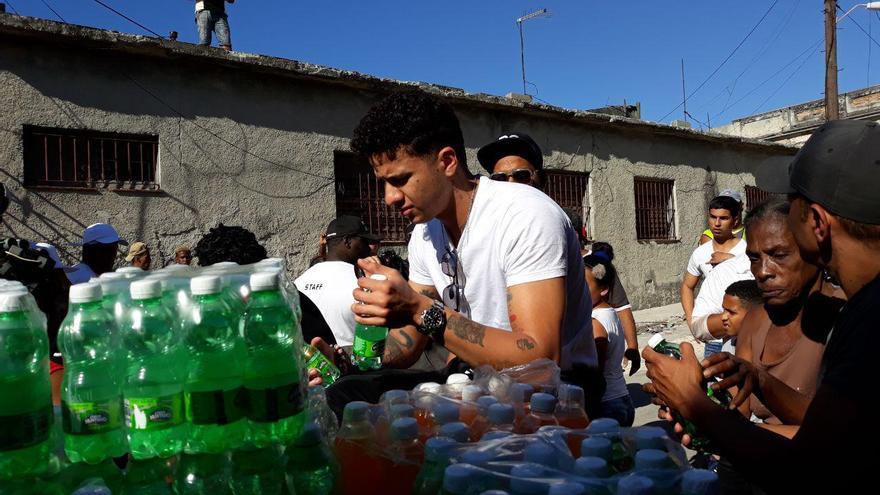
Under the motto Fuerza Habana (Havana Strong), individual and collective campaigns were activated on Monday, January 28. By personal initiative, they have brought food to the affected areas. The singer Haydée Milanés uploaded a video to her Twitter from one of the affected sites and asked those who were willing to help, to do so. Periodismo de Barrio tweeted that the duo of Yomil and El Dany, plus Diván and Alex Duvall, in addition to the rocker Athanay, distributed water jugs, soft drinks and other products in Jesús del Monte, Luyanó. The actor Andy Vázquez, of the Vivir del Cuento TV program, toured affected areas and comedian Ulises Torac wrote that “there are people without homes walking around asking for votes,” a reference to the government mobilizing hundreds of university students and soldiers to touring the devastated areas wearing shirts with the slogan “I’m Voting Yes,” on the February 24 Constitutional Referendum.

Spanish singer Alejandro Sanz and Cuban actor Luis Alberto García appealed for solidarity so that all humanitarian aid from abroad can reach Cuba for the victims of the tornado that hit Havana, free of restrictions and customs duties. The reggaetonist Osmani García went to Díaz-Canel and told him that, “like other global artists, we are spokespersons and ambassadors of our people throughout the world.

“Therefore, we have the duty and responsibility to speak for those who can not and do not ask for help. I know that you are a good father of a family, please it is necessary and urgent that a humanitarian channel be opened in Cuba so that the thousands of victims of that terrible tornado can receive donations and help from the world,

For some time, Cubans living on the island have considered that the government should decree a customs moratorium and free of cost, deliver the packages coming from abroad. “They talk about human rights without blushing their faces, but they charge dearly for the family help packages that come from outside. A few days ago, my daughter-in-law who lives in Europe, sent clothes and some gifts for my daughter’s birthday and to receive the box, which weighed little more than 4 kilos, I had to pay 50 cuc [roughly $50 US]. It is an abuse.

“Because of the anguished situation that so many people are living through, in Havana because of the tornado, but also in the rest of the country, where there are still families affected by floods and the passage of hurricanes, they should authorize the sending of packages at no cost to the recipients. Three months ago, milk powder was impossible to get in Havana, not to mention the scarcity of bread and eggs, among other products,” complains Marta, a housewife.

Despite the campaign that emerged on social networks (and which have been echoed by Florida media and independent Cuban sites), calling for a humanitarian aid channel to be opened, to date, the regime has only opened a bank account in pesos and another in convertible currency for those people who want to help.

In a country of excessive control, only the State has the green light to receive and distribute humanitarian aid. They do not even permit stipulations on how and where the donations are distributed. It is the intrinsic nature of a totalitarian system. The individual and spontaneous initiatives sound like an enemy plot against the Castro regime.

Names of the deceased

Lázaro Javier Ruiz Varela, 23 years old, from Mayabeque and resident of Cintra No. 55 between Empresa and Reyes, Cerro, Havana. Cause: When the bus in which he was traveling overturned, he suffered a fracture of the base and vault of the skull, with severe brain contusion, causing injury to upper nervous centers.

María Esther Linares Deroncelé, 56 years old, from Santiago de Cuba and resident of Calle H No. 26 between Adolfo del Castillo and Final, Guanabacoa, Havana. The collapse of the roof of her house caused severe thoracic-abdominal compression, causing acute anemia.

Juan Francisco Cuesta Kessel, 79 years old, native of Havana and resident of Calle 377 No. 17823 Apt. 10 between 178 and 184, Mulgoba Neighborhood, Boyeros, Havana. The collapse of the roof of his house caused him chest and abdominal compression, causing him to suffocate.

Ronner Hernández Caso, 42 years old, from Pinar del Río and resident of 3rd Avenue. No. 1410 between 14 and 16, Caraballo, Jaruco, Mayabeque. The bus in which he was traveling overturned, causing an acute subdural fracture and subarachnoid hemorrhage that caused him intracranial hypertension. He was operated on, but died.

In that list, released by Civil Defense and published in the Granma newspaper on January 31, does not include the case of a 13-year-old teenager who died from electrocution by a high voltage cable, while helping a neighbor in Mangos Street No. 133, Santos Suárez, Havana.

Note: On Friday, February 1, Cubanet reported that in a video posted on social networks showing residents chasing after an official delegation headed by President Miguel Díaz-Canel shouting “shameless,” The official delegated ran and hurriedly got into their vehicles. This happened in Regla, one of the localities most affected by the passage of the 300 km/h tornado that hit Havana on the night of Sunday, January 27. Three of the four dead and at least 50 of the injured are from Regla.
The Indignation of a Cuban Who Will Not be Able to Vote on February 24

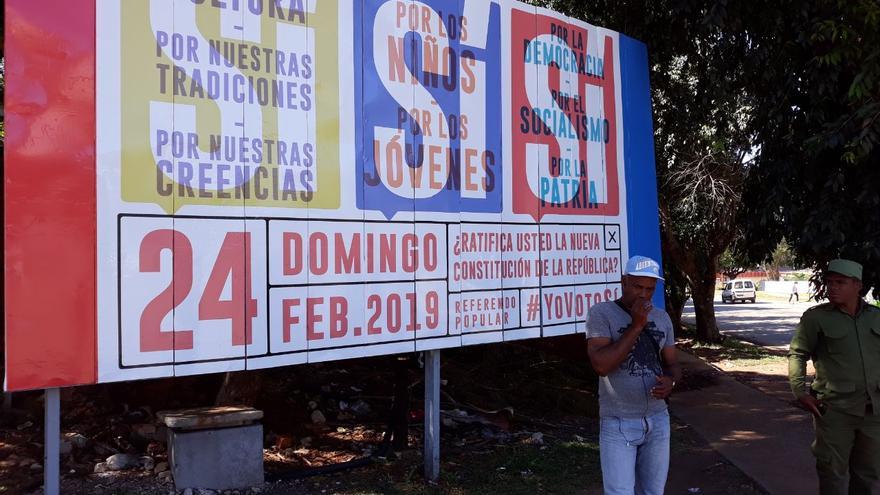
The only message permitted on billboards, television, radio, printed media, and in all public spaces, without exception, is Yes to the constitution. (14ymedio)

The author, who writes under a pseudonym, directs her letter to the opposition and to international bodies.

14ymedio bigger14ymedio, Guamacaro Canada, February 13, 2019 — An open letter from a common Cuban citizen, to all the member groups of the opposition, inside and outside of Cuba, as well as all the international bodies that maintain diplomatic relations with Cuba.

The proposal of some members of the Cuban opposition to abstain from the referendum on February 24 has no sense without having received, previously, international support on the illegitimacy of the process.

At these moments, facing the indifference of international actors, the only course that could provide salvation to the Cuban people is a massive No vote in the referendum.

In the first place, I invite all the participants of Cuba’s opposition to declare themselves in front of all the pertinent international bodies on the antidemocratic character of the upcoming referendum and to make a formal petition for the constitutional process led by the Communist Party of Cuba to be declared illegitimate. continue reading

I ask those same international bodies to take a position, since they will be the voice that defends an oppressed people, which, unlike the Venezuelan people, does not go out to the streets en masse to protest against its government because, in the course of the last 60 years, it has lost all hope of having a better future.

Cubans show a silent resignation in face of their numerous problems, starting with food of a low nutritional quality subsidized by the government via a provision card that is an instrument to gag the people.

The healthcare system, free but very precarious, and education based on indoctrination from early childhood are other instruments that fulfill the same function, in addition to the miserable salaries, which are around $30 per month on average.

The referendum will not have the presence of impartial international observers because the Communist Party of Cuba (PCC) does not permit them.

At this moment there is within the country a massive repression of the No campaign, according to statements from the Cuban Observatory of Human Rights, at the same time in which the PCC is carrying out a massive campaign for Yes. A countless number of banners promoting Yes, distributed by the PCC, invade the public space. The march of the torches, which was held at the end of January in the middle of a natural disaster in Havana, was dedicated to guaranteeing the vote for Yes, as is the televised campaign.

To this it’s necessary to add the immediate destruction of any banner alluding to No, the beatings of peaceful opposition figures who attempt to promote a campaign for No, as well as the constant censorship of telephone messages, of websites critical of the PCC, and of private mail that does not reach its destination if it contains any allusion to a position contrary to Yes.

A few days ago the PCC said that citizens who live or find themselves temporarily outside of Cuba will not have the right to vote. On the other hand, those who find themselves abroad fulfilling some mission for the government of Cuba will be able to vote. The excluded denounced this measure in protests in front of Cuban embassies in several countries.

The illegitimacy of the process of constitutional reform is reflected in Article 224 of the draft, which declares “the irrevocability of socialism and the political and social system established in Article 3.”

Rarely has the world seen a form of repression that guarantees the gagging of all the citizens of a country, against 11 million Cubans who maintain ties of blood and friendship with more than 3 million emigrants spread out all over the world, by denying them the right to enter and leave the country without restrictions.

This is the greatest emotional blackmail in modern history, when thousands of mothers see themselves deprived of seeing their children on or off the island because of having expressed their ideas. Because more than political prisoners inside jails, which unfortunately exist in the present in Cuba, those who are on the island live in reality in a psychological imprisonment, the same in which the 3 million relatives who live abroad find themselves.

What is happening in Cuba at this time is not a physical genocide, although many deaths are consequences of the policy of repression of the government, but rather a moral genocide, committed by a sole party against the people, snatching from them the right to mobility inside and outside of their country by means of blackmail, denying them the right to the free expression of their ideas.

This fact must be denounced in front of international authorities. A country in which the most minimal protest turns into a labor of titans needs to be defended in the face of the imposition of a shameful constitutional text on its citizens.

I ask for the same understanding toward Cuba that the international community now has toward Venezuela, where it has recognized the right of citizens to fight against communist doctrine to get out of famine and return to democracy.

Translated by: Sheilagh Carey

_______________________________________

The 14ymedio team is committed to serious journalism that reflects the reality of deep Cuba. Thank you for joining us on this long road. We invite you to continue supporting us, but this time by becoming a member of 14ymedio. Together we can continue to transform journalism in Cuba.

Nicaragua’s FSLN No Longer Represents the Values of the Socialist International

Voting on the expulsion of the FSLN from the Socialist International. (psoeinternational)

14ymedio bigger14ymedio, Franklin Villavicencio, Managua, 31 January 2019 — Fernando Zamora, general secretary of the National Liberation Party of Costa Rica  — a movement that promoted the expulsion of the Sandinista National Liberation Front (FSLN) from the Socialist International (SI) — stated that the human rights violations committed by the Government of Nicaragua was one of the main reasons for its expulsion in the ranks of the SI, an international organization that brings together 140 Socialist, Labor and Social Democratic parties from around the world.

“We were able to determine that the FSLN was undoubtedly violating the human rights of Nicaraguan citizens, and even of the journalists themselves,” Zamora said in an interview for the program Esta Noche, with Carlos F. Chamorro. “We are witnesses of the exiles, who have told us their reality,” he reiterated. continue reading

On Tuesday, over a hundred political parties that make up the SI decided, in a Council in the Dominican Republic, to expel the FSLN for its responsibility for the repression exercised against demonstrators who oppose the regime, and for the support it provides to the dictatorship of Daniel Ortega and Rosario Murillo, the main figures of the party.

The motion was presented by the Natural Law Party (PLN), in August, and emerged “as a clamor from the bases of the party,” Zamora said. “They began to demand that we, as leaders, should start doing things to denounce to the world what was happening in Nicaragua.”

In a letter signed by Jorge Pattonni Sáenz, president of the Costa Rican party, it was detailed that “the Government of Nicaragua and in this way its source of inspiration and political organization, the FSLN, violated the rights to life, to personal integrity, health, personal freedom, assembly and association, freedom of expression and access to justice for hundreds of thousands of Nicaraguans, this being unacceptable and reprehensible from every point of view for our Party and for the fraternal parties of the Socialist International.”

The countries that make up the SI ethics committee determined that the FSLN did not represent democratic values. According to Zamora, there was a consensus among the majority of political movements that voted, especially in Europe. Days before the expulsion, a mission of the European Parliament had arrived in the country to verify the political crisis, which has been going on for nine months. Through a preliminary report, they discarded the hypothesis of a coup d’etat that the regime insists upon.

With regards to the allegations on the part of the FSLN delegate, the Magistrate Francisco Rosales of the Supreme Court of Justice, at the meeting of the SI, remained firm about the discourse of an attempted coup d’etat that the Ortega government is alleging. “They are outdated arguments not only in Nicaragua, but also in the case of Venezuela,” commented the general secretary of the PLN.

The Spanish Socialist Workers Party (PSOE), was also one of the first to speak minutes after the deliberation.

“The Council of the Socialist International in the Dominican Republic has decided to expel the FSLN from the organization for the violations of Human Rights and the democratic values committed by the (Daniel) Ortega regime in Nicaragua.Socialism is incompatible with tyranny,” it wrote in its Twitter account.

______________________________

The 14ymedio team is committed to serious journalism that reflects the reality of deep Cuba. Thank you for joining us on this long road. We invite you to continue supporting us, but this time by becoming a member of 14ymedio. Together we can continue to transform journalism in Cuba

The "Self-employed" Represent 13% of the Cuban Population

Private restaurants are the business with the most “self-employed.” (Cal)

14ymedio biggerEFE, via 14ymedio, Havana, February 11, 2019 — Cuba recorded a total of 580,828 self-employed workers at the end of 2018, of which 29% are young people, 34% are women, and some 10% retirees who have joined the private sector, according to statistics published this Sunday by state-controlled media on the island.

The provinces of Havana, Matanzas, Villa Clara, Camagüey, Holguín, and Santiago de Cuba contain 65% of the private or self-employed workers in the country, according to the statement of the first vice minister of work and social security, Marta Elena Feitó, in an interview with the newspaper Juventud Rebelde.

The activities most represented are still those related to food (9%), transport of cargo and passengers (8%), renting of homes, rooms, and spaces (6%), telecommunications agents (5), and contracted workers (26%), employees in the areas of food and transport, specified the vice minister. continue reading

Feitó noted that the principal changes in the issuing of licenses applied since December 7 eliminated the capacity cap of 50 seats for service in a restaurant, bar, or cafe, and license holders are now allowed to establish more than one activity of this type in the same home, and even the possibility of selling non-alcoholic drinks in bakeries was included.

The announcement of the new rules regulating private work — which in theory had been expected to restrict to only one the number of licenses and limit the capacity for private restaurants and sparked discontent among its targets — was, in the end, settled with a reworking of those measures.

The last inventory made of the exercise of private work after the set of new rules went into effect found that 15,466 people do more than one activity, especially in the food sector.

However, the vice minister pointed out that the new measures are still “incipient” in light of the change in the control, but she assured that there are some aspects of the laws established that “were fulfilled” and others “are being fulfilled.”

In that sense, she mentioned that at the close of last December, 793 measures were enforced for breaches of the current legislation and specified that of that number, 610 were preventative notifications and 183 were fines, 18% of these for performing labor activities in an illegal manner.

The director emphasized that there are still people exercising activities in an illegal manner, in the majority of cases on public roads and on the outskirts of state-controlled bodies, and expressed the opinion that those “cannot face an inspection body alone” but rather it must be done in a “comprehensive” manner.

She stressed that it’s necessary to preserve this form of non-state management in a “framework of legality” because she recognized that it is an “important” type of employment that increases the supply of goods and services, frees the state of non-fundamental activities, and the taxes that are collected by that route are a source of income for local budgets.

In Cuba, with a total population of some 11.2 million inhabitants, self-employed people now represent 13% of the population, almost quadruple those recorded in 2010 when the island’s government increased private activity in a number of sectors and freelance workers surpassed 150,000.

Translated by: Sheilagh Carey

_____________________________________

The 14ymedio team is committed to serious journalism that reflects the reality of deep Cuba. Thank you for joining us on this long road. We invite you to continue supporting us, but this time by becoming a member of 14ymedio. Together we can continue to transform journalism in Cuba.

Bukele and How to End Poverty, Exodus, and Violence

Nayib Bukele would have to create in his people reasonable hopes of prospering. (EFE)

14ymedio bigger14ymedio, Carlos Alberto Montaner, Miami, February 10, 2019 — Nayib Bukele swept to victory in the presidential election in El Salvador. Bukele is an outsider who used GANA as an electoral vehicle, a party of the right that split off from ARENA. He used it, despite the fact that its founder, ex-president Tony Saca, is imprisoned and sentenced to ten years in jail, accused of misappropriating $300 million. That circumstance did not matter to anybody. GANA was only a ticket. The party barely got 11 out of a total of 84 representatives.

Bukele liquidated the communists of FMLN (23 representatives) and the liberal-conservatives of ARENA (37). Salvador Sánchez Cerén (FMLN) will leave the presidency with the disapproval of 80% of Salvadorans. He lost some 47% of the votes obtained in the penultimate contest. He is the worst-assessed president since Alfredo Cristiani inaugurated his presidency in 1989, initiating the four ARENA governments. After Saca, the last ARENA president, came Mauricio Funes of FMLN, exiled in Nicaragua accused of stealing $351 million, and, lastly, the repudiated Sánchez Cerén. continue reading

Through what crack did the outsider “sneak in?” First, he was no stranger. He had been mayor of San Salvador and voters did not blame him for the poverty or violence, the two main evils afflicting the country. Second, voters are tired of the parties’ empty promises, of corruption, of clandestine “bonuses,” and of traditional communication methods. Bukele barely went to meetings in the capital or in the towns of his tiny country and he avoided debates. He established, to be sure, his distance from Nicolás Maduro and Daniel Ortega, whom he described as “dictators.”

The new president is 37 and has a youthful aspect. If the Spanish poet Rafael Alberti asked for respect because he had been born with the cinema in 1902, Bukele and the young politicians of his generation, in all latitudes, can repeat that call because they were born with the internet, with computers, with Facebook and Twitter. They have another manner of communicating with voters and use it profusely. It is the story as well of Alexis Tsipras in Greece and of Pablo Iglesias in Spain, both Leninists fortunately hobbled by the moderate bourgeois reality of the European Union.

To combat social violence and its countereffect, local desires to emigrate, Bukele would have to create in his people reasonable hopes of prospering. After all, from Panama and Costa Rica, two Central American countries, almost no one leaves. It’s the other way around: they are full of immigrants who share the Panamanian “dream” and the Costa Rican “dream.” They are escaping, instead, from Nicaragua, Honduras, El Salvador, and Guatemala.

How is this miracle achieved? Investing in “human capital,” that is to say, in education and healthcare, but creating sources of work that allow a surplus to be produced over a couple of decades to be able to realize that investment. There are no shortcuts, but the secret is to be a little better each year that passes and forget about charismatic leaders. Freedom, the law, and institutions are irreplaceable. “Poor are the peoples who need heroes,” said Bertold Brecht, although he did not always obey his fair warning.

As for prosperity, all the information available on Bukele makes one think that he trusts in public spending to achieve it. He was a populist mayor, and it is a shame, because that path leads to disaster. He would do very well to dedicate five minutes to a brief YouTube video produced by the Liberty and Progress Foundation of Argentina entitled Productive Work vs. Unproductive Work.

Argentina is one of the few countries on earth that has gone little by little underdeveloping itself and conquering poverty without pause or truce. There he would learn that the growing prosperity is the result of the constant increase in productivity generated by the creativity almost without obstacles of entrepreneurs.

It is not even worthwhile for Bukele to hide behind the size and population of El Salvador to justify a hypothetical failure. They are the same as those of Israel, only that the successful Jewish state is surrounded by enemies, while El Salvador has the advantage of counting on the sympathies and the desire to help of half the planet. Let us hope that common sense enlightens Bukele. If he is not successful it will be terrible.

Translated by: Sheilagh Carey

__________________________________

The 14ymedio team is committed to serious journalism that reflects the reality of deep Cuba. Thank you for joining us on this long road. We invite you to continue supporting us, but this time by becoming a member of 14ymedio. Together we can continue to transform journalism in Cuba.

Everything in Cuba is About the Same Thing

Several artists and independent reporters organized to bring aid to the areas most affected by the tornado in Havana. (14ymedio)

14ymedio bigger14ymedio, Marta Requeiro, 8 February 2019 — We are all hurt by what happens in Cuba, and even more so now by what happened in Havana and seeing the damage caused by the January 27 tornado. However, I am surprised that there are those who ask that the issue of the suffering of the people, homeless and without food, not be mixed up with the political issue. I tell myself: How can that be possible?! How can we not see that one thing is a consequence of the other, that everything has a common denominator: the Government?

Thanks to the Government, Cuba is what it is: a country made up of families seaparated and scattered around the world, with a people divided by fear of reprisals, with supposed followers of the government who clap in the open, or shut up, and criticize from behind. With citizens unmotivated by work because it does not give them opportunities to progress. With people who, if they want to help, come up against the disapproval and lack of gratitude of the already legendary rulers. continue reading

Who to blame then? Why is a bag of cement sold at exorbitant prices? Whose fault is it that there is no Ministry of Housing and Urban Planning that works and distributes construction materials, free to those who lost their homes to focus on their reconstruction or that there are no brigades created to work in the fulfillment of that goal?

Who do we question because there is no canned food to distribute to those affected at a time like this, and if there is, it is sold, not given away? Why don’t we talk about dining rooms for these people? Where is the Ministry of the Food Industry with enough reserves to bring sustenance to those distressed in the affected areas?

We don’t want anyone to be confused, everything is a purely political issue. The fact that in a country where, by nature, cyclones, floods and phenomena such as the one that occurred, there is no entity, even a municipal entity, that operates effectively and accurately, is a serious problem of government and political mismanagement.

A disabled person loses his wheelchair under the rubble and can not acquire another quickly because there is no fully effective Ministry of Health to go when this happens, for example.

If everything worked properly we could stop talking about politics and focus on sending aid without fear of inadequate distribution, or contributing to the illicit enrichment of a few. Better yet, we could cooperate without setting conditions.

Applying common sense, we must realize that we can not separate the humanitarian issue from the political in Cuba, it is impossible. By thinking like that, by putting a patch on the wound of the shortages, we are propping up and making the calamity continue in the land that watched us being born.

Every time a natural disaster occurs on the island, the victims go mad when they see the hours go by without receiving help.

Whoever does not want to relate the situation in Havana at this time with the situation in the whole country is being partial and selfish. I ask, please, don’t be carried away by paternalistic feelings and look at the concrete reality.

It is good that neighbors offer a helping hand, it is a matter of conscience and principles that families help each other in difficult times, but the underlying problem of this and all the bad situations in Cuba is a theme that strikes the gong of decadence and it has to do with politics. It does.

____________________

The 14ymedio team is committed to serious journalism that reflects the reality of deep Cuba. Thank you for joining us on this long road. We invite you to continue supporting us, but this time by becoming a member of 14ymedio. Together we can continue to transform journalism in Cuba.