On Your Marks, Get Set, Go

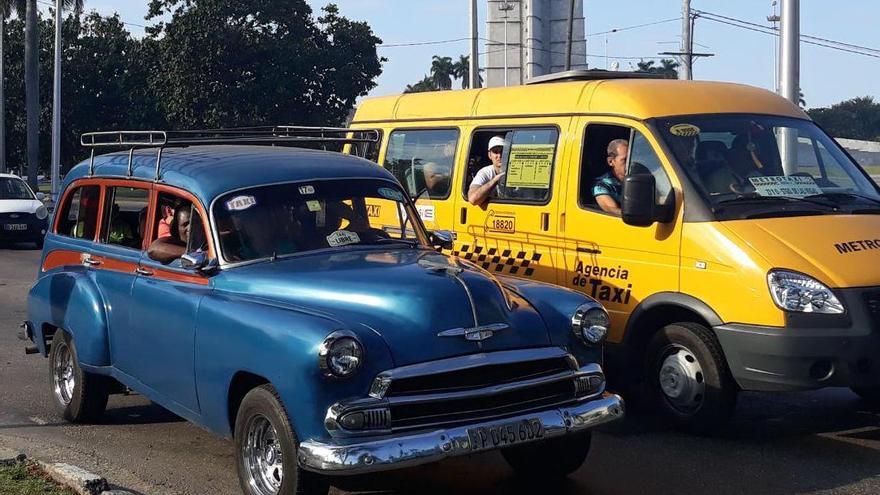
A struggle between private taxies and state-owned minibuses has developed on Havana’s streets. (14ymedio)

14ymedio bigger14ymedio, Marcelo Hernández, Havana, 29 March 2019 — Cuban authorities are trying to discourage private taxis on popular routes through the streets of Havana. Last December they began tightening controls on the used by the vintage vehicles, on procedures for buying fuel and even on the points at which they wait for customers. But the hardest blow for these drivers has been the arrival of a large fleet of state-owned minibuses that compete for customers.

This rivalry should be benefitting passengers but, so far, it is far from obvious that is the case. Long lines for the minibuses discourage many passengers, who end up paying twice the official price in order to arrive at their destinations on time. Drivers of the old cars, most of which are over sixty years old, continue fighting an uphill battle with the government, splitting up longer routes into a series of shorter ones in an effort to maintain profits and avoid fines.

Both sides, state and private-sector drivers, expect their counterparts to get tired. “As soon as it stops being a business of picking up passengers, they will find something else to do,” predicts Luís, the driver of one of the newly arrived Chinese minibuses, of the private taxi drivers. Meanwhile, Juan Alberto prophesizes from the helm of a 1950s Chevrolet, “There is a lot of enthusiasm at first but after a few months there won’t be enough spare parts, or thieves will have stripped everything off [the minibuses] down to the tires.” continue reading

Caught in the middle are the beleaguered Havana residents, who would prefer that the battle not crush one of the opponents or allow only one of type of business model — state-owned or private sector — to prevail. The struggle from which passengers do want to be free is that of mobility, which the capital has been suffering through for decades. The enemy is neither a vintage American automobile nor a Chinese minibus but the serious transportation crisis.

________________________

The 14ymedio team is committed to serious journalism that reflects the reality of deep Cuba. Thank you for joining us on this long road. We invite you to continue supporting us, but this time by becoming a member of 14ymedio. Together we can continue to transform journalism in Cuba.

"There’s Nothing to Talk About: We Want Ortega to Leave"

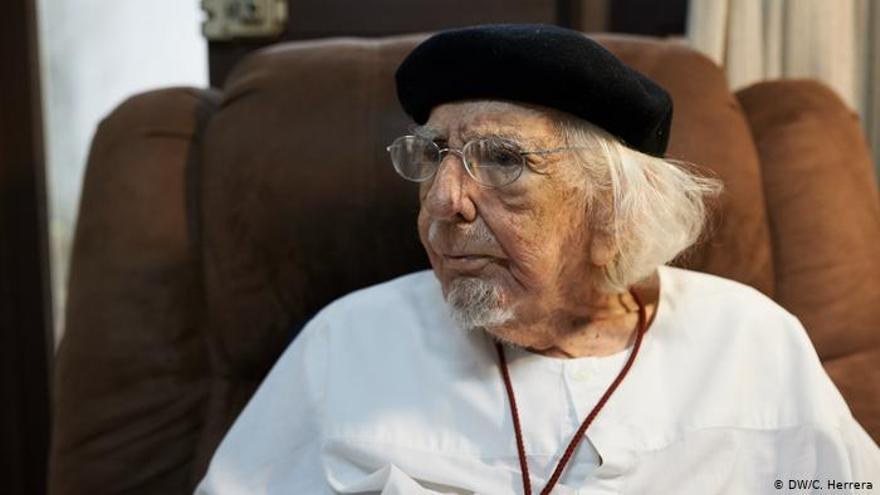
Ernesto Cardenal was removed from the priesthood by John Paul II in 1984 along with other Sandinista priests. In 2007 he became an outspoken critic of Ortega. (DW)

14ymedio bigger14ymedio, Gabriela Selser, Managua, 28 March 2019 —  He was in the hospital for 16 days and many feared the worst. But at 94, the Nicaraguan poet and priest Ernesto Cardenal not only survived a serious kidney infection, but he has returned to his literary routine.

“I feel very well, I just have a little night cough but nothing serious, it must be an ache of old age,” the famous author of Psalms, Lost Life and Epigrams tells Deutsche Welle in an interview. Cardenal’s vast literary work has been translated into more than 20 languages and included in some 100 anthologies.

He greets us at his home in Managua dressed in his typical while peasant shirt, baggy jeans and a black beret over his gray hair. He is sitting next to a rustic desk in his austere, monastic room, where there is only one wide leather armchair, a hospital bed and a blue canvas hammock, his favorite place to think and rest. continue reading

The small typewriter does not stop typing as the poet speaks his words. Three affable nurses take turns reminding him to take his medicine or assist him in his readings.

Although he has been in a good mood, Cardinal is anguished thinking about Nicaragua. “The situation is worse, we want to get out of this, we want a total change in the country, a real social change,” he says.

Almost a year ago he wrote a proclamation denouncing the government’s repression of a student rebellion that broke out on April 18. In it he expressed himself against the opposition dialogue with President Daniel Ortega and his wife, Vice President Rosario Murillo.

“And I keep saying: no to dialogue, we just want the presidential couple to leave, there is nothing to talk about,” he exclaimed when asked about the new negotiation, which began on February 27, to try to resolve the political crisis that has already gone on for 11 months.

What would you say to outsiders about what happens in Nicaragua? “They should know what is going on without me telling them, I have no freedom to say it, there is no freedom of any kind, anyone can suffer repression. Nor would I be free,” he says.

How to resolve what is happening in Nicaragua? “I do not know. I know the people, that is the people who can do it. And the young people mainly, who tried even though they did not succeed, but we are still waiting, hope is what keeps us going.”

Ernesto Cardenal began to compose verses as a child before he learned to read. He wrote his first poem, dedicated to the tomb of the Nicaraguan poet Rubén Darío, inspired by his father, who read aloud to him the rhymes of that forerunner of modernism (1867-1916).

“That poem was a childish thing, very primitive, it was not really poetry, but I called it poetry,” he recalls with a smile.

With the same passion that loved letters, he embraced religion. He was ordained as a priest in 1965, and founded a community of peasant artists in the Solentiname archipelago, in the southern Lake Nicaragua, where guerrilla groups emerged to fight the dictator Anastasio Somoza.

During the Sandinista Revolution, which included the first government of Daniel Ortega from 1985 to 1990, he was Minister of Culture. Because of his political commitment, Pope John Paul II applied an A Divinis sanction in 1984, prohibiting him as well as three other Sandinista priests from exercising the priesthood.

The papal sanction lasted for 35 years despite the fact that Father Ernesto distanced himself from Sandinismo and, in 2007 after the return of Ortega to power, he became a fierce critic of what he called “the new dictatorship.”

In mid-February, when the Cardinal was in serious condition, Pope Francisco annulled the 35-year long sanction. That same day, the author of The Gospel of Solentiname co-celebrated mass in the hospital with the apostolic nuncio in Managua, followed by other eucharistic celebrations at home, with close friends.

He says that the papal sanction did not affect his life as a priest. “I did not become a priest to administer sacraments, communions or marriages, my priestly vocation was always of social commitment and I never abandoned it,” he makes clear.

Ernesto Cardenal speaks to the scandals of pedophilia that have shaken the Catholic Church in recent years and attributes them to the obligation of celibacy in priests, something that he considers “unnatural.”

“Saint Paul said that he was celibate because he wanted to be, he did not oblige anyone to be celibate, and the other apostles were not, so there does not have to be obligatory celibacy,” he argues.

Cardinal admires the management of the Argentine pope Jorge Bergoglio. “It’s a miracle, a blessing from God, he’s making a revolution in the Vatican and, therefore, also in the Church and in the world,” he says.

The theme of God as author of the universe appears in many of his works from the famous Cosmic Canticle (1993), a poem of more than 500 pages translated into several languages, which he considers his most beloved book. “It’s my masterpiece, because of its length and because of the way in which the subject is approached,” he says.

In a similar vein he would later publish Telescope in the Dark Night (1993), This World and Another One (2011), Thus in the Earth as in the Sky (2018) and Sons of the Stars (2019), among others.

Now, the award-winning writer awaits the upcoming publication of a new anthology, Complete Poetry, which will see the light in Germany and Spain, countries where thousands of people have enjoyed his works.

Meanwhile, a new poem emerges from his typewriter. Titled We Are in the Firmament, its verses repeatedly blurring the dividing line between religious narrative and scientific theory. “The universe has a creator that is God, and an evolution that goes towards him, therefore, there is no cosmos without God,” concludes Cardenal.

__________________________________

Note: This interview was published by Deutsche Welle Latin America. We reproduce it with authorization from that newspaper.

The 14ymedio team is committed to serious journalism that reflects the reality of deep Cuba. Thank you for joining us on this long road. We invite you to continue supporting us, but this time by becoming a member of 14ymedio. Together we can continue to transform journalism in Cuba.

López Obrador and Historical Guilt

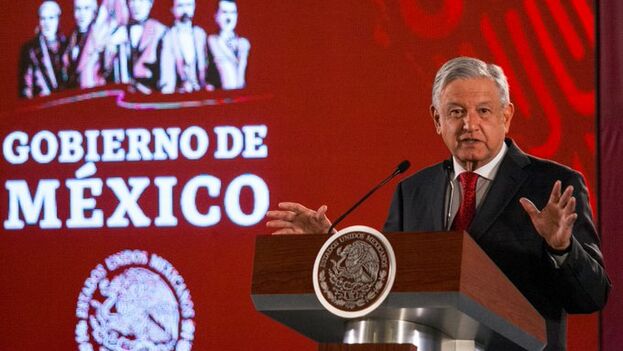
López Obrador has sent letters to the Pope and to the Spanish Government. (Screen capture)

14ymedio bigger14ymedio, Yoani Sanchez, Generation Y, 28 March 2019 — Until now, Andrés Manuel López Obrador seemed to be a focus of concern or hope for millions of Mexicans. Saving his lukewarm performance in the face of the regime of Nicolás Maduro, the Mexican president had received criticism and applause only within the borders of his own country, where he wages innumerable political and economic battles every day. That was how it was, until it occurred to him to stir up the ghost of historical guilt on two continents.

In a letter, AMLO — as he is popularly known in Mexico — has asked Pope Francis and the King of Spain to form a joint commission to study the conquest of America and to ask for forgiveness for the excesses committed. The letter has provoked some reactions of support, others of anger, many of indifference and resounding taunts that feed the memes in social networks. The Mexican politician has come to stand, in a few hours, at the center of a barrage of comments that cross the Atlantic from one side to another.

AMLO’s two Hispanic surnames do not help much in this process of demanding an apology, because they confirm that he himself is the fruit of a long cultural process that transcends the Manichaeism of the conquered and conquerors. His own existence springs from centuries of confrontation, integration, symbiosis, miscegenation and accommodation, where the limits are not precise and seeking the guilty is a work that delves deeper into the terrain of neurosis than of objectivity. But demagogues have to live for something and the most comfortable source lies in burdening others with responsibility. continue reading

López Obrador knows not what he has done. While he believed that he was extending that path of official apology that began with his mandate, which includes several bloody events of recent Mexican history, he did not realize that he was entering a terrain that does not belong to him: the distant past. In trying to extract returns from a supposed political humility that would have the powerful kneel before the defenseless victims, he has stepped on the tail of the Spanish bull and with it the millions of citizens of this part of the world whose veins run with both Hispanic and American blood.

It remains to be asked what led AMLO to compose the letters he sent to the Vatican and the Zarzuela Palace asking for an almost impossible historical redress. Was it the search for truth, or ignorance,or  the desire to shift attention beyond the problems of Mexico, or was it his own ego needing to scale higher peaks and take on more universal challenges? Whatever it is, so far he is losing the battle because he chose the losing path of “we are like this because they damaged us,” while rejecting the path of “we are nourished by diversity and in our culture many channels converge: this makes us powerful.”

If AMLO follows the path of blame then he must begin by preparing the plea to hold the Aztecs accountable for dominating and controlling large areas of Mesoamerica, the Romans for molding European faces with the advance of their implacable legions and the Mongols for having planted terror so many times under the hoofs of their horses. But this he will not do, of course, because his true objective is not to assign responsibility but to nurture his populist foundations. López Obrador is not looking for a culprit, instead he just wants to garner the distinctions of a savior.

_________________________________

This text was originally published in the Deutsche Welle for Latin America.

The 14ymedio team is committed to serious journalism that reflects the reality of deep Cuba. Thank you for joining us on this long road. We invite you to continue supporting us, but this time by becoming a member of 14ymedio. Together we can continue to transform journalism in Cuba.

Between Heaven and Hell / Fernando Damaso

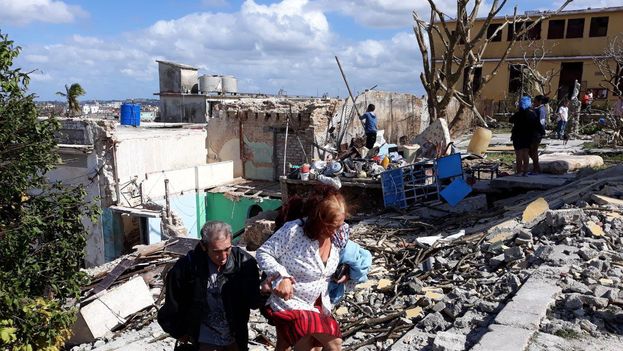
Damage from the tornado that struck parts of Havana earlier this year. (14ymedio)

Fernando Dámaso, 4 March 2019 —  As had been predetermined, the monstrosity of a constitution was ratified in a referendum last Sunday, February 24, in spite of the clumsy manipulation of polling data by the regime.

The reasons vary: government induced fear and an insane level of propaganda; political pressure exerted on workers, intellectuals, artists, athletes, professionals and students, who are elegible to vote, and and even on infants, who are not; all clamoring “I Vote Yes!”

Though no figures have been released, the amount of money and resources spent on the campaign must have far outstripped those of any presidential election held in the United States, which Cuban leaders and their front men never fail to criticize. In addition, the “Don’t Vote” and “Vote NO” campaigns, which left the opposition ridiculously divided, were suppressed. continue reading

With state monopoly of all media, including social networks, citizens were bombarded with constant sermonizing, leaving opponents with no legal public platforms to express themselves.

As of the 24th, Cuba has a new constitution, though it will require an additional twenty-four months for its articles to be formulated before it can be put into practice. Given the circumstances, it is likely to be the shortest-lived Constitution in the history of Cuba, surpassed only perhaps by the ephemeral Baraguá constitution, which lasted only a few days, during which time Antonio Maceo tried in vain to prolong a war that had already ended. It was an attempt to extend the life, at least on paper, of a failed revolution.

Shortly after Dr. Ramón Grau San Martín became President of the Republic in 1944, the island was hit by a devastating hurricane, which led the press to predict, “The new government threatens to be stormy.” And that’s was happened.

Since the current “designate” assumed the presidency, there has been a terrible airline crash in which there was only one survivor, intense rains and floods have washed away crops, homes, roads and bridges in central Cuba, and a tornado has destroyed parts of the already heavily damaged areas of Santos Suárez, Regla, Guanabacoa, and San Miguel near Havana. As if that were not enough, a meteorite has even broken up over Pinar del Río.

If we had a free press, it would predict that “the new government threatens to be disastrous.” On top of repeated economic failures, industrial decline, lack of investment and the deterioration of social services, we must now add the fall — sooner of later — of the Maduro regime in Venezuela, our main sponsor.

As a result, alarm bells have gone off and Cuban officials now spend hours flying around the world, looking for new partners who might be willing to “throw a rope,” as the local saying goes. But times have changed.

I doubt that Europe, which is having serious problems with some of its major member countries, is inclined to provide new credits knowing they might not be repaid. Russia is now capitalist, as are all the republics which made up the former Soviet Union.

Similarly, China and Vietnam have adopted market economies. In all of them, things cost money and nothing is free. If they extend credit, it must be repaid with corresponding interest. Even isolated North Korea, which has nothing to give, is in talks with the United States, its historic adversary.

In Latin America they have shut the door, with the exception of the indigenous Aymaran*, who spends his time ranting about the empire, blaming poultry consumption for causing homosexuality and worshiping the goddess Pachamama through dance.

Lacking resources, few can help their “brother president.” Mexico — a country immersed in serious problems on its northern and southern borders, as well as others such as drug trafficking, a violent crime wave, and longstanding, widespread corruption — does not have time to deal with its complicated Caribbean neighbor.

The little surrounding islands are of no use since, by necessity, they take more than they give. That leaves only Canada and the United States, and the former has always coordinated its policy in the region with the latter. In short, to escape the quagmire and save Cuba, dialogue with the latter is essential, but that does not necessarily mean also saving its government.

Dialogue, however, will require abandoning the brusque swagger, the childish arrogance, the antiquated dogmas, the rampant and cocky stupidity, and the outlandish demands. A dialogue requires two suitcases: a full one from which to give and an empty one in which to receive.

May God and the Orishas open our leaders’ eyes to the prevailing bleak reality so that they might think of Cuba and the Cubans, and set aside their addiction to absolute power. Otherwise, they will be consumed by the fire of Lucifer and Shangó.

 *Translator’s note: A reference to President Evo Morales of Bolivia.

What Did Their Royal Highnesses Come For? / Cubanet, Miriam Celaya

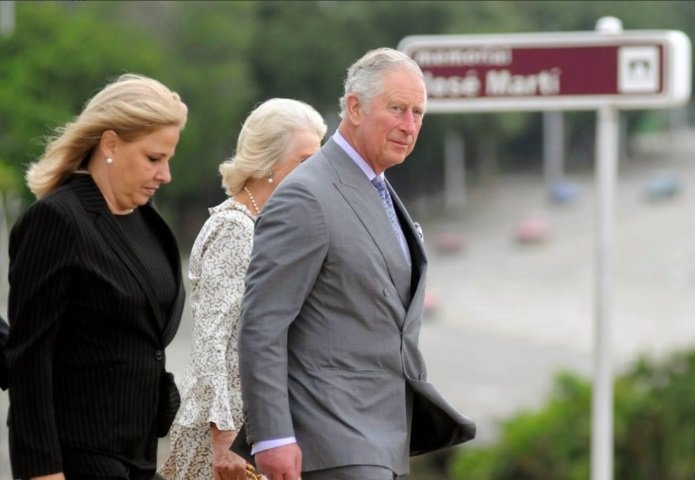
Source: radioreloj.cu

Cubanet, Miriam Celaya, Havana, 26 March2019 — Despite the publication by the Castro press of each of two decaffeinated official biographies of their Royal Highnesses, the Prince of Wales and the Duchess of Cornwall — who arrived on the afternoon of the same day at the Cuban capital, fulfilling a visit announced months ago, in response to an official invitation from the Cuban government — and the brief mention on TV news of the activities and tours of the distinguished couple during their short stay in Havana, the modest profile granted by the government media to guests of such vintage ancestry makes one stop and think.

Being such an unprecedented historic event, which some foreign media tried to view as a visit which will draw closer or improve the relations between Havana and London, the cold discretion of the Cuban authorities and the scant media coverage offered to the event are striking. If, in truth, the objective of this visit was so favorable to the leaders of the Government, they would not have missed the enthusiastic receptions and the mobilizations of the faithful, perhaps carrying posters in the style of: “Welcome Your Royal Highnesses” or some other similar tacky ploy.

Needless to also mention that the visit of the representatives of the British monarchy — or of any other of old Europe’s crown heads — is as unusual as it is foreign and distant to ordinary Cubans. Irreverent and plebeian by nature, anti-monarchists — earlier by inherited tradition from the independence wars; later, due to communist ideological indoctrination — and culturally refractory to any royal pedigree or palatial label, the idiosyncrasy of the inhabitants of this other archipelago has nothing in common with representatives of any royalty. continue reading

And so alien is the British royalty to Cubans that most do not even know of the scandals carried out in their day by the infidelities of the Prince of Wales who now visits us, his controversial divorce from Princess Diana, and the role the current wife of the heir to the throne, the former lover of the once restless Charles, played in those entanglements. Absorbed in the urgencies of daily survival, Cubans are not interested in this pair of aristocrats. To be sure, the heroes of the tearful regional telenovelas and their avatars are much closer and more familiar to the natives of this island than the intrigues of Buckingham Palace.

So, in perspective, it can be said that the presence of their British Royal Highnesses among us is a rather folkloric event which, at most, will awaken some curiosity among the plebes, but that will barely pass with neither sorrows nor glories and will be forgotten as soon as the visitors go back to where they came from.

Stranger still than this extemporaneous visit is that it is taking place in the midst of another turn of the screw in Cuba’s eternal economic crisis, when the deficiencies worsen, migrations abroad continue to show a growing trend and we can glimpse (literally) a grim horizon at the possibility of the loss of Venezuela’s oil subsidies in the near term.

If we look at them from the point of State relations, the links between a European monarchy with a long tradition and a rich lineage and a communist-cast dictatorship do not seem to be very consistent either. It is hard to believe that a politically influential personality such as the heir to the British throne can lend himself to offering friendly support to the Palace of the Revolution, especially when it is not usual for European royal houses to mark very clear political positions with the governments or mis-governments of the world.

Less credible still is that their Royal Highnesses should have taken the trouble to land in Cuba just to place a wreath to honor José Martí, visit the Palace of the Captains General, attend a function of the children of La Colmenita and another of the Alicia Alonso Ballet at the Gran Teatro de La Habana. They are princes, not dumb-asses.

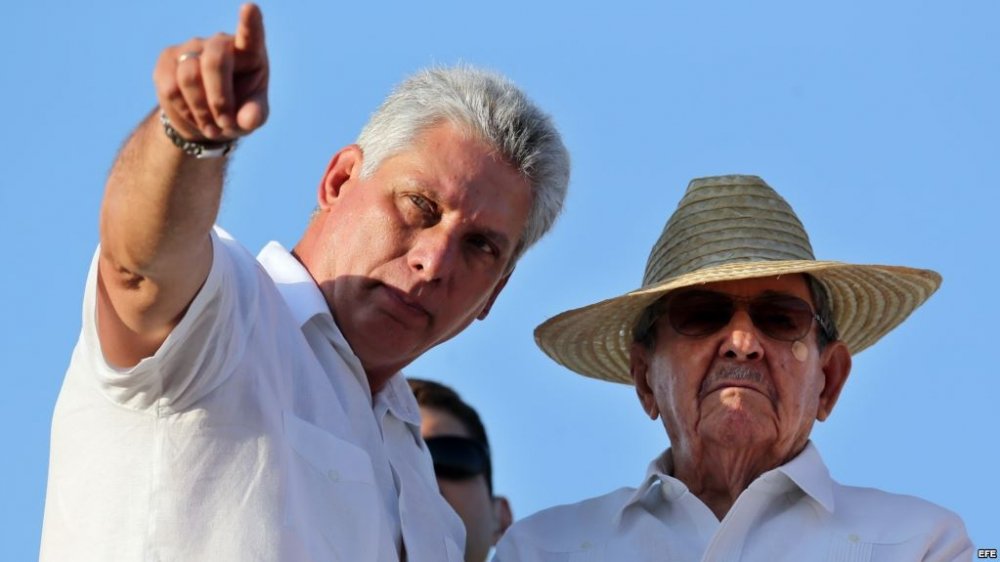
On the other hand, despite the fact that Prince Charles ignored US Senator Rick Scott’s request, when in February he asked him to change his travel plans to Havana and visit Florida instead, where, as Scott wrote, he could ” to learn firsthand the six decades of atrocities, oppression and misery that the regime inflicted on Cubans”; and although the Prince’s agenda in Havana did not include any meetings with the dissident sectors or statements about the situation in Venezuela and the important role of Cuba in the military and intelligence support in that South American country, there are no indications of any kind so far of compromise or alliance between the unelected President of Cuba, Miguel Díaz-Canel and his geriatric conga line with the representative of the British monarchy.

Rather, everything indicates that the presence of Charles and Camilla in Havana responds more to an agenda related to aspects of financial interest and exploration of possible investments than to issues of a political nature, although protocol and appearances may suggest otherwise. Maybe, behind the scenes, the prince has also come to air the debts to the United Kingdom on the Cuban side. In any case, historically, English policy has maintained its independence with respect to Washington and has drawn its own agenda — as was demonstrated when it carried out the Falklands War — but when it comes time to cut the cake, London knows where its allies are.

For now, the details of the meeting of the Prince of Wales with Díaz-Canel and the real purposes of this visit of the British Royal House to Cuba are wrapped in a halo of mystery about which we can only speculate. In any case, on Wednesday, March 27th, the royal couple will leave Cuba to visit their former Caribbean island colonies. They will leave behind the same poverty and despair that have become the sign that marks the reality for Cubans.

Translated by Norma Whiting

Venezuela Now Has Imported Blackouts / Ciro Diaz

This video is under two minutes long. Originally posted in 2012, we reposted it in 2014 given what was happening in Venezuela. It seems even more prescient now, in 2019, so here it is again.
The subtitles appear to have stopped working.  Here are the lyrics:

IMPORTED BLACKOUTS – An original song by Ciro Diaz

Ohhh…. Fucking up a little island is nothing
Anyone can fuck up a little island
With few natural resources it was easy, to drown it in misery
But Fidel Castro loves the hardest efforts
That’s why he made friends with Chavez
To see if he could fuck up Venezuela

It looked like it would be hard
Because every time they dug a hole
They found every imaginable mineral
And the oil never stopped gushing

Only a president truly idiotic
Would allow his plans to embrace
The foolish ideas of Fidel and Cuban counter-intelligence.
And just like that ten years later, the job seems to be completed

Venezuela now has blackouts, blackouts imported from Havana
Venezuela now has blackouts, our experience was useless to them
Venezuela now has blackouts, blackouts imported from Havana
Venezuela now has blackouts, if they don’t hurry they will be left with nothing.

Cancellation of the B2 Visa: Another Parting of the Waters Between Cubans

Photo taken from the Internet

Cubanet, Miriam Celaya, Havana, 21 March 2019 – The recent announcement by the US authorities of the cancellation of the five-year visas (B2) for Cubans, as of March 18, 2019, has fallen like a pitcher of ice water on those who have, so far, benefited from this type of visa that grants to those who wished to obtain it stays of up to six months in the US and the possibility of multiple entries.

It is not surprising, then, that almost everywhere these days this has been the unavoidable subject in Cuba: bus stops, shops, queues, work centers or the usual groups of friends and acquaintances. The impact of the news for the common Cubans far exceeds any other event that has taken place in recent times, including the very controversial constitutional referendum on February 24th, and it seems to have produced a desolation effect similar to that caused by the tornado that devastated a large swath of the Cuban capital just several weeks ago.

Once again it has become clear that the dispositions and the policies dictated by our Northern neighbor with respect to Cuba weigh more on the national mood and cause greater effects on the life of Cubans than any guideline that comes from the dome of power inside Cuba. continue reading

In spite of the so-called “independence and sovereignty”, after six decades of “communist” dictatorship, only the opposite results has been achieved: today  ̶ and increasingly ̶  the survival of a large part of the inhabitants of this island depends in some way on the US, either because of the family ties that intertwine both shores, because of the life-saving remittances, because of the flow of the kinds of articles that are scarce in Cuba and that reach Cuban families through the parcel agencies that proliferated as a result of the thaw of the Obama era, or because the US is an important source of supply for small businesses and the supporter of informal commerce, through the constant trips of an entire army of “mules”.

From now on, instead of the B2 visa, Cubans will be able to apply for a visa valid for only three months of stay in the US, which they can use for a single entry, which significantly increases the formality of the paperwork and visa payments for frequent travelers  ̶  that must necessarily be made through a third country since the closure of consular services at the American Embassy in Havana in response to the “acoustic attacks” on embassy personnel ̶   adding additional expenses for tickets, accommodations, food, etc.

This leads directly to the consideration of other possibilities that will begin to emerge in the new scenario going forward, such as greater number of Cubans who might decide to stay in US illegally, once their legal three month stays expire, until they reach the time needed to apply for status under the Cuban Adjustment Act and, eventually, obtain a permanent residence permit.

Another consequence will be the impact on ticket sales of the airlines that offer regular flights between Cuba and the US, of which a good part of the customers are Cuban residents on the Island. It is expected that, in the short term, by decreasing the number of travelers, the cost of these fares will become more expensive, directly affecting the Cubans who reside in the US who commonly pay for the trips of their relatives who live in Cuba. Logically, the shipment of parcels to the Island will become more expensive as well.

Despite this new thrust, and leaving aside the March 16th Cuban Ministry of Foreign Affairs hypocritical statement, where the authorities reject what they cynically consider “an additional obstacle to the exercise of the right of Cuban citizens to visit his relatives in that country” since, among other issues, “it also imposes high economic costs on family trips and exchange in multiple areas”, it is surprising the virulence and the merriment with which not a few Cuban emigrants living in the US have applauded a measure that so much affects their compatriots on both sides of the Straits of Florida.

“It’s good,” some say, because that’s how the dictatorship will stop the influx of dollars, the flow of snitches and State Security agents who have been entering the US, and the internal pressure on the Island will increase until a social explosion takes place that overthrows the puppet Díaz-Canel. They do not seem to care about the cost of family separation between parents whose children emigrated, between close relatives and close friends, a heartbreak that they themselves had to endure in the past.

“They get what they deserve”, others affirm, who feel chemically pure and politically enlightened, although there is no lack among them of those who participated in marches, were members of the Committee for the Defense of the Revolution (CDR), the Young Communist Union (UJC) or the Cuban Communist Party (PCC), those who felt afraid to express themselves freely and even applauded at the Plaza de la Revolución.

Both do not seem to be disturbed by the material needs of their compatriots inside Cuba. The grudges accumulated by their own pain have degraded their souls, and in response to so much inexplicable sense of revenge, many Cubans on the Island respond with distrust. Are these “paladins of absolute truth” those who pretend to trace the common future? Do they feel so elevated that they will be an imitation of the Castro leadership, from the antipodes? No, thanks.

Obviously, the anthropological damage that the well-known Cuban intellectual Dagoberto Valdés defined so clearly does not limit itself to Cuba’s territorial boundaries, but rather – like a plague that corrodes the spirit of solidarity that should exist between nationals – extends beyond a large part of the exile community.

Because, while it is true that the US government and its institutions have the sovereign right to decide and dispose of what they consider best or more appropriate to their interests, although the laws of that country have no obligation to look after foreign interests  ̶ in this case those of Cubans ̶  and if, indeed, the (un-)government of Castro-Canel is the one responsible for the national crisis and the only one from which we must demand accountability and demand rights, it speaks much and very badly of us as a Nation and as fellow citizens that we should rejoice at the misfortune of one or the other.

Personally, although my condition as a “cubañola” (Cuban of Spanish citizenship) did not harm me in particular with regards to visa issues, I feel a real embarrassment before the witches coven unleashed on the networks, pitching Cubans against Cubans, with ridicule, hatred, contempt and resentment, as if we were not already sufficiently fractured and divided, as if we had not consumed enough tons of hatred inculcated from the dictatorial power. And there are still arrogant people who dare to call out Cubans living in Cuba because of our spiritual miseries and the loss of values that, according to them, we all suffer from!

We definitely a lot of growing to do as Cubans and as human beings before we can overcome the trauma of the Castro regime and find the good and the kind that should unite us beyond our differences … Or we will simply be condemned to disappear as a Nation.

Translated by Norma Whiting

Rosa Maria Paya Meets With Jair Bolsonaro in Santiago de Chile

Opposition leader Rosa María Payá (right), with Brazilian President Jair Bolsonaro (2nd from right). (Twitter)

14ymedio bigger14ymedio, Havana, 24 March 2019 — Cuban opposition leader Rosa Maria Payá met Friday with Brazilian President Jair Bolsonaro in Santiago de Chile. The promoter of the initiative Cuba Decides asked the president for “support for the Cuban community in Brazil,” which is facing a difficult time after the end of the Mais Médicos (More Doctors) mission.

Also attending the meeting were the Brazilian Foreign Minister, Ernesto Fraga Araújo, who participated with Bolsonaro in the official launch of the Forum for the Progress of South America (Prosur), a regional body that seeks to replace the Union of South American Nations (UNASUR), currently in crisis after the departure of several governments.

On Twitter, Payá described the meeting with Bolsonaro and his foreign minister as an “intense meeting,” especially in relation to “the specific actions that Brazil and PROSUR can take in support of the Cuban people in their struggle for democracy.” continue reading

Intense meeting with President @jairbolsonaro and chancellor @ernestofaraujo on the specific actions that #Brasil and #ProSur can take in support of the Cuban people in their struggle for democracy. 

Thanks for the solidarity. #CubaDecide #Ni1Más (Not 1 More) 

– Rosa María Payá A. (@RosaMariaPaya) March 23, 2019

“We talked about the conditions of semi-slavery of health professionals sent abroad by the regime, I appreciated his actions to end the abuse of Cuban doctors and requested support for the Cuban community in Brazil,” Payá added.

Last November, Bolsonaro, then president-elect, said that the Cuban physicians who worked for Mais Médicos were “slaves” of a “dictatorship,” words that triggered a rapid response from the Government of Cuba which began to withdraw the more than 8,000 health professionals it had working in the South American country. Some 2,500 doctors decided not to return to the island and accepted an asylum proposal from Bolsonaro.

I held a conversation with the Cuban Rosa Payá @RosaMariaPaya. She tells truths that I have never seen anywhere about the new Cuban constitution and the lifestyle of the people living in the Castro dictatorship. Socialism kills! [Video here of RMP speaking with Eduardo Bolsonaro, Federal Deputy and son of Jair Bolsonaro]

– Eduardo Bolsonaro (@BolsonaroSP) March 23, 2019

Since then, these health professionals have been in limbo with regards to employment and have repeatedly demanded that they be allowed to revalidate their credentials and have access to jobs.

Last February these doctors sent a letter to Senators Marco Rubio and Bob Menéndez asking for support to restore the Cuban Medical Professional Parole program, repealed by former President Barack Obama in 2017, which grants US visas to health professionals who leave Cuba’s international missions.

__________________

The 14ymedio team is committed to serious journalism that reflects the reality of deep Cuba. Thank you for joining us on this long road. We invite you to continue supporting us, but this time by becoming a member of 14ymedio. Together we can continue to transform journalism in Cuba.

The Final Act of “Cubazuela”

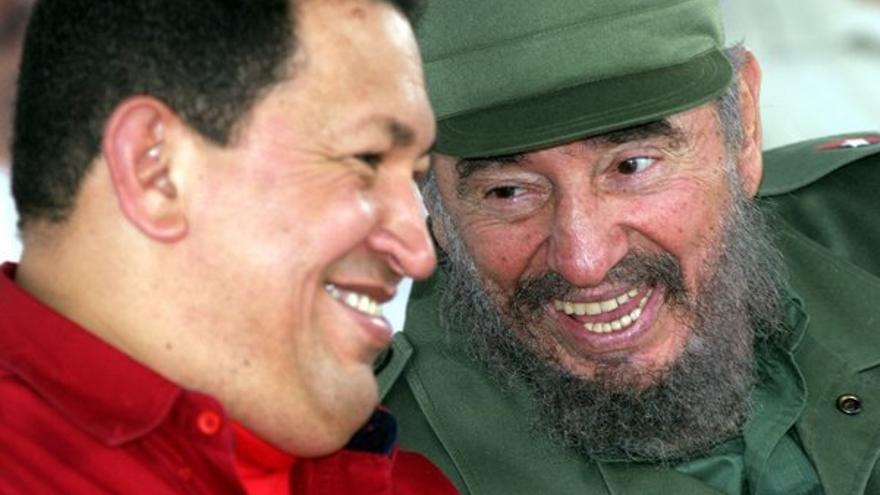
The then presidents of Venezuela, Hugo Chávez, and of Cuba, Fidel Castro, both now deceased.

14ymedio bigger14ymedio, Carlos A. Montaner, Miami | 23 March, 2019 — Carlos Lage, in December 2005, said in Caracas that Cuba had two presidents: Hugo Chávez and Fidel Castro. “Cubazuela had emerged.” At that time, Lage was vice president of Cuba’s Council of State and the Council of Ministers. He was the number two man in Cuba by appointment of Fidel. The Commander had ordered him to release that pearl among the Venezuelans. The idea was, as always, Fidel’s, but Chávez agreed. Lage obeyed.

That meant, also, that Venezuela had two presidents: Fidel Castro and Hugo Chávez. Fidel was the primus inter pares. Fidel had molded Chavez. He had spawned him. When he received him in Cuba, in December of 1994, Chávez was a failed coup leader under the influence of Norberto Ceresole, an Argentine fascist Peronist, passed through the Libyan desert by the hand of Gaddafi.

As Chávez’s political muse was totally promiscuous, Fidel impregnated him with four Marxist slogans and dismissed Ceresole without hesitation. El Comandante was not a theoretician, but a strategist and a tactician who, at age 18, was persuaded that he had been endowed with a Greek profile as a premonition of nature, and exchanged his middle name, Hippolytus, for Alexander, after Alexander the Great. It was his first step towards the conquest of the planet. Something that was impossible to do from poor Cuba, so far from Marx and so close to the United States, but possible with the enormous wealth of Venezuela, especially with a barrel of oil around one hundred dollars. continue reading

Then Cuban chancellor, Felipe Pérez Roque, was entrusted with another task for Venezuelans: explaining why Venezuela and Cuba should be allied. He did it at the Teresa Carreño theater in Caracas. Fidel formulated the script, carefully read the speech, and made a few suggestions. No important detail escaped his meticulously manipulative temperament. The task that lay ahead was gigantic. Replace the vanished and treacherous USSR in the defense of the oppressed of the world. Fight and defeat the American neighbor, huge, powerful and foolish.

Raul Castro did not appear in the equation. He was the neat and loyal boy to run errands, but without greatness. Fidel fabricated his biography. He dragged him to attack the Moncada barracks, to the Sierra Maestra and to the Ministry of Defense, but he did not respect him. He pegged him as a mediocre guy, unable to read a book, someone to leave in front of the armory, but nothing more.

He didn’t like Hugo Chávez either. Actually, he couldn’t stand him. Chavez was just a gun to assault the sky. The ordinariness of the Venezuelan bothered him. His “parejería” (conceit), as the Cubans call the unfortunates who want to become “equal” to the boss.

In one of Chávez’s frequent phone calls, Fidel explained that, “sadly,” he had to hand over the relationship to his two trusted men, Lage and Pérez Roque, because the Revolution, due to lack of time, demanded the sacrifice of ties that I really appreciated.” Chavez, impervious to rejection, began to constantly annoy the other two characters.

In 2009, Raúl Castro, with the fatigued consent of Fidel, dismissed Lage and Pérez Roque, turned them into non-people and they left the game accused of being ambitious and disloyal. On December 30, 2012, Hugo Chávez died in Havana because of his audacity in having his cancer treated in Cuba, although they didn’t disconnect him until March 5, 2013, exactly 60 years of Stalin’s death.

As Alexander the Great was surprised by death at the age of 32, and shortly afterwards his Greco-Macedonian empire was undone, Fidel Castro almost died as diverticulitis took him down at the end of July 2006, a few months after he deployed his strategy in Caracas, and they immediately began to demolish his fantasies, although he remained (more or less) alive until November 2016.

Nicolás Maduro, the replacement imposed by Cuba, is drowning because of his plunder, incapacity and stupidity. Raul Castro, old and tired, has gone all out to save him, but, as is often the case, the two are about to suffocate in the turbulent post-Communist swirl.

Everyone knows that the puppeteer is Raúl Castro. They have been abandoned by the artists who came to sing to Juan Guaidó, Michelle Bachelet, the OAS, the Italian Federica Mogherini, Heinz Dieterich, Noam Chomsky and the sursum corda. All that’s left are some deeply brainless men without the least prestige.

The image of Venezuela is terrible and is leaving the Cuban regime without friends or lifesavers. The irony is that they conquered Venezuela by swallowing Chávez and Maduro and now they have become indigestible, as historians say happened to Alexander the Great after a banquet.

____________________

The 14ymedio team is committed to serious journalism that reflects the reality of deep Cuba. Thank you for joining us on this long road. We invite you to continue supporting us, but this time by becoming a member of 14ymedio. Together we can continue to transform journalism in Cuba.

From the Left Wave to the Right Tsunami

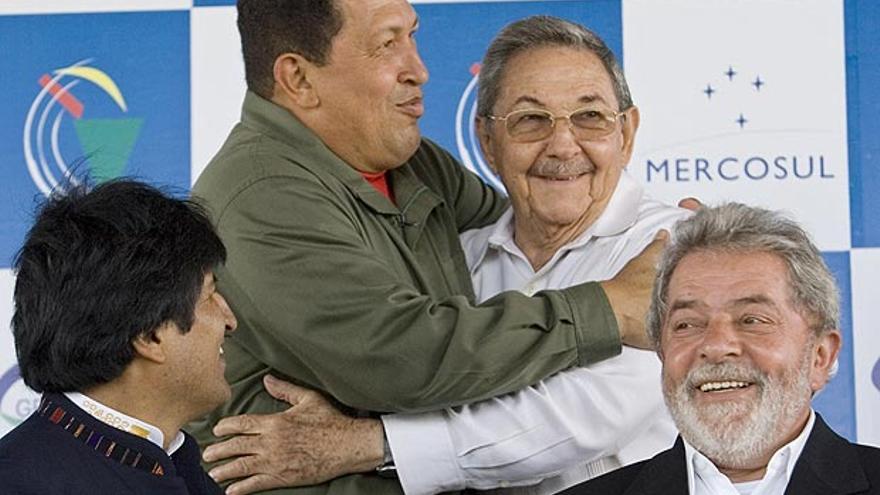
The Latin American left continues to crumble, in the image above one is still president and another has been able to leave a faithful successor. Left to Right: President Morales (Bolivia) and former presidents Chavez (Venezuela), Castro (Cuba), and Lula (Brazil)

14ymedio bigger14ymedio, Mauricio Rojas, Santiago de Chile | 23 Marzo 2019 — Ten years ago the Latin American left was in a situation unparalleled in the history of the region: never before had it been as influential or controlled as many governments as it did then.

Hugo Chávez in Venezuela, Lula da Silva in Brazil, Cristina Kirchner in Argentina, Rafael Correa in Ecuador, Michelle Bachelet in Chile, Daniel Ortega in Nicaragua, Evo Morales in Bolivia, Alan García in Peru, Tabaré Vázquez in Uruguay, Mauricio Funes in El Salvador and Fidel Castro in Cuba were part of a broad and diverse political family that seemed unstoppable.

By that time, very few could have imagined that just a few years later this great family would be in ruins and even less that a true right-wing tsunami could become the most transcendent legacy of the leftist wave.

It’s the economy, stupid

The fundamental explanation of the rise and fall of the Latin American left is relatively simple and can be summarized with the help of Bill Clinton’s famous saying: “It’s the economy, stupid.” The beginning of its meteoric rise was the triumph of Hugo Chávez in the Venezuelan presidential election of December 1998, and its context is given by the difficult times that Latin America experienced from the collapse, at the beginning of the 80s, of the model of “inward-directed development” that the region had followed since the 1930s. continue reading

The successes of the left were consolidated during the first decade of the new millennium with the help of the enormous abundance of resources generated by the export boom that began at the beginning of 2000 and ended during the first half of the decade of 2010. Then came the economic crisis, the scandals of corruption, the great electoral defeats and, in certain cases, like Venezuela, the dictatorial abyss and the humanitarian catastrophe, but also the emergence of leaders, such as Jair Bolsonaro in Brazil, with a political domicile located at the antipodes of 21st century socialism and other variants of Latin American leftism.

The background of the leftist surge must be sought in the 1980s and 1990s, when the region experienced the harsh consequences of the collapse of the type of economy that prevailed for half a century inspired by a development strategy based on import substitution, protectionism and extensive state intervention.

The failure of this strategy, theorized and disseminated in the post-war period by the Economic Commission for Latin America and the Caribbean (CEPAL by its initials in Spanish), became evident not only because of its inability to meet the demands of progress of the great majorities of the region, but also because of recurrent economic instability and ever greater dependence on traditional exports that increased the vulnerability of a development model that, paradoxically, had the great goal of reducing this dependence and the vulnerability it produced.

The debt crisis in the early 1980s resulted, first, in long economic recessions and then in painful attempts to restructure what were “greenhouse economies” dominated by patronage, privilege and connivance with politics. The consequences were dramatic: poverty increased from 134 to 225 million people between 1980 and 2002. In addition, that year recorded record levels of economic inequality: the regional average of the Gini coefficient reached 0.55 and the richest 10% of Latin Americans had income that was 14.4 times higher than the poorest 10 percent (data from CEPAL).

In Venezuela, to give just one example, per capita income fell by 28% towards the end of the 1980s compared to the level reached a decade earlier. In turn, poverty came to be estimated among more than half of the country’s population, something that is hard to imagine in the country that in the ’50s was not only the richest in Latin America, but one of the richest in the world.

The most visible and dramatic result was the so-called Caracazo, an unprecedented social outbreak that began on February 27, 1989 and lasted for a week throughout Venezuela, leaving hundreds or perhaps thousands dead in its wake, an impressive material devastation. No wonder Moisés Naím has said, referring to February 27 and its impact on the government of Carlos Andrés Pérez and the democracy that Venezuela had experienced since 1958: “That day Pérez fell and democracy fell.” And it can be added that, also that day, the winding road began that led first to the failed coup of then-Lieutenant-Colonel Hugo Chavez in February 1992 and then to his overwhelming electoral victory in December 1998.

From bullets to votes

The statistics and events just referred to give us the context in which the leftist wave emerges, particularly in its more populist and radical versions. The potential demand for leaders and movements that promised a rapid reduction of poverty and inequalities through redistributive policies was great.

In this sense, the charismatic leadership of Hugo Chávez came to give a face to a widespread desire to achieve better living conditions and more social justice without delay. The fact that the “eternal commander” could have practically unlimited resources, thanks to the nationalized oil already in 1976, to carry out his policies made him enormously popular, creating the illusion that it was enough the will of a messianic leader to liberate the poor of their painful condition, without putting the old elites in their place and challenging the power of the United States.

In this way, Chávez was able to occupy the place of redeemer and display the powerful attraction once enjoyed by Fidel Castro. Thus, the radical left could go on the offensive throughout the region, coordinated by the Sao Paulo Forum and financed by the petrodollars that Chávez used at will.

One of the most significant effects of Hugo Chávez’s rapid rise to Latin American left-wing stardom was a change in strategy by the region’s militant left. Instead of considering a guerrilla war or a revolutionary coup as a way to get to power, they now turn to the use of democratic electoral mechanisms. The means change, but the ends are maintained. And the result was undoubtedly much more encouraging than that obtained by Castro’s strategy during the 60s and 70s, at least while maintaining the large flow of income from what would be the largest export boom in the history of Latin America.

The leftist wave initiated by Hugo Chávez would consolidate with a series of important electoral victories. In this way, Lula da Silva and Néstor Kirchner came to the presidency of Brazil and Argentina in 2003, Evo Morales to that of Bolivia in 2006, Daniel Ortega and Rafael Correa to that of Nicaragua and Ecuador in 2007, and Mauricio Funes to El Salvador in 2009. To this wave of successes must be added, although they belong to a much more respectable and quiet branch of the leftist family, the victory of Ricardo Lagos in the second round of the Chilean presidential election of January 2000 and the one of Tabaré Vázquez, at the head of Frente Amplio, in Uruguay in November 2004.

It was the best of times, it was the worst of times

During this time — the first decade of 2000 — the export boom was taking off and poverty decreased throughout the region as a result of the economic growth generated by the export plethora combined with various redistributive policies. For the year 2011, CEPAL statistics report a decrease of 44 million poor compared to the figure for 2002.

In countries such as Argentina, Bolivia, Chile, Peru and Uruguay, poverty was reduced by half between 2002 and 2012, while in Venezuela the percentage of the poor fell from 49.4% in 1999 to 25.4% in 2012, that is, during the last full year in which Hugo Chávez governed. The distribution of income also became more egalitarian and the Gini coefficient fell below 0.4 in Uruguay and Venezuela, which is something very unusual in the history of Latin America.

The extraordinary magnitude of the export boom was the engine of this rapid but, as it would soon be demonstrated, fragile progress. To look again at the example of Venezuela, it can be pointed out that the value of its exports increased 5.5 times between 1998, the year before Hugo Chávez came to power, and 2012.

This implies that during his 14 years as president Chavez had an income surplus of more than $530 billion compared to the average income of Venezuelan oil exports during the decade prior to his government. This was the abundant manna from the sky that Chávez used to consolidate his increasingly personalistic and authoritarian government, as well as to subsidize the decrepit economy of Cuba and spread the Chavista doctrine, 21st Century Socialism, throughout Latin America.

Then came the fall into the abyss: the value of Venezuelan exports decreased by 75%, some 70 billion dollars between 2012 and 2016. But this fall and the consequent collapse of the Venezuelan economy under the government of Nicolás Maduro was due not only to the reduction of oil prices. Of equal importance was the disastrous economic management that has burdened all sectors of the Venezuelan economy, including the production of oil that today is at pitiful levels.

Among the most dramatic consequences of the economic disaster have been thousands of perfectly preventable deaths, a poverty that according to the latest estimates of the Survey of Living Conditions (Encovi), carried out by three prestigious Venezuelan universities, totals around 90% of the population, and a wave of emigration never before seen in the region that already exceeds 10% of the inhabitants of the country and that, according to the United Nations, could reach 5.3 million people by the end of 2019.

The evolution in other Latin American countries was similar, but without reaching the extremes of Venezuela. In the case of Brazil, the income generated by exports multiplied 5.3 times between 1999 and 2011, and then, between 2011 and 2016, fell by a third. This was enough to lead Brazil to a serious economic crisis that reduced per capita income by 9% in 2015-2016 and put an end to the long cycle of governments of the Workers Party, which continued from the time Lula da Silva assumed power, in 2003, until Dilma Rousseff was deposed in mid-2016. In Argentina something similar happened and in December 2015 ended the long era of the Kirchner spouses that started in 2003.

Other leftist populist leaders, such as Evo Morales in Bolivia and Daniel Ortega in Nicaragua — countries that experienced export booms comparable or superior to what happened in Venezuela or Brazil — have refused to relinquish power in the face of growing popular resistance and take the path of turning their countries into open dictatorships. In another case, that of Ecuador, the revolt against the populist authoritarianism of Rafael Correa came from within his own movement, the PAIS Alliance, and was headed by the current president Lenin Moreno, making Correa a fugitive from Ecuadorian justice for abuse of power.

In this sad way, in the midst of deep economic crises, serious corruption scandals and the rise of rampant dictatorships, the democratic path towards authoritarianism exhausted the capacity of the populist left to win elections by distributing donations generously financed by exports. Democracy was no longer useful and to preserve power and stay out of jail, only repression remained.

First comes morality, then food

The Latin American left is today, with few exceptions, in the greatest possible discredit. The kingdom of abundance and social justice it promised vanished when the vast resources of exports were exhausted and none of the great problems of Latin America was solved, quite the contrary. This refers in particular to the already traditional fragility of its institutions, which has been one of the great obstacles to achieving sustainable development. It is about the most basic thing: to be able to trust the authorities, the existence of the rule of law, protection against crime and violence.

The great resources generated by the export boom were used, to a significant extent, to further undermine an already fragile rule of law, distort democratic institutions and pay for the emergence of huge networks of corruption and crime.

These are the circumstances that today decisively mark the political course of Latin America, generating an increasingly broad demand for the restoration of those essential pillars of all civilized life: legality and decent codes of moral conduct. More and more Latin Americans have understood that things are exactly the reverse of Bertold Brecht’s famous phrase of  in the Threepenny Opera: (“Erst kommt das Fressen, dann kommt die Moral”; “First comes food, then morality”); first comes morality and then food. Without respect for basic moral norms or the law, there is no food on the table or any security to stay alive. Law and order is today the popular cry most heard south of the Rio Grande. It is not really about the left or the right, but about something much simpler and more vital: establishing the foundations of a civilized life.

The recent elections of Andrés Manuel López Obrador as president of Mexico (July 2018), of Jair Bolsonaro in Brazil (October 2018) and of Nayib Bukele in El Salvador (February 2019) have dealt with it. The rhetoric may have been left or right, but in all these cases their great victories have had a common source: a massive protest against the corrupt elites and a desperate demand for protection in the face of the dramatic escalation of violence, illegality and crime these three countries experience. Triumphant candidates have been seen as outsiders uncontaminated by the existing corruption, and their great promise has been to restore order and the foundations of civility. Everything else has been less important.

Of course, it is not the first time that an outsider comes to power in Latin America through major electoral victories and promises to put the house in order and end the corruption of political or economic elites. It is about the classic ingredients of the figure of the populist leader: presenting himself as the true voice of the people who stands up against the selfish and dishonest elite. This has been the case, just to mention some examples, of Juan Perón in Argentina in 1946, Alberto Fujimori in Peru in 1990, Hugo Chavez in Venezuela in 1998 and Jimmy Morales in Guatemala in 2015.

Now, the result of the exercise of power by these outsiders has not been at all encouraging, tending towards an authoritarian personalism that has seriously damaged or simply made democracy disappear. In the end, the remedy has been worse than the disease and in the present cases nobody should underestimate the risk of something similar happening. We will see what happens with time, but there is no doubt that Latin America is living more and more in the era of desperate hope or, to put it another way, in the era of the electoral lottery where no one knows for sure what he is choosing or what it will mean for the country.

From the left populist wave to the right tsunami

The most surprising thing in this context is the emergence, as a reaction to the economic and institutional devastation produced by the wave of the populist left, of a radical right led by an outsider who learned to use populist rhetoric against the populists and does so with total disregard for the prevailing political correctness. This is the new president of Brazil, Jair Bolsonaro, who comes to give a continental resonance to the political style of Donald Trump and who will have, given the enormous weight of Brazil, a decisive influence on the future of South America.

What has remained evident after the disastrous left-wing populist experience is the total collapse of the moral superiority and democratic legitimacy that the Latin American left achieved as a result of the violence and human rights violations of the region’s right-wing military dictatorships against whom they prevailed during the final decades of the Cold War. Today this is history.

The pro democracy and human rights farce has been unmasked by the dictatorial violence exerted by the leftist regimes in Venezuela and Nicaragua with the active or passive complicity of almost all the rest of the Latin American left. Today it is evident to all that they were against the dictatorship and against human rights violations as long as they were not themselves the ones who exercised violence in the name of socialism.

Moreover, the corruption scandals that have resulted in many of their great leaders ending up in prison or at the prison gates do nothing but complete the picture of a complete moral and political debacle. Behind the masks of populist rhetoric and the fiery proclamations of the Forum of Sao Paulo was hidden a multitude of despicable tyrants and thieves. They deservedly won generalized opprobrium and it only remains to hope that they do not cause even more damage than they already have, and leave the peoples of Cuba, Venezuela, Nicaragua and Bolivia to live in freedom.

At the end of the day, the result of the leftist wave seems to be one of those clever stories that Hegel told us that lead to an outcome that is the absolute opposite of that imagined by its protagonists. In this case, the most important legacy of the leftist wave initiated by Hugo Chavez in 1998 can end up being a tsunami of continental magnitude of a new radical right.

___________________

Mauricio Rojas is a researcher at the Faculty of Economics and Business at Chile’s Universidad del Desarrollo and a Senior Fellow at the Foundation for Progress

The 14ymedio team is committed to serious journalism that reflects the reality of deep Cuba. Thank you for joining us on this long road. We invite you to continue supporting us, but this time by becoming a member of 14ymedio. Together we can continue to transform journalism in Cuba.

Requiem for Havana / Fernando Damaso

Fernando Dámaso, 19 March 2019 — That Havana is falling to pieces is hardly news. The institutional neglect, apathy and general irresponsibility, which has affected the city, over the six decades since the “tornado” hit in January 1959, has totally destroyed it. November will be the 500th anniversary of its foundation and it is expected that the authorities will do it up a little, that’s to say, apply a bit of makeup, so that it looks a bit better and more presentable, at least for the foreigners who have been invited to attend the celebration.

As usual, there is more talk than action, and everywhere you look they are announcing the date with the slogan “Havana is the greatest”.

Nevertheless, what they are doing, with one or two exceptions, is slapdash, poor quality, with the worst productivity and even worse control. As an example of poor work, just look at  Calle Línea in El Vedado, with power cuts which hold up the traffic and pedestrians, and which has been going on for months, without anybody doing anything about it. And also Parque Acapulco in Nuevo Vedado, with bits demolished, rebuilt, and torn down again because of poor workmanship, and which has also been going on for months.  If that’s how it is in just two examples, it seems to me they won’t get much done in time for the celebration.

We all know that you can’t sort out a situation which has deteriorated over decades in a few months, but, at least whatever they do should be done properly.

Translated by GH

Journalist Jorge Enrique Rodriguez Continues to be Missing 24 Hours After His Arrest

Jorge Enrique Rodríguez, a journalist for Diario de Cuba, remains unaccounted for after his arrest. (Facebook)

14ymedio bigger14ymedio, Havana, 22 March 2019 – Some 24 hours have gone by since the Diairo de Cuba journalist Jorge Enrique Rodríguez was arbitrarily arrested, and he remains unaccounted for, his whereabouts unknown.

The reporter Manuel Alejandro León announced that he received a text message from Rodriguez saying he had left on Thursday in an bus from the Víazul company heading to Guantanamo, but at 4 o’clock in the afternoon he was arrested at the police checkpoint at the exit of the capital.

According to Rodriguez, his colleague told him that he was able to make out in the patrol car that stopped the bus the State Security officer who calls himself Camilo. After that message nothing more has been heard about his whereabouts. His phone responds with a recording saying that the number is “off or out of the coverage area.”

Given the poor state of telephone lines and the poor coverage on highways and roads, that message may appear even when the user is really available, but given the time between now and when he sent his text, the journalist should have reached his destination in Guantanamo or be back in Havana.

Arbitrary arrests of independent journalists are common and are aimed at preventing or making it difficult for the reporters to carry out their work. This practice has been denounced by the Inter-American Commission on Human Rights (CIDH) and the Inter-American Press Association (SIP).

_____________________________________

The 14ymedio team is committed to serious journalism that reflects the reality of deep Cuba. Thank you for joining us on this long road. We invite you to continue supporting us, but this time by becoming a member of 14ymedio. Together we can continue to transform journalism in Cuba.

Five Cuban Rafters Escape the Police on Reaching the Beach in Miami

An upturn in illegal arrivals is now expected because of the worsening of the crisis on the island due to the collapse of Venezuela, Cuba’s main ally. (Archive photo. Coast Guard)

14ymedio bigger14ymedio, Havana, 20 March 2019 — A group of Cuban rafters arrived on the coast of Florida at Sunny Isles on Wednesday, according to a statement from the Coast Guard. At least five rafters managed to escape the authorities as the abandoned the precarious boat which brought them to the U.S. coast.

A witness to the arrival recorded the boat bringing the rafters, from 162nd Street and Collins Avenue. When the authorities arrive the rafters had already escaped, so all they could do was inspect the boat and remove it from the beach.

According to the Border Patrol, the crew of the makeshift craft was made up of five people. Authorities have said they are investigating the incident and as of now they do not know the whereabouts of the rafters.

Since January of 2017 when President Obama put an end to the wet foot/dry foot policy that allowed Cubans who reached US soil to be welcomed as refugees, the number of arrivals on boats from Cuba has dropped significantly.

However, an upturn in illegal arrivals is now expected because of the worsening of the crisis on the island due to the collapse of Venezuela, its main ally. In January a group of 20 rafters arrived in the Florida keys.  All were processed and repatriated to Cuba.

In February, eight rafters who launched themselves into the sea from the south of Havana disappeared, according to complaints from their relatives to the independent portal Cubanet, while just a week ago, the Coast Guard rescued 26 Cubans in a raft that was about to be shipwrecked near the Keys.

__________________

The 14ymedio team is committed to serious journalism that reflects the reality of deep Cuba. Thank you for joining us on this long road. We invite you to continue supporting us, but this time by becoming a member of 14ymedio. Together we can continue to transform journalism in Cuba.

From Engineer in Havana to Magazine Director in Kentucky / Ivan Garcia

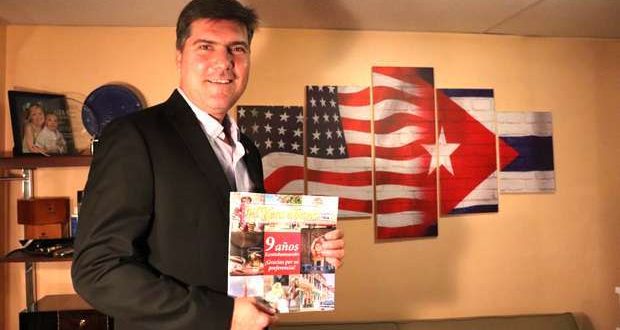
Luis David Fuentes with a copy of El Kentubano magazine. Taken from Insider Lousville.

Iván García, 5 March 2019 — Twenty-five years ago, Luis David Fuentes pedaled 17 kilometers a day on a rough Chinese bicycle through the dark and dilapidated Havana streets towards the CUJAE, today José Antonio Echevarría Technological University, located in Marianao, a municipality in the south of Havana, where he studied mechanical engineering.

Those were the hard years of the Special Period. The people ate little and badly. The blackouts lasted twelve hours. And hunger caused people to replace the usual animal proteins by eating cats, pigeons and sparrows. Fidel Castro had a Plan B in case the famine worsened. It was called Option Zero. Military trucks would distribute food in the neighborhoods, escorted by armed soldiers. It did not reach that extreme. Luis David still remembers that every day he pedaled as if he were a professional cyclist with a piece of dry bread and a glass of water with brown sugar for breakfast.

“It was a difficult stage. I went from El Vedado to CUJAE on that bicycle with hardly anything in my stomach. When I could, I drank a little jug of powdered milk. I returned home after eight or nine hours without tasting a bite. I do not know how I survived and became an engineer. Like most Cuban homes of that time, my parents were integrated in the process, especially my father, a hard-working man, a fidelista who believed to the core the story that utopian socialism would one day arrive. continue reading

My mother was always very clearheaded, but out of respect for my father, she just taught us to believe in God and we knew of the injustice that the Revolution had committed with her father, a Galician emigrant who arrived empty-handed and based on hard work managed to have land, livestock and property. Everything was expropriated by the agrarian reform. My grandfather did not survive that shock and the next year he died. After so much sadness and agony, after a while my grandmother also died. I did not know them in life,” says Luis David by email from Kentucky in the United States.

Very young he began to question the olive green totalitarianism and the economy of barracks implemented by the Castros. “I did not like that the double morality caused by the fear that prevented you from expressing your opinions with sincerity, nor the hypocrisy of the leaders: they preached as if they were proletarians and lived as bourgeois.

I never thought about leaving Cuba. When I graduated, I did my social service of two years in the National Institute of Normalization, an agency where bureaucracy and servility to the ideas of the Communist Party reigned, without the basic resources to work. The salary was 198 pesos a month (8 dollars). I was an engineer, but I felt miserable, with that salary I could not help my parents in the maintenance of the home. That reality made me change my mind and I decided to emigrate.”

He tried first in Venezuela and Colombia. In 1996, finally, he was able to travel to Chile, where before getting a job as an engineer, he was a door-to-door salesman and a doorman in a nightclub. In 2000 he traveled to the United States. Contrary to the vast majority of Cubans, who settle in Florida, because of the weather, to be able to speak Spanish and to see the same sea that bathes the northern coast of Cuba, Luis David, settled in Kentucky, in the southeastern center of the United States. For eleven years he worked as an environmental engineer-specialist in the Kentucky government.

In August 2009, faced with the need for information and publicity from the growing Cuban community, Luis David founded El Kentubano. “It was done with own resources, without external help. Something new for me, because I was not an entrepreneur or a journalist. I did it from nothing. I was learning along the way. The publication is supported by advertisements, one part is distributed free and another by subscriptions.

In the beginning, the money obtained was barely enough to pay the cost of production, printing, distribution and marketing. Many times I had to spend my income to continue putting out El Kentubano. At that time, except for the design, I was the one who wrote, did interviews, looked for sponsors and distributed the magazine, but now I have a team mde up of Yany Díaz, journalist, and Elizabeth Alarcón, designer,

“The digital era has decimated printed publications, but in the case of publications aimed at a specific group, be it health, sports or emigration, far from being extinct they have prospered. And in recent years, thanks to the increase in the Cuban community and new businesses, the magazine’s life was guaranteed. Sponsors contributing this include companies such as Humana, Kroger, Sprint, American Airlines, Toyota and McDonald’s, among others, have seen in The Kentubano a marketing tool and advertise in it. In 2009 a thousand copies of 20 pages per month were printed, today the magazine has 90 pages and 10 thousand copies are printed monthly.”

The Kentubano has color photos on its front and back cover. On the inside pages of the gazette paper, you can see photos and ads in color and black and white. Some of his texts are taken from Cuban digital sites. And in between the ads are interspersed advice to newcomers, interviews with relevant Cubans in Kentucky or recipes for traditional sweets. The business model of digital journalism is under construction. Newspapers like The New York Times already make a profit thanks to their 3.6 million subscribers on the internet. Other media implement proactive strategies and raise money among their readers by asking them what kind of stories they want to read.

“Taking the magazine forward was a titanic task. Two years ago I decided to take a break as an engineer and dedicate more time to my family, to the community through El Kentubano, the Capítulo Kentucky José Martí and the Cuban American Association of Kentucky (ACAK), a group created a year ago and whose members, selflessly, with their own resources, represent and defend the interests of our community under the José Martí motto Helping those who need it is not only part of one’s duty, but of happiness,” says Luis David proudly.

When Luis David arrived in Kentucky in 2000, the number of Cubans did not exceed 500. In 2006 there were already about 5,000 Cubans, currently there are more than 25,000 in Louisville alone, the largest city in the State. “Almost all of them come directly from Cuba and although their knowledge of economics is limited, they have managed to become a thriving and enterprising community that has managed to deal with the cold, language and customs that are so different.

The result of their integration into society is translated into the large number of shops, restaurants, consultancies and small businesses in Louisville. Also important has been the role of doctors, dentists, engineers, lawyers, computer scientists and police officers of Cuban origin, among other professionals with prominent positions in large companies and state offices.

Luis David had to pound the streets of Louisville to get sponsors. “At the beginning, it was difficult to convince Cuban business owners of the importance of advertising. The Cuban of the Island has no idea what marketing is. The only thing they had seen was a bodega manager writing out his accounts on the cash register paper. When you convince the first one, the others followed along, little by little.”

In his opinion, “after Florida, the Cuban community of Kentucky is one of the most prosperous in the United States and it is, per capita, where the largest number of small Cuban businesses exists in the world.” In 2018, Governor Matt Bevin received in his mansion about 200 Cuban leaders and entrepreneurs, a recognition of that community’s contribution to the economy and culture of Kentucky. Luis David has received several awards.

In the wake of the January 27th tornado that killed and wounded many and caused enormous material damage in five municipalities of Havana, Cubans from Kentucky raised $ 6,410. A member of the community traveled to one of the affected areas and personally delivered the donations. Words of thanks from the victims can be seen in this video uploaded to Facebook.

Luis David is married. Yamilet, his wife, is also Cuban and works as an interpreter and translator for the Kentucky government. They are the parents of two children, Fernanda, 15, a high school freshman, and Luis Manuel, 12, a 7th grader. Claudio Fuentes, a prominent photographer and dissident, is his cousin.

Despite having been away from Cuba for more than two decades, he is still passionate about Cuban music. “In 1996 I left for Chile with a suitcase with two changes of clothes. in one hand, a bag with my collection of vinyl records by Benny Moré and in the other my bongo, an instrument that I learned to play in my hometown. My professor was Arturo Linares, El hueso, bongocero by Joseíto Fernández.” Besides dancing salsa and rumba, he likes to drink coffee, smoke tobacco, have a drink of rum and play dominoes. He professes a deep respect for the hero José Martí.

Now established in Louisville, Luis David undertook the task of locating a bust of the Apostle, as Cubans call José Martí, given in 1955 to Kentucky by the Cuban government of the time, as a tribute to the brave Kentuckians who fought for the freedom of Cuba in 1850 and who had been missing for years. The makers of the magazine El Kentubano created a project named Facing the Sun, with the aim of replacing Martí’s bust in the Shively Park in Louisville. With the twelve thousand dollars collected, they were able to restore it and unveil it in a ceremony held on July 21, 2012.

Every 28th of January, that place is a meeting point for the Kentubanos, a name created by Luis David Fuentes, who at age 47 confesses that he does not know where life will take him tomorrow. “I never imagined living in Kentucky, it’s already been 19 years and I do not think I’ll return to the Island when things change. Yes I would like to contribute with my experience, do some business, maybe a magazine, be able to travel to my homeland. But the United States has adopted me as a son, here I have created a family, I have many friends and responsibilities in this society.”

As the Cuban poet Eliseo Alberto wrote, Cuba is a distant piano that someone plays behind the horizon.

Declaration of the “Revolutionary Government”: Late, Murky and Mendacious

Raúl Castro and Miguel Díaz-Canel. Archival photo

Cubanet, Miriam Celaya, Havana, 18 March 2019 — Under the strident title of “Cuba condemns terrorist sabotage against the Venezuelan electric system”, the monopoly of the Castro press disclosed on Monday, March 11th, an official declaration of the “revolutionary government” where it directly accuses the US government of unleashing “an unconventional war” against the government of Nicolás Maduro.

Needless to say, in the 20 tedious paragraphs that make up this statement, although there are many accounts based on the official mythology of the last 60 years of Cuban history, as well as the disqualifying epithets against many current and bygone figures in American politics, the official declaration does not offer proof or a single piece of evidence that the colossal electrical failure that began in Venezuela last Thursday, March 7th, whose effects continue as I write these lines, is the result of “terrorist sabotage”.

And they could not provide any evidence, because as far as several highly experienced electrical engineers have assured – including some who are very familiar with the “sabotaged” installation and the system that produces electricity for 85% of the entire Venezuelan nation – there isn’t the least chance of hacking the Venezuelan electrical system because it is not digital but analog; and on the other hand, the damage that caused the service interruption took place within an area strongly protected by the army and the chavista special security forces. continue reading

This means that no external agent could have been the cause of the disaster and that the Cuban government has no basis to describe terrorist sabotage as an event that, according to Nicolás Maduro himself and other vociferous roosters in his corral, is still under investigation, though they already have some “guilty” detainees and, in the days to come, there will be no shortage of “confessions” and accusatory fingers for sure, pointing against the usual villains.

However, the aforementioned statement by the Cuban government wouldn’t have been so outrageous if it were not for its shocking clumsiness and the fear and concern that transpire throughout its lines. The text is confusing, hazy, and obviously mendacious. It is clear that no preacher or druid of the Palace of the Revolution inherited Castro I’s twisted talent; it is fair to acknowledge that in his glory years he was master among masters in the questionable art of lying convincingly about any event and manipulating the crowds at his whim.

To this should be added that different times and different popular moods are now circulating. Many Cubans today question the double standard of the official discourse that is made clear in the Declaration. How can the Cuban authorities justify accusing the US government of “lying” in the case of the sonic attacks on Cuban officials in Havana because “they do not present evidence of this”, but in turn allow themselves to denounce a “terrorist sabotage” led by the US government against Venezuela, without providing evidence to prove it?

How to explain the selective amnesia of the Castro leadership and its spokesmen, capable of enumerating a multitude of historical examples of Yankee interference in the world and accusing the United States of meddling in the internal affairs of Venezuela, while conveniently forgetting also the numerous military intromissions of Cuba in armed conflicts in Latin America and Africa, as well as the Cuban interference in Allende’s Chile or in the Venezuela of Chávez and Maduro, just to mention well-known and documented examples?

But, returning to the official text, it is obvious that the current scribes of the “continuity” of the Castro sign are emotionless, lack conviction, are dull and forget that more and more Cubans have some access to other sources of information and social networks and, as if all this were not enough, the officials can’t express themselves in writing, as evidenced by this indigestible bundle of useless paper – i.e. “declaration” – where events and characters from different periods and from the most diverse world geographical points are mixed chaotically, and where, in an angry jumble, one sentence attacks Juan Guaidó and in the next, Cuba’s “solidarity” with Venezuela is extolled, the American military bases in the region are enumerated, the participation of Cuba in the operations of the Venezuelan National Armed Forces and in its Security Services is denied (which, paradoxically, seems to reaffirm it) and – as is inevitable – unfeasible figures are mentioned about the achievements of Cuba’s medical services in Venezuela, while inflating those of the victims of the evil US interference in the entire planet.

Obviously, the lords of the cupola look down on Cuban intellect. It would seem that they are writing for that amorphous and hypnotized mass, isolated from the world, uninformed, grateful and credulous, that decades ago applauded the false Messiah, convinced and happy, and not for the people we are today: disenchanted, unbelieving, cynical, irreverent and deeply frustrated. The lords of the power caste do not understand that the corrosive effect of 60 years of deceit makes us distrustful and sarcastic—if not with calculated indifference—of everything that comes from the summit.

So, reading in reverse, now it has been confirmed from the huge Castro press monopoly that the days of Maduro at the Miraflores Palace could be numbered. If something we’ve been taught by these six decades of informative obscurantism is that when the whistles and cymbals of the Plaza de la Revolución replace triumphalist slogans and bravado with warnings and accusations it is because they are already giving up the battle. More than a denunciation, the declaration of the Cuban government tastes like an obituary. Soon or later, Maduro will fall, and, with him, the Cuban dictatorship will lose its main energy sustenance and who knows what and how many other revenues. Diaz Canel’s bad luck is past being a simple streak … and there is more to come.