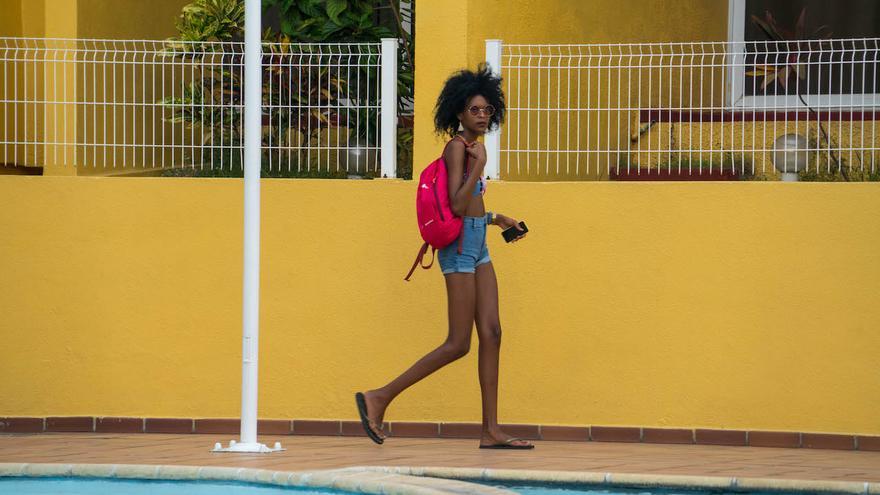

Cuba’s "Sexual Tourist" is No Longer Prince Charming

New technologies, such as chats and dating applications, are widely used by Cubans to arrange a meeting with foreign tourists. (Chris Goldberg)

14ymedio bigger14ymedio, Marcelo Hernández, Havana, 2 April 2019 — The past has many layers for María de la Caridad. In one of them she is the happy wife of an Italian and in another a young woman who has just arrived in Havana with nothing but her own body. In the ’90s she was among the first jineteras (female prostitutes) that took advantage of the legalization of the dollar to offer their services. Today, a widow, grandmother and resident in the island believes that “the business has changed and almost no one is looking for a prince charming.”

“What I did, like many other Cuban youngsters, was more of an escort service and a price was rarely said directly,” she recalls now in a conversation with 14ymedio in her apartment in El Vedado, bought a few years ago when she decided to return to the Island. The death of her husband, a Milanese who fell in love with her “at first sight,” led her to make the decision.

María de la Caridad believes that the business of prostitution on the island “has become hard, direct, without grace.” “Before we knew how to distinguish when it was a client who just wanted one night, versus one who wanted a companion during his entire trip in Cuba, to establish a relationship and perhaps end up in a marriage, but now, from the first moment it is clear that it is an economic transaction,” she says. continue reading

The government kept prostitution under control — considering it a capitalist scourge — through programs of social reinsertion during the first decades of the Revolution, but during the Special Period it became a common exit from the misery.

The characteristics of the Cuban market, where having money did not mean access to a great number of products or more of any one product, in the case of rationed ones, caused a mutation in prostitution. The “companion” sought the privileges of generals, ministers and other leaders.

Starting the 1990s, large areas of Cuba, such as Guanabo beach east of Havana, became the epicenter of jineteras and clients who were seen to come and go, despite police control. Those were the years when, most of the time, the women negotiated directly with the tourists. Many ended up married to foreigners and emigrated.

“In Milan I met several Cubans who had experienced the same thing and we were very supportive of each other in those early years,” says María de la Caridad. “As time passed and we were having our families, we called ourselves the jinatera grandmothers,” she explains with humor.

The landscape has changed a lot since the times of María de la Caridad. The competition is greater with the pingueros (male prostitutes), who offer all kinds of services to men and women. In addition, the pimps and the seclusion in brothels “complicate their situation,” says this Cubana who sometimes interjects words in Italian. “Now women have less independence and finding a good husband is very difficult in those conditions.”

A few yards from her house, two young people were preparing this Saturday to go to 23rd Street, to one of the state clubs that are a frequent meeting point between prostitutes and customers. They are 17 and 19 years old, respectively, and their names in this report are. Both have been in the business since junior high, and the youngest is preparing to enter the university this year.

The two young women use new technologies, such as chat rooms and some dating applications, to meet foreigners who occasionally visit Havana. “Everything is clarified from the beginning and a price is established, he knows that it is not about love, but a bit of fun, and for me it is an important economic support,” explains Karla, who has been in the business for two years.”

“An important sector of women, educated and trained, is marginalized: many of them have a technical or professional training and their individual and family biography would place them in a more favorable position in social life,” explains Cecilia Bobes, who has a doctorate in Sociology. “There is also a change in the values of young people, who begin to see in the activity of the jinetera as a normal job, a way to earn a living and a survival strategy in the face of the crisis.”

Mara and Karla have managed to evade, until now, the pimps because they manage their contacts directly. “But many of those in this business prefer to have more protection and have someone to represent them, to look for the tourist and someone who can help if the thing gets ugly,” she says.

Pimping is one of the main crimes related to human trafficking and the pimps resort, in most cases, to violence, intimidation and drugs to obtain economic benefits, especially exploiting women. “At the moment I am doing well alone and I try not to put myself in high risk situations,” says Karla.

Procuring and trafficking in persons are punishable on the island, but prostitution is legal. Cuban authorities maintain police controls, especially on women, who are fined or deported if they come from another province. In the worst cases, they are interned in work farms to be “re-educated.”

The dream of Mara and Karla is to save some money to leave the country, but they do not believe that they can leave like María de la Caridad, directly through a client.

“All I want is for them to pay me and leave because I can not imagine marrying a man who knows I’m doing this. When I leave Cuba I’ll make a clean slate and start looking for a partner for love,” explains the youngest of the two women. Karla nods: “This is a business, there is no affection or plans for the future, it’s just about sex and money.”

______________________________

The 14ymedio team is committed to serious journalism that reflects the reality of deep Cuba. Thank you for joining us on this long road. We invite you to continue supporting us, but this time by becoming a member of 14ymedio. Together we can continue to transform journalism in Cuba.
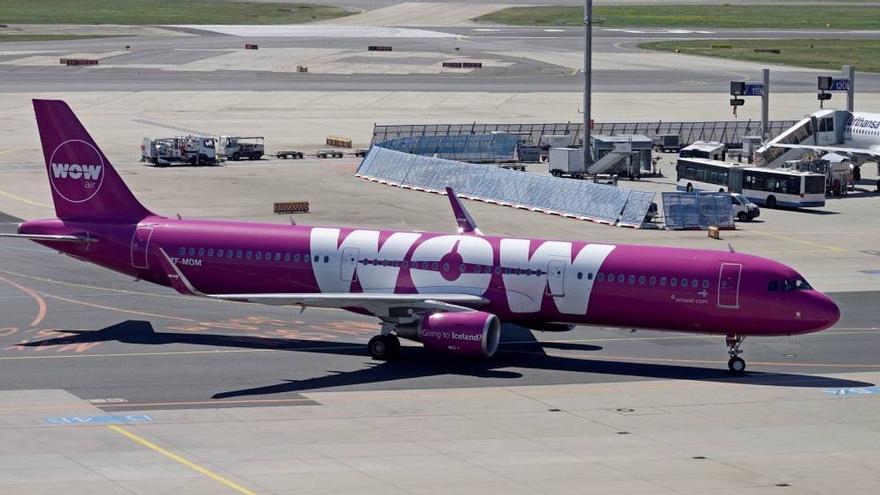
Wow Air Shutdown Affects Flights Between Miami and Cuba

Founded in 2011, Wow Air operated flights between Iceland, Europe and North America, and last year transported 3.5 million passengers.

14ymedio bigger14ymedio, Havana, 29 March 2019 — The Icelandic company Wow Air announced on Thursday it was ceasing operations and cancelling all its flights, which includes several flights scheduled from Miami to Cuba. Two flights had been planned for yesterday, one to Santa Clara and the other to Camagüey.

As of last Friday, dozens of Cubans were stranded at the Miami International Airport due to the cancellation of charter flights operated by Wow. The financial problems of the airline have finally forced it to close.

In the statement, the low-cost airline recommends those affected who they bought their tickets with a credit card to contact their bank to see if they qualify for a possible reimbursement. continue reading

For those who purchased their ticket through a European agency as part of a tour package, the solution is simpler because they are covered by the Community Directive on travel packages. These passengers can contact their agency to fly with another company.

Those who had a travel insurance contract or have it included in their credit card can access the compensations provided in each case.

It will be more complicated if would-be passengers try to get a refund from the company, due to its closure, although the airline also urges them to take advantage of European regulations on air passengers’ rights, stating that they should address their complaints to the administrator or liquidator of the bankrupt company.

In December of last year, the Institute of Civil Aeronautics of Cuba (IACC) authorized the operations of Wow Air to serve Cuba.

Wow faced heavy debts and had tried to close deals and investments with two companies, Indigo Partners LLC and Icelandair Group, without success.

The airline said in a statement last Sunday that its negotiations with Icelandair Group were canceled after the company decided that “its possible participation in Wow’s operations, as announced on March 20, 2019” would not materialize.

The first cancellations occurred at that time and the final outcome now is the end of all operations.

Founded in 2011, Wow Air operated flights between Iceland, Europe and North America, and last year transported 3.5 million passengers.

__________________________

The 14ymedio team is committed to serious journalism that reflects the reality of deep Cuba. Thank you for joining us on this long road. We invite you to continue supporting us, but this time by becoming a member of 14ymedio. Together we can continue to transform journalism in Cuba.
Iberostar and Melia Prepare Their Defenses in Face of the Hardening of the Embargo

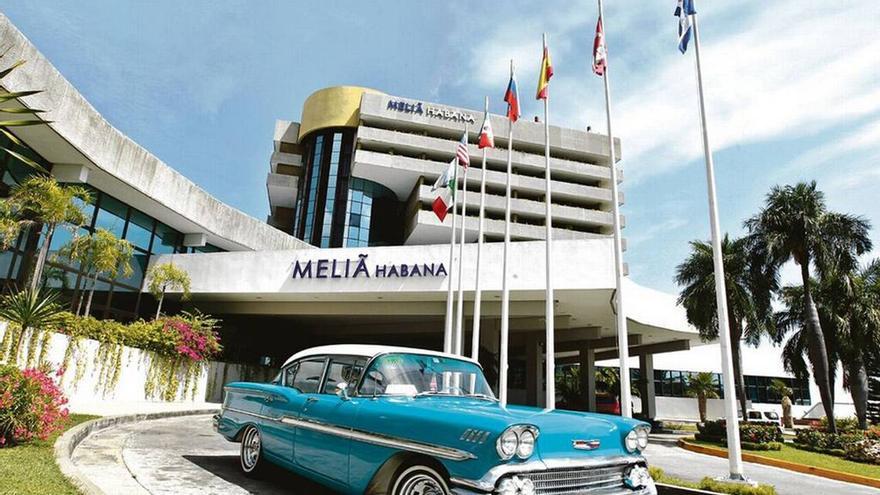
The Spanish hotel company Meliá has 32 hotels operating on the archipelago, 7 in construction, and some 15,000 rooms. (14ymedio)

14ymedio bigger14ymedio, Madrid, March 25, 2019 — Iberostar and Meliá, the two big Spanish hotel companies with major investments in Cuba, are preparing themselves in face of possible claims after the Trump administration partially activated Title III of the Helms-Burton Law. According to the Spanish economic newspaper Cinco Días, the hotel companies had already contracted the services of several lawyers’ offices to face eventual legal problems.

Title III of the Helms-Burton Law, approved by the United States in 1996, provides for the possibility of bringing claims in front of American courts which could result in the confiscation of properties in the United States owned by businesses with operations in Cuba.

In the last 20 years Washington has suspended the application of this title of the Law, but on March 17 the government of Donald Trump made the decision to apply it in a partial manner. continue reading

For the time being, people and companies are able to sue companies sanctioned by Washington that operate in Cuba and that are included on a “black list,” which principally affects those linked to the Revolutionary Armed Forces (FAR). In this case are found some hotels of Gaviota, which manages Meliá.

The main fear is that when April 17 comes, Trump will not definitively renew the suspension and allow the attempts to recover confiscated goods.

According to Hermenegildo Altozano, associate at the law office of Bird & Bird consulted by Cinco Días and an expert in Cuban affairs, Trump intends to use the pressure of economic measures to force political changes.

Marco Rubio is leading that strategy, explains the lawyer. “He is a very important, influential senator, who wants to make a political career and is using his power to try to convince Cubans in exile and in the US to make claims and reactivate the mechanism of coercion,” business sources close to Trump pointed out to the newspaper.

Ignacio Aparicio, associate of Andersen Tax & Legal and director of the Cuban Desk, also consulted by Cinco Días, says that there are around 6,000 certified claims before the Commission of Liquidation of Foreign Claims run by the Government, in the amount of approximately $9 billion, although the figure is conservative.

According to Cinco Días, experts on this matter rule out a priori that it comes to expropriating, but they consider other economic measures possible. “I see it as highly improbable that one of the certified claimants is able to begin the claims process, but if it did this it could generate a deterioration of the credit qualification of the companies and could provoke a cut of lines of credit to the Spanish companies,” said Altozano.

Another office consulted, which did not want to identify itself, doesn’t dismiss the resources so much. “The pulse could intensify if it passed from threats to reality and the American government could also opt to seize cash flows or assets of the company on American soil,” they declare.

Meliá has 32 hotels operating on the archipelago, 7 in construction, and some 15,000 rooms, while Iberostar has 21 hotels and 6,300 rooms. The latter has an important expansion plan approved to reach 12,000 rooms in 2020.

Last week the Spanish Chamber of Commerce called on the European Union for a common stance to fight in this framework. The body asked for actions aimed at avoiding the application of the Helms-Burton Law in an extraterritorial manner to European and especially Spanish citizens and countries.

Among the actions that could be carried out, it points out the application of Article 6 of the Blocking Statute of the European Union, which permits member States affected by the Helms-Burton Law to initiate legal actions on European Union territory against American companies demanding sanctions on European countries with interests in Cuba.

Translated by: Sheilagh Carey

_________________

The 14ymedio team is committed to serious journalism that reflects the reality of deep Cuba. Thank you for joining us on this long road. We invite you to continue supporting us, but this time by becoming a member of 14ymedio. Together we can continue to transform journalism in Cuba.
Sodom: The Cuban Chapter

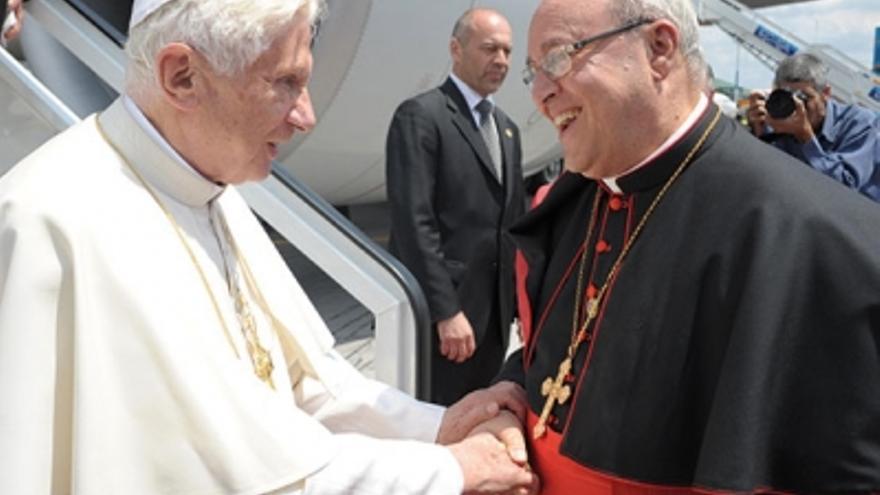
“Sodom” reveals that his trip to Cuba was crucial in the resignation of Benedict XVI. (CubaSí)

14ymedio bigger14ymedio, Reinaldo Escobar, Havana, 19 February 2019 — The newly released book “Sodom: Power and Scandal in the Vatican” can be taken as a scandalous revelation for some or as the confirmation of their suspicions by others. Either way, the 600 pages of the book will create a buzz about the inner life of seminars and parishes, all the way up to the religious elite.

By the French author Frédéric Martel, Sodom is being published simultaneously in eight languages and in twenty countries. The axis on which the text revolves is the extension of homosexuality in the Catholic Church, but it also touches on the crisis of values, pedophilia scandals, cover-ups and power struggles. Cuba is not on the sidelines and the island is signaled as one of the reasons for the fall of a Pope: Benedict XVI.

The author claims to have interviewed about 1,500 people during a field investigation that lasted more than four years. Cardinals, bishops, apostolic nuncios, priests and seminarians gave testimony. “A reality that I myself maligned, although many will consider it pure invention, a fable,” explains Martel. continue reading

Starting with the prologue, Sodom alerts the reader that the revelations refer to the dissolute behavior of those in the clergy who behave publicly as moralists but in private life engage in a wide range of sexual excesses and crimes ranging from orgies to corruption of minors and abuses.

The Cuban chapter is entitled The Abdication because it reports that the resignation of Joseph Aloisius Ratzinger was due, among other reasons, to the traumatic event that proved to him that the Church of the Island was not safe from evils such as pedophilia, which was known to have spread through several countries of Latin America.

In the most daring paragraph on that subject the author relates what happened in 2012, when the pope was flying to Cuba. “When the saintly father listened to what was said to him, and learned above all about the extent of the problem of the archdiocese of Havana, although he already knew the extent of the ‘filth’  of the Church (according to his own words), he now felt repugnance. According to one witness, the Pope, upon hearing this story, wept again.”

The “evidence” of these observations is obtained by Martel, according to he himself, from “three foreign diplomats accredited in Havana and several Cuban dissidents who remain on the island.” To the list of confidants are added “some Catholics from Little Havana in Miami, the Protestant pastor Tony Ramos of Cuban origin, as well as the journalists from WPLG Local 10. ”

The highlight of everything about Cuba is an encounter with Cardinal Jaime Ortega, in which, it seems, the main topic of the conversation was the Government’s relations with the Church. The interviewer physically describes the cardinal, presents a portrait of his personality, details the environment in which he lives and recounts the most familiar passages of his biography.

However, at least because of what was reported in Sodom, the journalist does not seem to have directly asked Jaime Ortega if he knew of cases of sexual abuse or pedophilia among his top hierarchy in the Catholic Church. Nor does it relate whether he asked him directly about his sexual preferences or whether he heard from him about this topic.

Other interviewees such as Orlando Márquez, Roberto Veiga, Monsignor Ramón Suárez Polcari, spokesperson for the archbishop, director of the Felix Varela Cultural Center and a layman named Andura express opinions on various matters, especially on what the Church had to cede in order to reach an acceptable harmony with the government, but rarely do they allude to the core of the investigation of Martel, who has said that “the Vatican has one of the largest gay communities in the world.”

Instead, in the chapter’s plot line, information of a political and diplomatic nature is juxtaposed, which the reader will be able to link in a cause-and-effect relationship with possible internal affairs of the bedroom. The author also takes the ingredients of the rumors and speculation which turns that part of the book into a bundle of gossip rather than a list of certainties.

After talking about Jaime Ortega’s concessions to the Cuban government, he says: “The regime knew perfectly the relationships, the meetings, the travels, the private life and the customs of Jaime Ortega, whatever they were, given his hierarchical level and his frequent connections with the Vatican, it is clear that the cardinal was guarded 24 hours a day by the Cuban political police.”

The idea seems a truth like a mountain, in a country with an extensive network of informers and a sophisticated political police trained in the methods of the German Stasi (Ministry for State Security) and honed with decades of experience, information gathering and the purchase of loyalties.

From a distance without coming to a conclusive statement, Martel adds: “One of the specialties of this police is precisely to engage prominent personalities by filming them in their sexual adventures, at home or in hotels.” A good listener with few words would suffice, but a journalistic investigation needs more than insinuations.

To fit his thesis, the author generously cites the testimony on Miami television of an ex colonel of the Cuban Revolutionary Armed Forces, Roberto Ortega, who “hinted that Archbishop Jaime Ortega would lead a double life: he would have had intimate relationships with an agent of the Cuban secret service.”

Frédéric Martel excessively bases his half-affirmations in “it is said,” “some sources affirm,” or “it seems that.” Too many voices that opt for anonymity, the absolute absence of testimonies from the victims and, of course, no probative documentation.

The scandals that have shaken the Catholic Church throughout the world have been mostly uncovered by those affected and by the voluntary declassification of some files. It would be a real miracle if the Cuban Church did not have similar cases in its 500 years of presence on the island, but obviously these have not reached the hands of the French author.

Instead of revelations, the section devoted to Cuba may seem to the eye of the local reader as a repertoire of gossip, a sequence of half-truths or stories shared from balcony to balcony. As it fails to convince of a dissolute life and the violation of a priest’s vow of chastity, it ends up making them seem like victims of intrigues and opinions issued by the laboratories of State Security.

It’s a shame, because the subject promises a lot. Sodom at least serves to bring to light a reason to open a public debate. It will be up to Cuban social investigators and journalists to take their questions to the temples and to the ecclesiastical authorities, to assume the responsibility of denying the false and revealing the true.

That this book encourages potential victims to speak could be its greatest achievement in this place where secrecy has become an inseparable part of life in too many orders: the State, the Church and the family.

________________

The 14ymedio team is committed to serious journalism that reflects the reality of deep Cuba. Thank you for joining us on this long road. We invite you to continue supporting us, but this time by becoming a member of 14ymedio. Together we can continue to transform journalism in Cuba.
The Glorious People of Cuba Accept Life With Pain and Without Glory

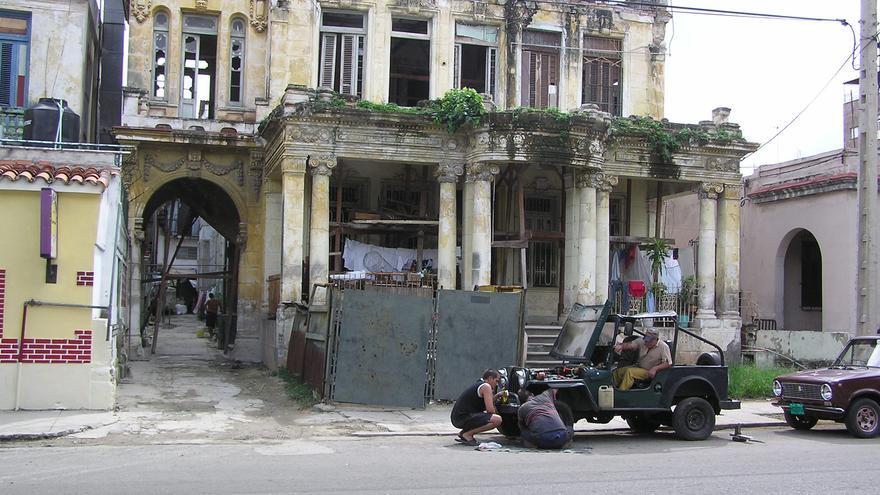
El Vedado, the old stately neighborhood in the heart of Havana, full of ruins. Here, what was a small palace (14ymedio / BDLG)

14ymedio bigger14ymedio, Juan E. Cambiaso, Buenos Aires, 25 March 2019 — It’s the fourth time I’ve been to Cuba. Against my natural inclination to go to a five-star hotel, this time I hired a private apartment in El Vedado, to be with the people. It is located on 17th Street, one block from the Museum of Decorative Arts, which was an elegant street and today is just a gutter through which spoiled memories run.

This time Havana moved me, as always, but I did not like it. Havana, Cuba in general, went from picturesque to stubborn. Struggle for the path that does not suit it and renounce others that would make it better. Cuba is masochistic.

The music and the sound that emerges among the cobblestones delighted me on the first trips. In this return I managed to separate the music from the musicians. The first delights me as always. The musicians, who emerge everywhere, are like smiling zombies that resuscitate an original past, prior to the Revolution, because there is nothing left to show. The Castros and their acolytes replaced reality with hypnotic slogans that generate vibrant attachments, however empty of substance and overflowing with stimuli for primary feelings. continue reading

The owner of the apartment does not get milk for breakfast, the restaurant does not get chicken for fettuccine Alfredo, the bar in front of the Cathedral has the same problem with beer, the international pharmacy has no alcohol, gauze or adhesive cloth to heal a wound I got when I fell, the homeowner with gastritis does not get omeprazole (Prilosec). The explanation is reiterated: “For now, we don’t have any.” And so they live, with what there is for now.

The glorious people of Cuba accept to live with pain and without glory, believing that the latter will be the consequence of living in pain. And from there comes everything else. The dream of the Jesuit alumnus who made it happen was that they believed that the suffering in this Cuban world was the guarantee that the secular paradise would finally arrive. Until victory always, victorious for now, no. Revolutionary Cuba is a victory in gestation. A pregnancy of half a century that has no childbirth in sight.

The most surprising thing is that they do not get angry atthe adversity or its causes, that they live relaxed, lazy, some working and others making like they work. Many believe they are striving to make the dream of el Comandante come true.

Nobody competes with anyone and everyone makes between 25 and 30 dollars per month. The freedom to engage in business is limited, rickety, among the ruins. Private micro-businesses, such as small restaurants and rented rooms in family homes (which are chosen because their low price justifies living with little comfort and seeing what happens), sprout like mushrooms.

The construction in Havana draws attention. But it’s only about foreign companies that build super hotels. Not hospitals, nor schools, nor homes for ordinary Cubans. The Vedado neighborhood continues in free fall and Centro Habana collapses despite a face wash for the facades along the Malecón.

Cuba is a great tide of good people who take it all because, as in the movie The Truman Show, they have been led to believe that this broken stage is true life. I did not hear anyone say that there was going to be a collective civic effort to try to change “the thing.”

A week after leaving the island, the first time, I no longer have the taste of rum, the smell of the sea, the music of the ropa vieja (shredded beef) and the fruits of the sea, which previously lasted a long time tinkling in a glass.

__________________

The 14ymedio team is committed to serious journalism that reflects the reality of deep Cuba. Thank you for joining us on this long road. We invite you to continue supporting us, but this time by becoming a member of 14ymedio. Together we can continue to transform journalism in Cuba.
Congolese Students Protest the Delay in Their Scholarships in the Streets of Havana

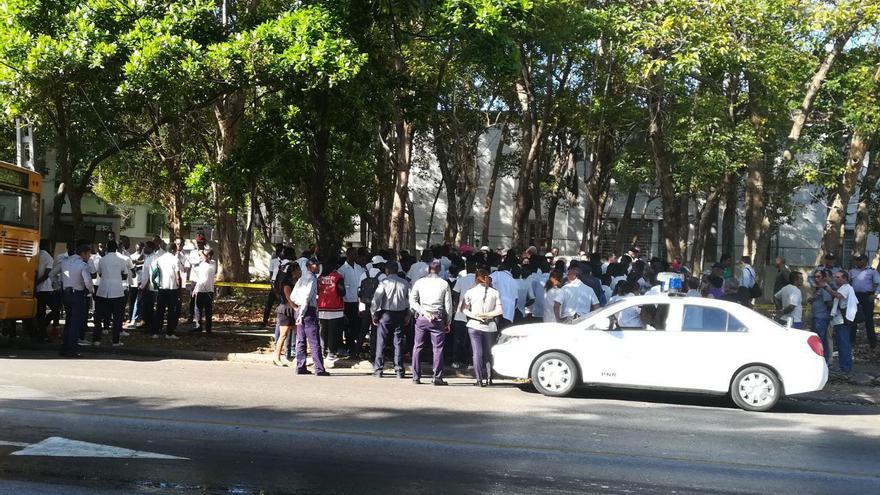
In front of the mansion on Fifth Avenue, between 10th and 12th, a large group of Congolese who study Medicine in Cuba gathered this morning. (14ymedio)

14ymedio bigger14ymedio, Havana, 26 March 2019 — Dozens of Congolese students protested Tuesday in front of their country’s embassy in Havana over the delay in the payment of their scholarships. The diplomatic headquarters of the Republic of the Congo was surrounded by a strong police operation while several officials ask for the young people’s “understanding,”14ymedio was able to confirm.

In front of the mansion of Fifth Avenue, between 10th and 12th, in the Miramar neighborhood, a large group of Congolese who study Medicine in Cuba gathered this morning. The young people shouted for the payment of their overdue stipends and asked the diplomatic headquarters to solve the matter urgently.

“We have gone months without receiving the payment that covers our basic needs for food and transportation,” one student, who declined to be identified, told 14ymedio. The amount, a little over 300 dollars, is essential for the young people because “the shelters where we live are in very bad condition and without that money everything is more difficult.” continue reading

“Since the beginning of the year we have not received a penny and some of us are surviving thanks to the help of other students and our families, but this can’t go on,” said the student. “If this is not resolved, many of us are ready to return to the Congo, because this is not living, so you can not study.”

This is not the first time this type of situation has occurred. At the beginning of 2015, the Congolese Loïc Junior Niombo, aged 20, was missing for two weeks. He was a member of the Union Committee for the Defense of the Rights of Medical Students from his country and was at the forefront of the negotiations during the crisis generated by the non-payment of the scholarships of the first 500 Congolese university students who arrived in Havana in 2013.

In the face of student protests, the then ambassador of the Republic of the Congo in Havana, Pascal Onguiémbi, proposed repatriating the six members of the union. The president of the African country, however, after estimating that it was not necessary to resort to expulsion, ensured that the students received part of their overdue scholarships.

The unionists claimed the remaining amount was seized by order of the ambassador shortly before Christmas, under the eyes of the authorities of the university campus. The Congolese National Convention of Human Rights (Conadho) then said that they were taken to a penitentiary center about 80 kilometers from Havana and released a few days later.

For decades, Cuban authorities have developed an extensive study program for foreigners on the island. It is currently estimated that 2,500 people from the African continent are students of Cuban faculties and, among them, about 800 Congolese are training as future doctors.

The Latin American School of Medicine (ELAM), founded in 1999, offers six-year studies to scholars from different countries and currently  enrolled in its classrooms, for different medical disciplines, are students from 44 African countries.

Recently, Clement Mouamba, Congolese prime minister, conveyed to the Cuban ambassador in that country, José Antonio García González, his gratitude for the invaluable support of Cuba in the training of human resources, according to the official press.

Last January fifty medical students from Kenya announced that if they did not solve the “problems” they are having on the island as soon as possible, they will abandon their studies and return to their country, according to the Standard newspaper of Nairobi.

A protest by a group of medical students from Pakistan was suppressed in 2010 by forces of an unusual anti-riot squadron at their residence at the Santiago Haza School of Medicine, in Jagüey Grande.

________________________________

The 14ymedio team is committed to serious journalism that reflects the reality of deep Cuba. Thank you for joining us on this long road. We invite you to continue supporting us, but this time by becoming a member of 14ymedio. Together we can continue to transform journalism in Cuba.
The Confession of a Tyrant

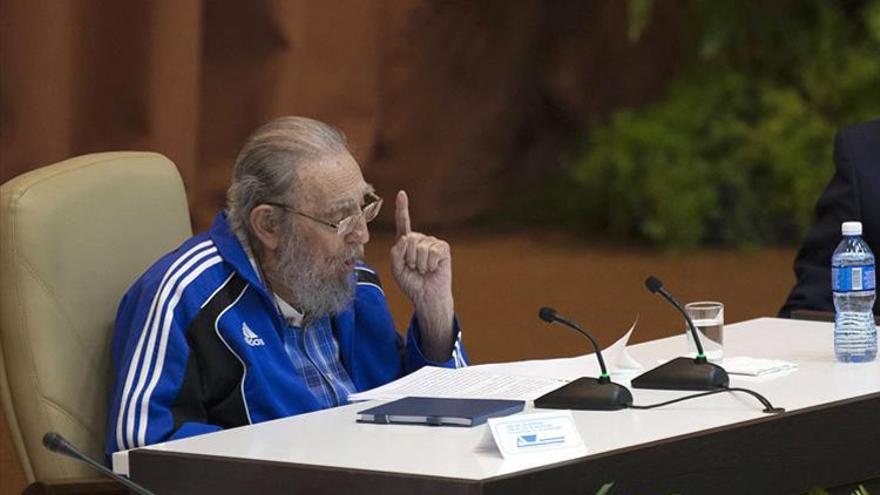
Fidel Castro during one of his last public appearances (Cubadebate)

14ymedio bigger14ymedio, Ernesto Santana, Havana, 31 March 2019 — In 1999, during a visit to Cuba by then Illinois Governor George Ryan, Fidel Castro gave a press conference in the Great Hall of the University of Havana before dozens of journalists. I couldn’t believe I was there, thanks to my role as a guide for the Chicago Telemundo team and as an assistant to the cameraman. Among the journalists covering the governor’s visit was Alejandro Escalona, winner of the Studs Terkel Prize in 2014.

Unusually, at the end of the press conference, Castro allowed himself to be surrounded by the journalists, who interrogated him about a thousand things, but the limelight fell on the editor of Éxito who asked him why he did not hold a plebiscite as Pinochet had done, to which El Comandante replied, stung: “You are comparing things that have nothing in common.”

Jorge Ramos — the Univision journalist who recently drove Nicolás Maduro crazy and who shares a courageous interviewer lineage with Escalona — apparently was there and, shortly afterwards, recounted what had happened in an article. Perhaps memory deceives me and today my description does not agree with his on some minor points, about that question like a gunshot: “If the people have the power, why don’t you leave the presidency?” continue reading

Then, like a bomb, in front of the cameras of half the world was heard, “Because I don’t feel like it!” Shortly after, el Comandante left, but it wasn’t even two minutes later when, in plain sight of all of us, a guard hurried up asking for “the Mexican” and left with Escalona, followed, of course, by all the journalists.

Fidel Castro had understood his enormous error. He had revealed to the international audience that, in effect, he was a despot and ruled “as long as I feel like it,” but the damage had to be repaired. Beside the open door of one of his black Mercedes Benzes, in the middle of the swarm of guards and reporters, with all the cameras and microphones pointed at him, he deployed his acting skills, giving the usual explanations and showing his interrogator a very friendly face.

He didn’t have to say any more. Escalona had achieved what every interviewer pursues and very rarely achieves: revealing the essence of his interviewee: making the truth visible. Ramos himself relates in his article that in 1991, in Mexico, in a brief encounter with the dictator, he had also asked about a plebiscite, but he only managed to get a shove from a bodyguard who knocked him to the grass.

Alejandro Escalona has met many important figures and always, as those who know him well, as a practitioner of the best American journalism of transparency and a follower of the master Studs Terkel, he has objectively pursued information, but surely at that moment in 1999 he was one of those who felt he had most fully realized his role as a journalist and most identified with his professional mission.

___________________

The 14ymedio team is committed to serious journalism that reflects the reality of deep Cuba. Thank you for joining us on this long road. We invite you to continue supporting us, but this time by becoming a member of 14ymedio. Together we can continue to transform journalism in Cuba.
Confirmation of Electoral Constituencies / Cubalex

From Cubalex – January 2019 

Step 5

Before calling elections, the Municipal Assemblies of Peoples’ Power (AMPP), divide their areas up into electoral constituencies, on the basis of the number of inhabitants in the Council area, and, after they have constituted them, present a proposal to the Municipal Electoral Commission, which, in turn, submits them to the respective Provincial Electoral Commission for approval.[1] The law does not lay down a time period in which to do this.

Note: This should happen before the Electoral Constituency Commissions are constituted, which, according to the official media, should happen before January 13th, 2019, the date upon which all the national electoral entities should be in place. The logic is that, in order to constitute the Electoral Constituency Commissions, the electoral constituencies should already have been determined. The law is silent on this matter. continue reading

In view of the haste with which this process has been carried out, it must be assumed that the constituencies approved for the previous elections in 2017 and 2018 will be used. At that point, they created 12,515 constituencies throughout the country, and 24,361 electoral colleges. 8% of the electoral colleges were in private houses.[2]

Step 6

The Provincial Electoral Commission decides the proposals for electoral constituencies submitted to them by the Municipal Electoral Commissions.[3]

Note: This should happen before the Electoral Constituency Commissions are constituted, which, according to the official media, should happen before January 13th, 2019. It is estimated that at least 12,515 electoral constituencies will be created across the whole country, based upon the official data on the elections which took place in 2017 and 2018. [4]

Step 7

The Municipal Electoral Commission designates the members of the Electoral Constituency Commissions in the time period established by the Council of State (between the 4th and 13th of January, 2019) in order to establish the subordinate electoral organs.[5]

[1] Article 12 and Subsection b) Article 26 of Law No. 72 of 29th of October 1992, “Electoral Law”.

[2]  http://www.granma.cu/elecciones-en-cuba-2017-2018/2017-07-21/mas-de-20-000-colegios-participaran-en-los-comicios-21-07-2017-00-07-58

[3]  Subsection f) Article 24 of Law  No. 72 of 29th October, 1992, “Electoral Law”.

[4]  http://www.granma.cu/elecciones-en-cuba-2017-2018/2017-07-21/mas-de-20-000-colegios-participaran-en-los-comicios-21-07-2017-00-07-58

[5] Subsection c) Article 16, Article  21, Subsections c) and ch) of Article 26, Article 29 and Subsection ñ) Article 30 of Law No. 72 of 29th October, 1992, “Electoral Law”

Translated by GH

Cuba’s Economic Forecasts for 2019 are Pie in the Sky

José Luis Rodríguez has given an account of the forecasts of the economic plan for 2019, not without first recognizing that “this year the world economy will face a situation even more complex than what was present in 2018.”

14ymedio bigger14ymedio, Elías Amor Bravo, Madrid, 27 March2019 — The The Castro regime’s former minister of the economy, José Luis Rodríguez has reported, in an article published in Cubadebate, on the forecasts for the authorities’ economic plan for 2019. He begins by acknowledging that “this year the world economy will face a more complex situation even than that of 2018.” And he is right. We have already said it several times. The Cuban economy in 2019 could be faced with a very difficult exercise in which anything can happen.

Therefore, and contrary to what Rodriguez says — to wit, “this situation will affect the economic performance of our country, to which is added the foreseeable increase in the negative impact of the US blockade, taking into account the new measures adopted by the government of Donald Trump already in the first months of this year, including the application of Title III of the Helms-Burton Act” — I intend to show in this article that the authorities are the ones to blame for the deficient “planning” for the Cuban economy.

We can orient ourselves with a look at the forecasts. continue reading

For example, for goods exports, growth is estimated to be 6%. A figure clearly excessive, if one takes into account this environment of lower growth of the global economy. And excessive if compared to the evolution experienced in this variable from 2012 to 2017. In those years, and with government data from the National Office of Statistics (ONEI), exports have decreased at an average rate of -3.5%, with some years collapsing -19.7% as happened in 2016. I do not know, therefore, where the planners of the economy invent that 6% for 2019 which, like every year, will end up being unmet, with the negative effects that this has on other variables of the economy.

Another excessively optimistic forecast it that of tourist revenues which, according to the leaders of the regime, should grow by 17.6% Another piece of incongruous data, as the lower growth of the global economy will exert an influence on the demand for tourism trips, and especially sharply so in European countries, which are Cuba’s main markets. Thinking about that 17.6% is pie in the sky to calm the Spanish hoteliers, who know that this can not be achieved. More prudence would have been the right thing to do.

And we continue.

As regards the total investments, so necessary in a decapitalized economy that has a sickly obsession for prioritizing current spending, a growth of 20.1% is planned, reaching 11.3 billion pesos. Once again, the ONEI imposes the number. In none of the 6 years elapsed between 2012 and 2017 has investment exceeded of 10 billion pesos, the average balance being 7.751 billion pesos.

To think that it can reach 11 billion pesos in 2019, with the existing difficulties, is more pie in the sky that undermines the credibility of the design of Castro’s economic policy. Furthermore, this already high level of investment continues to limit the participation of gross capital formation in GDP below 10%, with its negative effects on growth potential.

Forecasts with regards to direct foreign investment are the same thing, with growth estimated at 6.2% of that total, up to 700 million pesos, a far cry, of course, from the goal of two billion pesos that has been pointed out for years to justify the monster known as Law 119. I doubt very much that these figures will be reached with the forecasts of movements of capital at an international level associated with a lower global growth and the limited attraction of investing in Cuba.

The communist planners have established that imports will decline 11.2% compared to what was planned for 2018, with the aim of curbing the country’s foreign debt, which is based on conditions that allow access to financing new credits needed to prevent the economy from going bankrupt. The repossession of foreign currency in hotels that has been practiced since January is only the first step among all the actions that the regime must implement to avoid international bankruptcy.

Cuba’s communist planners remain convinced of the need to replace imports with domestic products, and this it be achieved in an economy that desperately needs technology, intermediate goods and even consumer goods from abroad, because domestic production is unable to meet the demands of the population.

The most curious thing is that this macroeconomic picture is expected to be achieved through the “four basic linkages with foreign investment” and Diaz-Canel talks about nothing else in his habitual meetings to report on progress. Namely, “those related to the growth of production, tourism, exports and the non-state sector, which have been estimated to contribute around 20% of GDP, although in sectors of low productivity, but which already absorb 31% of the workforce.”

With this laundering of figures — absolutely incredible — those responsible for the economy estimate a GDP growth in 2019 of 1.5%, just 4 tenths above what was achieved in 2018, which has little hope of improvement. And they remain so calm, because in Cuba nobody is going to question that scenario, much less offer another alternative that objectively improves the living conditions of the population.

Obviously, I can not trust this design, nor the estimations whose rigor is questionable, let alone give credit to the analysis made by the planners. To think that an increase in exports combined with a decrease of imports can be beneficial in the present conditions of a contracting economy is a serious error. To believe that the recovery of agriculture or tourism can increase the supply and allow the advance of investments is to fail to understand that, for the same reasons as in 2018, these forecasts can fail for meteorological reasons or whatever.

The communist planners’ other “ideas” — for lack of a better word — are to reduce idle inventories by 2%, to support 400 million dollars in the production of goods and services, to reduce the budget deficit of 9% in relation to the GDP in 2018 (predictably higher) to 6.1% this year, with a decrease of 3.06 billion pesos, without affecting the basic social services of public health, education, security and social assistance, something that is simply impossible and the authorities know it, and thus they will further strangle internal liquidity, especially for self-employed workers.

Financing the construction of 32,000 homes in just one year, certainly complicated for economic policy, is more pie in the sky, not to be fulfilled because it begs the question of where they are going to get financing. Lastly, but no less important, reducing the external debt service by 2.8% and the total debt by 1.5%, is an interesting action, but with limited effects because the level of the debt is so high that its sustainability is complicated. Small steps, without commitments or credibility, do not help much.

The Cuban economy can not improve with this design of the Castro regime’s economic policy because it is outdated, obsolete, inefficient and does not go directly to the origin of the problems. Undoubtedly, fundamental actions such as maximum respect for property rights, flexibility and liberalization in matters of production, private companies, investment by Cubans and not only by privileged foreigners, freedom of choice and development of markets and logistics are all lacking.

There are so many things that have to be done, that believing in this design of communist planning is like believing in a fairy tale. What happens is that in Cuba, these Castroite fairy tales always end badly. Very badly.

 ________________

Editor’s note: This article was originally published on the blog Cubaeconomía. We reproduce it with the authorization of its author.

The 14ymedio team is committed to serious journalism that reflects the reality of deep Cuba. Thank you for joining us on this long road. We invite you to continue supporting us, but this time by becoming a member of 14ymedio. Together we can continue to transform journalism in Cuba.
Fewer Potatoes, More Business

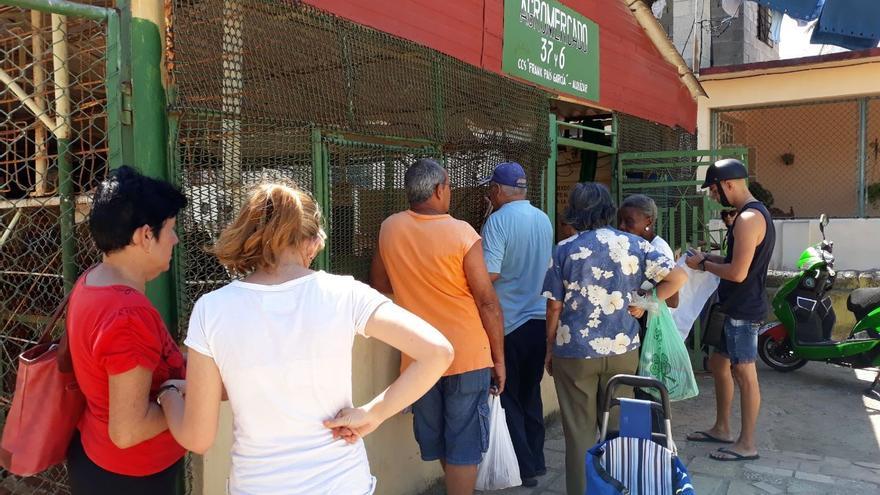
The line to buy the potatoes at the La Timba market at 37th and 6th in the Plaza municipality. (14ymedio)

14ymedio bigger14ymedio, Zunilda Mata, Havana,  27 March 2019 — “Between the end of February and April I do ’the harvest of potatoes’,” jokes Jaime, the fictitious name of an illegal seller of the tuber, in conversation with 14ymedio. “Before, I used to sell shrimp and lobster, but this is less dangerous, because despite having to move larger volumes, it does not leave a trail of odor like seafood does, nor is it so controlled by the police.”

Five years ago, Jaime went to the 19th and B market in El Vedado in Havana to buy some yucca and ended up talking with an informal vendor who offered a bag with 5 pounds of potatoes for 1 CUC. “I realized right away that there was a niche market and I started looking for contacts to do the same.”

At that time, he says, he was lucky. “The price of the potatoes went up because they have been scarce, so that same bag I now sell for 2 and even 3 CUC, it depends on the type of customer,” he says. “I sell from home and I have my network of contacts that are basically paladares (private restaurants), foreign diplomats and Cubans who can spend more.” continue reading

“I have two supply routes, several guajiros from the San Antonio de los Baños area and also some stores where they sell potatoes on the ration book,” he explains. “Both are all the same to me, but right now all the supply I have comes from the markets, because right now the sale to the population has begun.”

“The supply” to which Jaime refers is nothing other than the diversion (i.e. theft) of state resources that end up for sale illegally. “The miracle of the surplus,” as Jaime calls it, is the sum of what is obtained by manipulating the scales or by adding dirt and, also, from the rationed amounts that people don’t pick up. “I make a living from that, getting those potatoes to people who can pay what they are really worth.”

Consumers buying through the rationed market receive a total of 14 pounds of potatoes in multiple deliveries, at the subsidized price of 1 CUP per pound. The supply arrives in the months of February and March when the so-called Cold Campaign is harvested from the fields. In other provinces the sale of the product tends to be lower quantities and sporadic.

The fall in potato production has been remarkable in recent years. In 1996, during the Special Period when it was strictly rationed, exports began after the harvest reached 348,000 tons. With the Raulista reforms, in 2010 its unrationed sale was authorized, but in just five years the harvest had fallen to 123,938 tons and the authorities had to import 15,233 tons to meet the internal demand. In 2017, the potato was again rationed.

“We have several dishes that can be accompanied with mashed potatoes and malanga,” says Rubén Núñez, an assistant chef at a restaurant located next to the central Boulevard of Havana. “It has been several years since we began using instant flakes to replace the natural potato and although it is not ideal, there is enough demand.”

“The packages with instant mashed potatoes are very cheap and easy to bring to Cuba from Miami, Cancun or Panama, and they weigh very little so we have a stable supply,” says this paladar employee. “The recipes with fries are made with pre-cooked and frozen packages that we buy in some markets in Havana, but our menu does not include any dish with boiled or roasted potatoes.”

According to Núñez, you have to get used to it. “You can find many substitutes to the potato, such as bananas, sweet potatoes and taro, but we get tourists who ask for natural potatoes and you have to explain that there are none and suggest another garnish to accompany the main course.”

Luis Marrero was one of the first farmers in the area of Güira de Melena who joined the planting of potatoes when the state ended its monopoly on cultivation and distribution. “My father and my grandfather had planted a lot f potatoes at the beginning of the last century,” he tells this newspaper.

“That’s why when they allowed the farmers to buy the seeds to grow them, I immediately asked for the ’technological package’ that I needed,” he adds. In a state store he bought fertilizer sacks and the seeds necessary to achieve a good harvest.

“That first time I grew potatoes I was very happy because everything was very easy for me, although it is a crop that has its temperature demands,” he details. “I planted the Romano variety, which is quite common in this area and it went well, but over the years the purchase of the seeds became very complicated (as they call it in the Island when the tubers themselves have outbreaks) and the fertilizers have failed “

Over the years, Luis was reducing the area devoted to this crop because he thinks that the State pays the farmers “poorly for a quintal [101 pounds] of potatoes.” Most of the harvest must be sold to the State.

“We are paid between 45 and 65 CUP per quintal, it depends on the quality of the product but I can sell a pound at 3 CUP from the door of my house to the resellers who then sell them for twice that money,” explains the farmer. “It would be silly if I did not sell inthis way.” In this season Luis does not expect big gains. “I have not planted a lot of potatoes and if I take out about 1,000 or 1,200 CUP, it will be a lot.”

Until the beginning of March, 6,100 hectares of the tuber had been planted on the island and 7,200 tons had been harvested, of the 122,000 tons that are expected to be harvested in the provinces of Mayabeque, Artemisa, Matanzas, Villa Clara, Cienfuegos and Ciego de Ávila.

In view of this situation, the Government began, over a year ago, negotiations with Peruvian producers, who have surpluses. They do not seem to have reached an agreement. Meanwhile, the informal vendors continue with their business and the consumers with their packaged potato flakes.

___________________________

The 14ymedio team is committed to serious journalism that reflects the reality of deep Cuba. Thank you for joining us on this long road. We invite you to continue supporting us, but this time by becoming a member of 14ymedio. Together we can continue to transform journalism in Cuba.
Etecsa and Google Sign Agreement to Improve Internet Service

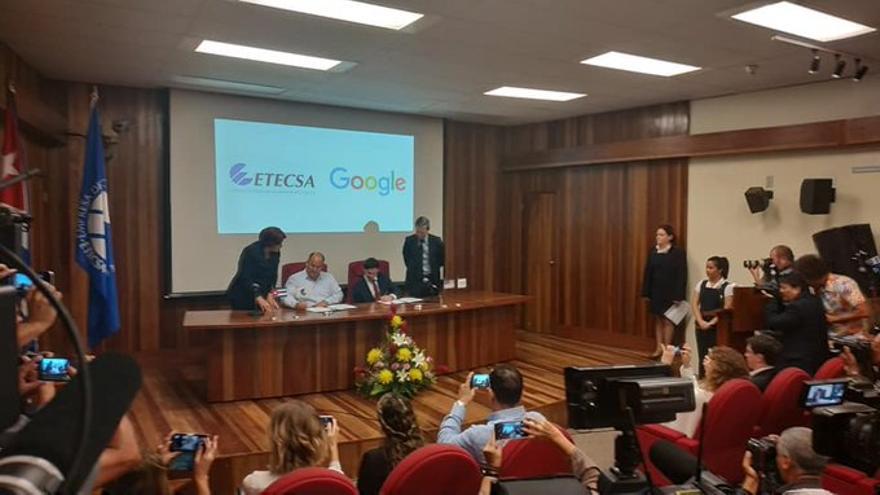
Signing of the memorandum between Etecsa and Google this Thursday in Havana.

14ymedio bigger14ymedio, Havana, 28 March 2019 — The Telecommunications Company of Cuba (ETECSA) and the US tech giant Google signed a memorandum of understanding in Havana on Thursday to negotiate an Internet traffic exchange service agreement, known as peering, which aims to improve the quality of access to the contents of the network.

The companies signed the document in a meeting this morning in the presence of a large group of journalists, but the event barely featured the agreement and no questions were allowed to the press.

It is not known when the improvements derived from this agreement will begin, since, according to a statement from Etecsa, the work will start “when the technical conditions allow it.” continue reading

The state monopoly affirms that this memorandum is part of its commitment to “the development and computerization of the country.” The company and Google had already signed a prior agreement in December 2016 that runs from April 2017.

Etecsa takes the opportunity to emphasize that more than a dozen US companies have agreements with Cuban companies, despite the deterioration of political relations and the recent measures taken by the US Government.

The signing of this document was announced for Tuesday, but it was postponed with no reasons or explanations given. A day before, the agreement with Russia in the telecommunications sector had been made known.

Cuba’s Deputy Minister of Communications, Wilfredo González, explained that this agreement referred in particular to the information technology industry and incorporates elements of cybersecurity.

__________________

The 14ymedio team is committed to serious journalism that reflects the reality of deep Cuba. Thank you for joining us on this long road. We invite you to continue supporting us, but this time by becoming a member of 14ymedio. Together we can continue to transform journalism in Cuba.
Cuba’s Embassy in Mexico Led the Fight Against Central American Dictatorships

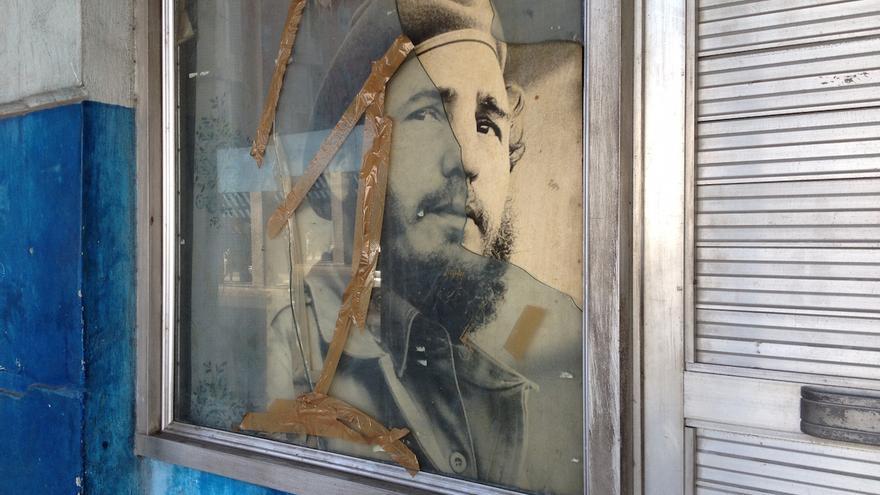
Mexico has made public the 411 files on the espionage carried out of Fidel Castro by Mexican security forces. (Luz Escobar)

14ymedio biggerEFE (via 14ymedio), José Antonio Torres, Mexico City, 28 March2019 —  In the 1960s Cuba used its embassy in Mexico to direct movements against those they considered dictatorships in Latin America, according to espionage archives declassified by the Mexican government.

In a version of 411 files Mexico has made public on the espionage carried out of Fidel Castro by Mexican security forces, both when he was in Mexico and in power in Cuba, it is noted that the Cuban embassy served as its focal point for these activities in the region.

“The Cuban Embassy in Mexico is in charge of directing in Latin America the various movements, both against the so-called Central American dictatorships and against the United States of America,” Mexico’s Federal Security Directorate (DFS) states in a report dated 1960 to which Efe had access. continue reading

In those years the first target of these activities was the Nicaraguan Government, when the Somoza clan was already in power, “and as a concrete case we can cite the armed incursion in the Segovias in the month of March in which nine people died,” the file emphasizes.

The reports about the activity that Cuban diplomats carried out from Mexico were always part Mexican intelligence’s surveillance of Castro, inlcuding when he was in power, as they considered him a factor of influence in social movements in Latin America.

“As a result of his coming to power, the various groups of political asylees distributed in Latin American countries tried to follow his example,” highlighted the offices of the DFS, an entity that disappeared in 1985 amid accusations of corruption.

However, the Mexican espionage noted in their reports, now housed in the National General Archive, that the Mexican communist groups had no links with the group headed by Fidel Castro, a situation that continued after his conquest of power and in the following years.

Mexican security prepared a detailed report of it first encounter with Castro, capturing him on June 21, 1956, in a car with license plates from Miami in the neighborhood of Polanco, after a year of following him through reports from Cuba that warned that he was preparing a coup against the Batista government.

Castro was arrested with several men, including his bodyguard identified as Universe Sanchez, by Mexican Captain Fernando Gutiérrez Barrios, whom Fidel always treated as a friend, and who became Secretary of the Interior in the presidency of Carlos Salinas (1988- 1994).

Even then, Mexican spies warned of Castro’s links with “political exiles of different nationalities,” mainly those of Nicaragua and Costa Rica, led by Manuel Flores Gómez, and those of Peru, headed by César Pardo Acosta.

In another report, Gutiérrez Barrios affirms that Castro was last seen in Ciudad Victoria, in the northeastern state of Tamaulipas, and confirms reports that he had already embarked on the yacht Granma.

The triumph of the Cuban Revolution, on January 1, 1959, revived the Mexico’s interest into maintaining espionage over Castro, with reports on the state of his health, his trip to the former Soviet Union, and a speech where he talked about the rumors related to the “disappearance” of Che Guevara.

The resignation of Castro from the position of prime minister to serve as Commander of the Armed Forces was highlighted in a report dated July 17, 1959, in which Mexican security already warns that an external aggression against the Cuban regime was being prepared (at a time when Castro was still in Mexico).

“There are three groups ready to attack Cuba,” the report in the Mexican archives detailed.

The first group was in the Dominican Republic with the Cuban general José Pedraza; another was in Miami with Rolando Masferrer, and the third was elsewhere in the United States with Batista’s brother-in-law, General Roberto Fernández.

Castro’s speech of 15 January 1966 at the close of the First Tricontinental Conference of Solidarity of the Peoples of Asia, Africa and Latin America, and a letter to the Secretary General of the United Nations, occupy a good part of the Mexican files on Castro.

The Mexican authorities determined in 2002 to allow the public disclosure of the confidential files of the Mexican espionage services from 1920 and 1985, and the new administration of President Andrés Manuel López Obrador, and has extended it to the documents of the Center of Investigation and National Security (Cisen).

The current archives of Mexican political espionage originated with the governments emanating from the Mexican Revolution (1910-1921) with organizations such as the First Section and the National Directorate of Intelligence, which were followed by the DFS and the CISEN, now replaced by a new entity in the current government.

In 1985, the AGN received 3,091 cases with files generated by the Office of Political and Social Research and the DFS in the period from 1920 to 1975; in 2002, it added 4,223 boxes with 58,302 Cisen files.

__________________

The 14ymedio team is committed to serious journalism that reflects the reality of deep Cuba. Thank you for joining us on this long road. We invite you to continue supporting us, but this time by becoming a member of 14ymedio. Together we can continue to transform journalism in Cuba.
Panama Bank Closes Accounts Related to Cuba

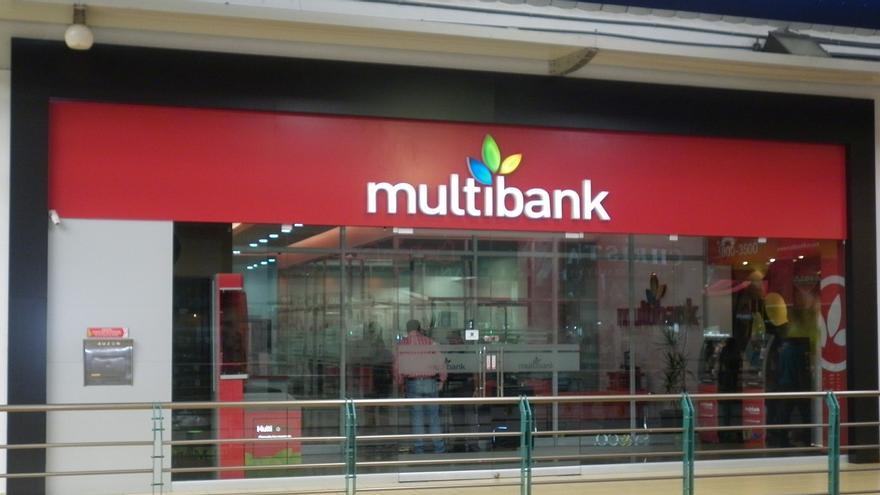
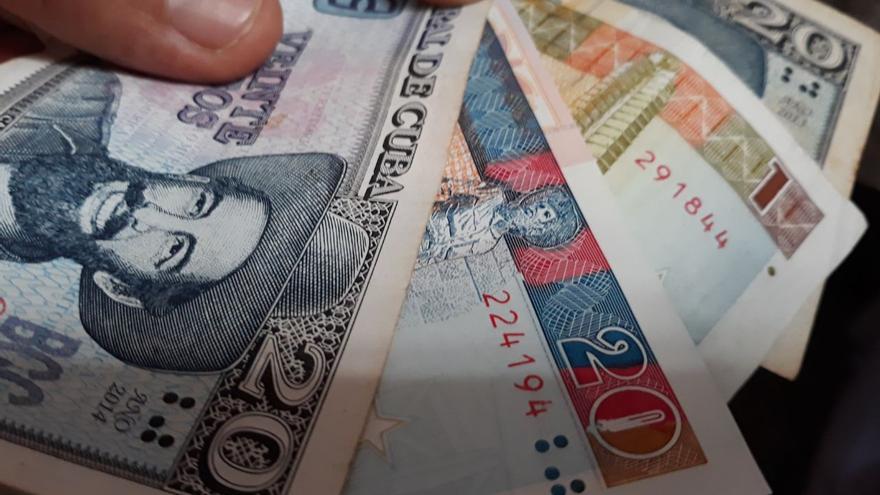
The Panamanian bank Multibank closed numerous accounts of companies that maintain relations or trade with the Cuban Government. (Multibank)

14ymedio bigger14ymedio, Havana, 30 March 2019 — Panama’s Multibank closed numerous accounts of companies that maintain relations or trade with the Cuban government, including that of the Prensa Latina (PL) correspondent, according to official reports.

Multibank, which started operations in 1968 under the name Gran Financiera, denied that the closure of the accounts is the result of external pressures or is related to the US embargo. The financial institution justified the measure as part of “an update to its internal policy and business lines,” according to Prensa Latina.

PL details that more than a dozen companies financially linked to Cuba received a brief email dated December 1, 2018. “We inform you that the Bank has taken the decision to close your bank account next Friday, December 28, 2018,” the text alerted. continue reading

Subsequently, the banking authorities informed by telephone that they had extended the deadline until January 3, 2019, although other entities affected by the same measure could maintain their accounts until the end of March.

Attached to the message, the directors of Multibank sent the so-called ’Trump List’, a list of companies sanctioned by Washington that operate in Cuba, some of them under the control of Cuban intelligence services and the Armed Forces.

The decision was preceded by an announcement dated October 27, 2018, in which Multibank informed its clients that “due to new internal policies,” as of December 31 of last year, the transfers received or sent from PAB (Balboas) should be in Euros and not US dollars starting then.

In 2015, Multibank, the third largest Panamanian bank based on the volume of its assets, had advanced its interest in settling in Cuba as part of the promotion to attract foreign investment in the island today.

“We see great opportunities in that country that will develop quickly and Multibank would love to be involved in that development, both to support Cuban financial institutions and entrepreneurs who intend to invest there,” said the CEO of that entity, Isaac Btesh.

_________________________________

The 14ymedio team is committed to serious journalism that reflects the reality of deep Cuba. Thank you for joining us on this long road. We invite you to continue supporting us, but this time by becoming a member of 14ymedio. Together we can continue to transform journalism in Cuba.
Academic Warns of Economic "Shock" if Cuba’s Dual Monetary System is Maintained

It was nearly 26 years ago that Cuba allowed the dollar to enter its economy (14ymedio)

14ymedio bigger14ymedio, Reinaldo Escobar, Havana, 30 March 2019 — There are issues that appear cyclically in the official media. Discussions that get heated in the streets and later cool down waiting for institutional responses. Among these is the end of the dual monetary system, a measure that at times seems to be around the corner and at others appears to be in a distant and improbable future.

The debate on this sensitive situation, which affects the pockets of every Cuban, has returned this week after the publication in several official media of an article signed by Armando Nova González, doctor of Economic Sciences, professor and researcher at the Center for the Study of the Cuban Economy.

The text stands out not only for its lapidary truths but also for having been published on digital sites more prone to praise than to criticism, more focused on highlighting “the achievements of the Cuban system” than on pointing out its flaws. Instead of applause, Nova Gonzalez urges the elimination the monetary duality because postponing its end increases social, economic and political costs. continue reading

The imperative that the author emphasizes contrasts with the scant information that has been offered in recent months about the process of ending the “economic schizophrenia” of the Cuban convertible peso (CUC) and the Cuban peso (CUP). Since December 2017, when Marino Murillo, vice president of Cuba’s Council of Ministers of Cuba, stressed that the Government was continuing the work to end that duality, very little more has been reported.

Twenty-six years have passed since the dollar was introduced into the Cuban economy, a measure that, together with the subsequent appearance of the convertible peso (CUC), was conceived as transitory but has extended “much further in time,” warns the economist. It has not even been possible to achieve the purpose of “bringing closer” the values of the CUP and the CUC, nor the necessary correspondence between the CUC and the US dollar.

Instead, the academic regrets that more CUCs have been issued than can be backed with dollars, so it has depreciated. Something that is reflected in “the increase in prices in the hard currency stores and, at the same time, in the markets of free supply and demand in Cuban pesos.” A reality that is palpable in the fact that in recent years the purchasing power of families has continued to decline in sync with the currency’s loss of value.

Nova González knows the complexities of a process of currency unification in a nation with very low productivity, and recognizes that the end of the monetary duality depends on solving the structural problems of the economy. His proposals to clean up such a mess are daring and tend an opening to the detriment of centralism, but they are gripped by a maxim that seems more like a religious dogma than a political premise.

His reflections can hardly take flight because they carry the burden of not altering, with any of these measures, “the socio-economic system aspired to.” Among the variables that could be used to clean up national finances and the Cuban monetary system, the authorities rule out those that put at risk a social structure based on forced social justice and false egalitarianism.

The assertions of the academic confirm the official fear of a worsening of the popular malaise, and a possible reaction in the streets after the monetary unification. Like the rationed market, the monetary duality has not come to an end, to a large extent, because the government fears losing support and power. Its end is delayed not only by low productivity but by fear of rejection.

The author ventures some proposals to alleviate the negative impact of this unification, among them “closing the inefficient state enterprises that could be transfered to their workers in the form of cooperatives” with the initial financial support of the State (…), direct foreign investment or investment mixed with national capital and/or loans from international financial institutions.”

One of his most daring suggestions is to avoid the flight of foreign currency. Those millions of dollars that each year leave the country in the hands of mules that buy goods abroad. For them, Nova González proposes opening national establishments where local entrepreneurs can buy in foreign currencies “at prices even lower than those found in the underground market.”

Finally the academic knows that he walks on a tightrope and does not renounce having a protective mesh under his feet, perhaps that is why he indicates that this whole process “should be undertaken with the necessary observation and the required restraint that guarantees the continuity and sustainability of the economic-social model to which it aspires, one that is fair and with the greatest possible equity.”

However, Nova Gonzalez seems to be a responsible man and warns that “to continue with immobility, the risks will multiply and could generate a strong shock to the economy, with unwanted results.” Something that can be summarized in the Cuban authorities losing if they unify the two currencies and losing each day that they take to unify them.

__________________________________

The 14ymedio team is committed to serious journalism that reflects the reality of deep Cuba. Thank you for joining us on this long road. We invite you to continue supporting us, but this time by becoming a member of 14ymedio. Together we can continue to transform journalism in Cuba.

The Venezuelan Outcome

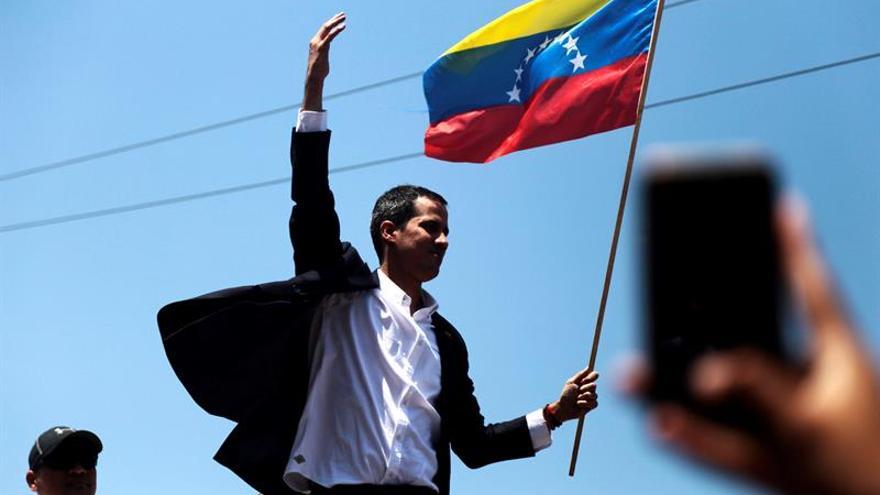
Guaidó was greeted by a crowd at the airport and by representatives of the international community after a tour of several South American countries. (EFE / Rafael Hernández)

14ymedio bigger14ymedio, Carlos Alberto Montaner, Miami, 30 March 2019 — The United States will not intervene militarily in Venezuela. It is one thing to threaten and something very different to disembark troops. The country would have to feel itself in danger and that is not the case today. It has been brilliantly explained by Professor Frank Mora, former Assistant Secretary of Defense of the Western Hemisphere in the Obama Administration. Even several well-informed analysts like Andrés Oppenheimer and Jorge Riopedre have described it, with regret.

In 1965 the United States intervened in the Dominican Republic, in the midst of a battle between the factions of the left and the right, because President Johnson, within the framework of the Cold War, wanted to prevent the emergence of a second Cuba in the Caribbean. The first one had given him quite a lot of headaches. Johnson lived and died convinced that Fidel Castro had killed Kennedy and had made him president. Finally, he managed to build an operation with other countries of the Organization of American States (OAS). The most ferocious were the Brazilian soldiers.

In 1983 it was the turn of the small Caribbean island of Granada. Reagan took advantage of an absurd and bloody coup by Bernard Coard and General Hudson Austin against Maurice Bishop. It was an ultra communist coup against the man from Havana. They shot Bishop along with nine of his close associates, including his lover. Washington’s pretext to intervene was the protection of a few hundred American students who were pursuing their medical studies there. They packaged the operation with the request of two other Caribbean islands. continue reading

In December of 1989, Bush (father) invaded Panama. General Noriega, the country’s strongman, was insane. He trusted that his previous services to the CIA would protect him. It was said then that Noriega “was not bought.” He was rented for short periods to the highest bidder. His supporters had killed an American soldier and raped an officer’s wife with total impunity.

Bush’s dilemma was to abandon Panama, even the famous bases, or to intervene. He decided on the second and did not even stop to look for a pretext or add allies. It was a narco-dictatorship and that was enough. Until 72 hours before the invasion began they tried to convince the general to leave for Spain with his fortune (200 million dollars) and avoid the invasion. Noriega did not believe them and died in prison almost three decades later.

Nicolás Maduro provokes the biggest rejection. For now, it is about liquidating him using sanctions and psychological warfare. Donald Trump repeats, as a mantra, that “all” options are on the table. That includes frontal warfare, but logic and observation indicate otherwise.

Trump is an isolationist. He is a cold “businessman.” He does not believe that the United States is the leader of the West, with the associated special responsibilities that entails. He is not the only one who thinks that way. Kissinger, in his own way, believes the same. Trump presides over a nation with interests, essentially economic. This vision leads him to confront the issue of tariffs with his allies in Europe, Canada and Mexico, and to belittle NATO, the quintessence of the “globalism” that mortifies him so much.

He would like Venezuela to behave democratically and sensibly. That is why he supports Juan Guaidó and receives his wife, Fabiana Rosales, in the White House, but barely shifts from sanctions and political and diplomatic support to an open war to evict Maduro and his 40 thieves from power.

Destroying Venezuela’s military apparatus is easy. It would take a few hours for a nation like the United States to do it from the air and sea with conventional weapons. It has the necessary arsenal and bank account. But occupying a large nation (three times the size of Germany), confronting armed gangs, holding elections and creating a police force capable of sustaining authority is a task that can last a couple of years and Trump is not willing to carry it out.

However, no informed person has any doubt that Maduro and his gang have created a narco-state, allied with Iran and the terrorists of the Middle East, led by Cuba and militarily assisted by Russia. And this narco-state constitutes a grave danger to its neighbors and, in the medium term, to the United States, especially since Moscow has made an appearance in the conflict with a hundred military personnel and abundant weapons.

If sanctions and psychological warfare do not achieve their purpose, it is best to divide the functions. The United States would destroy the military installations of the narco-state and with its missiles and drones would make the heads of the chiefs roll. After the demolition, the most affected countries of the Lima Group would enter, led by Brazil and Colombia, but with the help of Chile, Argentina, Peru and Paraguay. They would occupy the territory, invoking the democratic clause, and organize the conditions for the return to democracy and the restoration of the economy under the direction of Luis Almagro and the participation of the OAS.

This harsh outcome is against the scant Latin American tradition of forging an active foreign policy, although there is “the duty to protect” invoked by the former diplomat Diego Arria. If the Spanish-American democracies do not do so, surely the incapacity of the Maduro regime will provoke a terrible famine in which two or three million people will die, presumably children and destitute old people.

In any case, it is the minimum instinct of conservation that nations must have. There is the danger that fragile countries in the area will explode as a result of the “demographic bomb.” Between seven and ten million Venezuelans will soon leave the country, almost all heading to Latin America. Quite simply, South American democracies can not coexist with a gang of thugs in the neighborhood. They have to eradicate it because that life could be theirs.

_________________________________

The 14ymedio team is committed to serious journalism that reflects the reality of deep Cuba. Thank you for joining us on this long road. We invite you to continue supporting us, but this time by becoming a member of 14ymedio. Together we can continue to transform journalism in Cuba.