Cuba Blocks a Recognized LGBTI Activist From Entering the Country

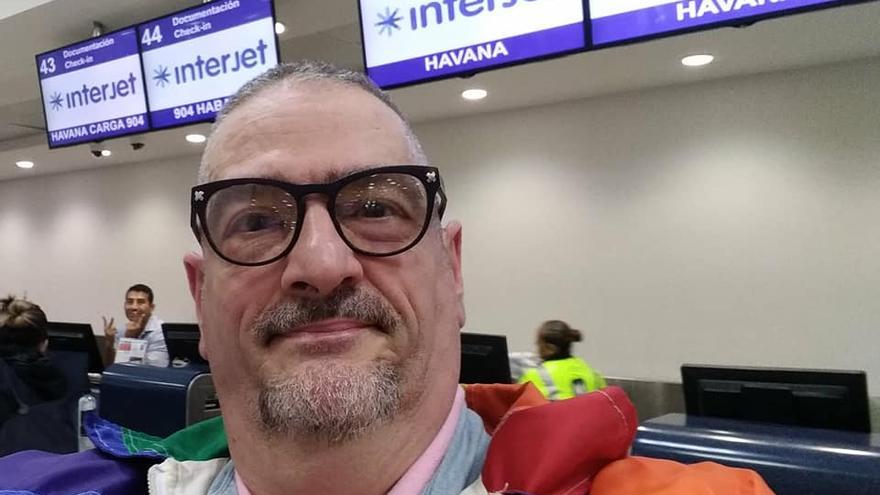
The Cuban authorities forbade the entry of Michael Petrelis, a renowned American activist for the rights of the LGBTI community. (Facebook)

14ymedio bigger14ymedio, Havana, 20 March 2019 — Cuban authorities prevented Michael Petrelis, a renowned US activist for the rights of the LGBTI community (Lesbians, Gays, Bisexuals, Transsexuals and intersex), from entering the island on Wednesday, 20 March, according to the digital site ADNCuba.

“My visa (tourist card) was revoked and I am very sad,” Petrelis told 14ymedio through the app Messenger.

A few minutes before, he had posted a text on his Facebook profile, explaining that while trying to board his flight to Havana, an employee of Interjet Airlines informed him that the Cuban authorities had blocked him from entering the country. “I flew overnight from San Francisco to Cancun on a turbulent flight and will return home in a few hours,” he lamented. continue reading

The Interjet agent did not allow him to make a screenshot of the document with the refusal of the Cuban authorities, but wrote on paper that “for immigration reasons” he could not allow him to go on to Havana “since the country will not allow him to enter.”

When asked about the reasons for the refusal to allow him to board the plane bound for Havana, the airline workers told him they were unaware of them. “We receive the same message every time a passenger is prohibited from entering the Island,” he says they told him.

“I have no idea why I am excluded from the tourists who are allowed to visit Cuba, but it surely has something to do with having shared the life of the LGBTI community outside the control of the government,” Petrelis told 14ymedio.

“I am disappointed not to see my friends, not to experience fabulous times and not to be able to share my suitcases full of rainbows. To my Cuban friends, I let them know that my love and respect for them does not diminish due to the decision of their Government to deny me entry,” the activist added on Facebook while waiting to board a flight back to the United States from Cancun.

Earlier this year, Petrelis had traveled to the island to visit friends, distribute stickers and support public actions of gay pride and support the promoters of equal marriage in Cuba with public actions.

On that occasion he said he felt harassed by the authorities. The official National Center for Sex Education (Cenesex), headed by Mariela Castro, daughter of ex-ruler Raúl Castro, tries to represent the entire LGBTI movement, but some work on the same issues independently.

On the island the entry ban decreed against Petrelis has been strongly criticized. The activist Isbel Díaz Torres regretted that the Cuban government has demonstrated its “authoritarianism with impunity” and denounced the “little respect” that it has for the rights of that community.

Torres noted that “while Michael Petrellis campaigns in San Francisco to promote impeachment of Trump, on the island they have the luxury of rejecting and humiliating a great fighter.”

Many of the independent organizations of that community have denounced the pressure exerted by Cenesex to maintain control over the LGBTI community. Recently the Parliament decided to suppress a controversial article proposed in the constitutional reform that would have allowed the approval of marriage between people of the same sex.

The Parliament decided to postpone the modification of the Family Code for two years and put the new version to a vote in a plebiscite, which has been criticized by many activists who see equal marriage as a human right that should not be subject to popular vote.

__________________

The 14ymedio team is committed to serious journalism that reflects the reality of deep Cuba. Thank you for joining us on this long road. We invite you to continue supporting us, but this time by becoming a member of 14ymedio. Together we can continue to transform journalism in Cuba.

Alain Gomez Earns a Living with his Supermarket Cart

Alain Gómez Acuña with his cart in the ETJ market in Tulipán. (14ymedio)

14ymedio bigger14ymedio, Reinaldo Escobar, Havana, 21 March 2019 — The agricultural market on Tulipán Street opens its doors early and buyers start arriving from several municipalities in Havana. Just outside, a well-known figure waits to offer his delivery services. He is Alain Gómez Acuña, a Habanero of 40 years with Down Syndrome.

With his supermarket cart Gómez earns his living by loading food, fruit and other products from the premises administered by the Youth Labor Army (EJT). He has been at the job for seven years and, together with plastic bag sellers and workers who staff the stands, he is part of a commercial ecosystem that runs from Tuesday to Sunday.

This Thursday, like every day, Gómez is waiting in his place within walking distance of one of the entrances of the market. He will spend a good part of the day going from one place to another pushing his cart and maybe a neighbor will congratulate him, because March 21 is World Down Syndrome Day. continue reading

Down syndrome, also known as trisomy 21, is caused by the existence of an extra chromosome on pair 21. Its incidence in Cuba is 9.8 cases per 10,000 births, according to Dr. Cristóbal Martínez Gómez, family therapist, head of the National Group of Child Psychiatry of the Ministry of Public Health.

Although the chromosomal alteration is related to diseases — mainly cardiac or digestive diseases — which tend to shorten life expectancies, society has historically tended to focus on the mental retardation that sometimes accompanies it. On the island, the stigma over families with children with special needs has been frequent, although in recent years important steps have been taken in the social integration of these people.

The families of those affected have joined in support groups and, slowly, have managed to displace the derogatory language by more respectful words. However, there is still much to be done to ensure that society protects the rights of Cubans with Down syndrome and allows them to occupy an active and independent place, without ridicule or excessive commiseration.

Gómez smiles as a customer from the market engages him to take a large pumpkin and some tomatos to her house “climbing Tulipán hill.” Those who know him know that his family, an elderly mother and stepfather, also depend on his efforts, and the economic contribution of this son eases their day-to-day existence.

“Families need to know that the tendency to ’hide’ the situation by preventing the child from leaving the house will cause more pain and tension,” Dr. Martínez tells families who have a child with Down syndrome. “They show great fondness for music, they are happy and rarely suffer from attacks of irritability,” he says.

In his work and in the building where he lives, the neighbors joke with Gómez and tell him that he has become a millionaire delivering products from the market. He smiles nervously, as if they had discovered him, and the laughter covers his whole face. Sometimes he offers to carry some unpaid cargo, just to help an elderly woman or someone of low income.

In addition to the economic contribution he brings with his work, Gomez helps out with domestic chores, taking care of washing and ironing his clothes and cooking from time to time, according to his mother. On days when the EJT market is mostly idle, with little merchandise and fewer customers, he lends a hand in the bicycle parking lot or helping at the stands.

His permanent smile is only hidden when he has the impression that some client wants to deceive him with a very low payment or is trying to avoid paying him any money at all for his services. Then he gets so serious that he instills respect, as he does when they ask him how he got the supermarket cart with which he travels the streets of Havana.

________________

The 14ymedio team is committed to serious journalism that reflects the reality of deep Cuba. Thank you for joining us on this long road. We invite you to continue supporting us, but this time by becoming a member of 14ymedio. Together we can continue to transform journalism in Cuba.

Juan’s Traveling Bathrooms

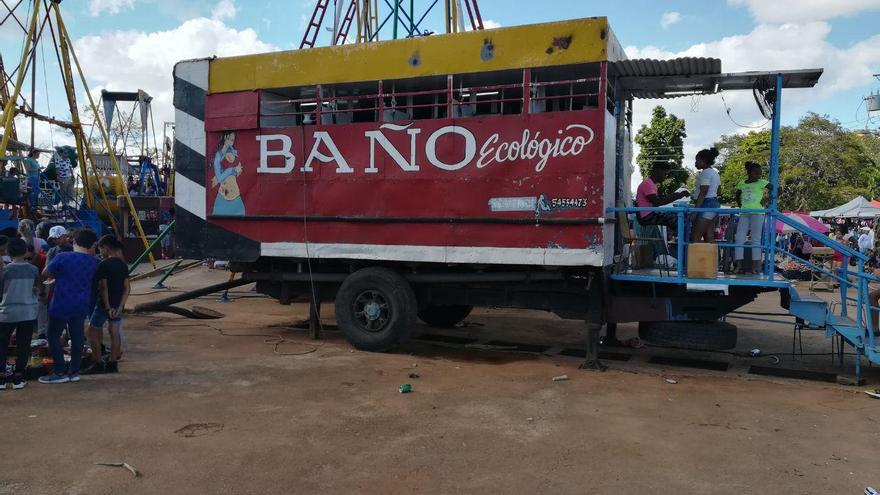
Juan Reyes remodeled a truck to contain ten cubicles with toilets and even a shower. (14ymedio)

14ymedio bigger14ymedio, Marcelo Hernández, Güira de Melena, 22 March 2019 — Juan Reyes was born in Santiago de Cuba but for the last seven years he has been touring the island chasing popular festivals. He drives a striking truck that has been adapted to contain a dozen individual bathrooms where cleanliness reigns and no bad odors are perceived. This week he arrived at the Potato Festival, in Güira de Melena, and his services attracted more customers than many of the festival’s own kiosks with food or fun products.

Reyes came up with the idea after seeing the difficulties that his wife suffered to find a decent bathroom at carnivals. Most of the time there was nothing more than a box placed over a sewer, stinky and without privacy. Immediately, this Santiagan with a great ability for business saw an almost untapped market niche. He bought the truck and began the process of converting it into a mobile sanitary service. continue reading

He created a drainage mechanism with a wide flexible hose that allows the sewage to be evacuated into the nearest sewer system. He added removable steps that is placed so that customers can easily access the interior of the vehicle and invested in some amenities so that “it does not resemble those dirty bathrooms with no personality,” he says. In addition to the immediate relief of the bladder, Reyes’ “invention” puts a smile on every face.

Now the “Ecological Bathroom” as he jokingly baptized it on one side in white paint, is a family business. At the entrance, Juan’s son charges 2 CUP per person (roughly 8¢ US) and inside each cabin there is water, soap, toilet paper and a mirror. In the last cubicle there is also a shower for those who want to cool off from the heat.

At the moment the service is exclusively for women but its owner does not rule out having a fleet of trucks where there is also space for men and mothers with small children who want a place to change diapers and breastfeed with tranquility.

________________

The 14ymedio team is committed to serious journalism that reflects the reality of deep Cuba. Thank you for joining us on this long road. We invite you to continue supporting us, but this time by becoming a member of 14ymedio. Together we can continue to transform journalism in Cuba.

Fourteen Cubans Detained near Caimanera to Prevent Exodus to U.S. Base

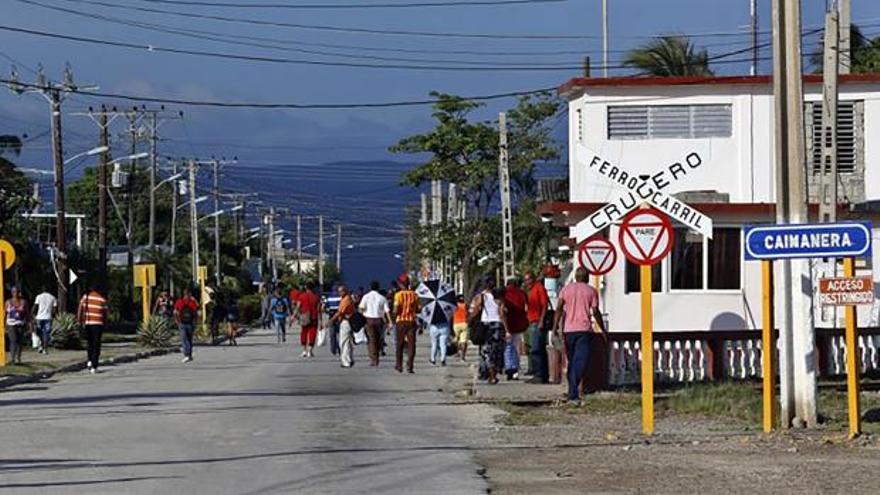
Caimanera is next door to the U.S. Naval Base in Guantánamo. (EFE/Archive)

14ymedio bigger14ymedio, Madrid, April 1, 2019 — Fourteen young people were incarcerated recently  in Caimanera, Guantánamo, for trying to enter the U.S. Naval Base. A rumor had been spreading for weeks that the U.S. would take in any one who tried to leave the island by getting onto the base, and this caused a streak of detentions and strict militarization of the zone by Cuban State Security forces.

According to sources cited by the Spanish newspaper ABC, the army prevented non-residents from entering the province, and on Sunday, some 159 people were detained by the municipal police for trying to bypass the system of access control.

The U.S Government decided to notify Cubans in Caimanera that they had been the victims of a hoax. “It is not true that the U.S. Naval Base is processing Cubans for immigration,” the Department of State’s communication said. continue reading

“We continue to support safe, legal and orderly immigration under the laws of the United States,” it pointed out.

According to ABC, those arrested up to now are: Argelio Lechuga, Yorie Céspedes, Daniel Manuel Estrada Gorra, Rafael Vadari Sánchez Ruíz, residentes en Guantánamo; Roinel Espinosa y Adonis Domínguez, of Holguín; Amari Martínez, Yordanis Ramírez, Yasiel Galván, Aniel Martel, Lázaro Valdez, Jesús Miguel Aguilar, Carlos Antonio García and Yasmani Marcelino Mendoza, of Cienfuegos.

According to ABC sources, they have been accused of “violating the security perimeter” and “disobedience,” but not of “intent to exit the territory illegally.”

Yulieth Yero and Lisbeth Téllez, the wives of Rafael and Daniel Manuel, said that their spouses arrived at the Naval Base, where they were met by U.S. military authroities, who facilitated a safe-conduct pass for them to avoid detention before being deported according to the migration accords. However, according to their spouses, the documents were taken away from them by the Cuban police, and they were detained in order to be processed.

The families of Jesús Miguel Aguilar and Aniek Martel also spoke with the newspaper and reported that the detentions were meant as an example to prevent similar cases. “If the Cuban Government had denied the rumor on time, our sons wouldn’t have been prosecuted,” they protested. Both families say that their sons are being mistreated in prison.

Since the end of February, in the context of the constitutional referendum, Guantánamo’s neighbors have denounced the excessive militarization of the province. At that time, the deployment was interpreted as a method of control for possible protests, but weeks later, the army and the police continue controlling the entrances and exits to the territory, with special emphasis on Caimanera.

According to what a neighbor from the town told ABC, several journalists have tried to contact him to get information about the situation, but none has been able to get through. At the National Revolutionary Police control points on the highway at the entrance to the city, they denied access to them after taking down their names on a list,” he said.

ABC’s correspondent in Havana, Jorge Enrique Rodríguez, was detained for approximately 24 hours on March 21. The journalist had, days before, reported the unusual military activity and notable influx of people with the apparent intention of approaching the Caimanera Naval Base of Guantánamo in order to leave the country. His release was made possible by the intervention of the Ambassador from Spain in Cuba at the request of the Director of the Spanish newspaper.

Translated by Regina Anavy

_________________

The 14ymedio team is committed to serious journalism that reflects the reality of deep Cuba. Thank you for joining us on this long road. We invite you to continue supporting us, but this time by becoming a member of 14ymedio. Together we can continue to transform journalism in Cuba.

Do We Want to Be Like Che? / Somos+

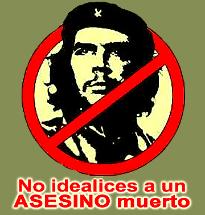
Don’t idolize a dead ASSASIN

Somos+, Susana Acosta Diaz, 12 March 2019  —  To be born and grow up in a country that is dreaming, a country that is asleep and seems not to want to wake up. A dream country that lives in a constant nightmare. An island that looks out to sea, to the infinite, because it does not find answers in its fields covered by the invasive marabou weeds but in the promised future ninety miles away.

To be Cuban is to know what it is to go to school with a glass of milk (in powdered form) for breakfast. To get up early for the “morning assembly” in order to shout out, “We will be like Che!” To be a selfless pioneer who battles the “enemy” from the school’s assembly room. To not think. To repeat, always repeat to the point of exhaustion, the same worn-out slogans. continue reading

But I was and am very obstinate (as well as sleepy). I asked my second mother, the one who gave me life, “Do children in Germany also sing the anthem (or anthems) every morning?”

My father explained to her what I meant and she laughed, she laughed a lot, and told me, “No, children in Germany go to school to study, not to recite anthems. Schools are for learning, not for memorizing slogans.”

It turns out that in Germany they don’t have morning rallies, and children learn the national anthem is for soccer games, not something to be forced on them at school. It turns out that in the country of the Nazis there is no cult of personality. No child who wants to be like Müller, Schneider, Fischer or Merkel… or like those whom one might call “martyrs” or “heroes of the fatherland.”

But we had to be “revolutionary” students, with no options, or else. We had to write glowing reports when the subject was Fidel and the Revolution. We had to go to political demonstrations, to meetings where we discussed new legal statutes or “revolutionary initiatives.” And as I heard countless times, “Here we educate revolutionary students who, first and foremost, will defend Fidel, Raul and socialism.”

Yes, in Cuba we were indoctrinated to be communists, to be submissive to a party unwilling to change and which acted against the interests of its people. We were indoctrinated to support a dictatorship that regulates and misrules freely, that constantly violates basic human rights.

I never understood why my mother used to tell our neighbor, “Girl, talk lower. Saying that out loud is going to get you into trouble.” But she was only saying what the rest of the adults in my life were whispering: the same message, the same doubts, the same needs.

Nor did I understand why my teacher, who had the same complaints as my neighbor and complained quietly about the same problems, used to scream energetically during May Day celebrations, “Viva al Revolución!”

No, I did not understand it then and do not understand it now. We are still like prisoners of a system in which freedom of thought is a crime. Worst of all, we are not doing enough to change it.

That is what we were and what they still want us to continue be: lambs who praise false gods, false leaders, false heroes.

Panama Adds Advantages to Its Tourism Card for Cuban Shoppers

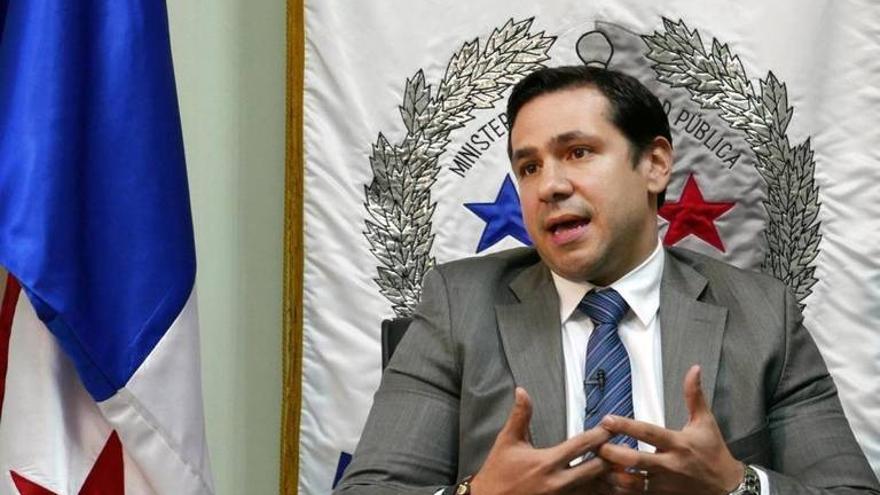
In this archive image, Panama’s security minister, Jonathan del Rosario, talks to ’14ymedio’ in his office in Panama City. (14ymedio)

14ymedio bigger14ymedio, Mario J. Penton, Miami, 17 March 2019 — The Government of Panama has decided to allow Cubans who have a tourism card for purchases in that country to obtain a stamped visa, according to a statement from Panama’s National Migration Service.

The new measure is established through an Executive Decree signed by the country’s president, Juan Carlos Varela, and the security minister, Jonathan del Rosario.

The stamped visa will allow those interested in visiting Panama multiple entries to the country, not just one, as has been the case to date with the tourist card. In addition, it expedites the paperwork when it is granted by the Panamanian consul in Havana, who determines the validity period of the document. continue reading

In a conversation with this newspaper, Del Rosario described the stamped visa and the tourist card as “very positive” tools and expressed the desire of the Panamanian Government to simplify the procedures to increase the visits of Cuban entrepreneurs.

The security minister also stressed that the new measure does not eliminate the sale of the tourist card, an option for tens of thousands of Cubans who travel to the Central American country every year to make purchases for private businesses on the island.

The sale of tourist cards was announced by Panama Migration last October to facilitate shopping tourism, without the need for a visa. It can be purchased by the self-employed and artisans of the Island or by those who present evidence of having traveled previously to any other country. The cards have a cost of 20 dollars, allow a single entry into the country and are valid for 30 days.

Since former Cuban president Raúl Castro expanded self-employment in 2010, the private sector in Cuba has not stopped growing. There are more than 589,000 self-employed workers on the Island, which represents about 12% of the nation’s workforce.

According to a recent report from the The Havana Consulting Group, self-employed Cubans took more than 2.3 billion dollars out of the country last year alone. The consulting group says that Panama is the second largest market for purchases by Cubans after the United States.

Cubans who already have a tourist card and want to obtain a stamped visa must meet four requirements:

  • Fill out the online application form

  • Present a current passport and a copy with the general information and entry to Panama.

  • Show a round trip flight reservation as well as the sum of 50 dollars.

  • Meet an economic solvency test never lower than 500 dollars.

Cubans who have a visa stamped on their passport can also opt to get a new one if they fill out an application form, pay $50 and present their passport, as well as a copy of the previous visa.

“This is a great advantage, I have traveled three times to Panama for purchases in the Free Trade Zone and every time I had to stand in long lines to get the tourist card,” says Ángel Álvarez, a self-employed man from Las Tunas who sells air conditioners, speaking to 14ymedio by phone.

Alvarez is among the more than 17,000 Cubans who have visited Panama so far this year, a number that is increasing. Last year, there were 57,251 Cubans arriving in that country, leaving Panamanian merchants a profit of more than 100 million dollars in the Colon Free Zone, according to figures offered by the authorities of that commercial epicenter.

“Panama is a safe country, the dollar is managed, it is much closer than Peru and you do not have to complicate your life with as many formalities to get a visa as with Mexico,” says Álvarez. Mexico, Peru and Haiti are other destinations popular among Cubans for shopping.

Despite the facilities that Panamanian immigration authorities have granted to Cubans in the last few months, there are still those on the island who are critical of the difficulties in getting an appointment at that country’s consulate in Havana. Achieving an interview via the internet is extremely complicated and in the informal market appointments to request a visa are sold for more than 300 dollars.

“We were lucky that a Panamanian friend interceded for us and they gave us the appointment at the end of last year; this week we have finally managed to obtain the visa,” said a retired Cuban couple who received the good news on Friday. They now have a Panama visa for five years of multiple entries.

“We want it, especially, to bring merchandise home to sell, because the money we receive for our retirement is very low,” says Maria. She still does not know how she will be able to compete in the informal market for clothes, footwear and household appliances, but this 64-year-old Cuban woman is happy because “at least we will be able to breathe twice a year.”

But not all Cubans go to Panama to make purchases, others also use the country as a springboard to reach the southern border of the United States through Central America and Mexico.

Angel, speaking from the city of Acuña, in Mexico, is waiting for a turn to ask for political asylum in the United States. He arrived in Mexico after crossing all of Central America on a journey that started at the Tocumen International Airport in Panama where he arrived with a tourist card for purchases.

“I filled out all my papers as self-employed and, with the money I was able to make selling my possessions in Cuba, I took to the jungle,” he says through WhatsApp. Rodriguez says he lost his job in the media on the island when he dared to criticize the system.

The number of Cubans who show up at the US border to ask for political asylum has increased. A recent report from the Border Patrol reported that, between October 1, 2018 and the end of February of this year, 6,289 Cubans had arrived on the southern border. Through the entire previous fiscal year (October 1, 2017 to September 30, 2018) there were 7,079 Cubans who showed up at the border requesting asylum.

Panama is also on the obligatory itinerary of hundreds of Cubans who use the routes of undocumented migration from Chile, Guyana and Uruguay to reach the United States. Recently the country faced a migrant caravan of Cubans that was transfered to the border with Costa Rica through the “Controlled Flow” operation.

_________________

The 14ymedio team is committed to serious journalism that reflects the reality of deep Cuba. Thank you for joining us on this long road. We invite you to continue supporting us, but this time by becoming a member of 14ymedio. Together we can continue to transform journalism in Cuba.

Cuban Authorities Acknowledge Food Shortages and Problems with the Sugar Harvest

In recent weeks the images of long lines and even fights to buy chicken, eggs and cooking oil have spread to the social networks. (14ymedio)

14ymedio bigger14ymedio, Havana, 13 March 2019 — Cuban authorities acknowledged on Wednesday the shortages of several staples such as eggs, chicken, cooking oil and flour while admitting the failure to meet their sugar production plans.

According to the official newspaper Granma, in the session of a meeting chaired by the first secretary of the Communist Party, Raúl Castro, with president Miguel Díaz-Canel was also present, the authorities acknowledged “that important production targets for the economy have failed.” All the heads of the Party and the Government at the municipal and provincial levels were present at the event.

In recent weeks the images of long lines and even fights to buy chicken, eggs and cooking oil have been repeated throughout the island; in some cases the scenes have come to light through social networks. Cuba imports between 60 and 70% of the food consumed on the island at an annual cost close to two billion dollars. continue reading

The Minister of Economy and Planning, Alejandro Gil Fernandez explained that “egg production has not yet stabilized to the point where eggs can be released for unrationed purchase,” but noted that they have been able to distribute the regular allocations through the ration card by the which the government sells 10 subsidized eggs per person per month.

Gil Fernandez projected a growth in tourism of 9.2% compared to 2018, in spite of the cooling in the relations with the United States and the decrease of the number of American tourists visting the Island, about 40% less than in the previous year.

The official highlighted achievements in the period, including the arrival of 1,200 motor vehicles during 2018, among them 221 Chinese Yutong buses and 504 microbuses, of which 401 went have been dedicated to shared-ride fixed-route taxi service in Havana.

Julio García Pérez, president of the state-owned Grupo Empresarial Azcuba, which is responsible for the sugar harvest, said that “less cane has been milled than planned” and added that the production had been only 82% of the 1.5 million tons of sugar in the plan.

Among the reasons given by Garcia are “breakdowns and interruptions in the industry.” Most Cuban sugar mills have been in use for decades and have obsolete technology.

The official added that some “inefficient” plants have been paralyzed and cane is being sent to other mills to try to raise the figures for sugar production.

The island, once the largest sugar producer in the world, now harvests the same amount of sugar it produced more than a century ago. With an internal consumption of 700,000 tons, the country has had to import sugar from France to meet domestic demand and export commitments. Cuba has an agreement to sell China 400,000 tons of sugar each year. The country had planned to export some 920,000 tons of sugar this year, 50 percent more than in 2018 when production fell by 43.7 percent.

The drop in the sugarcane harvest affects the plans of the Government, which had foreseen a rebound in the production and exports of sugar that would help compensate for Cuba’s serious liquidity problem. After the deepening of the economic crisis in Venezuela, Cuba’s main ally, the island has seen oil shipments and investments from Venezuela dwindle.

______________________

The 14ymedio team is committed to serious journalism that reflects the reality of deep Cuba. Thank you for joining us on this long road. We invite you to continue supporting us, but this time by becoming a member of 14ymedio. Together we can continue to transform journalism in Cuba.

Cuban Government Tries to Stop Illegal Fishing with New Legislation

Individuals fishing from the Havana Malecon. (14ymedio)

14ymedio bigger14ymedio, Havana, 14 March 2019 — Today Cubans eat a quarter of the fish they consumed 25 years ago and seafood fishing has plummeted in the last five years, while a thousand boats are engaged to the illegal harvesting of fish, a situation that authorities are trying to stop with a new Fisheries Law.

With the new legislation, authorization will be required for those who want to carry out fishing activities for commercial purposes, be they individuals or companies, and of Cuban or foreign nationality. The licenses will be issued once the status of the resources is evaluated and it will empower the holder to carry out the activity in accordance with the law.

The request to grant, renew, modify and cancel any type of authorization will be processed before the authority empowered by the government, the Food Industry (Minal), according the draft, which also establishes as an “indispensable requirement, in the case of natural persons, that the applicant be at least 17 years old.” continue reading

The Fisheries Consultative Commission (belonging to the Minal) will be responsible for analyzing “the state of exploitation of hydrobiological resources in areas where the State exercises its sovereignty, and propose the regulations and measures necessary to achieve sustainable economic exploitation, which includes zones and fishing quotas, closures, establishment of minimum and maximum sizes or weights, requirements, limitations or prohibitions of fishing gear and other provisions to that effect.”

Meanwhile, the areas in which the activity is permitted will be determined by the Council of Ministers, which may limit or prohibit fishing “due to state interests related to the defense of the country or the environment.”

Another aspect that will be regulated by the rule are the fishing methods, which will be defined as: sports, recreational, research or commercial.

According to government data, the decline in fish consumption has gone from 35 pounds annually per person in 1989 to 9.5 pounds in 2014. In addition, in the last five years the number of species that are fished has decreased by 44%; the current number is 54. Catches accounted for 70% and fish imports were around 8,000 tons.

The reduction of fish consumption by the Cuban population in recent years has gone hand in hand with the fall in the supply and variety of fish available through Mercomar, a network of state stores dedicated to the sale of seafood. The reduction of supplies of large fish and shellfish has meant the refrigerators of these places hold only freshwater varieties such as tilapia, tench and catfish.

Many private businesses dedicated to food service, especially restaurants, maintain their supply of fish from contact with private fishermen, most of them illegal. Much of the lobsters, shrimp, and fillets of snapper and swordfish served in these exclusive places come from poaching.

Another serious datum of the last five years is the fall in lobster and shrimp fishing, which has been reduced by 65% and 90%, respectively. These two coveted shellfish contribute $63 million US annually through exports.

The requirement to obtain authorization will make an exemption for free fishing practiced by any person or company regardless of their origin “from the coast or natural shores by rods or reels, lines and hooks, without the aid of floating means.”

The Government is concerned about the thousand vessels that engage in illegal fishing, involving a total of approximately 2,500 people, over which they can increase control when the new law is approved.

To these are added the fishermen not linked to the state sector, who until now were in legal limbo: “The relationship with this mode of management is limited to contracts of sale. Private commercial fishermen have no defined employment status and are not linked to any social security scheme,” indicates the draft of the project.

The legal recognition of fishing as a self-employed activity opens the door not only to the legalization of those who until now have engaged in the activity informally, but also to the fact that they can accumulate money for a future pension, something that they have been excluded from as illegal fishermen.

Another of the problems identified by the authorities is that of the 168 settlements that live by fishing. “In several, fishing is the main livelihood and the employment alternatives in other sectors are scarce.”

The draft Fisheries Law, which has 27 articles and seven final provisions, will be debated with the deputies and directors of appropriate bodies between March 27 and April 3. In addition, an email address has been established so that citizens can send their own proposals.

To date, Cuba was governed by the Fisheries Regulation approved in 1996, which, according to the authorities, turns out to be obsolete and is “insufficient for confronting illegal fishing and preserving fishery resources” as data collected by the state confirm, reflecting the poor state of the sector on the island.

Some 3,376 people are state fishermen and 245 fish for self-consumption. Indirectly linked to state fishing are some 10,843 workers and 2,329 connected to aquaculture. On the other hand, 18,638 carry out private commercial fishing and 17,600 engage in sport fishing.

However, the new legislation does not yet include details on ways in which vessels can legally be acquired, or for the format or the size of the vessels allowed for private fishing. So far, most fishermen use old boats of small sizes, some with more than half a century of exploitation, or they build their own boats or use the inflated inner tubes from vehicles such as trucks, many of them bought on the black market or diverted from the network of state companies.

The importation of these boats is not allowed and the police control the construction of new ones in the coastal areas to avoid illegal emigration to the United States, which complicates the task of building a vessel for fishing purposes. Once built and before being launched into the sea, the ship must be registered in the Cuban Ship Registry, an action that entails a thorough verification of the owner. Those who have a criminal record or have tried to illegally exit the country have little chance of obtaining the authorization.

The new law also ensures that, with the legalization of these fishermen, until now poachers, “there will be no damage to the non-state sector, maintaining the current vessels,” which suggests that only a license for self-employment will be granted only to those who already have a registered boat.

The owners of registered ships must pay an annual tax to the National Tax Office (ONAT) whose value will depend on the size and model of the vessel.

Although the text points to a “gradual reduction of current state vessels, promoting the elimination of those whose technical status is harmful to the marine environment,” it does not announce the sale of some of these boats and ships to private companies for subsequent repair and reuse.

______________________________

The 14ymedio team is committed to serious journalism that reflects the reality of deep Cuba. Thank you for joining us on this long road. We invite you to continue supporting us, but this time by becoming a member of 14ymedio. Together we can continue to transform journalism in Cuba.

"They Managed to Gather All the ‘Despicables’ in a Concentration Camp"

Pablo Milanés talks about his time in the UMAP camps in the 60s in this Pin Vilar documentary. (14ymedio)

14ymedio bigger14ymedio, Luz Escobar, Havana, 4 April 2019 — “I’m waiting for day someone is going to offer Pablo and the other people an apology.” This phrase, from the recently deceased Sergio Vitier, is part of the documentary Pablo Milanés, which addresses, among other topics, the time in the 1960s that the singer-songwriter spent in Cuba’s forced labor camps known as Military Units of Production Aid (UMAP).

The film was screened yesterday at the 23rd and 12th cinema in Havana in a room with a large audience, despite the odd scheduling: 3:00 in the afternoon on a Wednesday, in the special presentation of the documentary, in the context of the Cuban Film Institute’s 18th Young People’s Show. Its director, Juan Pin Vilar, was present and thanked the programmers for their arduous work to show the film.

The only previous screening in Cuba took place during the Gibara Film Festival, where it won an award. “We made it [the documentary] because we have to apologize to the victims sometime, we made it always thinking about the man who had a bad time there, not the ones who put him there, and we thought it our duty to tell the story,” the author explained to 14ymedio. continue reading

During almost an hour of footage, the film alternates between interviews with artists and relatives close to the musician and selected archive materials to frame that era for the viewers. The testimonies attest to the strength of Milanés when facing the difficult times that came with the year 1966, as well as the talent of the renowned artist.

Pablo Milanés points out that in those times in Cuba “he was operating under a certain repressive order (sic),” one he did not like and to whom he expressed his criticisms.

The artist recalls the day he received a telegram in which he was summoned to fulfill his Military Service, although in fact he had been chosen to go “to a concentration camp” located in another province. “That was brutal for a 23-year-old boy, that was brutal,” he says.

He did not have time to say goodbye to his mother or his wife. There were guards with bayonets around the buses that transported them to the forced labor camps.

Although his preference was to continue with his music, Milanés acknowledges that at first he felt happy and satisfied to be going to fulfill his duty, but as the days passed, when he realized where he was, he thought it was a mistake.

Throughout the film, Milanes reviews moments such as the arrival of common prisoners in the camp and his worry about that, or his running off with the money collected in a recital for the inmates.

“Yes, I ran away, I ran away because we were waiting for news that there was going to be a meeting and it was going to be determined that this was a mistake.” There were already scandals at the UN, the U2s, the spy planes had already taken pictures of the camps and the only thing they did was, instead of 23 strands of wire, they went down to 14 strands [on the perimeter fence], nothing more.”

At that moment, Milanese’s voice bursts into a verse that now makes sense: “14 strands and one day separate me from my beloved, 14 strands and one day separate me from my mother and now I know who I will love.”

“I finally gave myself up because my mother was in anguish that I was going to die because I was a fugitive. I presented myself to Commander Almeida, who was my second cousin, and he did not understand anything, he said: ’I am the boss because Raúl is taking a course in the Soviet Union, and even if you are my relative, I can not do anything for you’.”

He was then sent to the La Cabaña prison where he stayed for a short time and, from there, to a “camp for escapees” in Camaguey. The trip “was a horrendous parade” because the train stopped by day, in the center of the city, and from there to the camp they went on foot. “Everyone shouting things at us on the way, and on top of that I was lame because I’d hurt my foot.”

However, in his memoirs, he highlights a group he considers the most abused. “Actually, those who had it the worst were the homesexuals, they had it even worse. One afternoon trucks came with a list, some officers named people in a lightning operation, that happened in all the Camagüey camps on the same afternoon, it was timed, they took everyone and they took them to ghettos, you can say,” he recalls.

Several decades after that unfortunate episode that the Government has never acknowledged in its real dimension, and Milanés describes the facts as macabre. “They managed to gather everyone they considered despicable in a concentration camp.” In his personal case it was for his opinions on the Revolution. “I was liberal enough to say it wherever I liked.”

In the documentary we also hear the voice of Marta Valdés, composer and performer, who remembers that at that time there was “a frightful tendency” to address political issues in music, which many resisted.

“There have been very crude people,” says Sergio Vitier. And the audience laughed.

Pablo Milanés was not able to be at yesterday’s screening. Pin Vilar apologized in his name and encouraged the audience before turning off the lights. “I hope you enjoy it because I can not guarantee you it will be shown again.”

To this day, Pablo Milanés sees things from another perspective. “As time goes by you’re gathering your own wisdom that allows you to live and survive, but you are not changing the world, which is what you thought when you were young. (…) You are already more skeptical and you do not change anything, you simply survive and do what you know how to do.”

When the screen goes dark there is a minute of silence and then applause accompanies the rolling of the documentary’s credits.

________________________

The 14ymedio team is committed to serious journalism that reflects the reality of deep Cuba. Thank you for joining us on this long road. We invite you to continue supporting us, but this time by becoming a member of 14ymedio. Together we can continue to transform journalism in Cuba.

The State Increases Pressure on Taxi Drivers

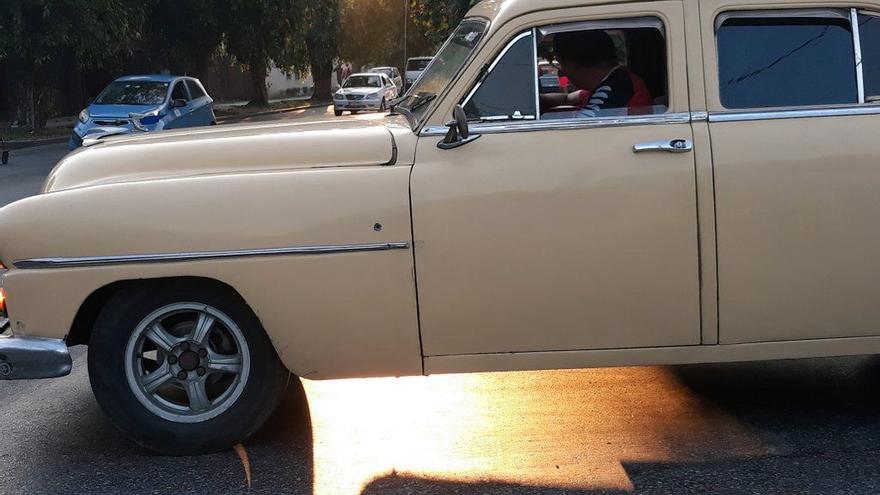
New measures that have gone into effect have made it very difficult to catch an ’almendrón’ (shared taxi) in Havana. (14ymedio)

14ymedio bigger14ymedio, Luz Escobar, Havana, 3 April 2019 — “They are tightening the net all around us” laments Heriberto Avila, a driver who plies the route between Santiago de las Vegas and an area near Fraternity Park. “First, they prohibited us from picking up passengers near the Capitol and now they are keeping us away from El Curita Park,” he complains. “We’re losing a lot of money because customers do not know where we are.”

Until it was shut down on Tuesday, the main taxi stop for almendrones — Havana’s emblematic restored 1950s American cars — had been at a park in El Curita. Now private sector transport workers will have to use pickup locations managed by the state. The provincial transport agency announced the measure in a written statement and suggested various alternatives passengers might use. It blamed the closure on repair work being done in the area and on the reorganization of transport services that have been taking place in recent months in the capital.

The measures allegedly are aimed at solving problems related to transportation, which is not operating as effectively as it should. A series of measures took effect last December that has affected workers in various sectors of the economy. These includes self-employed taxi drivers, known as boteros, who complain about the inevitably increasing costs, which affect their customers. continue reading

Within days after the regulations took effect, boteros illegally went on strike, pressuring the government and seriously impacting mobility in Havana. Since then, the number of privately owned taxis on the streets has remained low.

The government has tried to confront the situation by introducing newly imported vehicles. Last January a fleet of eighty-nine buses arrived from China along with another fleet of microbuses manufactured by the Russian company GAZ. They provide service between 6:30 A.M. and 10:00 P.M but have had little impact alleviating the transportation problems in a city where, during peak usage, passengers must wait for more than an hour before being able to board a bus.

“I have noticed an improvement in the transportation situation, although only during the hours of lower demand, such as after 9:00 A.M. and before 4:00 PM. That’s when you can see buses with empty seats,” said a retiree on Tuesday as he waited to get from an area near Ciudad Deportiva, the city’s indoor sports arena, to Old Havana.

“The minibuses are very small. They carry only twelve passengers and fill up very quickly at the starting point, so it’s very difficult to catch one along some intermediate stretch,” complains the pensioner. “They are forcing passengers to travel long distances to reach those points.”

Problems remain even for those who resort to private transport. As this publication was able to confirm in a trip carried out over the course of several days, fares for almendrones have shot up, in some cases doubling in price. “Before, I was paying ten Cuban pesos to get to Fraternity Park, to the corner of Boyeros and Tulipán. That stretch now costs me one convertible peso [twenty-four Cuban pesos],” explains Rita, a high school teacher.

“Taxi drivers come by and want to charge me one convertible peso. Transportation is in such bad shape that you have no choice. Either I pay it or I spend hours at the bus stop,” she complains. The price increase is, in her opinion, “a response to official controls but also a result of the decrease in the number of almendrones on some routes.”

Manuel, who until very recently worked near the Palace of Computation* as a buquenque (someone who manages the queue at a taxi stand), confirms the number has fallen. “I had to turn in my business license because the number of boteros had fallen so much and there wasn’t enough business to justify spending hours there for so little money,” he explains to 14ymedio.

“Since the new rules took effect on December 7, many taxi drivers have not returned to work or have decided to give up their business licenses,” he points out. “The reason is that, under these new regulations, they have lost a lot of their independence and must also buy fuel from state-owned gas stations. It’s not worth it.”

Authorities have repeatedly warned that much of the fuel used by private taxis is being siphoned off from the state sector, especially in industries such as sugar. To eliminate the black market in gasoline and diesel, drivers are now forced to use a magnetic card, which records their purchases of the product.

“The formula is simple: Previously, we were able to keep prices lower because we were buying fuel at half the price the state normally sells it. That is now increasingly difficult and the reason customers have to pay more,” explains Juan Carlos, a driver who works the route from the central Havana to the a stop in Playa.

The botero is not worried about losing customers to the state buses. “There are a lot of passengers who want to travel more comfortably and not be crowded into a bus, or who want to transport some merchandise in the trunk, or who just prefer sitting rather than standing. It doesn’t matter if the government puts a hundred or a thousand more buses on the road because private transport will continue to be in high demand.”

Translator’s note: A state-sponsored youth center which offers “the possibility of knowing and applying computation as a branch of knowledge, important for the technological and computer development” in Cuba. 

________________________________

The 14ymedio team is committed to serious journalism that reflects the reality of deep Cuba. Thank you for joining us on this long road. We invite you to continue supporting us, but this time by becoming a member of 14ymedio. Together we can continue to transform journalism in Cuba.

Nuevo Vedado Businesses Suffer after Viazul Offices Relocate

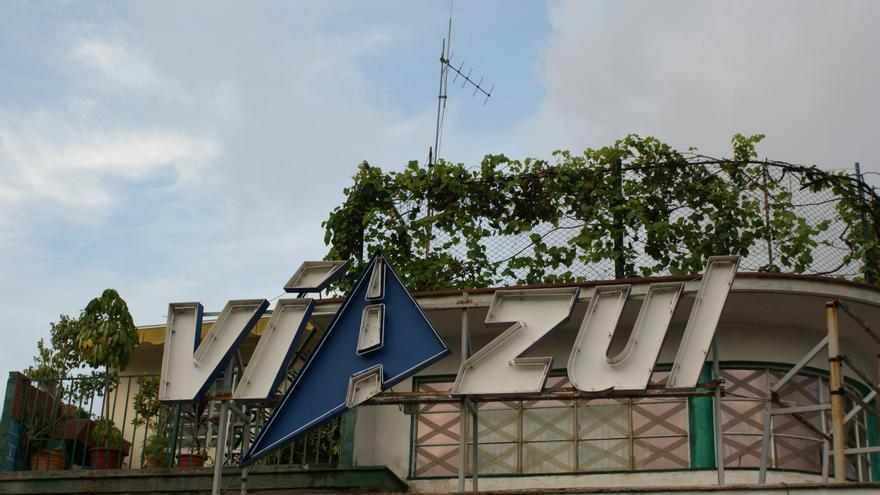
Viazul no longer occupies its signature location on 26th Street in Havana. (Martin A.)

14ymedio bigger14ymedio, Zunilda Mata, Havana, April 1, 2019 — “Things never slowed down. All day long the place was full of tourists. Now, if there are one or two, it’s a lot,” laments Sara, an employee at a privately owned cafe near the location where, until March 22, the Viazul bus company had its offices in Havana. The agency’s relocation has been a severe blow to businesses in this part of Nuevo Vedado.

“The economy of the entire neighborhood revolved around Viazul because there was nothing else here to attract tourists,” explains Sara, who notes that in the past week she has sold “very little food and almost no beverages” in the small cafe that also sells takeout items. “If this keeps up, we will have to close,” she warns.

Created in 1996, Viazul is a subsidiary of the Astro Business Group, owned by the Ministry of Transportation, which provides transportation services to travelers. With twelve daily departures from the capital and three departures from Varadero, Trinidad and Santiago de Cuba, the company handles more than 8,000 customers per month, most of them foreign tourists. Tickets can only be purchased with hard currency. continue reading

The Viazul station had always been located on 26th Avenue, near the Zoological Garden, before moving to the Central National Bus Station on Independence Avenue, a few yards from the Plaza of the Revolution. Until then, the central station had only been used by the state-owned transportation company Astro, which charges for its services in Cuban pesos.

“There were several short-term rental properties in this neighborhood which were doing well because they had customers who wanted to spend the night here before catching the early bus the next day,” explains Luís Alberto, who was born in the 26th Street vicinity. “Many residents also provided private taxi service for travelers, but now all that is up in the air.”

“This is the kind of decision that is made at the top without consulting the local community and that ends up causing a lot of difficulties and problems,” adds the young man. “There are people who are already losing a lot of money.”

A travel agency that provides trips to Isla de la Juventud is planning to move into Viazul’s former location, where passengers will be able to buy a bus ticket from Havana to Batabanó on the southern coast as well as a ticket for the catamaran that will then take them to the small island. “But that will mean many fewer customers because most of them are Cubans and they don’t have as much money to spend,” explains Luís Alberto.

Viazul has a fleet of more than 90 vehicles, at least 75 of which are forty-seat buses, as well as 13 microbuses with ten to eleven seats, and four mini-buses with twenty-four seats. In contrast to the buses operated by Astro, Viazul’s vehicles have a reputation for being safer and more comfortable.

Last January a Viazul bus was involved in an accident in Guantánamo province which killed three Cubans, two Argentinians, a German woman, a French man and injured thirty-three others. “This has been a very big problem for our company, which is currently involved in several lawsuits with the victims’ families, who are demanding compensation,” said an employee who preferred not to give his name.

We have tried to maintain a high level service but, over the years, the bus yard has deteriorated a lot, almost none of the restrooms in the buses work, the seats suffer from constant use and mechanical breakdowns are becoming more common,” he explains. “Even then, we’re still way above what Astro offers.”

The employee points out that the move to a new location is unrelated to the January accident or to the costs of the lawsuits. “It was a decision made by the former transport minister, Adel Yzquierdo, when she was still in office and is only now being carried out,” he notes.

The ministry announced its decision in mid-March and stated that the change was in response to the reorganization and consolidation of the National Bus Company, apologizing for any inconvenience this might cause.

During the initial phase, authorities have provided free transfers from 26th Street to the new location to give travelers time to adjust to the change.

“A lot of us who work for the company don’t agree with this but there is nothing we can do.”

“Having one company which charges in hard currency and another which charges in Cuban pesos under the same roof is not a good idea,” he states. “Their customers’ expectations are not the same. And Central Station does not meet the standards that tourists are looking for. There isn’t even a convenient taxi stand in the area.”

A group of drivers from Panataxi, who used to regularly pick up passengers at the former location, sent a letter to the ministry last week asking that Viazul either be returned to its former headquarters or that a dedicated taxi stand for its customers be provided. So far, however, they have not received a reply.

The issue of both companies operating under one roof has also led to complaints from Viazul customers, who lament the poor conditions of the station’s public areas. “You cannot use the toilets because they are so dirty. They have no toilet paper and you can’t flush most of them because there’s no water in the tanks,” complained Lucía, a Cuban living in Miami who bought a ticket on Saturday to travel to Camagüey.

“I arrived at the airport and thought I had to go to the terminal on 26th Street but they told me it had moved,” she reports to 14ymedio. “The old station was smaller but it was in better condition. At the new location things are very disorganized and the customer services leave much to be desired”. She acknowledges, however that “though the quality has gone done, at least it’s now in a more central location.”

____________________________________

The 14ymedio team is committed to serious journalism that reflects the reality of deep Cuba. Thank you for joining us on this long road. We invite you to continue supporting us, but this time by becoming a member of 14ymedio. Together we can continue to transform journalism in Cuba.

High Prices and Greater Control: An Old Formula for A Renewed Crisis

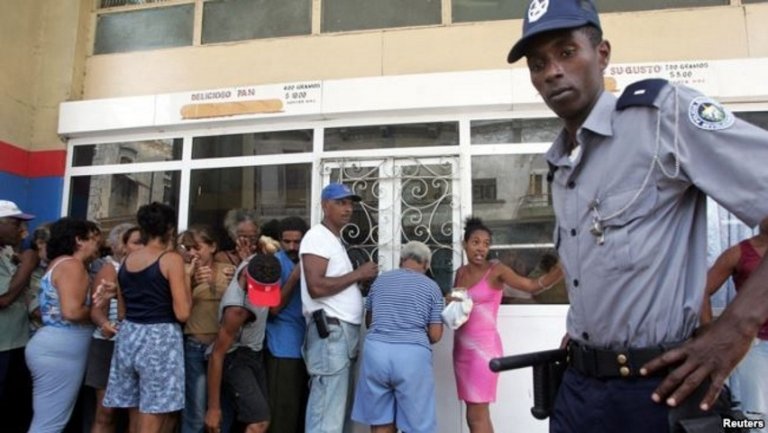
Officer watches as Cubans line up to shop (Reuters)

Cubanet, Miriam Celaya, Havana, 1 April 2019 — It’s Saturday morning and The Carlos III Shopping Plaza in Centro Habana recently opened, but already the butcher shop, in the interior of the establishment, is packed with people while, beyond the windows of the front door, another crowd swarms, expectantly waiting their turn to come in.

The customary shortages, made worse during the final months of 2018, have become chronic in hard currency stores, so that in the few markets where there is some assortment, large crowds gather. People in Cuba devote a large part of their time to the search for and acquisition of food.

“This is the only place I’ve found chicken and ground beef after looking in lots of other stores”, says a mature woman while placing the desired products in her shopping cart. Like her, dozens of people lean over the refrigerators gathering food to buy and take home. continue reading

In comparison with the empty shelves of previous days, this weekend the market has released products of dubious nutritional quality but of popular acceptance, due to their more modest prices: beef burgers, meatballs, sausages, various types of chopped meats, mixed with soy and starches — all of them imported — and artificially flavored and sweetened yogurt produced domestically. Chicken, which has become an obligatory character at the Cuban table and enjoys great popular demand, has reappeared after being absent for several days in this market. Nobody knows when the food supplies will be restocked, so everyone tries to hoard food as far as their limited finances will allow.

The endemic food shortage in Cuba has been joined by a subtle but steady increase in the prices of some foods. At the back of the butcher shop, next to the glass case, a blackboard displays what looks like science fiction for the Cuban pockets. The notice board is insulting: Marbled, bone in Beef Loin 20.25 CUC* / Kg (equivalent to 506.25 CUP). The same boneless product is also offered at 19.30 CUC / Kg (equivalent to 482.50 CUP), in addition to “super” ham at 10.25 CUC / Kg (256.25 CUP), bacon at 3.00 CUC / 250gr (75.00 CUP), Siboney brand processed cheese 4.95 CUC / Kg (123.75 CUP) and several types of sausages produced nationally with mixed capital of State companies and Spanish partners, in tubes of 500 grams whose prices range between 4.65 CUC (116.25 CUP) and 7.10 CUC (177.50 CUP). Most customers are buying only processed cheese, while a large stale piece of beef worth 88 CUC (2,200 CUP) continues to age, dark and forgotten, behind the vitreous refrigerated showcase.

Concerning the agricultural markets, they have joined the upward prices spiral that, usually high, continue to shoot even higher without mercy in the agricultural demand and supply (i.e. unrationed) markets, whose products are of greater variety and of superior quality to the ones offered in the small kiosks of other private sellers. As for the agricultural markets of state cooperatives, they usually have a poor supply, and their products, with some exceptions, are usually of the worst quality, and even their more modest prices do not have a realistic relationship with the purchasing power of the common Cuban.

Although not everyone is aware of the complexity and depth of the economic crisis that grips them and threatens to worsen in times to come, the perception of the deterioration begins to be felt on the minds of the people. The uncertainty about the near future continues to grow, along with the certainty that the government does not have a viable alternative to address the growing problems of the economy and society.

The most recent meetings of the Councils of Ministers have uncovered some of the huge cracks through which finances disappear, as well as other serious ills ailing the national economy that have forced the government to make public certain deficiencies that years ago would have remained hushed. However, far from implementing reforms to end with damaging centralism and to free up the productive forces leading to the development of private initiative, the authorities have opted for the formula, largely unsuccessful, of “control increases,” savings “as source of income” and the eternal calls for the productive efficiency of workers.

However, in crisis situations nothing is as useful to the official script as a villain. And, since the “blockade” (the embargo) is still useful but no longer enough to justify internal failures, in recent issues the television news program has been focusing precisely on the “hoarders-speculators”  — that fauna, the natural daughter of scarcity and unproductiveness — as if it were about a new phenomenon and had not been a permanent character of our existence for at least the last half century.

Thus, in order to remedy the shortages, the hot potato has been launched at the population by the Castro media: “the people” have been invited to go onto the National Television News (NTV) website and other lampoons to present their proposals as to what measures the authorities should take to curb this scourge of parasites that make the lives of the most humble Cubans so expensive by appropriating large quantities of basic goods and then reselling them at multiplied prices in the informal market.

With that amusing touch of modernity — a sign of the new style of media-focused governance with which they have been refreshing the image of the failed Castro experiment in the hands of the “young” commander without command — the power cupola not only evades its direct responsibility in the economic catastrophe into which it has plunged Cuba, and its obligation to present a proposal to mend it, but suggests to the servants of the ruinous medieval village to disburse a part of their already meager pockets to connect to the Internet (also with the onerous prices of its connections) and declare on the official page of the NTV what to do with these lesser delinquents, that is, the hoarders.

What the plan is really about is to set an example by punishing, not the true and biggest hoarders-speculators who have been squeezing all of us for 60 years, but to chastise those petty rascals who engage in small-scale mercantile fiddling and who, in the last instance, also survive, protected by the general corruption of the system.

Because, in a good fight, the State-Government-Party is the first link of the chain of speculators dragging Cubans to poverty. They are officials of the Castro regime — many of them proven corrupt over the years — who are responsible for the ever increasingly insufficient purchases of food at the lowest price abroad later sold for prices that are multiplied several times in the state retail trade networks, in which Cubans must necessarily buy to survive, and it is the economic paralysis of state centralism that fosters the proliferation of those markets and these speculators, in a system that reproduces its own basic vices time and again.

The inefficient and unproductive State-Party-Government is the parasite that sets low prices for food production by peasants, imposes what kind of crops they must develop, monopolizes harvests, which often deteriorate or are lost in the fields or in storage warehouses, and thus pushes producers to sell to intermediary speculators, who offer better prices for the farmers’ harvests, but raise consumer costs.

Thus, by diverting attention to the effect to mask the causes of evil and, at the same time, manipulate national public opinion, the leadership creates a false impression that popular participation is part of the decision-making of the economy and in the solution of the problems that afflict the population, at the same time that it increases the time to implement the essential apertures that, sooner or later, would mark the route towards the inevitable end of the socialist experiment in Cuba.

*Translator’s note: The CUC (Cuban Convertible Peso) is roughly equivalent to one U.S. dollar. Monthly wages in Cuba average roughly 17-30 CUC a month, thus this price for 2.2 pounds of beef is more than many Cubans’ monthly wage.

Translated by Norma Whiting

In Cuba Fear Won / Ivan Garcia

Photo by Juan Suárez taken in January 2019 in Centro Habana. Source: The Havana Times.

Iván García, 27 February 2019 — Ten minutes before 7:00 am on Sunday, February 24, the president of Electoral College Number 3 of District 68 hurried his meager breakfast of bread with mortadella and a cup of a beverage that was brewed from a mixture of coffee and ground peas.

He already had the ballots in order and the pencils were ready for the voters in the four cubicles. On the walls of the premises, located in a garage, were photos of Fidel Castro and several posters in favor of a Yes vote on the revised constitution.

Two “pioneers” — Cuban schoolchildren — commented on the Barcelona-Sevilla soccer game the day before when the president asked them to stand on either side of the small plastic urn of Prussian blue. continue reading

In the first hour of voting turnout was very light. Some retirees who, early in the morning, go out to buy the bread granted by the rationing book, took advantage and voted expeditiously.

“It’s that people like to sleep in, in the morning,” said a woman seated at the school table. The procedure was fast. They wrote down your identity card number, compared your data with the voter registration and then gave you a ballot.

The deficiencies in three of the four voting places visited were palpable. At the number two school in constituency 68 of the Lawton-Vista Alegre people’s council, the day before the vote, voters’ lists had not yet been posted. In three of them, instead of pens, they had put pencils, making it very easy to manipulate the vote.

In all the polls, propaganda in favor of a Yes vote was blatantly on display. The number one electoral college in District 68, where I had to vote, they did not even knock on my door to give me the summons used to call people to vote. They threw mine and my neighbor’s under the door. My name did not appear on the rolls, nor did that of my wife and daughter, eligible to vote. Where the voter’s name was supposed to be placed, they showed an address and an apartment number.

That Sunday, Daniel and his brother took out a bottle of rum and started drinking while playing dominoes with two friends from the neighborhood and listening to reggaeton. “A neighbor who worked at the polling station went through the corridor where we live and jokingly told us, ’when are you going to vote, then get drunk and forget them?’ You know, nobody wants to be marked [for not showing up]. We made a stop and went to vote.”

The domino players say they voted Yes. Do they agree with the text of the new Constitution? Daniel responds: “I have not read it. Everything is pure procedure. If you vote No, they win. If you vote yes, it’s the same.”

It may be true. But automatically a segment of Cubans continues to act like zombies. Luisa, a clerk in a state cafeteria, says she does not approve of the government’s management and is able to overwhelm you for a couple of hours with complaints about market shortages and deficiencies in public services.

But when she votes, she always checks the box that favors the regime. Why? “Hey, the dissidents do not give me a means to vote NO. If I am fired from my job the Embassy of the United States will not grant me asylum as a political refugee. This is the country that I have to live in. And if you do not look like you support the government, you are looking for a problem,” Luisa explains.

Fear always knocks on the door before civic citizenship. The reasons are understood. We Cubans reside in a nation of command and order. The good and bad that can happen to you in life depends to a great degree on your support for the autocracy. Sixty years later, that behavior works as a conditioned reflex.

In spite of everything, the fear has been overcome. In the referendum to approve the 1976 Constitution, 97.7% of Cubans ratified that legal document and attendance was 98%. Forty years later, in the imitation of elections to choose the deputies to the National Assembly, held in 2018, between 23 and 24% of citizens abstained, left the ballots blank or annulled them with rude words and slogans of “Down with Fidel.”

According to reports from observers and alternative media, in the majority of the polls visited, the number of abstentions exceeded the NO vote, while the Yes won comfortably.

Carlos, a sociologist, affirms that “in every election, votes against government proposals increase, but for various reasons, including fear, people feel more comfortable staying at home than going to vote and having to voteno or leave the ballot blank. Abstention can be justified in innumerable ways. I’m sick, I had a family problem, or a lie. But still many Cubans think that in the polling stations there are video cameras and voting NO or putting anti-government slogans can bring you problems.”

Although the ballot boxes are watched over by the young pioneers, in the vicinity of the polling stations the presence of State Security agents dressed in civilian clothes is visible. “Operations are mounted in all elections, with the participation of the police, DTI and Security. In areas where known dissidents live, surveillance is greater. If they are going to audit the vote count they are alert in case of any provocation,” says a former intelligence officer.

These operatives Olympianly transgress their own legal norms implemented by the regime. Dozens of opponents, such as José Díaz Silva, were assaulted or prevented from voting. Yoani Sánchez, director of 14ymedio, chronicled the tension she experienced in an electoral college when she demanded her rights. In the end, at the cry of Viva la Revolución, he had to endure the usual act of repudiation.

This fear of what can happen when acting voluntarily or against the interests of the government is always present among Cubans. That is why people prefer to see things from the stands or record from a distance with their mobile phones the protests and beatings of the political police to peaceful opponents.

In this referendum the victory was pre-ordained in favor of the Yes. After three o’clock in the afternoon of Monday, February 25, Alina Balseiro, president of the National Electoral Commission, appeared in a press conference informing that the new Constitution of the Republic of Cuba it was approved with 86.85% of the votes cast, according to preliminary data. Of the 9,298,277 citizens with the right to suffrage, 7,848,343 (84.4%) went to the polls to answer the question Do you ratify the new Constitution of the Republic?

Accepted as valid were 7,522,569 votes were, of which 6,816,169 voters voted Yes (86.85%) and 706,400 voted No (9.0%). 127,100 ballots were canceled and 198,674 were left blank.

In an article published in, the independent journalist Reinaldo Escobar commented: “The preliminary results of the referendum on the new Constitution confirm what was expected: that the new Constitution was going to be approved by the majority and that the process was going to make clear the increase in citizen dissent by putting a number to that group that rejects the administration of the authorities.

“More than two and a half million voters all over the country have distanced themselves from the new Constitution, between No, null, and blank votes, in addition to abstentions. Many have thus found themselves on the path to distancing themselves from the ruling political and economic system on the island.”

In Cuba, without international observers, reliable automatic voting machines, indelible ink, not to mention the excessive propaganda in favor of the regime, even inside the polling places, the official data usually awakens distrust among the opponents, independent journalists, exiles and analysts who follow Cuba.

Fear, for now, remains an involuntary ally of the olive-green autocracy.
The Man of the White Suit / Fernando Damaso

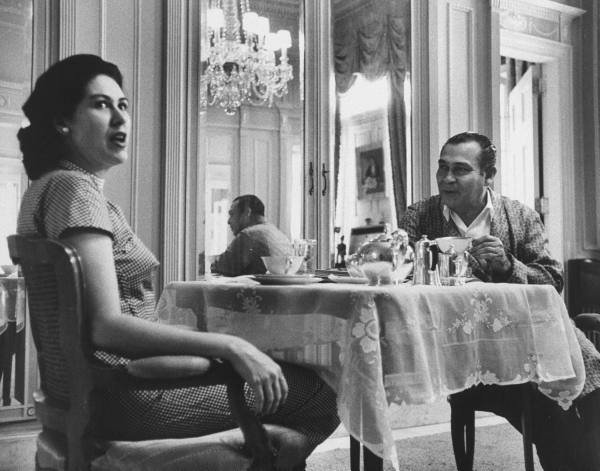
Batista lunching with his wife in the Presidential Palace, 8 months before fleeing Cuba. (Wikicommons)

Fernando Dámaso, 28 February 2019 — As a result of the Constituent Assembly and the elaboration and implementation of a new Constitution of the Republic, in an electoral process characterized by legality and tranquility, Fulgencio Batista Zaldívar became the sixth president, a man who had left the army with the rank of colonel (in February 1942, the new Organic Law of the Army grants him the rank of general retroactively), and fused into this same person the two antagonistic currents during the seven prior years, with losses for both sides and for the Republic: the military and the civilian.

Although he was a military caudillo, and had acted as such in previous years, exerting his influence in the rise and fall of several presidents, his personality also projected on the political plane. His rise to the presidency gave continuity to the Generals-Presidents of the Republic. Perhaps, because of this, he was able to easily defeat the military coup of the Chief of Police, General Jose Eleuterio Pedraza, at the beginning of his term. He exercised power from October 10, 1940 until October 10, 1944. continue reading

The main objective of his government, formed by the so-called Socialist Democratic Coalition, was to consolidate the state of peaceful coexistence that had been achieved during the Constitutional Convention, where parties, organizations and political and social groups of different stripes had managed to debate their proposals with civility and reached important results for the good of the Republic. In spite of this, from the beginning of his mandate, he had to face the opposition of the Cuban Revolutionary Party (Authentic), his main opponents and losers of the elections.

Unlike prior presidential terms, which began in 1902, he set in motion the semi-parliamentary regime established by the 1940 Constitution, appointing as its Prime Minister Dr. Carlos Saladrigas, a relevant personality, who managed to establish and maintain correct relations between the Executive and the Legislative branches.

During his exercise of the presidency,  Batista created the National Development Commission, with the objective of coordinating and promoting the development of the country, set a gold standard for the issuance of monetary certificates and achieved important advances in labor policy, establishing the Sugar Workers Retirement plan.

In addition, he  approved the creation of the National Council of Education and Culture, which achieved good results in the improvement and development of these two important activities, turned over the Calixto García General Hospital and the Limones Central (a sugar mill) to the University of Havana, for their use as learning centers, built the National Archive building, as well as that of the Economic Society of Friends of the Country and established the Order “José María Heredia”, to reward Cuban and foreign personalities in the world of science, letters and the arts.

Upon entering Cuba into the Second World War, he called for national unity, the ABC Party, an ally until that point of the Cuban Revolutionary Party (Authentic), responded favorably and came to collaborate with the government. In the context of the war, important measures were taken, with the aim of avoiding the scarcity of supplies and making the lives of citizens too expensive.

Although the Cuban Revolutionary Party (Authentic) continued in the opposition, it collaborated from the Congress with every act of national defense and with the belligerent attitude that Cuba had assumed. In response to this, the government appointed Engineer Carlos Hevia, an important figure of this party, as President of the ORPA, the Office of Regulating Prices and Supplies.

The President, during the years of his mandate, was able to summon and surround himself with people prepared to successfully carry out his government projects, allowing the country to live a stage of social tranquility and progress, experience that, unfortunately, has been forgotten by the others who suceeded him.

On June 1, 1944, general elections were held, including the candidacies of the Socialist Democratic Coalition, composed of Carlos Saladrigas-Ramón Zaydín, and the Cuban Revolutionary Party (Authentic) by Ramón Grau San Martín-Raúl de Cárdenas.

In an orderly process, honest and with all the guarantees, Dr. Ramón Grau San Martín obtained the victory, as the Republican Party of Dr. Guillermo Alonso Pujol joined his ranks, with the goal of, at the last minute, softening the excessive radicalism of some authentic leaders, among them, mainly, Dr. Eduardo R. Chibás, that affected the intention of voters. The transfer of powers was carried out in the most perfect democratic order.

Fulgencio Batista Zaldívar was the first President elected in democratic general elections, in accordance with the new Constitution of the Republic, after the fall of the government of General Gerardo Machado. His presidential term was characterized by the achievement of peaceful coexistence among Cubans, and the realization of important works, both material and social, which helped the country’s development after the impasse of seven years of political and economic instability. By restoring the democratic order, he created the base for its continuity.

The facts show that Batista was not the illiterate politician that they tried to make us believe, but someone intelligent who made good government during this presidential period. No monument or bust was erected that would honor him, although during his presidential termt the 4th of September flag fluttered next to the Cuban flag in the military camps and institutions.

Translated by Wilfredo Díaz Echevarria