Six Activists Prevented from Leaving Cuba

From left to right, Abdel Legrá, Boris González and Enix Berrio, three of the six activists prevented from traveling this Sunday. (Facebook)

14ymedio bigger14ymedio, Havana, 2 June 2019 — Cuban authorities prevented the activists Enix Berrio, Alberto de la Nuez, Fernando Palacios and Boris González from boarding flights at Havana’s José Martí International Airport for Panama City, this Sunday. The opponent Abdel Legrá Pacheco was also unable to board his flight to Colombia and the political police arrested the dissident María Elena Mir to prevent her from getting to the airport.

Berrio, De la Nuez, Palacios and González were going to travel to the Panama to participate in a meeting of the Democratic Unity Table (Muad), a coalition of opposition groups and civil society organizations. However, officials of the Directorate of Identification and Immigration and Immigration in Cuba (DIIE) informed them that they are “regulated” — the government’s euphemism for not being allowed to leave the island — González explained to 14ymedio.

“Castroism blocks our exit, as it has blocked our freedom for six decades,” González denounced in his social network account on Facebook, where he also published a photo in which he is seen with Berrio and Legrá a few yards from the points of immigration control at the airport. continue reading

Berrio, spokesman for the opposition coalition, explained to this newspaper that the suspension of this trip does not paralyze the organization’s plans. “Muad will hold its meetings separately, one part in Panama and the other in Cuba, so we will continue working,” said the historian and economist.

Another participant in the meeting in Panama, the activist María Elena Mir, was arrested on Saturday by members of the State Security who told her that she could not leave the country. In addition, they blocked her mobile phone until Sunday afternoon so that she could not make or receive calls.

For his part, Legrá, who wanted to travel to Bogotá, also received a refusal at the immigration window. The activist was one of the more than 650 dissidents who presented themselves as candidates for constituency delegates during the People’s Power electoral process in 2017, but State Security pressures blocked them.

In January 2013, an immigration reform came into effect that considerably eased the procedures for traveling outside the Island, eliminating the previously-required “exit permit.” However, over the years the Government of Raúl Castro and, later, that of Miguel Díaz-Canel has lengthened the list of opponents who can not leave the country.

Initially, to prevent them from traveling, State Security used the arbitrary arrests of the dissidents, hours before their planes took off, or intercepted the vehicle in which they were traveling to the airport and kept them detained until their flights had left.

In the last year, however, the strategy of informing them that they are “regulated” when they are about to pass through the immigration window has become more common.

The Cuban Commission for Human Rights and National Reconciliation, based in Havana, has repeatedly denounced the use of travel restrictions as a repressive measure against opponents and activists.

_____________________________

The 14ymedio team is committed to serious journalism that reflects the reality of deep Cuba. Thank you for joining us on this long road. We invite you to continue supporting us, but this time by becoming a member of 14ymedio. Together we can continue to transform journalism in Cuba.
Cuban Artist Luis Manuel Otero Alcantara Released on Tuesday

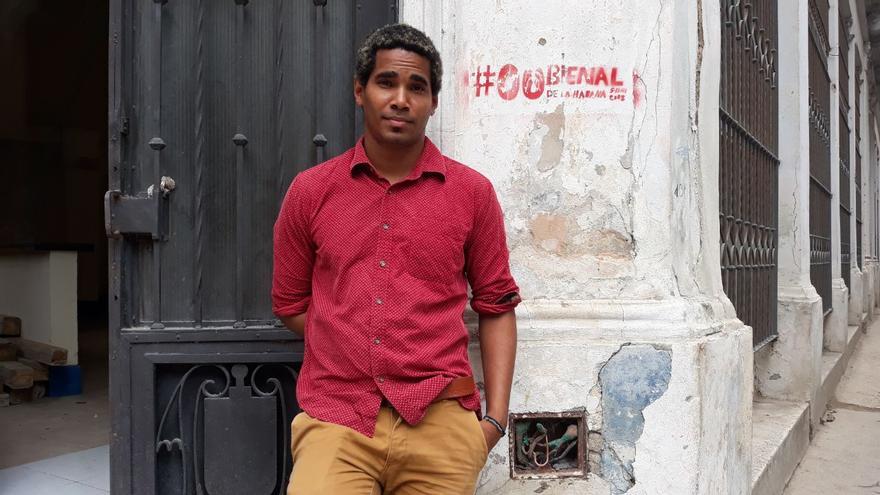
Luis Manuel Otero Alcántara was arrested on Monday afternoon. (14ymedio)

14ymedio bigger14ymedio, Havana, 4 June 2019 — The police released artist Luis Manuel Otero Alcántara on Tuesday afternoon after he spent 24 hours in the San Miguel del Padrón police station, the independent artist explained to 14ymedio.

By telephones, moment after his release, Alcántara related that he was arrested on Monday in the middle of the street. The artist claims State Security officers along with uniformed National Revolutionary Police (PNR) who led him to a patrol car.

The arrest came shortly after Alcántara announced his participation in a performance at the Museum of Dissidence in Cuba, which consisted of holding the Cuban flag on a balcony for a period of 24 hours at a ninety degree angle. During the arrest, the police confiscated one of the banners that he was going to use in the artistic action. continue reading

May the country contemplate you with pride? is the name of the performance that, despite the repression, was carried out. “We did everything, the reading, the action with the flag and then a party,” one of the members of the San Isidro Movement told this newspaper.

“Once again they talked to me about public space, they say that everything inside the house is fine but they will not allow anything to happen in the public space. I told them that the balcony was part of my house but they say no, and well, we can go on like this for 70 years because I am going to continue making my art despite the arrests,” explained Otero Alcántara.

This work is the last of the series SeUsa, a work that received criticism from officialdom. In particular, the peformance with the American flag was described as “annexationist” by Fernando Rojas, the vice minister of culture.

In his Twitter account Rojas wrote “Thousands of exhibitions, hundreds of artists, millions of Cuban men and women, the great popular festival of visuality in Cuba, that three annexationists will not tarnish. They dressed children in the US flag and made them parade down the street, they abuse goodness and innocence.”

Last April, the artist, who is also a member of the San Isidro Movement, suffered an arbitrary detention that prevented him from carrying out this action, planned in the context of the XIII Havana Biennial.

The piece was a tribute to Daniel Llorente, “The man with the flag,” and consisted of young people from the neighborhood running 66 meters wearing a T-shirt with the Cuban flag and holding the American flag on their heads. The action recalled the protest of Daniel Llorente, on May 1st of 2017, in the Plaza of the Revolution.

Otero Alcántara is known on the island for his rebellious art and was one of the most visible faces in the fight against Decree 349, which restricts the freedom of creation of artists. In 2016 he created the Museum of Dissidence in Cuba with Yanelys Nuñez, a project that aims to approach the history of the Island with an independent and critical view.

_________________

The 14ymedio team is committed to serious journalism that reflects the reality of deep Cuba. Thank you for joining us on this long road. We invite you to continue supporting us, but this time by becoming a member of 14ymedio. Together we can continue to transform journalism in Cuba.

Actor Salvador Wood Dies in Havana

Actor Salvador Wood died in Havana on Saturday (Twitter)

14ymedio bigger14ymedio, Havana, June 2, 2019 — Radio, television, theater and movie actor Salvador Wood died in Havana on Saturday afternoon at the age of 90 according to the Cuban television website. At the time of his death he was living in Cojímar, a town east of Havana.

Wood was a recipient of the National Television Award for Lifetime Achievement and achieved recognition for roles in films such as The Death of a Bureaucrat by Tomás Gutiérrez Alea and El Brigadista by Octavio Cortázar. He also received the 2016 ACTUAR Award for Lifetime Achievement from the Artistic Agency for the Performing Arts.

Born on November 24, 1928 in Santiago de Cuba, Wood moved to Havana in 1946 in search of career opportunities after having gained some experience as a theater and radio actor in his home province. continue reading

He got his start on radio in 1943 in drama which focused on the execution of eight medical students, in which he played one of the students. In 1945, at age seventeen, he joined the Comedy and Dramatic Art Company, performing in the 1844 Spanish play Don Juan Tenorio by José Zorrilla.

He made his television in a 1952 program directed by Jesús Cabrera in which he played a peasant, a role he reprised numerous times throughout his career. In the early 1960s he made his film debut, first in a documentary, Chinchín, and later in a film, El Brigadista, appearing alongside his son, Patricio Wood.

Considered an excellent actor by critics in spite of a lack of formal training, Wood explained in several interviews that he learned by observing, reading and talking to other colleagues such as Juan Carlos Romero and Alejandro Lugo, who had studied performing arts.

Wood was married for sixty years to fellow actor Yoland Pujols, who died in 2015. It was while appearing together in a Cuban soap opea by Maité Vera, Lo que me queda vivir (Why I Go on Living), that he created one of his most memorable characters. His final appearance on the big screen was in the 2006 film Listos para la isla (Ready for the Island).

___________________________________

The 14ymedio team is committed to serious journalism that reflects the reality of deep Cuba. Thank you for joining us on this long road. We invite you to continue supporting us, but this time by becoming a member of 14ymedio. Together we can continue to transform journalism in Cuba.

Why Do Independent Journalists Matter? / Cubanet, Luis Cino

Hundreds of Havana protesters gathered in the streets of the Diez de Octubre neighborhood after five days without electricity. (Facebook Andy Michel Fonseca)

Cubanet, Luis Cino Álvarez, Havana, 11 March 2019 — Oftentimes while traveling in other countries, independent journalists are challenged for, as some say, being “hyper-critical” and “lacking objectivity.” Thus, their dispatches are received with doubts and skepticism. But it turns out that the detractors of Cuban independent journalism do not harbor good intentions.

Among those most critical and skeptical can be found many of the foreign correspondents accredited in Cuba. This should not be so because they know, from their own experience, under what conditions and rules that they themselves – despite the immunity that they supposedly enjoy – are forced to comply with in order to practice their profession. They know that when they try to interview people on the street, these subjects act evasive and seldom really and truly say what they think.

Despite their press credentials, these reporters have little or no access to government functionaries, and they collide with laws that guarantee official silence. Besides, they are under the surveillance of State Security, informants for the CDR and rapid-response brigades – and even by their colleagues in the official press, who tend to provoke and lay traps for them. continue reading

So, why are these foreign press members so critical and demanding, for example, with respect to sources and official data cited by independent journalists who are doing their work under much more disadvantageous and difficult conditions than they?

The foreign correspondents accredited by Havana’s International Press Center (CIP) find it much more convenient and secure to ignore reports by independent journalists, and to quote Granma newspaper and Cubadebate when saying that the majority of Cubans voted “Yes” to the new Constitution, that the update to the economic model is proceeding full steam ahead, that Cubans are happy as clams with cuentapropismo [self-employment or entrepreneurship] – along with repeating the usual refrain about “the fragmented and State-Security-penetrated opposition” that “lacks convening power” and is “incapable of garnering the mass support of the population.”

For a long time, and not just from the official media, there were those who affirmed that the majority of independent reporters were unprepared, individuals of low educational level, who lacked a command of the rules of grammar and composition, and who confused political activism with journalism.

We made ourselves vulnerable to such attacks because of the paternal solidarity (a legacy of socialism’s false paternalism) towards individuals who regrettably demonstrated from the start that despite their great desire and enthusiasm, they would never be journalists. By tolerating ersatz practitioners in the ranks, all we gained was to be discredited. And also to be infiltrated by moles, like that dopey Carlos Serpa Maseira, who turned out to be Agent Emilio.

Not just anybody can be a journalist, just as not just anybody can be a physician. The profession deserves respect. But some of us long-time veterans cannot forget how we got our start in independent journalism. Reporters will always be needed to cover the activities of the opposition and to denounce human rights violations. It can’t all be political analysis, opinion pieces, and columns worthy of Tom Wolfe. We would run the risk of turning into a reduced and exclusive club of snobs. It appears that such a coterie is not what is most needed to win the struggle for democracy and freedom of information in Cuba.

Within the last decade, the quality of independent journalism has improved extraordinarily following the addition of bloggers who are outside of state control, writers who have broken with UNEAC and have joined CubaNet, journalism students, and journalists who have unleashed themselves from the official media to write for alternative sites such as El Estornudo and El Toque.

We independent journalists have no need to invent or exaggerate, to publish diatribes in the style of Granma – on the contrary: we write about what we live daily, not what people tell us or what we suppose.

The topic that the majority of foreign correspondents accredited in Cuba report on the most is the “flourishing private restaurant sector in Havana.” As if there were no blackmailing inspectors and obstacles of all kinds. It’s as if the exceptions were the rule. As if all paladar [private restaurant] owners had the good luck of the proprietors of La Guarida, the setting where some scenes in Fresa y Chocolate were shot and where various pop celebrities have dined.

Who cares about what we independent journalists – hypercritical and overly passionate as they accuse us of being – have to say, given that regarding Cuba, everything that needs to be said and should be heard is said by the international press?

Therefore at times we become discouraged. We know that, in our situation – lacking access to official, trustworthy statistics and relying on sources who will probably retract when facing State Security officials – it is very difficult for us to produce the great news reports we dream of writing.

There is no need to be so pessimistic. There are always subjects that are a few degrees beyond the grasp of foreign journalists and which are not covered in the magical statistics that they cite. We still have the stories about jineteras [female prostitutes] and pingueros [male prostitutes], the garbage dumpster divers, the transvestites who haven’t been coaxed by CENESEX to dance in their conga, the artists who oppose Decree 349, the palestinos who struggle to make it to the capital, the inhabitants of the peripheral shantytowns and the tenements of Centro Habana and 10 de Octubre. But there will always be those who consider these depressing stories to be fiction – and even those who opine that Pedro Juan Gutiérrez does it better in his novels. And then they will again seek in the foreign press the fable of the successful and prosperous entrepreneur, the administrator who is given to reforms, and the soulless and corrupt bureaucrats who hamper her efforts while never showing their faces.

luicino2012@gmail.com

Translated By: Alicia Barraqué Ellison

An Ever Better World, No Matter What People Say

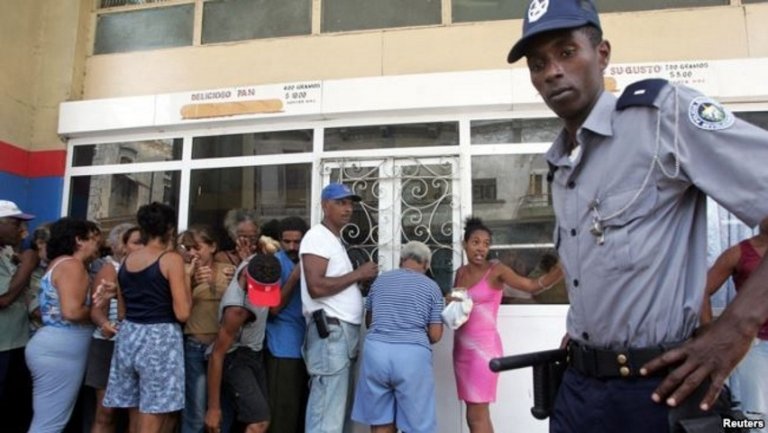
Cuba’s “Gini Index” ranges in the 40s. Here an officer watches as Cubans line up to shop, facing the daily shortages of all kinds of necessities. (Reuters)

14ymedio bigger14ymedio, Carlos Alberto Montaner, Miami, 24 May 2019 — Is the cup half empty or half full? It depends. According to Bernie Sanders, 1% of society is enriched exponentially while the poor, 40 million Americans, 13% of the census, lack the resources to have a dignified life.

Is that true? It also depends on what one calls a “dignified life.” Poverty in the United States is measured by income. A family of 4 people with less than $25,000 a year is considered “poor.” But poverty is relative. That family has a home and public schools. As a benefit, they can acquire food without cost. Electricity, telephones, drinking water, internet. Cars and paved streets. Police protection and a judicial system with public defenders representing victims and victimizers.

At the same time, unemployment in the United States continues to decline. That is magnificent. It continues to be the country of opportunities, as determined by the flood of legal or illegal immigrants who arrive annually. However, a CEO or President of a major company earns in a year 312 times what an average employee receives. That is problematic and is reflected in what is called the Gini Index: the richest 20% of the nation gets much more wealth than the poorest 20%. continue reading

Corrado Gini was an Italian statistician, a fascist, who in 1912, more than a century ago, designed a formula to establish the division of income among the quintiles of any society. (With the years and the attacks the mathematician abandoned fascism). Supposedly, the Index or Gini Coefficient measures the equity or equality that reigns in the country subjected to the analysis. Roughly speaking, the most egalitarian region is Scandinavia and one of the most unequal is Latin America.

There are so many variables — cultural, geographical and historical — that present real conceptial obstacles to converting these variables into reliable indexes of inequality, which the demagogues wield constantly. “El Gini” is almost useless. Two of the most “unequal” nations are, precisely, Panama and Chile; two of the region’s nations that have seen the greatest growth and that are closest to full employment.

But, when one proudly shows what is happening in Chile, the adversaries are quick to cite the rancorous fact that Chile and Panama have Gini Indices exceeding 50, when the Scandinavian countries are under than 30. The way  this coefficient works, zero would be absolute equality and 100 total inequality. Cuba, a country in which almost everyone lives miserably, ranges in the 40s and most of its population dreams of settling in Chile or Panama, let alone in the United States, whose “Gini” is 45.

Perhaps the Human Development Index published annually by the United Nations is more reliable, as it is more complete. It considers three factors: per capita income levels, schooling levels and life expectancy. The Spanish economist Leandro Prados de la Escosura, quoted by Juan Ramón Rallo, another leading economist, measured the inequality between countries from 1870 to 2015 and found that, although the inequality within populations was increasing as far as monetary income was concerned, it was decreasing with respect to education and life expectancy. (The review of the work of Prados de la Escosura by Rallo can be found at The Cato Institute).

_________________

The 14ymedio team is committed to serious journalism that reflects the reality of deep Cuba. Thank you for joining us on this long road. We invite you to continue supporting us, but this time by becoming a member of 14ymedio. Together we can continue to transform journalism in Cuba.
Police Surround and Raid Homes of Several Unpacu Activists in Santiago de Cuba

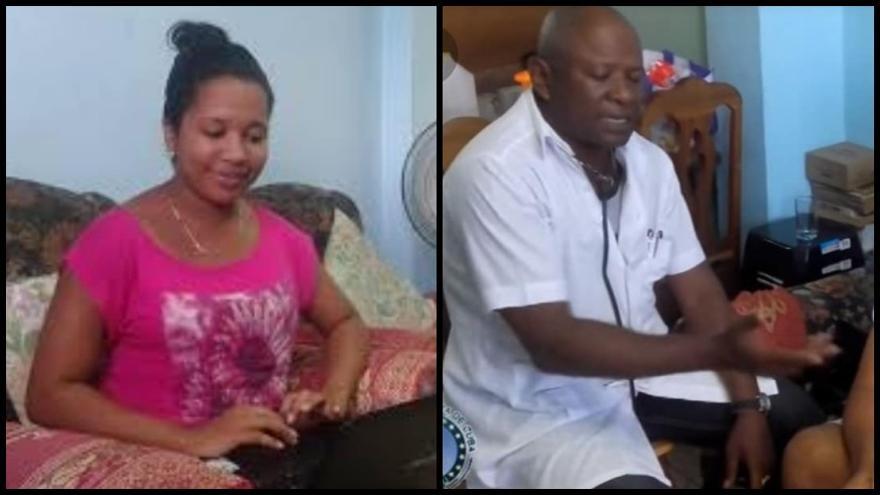
The homes of activist Yadira Serrano and her father, Dr. Roberto Serrano, were raided by police on Monday in Santiago de Cuba. (Facebook)

14ymedio bigger14ymedio, 3 June 2019 — On Monday morning, Cuban police and State Security forces raided the homes of Dr. Roberto Serrano and his daughter, activist Yadira Serrano, in the municipality of Songo la Maya, in Santiago de Cuba, according to information received by 14ymedio from the opponent Carlos Amel Oliva, a member of the Patriotic Union of Cuba (Unpacu).

The homes of the father and daughter are located one on top of the other and during the police search a laptop, two mobile phones, two USB memories and numerous documents were seized.

Along with the police searches, the main headquarters of Unpacu and another house, where the Freedom and Democracy Academy was planning an activity, are surrounded and access to their interiors is not allowed. continue reading

Dr. Serano, who works as a physical medicine and rehabilitation doctor at a medical center of Songo La Maya, recently made public his support for a complaint filed with the International Criminal Court (ICC), which accuses the Government of Cuba of using practices akin to slavery with regards to physicians who carry out missions abroad.

“This action is nothing other than government revenge against a doctor who expressed his opinion in favor of the complaint,” Oliva explains. The lawsuit included the testimony of 110 doctors on the island who abandoned so-called “internationalist missions” and whose identity, in many cases, was protected to prevent reprisals against them.

For her part, the daughter of the doctor, Yadira Serrano, has been prominent in recent months in preparing several documents that a group of civil society organizations intend to present to the next General Assembly of the Organization of American States (OAS), to be held in Colombia.

Also on Monday, Yadira Serrano was in charge of a workshop as part of the activities of the Freedom and Democracy Academy planned take place in a house in the Mariana de la Torre neighborhood in the capital of Santiago. But from the early hours of the morning a police siege has prevented the entry of participants, detailed Carlos Amel Oliva.

The workshop, in which some 15 people were planning to participate, was scheduled for 8:00 am and was dedicated to instructions on international entities where complaints can be filed for human rights violations.

The headquarters of Unpacu, in the Altamira district, is also under police siege. Oliva noted that the raids perpetrated today by the police in Songo la Maya are the 22nd and 23rd carried out so far this year against that opposition organization.

________________

The 14ymedio team is committed to serious journalism that reflects the reality of deep Cuba. Thank you for joining us on this long road. We invite you to continue supporting us, but this time by becoming a member of 14ymedio. Together we can continue to transform journalism in Cuba.
The Cuban Intelligence Network in Venezuela "Has Been Diminished," According to Guaido

Juan Guaidó believes that the efforts of the Donald Trump government to cut off the supply of Venezuelan crude to the island are working. (Cocuyo Effect)

14ymedio bigger14ymedio, Havana, 30 May 2019 — “The intelligence network has been diminished somewhat by the cutting off of the oil supply to Cuba [with the sanctions],” Juan Guaidó said in an exclusive interview with El Nuevo Herald. Venezuela’s head of Parliament explained on Wednesday in Caracas that the support of the allies “leaves these networks without funding.”

Guaidó believes that the efforts of Donald Trump’s government to cut off the supply of Venezuelan crude to the island are working and have achieved a weakening of the spy network that Havana maintains in Venezuela, according to the US newspaper.

Guaidó said that he and his supporters will maintain pressure from the streets to end Nicolás Maduro’s regime. In addition, they seek greater collaboration with friendly countries to increase diplomatic pressure and international sanctions, particularly those of the United States, which in Guaidó’s opinion are affecting Havana’s ability to spy on Venezuela. continue reading

“Through these actions that network is weaker than a year ago,” stressed the interim president. “They had an intelligence network [there] too,” he said, referring to the Barrio Adentro program that the island maintains in Venezuela, but the presence of Cuban personnel today is very scarce due to the fall in revenues.

“It’s still a contributor to fear, but it’s weaker,” Guaidó said in the interview, held in a place in eastern Caracas that his advisers asked not to be disclosed.

Donald Trump’s administration has implemented a series of sanctions against shipping companies involved in the transport of Venezuelan crude to Cuba. Washington accuses Caracas of paying for the espionage services of Havana with the money it should invest in the purchase of food and medicines for Venezuelans.

Despite US sanctions, the state oil company Petróleos de Venezuela SA (Pdvsa) exported 1.42 million barrels of crude oil and combined products in May to state-owned Cubametales, compared to 355,000 barrels in April, according to reports published by La Patilla. However, those figures are far from 110,000 barrels per day sent during the mandate of Hugo Chavez.

Although Nicolás Maduro has also sought diplomatic and commercial support in other nations, such as Russia and China, Guaidó insists that no other country exerts an influence in Venezuela with the intensity of Cuba. “It has a presence in decision making and it is the inner ring of the security services. Maduro relies so little on the [Venezuelan] armed forces that his closest security ring is Cuban,” he said.

Cuba continues to direct “intelligence and counterintelligence to terrorize and frighten, and part of the torture of Venezuelan military personnel is being perpetrated by Cuban officials, which bothers the armed forces very much, interference is very serious, Cuba’s intervention in Venezuela.” he explained.

Juan Guaidó, recognized as interim president of Venezuela by 54 countries, has not managed to overthrow Maduro so far, due to the influence of some 25,000 Cubans who allegedly act within the military and intelligence structures of the country.

Despite that presence, Maduro has lost some share of loyalty within the Bolivarian National Intelligence Service (SEBIN), according to several analysts. A month ago the director of that entity, Manuel Ricardo Cristopher Figuera, went into hiding and accused the regime of having murdered his assistant, a major, who was found dead in a hotel near Caracas.

“Imagine that the intelligence chief of [any] country accused the president of assassinating his assistant because of political retaliation… Imagine how serious this is,” says Guaidó, adding that Cristopher was replaced this month by General Gustavo González, who had previously been dismissed for not trusting the Government.

“So, how serious is [the SEBIN]? … Very serious,” he said.

Guaidó said he has hopes that the armed forces will eventually act in the face of the nightmare Venezuelans are going through. “They will have a role in the reconstruction of Venezuela, they will keep their ranks and their positions, under the Amnesty Law,” approved this year by the National Assembly to encourage the military sector to restore Venezuelan democracy.

The country needs them and they will have a central role in exercising sovereignty, said Guaidó.

____________________

The 14ymedio team is committed to serious journalism that reflects the reality of deep Cuba. Thank you for joining us on this long road. We invite you to continue supporting us, but this time by becoming a member of 14ymedio. Together we can continue to transform journalism in Cuba.

Cuba Tries to Meet 86% of the Demand for Rice with Help from Vietnam

According to Vietnam, the agreement to increase rice production has yielded greater fruits than expected. (DC)

14ymedio bigger

14ymedio, Havana, 30 May 2019 — Twenty years have passed since the start of the collaboration between Cuba and Vietnam to increase the island’s rice production. The authorities plan to produce 86% of internal demand in the new phase of the project, which begins this year and should end in 2023.

This new cycle, the fifth of the cooperation agreement initiated in 1999, foresees an increase in the area under cultivation to 200,000 hectares (495,000 acres), which must yield, if the plans are to be met, 6.0 tons per hectare. continue reading

The new objectives were addressed at a meeting held in Havana between agricultural officials and scientists from both countries.

Nguyen Hong Son, director of the Vietnam Academy of Agricultural Sciences, told the Vietnamese state news agency that rice cooperation is helping to guarantee food in Cuba.

For his part, the ambassador, Nguyen Trung Thanh, affirmed that the project expresses “the special solidarity between the two peoples” and highlights the ties between the two nations.

In the four previous phases, the objective was to improve Cuban production through technological improvement and the application of intensive production techniques.

At the end of the fourth phase, in 2015, the plan was in place in 12 of Cuba’s 15 provinces and covered an area totaling 54,000 hectares. According to data from Vietnam, this represents an increase of 163% over the forecasts, since the new cultivation models produced 4.36 tons per hectare, compared to the previous yield of just 2.5 tons.

__________________

The 14ymedio team is committed to serious journalism that reflects the reality of deep Cuba. Thank you for joining us on this long road. We invite you to continue supporting us, but this time by becoming a member of 14ymedio. Together we can continue to transform journalism in Cuba.
"If You Come Back You Are Going To Regret It"

State Security agents accompanied Daniel Llorente all the way to the stairs of the plane.

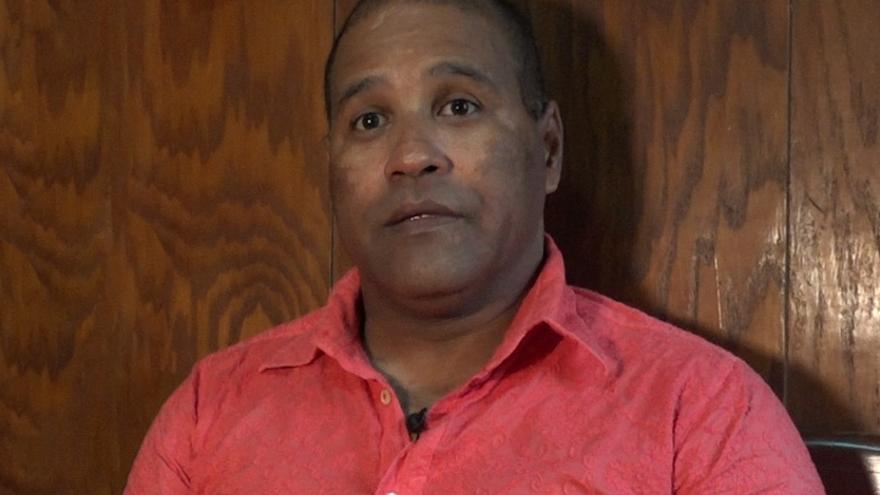
14ymedio bigger14ymedio, Luz Escobar, Havana, 31 May 2019 — It’s been almost 15 days since Daniel Llorente, known as “the man with the flag,” arrived in Guyana pushed out by the Cuban authorities, who even took him to buy the ticket and accompanied him all the way to the stairs of the plane to make sure he left the island.

“It wasn’t forced,” clarifies the activist speaking to 14ymedio from Guyana. Thus he quashes the controversy generated after independent media published that he was forced. However, he also makes clear that the decision was not taken freely and that he faced the dilemma of being imprisoned or, at least, harassed, or leaving Cuba.

Llorente Miranda, who was locked up in a psychiatric hospital after running with the US flag in the May Day parade in 2017, was recently arrested and interrogated by the State Security after leaving a tribute at the Museum of Dissidence, in the neighborhood of San Isidro, in Old Havana, where he had gone with his son Eliezer. continue reading

The agents warned him of the possible consequences of continuing his activism: leave the country or go to jail.

On Wednesday, May 15th, an officer went to his house, asked for his passport and summoned him to a travel agency specializing in the sale of tickets to Aruba. He told him that if he refused to leave, he would inform his superiors and “he could be sure that, in a short time, he would be imprisoned.”

“I did not resist. They arranged the ticket, they bought it, the lady who sold them the ticket explained that at four-thirty in the morning I had to be at the airport. They picked me up at my house and accompanied me to the stairs of the plane. Before I went up they said to me: ’Daniel, the advice we give you is that you do not come back, you say that the Americans are your friends, go and tell them to help you, do not come back, if they do not help you, continue with your life there, because if you come back you’ll regret it’.”

The threats and pressures convinced Daniel Llorente to make this difficult decision, but he is grateful to have found people who helped him from the first moment.

“When I arrived in Guyana I was asking where there were Cubans but I did not find any at first, then a Cuban-American took me to the hotel where he was staying and I spent the first night there,” he recalls.

Now he has managed to minimally stabilize his situation and is being hosted for free in the apartment of another Cuban who aspires to go to the United States and, meanwhile, helping those who arrive and need information.

“I went to the US embassy and gave them the evidence of what I am doing and a letter requesting political asylum, and they told me that, after an interview with me in the Guyana press, they were committed to my case. In addition, they asked for my address to be able to find me. I hope that some solution results from this,” says the activist about his future plans.

Llorente spent more than a year in the Comandante Dr. Bernabé Ordaz Ducungé Psychiatric Hospital, in Havana. Born in 1963, he became popular for his activism after the diplomatic thaw between Havana and Washington. A few yards from the platform where then president Raul Castro was, and in front of the accredited press on the island that covered the event, Llorente shouted for freedom for Cuba.

With a degree in engineering in the former German Democratic Republic (GDR), he ended up making a living working as a bricklayer, electrician, plumber and private taxi driver. In June of 2017 he asked to be expatriated to the United States.

___________________

The 14ymedio team is committed to serious journalism that reflects the reality of deep Cuba. Thank you for joining us on this long road. We invite you to continue supporting us, but this time by becoming a member of 14ymedio. Together we can continue to transform journalism in Cuba.
The Decadence of the Imperial Project of the United States

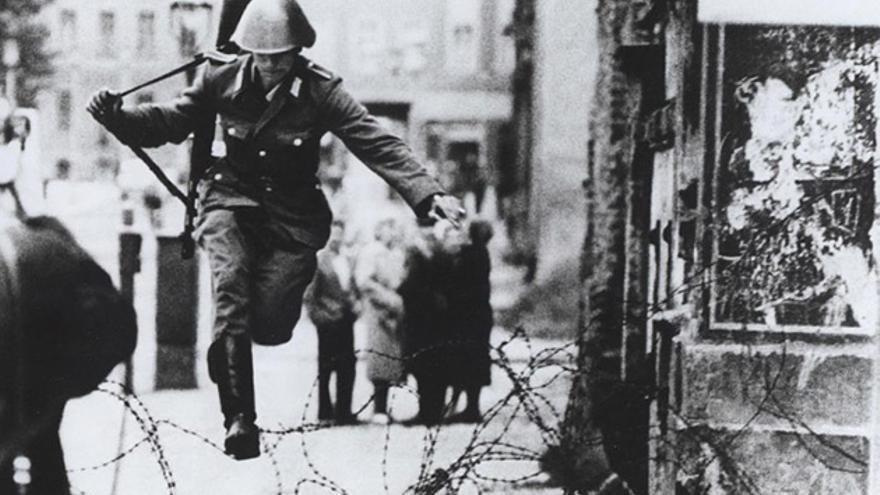
An East German border guard escapes to West berlin during the Cold War  (flickr.com/The Central Intelligence Agency)

14ymedio bigger14ymedio, Carlos A. Montaner, Miami, 1 June 2019 — Are we closer to another war? I don’t know, but if it comes it will be much more dangerous because the atomic bomb has escaped its dusty magic lamp and is within reach of anyone who knows how to rub it and has the resources for it.

Let’s see.

It was about avoiding wars. Woodrow Wilson had failed in his attempt to have the First World War (1914-1918) put an end to all the great wars, but the White House would not let a new opportunity pass. It was in the spirit of Franklin D. Roosevelt and Harry Truman during the Second World War. The United States must spearhead the enormous effort of leading the “free world” to prevent the great conflagrations between powers. This, exactly, is what is in crisis. continue reading

Then it was about building an empire based on the ideology of liberal democracy (democratic institutions plus markets and private property) and not, as had been done until then, adding territories conquered by force to  distant and distinct centers such as London, Moscow, Vienna, Istanbul, Madrid and Lisbon.

For these purposes, the Bretton Woods Conference was convened in 1944. It was vital to provide the planet with a financial system that would allow it to face post-Nazism. The Germans were practically defeated and there was no time to lose. After Roosevelt’s death, his vice president Harry Truman took the baton and created the defense mechanism to confront the Soviet imperial spasm. In the second half of the forties originated all the institutions that successfully fought the Cold War: the Marshall Plan, NATO, the CIA, the OAS, the TIAR and a short etcetera.

None of them counted on the stubborn persistence of nationalism. A nationalism that would resurface everywhere, including the United States, driven by migrations of people partly different from the mainstream that profiled the host nations.

The Communist Manifesto of Karl Marx and Friedrich Engels began with a very journalistic phrase: “A ghost crosses Europe. The ghost of communism.” They published it a month before the revolution of 1848, but then it went unnoticed. There was no relationship between the appearance of that text and the European revolts. If instead of the word “communism” the authors had written “nationalism” they might have guessed right.

Europeans continue to die or kill for their respective nations, but not for the European Union. The persistence of this phenomenon is very dangerous. I saw it very clearly after reading an intelligent observation by the Argentine Mariano Grondona. He said, more or less, because I quote from memory: “Many Argentines are willing to die for their country, but I do not know anyone who is willing to die for MERCOSUR.” The same thing happens in the European Union.

In the latest elections to the European Parliament it was quite obvious that the degradation of the purpose that animated this platform continues: to unite the European peoples based on democratic ideologies and not on nations, races or languages. In that great legislative body there exists, and still dominates, the center-right or European People’s Party. They are followed, by number of deputies, by the Socialists, the Liberals, the Greens and, finally, the Communists, who are not exactly democrats, because Marxism-Leninism is not democratic and makes fun of these “petty bourgeois trifles,” but in the short term they behave as such.

The British Nigel Farage, the Italian Matteo Salvini, the French Marine Le Pen, the Hungarian Viktor Orban, the Spanish Santiago Abascal, and the adviser of all, directly or in pectore, the American Steve Banon, who was very close to Donald Trump, are all delighted. The trend increased markedly in the European Parliament.

To me, on the other hand, it seems a symptom of the death throes of American hegemony and the gradual end of the world that emerged after the Second World War. We are entering a much more dangerous stage. Confronting the USSR everything was clearer, easier, probably better.

__________________

The 14ymedio team is committed to serious journalism that reflects the reality of deep Cuba. Thank you for joining us on this long road. We invite you to continue supporting us, but this time by becoming a member of 14ymedio. Together we can continue to transform journalism in Cuba.
Latin America, Battlefield Between Huawei and the United States

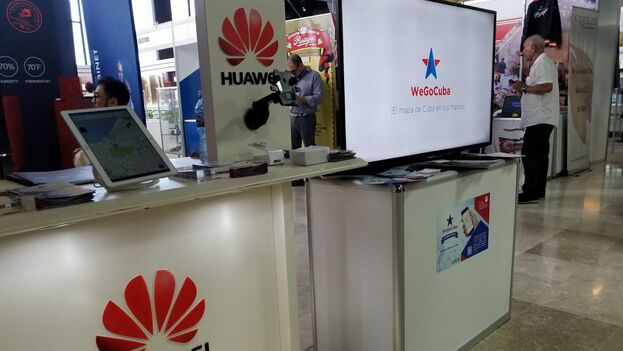
Huawei’s presence in Cuba is obvious to travelers as soon as they arrive at the José Martí International Airport. (14ymedio)

14ymedio bigger14ymedio, Yoani Sanchez, Generation Y, Havana, 1 June 2019 — What happens on social networks does not stay on social networks and any event that affects mobile phones also ends up radiating unsuspected consequences throughout our lives. That is why the current conflict between the Chinese company Huawei and the US administration keeps millions of mobile users around the world in suspense, many of whom live here in Latin America.

China has gained ground in the last two decades in the economies between the Rio Grande and Patagonia, but it has been in the telecommunications arena where it may have taken its most rapid steps. Founded in 1987 by Ren Zhengfei, the Asian firm is on the heels of Samsung and is already ahead of Apple on the list of the most important mobile phone manufacturers in the world.

In Latin American countries, the most affordable prices and extensive features of Huawei’s devices have won the favor of customers looking for mid-range or even high-end phones that are not too expensive, in contrast to those customarily offered by the giant from Cupertino. After reaching this side of the world at the beginning of this century, Huawei has led an almost viral expansion, supported by telecommunications projects in which it has been involved with several governments in the region. continue reading

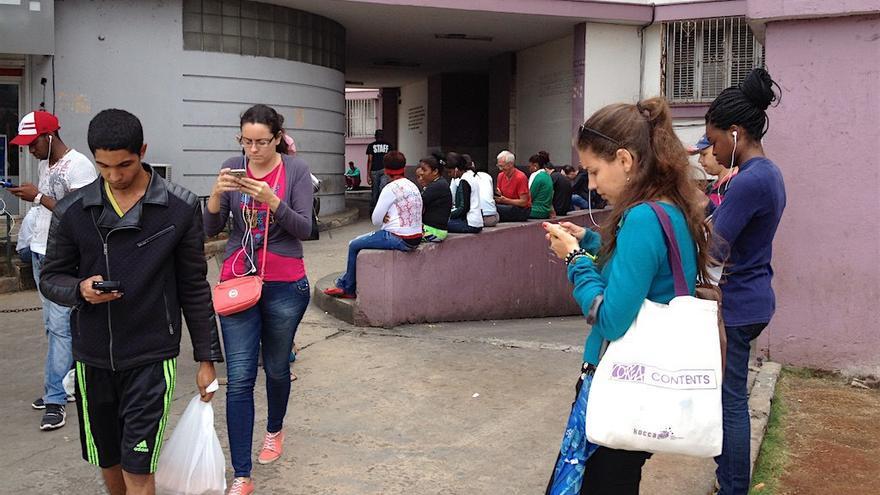
In Cuba, working with the state telecommunications monopoly, the Asian company has been the main distributor of the antennas used for the Wi-Fi zones, which, starting in 2015, the government began to open in squares and parks. In a captive market, like that of the Island, Huawei’s traditional competitors – embodied in South Korean and American firms – cannot carve out major pieces of the succulent pie of the computerization of society. Here, the Chinese company has the playing field almost entirely to itself, supported by the Plaza of the Revolution.

In Venezuela, Nicolás Maduro recently announced that he planned to make a joint investment with Huawei, the Chinese company ZTE and Russian companies to deploy a 4G network throughout the territory of that South American nation. In Mexico, according to data from the consultancy Statcounter, Huawei ranks fourth in the telephone market. In 14 countries of the region, the market shares accumulated by the Chinese company exceed two digits and in at least four of them it has grown to over 20%.

Not even the accusations made months ago by the United States that Huawei devices could be used by Beijing to spy on their users could dissuade Latin American customers from buying one of these devices, and in the last year the number of Huawei brand phones on the continent continued to grow. Users appeared to be more influenced by their pocketbooks than by fears of violations of their privacy.

So it was, until this May, when the conflict escalated a little more and several technology companies in the United States announced that they will stop supplying technology to Huawei. Google marked the turning point by decreeing that its Android ecosystem would no longer be included on phones sold by Huawei, a measure that also affects updates of that operating system on mobile phones that are already active. Chinese managers have insisted that they can get their own software but, despite their words calling for calm, the alarm is widespread.

While Washington and Beijing test their forces in this technological dispute, Latin America is about to divide again between affinity towards or rejection of one of the parties. Everything indicates that mobile phones will be the cause of the new schism.

___________________

Note: This text was originally published in the Deutsche Welle for Latin America.

The 14ymedio team is committed to serious journalism that reflects the reality of deep Cuba. Thank you for joining us on this long road. We invite you to continue supporting us, but this time by becoming a member of 14ymedio. Together we can continue to transform journalism in Cuba.
The Conflict Between Google and Huawei Has Cubans Scrambling

The highest-end terminals on the island cost over 500 CUC (close to the annual salary of a professional). (14ymedio)

14ymedio bigger14ymedio, Zunilda Mata, Havana, 24 May 2019 — As soon as the news was heard, webpages were filled with offers for Huawei phones accompanied by the words ‘rebate’ and ‘bargain’.  One of the ads included the phrase, “Don’t listen to what Google says, Huawei will win this battle.” The American technological giant announced last Sunday the suspension of all commercial activity with the Chinese firm, which has a huge market share in Cuba due to the sanctions imposed by the US Government.

Users who already have Huawei brand devices may install new applications and download updates for Google services, but they can not update the Android operating system, which presents an ongoing security problem.

“I already had to exchange my Blu-branded phone last year because it did not work for me to surf the internet with 3G service and I bought this Huawei Honor 7A,” explains Yaima Chávez, a Havanans who fears she will have to get rid of a device that she finds “practical and efficient.” However, she does not want to “have to jump through hoops and pay technicians under the table to update the operating system.” continue reading

“If there comes a time when I can’t update it, I’ll have to sell it, but who’s going to want to buy this when the thing gets uglier?” she says. In Cuba, as soon as you enter the José Martí International Airport in Havana, the posters with Huawei advertising immediately trumpet the firm’s leading role in the country.

The step taken by Google is in line with the executive order issued by Donald Trump, on May 15, which prohibits US companies from using services of foreign telecommunications firms that “endanger the country’s security.”

Huawei is currently the second largest manufacturer of telephones in the world and in Cuba it has deep roots among users due to its more favorable prices and the quality of its screens.

Since 2008 when the Government of Raul Castro authorized Cubans to contract for cell phone service, the number of customers with mobile lines has soared. Currently there are more than five million subscribers to the prepaid service of the Telecommunications Company of Cuba (Etecsa), in a country with a population of about 11.5 million people.

Osvel Álvarez Jacomino, a graduate of the University of Computer Science (UCI), downplays the situation and believes that it will not affect customers too much. “If you can’t use Google Play there are other alternatives. In Cuba you can visit platforms such as Apklis, or Cubapk.com, Apkpure, Uptdown and many others that, although they do not have as much security, basically provide the same service,” he says.

Ezequiel, a 27-year-old mobile repair technician who works in a small workshop on San Lazaro Street, has a different opinion. “People get very nervous with anything like this and it is enough that Google has said that things will not continue as they have, with Huawei, for someone in the market for one of those Chinese mobile phones, to think twice about it.”

Ezequiel believes that “when it comes to their pockets, the buyers want to play it safe.” Most of the sales of terminals take place in the informal market because the state network fails to satisfy users, who complain that Etecsa offers outdated models at very high prices.

Etecsa telepoints continue to sell models such as Huawei Y3 and Huawei Y520 for 80 and 85 CUC, respectively. Cataloged as low-end terminals with limited features, these devices are an option for those who can not afford higher-end terminals that, on the island, can exceed 500 CUC.

Huawei’s presence is felt not only in phones. In 2000, the Chinese company obtained a contract to install the national fiber optic network and its equipment is also used in Wi-Fi hotspots and in the newly-created Nauta Hogar service that provides Internet access from homes. The presence of the firm on the island dates back more than three decades, according to Javier Villariño Ordoñez, sales director.

But this presence has not been exempt from controversy. The freedom-defense organization Freedom House, based in Washington, has closely followed several allegations about Huawei’s close ties to Chinese state power. The entity warned about the security and human rights problems that have been associated with the company.

In the midst of this conflict, Huawei has called for calm saying that it will continue to provide security updates to existing models, including those already sold and those in stock.

“We will continue to build an ecosystem of safe and sustainable programming to provide the best experience for our users,” said the company, which has lamented Google’s decision.

The biggest markets affected by Google’s actions are the European and Latin American, since the US and China already inhabit practically different universes. In the US, Chinese phones are only 1% of the market and in China the presence of Google is very rare. However, in Europe, 18% of phones are from Huawei and in Latin America it ranges from 28% in Costa Rica to 17% in Chile.

“It’s the straw that broke the camel’s back.  If I already didn’t trust Huawei very much because of all the security scandals, now this comes along and it is not worth risking it,” says a young man who, on Wednesday, convinced several friends to change to the Samsung brand. At the centrally located corner of G and 23rd Streets, the passionate user assured that “South Korea and the United States are not going to be squeezed out, so better safe than sorry.”

____________________

The 14ymedio team is committed to serious journalism that reflects the reality of deep Cuba. Thank you for joining us on this long road. We invite you to continue supporting us, but this time by becoming a member of 14ymedio. Together we can continue to transform journalism in Cuba.

Fish Returns to Cubans’ Tables… Sort of

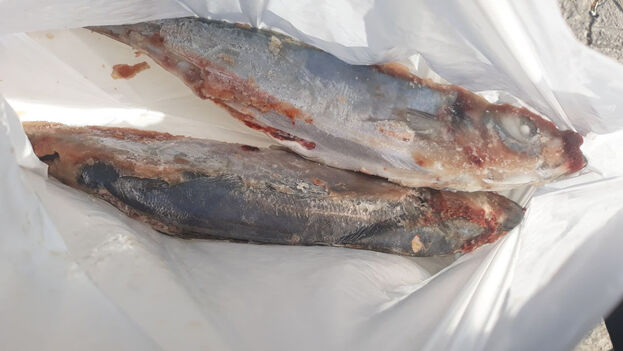
These two fish cost 60 Cuba pesos (CUP). (14ymedio)

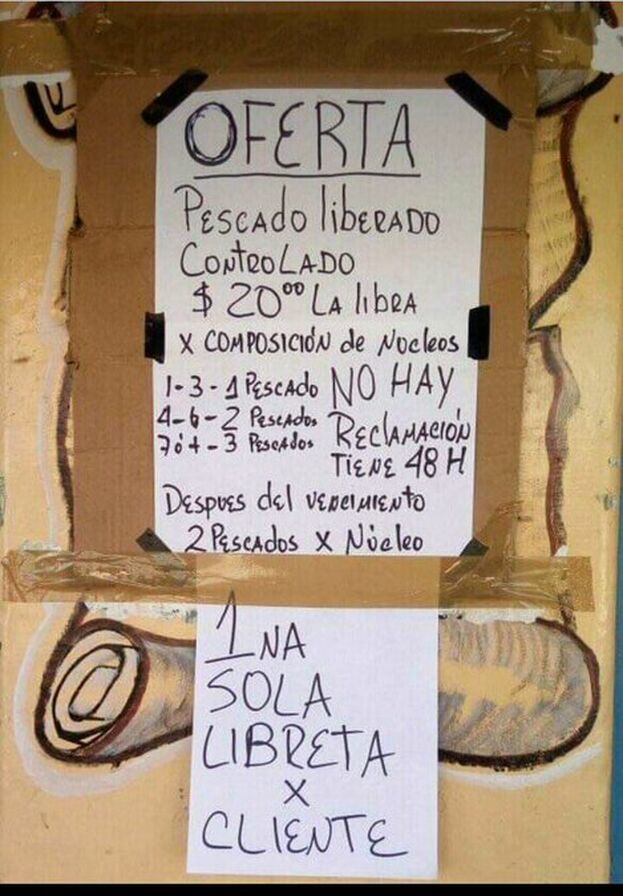
14ymedio bigger14ymedio, Marcelo Hernández, Havana, 29 May 2019 — Just crossing the street, the aroma changes. You can smell the fish cooking in the houses of Central Havana, where the product is for sale “liberated but controlled” — that is not on the ration book, but in limited quantities — according to a sign outside the markets. On the other side of the avenue, the residents wait for the fish to be unloaded as soon as possible, because of the refrigeration problems in the butcher shops.

The product sells at 20 Cuban pesos (CUP) a pound, in amounts ranging from 1 to 3 ‘units’ per family, according to the number of members.  Its arrival in the rationed markets has generated reactions of all kinds, from those who fear that its appearance means that chicken will continue to be missing, to those who protest the amounts they are allowed to buy.

In some neighborhoods the sale of rationed fish has already started. This sign details the complex allocations of ‘liberado’ (i.e. ‘freed’ or unrationed) but ’controlado’ (controlled) fish. A family (‘nucleo’) of 1-3 people gets one fish; a family of 4-6 people gets 2fish, and a family of 7 or more gets 3 fish. (14ymedio)

On social media the internauts joke, resignedly. “I don’t know whether to eat it or to keep it as a souvenir for all the years when we won’t see one of these again,” says one user. “Before they sold ‘chicken for fish’* and now they sell ‘fish for chicken’. This country is upside down,” adds another.

While fish is already being sold in some neighborhoods, others are waiting for it to arrive, although they will barely receive a tiny bit of fish to share.

*Translator’s note: The libreta, or ration book, lists the amounts of rationed products each family or individual is entitled to. When the shopper goes to the bodega (ration store) another product may be substituted for something that is unavailable. Hence the phrase “chicken for fish,” and, in this case, its alternate, “fish for chicken.” 

__________________

The 14ymedio team is committed to serious journalism that reflects the reality of deep Cuba. Thank you for joining us on this long road. We invite you to continue supporting us, but this time by becoming a member of 14ymedio. Together we can continue to transform journalism in Cuba.
The Recharge of Discord

Phone recharges now represent a very valuable source of income in foreign currency for the Cuban government. (14ymedio)

14ymedio bigger14ymedio, Reinaldo Escobar, Havana, 30 May 2019 — A new reproach has come to join the list of complaints that some Cubans living abroad make to their compatriots on the island. This time it is about requests from abroad to recharge phone balances: “You voted Yes on the constitutional referendum, you participate in the May Day march, you do nothing to overthrow the dictatorship and on top of that you ask me for a recharge,” respond some angry relatives.

The actors in this drama are three: the Cuban who wants connectivity; the State that keeps the money; and the emigrant who pays to recharge a mobile phone or a Nauta navigation account for a relative or friend still in Cuba.

For the resident in Cuba, connectivity can be considered as either a luxury or as an urgent need; everything depends on their occupational profile, their desire to be informed, their plans to emigrate or simply their vocation to behave like earthlings of the 21st century. They appeal to relatives abroad to recharge their phones because their wages do not allow them to pay the unjustifiable price imposed by the state telephone monopoly. continue reading

For the Cuban State, connectivity, whether to talk on the phone or to link to the network, has become the most profitable merchandise it can offer. The cost to the State is minimal, the price is disproportionate, the demand is increasing and a large part of the payment is made in real money — dollars, euros, pounds sterling or whatever currency is used by the generous relatives who buy the balance on the numerous digital sites that offer the service.

For the relative or friend who pays for the recharge, let’s say 20 dollars a month, this is a way to guarantee fluid communication with one’s family, while at the time supporting the possibility that the recipient in Cuba will find out what is happening in the world independently and may also, if they dare, participate as an activist by uploading their opinions or a video denouncing any abuse on the part of the authorities. Since most of the emigrants have to work very hard to earn a living, these recharges are usually a sacrifice, especially when they have more than one possible beneficiary on the Island.

As mobile telephony expands in Cuba, the demand for recharges from abroad grows. The possibility of connecting to the Internet from cell phones has triggered a consumption of gigabytes that, due to the high prices, is not within reach of the average purchasing power of the population.

It is for this reason that the state telecommunications monopoly Etecsa encourages, with tempting promotions, the purchase of balances from abroad. Pay $20 and get a bonus of $30 is one of the most repeated promotions, and the one that produces the most excitement among the possible beneficiaries.

It is well known that almost all of the remittances sent to Cuba by relatives living outside the country end up being spent at the counters of State markets. It has been estimated that for any merchandise sold in the “Hard Currency Collection Stores*” (TRDs) the State imposes a price that can exceed by 200% its costs to acquire or produce it.

Many people, especially retirees, survive thanks to these transactions. The ties of blood and affection towards a mother or a grandfather more than outweigh any political scruples.

But when the frequency with which Cubans on the island ask for a recharge reaches certain limits, “as if here money grows on trees,” many emigrants ask themselves two questions: What does the Government do with my dollars? Why do these “servile eunuchs, obedient rams, supporters of the dictatorship” want to connect to the internet?

The above-mentioned epithets abound in the networks. Perhaps they come from patriots who were deprived of their property, who endured long years of political imprisonment or who had to escape to avoid certain death. Or not. Sometimes those who have paid a high price for courage understand the cowards better.

In their idealistic desire to hasten changes in Cuba, especially when they have been in exile for many years, some emigrants would like to see a more immediate and substantial result from the help they provide. But gigabytes are not projectiles with an explosive charge, rather they are slow and subtle pushes against the wall of disinformation, windows from which to look out at freedom, tears to the veil that does not let one see the reality.

The photos and videos that showed the stampede of shouting protestors chasing Diaz-Canel’s presidential caravan in the town of Regla, the images of an angry protest in Guantánamo, the repression to which a march against homophobia on Havana’s Prado was subjected, the arbitrary detentions and beatings and other events of recent history, never disseminated by official media, are now accessible on YouTube. The recharges of discord are behind all that as well.

*Translator’s note: This is literally the name the State chose to give its network of stores that sell products in hard currency.

________________

The 14ymedio team is committed to serious journalism that reflects the reality of deep Cuba. Thank you for joining us on this long road. We invite you to continue supporting us, but this time by becoming a member of 14ymedio. Together we can continue to transform journalism in Cuba.
Instar Offers Two Residencies to Promote Civic Initiatives in Cuba

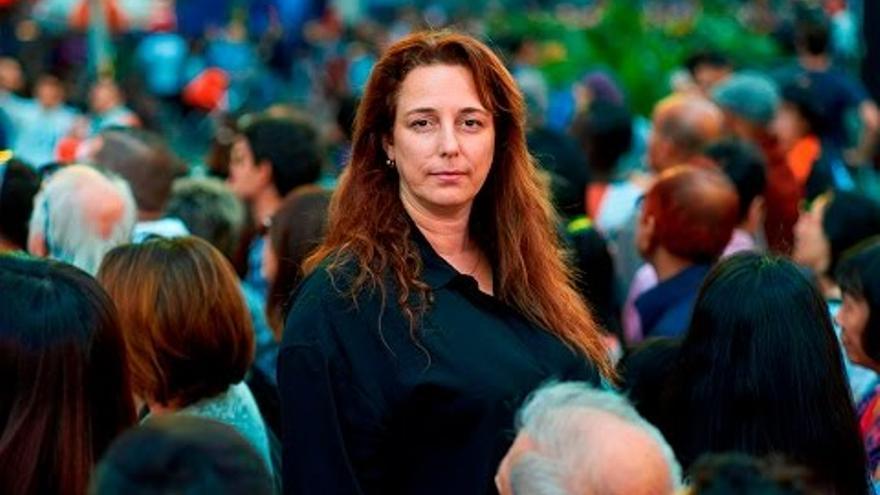
The artist Tania Bruguera directs the Hannah Ardent Institute of Artivism. (Youtube)

14ymedio bigger14ymedio, Havana, 30 May 2019 — The Hannah Arendt Institute of Artivism (Instar) is offering two Vita Activa (Active Life) Residencies “to promote civic initiatives with viable solutions in the short or medium term.” Every Cuban resident on the island can apply and novelty and creativity will be rewarded.

Vita Activa is looking for “projects which, using a strong theoretical and investigative base, are implemented in the public sphere,” explains Instar, the institute led by the renowned artist Tania Bruguera. The registration period has been extended until July 1, 2019 and individual or collective projects will be considered.

The jury that will select the winners will privilege those proposals that explore “new management models for the social and cultural development of a community.” The projects selected will be both “transdisciplinary artistic projects” and “innovative projects that start from any other social practice,” says the call for applications. continue reading

“Projects that are already in the process of being implemented and that need support will also be accepted, and priority will be given to those with the prospect to continue beyond the time of residency,” the call states. Projects will be evaluated based on a “sense of social justice, and the mutual trust generated by the project in the community and creativity,” it adds.

Two residences will be awarded and, during the first three months, the residents will have to “develop a research period to explore the potentialities and possible implementation of their proposal.” To achieve this they will have a stipend of 200 CUC per month, in addition to advice and logistical support from Instar.

The residency takes its name from the concept “vita activa,” one of the fundamental approaches of Hannah Arendt’s work “The Human Condition,” which designates three fundamental activities — labor, work and action — which condition and determine in a basic way the existence of man.

The Institute itself uses the term “artivism” to define itself based on the idea of combining art and activism, which results in socially responsible actions. It bears the name of Arendt, the political scientist who “studied totalitarian systems, both in capitalism and in socialism, and its effects on the concept of citizenship,” Bruguera said in an interview.

“In the following six months, the resident must implement the project in the space or community for which it was conceived with a budget of up to 5,000 CUC, depending on the production needs of the project.” The institute will work with the project during its first year and the results will be presented at the Instar headquarters in Havana.

The application for residencies is available on the Institute’s website and can be sent via email or presented in person to Instar headquarters.

The call emphasizes that the funds used for the residencies do not come from “donations from institutions or entities that incite violence, discrimination, demand ideological ties or demand commitments against our principles.”

Instar and Bruguera have been accused by the official press of working “actively to subvert the Cuban constitutional order” and receiving funds from the National Foundation for Democracy (NED).

________________

The 14ymedio team is committed to serious journalism that reflects the reality of deep Cuba. Thank you for joining us on this long road. We invite you to continue supporting us, but this time by becoming a member of 14ymedio. Together we can continue to transform journalism in Cuba.