
‘Chernobyl’ and the Reconstruction of Memory

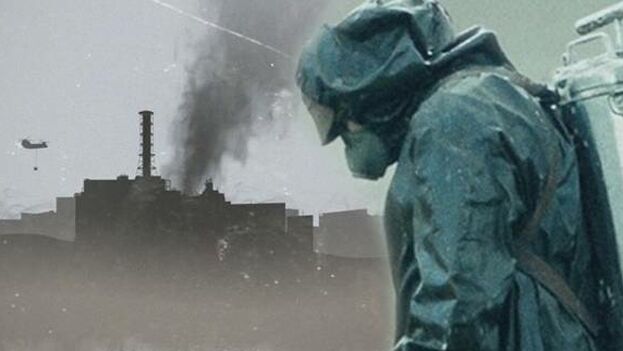
The HBO series Chernobyl is circulating in Cuba on “alternate distribution networks.” (HBO)

14ymedio bigger14ymedio, Yoani Sanchez, Generation Y, Havana, 13 June 2019 — I was 10 years old and my world was the size of the matryoshka dolls that adorned my living room. It was 1986 and in Cuba we were experiencing another turn of the screw of nationalization with the rectification of errors and negative tendencies process, while the official press reached its highest levels of secrecy. In April of that year the Chernobyl accident occurred in Ukraine (then a part of the Soviet Union), a nuclear disaster that we – along with the Soviets – were the last to find out about.

Under the strict monopoly of the Communist Party, the island’s media hid, for months, the explosion in the Vladimir Ilyich Lenin Power Station that exposed enough radioactive material to spread almost entirely across Europe. The details of that catastrophe, the horror caused by the accident and the forced evacuation of the inhabitants of Prípiat, a city located 3.5 kilometers from the reactors, were barely mentioned in the Cuban newspapers.

While millions of parents over there were putting their children to bed without knowing if they would see a tomorrow, over here we were oblivious to the tragedy that had been unleashed. The camaraderie between Havana’s Revolution Square and the Kremlin, in this case as in others, involved sweeping the problem under the information rug, even if it was a highly explosive story, if one might say so. The few details released, after months, spoke of a controlled situation, of the punishment of those at fault, and of the heroic response of the Soviet people. continue reading

We would have continued to believe this if other fragments of the story had not, over time, breached the Island. Some of them from the mouths of the so-called children of Chernobyl, who for more than two decades received treatment on Tarara beach, a development east of Havana where I spent several summers in student camps located in houses confiscated from the Cuban bourgeoisie. The situation of those infants, many of them orphans, and the serious health problems with which they arrived, did not fit with the official story we had been told.

How could there be so many people affected if that accident was just exaggerated by the Western media, as the apparatchiks told us, and was also quickly controlled by the warlike Soviet comrades? Something was wrong in that story and then we knew it.

The Chernobyl series, broadcast by the American channel HBO, is already circulating in Cuba, thanks to the alternative networks that distribute content. Its five episodes have probably been seen, so far, by a greater number of viewers than those who tune in to the official television news. Such voracity is due to the fact that several generations need to fill a hole in our history and reconstruct the memory of an event that they hid from us.

Filling in the memories we never had can be a painful process. Our first impression on watching the initial scenes is the familiarity, the objects that populated our childhood, the way of speaking of the opportunists, the constant camouflage of reality that is a fundamental pillar of these totalitarian regimes. They are Soviets, but they are so similar to us that at times there is a sense of the tragedy of our own history.

Then comes the conviction of how little value is placed on human life in these circumstances. Of people as numbers. Individuals as a gears in a superior engine that does not skimp on sacrificing its own, the ordinary citizens who are sent to a certain death without knowing the magnitude of the disaster and the risk. And the lie. Deceiving the world, covering the truth, hiding the problem, threatening those who could relate what was happening; in short, appealing to one of the cards that kept the USSR standing for more than 70 years: Fear.

With its dark tones, almost black and white, the atmosphere of Chernobyl  can become stifling at times. It makes you want to scream all the time, but 33 years after that event it would be a scream too much delayed… As the end approaches the indignation grows. How could something like this happen and we be so marginal? Why did we never know how close the world was to a nuclear catastrophe of irreversible proportions?

Beyond the license for fictionalization for which some have reproached the series, beyond those who criticize its approach to the health effects of radioactivity, and beyond the sparks that it has provoked in the Russian authorities, who have announced the filming of an alternative Chernobyl, the series has a special value for Cubans in particular because at the time of the accident they were building the Juraguá Nuclear Power Plant in Cienfuegos, a cousin of the Ukrainian plant. Knowing the inefficiency, secrecy and triumphalism of the Cuban state company, that would have been a time bomb.

Personally, and in addition to the horror that this HBO production has caused me, I believe that Chernobyl  leaves us with the hope that everything ends up being known and that it is of little use to disguise or silence a reality, because there are voices that will eventually tell it. I await, then, all the documentaries about Cuba and its taboo subjects that the future will bring us.

__________________________________

The 14ymedio team is committed to serious journalism that reflects the reality of deep Cuba. Thank you for joining us on this long road. We invite you to continue supporting us, but this time by becoming a member of 14ymedio. Together we can continue to transform journalism in Cuba.
Ciego de Avila Opens First Market to Supply Private Tourist Services

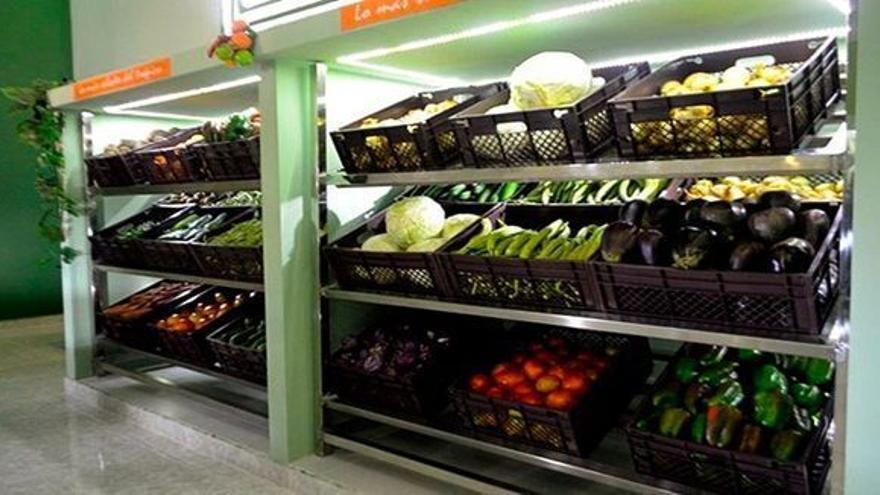
The markets are designed to supply the self-employed who provide food and lodging for tourists. (Granma)

14ymedio bigger

14ymedio, Havana, 10 June 2019 — Ciego de Ávila has just launched a new “merca hostel,” the ninth in the country and first in the province of these wholesale agricultural markets for the self-employed, created by the Government in 2017 to supply the tourism sector.

In Ciego de Ávila there are more than 100 registered homes with lodging and food services. They are the targets of this new type of market type, where they can purchase products, as are the operators of paladares (private restaurants) and cafes. Each will be registered with a customer file that can include two buyers, as explained by the director of the Business Unit of Base (UEB) Selectas Frutas in the City of Portales, Gualberto Torres González.

The manager said that the new establishment has more than 33 products, including bananas, pineapples, garlic, pepper, white cabbage, watermelon, taro, potatoes, oranges, and, more generally, vegetables, grains, and products industrialized or from beekeeping. Other foods that will be offered, depending on the production of the territory, are seasonal and refrigerated, preserved in the province. continue reading

Since the private sector was allowed to operate legally, the desire for a wholesale market has been one of the most consistent among the self-employed, along with a reduction in taxes and the ability to import and export without having to go through the State as an intermediary.

In this context, the merca hostales emerged two years ago. The first was in Trinidad, in Sancti Spíritus and, later, the Remedios one in Havana and another in Santiago de Cuba. In the summer five more were added, in Viñales, Baracoa, Cerro, Bayamo and Villa Clara, all of them areas of great tourist activity. Now, number nine arrives.

But the merca hostales are far from meeting the demand and since the beginning they have not been exempt from criticism, since their ultimate goal is to cover the needs of tourism by supplying businesses that pay large taxes and thus support the State, by the creation of State-run network to take over from what was previously handled in the black market.

Some buyers consulted by 14ymedio say that the supply is not stable and that the prices do not offer real advantages for buying in large quantities. “Rather than wholesalers they are wholesale markets where you can buy large volumes but without special offers depending on the quantity because prices are still retail,” laments a self-employed woman who rents two rooms of a colonial house in downtown Trinidad.

The rates in these markets are in convertible pesos and some are not very attractive for the private workers’ pocket. One kilogram of pumpkin costs 0.50 CUC (about 12 CUP), while in the agricultural markets of the Island the product rarely exceeds 5 CUP per half kilogram.

The quality of agricultural products is another of the points that is leading to more complaints. “Fruits, for example, do not meet the standards that one expects to put on the table of a tourist and they almost always sell them green, so they don’t help solve the problem of the next day’s breakfast, we have to wait for them to mature,” explains an entrepreneur. “In addition, not everything is food, in this business I need sheets, detergents, toilet paper. Where is the wholesale market for these supplies?”

In the city of Santa Clara, Yasniel, an cuentapropista who rents three rooms in his house, is a frequent client of another merca hostal managed by the state company Frutas Selectas. “For two years now, I have been buying some agricultural products and also preserving them in this place, and although there is nothing of high quality, at least I can find general products that I would otherwise have to buy little by little in other markets.”

For Yasniel, the best thing about the establishment is that “you can buy at a single time, and legally, foods that you had to buy in several places before,” but “the quality and variety of the merchandise are still not up to par considering the prices we pay.” As an example, he says that “the vegetables most demanded by tourists, such as tomato and lettuce, often are not available, perhaps because they are more difficult to transport and preserve.”

“The same goes for fruits, you can find a lot of fruit and a lot of green fruit, but forget about an custard apples or guanábana, it’s not a market for exclusivities or big varieties, but it’s what you get.” One of the products Yasniel most lacks is “Cuban coffee” that he must continue to buy in stores in convertible pesos at retail prices. “Milk is not found in these markets either, so to prepare a good breakfast I have to keep going to several places,” he laments.

___________________

The 14ymedio team is committed to serious journalism that reflects the reality of deep Cuba. Thank you for joining us on this long road. We invite you to continue supporting us, but this time by becoming a member of 14ymedio. Together we can continue to transform journalism in Cuba.
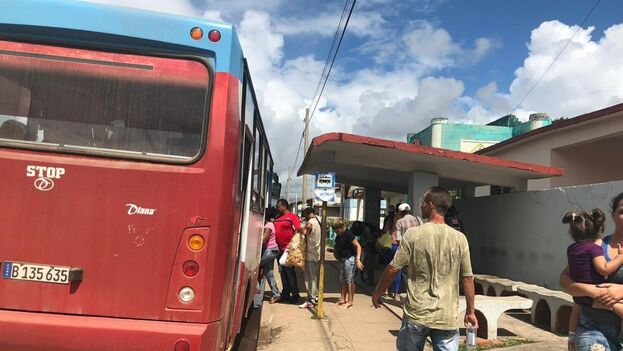
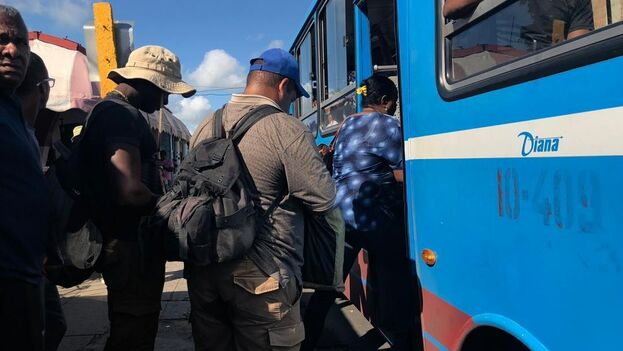
Fuel Shortage In Artemisa Leaves No Option Than to Go by Foot

Several towns in Artemesia province remain virtually isolated due to cuts in public transport services. (14ymedio)

14ymedio bigger14ymedio, Bertha K. Guillen, Candelaria, June 10, 2019 — The highway connecting Candelaria with Soroa, a town in Artemisa province, is filled with pedestrians. Every day, hundreds of women with children on their backs, self-employed merchants carrying their wares and state-sector workers walk a stretch of road on which public transport is increasingly absent.

“We’re used to it. It’s nothing new for the buses to stop running because of fuel, breakdowns or because they put it to some other use,” says Maria de los Angeles, who walks about 18 kilometers to reach the nearest point where she can hitchhike. “There is no other option than by foot. There are no stores, pharmacies or even a doctor’s office up there,” complains the Artemiseña.

In the last month, the situation has gotten worse due to lack of fuel. As a result, authorities have had to reduce the number of public transport routes, working hours in state agencies and even university class periods to save gas. continue reading

The reduction in public transport services began gradually in mid May but by the beginning of June things had gotten worse, leaving the most mountainous towns located along the highways to Soroa, and from Central to San Cristobal, Candelaria and Bahia Honda, without transport.

An employee from the Candelaria’s public transport agency, who preferred to remain anonymous, explained to 14ymedio that, by Monday, fuel supplies were expected to arrive and, based on the amount alloted to the province, transport service should be able to resume. Last month’s supply of hydrocarbons barely covered the first half of May.

A large segment of Candelaria’s population lives along the mountainous Soroa road, where the development of tourism has led to a high demand for mobility between the region and its neighboring towns. In the nearby Cordillera de Guaniguanico nature reserve there are numerous privately owned short-term rentals geared towards tourists as well as local attractions such as its famous orchid farm.

But local tourist developments must still overcome the transportation problem. Communities such as Candito, Soroa and El Campismo are served by only two buses a day. Meanwhile, Los Tumbos and La Comadre, located 25 kilometers from Candelaria, have no public transport service at all.

Additionally, there are the poor conditions of the roads, which are winding in the mountainous stretches, and the price of fuel. As a result freelance taxi drivers are not interested in these routes unless they involve non-stop trips booked in advance, a service focused on tourists and recreational travelers.

“There’s a lot of tourism in this area. There is the highway between Soroa and Las Terrazas as well as a fair number of houses for rent. But taxi drivers want to charge us the same prices as tourists and we can’t afford that. We’re peasants,” says Angel Martinez, another affected resident.

The new Diana buses were a hopeful sign for residents of Artemisa but now the problem seems to be a lack of fuel. (14ymedio)

Mobility problems are not plaguing just the tourist towns; they are being felt throughout the entire province. At Artemisa’s main terminal this week, there were major schedule changes to buses traveling to San Cristobal. Though the departure board showed that only two trips had been cancelled, 14ymedio confirmed that at least half of the so-called Diana buses* that operate from of this station were out of service due to fuel shortages.

In the provincial town of Guanajay there is a factory that assembles buses on top of Russian-made chassis. When it began operations, the plant was a hopeful sign for nearby residents, who were tired of the unpredictability of public transport. Now, however, it is lack of fuel that is the problem.

Other towns, such as Bahia Honda, lack any public transport services at all. “There are no buses. Only trucks and vans for 10 and 20 pesos,” reports Rojelio Blanco, who makes the journey to and from Artemisa every day. “At the terminal up to three buses in a row don’t show up. But none of these changes are ever announced so people assume the buses are still running. The situation is really serious.”

“Our top priority is to open or close routes based on demand so that no town is completely without transport,” says Magalis, a terminal employee, who confirms that the last few weeks have been especially difficult for trips from the provincial capital to outlying towns and that, in spite of the adjustments, it has not been possible to maintain service to all the towns.

Faced with this situation, authorities have doubled the number of inspections on the roadways to prevent unlicensed drivers from operating illegally, picking up passengers and charging them for rides. Inspectors are also spot checking licensed taxi drivers to verify where they have purchased their fuel.

On the outskirts of Artemisa, government inspectors, known as azules (or “blues”), have mounted a large operation and levy fines of 1,000 pesos to unlicensed taxi drivers who charge a fare above the allowable limit and 4,000 cuotas to licensed independent drivers who do not have proof of purchase for gasoline or diesel from a state-owned service station.

Some of the inspectors pose as passengers to find out how much a driver actually charges. Most drivers of vintage cars prefer not to risk their licenses and offer only a ride to Havana, which is more profitable for them anyway.

*Translator’s note: Small buses whose parts are supplied by a Chinese company, Yutong, and assembled in Cuba. In 2014 over 930 chassis were sold to Cuba to meet the high demand of public transportation throughout the island.

_____________________

The 14ymedio team is committed to serious journalism that reflects the reality of deep Cuba. Thank you for joining us on this long road. We invite you to continue supporting us, but this time by becoming a member of 14ymedio. Together we can continue to transform journalism in Cuba.

"We are not afraid of what might happen to us", says Melia Vice President

Escarrer, Meliá vice president, in his interview for Cubavisión

14ymedio bigger14ymedio, Havana May 13th 2019 — The Executive Vice President of Melia Hotels International, Gabriel Escarrer, has dismissed “external pressures” and announced the strengthening of the hotel chain’s presence in Cuba, in an interview on Cubavision, picked up by Hosteltur.

The entrepreneur has rejected the Trump administration’s policy toward Cuba following the activation of Titles III and IV of the Helms-Burton Act, which recognises claims in US Tribunals by those affected by the confiscation of property after 1959.

“We are not afraid of the pressures which might be applied from abroad,” he explained, while detailing a forthcoming investment of several million euros. In 2020, the company hopes to get to 38 hotels and more than 15,000 rooms on the island. continue reading

“We have been very clear over the last 31 years: that our stake in Cuba is unconditional. We consider these measures to be totally unjust, and we are continuing with our chosen route. We will continue to work closely with the Cuban authorities in developing this country’s tourism industry, which I consider to be exemplary in every sense,” he confirmed.

“In company with our Miramar joint venture, we have approved an investment of about 200 million dollars, to be committed in the next three years, and we will be reforming and broadening out Melia Habana and adding in a large convention centre; and three hotels in Varadero: Sol Palmeras, our five-star hotel, which has given us a great deal of satisfaction, the Melia Las Americas, and Melia Varadero,” he explained.

The Melia CEO, who is in the island for the tourism fair FitCuba, said that the investment in these four hotels was around 200 million dollars, and that construction of the Melia Trinidad was under way, in this case, with another joint venture, Athos-Cuba, in which they will be investing approximately 60 million dollars over two years.

Escarrer considers that Cuba is able to not just exploit sun and beach tourism, but also its patrimonial and cultural offerings, in cities such as Havana, Trinidad, Cienfuegos and Camaguey.

“I would also mention some other aspects which should be developed, which we call the MICE sector, to do with congresses, conventions, and incentives. And I think there are some great possibilities there, because Cuba offers things which other Carribean islands don’t have. Among other thnigs, security, which is a fundamental basis for success in any important event”.

Escarrer also praises the professionalism of Cuban workers, and the character of the people, which provide a unique destination in the region.

“We are here to stay and to work hand in hand in the development of tourism in the country. For me, it’s a success story, and we have been delighted to be here these 31 years and we would hope for another 31, at least.”

Translated by GH

___________________

The 14ymedio team is committed to serious journalism that reflects the reality of deep Cuba. Thank you for joining us on this long road. We invite you to continue supporting us, but this time by becoming a member of 14ymedio. Together we can continue to transform journalism in Cuba.
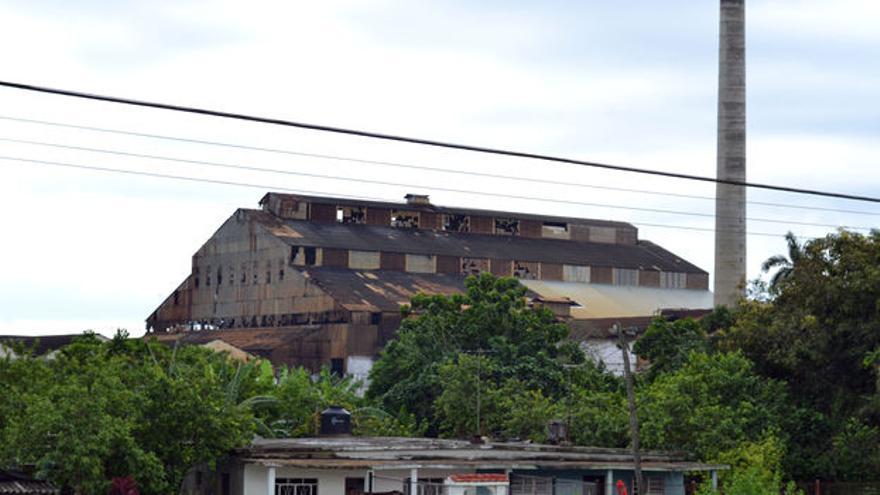
Cuba Again Records One of the Worst Sugar Harvests in its History

Under the mandate of Fidel Castro, a process of dismantling dozens of sugarmills began, given that the fall in product prices in the international market made the industry unsustainable. (Michael Anranter)

14ymedio bigger

14ymedio, Havana, 10 June 2019 —  The official press has again hidden the data of the just concluded sugar harvest. Instead of absolute numbers, a spokesperson for the Azcuba business group said that the sugar harvest was 13% of the proposed plan.

This was reported to Prensa Latina by the spokesman of the sugar group, Liobel Pérez, who pointed out that the export commitments of this season were fulfilled and that this year’s harvest was 31% above the production of last year when it was just under one million tons. This percentage allows us to place this year’s production at 1.3 million tons, one of the lowest since the beginning of the last century.

At a government meeting in December, Economy Minister Alejandro Gil Fernandez said the country would produce 1.5 million tons of sugar, of which 920,000 tons would be exported. continue reading

Cuba has an agreement with China to buy 400,000 tons a year and expected to sell more than 500,000 tons in the open market.

The Azcuba official detailed some figures of the 13 provinces involved in the plan but none of the local companies managed to fulfill their commitments. At the beginning of November 2018, the harvest started with the participation of 54 industries out of the 56 still existing in the country.

The official blamed these results on “the late arrival of spare parts for mills, harvesters and trucks” and “the poor condition of the roads, the lack of workers and the quality of the cane.”

The harvest started in November and ended in May, although some mills are still grinding this month.

For decades the national sugar industry was the flagship of the national economy but for years it has not been able to match the results of earlier times. In 1991, the harvest reached 8 million tons, just before the collapse of the Soviet Union sank the Cuban economy and in particular damaged this sector.

However, at the beginning of this century and under the mandate of Fidel Castro, a process of dismantling dozens of plants began, given that the fall in product prices in the international market made the industry unsustainable. In 2011 the Sugar Ministry was eliminated and its functions were assumed by Azcuba.

Currently more than 60% of the plants that were closed in those years are still not producing or have been completely dismantled, their workers relocated to other positions and most of the cane fields destined to other crops.

Cuba has a high consumption of sugar and needs between 600,000 and 700,000 tons per year to satisfy the demand of the rationed market, local industries and the self-employment sector.

In September of last year, this newspaper revealed that the sugar that was distributed that month for the basic basket of the rationed market did not come from the Cuban fields but from faraway France. The bad performance of the last harvest forced the Government of the Island to import the product.

______________

The 14ymedio team is committed to serious journalism that reflects the reality of deep Cuba. Thank you for joining us on this long road. We invite you to continue supporting us, but this time by becoming a member of 14ymedio. Together we can continue to transform journalism in Cuba.

Cubans Say Goodbye to an Era

With the touchdown of the United Airlines plane in New York at 6:35 PM, most of its passengers were saying goodbye to an era.

14ymedio bigger14ymedio, Marcelo Hernandez, Havana, June 6, 2019 — Before departing, the ship’s bullhorn sounded and cars near the Havana Cruise Terminal responded by honking goodbye with their own horns. A group of people waved farewell and some even took out a handkerchief. The Empress of the Seas sailed away and, as the impressive structure left Cuba’s main port, an era came to an end.

On Wednesday the Trump administration implemented a travel ban on educational and cruise trips to Cuba, which thousands of Americans had used to visit the island nation that is so close yet so far away. Licenses for recreational and passenger ships were also canceled along with private air flights in an effort to deprive the Cuban government of a major source of hard currency.

However, in the streets of Havana and the areas near tourist attractions, which until recently benefitted from this flow of visitors, the economic pain seemed to be felt more by self-employed workers than the almighty state. continue reading

“Now there a lot of people affected by this,” says Sergio, a guide from a private guided tour agency who had been waiting for customers all day Wednesday but went home empty handed. In addition to dealing with the daily challenges imposed by Cuban bureaucracy — the young man’s business does not yet have a license to operate — he now has run up against another obstacle.

“We have to be discreet so that the police patrolling Old Havana don’t stop us. If they see us with a group of foreigners, they’ll slap us with a sixty-dollar fine.” In the middle of the off-season, the arrival of cruise ships offered many like Sergio the chance to earn a little hard currency in a country that in recent months has experienced increased food shortages and a rise in prices.

“The list of those affected by this is long: owners of short-term rentals, privately owned restaurants, drivers of vintage cars,” says the tour guide. A whole network of private businesses that must pay the state high taxes just to stay in business. According to Sergio, owners of the old 1950s cars that offer cruise ship passengers tours around the city must pay almost 800 dollars a month. “Those guys are screwed,” he says,

A sizable portion of economic earnings remain in the hands of officials, a situation criticized by activists and dissidents who are subjected to repression on a daily basis.

Independent journalist Boris González believes that the steps taken by Obama “were seen as somenting potentially positive” at the time but adds that those steps were taken only by one side. The Cuban government barely budged at all. “The first move should have been by the Cuban goverment. It should have lifted the blockade it has on its citizens,” he says.

González believes that, if the Cuban authorities do not lift restrictions on its citizens, “they should not be allowed to enjoy and consolidate the benefits of that policy.” He adds, “We Cubans have to keep insisting that it’s about having freedom and not about picking up the money that falls out of the government’s pocket.”

At the  table of a bar near the dark waters of the bay, Jonathan and Josephine finish off a mojito as they count the hours before their return to San Francisco. Both work at a medical insurance company and arrived in the Cuban capital as part of a group that sponsors agro-ecology projects on the outskirts of the city.

“This is the fourth time we have been here in the last three years and we’ve made a lot of friends here. Now it will be difficult to see them again,” laments Jonathan.

Josephine adds, “It’s a shame because we help the people and most of the Cubans we speak with are critical of their government and want more freedom. Now they are going to be punished as well.”

At José Martí International Airport’s Terminal 2, several miles away, dozens of American passengers are boarding a United Airlines flight to Newark. A selfie on the plane’s tarmac with Havana’s afternoon sky in the background was all that was left of a visit that no one knows when they will be able to make again.

Twenty-two-year-old Claire took a trip with two friends to see Cuba and boasted of being the first person in her family to visit the island thanks to measures adopted by Barack Obama after the diplomatic thaw that began at the end of 2014

“We came with a group visiting Baptist churces but we really we had a lot of time to see the country, have fun and visit places.” In her bag are two bottles of Havana Club rum, sealed in a plastic security bag, which she promises will be “the last souvenir we can take with us before it all ends.”

Claire and her friends heard about the end of cultural and educational trips to the island, known as “people-to-people” exchanges, while they were taking a dip at the beach at Santa Maria, east of Havana. They had been able to visit because their trip fell under one of the twelve categories of licenses issued by the US State Department, which include government business, media activities, research, and educational, religious or medical projects.

“I feel sorry for the people I met and hope these measures really help the Cuban people, though at the moment it’s hard to see if they will have positive results,” she admits. “I hope that, when I return to Cuba the next time, there will be more freedom, especially for young people. Many of them I spoke with asked me to help them leave the country and that means they do not feel good about being here.”

For activist and former Black Spring prisoner Angel Mora the measures adopted by the US administration are correct: “The money they get from these businesses will end up in the hands of those strenthening the repressive apparatus of the dictatorship.” He adds, “The public does not benefit from this type of tourism. It amounts to trafficking in properties that were confisctated from their legitimate owners.”

Moya believes the next step will be the elimination of the so-called cultural exchanges, which have resulted in many artists from the island performing on American stages in the last five years. “They serve no purpose other than to allow the Cuban regime to export its ideology and propaganda,” says the activist.

By contrast, Elaine Díaz, director of the independent digital news outlet Periodismo de Barrio (Neighborhood Journalism), is not happy about this action by the Trump administration. “It’s bad news for Cubans. One more measure that hurts citizens rather than the government,” she said.

With the touchdown of the United Airlines plane in New York at 6:35 PM, most of its passengers were saying goodbye to an era.

_________________________________

The 14ymedio team is committed to serious journalism that reflects the reality of deep Cuba. Thank you for joining us on this long road. We invite you to continue supporting us, but this time by becoming a member of 14ymedio. Together we can continue to transform journalism in Cuba.
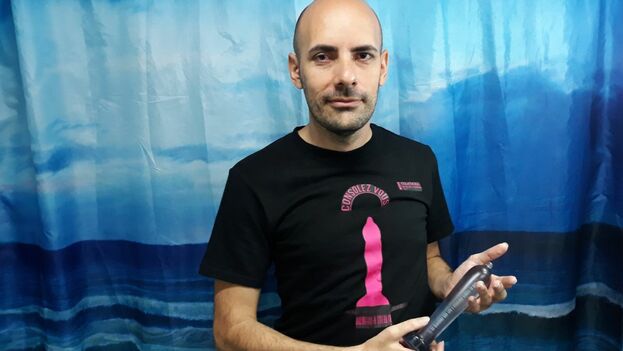
’Consolez Vous,’ The Cuban ’Sex Shop’ That Seeks to Integrate Art and Pleasure

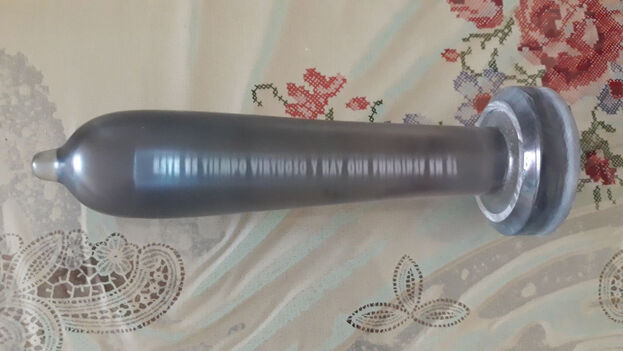
Alejandro Bobadilla, one of the artists involved in Consolez Vous. (14ymedio)

14ymedio bigger14ymedio, Luz Escobar, Havana, 9 June 2019 — In a city where basic products are scarce, thinking about buying a sex toy, never mind the taboo, can be a real odyssey. In Cuba there are no stores “for adults” and XXX cinema is viewed with suspicion or persecuted by the authorities.

A group of artists wanted to break with the canons of a society that rejected “bourgeois morality” in the ’60s but that keeps intact the puritanisms and taboos of that era. Consolez Vous — the name is French and means roughly ’Console Yourself’ — is the project of the artists Yanahara Mauri, Javier Alejandro Bobadilla and Joan Díaz, who during the last Biennial of Havana stormed the Cuban Art Factory with the provocative idea of installing a sex shop. Their pieces are now exhibited at La Marca, as part of the Design Biennial, convened and organized by the National Design Office.

“Everything started as a project of the Biennial, we presented it and they accepted it. Although the initial idea was not to participate in the Biennial, this work began much earlier, with the project of establishing a store,” says Bobadilla in an interview with 14ymedio. continue reading

For the artist, the important thing is not the objects themselves, but “the gesture of openly and publicly” establishing a sex shop in Cuba. “I was very skeptical, I have always been pessimistic and I did not think that it would be approved for the Biennial but, well, they accepted it, like magic,” he says.

The original idea was to establish a traveling store. “We wanted to go to the opening of the art shows and set up the store there or park a couple of days at the fairs where they sell handicrafts, shoes, wallets and sell there, near the town,” he explains. The authorities did not accept this proposal and placed the proposal in the Art Factory, a place where thousands of people enter daily.

“These erotic objects are all transparent, they have messages and things inside, apart from the mixtures of colors. We prepare the right environment to make them look better and be more appealing. We put up banners, we set up like a boutique. Every day that the Factory opened, we were going to sell, from Thursday to Sunday, “explains Bobadilla, a cybernetic professional.

To make the pieces, they use polyester resin. “The material is liquid, it looks like honey, then you put another substance that hardens it. We give it a form using condoms, which are difficult to obtain, because they are missing from pharmacies,” he adds.

We have toys of different sizes and colors, some are smooth but there are others that have curves. In the shop some complained that the objects “do not vibrate” or that “they are very hard.” Others asked that silicone be used instead of resin.

Customs prohibits “natural persons” (individuals) from importing goods, and self-employed people do not have the legal standing to do so. “What else would I like. With a silicone tank and a 3D printer there is much we can produce, but, although we want to promote the industry, we have the ’internal blockade.’ This business in Cuba is very complicated,” he laments.

In the absence of places licensed for the sale of sex items, an illegal market has developed in the country. A sex toy costs between 20 and 60 CUC. Sex shops in Cuban exist clandestinely in private homes with products arriving in the country in the baggage of the so-called ’mules’ — individuals who bring items through customs.

The Consolez Vous artistic project ran throughout the month of April and the first week of May at the Art Factory, at which point the institution abruptly closed. The artists sometimes wandered away from  their small space with erotic objects in hand to provoke potential customers and although some walked away embarrassed, others entered to look.

“Some people buy it for decoration, in the end this is art. If someone asks me if I’m selling dildos will tell him no, that what I sell are sculptures, what they used after they leave the store is someone else’s problem,” says Bobadilla.

Although at first the idea was to give away the objects, the high price of the raw material forced the artists to sell their work. Each sexual object is sold at 5 CUC (roughly 5 dollars). The price barely covers the investment, but it is part of the purpose of the display: “For these objects to be within reach of people’s wallets,” he adds.

One of the sex toys of the Consolez Vous project. (14ymedio)

The artists want the Cuban public to change their perception of sexual objects. “In some cases couples came into the store together. Others preferred to leave their wife or husband outside. Many were laughing at the entrance without daring to pass. We always provoke people and hawk the goods, like in agriculture,” he adds.

“For the Biennial we made 500 toys and we only have one small box left in Matanzas. We have sold more than 400,” says Bobadilla proudly, dreaming of having his own shop in the Art Factory.

“The difference between the toys that come from abroad and ours is that what we offer to the Cuban public, in addition to costing a lot less, is art,” he emphasizes. “Art made in Cuba.”

__________________

The 14ymedio team is committed to serious journalism that reflects the reality of deep Cuba. Thank you for joining us on this long road. We invite you to continue supporting us, but this time by becoming a member of 14ymedio. Together we can continue to transform journalism in Cuba.
Cuba Produces One Billion Painkiller Tablets, Where Are They?

Cuban pharmacies have been experiencing serious supply problems for at least three years. (14ymedio)

14ymedio bigger14ymedio, Havana, 7 June 2019 — The news is not encouraging for the more than 3 million Cubans who suffer from high blood pressure. The national pharmaceutical industry is going through a difficult time due to the drop in the import of raw materials, while the demand for anti-hypertensive drugs, such as Enalapril, continues to grow.

Hundreds of millions of tablets to address hypertension and 1 billion tablets of the painkiller Dipirona (metamizole) are produced every year on the island, but demand has doubled in the last decade. The prognosis is that this trend will continue, because more than 30% of the adult population is hypertensive.

Rita María García Almaguer, Director of Operations and Technologies for BioCubaFarma, explained on the Roundtable TV show on Thursday that there are 500,000 patients in the country who consume the anti-hypertensive drug Enalapril. In 2010, the national production reached 151 million tablets of this drug, while in 2018 the figure rose to 337 million and for this year it is expected to reach 400 million units. continue reading

A netizen, who identified herself as Dalila, appearing in a forum with an organized debate on the subject on the official website of Cubadebate, stated her concern that “in the last 5 years the demand has almost quadrupled, which means there needs to be an analysis at the national level about what the Ministry of Public Health is doing to prevent these risks. “

The state company BioCubaFarma has been at the center of the complaints of patients and relatives for several years, due to supply problems in the national network of pharmacies. The deficit has reached a point where many Cubans depend on medicines and supplements sent by their emigrated relatives.

Aspirin, band-aids, thermometers, hydration salts, alcohol to heal wounds and test strips for blood glucose measuring devices are some of the basic products that are difficult, if not impossible, to find in the pharmacies that offer their services in national currency.

The extensive informal market network includes among its offers many of these products, from personal imports, which are also more attractive to the consumer than Cuban versions, including medicines such as those to relieve the discomforts of a cold, vitamin C, vitamin supplements and some antifungal creams and antibiotics for topical use.

Another commentator said in the forum that “the last straw was the attending doctor in a consultation with a relative of mine told him in which houses there are medicines sold by private individuals, because the are not available in the pharmacies.”

But the situation is more complicated with those prescription drugs that are used by the chronically ill. Although there is also a black market where antibiotics, antidepressants, analgesics and antihypertensives are sold, it depends mainly on the diversion of resources to the state sector, which is now going through a bad time.

For example, the national industry had to increase the production of the anti-hypertensive Amlodipino from 62 million tablets last year to 87 million in the current year, and yet patients criticize the lack of availability of the drug and long lines appear in state pharmacies when does the product arrive.

The problem repeats itself with Dipirona, a non-opioid analgesic in demand in Cuban homes to relieve everything from a toothache to a cold. Belonging to the pyrazolones family, Dipirona has been renamed in popular humor as “solve everything.”

“In 2010 the production [of dipyrone] in our facilities was on the order of 450 million. In 2011 the demand increased to 500 million tablets […] which led to our having to import this medicine since that year,” explained García Almaguer. In 2018, production went up to one billion tablets, but for this year only 800 million pills of this drug will be available to pharmacies.

The “basic table” is made up of 757 medications, mostly produced on the island and 619 of them are priorities. The authorities have decided to concentrate resources on these, while decreasing the production figures of serums, dipyrone, aspirin and others, said García Almaguer.

However, last April there were 85 drugs missing from that basic table, including 16 of those sold under controls that require the patient to have a card to receive them. The drop in the arrival of raw materials and financial problems influenced this deficit, aggravated by the closure — due to environmental pollution — of several industries in China, where the Island buys the largest quantity of the inactive substances that are used in drug formularies.

The official said that in May they managed to reduce the number of missing drugs to 48, eight of which are sold under a system of control cards, such as Glimepiride, Spironolactone, Risperidone, Terazosin, Clonazepam, Dorzolamide [for the treatment of glaucoma] and Fludrocortisone.

However, García Almaguer was clear when he spoke of the future. “We can not assure that from now on there will not be specific shortages on some of the medications that today make up the basic medication framework”.

______________________

The 14ymedio team is committed to serious journalism that reflects the reality of deep Cuba. Thank you for joining us on this long road. We invite you to continue supporting us, but this time by becoming a member of 14ymedio. Together we can continue to transform journalism in Cuba.

Testimony of 110 Doctors Cuban Doctors on Foreign “Missions” Leads to Complaint Over Slavery

Javier Larrondo says that Cuba has deceived many countries for years, presenting these missions as a humanitarian program. (Mario J. Pentón)

14ymedio bigger14ymedio, Havana, 23 May 2019 — The Cuban-Spaniard Javier Larrondo, president of the organization Defenders of Cuban Prisoners, in partnership with Solidarity Without Borders and the Patriotic Union of Cuba, explained on Thursday at a press conference in Miami that a complaint against the Cuban government as been presented to multiple international organizations for “slavery, persecution and other inhumane acts.”

Larrondo bases the complaint on the testimony of 110 doctors on the island who abandoned the so-called “internationalist missions” and whose identity has been protected because they are victims of human trafficking.

“We are in the presence of a tragedy of colossal dimensions: families broken by the separation, punishments against professionals forbidden to see their children for eight years [because they are not allowed to return to Cuba and their children are not allowed to leave Cuba to join them] for the mere fact of wanting to leave a job,” in addition to the theft of 75% of their salaries for years, explained the entrepreneur, investor and philanthropist. continue reading

According to the NGO’s calculations, the population affected every year by the “human trafficking practices” of the Cuban Government is between 50,000 and 100,000 people. “Cuba violates several international conventions of which it is a member, including the Universal Declaration of Human Rights, the International Convention on Civil and Political Rights, the Convention on the Rights of the Child, among others,” added Larrondo.

The complaint, open to other professionals who wish to provide their testimonies, is available online and has been submitted to the International Criminal Court, the United Nations, the European Union and more than 80 countries, in several dozens of which there are Cuban professionals serving on “missions” for the Cuban government.

“Cuba has deceived many countries for years, presenting these missions as a humanitarian thing when in reality they are a big business for the island, we are talking about earnings of 8 billion dollars a year, much higher than the 3 billion earned from tourism or the 4 billion sent to the country in remittances,” he explained.

This complaints comes at a time when media such as The New York Times and the BBC have published two reports on the conditions of slavery and pressure that Cuban physicians who serve on an internationalist mission must endure. Before now, and despite the data provided by independent Cuban media, the issue had not caught the attention of international public opinion.

As part of the methodology to present the complaint, Larrondo interviewed several doctors, who told him the conditions in which they are obliged to practice in third countries. The NGO Defenders of Cuban Prisoners also compiled labor contracts, internal regulations and based its claim on the articles of the Cuban Penal Code that punish those who leave the missions.

“Some 56% of the professionals declared that they did not go on the missions voluntarily and 39% said that they had been highly coerced fpr having a ’debt’ to the education system that trained them or for fear of being considered as ’disaffected’ from the Revolution,” explained Larrondo.

Some 94% of the 110 cases interviewed said that they would have abandoned the missions if they had known that they or their family would be retaliated against, while 41% said they had not signed any contract before leaving for the missions.

Among the doctors 82% said they had received indoctrination before leaving Cuba and 89% said they were constantly monitored and forced to monitor their co-workers. More than half of the professionals confessed that they were forced to violate the code of ethics of their profession, through behaviors such as inflating the statistics of medical consultations, discarding medicines and medical supplies or engaging in propaganda in favor of parties related to Havana.

According to Larrondo, the freedom of the professionals is limited to such an extent that they can not have romantic relations with locals, nor friendship with opponents of the Chavista regime in Venezuela, to mention examples taken from Resolution 168, which establishes the rules for Cuban “civilian workers” abroad.

“Cuban professionals are made to believe that they owe the State for their education. That is false, I studied in Spain free of charge until university and I do not owe anything to the State, because that is its function, to help individuals have more opportunities,” he stressed.

“Cubans pay for their education with interest, they pay for it with their lives, everything is designed to create slavery, servitude and deception so that people can not be free,” Larrondo added.

Through Skype, several Cuban doctors who escaped missions in Venezuela also participated in the press conference. The physicians are now in Colombia without documents allowing them to reside there legally and without the possibility of legalizing their qualifications to practice as doctors.

“We took the step towards freedom and fled Venezuela, now we are in legal limbo, without papers in Colombia. In Cuba we were not allowed to take our current passport out of the country or travel to any other country, because some of us doctors are regulated by our specialties,” explained Dr. Yunier Moranti Vázquez, who escaped from Venezuela this year.

The doctor Yinet Perez called on the United States to reactivate the Cuban Medical Professional Parole program, a special refugee program for doctors escaping from missions, cancelled by former President Barack Obama.

“My baby is only five years old, I had to leave Cuba to look for a better future for myself and for him. It is sad and depressing how the Cuban government forces us to be separated from our loved ones for eight years without seeing them. I haven’t seen him for almost two years, What human rights are they talking about?”

___________________

The 14ymedio team is committed to serious journalism that reflects the reality of deep Cuba. Thank you for joining us on this long road. We invite you to continue supporting us, but this time by becoming a member of 14ymedio. Together we can continue to transform journalism in Cuba.
The Consumer Revolt

The arrogant disdain with which communist party ideologues mock “the hoaxes of consumerism” has been diminishing in response to the public’s growing demand to be treated with respect. (14ymedio)

14ymedio bigger14ymedio, Reinaldo Escobar, Havana, June 4, 2019 — In spite of official slogans calling for “continuity of the revolutionary process,” there is a disconnect between the reality of today’s Cuba and its ideological paradigms. Deprived of the right to elect their own leaders and prohibited from proposing any political alternatives, citizens have been reduced to being mere consumers.

The generation that sacrificed its youth to create Utopia must now rely on an uncertain pension. Their grandchildren, who grew up with the country’s dual currency system, have graduated from university, have their own children and feel no commitment to the past.

What unites these people, who are weighing the threatening prospect of another Special Period on the island, is simply their shared interests as users, customers and consumers. It is very risky to hold onto the notion that “no one will be abandoned” while people are beginning to push back against the abusive way the state treats them. continue reading

How has the relation of the customer to the marketplace evolved over the last sixty years?

The rules of the market were upended in the 1960s. The concept of selling goods was replaced with the concept of distributing them, with the stated intention that everyone would get a little of everything equally, at subsidized government-controlled prices. The rationing system, under the direction of the Office of Control and Distribution of Supplies, officially came into being on July 12, 1963.

Five years later the Revolutionary Offensive did away with all vestiges of private-sector retail. Throughout the 1970s the only things anyone could buy that were not rationed were newspapers and magazines, along with prescription medications. Everything else — from shoelaces to ballpoint pens — was listed, along with corresponding quantities, in the ration book for industrial products.

Over time, various reforms and counter-reforms were carried out. The reforms recognized the rules of the free market and acknowledged the existence of social differences as a natural phenomenon. The counter-reforms were efforts by a paternalistic state, which was inclined to see itself as the champion of egalitarianism, to keep controls in place.

The 1980s saw the birth of the “liberated market” in which some goods were not subject to rationing. Stores sold clothing and footwear, people sold handicrafts on Saturdays in Cathedral Square and farmers markets sold produce at prices set by supply and demand. It was also the era of the so-called diplo-tiendas, stores catering to diplomats and other foreigners. Cubans were not allowed to shop there but could ask their foreign friends to buy things for them. Interpreting the old Leninist expression “one step forward, two steps backwards” in his own unique way, Fidel Castro decided to do away with most of these “weaknesses.”

This was also the period in which, if you wanted to buy a household appliance, you not only had to pay for it but also had to present a voucher, which employers gave to workers who had earned the most merit points. Fulfilling certain requirements expected of a socialist, racking up voluntary work hours and participating in political activities became part of an invisible currency without which you could not buy a refrigerator, a television or a washing machine, almost always Soviet made.

All this changed unexpectedly after the fall of the Soviet bloc. The Cuban government was forced to allow the US dollar to circulate and established a network of hard currency exchanges and stores known as TRDs*. The invisible currency disappeared overnight. Now if you wanted to buy anything of value, you no longer needed merit points; you only needed dollars. Curiously, the strategies for earning hard currency were very different from those required for the revolutionary point system.

Being able to buy things at shopping malls — partaking of the “hoaxes of consumerism” — became the ultimate status symbol. For die-hard Communist Party loyalists, going into one of these places represented an ideological transgression, a possibility only for those who had maintained cordial relations with their relatives overseas, who in turn generously sent fresh cash to maintain “the sacred victories of the Revolution.”

Reality has forced Cubans to develop a new and considerable appreciation for the market, especially if the market prices its products in convertible pesos (CUC). Perhaps because the least dynamic sector of the market is to be found in what is referred to as subjective aspects, these changes have been slow, almost imperceptible.

Because of reductions in the inaptly named “basket of basics,” which is supposed to guarantee distribution of essential rationed goods, most Cubans have come to rely on shopping centers. Though items there are also in short supply, their stores do accept Cuban pesos (CUP) at an exchange rate of 25 CUP to 1 CUC. Bars of soap, sausages, vegetable oil, detergent and, when available, chicken are the most popular commodities at the nearly 2,000 TRD stores throughout the country.

Though TRD changed its name last March to Caribbean Store Chain, perhaps to make its obscene goal of getting the most money it can from its customers seem less obvious, the prices it charges consumers remain excessively high, as much as 200% of what it costs to acquire or produce an item.

In other words, the widespread perception among the consuming public is that these are no longer stores selling superfluous luxury goods but rather their only outlet for acquiring essentials. The decision makers, however, continue acting as though they are stores geared exclusively towards the rich.

The policy for setting prices is based on a notion of social justice that involves penalizing the possession of money so that the disadvantaged may enjoy the benefits of social programs. The absurdity of this policy is that the disadvantaged must turn to these markets, where they are stripped of a significant portion of their salaries.

Just a few years ago it would never have crossed any voter’s mind to file a complaint with his or her local representative over supply shortages or price gouging. Such actions might have been seen as ostentatious by one’s neighbors — a problem only for a minority who can afford shopping malls — and possibly a cause for reproach. But times have changed. Things are not the way they used to be.

Now the fight takes place in the ring of social networks, where consumers refuse to meekly accept what some would have them believe — that ostrich meat is an option for feeding one’s family. They openly protest the illogical distribution of “liberated-controlled” fish. They even reveal their identities in a tweet campaign demanding that the Cuban telecommunications monopoly Etecsa lower its prices.

In the globalized village where the market economy operates, things have evolved and expanded quite differently. Black Fridays, spring sales and membership cards that accrue points based on purchasing volume are features found in most countries.

You can almost watch in real time the quality and variety of products evolving along with the way they are displayed and the way in which the shelves are arranged. Home sales, online orders and delivery by drones or unmanned vehicles will perhaps become the latest milestones of modernity.

The system’s critics characterize all this as “the dictatorship of the market” and never tire of warning Cubans not to be tempted into renouncing the benefits of socialism by succumbing to the traps of capitalism.

The arrogant disdain with which communist party ideologues mock “the hoaxes of consumerism” has been diminishing in response to the public’s growing demand to be treated with respect. Tired of being hearing, “It’s your turn, comrade,” they look forward to hearing, “How may I help you, sir?”

It is the revolt of the consumers.

*Translator’s note: TRD stands for “Tiendas Recaudadoras de Divisas” — literally “Hard Currency Collection Stores.” 

__________________________

The 14ymedio team is committed to serious journalism that reflects the reality of deep Cuba. Thank you for joining us on this long road. We invite you to continue supporting us, but this time by becoming a member of 14ymedio. Together we can continue to transform journalism in Cuba.

Kenya Reiterates That it Will Not Pay Ransom for Cuban Doctors, But Hopes to Secure Their Release

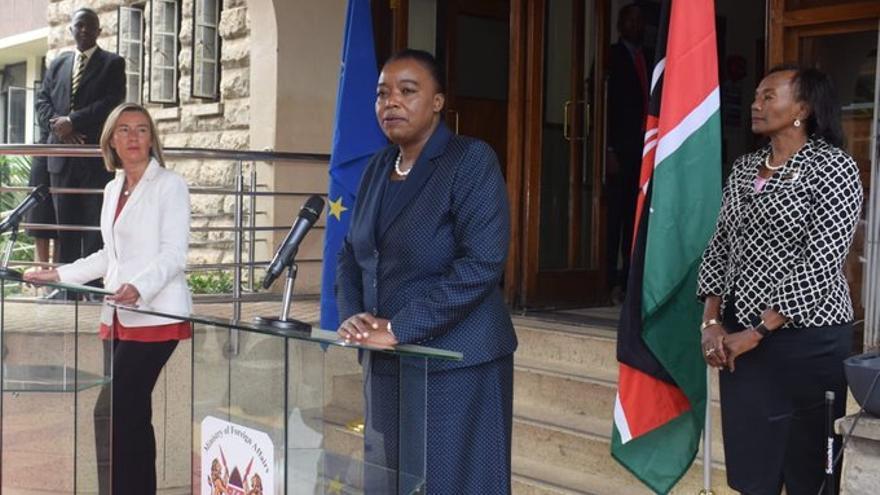
Monica Juma spoke about the Cuban doctors kidnapped after her meeting with Mogherini to talk about security in the Horn of Africa. (AmbMonicaJuma)

14ymedio bigger14ymedio, Madrid, 22 May 2019 — Kenya’s Ministry of Foreign Affairs has ruled out once again negotiating with Al Shabaab militants in Somalia for the rescue of the Cuban doctors kidnapped from Mandera in April.

Mónica Juma, secretary of the cabinet, said that an operation is underway to rescue the two doctors, speaking at a press conference on Tuesday with Federica Mogherini, the High Representative for Foreign Policy and Security of the European Union.

“We believe that we will ensure their release in the ongoing security operation, but politically the government does not negotiate the rescue. We hope to have the doctors back home,” she said.

Last week it emerged that the terrorists, linked to Al Qaeda, ask for a sum of 1.5 million dollars, according to the media in Kenya.

The elders (tribal leaders) of Mandera County, who were sent to negotiate confirmed that they had seen them alive and serving the community in which they remain abducted, in the Jubaland region of Somalia.

Landy Rodríguez Hernández and Assel Herrera Correa were being escorted to their work at Mandera Hospital when they were abducted by an armed group. Some intelligence sources believe that it was a group of criminals who then handed over the doctors to the terrorist group Al Shabaab. In the confrontation, a Kenyan officer died.

Herrera Correa is a specialist in Comprehensive General Medicine from the province of Las Tunas, while his colleague, Landy Rodríguez Hernández, is a specialist in Surgery in the province of Villa Clara.

Juma spoke with Mogherini on Tuesday about commercial relations between Kenya and the European Union, as well as the key role of the African country in regional security. A statement issued by the Kenyan presidency recalled the EU’s commitment to continue supporting peace activities in the Horn of Africa.

_________________

The 14ymedio team is committed to serious journalism that reflects the reality of deep Cuba. Thank you for joining us on this long road. We invite you to continue supporting us, but this time by becoming a member of 14ymedio. Together we can continue to transform journalism in Cuba.
Cuban Government Revokes Permission to Build a Church for Political Reasons

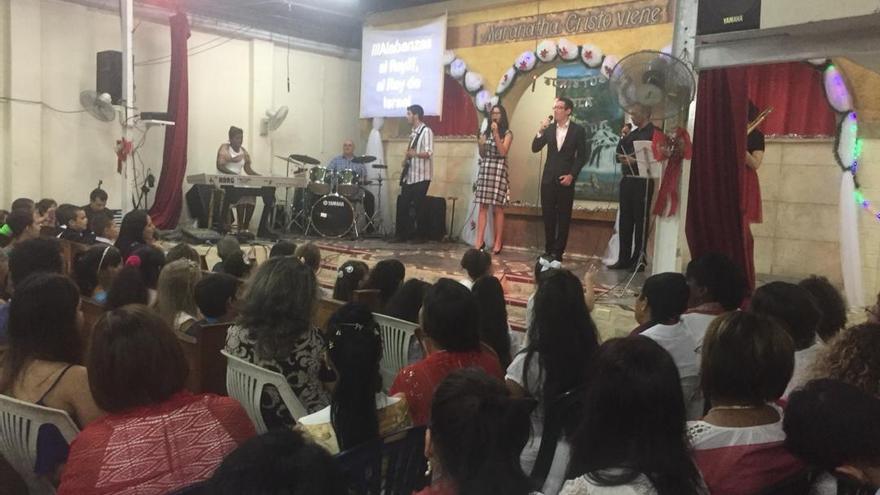
The pastor believes that the revocation of the building permit can be “closely related” to the critical position of his church on the constitutional referendum. (Courtesy)

14ymedio bigger14ymedio, Havana, 6 June 2019 — The Cuban government has decided to revoke its permission to build a Baptist church in eastern Cuba in what could be a reprisal for the position of the Christian community on the constitutional referendum held on February 24, as reported by Pastor Amado Ramírez in a telephone conversation from Holguin.

“We had all the permits in order, but we were informed by the Office of Religious Affairs of the Central Committee of the Communist Party that the building permit had been canceled,” Ramírez explained. The authorities said that the request would be studied by the Council of Ministers, the highest administrative and executive body in the country and that this could take “some time.”

El Nuevo Herald tried unsuccessfully to communicate with Caridad Diego, head of the religious affairs office of the Communist Party. continue reading

“Our church is one of the oldest in the province, founded in 1932 and the first to be organized in the city of Holguín, said Ramírez, who lamented that his community has had to spend more than $1,500 in proceedings, when the average salary on the island is around 30 dollars a month, according to official figures.

The pastor believes that the revocation of the construction permit could be “closely related” to the critical position of his church onlast February’s constitutional referendum. The evangelical congregations opposed several of the articles of the new constitution, forcing the government to eliminate Article 68 that would have allowed equal marriage and replace it with Article 82 with the promise of a plebiscite to consult the country on a new family code.

The campaign of the evangelical churches took the State and Cuban civil society by surprise, even requesting permission to publicly demonstrate against an initiative headed by Mariela Castro, the daughter of the ex-president Raul Castro. Several pastors denounced pressures by the Communist Party to join the campaign in favor of the approval of the constitutional reform referendum.

The Maranatha Baptist Church, in the city of Holguin, had received the necessary permission to build a new temple in February 2017 from the Provincial Department of Justice after a long legal battle. The religious leaders subsequently processed the permits before the Ministry of Science, Technology and Environment and the Institute of Physical Planning, which took a year and a half.

From then on, the pastor along with his religious leaders began “a long and tortuous process” to obtain the construction license issued by Physical Planning. For the negotiations, they had to go to the Ministry of Science, Technology and Environment as well as to the offices of Physical Planning in Holguín, paying numerous fees.

Maranatha had been subjected on other occasions to the fury of the government. In May 2015 the authorities tried to confiscate the temple but after several international demands rescinded the order. According to Ramírez, about 700 Baptists gather in the temple each Sunday and the church has grown in other neighborhoods of the capital of Holguin, carrying out an extensive missionary and charitable work.

Evangelical churches in Cuba have experienced a rapid growth after the religious opening that the country experienced in the 90s. The Methodist Church has more than 80,000 faithful, while other denominations also have hundreds of “temple houses” throughout the country.

“Holguín was the province that had the most votes against the new constitution, especially the municipality of Moa, which has a large number of Christians,” the pastor added. According to the religious leader, after the approval of the constitutional reform, the dialogue between the Christian churches and the government “has stopped somewhat.”

According to official data, the new constitution was approved with more than 6.8 million votes for Yes, but with historic levels of abstention and votes against that totalled more than 1.8 million voters. The government waged a fierce campaign for a Yes vote through the media and waged a war of repression activists and opponents who asked voters to reject the constitutional reform.

CSW, an international NGO dedicated to the promotion of human rights and specializing in religious freedom, rejected the decision of the Cuban government to revoke the construction permit for Maranatha Baptist Church.

“The use of government bureaucracy and the endless requirements for permits that can be arbitrarily canceled at any time is the typical way the Cuban government seeks to control and restrict freedom of religion or belief on the island,” said Anna-Lee Stangl, CSW’s Head of Advocacy in Defense of Religious Freedom.

“We call on the Cuban government to simplify and make transparent procedures for religious associations to build and repair buildings, and we continue to demand reforms so that religious groups are no longer hostages to these arbitrary and manipulative decisions,” she added.

____________________________

The 14ymedio team is committed to serious journalism that reflects the reality of deep Cuba. Thank you for joining us on this long road. We invite you to continue supporting us, but this time by becoming a member of 14ymedio. Together we can continue to transform journalism in Cuba.
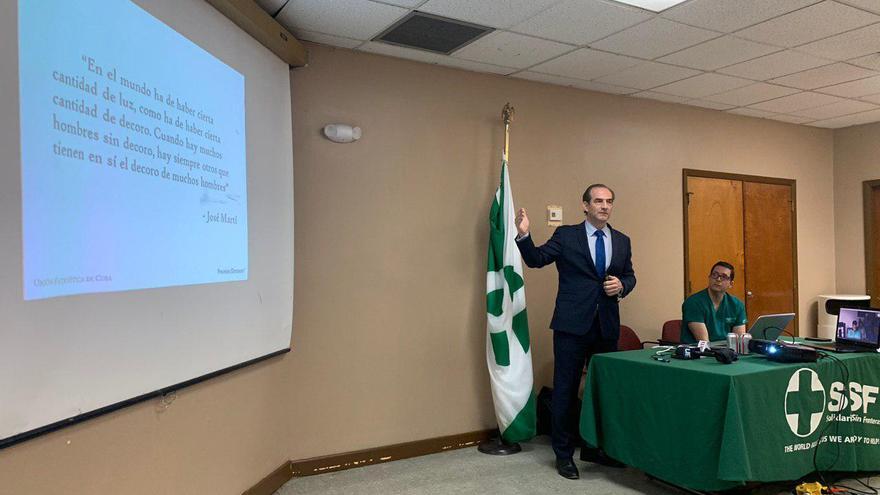
The Cuban Paradoxes / Juan Juan Almeida

Juan Juan Almeida, 4 June 2019 — Precisely in the country where the imposition of decrees far exceeds the respect for rights and, coincidently, in the city where Ignacio Agramonte, Major General of the Liberation Army, discussed his thesis of Civil and Canon Law, this June 7th has been declared “Day of the Jurist” with activities planned in Camagüey.

It seems like a sweet story to please the naive and insult the intelligence. Be that as it may, we are already used to the Cuban government showing us that on the island the staging is more important than the script.

Scarcity is a "Perverse Strategy" of the Cuban Government, Says Opposition Group

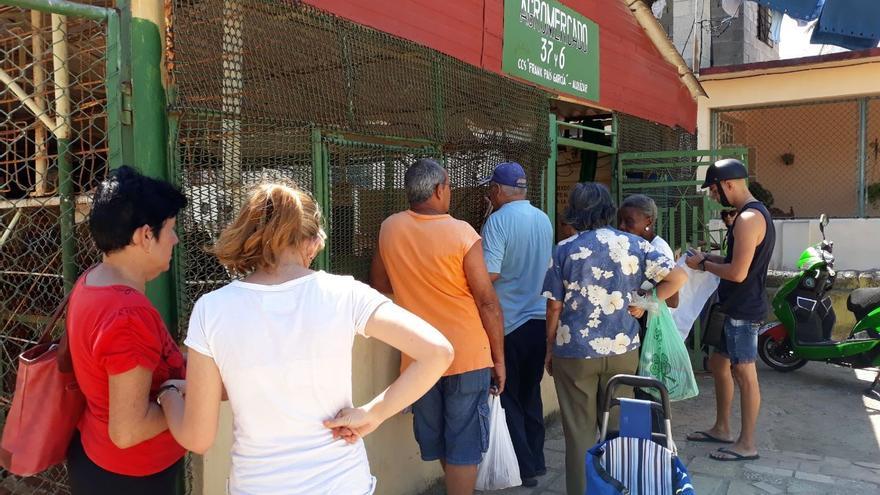
A line to buy potatoes at the market at 37th and 6th, La Timba, in Havana’s Plaza municipality. (14ymedio)

14ymedio bigger14ymedio, Havana, 24 May 2019 — The Democratic Action Unity Round Table (Muad) accuses the Cuban government of employing a “perverse strategy” of using political shortages to throw blame on the United States. The opposition group maintains that the “difficult dietary conditions, the exaggeration of the liturgy of the resistance and the indictment of the embargo” have defined life in Cuba for the last sixty years and, “in a cruel way,” in the 90s.

“The images of the crowds, the fights and the social stress at food stores, whose prices exceed the sum of several average salaries when you want to feed your family more than two or three times a week, doesn’t anger: it scandalizes,” they protest in a press release.

In the text, Muad denounces the Government talk about productive growth and the “parsimony” of the situation while citizens take to the streets and line up the minute they hear a product has arrived at the markets. In addition, in their opinion that lack is not explained by the lack of liquidity since in Cuba one pays “a price that exceeds the price paid by our peers in the rest of the world.” continue reading

The group points out that another government strategy, “more humane,” is to impede the development of the private sector, which they believe has been the most productive in recent years, since Raúl Castro introduced measures that made it possible.

However, it is necessary to “release entrepreneurs from the limitations, recognize their legal status and allow the broad importation of all their needs.” Other measures cited to improve free markets are “lifting the absurd prohibitions that impede farming and livestock production,” facilitate the acquisition of modern means of transport and develop processing industries, refrigeration and derivatives.

Although Muad stresses that it does not attribute legitimacy to the Government and the President of the Republic, Miguel Díaz Canel, they urge him to act with the responsibility that his position represents and they ask him to step aside if he is not able to do so and allow other citizens to take on the work.

Finally, Muad notes that the aforementioned economic rights are not separate from political rights and asks the State to ratify the United Nations International Covenants on Human Rights which considers them as an inseparable system.

“We want to remind the private sector that it is looking not only at the growth of business, but also at producing for free customers and doing so with sovereign workers.”

Muad, born in 2015, is defined as “a coalition of organizations, groups and political people” that seeks “to democratize the Cuban political system by peaceful and democratic means for a new project of an inclusive nation.”

_________________

The 14ymedio team is committed to serious journalism that reflects the reality of deep Cuba. Thank you for joining us on this long road. We invite you to continue supporting us, but this time by becoming a member of 14ymedio. Together we can continue to transform journalism in Cuba.

Employee Dies in Explosion at Meat Company in Sancti Spiritus

After a visit at the beginning of this year by Miguel Díaz-Canel to the Import and Export Company of Cítricos Caribe SA in Sancti Spíritus, the idea of exporting the spam produced by that industry was promoted. (Escambray)

14ymedio bigger14ymedio, Havana, 29 May 2019 — A woman worker at the Toricuba Meat Industry died on Tuesday after the explosion of a steam generator due to the increase in internal pressure in the Agroindustrial Company of Southern Grains of El Jíbaro, in the municipality of La Sierpe, in Sancti Spíritus.

Experts from the Ministry of the Interior in the province are now investigating the causes of the accident that led to the death of Maité Toledo Pérez, age 51.

Boris Luis Rodríguez, deputy director of the company, told the official Escambray newspaper that there have been no more victims, although there the material damages have yet to be quantified. continue reading

The Toricuba Base Business Unit is responsible for the slaughter of pork and beef for the production of meat products for both tourism and national food markets. It also deals with the production of spam, made from both meats, including a type of spam that is exported.

After a visit at the beginning of this year by Miguel Díaz-Canel to the Import and Export Company of Cítricos Caribe SA in Sancti Spíritus, the idea of exporting the spam produced by that industry was promoted. The Toricuba Meat Industry Base Business Unit was designated to prepare the sausage.

Figures from prior years record that in the first nine months of 2017 there were 51 deaths in Cuba in a work accident, a figure slightly lower than the 89 in 2016, according to official data from the newspaper Trabajadores (Workers).

_________________

The 14ymedio team is committed to serious journalism that reflects the reality of deep Cuba. Thank you for joining us on this long road. We invite you to continue supporting us, but this time by becoming a member of 14ymedio. Together we can continue to transform journalism in Cuba.