A Russian Plane Accused of Transporting Weapons Through the US Completes the Caracas-Havana-Managua Route

Before crossing the Atlantic, the cargo plane stopped in Armenia, Algeria, Morocco, Senegal and Mauritania

The Ilyushin Il-76 has the capacity to transport up to 50 tons of cargo / Pexels

14ymedio biggerEFE (via 14ymedio), Washington, October 29, 2025 — An Ilyushin Il-76 air cargo carrier of the Russian company Aviacom Zitotrans, sanctioned by the US for participating in the arms trade and transport of mercenaries, left from Havana this Wednesday for Managua, after landing earlier in Caracas. This route among allies takes place in a climate of military tensions with the US naval and air deployment off the Venezuelan coast.

The Il-76 is capable of carrying up to 50 tons of cargo and is one of the largest cargo planes in the world, similar to the Airbus military A400M and Boeing’s C-17 Globemaster.

According to data from the website Flightradar, the Russian plane, which flew part of its route with the transponder off so as not to be identified, took off this morning from Havana. On Tuesday, October 28, it operated between Caracas and Havana, and on the 26th it landed in the Venezuelan capital, continue reading

coming from Mauritania.

The Russian plane, which flew part of its route with the transponder off so as not to be identified, took off this morning from Havana

Before crossing the Atlantic, the cargo plane stopped in Armenia, Algeria, Morocco, Senegal and Mauritania.

The Russian company Aviacon Zitotrans is accused by the US of being involved in transporting military materiel and supporting the Russian defense sector, as well as supporting the deployment of mercenaries of the so-called Wagner Group, designated by the US as a transnational criminal organization.

The US added Aviacon Zitotrans to the list of entities sanctioned in January 2023 for transporting light weapons, missiles and helicopter parts, with special emphasis on logistical support to Venezuela and military operations in Africa.

The fleet of Aviacon Zitotrans includes six Ilyushin cargo planes. The one that made this last route between Venezuela, Cuba and Nicaragua is registered RA-78765 and is one of the aircraft specifically named in the US sanctions, so it is subject to intervention if it enters the jurisdictions of the US or its closest allies.

It is one of the aircrafts specifically named in US sanctions and therefore subject to intervention

This air movement occurs in the midst of massive US reinforcement in the Caribbean and off the coast of Venezuela, where several destroyers and amphibious assault ships are already operating. In the next few days the attack group of the carrier USS Gerald Ford, the largest and most modern in the US Navy, is expected to arrive.

Analysts see this massive US deployment, which includes overflights near the Venezuelan airspace of strategic bombers, as an attempt to pressure the government of Nicolás Maduro to accept a negotiated exit. However, in public, the main reason given by the White House is its campaign to combat fentanyl trafficking.

Translated by Regina Anavy

____________

COLLABORATE WITH OUR WORK: The 14ymedio team is committed to practicing serious journalism that reflects Cuba’s reality in all its depth. Thank you for joining us on this long journey. We invite you to continue supporting us by becoming a member of 14ymedio now. Together we can continue transforming journalism in Cuba.

The Cuban Regime Obtains the Worst Result in History on Its Resolution Against the US ‘Blockade’ at the UN

In addition to the US and Israel, five other countries rejected the motion with 12 abstentions

The resolution against US sanctions on Cuba has no binding effect / X

14ymedio bigger

14ymedio, Madrid, October 29, 2025 — The resolution promoted by the Cuban Government at the United Nations, entitled The need to end the economic, commercial and financial blockade imposed by the United States of America against Cuba, received 165 votes in favor, 7 against and 12 abstentions. Although the island’s chancellor, Bruno Rodríguez Parrilla, described the result on the social network X as a “victory for Cuba,” it is actually the worst diplomatic show of support for Cuba in the history of these votes.

Since the text was first introduced in 1992, it has never received more than four votes against. On this occasion, the usual ones – the United States and Israel – were joined by Argentina, Paraguay, North Macedonia, Hungary and Ukraine. Abstentions – 12 in total – have not reached a similar figure since 1998. The countries that chose to abstain were Albania, Bosnia and Herzegovina, Costa Rica, the Czech Republic, Ecuador, Estonia, Latvia, Lithuania, Morocco, Moldova, Romania and Poland.

Although the resolution maintains a majority condemnation of the US embargo, the most significant political fact is the change in the diplomatic trend towards Cuba. Several Latin American and European states that traditionally supported Havana have begun to distance themselves from its historical position.

Since 1992, with the exception of 2020, when it was not presented because of the pandemic, the General Assembly has voted on this text almost every year, with always overwhelming results. The resolution initially received 59 votes in favor and 71 abstentions, but since 2005 support has regularly continue reading

exceeded 180 countries.

The official narrative of “blockade victim” is eroding against the evidence of more than six decades of authoritarian control

The moment of greatest consensus was recorded in 2016, when 191 states supported the resolution and none voted against it, coinciding with the rapprochement between Barack Obama and Raul Castro. However, since 2017 Washington resumed its negative vote along with Israel, reissuing the traditional diplomatic confrontation. In 2024, the resolution received 187 votes in favor, so this year’s collapse reflects a substantial loss of support for Havana in just twelve months.

This shift occurs in the midst of an unprecedented economic and social crisis on the island, with chronic shortages, blackouts, the collapse of health services and a mass migration exodus. Although the embargo continues to affect the country’s economy, the official narrative of “blockade victim” is eroding against the evidence of more than six decades of authoritarian control, repression of dissent and absence of structural reforms.

During the preliminary discussion, the delegations of Cuba and the US engaged in a bitter exchange. Rodriguez interrupted US ambassador Mike Waltz, accusing him of “lying in a rude manner” and expressing himself with a “rudeness and arrogance” inappropriate for the forum. Waltz replied that the Cuban regime “oppresses its own people” and uses the country’s resources to maintain the “elite status” of its leaders, calling the government in Havana an “illegitimate communist legislature.”

In total, the UN has adopted 33 resolutions of this kind, with a symbolic rather than practical scope. The Cuban regime has turned the “blockade” issue into a pillar of its beleaguered plaza rhetoric, which it uses to justify internal failure, solicit donations, negotiate debt deferrals and keep its diplomatic machinery active. But the loss of support in the UN suggests that international patience with Havana is running out, and that the talk of the embargo is no longer enough to cover up the deep crisis of legitimacy of the Cuban system.

Translated by Regina Anavy
____________

COLLABORATE WITH OUR WORK: The 14ymedio team is committed to practicing serious journalism that reflects Cuba’s reality in all its depth. Thank you for joining us on this long journey. We invite you to continue supporting us by becoming a member of 14ymedio now. Together we can continue transforming journalism in Cuba.

The Butterfly Returns: Promises, Ruins and Nostalgia in Havana’s Lenin Park

After years of neglect, the recreation center is trying to attract visitors with ranch-style huts, horses, and soft drinks.

14ymedio bigger14ymedio, Darío Hernández, Havana, 27 July 2025 (delayed translation) — After several years of abandonment, Mariposa Park, one of the most emblematic areas of Lenin Park in Havana, seems to want to take flight again. Although the official reopening has not been announced, there is already a mixture of work, improvisation and distant memories on the ground.

“What they are doing for now is fixing the open-air eateries and other things like that to inaugurate the park again,” says a worker at the site, while pointing to a couple of freshly painted wooden structures. “Inside they are fixing the equipment for the holidays. They have already made enough progress,” he adds.

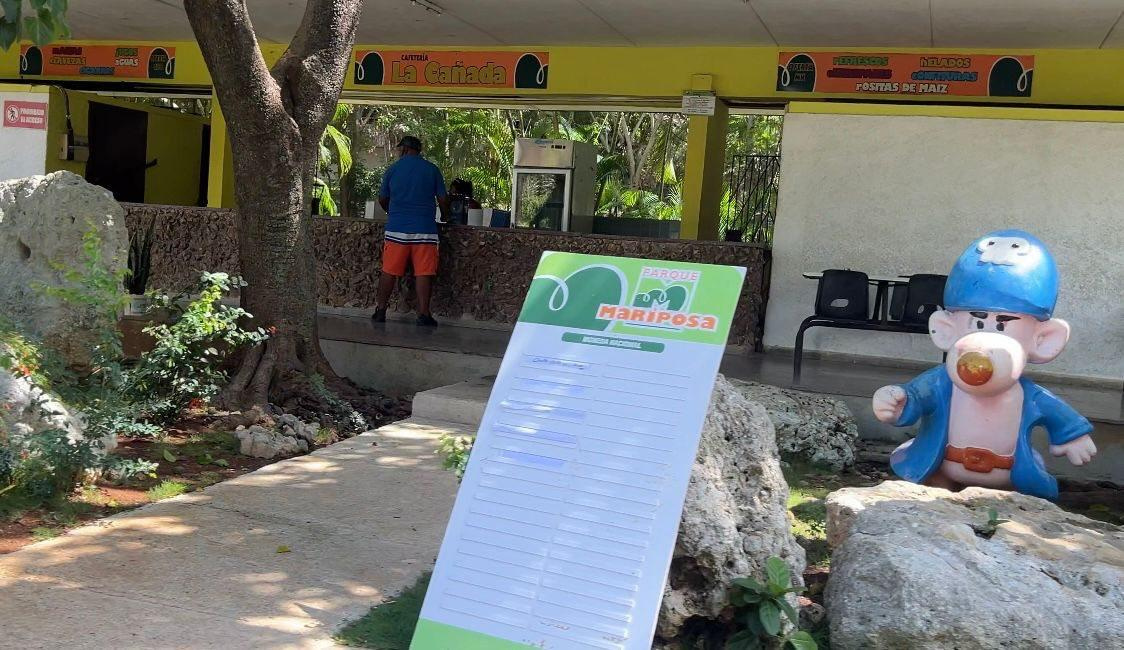
The image offered today by Mariposa Park is far from the hive of children’s laughter and endless queues of yesteryear. Apparatus covered by bushes, children’s figures corroded by the weather and roller coasters frozen in time draw a scene that is more reminiscent of a ghost town than a recreational center. Every now and then you remember a device that was set up in your childhood and you get a little nostalgic.

The image offered today by Mariposa Park is a far cry from the hive of children’s laughter and endless queues of yesteryear. / 14ymedio

At the side entrance – through which it is possible to sneak without great effort due to the absence of fences – you are greeted by a lackluster version of Captain Plin and Elpidio Valdés. Behind, the immense metallic star that once rotated luminous now remains motionless, rusty, without seats, a symbol of deterioration. continue reading

One of the few elements in the park that shows some life is the modest kiosk that offers jams, beers and soft drinks. “They treat you quite well,” admits a regular visitor. Even so, some employees consulted are skeptical about the alleged arrangement of the rides. “There is nothing new here. Go to Expocuba if you want to see something, there at least they are setting up playthings for the children,” said a clerk between resignation and incredulity.

In the surroundings of the park, other spaces reveal the same pattern of abandonment. Behind the area known as “the head-and-headless riders,” an ancient Chinese restaurant called El Dragon [The Dragon] survives without offering Asian food, but beer and the occasional quick meal. Later, La Parrillada and other eateries that once functioned as restaurants and cafes, are now ruins covered in rubble.

In the park’s surroundings, other areas reveal the same pattern of neglect. / 14ymedio

The bamboo forest, which used to be a magical place to hide or simply stroll, has been partially cleared out, leaving behind a picture of toppled logs and bare clearings. Silence prevails, barely interrupted by the birds or the constant buzzing of cicadas.

In the midst of this desolate landscape, the attempt to revive the space manifests itself in small details. A few children’s playthings have been installed on the outskirts of the Mariposa and eateries are being rehabilitated where families can sit down to eat. “Every weekend that passes a few more people come,” says an optimistic worker.

The horseback riding business, which has also suffered the consequences of the tourist decline, is trying to stay afloat. “We are doing well, but it has to comply with regulations. We have a contract with the head of the park, because the police require papers,” explains one of the drivers.


The Butterfly Returns: Promises, Ruins and Nostalgia in Havana’s Lenin Park

Only a few horses are available and those who rent them out must compete with their memories of a tourism that was once much more dynamic. “Now there are hardly any tourists and it is difficult to find someone out there,” laments one of the people who give rides.

Among those who offer the rides are minors, some as young as 10 or 12 years old. “There are few of us because we are the only legal ones,” clarifies the caretaker of one of the animals, while trying to convince a family to dare to ride.

The attempt to reactivate Mariposa Park parallels the state of the faded memory of the rest of Lenin Park. Its green areas continue to attract families who improvise picnics, fly kites or play soccer among the palms. In the Palace of the Pioneers, the open bars and the absence of guards turn the place into another symbol of institutional abandonment.

The horseback riding business, which has also suffered the consequences of the tourist decline, is trying to stay afloat. / 14ymedio

The new director of the Mariposa park has guaranteed certain improvements, say workers at the site. “This has been allowed to decay here because of several previous administrations. But this director has done a lot. This was abandoned, with stagnant water that rusted the devices,” recalls an employee.

“When this was working, it was good,” says one custodian wistfully. Meanwhile, two of his colleagues interrupt the conversation to ask a group of visitors to leave the area of the devices, with such moderate firmness that it suggests that they are exercising a learned routine rather than authority.

Translated by: Hombre de Paz

____________

COLLABORATE WITH OUR WORK: The 14ymedio team is committed to practicing serious journalism that reflects Cuba’s reality in all its depth. Thank you for joining us on this long journey. We invite you to continue supporting us by becoming a member of 14ymedio now. Together we can continue transforming journalism in Cuba.

As the Cuban Economy Sinks, Spanish Group Vima Increases Its Revenue on the Island

The profits, which reached €10 million, “demonstrate the weight of the Moro family’s discreet food empire.”

Vima Caribe dollar store on Infanta and Santa Marta in Havana / 14ymedio

14ymedio bigger14ymedio, Olea Gallardo, Havana, July 30, 2025 (delayed translation) — The Vima Foods group increased its profits last year thanks to its buoyant business in Cuba. Specifically, according to a report on Tuesday by Economía Digital, the conglomerate’s purchasing center, which operates from La Coruña (Spain) under the name Corporación Alimentaria Vima, increased its profits by 16%, from €8.6 million in 2023 to €10 million in 2024, as well as its turnover, from €88 million to €105.8 million.

Of these nearly 106 million, 49 million correspond to its operations with the island, its main market, which is nevertheless suffering the worst food crisis in its history.

According to Economía Digital, based on the latest accounts submitted to the Spanish Commercial Registry by Corporación Alimentaria Vima, a conglomerate founded by Víctor Moro Suárez—son of Víctor Moro Rodríguez, who died in 2021, a politician during the Spanish Transition and also head of a frozen food packaging conglomerate— Cuba is followed in importance by the Dominican Republic (33 million) and Mexico (15.4 million). The data, according to the local media, “highlights the weight of the Moro family’s discreet food empire.”

The article does not mention Spain—although it does mention other countries where Vima Foods claims to have a presence, such as China, Panama, and the United States—and rightly refers to the Coruña-based company as “a firm as little known as it is profitable.” Vima’s products, which are as ubiquitous in Cuban stores as they are reviled by their buyers—and which range from frozen vegetables to pre-cooked foods, canned vegetables, jams, and grains—are not found in Spanish supermarkets. continue reading

As an explanation for its growth, the company’s administrators stated in their most recent report that it was due to increased activity across the group as a whole

As an explanation for its economic growth, the company’s administrators stated in their most recent report that it was due to increased activity across the group as a whole: “Throughout the 2024 financial year, the company has experienced growth in turnover as a result of the product rebranding strategy initiated in previous years and the consolidation of the group’s presence in the retail and food services channels, which has led to an increase in demand from Vima Group companies at its purchasing center.”

A notable element in the report is the “new subsidiary” created by the group on the island this year, Vima Caribe, “which channels all commercial operations to a new branch, a 100% foreign-owned company responsible for the import, storage, marketing, and distribution of the group’s products in Cuba.”

This makes it clear that the “collaboration project” between Vima and the military conglomerate Gaesa (Grupo de Administración Empresarial S.A.) through its corporation Cimex, signed last January, goes beyond the mere management of several “dollarized” stores. It has involved the legal creation of a new company, which has not been reported in the official Cuban press.

This new branch,“ continues Economía Digital, ”will replace the previous one, and it is expected that its status as an importer will give it greater commercial capacity.”

The media outlet also clarifies the latest ups and downs of Vima Foods’ subsidiaries, which are not without reason referred to as “a highly dispersed conglomerate.”

The media outlet also clarifies the latest ups and downs of Vima Foods’ subsidiaries, which are not without reason referred to as “a highly dispersed conglomerate.” As a result, Corporación Alimentaria Vima “has transferred its corporate employees in Spain to a new company, CS Vima, based in Madrid, which will be responsible for centralizing all services related to leadership, operational support, and human resources provided to all companies within the group.””

The headquarters of the conglomerate, Vima World, is registered in the Spanish capital, having previously been based in Panama until March 2023. At that time, according to sources from the specialized outlet, “it completed the process of transferring its registered office to Spain and converting into a limited liability company, while retaining its legal identity.”

The group’s business prospects, according to Economía Digital, will continue to grow, focusing on “its consolidation in the food distribution segment in Central America” and “opening markets in countries where it did not previously have a presence.”

Vima continues to describe itself on its website as a “family-run company founded in 1994” and as a group “originally linked to the fishing industry in Galicia, Spain,” despite being relatively unknown in that region.

At the same time, the Moro family has never hidden its connection to the Island, and in fact, Moro Suárez’s son, Víctor Moro Morros-Sarda, held a lavish wedding in Havana in December 2023. The patriarch himself has lived in Cuba for over 25 years, where he served as president of the Association of Spanish Entrepreneurs in the country.

The Moro family has never hidden its connection to the Island, and in fact, Moro Suárez’s son, Víctor Moro Morros-Sarda, held a lavish wedding in Havana

The origins and growth of its multimillion-dollar business are more opaque. The Panama Papers, a publication of the Mossack Fonseca law firm’s database by the International Consortium of Investigative Journalists (ICIJ), revealed in 2016 that Vima World was listed among the companies registered in offshore tax havens.

According to the ICIJ database, it was founded in January 1994 in the British Virgin Islands. However, Moro Suárez himself acknowledged in a 2006 interview with the local Galician press that his business empire began in Cuba. When asked by the journalist how he had “learned” to manage “one hundred and sixty employees serving twenty million meals around the world,” the businessman replied: “I found a work niche in the Caribbean region, starting from Cuba, and that circumstance led me to organize this group of companies.”

A report published in La Voz de Galicia four years earlier confirmed this: “Vima was founded in Havana in 1994 to take advantage of the Cuban market’s opening to tourism investment and become the leading supplier to hotels and restaurants.” In 2002, the article stated that Vima World, “a distribution company based in Vigo and fully owned by the Galician Moro family,” was the market leader in Cuba, controlling 15% of food distribution and 25% of hotel supply. In 2001, its revenues reportedly reached 25 million euros. Over the course of a quarter century, the business has quadrupled, nearing 106 million last year.

How a company led by a foreigner could be founded in Cuba in the mid-1990s and reach such figures within just seven years remains one of the questions surrounding Vima, which began appearing in establishments across the Island during that very period — marked by dollarization and the desperation of the Special Period. The answer may lie in that 2006 interview, where the journalist wrote that, according to what he had been told, Moro Suárez held meetings with regime figures, including none other than Fidel Castro himself.

Translated by Gustavo Loredo

____________

COLLABORATE WITH OUR WORK: The 14ymedio team is committed to practicing serious journalism that reflects Cuba’s reality in all its depth. Thank you for joining us on this long journey. We invite you to continue supporting us by becoming a member of 14ymedio now. Together we can continue transforming journalism in Cuba.

Cubans Reinforce Their Homes, Working Against Against the Clock Before the Arrival of Hurricane Melissa

  • It remains a dangerous category 5 hurricane on the Saffir-Simpson scale, as it heads for the Island
  • “We know that there will be a lot of damage caused by this hurricane,” warns President Miguel Díaz-Canel
Cubans walk olong the sea this Tuesday in Santiago de Cuba, while Melissa advances toward the Island. / EFE

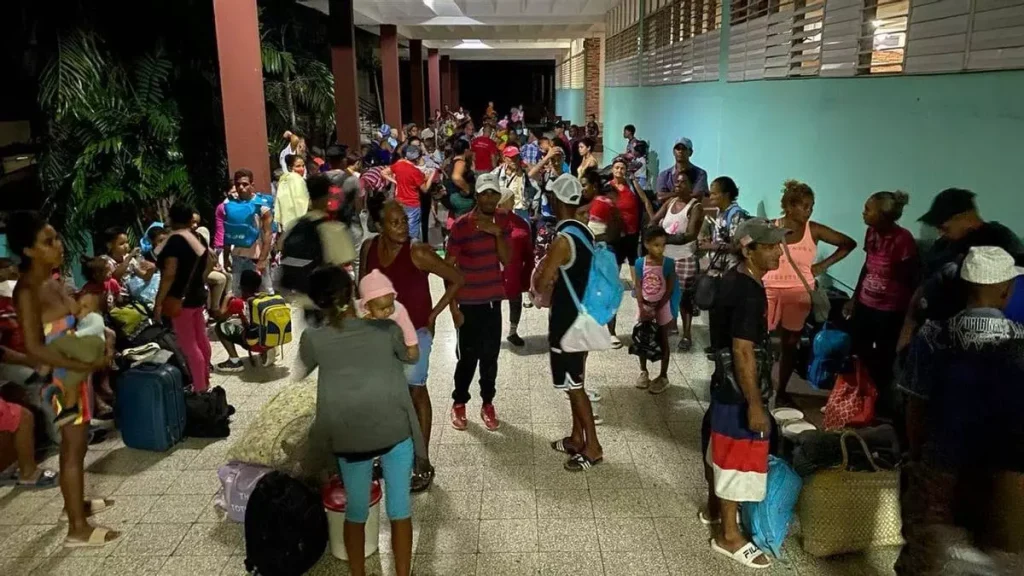
14ymedio bigger14ymedio / Havana/ Holguín, Miguel García, October 28, 2025 — “I have spent the day nailing doors and windows,” a resident of Holguín told 14ymedio. He adds that they are preparing the best they can to survive Hurricane Melissa, although they have not had time to follow the details of its trajectory due to a poor internet connection and blackouts. His house has brick walls, but he doesn’t want anything to surprise him and endanger his family.

Melissa made landfall this Tuesday near New Hope, Jamaica, with sustained maximum winds of 185 mph. A probe was able to capture a burst of 252 mph inside the hurricane. Its central pressure dropped to 892 hectoPascal, so it remains a dangerous category 5 hurricane on the Saffir-Simpson scale, as it heads east towards Cuba.

At least 7 people have died so far: 3 in Jamaica, 3 in Haiti and 1 in the Dominican Republic. Authorities fear that the number of casualties may increase as more damage reports come in.

From Jamaica, a Cuban doctor wrote on her social networks: “I tell the people in eastern Cuba: this is too much for Cuba. It is too much for you, my dear people.”

In the municipality of Palma Soriano, province of Santiago de Cuba, Katia, 51 years old, says that no one has slept at home: “We removed the mattresses from the beds and sent them to some neighbors who have a house that is stronger than ours, the same with the refrigerator,” she reports by phone to 14ymedio. The family has set two clear priorities: keeping the children safe and preserving their most valuable assets. continue reading

“We are not going to evacuate because here when people leave their homes, the danger of being robbed is high,” she says. “These walls are strong, our problem is the roof: one part is board and the other has a light cover. We’ve blocked the blinds with boards and tried to keep the water tank above the bathroom full, so it doesn’t blow away in the wind. We’re avoiding wasting the rechargeable batteries for our flashlights and mobile phones.

“Yesterday people stocked up on everything they could. There were lines in front of the MSMEs* that sell food, and trucks and tricycles were carrying boxes and large packages.”/ 14ymedio

Niurka can listen to local FM radio stations with a headphone attached to her cell phone as an antenna. “This has given us luck because we have had many blackouts in recent days and being informed has been difficult. At least we now know that the creature is coming here and has an impressive size,” she says about Melissa.

In the city of Holguín it’s hard to find something to buy this Tuesday. “Yesterday people stocked up on everything they could. There were lines in front of the MSMEs that sell food, and trucks and tricycles were carrying boxes and large packages,” says Rodolfo, driver of an electric vehicle that transports passengers and goods. He decided not to go to work today, preferring to be employed in reinforcing his home’s security.

“Luckily my little house is attached to others and that protects us,” he explains. ” I spent my life complaining about the neighbors who play their music too loud and sometimes even wake up the kid with their screaming, but today that is the greatest security I have to confront the wind.” In the event that the electricity is cut off for several days and food becomes more scarce, neighborhood solidarity will also be important.

“In previous hurricanes we improvised a pot of soup on the block and that saved us,” he recalls. This kind of support will be more important on this occasion. “There are many old people who are alone in this neighborhood. Some have been evacuated to other houses, but others have no one who can help, so we will take turns looking after them.”

Rodolfo’s sister, a newly graduated doctor, is being evacuated to the Vladimir Ilyich Lenin General University Hospital along with other health workers. “She took a couple of changes of clothes because this can last for a long time.” The tricycle with which he earns his living now occupies most of the space in the room. “Usually I keep it in an open carport outside, but this time I cannot risk it. If a tree falls on top, my way to earn a living is lost.”

“Luckily my little house is attached to others and that protects us.” / 14ymedio

His decision coincides with the advice offered on Facebook by an architect in Guatánamo with experience in natural disasters. The expert warns that winds from 155 to 186 mph are strong enough to destroy even houses made of reinforced concrete, so nobody should underestimate their power. He also explains that wood or brick dwellings with thin ceilings are extremely vulnerable, as the wind can tear off roofs and knock down structures, especially in rural areas or isolated buildings. In these cases, the recommendation is to evacuate immediately to someplace safe and not assume that thick or concrete walls will provide protection.

Only concrete dwellings with heavy roofs and in good structural condition could provide some safety if they are away from the shore. In coastal areas or where the sea is at least 656 feet high, even solid houses should be evacuated, as the waves can cause more damage than the wind, says the specialist.

On Tuesday, President Miguel Díaz-Canel, who chairs the National Defense Council, released a statement calling on Cubans to avoid deaths and serious damage in the face of the next powerful impact of hurricane Melissa on the east of the island.

We know that there will be a lot of damage caused by this storm, but we will have the capacity to recover in food production, housing, and also in the the economy,” said the president in a message broadcast on state television.

“No one should venture to swim in the swollen rivers; no one should return home from the places of evacuation when the indications for returning or going to the recovery phase have not yet been given in each of the territories,” advised the first secretary of the Communist Party, who described the preparatory work at all levels as “intensive and responsible.”

Neighborhood residents in Santiago called the Communal Services, but “they responded that the truck can’t come. There is no fuel and the ones that work are going to Guamá. / Facebook / Yaya Panoramix

For his part, José Daniel Ferrer, leader of the Patriotic Union of Cuba (UNPACU) and recently exiled in Miami, shared a video from Santiago de Cuba where you can hear “the hammering of people trying to secure their homes in order to cope with Hurricane Melissa.” Some 168,900 people have been evacuated in this province to 101 centers set up for that purpose.

Actress Dayana Figueroa, known on social networks as Yaya Panoramix, complained on Facebook that the garbage threatens to cause obstructions in the sewage system of her neighborhood in Santiago de Cuba, “a few blocks from Céspedes Park.” She says that the neighbors called the local authorities, but “they replied that the truck can’t come. There is no fuel and those that work are going to Guamá.” Aware that her neighborhood is often flooded, she concluded, “My family is in danger.”

From Yateras, in Guantánamo, official profiles defend the use of caves in the mountains to house vulnerable people. Meanwhile, Melissa is moving north-northeast and has slightly increased its travel speed by 9 mph. It is expected to lose some strength as it crosses Jamaica and arrive with a lesser category on Cuban soil between Tuesday and Wednesday.

Over the next 24 hours, Melissa should tilt its trajectory further to the northeast, gradually increasing its speed. The external bands of this hurricane are already affecting the eastern region of Cuba, generating showers and rain, which will increase in the afternoon from Camagüey to Guantánamo. Rainfall will be strong and intense, mainly in mountainous areas, with accumulations between 7.5 and 17.7 inches over the next 24 hours.

*Micro, Small, Medium Enterprises [mipyme in Spanish], generally privately operated

Translated by Regina Anavy

Hurricane Melissa Challenges “The Entire Value Chain of Cuba’s Energy Logistics System”

Not only is power generation hanging in the balance as the powerful hurricane approaches: the fuel storage network is at risk, an expert warns.

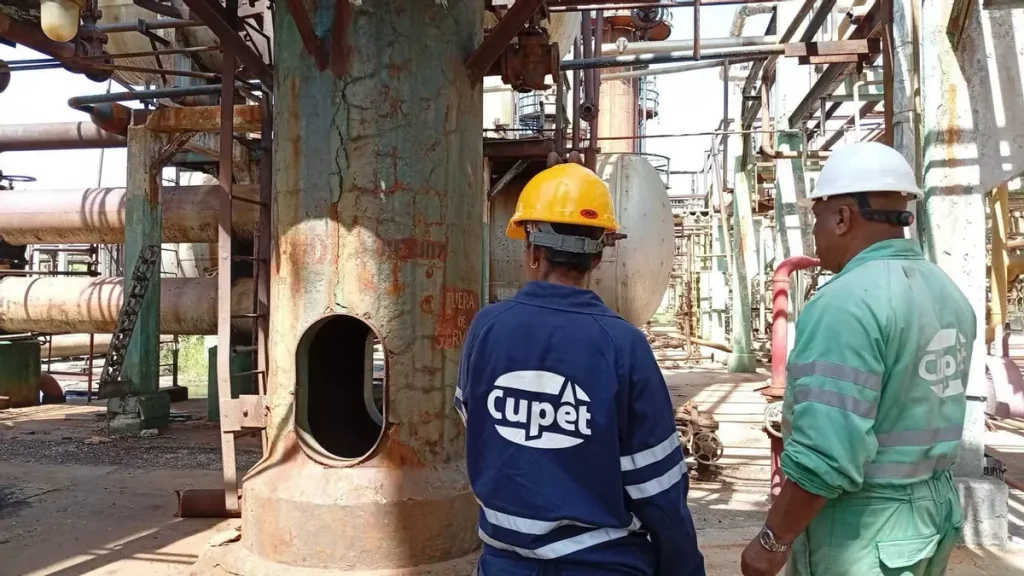
Workers at the Hermanos Díaz refinery carried out hurricane preparation tasks on Monday, Cupet said. / Cupet

14ymedio bigger14ymedio, Madrid, October 28, 2025 / Hurricane Melissa was approaching Kingston, Jamaica early this morning as a powerful hurricane, with sustained winds of 280 kilometers per hour and gusts exceeding 300 kilometers per hour, including one of 388 kilometers per hour recorded by a U.S. National Oceanic and Atmospheric Administration aircraft. Although it is expected to weaken slightly as it leaves Jamaica, forecasts indicate it will regain strength before reaching Cuba early Wednesday morning.

The greatest concern is the storm surges it will prompt on the coasts of Granma, Santiago de Cuba, and Guantánamo, which will cause flooding in low-lying areas, as well as the heavy rains expected throughout the eastern part of the country, which are dangerous in mountainous areas due to the risk of river flooding and landslides. The risk is such that the official newspaper Granma newspaper has not minced words.

“Melissa will hit with great power and cause great concern about what it could destroy in its path. But let it not be lives that are left vulnerable,” the newspaper warns. It states that, in addition to the hundreds of thousands of evacuees, “no time has been wasted in planning and implementing evacuation plans for those at risk, safeguarding resources, securing health institutions, providing rescue equipment, and updating waterworks.”

But if there is one infrastructure in serious danger, it is precisely the weakest: the national electricity system (SEN). Jorge Piñón, a researcher at the University of Texas at Austin, warned this newspaper that the risks go far beyond power generation—which will have to be halted at thermoelectric plants in affected areas when the time comes, according to the official press—and even extend to logistical capacities. continue reading

“The impact of Hurricane Melissa, a Category 5 storm, could not only be devastating for the Antonio Maceo and Renté thermoelectric plants in Santiago de Cuba, and the Lidio Ramón and Felton plants in Holguín. It could also affect 26% of the country’s power plants, with an installed capacity of 813 GW in the five eastern provinces, representing 31% of the national total,” the specialist says, citing official data.

Although the government announced this Sunday that lineworkers from across the country were already en route to the eastern region to prepare—and recover—the infrastructure, Piñón points out that there will be “thousands of kilometers of electrical transmission and distribution lines, along with their substations,” crisscrossing the areas that are expected to be hardest hit by Melissa.

The photovoltaic panels, towers, and generators at La Herradura wind farm in Holguín are also exposed. The Electric Union and the official provincial press have explained that the panels at all solar farms have been protected with strong straps tied to the foundations of the wind turbines, although the omen is not good. César Luis Sarmiento Ávila, head of investment at the Holguín Electric Company, indicated that, according to the design, the support can withstand winds of up to 200 kilometers per hour, which is 80 kilometers per hour less than the current speed of the hurricane as it is passing through Jamaica.

“But Melissa’s impact could go far beyond electricity generation. The entire energy logistics system value chain in the eastern provinces could be seriously compromised,” warns Piñón. “The Hermanos Díaz refinery, with an installed capacity of 30,000 barrels per day and an extensive fuel storage network, constitutes a strategic hub for the supply of refined products, lubricants, and liquefied gas cylinders to this region of the country,” he explains.

Screenshot

Furthermore, all of Cuba-Petroleo’s (CUPET) territorial marketing terminals have dozens of fuel and liquefied petroleum gas storage tanks that are “vital to the national economy,” and it will be essential for tanker trucks to be able to access the roads to supply generators, gas stations, and industries. “Yes, electricity is crucial, but logistics—the backbone of fuel supply—will also be put to the test in the coming weeks,” the specialist concludes.

In homes, there continues to be concern about blackouts lasting longer than 24 hours, and although applications that don’t require an internet connection have been activated and amateur radio emergency networks are operating to access hurricane information, a large part of the population lives in anguish over the disconnection.

“My mother spends more time without electricity than with it,” X, originally from Santiago, tells this newspaper. “She only told me that at the llega y pon [informal settlement] with my house, they came with several buses and took everyone away. They’ve moved everyone who might be in bad shape, that’s what she told me.” Since her house is in good condition and has sufficient food, “she’s more worried about the viruses than the cyclone,” she adds.

The arbovirus infections that have been ravaging the country for weeks face another test of fire with the hurricane, where everything could get worse. The United Nations Development Program (UNDP) has sent a donation that includes, among other things, hygiene kits and water treatment plants. “The goal is to support national efforts for early recovery and reduce the suffering of affected families,” a spokesperson reported Monday.

The donation includes 4,000 tarps for temporary roof coverings, seven electric generators, six chainsaws, 259 specialized and basic tool kits for roof repair, and more than 2,000 single-person mattresses. The United Nations also announced it has activated its Anticipatory Action mechanism, through which it plans to distribute more than 100 tons of rice and emergency supplies.

The gap between what is reported in the official press and what citizens report on social media is total. The government maintains that all preventive measures have been taken and now calls for individual discipline and responsibility to avoid any tragedy, while social media messages claim that the conditions under which this hurricane arrives are so deplorable that even the best forecasts cannot mitigate its effects.

But authorities consider the accusations a “smear campaign.” “A failed state could do everything we were doing before the cyclone, nor can it organize all the efforts being made to confront this situation and recover from it,” President Miguel Díaz-Canel said yesterday.

____________

COLLABORATE WITH OUR WORK: The 14ymedio team is committed to practicing serious journalism that reflects Cuba’s reality in all its depth. Thank you for joining us on this long journey. We invite you to continue supporting us by becoming a member of 14ymedio now. Together we can continue transforming journalism in Cuba.

A New Card and the Same Trick: Cuban Doctors in Angola Still Can’t Collect Their Pay in Dollars

The authorities advance a new payment mechanism to settle complaints, but the doctors still demand payment in dollars

Cuban doctors in Angola say the authorities have held onto their dollars for years / Cubadebate

14ymedio bigger14ymedio, Havana. Natalia López Moya, October 28, 2025 — “We are somewhat resigned, but not at all in agreement,” said Héctor, a Cuban doctor in Angola who participated in the meeting on October 23 between health workers and representatives of Antex, the Cuban company that manages the missions in the African country. The meeting, held in Luanda, served to announce a new payment mechanism through the Classic card, which maintains restrictions on access to dollars and thwarts the hopes of health workers to be able to recover their money in that currency.

The meeting took place in a tense atmosphere, albeit with fewer complaints than on previous occasions. “It’s not that we have given up, but people have now realized that these officials aren’t going to do anything; it’s like talking to a wall,”explains the doctor, using a pseudonym for fear of reprisals. According to his statement, the document read during the meeting had already been leaked days before, so the attendees arrived “more than informed.”

The official text stated that, beginning October 20, Cuban professionals in Angola and Algeria can transfer the savings accumulated in their accounts in freely convertible currency (MLC) to a Classic card, with which they will be able to buy in dollar stores, acquire a car and pay for fuel at foreign currency gas stations.

The change does not solve the main problem: the impossibility of withdrawing dollars in cash from Cuba

However, the change does not solve the main problem: the impossibility of withdrawing dollars in cash from Cuba. “This has changed nothing,” says Hector. The availability of dollars still depends on the bank, and the answer is always the same: we don’t have any.” continue reading

The measure was to be implemented in January 2026, but it was brought forward by growing unrest among the health workers, tired of collecting pay in a devalued currency. “All this prevents us from making plans for housing, investment or migration,” laments Héctor, who is about to finish his mission after more than three years. “The MLC is worth much less than the dollar, and the balance in a Classic card is also below. In the end we lose money on every transaction.”

The currency gap is confirmed by the informal market: while the dollar is quoted this Tuesday at 485 Cuban pesos, the MLC barely reaches 200, and the money in a Classic card equals 446. “We can forget about a part of our savings; that money evaporates in the many deals we have to do to get the cash,” he concludes.

For months, a number of health workers had been confident that the authorities would allow direct payment in dollars or kwanzas (Angolan currency), to later buy dollars in the local market. But the decision of the Cuban government, advanced this week, fell like “a bucket of cold water” on these expectations.

In September, the professionals received only half their monthly payment in kwanzas, about $200

The discomfort is aggravated by other failures. In September, professionals received only half their monthly payment in kwanzas -about $200- and in October the disbursement was further delayed. Some doctors have not yet been paid. ” People are demoralized, but also scared,” says another health worker in Luanda. “They have tried to divide us and scare us so that no one protests.”

The clearest warning came a few days ago from Cuba’s Ministry of Public Health, which officially called the doctors who criticize the system or report irregularities “ingrates and traitors.” It was like a direct message, says the doctor. Anyone who complains risks being sent back to Cuba and losing their savings.”

The discontent had reached such a point that a group of collaborators drafted a letter to the Cuban Public Prosecutor’s Office, on behalf of all, demanding payment in foreign currency and better working conditions. At the center of their complaints is Antex, a subsidiary of the military conglomerate Gaesa, sanctioned by the US Office for Foreign Assets Control (OFAC). Antex manages a wide range of businesses in Angola, from road construction, airfield repairs and travel agencies to managing medical missions.

The discontent had reached such a point that a group of collaborators wrote a letter to the Cuban Public Prosecutor’s Office

In July, the professionals also sent a letter to Miguel Díaz-Canel, denouncing “non-compliance with the form of payment established in the contract” and demanding access to their funds in dollars deposited on the island. There was no response. Instead of rectifying, says another doctor, “what they have done is give us another plastic card but no cash dollars, nothing.”

Most of them have lost hope of a change. “They don’t want to give up the money, says Héctor. They have kept our currency for years and will not return it, even if that costs them more complaints in the meetings.

Translated by Regina Anavy

____________

COLLABORATE WITH OUR WORK: The 14ymedio team is committed to practicing serious journalism that reflects Cuba’s reality in all its depth. Thank you for joining us on this long journey. We invite you to continue supporting us by becoming a member of 14ymedio now. Together we can continue transforming journalism in Cuba.

Cuban Roel Santos Dreams of Seeing the Island Play With Its MLB Stars

“It’s a topic that has caused a lot of controversy,” the Granma native acknowledges.

Santos has been selected for both World Baseball Classics, in 2017 and 2023. / ‘Cubadebate’

14ymedio bigger

14ymedio/SwingCompleto, Havana, Ocotber 27, 2025 / Cuban baseball player Roel Santos, who has represented Team Cuba in various international tournaments, called for Major League Baseball players to be part of the team’s roster for the VI World Baseball Classic – if Cuba finally receives permission to participate – which will take place in 2026 in the United States, Japan and Puerto Rico.

The outfielder, who plays in the Venezuelan Professional Baseball League with the Bravos de Margarita club, said in an interview with Swing Completo that he hoped Cuba “has the good fortune that its MLB players can say yes and that their teams can give them the nod. It would be a very good thing. I would love it if this could be achieved someday. That the best players in the world can participate. It will be good for both baseball and the fans, who also want that.”

The Granma native acknowledged that “it’s a topic that has caused a lot of controversy,” but that a good result for the island only depends on adding MLB players. “It’s the best event, and honestly, who doesn’t want to be in a World Baseball Classic? Being able to have major league players in a Classic is a great prospect, because the best players in the world will be facing each other,” he remarked.

“For the 2026 World Classic, if Cuba receives permission, we haven’t made the call yet.”

However, Roel Santos’s ambition seems unlikely due to the political differences between the Cuban government and the main Cuban stars playing in the MLB—like Aroldis Chapman—although he hasn’t lost hope that, at some point, this barrier will be broken: “I would like everyone to participate. There are many legends I played with on the national team, and they could participate now. It would be a very good thing for the country.” continue reading

The baseball player, who is on Team Cuba’s pre-roster for the Copa América, which will be played from November 12 to 22 in Panama, has been selected for both editions of the World Baseball Classic, in 2017 and 2023, the latter when the island reached the semifinals, where it lost to the United States.

A player who played for the Houston Astros, pitcher Julio Robaina, was recently contacted by the Cuban Baseball Federation to represent Team Cuba in the upcoming World Baseball Classic. The pitcher appears to have said yes.

However, Cuba is currently waiting for confirmation to compete in the tournament, which, as of October 22, had not arrived. Germán Mesa, who will lead Team Cuba in the Copa América, reported that “for the 2026 World Classic, if Cuba receives permission, we have not yet made the call.”

Even so, for the tournament scheduled for next March, although there’s no official confirmation, tickets are already on sale for the games in which the Cuban team will participate. The online platform Gotickets offers tickets for up to $1,345 to watch Team Asere ‘s match against Colombia in Box B of Hiram Bithorn Stadium, Puerto Rico.

____________

COLLABORATE WITH OUR WORK: The 14ymedio team is committed to practicing serious journalism that reflects Cuba’s reality in all its depth. Thank you for joining us on this long journey. We invite you to continue supporting us by becoming a member of 14ymedio now. Together we can continue transforming journalism in Cuba.

Foreign Ministry Data Reveals There Are 3,650 Cuban Doctors Hired by Mexico

A report details that in the last seven years, 288,073 tourist, humanitarian and temporary residence visas have been granted to people from the Island.

A group of Cuban specialists is in Hermosillo, in the state of Sonora (Mexico). / Facebook

14ymedio bigger14ymedio, Mexico City, October 27, 2025 — In the last seven years the Mexican government has granted temporary visas to 3,650 Cuban healthcare workers. The figure provided by the Foreign Ministry to the newspaper El Sol de México reveals that during Claudia Sheinbaum’s administration, which began in October 2024, another 549 specialists have arrived, but no date or location has been set for their integration into the country.

During Andrés Manuel López Obrador’s administration (2018-2024), an agreement was reached with Cuba to provide 3,101 health workers to provide medical care in remote, high-risk areas of the country. The pact was successful despite numerous complaints, such as one made by the Prisoners Defenders association, which stated that Mexico “is allowing slavery” and “financing” the Cuban regime.

Between July 2022 and 2023, the Health Services Department of the Mexican Social Security Institute for Welfare signed three agreements with Comercializadora de Servicios Médicos Cubanos SA de CV, a Cuban company internationally accused of human trafficking. The program received 1,177,300 euros monthly, totaling 23,227,156 euros for 610 specialists.

During the term of Andrés Manuel López Obrador (2018-2024), an agreement was reached with Cuba for the arrival of 3,101 health workers to provide medical care in remote areas of the country.

Mexican President Claudia Sheinbaum has defended the hiring of physicians. Last June, she emphasized that “it is not forced labor” and the relationship with the island is “legal and open.” But the president did not report on a new agreement. However, 14ymedio confirmed that 20 family continue reading

medicine specialists from the municipalities of Guane, Mantua, and Sandino were at the Ernesto Guevara polyclinic in the municipality of Sandino, Pinar del Río, last September, awaiting their trip to Mexico.

The Foreign Ministry’s information also indicates that during López Obrador’s term and during Sheinbaum’s administration, 288,073 tourist, humanitarian, and temporary residence visas have been granted to Cubans. The number of permits doubled compared to the 122,713 registered during Enrique Peña Nieto’s administration (2012-2018).

During López Obrador’s term and during Sheinbaum’s term, 288,073 tourist, humanitarian, and temporary residence visas have been granted to Cubans.

“The number of visas granted to the island even exceeds that issued to other countries in the region such as Colombia, Brazil, Chile, and Argentina,” reported El Sol de México .

Among the beneficiaries of temporary visas are 100 Cuban professors from various medical sciences educational centers on the island who arrived in 2023 to teach at 50 municipal schools of the Benito Juárez Universities for Well-being, located in the state of Michoacán.

Regarding humanitarian visas, in the first half of this year, the Mexican Commission for Refugee Assistance (COMAR) has issued a total of 3,342 cards. Attorney José Luis Pérez asserts that the figures correspond to the number of applications processed, but in reality, there are more than 20,000 Cubans seeking to regularize their status in order to settle in the country.

____________

COLLABORATE WITH OUR WORK: The 14ymedio team is committed to practicing serious journalism that reflects Cuba’s reality in all its depth. Thank you for joining us on this long journey. We invite you to continue supporting us by becoming a member of 14ymedio now. Together we can continue transforming journalism in Cuba.

Matanzas Resident Pavel Torres Rodríguez Is Released After a Year in Prison at Combinado Del Sur

He was arrested for “propaganda against the constitutional order,” but the Prosecutor’s Office substituted the crime for “resisting arrest.”

“I will continue to think freely, without inciting violence, but being critical of the country’s path,” he told this newspaper. / Facebook

14ymedio bigger14ymedio, Pablo Padilla Cruz, Matanzas, August 22, 2025 — Matanzas resident Pavel Torres Rodríguez was released last Tuesday, October 21, after spending a year in the Combinado del Sur prison, initially accused of “propaganda against the constitutional order.” His release came after a change of sentence in which the Prosecutor’s Office dismissed the original case and replaced it with a new, fabricated crime: “resisting arrest,” punishable by up to one year in prison, exactly the same amount of time the activist had already served.

“I was always seen as an instigator of public disorder,” Torres told 14ymedio. “State Security tried to link me to dissident figures and groups inside and outside of Cuba. They mentioned names like Dr. Alina Hernández, José Daniel Ferrer, and UNPACU (the Patriotic Union of Cuba). I responded that I admire those Cubans, that they influence my critical thinking, but I’m not affiliated with any political party.”

The only “crime” committed by this resident of the Versalles neighborhood in Matanzas was to speak out fearlessly , openly criticizing the country’s economic situation and the performance of its leaders, whom he accused of having forgotten the people. He also didn’t hesitate to call them “thieves” in his social media posts.

“I went from a normal life with my family to being confined to a breeding ground for bedbugs and disease.”

On October 11, 2024, after “letting loose with a barbarity” in the doorway of his house, following a power outage—according to Margarita Rodríguez, his mother—a patrol car arrived and took him into custody. “The rest is continue reading

history,” the woman added, “two weeks in the Técnico and since then in Combinado del Sur.”

Until then, Torres had been working at a neighborhood guarapera [sugarcane juice stand] and was fond of underwater fishing, but two years ago he suffered a heart attack that left him with lasting effects. “I’m afraid for him,” Margarita confessed, “because I’ve heard rumors of prisoners who have died at Combinado del Sur. I’ve already lost a daughter to COVID-19; I couldn’t bear to lose another child.”

During his incarceration, he lived with common-law prisoners in conditions he described as “inhumane.” “I went from a normal life with my family to being confined in a breeding ground for bedbugs and disease,” he recalls. “Despite everything, I tried to remain calm. Some prisoners ended up being like family to me.”

“The hardest part of unjust imprisonment isn’t getting there, but surviving the cycle of new difficulties that begins from day one,” the Matanzas native confesses. He was overwhelmed by the uncertainty of not knowing where his criminal proceedings would lead, even though he hadn’t committed a crime, “at the mercy of a situation, real or fabricated by the authorities,” that would jeopardize both his physical and emotional safety.

“I know they can invent a new cause and repeat the cycle.”

Torres asserts that his faith in God was what kept him steadfast during the months of confinement. “I will continue to think freely, without inciting violence, but being critical of the country’s path,” he tells this newspaper. “Even though a semi-illiterate officer can destroy your life with a signature, I believe the day will come when that same oppressive power will have the opportunity to redeem itself in a Cuba for all and for the good of all, as the Apostle [José Martí] said.”

Despite his release, the 46-year-old Matanzas native considers himself on “conditional release.” Both he and his family fear continued surveillance by State Security agencies, often carried out by neighbors sympathetic to the regime. “I know they can invent a new case and repeat the cycle,” he warns.

With uncertainty as his companion, Torres Rodríguez says he walks “with God, his homeland, and freedom in his heart,” determined to continue being useful on the path toward a more just Cuba.

_________________

COLLABORATE WITH OUR WORK: The 14ymedio team is committed to practicing serious journalism that reflects Cuba’s reality in all its depth. Thank you for joining us on this long journey. We invite you to continue supporting us by becoming a member of 14ymedio now. Together we can continue transforming journalism in Cuba.

Silent Hostility: The Price of Anti-Castro Exile

Immigration policy has oscillated between privilege and punishment

Hostility toward the anti-Castro exile isn’t always expressed through shouting. / Pedro Pan Group Archive

14ymedio bigger14ymedio, Rafael Bordao, Miami, 27 October 2025 — There is no exile without loss, but the anti-Castro Cuban exile has also carried a more subtle and corrosive form of loss: that of recognition. From the first days after the triumph of the Revolution, those who dared to dissent and leave the island were marked not only by the pain of separation, but by a persistent hostility disguised as indifference, suspicion, and silence.

Castro’s skillful and tenacious propaganda has managed to infiltrate the most intimate fabric of cultural and academic life in the United States, Latin America, and Europe. In universities, at film festivals, in publishing houses, and in the media, the official narrative has been repeated so effectively that the anti-Castro exile appears as an uncomfortable, almost anachronistic figure: the “worm,” the reactionary, those nostalgic for a past that, we are told, deserved to die.

In Spain, where the cultural left has embraced a romantic vision of the Cuban Revolution for decades, exiles have been received coldly, if not with outright animosity. They have been denied the right to complexity, to contradiction, to plural memory. But something is changing. The growing presence of Cubans in Spanish territory has begun to erode this monolithic narrative. Direct experience, human closeness, and the voice of those who have experienced repression and scarcity are opening cracks in the wall of propaganda.

Exile is not just a wound: it is also a form of resistance.

In the United States, paradoxically, where many exiles found refuge, they have also faced the weight of suspicion. Immigration policy has oscillated between privilege and punishment, and new exiles, especially those who continue reading

arrive after denouncing the regime, face a system that demands proof of suffering while denying them empathy.

Hostility toward the anti-Castro exile isn’t always expressed in shouts. Sometimes it is omission from textbooks, exclusion from academic panels, mockery in intellectual circles. It is the silence surrounding their testimonies, the discomfort their presence provokes.

But exile is not just a wound: it is also a form of resistance. Every voice that rises against the single narrative, every story told from a fractured perspective, every gesture of memory that defies propaganda, is an act of dignity. And that dignity, though often ignored, is what sustains the truth in the face of oblivion.

____________

COLLABORATE WITH OUR WORK: The 14ymedio team is committed to practicing serious journalism that reflects Cuba’s reality in all its depth. Thank you for joining us on this long journey. We invite you to continue supporting us by becoming a member of 14ymedio now. Together we can continue transforming journalism in Cuba.

Almost 650,000 Cubans Await Evacuation Due to Category 5 Hurricane Melissa

Insmet forecasts that the storm will hit the eastern part of the island on Tuesday night.

Evacuations in eastern Cuba to address the threat of Melissa. / Facebook

14ymedio biggerNearly 650,000 people in eastern Cuba must be prepared to evacuate or protect themselves from the upcoming impact of Hurricane Melissa -which this Monday rose to Category 5, the highest on the Saffir-scaleSimpson-, reported Miguel Díaz-Canel this Sunday after an expanded meeting of the National Defense Council. He stressed that “the main goal is to protect the population” and ordered “the evacuation of all people who are downstream from the dams, reservoirs and all flood zones.”

“We are working intensively for the rest of Sunday and Monday, ensuring peace of mind for the worst possible situation. This event will come at night or in the early hours, and what we don’t do now will be lost later,” he said. He also called for “special attention” to the most vulnerable population and to securing primary health services and the epidemiological surveillance system.

Díaz-Canel asked the population to maintain “constant communication” with neighbors, using “all possible ways, especially in the midst of the country’s electrical situation.” Many citizens live almost on the fringes of what is to come, going days without electricity, especially in the eastern zone where Melissa will land, which prevents them from watching continue reading

television or having access to other sources of news.

Many citizens live almost on the fringes of what is to come, going days without electricity, especially in the eastern zone where Melissa will land, which prevents them from watching television or having access to other sources of news.

The Institute of Meteorology (Insmet) predicts that the hurricane will hit Cuban soil on Tuesday night and transit from south to north across the island for 12 hours, keeping the whole area on alert.

Since this Monday, classes have been suspended throughout the east, as announced in an official note by the Ministry of Education. The measure affects all types and levels of education, whereas in Ciego de Avila, Sancti Spíritus, Cienfuegos and Villa Clara, teaching activities are being gradually discontinued only in internal schools, while the other educational levels remain under observation. 

In the west, from Matanzas to Pinar del Río, including Isla de la Juventud,  classes will be held normally, although they could be canceled according to the evolution of the hurricane. The Ministry called on the population to maintain “prudence, solidarity and responsibility” in the care of children and teenagers.

In addition, as of yesterday, departures of major national trains and all local and interprovincial services from Las Tunas to Guantánamo were canceled,

In addition, since yesterday, the departures of the main national trains and all local and interprovincial services from Las Tunas to Guantánamo have been canceled, which implies the total disconnection of the eastern region by rail. As for road transport, since 1:00 pm on Monday they have not suspended national bus services, including those of Viazul, from and to the eastern provinces.

in the complete disconnection of rail services to the eastern region. Regarding road transport, as of 1:00 p.m. this Monday, all national bus services, including those operated by Viazul, to and from the eastern provinces are suspended.

Domestic and international flights to and from Santiago and Holguín scheduled for October 28 and 29 are canceled, as is the Batabanó maritime transport in Nueva Gerona and Cayo Largo del Sur.

The presidents of the provincial Defense Councils declared themselves to be on “alert” in a videoconference about their work to protect people and vital resources, the development of evacuation centers and food processing, as well as multi-channel communication. The fear, in the midst of a very precarious situation for Cuba, is enormous.

In the provinces of Santiago de Cuba and Las Tunas, protection is provided for 258,579 and 72,000 persons respectively. In addition, 110,000 residents will be evacuated in Granma, 69,000 in Holguín and 139,914 in Guantánamo. In total, about 7% of the Cuban population is on alert because of Melissa, according to official figures.

The director of Insmet, Celso Pazos, specified that Melissa is a hurricane of “great intensity,” accompanied by winds exceeding 124 mph and intense rains that represent one of the most “dangerous” factors of this system, which will generate floods upon its arrival on the southeastern coast of Cuba.

The accumulation of rain is estimated to be between 10 and 15 inches over 34 or 48 hours and will be higher in mountainous areas. Sea penetrations are also expected on the south coast, at its entrance, and in the north, at its exit, with coastal flooding.

General Ramón Pardo Guerra, head of the National Civil Defense Staff, reported that several hundred people, including tourists, will be evacuated due to the rains that are already occurring. “It is a situation that will continue to become more complex due to the saturation of soils,” he said.

The foreseeable threat of Melissa to Cuba has Imelda as its closest antecedent, the tropical storm that hit eastern Cuba at the end of last September with heavy rains. It left two dead, several thousand displaced, flooding, landslides, overflowing rivers and house collapses, among other damage.

In Granma province, Yudelkis Ortiz Barceló, first secretary of the provincial committee of the Communist Party, said the territory has been preparing for a week, with 98 critical areas identified and 224 evacuation centers prepared. Food processing sites have also been set up. The official said that sanitation and clearing, the pruning of branches and other cleaning activities have also been carried out.

Fifteen percent of the population in Granma is on alert, including 470 pregnant women who have been admitted to shelters because they live in vulnerable areas or are at some kind of risk. In addition, there are 116 families being protected, and yesterday, Sunday, most of the evacuations began and were carried out with “rigor and discipline,” according to Ortiz.

In addition, there are 116 protected families, and yesterday, Sunday, most of the evacuations began and were carried out with “rigor and discipline,” according to Ortiz

Beatriz Johnson Urrutia, the party’s first secretary in Santiago de Cuba, used the same words. There, nine municipal defense councils and the 126 area-level defense councils have been activated. Twenty-five percent (258,573 people) are in protection plans while the water in the most important reservoirs has been released. The official said that special attention is being paid to the coffee harvest, “since there is enough ripe coffee for 49,000 cans.”

In Holguín, there are plans to evacuate 305,530 people to the 151 available centers. Joel Queipo Ruiz, first secretary of the provincial committee of the Party, said that they are “preparing for the worst scenario, so that nothing surprises us.”

Meanwhile, Yoel Pérez, his counterpart in Guantánamo, said that 30% of the population, some 140,000 people, are on alert, and 108 centers are available. Las Tunas has 113 shelters for the 72,000 people whose evacuation is planned, said Osbel Lorenzo Rodríguez, first secretary of the provincial committee.

Cuban meteorologists have warned that the current hurricane season in the Atlantic Ocean and Caribbean Sea, which runs from June 1 to November 30, will be “very active, “with the possible formation of eight hurricanes.

According to their forecasts, the probability that at least one hurricane will originate and intensify in the Caribbean is high (75%), while it is 50% for one from the Atlantic to penetrate the Caribbean Sea and affect Cuba.

In the 2024 season, two hurricanes hit the island. The first was Oscar, a category 1, which struck the east of Cuba. A month later came Rafael, category 3, which punished the west and caused the total collapse of the national electrical system.

In its passage through Haiti, Melissa remains a threat and has left three dead and 16 wounded, as well as 10 houses damaged and 450 flooded

In its passage through Haiti, Melissa remains a threat and has left three dead and 16 wounded, as well as 10 houses damaged and 450 flooded, according to the latest assessment of the Directorate of Civil Protection. “Given the amount of rain falling, there are risks of flooding and landslides, as the soil is saturated with water,” said the authorities.

For his part, the president of the Dominican Republic, Luis Abinader, called this Sunday to move towards “normality” after several days with most of the provinces on red alert and the working day suspended.

The Dominican Emergency Operations Center (COE) yesterday decided to reduce the alert level for four provinces in the southwest of the country, while 13 others are on yellow and the same amount are on green.

So far, Melissa has caused one death and flooding in Dominican territory, and the COE indicated that there are “735 damaged houses, 3,765 displaced persons, four active shelters, with 77 people housed and 48 communities incommunicado.”

The forecast is that Melissa will hit Jamaica as a hurricane on Monday and Cuba on Tuesday or Wednesday, in addition to causing rain in Haiti and the Dominican Republic, where one million people were left without water.

The National Hurricane Center warns the people of Jamaica not to leave shelter, since there is a high risk of flash floods and catastrophic landslides up to Tuesday morning.

In addition, it reminds people that destructive winds, especially in mountainous areas, will begin tonight and could cause serious damage to infrastructure, power outages and long-term communications, leaving communities isolated.

Translated by Regina Anavy 

Cuban Doctor Arrested in South Africa for Medicine Theft

The doctor has also been part of medical brigades in Venezuela, Pakistan and Brazil

A routine check found “unauthorized” drugs in her bag and office / Screen capture

14ymedio bigger14ymedio, Havana, 26 October 2025 — Cuban doctor Yamilet Castañeda was arrested for stealing medications in South Africa. According to a report published this Saturday by the Police Service of that country, the event occurred on September 2, when the 54-year-old woman was checked by a guard at the hospital where she practices in Thabazimbi, in the province of Limpopo, in the north of the country. During the “routine” check, “unauthorized” drugs were found in her bag, so she was taken to her office, where another search turned up more drugs.

According to the report, the woman, born in Camagüey according to her Facebook profile, was accused by the police, and more than a month and a half later, “after the investigation, the suspect was apprehended upon her return to South Africa from Cuba on October22.”

One day later, Yamilet Castañeda appeared before the Thabazimbi Magistrate’s Court and was subsequently released “with a warning,” as the investigation continues. The case was postponed until October 28 “for further presentation of evidence.”

The police report states that she was subsequently released “with a warning”

The doctor, very active on social networks, posted photographs of her workplace and pointed out that she has been part of medical brigades in Venezuela, Pakistan and Brazil, as well as South Africa, “countries that have allowed me to grow professionally and personally.”

She also said that the medical profession chose “to bully” her because “I had no vocation for it, and those who know me know that I prefer the arts.” She even said that she did some “group B and C entrance tests. My first continue reading

choice was Journalism, but they chose Medicine for me.* Otherwise I would be who knows where and writing who knows what.”

She also praised South Africa, “which has made me fall in love with my profession and taken me to the limit, but with effort I have managed, although I know that I still have a long way to go.”

Some South Africans have reacted to the news on social media. South Africa Vibes reports that the arrest “has sparked public outrage and rekindled debate about why the South African government continues to hire foreign doctors, especially Cubans, while hundreds of South African medical school graduates remain unemployed.”

The arrest “has sparked public outrage and rekindled debate on why the South African government continues to hire foreign doctors”

The message adds that “for years, government officials have defended the controversial medical cooperation program between Cuba and South Africa, arguing that it covers the shortage of qualified professionals in rural hospitals. However, critics argue that it is an insult to local talent, and now incidents like this raise questions about accountability, background checks and fairness in public health recruitment.”

At the beginning of 2024, South Africa estimated that nearly 700 national doctors were unable to find employment in the public sector, a figure which the government said was better than last year’s figure of 800.

“It is simply strange that we spend so much money on training local doctors and that so many of them are unemployed,” said Jack Bloom, a local politician and member of the Democratic Alliance, who has been monitoring and denouncing the hiring of doctors from Havana for years.

“It’s simply strange that we spend so much money on training local doctors and that so many of them are unemployed”

In 1996, South Africa and Cuba signed a bilateral agreement to launch the Nelson Mandela/Fidel Castro Medical Collaboration Program. The agreement seeks to address “the excessive concentration of health personnel in urban areas and the exclusionary private sector, as well as to increase the number of qualified health professionals,” said the then Minister for International Relations and Cooperation, Naledi Pandor, during a parliamentary debate about Cuba.

The Cuba-South Africa relationship has since left controversial episodes, such as the payment of $225,000 during one year to seven Cuban doctors who worked in that country, out of a group of 28 hired in 2020, to help at the peak of the Covid-19 pandemic but had already returned to the Island by that time, or the disbursement of $750,000 from South Africa annually for 11 Cuban doctors.

*Translator’s note: Cubans cannot choose their own vocation; they go “where the Revolution needs” them.

Translated by Regina Anavy

US Thanks Cuba for Its ‘Valuable Collaboration’ in the Extradition of Chinese Drug Lord Brother Wang

This Thursday, Havana returned Zhi Dong Zhang to Mexico, and he is now in the Washington

Zhi Dong Zhang was extradited by Cuba to Mexico, which handed him over to the US immediately. / Omar H Garcia Harfuch

14ymedio bigger14ymedio, Madrid, October 24, 2025 — The capo of fentanyl, “Brother Wang,” is now in the US. Zhi Dong Zhang, a Chinese national, first left Havana, where he had been arrested on 31 July 2025, according to a statement made public yesterday by the Ministry of Foreign Affairs. The authorities spoke for the first time about the arrest and extradition of the drug trafficker, returned to Mexico at the request of that country and “by decision of the Cuban government,” says the statement.

The brief communication also states that Zhi “was arrested for offenses committed in the national territory of document forgery and human trafficking, as provided for in the Cuban Penal Code, and he was under provisional detention. Since July 2025 he has been a fugitive from the Mexican authorities, a country where he was serving a sentence for crimes associated with international drug trafficking.”

Shortly thereafter, Mexican Security Secretary, Omar García Harfuch, confirmed his surrender to Washington, which had him targeted as a priority because of his international criminal drug trafficking network, which cooperated with the Sinaloa and Jalisco New Generation cartels.

Washington had Zhi targeted as a priority because of his international criminal drug trafficking network, which cooperated with the Sinaloa and Jalisco New Generation cartels

Harfuch made the result public through his X account with an unusual gesture: he thanked Cuba “for its valuable collaboration.” “As a result of investigations, international cooperation and coordination, on October 30, 2024, the Mexican authorities of the Security Cabinet of the Government of Mexico arrested in Mexico City Zhi Dong “N,” identified as responsible for international drug trafficking, money laundering and alliances with criminal groups present in the Americas, Europe and Asia, and who has a Red Notice from Interpol,” he explained.

“On July 11, 2025, he escaped from the authorities after a judge granted him house arrest, so a search operation was implemented and international bodies were alerted. He was arrested in Cuba on July 31, along with two other persons, and today he has been handed over to US authorities as a result of efforts made by the Office of the Attorney-General of the Republic of Mexico,” he adds, listing all the Mexican security forces that participated in the operation, as well as the institutions.

Zhi has at least one case pending in Georgia — the charges were upheld by a federal court six days after his escape — which accuses him of having laundered at least 20 million dollars in the country through 150 shell companies and 170 bank accounts between 2020 and 2021. The arrest of one of his partners, Ruipeng Li, made it possible to determine how Zhi operated the criminal network and collected money through it from the sale of the drug and laundered it in China.

The arrest of one of his partners, Ruipeng Li, made it possible to determine how he operated the criminal network through which Zhi, inside a Mexican cell, collected money from the sale of fentanyl and laundered it in China

At this point in the investigation, they knew how the money transfers were made and what the products were called — “coffee” was fentanyl and “food” was cocaine — and that 2,000 kilos of the first and 1,000 of the second had been moved.

Zhi was arrested in Mexico in October 2024 and placed in a maximum security prison, but a judge decided to grant him house arrest under military custody, a measure that ended up favoring his escape on July 11, 2025. According to the Mexican press, while the precautionary measure was being applied for, his partners tunneled into the house and, once granted, the authorities did not properly review the conditions of the property.

Brother Wang, also known as El Chino, Tocayo, Pancho and Nelson Mandela, had several false identities and tried to reach Russia with a fake passport but failed. He then went to the Island in the same way, but there he was arrested and taken into custody. According to some Mexican analysts, the Island could have used Zhi to get some diplomatic oxygen at a very delicate geopolitical moment, when its biggest allies on the continent are being besieged by the US.

Translated by Regina Anavy

____________

COLLABORATE WITH OUR WORK: The 14ymedio team is committed to practicing serious journalism that reflects Cuba’s reality in all its depth. Thank you for joining us on this long journey. We invite you to continue supporting us by becoming a member of 14ymedio now. Together we can continue transforming journalism in Cuba.

Matanzas, Cuba, Tries to Move With Electric Tricycles, But the Blackouts Slow the Route

The new fleet of vehicles partially alleviates urban transport, but the lack of electricity and inefficient journeys frustrate drivers and passengers.

Electrical cars are not charging, and gasoline cars are not refueling,” comment Matanzas residents. / 14ymedio

14ymedio bigger14ymedio, Matanzas, Pablo Padilla Cruz, October 26, 2025 — The improvised stop in front of the pre-university school in Matanzas fills up quickly. A group of passengers are waiting their turn for one of the new electric tricycles that cross the city. Some watch the corner where the vehicles should appear; others comment that “they come when they want to.” The scene is repeated every morning since the 15 vehicles assigned to the provincial capital arrived as part of the plan to relieve urban transport.

“Almost none of them go all the way to the Faustino Pérez hospital,” complains Indira, her backpack resting on her knees. “At the beginning of the month I had to take a sick family member there, and neither the electric cars nor the gas cars go that far up. Private motorcycles ask for 400 pesos during the day and whatever they can get at night, up to 800. There is no pocket that can stretch that far.” She sighs and adds: “Luckily, the wide guaguas [buses] still save us for 20 pesos.”

One of the tricycle drivers, Ricardo, defends his reasons for avoiding that route. “These bikes are electric, and going up to the hospital consumes a lot of battery. If we reach the limit, we have to go back to the base to recharge, and that makes us waste time and money. We pay to rent the tricycles and also for fixing them when they break. Right now there are three tricycles out of use, and all indications are that their repair will come out of the pockets of those who rent them.”

He says that the problem is not exclusive to the electric ones. “It also takes more gas to go up there, and without a monthly quota, we can’t afford it. continue reading

That is why many drivers prefer to take short routes or charge more to go up there.”

Three months after the arrival of the tricycles, transportation officials acknowledge that “they don’t solve the underlying problem.” / 14ymedio

The Faustino Perez hospital, built on the outskirts of the city under an old development plan that never prospered, has become a hard-to-reach site. Its isolation is compounded by the prolonged blackouts, affecting both medical services and the transport system. When electricity is lacking, charging tricycles becomes a headache, a problem that 14ymedio has also documented in provinces such as Havana, Holguín, Villa Clara and Las Tunas.

In Matanzas, the arrival of tricycles was received with anticipation. But three months later, transport officials admit that they “do not solve the underlying problem.” In addition to the difficulties of getting to the hospital, residents question why the city received only 15 vehicles while Cárdenas, much smaller, got 10. “The routes to the bus terminal are also interrupted,” explains a sector employee. “Until the repair of the building is completed and the terminal returns to its original location, the Terminal-Pre route will not be able to operate.”

The Minister of Transport, Eduardo Rodríguez Dávila, admitted earlier this month that the project faces “concrete limitations that condition coverage and frequency.” According to the official, who is the most active on social networks of the entire Cabinet, the city’s slopes use up the battery charges, forcing some vehicles to return before noon to the charging base.

“The electric cars are not charged, and the gasoline cars are not fueled.”

Despite the justifications, the people of Matanzas agree that the State’s tricycle system barely alleviates the transport shortage. In a city where traditional bus routes are a thing of the past, the workers’ buses from the Varadero beach resort have also been reduced, due to the tourism crisis. “The new tricycles are not so new anymore,”says a neighbor, observing the traffic. ” Sometimes you see them outside the service hours, going empty, at the service of their drivers but not the people.”

The picture is aggravated by both the fuel and electricity crises. “The electric cars are not charged, and the ones that use gasoline do not have fuel,” summarizes Indira, as she finally climbs onto one of the tricycles that arrives at the stop just as rush hour begins and anxiety is at its peak.

The vehicle starts up with a slight hum and moves slowly down the avenue. Behind is the sidewalk, full of distressed passengers who have the feeling that, in Matanzas, every solution depends on the next cut off of the electricity.

Translated by Regina Anavy

____________

COLLABORATE WITH OUR WORK: The 14ymedio team is committed to practicing serious journalism that reflects Cuba’s reality in all its depth. Thank you for joining us on this long journey. We invite you to continue supporting us by becoming a member of 14ymedio now. Together we can continue transforming journalism in Cuba.