Cuba: How Long Will This Suffering Last?

It is not the virus that is making Cubans sick, it’s the system


[In a country with no drinking water, no electricity, no garbage collection, no medicine or hospitals that work, everything is possible except for a life of dignity. / 14ymedio
14ymedio bigger14ymedio, Madrid, Eugenia Gutiérrez, October 26, 2025 — A few days ago, Cuba’s Minister of Public Health, José Ángel Portal Miranda, was obligated to break his silence in the face of what could be the biggest epidemiological crisis that the Island has experienced in recent times.

Specifically, he said: “The situation is under control,” and “we have to convey to people that we know we have problems, but we are doing everything to save their lives.” With these words, the minister broke the silence, yes, but remained in denial, the usual practice of a regime that avoids accountability by any means. If the magnitude of the tragedy is denied, scrutiny is reduced.

Today in Cuba there are three viruses circulating simultaneously: dengue, chikungunya and oropouche, along with nine respiratory viruses, as well as an alarming increase in acute diarrhoeal diseases and cases of hepatitis A. This means entire families are infected, from children to the elderly, without adequate resources or assistance.

Of the country’s 15 provinces, these viruses are present in 12, as recently recognized by Doctor Francisco Duran Garcia, national director of Epidemiology, a face known to Cubans since the covid-19 pandemic. As a result, according to official data, 80 per cent of the national territory is continue reading

currently affected.

This systematic denial once again breaks the hearts of Cubans

As for the number of deaths, Doctor Duran himself stated on October 8 that there were not 11 deaths a day, as was being said, nor were the hospitals collapsed. Again the discourse of denial, and the opacity and lies that no one believes anymore.

This systematic denial once again breaks the hearts of Cubans who suffer from these diseases themselves. Many report the lack of reagents to identify the viruses, a shortage of serums and medicines, and the collapse of hospitals.

In the absence of official transparency and the silence of the authorities, it has been the citizens themselves who have taken on the role of warning, denouncing and telling the truth about what is happening. They are victims of the abandonment of a regime that, instead of taking responsibility, shifts the burden to the people, requiring them to implement impossible measures in the midst of endless blackouts, lack of water and the accumulation of garbage on every corner.

Cuba needs a change of system, not palliatives and empty promises

Cubans once again are depending on aid from the exile community, which the regime itself is forced to accept but never acknowledges

The health crisis is not an isolated fact: it is the reflection of a failed state, a structural and multidimensional crisis that has only one possible exit. It’s not the virus that is making Cubans sick, it’s the system. In a country with no drinking water, no electricity, no garbage collection, no medicines and no functioning hospitals, everything is possible except for a life of dignity.

How long will this suffering last? How long will there be this official resistance, for which the Cuban people themselves pay? Cuba needs a change in the system, not palliatives or empty promises, because only when the system changes can lives be saved.

Translated by Regina Anavy

____________

COLLABORATE WITH OUR WORK: The 14ymedio team is committed to practicing serious journalism that reflects Cuba’s reality in all its depth. Thank you for joining us on this long journey. We invite you to continue supporting us by becoming a member of 14ymedio now. Together we can continue transforming journalism in Cuba.

“The Situation Is More Critical Than During the Special Period,” Warns Cuban Economist Pedro Monreal

Cuba is suffering from shortages, prolonged daily blackouts, high inflation, recession, dollarization, mass migration, and an accelerated deterioration of living conditions.

After five years of deep crisis on the island, the “decline is more sustained and there is no way out in sight.” / 14ymedio

14ymedio biggerEFE (via 14ymedia), Havana, 25 October 2025 —  The Cuban crisis is “systemic” and its planned economic model has likely reached “its limits,” said renowned Cuban economist Pedro Monreal in an interview with EFE. He emphasized that the first step in economic reform must always be “political.”

“The current situation is very critical, more critical than during the Special Period, between 1990 and 1993,” he said, referring to Cuba’s worst crisis to date, which followed the collapse of the Soviet bloc in Europe.

This doctor in Economics from the University of Havana, who has taught and researched for decades in his country and abroad, currently resides in Madrid and is a leading figure for his social media analysis of current Cuban events.

He explains that the economic contraction was greater during the Special Period, but that now, after five years of deep crisis on the island, the “decline is more sustained and there is no way out in sight.”

Cuba is suffering from shortages of basic necessities (food, medicine, fuel), prolonged daily blackouts, high inflation, recession, growing dollarization, mass migration, and a rapid deterioration of living conditions.

“I believe the limits of a centralized planning system’s ability to adjust have been reached,” Monreal analyzes, adding that “after successive modifications that haven’t eliminated the country’s structural problems—but only some of their consequences—the measures adopted by the government have had “decreasing effects.” continue reading

“The economy continues to decline, and the crisis has no way out; it can’t be resolved. What is being done is having no result.”

“The economy continues to decline, and the crisis has no way out; it can’t be resolved. What is being done is having no result. Are we at the end of a nearly 60-year-old regulatory model? It is likely,” he replies.

Monreal paints an alarming picture. He highlights the “completely collapsed levels” of agricultural production, which “continue to plummet from the peaks of 2016-2018,” and warns of a “very, very serious” food security crisis.

He also warns about the energy situation, with repeated breakdowns at obsolete thermoelectric plants; the budget deficit; the loss of the driving capacity of the tourism sector; the lack of “productive support” for the Cuban peso; and the 30% collapse in the purchasing power of wages in just four years due to inflation.

In his opinion, Cuba is experiencing a “systemic crisis,” “a profound and protracted alteration of the matrix” of the economic model that affects its foundations. “It’s the type of crisis from which a country cannot recover from within the framework of the system,” he says, lamenting that the country’s leadership does not seem willing to embrace the “radical” nature of the necessary changes.

“Every economic reform is a political act,” emphasizes this economist, who insists that maintaining the planned economy in Cuba “has more to do with political persistence, not so much economic.”

The lack of political action in this area, in his opinion, can only be explained by two reasons. First, the attempt to “preserve power” by the government and the Cuban Communist Party (PCC, the only legal party) because, as in almost all other socialist economies, these needs “dictate the pace and direction of reforms.”

The second, he points out, is the fear that economic changes could modify “institutional functioning,” diversify the interests of elites, and subsequently “fragment” the country’s leadership.

In his opinion, the “calculation” of these elites is that “it is preferable to assume the risk of economic disintegration,” trying to prop up only “the most critical elements,” than to launch “more radical reforms that could completely disrupt” the power structure.

“In Cuba, there is obviously a very high risk that the loss of economic dynamism could drag the population into a social crisis that could turn into a political one, of which there have been glimpses.”

“In Cuba, there is obviously a very high risk that the loss of economic dynamism could drag the population into a social crisis that could turn into a political one, of which there have been glimpses,” Monreal notes.

With respect to the government’s program to correct distortions and boost the economy, which has been implemented piecemeal for almost two years, Monreal points out inconsistencies: “It is an attempt to resolve a structural crisis without substantially changing the framework.”

He believes the program, which primarily included budget adjustment measures and the partial dollarization of the economy, has no chance of achieving its objectives because “it continues to maintain the idea that the system can be rebuilt through modifications—I would say— that are cosmetic.”

One of the measures contemplated in this plan is a reform of the monetary system, which has been deeply strained by the so-called Ordering Task of 2021, a failed attempt by the Cuban government to remove the dollar from the local economy. “It’s a disaster, something that has turned the Cuban economy upside down more than anything else,” Monreal believes.

However, any action in this area now is also complex, he acknowledges. The economist doesn’t believe the government will unify the exchange rates (currently two official ones, both very far from the informal one) or that it could establish a new rate based on fundamentals because it would “starve the country.”

Regarding whether it would be a floating exchange rate, as the government announced at the end of last year, Monreal also has doubts. A “dirty float” between two bands would be more likely, although that would require the central bank to hold foreign currency to defend the rate.

The government has indeed been “successful” in reducing inflation and the public deficit, the economist points out, but this has been achieved “basically by impoverishing the country,” due to the decline in the purchasing power of state workers and cuts in services.

____________

COLLABORATE WITH OUR WORK: The 14ymedio team is committed to practicing serious journalism that reflects Cuba’s reality in all its depth. Thank you for joining us on this long journey. We invite you to continue supporting us by becoming a member of 14ymedio now. Together we can continue transforming journalism in Cuba.

Cuba: Voluntary Work, Compulsory Enthusiasm

How the ideal of the New Man turned into an empty rite that Cubans transformed with humor and resistance

As they used to say, now with resigned insight, voluntary work “builds character.”/ Victoria

14ymedio bigger14ymedio, Malaga, José A. Adrián Torres, October 25, 2025 — As a child in Spain, in the camps of the Catholic Scout Movement, I remember that there was also something called volunteer work. It was carried out on Saturdays and consisted of performing tasks, which although they appeared to be spontaneous, were actually assigned in advance. Everything had to be done “of its own accord” but under the eyes of the “pack leaders,” referring to the The Jungle Book that was a reference for the Cub Scouts movement.

That routine, a mixture of discipline and fervor, was clothed in a mystique: to serve others joyfully under the motto vale quien sirve, We Serve. Over the years I understood that beyond youthful idealism, it was also a form of directed moral learning, an obedience wrapped in enthusiasm.

In Cuba, that spirit of cheerful discipline and youthful symbolism had its own version: a kind of tropical Baden-Powell Scouts Association

The so-called “voluntary work” was never exactly a practice of solidarity, but rather an ideological tool designed to shape the new citizen: austere, loyal, cooperative, obedient. As a Cuban friend commented to me, “Its value was not productive but formative, to transform the young person into a collective being, to go from the self to the collective.” The goal was not the amount of cane cut, but the reformed soul with revolutionary spirit.

The rituals of the socialist utopia, copied from the Soviet model, met with an obstacle in the Caribbean that was impossible to overcome: the Creole and Hispanic idiosyncrasies of Cervantes

That moral training project also had its class bias: the intended to ‘proletarize’ the remnants of the bourgeoisie, discipline the professional and domesticate the peasant farmers, who were clinging to their land like the wealthy kulaks did to theirs, when Lenin wanted to make an example of them. But the dreamed-of New Man ended up wanting to be a foreigner–and many did–or he merely got old.

In a way, the system of pioneers with red bandanas — copied from the USSR and countries like Romania and East Germany — recalled the Scout movement, although under another banner and another creed: that of the Revolution.

But the result was different. The rituals of the socialist utopia, copied from the Soviet model, met with an obstacle in the Caribbean that was impossible to overcome: the Creole and Hispanic spirit of Cervantes.

The tropical culture did not fit with parades, uniforms or doctrinal solemnity. Where communism called for fervor and discipline, the Cuban responded with a story —  a joke, a chiste, we would say in Spain. Where heroism was required, mockery was born.

Popular humor and passive resistance were disguised in Cuba as “revolutionary participation.” Volunteer work was thus transformed into a layperson’s mass in which the faithful feigned devotion while whispering jokes.

Jorge Mañach had accurately described it decades earlier, defining the joking as “a mockery of any non-imperative form of authority, the art of not taking anything seriously. The Spanish chiste had a close relative: the Andalusian guasa, banter, that sarcastic and corrosive irony that — like the choteo — disarms solemnity with a smile, especially in its most popular and festive form: the carnival, with its satirical chirigotas — limericks — and cuplés, couplets.

Voluntary work, conceived as an academy of socialist conscience, turned out to be a masquerade of appearances

Deep down, voluntary work was the apotheosis of that conflict between obedience and humor. It was a faithless liturgy, an obligatory sacrifice to demonstrate ideological purity. And the Cuban, who cannot stand inflated pomp without a nickname or a joke, turned the ideal of the New Man into a tragicomic character: a hero of the sugarcane harvest with a rogue soul of the Golden Age, apparently devoted but a master in the art of escaping with wit.

That attitude, so Cuban, has deeper roots: it is inherited from the Hispanic spirit, that mocking skepticism that runs through Lazarillo and Quixote, where laughter does not destroy but plays down dogma. Cervantes ridiculed chivalrous dreams with the same ingenuity that Cubans parodied revolutionary fervor: both made humor and sarcasm a form of lucidity.

When the communist ideal traveled from the Russian steppes to the Caribbean beaches, it changed its accent and temperature. The parades were filled with music, slogans were made into songs and collectivism became a pretext for excuses, so classic and “evocative” in more than one sense for Cubans in the so-called schools in the countryside.

Communism, when it arrived in Cuba, was tropicalized: it gained rhythm, but lost gravity. And the voluntary work, envisioned as an academy of socialist conscience, ended up being a masquerade of appearances, in which everyone complied so they wouldn’t be reported. They pretended to obey but laughed inside, in order to not surrender.

Perhaps that laugh was the most Cuban of all forms of resistance. It was not epic or head-on, but effective: an intimate resistance, intelligent, like Sancho Panza, against the pomp of power.

As many said — now with resigned lucidity — voluntary work “builds character,” or even that crueler joke, that you would get “a kick in the butt” as a stimulus. In these minimal phrases a whole philosophy was condensed: obey without believing; laugh without ceasing to survive. Voluntary work, in short, did not create the New Man. What it formed was the national vanguard joker, able to feign enthusiasm while mocking, in silence, the solemnity that oppressed him.

Humor has been, for Cubans, their manual of resistance to the bitter drink that the bartender of the country’s history served them… and which history itself will not absolve.

Acknowledmemts:
I would like to thank Jorge Mayor Ríos for his valuable contributions, comments and suggestions to this text, the result of long conversations that over the years helped me better understand the complex contemporary history of revolutionary Cuba and the peculiarities of the Cuban soul. It was also he who, for the first time, put in my hands the essays of Jorge Mañach, the starting point for many of the ideas developed here.

Translated by Regina Anavy

____________

COLLABORATE WITH OUR WORK: The 14ymedio team is committed to practicing serious journalism that reflects Cuba’s reality in all its depth. Thank you for joining us on this long journey. We invite you to continue supporting us by becoming a member of 14ymedio now. Together we can continue transforming journalism in Cuba.

About to Start School, Amanda Gets Her Life Back in Madrid

Her mother, Milagros Ortiz, hopes to legalize her status so she can bring the other daughter she left in Cuba.

Amanda with her parents, Emmanuel Lemus and Milagros Ortiz, in Madrid, where they live. / 14ymedio

14ymedio bigger14ymedio, Luz Escobar, Madrid, 20 October 2025 —  Amanda Lemus Ortiz looks like a very different girl from the one who left Cuba almost two years ago, accompanied by her parents, Emmanuel and Milagros. Those sad, yellow eyes are now full of life in Spain. Her skin has regained its radiance and cinnamon color.

In a small apartment in Madrid, surrounded by toys her daughter has accumulated during long hospital stays, Milagros Ortiz recounts her journey to save Amanda’s life , undergoing a liver transplant at La Paz Hospital, something she couldn’t receive in Havana. “Now, thank God, Amanda has been accepted into school and will begin her adaptation process on Tuesday,” her mother boasts.

“The only fear I had was that she would die in my arms without having done anything,” she tells 14ymedio firmly. She has faced everything else—the threats, the questions on social media, the precariousness in Cuba, and the leap to an unknown country—with the conviction that being a mother means never giving up. Before Amanda’s condition completely changed their lives, Milagros worked as a designer in Sancti Spíritus, and her husband was a specialist at the Ministry of Science, Technology, and Environment.

The Ministry of Health authorized the transfer to Spain under “an agreement” between hospitals, explains Ortiz, who states that the family left the island with tourist visas.

The story began when Amanda was just a baby and was diagnosed with a rare liver disease, biliary atresia type III, which made a liver transplant vital. From the beginning, Ortiz had to deal with a lack of supplies, late diagnoses, and a healthcare system unable to respond. Between trips to Havana, hospital beds, and a lack of medication, she learned the details of her daughter’s illness, while Amanda’s deterioration became increasingly evident.

Desperate, in early 2024, Ortiz wrote a public letter that went viral on social media and attracted the support of thousands of Cubans continue reading

inside and outside the country. Despite smear campaigns against her and fear of reprisals, the mother clung to the idea of ​​saving Amanda. Social pressure was decisive: donations of food, clothing, diapers, and medicine poured in.

Finally, the Ministry of Health authorized the transfer to Spain under “an agreement” between hospitals, explains Ortiz, who claims the family left the island on tourist visas. “I didn’t believe anything until I was on the plane,” she says, referring to the comments she received from doctors in Cuba, State Security, and the slanderers on social media: “They said everything to me, but I wasn’t with anyone but my daughter. For her, for Amanda, I held on.”

On March 3, 2024, Amanda landed in Madrid and was immediately transferred to La Paz University Hospital. The contrast with what she experienced in Cuba still moves her mother. There, she slept on a hard chair; here, she was given a comfortable bed. There, she had to wait days for a clean sheet for her daughter; here, they change them daily. And most importantly, “here, they explain everything to you transparently.”

Just twelve days later, the little girl underwent a liver transplant. The donor was her own father. “He left the room first, pale, but alive. And then Amanda came in. When she left at six in the evening, I felt like we had all been given life back.”

The recovery was slow, with weeks in intensive care, but surrounded by care unimaginable in Cuba: constant monitoring, psychological care, even visits from clowns and volunteers who gave away toys. “And the best part: all within the public system, without owing a cent to anyone.”

Returning to the island is not an option: “Amanda can’t go to Cuba. With the medications she needs, it would be a disaster.

Today, Amanda, about to turn four, walks, eats well, and receives speech therapy to stimulate her speech. “The only thing missing is for her to start speaking more clearly, but everything else is going very well. The doctors are happy with her,” says her mother, who never leaves her side for a second.

With the help of activist Yamilka Lafita—the “Lara Crofs” of so many charitable cases—the family managed to raise funds on GoFundMe to start a new life in Madrid. That money covered the first few months’ rent, while the father and an uncle found work in workshops. Amanda, who already has Spanish nationality through her father, is starting school, and her mother hopes to legalize her status so she can bring the other daughter she left behind in Cuba.

Returning to the island is not an option: “Amanda can’t go to Cuba. With the medications she needs, it would be a disaster. Here is her life, here is her future.”

At the end of the conversation, the woman insists that her actions weren’t heroic: “I don’t feel like I did anything incredible. What I did was what I had to do as a mother.” And she leaves a message for those going through similar situations in Cuba: “You can’t be afraid. They depend on you, on no one else. If you let fear paralyze you, your child will die. Being a mother is already being brave: just as you push to give birth, you have to push to save your child’s life.”

Ortiz looks to the future with hope. She trusts that Amanda will be stronger and healthier, that everyone will be able to work and live in peace, with the family reunited and grateful. “We just want to live and enjoy our daughters,” she says. “I know everything will turn out well, because they are wonderful with children here.”

Amanda plays on the floor while her mother talks. The little girl, who was on the brink of death, smiles. And in that smile, Milagros Ortiz finds proof that all the pain and effort were worth it.

____________

COLLABORATE WITH OUR WORK: The 14ymedio team is committed to practicing serious journalism that reflects Cuba’s reality in all its depth. Thank you for joining us on this long journey. We invite you to continue supporting us by becoming a member of 14ymedio now. Together we can continue transforming journalism in Cuba.

Prison Sentences of up to Six Years in Cuba for Demanding Electricity in an “Orwellian” Ruling

  • Those convicted are protesters from Manicaragua who were protesting the lack of electricity.
  • A report claims that 60 people lost their lives in state custody in Cuba in one year.
Demonstration in Manicaragua, Villa Clara, on October 20, 2024. / Facebook/Screenshot

14ymedio bigger14ymedio, Madrid, October 24, 2025 / The October 20, 2024 protests in Manicaragua, Villa Clara, over the power outage resulted in severe prison sentences of five and six years for six demonstrators. The sentence was issued just one year after the protest, during which 23 people were arrested. The Cuban Observatory of Human Rights (OCDH) has had access to it and denounces the document’s “Orwellian narrative.”

Those sentenced to six years are José Águila Ruiz, for the crime of propaganda against the constitutional order, and Raymond Martínez Colina and Carlos Hurtado Rodríguez, both for public disorder. Meanwhile, Osvaldo Agüero Gutiérrez, Narbiel Torres López, and Yoan Pérez Gómez all received five-year prison sentences for public disorder.

The Provincial Court of Villa Clara considers that all of them were among the 100 people who marched on the headquarters of the Municipal Assembly of People’s Power in the town on October 20th, demanding an end to the blackouts. During the event, the ruling indicates, they resorted to “banging pots and other metal objects” that “disrupted public peace” and interrupted traffic while shouting “we want electricity.”

During the event, the sentence indicates, they resorted to “banging on pots and other metal objects” that “disrupted public peace” and interrupted traffic while shouting “we want electricity.”

The text details that “the accused Narbiel honked a type of horn that incited the noise; the accused Raymond wore a metal object around his waist that he banged, and the accused Carlos made similar noises,” while two others complained “with shouts and gestures,” making it difficult, according to the document, to which the OCDH had access, for the authorities to verbally communicate with the citizens to explain the situation. The objective, the court determined, was “to overwhelm the officials.” continue reading

José Águila Ruiz, convicted of “propaganda against the constitutional order,” was charged with that crime for having filmed and disseminated the demonstration in real time on social media “with the aim of discrediting the Cuban social system.”

In the protests of those days, which, as the ruling recognizes, dissolved peacefully when the power was restored, 23 people were arrested, with the largest group being those arrested in the neighboring Encrucijada. Among them was independent journalist José Gabriel Barrenechea, for whom a seven-year prison sentence was sought in a trial held at the end of September against the defendants from that town.

The OCDH considers the Manicaragua ruling to be a typical one and constitutes “a fraud whose sole purpose is to criminalize civic protest, serving as an instrument of repression and the abrogation of human rights,” in addition to being handed down “in a context of increasing repression as the only response to serious social problems.”

The organization insists that there are no guarantees in the island’s judicial processes and that the principle of legality is being overridden by condemning actions that are not defined crimes, although it does not specify which of the acts it refers to. “The absence of a duly proven crime should have resulted in the acquittal of the accused and their immediate release, given that they have been illegally deprived of their liberty since October 2024,” it adds.

Among the many details the organization questions is the fact that, in its view, the witnesses’ testimony is unreliable, as they “indistinctly” identified the defendants from a group of at least 100 people. “As is customary, the court automatically gives full weight to the testimony of officials from the Ministry of the Interior and local government, which is incompatible with judicial impartiality,” it argues.

Furthermore, it argues, there was a lack of logical reasoning, since the court fails to explain “the causal link between the individual actions and the impact on public order, nor does it define the threshold that distinguishes a legitimate protest from a criminal act.” Furthermore, the court uses “politically sectarian language, such as ‘people opposed to the revolution’ or ‘enemy media,’ [which] seriously compromises the court’s objectivity and blurs the legal analysis.”

The decision was announced on the same day that the Cuban Prison Documentation Center (CDPC) publicly denounced the situation of prisoners in Cuba, 60 of whom it estimates have died in state custody.

The facts are collected in a report that runs from March 2024 to the same month in 2025, a period in which “1,858 events related to persons deprived of liberty in Cuba” were recorded.

The events are described in a report covering the period from March 2024 to the same month in 2025, during which “1,858 incidents involving persons deprived of liberty in Cuba were recorded. Of these, 1,330 constituted human rights violations, revealing a pattern of institutional violence and a critical deterioration of prison conditions.”

The document, titled What the Numbers Tell, specifies that of the 60 deaths, 47 were related to the victims’ physical and mental health, as well as lack of care. Another seven were due to direct physical violence, while the remaining six are unspecified.

The most common acts of violence in prisons are repression and harassment, followed by inadequate medical care, poor living conditions, and inadequate food. There is also a “persistent” use of actions that violate human rights, ranging from isolation and transfers as punishment to practices bordering on torture, such as the Turkish bed (immobilization of prisoners) or the bicycle (which involves throwing handcuffed inmates from the top of stairs).

Common-law and political prisoners are subjected to these practices, which are compounded by overcrowding and unsanitary conditions. The latter constitute 329 of the 545 identified as affected. The CDPC urges the international community to monitor and promote oversight mechanisms for these practices, which also result in total impunity for officials. “The Cuban prison system is today a space of human degradation and political repression. These are not isolated failures, but rather a structural policy of punishment and silence that requires a firm international response,” they warn.
____________

COLLABORATE WITH OUR WORK: The 14ymedio team is committed to practicing serious journalism that reflects Cuba’s reality in all its depth. Thank you for joining us on this long journey. We invite you to continue supporting us by becoming a member of 14ymedio now. Together we can continue transforming journalism in Cuba.

Mexico Has “Surplus Diesel” To Export to Cuba Because It Also Buys From the US

Expert Jorge Piñón questions the MCCI data on exports of crude oil and derivatives worth 3 billion dollars between May and August 2025

“Thanks to these imports from the US, Mexico can afford to export diesel to Cuba,” explains Jorge Piñón. / EFE

14ymedio bigger14ymedio, Havana, October 17, 2025 — Mexico has a fuel deficit, not a surplus, as stated by the president of Mexico, Claudia Sheinbaum, to justify the export of diesel to Cuba, say experts in the energy sector speaking to 14ymedio. The alleged “surplus” is due to the fact that Mexico imports diesel and gasoline from the US, being its largest buyer of refined fuels, according to official data published by the US Energy Information Administration.

“Thanks to these imports from the US, Mexico can afford to export diesel to Cuba,” explains Jorge Piñón, a researcher at the University of Texas in Austin. Mexico is not supposed to send US fuel to the Island; it must send fuel produced by its own refineries. According to information published in the specialized press, Mexico imported 61% of its gasoline, diesel and jet fuel from the US, about 787,000 barrels per day in 2024.

“A part of Mexico’s imports come from the Pemex refinery located in Texas City, one of the largest on the Gulf coast, with a daily production of 275,000 barrels,” says Piñón.

Both Mexico and Cuba refuse to publish data on the sale of hydrocarbons

Questioned about this on Thursday in her usual morning conference, the Mexican president confirmed that her country is exporting oil to Cuba, although without specifying how much or for what price. “Yes, it is buying fuel, as other countries buy. Now there is a particular surplus of diesel and it is being exported,” she replied to a journalist who asked how much oil is being provided to the Island, in exchange for what, and how it is delivered. continue reading

Tanto México como Cuba se niegan a publicar los datos sobre la compraventa de hidrocarburos e intentan mantener el secreto sobre los movimientos de tanqueros desde los puertos de Coatzacoalcos-Pajaritos (Veracruz) y Tampico (Tamaulipas) hacia la Isla. Esta opacidad ha llevado a una organización de la sociedad civil, Mexicanos Contra la Corrupción y la Impunidad(MCCI), a investigar ese comercio. 

Both Mexico and Cuba refuse to publish data on the sale of hydrocarbons and try to keep secret the movements of tankers from the ports of Coatzacoalcos-Pajaritos (Veracruz) and Tampico (Tamaulipas) to the Island. This opacity has led a civil society organization, Mexicanos Contra la Corrupción y la Impunidad (MCCI), to investigate this trade. 

In a report published on October 13, the MCCI gave shocking figures: “The value of hydrocarbons sent by Mexico to Cuba between May and August 2025 exceeds three billion dollars, equivalent to about 60 billion pesos, according to records on foreign trade platforms consulted by the MCCI.” It also stated that Mexican customs had recorded 58 shipments of hydrocarbons to Cuba in those same months.

 “Cuba does not have enough storage capacity for these barrels reported by the MCCI”

Piñón believes that “the MCCI has misinterpreted Mexican Customs data and that, on the contrary, Pemex is having problems with light crude oil production.” This has resulted in a substantial decline in their oil exports in 2025. “I understand that Mexico is not currently shipping oil to Cuba. According to Vessel Finder, this Friday, the Cuba-flagged tankers used on the Pajaritos/Tampico-Cienfuegos route are in Cuban ports: the Lourdes in Nipe, the Alicia in Matanzas, the Delsa in Cienfuegos, the Vilma in Santiago and the Petion in Cienfuegos.”

The expert explains that “Cuba does not have the storage capacity for these barrels reported by the MCCI. It should be remembered that Cuba lost one million barrels of storage capacity with the Matanzas fire in August 2022. In addition, floating storage systems with coastal tankers are now being used to store the domestic oil that accumulates in non-operational thermal power plants.”

Translated by Regina Anavy 

____________

COLLABORATE WITH OUR WORK: The 14ymedio team is committed to practicing serious journalism that reflects Cuba’s reality in all its depth. Thank you for joining us on this long journey. We invite you to continue supporting us by becoming a member of 14ymedio now. Together we can continue transforming journalism in Cuba.

In Cuba State Operators Can Steal Up to 30,000 Liters of Fuel per Day

Managers, custodians and neighbors of the facilities are involved in numerous cases of oil theft

One of the fuel theft cases shown on Hacemos Cuba this Wednesday. / Canal Caribe/Screen Capture

14ymedio bigger14ymedio, Madrid, October 23, 2025 — Most of the fuel stolen in Cuba is the responsibility of workers in state-owned enterprises. This follows from the litany of examples presented this Wednesday, in a special program of Hacemos Cuba, by regime spokesman Humberto López, aimed at curbing a bleeding that doesn’t seem to stop.

One of the guests, Yarianna Guerra González, director general of the fuel marketing company Unión-Cuba Petróleo (Cupet), under the Ministry of Energy and Mines, explained that in this entity, oil is mainly subtracted from “large storage capacities” and is then transported in tank trucks to all corners of the country.

“There are several flaws in the process,” acknowledged the official, who explained how the theft is carried out. The tanks must maintain a certain temperature, and when it is higher the fuel evaporates. The “people aware of this activity” manipulate the temperature on paper, indicating that it is higher and therefore some fuel evaporated, when in reality they appropriate it.

With this system, “you could lose up to 20,000 or 30,000 liters of fuel” a day, she said, pointing out that the procedure is not simple and that it continue reading

“fundamentally” involves not only operators, but also brigade directors, managers and even custodians present at the site.

Up to ten years in prison for 17 people accused of stealing and reselling more than 800,000 liters of jet fuel

This was the case in one of the show trials mentioned on the program, held in Havana earlier this year. Up to 10 years in prison was the sentence for 17 people accused of stealing and reselling more than 800,000 liters of aircraft fuel that the Hydrocarbon Transport Company had stored on a farm belonging to the Havana Agroforestry Company, in the municipality of Guanabacoa. The events involved managers of the entity, as well as custodians, residents in the vicinity and drivers for other state enterprises and the private sector.

Accused of “robbery with force in a continuous manner,” “embezzlement,” “bribery” and “receiving,” those involved caused an economic gap of almost 18 million pesos, which the sentence obliged them to “repair.”

Thefts of fuel from the Berroa generator group in Havana and from a similar facility in Güines, Mayabeque, were also presented in the program. They revealed a similar modus operandi: State workers, including bosses, act “in collusion” with residents in the immediate vicinity to commit the crime. For all this, there are still “four or five” trials in progress that have not yet concluded.

The crime they face is not minor, repeated López and his guests, but is very serious and can carry prison sentences of up to 30 years for sabotage. They said that “tackling fuel crime” is a “priority” due to the “energy crisis situation.” The People’s Supreme Court already stated last May that “acts of vandalism to strategic infrastructures” in the country are considered sabotage, “even when they don’t have that intention.”

However, once again, threats do not seem to be of much use. Authorities did not provide the overall figures, but the amount of stolen fuel recovered between January and August 2025, 350,000 liters, gives a measure of what was actually lost. That figure, they said, would be enough to “provide electrical service to 5,500 houses for one month.”

“We must establish tighter control of the technology, a vulnerability that we have today”

“What are we going to do to prevent it from happening?” Lopez asked those present. “We must establish tighter control of the technology, a vulnerability that we have today,” replied Guerra González, referring to the reinforcement of cameras and other surveillance equipment. The announcer insisted that “the main problem here is not equipment but people.”

To that they answered: “People are also being treated preventively. We try to talk with them and explain to their families all the things that could happen if they break the law.”

In addition, said Mario Pedroso Caballero, director general of the Electric Power Plant and Services Company of the Electric Union of Cuba, “we are doing better in the selection of staff,” but not just focusing on this, “because at that moment someone can seem to be very good, but in the course of time they can deviate.”

In fact, explained the official, such organizations are governed by Decree 200, which does not allow employees with criminal records. “We haven’t had people come in with criminal records, the key is after,” he said, referring to those possible “deviations.”

Before launching a new program on the same topic next week, “What must be made clear is that this all-out war will not go unpunished.”

Translated by Regina Anavy

____________

COLLABORATE WITH OUR WORK: The 14ymedio team is committed to practicing serious journalism that reflects Cuba’s reality in all its depth. Thank you for joining us on this long journey. We invite you to continue supporting us by becoming a member of 14ymedio now. Together we can continue transforming journalism in Cuba.
Mexican Experts Suspect That Pemex Is Giving Cuba Low Quality Diesel That Won’t Work

The product does not meet the country’s regulations to be considered ultra low in sulfur, but it is suitable for power plants.

Between January and September of this year, the daily average number of barrels leaving Mexican state oil refineries was 199,000 per day. / Onexpo

14ymedio bigger14ymedio, Madrid, October 22, 2025 — Days after 14ymedio denied, through sources in the oil sector, the assertion of President Claudia Sheinbaum that Mexico has a surplus of diesel, the US media La Silla Rota confirms the thesis based on statements by another expert. In this case it is Ramsés Pech, an energy analyst, who also suspects that the diesel that Pemex sends to Cuba is the kind that Mexico doesn’t want.

As far as diesel is concerned, the maximum sulphur content that must be contained in order to have the official NOM-016 certificate–the official regulation of Mexico that establishes the quality parameters that oil products must meet–is 15 milligrams per kilo (called DUBA), but Pemex doesn’t have It.

“This is a very big structural problem. The crude oil that is extracted in Mexico is very heavy and has a lot of sulphur. Pemex has not been able to get it certified for market entry under the NOM-16 requirements. They have gone from one extension to another since 2009,” said Gonzalo Monroy, director of a consulting company specializing in the renewable energy sector.

However, this “surplus” does not serve the country and has to be exported, so it is expected to end up in Cuba, where it is useful for electricity generation

During the administration of Andrés Manuel López investments were allocated to the Dos Bocas Refinery in Tabasco, with its promise to be able to produce diesel that was very low in sulfur, but construction remains bogged down. Between January and September of this year, the daily average for barrels leaving Mexican state oil refineries was 199,000 per day, something not seen since 2016. continue reading

However, this “surplus” does not serve the country and has to be exported, so it is expected to end up in Cuba, where it is useful for electricity generation.

“Daily demand for diesel fluctuates between 400,000 and 420,000 barrels. The US makes up the difference. In addition, Pemex produces only 35% of the country’s diesel. If this is what it is sending to Cuba, it is a low quality diesel for use in the electrical system,” added Pech.

On October 16, Sheinbaum sounded proud of the high production of this petroleum derivative. “There is now a particular surplus of diesel, and it is being exported (to Cuba).”

However, almost 200,000 barrels are imported daily from the US, which means that 50% of the country’s needs come from abroad. This type of fuel is needed for the transport of cargo, buses, agricultural and construction machinery, and electric power generation, although it may have a higher sulphur content. However, the Mexican diesel has less of this element than what is extracted from the wells in Cuba.

This newspaper published, based on Sheinbaum’s words, that Mexico has a fuel deficit, since it relies mainly on the US to cover its needs. “Thanks to these imports from the US, Mexico can afford to export diesel to Cuba,” said Jorge Piñón, a researcher at the University of Texas in Austin.

Mexico imported from the US 61% of its gasoline, diesel and jet fuel, about 787,000 barrels per day in 2024. “A portion of Mexico’s imports come from the Pemex refinery located in Texas City, one of the largest on the Gulf coast, with a daily production of 275,000 barrels,” added Piñón.

“Part of Mexico’s imports come from the Pemex refinery located in Texas City, one of the largest on the Gulf coast, with a daily production of 275,000 barrels”

The specialist denied, however, the data published by the civil society organization, Mexicanos Contra la Corrupción y la Impunidad (MCCI), which days before had stated that “the value of hydrocarbons sent by Mexico to Cuba between May and August 2025 exceeded US$3 billion, equivalent to about 60 billion pesos, according to records on foreign trade platforms consulted by the MCCI.”It also stated that Mexican customs had recorded 58 shipments of hydrocarbons to Cuba in those same months.

The MCCI has misinterpreted the data of Mexican Customs. On the contrary, Pemex has problems with the production of light crude oil,”said Piñón, who claims to have no record of recent shipments from Mexico to Cuba.

According to official data from Gasolinas del Bienestar, a subsidiary of the Mexican state-owned company that exports to Cuba under unknown economic conditions, in the first half of 2025 the value of shipments rose by 6% compared to the same period last year, from 5 billion pesos (about US$272 million) to 5.3 billion pesos (US$289 million). Based on this data, it can be estimated that the total number of barrels was 3,257,800.

Translated by Regina Anavy

____________

COLLABORATE WITH OUR WORK: The 14ymedio team is committed to practicing serious journalism that reflects Cuba’s reality in all its depth. Thank you for joining us on this long journey. We invite you to continue supporting us by becoming a member of 14ymedio now. Together we can continue transforming journalism in Cuba.
The Fight Against the Viruses in Cuba Is Waged From Miami

Mosquito repellents and medications sent to the island by emigrants are running out in Florida.

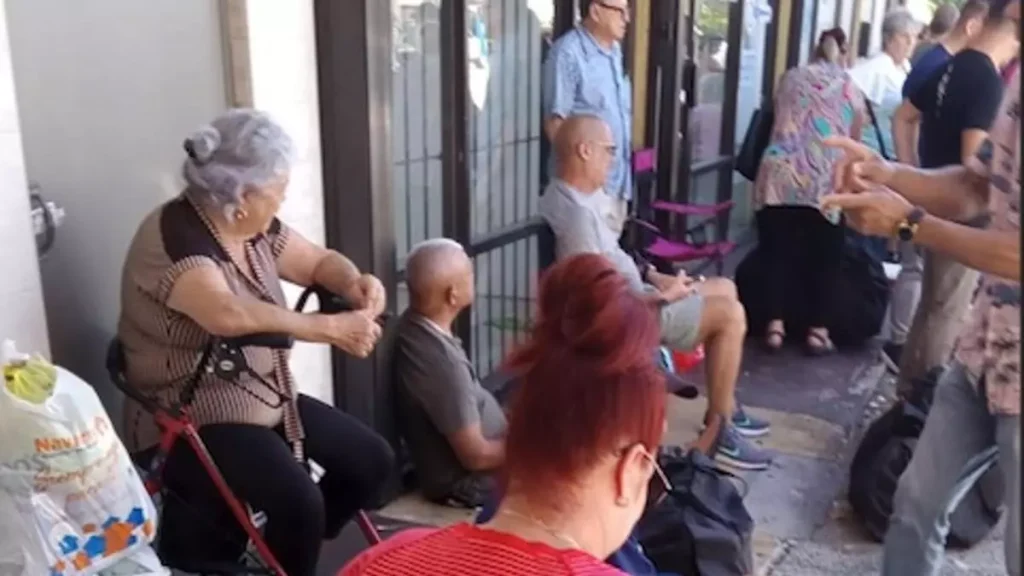
The Line at a Cubamax agency office in Miami, this Monday. / 14ymedio

14ymedio bigger14ymedio, María Casas, Miami, October 23, 2025 – Sitting on folding chairs, with umbrellas, small cups of coffee, and sunglasses, dozens of customers waited this Thursday morning in front of one of the offices of the Cubamax agency in Miami, to send a package to their families on the island. The health crisis ravaging Cuba shapes everything from what is bought in the markets of the capital of the Cuban exile to the contents of those boxes that travel 90 miles by boat or plane.

“I have two bottles of mosquito repellent, several packets of citronella incense to keep the bugs away, and medication for fever,” details Gladys, 66, who has only been in the United States for three years, speaking to 14ymedio. With numerous relatives suffering from dengue and chikungunya, the woman was trying to send several boxes full of medicine, food, and all kinds of products to keep away the Aedes aegypti mosquito, the insect that has put the Cuban Public Health system in jeopardy.

Living in San Miguel del Padrón, Gladys’s relatives have been “getting over one and getting another” for weeks, the woman warns. “It started with the children, and now the oldest members of the house are also infected. The one who’s having the worst time is my cousin, who is diabetic, has high blood pressure, and heart disease.” To complete the long list of needs and requests, the emigrant visited several supermarket chains: Sedano, Navarro, Fresco, Costco, Publix, and even Target. “I arrived in some places and they were out of repellent spray because they say people are buying too much to send to Cuba.” continue reading

The emergencies on the Island have ended up shaping commerce in Miami.

The island’s emergencies have ultimately shaped commerce in Miami. In the weeks leading up to the start of the school year on the island, demand for school uniforms increases in stores that have seen a financial windfall in the sale of these uniforms, mandatory in Cuban classrooms. If domestic coffee production plummets and the rationed quota is delayed, emigrants flock there to purchase La Llave, Bustelo, and other cheaper brands to send as quickly as possible to Havana or Camagüey.

Next to Gladys, a young man held a long, drawn-out discussion this Thursday about the merchandise he would send when, after waiting in a long line, he was able to enter the air-conditioned office. “I brought a cane for my mother, whose knee is severely swollen from the virus and she can barely take a step. I also included some medication for diarrhea and a product to purify her water, which is arriving very dirty.” He will fill the rest of the box, weighing up to 100 pounds and currently shipping for $45 under a special offer, with cans of sardines, powdered milk, and “a nebulizer for a great-uncle who suffers from asthma, and on top of that, he has oropouche fever.”

Oral rehydration salts, ointments to soothe joint pain, anti-nausea remedies, and a long list of headache relievers also piled up in the bags accompanying customers. With each person who managed to enter the office and ship their package, a family in Cuba saw the light of relief at the end of the tunnel of health collapse.

____________

COLLABORATE WITH OUR WORK: The 14ymedio team is committed to practicing serious journalism that reflects Cuba’s reality in all its depth. Thank you for joining us on this long journey. We invite you to continue supporting us by becoming a member of 14ymedio now. Together we can continue transforming journalism in Cuba.
Havana Has Died and I Could Not Attend Its Death Throes

The city has passed from the to-do list to the impossible list

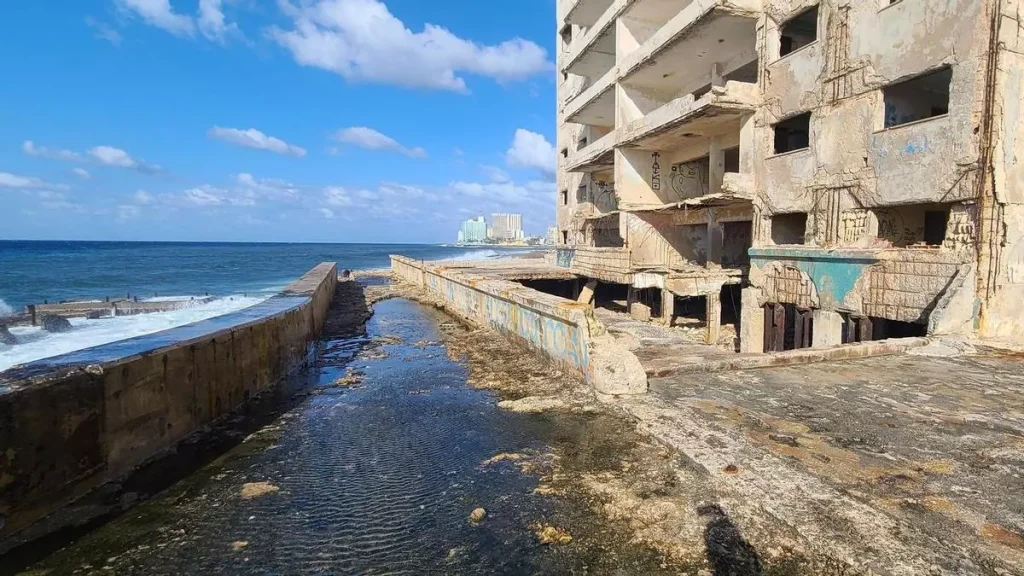
It has killed my octogenarian hope of getting away, with someone to assist me in the farewell ceremony. / 14ymedio

14ymedio bigger14ymedio, Juan Ernesto Cambiaso, Panama, 23 October 2025 — With my lungs tired from blowing out so many candles on my 81st birthday cake, I find it necessary to redo the list of pending subjects to find a way to address them. It is not easy, because my physical stamina has diminished, my gait has slowed, my balance isn’t the same, and my health has sent warnings that must be heeded.

The unfinished business that troubles me most is not saying goodbye to Havana, a city I love like an old harlot who has given me unforgettable moments of intense passion. I never knew a flourishing Cuba; I could only see a decaying Cuba that, as it tumbled down, emanated the aroma, sound, and light that make it unique and unforgettable.

Havana, in its death throes, rejects that I will take it by the hand

Friends whose judgment I respect have warned me that I should not travel because the filth accumulating in the streets has caused painful illnesses, because good food is scarce, medical care is conspicuous by its absence, and the sporadic moments when there is electricity, they call it alumbrones, lights, bring insurmountable inconveniences such as refrigerators no longer keeping the little food available fresh.

Listening to and reading the information I hear and see, I gather that I’m going to have to get used to the fact that Havana has gone from the to-do list to the impossible list. That Havana, in its death throes, refuses to let me take its hand, as I was able to do with my sister Rita and my friend Juan José. It has killed my octogenarian hope of escaping from Panama in January, with someone to assist me in the farewell ceremony, to hold me up as I go up and down the stairs, as I walk unsteadily on the uneven sidewalks, as I get in and out of cars, which is becoming acrobatic. It’s sad to say that on this brief one-way journey of my old age, Havana abandoned me halfway. For me, Havana has been murdered by its worst people.

____________

COLLABORATE WITH OUR WORK: The 14ymedio team is committed to practicing serious journalism that reflects Cuba’s reality in all its depth. Thank you for joining us on this long journey. We invite you to continue supporting us by becoming a member of 14ymedio now. Together we can continue transforming journalism in Cuba.
‘Continuing This Without Fidel is Not Easy, It is Not Easy’

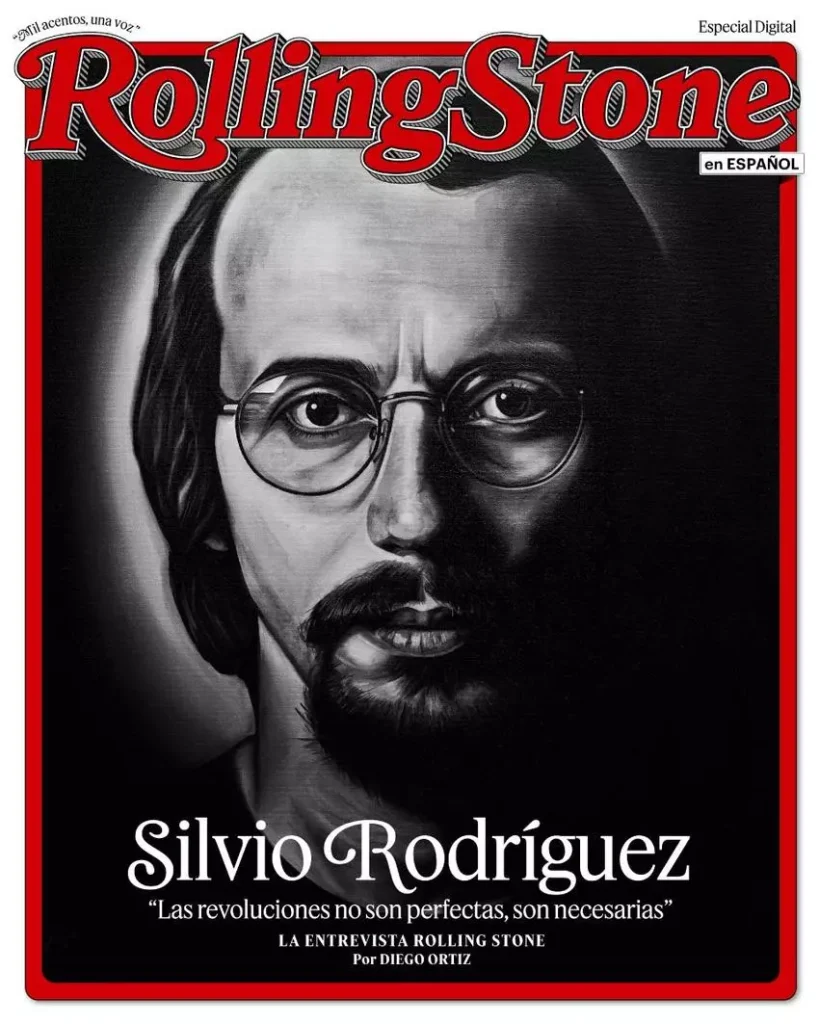
An interview with Cuban singer-songwriter Silvio Rodríguez, featured on the cover of Rolling Stone magazine in Spanish.

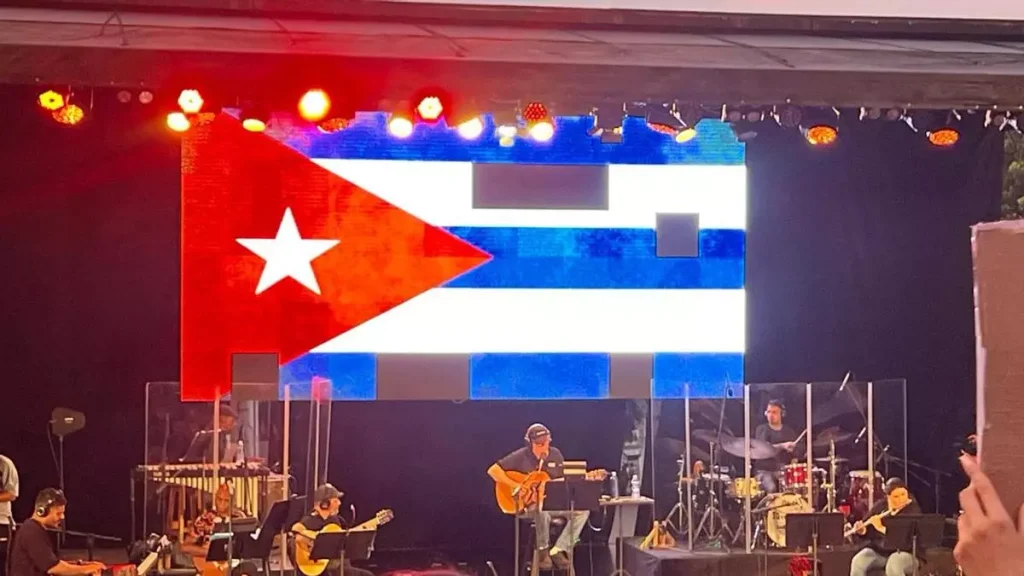
Silvio Rodríguez at his concert at the University of Havana on September 19. / 14ymedio

14ymedio bigger14ymedio, Madrid, October 22, 2025 — The entire cover of the Spanish edition of the prestigious American music magazine Rolling Stone features the face of Silvio Rodríguez, who at almost 79 has just published Álbum Blanco para Silvio Rodríguez, an album made up of eleven previously unreleased songs by the Cuban singer-songwriter, created between the late 1960s and the first half of the 1970s, and which was presented this Monday in Havana.

The interview, published this Tuesday by Rolling Stone and reproduced this Wednesday by Cubadebate, was conducted by the director of the media, Diego Ortiz, in the house that the troubadour owns in Havana and is a very extensive dialogue that revolves around Rodríguez’s culture, his influences in music and poetry and the history of the so-called Nueva Trova Cubana of which he is already almost one of the few living and active representatives.

Inevitably, politics takes over in Rodríguez’s case, and to such an extent that an interview so clearly focused on music is titled with the quote “Revolutions are not perfect, they are necessary.” In the conversation, the singer-songwriter—who was also a member of the Cuban Parliament—makes it clear that his admiration for Fidel Castro remains intact.

“I’ve never felt disillusioned with the Revolution, ever. Disillusioned with some people, yes, of course.”

“Fidel was a brilliant man, there’s no doubt about that. He was a highly cultured man. Fidel was an intellectual, an intellectual lawyer. He read like crazy, knew everything, and was extremely well-informed. And he had charisma, a history, and an unquestionable track record. Continuing this without Fidel isn’t easy, it’s not easy. But it has to be this way, it has to be this way,” he says. The artist responds to the interviewer’s interrupted question, which suggests a comparison between the Cuban and Venezuelan regimes and the right-wing dictatorships in Latin America of the last continue reading

century.

“Revolutions aren’t perfect, they’re necessary. Those who make them are human beings like you and me, who aren’t perfect, so in one area of ​​the revolution, you see wonders happening, and in another, they’re doing crazy things,” Rodríguez apologizes, arguing that there is no perfect system, neither capitalism nor socialism, which he considers to be still underdeveloped and whose deployment should be adapted to the conditions of each country.

The singer-songwriter believes, on this point, that Cuba has been unable to do what it would have liked because of the measures of the United States. “Cuba is a country that has been, more than blockaded, I would say tortured. It has been subjected to a very conscious, intentionally perverse torture by a declining but extraordinarily powerful empire that controls practically everything in the Western world, and we are, geographically, part of the Western world and are 90 miles away from those people,” he specifies.

The singer-songwriter, on the other hand, very clearly rejects the idea that the embargo has affected his career as an artist when the interviewer asks him if he thinks he hasn’t been to the Latin Grammys for that reason. “They invited me, I don’t remember if it was in 2015 or 2016, or 2014. They invited me to present me with a Grammy for Musical Excellence,” he explains. According to his testimony, the organization wanted him to travel to Las Vegas to collect the award, something he found “tempting” since he’d never been, but which he had to decline due to his commitments. “I asked them if they could give me the Grammy at a neighborhood concert, inviting them to come to Cuba for that, and they told me no, that it was a hassle for them, because if they did it for one person, going to another country, they’d have to do it for someone else,” he explains.

Cover of the Spanish-language Rolling Stone magazine, featuring an interview with Silvio Rodríguez. / Rolling Stone

Although Ortiz insists it is striking that someone with his career hasn’t won multiple awards from the Miami-based Latin Academy of Recording Arts and Sciences, Rodríguez insists on avoiding confrontation on this point. “They took me into account that time, and it’s good to let it be known that we simply couldn’t meet,” he argues, pointing out that he, too, doesn’t have a profile that corresponds to those awards. “I have nothing against that world; it’s great that it exists; that’s part of the entertainment for people. Besides, there are very good, extraordinary artists in that world, without a doubt. But it’s not my thing.”

Rodríguez reviews some other issues, including his time in the Army (he did active military service and was in Angola as a volunteer, but considers the Cuban Armed Forces defensive rather than offensive); his friendship with Gabriel García Márquez; the ideological roots of Nueva Trova (which he traces back to Bob Dylan and Atahualpa Yupanqui); and various political issues ranging from his opinion of the Spanish Prime Minister to the war in Gaza.

He also recounts that at a very young age, he had a run-in with officialdom—much less severe than what some, he claims, suffer—which he quickly overcame. The artist was 21 years old when, fresh out of high school, he was signed to a music television show. “Suddenly, one day, because of an argument, they took me off television and radio, they erased me from national broadcast radio. They banned the airing of my songs,” he reveals.

However, his conclusion was that such attitudes were not representative of the system, but rather of malicious people: “This man is not the Revolution, and no one can throw me out of the Revolution anymore,” he told himself. And he remained loyal to Castroism.

In recent years, Silvio Rodríguez has been moderately critical of Miguel Díaz-Canel’s government and some of its decisions, and in this interview he was no less so. When asked if he has ever felt disappointed with the system he supported, he replies: “I have never felt disillusioned with the Revolution, never. Disillusioned with some people, yes, of course. And not even disillusioned, but simply: ‘What’s wrong with this guy?’ [laughter ].” ‘What’s wrong with this guy?’ he says, openly.

____________

COLLABORATE WITH OUR WORK: The 14ymedio team is committed to practicing serious journalism that reflects Cuba’s reality in all its depth. Thank you for joining us on this long journey. We invite you to continue supporting us by becoming a member of 14ymedio now. Together we can continue transforming journalism in Cuba.
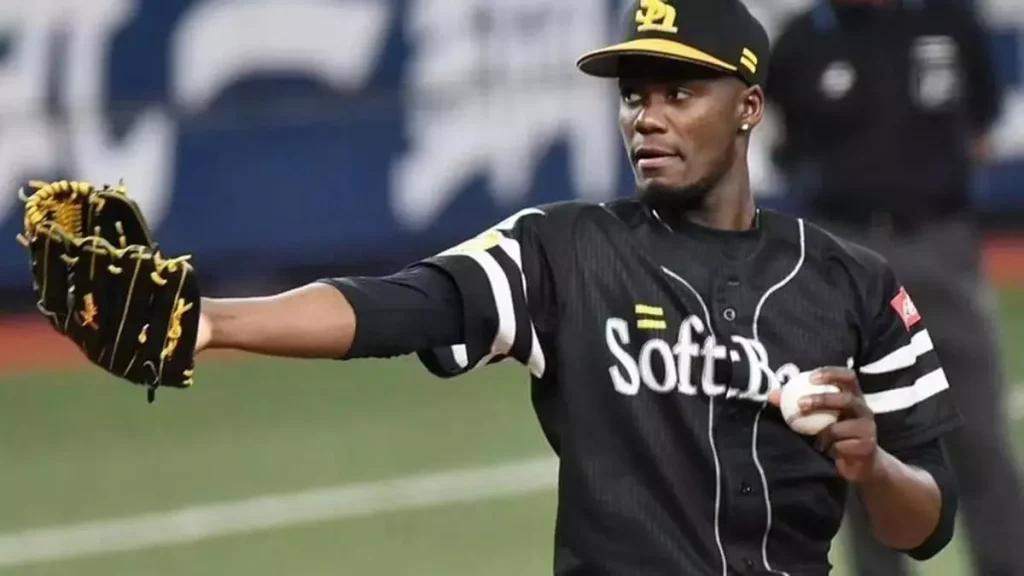
Cuban Player Liván Moinelo Brings His Team to the Japan Series

He is the first pitcher to win the MVP in a Japanese championship series, since Masahiro Tanaka in 2013

Liván Moinelo earned his place as starting pitcher after seven years of being middle relief / Instagram

14ymedio bigger14ymedio/SwingCompleto, Havana, October 20, 2025 — Cuban pitcher Liván Moinelo led the SoftBank Hawks of Fukuoka on Monday to compete for the Japanese Professional Baseball League title. His performance in the decisive duel against Hokkaido’s Nippon Ham Wrestlers to qualify for the final led him to win the most valuable player award (MVP) of that series.

In his second appearance in seven games, with only four days of rest, he completed seven innings — as in his first appearance — and allowed three hits and a single run, in addition to giving a base on balls and six strikeouts, to take the 2-1 victory against the team from Hokkaido.

His two appearances against the Wrestlers, with 14 innings pitched and a 0.64 ERA, allowed Moinelo to be the first pitcher to win MVP in a championship series since Masahiro Tanaka in the 2013 campaign.

Now the challenge will be to maintain dominance in the Japan Series from next Saturday, when the Hawks seek the throne of Japanese baseball against the Hanshin Tigers.

Now the challenge will be to maintain dominance in the Japan Series from next Saturday

In what was just his second season as the starter of the Fukuoka franchise, the 29-year-old from Pinar del Río led the ERA with an average of 1.46 runs per game, which was a remarkable improvement continue reading

from what he achieved a year ago, with another great figure, 1.86. He struck out 155 opponents last year and exceeded that figure this season with 172 strike-outs, while reducing his number of bases per ball, from 47 to 42 between both campaigns.

Moinelo earned his place as starter after seven years of being a middle reliever. Now as opener in the last two campaigns, he has registered a record of 11-5 and 12-3.

Last year’s numbers allowed him to win the Golden Glove, which made him the first Latino pitcher to earn the ERA title during the regular tournament in the second best league in the world.

That campaign had 25 starters, and he pitched 163 innings. From the mound, he struck out 155 opponents, allowed only 34 runs and allowed 47 bases per ball, for 68.8% of wins.

That campaign had 25 starters, and he pitched 163 innings. From the mound, he struck out 155 opponents

Moinelo, one of the strong cards of the Cuba team, has found in Japan an option to have important income — he is the highest paid of the whole league, together with the Mexican Roberto Osuna, with $26.4 million for four seasons — and to compete at a high level. Other competitions in Asia have also received Cuban players, who have been highlighted recently, such as Guillermo Heredia, who plays in the South Korean league with SSG Landers.

In three seasons, the pitcher from Matanzas has established himself as the player with the best average, .342, among the batters, with at least a thousand at-bats in the last three seasons in that league. With a past in the major leagues with the Atlanta Braves, the outfielder has managed to sign a $1.6 million contract, with a $200,000 bonus.

Translated by Regina Anavy

____________

COLLABORATE WITH OUR WORK: The 14ymedio team is committed to practicing serious journalism that reflects Cuba’s reality in all its depth. Thank you for joining us on this long journey. We invite you to continue supporting us by becoming a member of 14ymedio now. Together we can continue transforming journalism in Cuba.

Cuba Has Reported 71 Cases of Severe Dengue to the Pan-American Health Organization

The Ministry reported a rate of 24.3 suspected cases of arbovirosis per 100,000 inhabitants, which rises to 59.6 in the specific case of dengue

The authorities warn that contracting a serotype other than the current one aggravates the condition. / Archive/Granma

14ymedio bigger14ymedio, Madrid, October 23, 2025 — The Cuban authorities explained yesterday that the health crisis, far from improving, is getting worse. And not just a little. Carilda García Peña, Deputy Minister of Public Health, said on Wednesday that there is a “significant increase in the rate of suspected cases of fever, with 24.3 cases per 100,000 inhabitants. The Ministry has not broken down the data by disease and merely points out that dengue is the “most dangerous” one, but data from the Pan American Health Organization (PAHO) show that the rate in this case reaches 59.6 per 100,000.

García Peña warned that the regional context is bad and that the situation of the Island is not exclusive. The PAHO figures, which are provided by the authorities of each country, coincide. There are rates much higher than the Cuban one, from 6,191 in Guyana to 1,629 in Brazil and 333 in Panama. If divided by regions, the Island is not the champion either, since Puerto Rico, with 81.2 cases per 100,000 inhabitants, has worse numbers.

There is, however, one very striking fact, which is the difference in ratio between global and severe cases. This figure gives clues about the effectiveness of the health system, since a country could have many registered patients but few that develop badly, as is the case of Brazil, whose proportion is only 0.07% of serious cases in total. Cuba is among the countries with the worst proportions, since a large majority have rates well below 1% and the Island reaches 1.09%. What is worrying is that the US, with only 0.21 dengue patients per 100,000 inhabitants, has a proportion of 1.78% cases that develop badly. continue reading

Cuba is among the countries with the worst proportions, since a large majority have rates well below 1% and the Island reaches 1.09%

According to the numbers provided by the authorities to PAHO, 71 cases of severe illness have been recorded on the Island, out of a total of 6,519 affected. This figure refers to suspected cases, not just confirmed ones, but they must have been reported to the authorities to be included in the count. Therefore, the actual figures must be much higher, since not all patients report their symptoms or seek out medical services because of the lack of personnel and medicines and the unsanitary conditions.

García Peña said yesterday, as OPS also stated on its social media, that Cuba has more circulating cases of dengue type 2, 3 and especially 4. Although all are considered potentially dangerous, types 2 and 3 are most commonly associated with serious developments, according to the scientific community. The deputy minister pointed out that an infected person who has a serotype different from the one he contracted is more likely to get worse, to have hemorrhagic dengue, or even have increased chances of dying.

The official focused on this disease because, as is warned, when viewing the incidence of dengue separately, the one that is most in circulation is the most serious of the four types. In addition, there are also chikungunya, Zika, yellow fever and oropouche, the latter in slight decline.

By province, there are more cases of dengue in Las Tunas, Ciego de Ávila, Matanzas, Sancti Spíritus, Villa Clara and Havana, not necessarily in that order. The minister did not indicate the number of cases by province, nor which one has the most. Meanwhile, chikungunya, which began its expansion through Perico (Matanzas) in July, has spread to almost the entire Island, with Havana and Matanzas being the most affected.

By province, there are more cases of dengue in Las Tunas, Ciego de Ávila, Matanzas, Sancti Spíritus, Villa Clara and Havana, not necessarily in that order

The authorities insisted yesterday that a massive fumigation campaign is underway against the Aedes aegypti mosquito that spreads the disease, although the population signals it is already too late. There are 26 fumigation carts and 2,334 backpack bazookas with insecticides, and they are guaranteed, said the official, to wipe out the larvae in water containers.

The main challenge is making sure people do not get to the point of having serious illness and avoid fatal outcomes,” added Reinol Delfín García Moreiro, Deputy Minister of Public Health, who supported his colleague’s call to be aware of the disease and seek medical attention. Cuba has, he argued, more than 10,700 medical offices and 451 polyclinics with emergency services, despite the fact that the authorities themselves recognize the delicate situation in which they find themselves.

Translated by Regina Anavy

____________

COLLABORATE WITH OUR WORK: The 14ymedio team is committed to practicing serious journalism that reflects Cuba’s reality in all its depth. Thank you for joining us on this long journey. We invite you to continue supporting us by becoming a member of 14ymedio now. Together we can continue transforming journalism in Cuba.

Shovels Make Little Headway Against the Monstrous Piles of Garbage in Havana

With each movement, the flies return, and the stench sneaks through the shutters of a nearby building

A few meters away, the door of a warehouse where food for the rationed market is stored remains open. / 14ymedio

14ymedio bigger14ymedio, Havana, Natalia López Moya, October, 23, 2025 — It was Wednesday, and at the corner of Factor and Conill, two workers from Communal Services are facing an enemy that already seems mythological: one of the many mountains of garbage in Havana, this time in Nuevo Vedado. Armed with shovels, they try to reduce what the blue containers can no longer contain: bursting bags, wet cartons, food scraps and even an old flip-flop poking through the blanket of flies.

The truck, which is older than the employees themselves, waits with its door open like a tired mouth. One of the men sighs before throwing in another shovelful, but the mass of waste is barely reduced on the asphalt. “This is hard,” he says, while the other one tries to scare away the flies buzzing around the debris. A few meters away, the door of a warehouse, where food for the rationed market is stored, remains open.

Translated by Regina Anavy

____________

COLLABORATE WITH OUR WORK: The 14ymedio team is committed to practicing serious journalism that reflects Cuba’s reality in all its depth. Thank you for joining us on this long journey. We invite you to continue supporting us by becoming a member of 14ymedio now. Together we can continue transforming journalism in Cuba.
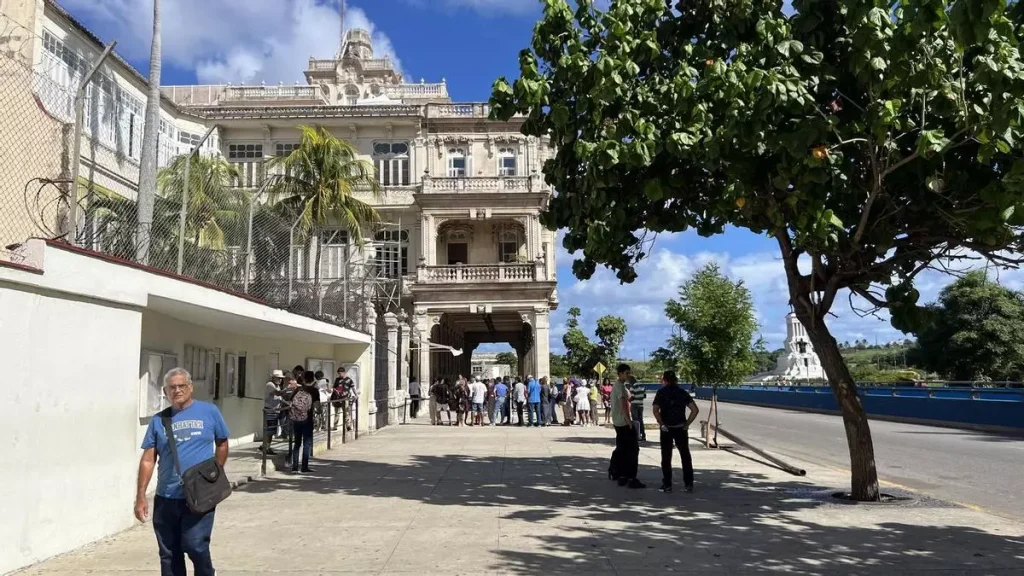
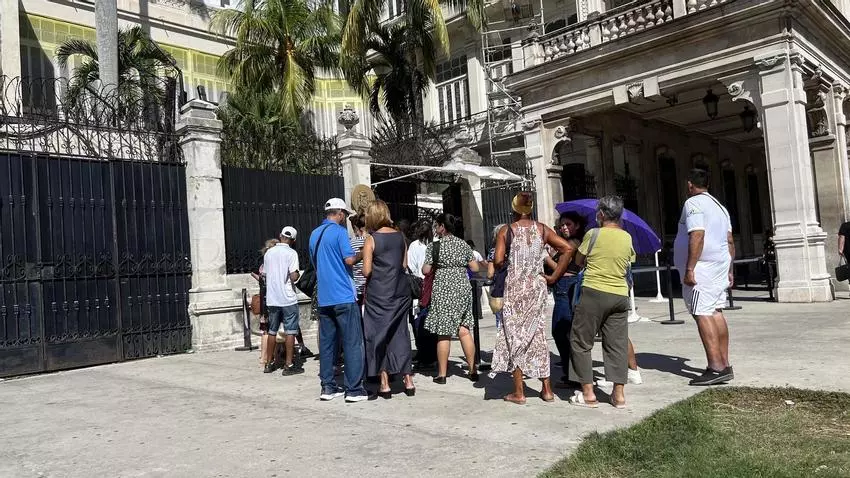
“For Spanish Nationality, If You Don’t Do It Today, It All Ends” Announces the Embassy in Havana

On the last day to apply for the Democratic Memory Law, an official counseled the unsuspecting in front of the Embassy in Havana

Lines at the Spanish Embassy in Havana, this Wednesday October 22. / 14ymedio

14ymedio bigger14ymedio, Darío Hernández, Havana, October 22, 2025 — In front of a frantic crowd divided into several lines, the custodian at the Spanish Embassy in Havana kept repeating this Wednesday that it was the last day to apply for Spanish citizenship through the Democratic Memory Law (LMD). “For Spanish nationality, if you don’t do it today, it all ends,” he warned, waving his hands decisively.

The man patiently explained to the clueless that they should consult, on the Embassy’s website, the section corresponding to the rule for making the request. “Forget about your brother, this or that other person,” he urged them. Just follow the instructions, “or you won’t be able to do it.” The questions showed how, almost three years after the law came into force and hours before the deadline for accepting applications, there are still doubts among Cubans.

One of the concerns raised by those inquiring was related to the waiting time before being called upon to review documents and continue with the process once the request has been made and the file number has been received by e-mail. As this newspaper was reminded by sources from the Spanish Ministry of Foreign Affairs, processing all of them “could take years.”

As this newspaper was reminded by sources from the Spanish Ministry of Foreign Affairs, processing all of them “could take years”

Published in October 2022, the LMD offered, in principle, the possibility of obtaining Spanish nationality for descendants of Spaniards exiled by the civil war and Francoism, to those born of Spaniards who had lost their nationality by marrying foreigners continue reading

before the entry into force of the 1978 Constitution, and for the adult children of those who had acquired it under the previous grandchild law – the Historical Memory Act of 2007 – but who had remained excluded because they were over 18 years old.

However, the instructions for applying, published a few days later in order to remove “any questions that may be raised by the Officers of the Spanish Civil Registry Offices as to the scope and interpretation of this eighth additional provision,” were interpreted to mean that not only the descendants of exiles from the civil war could be eligible but also all those “born outside Spain to originally Spanish parents or grandparents.” This led to a huge volume of applications, especially from Cuba, the second largest number of requests after Argentina.

Spanish Foreign Ministry sources told 14ymedio that up to the beginning of October, there were about 400,000 requests for the LMD in Havana, and every day they estimated they were receiving between 5,000 and 6,000 more, so they expected to reach 500,000 requests or even exceed this number.

One of the lines in front of the Embassy was exclusively for questions. / 14ymedio

For all countries, by the end of July, 876,321 people had made the request; 414,652 have now been approved, and 237,145 have obtained passports.

“We are not interested in your problems; what interests us is that you enter the system before the deadline expires,” said the custodian to those who were waiting in a line that was exclusively for questions.

In another line, people were coming and going, running, trying to resolve a needed copy or some forgotten document.

Many Cubans have criticized the “chaos” they found at the Spanish diplomatic headquarters for the LMD procedures. Asked about it during an official visit to Chile and Argentina, the Spanish minister of Territorial Policy and Democratic Memory, Ángel Víctor Torres, revealed that in Havana there had been difficulties in speeding up the process. “We have tried to set up mobile offices but it’s complicated,” said Torres, referring specifically to Cuba and Venezuela.

In line this Wednesday, a man from Havana who hoped to enter to legalize and deliver documents for several relatives, was denied: “This is the only well-organized line in all of Cuba”

The Spanish Embassy in Havana, on the last day to apply for citizenship with the LMD / 14ymedio

Translated by Regina Anavy

____________

COLLABORATE WITH OUR WORK: The 14ymedio team is committed to practicing serious journalism that reflects Cuba’s reality in all its depth. Thank you for joining us on this long journey. We invite you to continue supporting us by becoming a member of 14ymedio now. Together we can continue transforming journalism in Cuba.