Not only is power generation hanging in the balance as the powerful hurricane approaches: the fuel storage network is at risk, an expert warns.
 14ymedio, Madrid, October 28, 2025 / Hurricane Melissa was approaching Kingston, Jamaica early this morning as a powerful hurricane, with sustained winds of 280 kilometers per hour and gusts exceeding 300 kilometers per hour, including one of 388 kilometers per hour recorded by a U.S. National Oceanic and Atmospheric Administration aircraft. Although it is expected to weaken slightly as it leaves Jamaica, forecasts indicate it will regain strength before reaching Cuba early Wednesday morning.
The greatest concern is the storm surges it will prompt on the coasts of Granma, Santiago de Cuba, and Guantánamo, which will cause flooding in low-lying areas, as well as the heavy rains expected throughout the eastern part of the country, which are dangerous in mountainous areas due to the risk of river flooding and landslides. The risk is such that the official newspaper Granma newspaper has not minced words.
“Melissa will hit with great power and cause great concern about what it could destroy in its path. But let it not be lives that are left vulnerable,” the newspaper warns. It states that, in addition to the hundreds of thousands of evacuees, “no time has been wasted in planning and implementing evacuation plans for those at risk, safeguarding resources, securing health institutions, providing rescue equipment, and updating waterworks.”
But if there is one infrastructure in serious danger, it is precisely the weakest: the national electricity system (SEN). Jorge Piñón, a researcher at the University of Texas at Austin, warned this newspaper that the risks go far beyond power generation—which will have to be halted at thermoelectric plants in affected areas when the time comes, according to the official press—and even extend to logistical capacities.
“The impact of Hurricane Melissa, a Category 5 storm, could not only be devastating for the Antonio Maceo and Renté thermoelectric plants in Santiago de Cuba, and the Lidio Ramón and Felton plants in Holguín. It could also affect 26% of the country’s power plants, with an installed capacity of 813 GW in the five eastern provinces, representing 31% of the national total,” the specialist says, citing official data.
Although the government announced this Sunday that lineworkers from across the country were already en route to the eastern region to prepare—and recover—the infrastructure, Piñón points out that there will be “thousands of kilometers of electrical transmission and distribution lines, along with their substations,” crisscrossing the areas that are expected to be hardest hit by Melissa.
The photovoltaic panels, towers, and generators at La Herradura wind farm in Holguín are also exposed. The Electric Union and the official provincial press have explained that the panels at all solar farms have been protected with strong straps tied to the foundations of the wind turbines, although the omen is not good. César Luis Sarmiento Ávila, head of investment at the Holguín Electric Company, indicated that, according to the design, the support can withstand winds of up to 200 kilometers per hour, which is 80 kilometers per hour less than the current speed of the hurricane as it is passing through Jamaica.
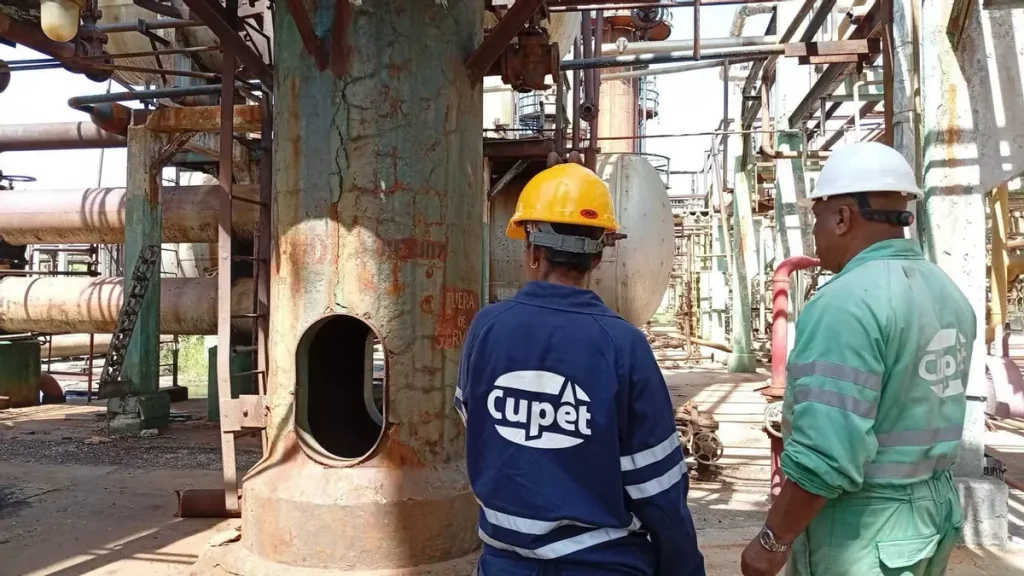
“But Melissa’s impact could go far beyond electricity generation. The entire energy logistics system value chain in the eastern provinces could be seriously compromised,” warns Piñón. “The Hermanos Díaz refinery, with an installed capacity of 30,000 barrels per day and an extensive fuel storage network, constitutes a strategic hub for the supply of refined products, lubricants, and liquefied gas cylinders to this region of the country,” he explains.

Furthermore, all of Cuba-Petroleo’s (CUPET) territorial marketing terminals have dozens of fuel and liquefied petroleum gas storage tanks that are “vital to the national economy,” and it will be essential for tanker trucks to be able to access the roads to supply generators, gas stations, and industries. “Yes, electricity is crucial, but logistics—the backbone of fuel supply—will also be put to the test in the coming weeks,” the specialist concludes.
In homes, there continues to be concern about blackouts lasting longer than 24 hours, and although applications that don’t require an internet connection have been activated and amateur radio emergency networks are operating to access hurricane information, a large part of the population lives in anguish over the disconnection.
“My mother spends more time without electricity than with it,” X, originally from Santiago, tells this newspaper. “She only told me that at the llega y pon [informal settlement] with my house, they came with several buses and took everyone away. They’ve moved everyone who might be in bad shape, that’s what she told me.” Since her house is in good condition and has sufficient food, “she’s more worried about the viruses than the cyclone,” she adds.
The arbovirus infections that have been ravaging the country for weeks face another test of fire with the hurricane, where everything could get worse. The United Nations Development Program (UNDP) has sent a donation that includes, among other things, hygiene kits and water treatment plants. “The goal is to support national efforts for early recovery and reduce the suffering of affected families,” a spokesperson reported Monday.
The donation includes 4,000 tarps for temporary roof coverings, seven electric generators, six chainsaws, 259 specialized and basic tool kits for roof repair, and more than 2,000 single-person mattresses. The United Nations also announced it has activated its Anticipatory Action mechanism, through which it plans to distribute more than 100 tons of rice and emergency supplies.
The gap between what is reported in the official press and what citizens report on social media is total. The government maintains that all preventive measures have been taken and now calls for individual discipline and responsibility to avoid any tragedy, while social media messages claim that the conditions under which this hurricane arrives are so deplorable that even the best forecasts cannot mitigate its effects.
But authorities consider the accusations a “smear campaign.” “A failed state could do everything we were doing before the cyclone, nor can it organize all the efforts being made to confront this situation and recover from it,” President Miguel Díaz-Canel said yesterday.
____________
COLLABORATE WITH OUR WORK: The 14ymedio team is committed to practicing serious journalism that reflects Cuba’s reality in all its depth. Thank you for joining us on this long journey. We invite you to continue supporting us by becoming a member of 14ymedio now. Together we can continue transforming journalism in Cuba.