- Rubén Remigio Ferro, president of the Supreme Court that tried former minister Alejandro Gil, is dismissed
- “The outlook for the economy is one of decline,” says Manuel Marrero in his speech to Parliament.
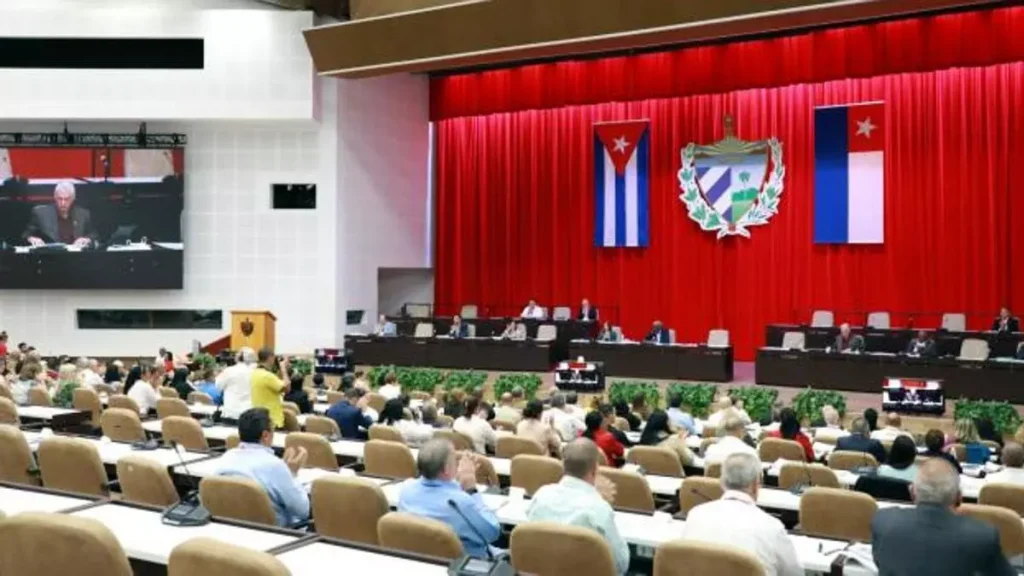
 14ymedio, Havana, December 18, 2025 –The main news from Thursday’s session of the National Assembly of People’s Power (ANPP) is the appointment of Óscar Pérez-Oliva Fraga, Raúl and Fidel Castro’s grandnephew, as a deputy, which makes him eligible to run for the Presidency of the Republic. The decision was to be expected, after the government announced his appointment as Deputy Prime Minister of the Republic on 18 October.
The announcement was made by Esteban Lazo, President of Parliament, as part of the election of vacant seats. He also reported the resignation requests of Homero Acosta, Secretary of the ANPP and the Council of State, and Ulises Guilarte, former Secretary General of the Cuban Workers’ Central Union. With the new deputies, there are now 464, leaving six vacant seats to be filled.
It was, moreover, President Miguel Díaz-Canel who announced the “release” of Rubén Remigio Ferro as president of the People’s Supreme Court, which recently tried former minister Alejandro Gil for espionage and corruption. He will be replaced by Oscar Manuel Silvera Martínez, Minister of Justice, who in turn will be replaced by the first deputy minister of that portfolio, Rosabel Gamón Verde.
Otherwise, the meeting, attended by Raúl Castro via videoconference, focused on the country’s serious systemic crisis, the plan to reverse it, and the difficult outlook for the coming year.
In his lengthy speech, Prime Minister Manuel Marrero reviewed all the measures taken to rectify the situation and made clear the “challenges” ahead. The main one is attracting foreign currency. “The outlook for the economy is one of decline,” continue reading
He repeatedly emphasised that the measures are being implemented “under adverse conditions: lack of foreign currency, energy instability, inflation and organisational constraints”.
Nothing he said was new, including the establishment of a new floating exchange rate on Wednesday night, the third to be implemented in the country, aimed at “transforming the foreign exchange market”. Marrero recalled that the government has set 106 “specific objectives” and that of the 90 “directions associated with the 10 general objectives, 51 have been achieved and the rest are in progress”.
He repeatedly emphasised that the measures are being implemented “under adverse conditions: lack of foreign currency, energy instability, inflation and organisational constraints”. And, of course, he framed his words in the global context of “moderate economic growth” and a “regional scenario marked by US policy, the Monroe Doctrine and actions against Venezuela”. The island faces, he excused with the same old argument, “the cumulative impact of US economic, trade and financial policy, with reinforced sanctions and extraterritorial effects”.
Although some indicators improved, such as the budget deficit, he said, “difficulties persist in stabilising the currency and purchasing power”. Inflation, for example, is still above 14.95%, and tourism, the country’s third largest source of income, remains in a “complex situation”.
His assessment was a little misleading. The Minister of Economy and Planning, Joaquín Alonso, when taking stock of the situation in the sector, said that the number of international travellers will be around 1.9 million people, almost 30% less than expected, as will the revenue that will be achieved: 917.4 million dollars. If confirmed, this number of travellers would be the worst annual record for the Cuban tourism sector since 2003, not counting the years corresponding to the COVID-19 pandemic. In 2018, the island attracted 4.7 million visitors.
Alonso also estimated “modest” economic growth of 1% for 2026, the same as was projected for this year and which will not be achieved. The country’s president, Miguel Díaz-Canel, acknowledged this weekend that in the first three quarters of the year the economy had contracted by more than 4%, although he did not provide further details.
Marrero asserted that, “amid complex financial conditions,” $1.15 billion has been invested in energy.
The modest improvement in the outlook is due, the minister argued, to a more optimistic forecast for the tourism and foreign sectors, led by sales of services abroad (mainly in the medical sector).
As for inflation, the minister indicated that the forecast is for a 10% rise in prices in the formal market (the informal market is experiencing higher increases), which would be about five percentage points below the year-on-year rate recorded in recent months.
The productive outlook is also dire, although no new data was provided. Agriculture, industry, and the sugar sector continue to be a mess. The only thing growing, albeit at a slow pace, is the number of small private enterprises. With 816 new MSMEs, there are now a total of 11,866 in the country.
Regarding another pillar of the serious crisis, energy, Marrero claimed that, “amid complex financial conditions,” 1.15 billion dollars have been invested in increasing electrical capacity. Among the “recovered” capacity are the 778 megawatts (MW) provided by the 41 photovoltaic solar parks synchronised to the system, “which manage to produce more than 30% of the country’s total generation during peak hours of irradiation”, i.e. only during the day.
The Prime Minister promised to end the year with an additional 1,000 MW of “renewable capacity”.
The Prime Minister promised to end the year with an additional 1,000 MW of “renewable capacity”, although he acknowledged the 2,000 MW deficit reached in recent weeks, “which is causing 24-hour service disruptions, exacerbating public discontent and damaging the economy”.
The regular end-of-year session, which normally brings together MPs in Havana for two or three days, is being held in a reduced format and by videoconference due to the deep crisis in which the island finds itself.
The country is in a “critical” situation, Cuban President Miguel Díaz-Canel acknowledged on Saturday in his speech to the plenary session of the Central Committee of the Communist Party of Cuba (PCC).
The Parliament’s agenda includes, first and foremost, a review of the implementation of the Government Programme to Correct Distortions and Revitalise the Economy, the Cuban Executive’s anti-crisis plan, consisting of budget cuts, reforms and measures to increase state foreign currency earnings.
In addition, the country’s macroeconomic performance will be reviewed, which between 2020 and 2024 lost 11% of its GDP and will also close this year in negative territory due to the collapse of agricultural and industrial production, the lack of supplies and prolonged daily power cuts of 20 or more hours in large areas of the country.
“Yes, there is a huge material shortage in Cuba,” Díaz-Canel acknowledged before the plenary session of the PCC Central Committee, where he recognised that despite the “fatigue”, “uncertainty” and “irritation in social sectors”, “there are no easy or quick solutions” to the multiple crises afflicting the country.
Translated by GH