The owner of a local MSME — micro, small, or medium-sized enterprise — laments the exclusion of the most dynamic private companies from an event dominated by bankrupt state-owned enterprises.
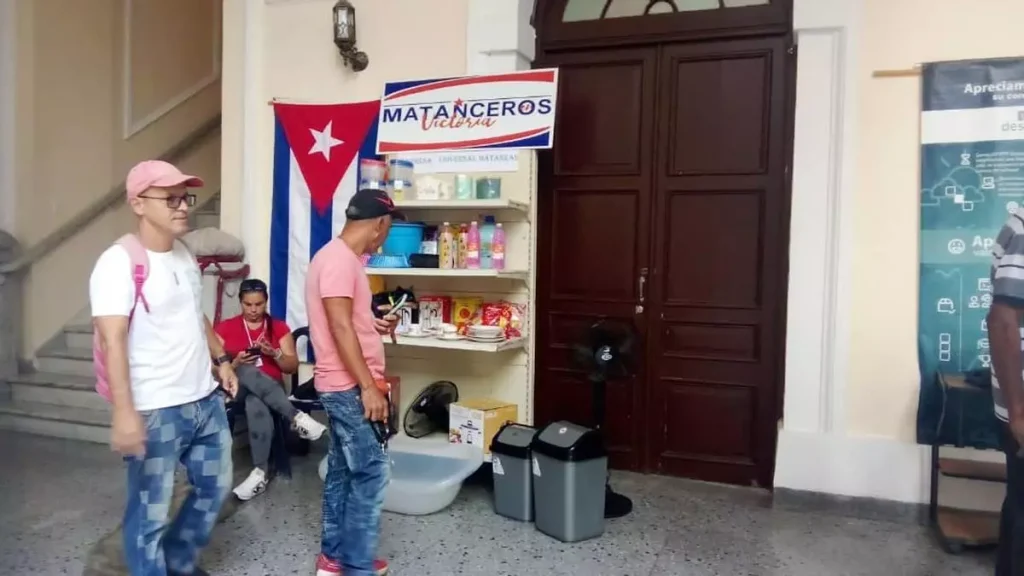
 14ymedio, Julio César Contreras, Matanzas, Cuba, December 15, 2025 — The Business Fair opened its doors in Matanzas like almost all official events in Cuba are announced: with institutional enthusiasm, grandiose headlines and promises of productive chains that, at least on paper, seemed capable of boosting the local economy. For three days, the former Palace of Justice – now under the administration of the Office of the Conservator – became the venue for the third edition of a meeting that intended to showcase business muscle and modernity. However, you only had to cross the threshold for the story to begin to unravel.
In the wide corridors, the echo of footsteps was more eloquent than any slogan. The stands, lined up in apathetic uniformity, offered little more than poorly printed banners, bottles of rum placed listlessly on decorative barrels, and tables where representatives sat waiting for an audience that never arrived. The contrast between the official account and reality was difficult to ignore.
“They gave participation to their companies and a few private ones that respond to their interests,” Karel, owner of an MSME dedicated to furniture manufacturing, told 14ymedio. Since the middle of the year, he had tried unsuccessfully to obtain an exhibition space. He submitted documents, described his business purpose, and met every requirement. The final response was a bureaucratic phrase: all capacities were covered. Walking around the fair, however, it was difficult to understand what those capacities were.

The province has 137 state-owned companies, more than 600 micro, small and medium-sized enterprises, almost 300 local development projects and tens of thousands of self-employed workers. That diversity was not reflected in the event. “Who are you supposed to form alliances with here?” Karel asked as he pointed to an empty stand. “I can’t even hang a banner with basic information about my business. This isn’t a fair, it’s a stage set.”
The decoration included, of course, the state-owned companies and entities that survive thanks to the official monopoly on certain sectors. The Banco de Crédito y Comercio (Bandec) and the Banco Popular de Ahorro occupied visible spaces, although their presence was limited more to promoting digital platforms than to solving specific problems. “I came because I read that they were going to hand out magnetic cards,” says Ania, a resident of the historic centre. “All they do is install Transfermóvil and EnZona. I’ve had those for a long time. There was no need to set up a fair for that.”
The aesthetics did not help much either. The exhibition stands seemed improvised, with no clear visual line or minimal effort to communicate efficiency. “If they give design awards here, they can give them to anyone,” said a university professor who walked around the venue with a sceptical look on her face. The woman gave up on calling her son to get banking advice: “This is not the place to talk about a serious loan.”

Initially scheduled for October, coinciding with the anniversary of the founding of the city of Matanzas, the Fair was suspended at least twice. This organisational back-and-forth left a trail of mistrust among those invited. Some gave up on participating; others attended more out of curiosity than real expectations. The result was an event where one could walk around comfortably, something unthinkable in any space that truly connects supply and demand.
Meanwhile, the “window dressing” was evident. State-owned companies with supply problems, financial deficits or impaired services presented themselves as efficient cogs in a moving economy. Not even this self-promotion could hide the fact that many are bankrupt and others survive because there are no alternatives. In key sectors – banking, commerce, paperwork – the customer does not choose: they accept.
At the close, provincial authorities described the Fair as a business success, but for those who walked those aisles, the assessment is different. There was no real variety of services, no effective interrelation between economic actors, and no signs of an expanding productive environment. There was, however, a staging designed for the photo and the report.
The slogan for this edition was “Matanzas, more productive every day.” The phrase hung in the air, without tangible backing. Outside the Fair, the city continued to grapple with power cuts, shortages and businesses that survive in spite of the system, not because of it.
Translated by GH
____________
COLLABORATE WITH OUR WORK: The 14ymedio team is committed to practicing serious journalism that reflects Cuba’s reality in all its depth. Thank you for joining us on this long journey. We invite you to continue supporting us by becoming a member of 14ymedio now. Together we can continue transforming journalism in Cuba.