
A Senior Migration Official in Mexico Demands $70,000 from 14 Cubans to Avoid Deportation

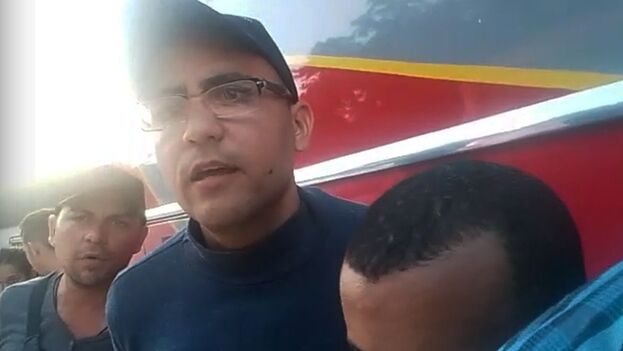
In recent months, several Cubans have been arrested during their journey through Campeche. (Captura)

14ymedio bigger14ymedio, Ángel Salinas, Mexico,30  September 2022 — “You have 72 hours or you’ll be deported.” In this way, an agent of the National Migration Institute threatened a group of 14 Cubans in Mexico City. The alternative is blackmail: “They’re asking for $5,000 for each, $70,000 for the group,” a close friend of the detainees who wants to remain anonymous tells 14ymedio.

The group formed part the 103 Cubans detained in the Mexican state of Campeche, who were forced to remain on a bus without food for 24 hours. A Migration officer recommended to the source interviewed by this newspaper to “get moving” with the money.

In an audio to which this newspaper had access, the telephone warning of the agent, identified as the deputy director of the Las Agujas migration station in the Mexican capital, is heard. “I want to know if they’re going to get their hands on it,” asks the official, who warns that “the amount will be considerable” if the group wants to be freed.

The voice also proposes the alternative of allowing their deportation and then negotiating a new entry. Although, it clarifies, now this was going to “stain their passports.” “It’s going to be a little more complicated, I think,” says the man, who recommends that the Cubans act quickly.

“The group had been divided,” explains the same source. “Some of them were taken to the Escárcega migration station, in Campeche, but others were transported to the prosecutor’s office, after spending more than a day without eating, until they were moved to Cancun, then to Chetumal and now they are in Las Agujas,” he says. continue reading

Those who moved to Cancun offered money to the agents and achieved their release in Chetumal. A minor, Jimmy Jorge Céspedes Sánchez, who presented health problems derived from the asthma he suffered during the retention, and also Yaimet Sánchez Selles, Yaimet Selles Velázquez and Jorge Luis Sánchez Proenza, are part of this group.

It’s not the first time that Cubans have reported abuses by Las Agujas Migration agents.

In the last week of July, Angélica María Rodríguez Varela, Isael Meléndez Castro, Junier Blanco Hernández and two other Cubans were arrested despite having legal protection to pass, during their transfer to the border with the United States.

Rodríguez, Meléndez, Blanco and other nationals of the Island were robbed of the little cash they had. Their passports were taken away, the chips from their mobile phones removed and they were kept incommunicado for several days. The agents demanded the payment of $2,000 from each one to be released and have their documents returned. Thanks to the intervention of an activist, they were allowed to leave and are currently in El Paso, Texas.

The journey of Cubans through Mexico has increased significantly in recent months. In the last 45 days, immigration authorities reported the arrest of 220 people who entered the country illegally.

What they don’t say is that there are hundreds of prisoners in Migration prisons. “That’s a crime,” says the 14ymedio source, who warns Cubans not to rely on money to avoid deportation. “It’s crazy, they want $70,000.”

More than 177,000 Cubans have arrived by land in the United States and more than 5,000 by sea since October 2021.

Translated by Regina Anavy

____________

COLLABORATE WITH OUR WORKThe 14ymedio team is committed to practicing serious journalism that reflects Cuba’s reality in all its depth. Thank you for joining us on this long journey. We invite you to continue supporting us by becoming a member of 14ymedio now. Together we can continue transforming journalism in Cuba.

Angel Pena and Yadier Batista Join the Long List of Escaped Cuban Baseball Players

The prominent former baseball player Ángel Peña left the Island to embark on the crossing like thousands of Cubans through Central America in order to reach the United States. (Cubadebate)wewew

14ymedio bigger14ymedio, Havana, 3 October 2022 — The list of expatriate Cuban baseball players already forms a sports catastrophe. So far in October, the abandonments of retired pitcher Ángel Peña and left-handed pitcher Yadier Batista have been confirmed. These athletes join David Mena, Jefferson Delgado, Ciro Silvino Licea, Adriel Labrada, Juan Carlos Hernández, Sergio Pérez, Dismany Ortiz and Yunior Charadan, who left the Island in September.

Peña, according to journalist Francys Romero, left Cuba “in the late hours” for the United States going through “the Central American route,” the same one taken by Mena, Delgado, Licea and Labrada a few days ago.

People remember that the “Falcon of March 13,” as they call Peña, earned more than 1,027 strikeouts in the National Series. In 2013 this baseball player became the fourth pitcher in Sancti Spíritus to reach that mark in the category, beneath only Yovani Aragón (1,926), Roberto Ramos (1,151) and Maels Rodríguez (1,148), as published in Escambray.

In his career he won 132 games. In the beginning, he stood out as a U-15 and U-18 World Cup player in the 1990s, but little was known about this athlete until he decided to emigrate with his family, according to a comment on Facebook. continue reading

“Cuban society continues to emigrate massively, including active players, retirees, coaches and athletes from other disciplines,” Romero said on his social networks. He anticipated that given the possibility of flights to Nicaragua, there would be several departures before the First Elite League, which will begin on October 8.

El pelotero Yadier Batista puede lanzar entre 88-91 millas. (Collage)

Meanwhile, he has left for the Dominican Republic. This 18-year-old hopes to continue his career with a U.S. Major League team. “In the recently finished National U-23 Championship he made news by pitching a game without a hit or any runs,” posted Baseball FR!

“Now he’ll go through new processes. In the first he will seek to perfect his tools and polish his entire command,” Francys Romero said. “The second part is to apply for free agency and receive permission from the MLB to be able to sign with a professional team.” This athlete, originally from Ciego de Ávila, 6’3 tall and 180 pounds in weight, can throw between 88-91 miles per hour.

Batista can pitch at a speed between 94-95 miles per hour, and according to the specialized journalist, “he has a profile of opener, command and sufficient repertoire. His body still has much more space for the development of those tools.”

Batista is preceded by his performance in 2019, when he left a statistic of 5-0 in 46 innings, and 52 strikeouts in the Nacional 2015-16. At that time he was one of the 13 pitchers who averaged fewer than three clean runs per game.

Translated by Regina Anavy

____________

COLLABORATE WITH OUR WORKThe 14ymedio team is committed to practicing serious journalism that reflects Cuba’s reality in all its depth. Thank you for joining us on this long journey. We invite you to continue supporting us by becoming a member of 14ymedio now. Together we can continue transforming journalism in Cuba.

Cuban Tobacco ‘Has Suffered the Largest Blow in its History’

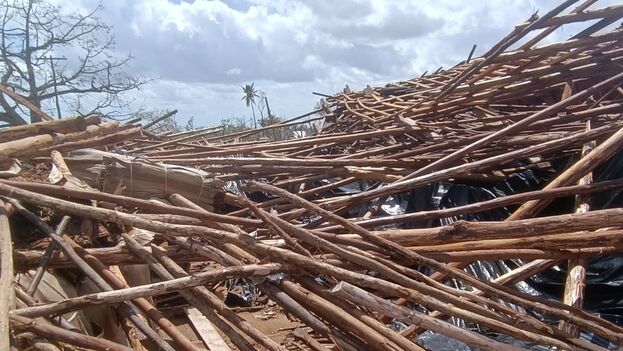
A tobacco curing house completely collapsed in San Juan y Martínez. (Cubadebate)

14ymedio biggerEFE (via 14ymedio), Havana, 4 October 2022 — Hurricane Ian has been a “demolishing blow” for Cuba’s most select tobacco cultivation, the official press reported, with major material damage and the loss of thousands of tons of raw material.

Hurricane Ian — a category three storm with heavy rains and winds of up to 125 miles per hour — caused massive damage, “both in tons and in the quality of a crop that contributes hundreds of millions of dollars for export every year,” according to the official newspaper Granma.

The digital media Cubadebate also reported on the destruction of much of the infrastructure of the tobacco sector in Pinar del Río, the province where a large part of Cuban tobacco is grown and where the raw material of the most sought-after cigars comes from.

The Pinar del Río Agriculture delegate, Víctor Fidel Hernández, told Granma that “it’s the biggest blow that the tobacco infrastructure has suffered in its history.” continue reading

In the country’s main tobacco-producing region, 90% of the approximately 12,000 natural curing houses, where tobacco leaves are stored for drying, have been damaged.

The storm also dampened “around 11,000 tons of tobacco” that was in the process of drying, and much of it will have to be discarded.

The curing sheds and other facilities should be repaired for the next harvest, which was scheduled to begin on October 20. For that they estimate that about 6,003493 cubic feet of wood and 600 tons of nails will be needed.

This blow to the sector comes at an already delicate time for the Cuban tobacco sector. The Cuban state tobacco company produced less than half of what was planned from January to June, due to lack of basic inputs, logistical problems and breakdowns, among other problems.

The situation, a continuation of the one experienced in 2021, has caused “instability” in the “distribution in the retail sales network” of tobacco within Cuba, Granma acknowledged this August.

Tobacco, which employs about 200,000 workers — 250,000 at the peak of the harvest — is one of the largest sources of income for Cuba.

Production decreased from 32,000 tons in 2017 to 25,800 in 2020, according to official data; 2021 was one of the worst years for the Cuban countryside in the last decade, as the Minister of Agriculture, Ydael Pérez Brito, recently said.

Translated by Regina Anavy

____________

COLLABORATE WITH OUR WORKThe 14ymedio team is committed to practicing serious journalism that reflects Cuba’s reality in all its depth. Thank you for joining us on this long journey. We invite you to continue supporting us by becoming a member of 14ymedio now. Together we can continue transforming journalism in Cuba.
A Basque Businessman Has a Terrorist Support Network in Cuba

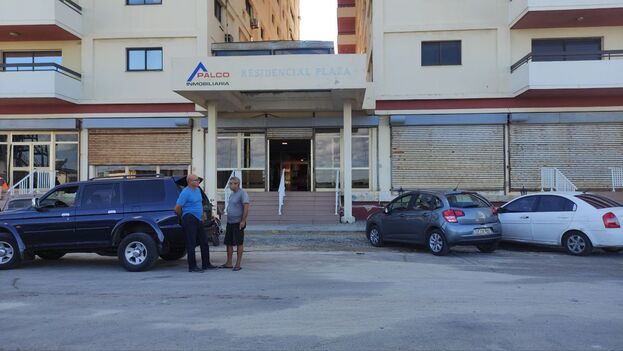
The offices of the Ugao Group are in Havana, where Josu Abrisketa was established in mid-1984. (14ymedio)

14ymedio bigger14ymedio, Madrid, 4 October 2022 — Josu Abrisketa has been in Havana for 28 years, where in addition to being a husband, father and grandfather, he is president of the Ugao Group, a conglomerate of companies that provides varied services that include rum, boilers, footwear and rail services. In Spain he is best known for his membership in the terrorist organization ETA, and these days his name has returned to the fore for his friendship with the ETA leader Mikel Albisu, alias Mikel Antza, who on Monday was called to testify in Madrid in relation to an accusation of an attack in 2002.

Antza was accused in July, along with five other former ETA leaders, of the attack on a Civil Guard barracks — which left two dead, including a six-year-old girl — in order to prevent the expiration of the time allowed for prosecution (20 years).

This Monday he went to a hearing at the National Court (AN), (empowered in cases of terrorism) to decide on his imprisonment, as demanded by the accusation; the measure was denied, although it was subject to precautionary measures, one of them being the prohibition to leave Spain.

One of the associations that have taken part in the case, Dignity and Justice, provided an expert report to the AN in which it warned of the possible risk of Antza’s escape by taking advantage of his friendship with Abrisketa. The report, to which the Spanish digital news source The Objective has had access, maintains that the former ETA member living in Havana could “be giving him financial support” through his companies. The expert considers that Ugao is part of the financial and business structures created by the terrorist organization in Latin America to facilitate “the social and economic integration of those terrorists fleeing from Spanish Justice.” continue reading

“Mikel Albisu Iriarte maintains a strong existing relationship with the Basque businessman D. Josu Abrisketa Korta, owner of the Ugao S.A. Group. This group has its base of operations on the Island of Cuba and remains very active in the promotion of the independence and culture of the Basque Country,” says the author of the document.

To substantiate his opinion, the expert relies on a final ruling in 2007 in which several people who were part of the business network that supported the military were convicted, including the fugitives and refugees in Latin America. Ugao was among the companies indirectly controlled by ETA through an intermediary (the Socialist Abertzale Coordinator, KAS).

In Cuba, according to the report, “monthly salaries of $1,000 were paid to those responsible for the terrorist organization at the head of the companies, and business infrastructure expenses were financed from the KAS common fund.” Although the author of the document admits that the ETA now lacks a military structure, he believes that the support network continues to work perfectly to accommodate one of its former leaders.

The judge of the AN handling the case rejected Dignity and Justice’s petition and determined that there is no real risk of escape, but he did agree to the Prosecutor’s request to impose precautionary measures on Antza, including the obligation to appear every month in court and the prohibition on leaving Spain, in addition to the designation of a domicile for notifications.

Ugao’s offices are in Havana, where Abrisketa was established in mid-1984. The former member of ETA was one of the 16 convicted in 1970 in the so-called Burgos Trial, a case that transcended borders in which 16 ETA members accused of killing three people were sentenced to death during a very close trial by the Francoist courts. The sentences were commuted to long prison sentences (62 years in the case of Abrisketa) after an intense campaign inside and outside Spain, and the defendants benefited from the 1977 Amnesty Law during the transition to democracy.

Most of the defendants became involved in politics or trade union movements after their release, but some remained close to the ETA. In the specific case of the businessman living in Cuba, the return was total, and he entered the military apparatus of the terrorist organization again, this time from the French territory that the Basque independence movement considers its own. There he was arrested in 1983 by the French police, who deported him to Panama months later.

As he himself said in several interviews, Havana welcomed him four months later on the condition that it was voluntarily. “The experience in Cuba has been very good; they treated us and continue treating us like revolutionaries” he says. Now, he warns: “When conditions are right, I’m going to return.”

Translated by Regina Anavy

____________

COLLABORATE WITH OUR WORKThe 14ymedio team is committed to practicing serious journalism that reflects Cuba’s reality in all its depth. Thank you for joining us on this long journey. We invite you to continue supporting us by becoming a member of 14ymedio now. Together we can continue transforming journalism in Cuba.
Cacerolazos, Barricades and Marches Characterized the Month of September in Cuba

The Observatory of Cuban Conflicts documented 364 protests during the month of September. (14ymedio)

14ymedio bigger14ymedio, Havana, 3 October 2022 — Governance on the Island continues to deteriorate. In September, the more than 4 million Cubans who abstained and those who voted “No” despite pressure was a clear rejection during the referendum on the new Family Code, which was finally approved. This setback coincided with the most widespread popular protests since July 11, 2021, according to the Cuban Observatory of Conflicts (OCC).

The organization, which prepares monthly reports on conflicts on the island, refuted  with data the statement proclaimed by President Miguel Díaz-Canel that the affirmative vote on the Family Code favored “Unity, the Revolution and Socialism.”

The 3,936,790 votes obtained under pressure were less than the 4,145,771 combined total of voters who refused to vote — despite reprisals for those who refused — (2,195,771) and those who voted no (1,959,097). In addition, this “sum does not include those 360,042 whose ballots were annulled.

The month coincided with the total collapse of the National Electric System, a worsening of the dengue epidemic, and the passage of Hurricane Ian, which left five dead and 30,000 homes damaged, some completely destroyed. “These are just catalysts for the protests, since the main conflict is between the current dictatorial regime and the aspirations and basic needs of the population,” says the US-based OCC. continue reading

The protests escalated in tone and “not only included cacerolazos [banging on pots and pans] and marches, but also barricades in the streets.” The social demands ranged from the restoration of the electrical service to cries of “freedom” and “expressions of rejection of the repressive forces and the rulers.”

This was evident during a tour of areas affected by Hurricane Ian, when Díaz-Canel visited Batabanó, in Mayabeque. “He is surrounded,” a woman shouted from the crowd that surrounded the vehicles in which the ruler and his entourage were traveling. “They don’t let the people talk” and “walk so you can see”, claimed the neighbors, who also called the security agents “brazen” and “snitches”.

Of the 364 protests mentioned above, 43 were massive street demonstrations, especially on September 29 and 30, which “included cacerolazos, roadblocks and marches.” In Havana, 33 were documented, Artemisa, the province which was second in terms of the number of protests, Las Tunas (3), Villa Clara (3), Holguín (1), Santiago de Cuba (1), Mayabeque (1) and Matanzas (1). The document reiterates that the reports of “repressions” and “new protests” were ongoing at the time the report was completed.

Another 227 demonstrations were for political and civil rights (62%) and 137 for economic and social claims (38%), which followed the same trend as the previous month, indicative that more than half of the demonstrations were for political and  social issues.

These protests, the OCC points out, respond to the “deliberate neglect for years of the needs of the population: food, energy, housing, health, sanitation, education and transportation,” which aggravated the crisis.

The OCC warned the United States that in unilateral concessions are made to the Government of Cuba, these would “strengthen its capacity to use them in a strategy of social appeasement and an increase in repressive brutality in the short term.”

The organization specified that the core of this conflict is not between Havana and Washington, but between the failed system that governs Cuba and the needs and aspirations of the population.

____________

COLLABORATE WITH OUR WORKThe 14ymedio team is committed to practicing serious journalism that reflects Cuba’s reality in all its depth. Thank you for joining us on this long journey. We invite you to continue supporting us by becoming a member of 14ymedio now. Together we can continue transforming journalism in Cuba.

Cuba Confirms Contact with the U.S. for Help with the Damage of Hurricane Ian

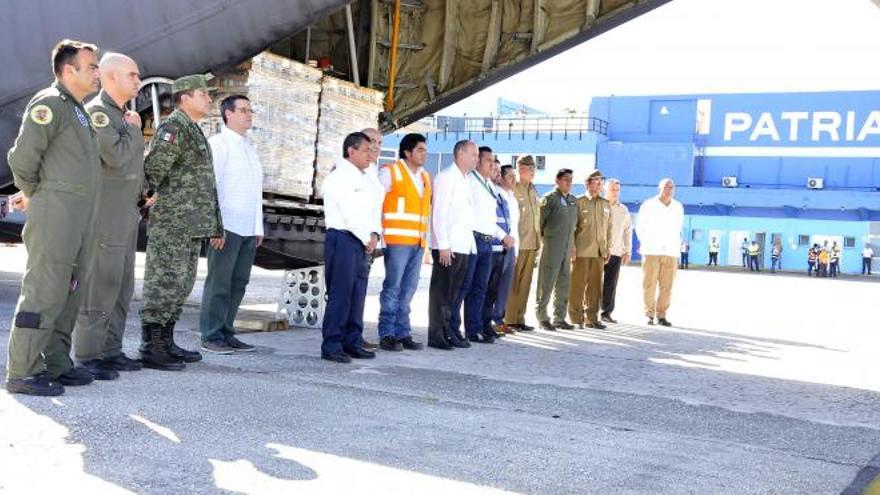
Aircraft landed in Havana from Mexico this Monday. (Granma)

14ymedio biggerEFE/14ymedio, Havana,3  October 2022 — The Cuban Government confirmed on Monday that it has maintained contacts with the United States regarding the material damage suffered by Hurricane Ian last week.

Havana thus confirms a report recently released by The Wall Street Journal in which it was claimed that the Island had contacted the United States Government.

“Governments of Cuba and the United States have exchanged information about the substantial damage and unfortunate losses caused by Hurricane Ian in both countries,” the Cuban Foreign Ministry said on the social network Twitter.

The brief message added that the Government of Cuba also maintains communication “with other governments interested in the devastation and requirements for the recovery in Cuba.” continue reading

The Wall Street Journal published this Friday an exclusive entitled “Cuba makes an unusual request for American help after the devastation by Hurricane Ian,” in which it explained that the Cuban government had requested “emergency assistance” from Washington, and the Biden Administration was in contact with the authorities on the Island to understand how much help was needed.

In recent days, assistance of various types has arrived in Cuba from Mexico, Venezuela and Argentina, as well as from the World Health Organization (WHO) and its regional subsidiary in the Americas.

From Mexico, a plane with more than 10 tons of electrical insulation landed in Havana on Monday, according to the official press, as part of the “more than 100 tons of solidarity aid” transported in “four planes of the Mexican Air Force, which made 16 flights, working uninterruptedly for 96 hours,” after the hurricane.

U.S. civil society collectives close to Cuba asked this Saturday, in an announcement in The New York Times, for the U.S. Government to temporarily lift sanctions on the Island to facilitate reconstruction after Ian’s passage.

Hurricane Ian crossed the western tip of Cuba from south to north on Tuesday, with heavy rains and winds of up to 125 miles per hour, leaving five deaths and heavy material damage.

For reasons not fully clarified, the passage of the hurricane generated a complete blackout on the Island, damage to about 200,000 homes and serious effects on crops and infrastructure.

Translated by Regina Anavy

____________

COLLABORATE WITH OUR WORKThe 14ymedio team is committed to practicing serious journalism that reflects Cuba’s reality in all its depth. Thank you for joining us on this long journey. We invite you to continue supporting us by becoming a member of 14ymedio now. Together we can continue transforming journalism in Cuba.
Repression Breaks Out in Cuba in the Face of the Increasing Protests on the Fifth Day of the Post-Hurricane Blackout

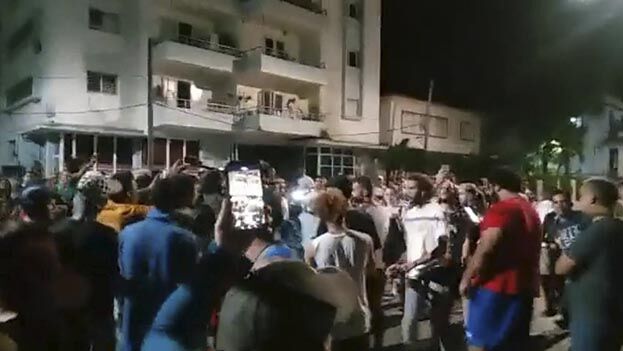
Neighbors of Línea Street, in Havana’s El Vedado district, closed the central avenue on Saturday night to demand the restoration of electricity. (14ymedio)

14ymedio bigger14ymedio, Juan Diego Rodríguez, Havana, 2 October 2022 — With the mobilization of police officers, State Security agents dressed in civilian clothes and military service recruits armed with sticks, the authorities responded on Saturday night to the popular protests on the fifth day without electricity in several municipalities of Havana. The cacerolazos [banging on pots and pans to demonstrate] and the barricades closing the streets and avenues marked the day.

On Línea Street, in El Vedado, the neighbors closed the central avenue at the intersection with F Street where vehicles pass to join the Malecón. Traffic was blocked by turned-over garbage cans and tree branches that fell in the winds of Hurricane Ian, which hit the Island last Tuesday.

A human cordon also stood blocking the road, which was illuminated with public lighting although the surrounding houses were still without electrical service. They chanted slogans such as “Put on the current!” And “Put on the light!”, a demand that was answered a while later with the arrival of buses and trucks full of shock troops dressed in civilian clothes to counter the demonstrators, as confirmed by a reporter from 14ymedio at the scene.

“They arrived in microbuses, trucks and buses, and you could tell they were security forces because of their tough talk,” a resident from the area told this newspaper. The people who were blocking the passage of the vehicles withdrew to their homes with the arrival of the official troops, who began to deploy throughout the street and the surrounding roads with a threatening attitude. continue reading

“It seems that they’re waiting for Forensics to find the fingerprints that people might have left in the garbage cans they put on the street, but that’s just to intimidate us,” another neighbor said. “But now people here have lost their fear; they’ve learned that if they don’t protest they won’t get respect.”

The place was completely taken over by State Security, and the operation was even larger than that deployed in the same area after the popular protests of July 11, 2021. “The most interesting thing is that the only ones who are in uniform are the bosses; there are even some with three stars on their uniforms, sitting in their typical locked cars, all parked at the corners,” said the woman.

Two blocks away there were also two buses full of repressors dressed in civilian clothes. “When the people who were on the street saw them arrive, they went running away in the middle of the darkness, and they couldn’t catch them. State security arrived with two “cage” trucks. What the repressors brought was disproportionate, because among those who protested were many old people and minors.”

This newspaper found that several of the bosses dressed in uniform were looking at the videos of the protest on Línea Street on their mobile phones to locate the places where it had been strongest and try to identify the participants. Several of them were reviewing on Facebook the transmissions of the demonstration and the closure of the avenue, and guiding themselves by those images to deploy the operation of agents dressed in civilian clothes.

Protests also took place on 31st Avenue, in the municipality of Plaza, for the second consecutive night. In a video posted on social networks, you can see dozens of people advancing along the road and pushing back the vehicles that are trying to cross through the crowd. From the neighboring houses, entire families are heard banging on pots and pans and shouting their support of the demonstrators.

41st Avenue, also in the municipality of Playa — one of the most affected in Havana by power outages — was the scene this Saturday of another popular protest very similar to the one led by its residents last Friday. The protesters made a chorus shouting “Freedom!” and filled the avenue between the corners of 42nd and 44th streets.

Several of the neighbors confirmed to this newspaper that they again saw young military-service recruits deployed, dressed in civilian clothes and holding sticks, as a group for confronting the protests. The same thing was also reported the night before and confirmed by the family and friends of these soldiers, who were taken in trucks and buses from their military units.

In Nuevo Vedado, a cacerolazo echoed in the vicinity of the Ministries of Agriculture and Transport, where several tall buildings remained without electricity on Saturday night, five days after the passage of the hurricane. Just after the night’s nine o’clock cannon shot* sounded, the cacerolazos began to be heard and lasted for more than two hours.

The residents of the area, which is made up mostly of buildings with more than ten floors, suffered not only from the lack of power but also from the difficulties in carrying water up the stairs to the upper floors. During the cacerolazo, there were also shouts demanding the return of power and addressing the dismal economic situation.

“I don’t have money to buy food!” a woman of a twelve-floor building on Santa Ana Street, between Estancia and Factor, shouted at full volume. “I have just had surgery; my daughter has dengue fever, and we have nothing to eat!” she added. The woman complained that no state entity had helped her in that situation and concluded her speech by emphasizing: “I’m through with the Revolution!”

“The child who doesn’t cry doesn’t get the breast,” another neighbor of the building known by its acronym ICRT (a building built in the 1980s by a microbrigade of the Cuban Institute of Radio and Television) told 14ymedio. “We’ve been without power for five days because in this neighborhood people haven’t gone out to protest like in others. It’s about time for us to wake up because all of Havana is going to have light except us.”

“This is a neighborhood where there are many government supporters, many officials and many opportunists,” the same man explained to this newspaper. “People are afraid to point it out but the cacerolazo has the advantage that it can be done from inside the house and stay more anonymous. That’s something to start with.”

The cacerolazo in Nuevo Vedado extended to other nearby areas that also remained in the dark, as part of the municipality of Cerro and the vicinity of Puentes Grandes. Around four in the morning this Sunday, electricity service was restored in the area around the Ministries of Agriculture and Transport.

The reporters of this newspaper have also received reports of protests in Bauta, a municipality in the province of Artemisa, in Santiago de Las Vegas and in Guanabacoa, both in the province of Havana. In the latter, the popular demonstrations included the burning of garbage and other objects in the middle of the public road, scenes very similar to those with hundreds of residents in the area, also last Saturday.

Some Twitter users report the arrest of at least four young protesters on Línea, when it seemed that the protest had ended.

*The tradition of shooting off a cannon at 9:00 p.m. every night at the El Morro fortress in Havana goes back to colonial times, when it signaled the closing of the gates in the wall to protect the city from pirates.

Translated by Regina Anavy

____________

COLLABORATE WITH OUR WORKThe 14ymedio team is committed to practicing serious journalism that reflects Cuba’s reality in all its depth. Thank you for joining us on this long journey. We invite you to continue supporting us by becoming a member of 14ymedio now. Together we can continue transforming journalism in Cuba.
The Padilla case, or the ‘Generous’ Terror of the Cuban Revolution

A frame from The Padilla Case by Pavel Giroud

14ymedio bigger14ymedio, Yunior García Aguilera, Madrid, 28 September 2022 — I was finally able to see The Padilla Case, Pavel Giroud’s film that brings to light a disconcerting, devastating historical archive. The original material remained hidden in the vaults of the Castro regime for half a century, until now. And it’s urgent that we look back at that unburied corpse, because it’s not about ancient history, but about an urgent topical issue.

Many already knew the details of that meeting at the Union of Writers and Artists of Cuba (UNEAC) in April 1971, where Heberto Padilla revealed the Stalinist character of the Cuban Revolution. But seeing the images, observing the gestures, listening to the tone of self-criticism, contemplating the panic in the eyes of those present and feeling the sweat on the poet’s shirt, is an extremely shocking experience.

They say that Mario Vargas Llosa himself, after seeing it, confessed that he regrets not having seen the material when Padilla was still alive, because he would have embraced him and told him: “Now I believe you.” Others have stated that, with materials like this exposed to light, history will not be able to absolve Fidel Castro in any way.

I was in shock for several seconds at the end of the film. Pavel is a renowned Cuban filmmaker who had already triumphed with titles such as Tres veces dos, [Three Times TwoLa edad de la peseta [The Age of the Peseta], Omertá or El acompañante [The Accompanist]. And in this last installment he turns the documentary genre into something different. It’s as if we were dealing with a thriller, a spy movie, a horror drama, an archaeological adventure. His talent for editing allows him to transform an archive filmed in an elementary way into something absorbing, fast-paced, disturbing. Beyond the testimony, Pavel gives us a work with a high cinematic aesthetic and a screen setting of something alive and current. continue reading

What happened in that room of the UNEAC was much more than a warning: it was a collective suicide. The Cuban union of writers, artists and intellectuals emasculated itself, put on its own gags , let itself be violated by a system that spilled all its authoritarian semen into the creative belly of a generation, to force it to give birth to the New Man.

Seeing the faces of those who attended that meeting is quite a spectacle. Recognizing Reinaldo Arenas among the crowd, contemplating a Virgilio Piñera who refuses to applaud, noticing the indifferent yawn of Nancy Morejón… How many of those attendees were paralyzed by fear for lives? How many started suffering from Stockholm syndrome? How much poetry died suddenly that night?

Even today, a part of the intelligentsia still has that absurd romance with a stagnant and dying Revolution. Some still believe, as García Márquez did at the time, that Cuba is a battering ram for which everything must be forgiven, in pursuit of I don’t know what utopia, like the submissive wife who endures the blows of her husband in the name of a sick love. Until when?

The protagonist of the film is neither a traitor nor a martyr. He’s a chip in a game that he cannot win or lose, a game that would leave him out, irremediably, as in the title of his book. Was Padilla sending messages to the future? Was his performance useful? Was it ethical to stab himself in front of everyone and stick a knife into the back of his friends, even if they were forewarned? Did he know how to read the world’s signs? Did he act out of cowardice, sarcasm or the ego of transcending when he was grateful for the “generosity” of the Revolution?

The Chilean writer and diplomat Jorge Edwards said that Padilla felt untouchable, because the Revolution had an image to show to  the European left. But State Security would be in charge of showing him that no one escapes revolutionary terror. The poet was arrested, taken to Villa Marista, locked up, threatened, humiliated, forced to publicly self-flagellate, and what? García Márquez admitted that Padilla’s indictment did even more damage to the Revolution than his own confinement, so? The regime’s hand does not tremble when it decides that it’s time for heads to roll. No one is safe; no one is considered untouchable; no one will have clemency.

How important it is that this material is exhibited right now! How urgent it is to definitively tear the veil off those who continue to defend a mafia that hides behind the word “Revolution”! Thanks to Pavel Giroud and his team for this work, which is already essential for Cuban cinema and for Cuba.

Translated by Regina Anavy

____________

COLLABORATE WITH OUR WORKThe 14ymedio team is committed to practicing serious journalism that reflects Cuba’s reality in all its depth. Thank you for joining us on this long journey. We invite you to continue supporting us by becoming a member of 14ymedio now. Together we can continue transforming journalism in Cuba.

Havana Blames Airlines for the Cancellation of Flights Between the United States and Cuba

“Most of the planned flights were carried out,” ECASA said in a statement.

14ymedio bigger14ymedio, Havana, 2 October 2022 — After the cancellations, on Saturday, of most of the flights between the United States and the Island, the situation has normalized, and all the airports in the national territory are operating, according to the Cuban Company of Airports and Airport Services S.A. (ECASA). “Recovery actions are being carried out in the facilities after the passage of Hurricane Ian,” reported the official newspaper Granma.

The same publication assures that an “effect on the technological systems that support the check-in service for passengers,” caused delays the previous day; although, it adds, “most of the planned flights were carried out.” The operations canceled were due to “the decisions of the airlines,” which provided information to passengers.

These cancellations generated discomfort among travelers and their relatives, who expressed their dissatisfaction through social networks and didn’t seem convinced by ECASA’s explanations. For his part, one of the regime’s spokespersons on Cuban Television, Humberto López, denounced an alleged “fake news campaign from Miami, that airports in Cuba were closed, when in reality all operations were working —  slowly but working.”

Arturo Mesa, a friend of one of those affected by these cancellations, for which Havana is responsible, commented that the airlines didn’t provide any support to travelers who arrived at Miami and Fort Lauderdale airports to travel to Cuba. On Facebook he detailed that his acquaintance, who “came with 140 pounds of gifts, animal medicines and some donations for Viñales,” had to return home with all his luggage. The companies “didn’t pay him for a hotel or transportation” even though he lives far from Miami. continue reading

Mesa told Humberto López: “The lack of information is forgiven. The lie is despicable and has very short legs.”

Many users of Cuban airports pointed out that the power generation plants in the terminals were insufficient: “They give power for 20 or 30 minutes and then it goes away.”

According to Granma, this Sunday “the check-in system has already been restored, providing totally normal service. There has been no impact on the rest of the systems,” the official report concludes.

Translated by Regina Anavy

____________

COLLABORATE WITH OUR WORKThe 14ymedio team is committed to practicing serious journalism that reflects Cuba’s reality in all its depth. Thank you for joining us on this long journey. We invite you to continue supporting us by becoming a member of 14ymedio now. Together we can continue transforming journalism in Cuba.

One of the July 11th (11J) ‘Plantadas’ in Cuba is Hospitalized and ‘Very Weak’

Lizandra Góngora Espinosa is hospitalized after several days “plantada”* in Guatao prison. (Facebook)

14ymedio bigger14ymedio, Havana, September 30, 2022 — On Monday, political prisoner Lizandra Góngora Espinosa, sentenced to 14 years in prison for her participation in the protests of July 11, 2021, was transferred to the hospital at El Guatao women’s prison, in the municipality of La Lisa, Havana, a week after declaring a hunger strike.

Ángel Delgado, father of four of Góngora’s five children, confirmed to this daily that another unidentified prisoner, alerted him that Lizandra was transferred to the hospital in a very weak state of health and with low blood pressure.

On September 20th, Góngora, along with sisters María Cristina and Ángela Garrido, declared a hunger strike to demand their release, and all three refused to use the common prisoner uniform.

On Monday, it was confirmed that El Guatao prison allowed the Garrido sisters’ family members to deliver food, although they remained “plantadas.”* Meanwhile, Delgado stated that he did not know whether Góngora had ended her hunger strike and believed that starvation was the cause for her transfer to the hospital.

Góngora was arrested for participating in the massive demonstrations on July 11th in Güira de Melena (Artemisa province). The activist has explained that she joined a group of demonstrators who positioned themselves in front of an MLC [hard currency] store to demand donated food, which the store was selling; there she injured her leg and fled. Faced with that version, the government accuses her of leading the crowd of protestors. continue reading

Several activists who participated in the 11J demonstrations are jailed and charged with the crime of sedition, one of the most serious in the Criminal Code.

Also immersed in a hunger strike since September 13th, is physics instructor Pedro Albert Sánchez, for whom the liberal Spanish Euro delegate, Soraya Rodríguez, spoke up.

“We want to call on the Cuban government to request his immediate release. His health is in the hands of the Cuban state,” said the legislator. Rodríguez, in a message sent to the Cuban Observatory for Human Rights and published on social media, insisted that the life of the instructor is in danger and urged the European Union to intercede on his behalf with the regime.

On September 20th, Sánchez, who has cancer, was transferred to General Enrique Cossío (National) Hospital as his health status declined. The instructor has been jailed since November 3rd, 2021 and is awaiting trial for announcing a walk in solidarity with the Civic March of November 15th of last year.

On Wednesday in Sancti Spiritus, the death of a common prisoner, who was also on a hunger strike, was confirmed. Andy Reyes had refused to ingest food for almost two months, according to activist Néstor Estévez. The young man, jailed on several occasions, most recently for theft with violence, spent 16 days in the General Camilo Cienfuegos Provincial Hospital where de died.

*Translator’s note: A ‘plantado’ — literally ’planted’ — is a term with a long history in Cuba and is used to describe a political prisoner who refuses to cooperate in any way with their incarceration. “Plantada” is the feminine.

Translated by: Silvia Suárez

____________

COLLABORATE WITH OUR WORKThe 14ymedio team is committed to practicing serious journalism that reflects Cuba’s reality in all its depth. Thank you for joining us on this long journey. We invite you to continue supporting us by becoming a member of 14ymedio now. Together we can continue transforming journalism in Cuba.
A Family Steals a Boat From Cuba’s Port of Mariel to Try to Get to the United States

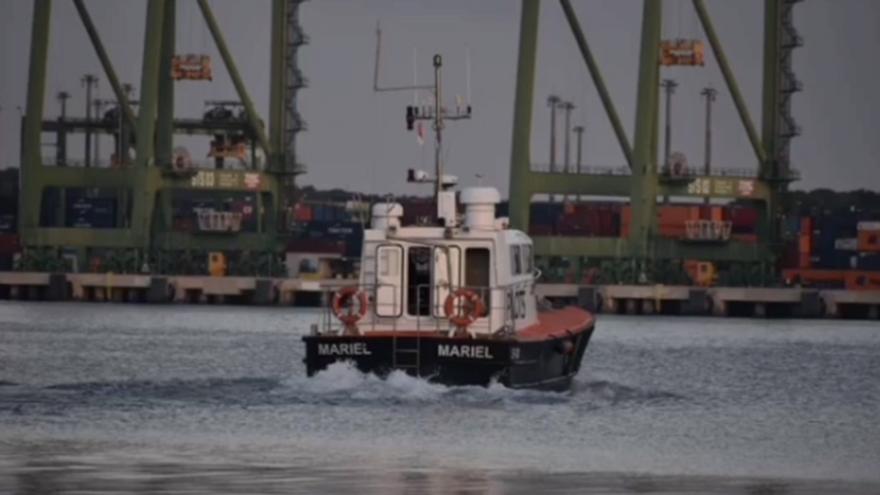
In the picture, a pilot boat in the port of Mariel. (Facebook/Naivi DRguez)

14ymedio bigger14ymedio, Havana, 26 September 2022 — Last Friday, a family of Cubans stole a boat belonging to the Cuban government from the port of Mariel, with the aim of leaving the country and heading to the United States. According to Daniel Calvo, a resident of Miami, he has no details of how they stole the boat; the only thing he knows is that his brother Evelio left with family members and that “there are many minors.”

Calvo told journalist Mario J. Pentón his worry about the lack of information about his brother, who stole the boat. “I don’t know what happened. Nothing is known so far. The Government of Cuba says nothing, and neither does the United States Coast Guard.”

State Security agents, Calvo said, are creating rumors about the event. Among the accusations that the Cuban political police are spreading are that the Island’s coast guard chased the boat, then returned it to the place where they usually maintain it, and that the crew members were taken to the Villa Marista prison.

However, relatives haven’t been able to confirm any rumors. “What I believe is that they were rescued by the American Coast Guard, who themselves returned the boat,” Calvo confided. “In any case, we fear for my brother’s life. This is not the first time this has happened in Cuba.” continue reading

Calvo expressed his fear that his brother and the people who went with him will be punished by the Cuban government, and as has happened on previous occasions, “they use violence to punish those who try to leave the country in this way.”

People remember that fateful April 11, 2003, when Lorenzo Copello, Bárbaro Sevilla and Jorge Martínez were found guilty and sentenced to death for the crime of terrorism, while seven other detainees were sentenced for participating in the attempted hijacking of the Baraguá ferryboat, which was making the journey between Regla and Old Havana, in order to reach the United States.

Cuban lawyer Laritza Diversent detailed that in the legal process that was followed against Copello, Sevilla and Martínez “there was a complete violation” of their rights. “The judges who signed the sentence, and the intellectuals who expressed their approval in a document that was made public at the time, managed a tremendous injustice,” she told Radio and Television Martí.

Copello, Sevilla and Martínez were shot nine days after their arrest. Ramona Copello, mother of one of the defendants, revealed to the same media that the families of the young people were never notified of the sentence. “A colonel told me on Thursday that we had to wait for the papers to come down from the Council of State; however, the next day, Friday, they woke up dead,” she said.

The flight of Cubans by sea has not decreased despite the hurricane season. According to figures for the fiscal year that began in October 2021, the number of 6,052 rafters intercepted in their attempt to reach the United States already exceeds the total of the previous five years. In 2017, they arrested 1,468; in 2018 there were 259; in 2019, 313; in 2020, 49; and in 2021, 838, according to official figures.

On Monday, the Border Patrol reported that last weekend, 50 Cubans were placed in custody after making landfall in Key West. The three improvised boats in which they arrived in Florida endangered their lives, Officer Walter Slosar warned.

The data are even more alarming if one considers that in the year since last October, 180,000 Cubans have entered the United States by land, and that record does not into account those who have emigrated to Europe and Latin America.

Translated by Regina Anavy

____________

COLLABORATE WITH OUR WORKThe 14ymedio team is committed to practicing serious journalism that reflects Cuba’s reality in all its depth. Thank you for joining us on this long journey. We invite you to continue supporting us by becoming a member of 14ymedio now. Together we can continue transforming journalism in Cuba.
Protests Are Spreading in Cuba, with Barricades in the Streets of Havana and Other Cities

Hundreds of people participated this Friday in several spontaneous protests in different neighborhoods of Havana. (Capture)

14ymedio bigger14ymedio, Havana, 1 October 2022 — After several days without electricity, Cubans took to the streets again on Friday night and the early hours of Saturday in Havana, where the protests have reached a massive level. Demonstrations have been documented in the municipalities of Playa, Arroyo Naranjo, Guanabacoa, Cerro, Marianao, Boyeros and Cojímar, and in the neighborhoods of Puentes Grandes, La Palma and Mantilla.

In the case of Cerro, the protest lasted until Saturday morning. Several neighbors have built barricades with garbage containers and are protesting without masks. A sign has been painted on the street: “Five days without light.”

The protest also continues in Guanabacoa, where residents have blocked 20th and Máximo Gómez streets, according to a source for 14ymedio.

“The police are supporting them, not assaulting them,” he says. “They blocked the four corners because they’ve been without electricity for four days, and all the food is spoiled.” continue reading

“Everyone is amazed,” says this newspaper’s contact, “because none of the agents has been aggressive. The police let them protest, waiting for them to get power.” Avoiding the confrontation seems to have been one of the constants of uniformed personnel during this Friday’s protests, which suggests that it’s a government direction — unlike what happened on July 11, 2021 — although several witnesses point to the presence in some places of government groups armed with sticks.

A video published on social networks shows how several young people, screaming “Go back, you’re disgusting!” prevent two police officers from the Ministry of the Interior from advancing on motorcycles and force them back.

Cuban baseball player David Mena, Traveling to the United States From Nicaragua

Cuban pitcher David Mena is heading to the United States, where he plans to settle in Miami. (Twitter/@daniel_malas)

14ymedio bigger14ymedio, Havana, 26 September 2022 — David Mena Justiz is the fifth Cuban baseball player to leave the Island in order to reach the United States on the Nicaragua route since September 8. The specialized media Swing Completo published this Sunday that Mena, along with 40 other people, is at a border crossing point between Mexico and the United States.

The player plans to settle outside Miami, although his intention is to stay in baseball. He still doesn’t know if he will be able to make the step to professional in the Major Leagues or will look to develop some other role, the publication says.

The intentions of the 29-year-old from Yimurí to make a career in a major league team are not new. Two years after his debut in the National Series with the Industriales (2011-12), he left the Island for the Dominican Republic, but that long-awaited contract didn’t arrive, and he had to return to Cuba.

With a strong temperament and a forceful straight, Mena was good enough to stay in baseball. Industriales allowed him to return to the field, and after two seasons he joined the Matanzas team. “His arrival at the Crocodiles couldn’t have been more timely. He alternated as a starter and closer in the squad that under the direction of Armando Ferrer won the title,” said journalist Yasel Porto.

During his stay in Matanzas, the name of David Mena Justiz appeared on the roster of European teams. He even had the possibility of joining the ATMA, one of the five teams that at that time were playing in Division A, the name of the Ukrainian baseball league, but due to issues related to the flights, the hiring didn’t materialize, according to Cubalite. continue reading

After his stay with Matanzas, he returned to Industriales where he achieved a no-hit no-run game. In eight National Series, his record was 21-25 with 16 games saved.

Last Friday it was the third baseman of Matanzas, Jefferson Delgado, who arrived in the United States. With experience in 15 National Series, in 3,179 turns at bat, he connected for 1,038 hits. Outstanding among these connections were 43 home runs, 134 doubles and 17 triples. He also drove home 477 runs and scored 500, maintaining an offensive line .327/.402/.420.

The native of Villa Clara was received by his cousin, Liana Martínez, as published by “La Familia Cubana” on Instagram.

Before Mena and Delgado, Granma’s pitching coach, Ciro Silvino Licea, left Cuba to get to Houston and reunite with his family. He is joined by the captain of Avispas, Adriel Labrada, and the Mayabeque player, Juan Carlos Hernández.

Translated by Regina Anavy

____________

COLLABORATE WITH OUR WORKThe 14ymedio team is committed to practicing serious journalism that reflects Cuba’s reality in all its depth. Thank you for joining us on this long journey. We invite you to continue supporting us by becoming a member of 14ymedio now. Together we can continue transforming journalism in Cuba.
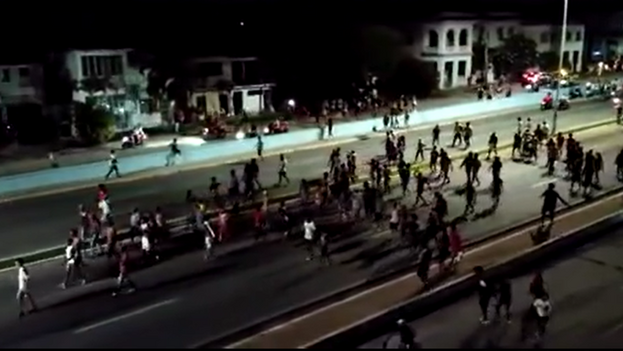
Crowds in Havana’s Streets Shout ‘Freedom’ During a Second Day of Protests

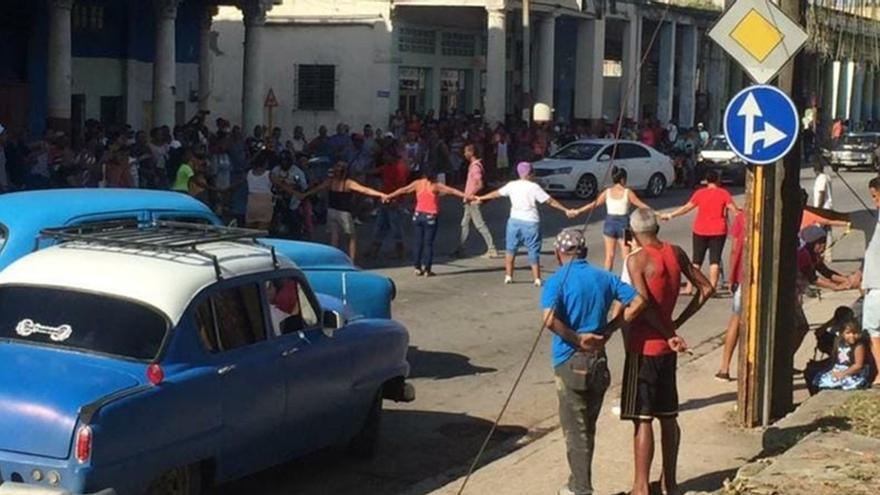
People join hands in the middle of a street in Havana’s Cerro district to block traffic. (Facebook)

14ymedio bigger14ymedio, Juan Izquierdo, Havana, September 30, 2022 — Shouting “Freedom,” a crowd took to the streets of Havana on Friday night for a second day of protests, which spread to several neighborhoods in the city. In response to the demonstrations, the regime again cut off internet access at roughly 7:00 PM.

Throughout the day demonstrators blocked traffic in many areas. In some streets they formed human chains to close off major avenues, like those in the Cerro district.

“Besides joining hands, people have roped off several blocks of Cerro Avenue between Tejas and Patria streets,” reports one source at the scene.

Protests began in the morning on Palma Street and Calzada de Bejucal in the Arroyo Naranjo district. They later spread to Puentes Grandes in the Havana suburb of Playa, which has been without power for 72 hours.


Protests increase, people shout “Freedom” in the streets.

Several videos posted on social media show a crowd in Arroyo Naranjo banging pots and calling for the government to resolve the country’s energy crisis. “They blocked the street so no one could get through,” says a woman filming the protest. “Down with the dictatorship! Enough is enough!” she shouts as she joins the demonstrators. Several police officers stand nearby, leary of confronting the protestors. continue reading

Several women with children joined another afternoon protest, blocking traffic along a stretch of the National Highway, known as the First Ring of Havana. Videos and photos posted online show uniformed officers trying to convince demonstrators, who had placed stones and wooden poles in the roadway, to allow vehicles to pass.


Protest along a stretch of the National Highway.

The collapse of the National Electrical System in the wake of Hurricane Ian, along with worsening shortages, have led to a new wave of demonstrations. Residents of several areas, including Cerro, San Miguel del Padron and Arroyo Naranjo, demonstrated into the night on Thursday.

Those who managed to charge their mobile phones and videotape the protests try to avoid focusing on people’s faces, aware that police later use videos like these to identify and arrest demonstrators, as happened in the aftermath of the July 11 protests in 2021.

14ymedio contacted the state telecommunications company Etecsa to ask about the disruption of internet service that began around 8:00 PM on Thursday. The operator said the disruption was “nationwide” and that the company was working to resolve the problem. Asked about its cause, she curtly replied, “I cannot give out that information.”


Tweet: “Cubans, tired of all the hardship and crisis, confront government leaders and officials. More information on 14ymedio.com” [Click on blue bird to see tweet.]

On Thursday officials from the Provincial Defense Council (CDP) tried to placate crowds with the usual government rhetoric. During one encounter in a Havana neighborhood, a woman interrupted a female official dressed in military uniform to say “I don’t believe you people.” Next to her, an older woman snapped at the officer: “I am a materialist; I am not an idealist. I believe what I see. If after 72 hours they haven’t done anything, I have to say that nothing’s been done.” Her words were greeted with applause by those standing nearby.

Another officer trying to “explain the situation” was also taken to task by the crowd. “Why don’t you take the gas from the patrol cars and use it for the electric company’s cars?” someone asked

On Friday the CDP president himself, Luis Antonio Torres Iribar, acknowledged, “[Last night] we had to deal with isolated events in the province which involved mass demonstrations over the water situation, over the electrical situation, over the loss of food due to the power outage,” before conceding, “I consider these demands to be just.”


Crowd along Bejucal Avenue in Arroyo Naranjo on Thursday.

“I believe people have a right to protest, but only when government leaders are not doing what they are supposed to do,” claimed the official, adding, “But in the situation we’re talking about, yesterday’s protests, instead of helping, they prevented us from carrying out our mission and bringing about a full recovery in the shortest possible time, as we desire.”

Three days after the hurricane, the power outage is affecting whatever small amounts of food people might being storing in refrigerators. Some were able to freeze large plastic bottles of water to keep temperatures in their refrigerators low, but the ice has since melted and the food is threatening to rot.

This has led to a pressing need to consume whatever reserves of meat, milk and other products families might have before they go bad. Even if power is restored in the next few hours, finding food will be the biggest challenge people face in a country that, before the hurricane, already suffered from alarming shortages.

Meanwhile, the government has mobilized its military and police forces, leaving bodegas* and other locations authorities consider essential “unprotected.” In other establishments that sell food, such as some department stores, the police have stationed none-too-subtle “co-workers,” often young men of military age, to keep watch.

According to the state-run newspaper Tribuna de la Habana, the Ministry of Domestic Commerce reported that 700 “economic targets” in the western part of the country were damaged by Hurricane Ian. These include bodegas, department stores and building supply stores. Lost food supplies, flattened buildings, collapsed roofs and structures rendered unusable are some of the most serious types of damage.

The government has said it will prioritize “maintaining food supplies intended for people who have been evacuated,” which are limited to “items to be cooked.” It has forgotten that the rest of the country is facing the same challenges of preserving  and cooking food without electricity.

*Translator’s note: small state-run neighborhood or corner grocery stores that sell rationed goods.

____________

COLLABORATE WITH OUR WORKThe 14ymedio team is committed to practicing serious journalism that reflects Cuba’s reality in all its depth. Thank you for joining us on this long journey. We invite you to continue supporting us by becoming a member of 14ymedio now. Together we can continue transforming journalism in Cuba.
The Reasons for the End: In Search of Lost Unity in Cuba

Hurricane Ian left nearby buildings standing in this location, but took down large trees, (14ymedio)

14ymedio bigger14ymedio, Elias Amor Bravo, 2 October 2022 — As of now, that unity has nothing to do with the necessary process of listening to society, interpreting their motivations, tending to their demands and resolving problems, making them participants of the reality. That process is not related to the “teachings of Fidel” nor to the accumulation of nonsense and interference by those in power whom Cubans have had to tolerate for 63 years. The people have said, “Enough,” and they want a new start, one in which a true democratic process of leadership and public management, which have never existed in Cuba, can be applied.

Therefore, to speak of unity to achieve a recovery is a recipe that will not work, it is useless. Cubans have every right to chose other formulas.

The people are fed up when, each time new problems emerge, for which the solution does not seem possible, such as the nationwide blackout due to the hurricane that crossed over the western region, the regime only offers unity, unity in work, solidarity and the public’s own participation. And similarly, in the official language, why not add the influence of the “nefarious monstrosity” of the United States blockade, just as the regime’s conversations requesting assistance from its northern neighbor became public.

Unity and falsehood. A description of the reality which aims to hide from Cubans the truth, which they do not want to change, in fact, they just want to continue at the helm of power. It is the same as insisting, time and again, that the Fatherland does not have “a road map other than the one created by the example of the historic generation of Fidel and Raúl.” Lies. The democratic road map is the one Cubans now want to decide on, to face the future on new foundations that mean progress for all, and not just for the few. continue reading

The official propaganda accuses the “enemy” of “attacking because it fears the continuity represented by the new generation at the helm of the country,” when the new generations do nothing but say they have no interest in leading anything, they simply want to leave the country. The 200,000 Cubans that have left the country en route to the United States this year, are mostly young people who do not want to see unity nor continuity of anything. The leaders no longer know how to interpret the signals and do not wish to do so, and this is another indicator of the end.

While the official press does not skimp on effort as it creates an alternative reality far from human reason when it says, “the enemies of Cuba never offer a solution that does not respond to the interests of subverting our socialist society; and it is in that eagerness that they take advantage — and even fabricate — the vicissitudes we are going through.” Let’s see if the true enemies of Cuba are the ones who insist on staying in power at any cost, waiting out their terms without stepping aside, as is needed. Perspective is very important, in any case.

Is it that perhaps the problems, unresolved for generations by Cubans, are not the responsibility of their government, or regime, which is the same? Of course, the hurricane has also wreaked havoc in the north, but there, very soon, it will be possible to see a return to normality.

In Pinar del Río, many of the destroyed houses had been destroyed by past hurricanes. Problems in Cuba are not fixed, they are frozen. The issue is to gain time. The worst enemy of the Cuban people is its regime or government, which in 63 years has not been able to create professional emergency units to deal with crisis situations and catastrophes, and which is incapable of providing a definitive solution to the problems of the people. It is not good to think about the “other,” without reviewing in depth what lies within.

And thus, the regime’s official propaganda, after trying to justify unity with fantastic and hilarious arguments, launches another much more alarming argument, “healing the damage from Hurricane Ian will not be an easy nor a short-term task.” It will be long term and no one can say they were fooled. Those affected should start looking for other areas or counting on the help of family or those living outside their areas. The recovery will be long and in many cases will not arrive.

Not even international solidarity has arrived well. The usual friends (Iran, North Korea, Russia, Venezuela, Mexico, Nicaragua) have their own problems and no one is giving away money during complex times like these. Here, also, the end seems near. The unity argument falls apart, but the Cuban communist regime does not want to acknowledge it. Loneliness is the worst consequence of not knowing how to do things well.

Translated by: Silvia Suárez

____________

COLLABORATE WITH OUR WORKThe 14ymedio team is committed to practicing serious journalism that reflects Cuba’s reality in all its depth. Thank you for joining us on this long journey. We invite you to continue supporting us by becoming a member of 14ymedio now. Together we can continue transforming journalism in Cuba.