US Authorizes the Sale of ‘Motorinas’ to Private Companies and Individuals in Cuba

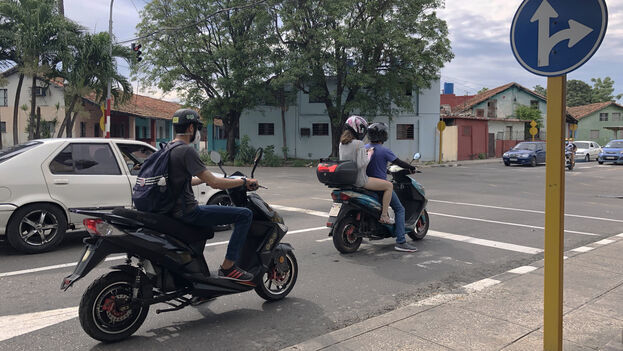
Motorcycles have increased the Cuban mobile fleet in the last two years, due to their lower prices compared to a vehicle and the ease of avoiding traffic. (14ymedio)

14ymedio bigger14ymedio, Havana, 6 October 2022 — Cubans have just discovered that, since September 28, they can buy electric motorcycles and scooters from the United States thanks to an authorization issued that day by the US Department of Commerce.

The Bureau of Industry and Security (BIS) approved an exclusive license in favor of the distributor Premier Automotive Export (PAE), based in Columbia, Maryland, for the export of these products, which may be purchased by residents and private companies on the island, as reported this Wednesday the US-Cuba Economic and Trade Council. Until now, only embassies had benefited from this type of exemption on some opportunities.

The Export Administration Regulations (EAR) prohibit the sale to Cuba of various items, particularly computers or certain telecommunications devices, among other things. However, the permit granted to PAE is based on an exception that allows the commercial exchange of elements “necessary for the environmental protection of the quality of the air, waters and coasts of the United States and internationally,” including those related to renewable energy and energy efficiency. continue reading

Premier Automotive Export received four authorizations for the export of automobiles to Cuba in the last five years. The first, in 2017, was granted by the Barack Obama Administration to sell electric vehicles from the Japanese manufacturer Nissan Leaf and Clipper Creek electric chargers to the Guyanese embassy in Havana.

The second, in 2019, was approved by Donald Trump for spare parts for gasoline vehicles destined for embassies in Havana, while the third was extended by the Biden government, last January, for the sale of cars with internal combustion engines, electric or hybrid, also for the embassies located in Havana.

Ten months ago, the current Administration denied PAE a request to export electric vehicles and chargers to the Island.

On August 15, new provisions approved by Customs came into force, allowing Cubans entering the country to declare two electric motorcycles as non-commercial accompanied luggage, in addition to two electric generators, two motorized scooters and a third if it is sent as freight.

The US-Cuba Economic and Trade Council noted that there is “a commitment” by the US government to “accompany the Cuban people in seeking to determine their own future… We will support those who improve the lives of families and workers, the self-employed who have forged their own economic paths and all those who are building a better Cuba,” the organization quoted Antony Blinken, Secretary of State of the United States.

____________

COLLABORATE WITH OUR WORKThe 14ymedio team is committed to practicing serious journalism that reflects Cuba’s reality in all its depth. Thank you for joining us on this long journey. We invite you to continue supporting us by becoming a member of 14ymedio now. Together we can continue transforming journalism in Cuba.
‘We Didn’t See Any Food,’ Admits Senior Cuban Communist Party Official after Flying over Pinar del Rio

National Assembly president Esteban Lazo (in the center, in a short-sleeve shirt) in Pinar del Rio on Wednesday. (Cubadebate)

14ymedio bigger14ymedio, Havana, 6 October 2022 — The agricultural landscape of Pinar del Rio is one of devastation in the wake of Hurricane Ian. Speaking with unusual candor after a helicopter tour over the province’s farm fields, Felix Duarte, a member of Cuban Communist Party Central Committee, observed, “We didn’t see any food [there].”

Duarte, who headed the party’s agriculture and food department, claimed in a meeting with local Pinar del Rio farmers that more than 12,000 hectors had been impacted. When asked what residents would eat in the coming days, he responded, “We will eat what we ourselves are able to grow, with a commitment to plant food crops.”

Duarte emphasized the need for crops with “short growing cycles” such as vegetables, legumes and other fast-growing plants that can be harvested quickly. “We have to commit to reversing the situation,” he emphasized. Some of the farmers attending a meeting with Duarte raised questions about problems such as being able to lease farmland and the limits on rice cultivation.

It was learned at the meeting, which was also attended by deputy prime minister Jorge Luis Tapia Fonseca, that the state-owned company Frutas Selectas had failed to abide by its contract with farmers from San Juan y Martinez. “They haven’t been paid for the beans they sold the company in February,” explained reporter Lazaro Manuel Alonso in a report on the national nightly news program.

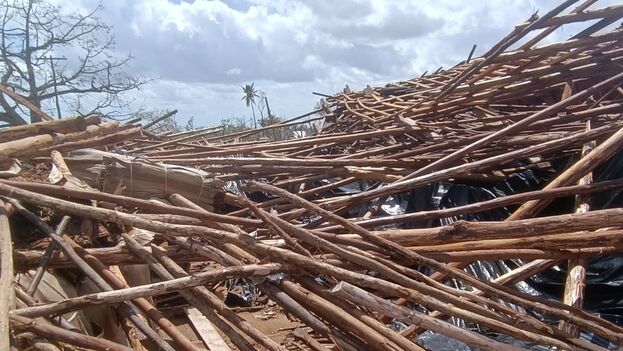
The situation is especially tense in Pinar del Rio, where 63,133 homes have been damaged, 7,107 of which have been totally destroyed. Many residents are without access to food due to spoilage, crop loss, road closures and damage to more than 429 neighborhood stores selling rationed products.

“All our banana, papaya and tobacco crops have been destroyed,” says Norges Valenzuela, a farmer from San Juan y Martinez. “My house suffered roof damage but what’s even worse is what’s happened to the crops. They’re totally wiped out.” Valenzuela’s family still does not have electricity and has moved to the city of Pinar del Río. continue reading

“The worst is yet to come: the robbery and looting,” says the farmer. “My two brothers are staying at the farm to keep an eye on the house, the water pump and what little we have left, but I had to come to Pinar with my father because he has Alzheimer’s and we couldn’t take care of him under those conditions.”

The family also lost animals, some of which were knocked down by the winds. “There are always people who take advantage of situations like these to steal what doesn’t belong to them” says Valenzuela. Among his missing animals are chickens, a ram, at least two pigs and a calf. “We’re looking at thousands and thousands of pesos which we won’t get back. But even worse is our situation right now. We basically eat what we produce on the farm and I don’t think we’ll be able to harvest anything any time soon.”

The sudden arrival of government officials has annoyed farmers like Valenzuela. “We’ve spent years trying to get paid for our products. The state doesn’t pay well and it doesn’t pay on time. We had to wait till a hurricane passed through this area and destroyed everything for senior officials to meet with the guajiros,” says Luis Gonzalez, a tobacco farmer who recently describes the situation in the province as a “complete disaster zone.”

____________

COLLABORATE WITH OUR WORKThe 14ymedio team is committed to practicing serious journalism that reflects Cuba’s reality in all its depth. Thank you for joining us on this long journey. We invite you to continue supporting us by becoming a member of 14ymedio now. Together we can continue transforming journalism in Cuba.

An Exile Foundation in Miami will Send $5 Million in Medical Material to Cuba

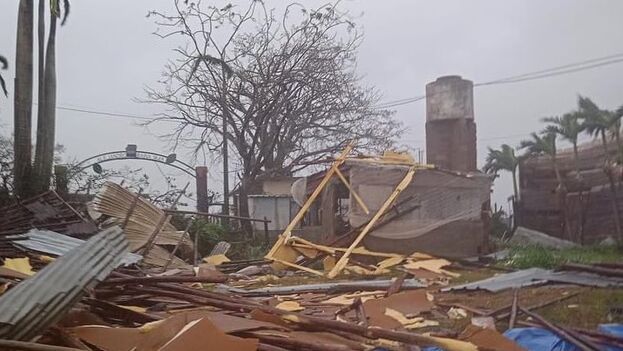
Damage from Hurricane Ian in Pinar del Rio (14ymedio)

14ymedio biggerEFE (via 14ymedio), Miami, 6 October 2022 — The Legal Rescue Foundation (FRJ) of Cubans exiled in Miami announced on Wednesday the shipment to the Island of 5 million dollars in medical equipment to help the population, after the damage caused by Hurricane Ian.

The president of the FRJ, Santiago Álvarez, announced at a press conference that the aid is now ready to be sent, although he clarified that work is being done on the delivery conditions for the material through diplomatic channels, without giving details.

“The aid will be delivered to hospitals and victims,” Álvarez told EFE, after noting that, in any case, it will go through the Cuban authorities.

“The containers with the material are ready to be shipped, but the Government of Havana will not touch them,” Álvarez stressed at the American Museum of the Cuban Diaspora in the city of Miami.

Although the aid had been planned for a long time, due to the deterioration of the living conditions of the Cuban population, efforts intensified after Hurricane Ian hit the west of the Island with special virulence last week.

In addition, the passage of Ian further complicated the situation of the electrical system, causing a breakdown that almost completely turned the entire country dark. continue reading

The scourge of the hurricane, the first to hit Cuba in the current cyclone season, left a provisional figure of five deaths and serious material damage, so far only partially quantified.

Álvarez said that the Cuban authorities intend to “sell” the aid that arrives for their compatriots, in addition to ensuring that “thousands of Cubans live in shelters after the passage of previous hurricanes” and that he hopes that after Ian “it will not be different.”

“Inefficiency and negligence” are the words that Álvarez used to define the Government’s response to the hurricane.

Alexis Abril, of the Miami Medical Team Foundation, a group of medical professionals in South Florida that helps countries suffering from disasters, told EFE that there are teams ready to join the FRJ shipment, but that they are waiting for the approval of the authorities.

Cuba has so far received solidarity aid from the Governments of Mexico, Venezuela and Argentina, as well as from international organizations such as the World Health Organization (WHO).

Hundreds of protesters took to the streets of Cuba at the end of last week to protest the lack of electricity, which added to a widespread cut in the mobile Internet service, a problem that is added to the general shortage.

During the press conference, Álvarez also announced that the FRJ establishes two annual awards in recognition of the fight against the “Cuban regime,” the Virgilio Campanería and the Carlos Alberto Montaner, both endowed with 5,000 dollars and whose winners will be made public on October 10.

Translated by Regina Anavy

____________

COLLABORATE WITH OUR WORKThe 14ymedio team is committed to practicing serious journalism that reflects Cuba’s reality in all its depth. Thank you for joining us on this long journey. We invite you to continue supporting us by becoming a member of 14ymedio now. Together we can continue transforming journalism in Cuba.

Three Vendors Fined 1,500 Pesos for Selling Shaved Ice in Front of Carlos III Shopping Mall

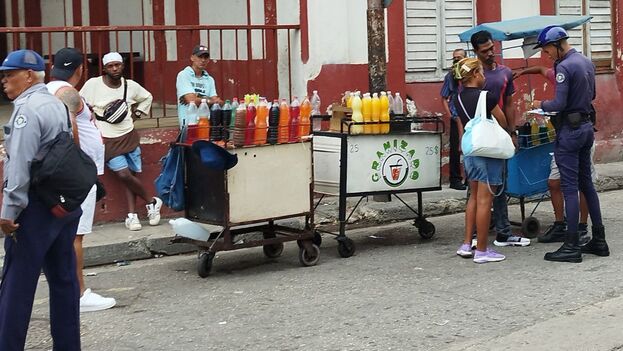
The vendors were approached by two plainclothes inspectors, a man and a woman, while operating on Arbol Seco Street. (14ymedio)

14ymedio bigger14ymedio, Havana, 6 October 2022 — Three vendors selling shaved ice near a Havana shopping mall will each have to pay a fine of 1,500 pesos.

The individuals were operating on a strategic corner of Arbol Seco Street, a spot where shoppers wait in line to enter the Carlos III shopping mall, when they were approached by two plainclothes inspectors, a man and a woman. After fining them, the inspectors ordered the vendors to move to another location.

The vendors became angry not only because they had valid operating licenses but also because of the reason the inspectors gave for fining them: as pushcart operators, they are required to keep moving; they are not allowed to remain in one place. “And how am I supposed to serve customers while I’m walking,” one irritated vendor asked. “You have to stop, even if it’s for five minutes.”

Another visibly irritated vendor had to be calmed by someone who seemed to be his wife, telling him not to argue with the inspectors: “Look, you’ll pay the fine and you’ll go on, so don’t worry.” Uniformed police officers also intervened to defuse the situation, telling him, “Just go over there, to Manglar Street, to the other side.”

After moving a few blocks away, the first vendor returned to the spot where he  had been fined. “I don’t care. I am going to keep selling shaved ice for 25 pesos here because I have a license. And if they don’t want me stopping here, I’ll move to another corner,” he said.

____________

COLLABORATE WITH OUR WORKThe 14ymedio team is committed to practicing serious journalism that reflects Cuba’s reality in all its depth. Thank you for joining us on this long journey. We invite you to continue supporting us by becoming a member of 14ymedio now. Together we can continue transforming journalism in Cuba.

US Coast Guard Intercepts Five Boats With Cubans in 48 Hours

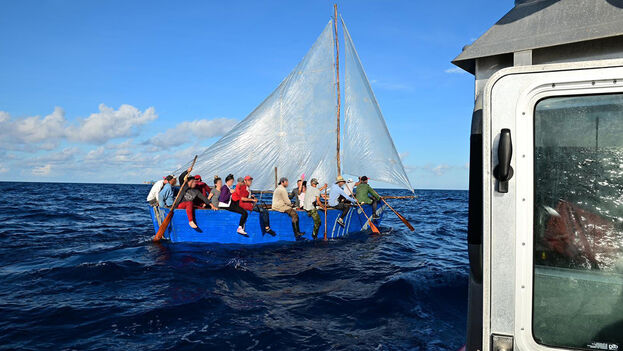
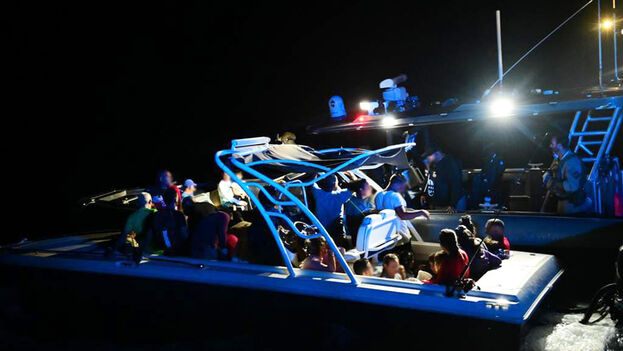
The US Coast Guard repatriated 120 Cubans aboard the ship Reliance. (Twitter/@USCGSoutheast)

14ymedio bigger14ymedio, Havana, 7 October 2022 — Between Wednesday and Thursday of this week, the United States Coast Guard “prevented illegal migration,” without specifying the number of crew members, of five boats with Cubans heading to Marquesas Key. The rafts were detected from the air, in actions “to prevent illegal and unsafe ventures,” according to the authorities on social networks.

In fiscal year 2022, concluded on October 1, there was a record number of 6,182 Cubans detained while trying to reach the United States by sea. This Thursday, the Coast Guard confirmed that despite the hurricane season, rafts are coming from the Island  almost every day. In seven days of this month, “66 rafters have been arrested,” Lieutenant Connor Ives confirmed.

The five recent interdictions occur two days after the US authorities repatriated 55 Cubans on board the ship William Trump.


continue reading

The US entity alerted people to the danger of the crossing on rustic rafts. One of these vessels with 27 natives of the Island was shipwrecked on September 28 in its attempt to reach Florida. Nine survived from the shipwreck near Cayo Hueso; 11 were not found, and the bodies of seven dead were recovered. Two of these, the Florida Sheriff’s office announced in a statement, were found near Boca Chica.

In an attempt to prevent the arrival of the balseros [rafters], the Coast Guard announced on Friday that staff from two companies joined the routes “to prevent, deter and intercept attempts at illegal migration by sea.”

Neither Hurricane Ian nor the reinforcement of surveillance has prevented the arrival of rafts or speedboats. The head of the Border Patrol has reported on his social networks that so far 86 Cubans managed to reach land in October.

Among the many boats, on Wednesday a raft arrived at Tortugas Secas National Park with planks on empty plastic tanks and rubber chambers adapted as floats. That day, Slosar reported the arrival of 15 Cubans, who were placed in custody.

This Thursday, 36 Cubans managed to land. A group of 26 people arrived on board a boat to Cayo Vizcaíno, an island linked to Miami by bridges and with one of the highest living standards in South Florida. Another 10 migrants were arrested in Key Colony Beach.

Translated by Regina Anavy

____________

COLLABORATE WITH OUR WORKThe 14ymedio team is committed to practicing serious journalism that reflects Cuba’s reality in all its depth. Thank you for joining us on this long journey. We invite you to continue supporting us by becoming a member of 14ymedio now. Together we can continue transforming journalism in Cuba.

Alternatives to Providing Cuba’s Communist Regime with Aid for Those Affected by Hurricane Ian

Damage such as this, from an earlier Hurricane Matthew, is ‘routine’ on the island. (EFE)

14ymedio bigger14ymedio, Elias Amor Bravo, Economist, 5 October 2022 — Attentive to the first measures announced by the regime for precariously addressing the effects of Hurricane Ian in Pinar del Rio. The leader has been the minister of Domestic Commerce, Betsy Díaz, who during the first edition of Mesa Redonda (Roundtable) on Cuban TV, announced a series of measures which I analyze in this blog entry.

Apparently, the hurricane delayed the regular supply of family food baskets as a result of the “slowdown of activities at the ports, and although there are other products which had already arrived in the country, they needed to halt operations and it was not possible to deliver these, as is customary, before the first of each month.”

We need to look at the unbelievable. The food baskets stuck at the ports due to the hurricane. Not even Mrs. Díaz herself believes that. She later said that “we are ending the coffee distribution, except on the Isle of Youth and Holguín; we are finalizing a substitution for the yogurt, which could not be produced; and we are finishing up the delivery of last month’s meat products throughout eight territories such as La Habana, Mayabeque, Pinar del Río, Sancti Spíritus, Matanzas, Ciego de Ávila, Holguín and Granma.”

Instead of forgetting about the food basket for once, they back themselves into a corner and proceed with the distribution of goods in dribs and drabs; such that the only reaction it elicits is popular indignation. The bureaucratic planners do not understand that every Cuban is different and that treating everyone the same is a big mistake. The precariousness of the measures seem insufficient for the 903 damaged facilities, of which 22 are warehouses, said the minister. Furthermore, 871 retail units were affected; of these 520 bodegas (ration stores], 429 in Pinar del Río. continue reading

With regard to the energy deficit caused by Ian as it passed through the westernmost provinces, the minister stated that they have begun distributing charcoal for cooking. That is, a return to a past long ago.

She also said that there is a delay in the distribution of domestic gas in the provinces of Holguín, Ciego de Ávila, Granma and Las Tunas, as well as delays in the distribution of salt as all operations are paralyzed. It is not strange that people protest in a situation such as this, absolutely not justified by the effects of the hurricane. The minister concluded by saying that all inputs for the food basket are in the country, for which she begged the population for calm in this matter.

She added that “as of October 6th, food modules for the affected provinces,” including the distribution in four provinces and the special municipality of Isle of Youth, [will contain] supplementary food, taking into consideration the damages to agriculture and the energy deficit.

Specifically, three additional pounds of rice for the entire population of the territories mentioned above. Similarly, preserved meat will be distributed depending on household size. “This measure will benefit more than 3,553,000 consumers,” according to the minister who also announced more potatoes, hygiene products, grains in Pinar del Río and Havana, and beginning on October 6th, food modules for all consumers. She even spoke of mattresses for those who have requested them. Dribs and drabs instead of liberalizing and freeing markets.

She references aid received from international organizations such as the World Food Programme, specifically tents, tarps, lanterns, mobile warehouses to protect foodstuffs, and kitchen kits, which will be controlled by the communist Defense Councils.

But of everything mentioned above, the most interesting has to do with the sale of construction materials, especially for the facilities and homes affected by the hurricane.

And the solution is subsidies. More spending. People affected may be assessed for subsidies, access to bank loans, or could pay cash if they have the financial means to do so; also, as a new feature, they are offering payment plans to sell these goods.

The discount is 50% of the price. This is the only thing being rolled out in a singular and generic manner; it is the same for a Cuban who earns 2,500 pesos per month and one who earns 5,000 per month. This is communist equality, that later ends up creating shameful distortions in society. Because, furthermore, it subsidizes 50% of the materials for someone who is without a home or business due to the hurricane, and someone who has some roof or wall damage which requires minor repairs.

Has no one thought of adjusting the percentage of the subsidy? It seems unreal that in a country with a centralized economy and planning, aid cannot be tailored to the personal circumstances of the applicant. Providing equal aid to everyone is pure communist demagogy and lack of motivation to work for the collective good. The minister still has time to change the aid formula and stop distributing products as if this were an old parroquial charity office. During catastrophic situations in communist Cuba, public administration leaves much to be desired.

Translated by: Silvia Suárez

____________

COLLABORATE WITH OUR WORKThe 14ymedio team is committed to practicing serious journalism that reflects Cuba’s reality in all its depth. Thank you for joining us on this long journey. We invite you to continue supporting us by becoming a member of 14ymedio now. Together we can continue transforming journalism in Cuba.

Hurricane Ian Has Destroyed 38 Homes and Damaged More than 1,000

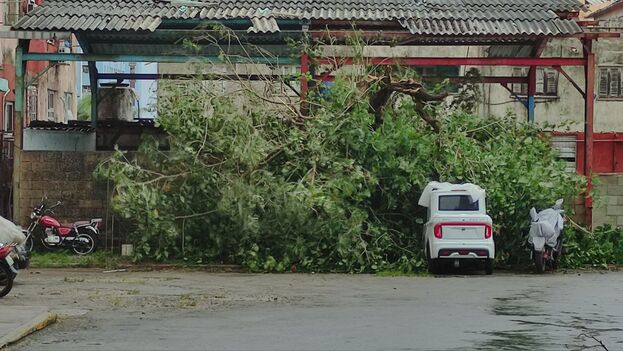
Fallen vegetation in the capital was a particularly visible sign of Ian’s destructive force. (14ymedio).

14ymedio biggerEFE (via 14ymedio), Havana, 5 October 2022 — On Tuesday the government announced that Hurricane Ian, which recently passed through western Cuba, completely destroyed thirty-eight homes in Havana and caused partial damage to roofs or other sections of 1,131 others.

As part of the initial estimate of the damage Havana has suffered as a result of Ian, the regional governor, Reynaldo Garcia Zapata, pointed out that the city’s entire electrical system was affected and that 17,760 people had been evacuated from danger zones to state-run shelters or private homes.

Garcia Zapata indicated that, over the last six days, all electrical lines and circuits impacted by the storm were restored but that eight poles and twenty transformers are still out.

Homes and electricity were the most severely impacted by Ian, which a week ago tore through the country on a northward path starting in Pinar del Rio province in the southeast, where it caused major damage, and extending to neighboring Artemesia, Havana and Mayabeque provinces. continue reading

Its impact on the electrical power system caused a nationwide blackout, aggravating a situation in which the entire country had already been experiencing daily power outages caused by failures at antiquated power plants, lack of fuel and lack of routine maintenance.

Blackouts over several consecutive days have recently led to protests in several Havana neighborhoods as wall as in Camaguey, Holguin and Guantanmo.

Demonstrators have protested by banging pots, blocking major thoroughfares and staging sit-ins. In some instances they also called for political change. The independent media Proyecto Inventario has counted fifty-five protests, most of them in Havana.

Activists have also reported twenty-six detentions, including at least one minor, and have accused plainclothes police and security forces of using violence against demonstrators.

Hurricane Ian, the first storm to hit Cuba in the current hurricane season, has left five dead and caused extensive damage, which so far has only been partially accounted for.

____________

COLLABORATE WITH OUR WORKThe 14ymedio team is committed to practicing serious journalism that reflects Cuba’s reality in all its depth. Thank you for joining us on this long journey. We invite you to continue supporting us by becoming a member of 14ymedio now. Together we can continue transforming journalism in Cuba.

Deported and Whereabouts Unknown–One of the Cubans who Stole a Boat in Mariel

The U.S. Coast Guard returned to the Island the Cubans who stole a boat from the port of Mariel. (Twitter/@USCGSoutheast)

14ymedio bigger14ymedio, Havana, October 5, 2022–The family of Evelio Calvo Capote, who organized, with 21 family members, the theft of a boat from the port of Mariel with the intention of reaching the U.S. does not know where he is being held. “They grabbed him and loaded him onto a white van and they took him,” said Daniel Calvo, who lives in Miami, speaking to journalist Mario J. Pentón.

Evelio’s brother recounted that the stolen boat was intercepted in American waters. “They were spotted by a helicopter and six speed boats and they started to launch tear gas at them,” which created panic because of the children that were in the group, he said. The coast guard hopped on the boat, pointed a weapon at his brother and ordered him to stop.

Calvo Capote, as well as the rest of the group, requested asylum at the time they were interviewed by a consul, whom they also made aware of the danger they faced if they were returned to the Island. The hope of being accepted was buried when they saw that each day they were moved from one boat to another. “They went through six,” stated Daniel Calvo.

On one boat, the detainees joined two Cubans who were presumably “escapees from justice,” explained Daniel; however those people “were dropped off at Guantánamo,” while the rest, including Evelio, were transferred to a bay in Santiago, Cuba. The ship approached the dock, an official from the Ministry of the Interior boarded asking for Evelio Calvo and, “they arrested and took him.” continue reading

Daniel Calvo underscored that his brother let his mother know that “he had no hope,” because the regime was requesting the return of someone who for six years worked as a ship mechanic for the Cuban Coast Guard.

On Saturday, the US Coast Guard confirmed that they returned 22 Cubans to the island. That same day, Congressman Mario Díaz-Balart denounced on social media the disparities between U.S. President Joe Biden’s discourse, when he stressed that it was not “rational” to deport Cuban migrants. “Clearly that was another bald-faced lie, as his Administration returned those 22 Cubans, knowing full well the repercussions they’d suffer.”

Meanwhile, on Wednesday, the U.S. Coast Guard repatriated 55 Cubans aboard the vessel William Trump. The group was composed of rafters from four crafts intercepted along the Florida coast.

Through a statement, American maritime authorities exhorted rafters to avoid risking their lives on rustic boats. “Hurricane season has not ended and more storms are brewing,” warned Lieutenant Connor Ives. “Our air and surface crews are patroling and keep watch to save lives and prevent illegal and unsafe ventures.”

Since October 1, 2022, Coast Guard crews have intercepted 66 Cubans.

On the other hand, the bodies of three female Cuban rafters were found on Saturday near Key West, and with that the search for the missing came to an end. The women were part of the group of 27 people who attempted to reach Florida in a boat that capsized last Wednesday close to Stock Island, near Key West.

In all, the bodies of four women and one man were found, while nine people survived the wreck and are in custody of the authorities. One of the Cuban men rescued on Wednesday told television channel WPLG that they left the Island last Friday and had spent five days at sea when the ship wrecked. He stated that they remained “two days and two nights near the coast of Cuba and they did not rescue us.”

Translated by: Silvia Suárez

____________

COLLABORATE WITH OUR WORKThe 14ymedio team is committed to practicing serious journalism that reflects Cuba’s reality in all its depth. Thank you for joining us on this long journey. We invite you to continue supporting us by becoming a member of 14ymedio now. Together we can continue transforming journalism in Cuba.

The Cuban Government Will Deliver Food Packages with the Support of the United Nations

Lines for the delivery of donated food packages during the pandemic in Cuba. (14ymedio/Archive)

14ymedio bigger14ymedio, Madrid, October 5, 2022 — The authorities will begin distributing food packages this Thursday in the provinces most affected by Hurricane Ian, in a attempt to calm the population. Havana, where more protests have occurred in recent days, will be the last to start receiving them, in the middle of the month, “because of the large number of people,” the Minister of Internal Trade, Betsy Díaz Velázquez, said on television on Tuesday.

The population of Pinar del Río, Artemisa, Havana, Mayabeque and Isla de la Juventud will benefit from a “food supplement” that includes three more pounds of rice for the entire population and canned meats per family nucleus. “This measure will benefit more than 3,553,000 consumers,” she said.

The initiative assumes that all inhabitants, regardless of their needs, will be treated equally, a formula criticized by the Cuban economist Elías Amor Bravo, who is stunned — although accustomed to being so — that such a strongly centralized model doesn’t know how to “discriminate aid based on the personal circumstances of the applicant.” Similarly, in construction, the regime has decided to offer a 50% subsidy on construction materials regardless of who is the beneficiary.

“The minister still has time to change the aid formula and stop distributing products as if it were an old parish charity office,” says the expert, annoyed by the public management carried out by the regime. continue reading

In detail, the additional food planned for the west of the Island also includes two pounds of potatoes for Pinar del Río and, later, for Havana; while in Artemisa, the amount will depend on the provincial authorities. Also in Batabanó, Mayabeque, potatoes will be received, without further details about the quantity or clarifications with respect to the rest of the territory. Grains are increased for these areas, as well as cleaning products, whose distribution “has been affected in recent months.”

The World Food Program, which will be responsible for delivering the packages in some municipalities, has provided some products, including tents, tarpaulins, lamps, mobile warehouses for food protection and kitchen kits, in addition to 478 hygiene kits, which were delivered in the Surgidero de Batabanó and to vulnerable people.

But the first problems with special aid after Hurricane Ian have already begun to appear. The Government promised to finance mattresses for those who requested them, and, according to the minister herself, not everyone will get one “because the effects [of the hurricane] are still being felt, but there’s a level of support for cases that need it.”

Díaz Vázquez tried to explain during her speech that another consequence of Ian is the delay in the delivery of the family basket, given that the dates have coincided. But then she began to relate the number of products that are being distributed now but with a delay of months.

“We’re concluding the distribution of coffee, except on the Isla de la Juventud and Holguín; a substitute for yogurt that couldn’t be produced is being completed and the delivery of meat products from last month in eight territories such as Havana, Mayabeque, Pinar del Río, Sancti Spíritus, Matanzas Ciego de Ávila, Holguín and Granma. In addition, she acknowledged the delays with salt and added that it hasn’t been possible to distribute the oil in Pinar del Río because the flow meter to measure it only works with electricity. “Yesterday the marketing of rice, other grains and sugar began in all the ration stores,” she added after saying that they have already finished distributing milk for the children, which had been the priority.

Díaz Velázquez assured that all the products in the basket are in the country and asked the population for calm, although the discomfort is evident and not limited to food.

One of the most disturbing reports provided by the minister was that the distribution of charcoal for cooking has begun in Pinar del Río. “That is, back to the most remote past,” says Elías Amor.

Of the 871 retail stores that were damaged with the passage of Ian, 520 were state ration stores, and within them, 429 were in Pinar del Río, a province for which everything is bad news.

It has even been necessary to set up offices to serve the population and multiply points of sale for construction materials. In addition to the blow to its main crop, tobacco, there are 63,133 damaged homes, of which 7,107 are totally collapsed. Díaz emphasized the innovation of the installment sale of construction materials and recalled that bank credit can also be accessed and evaluated for the 50% subsidy.

“What is processed in a unique and generic way, is the same for the Cuban who earns 2,500 pesos per month as the one who receives 5,000 pesos. That is communist equality, which then ends up generating painful distortions in society,” writes Elías Amor. “But, in addition, 50% of the materials are subsidized for those who are without housing or shelter, destroyed by the hurricane, and where only a roof or a wall has collapsed that requires minor work. Has no one thought about adjusting the percentage of the subsidy?” asks the economist based in Spain, for whom the measures are “pure communist demagoguery and show little desire to work for the benefit of the community.”

Translated by Regina Anavy

____________

COLLABORATE WITH OUR WORKThe 14ymedio team is committed to practicing serious journalism that reflects Cuba’s reality in all its depth. Thank you for joining us on this long journey. We invite you to continue supporting us by becoming a member of 14ymedio now. Together we can continue transforming journalism in Cuba.

The Agricultural Development Development Fund Has Been a Failure

14ymedio bigger14ymedio, Elías Amor Bravo, Economist, 3 October 2022 — One of the most resounding failures of the 63 measures approved by the Cuban communist regime to increase agricultural production has been the so-called Agricultural Development Fund. One year after its creation, the balance sheet cannot be more demoralizing. The official state newspaper Granma explicitly recognizes it when it points out that “in Ciego de Ávila there could be more credits approved, because it’s a purely agricultural province,” but only 22 credits have been granted in the amount of about 230 million pesos. A trifle. For it to be useful,they have to keep in mind what they intend to do in Pinar del Río, selling construction materials at half the price to fight the destruction of Hurricane Ian. This type of measure doesn’t work.

But let’s go to the case in question. The 63 measures that sought to encourage the progress of agriculture and speed up food production haven’t worked a year later. It’s logical, since they are poorly designed and try to achieve objectives without first making structural transformations.

Far from attributing responsibilities for the failure to the banks of Credit and Commerce and Popular Savings, which are only transmission belts of a program, which, I emphasize, is poorly designed, the only ones who should respond to the failure is the regime, the ministry and even Díaz-Canel himself for relying on measures that are imprecise, poorly designed and of little social utility, such as this fund.

Why do we say that the design is incorrect? continue reading

Well, basically because of those who apply for and get the credits from the fund. These are state companies that will be supported by political and partisan criteria. Since this financial modality was launched, the banks have also approved reduced loans with a small amount, destined for state companies, such as Arnaldo Ramírez and Porcina.

Very few independent farmers benefited from the loans. Those who benefited from the Agricultural Development Credit have been state companies with a weight in food production, such as Agropecuaria La Cuba, Agroindustrial Ceballos, Agropecuaria Chambas, and integral Agropecuaria, and only three entities in the cooperative sector participated, which received 108 million pesos for the cultivation of bananas, guava, potatoes and the promotion of pasture for livestock.

On the other hand, Granma’s note reported that the Agricultural Development Bank approved 2.8 billion pesos for the planting of cane, in addition to other amounts for the production of pork, protected crops, the planting of cassava, corn, soybeans, sweet potatoes, rice, fruit trees and protein plants for animal feed. And yet, the sugar campaign was the worst since colonial times. Bandec is now in charge of managing the committed debt, but, as Granma says, the greatest responsibility lies with Agriculture and Azcuba, responsible for defining the natural and legal persons who meet the requirements to receive the loan and are in a position to increase production, as intended, and be able to repay it.

This is the question. What is the requirement to be met? It seems that we are talking about irrelevant issues, but efficient banking practice is clear about it. Property rights are a necessary, but not sufficient, condition for an effective financial policy. If this relationship is not established transparently and with the utmost legal respect, things cannot go well. And so, after a year, as Granma says, the credits approved in a purely agricultural province are scarce, and it is recognized that, “even though all the scenarios have been used to divulge the advantage of the initiative, it’s never enough, because it doesn’t always go directly to the producers.” Once again, communication, and start blaming the complex situation of the economic and social environment for failure.

Translated by Regina Anavy

____________

COLLABORATE WITH OUR WORKThe 14ymedio team is committed to practicing serious journalism that reflects Cuba’s reality in all its depth. Thank you for joining us on this long journey. We invite you to continue supporting us by becoming a member of 14ymedio now. Together we can continue transforming journalism in Cuba.

The New York Times Publishes a Deceitful Ad in Favor of the Cuban Regime

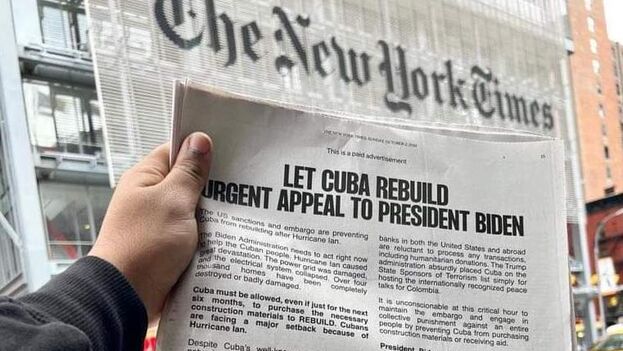
A paid ad last Sunday in The New York Times in favor of the Cuban regime. (Cubadebate)

14ymedio bigger14ymedio, Frank Calzón, 5 October 2022 — The New York Times has published an ad asking President Joe Biden to respond affirmatively to the Cuban government’s call for the lifting of economic sanctions for six months “so that Cuba can reconstruct after the hurricane.”

The text contains a catalogue of fallacies and half-truths.

It’s not true, as it says, that the US embargo impedes the purchase of construction material. Cuba buys everything it wants from countries around the world. The problem is that the countries that previously forgave the regime’s millions of dollars of debt now refuse to extend credit to Havana, since the debt won’t be paid.

One of the consequences of the U.S. embargo is that Cuba has to pay cash for what it buys from the U.S., like the tons of frozen chicken it imports from New Orleans. Otherwise, the U.S., like the Spanish, French, Argentinian and other governments, would stop subsidizing the regime.

As for the blackouts and the disaster of the thermoelectric plants in Cuba, to pretend that it’s because of Hurricane Ian, speaking diplomatically, lacks truth. For more than thirty years, the readers of the official newspaper Granma have been informed in which neighborhoods, on which days and at what times the power would be shut off. continue reading

For Cubans familiar with the craziness of Fidel Castro, like the Ten Million Ton Harvest and the closing of most of the sugar mills, which made the spectacular development of the country possible for two centuries, the regime can’t tell them that the blackouts are the fault of the hurricane or the Yankee embargo.

Many years ago, Fidel ordered the removal of stovetop cookers that used kerosene and charcoal and obliged the population to buy electric cookers to replace them. This increased the price of electricity. Fidel gave classes on television to Cuban housewives about the advantages of electric pressure cookers.

Ignoring the analysis of the experts, they used the national oil, which unfortunately has a high sulphur content, in the thermoelectric plants. The result, as in the case of the almost-disappeared sugar industry, is the energy crisis, with or without a hurricane.

The ad alleges that President Trump put Cuba back on the list of countries that facilitate international terror because Cuba was the seat of the peace negotiations for Colombia. But it doesn’t say that the F.B.I., for years, has offered thousands of dollars for information that might lead to the capture of U.S. terrorists who have sought refuge on the Island. Among them is Joanne Chesimard (alias Assata Shakur), an African-American extremist [member of the Black Liberation Army] who received a life sentence in 1977 after killing a New Jersey state patrol officer in cold blood when she was stopped for speeding in 1973. She escaped from prison in 1979 and was granted political asylum in Cuba. Her case isn’t the only one.

And what about the suggestion that Washington should stop basing its policy towards Cuba on the paradigm of the Cold War? Suffice it to point out that, even for Havana’s friends in Washington, it’s impossible to ignore the role of the regime’s propaganda in favor of President Vladimir Putin’s criminal war in Ukraine. Havana was one of the handful of dictatorships that voted against suspending Russia from the United Nations Human Rights Council and tried not to allow the recorded appearance before the General Assembly of the president of Ukraine, Volodymyr Zelensky, who could not attend for obvious reasons.

The Biden Administration has denounced all of the above, while the Plaza de la Revolución is preparing to send “volunteers” to Ukraine under the orders of Russian officers.

There’s more, but even so, President Biden shouldn’t ignore the regime’s request, according to the The New York Times ad. If the president wants to help the Cuban people, he must offer to establish a humanitarian channel with the following conditions:

1. That the aid is clearly marked “Free gift from the people of the United States to the Cuban people. FORBIDDEN TO SELL.”

2. That the aid be distributed in Cuba by staff of the American Red Cross and the Agency for International Development, and that both be allowed to monitor the impact of the aid on the population on the ground.

If not, it’s possible that the same thing would happen as years ago, when a shipment of medicines and food that the Catholic Church wanted to distribute on the Island was sent to Haiti, because some Cuban mothers in Florida had written on the boxes “With the love of your brothers exiled in Miami.” Something similar to the Cuba Decide shipment of humanitarian aid, confiscated in the Port of Mariel in 2020, in the midst of the pandemic.

It’s not true that the sanctions hinder the reconstruction of Cuba after Hurricane Ian, because the blackouts and lack of electricity across the Island precede Hurricane Ian by years. Homelessness, although it has been worsened by the hurricane, is basically the result of more than 60 years of lack of maintenance of the buildings where Cubans live. According to the regime’s priorities, millions of dollars are spent on the construction of luxury hotels for foreigners, while the country’s homes, aqueducts, sewage systems and infrastructure in general have deteriorated disastrously.

The ad regrets the destruction of the tobacco production, pointing out that 5,000 farms have been destroyed. But it doesn’t say that these farmers, if they dare to sell their tobacco to Cubans and not to the state monopoly, are sentenced to prison, like others who dare to sell their chickens, rice or the milk of their cows.

President Biden should order the Administration to implement its promises to provide free Internet service for the Cuban people. And if Havana rejects Biden’s offer, Washington should lead an international United Nations coalition to suspend Cuba from the Human Rights Council, as was done with Vladimir Putin’s regime.

The true friends of the Cuban people in the United States Congress, who are a majority, should immediately address Biden to make sure that the president doesn’t turn a deaf ear to the claim of thousands of protesters throughout Cuba, who don’t shout against the U.S. embargo, but in favor of their own freedom. For doing so, peacefully, there are a thousand young people in prison after the social explosion of Sunday, July 11, 2021.

The sponsors of the ad, as well as the editors of The New York Times, are complicit in omitting these details. Once again, they make the victims of repression on the Island invisible, while they whitewash the face of the human rights violator.

Translated by Regina Anavy

____________

COLLABORATE WITH OUR WORKThe 14ymedio team is committed to practicing serious journalism that reflects Cuba’s reality in all its depth. Thank you for joining us on this long journey. We invite you to continue supporting us by becoming a member of 14ymedio now. Together we can continue transforming journalism in Cuba.

A Neighborhood with Proven Revolutionary Credentials Turns to Protest

After more than 100 hours without electricity in the wake of Hurricane Ian, only few lights could be seen in our community.

14ymedio bigger14ymedio, Reinaldo Escobar, Havana, 2 October 2022 – The night of Saturday, October 1, 2022 will be remembered in our Havana neighborhood of Nuevo Vedado as the moment we came to think of ourselves as protestors. After more than 100 hours without electricity in the wake of Hurricane Ian, only few lights could be seen in our community. In addition to numerous individual private homes, the blackout impacted multi-family buildings of twelve, fourteen and twenty-four floors, the equivalent of 5,000 people by conservative estimates.

At 9:00 PM, the exact same time that a few months ago people went out onto the balconies of these buildings to applaud the health care workers who were battling the Covid-19 pandemic, one could hear the first recognizable shot being fired: the shy, almost casual sound of someone banging a metal pot. It was like the fuse that sets off an explosion of long-repressed desire. For an hour and a half the sounds continued. Government skeptics confirmed there were many who participated; officials feared there were too many.

Most of those who obtained homes in these buildings, products of the micro-brigade system,* had to go through a rigorous screening process to determine if they had a distinguished revolutionary background. Housing distribution regulations called for applicants to be judged on how many “labor and social merits” they had earned. Inspectors also secretly noted if these applicants kept religious images in their homes or maintained relations with relatives overseas.

This meant that being a member of the Communist Party or the Young Communist League, having spent time in an overseas mission or holding an official leadership position was considerably more advantageous than having three, seven or even ten years of hands-on construction experience. continue reading

More than forty years have passed since residents of some of these buildings went through the process of acquiring their homes. In one 144-unit structure, 52 of the original owners have died, 47 have moved elsewhere and 15 have emigrated (not counting their children). Among those still living in the building who acquired their units on the basis of “labor and social” merit, the average age is 73 years.

It is true that residents were only calling for the power be turned back on. No one was heard shouting “Freedom!” or demanding those in power step down, as occurred in other neighborhoods in the capital. Still, the protest was massive and effective. Six hours later, electrical service was restored. And by dawn we were no longer the same.

If what happened in our neighborhood is an indication of what has happened in the country, if this small area is like a biopsy that indicates a broader malaise in other areas, it should be taken as a sign of the need to adjust the countdown, the one that will end the anomaly in which we live.

*Translator’s note: a form of collective, self-help construction. https://www.jstor.org/stable/43932851

____________

COLLABORATE WITH OUR WORKThe 14ymedio team is committed to practicing serious journalism that reflects Cuba’s reality in all its depth. Thank you for joining us on this long journey. We invite you to continue supporting us by becoming a member of 14ymedio now. Together we can continue transforming journalism in Cuba.

Officials are Losing the Public Relations Battle in Cuba

Díaz-Canel on Sunday in La Coloma, Pinar del Río. (Office of the President)

14ymedio bigger14ymedio, Madrid, October 3, 2022–Amid the restlessness and hardship which has settled in the streets of the Island, the Cuban government has put in motion the communications machinery to regain political and social ground, not just within Cuba, but also abroad. It took the most ideologically forward step on Sunday publishing a declaration by Casa de las Américas in which it accuses the “media” and “voices” on social media of taking advantage of the devastation caused by Hurricane Ian “to shape the opinion that our ills and the difficulties facing them are the result of the Government of Cuba’s ineptitude.

The ones Miguel Díaz-Canel calls “haters,” those who “take advantage of these circumstances to make other types of statements, that are counterrevolutionary; they try to commit vandalism, such as closing off streets, throwing stones against economic or social sites; that is outside of the law,” reports the official press. And these situations, threatened the leader, will be met with the rigor of the law.

The article, titled Ante la Cuba virtual, la Cuba real [Before the Virtual Cuba, the Real Cuba], leads with questions that attempt to respond to rhetorical ones. “Are ‘the people’ really confronting ‘the government’? Is Cuba a ‘failed state’ incapable of solving a crisis?” asked the declaration. The conclusion is “that the overwhelming majority of people identify with their leaders, participate in the country’s recovery, and defend the threshold principle in the new constitution approved in April 2019, “Cuba is a socialist state of laws and social justice, democratic, independent, and sovereign,” stated Casa de las Américas. continue reading

The article offers, as evidence of popular support for the regime, the yes votes in the referendum on the Family Code last Sunday the 25th, despite the fact that the abstentions were over 26%, the highest since 1959. Immediately after, it continues, a category three hurricane arrived. “It is painful and difficult, for any country suffering such a contingency, to rise up again, attenuate suffering of those affected, attempt to recover from the damages, and move forward,” it adds, and continued by saying the U.S. embargo — which it insists on calling a ‘blockade’ — makes the difficulties worse for Cuba.

The declaration maintains that to report, be it in the press or on social media, on the protests of thousands of citizens who for the past week have been requesting electricity is politicizing their suffering and inciting street violence while insisting that there not be a loosening of the embargo.

“They want to capitalize on the logical suffering of citizens deprived of basic services with the hope that nature will provide, at last, what the many desperate attempts at destroying the Revolution have not,” stated the text, which also mentions the missile crisis, Che Guevara, and Fidel Castro, who they say ‘shined like few statesmen in history’.”

The article reviewed some of the themes which in the last few days the government sought to defended ideologically. One of them is the “expressions of solidarity” from the world, especially from the U.S. to Cuba. On Sunday, The New York Times published a declaration in the form of an advertisement paid for by The People’s Forum, a pro-castroite group, which urges the government of Joe Biden to ease the embargo so the island can “rebuild.”

The ad highlighted that the damages following Ian are many and asked Washington to allow, even for just six months, the Island to access its markets to purchase construction materials.

“It is unconscionable . . . to engage in collective punishment against an entire people. . .Don’t let outdated Cold War politics prevent. . .people from helping the Cubans,” insisted the text.

The declaration by Casa de las Américas states that Hurricane Ian also affected the U.S., a theme which links to an article in Granma dedicated to hurricane damages in Florida titled Los tiempos relativos de la recuperación [Relative recovery times]. The article emphasized the magnitude of the destruction in the neighboring country as evidence that the Island is not the only one harmed and suggests, in a false tone of solidarity, that mutual support should flourish on these occasions.

“The fact that in the state of Florida there were more than 70 fatalities as a result of the strong pounding by Hurricane Ian, in addition to consternation and regrets, warned of how necessary it was to replace that country’s climate of hate and hostility with respect to Cuba, and to allow the contribution and collaboration in mitigating risks, and solidarity assistance after the disaster,” states the article, which reminds readers of the U.S. government’s rejection of assistance offered by Cuba during Hurricane Katrina which ravaged New Orleans in 2005.

While Cuba continues waiting, as if for a godsend, for a gesture of detente–which the Miami exile community watches carefully — authorities announced what its allies can send. One of them is Venezuela, which has sent 40,000 food packages, 50 transformers, power lines, and more than 22,000 square meters of zinc sheets to repair rooftops on two ships en route to Cuba, Carmita and Karola Sky.

“These will launch a maritime bridge extended by the ‘bolivarian‘ government over the waters of the Caribbean Sea, for the solidarity operation. . . but the operation will not end there. This is just the beginning,” stated the article.

Furthermore, on Monday, 19 cases of water purification tablets left Argentina, enough to treat 950,000 liters of water. According to calculations from the chancellery, this can serve 2,000 people for 90 days. “This input is fundamental to collaborate with the Cuban government’s response to the needs of the population of Pinar del Río, the city most damaged by the climate phenomenon,” stated the Argentinian chancellery.

Assistance is also expected from Mexico, announced by Andrés Manuel López Obrador, according to Miguel Díaz-Canel’s own account on Twitter.

The president has not stopped traveling to Pinar del Río, where he traveled for the third time on Sunday, with his military uniform. Though, his contacts in the streets are ever more complicated and the military must control the area for Díaz-Canel to approach the uneasy population without videos appearing, like those from last week in Mayabeque, where he was booed by residents of the area and was rebuked by a woman who ended up yelling, “They mock the people.”

In the last few days, the government announced different measures that, he maintains, will contribute to alleviate the situation of the people following this disaster. Among them are the approval of state funding to cover 50% of the price of construction materials, water tanks, and mattresses sold to the affected population. Furthermore, those who do not have enough income can access bank credits and request subsidies for the purchase of construction materials.

Specific provisions have also been approved by the Ministry of Labor so anyone who cannot work during the recovery may continue to receive 60% of their salary, among other measures related to Social Security.

It is to be seen whether they will comply with these announcements in time and in form, something which rarely happens, but seeing the unending protests, whether large or small, the government is losing the battle which matters most: public relations.

Translated by: Silvia Suárez

____________

COLLABORATE WITH OUR WORKThe 14ymedio team is committed to practicing serious journalism that reflects Cuba’s reality in all its depth. Thank you for joining us on this long journey. We invite you to continue supporting us by becoming a member of 14ymedio now. Together we can continue transforming journalism in Cuba.

Silvio Rodriguez is Saddened that ‘The Humble’ for Whom the Cuban Revolution Was Made are Protesting

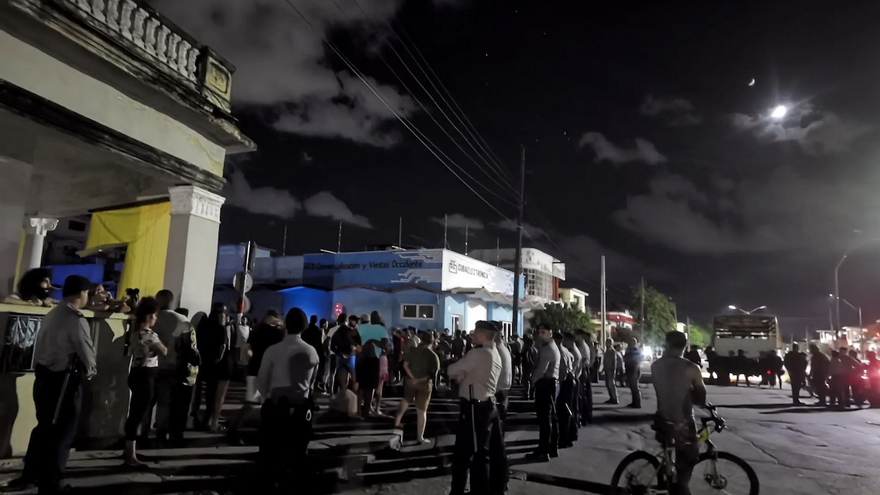
Demonstration in Havana, guarded by uniformed and civilian agents, on Saturday night. (EFE/ Yander Zamora)

14ymedio bigger14ymedio, Madrid, 4 October 2022 — Singer-songwriter Silvio Rodríguez sees “something positive” in last Friday’s mass demonstration on 31st Avenue in the Havana municipality of Playa: it “was guarded by law enforcement but not repressed.”

In a post published on Saturday on his blog Segunda Cita (Second Date) the troubadour confesses that the protest, which took place after almost 100 hours without electricity due to a widespread blackout on the Island after Hurricane Ian, made him “sad.” The reason, he says,  is that “they didn’t seem to be of the  privileged classes who rebuke a inheritor government of a Revolution that was made in blood and fire for the humble.”

“How is it possible that such a distortion has been reached? Is it a mirage for the intensification of a six-decade blockade, or because of how difficult it has become to get food after the pandemic, or because of the havoc that the hurricane caused us?” Rodríguez asks, suggesting again and in his own way a slight criticism of the system that he doesn’t reject.

Taking, as on other occasions, both a hard and soft line, the musician concedes on one hand that “it’s worth asking how much responsibility belongs to those of us who have bet, more than our lives, our history, on an emancipatory project,” but, on the other, affirms that “essentially, I’m sure we weren’t wrong — and I’m not enumerating the virtues, the resounding benefits for the Cuban people that the revolutionary process meant.” continue reading

Rodríguez’s text was published on precisely the same day that, for the first time since the demonstrations began after the hurricane, the regime unleashed the usual repression.

Police officers, but above all State Security agents and military service recruits dressed in civilian clothes and armed with sticks responded on Saturday night to a spontaneous protest that took place in the middle of Vedado in Havana, on Línea and F. There, the neighbors had blocked the street with barricades made from overturned garbage containers, branches of fallen trees and other objects.

In addition, as shown in videos released by the Spanish agency EFE, the demonstrators faced the authorities and the official civilian brigade — which shouted revolutionary slogans such as “Fidel, Fidel” or “Viva Díaz-Canel” — demanding not only “light” but “freedom” and chanting “down with the dictatorship” and “Díaz-Canel motherfucker.”

Although the regime has wanted to sell the idea that in no case was there repression and that the agents responded to “provocations” of violent demonstrators, images disseminated by international media, such as Reuters and The Associated Press, show that those who were armed were the government agents.

On Tuesday, the Justice 11J platform updated the number of detainees since September 30, which has now reached 26. The last arrests registered by the organization are Rafael Zamora Mederos, José Adalberto Fernández Cañizares ( both 38 years old), Alejandro Guilleuma Ibáñez (29), Hillary Gutiérrez (26 ) and Frank Artola (18).

According to Justice 11J, Zamora Mederos,  a member of the Movement of Opponents for a New Republic, was arrested on Saturday and is in the Vivac prison of Havana accused of public disorder “just for walking through the streets on a day of protest.” The platform reports that his relatives have tried to raise 16,000 pesos for his bail, but it’s been impossible, and Mederos  is “on a hunger and thirst strike.”

About Fernández Cañizares, nicknamed Pepitín, acquaintances of his family confirmed to this newspaper that he was hit in the head and was transferred to the Calixto García hospital to be given 37 stitches, according to the doctor who attended him, his own mother. In addition, they fractured his nasal septum. The young man is accused of public disorder and resistance.

Alejandro Guilleuma Ibáñez, Hillary Gutiérrez and Frank Artola are locked up in the DTI 100 detention center and Aldabó, also in the capital, for the same crimes.

Witnesses also claim that this last group was mistreated. Frank “is an exemplary teenager who attends the parish church on Línea in El Vedado. He suffered a fracture of the septum; his lips were split and one of his eyes was swollen because of the blows he received,” wrote Adrián Martínez Cádiz, who added: “His sister, Hillary Gutiérrez, is a good girl. She has a little girl who cries because of her mother’s absence.”

Justice 11J emphasized that “the reports of people injured, brutally beaten and currently in detention for protesting are alarming.”

Translated by Regina Anavy

____________

COLLABORATE WITH OUR WORKThe 14ymedio team is committed to practicing serious journalism that reflects Cuba’s reality in all its depth. Thank you for joining us on this long journey. We invite you to continue supporting us by becoming a member of 14ymedio now. Together we can continue transforming journalism in Cuba.

In Miami, they Support the Protests in Cuba and Ask the US Not to Give Aid to the Regime

A group of people demonstrated in support of Cubans on the island this Sunday in Miami. (14ymedio)

14ymedio bigger14ymedio, Havana/Miami, 3 October 2022 – – A group of Cubans living in Miami gathered this Sunday in front of the Versailles Restaurant to support the protests that have been taking place on the island since the electrical system collapsed after the passage of Hurricane Ian, leaving millions of citizens without service. The Internet cuts began in order to prevent communication and dissemination of the demonstrations and their repression.

Among those gathered in front of the legendary Florida restaurant were historical opponents such as former political prisoner Jorge Luis García Pérez, Antúnez, and Cuba Decide leader Rosa María Payá; along with other recently arrived opponents such as rapper Eliecer Márquez Duany, El Funky, graffiti artist Danilo Maldonado, El Sexto, independent journalist Esteban Rodríguez, and boxer Yordenis Ugás. In addition, actor Roberto San Martín and influencer Alexander Otaola were also present.

Together with them, more than 200 Cuban exiles called on the international community not to abandon Cuba in the face of repression and called on Joe Biden’s Administration to take a strong stand against the Cuban regime and refuse to send aid.

In a brief speech, Rosa María Payá, daughter of the late leader of the Christian Liberation Movement and the promoter of the Varela Project, Oswaldo Paya, insisted that the aid that Castroism is asking the U.S. government for should not be provided, since the people have taken to the streets to demand freedom and not business or aid. “Business will come when Cuba is free,” cried the activist, who added that the opposition will help at that time. continue reading

Payá insisted that it is necessary to send a message to the Biden Administration that there should be no rapprochement that would legitimize the dictatorship and would not change anything for the population.

Among the demonstrators, some called for military intervention in Cuba, although most showed their solidarity with the protests and support for those who are in the streets of the island standing up to the authorities. “If Cuba is in the streets, so is Miami,” they chanted.

Many of those who gathered this Sunday in front of the Versailles were recent arrivals to the U.S. who were telling each other about their journey through Nicaragua. There were also some who were still fearful of the presence of several police units guarding the peaceful development of the rally, although the more experienced ones asked for calm. “The police are here to take care of us,” they said to each other.

Meanwhile, this Sunday night Cubans went out again in several cities, according to videos that circulated on social networks. From Punta Brava and Santiago de las Vegas, in the Havana municipalities of La Lisa and Boyeros or Capellanía, in Artemisa, came testimonies of different pots and pans in which people shouted “We want the lights”.

According to the organization Justicia 11J, since September 30 there have been 20 arrests of participants in these protests, 14 of whom are still in detention.

“About 15 people [were] detained over last night’s protests in Linea Street, Vedado and Arroyo Arenas,” in Havana, as well as in Baracoa, the collective said on Twitter. They are in addition to five arrests in previous days.

Although the relatives “have been told that the demonstrators will soon be released”, some of those who were detained in Vedado have been transferred to the Technical Department of Investigations (DTI), where suspects are usually taken for prosecution.

Justice 11J also reports that five protesters from Havana, Villa Clara and Guantanamo have already been released.

In addition, the organization Amnesty International (AI) charged on Sunday that “protests are intensifying in Cuba” and that they are receiving “reports of repression, possible detentions and Internet cuts”.

“We demand that the government of President Miguel Diaz-Canel put an end to the repression, and listen to the demands of those who protest peacefully,” AI stressed on Twitter.

Hurricane Ian crossed the western tip of Cuba from south to north on Tuesday, with heavy rains and winds of up to 200 kilometers per hour, causing heavy material damage and five deaths, according to the latest official balance published on Sunday.

The Cuban Electric Union (UNE) multiplied this weekend its announcements of new electric circuits reestablished, but outages and blackouts continue without it being possible to distinguish whether they are a consequence of the major breakdown last Tuesday or of the months of generation deficit accumulated by the system due to the continuous breakdowns of thermoelectric plants and distributed generating plants.

In Havana, UNE has reported that 95.3% of customers now have electricity, but there is still no service in some parts of the city. Regarding water supply, at a meeting of the Government of Havana it was said that 92% of the population is receiving service, with 170,000 customers pending.

On the other hand, the restoration of services is extremely slow in the province of Pinar del Río, the most affected by the hurricane, where only 7% of the 235,311 customers have electricity service and, according to the authorities, the situation will be normalized within 15 to 20 days.

Translated by: Hombre de Paz

____________

COLLABORATE WITH OUR WORKThe 14ymedio team is committed to practicing serious journalism that reflects Cuba’s reality in all its depth. Thank you for joining us on this long journey. We invite you to continue supporting us by becoming a member of 14ymedio now. Together we can continue transforming journalism in Cuba.