
Hate Crimes of the Castro Regime

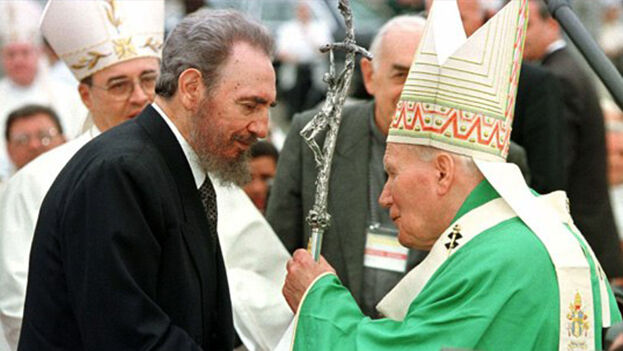
Fidel Castro and Pope Juan Pablo II. (14ymedio)

14ymedio bigger

14ymedio, Pedro Corzo, Miami, 1 October 2022 — Although the leadership of the Revolution tried to give the insurrectional triumph a certain religious and humanistic aspect, very soon the belief in another superior being became the most feared enemy of the triumphant insurrection, along with proclaimed humanism, as green as palms.

Fidel Castro attacked religions in Cuba with ferocity, just as he did with homosexuals. He anointed himself as the paradigm to follow, he could not allow another religion that was not embodied in his person because, after all, Castroism is a form of mystical fundamentalism.

Church attendance dropped dramatically, as did membership in fraternal associations like Freemasonry. In Cuba a new religion was installed in which Fidel Castro was its God and “castrolicism,” as Gerardo Fundora described it, was truth revealed.

The regime then imposed values and norms that were inspired by Fidel’s beliefs and Marxism, following the dogma that “religion was the opium of the people.” Ethical foundations of society were thoroughly attacked, one of its most important objectives being religions in general, and the Catholic Church was a key target to destroy, in order to build the promised new order.

It was an indelible experience for believers who, in defense of their faith, were discriminated against, persecuted, humiliated, imprisoned and shot, as happened, among many others, with Alberto Tapia Ruano and Virgilio Campanería, who shouted “Viva Cristo Rey”  before they died. continue reading

The regime-imposed values and norms that were inspired by Fidel’s thinking and Marxism, following the dogma that “religion was the opium of the people”

Verbal attacks against religions were very severe, among others, and Church-owned schools confiscated. Parishioners were systematically harassed, and those without deep faith buckled under pressure as a result.

Still, a significant number of the faithful, despite the fact that repression and discrimination became accentuated, maintained their religious commitment, as was the case of young Arnaldo Socorro, a native of Unión de Reyes, Matanzas, whose family moved to Havana during his adolescence.

Socorro had been awarded a scholarship to study at the Belén School, where he joined the Catholic Workers’ Youth. On September 10, 1961, he attended a procession with the image of the Blessed Virgin Mary, Our Lady of Charity of El Cobre, Patron Saint of Cuba.

The procession was set to start from the Church of La Caridad, under the guidance of the then auxiliary bishop of the Archdiocese of Havana, Monsignor Eduardo Boza Masvidal, one of the most courageous censors of the Castro regime, who was expelled from Cuba a week later with another 130 priests, by order of the hater by trade.

Arnaldo decided to participate in the religious procession that was undoubtedly an expression of rejection of the regime. When he arrived, he learned that the authorities had banned the procession, however, like thousands of people, he remained in front of the church to demand that his rights be respected.

The verbal attacks against religions were very severe, among others, confiscations of church-owned schools

Sheltered by an image of the Virgin, he marched at the head of hundreds of people who decided to follow him, shouting cheers to Christ the King, the Virgin and freedom, just as many of the young people shot by the dictatorship at that time shouted in front of the firing squad.

Socorro’s courage would not be respected by the regime and his henchmen. One of the enforcers, aware of his impunity, unloaded a machine gun into the young man, who fell mortally wounded.

He was 17 years old when he was assassinated, but, as journalist Julio Estorino sustains, “crime and outrage,” was added to the homicide by the regime, by proclaiming that the murdered young man was a revolutionary who had gone to the scene of the events to prevent an act of the “henchmen in cassocks,” as Castro identified Catholic priests.

The murder was blamed on Agnelio Blanco, a priest who was on the Isle of Pines at the time of the events, another cruel lie in Castro’s extensive defamation campaign against his critics. The evil did not end there. State Security officers went to Arnaldo Socorro’s house, threatened his family, buried him as a combatant killed by the counterrevolution and forged another martyr for the motherland.

____________

COLLABORATE WITH OUR WORKThe 14ymedio team is committed to practicing serious journalism that reflects Cuba’s reality in all its depth. Thank you for joining us on this long journey. We invite you to continue supporting us by becoming a member of 14ymedio now. Together we can continue transforming journalism in Cuba.

Censoring ‘The Worst Generation’ Thwarts a Dialogue with Cuba’s Youngest Writers

The poster for “The Worst Generation, canceled by the Hermanos Saíz Association (AHS)

14ymedio bigger14ymedio, Havana, 11 October 2022 — The Hermanos Saíz Association (AHS), the radical youth arm of the Cuban Union of Writers and Artists, was not enthusiastic about La peor generación [The Worst Generation] conversation, an event where a group of novice writers were to debate literature, culture, politics, and society.

The debate, scheduled to take place in La Madriguera in Central Havana on October 15th was canceled on Tuesday under the pretense that several members had, on several occasions, repudiated AHS, its directors, and thus they did not see a reason for the “unworthy” to participate in its space.

Alejandro Mainegra, one of the organizers of La peor generación, told 14ymedio that the event would have served to introduce a book by the creators “who have a voice right now, they are writing and being read.”

“We naively thought we could all coexist one afternoon to talk about literature, within the AHS space, and it didn’t happen. It is very sad,” he added.

La peor generación was conceived with the goal of bringing together in the same space some of the most notable names in cutting-edge literature of the current generation,” explained its coordinator, Raymar Aguado Hernández, in a Facebook message.

Mel Herrera, Julio Llópiz Casal, Alexander Hall, Lisbeth Moya, Jairo Aróstegui, Ricardo Acostarana, Hamed Toledo and Manuel de la Cruz were invited to the dialogue to be moderated by Aguado and Mainegra, among others. The group was characterized by its ideological diversity, rejection of political monolithism, and its customary collaboration with independent newspapers and magazines. continue reading

This heterogeneity is precisely what sparked the censorship and “brought down the verdict” of AHS, denounced Aguado. Its objective, which was to “generate debates around the Cuban literary panorama and achieve a closeness among the public, the authors, and the home of youth creators in the capital,” was curtailed by the association.

In his message, the coordinator of La peor generación attached his resignation from the position of Specialist in Visual Arts and Critique and Research of the Havana-based AHS, as well as his resignation as an employee of La Madriguera. He maintains, however, his membership in that organization.

In what he wishes to be a moderate position, Aguado argues that AHS should, “represent all the values of national culture and youth art and not political differences with creators, nor positions tangential to the institutional aspirations, nor episodes of misunderstanding.”

“I work for conviction, commitment with my generation, and with the culture of my country, as a result, I cannot continue on the margins of this episode of censorship,” lamented the young man.

With support from two initiatives — La Tertulia Literaria and Cubao — they chose La Madriguera for their meeting, as the venue represented “an example of artistic resistance” at the margins of the “terrible management of Cuban institutions.”

For her part, one of the invitees, Lisbeth Moya, alluded to the venue as a “free space” for “diverse voices.” The young lady, who collaborates on the Communist platform, made it clear that she would not abandon AHS despite the institutional pressure. “When you want to talk, I’ll be here,” she quipped.

Meanwhile, artist and critic Julio Llópiz Casal, in a comment on Aguado’s publication, explained that “many Cubans will continue to pay the enormous price of living in a country subjected to sadness and despair,” at the mercy of institutions such as AHS, “without autonomy or steadiness.”

With the censoring of La peor generación, the Island’s bureaucracy looks down upon an entire pool of recent and talented writers and, as it did after that hopeful November 27, 2020 encounter, shuts the door on a dialogue and a consensus through culture.

Translated by: Silvia Suárez

____________

COLLABORATE WITH OUR WORKThe 14ymedio team is committed to practicing serious journalism that reflects Cuba’s reality in all its depth. Thank you for joining us on this long journey. We invite you to continue supporting us by becoming a member of 14ymedio now. Together we can continue transforming journalism in Cuba.

Omara Ruiz Urquiola Asks That It Be Known ‘Whether the United States and Cuba are Negotiating and If So, About What’

Omara Ruiz Urquiola at Miami airport. (EFE)

14ymedio biggerEFE/14ymedio, Havana, 10 October 2022 — Cuban dissident Omara Ruiz Urquiola, who for the third time since arriving in the United States with a tourist visa in January 2021 couldn’t board a plane to Cuba, demanded that the U.S. government be “transparent” about its policy towards the Island, in statements to EFE in Miami.

“Not only do Cubans know nothing, the American people don’t either,” Ruiz Urquiola said on the phone.

The art historian and former university professor said she had informed an official of the U.S. State Department in advance of her travel plans and reported that he informed her that her superiors were going to “intercede” for her with the Cuban authorities.

The U.S. Embassy in Havana sent a tweet about her case, but the activist complained that her discussion with the official was of no use, and this time, once again, she wasn’t able to get on the plane.

“Today, the regime again prevented Omara Ruiz Urquiola from returning to Cuba to assist her mother, whose house was severely damaged by Hurricane Ian. We urge the regime to allow all Cuban citizens to return freely to their homeland,” the diplomatic headquarters stated. continue reading

The activist accuses the U.S. government of being an accomplice of the Cuban government and Southwest Airlines for supporting the regime’s orders. However, neither airlines nor countries of origin can transport a person who is rejected by the country of destination.

Ruiz Urquiola said that she needs to travel to Cuba urgently because the family farm in Pinar del Río was “devastated” by Hurricane Ian at the end of September, and her 75-year-old mother, who lives there, is alone to take care of everything.

Omara, who is an oncology patient and has received treatment in the U.S., is the sister of Ariel Ruiz Urquiola, a human rights activist who is in Europe. He has held several protests before the UN office in Geneva and other organizations to denounce the Cuban government.

According to Omara, in January 2021, she travelled from Cuba to Miami to visit her oncologist and receive an award from the Foundation for Human Rights in Cuba, based in this city.

It was her fourth trip to the United States, and like the previous ones, she did it with a tourist visa that was renewed while in Miami, due to the impossibility of returning to Cuba. That visa expires in December.

Omara Ruiz Urquiola was very critical both of the Government of Cuba, for denying her the right to enter her own country, and with that of the United States, which she accuses of allowing it.

“It’s very painful to know that the great democracy of the world makes fun of us, leaves us helpless,” she said this Saturday in a video recorded in front of the Southwest counter at Fort Lauderdale International Airport, about 40 kilometres north of Miami, after being rejected as a passenger.

“I don’t have an immigration plan, I don’t have the nationality of another country nor am I an asylum seeker,” the activist stressed this Sunday to EFE, emphasizing that her house and her family are in Cuba.

Even so, she was “hopeful” that her situation can be resolved, since the United States is “a free country” and she has not violated the laws. “This is an arbitrary act,” she stressed, after demanding that it be made known whether the United States and Cuba are negotiating and, if so, about what.

Translated by Regina Anavy

____________

COLLABORATE WITH OUR WORKThe 14ymedio team is committed to practicing serious journalism that reflects Cuba’s reality in all its depth. Thank you for joining us on this long journey. We invite you to continue supporting us by becoming a member of 14ymedio now. Together we can continue transforming journalism in Cuba.
Two Men from Manzanillo Get Married, Applying the New Family Code

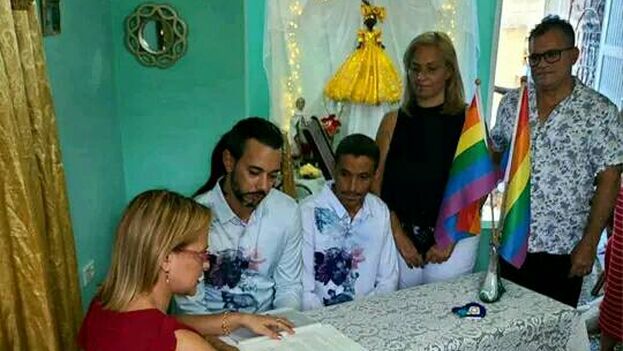
Alberto and José are the first gay couple to marry in Granma province.

14ymedio bigger14ymedio, Havana, 6 October 2022 — On Tuesday, seven days after the entry into force of the Family Code, what may be the first wedding between two people of the same sex in Cuba was celebrated. Alberto and José, two young people from Manzanillo, Granma, got married on Tuesday after 18 years of civil union.

The news was disseminated on Facebook  by the EntreDiversidades page, which shared the report of Roberto Mesa Martos, a journalist for the provincial newspaper La Demajagua.

According to the reporter, one of the spouses, José, expressed his “happiness at realizing a dream I’ve cherished for years.” “I never thought they were going to approve it here but we always wanted it,” said the other spouse, Alberto.

The ceremony was held at the couple’s home with family and friends of the newlyweds. continue reading

“They seal in this way a process that now offers them responsibilities in the face of any situation of the spouses, the legal support of common acquired property and the rights of food and care,” Mesa said.

The Family Code, which authorizes same-sex marriages, was approved in a referendum on September 25 and entered into force two days later, after the provisional results were announced on Monday.

This Tuesday, a week later, the National Electoral Council (CEN) of Cuba disseminated “the final results,” very similar to those already known.

Final results showed “Yes” slightly lower, going from 68.87% to 66.85%. “No” did not grow to the same extent, from 33.13% to 33.15%. Meanwhile, abstentions rose from 25.01% to 25.88%. The consolidated data delve into the number of those who didn’t go to the polls, the highest since 1959.

The president of CEN, Alina Balseiro, communicated the figures at a press conference in which she alluded to the “total transparency” of the process and the “total attachment to the truth” of the organization, although in her comments she added surprising statements in a State without separation of powers.

The official said that the CEN is “an electoral” and “non-political” body of an “independent” nature that “organizes, supervises and controls” the electoral process, but she had to defend herself before the international press for having published on Twitter a message from Cuba President Miguel Díaz-Canel, in which he asked voters to vote “Yes.” Balseiro argued that this didn’t affect the credibility of the organization.

“More than the ’Yes’ vote, I was promoting the dissemination of the process we were developing. And we did it with all conviction, and we will continue to do it. That doesn’t imply that our work doesn’t fulfill our duty and independence,” she rescued herself.

The census was updated, according to Balseiro, including new voters and recent deaths, which left a growth of 8,447,467 to 8,457,978. The register includes thousands of Cubans who have left recently, whom the Government still considers residents since the two-year period after which they will be excluded has not yet passed. It’s not known what effect on abstention those absentees could have had — very numerous, judging by the migration figures for the countries that are transit areas or more frequent destinations.

The Family Code, which replaces that of 1975, prohibits child marriage, authorizes “solidarity marriage,” contemplates sexist violence (absent from the new Criminal Code, however) and replaces the concept of parental authority with that of parental responsibility.

Translated by Regina Anavy

____________

COLLABORATE WITH OUR WORKThe 14ymedio team is committed to practicing serious journalism that reflects Cuba’s reality in all its depth. Thank you for joining us on this long journey. We invite you to continue supporting us by becoming a member of 14ymedio now. Together we can continue transforming journalism in Cuba.
‘They Have Chosen to Support Repression. We Denounce It.’

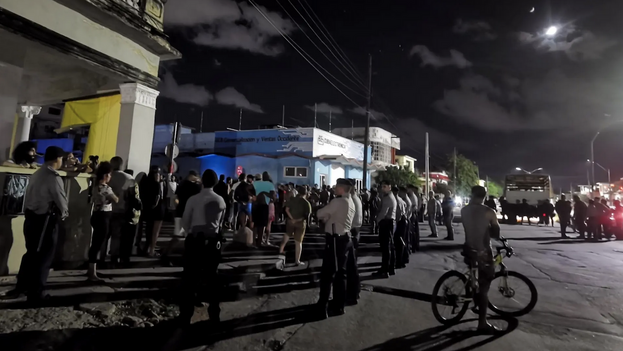
Demonstration in Havana, watched over by uniformed and civilian agents, on Saturday night. (EFE/ Yander Zamora)

14ymedio bigger14ymedio, Havana, 10 October 2022 — Members of the independent Cuban intellectual and artistic community have signed a manifesto in which they accuse the Cuban Government of “lack of political will” to manage the “accumulated needs of the population” and “their human desire for freedom.”

The letter “From Cuban artists and intellectuals to Cuban citizens and international public opinion” is a direct response to the official one published last Wednesday and entitled “Message from Cuban educators, journalists, writers, artists and scientists to their colleagues from other countries,” in which the signatories offered full support to the authorities and denied the violence exercised against the protesters, who have demanded explanations in recent weeks for the lack of electricity. It claims that “repression only exists in the messages that incite violence and support the blockade, contrary to the interests and desires of the Homeland.”

The signers of the independent text review the main ills that afflict Cuba, from the lack of public rights and freedoms to the most basic and elementary services that have led to the recent massive exile of up to 200,000 compatriots “by any means and risking their lives,” while “the Government has chosen to invest in hotels.” continue reading

“The official data themselves,” the statement reads, “reveal the priorities of government investment and the negative impact of economic policy decisions on the living conditions of the population. Official and independent academics have criticized the Ordering Task*, suggesting it be corrected. Nothing happens. Those responsible for these decisions remain in their posts,” the text says.

The signers denounce the academics and intellectuals who subscribe to the official declaration “with an elitist language, which prioritizes a State agenda over the demands of ordinary people.” In addition, they consider that the official text denies humanistic values and is “intellectually mediocre, politically reactionary and socially insensitive.”

The statement also accuses the intellectuals who have defended the Government of being repressed and justifying repression, as well as abandoning the people and criminalizing their demands.

“Suffice to say that they had no other alternative. There always is one. It is always possible to choose. At least, don’t subscribe to the lie that protects abuse, and chooses, without heroism, silence. But those who have signed this have chosen to support the repression exercised against their people. We, on the other hand, denounce it,” the text concludes.

The letter has been signed to date by 125 people including artists, writers, film directors, architects and jurists, residing inside and outside Cuba. Among those who signed the letter, names such as the historian Rafael Rojas, the artists Tania Bruguera and Hamlet Lavastida, the jurist Eloy Viera Cañive and the journalist Mónica Baró stand out.

*Translator’s note: The “Ordering Task” [tarea ordenamiento] is a collection of measures that include eliminating the Cuban Convertible Peso (CUC), leaving the Cuban peso as the only national currency, raising prices, raising salaries (but not as much as prices), opening stores that take payment only in hard currency which must be in the form of specially issued pre-paid debit cards, and a broad range of other measures targeted to different elements of the Cuban economy.  

Translated by Regina Anavy

____________

COLLABORATE WITH OUR WORKThe 14ymedio team is committed to practicing serious journalism that reflects Cuba’s reality in all its depth. Thank you for joining us on this long journey. We invite you to continue supporting us by becoming a member of 14ymedio now. Together we can continue transforming journalism in Cuba.

EU to Provide One Million Euros for Cuban Victims of Hurricane Ian

Janez Lenaric, the European Commissioner for Crisis Management, which overseas the Coordinator for European Civil Protection and Humanitarian Aid, and the European Emergency Response Coordinator. (Prensa Latina)

14ymedio biggerEFE/14ymedio, Havana, 8 October 2022 — The European Union will provide one million euros in relief for Cuban victims of Hurricane Ian, which left three dead and multiple people injured. The EU’s diplomatic mission in Havana made the announcement on Saturday.

“Hurricane Ian has had a devastating impact on Cuba and it is estimated that 100,000 homes have been affected,” the EU said in a statement on Twitter.

The EU’s statement was also made on behalf of Janez Lenaric, the European Commissioner for Crisis Management, as well as the Coordinator for European Civil Protection and Humanitarian Aid, and the European Emergency Response Coordinator.

The EU mission expressed the solidarity of the twenty-seven European countries that make up the organization with the Cuban people at this “difficult moment.” continue reading

“The path of Hurricane Ian has left a devastating impact on several regions of the country. Our emergency assistance will help bring vital support to those directly affected on the ground,” it said.

In the wake of Hurricane Ian, the Cuban government adopted several strategies for obtaining foreign aid. The initial response came from the country’s traditional allies: Venezuela, Mexico and Argentina. The World Health Organization and its regional affiliates also provided support.

In an exclusive article entitled “Cuba Makes Rare Request for U.S. Aid after Devastation,” the Wall Street Journal  reported that Havana has submitted requests for emergency aid to the Biden administration.

The Cuban Foreign Ministry also confirmed that these conversations had taken place.

Several private aid organizations have also lobbied the U.S. government to temporarily lift economic sanctions to facilitate reconstruction in the aftermath of Ian.

Hurricane Ian passed over western Cuba eleven days ago with intense rain and winds of 125 miles an hour, leaving behind three dead and heavy damage.

The hurricane knocked out power to the entire island, damaged roughly 100,000 homes and severely impacted crops and infrastructure. It also led to widespread discontent as evidenced by several days of protests, which were violently repressed by the government.

____________

COLLABORATE WITH OUR WORKThe 14ymedio team is committed to practicing serious journalism that reflects Cuba’s reality in all its depth. Thank you for joining us on this long journey. We invite you to continue supporting us by becoming a member of 14ymedio now. Together we can continue transforming journalism in Cuba.
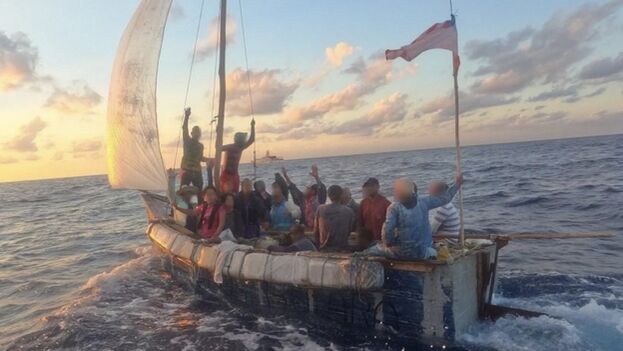
In Ten Days, the US Border Patrol Took 117 Cubans into Custody

U.S. authorities have increased surveillance controls along the coast of Florida to prevent illegal immigration. (@USCGSoutheast/Twitter)

14ymedio bigger14ymedio, Havana, 10 October 2022 — The United States Border Patrol in coordination with Florida county officers arrested 10 balseros (rafters) who managed to reach Marathon this Monday. Cubans pointed out to the authorities that the boat in which they were traveling “sank near the coast, but they were able to swim to the shore,” according to the chief officer of the Miami sector, Walter Slosar.

In the first ten days of October, the Border Patrol has placed 117 rafters in custody. These Cubans have the option of applying for asylum, which implies demonstrating before an officer or judge that they are afraid of returning to their country. If they don’t manage to convince them with their arguments, they will be repatriated to the Island.

Last Friday, a group of 21 rafters reached land at the Fort Zachary state park in a rustic boat with an adapted vehicle engine. The migrants, four women and 17 men, were detained and taken to the Krome Detention Centre in Miami for processing. continue reading

Slosar said that the U.S. authorities have increased surveillance along the coast of Florida to prevent illegal immigration.

Flights of the Clearwater C-130 planes belonging to the Coast Guard air station, which located several rafts with Cubans on the high seas, have been added to the land routes. The information collected has allowed 232 rafters to be intercepted since October 1, the date on which the fiscal year began.

This Sunday 58 Cubans were returned to the Island aboard the ship Richard Snyder. These balseros were intercepted in Cayos Marquesas and in Tortugas Secas National Park. Lieutenant Caleigh Cobb warned migrants that they do surveillance in teams and urged them to “choose a safe and legal route.”

A day earlier, the Coast Guard had repatriated another group with 174 Cubans on the Raymond Evans ship. The authorities then warned of the danger of crossing on homemade boats.

At the end of September, seven Cuban balseros drowned in their attempt to reach Florida, 11 more disappeared on the high seas and nine managed to survive after the boat on which they left Matanzas was shipwrecked.

Carolina Bárbara Gutiérrez, 19, was traveling on that boat. The young woman’s body has not yet been identified by her grandmother, Noemí Alfonso; however, the image of a torso with a piercing and clothes have been the first indication that she is one of the deceased migrants.

Alfonso requested support to be able to return the remains of his granddaughter. His voice was heard by Dayana Sosa Reyes, owner of National Funeral Homes, who is waiting for confirmation that the remains are those of Gutiérrez.

“The family member has not yet presented himself to the Monroe County coroner, but it’s a process, and I suppose that on Monday they should already be contacting the grandmother to identify their loved one,” Sosa told Telemundo 51.

They took a sample from Carolina Bárbara Gutiérrez’s grandmother for a DNA test. As Sosa explained, the body will be cremated and returned to the Island. “For any other family that wants to do the same, we have the doors of the funeral home open to assist them.”

Translated by Regina Anavy

____________

COLLABORATE WITH OUR WORKThe 14ymedio team is committed to practicing serious journalism that reflects Cuba’s reality in all its depth. Thank you for joining us on this long journey. We invite you to continue supporting us by becoming a member of 14ymedio now. Together we can continue transforming journalism in Cuba.
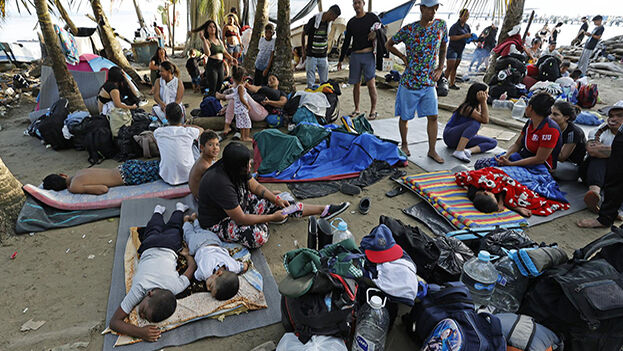
In 2021, 133,726 Migrants Passed Through the Darien Gap, One of the Most Dangerous Border Crossings

Migrants wait to board a boat to the border with Panama in Necoclí, Colombia. (EFE / Mauricio Dueñas Castañeda)

14ymedio biggerEFE (via 14ymedio), Necoclí, Colombia, 8 October 2022 — In the Colombian town of Necoclí they are already used to hundreds of people camping on their beaches every day to wait for boats that will take them to the border with Panama, on a migration to the United States that is constantly growing and threatens to “explode.”

It’s an uninterrupted flow of people from all over the world, entire families who walk together and share the desire to get a better future at any cost, even that of passing through one of the most dangerous border crossings in the world: a week-long adventure through a lush, mountainous jungle, which they say swallows people.

Last year, according to figures from the Panamanian authorities, 133,726 people crossed the Tapón del Darién, a number that had never been recorded before due to the difficulty of the journey. The numbers are constantly increasing, and in the first nine months of this year  151,572 have already passed through.

Necoclí is the first stop on the route through the Darién. This is an Antioquia town located on the east coast of the Gulf of Urabá, in the Colombian Caribbean, where, lulled by the vallenato and salsa music of the beach kiosks, migrants rest, laying on the sand while their children swim in the sea or make castles with dominoes. continue reading

“The situation is difficult. This problem is going to explode in our faces,” says a person from Capurganá, the town that receives them on the other side of the Gulf of Urabá, almost on the border with Panama and who knows the business well. He says that between 1,200 and 1,600 people pass every day, while last year, due to limitations of the Colombian Government, only 650 could pass.

Since it began to receive this constant exodus of people in transit, a phenomenon that has always existed but that skyrocketed last year, Necoclí has evolved. Migration is a business that is easy to perceive.

Now the company that manages the boats for the migrants — the same ones used by tourists who want to enjoy this paradisiacal corner of Colombia — is expanding; the company has bought three more boats.

There are more hotels and informal businesses selling food and rubber boots or exchanging dollars that flourish along the humble passage where garbage accumulates in the corners and migrants walk back and forth gathering what is necessary for the jungle crossing.

The wooden plank dock of just 200 meters now looks suspiciously at the brand new cement dock, which they built quickly, but which cannot be inaugurated because it’s too high for the boats.

Those who pass by here have also changed. While in previous years most were Haitians and Cubans, this year more than 70% are Venezuelans, some of whom get on the boats humming Pedro Navaja, by the Panamanian Rubén Blades, when they hear it in the background.

Leonardo hasn’t got tickets until Sunday, so his family, the 40 people who accompany him, will have to wait until then on the beach.

“Some say that Venezuela has improved, but it’s a big lie,” says Yasmari, one of the members of this large family. They come from Venezuela — or from other countries where they first tried their luck, such as Peru, Chile or Colombia itself — encouraged by acquaintances from the United States who tell them that things are better there.

They don’t hesitate to confess that they’re afraid of what they have in front of them, a jungle in which the risks of flooding rivers, insect bites, steep hills full of mud and torrential rains come together with robberies, rape and other dangers.

But that, they say, is better than staying where they come from. Fear doesn’t overshadow the will to achieve a future, although that means entering a reality that borders on the unreal and, above all, the inhuman.

Translated by Regina Anavy

____________

COLLABORATE WITH OUR WORKThe 14ymedio team is committed to practicing serious journalism that reflects Cuba’s reality in all its depth. Thank you for joining us on this long journey. We invite you to continue supporting us by becoming a member of 14ymedio now. Together we can continue transforming journalism in Cuba.

Cuba: During a Blackout, Residents of Santa Cruz del Sur Boo the ‘Full Bellies Up There’

Mass protest on Sunday in Santa Cruz del Sur, Camagüey. (Capture)

14ymedio bigger 14ymedio, Havana, October 10, 2022–Antonio Guiteras, a 280 megawatt power plant, could not contribute to the National Electric System (SEN) on Sunday as planned, nor will it be able to do so on Monday. Yesterday, the deficit reached 1.412 MW at the national level during peak hours at 11pm and people went out to the streets to protests in several areas of the Island.

The most watched and best documented protests, with videos shared on social media, were people banging on pots in Bejucal (Mayabeque province) and especially in Santa Cruz del Sur (Camagüey province), where residents threw themselves into the streets yelling, “Díaz-Canel motherfucker,” “Down with Díaz-Canel,” “Long live a free Cuba,” or “Down with the full bellies up there.”

“While restarting, the Antonio Guiteras power plant had a problem in its starter for which we are seeking a solution. We do not expect it to restart today,” informed the Cuban Electric Union (UNE) in its statement on Monday, which expected a maximum deficit of 41% for Monday.

According to the information, at 7 am, there were 1,676 MW generated and a demand of 2,553 MW; that is, a difference of 872 MW of which only 77 were due to the damages caused by Hurricane Ian. In addition, it is possible the maximum deficit will reach 1,000 MW. continue reading

On Sunday, the director of the main thermoelectric power plant in Cuba, Misbel Palmero Aguilar, stated in a declaration shared on Canal Caribe that “a fissure on the outside wall of the boiler, detected in the restarting process” on Saturday, has prevented the synchronization of the plant.

Furthermore, the official added that “this fissure has nothing to do with the breakdown that occurred a few days ago,” confirming that the solution for the failing Guiteras plant will be difficult. Palmero Aguilar said that while they were in the process of restarting on Saturday, as soon as it reached 70% and the pressure in the boiler increased, this fissure appeared in one of the tubes that supports a burner.

The director added that Guiteras has “mechanical defects caused by the expansion and contraction while starting and stopping the plant, which has been in use for 34 years,” and highlighted that the thermoelectric plant is subjected to continuous tension in its walls and starters “and that it was not possible detect this during the hydraulic test they conducted after the repairs they made to the boiler.”

Now they need to determine its caliber to fix the fissure, but it is evident that the power plant has been shut off more days than it has been functioning since the summer and that citizens continue without seeing the light at the end of the tunnel. Despite the jokes upon hearing the daily news on UNE, the desperation is evident.

“Stop trying to restart Guiteras, it no longer works. Stop wasting money on other things and invest in that. They don’t realize that’s the country’s main problem,” said one of the many comments on the news Monday. “Guiteras. Season 5. Episode 250. The New Cooling,” said another one ironically. “Guiteras has been out of service for more than ten days. Today it’s the starter, yesterday it was the leak, tomorrow surely another leak. Those who live in the provinces resisting and those who live in the capital just watch calmly. The problem is only for those who of us who live in the interior provinces,” adds another reader.

The blackouts in the provinces exceed, by a lot, any outages in the capital city. The 14ymedio correspondent in Holguín was without power for 12 hours on Sunday, from 6pm Sunday until 6am Monday.

Another Cubadebate reader who lives in that same province, in the Zayas neighborhood, stated that he’s been without water for a month and the blackouts last half the day. “Hundreds of calls to those who should provide water and no solution; explanations and justifications, thousands. We need leaders who move with more haste,” he reproached.

The information provided by UNE is repeated every day in the official daily and within minutes it becomes the most read and most commented news item of the day, even though it is a state-controlled media. The messages leave no room for doubt — people are reaching their limit.

“Only the truth can save us from this quagmire of poor governance in which we find ourselves. Nothing works — there is no electricity, terrible water service, basic food such as bread, milk and sugar, etc. in total deficit. Shortages of medicines and other products. Stores sell in MLC (freely convertible currency) at exorbitant prices for Cubans. We need to begin to recognize the problems, beginning with the newscast, and face the people. More critiques and real changes and stop with the slogans and social media. Urgent changes are needed and no more dressing it up.”

Translated by: Silvia Suárez

____________

COLLABORATE WITH OUR WORKThe 14ymedio team is committed to practicing serious journalism that reflects Cuba’s reality in all its depth. Thank you for joining us on this long journey. We invite you to continue supporting us by becoming a member of 14ymedio now. Together we can continue transforming journalism in Cuba.
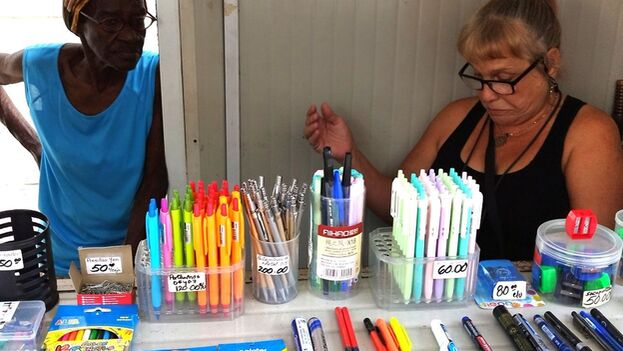
Newsstands in Cuba No Longer Sell Newspapers

Without announcements or fanfare, the kiosks for the official press have gradually become private businesses. (14ymedio)

14ymedio bigger14ymedio, Juan Diego Rodríguez, Havana, 10 October 2022 — Where before there were only old magazines and the occasional newspaper, now colorful pens, school notebooks and paper glue are on display. The small shop on 26th Street near Tulipán, in Havana, has been leased to a self-employed person who offers office products instead of the copies of Granma or Juventud Rebelde that until recently were sold in the small stand.

Without announcements or fanfare, the kiosks intended for the official press have been turning into private businesses that no longer market the publications with triumphalist headlines that come out of Cuban printers. The transformation has hardly surprised customers, who had already noticed that the arrival of newspapers was increasingly delayed and the number of copies decreased.

In a country where digital information sources are taking space away from paper, the economic crisis has also contributed to the official media losing prominence. “I used to buy the newspaper to use it as toilet paper, but a few days ago I came and found that they don’t sell newspapers here anymore,” a retiree who lives near the stand on 26th 14ymedio.

In Centro Habana, the mutation of the newsstands is also proceeding at an accelerated pace. In the Cayo Hueso neighborhood, “there are practically no stalls left that sell newspapers,” laments a neighbor on the corner of Infanta and San Lázaro. “Those who don’t have a mobile phone to read the news on the Internet don’t know anything because you can’t find a magazine or a newspaper in this whole area.” continue reading

The transformation has hardly surprised customers who had already noticed that the arrival of the newspapers was increasingly delayed and the number of copies decreased. (14ymedio)

“The most affected are the old men who bought Granma and resold it,” explains the woman, pointing to a kiosk on Calle Infanta where they still carry the Communist Party newspaper but only on Mondays. “They lost that income, or now they have to go further to find where they are selling it.” But not only has the type of merchandise that is offered in the stalls changed, but the subsidized price of the national press has now given way to the private sector. “A pen, 200 pesos and a notebook, 500,” she says.

“At least these kiosks are being used for something, because before it was a crime to see them empty,” says the woman. On the counter of one of these places there are erasers, rolls of transparent tape and mechanical pencils of various models. A box of colored pencils catches the eye of a passing child who also asks the price of a pencil sharpener. “They are at 50 pesos and they are very good, everything here is imported and of quality,” the vendor stresses. The word “Press” is still written on the outside of the stall.

____________

COLLABORATE WITH OUR WORKThe 14ymedio team is committed to practicing serious journalism that reflects Cuba’s reality in all its depth. Thank you for joining us on this long journey. We invite you to continue supporting us by becoming a member of 14ymedio now. Together we can continue transforming journalism in Cuba.
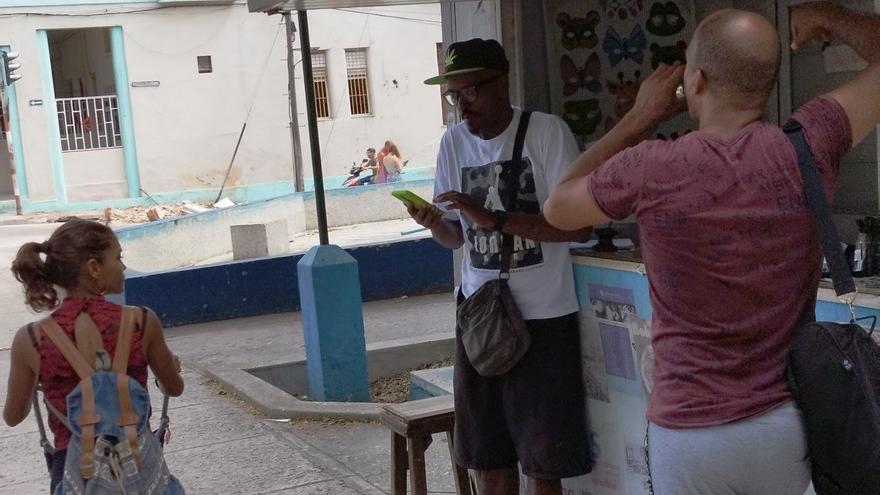
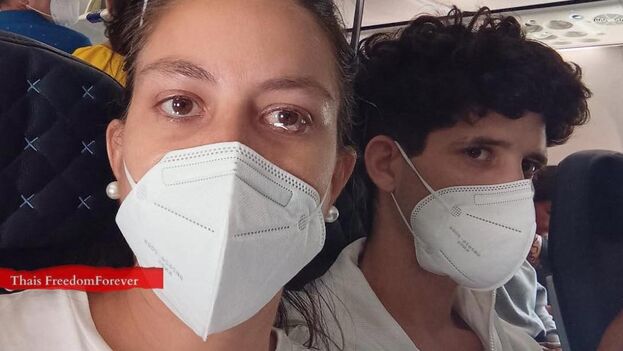
Thais Mailen Franco, One of the Detainees from the Obispo St. Demonstration, Arrives in the U. S. by the ‘Route of the Volcanoes’*

Thais Mailén Franco and her eldest son, leaving the Island by plane on August 12 (Facebook)

14ymedio bigger14ymedio, Havana, 7 October 7, 2022 — Thais Mailén Franco, one of those arrested for the demonstration on Obispo Street in Havana in April 2021, has been in U.S. territory since the early hours of Wednesday. “Crossing the California border, crossing the entire desert,” says the activist herself in a video posted on her social networks in which she shows that she is, at night, next to the fence built on the border with Mexico.

“We have gone through a lot on the crossing,” she confesses, “and we’re going to surrender to the United States Army right now,” she says before starting to cry. Franco is currently detained by the immigration authorities, according to the usual procedure in these cases.

The opponent left Cuba on August 12 with her eldest son, leaving the other two, 9 and 10 years old, in Havana. In a post on her Facebook page, next to a photo where they were both seen on a plane, she reported that her son had “been called to Compulsory Military Service” and she was threatened with “being returned to prison.”

“Painfully, the resources that we received, with a lot of sacrifice on the part of those who donated, shared, helped, weren’t enough for the two youngest children to leave as well,” she said in the same text.

A few weeks ago, on September 21, Franco herself, who kept her whereabouts secret until now, denounced that State Security had summoned her minor children for a “special services program.” “Special services of what?” the activist cried indignantly in a broadcast, where she affirmed that this “only happens in a dictatorship.”

That very day was exactly one year since she had been released without trial from El Guatao prison after five months of imprisonment for the protest on Obispo Street. Afterwards, she was sentenced to eleven months of house arrest, until July 12, 2022. continue reading

On April 30, 2021, in Old Havana, several activists tried to approach the house of the artist Luis Manuel Otero Alcántara, who was then carrying out a hunger strike, when the police prevented them from passing. At that time, they sat down to protest against what they considered a limitation of their right to free movement.

Their video, broadcast live, provoked broad solidarity with the detainees that day. Amnesty International was one of the first international organizations to ask for the immediate release of the protesters.

Together with Franco, Inti Soto, Ángel Cuza, Yuisan Cancio, Mary Karla Ares and Esteban Rodríguez were detained for months. Of them, all but two — Cuza and Cancio — are out of Cuba today.

Regarding the political prisoners of the Island, the U.S. Secretary of State, Antony Blinken, spoke harshly to the Organization of American States (OAS). “The Cuban regime continues to keep in prison hundreds of people unjustly detained in the protests of July 11, 2021, for the alleged crime of taking to the streets to peacefully ask their government to meet their basic needs and give them human rights. Some of those prisoners are minors; others were sentenced to decades in prison just for saying what they thought,” Blinken recalled.

Translator’s note: See

Translated by Regina Anavy

____________

COLLABORATE WITH OUR WORKThe 14ymedio team is committed to practicing serious journalism that reflects Cuba’s reality in all its depth. Thank you for joining us on this long journey. We invite you to continue supporting us by becoming a member of 14ymedio now. Together we can continue transforming journalism in Cuba.
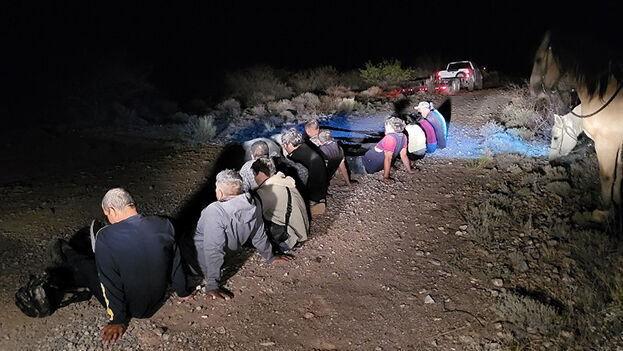
Belize and Cuba Will Talk About the ‘Worrying’ Increase in Migrants From the Island

To get to the United States, Cubans also use the Guatemala and Mexico route, entering through Belize. (CBP)

14ymedio bigger14ymedio, Havana, 7 October 2022 — The Government of Cuba and Belize will hold bilateral meetings at the end of October to discuss the increase in the number of Cuban citizens arriving in the Central American country.

Eamon Courtenay, Belize Minister of Foreign Affairs, Trade and Immigration, pointed out that Cuban migrants are the “most worrying” group for the Belizean government, either because they enter in transit to the United States or to stay in the country, as published in the local newspaper Breaking Belize News.

“We’ve noted a singular increase in immigrants, illegal and irregular,” Courtenay told the local newspaper, “and the Cubans increased significantly.”

Belize, on the Caribbean coast of Central America, has become a transit destination for Cubans who leave the Island, submerged in its worst economic and social crisis in recent history. In their eagerness to reach the United States, some try to cross the sea in rustic boats in the Florida Straits, and others resort to the route from Guatemala to Mexico, entering Belize.

Courtenay said that this situation was a central issue at a recent meeting of the Immigration Department, in which “recommendations” were prepared that will be delivered in a document to the Cuban Government.

For Courtenay, the “most important challenge” is to deport Cubans to the Island, because there are no direct flights between the two countries. Some migrants were transferred on Panamanian Copa Airlines flights, but, the official said, in the last deportation exercise the migrants caused problems, and the airline warned the Government that it will no longer accept this type of passenger. continue reading

The Belizean government will seek rapprochement with the Biden Administration to receive assistance because “preventing migrants from passing through Belize also serves the interests of the United States.”

In this regard, Courtenay posted a photograph on Twitter on Thursday with U.S. Secretary of State, Antony Blinken, accompanied by this message: “It was good to catch up to discuss matters of importance for Belize and the United States. We are committed to continuing to work on issues of mutual interest.”

The migration crisis in Cuba remains unstoppable. U.S. authorities have intercepted 6,182 balseros [rafters] since October 1, 2021, the highest figure since 2016, while the Government of Mexico reports that Cuban citizens are the second largest group that requests asylum when crossing their borders.

The Mexican Refugee Aid Commission reported that 14,056 Cuban migrants have requested protection, up to the end of September 2022, only surpassed by Honduras, with 23,146.

Translated by Regina Anavy

____________

COLLABORATE WITH OUR WORKThe 14ymedio team is committed to practicing serious journalism that reflects Cuba’s reality in all its depth. Thank you for joining us on this long journey. We invite you to continue supporting us by becoming a member of 14ymedio now. Together we can continue transforming journalism in Cuba.
A Chinese Company Will Resume the Russian Project to Improve the Railroad in Cuba

Among the points of the agreement are the restoration of the railway and locomotive workshops that are in the Special Development Zone of Mariel. (14ymedio)

14ymedio bigger14ymedio, Madrid, 7 October 2022 – The first edition of the International Transport and Logistics Fair held in Cuba closed this Thursday with great joy but without much concreteness. The minister of the sector, Eduardo Rodríguez Dávila, said that almost 40 contracts and more than 100 business agreements and “intentions” for land, sea and air had been signed.

However, there is information about the one signed with a Chinese company to improve the railway, a project that was already attempted with Russia but was paralyzed by Moscow in the face of repeated non-compliance by the Cuban side.

The Union of Railways of Cuba (UFC) and Beijing Fanglian Technology signed “two letters of intent for the gradual recovery of part of the railway infrastructure,” according to the official press last Tuesday.

Among the points of the pact are the restoration of the railway and locomotive workshops that are in the Mariel Special Development Zone, and the import of parts and pieces of the equipment.

Luis Roberto Roses Hernández, general director of the UFC, said this would make it possible to acquire “the necessary parts for the maintenance of high-scale Chinese locomotives and the gradual improvement of their reliability, which guarantee a better quality service in cargo and passenger transportation.”

Beyond that agreement, which reflects an intention for now, Rodríguez Dávila believed that the event served to “renew old contacts and make new ones” in order to recover the sustainable development of transport in Cuba. continue reading

There was also time to hold the United States accountable for the poor quality of service. Carlos Alberto González González, deputy director of the Directorate of Passenger Transport, said that “the supply deficit” is due to “the insufficient technical availability of the means and the diesel fuel due to the pressures exerted from Washington.” In addition, an official note from the ministry highlights that “the complex context” — which also affects the burden — is due to the “blockade of the United States Government.”

In October 2019, Cuba experienced the prequel to the episode that just happened with China. At that time, the Russian state railway company RZD signed an agreement with the Cuban Railway Union to modernize the entire Cuban railway structure. Moscow was in charge of the funding, with a value of 2,314 million dollars destined for the modernization of the infrastructure in this case (1,000 kilometers of road, materials, technology and training), as well as a traffic control center.

At the end of 2020, the director of RZD, Sergey Pavlov, temporarily concluded the project. “Unfortunately, we have had to suspend our project of comprehensive modernization of the Cuban railway infrastructure due to economic difficulties and quarantine restrictions on the Island, but we hope to resume work after the situation has stabilized,” he said.

During that period, Russia sent locomotives to the Island, but sources in the railway sector told 14ymedio that the machines were not suitable for the reality of the country. “They are high consumers of fuel. Compared to other locomotives on the market, they demand a large amount of fuel for their operation, and it’s now known that this is a problem here, because the supply we have is not always stable,” they said.

The shutdown of the Russian railroad continues to this day. In 2020, the executive secretary of the Russian-Cuban Intergovernmental Commission on Trade, Economic, Scientific and Technical Cooperation, Oleg Kucheriáviy, warned of the massive cancellation of investments in Cuba due to Havana’s noncompliance.

The official told the Russian press that of the 60 joint projects, only ten were being carried out, and he said at a meeting of the Senate Committee on International Affairs that the last session of the intergovernmental commission, which was to be held on the Island, was canceled due to the “silence” and “stalling” of the Cuban authorities.

In addition, Yuri I. Borisov, deputy prime minister of Russia and in charge of economic relations with Cuba since 2018, said in reference to the Cuban side: “They are complicated businessmen, I’m not going to hide it, the mentality of the past is constantly weighing on them. During the negotiations, in the positions they take, it always appears that we are an outpost of the world revolution and they simply have to help us,” he said.

With the pandemic, which was especially hard for the Island in 2021, none of this has improved, and public transport is still anchored in the past without managing more than the shipment of some equipment that is clearly insufficient, such as electric buses from Japan or Belgian buses.

The only announcement with support from the authorities is the creation of the title of Transport Engineer, a new career for professionals trained in the administration of human and material resources in that sector.

“The new transport engineer will participate in the technology transfer processes, act with economic awareness taking into account the Cuban reality and master legal elements related to his professional activity,” said Juan Cogollos, president of the national career commission and full professor at the University of Cienfuegos, where the specialty will be taught.

The new studies will last four years and have subjects such as transport engineering, electricity and automation, statistics and operational research, economics and process management, and transport technology and operation.

The authorities announced that graduates will be able to work in the Ministry of Transport and its business system, the private sector and other agencies linked to the specialty at a time when young people seem more encouraged to leave the Island due to the lack of opportunities or the miserable salaries they receive after having studied for years.

Translated by Regina Anavy

____________

COLLABORATE WITH OUR WORKThe 14ymedio team is committed to practicing serious journalism that reflects Cuba’s reality in all its depth. Thank you for joining us on this long journey. We invite you to continue supporting us by becoming a member of 14ymedio now. Together we can continue transforming journalism in Cuba.

Aerovaradero Allies with Maravana US Cargo to Expedite the Shipment of Packages to Cuba

Maravana Cargo, created two years ago in Hialeah, assured that now deliveries will arrive “with the greatest security” to their recipients. (Facebook/Maravana Cargo Inc.)

14ymedio bigger14ymedio, Havana, 8 October 2022 — Cubans living in the United States will be able to send more easily non-commercial packages, such as medical supplies, to their relatives on the Island after the state company Aerovaradero S.A. and the American company Maravana Cargo signed an agreement this Friday to shorten the times in cargo transport.

The agreement was signed on the last day of the International Transport Fair, held this week in Havana, the official agency Prensa Latina reported. About 23 small and medium-sizes businesses, as well as self-employed workers and state institutions, will benefit from this alliance.

Alejandro Martínez, president of Maravana Cargo, a company created two years ago in Hialeah (Miami), assured that now maritime deliveries and flights will arrive “with the greatest security” to their recipients, who import, above all, medicines and products that they cannot find in the Cuban market.

Aerovadero assumes the “commitment and responsibility to make deliveries in the shortest possible time,” said the general director of the state company, Mayelin Gotera, for whom a “way to gain credibility” is for the recipient to receive his package without damage or adulteration. continue reading

The agreement includes the transport of goods by sea, but Gotera clarified that Aerovadero will continue to focus on the air sector, because it’s a “well-regulated” alternative for large-volume loads.

The official also announced that they work in other alliances, without specifying which ones, to expand parcel services and reduce correspondence rates “with the aim of benefiting customers in the face of the limitations and low availability of goods products in the domestic market,” said Prensa Latina.

In August 2022, a package of easing measures for the import of non-commercial goods by natural persons from the United States came into force. One of these provisions allowed doubling the weight of packages that Cubans can bring up to 20 kilograms at a cost of 200 dollars. For the same amount before, it was only possible to transport 10 kilograms.

The weight of the package for which no tariff is paid was also increased from 1.5 to 3 kilograms, in addition to reducing the customs levy charged depending on the volume of the merchandise.

Translated by Regina Anavy
____________

COLLABORATE WITH OUR WORKThe 14ymedio team is committed to practicing serious journalism that reflects Cuba’s reality in all its depth. Thank you for joining us on this long journey. We invite you to continue supporting us by becoming a member of 14ymedio now. Together we can continue transforming journalism in Cuba.
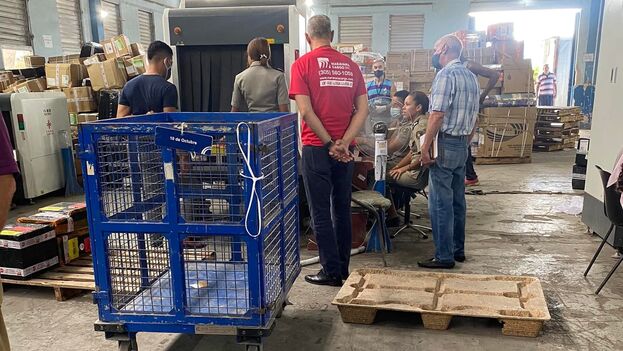
Despite the Embargo, U.S. Humanitarian Donations to Cuba are Growing

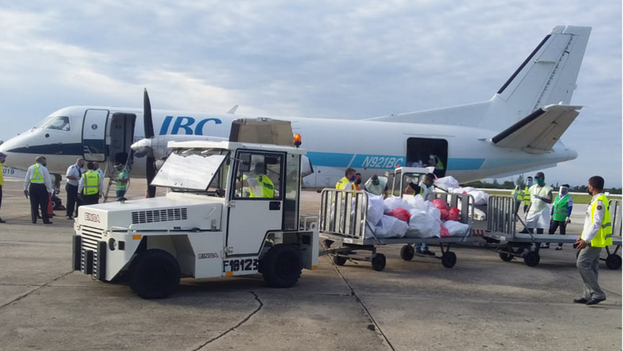
In August 2022 alone, donations from the United States exceeded $3.3 million after Hurricane Ian, which devastated the Island. (Archive/Customs of Cuba)

14ymedio bigger14ymedio, Havana, 9 October 2022 — While the Cuban regime devotes a lot of energy to make believe that the shortage of food on the Island is due to the Washington embargo, mass imports of chicken from the United States continue and, above all, the humanitarian donations of that country are growing, which in the first eight months of this year have already exceeded those of all of 2021.

According to the U.S.-Cuba Economic and Economic Council, the inputs received during the first eight months of 2022 represented more than 12.14 million dollars, a figure that exceeds by 9.6% the total received in 2021, by 11.07 million. In August alone, donations reached $3.39 million, which meant an increase from the 2.26 million received in July.

Last month, western Cuba suffered significant damage from the passage of Hurricane Ian, particularly in agriculture and economic infrastructure, in addition to a widespread blackout throughout the Island, which lasted almost a week and generated protests in various parts of the country.

The Council reported that Cuba had not only received more donations from the United States, but that imports of food and agricultural products in August 2022 grew by 6.2% compared to the same month last year.

In its report, this independent economic analysis group based in New York pointed out that food imports represented just over $29.28 million compared to the $27.65 million recorded in 2021.

Among the main imported products are cookies, condiments, beans, frozen chicken meat, sea cucumbers, coffee, non-alcoholic beverages, deodorants, soap, insecticides and disinfectants. Only health care supplies accounted for a little more than $879,628 in August, although the Cuban government doesn’t report on their destination. continue reading

The United States is Cuba’s main supplier of chicken, which accounts for almost 90% of total imports. However, this year the Island had to pay more for poultry meat, since the kilo reached $1.1 in July, the highest price in the last three years.

From January to August 2022, imports from the United States exceeded $197.03 million, 4.5% below the $206.43 million recorded in the same period of 2021.

In addition to food and agricultural products, the Biden Administration has just approved an exclusive license in favor of the Maryland-based Premier Automotive Export (PAE) distributor, so that it can sell motorcycles and electric skateboards from the United States on the Island.

Translated by Regina Anavy

____________

COLLABORATE WITH OUR WORKThe 14ymedio team is committed to practicing serious journalism that reflects Cuba’s reality in all its depth. Thank you for joining us on this long journey. We invite you to continue supporting us by becoming a member of 14ymedio now. Together we can continue transforming journalism in Cuba.