Infant Mortality in Havana Skyrockets to 14 per Thousand Births, the Highest in the Country

The data went unnoticed in the middle of a report from the plenary session of the Provincial Party Committee

This unprecedented crisis is becoming increasingly impossible for the regime to cover up. / 14ymedio

14ymedio bigger14ymedio, Havana, 31 January 2026 — Infant mortality in Havana saw a dramatic increase in just one year, rising from 10.2 per 1,000 live births in 2024 to 14 in 2025. This figure, the highest in the country, was acknowledged this Friday by the First Secretary of the Provincial Committee of the Communist Party , Liván Izquierdo Alonso, during the last meeting of the Extraordinary Plenum of the Provincial Committee of the Party. In the middle of his report, in which he spoke of exceeding net sales and business profit targets, he discreetly revealed this shocking statistic, which demonstrates the collapse of the healthcare system in which the country finds itself.

The revelation, though brief, hinted at the magnitude of the problem. During his speech, Izquierdo attempted to qualify the figure by pointing out that there are 4% more family doctor’s offices in the capital than last year, an improvement that in theory should bring healthcare closer to the population, but which in practice fails to offset the increase in mortality.

Last year, the chikungunya and dengue epidemic overwhelmed the island’s healthcare system, claiming the lives of 8,500 people, the vast majority of whom were children. These arbovirus-caused diseases, which normally have a relatively low mortality rate, became a major threat due to the country’s deteriorating hygiene, sanitation, and food security. The combination of epidemic outbreaks, a lack of medical resources, insufficient medicines, and the nutritional vulnerability of many children created a scenario that authorities now recognize as a health emergency unlike anything seen since 2021, the most critical year of the COVID-19 pandemic in Cuba. continue reading

Adding to this worrying situation is the low birth rate: last year ended with 3,108 fewer births than in 2024.

Just a month ago, at the end of 2025, the Ministry of Public Health announced a worrying increase in infant mortality in Cuba, which rose from 7.1 to 9.7 deaths per 1,000 live births in a single year—figures that already signaled the accelerating crisis across the country. In Havana, the figures skyrocketed from 10.2 at the end of 2024 to 14 deaths per 1,000 live births in 2025, a jump that reflects an alarming trend. Since 2020, Havana has remained above the national average.

Adding to this worrying situation is the low birth rate: last year ended with 3,108 fewer births than in 2024, while the mass exodus that, according to Cuban demographer Juan Carlos Albizu-Campos , has reduced the island’s population by 24% in just four years, is contributing to a shift in the country’s demographic structure. The island is gradually aging; more than a third of its inhabitants are over sixty, and young people represent a decreasing proportion of the Cuban population—they are the ones who emigrate the most—a reality that also influences the country’s social and health dynamics.

This unprecedented crisis is becoming increasingly impossible for the regime to conceal, a regime that until recently boasted of being a leader in healthcare in the region. In 2018, the country recorded an infant mortality rate of 3.9 per 1,000 live births, although several experts questioned the accuracy of this figure, which was by far the best in the Americas. In any case, the contrast with the 2025 figures highlights the brutal deterioration of the healthcare situation in less than a decade.

____________

COLLABORATE WITH OUR WORK: The 14ymedio team is committed to practicing serious journalism that reflects Cuba’s reality in all its depth. Thank you for joining us on this long journey. We invite you to continue supporting us by becoming a member of 14ymedio now. Together we can continue transforming journalism in Cuba.
The Cuban Regime’s Response to Trump: “Homeland or Death”

  • “The president of the Empire is behaving like Hitler, with a criminal, contemptuous policy aimed at taking over the world,” Díaz-Canel said.
  • Despite everything, Havana does not rule out maintaining a “serious, responsible dialogue based on international law” with the US.
The discourse, repeated for more than six decades, no longer disguises the lack of new ideas or the profound decay of the model. / Cubadebate

14ymedio bigger14ymedio, Havana, January 31, 2026 — Faced with increasing pressure from Washington and the accelerating loss of its fuel suppliers, the Cuban government has once again recycled its oldest and most predictable response: “Homeland or Death.” There are no indications that they have an alternative economic program. Nor are there any visible political reforms or signs of internal course correction. Only rhetoric.

The phrase resurfaced this Friday, uttered by President Miguel Díaz-Canel in a speech widely reported by Cubadebate, and was reiterated hours later in an official statement sent to the international press. The message offers nothing new; in the face of the latest US sanctions, the strategy remains the same.

The discourse, repeated for over six decades, no longer disguises the absence of new ideas or the profound decay of the model. The official narrative once again revolves around a “decline empire,” constant external aggression, and a heroic country that resists. But it carefully avoids any reference to its own mistakes, the structural inefficiency of the system, or the lack of freedoms and rights.

The scene is all too reminiscent of Venezuela in the days leading up to Nicolás Maduro’s arrest. Then, as now in Cuba, the government’s rhetoric combined calls for peace, accusations of international conspiracies, and a supposed willingness to engage in dialogue “without preconditions,” while in practice not a single real political concession was offered. The outcome is well known.

In Havana, the script is repeated almost verbatim. Díaz-Canel asserts that Cuba is willing to engage in dialogue with the United States, but only continue reading

“on equal terms,” without “interference” and without touching the pillars of the system. In other words, a dialogue to change nothing. A rhetorical exchange without consequences, designed more for international consumption than to solve the daily problems of the population.

The regime’s alliances have also failed to translate into economic stability or relief for an island facing its worst crisis.

The government reaffirms its commitment to “continue working with friendly countries,” alluding to Russia, China, and Iran, presented as geopolitical counterweights to Washington. But this alliance, more symbolic than effective, has also failed to translate into economic stability or relief for an island facing its worst crisis in the last three decades.

The official statement insists that the United States has failed in its attempt to “surrender and destroy” the Revolution for 67 years. However, the text omits a key question: what has the Cuban government itself achieved during that same period to guarantee prosperity, rights, and sustained well-being for its citizens?

The energy crisis, aggravated by the suspension of Venezuelan supplies and US pressure on Mexico, is presented exclusively as a consequence of the “blockade,” when in reality it is also the result of decades of mismanagement, lack of investment and centralized decisions that scare away capital and talent.

Even Havana’s traditional allies no longer hide their frustration with a state incapable of honoring its financial commitments or undertaking even minimal reforms to stabilize its exhausted economy. This is compounded by the apparent normalization of non-payment and an ever-increasing dependence on donations and political concessions, accepted as simply part of the system’s normal operation.

The regime presents itself as a “peaceful people,” open to dialogue, but it intensifies the mechanisms of internal repression.

Belligerent rhetoric is also accompanied by an increasingly bombastic tone. The words used to define the United States are designed for ideological mobilization, not for diplomacy or the resolution of real conflicts. And they reinforce the perception of a power trapped within its own narrative.

Meanwhile, official figures presented at recent party rallies paint a far less rosy picture, with a collapsed transportation system, industrial production well below projections, stagnant housing, and rising infant mortality. All of this, according to the official narrative, is being managed with more slogans and calls for resistance, but with no concrete solutions in sight.

The regime presents itself as a “peaceful people,” open to dialogue, but it intensifies internal repression, persecutes dissent, and maintains absolute control over political life. It calls for international “understanding” while denying fundamental rights within its borders. It speaks of popular sovereignty without allowing free elections or pluralism.

Patria o Muerte” [Fatherland or Death] thus functions once again as a closing slogan, but not as a project for the future. A useful phrase for uniting the ruling elite and justifying inaction, but increasingly distant from an exhausted citizenry that demands not epic narratives but concrete solutions: electricity, food, medicine, transportation, and freedom.

____________

COLLABORATE WITH OUR WORK: The 14ymedio team is committed to practicing serious journalism that reflects Cuba’s reality in all its depth. Thank you for joining us on this long journey. We invite you to continue supporting us by becoming a member of 14ymedio now. Together we can continue transforming journalism in Cuba.
Some 50 Cuban Migrants Are Stranded at the Guantanamo Naval Base

Havana doesn’t want to receive them, and Washington doesn’t know what to do with them.

File photo of an area of ​​the detention center at the U.S. military base in Guantanamo. / EFE/ Marta Garde

14ymedio bigger14ymedio, Havana, January 3o, 2025 — Dozens of Cuban migrants detained in the United States have been stranded for weeks at the Guantanamo Naval Base. The story was revealed this Thursday by The New York Times (NYT) in a report by journalist Carol Rosenberg, the newspaper’s correspondent in Guantanamo for more than twenty years and one of the reporters with the best knowledge of the base’s inner workings.

According to the US newspaper, around 50 Cuban men, aged between 20 and 50, were transferred to Guantanamo in December and January as part of an operation by Immigration and Customs Enforcement (ICE). Many of them had been detained in the United States for months, some with work permits and pending asylum applications. Faced with uncertainty, several agreed to return to Cuba. But they never imagined the flight would end at the naval base.

Since then, they have remained confined in military facilities, first in former barracks and, more recently, in Camp 6, a prison that for years housed jihadists. The transfer occurred, according to sources cited by the Times, due to technical problems in other buildings on the base.

The principle obstacle isn’t in Washington, but in Havana. Cuba maintains severe restrictions on flights from the base to the rest of the country. For one of these men to reach Cuban soil, he would first have to fly to a U.S. city and from there board another plane to Cuba. That operation, which U.S. officials claim to have considered, was never carried out. continue reading

Cuba is among the countries most reluctant to accept the return of its own deported citizens.

There have been no official declarations from the Cuban government, no press releases, and no public explanations regarding the situation of these citizens. Nor have there been any visible efforts to expedite their return. The only known policy is the acceptance of a single monthly deportation flight from the United States, a number that Washington has unsuccessfully requested be increased, according to diplomatic sources cited by the newspaper. In fact, the flight scheduled for January should have departed yesterday—they always leave on the last Thursday of each month, unless it coincides with a US holiday—and it has not yet taken place.

The lack of gestures on the part of Havana has created a moment of heightened tension with the Trump administration, which, following the arrest of Nicolás Maduro on January 3, has maintained intense pressure on the island, declaring it an “unusual and extraordinary threat” to its national security and foreign policy. According to a person familiar with the matter who spoke to the Times on condition of anonymity , the regime has continued to refuse to increase the frequency of repatriation flights.

According to Refugees International, Cuba is among the countries most reluctant to accept the return of its own deported citizens. “The Cuban government doesn’t want to receive them back,” confirmed Yael Schacher, an analyst with the organization, quoted by the NYT, noting that the current economic crisis—marked by blackouts, food shortages, and fuel scarcity—reinforces that posture.

The result is a limbo in which Cubans are trapped between two governments, with no clear rights or defined timelines. Some have managed to call relatives in the US, who in turn have informed family members on the island. On social media, wives and mothers have created support groups where rumors of release, messages of faith, and snippets of phone calls from the base circulate.

An order signed by President Trump in January 2025 instructed that the base be prepared to receive up to 30,000 deportees.

The immigration operation that brought them to Guantanamo originated from an order signed by President Trump in January 2025, instructing that the base be prepared to receive up to 30,000 deportees. A year later, the actual number is far from that target. According to the New York Times itself, some 780 people have passed through the base under this scheme, without the U.S. government having demonstrated that most of them had criminal records.

The cost of the operation is also not transparent. The Pentagon acknowledged to Congress that the first month cost $40 million. Since then, no official figures have been released. Democratic Senator Gary Peters, chairman of the Senate Committee on Homeland Security, estimated that the cost of the operation could reach about $100,000 per day for each migrant detained at the base.

Tom Cartwright, an activist and migrant rights advocate who has monitored ICE flights for years, questioned the necessity of Guantanamo as a transit station for these deportations. In his view, the use of the base is not based on a real logistical need, but rather on a political decision.

Cartwright believes that the Cubans held in Guantanamo serve as a tool of pressure against Havana, in an attempt to force the Cuban government to accept more than one monthly repatriation flight, a demand that has so far been rejected.

Neither ICE nor the Department of Homeland Security has responded to questions from the Times about why these men are still there or when they will be transferred. Nor has the Havana regime.

____________

COLLABORATE WITH OUR WORK: The 14ymedio team is committed to practicing serious journalism that reflects Cuba’s reality in all its depth. Thank you for joining us on this long journey. We invite you to continue supporting us by becoming a member of 14ymedio now. Together we can continue transforming journalism in Cuba.
Delcy Rodríguez Proposes a General Amnesty Law for Political Prisoners in Venezuela

The Judicial Revolution Commission and the Program for Coexistence and Peace will present the law to the National Assembly

File photo of Venezuela’s acting president, Delcy Rodríguez. / EFE/ Rayner Peña R.

14ymedio biggerEFE (via 14ymedio), Caracas, 30 January 2026 — Venezuela’s interim president, Delcy Rodríguez, proposed a general amnesty law on Friday to release political prisoners who have been detained from 1999 to the present, a period that covers the Chavista governments.

“I want to announce that we have decided to promote a general amnesty law that covers the entire period of political violence from 1999 to the present,” Rodríguez said at the opening ceremony of the judicial year at the Supreme Court of Justice (TSJ), broadcast by the state channel Venezolana de Televisión (VTV).

The Chavista leader instructed the Judicial Revolution Commission and the Program for Coexistence and Peace to present the law to the National Assembly (AN, Parlamento) in the “coming hours,” as well as to provide “maximum collaboration” to the legislative body for its approval.

“May it be a law that serves to repair the wounds left by political confrontation, by violence, by extremism, that serves to redirect justice in our country and that serves to redirect coexistence among Venezuelans,” she added.

“I want to announce that we have decided to promote a general amnesty law that covers the entire period of political violence from 1999 to the present.”

The Chavista leader asked the country’s political prisoners, including those who have already been released, to “not allow revenge, retaliation, or hatred to prevail.”

Rodríguez indicated that this proposed law excludes those continue reading

prosecuted or convicted for homicide, drug trafficking, and human rights violations.

Several NGOs have been calling for a general amnesty for all political prisoners for years, simultaneously submitting various draft laws. The latest was proposed last Tuesday by the Surgentes organization and the Mothers for Truth Committee.

The text from the NGO and the Committee included 12 articles and proposed amnesty for “all those people who have been persecuted, social activists, journalists, members of victims’ committees, military personnel and people persecuted or deprived of their liberty in the context of post-election mobilizations.”

Earlier this month, a parliamentary faction in Venezuela also proposed an amnesty law to, it argued, bring “peace of mind” to the families of people “who are unjustly detained.”

“May it be a law that serves to heal the wounds left by political confrontation, by violence, by extremism, that serves to restore justice in our country.”

Currently, according to the NGO Foro Penal, there are 711 political prisoners, but the Venezuelan government denied that there were people detained in the country for these reasons and stated that those detained committed crimes, mostly related to terrorism.

The last time an amnesty law was enacted in Venezuela was in December 2007, when the late President Hugo Chávez (1999-2013) pardoned people involved in the 2002 coup against him.

In 2016, Parliament, then controlled by the opposition, passed an amnesty law, which was declared unconstitutional by the Supreme Court of Justice (TSJ), which is aligned with Chavismo, and so the law could never be applied.

In August 2020, Venezuelan President Nicolás Maduro granted, by decree, 110 pardons to opposition members, union leaders, and social actors accused of various crimes, ahead of legislative elections held in December of that year, an event that the majority of the opposition did not attend.

____________

COLLABORATE WITH OUR WORK: The 14ymedio team is committed to practicing serious journalism that reflects Cuba’s reality in all its depth. Thank you for joining us on this long journey. We invite you to continue supporting us by becoming a member of 14ymedio now. Together we can continue transforming journalism in Cuba.
Cuba’s Oil Union ‘Cupet’ Labels as ‘False’ a Statement Announcing the Suspension of Fuel Sales to the Public

Reporters from 14ymedio and users confirm widespread shortages in Havana and Matanzas

Lines outside the Oro Negro gas station in Matanzas. / 14ymedio

14ymedio bigger14ymedio, Havana / Matanzas, Olea Gallardo / Pablo Padilla Cruz, January 30, 2026 – “They’re all false, the capital is paralyzed.” Comments like this are how users in groups dedicated to gasoline sales in Havana responded to the  this Thursday about a false official statement.

The spurious text, reproduced by the state company itself, bears Cupet’s letterhead and colors. “Given the serious fuel supply situation affecting the country, worsened by the intensification of the economic, commercial, and financial blockade imposed by the Government of the United States and the external pressures exerted on our traditional suppliers,” reads the note in the usual government prose, “the Cuba-Petroleum Union (Cupet) and the Ministry of Tourism inform the population and the tourism sector as follows: It has been decided to temporarily halt the general supply of fuel at gas stations and state points of sale as of the date of issuance of this statement and until further notice.”

The measure, the supposedly fake document continued, was “inevitable due to the interruption of imported supplies, caused by hostile actions and foreign pressures that limit access to essential energy resources,” something consistent with the growing hostility from the United States, especially after the capture of Nicolás Maduro in Venezuela, to prevent fuel from reaching the island.

The statement was not implausible, as it doubled down on blaming “unilateral coercive measures imposed by foreign powers”

The statement was not implausible, as it doubled down on blaming “unilateral coercive measures imposed by foreign powers” and urged people to “avoid non-essential travel and coordinate continue reading

any priority needs with local authorities.” A “controlled and limited supply” would be allocated to “essential” sectors such as health care, public transportation, electricity generation, and tourism, the text also said, ending with a call for “unity, discipline, and solidarity among all Cuban men and women in these difficult times.”

In a brief tweet, Cupet rejected all of this information, asserting: “This note circulating on some digital media is false. Fuel supplies to the country’s network of gas stations have not been halted.”

However, reports published in recent days by 14ymedio and comments from customers at gas stations in the capital show just how closely reality resembles what the fake Cupet statement described. “There’s hardly any gasoline anywhere. I went by the ones in El Vedado and nothing; at the one at 5th and 120 they came out and said there was little left, not enough for everyone,” one person wrote, referring to stations that sell in pesos.

“At Línea and E people slept there, so the line is intact; nobody is leaving until they restock,” another complained. “Only Zapata and 4 have served regular gas today,” a third reported. A fourth tried to excuse the situation by mentioning stations that have switched to dollar sales: “This story doesn’t change; every day it’s the same stations selling in pesos. Today they already served Coyula, Corral Falso, Infanta, El Mar, Guanabo, Camilo Cienfuegos, Santa María del Rosario, and Hatuey.”

An empty gas station in Matanzas. / 14ymedio

Questions keep coming in the chats. “Does anyone know what’s going on with the Cupet station at G and 25, since the Ticket isn’t advancing?” asked a young man, referring to the app that acts as a “virtual line” to buy fuel. The reply was blunt: “None of them are moving; they’re only serving stations that operate in DOL-LARS, so we’re going to have to get used to paying for gasoline in the currency they wanted to eliminate with the economic restructuring and that now is stronger than ever.” The commenter didn’t stop there and, with emojis and capital letters, added ironically: “Before, 1 dollar was worth 25 CUP and now 1 dollar is worth… So down with the blockade or down with whoever needs to go down.”

The situation in Havana has worsened with the arrival of a cold front from the north. Due to possible storm surges, pumps have been removed from both the El Tángana gas station, located at the Malecón and 13th Avenue, and Riviera, also on the seafront.

Meanwhile, in the provinces, gasoline shortages are also a major source of tension. Added to this, customers complain, is the poor communication of Cimex, the commercial company in charge of gas stations and part of the military conglomerate Gaesa.

In recent weeks in Matanzas, the state company briefly announced fuel sales via the Ticket app, setting a limit of 100 slots for power generators and 50 for motor vehicles. The information, shared with almost no details and even reposted by company employees on social media, sparked a wave of indignation among citizens.

“It is shameful that an entity that forces its workers to post these notes isn’t capable of explaining where, how, and when fuel can be bought”

“It’s shameful that an entity that forces its workers to post these notes isn’t capable of explaining where, how, and when fuel can be bought,” complained Jean Michel, a resident of the Versalles neighborhood. “I wasted hours of my time because they didn’t specify that at the San Luis gas station they were only serving users with power generators.”

He wasn’t the only one confused. Residents of Peñas Altas say the new sales modality raises more questions than answers. “Who exactly is it aimed at—private individuals, state entities, public transport?” asks Ania, who lives in the neighborhood. “In what currency is it sold, CUP or MLC? What amount are we entitled to?” According to her, not even workers at the Oro Negro or Bellamar stations have been able to clarify matters. “Those people think we ordinary folks have time to figure everything out,” complained Marlene, another neighbor.

The confusion also affects Cimex employees themselves. A company worker, who asked not to be identified, told this newspaper that they often share information they themselves don’t know.

“I’m not a communications specialist. I never studied that, but they force me to post on my personal profile things I don’t even know where they come from,” she complained. In her view, at company headquarters “there’s either a lot of inexperience or they simply don’t care how decisions are communicated.” The priority, she says, is to announce that a station is opening, without explaining under what rules or conditions.

Not even workers at the Oro Negro or Bellamar stations have been able to clear up the doubts. / 14ymedio

This information vacuum has eroded public trust and multiplied wasted time and citizen frustration, especially when it comes to a vital resource. Although slots have been allocated for registered power generators and private vehicles, fear that fuel will run out persists. The turns in line advance extremely slowly and satisfy no one.

Raudel, a resident of the Iglesias neighborhood, has been waiting since last November for his turn—number 613—to buy diesel at the Bellamar station. “When they do have fuel, it’s 50 people at a time, maybe once a month if you’re lucky. If everything goes well, maybe in December I’ll be able to buy what I’m entitled to… and then wait again,” he says resignedly.

Among motorcyclists engaged in informal transport, the situation is even more critical. Darío, who works ferrying passengers, explains that the assigned gasoline doesn’t even come close to meeting his needs. “In USD we can get it at 1.10 or 1.20, but when there isn’t any, which is most of the time, you have to buy from hoarders at 650 or 700 pesos a liter. Do the math for a trip that uses half a liter and tell me if that’s profitable.”

Although the 50 liters sold through the Ticket app somewhat ease the economic burden, the process is riddled with technical and organizational obstacles. “Everything is a problem—the registration, the email, the turn… and when it’s time to distribute, nobody knows anything. Not Cimex, not Cupet, not the workers,” Darío says, adding a common complaint: “Meanwhile, government cars, the Minint [Ministry of the Interior], and the FAR [Armed Forces] fill up without lining up; they have their own station. There’s never a fuel shortage there.”

The deep energy crisis goes beyond national borders and threatens to deepen the collapse of tourism. In one of the Telegram groups for gas stations, a man identifying himself as Gustavo from Argentina asked for help this Thursday to see whether anyone could provide information about gas stations in Cienfuegos, Trinidad, and Ciego de Ávila for a car he had rented from Transtur for an upcoming trip to the island. Replies from some users, saying there are stations where one can pay with international cards, did not reassure him.

In another message, he says he has no guarantee that the vehicle will be delivered with a full tank or that he will be able to refuel in the provinces, and he complains that Transtur has not responded to emails or WhatsApp for three days. “I don’t know how I’m going to manage getting a refund for the car rental; it’s $700,” he says, concluding: “Unfortunately, I’m going to have to cancel my trip to get to know Cuba.” Another commenter replies bluntly: “Cancel your trip! It’s the right decision.”

Translated by Regina Anavy

____________

COLLABORATE WITH OUR WORK: The 14ymedio team is committed to practicing serious journalism that reflects Cuba’s reality in all its depth. Thank you for joining us on this long journey. We invite you to continue supporting us by becoming a member of 14ymedio now. Together we can continue transforming journalism in Cuba.
Cuba and the U.S. Accuse Each Other of Being a Threat to Regional Peace

  • Foreign Minister Bruno Rodríguez condemns Washington’s intention to “impose a total blockade on fuel supplies” to the Island
  • The president of the state news agency Prensa Latina accuses Trump of seeking “a genocide of the Cuban people”
  • China condemns U.S. measures against energy supplies
U.S. and Cuban flags in front of the U.S. Embassy in Havana / EFE / Ernesto Mastrascusa

14ymedio bigger14ymedio, Madrid, January 30, 2026 – Cubans were heatedly debating whether the new U.S. measure to impose tariffs on countries that deliver oil to the Island is good news that would bring down the regime or a punishment that would be borne by the people. Into that debate stepped Foreign Minister Bruno Rodríguez, with his usual verbosity: “We condemn in the strongest terms the new escalation by the United States against Cuba. It now proposes to impose a total blockade on fuel supplies to our country,” he wrote on his X account.

The minister added: “To justify it, it relies on a long list of lies that attempt to portray Cuba as a threat that it is not. Every day there is new evidence that the only threat to peace, security, and stability in the region, and the only malign influence, is that exerted by the U.S. government against the nations and peoples of Our America, whom it seeks to subject to its dictates, strip of their resources, mutilate their sovereignty, and deprive of their independence.”

Rodríguez denounced that the U.S. is resorting “to blackmail and coercion, trying to get other countries to join its universally condemned policy of blockade against Cuba, and threatening those that refuse with the imposition of arbitrary and abusive tariffs, in violation of all norms of free trade.” This statement has accumulated more than 200 reactions for and against, among which one stands out as particularly interesting: “And besides condemning, what else is your regime going to do? Because you’re going to be left with zero fuel.”

For her part, Mexican President Claudia Sheinbaum appealed this Friday to the principle of national sovereignty to defend crude shipments to Cuba through Petróleos Mexicanos (Pemex). According to the president, the imposition of tariffs announced by the U.S. government “could trigger a far-reaching humanitarian crisis.” continue reading

“We have to know the scope, because we also don’t want to put our country at risk in terms of tariffs,” said Mexican President Claudia Sheinbaum

However, Sheinbaum said she wants to know the scope of the announced measure so as not to “put Mexico at risk,” and therefore instructed the foreign minister, Juan Ramón de la Fuente, to establish immediate communication with the U.S. State Department.

The recent threat by U.S. President Donald Trump comes amid negotiations over the United States–Mexico–Canada Agreement (USMCA). Trump has threatened to pull his country out and negotiate bilateral agreements, as he has already done with some nations.

“We have to know the scope, because we also don’t want to put our country at risk in terms of tariffs,” the president said at her usual morning press conference, this time from Tijuana, Baja California.

Sheinbaum insisted that Mexico “will always seek the diplomatic route” and called, “first, for the self-determination of peoples and, second, to avoid a humanitarian crisis for the Cuban people.”

For the moment, there does not appear to be a plan within the Cuban government, whose only available mechanism for now is rhetoric. “Having to resort to so much abuse against Cuba is the greatest recognition by the U.S. executioners of their own defeat. Long live Cuba and down with the criminal siege of the U.S. We will resist, we will defend the peace we conquered through struggle. We will live and we will prevail!” wrote the deputy head of the Cuban mission in Mexico, Johana Tablada, in a tone similar to her minister’s tweets.

Going even further was the president of the state news agency Prensa Latina, Jorge Legañoa, who was the very first voice of officialdom to speak out on Cuban television, in a special news broadcast. “What is being sought? What is being sought is a genocide of the Cuban people, and if it materializes through tariffs, the effect would be to paralyze electricity generation, transportation, industrial production, agricultural production, the availability of health services, the water supply… in short, all spheres of life, asphyxiation by the U.S. government.”

Legañoa denied one by one all the accusations contained in the executive order signed by Donald Trump this Thursday. “Cuba is not a threat to national security and never has been,” he maintained. He then rejected claims that there are Russian or Chinese facilities on the Island, that there is cooperation with terrorism, and that political opponents are persecuted and tortured. He also accused the U.S. of harboring terrorists, citing the late Luis Posada Carriles as an example.

The journalist described the new measure as “an act of aggression” and called on the international community to choose whether or not to join that blockade policy. “We ask ourselves whether the world will be governed by the use of force to impose the will of one state over another and compel a third to join in,” he reflected.

“We ask ourselves whether the world will be governed by the use of force to impose the will of one state over another and compel a third to join in”

Legañoa stressed that no country can survive without fossil energy and accused the U.S., after seven decades of failing to do so, of trying to bring down a “legitimate system of full sovereignty, social justice, and the promotion of peace and solidarity with the rest of the world. Let us not be deceived by another blow from the empire,” he concluded.

Legañoa’s appeal to other countries has found its first response in China, which this Friday condemned the measure, considering that it violates Cuba’s sovereignty and deprives its population of the right to development. Chinese Foreign Ministry spokesperson Guo Jiakun said at a press conference that Beijing “firmly supports Cuba in safeguarding its national sovereignty and security,” and opposes “external interference” and “actions and even inhumane practices that deprive the Cuban people of their right to survival and development.” He also reiterated support for lifting the embargo and any pressure policy.

Nevertheless, the response does not differ from statements made in previous days or from those China once made regarding Maduro’s Venezuela. This Tuesday, Guo used very similar language when the new executive order was not yet known. “We urge the U.S. side to stop depriving the Cuban people of their right to survival and development, to end the blockade and the sanctions against Cuba,” he said, adding that China will continue to support the Island “within its capabilities.”

Attention is now turning to Russia, which in 2026 supplied about 6,000 barrels of fuel per day, according to the University of Texas Energy Institute. For the moment, the Kremlin has not spoken, although Russia’s ambassador to the UN, Vasily Nebenzya, did address a related issue: the chances that the U.S. could achieve political change on the Island similar to what it achieved in Caracas. “In Venezuela, without a doubt, a betrayal took place. It is something spoken about quite openly. A part of the senior officials, in fact, betrayed the president,” Nebenzya said in statements to Russian television. He added: “That little trick won’t work in Cuba.”

“In Venezuela, without a doubt, a betrayal took place. That little trick won’t work in Cuba”

Another focal point is Mexico, Cuba’s main crude supplier after Venezuela. This Thursday, before Trump’s measure was announced, the U.S. president spoke with his Mexican counterpart, Claudia Sheinbaum, in what he described as a “very productive” conversation on border issues and drug trafficking. “Mexico has a wonderful and very intelligent leader. They should be very happy with that!” the president remarked.

Sheinbaum, for her part, has spent several days carefully navigating the issue with the press, which has persistently asked about the cancellation of a Pemex crude shipment that was supposed to arrive in Cuba at the end of January. The Mexican president maintained that it was a “sovereign” decision by the state company and that crude would continue to be sent depending on the company’s decisions or, failing that, on a government decision for “humanitarian reasons.” In 2025, between 6,000 and 12,000 barrels per day arrived on the Island from Mexico, depending on estimates. Although two weeks ago the U.S. Secretary of Energy said he would not pressure Mexico to suspend those exports, Trump’s latest statements point in the opposite direction.

“It seems it won’t be able to survive. Cuba won’t be able to survive,” the U.S. president said last night. When asked whether he is trying to “strangle” Cuba, he replied that the word is “very harsh,” but insisted that the Island is “a failed nation.”

“You have to feel sorry for Cuba because they have treated people very badly. We have many Cuban Americans who were treated very badly and would like to return,” he said to close the matter.

Translated by Regina Anavy

____________

COLLABORATE WITH OUR WORK: The 14ymedio team is committed to practicing serious journalism that reflects Cuba’s reality in all its depth. Thank you for joining us on this long journey. We invite you to continue supporting us by becoming a member of 14ymedio now. Together we can continue transforming journalism in Cuba.
The First Shipment of a Chinese Donation of 30,000 Tonnes of Rice Arrives in Cuba.

Havana and Santiago de Cuba each received 2,400 tonnes, with a delivery ceremony held in the capital.

El viceprimer ministro, Óscar Pérez-Oliva Fraga, y el embajador chino, Hua Xin, estuvieron al frente de la ceremonia de La Habana. / Canal Caribe

14ymedio bigger14ymedio, Madrid, 20 January 2026 — Up to 30,000 tonnes of rice will arrive in Cuba from China in the coming weeks, according to an announcement made by the official press on Monday, reporting the arrival of the first 2,400 tonnes in Havana and the same amount in Santiago de Cuba. The delivery in the capital was marked by a reception ceremony attended by authorities, including Deputy Prime Minister Óscar Pérez-Oliva Fraga and Chinese Ambassador Hua Xin.

“This assistance is another tangible sign of the solidarity that unites us. We are confident that, with the joint efforts of both countries, no difficulty will be able to hinder our path forward,” said the diplomat at the ceremony, held at the Ministry of Domestic Trade’s Loading and Unloading Centre.

“We deeply appreciate and are grateful for this assistance at a difficult time when levels of aggression are rising and the United States’ economic, commercial and financial blockade against the Cuban people is intensifying in an unprecedented manner,” said Pérez-Oliva.

“We deeply appreciate and are grateful for this assistance at a difficult time when levels of aggression are rising and the economic, commercial and financial blockade is intensifying in an unprecedented manner.”

In the provinces of Pinar del Río, Artemisa and Mayabeque, two pounds per person will be delivered, while in Havana it will be one continue reading

and a half pounds and on Isla de la Juventud one pound. However, it is not clear how much will reach the east, although the provinces of Guantánamo, Granma and Santiago de Cuba were specifically mentioned.

According to Hua Xin, the next shipment of 15,000 tonnes is already ready to set sail, and a quarter of the total – 9,600 tonnes – will be distributed in the middle of next month.

The donation is part of China’s Emergency Food Aid Project to Cuba, under which similar shipments have already been delivered. In 2024, China delivered just over 20,400 tonnes as part of the same programme, the first shipment of which – 408 tonnes – arrived in six flights due to the urgent nature of the situation on the island at the time. South Korea and, in particular, Vietnam are other countries that have made similar donations of grain.

However, this aid barely covers a fraction of the population’s needs, which traditionally consumed around 600,000 tonnes per year.

For this year, the authorities announced the planting of around 200,000 hectares, double the amount in 2025, but still far from the country’s needs. In 2024, Cuba harvested around 80,000 tonnes, 30% of what it produced six years earlier. Between 2012 and 2018, the island experienced growth in harvests, exceeding 300,000 tonnes.

The amount was still insufficient for the population, forcing the country to import as well. However, in 2024, almost 100% of the rice distributed through the ration card system had to be purchased.

However, in 2024, almost 100% of the rice distributed through the ration book had to be purchased.

Attempts to boost yields have so far proved unsuccessful, as can be seen by comparing the yields produced on land granted in usufruct to the Vietnamese company AgriVMA. While national production yields around two to 2.5 tonnes per hectare – compared to the five tonnes achieved in the past – the Asian company achieves 7.2 tonnes on its land in Pinar del Río.
Furthermore, according to data from the inter-state cooperation programme, yields of up to 9.14 tonnes per hectare have been reported for some of the varieties used in this joint project.

At the end of last year, Roberto Caballero, a member of the National Executive Committee of Agricultural and Forestry Technicians, sparked heated controversy when he commented on the television programme Cuadrando la Caja that the State was allocating resources beyond its means to the rice production programme, a crop that, in his opinion, is not suited to the soil and climate conditions of the island – just like potatoes. The technician proposed focusing efforts on products with a greater chance of success and stated that neither of these two crops was culturally national. “We are not Asian, this is not a Cuban habit,” he stressed, provoking endless criticism on social media.

Translated by GH

____________

COLLABORATE WITH OUR WORK: The 14ymedio team is committed to practicing serious journalism that reflects Cuba’s reality in all its depth. Thank you for joining us on this long journey. We invite you to continue supporting us by becoming a member of 14ymedio now. Together we can continue transforming journalism in Cuba.
Unilever Evacuates Its Workers in Cuba Amid Fears of a U.S. Intervention

According to the EFE news agency, companies and embassies on the Island are “updating their evacuation plans and their lists of resident nationals”

The Unilever Suchel plant was inaugurated in 2022 in the Mariel Special Development Zone, in Artemisa. / Granma

14ymedio bigger14ymedio / EFE, Havana, January 29, 2026 – The British multinational Unilever, which produces personal hygiene and cleaning products in the Mariel Special Development Zone in partnership with the state-owned company Suchel, has evacuated its foreign workers from Cuba. This was reported by EFE, citing two sources close to the company who requested anonymity, as Unilever itself did not respond to questions from the Spanish news agency.

Not only companies but also embassies, EFE reported this Thursday, are reviewing their contingency and evacuation plans as a result of U.S. pressure on the Island following the operation carried out on January 3 in Venezuela that ended with the capture of Nicolás Maduro and his wife, Cilia Flores.

The Spanish agency contacted foreign diplomatic and business sources who confirmed that concern has escalated in recent weeks amid growing geopolitical uncertainty in the Caribbean and the possibility that the United States could even be preparing a military intervention.

“It is our responsibility to review plans and prepare scenarios,” a diplomat in Havana told EFE.

“It is our responsibility to review plans and prepare scenarios,” said a diplomat in Havana who asked that her name be withheld “due to the sensitivity of the issue.”

Nearly a dozen European and Latin American countries acknowledged to the Spanish agency that they are “updating their evacuation plans and their lists of nationals residing in Cuba, in some cases calling their citizens one by one to verify the information.” continue reading

Likewise, there are diplomatic missions preparing to endure long periods without electricity, fuel, and water, eventualities they believe could arise from the combination of the current context of total crisis on the Island and increasing U.S. pressure.

A minority of embassies—unnamed by EFE—said they do not see the need to update their evacuation plans for now, although they did not rule out doing so at some point and said they remain alert to the possibility that emergency procedures may need to be activated in the future.

As for the private sector, the agency reports that several subsidiaries of international companies privately acknowledge that geopolitical uncertainty has led them to reconsider their activities in Cuba with their parent companies.

The reasons cited include a potential U.S. military intervention, however limited it might be (as in Venezuela), and the impact on their operations of the country’s severe economic deterioration, especially the increase in power outages and the critical shortage of fuel.

If shipments of crude oil and derivatives from Venezuela and Mexico are definitively cut, maintaining production will be unsustainable

Some international firms—always under condition of anonymity—say they have fuel reserves for their manufacturing operations, but warn that if shipments of crude oil and derivatives from Venezuela and Mexico are definitively cut, it will be impossible to sustain production.

Since Maduro’s capture, the United States has issued several direct warnings to Cuba and has forced the cessation of Venezuelan oil supplies to Havana, the Island’s main source of fuel for more than 25 years. In the midst of that campaign, and without explanations from the government, Mexico also canceled a crude oil shipment to the Island that had been planned for January on a vessel that will now end up in Denmark.

This same week, U.S. President Donald Trump said that, following the energy shutdown, Cuba is “about to fall,” and just yesterday, during a Senate hearing, Secretary of State Marco Rubio said he would “love” to see a change of “regime” on the Island, although he clarified that this did not mean Washington would provoke it.

Trump had previously gone further, stating that the only thing left to do in Cuba was to “go in and destroy the place,” to which Rubio added: “If I were in Havana, I would be worried, even if just a little.”

U.S. Under Secretary of State Christopher Landau himself said on Wednesday that Washington would like Cubans to be able to “exercise their fundamental freedoms” as early as 2026, a clear reference to political change on the Island.

According to an exclusive published last Thursday by The Wall Street Journal, what the U.S. administration is prioritizing is the search for a “traitor” within the Cuban regime who—much as it is doing with Delcy Rodríguez in Venezuela—could help facilitate a transition to democracy on the Island.

Translated by Regina Anavy

____________

COLLABORATE WITH OUR WORK: The 14ymedio team is committed to practicing serious journalism that reflects Cuba’s reality in all its depth. Thank you for joining us on this long journey. We invite you to continue supporting us by becoming a member of 14ymedio now. Together we can continue transforming journalism in Cuba.
The 700,000 Barrels Aboard the Tanker Swift Galaxy Destined for Cuba Will Ultimately Go to Denmark

The Mexican president dodges questions about the suspension of oil deliveries to the Island

The Swift Galaxy, flying the Panamanian flag, was christened Parthenon when it began sailing in 2003 under the Greek flag / maritimeoptima

14ymedio bigger14ymedio, Madrid, January 28, 2026 – Energy uncertainty continues in Cuba after Mexican President Claudia Sheinbaum resisted giving clear answers about the future of Pemex shipments. The president had to respond to questions from the press, which has been keenly interested in the issue since Bloomberg reported on Monday that the state oil company suspended an oil cargo bound for the Island.

“As we have said, it is a sovereign decision and Pemex makes its decisions. And as we have also said, Mexico’s decision to sell or provide oil to Cuba for humanitarian reasons also has to do with a sovereign decision that has existed for many years; it is not recent,” Sheinbaum said at her usual morning press conference. She was being asked about the cancellation of the Swift Galaxy’s voyage, which was supposed to arrive on the Island around this time but disappeared from the schedule, according to the U.S. outlet.

The Swift Galaxy, flying the Panamanian flag, was anchored for 100 days at the Mexican port of Pajaritos, until December 10

Cuban expert Jorge Piñón of the University of Texas has drawn attention to the tanker’s unusual route and its large size (more than 700,000 barrels), far larger than the vessels Pemex typically uses for shipments to Cuba. The Swift Galaxy, flying the Panamanian flag, christened Parthenon when it began sailing in 2003 under the Greek flag and adopting its current name in March 2025, was anchored for 100 days at the Mexican port of Pajaritos until December 10. On that date it set sail for Jamaica, then Colombia, before crossing the Atlantic to Gibraltar and finally continue reading

changing course to a much more northerly destination: Denmark, where it is expected to arrive on February 4, according to Vessel Finder.

Sheinbaum shed little light on the matter, even when asked directly. “Are you denying that the oil shipment was suspended or is about to be suspended?” a reporter asked. “It is a sovereign decision and is taken at the moment it is deemed necessary,” she insisted. The president nevertheless denounced the U.S. blockade preventing Venezuelan crude from reaching Cuba, which “has generated a supply problem,” she said.

“Mexico has always been supportive and Mexico will continue to be supportive. So the decision of when it is sent, how it is sent, is a sovereign decision and depends on what Pemex determines, based on contracts or, in any case, on a government decision of a humanitarian nature to send it under certain circumstances,” she concluded.

Speculation continued in the country on Tuesday. Some analysts maintain that shipments are being halted out of fear of U.S. reprisals, although the U.S. Secretary of Energy said they would not ask Mexico to take such a step. Others believe it may simply be due to supply problems, and a third group argues that if the explanation were technical, it would have been made public.

On Tuesday, the Ticket system indicated the restocking of 8 of the 24 gas stations in eastern Havana

The last tanker to arrive in Cuba from Mexico was the Ocean Mariner, on January 9, carrying 86,000 barrels of crude, which Havana’s Ñico López refinery is currently processing to supply fuel to the capital’s gas stations. On Tuesday, the Ticket system indicated the restocking of 8 of the 24 gas stations in eastern Havana, all of which had been closed just the day before. Meanwhile, in the western area, only 6 of the 14 stations were operating.

In the past year, according to Mexican outlet Animal Político, Mexico sent Cuba oil worth $556 million, although it is still unknown how or who paid for it or whether it was a barter or a donation, the latter being the only option denied by Pemex.

According to the Bank of Mexico (Banxico), over the 31-year period from January 1993 to September 2024, oil exports to Cuba totaled $841.9 million. By contrast, in just 13 months of the Sheinbaum administration (October 2024 to November 2025), Cuba received Mexican crude worth more than $1.1 billion.

Translated by Regina Anavy

____________

COLLABORATE WITH OUR WORK: The 14ymedio team is committed to practicing serious journalism that reflects Cuba’s reality in all its depth. Thank you for joining us on this long journey. We invite you to continue supporting us by becoming a member of 14ymedio now. Together we can continue transforming journalism in Cuba.
A Third US Aid Flight Arrives in Cuba for Those Affected by Hurricane Melissa

The Pan American Health Organization (PAHO) announces a new aid package worth 1.2 million euros thanks to three international donors: Korea, the EU, and The Church of Jesus Christ of Latter-day Saints.

Arrival of the flight in Santiago de Cuba with US humanitarian aid. / Caritas Cuba

14ymedio bigger14ymedio, Madrid, January 29, 2026 – Santiago de Cuba received a third shipment of humanitarian aid from the United States on Wednesday for those affected by Hurricane Melissa in the eastern part of the country, according to the Catholic organization Cáritas.

The cargo, which arrived accompanied by two representatives of the Archdiocese of Miami—Joaquín Espino, rector of the Shrine of Our Lady of Charity, and Sister Eva Puelles, a member of the Daughters of Charity—consists of 648 food kits and 510 hygiene kits, which will be distributed by Cáritas in the community of San José.

The donation will be delivered “gradually by the parish team and volunteers,” once again accompanied by the U.S. international agency Catholic Relief Services (an organization founded by U.S. Catholics) and Caritas Germany.

According to the Cáritas statement, the donations will be delivered “to people who have been previously identified,” based on “their vulnerabilities,” with priority given to families headed by single mothers with young children, older adults, as well as people with disabilities and limited or no mobility.

The cargo arrived accompanied by two representatives of the Archdiocese of Miami—Joaquín Espino, rector of the Shrine of Our Lady of Charity, and Sister Eva Puelles, a member of the Daughters of Charity. / Cáritas Cuba

“This protocol, applied in strict adherence to humanitarian principles and to Caritas’s international safeguarding policy, is the bridge that turns generosity into concrete hope and guarantees that the Christian values of fraternity and love of neighbor prevail,” the statement underscores.

On January 14 and 16, the first shipments of humanitarian aid from the U.S. government—worth a total of $3 million—arrived in Cuba and were delivered by Cáritas to communities in the provinces of Holguín and continue reading

Santiago de Cuba, two of the five eastern regions hardest hit by Melissa.

The shipments have included rice, beans, cooking oil, sugar, water purification tablets, pots, kitchen utensils, blankets, and flashlights.

The donation has become another point of friction between the governments of both countries. When U.S. Secretary of State Marco Rubio announced in October the delivery of humanitarian aid to the Cuban people to prevent it from being controlled by Cuban authorities, the regime criticized him for attempting to bypass official channels in what it called a form of “political opportunism.”

The Catholic Church offered itself as a neutral channel to distribute the aid, a proposal that some saw as a solution, while others argued that the institution is too closely linked to the authorities.

When the first shipment arrived, Cuban authorities complained that, after so much time, they had learned of the cargo’s arrival through the Church rather than through official communication from the United States. Nevertheless, they said they would accept the aid, as it was a donation from the American people as taxpayers through their taxes.

On Wednesday, the Pan American Health Organization (PAHO) announced a new donation, also aimed at those affected by the hurricane, with a total value of €1.2 million. In a press release reviewing the coordinated response following Melissa, the organization added that “additional resources have been mobilized thanks to contributions from three international donors.”

PAHO shipment in Cuba after Hurricane Melissa. / PAHO

Most of the funding comes from the European Union through its humanitarian aid agency (European Civil Protection and Humanitarian Aid Operations—ECHO), with €700,000 approved for the rehabilitation of affected health institutions, strengthening epidemiological surveillance, and the acquisition of medicines, diagnostic supplies, vector-control equipment, and resources to ensure safe water and restore the functional capacity of services.

In addition, the Government of Korea has contributed $300,000 for generators, emergency kits, and hygiene supplies aimed at restoring essential services and preventing infectious diseases. Finally, the Church of Jesus Christ of Latter-day Saints provided $300,000 for the purchase of emergency supplies, rapid tests for communicable diseases, and equipment for vector-control actions.

“During the last quarter of 2025, the Pan American Health Organization (PAHO) supported the country’s response to the damage caused by Hurricane Melissa, in a context also marked by a simultaneous outbreak of dengue and chikungunya. To respond to Melissa, more than 11 tons of essential medical supplies were sent from PAHO’s Strategic Reserve in Panama; several field assessment visits were conducted, and work was carried out with different partners to expand the reach of the aid. Three months after the event, recovery actions supported by partners continue to be implemented, and this will remain the case over the next six months,” the statement adds.

Translated by Regina Anavy

____________

COLLABORATE WITH OUR WORK: The 14ymedio team is committed to practicing serious journalism that reflects Cuba’s reality in all its depth. Thank you for joining us on this long journey. We invite you to continue supporting us by becoming a member of 14ymedio now. Together we can continue transforming journalism in Cuba.
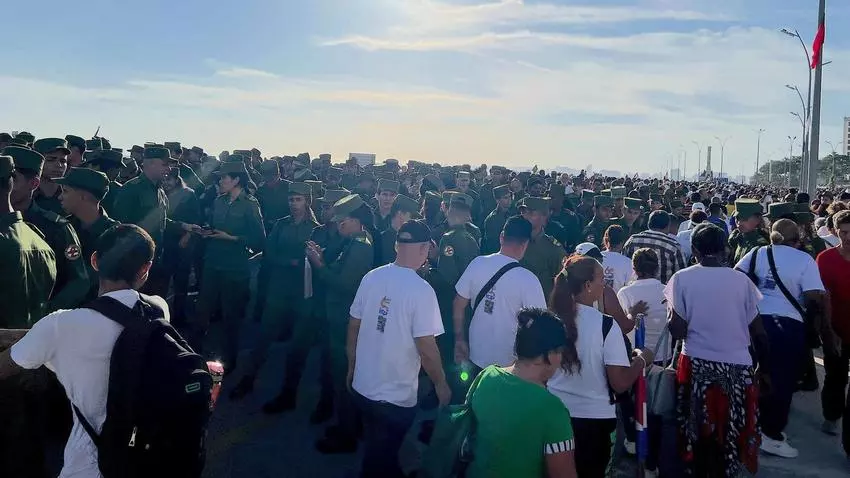
A Lackluster Torchlight March Without Raúl Castro in Response to the Cuban Regime’s Imminent Collapse

The crowd was very focused on making the steps look full, because the park, which in other years was overflowing, was empty this time. / 14ymedio

14ymedio bigger14ymedio, Dario Hernandez, Havana, 28 January 2025 — “Thousands of Cubans, led by young people, are marching tonight with torches through the streets of Havana honoring José Martí and, with him, his firm and unwavering anti-imperialist stance.” That was the response of Cuban Foreign Minister Bruno Rodríguez to US President Donald Trump, hours after the American again predicted the fall of the regime due to the lack of oil, on a day when doubts about Mexican crude shipments remained unresolved.

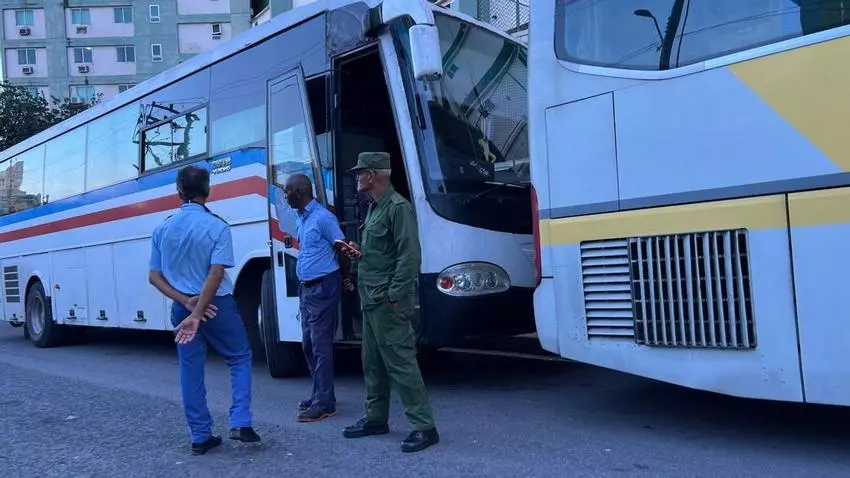
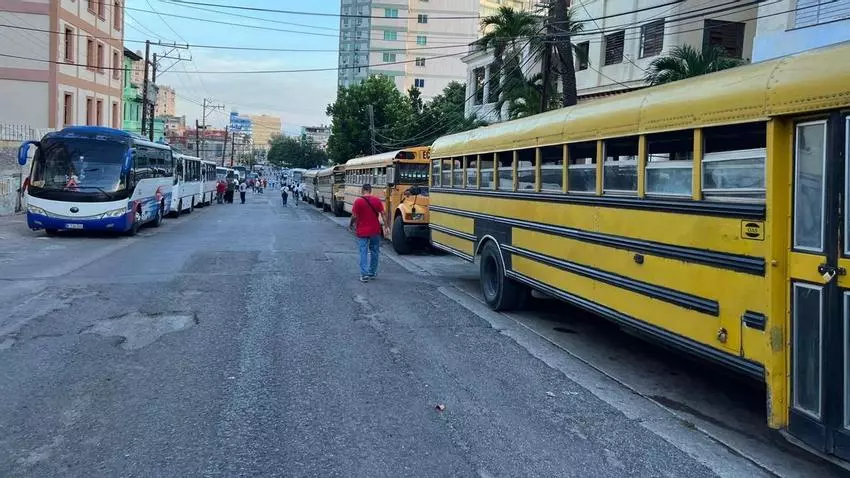
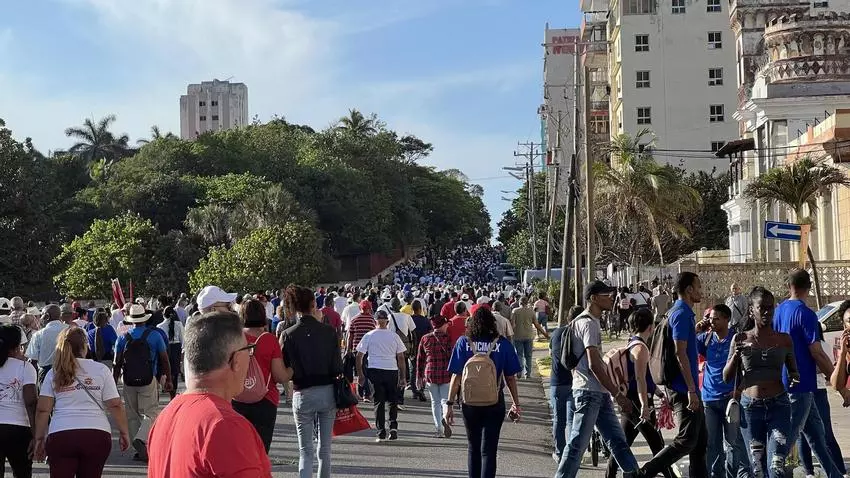
The reality was far less epic. Yesterday’s march drew much smaller crowds than last year, and although some young people, already hoarse, shouted slogans on street corners, indifference was widespread. “Most people leave within the first few blocks, and others throw down their torches at the first opportunity,” said Alejandro, a Havana resident who came more out of curiosity than revolutionary fervor. “It seems the security cordons, rather than protecting us, are there to prevent people from heading en masse for the buses parked on Carlos III Avenue,” he quipped.

“It seems that the security cordons, rather than protecting anyone, are there to prevent people from flocking to the buses parked on Carlos III Avenue” / 14ymedio

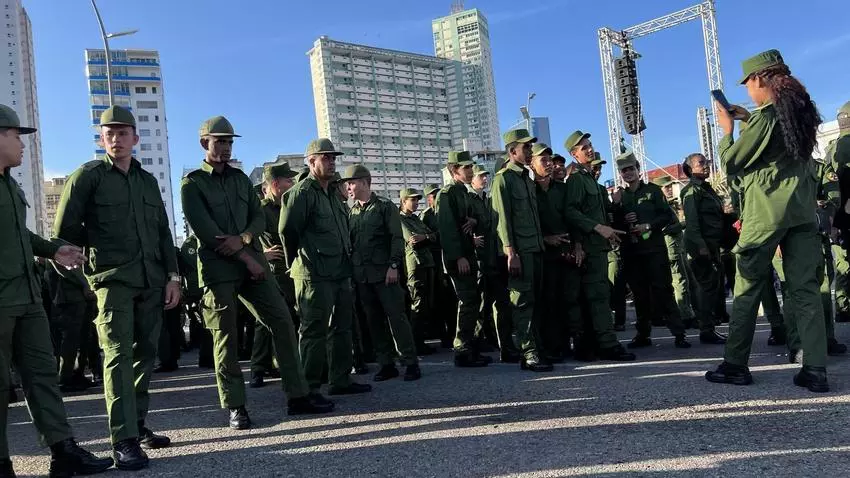
Heavy police presence, road closures, and a crowd intent on making the steps appear full, because the park, which in other years was overflowing, was empty this time. “While the inaugural speech was being given, people were preoccupied, not paying attention,” a Havana resident observed. The presence of workers, sports schools, and cadets was more significant this year, but there were far fewer students than usual. The conversations were almost entirely focused on one topic: the power outages, Trump, and Mexico were on everyone’s lips, and it was no surprise. continue reading

“Cuba is about to fall. Cuba is a nation that is very close to collapse,” Trump had just told the press before beginning a rally in Iowa. The president reiterated—as he did on January 9—that Havana “got its money from Venezuela, got its oil from Venezuela, but they don’t have it anymore.” Not another word about the island, although he did continue praising “the largest oil reserves in the world”—referring to Venezuela’s—and the “excellent job” being done by Delcy Rodríguez. “We have a very good relationship with the leaders of Venezuela, and we’re going to keep it that way,” he said.

The words were not well received in Havana, especially during one of the biggest propaganda events of the year, this time commemorating the 173rd anniversary of José Martí’s birth. But every cloud has a silver lining, and the incident served to invigorate the previously lackluster rhetoric. “This is not an act of nostalgia, it is a call to action,” said Litza Elena González Desdín, national president of the Federation of University Students (FEU), which organizes the march every year with the support of the Communist Party’s propaganda apparatus.

The event was attended by top government officials, who paid tribute to Fidel Castro, whose centenary is being celebrated this year. / 14ymedio

“It is up to us to defend sovereignty, build more social justice, and raise the banner of Latin American unity and anti-imperialism,” he continued, turning into an epic statement, saying that the youth “do not accept new or old chains and do not surrender or sell out.”

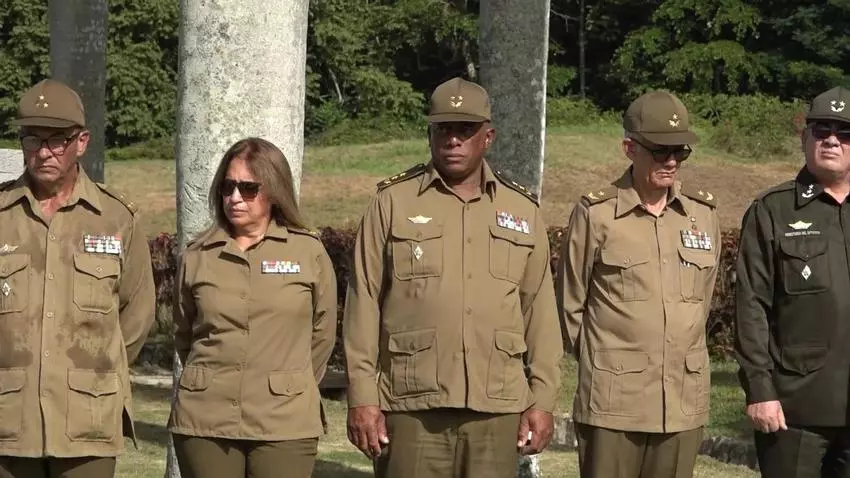
The event, which, incidentally, was not attended by Raúl Castro – for the first time in at least ten years – nor Ramiro Valdés, who is suffering from health problems, was attended by the top brass of the Government, who evoked Fidel Castro – whose centenary is being celebrated this 2026 – and tried, with little success, to turn it into a demonstration of revolutionary reaffirmation in the face of the unprecedented crisis the country is experiencing.

A Lackluster Torchlight March Without Raúl Castro in Response to the Cuban Regime’s Imminent Collapse / 14ymedio

____________

COLLABORATE WITH OUR WORK: The 14ymedio team is committed to practicing serious journalism that reflects Cuba’s reality in all its depth. Thank you for joining us on this long journey. We invite you to continue supporting us by becoming a member of 14ymedio now. Together we can continue transforming journalism in Cuba.

Cuban State Security Detains Yoani Sánchez and Returns Her to Her Home With a Ban on Leaving

Cuban authorities follow through on their warning to prevent people from attending a reception at the residence of US Ambassador Mike Hammer

Yoani Sánchez was followed for several minutes by a State Security agent in civilian clothes with his face covered, his back to the camera in the image. / 14ymedio

14ymedio bigger14ymedio, Madrid, 28 January 2026 — Yoani Sánchez, director of 14ymedio, was arrested in the street Wednesday to prevent her from attending a reception at the residence of the US mission chief in Havana, Mike Hammer. Her husband, Reinaldo Escobar, a columnist for the same publication, who left through another door of their building, was also stopped by two plainclothes State Security agents and forced to return home.

Followed for several minutes by an off-duty officer in his mid-twenties with his face partially covered, Sánchez managed to contact the newsroom in Madrid to explain what was happening. The young man called her by name, and she told him to identify himself, saying she didn’t know who he was, to which he didn’t reply. Instead, he called what sounded like a patrol car or other officers, requesting backup.

However, he couldn’t pinpoint her exact location to give them. It is well known that the Ministry of the Interior often assigns officers to the capital from other provinces, especially from the eastern part of the island, who frequently don’t know the city.

At the intersection of Ayestarán Avenue and First Street, in the Plaza de la Revolución municipality, the director of ’14ymedio’ stopped her walk and was then approached

At the intersection of Ayestarán Avenue and First Street, in the municipality of Plaza de la Revolución, the director of 14ymedio stopped her walk and was then approached by the man who was following her and three other people who caught up with them, a man and two women.

Both men showed Sánchez ID cards bearing the initials DSE (Department of State Security), but the women never identified themselves. Once there, they told her she had to walk back home—”perhaps because they don’t have gasoline,” the journalist speculated—and that she couldn’t leave “until tomorrow.”

The four escorted Sánchez to the ground floor of her building. The agents made it clear that the reason for the operation was to prevent the two journalists from attending the reception hosted by the head of the US mission. “Of course she was going there, where else would she go?” the editor of this newspaper overheard one agent remark to another.

The event to which both Sánchez and Escobar had been invited marked the beginning of the celebrations for the 250th anniversary of the United States’ independence, this Wednesday at 5:00 pm at Hammer’s residence, located in the Playa municipality. The evening’s special guest is Rob Allison, the US State Department’s coordinator for Cuba affairs.

Other dissidents, such as Boris González, Berta Soler, and Ángel Moya, also have operations underway at their respective homes.

Other dissidents, such as Boris González, Berta Soler, Ángel Moya, Manuel Cuesta Morúa, and Marthadela Tamayo, also have operations being carried out at their homes. “This is how the anniversary of the Apostle [José Martí] is being experienced in Cuba today, with police surrounding the homes of activists and arresting others,” wrote González’s wife, Juliette Fernández Estrada  on her Facebook wall to report the police harassment on this day, which also marks the 173rd anniversary of José Martí’s birth. “It’s very cold and drizzling; I’m glad the weather is adverse to those who engage in these despicable actions,” she added, illustrating her words with two photos taken that same morning.

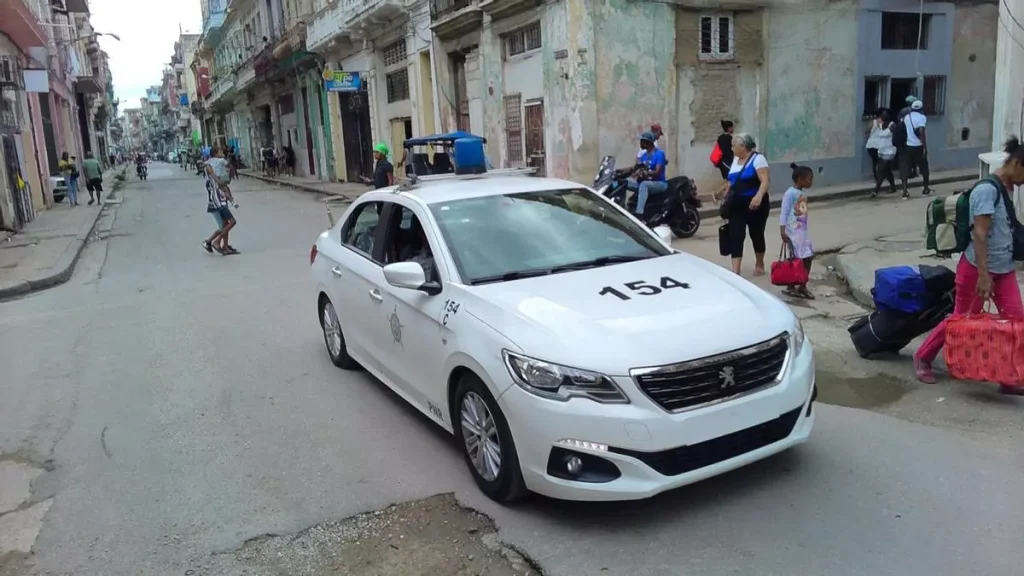
In the case of Soler, leader of the Ladies in White, and her husband, Ángel Moya, they claim to have known nothing about the reception held today at Hammer’s house. Independent journalists Camila Acosta and Ángel Santiesteban are also being harassed this Wednesday. “I’ve been surrounded since early this morning. Several State Security officers, men and women, on motorcycles, in a Lada, and in a patrol car,” Acosta recounted on her social media, denouncing that the officers had also been “aggressive with the neighbors.”

Dagoberto Valdés, director of the Convivencia Studies Center in Pinar del Río, is also under police cordon, preventing him from leaving his home. Last Friday, he was arrested by State Security, as was his colleague Yoandy Izquierdo. Both were interrogated for several hours in an operation led by Majors Ernesto and Manuel, both officers of the political police, who acknowledged that the arrests were motivated by a recent visit Valdés made to Hammer.
___________

COLLABORATE WITH OUR WORK: The 14ymedio team is committed to practicing serious journalism that reflects Cuba’s reality in all its depth. Thank you for joining us on this long journey. We invite you to continue supporting us by becoming a member of 14ymedio now. Together we can continue transforming journalism in Cuba.

Venezuela’s Delcy Rodríguez Says “Enough of Washington’s Orders,” but Continues To Release Political Prisoners

The NGO Foro Penal reports at least 80 new releases from prison in the last few hours

Delcy Rodríguez called it “shameful” that a Venezuelan would celebrate and thank the US military attack / EFE

14ymedio biggerEFE (via 14ymedio), Caracas, January 25, 2026 – On Sunday Venezuela’s interim president, Delcy Rodríguez, defended  the dialogue proposed by her administration as a way to resolve “divergences” and “internal conflicts,” and rejected the “orders” she claimed came from Washington regarding politicians in her country.

“That is why it is important that we open up spaces for democratic dissent, but let it be politics with a capital P and with a V for Venezuela. Enough of Washington’s orders to Venezuelan politicians; let Venezuelan politics resolve our differences and internal conflicts,” the official declared at an event with oil workers in the city of Puerto La Cruz (northwest).

In the event, broadcast by the state channel Venezolana de Televisión (VTV), Rodríguez stated that “respectful discussion is welcome” with people who “think differently,” but added that “those who seek harm and evil” must be “rejected and separated from national life.”

“Those who dared to go to the United States to give thanks for the bombing against our people do not deserve the dignity of this country or its people,” she stressed without continue reading

mentioning names.

“Those who dared to go to the United States to thank them for the bombing of our people do not deserve the dignity of this country.”

The acting president recalled that on Friday she proposed calling for a “true dialogue,” an initiative that – as she said that day – should include both “agreeing” and “divergent” political sectors, and entrusted this task to her brother and the president of Parliament, Jorge Rodríguez.

She also called for the dialogue to have “concrete, immediate results,” to be Venezuelan, and to ensure that “external orders are no longer imposed,” she stressed, “neither from Washington, nor from Bogotá, nor from Madrid.”

On Saturday, Delcy Rodríguez called it “shameful” that a Venezuelan would celebrate and thankful for the US military attack in which Nicolás Maduro was captured, a week after opposition leader María Corina Machado met with President Donald Trump.

However, despite her speech against the directives issued from the White House, new releases of political prisoners continue to be reported, a demand from Washington after the change in government.

This Sunday, the NGO Foro Penal, which leads the defense of political prisoners in Venezuela, reported at least 80 new releases in the country in the last few hours.

“At least 80 political prisoners, as we are verifying, have been released today across the country. More releases are likely to follow.”

“At least 80 political prisoners, as we are verifying, have been released today across the country. More releases are likely to follow,” Alfredo Romero, president of Foro Penal, posted on X.

The vice-director of Foro Penal, Gonzalo Himiob, in a publication in X, reported “with great joy” the release of Foro Penal’s volunteer lawyer Kenny Tejeda Jiménez, who, he assured, “was arbitrarily detained” since August 2, 2024.

The NGO reported on its website that Tejeda was arrested while “providing legal assistance” to citizens at a Bolivarian National Guard (GNB) command post in Carabobo state (north), amid the crisis following the July 2024 presidential elections, in which the opposition led by María Corina Machado and Edmundo González Urrutia denounced the fraud in the result that gave Nicolás Maduro re-election.

This Sunday, the National Union of Press Workers reported on the release of journalism student Juan Francisco Alvarado, who had been sentenced to 15 years in prison, but whose conviction was overturned this week by an appeals court.

The interim president stated on Friday that 626 people have been released in the country. However, Foro Penal had only verified 156 releases as of Friday, while the Democratic Unitary Platform (PUD), which groups the majority opposition, said on Saturday that it had confirmed 173 releases up to that day.

Even with the releases that continue to accumulate, there are still 780 political prisoners, according to Foro Penal, including activists and opposition members.

One of them is former congressman Juan Pablo Guanipa, a close associate of opposition leader María Corina Machado, who, after several months in hiding, was arrested on May 23, 2025, in a police operation aimed at dismantling an alleged plan to “boycott,” through supposed “terrorist acts,” the regional and legislative elections held that month. Seventy other people, including foreigners, were also arrested at that time, according to the government.

Perkins Rocha, another of Machado’s closest allies, was arrested on August 27, 2024.

Also on the list is Perkins Rocha, another of Machado’s closest allies, who was arrested on August 27, 2024, almost a month after the presidential elections that year, after being linked to the disclosure of the electoral records that the majority opposition claims to have collected in the elections and which it presents as evidence of the claimed victory of Edmundo González Urrutia, a victory Chavismo labeled as false.

Another name is that of Freddy Superlano, a former deputy who was arrested on July 30, 2024. In September of that year, Attorney General Tarek William Saab linked him to the disclosure of more than 80% of the voting records that the majority opposition claims to have collected.

Javier Tarazona also appears in the list. The director of the NGO Fundaredes was arrested on July 2, 2021, after going to the Prosecutor’s Office in Coro, the capital of Falcón state (northwest), to report that he was being harassed and persecuted by police officers, agents of the Bolivarian National Intelligence Service (SEBIN), and unidentified individuals, according to the organization. Tarazona faces charges of alleged incitement to hatred, terrorism, and “treason.”

Meanwhile, Nélida Sánchez, training coordinator for the NGO Súmate, was arrested in August 2024 “without a warrant and under false pretenses in the city of Los Teques, Miranda state (northern Venezuela),” according to the organization. She was subsequently accused of the alleged crimes of incitement to hatred, criminal association, conspiracy, treason, and terrorism.

Nélida Sánchez, training coordinator of the NGO Súmate, was arrested in August 2024 “without a court order”

Another woman on the list is María Oropeza, an activist with the Vente Venezuela party—led by Machado—in the western state of Portuguesa. She was arrested on August 6, 2024, when she broadcast live on Instagram the moment state security officials arrived at her residence and took her away. Oropeza had previously warned about an operation targeting opposition members.

Finally, Eduardo Torres, a lawyer and member of the NGO Provea, was arrested on May 13, 2025, after being accused of his alleged involvement in a plot to “generate violence” in the regional and legislative elections that month.

Provea had reported, three days before the Attorney General’s announcement, that Torres’s whereabouts were unknown. The activist is a beneficiary of precautionary measures from the IACHR (Inter-American Commission on Human Rights) due, according to that body, “to the threats and acts of harassment he has suffered for his work” in Venezuela.
____________

COLLABORATE WITH OUR WORK: The 14ymedio team is committed to practicing serious journalism that reflects Cuba’s reality in all its depth. Thank you for joining us on this long journey. We invite you to continue supporting us by becoming a member of 14ymedio now. Together we can continue transforming journalism in Cuba.

Mexico Cancels Without Explanation an Oil Shipment Bound for Cuba

Pemex’s decision comes amid a U.S. campaign to completely cut off fuel supplies to the Island

The last Pemex shipment reached the island on January 9. / EFE

14ymedio bigger14ymedio, Madrid, January 27, 2026 – Mexico’s state-owned oil company Pemex canceled an oil shipment to Cuba that had been scheduled for this month, according to U.S. outlet Bloomberg. According to the information published on Monday, the company had planned a mid-January shipment aboard the Swift Galaxy, flying the Panamanian flag, which was supposed to arrive by the end of the month, but it disappeared from the schedule.

Bloomberg reports that it contacted both Pemex and Mexico’s Ministry of Energy, which did not immediately respond to its inquiry. Likewise, several Mexican media outlets, such as La Jornada and Sipse, tried to reach Pemex with mixed results. The former was told that they had “no information on the matter,” while the latter says it turned to experts due to the lack of comment from the company. “Sources linked to the energy sector indicate that the adjustment could be related to factors such as crude availability, logistical planning, and international market conditions,” they note.

The decision became known almost two weeks after U.S. President Donald Trump stated on social media: “There will be no more oil or money for Cuba: zero.” The message was part of a reference to how the regime had benefited from Venezuelan crude, helping ensure its survival, but it raised doubts as to whether it applied only to PDVSA products, which Trump now effectively controls, or extended to other countries as well.

“Sources linked to the energy sector indicate that the adjustment could be related to factors such as crude availability, logistical planning, and international market conditions,” they note

A few hours later, U.S. Secretary of Energy Chris Wright said in an interview with CBS that the policy would be to “allow” Mexico to continue sending crude to Cuba. According to Bloomberg, it was precisely during those days that the Swift Galaxy tanker should have been loaded.

Mexican President Claudia Sheinbaum also spoke by phone with Donald Trump on January 13, in a call during which it was speculated that the situation with Cuba might have been addressed, but both sides denied it. “We had a very good conversation with the President of the United States, Donald Trump. We talked about various topics, including security with respect for our sovereignties, reducing drug trafficking, continue reading

trade, and investments,” the president said on social media.

Later, at her morning press conference, Sheinbaum explicitly stated that she did not speak with Trump about Cuba, but that she could facilitate negotiations between the two countries. “Obviously, if Mexico were to become a vehicle for communication between the United States and Cuba, both sides would have to agree, evidently,” she said, hours after the American president had demanded that Havana sit down to negotiate and even claimed that they already were, something denied by the Cuban side.

The Mexican president has since insisted that cooperation with Cuba is historic and will continue, but this Friday Reuters published a report based on statements from three high-level sources who said the Mexican government is evaluating whether to maintain, reduce, or suspend crude supplies to the Island out of fear of retaliation. “There is real fear of antagonizing Trump just when Mexico needs room to negotiate with Washington,” one official told the agency. The report coincided with Politico publishing that the White House is considering invoking the Helms-Burton Act to “impose a total blockade on oil imports made by Cuba.”

Mexican officials said there has been a growing presence of U.S. Navy drones over the Gulf of Mexico, following routes similar to those of tanker ships carrying Mexican fuel to Cuba. “It’s impossible not to read that as a message,” one source admitted.

The cancellation of the January shipment, in any case, predates those reports, but the context is unmistakable. The last Pemex crude shipment to reach Cuba was aboard the Ocean Mariner on January 9, with around 85,000 barrels of fuel from Veracruz.

In 2023, exports totaled about 16,000 barrels per day of oil and derivatives (worth roughly $300 million). In 2024, cooperation increased to 20,100 barrels per day, 20% more (although derivatives fell by 18%), with an estimated total value of $600 million.

Between January and September 2025, Mexico supplied Cuba through Pemex subsidiary Gasolinas Bienestar with around 19,200 barrels per day, according to official documents: 17,200 barrels of crude and 2,000 of derivatives. University of Texas expert Jorge Piñón estimates that in the first 13 months of the Sheinbaum administration, from October 2024 to November 2025, the average was 8,700 barrels per day.

Pemex is currently the largest oil supplier in the absence of Venezuelan crude, since contributions from Russia, Iran, and Algeria have been very limited, at least until now. Even so, Cuba, which needs at least 110,000 barrels per day and produces only 40,000 of heavy crude (usable only for thermal power plants) is in a severe energy crisis, and blackouts are beginning to exceed 40 uninterrupted hours in several provinces.

Translated by Regina Anavy

____________

COLLABORATE WITH OUR WORK: The 14ymedio team is committed to practicing serious journalism that reflects Cuba’s reality in all its depth. Thank you for joining us on this long journey. We invite you to continue supporting us by becoming a member of 14ymedio now. Together we can continue transforming journalism in Cuba.

Tourists Aren’t Going to Cuba Anymore Because There’s No Food, Admits the Minister of Tourism

This sector “is experiencing the worst numbers in its recorded history” according to economist Pavel Vidal.

Tourists fanning themselves in the Havana bus terminal in Viazul, which is without air conditioning.

14ymedio bigger14ymedio, Madrid, July 16, 2025 [Delayed Translation] Cuban authorities no longer mention the Coronavirus pandemic, as they have until now, as an explanation for the tourism debacle. Discussing the topic at the Agro-Food Commission in Parliament this Tuesday, Minister of Tourism Juan Carlos Garcia Granda related the decrease in visitors to the “shortage of the sector,” which he said began in 2023 and “worsened” throughout 2024.

“This has been the worst moment since the collapse of the Twin Towers, in 2001, not counting the pandemic period,” asserted the Minister of Tourism, in another meeting on top of those that have been held prior to the fifth regular session of the National Assembly, which begins today, and which paint the bleakest picture for the country.

Among the principal reasons for this shortage given by Garcia Granda are “the centralization of foreign payments and schemes that are unattractive to national producers, especially in the agricultural sector.” That is to say, the difficulty for farmers in accessing dollars, who largely also do not do bank transactions.

There are also “debts in the national currency, difficulties in the conciliation and payments that are not made effectively”

The Minister of Agriculture, Ydael Perez Brito, gave more information, indicating that even though there are “more than 55 links between agriculture and non-state management related to tourism,” there are also “debts in the national currency, difficulties in the conciliation and payments that are not made effectively, which discourages producers.”

The Minister of the Food Industry, Alberto Lopez, went even further: simply, there is an “incapacity” of the production right now to satisfy the demands of tourism. The sector, according to the official continue reading

press account of his words, “depends on two essential sources: national agriculture and imported products, which both have been diminished in the last few years, which has reduced industrial production.”

Hotel chains like Melia know this well; since last year it has its own importer, Mesol, to guarantee its services. The Spanish chain is one of the few that has been partially saved from the wreck of the sector on the island. In the first trimester of the year, it recorded a 40% occupancy rate, compared to the pitiful national average of 24.1%.

The authorities seem to be conscious of the complaints of the people due to the fact that the regime spends more on luxury hotels than other economic and social sectors, but without explicitly admitting it. The Prime Minister, Manuel Marrero Cruz, who, returning to a phrase that has been repeated in official sources for months, said that tourism “when it is going at a good rate, revives the whole economy” and that “guaranteeing its functioning doesn’t imply neglecting the population, but rather facilitating profits to answer to their needs.”

The Food Industry “does not seek to get rich off of tourism, but rather restock itself to sustain production.”

In the same thread, minister Alberto Lopez underlined that the Food Industry “does not seek to get rich off of tourism, but rather restock itself to sustain production.”

Other problems of the sector mentioned at the meeting were the lack of fuel and the state of the airports. On this last point, they detailed an official report that revealed “deficiencies that affect the quality of a fundamental service for mobility and tourism development.”

The report, which included the inspection of 19 out of the 22 civil airports on the island, and interviews with more than 400 people showed that despite “improvements in preventative maintenance” of international terminals like Havana, in domestic terminals like Granma, Guantanamo and Las Tunas, “the runway deterioration necessitated the partial closure or limitation of operations for small planes.”

Failures of basic services like water supply, poor hygiene in the bathrooms, connectivity issues, scarce cleaning even in VIP lounges, as well as delays in migration and customs processes were just some of the beads in the rosary of problems on display, of a manner rarely seen by those same authorities of the Assembly.

The exposition of this commission coincided with the publication, also this Tuesday, of the monthly report of the economist Pavel Vidal, in which the tourism disaster stands out significantly. “Neither tourists, nor electricity. The Cuban economy continues to be far from offering any sign of recovery. The tourist industry in Cuba in 2025 experienced the worst numbers in its recorded history. This has repercussions in the foreign currency shortage in the country, meanwhile the Cuban government maintains the position of evading any exercise of grand transformation,” summarizes the specialist in his report, which raises alarms, furthermore, that this month could surpass the barrier of 400 pesos to the dollar on the informal market.

“Both phenomena feed back into themselves and create a vicious cycle that limits any kind of economic recuperation”

Vidal, a Colombian resident, concludes that, if you extrapolate the data of the National Office of Statistics and Information (ONEI), about the arrival of visitors until May 2025 and consider the trends of the remaining months, this year “will unlikely surpass 1.8 million tourists,” when the government’s plan was to reach 2.6 million. “The former number would represent around 400,000 fewer tourists than in 2024, a reduction of around 19%,” continues the economist. “The contraction of the Cuban tourism industry in 2025 is the largest recorded since the recording of visitors began (1985), excluding 2020 and 2021, the years of the Covid-19 pandemic.”

This carnage, continues the specialist, is coupled with the no-less-serious issue of the energy deficit. “Both phenomena feed back into themselves and create a vicious cycle that limits any kind of economic recuperation,” says Vidal. “On one hand, the frequent and prolonged blackouts undermine the competitiveness of the tourism sector and greatly affect the international perception of the destination as well as the quality of its services. On the other hand, the sustained drop in revenue from international tourism– one of the principal sources of foreign income for the country– reduces the availability of foreign currency from the State to import fuel and carry out the maintenance that the antiquated thermoelectric plants require.”

Apart from an increase in inflation, Vidal also signaled a loss for private companies. “The MSMEs and the private sector in general are very affected given the high level of direct and indirect dependency on tourism,” and, given “a significant decrease in revenue and profit margins,” in addition to “regulatory prohibitions,” they are given little chance of recovery.

Translated by Logan Cates
____________

COLLABORATE WITH OUR WORK: The 14ymedio team is committed to practicing serious journalism that reflects Cuba’s reality in all its depth. Thank you for joining us on this long journey. We invite you to continue supporting us by becoming a member of 14ymedio now. Together we can continue transforming journalism in Cuba.