Throughout the month of May, residents of Ávila have had bread on only two days
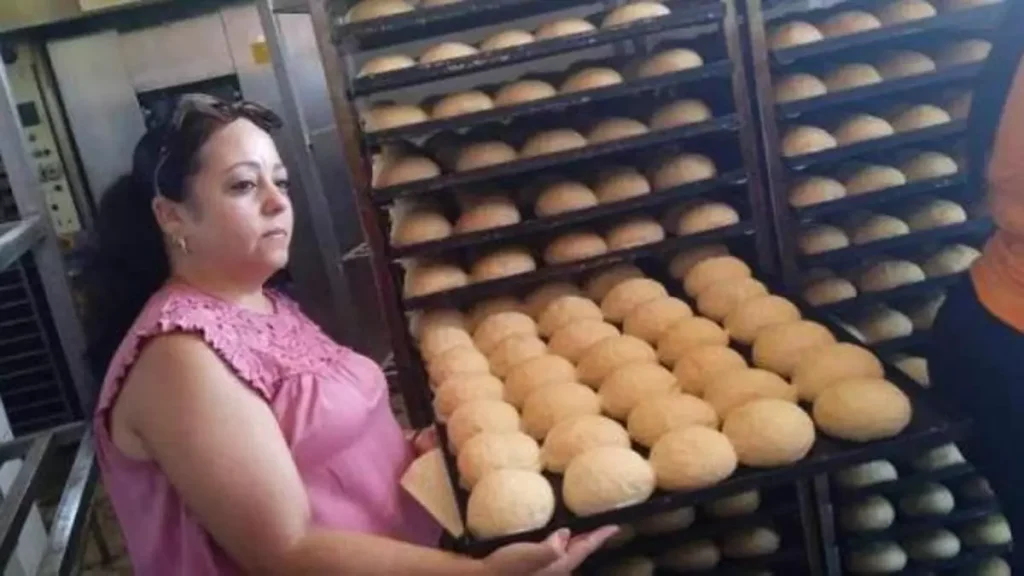
 14ymedio, Madrid, 29 May 2026 / This May, the people of Ciego de Ávila had bread for two days. That is how extreme the situation is, acknowledged Rafael Pina Joba, Director General of the Food Industry in the province, who described the amount of flour reaching the territory as “negligible.” In an interview with the local outlet Invasor, the official stated that in recent days the quantity of raw material received amounts to just 32 tonnes for the more than 430,000 inhabitants of Ciego de Ávila.
“In the current month, we had planned to deliver between four and five days’ worth of bread for the population,” said Pina, but the allocation received forced a much steeper downward recalculation than expected – and expectations were already more than modest. Public discontent is plain to see, above all because the pastry shops do have baked goods available.
“Very good question,” said Pina, when challenged on this point. “Following the directives that the country has in place, we are obliged as a company to steer ourselves toward new lines of production and to engage with the economic actors that allow us to increase production levels,” he explained. These agreements have enabled a type of flour known as “differentiated” – used for pastry-making – to reach the state industry.
These agreements have enabled a type of flour known as “differentiated” – used for pastry-making – to reach the state industry.
“The core mission of our company is to provide food to the people of Ávila and to be able to compete in the informal market with our products – to ensure that ours have a greater level of acceptance among the public,” the director argued. However, he acknowledged that quantities are scarce and are used almost exclusively, on the instructions of the Ministry of Commerce, for quinceañera cakes. The remainder is distributed in a controlled manner to vulnerable communities, he maintained.
The official spoke about bread obtained through the ration book, a situation that is far from new. Until recently, the theoretical daily allowance was 60 grams – 20 grams below the previous weight, though the reduction came with a price adjustment that was poorly compensated by the complete absence of quality – but now even that is a utopia. The shortage of raw materials is compounded by the shortage of electricity.
“Because of the energy” – he said, without elaborating – “we have had to use more than 25 electric ovens in order to carry out the production that prevents the bread from going off, from turning sour, from our output being ruined. And we have tried to recover this production to provide a better service to the population, within our means,” he said. Pina also addressed the question of why dough is prepared in one location and baked in another – a process that likewise has a negative impact on bread quality.
“We would rather not do it that way, because it needs to be a continuous process,” he lamented, but there is no better alternative. “We have had to bring back our wood-fired ovens. And in some locations, during the few hours that production allows, the machines cannot work the dough because of the level of raw materials needed, and at certain moments we have had to move that dough to a unit that has electricity at that particular time in order to prepare it, and then bring it back to the original unit to bake it in the wood-fired ovens,” he explained. Things could be worse – there would otherwise be a risk of having to discard it altogether.
“At this moment we have no freely available bread. We are acquiring a small level of flour through economic actors and through the companies that can supply it to us.”
As for bread sold freely off the ration, that is out of the question. “At this moment we have no freely available bread. We are acquiring a small level of flour through economic actors and through the companies that can supply it to us,” he said. The expectation, nevertheless, is that if production is ever resumed, sales will be managed on a controlled basis.
The director also spoke about how the industry has had to reinvent itself – producing everything from croquettes with cassava, pumpkin and sweet potato extenders, to fried plantain chips and noodle soups. The situation is so outlandish that diversification has extended into areas with no connection whatsoever to the company’s core activity. “We are planning to open a shop selling vehicle parts and components, which will allow us to guarantee the wages of our workers. My company – it may not seem like it – has more than 1,300 employees across the province, and we have a responsibility to them and their families. To give them, at the very least, their minimum wage so that they can keep their households going,” he said.
The industry has a repair and maintenance workshop and is currently negotiating with various companies to lease out its machinery or the services of its workers – an arrangement similar to what it intends to do with the nine vehicles it has standing idle and plans to rent out to private operators.
What the official described illustrates the dramatic situation facing the bread industry, which was already coming from appallingly bad figures. In 2021, 446,500 tonnes of bread were produced across the island, compared with 176,400 tonnes in 2025. The figures show a 60% fall over four years – but everything points to the numbers for 2026 having no parallel whatsoever.
Translated by GH
______________________
COLLABORATE WITH OUR WORK: The 14ymedio team is committed to practicing serious journalism that reflects Cuba’s reality in all its depth. Thank you for joining us on this long journey. We invite you to continue supporting us by becoming a member of 14ymedio now. Together we can continue transforming journalism in Cuba.