The Pan American Health Organization (PAHO) announces a new aid package worth 1.2 million euros thanks to three international donors: Korea, the EU, and The Church of Jesus Christ of Latter-day Saints.

 14ymedio, Madrid, January 29, 2026 – Santiago de Cuba received a third shipment of humanitarian aid from the United States on Wednesday for those affected by Hurricane Melissa in the eastern part of the country, according to the Catholic organization Cáritas.
The cargo, which arrived accompanied by two representatives of the Archdiocese of Miami—Joaquín Espino, rector of the Shrine of Our Lady of Charity, and Sister Eva Puelles, a member of the Daughters of Charity—consists of 648 food kits and 510 hygiene kits, which will be distributed by Cáritas in the community of San José.
The donation will be delivered “gradually by the parish team and volunteers,” once again accompanied by the U.S. international agency Catholic Relief Services (an organization founded by U.S. Catholics) and Caritas Germany.
According to the Cáritas statement, the donations will be delivered “to people who have been previously identified,” based on “their vulnerabilities,” with priority given to families headed by single mothers with young children, older adults, as well as people with disabilities and limited or no mobility.

“This protocol, applied in strict adherence to humanitarian principles and to Caritas’s international safeguarding policy, is the bridge that turns generosity into concrete hope and guarantees that the Christian values of fraternity and love of neighbor prevail,” the statement underscores.
On January 14 and 16, the first shipments of humanitarian aid from the U.S. government—worth a total of $3 million—arrived in Cuba and were delivered by Cáritas to communities in the provinces of Holguín and Santiago de Cuba, two of the five eastern regions hardest hit by Melissa.
The shipments have included rice, beans, cooking oil, sugar, water purification tablets, pots, kitchen utensils, blankets, and flashlights.
The donation has become another point of friction between the governments of both countries. When U.S. Secretary of State Marco Rubio announced in October the delivery of humanitarian aid to the Cuban people to prevent it from being controlled by Cuban authorities, the regime criticized him for attempting to bypass official channels in what it called a form of “political opportunism.”
The Catholic Church offered itself as a neutral channel to distribute the aid, a proposal that some saw as a solution, while others argued that the institution is too closely linked to the authorities.
When the first shipment arrived, Cuban authorities complained that, after so much time, they had learned of the cargo’s arrival through the Church rather than through official communication from the United States. Nevertheless, they said they would accept the aid, as it was a donation from the American people as taxpayers through their taxes.
On Wednesday, the Pan American Health Organization (PAHO) announced a new donation, also aimed at those affected by the hurricane, with a total value of €1.2 million. In a press release reviewing the coordinated response following Melissa, the organization added that “additional resources have been mobilized thanks to contributions from three international donors.”
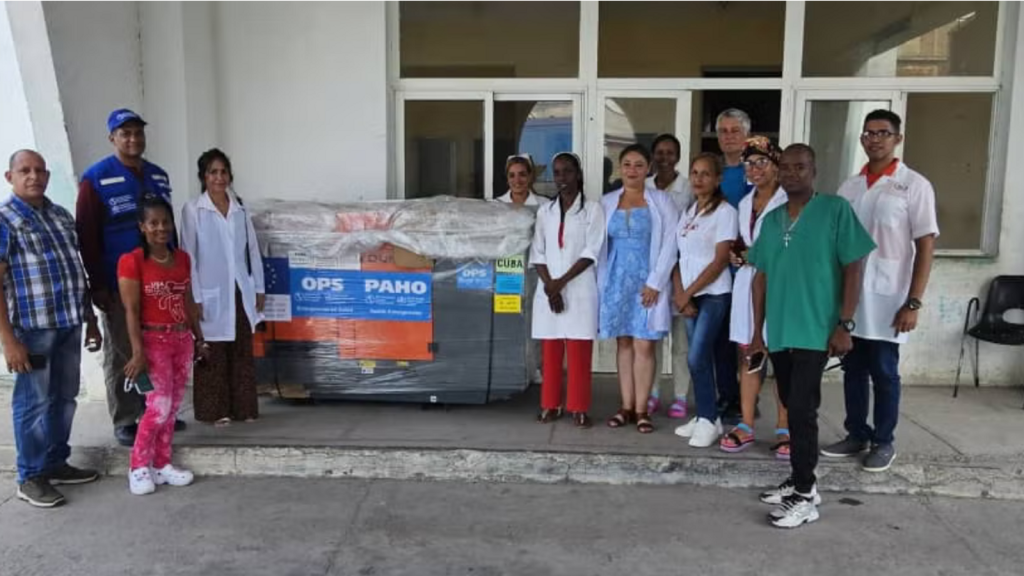
Most of the funding comes from the European Union through its humanitarian aid agency (European Civil Protection and Humanitarian Aid Operations—ECHO), with €700,000 approved for the rehabilitation of affected health institutions, strengthening epidemiological surveillance, and the acquisition of medicines, diagnostic supplies, vector-control equipment, and resources to ensure safe water and restore the functional capacity of services.
In addition, the Government of Korea has contributed $300,000 for generators, emergency kits, and hygiene supplies aimed at restoring essential services and preventing infectious diseases. Finally, the Church of Jesus Christ of Latter-day Saints provided $300,000 for the purchase of emergency supplies, rapid tests for communicable diseases, and equipment for vector-control actions.
“During the last quarter of 2025, the Pan American Health Organization (PAHO) supported the country’s response to the damage caused by Hurricane Melissa, in a context also marked by a simultaneous outbreak of dengue and chikungunya. To respond to Melissa, more than 11 tons of essential medical supplies were sent from PAHO’s Strategic Reserve in Panama; several field assessment visits were conducted, and work was carried out with different partners to expand the reach of the aid. Three months after the event, recovery actions supported by partners continue to be implemented, and this will remain the case over the next six months,” the statement adds.
Translated by Regina Anavy
____________
COLLABORATE WITH OUR WORK: The 14ymedio team is committed to practicing serious journalism that reflects Cuba’s reality in all its depth. Thank you for joining us on this long journey. We invite you to continue supporting us by becoming a member of 14ymedio now. Together we can continue transforming journalism in Cuba.