
Cuban Communist Party Blocks Religious Procession Honoring Cuba’s Patron Saint

The government is preparing a deployment of agents to minutely “keep an eye on” every step of the procession, warns Reyes. (Facebook/Alberto Reyes)

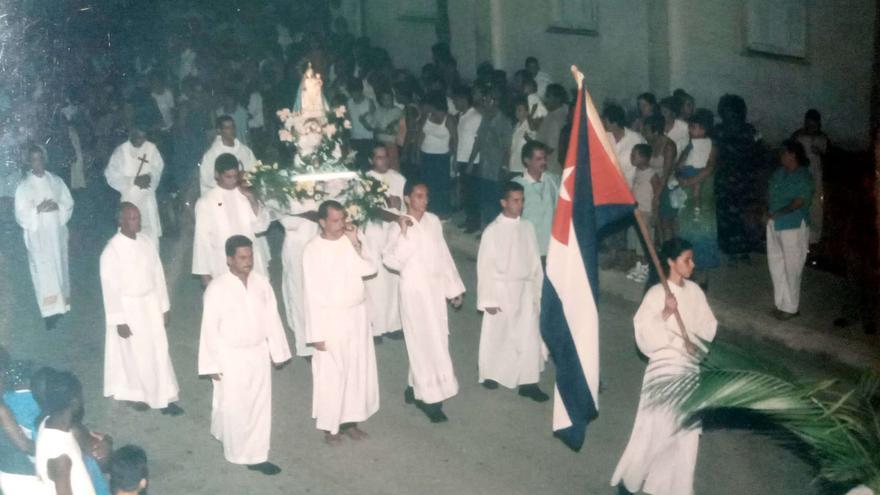
14ymedio bigger14ymedio, Havana, 1 September 2023 — On Thursday, Catholic priest Alberto Reyes accused the Communist Party of Esmeralda, a town in Camaguey province, of preventing a procession honoring the Virgin of Charity from taking place on the night of September 8. Without explanation, officials said the event must instead take place at 6:00 PM. “Under the blistering sun and heat,” Reyes noted.

“My idea, and that of the parish council and the Christian community of Esmeralda, was to celebrate mass at night and then follow it with a procession. But that won’t be possible because of the irrevocable decision by the only political party that exists in this country to say no,” he complained.

Reyes emphasized that the government is carefully monitoring “to the millimeter” any activities it finds to be suspicious. He adds that it is also preparing to deploy agents to minutely “keep an eye on” every step in the procession while ignoring the poverty and widespread shortages Cubans are experiencing.

He was also critical of the government’s apparent surprise at the claim that it does not respect religious liberty. He said that authorities often “complain to the bishop” about priests calling the Cuban regime a dictatorship and that and that the public is “bound and gagged.

Reyes admitted he knew the risks of speaking his mind at a time when the party’s decision has left him feeling irritated and powerless.

“The security services get alarmed when people lash out here and there, and shout, ’Fatherland and Life,’ ’Freedom’ and ’Change the system.’ If we as a church cannot even decide when to hold a procession, what hope is there for the public?” he asked. continue reading

Official authorization, a requirement for any public event in Cuba, is one of the tools the Communist Party regularly uses to constrain or hinder the work of the Catholic Church. Withholding approval is also frequently used as a means of reprisal against those such as Reyes who are critical of the regime.

Reyes admitted he knew the risks of speaking his mind at a time when the party’s decision left him feeling irritated and powerless. He claimed, however, that this was not going to prevent the procession from taking place.

“The party has spoken, the party has decided, and that decision is final. You either accept it or there is no procession, even if it means having it at a time when the sun and heat are stifling,” he said.

The priest concluded his message by stating that he would pray for the needs of Cubans, for “necessary prosperity” and the “freedom that has not yet come.” He added, “When all this ends (as it certainly will), this church which they persecute today will perhaps be the only thing that protects them from violence and revenge.”
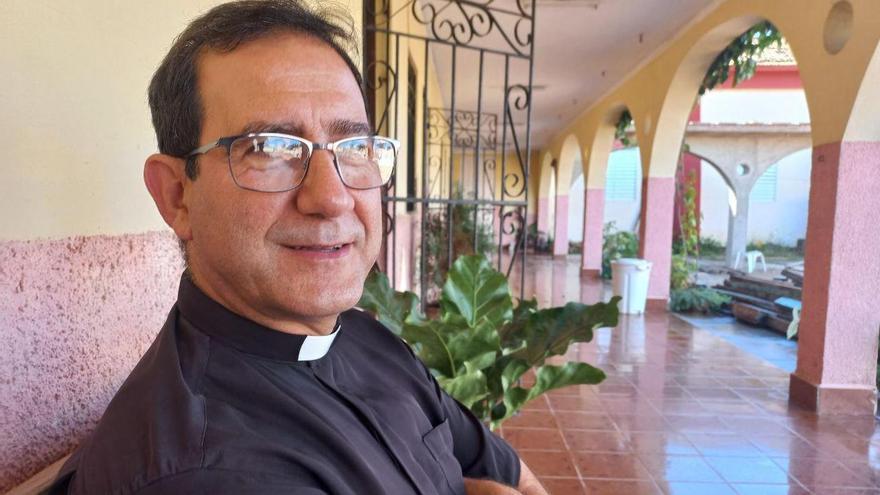
Reyes, along with other Cuban priests and religious leaders such Jose Castor and Nadieska Almeida, have, in recent years, criticized abuses by the regime. (14ymedio)

Reyes has been one of the voices within the Catholic church most critical of the Cuban regime. In an interview with 14ymedio in April he said that the island has “no present or future” and that the reelection of Miguel Diaz-Canel as president was a clear symptom of stagnation.

On that occasion, Reyes stated that Cubans had “learned defenselessness” after having been inoculated with fear of the government after its crackdown following the protests of July 11, 2021. In regards to the Cuban Bishops Conference, which has apparently been unsuccessful in negotiating an amnesty for political prisoners despite numerous attempts, Reyes has been clear: “It is neither a charitable organization nor a political party,” and is limited in what it can do.

In their most recent pastoral plan, which sets guidelines for Catholic believers for the coming years, the bishops stated that the island was going through “the most serious crisis in recent decades.” They added, “Food and medicine shortages have reached levels we have never seen before. There is growing inflation and discontent with the additional and significant burden of hopelessness and neglect.”

____________

COLLABORATE WITH OUR WORKThe 14ymedio team is committed to practicing serious journalism that reflects Cuba’s reality in all its depth. Thank you for joining us on this long journey. We invite you to continue supporting us by becoming a member of 14ymedio now. Together we can continue transforming journalism in Cuba.
The Suspicious Fall of the Dollar in Cuba Is Linked to a Wave of False Foreign Exchange Offers on Networks

Many point to bancarización as the main reason for changes in the informal currency market. (EFE)

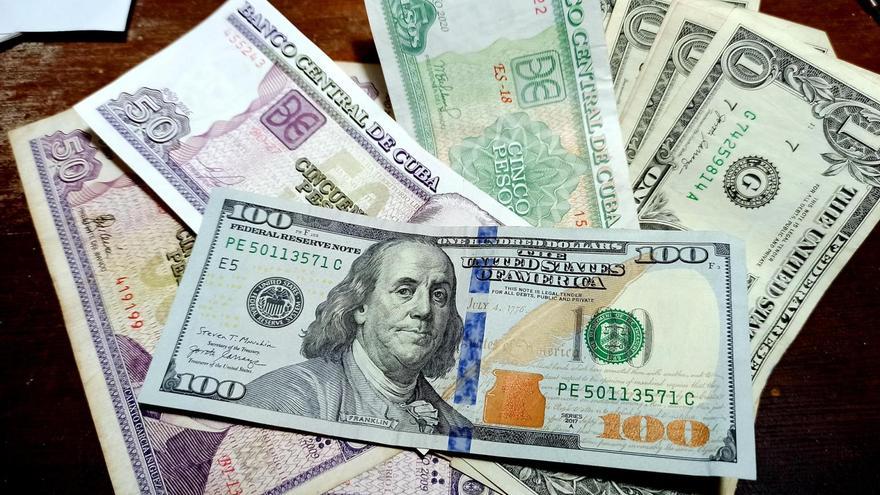
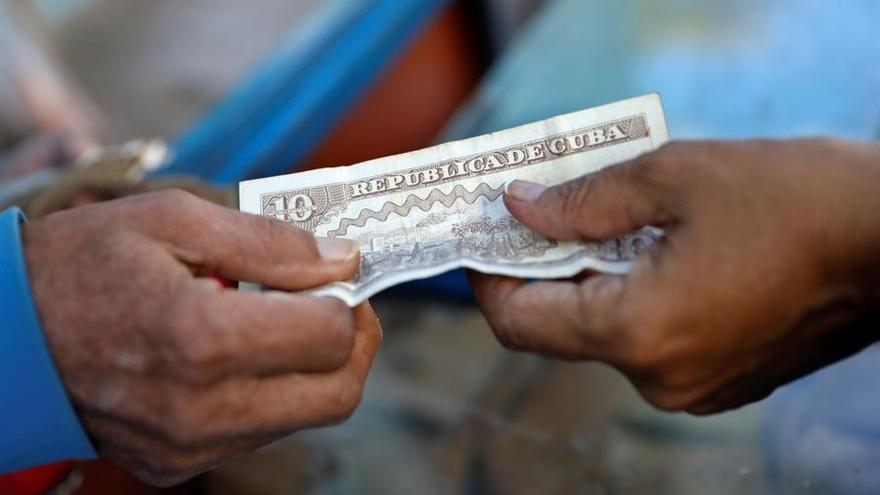
14ymedio bigger14ymedio, Natalia López Moya, Havana, September 3, 2023 — “No, I’m not buying foreign currency at the moment,” an informal money changer in Central Havana responds bluntly. In two weeks the dollar has fallen from the 250 pesos it cost in mid-August to 215 pesos this Sunday, according to the reference rate published by the digital site El Toque. The euro has also experienced a similar decline and went from being quoted above 255 pesos to currently sold in the informal market at 225 pesos. However, the speed of the collapse causes a lot of distrust. Some even speak of an artificial drop motivated by the emergence of false money changers on digital sites that promise dollars and euros at increasingly lower prices.

“When you call, they tell you that they have already sold them, but it sounds like a lie,” says Nataniel, a 26-year-old who buys dollars to embark on the migratory route through Nicaragua. “All the ads I have found with dollars below 230 pesos have come to nothing, or the phone turns off or they say that they don’t have any left.”

A similar opinion spreads among foreign exchange buyers. María Antonia has a small cell phone repair business in the Havana neighborhood of San Leopoldo. Thanks to her Spanish nationality, she frequently travels to Madrid to buy spare parts and devices to resell on the Island. Her neighbors know that she is always interested in buying euros for her trips.

But for several days, María Antonia has been “paralyzed,” according to 14ymedio. “If it is true that the currency is falling, it is better to wait for it to fall further. If everything is momentary and forced by the Government, then it is also better to wait because despair lends itself to scams, thefts and risks. So I’m not buying,” she explains. continue reading

Other entrepreneurs and private business owners also add to that distrust. “This container that we are going to receive with chicken and oil in the first days of September is going to be the last because this bancarización* is affecting us,” warns Julián (his name is changed to avoid reprisals), an accounting worker of a small private company.

“On the one hand, a cheaper dollar suits us because that is the currency we have to buy to be able to import merchandise, but our customers pay us mainly in Cuban pesos. We bought the currency a few weeks ago at a low price but now we lose when we have to sell with a lower exchange rate,” he says.

“You have to be patient and not rush. It’s not final, and people no longer have confidence in the Cuban peso,” he says. For the moment, the solution to avoid having major losses in your business has been to “try to sell as much as you can directly in euros or dollars.”

Many point to bancarización and its focus on reducing cash transactions as the main reason for changes in the informal currency market. With the new regulations, the ruling party has imposed restrictions on small and medium-sized businesses for the extraction of cash from bank branches. “We have had to cancel several contracts that we already had,” Julián says.

“Two of those contracts were with state entities and right now our demand for dollars has also fallen because we have at least two large purchases abroad that we are no longer going to make,” he adds. The entrepreneur believes that things will even out and “the dollar will rise again.”

Translated by Regina Anavy

*Translator’s note: “Bancarización” is term used in Cuba and other Latin American countries that refers to government efforts to reduce the role of cash through a greater reliance on banks’ digital payment options. The term does not seem to have a counterpart in English so the Spanish term is used throughout this translation.

____________

COLLABORATE WITH OUR WORKThe 14ymedio team is committed to practicing serious journalism that reflects Cuba’s reality in all its depth. Thank you for joining us on this long journey. We invite you to continue supporting us by becoming a member of 14ymedio now. Together we can continue transforming journalism in Cuba.
Bill Richardson, the Man Who Freed Cuban Prisoners but Couldn’t Help Alan Gross, Has Died

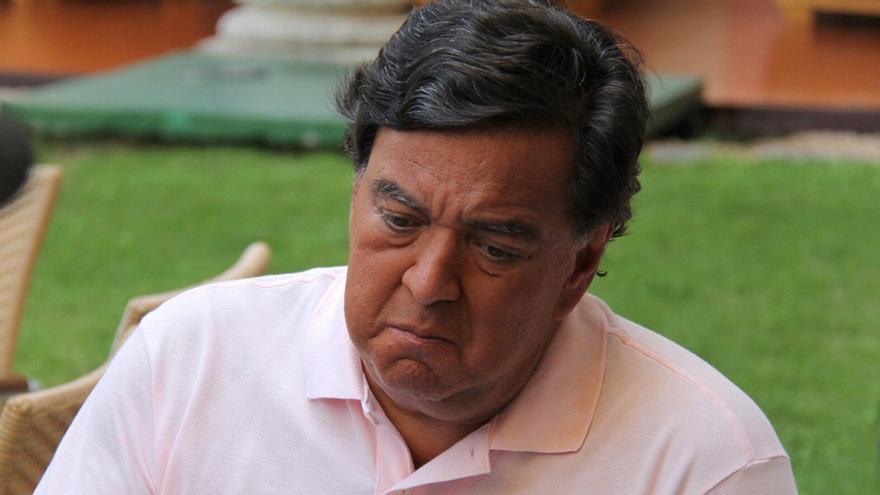
Bill Richardson at a press conference in Havana, in 2011, when he failed in his attempt to obtain the release of Alan Gross. (EFE)

14ymedio bigger14ymedio/EFE, Havana, 3 September 2023 — Former governor of New Mexico, Bill Richardson, of Hispanic origin, was U.S. ambassador to the UN and Secretary of Energy under the presidency of Bill Clinton. He passed away at the age of 75 at his home, the Richardson Center for Global Commitment reported on Saturday.

“He lived his entire life in the service of others, including his time in the Government and his subsequent career helping to release people taken hostage or unjustly detained abroad,” Mickey Bergman, vice president of the Richardson Center, said in a statement.

Richardson died while sleeping in his summer home in Massachusetts, as reported by CNN and other American media. The Democrat, after completing his political career, devoted himself to working to free Americans detained abroad.

Throughout his career, Richardson interceded for the release of hostages and prisoners in places such as Cuba, North Korea, Iraq, Russia and Sudan. In the 1990s, he had a rapprochement with Havana on several occasions.

In 1996, as a Democratic congressman, Richardson obtained the release of the political prisoners, Carmen Arias Iglesias, Luis Grave Peralta Morell and Eduardo Ramón Prida, after holding a two-hour meeting in Havana with Fidel Castro. According to the Spanish newspaper El País, the American politician sought the release of 12 people. continue reading

In 1996, as a Democratic congressman, Richardson obtained the release of the political prisoners, Carmen Arias Iglesias, Luis Grave Peralta Morell and Eduardo Ramón Prida, after holding a two-hour meeting in Havana with Fidel Castro

Richardson returned to the Island as governor of New Mexico in 2009 to promote commercial and cultural exchange. The Democrat, close to Barack Obama, took advantage of the fact that in 2001, commercial operations of American companies in Cuba had resumed after Washington excluded food and medicines from the financial and commercial embargo that had been applied to the Island since 1962.

As part of that trip, which Richardson himself paid for, he met with Deputy Chancellor Dagoberto Rodríguez and the then-president of the Cuban Parliament, Ricardo Alarcón, according to the Spanish newspaper El Mundo.

In 2010, he returned to the Island to promote commercial and cultural exchanges and, in addition, to act as an intermediary in the release of contractor Alan Gross, imprisoned in Cuba. The following year, in September, a new attempt at liberation was thwarted. “My feeling is that there are some elements in your government [the one in Cuba] that do not want to improve relations with the United States,” Richardson said at the time.

“Cuba’s action seemed to be an extraordinary snub towards the prominent Spanish-speaking Democrat and former UN ambassador who has had cordial relations with the government of the Island. There was no information from the Cuban government about why Richardson could not see Gross, who had usually received visits from diplomats and members of the US Congress,” The Washington Post published.

In this same newspaper, Richardson published an article in 2013 in which he highlighted the Havana fiasco. “I learned this lesson in the worst way,” he wrote, “in 2011, when the Cuban authorities initially refused to release and hand over to me USAID worker Alan Gross, and I said that I would not leave Cuba without him.”

“My public complaint made Cubans less willing to negotiate; they were clearly upset that I had tried to embarrass them. Gross is s till in a Cuban prison today,” he added then.

In 2010 he returned to the Island to promote commercial and cultural exchanges and, in addition, to act as an intermediary in the release of contractor Alan Gross, imprisoned in Cuba

Gross was finally released on December 17, 2014, simultaneously with the five Cuban agents of the so-called Wasp Network, imprisoned in the United States.

Bill Richardson’s name appeared on several occasions among the candidates for the Nobel Peace Prize. Just a few days ago it was known that this year he was nominated again, this time by four Democratic senators, Bob Menéndez, Joe Manchin, Martin Heinrich and Ben Ray Luján.

“Needless to say, I am honored by this nomination for a prestigious award, knowing that it is a remote possibility,” Richardson told The Hill newspaper on August 25. His nomination was backed by 14 letters from former hostages and their families, praising his role in their release.

The President of the United States, Joe Biden, lamented the death of the former governor of New Mexico on Friday. “He was a patriot and truly genuine, and he will not be forgotten,” the President said in a statement in which he reviewed the many milestones in Richardson’s life.

“Bill Richardson carried many heavyweight titles during his life,” Biden said in his message. “Few have served our nation in so many ways or with so much insistence, creativity and good cheer,” he added.

Former US President Bill Clinton and his wife, former Secretary of State Hillary Clinton, also mourned Richardson’s death with a message in which they referred to the politician as “a masterful and persistent negotiator. He helped make our world a safer place and managed to free many people unjustly detained abroad,” the Clintons stated.

Bill Richardson was born in Pasadena, California, although he grew up in the Coyoacán neighborhood of the Mexican capital since his father, a banking executive of Anglo-American and Mexican descent, was stationed there. His mother was Mexican of Spanish origin.

As a child he was sent to study in the United States and later graduated in Political Science at Tufts University in 1970. From a very young age he began his political career as a Republican congressman. He also worked in the State Department with Henry Kissinger during the Richard Nixon Administration (1969-1974).

In 1982 he was elected congressman of the House of Representatives for New Mexico. He spent 14 years in Congress, where he met Bill Clinton (1993-2001) and began to get involved, circumstantially, in the negotiations to release hostages.

It was in 1994 when Clinton asked him to participate in the release of two American pilots whose helicopter was shot down in North Korean airspace, since Richardson was casually visiting the country.

In 1997, Clinton appointed him United States ambassador to the UN (1997-1998), and a year later, he was elected Secretary of Energy until the end of the Democratic president’s second term. He was the Hispanic politician who reached the highest position in those years.

Among the last tasks he performed, Richardson acted as a mediator in several prisoner exchanges between the United States and Russia, including basketball player Brittney Griner and American student Trevor Reed

At that time he also participated in several foreign policy missions, including a negotiation in Baghdad with Saddam Hussein to ensure the release of two American aerospace workers who had been captured by the Iraqis.

After the end of the Clinton Administration, in 2002, Richardson became the only Hispanic governor of the United States at that time and the fifth in the history of New Mexico, the state with the highest percentage of the country’s Latino population.

He was governor for two terms, and in 2008 he sought the Democratic candidacy for the Presidency but abandoned his campaign after the Iowa and New Hampshire primaries.

Among the last tasks he performed, Richardson acted as a mediator in several prisoner exchanges between the United States and Russia, including basketball player Brittney Griner and American student Trevor Reed, at the end of last year.

Married to his childhood friend Barbara Flavin, with whom he had a daughter, he is also the author of three books, including How to Sweet-Talk a Shark: Strategies and Stories from a Master Negotiator, and his participation as a commentator on different television channels such as CNN or Fox News was frequent.

In addition to the Richardson Center for Global Commitment, Richardson created the New Mexico Wildlife Preservation Foundation with actor Robert Redford, to protect wild horses.

Translated by Regina Anavy
________________________

COLLABORATE WITH OUR WORKThe 14ymedio team is committed to practicing serious journalism that reflects Cuba’s reality in all its depth. Thank you for joining us on this long journey. We invite you to continue supporting us by becoming a member of 14ymedio now. Together we can continue transforming journalism in Cuba.
Accused of Smuggling Migrants From Mexico, a 26-Year-Old Cuban Woman Faces Trial in the United States

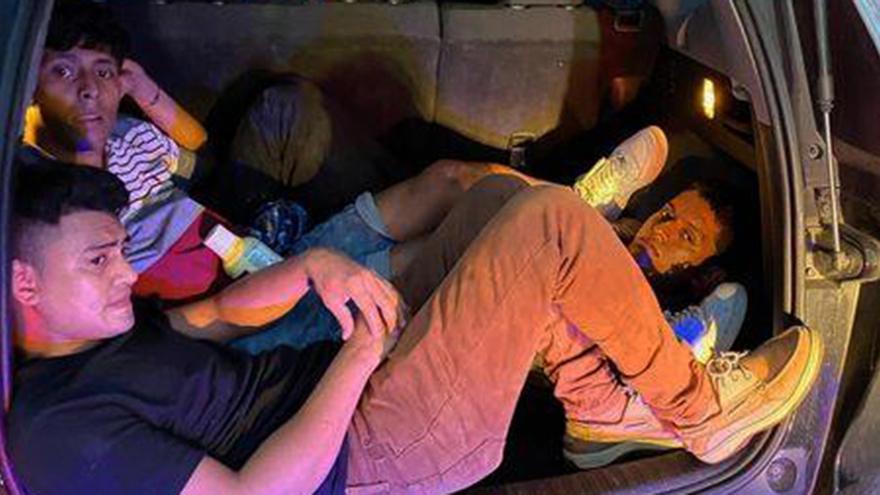
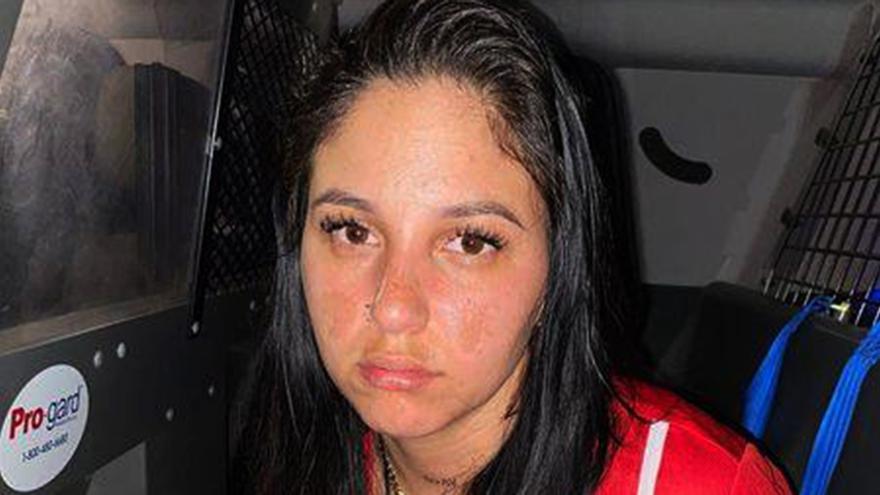
Seven migrants were found in a van driven by a Cuban woman, Nahara Candelaria Milan. (Facebook/Maverick County Sheriffs Department)

14ymedio bigger14ymedio, Havana, 31 August 2023 — The 26-year-old Cuban Nahara Candelaria Milan faces trial in the United States for the crime of human trafficking and, if guilty, must pay $10,000 and serve 10 years in prison. The young woman was arrested on Monday for a traffic violation while on her way to Eagle Pass (Texas), and during the search of her vehicle, the police discovered that she was transporting seven illegal migrants picked up in the vicinity of the Rio Grande.

According to Lieutenant Efrain Valdez from the detective corps of Maverick County (US), Milan admitted to being Cuban while he was examining the vehicle, a 2019 Honda. At the moment, the authorities have not revealed the nationality of the people she was transporting.

The agents of the US Border Patrol took care of the seven irregular migrants and, after taking their data, took them to a detention center in Eagle Pass before returning them to Mexico.

Eagle Pass is one of the coyotes’ favorite areas for transporting migrants in small and often precarious vehicles, such as vans. This Wednesday, one of these transports overturned while trying to escape from the Police. The trafficker, whose identity was not revealed, is seriously injured in a hospital in San Antonio (Texas), and the nine undocumented people he was transporting were handed over to the Border Patrol.

Nahara Candelaria Milan, a Cuban woman,  faces charges for trafficking migrants in the United States. (Facebook/Maverick County Sheriff Department)

Last June, Sheriff Brad Coe warned of the participation of Cubans in migrant smuggling networks. According to the Kinney County officer, near Brackettville (Texas), some drug trafficking organizations are putting pressure on people whom they helped enter the United States, in order to turn them into coyotes at their service. continue reading

Coe stressed that Cubans participate as part of “some payment they have pending or for extortion.” The US authorities opened an investigation folder last April, when Rainel Lázaro Silies and Lima Gálvez González were arrested in Kinney. They were prosecuted for transporting five undocumented people in their van.

Two months later, in the same region, Julio César Aspiazu Gómez was arrested and prosecuted for carrying five migrants in his car. This Cuban-American was released after paying a fine of $5,000.

Translated by Regina Anavy

____________

COLLABORATE WITH OUR WORKThe 14ymedio team is committed to practicing serious journalism that reflects Cuba’s reality in all its depth. Thank you for joining us on this long journey. We invite you to continue supporting us by becoming a member of 14ymedio now. Together we can continue transforming journalism in Cuba.
Cuba’s Representative to the UN Praises China’s Occupation of Tibet

Ambassadors in Geneva from Venezuela, Nicaragua, Belarus, Pakistan and Cuba. On the far right, the Cuban diplomat Juan Antonio Quintanilla. (X/Juan Antonio Quintanilla)

14ymedio bigger14ymedio, Havana, 2 September 2023 — Cuba’s support will be fundamental to the imminent inspection that the United Nations will carry out in China, which is accused of violating human rights and indoctrinating children in Tibet, under Chinese occupation since 1951. To tip the balance in its favor, Beijing invited a group of ambassadors from allied nations such as Venezuela, Nicaragua, Belarus and Pakistan to the region, in addition to the representative of Havana in Geneva, Juan Antonio Quintanilla.

Although the diplomats have been discreet about the visit, Quintanilla has published a thorough summary of the trip on social networks and has spared no praise for the “achievements” for which Tibet should thank Beijing.

On August 10, the UN Human Rights Council demanded a response from China on the arrest of nine Tibetan leaders who denounced the mining of “sacred mountains” and the hunting of protected species, for which they were sentenced to up to 11 years in prison. According to the UN claim, the Chinese government’s silence on the sentences could be attributed to a deliberate attempt to “make the world forget” about the detention of activists, while they face “isolation, year after year.”

The countries that accepted the invitation are close allies of China and it is to be hoped that they will support the Asian country in the face of any accusation in the international rostrum

The Council then informed Beijing that, at the beginning of 2024, it will carry out an inspection of the case and the situation of Tibet, considered by China as an “autonomous region.” For its part, the United States also accused the Asian country of subjecting Tibetan children to “forced assimilation” in state schools, with the purpose of eliminating Tibetan traditions and imposing the Chinese culture. continue reading

Beijing’s response was to send a letter to the UN headquarters in Geneva, to which the British agency Reuters had access, in which they invited diplomats who wished to go on a trip to Tibet. The objective: for the UN to understand “China’s policy and practices regarding human rights” through meetings and tours of educational, cultural and religious institutions.

The countries that accepted the invitation are close allies of China, which hopes that they will support the Asian country in the face of any accusation in the international rostrum. Of the members of the delegation, only Quintanilla has offered information about the trip, which began on August 29.

“I thank the Chinese Government for the invitation and the hospitality. Excellent opportunity to appreciate the economic and social development of this region,” the diplomat said in his first message, whose laudatory tone for Beijing marked the rest of his reports.

One of our last activities in Tibet, #China, was to visit the Sera Monastery, in the city of Lhasa. We learned about the preparation of the monks and the facilities that exist to profess the Tibetan religion.

This is another series of photos of Tibetan monks.

Following the agenda planned by the Chinese authorities, Quintanilla and his colleagues claimed to have confirmed “the economic development achieved” in Tibet, “thanks to the support of the Chinese central government.” The ambassador insisted that the situation of education and religious freedom was unbeatable, and that the spiritual values of Tibet – one of the most sacred regions for believers of Buddhism – were “very well preserved and promoted” by the authorities, who respected their transmission “to the new generations.”

As for education, Quintanilla said, after visiting an elementary school in Nyingchi Prefecture, that Beijing maintained a “high commitment” to the training of children in Tibet. He was also in Lhasa, the main city in the region, and guaranteed that both artists and university students were well taken care of.

On Wednesday, the delegation went to the Potala palace, in Lhasa, which was the residence of the Dalai Lama – the highest spiritual leader of Tibetan Buddhism – until 1959, when Tenzin Gyatso, the current Dalai Lama, had to go into exile in India after the brutal repression of the Chinese Army against attempts to maintain the independence of Tibet.

The ambassador concluded his trip by commenting that “education is a priority for the Government, while preserving Tibetan culture”

Quintanilla also said that in Potala Buddhists can “profess their religion daily,” a comment he repeated during his meeting with the monks of the Jokhang temple.

The ambassador concluded his trip by commenting that “education is a priority for the Government, while preserving Tibetan culture.” Finally, this Thursday, he met with Ma Zhaoxu, Deputy Minister of Foreign Affairs of China, who addressed the issue of human rights in Tibet during an exchange that Quintanilla found “beneficial.”

The Havana regime is one of Beijing’s staunchest supporters. Cuban president Miguel Díaz-Canel met in August with his Chinese counterpart in South Africa during the summit of the BRICS group of countries and assured that the relationship of the communist parties of both countries was better than ever.

Translated by Regina Anavy 

____________

COLLABORATE WITH OUR WORKThe 14ymedio team is committed to practicing serious journalism that reflects Cuba’s reality in all its depth. Thank you for joining us on this long journey. We invite you to continue supporting us by becoming a member of 14ymedio now. Together we can continue transforming journalism in Cuba.

The Castro Regime’s Fear of Private Land Ownership in Cuba

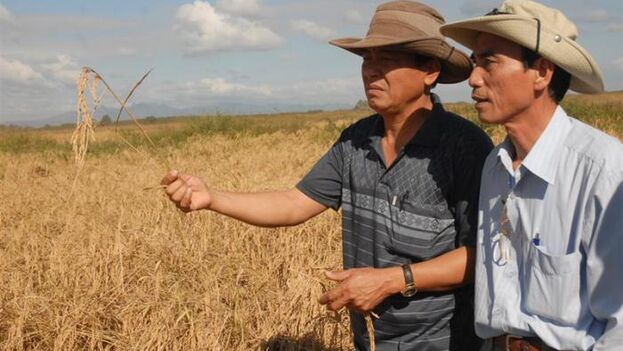
Tired of Cuban inefficiency, the Vietnamese abandoned their successful rice project in Sancti Spíritus. (Granma/Archive)

14ymedio bigger14ymedio, Elías Amor Bravo, Economist, 2 September 2023 — Communists don’t want a private sector in Cuba like the one that exists in the rest of the world. On numerous occasions, the Castro revolution has been interpreted as a process that extends the poverty of the population by depriving it of one of the main sources of vital income along with salary: property rights over economic assets. Since all productive capital is in the hands of the State, the possibility of civil society making a difference with respect to the political power of the regime becomes impossible. Cubans, immersed in an absurd poverty, depend on the State to develop their lives. There are hardly any spaces for independence from the crumbs of power.

A good example of this is the current study in the National Assembly of a Draft Land Law that, far from regulating private property rights, concerns inconsequential issues such as the ordering of the use and possession of the resource. Ordering, because it means greater power of intervention and coercion by the regime, and possession because in communist Cuba private property will never be recognized. It is worth noting the differences between the two concepts.

Using the dictionary of the Royal Academy of the Spanish language, property is the right of someone to possess something and be able to dispose of it within the law. It has other meanings, but this is the one that interests us. On the contrary, possession means having something that is not owned, with the intention of preserving it for oneself or for another. Look at the differences, because they are substantial. “Property” means its owner can do whatever he wants with something within the law. “Possession” means he can only use it and conserve it. One has nothing to do with the other.

The Vietnamese communists understood this, and in the 90s they implemented the reforms known as Doi Moi, which simply recognized what was forbidden in Cuba: land property rights. And from then on, in just five years, the country’s frequent famines gave way to Vietnam’s becoming one of the world’s leading rice-producers.

By the way, Vietnam’s success has been so great that it occasionally gives a helping hand to its Cuban friends. They know the Vietnamese experience well and have been advised on what to do on numerous occasions, but the fear that Cuban communists have of private property is unhealthy, more burdened with ideological and Party issues, than with concepts of economic reasoning. continue reading

This is why the National Assembly of the People’s Power of Cuba, whose obedience to the single party is providential, will hardly open spaces for land ownership in the next Draft Land Law, currently in the process of being created. And this, despite the fact that this is the most appropriate time to address a debate that the Cuban communists simply despise, because they know that if they assumed certain postulates, their time in power would end.

In Vietnam the communists continue to rule, but the social and economic evolution in that country since the reforms of the Doi Moi have completely removed it from Castro’s poverty and misery, and today Vietnam is close to the advanced nations in the World Trade Organization. The Vietnamese people, although they lack political freedoms, have seen their income levels rise exponentially along with quality of life and prosperity, which are the bases for the development of democracy.

No one should imagine that this could happen in Cuba. The state press highlights, for example, that the Draft Land Law has as its background in the agrarian reform laws of 1959 and 1963, which constituted the first radical change in the agrarian structure and the redistribution of wealth in the country. So it is established that the redistribution of wealth and the contingency of land ownership, in pursuit of social interest, with principles and budgets that constitute premises for the transformations in terms of land use and possession in Cuba, will be maintained in the Preliminary Draft.

Not content with the failure of the change in land property rights produced more than 60 years ago, the communists return to their old ways and are inspired to draft a 2023 law like one of the most terrifying ideological failures of the so-called revolution: the agrarian reform.

As has already been indicated, the law only considers the planning of the countryside in terms of the use and possession of the land, which they say has direct impact on the control and legal guarantees for farmers. What is not indicated is what guarantees the rights of those who are deprived of property, and most likely we will find ourselves again with a relationship of “rights” that will be offered from the top of the regime down to the farmers, but without altering the hierarchy or operating structures.

An article by the Legal Directorate of the Ministry of Agriculture, published on its website, addresses what little is known about this Preliminary Draft.

And here are some issues to highlight:

First of all, the communists continue to believe that the solution to the lack of food in Cuba depends on the reorganization of the use and possession of land in Cuba, without touching the issue of property rights. And once again they are wrong, because the solution to the agricultural problem is not about putting on makeup or making superficial transformation. It’s about putting the hoe in the ground and digging hard.

It requires structural reforms of land ownership that reward the work of the farmers. The land must be mostly privately owned and subject to commercial activity within a law that won’t interfere. It seems unbelievable that after six decades of failure and agricultural unproductivity, the communists believe that legislative changes involve reordering the use and possession of land.

This same old song will lead them to a much worse situation than the current one, which doesn’t take into account the true aspirations of the Cuban farmer. Most likely this Draft will not save the sovereignty and food security of the nation, nor will it help to improve agricultural yields.

Second, to establish the issue of the legal framework of land, the aforementioned Draft refers to the provisions of the communist constitution of 2019, where a series of “forms of property” were fixed about land. This left the “private” land with the marginal character that it has historically had since the confiscations and expropriations of the so-called agrarian reform of Fidel Castro.

The constitution also serves the Draft for references to the protection of the right to healthy and adequate food, access to justice and due process and procedure, all based on sustainable development for individual and collective prosperity. You can see that Castroism talks about guarantees and rights that end up being nonexistent and not exercised by those affected, out of fear.

Third, the Draft is justified by Cuba’s need to respect the international conventions to which it is a signatory. It is curious that the regime respects the outward appearance of possession, use and access to land and agricultural goods that are established in those agreements, but it forgets and despises everything related to private property.

There is no point in relying on those international conventions, “such as the 2030 Agenda for Sustainable Development; the United Nations Declaration on the Rights of Farmers and Other People Working in Rural Areas; the Convention on the Elimination of All Forms of Discrimination against Women, as far as rural women are concerned, who advocate promoting and protecting the right to land with equality and equity,” if a basic right of the Charter of Human Rights, such as private property, is more than evidently violated.

Fourth, all this legislative effort is supposed to contribute to the implementation of Law 148 on Food Sovereignty and Food and Nutrition Security of May 14, 2022. And this objective, still unattained (and we fear that it will be another unsuccessful experience), is the one that requires modifying the policy of use and possession of the land and its legal framework.

The communists point out that the long-standing legal norms require an update corresponding to the existing problems for the transmission of land and its use and possession. But from the experience of other legal systems and reorderings, it has already been proven that not everything depends on legislative changes when they are only superficial. Food sovereignty and security in Cuba is a failure of the communist regime, no matter how you look at it.

Fifth, it seems that the results of the Temporary Working Group for the elaboration of the proposed land use and possession policy and its legal instrumentation have had some influence on the  Preliminary Draft. This Group has been behind the various measures that have been approved to boost agricultural production since October 2022, and which, as we know, have not yielded results, such as the famous 63 measures of the agricultural sector or the 93 measures for sugarcane.

Apparently, the work of this group has been accompanied by projects of international collaboration for strengthening policies for sustainable food security in Cuba and climate resilience in the agricultural ecosystems of Cuba, whose implementing agency is the Food and Agriculture Organization of the United Nations, which awarded Cuba 6 million dollars for the implementation of these projects. This has had little or no effect on the daily food situation for Cubans, as currently reported from the Island.

Last but not least, it is pointed out in the cited article that the regime allowed participation by representatives of agencies of the Central State Administration, the agricultural business system, associations, research institutes, academics, experts and agricultural producers in the creation of the Draft Law. These contributions were “weighted,” which means that the proposals coinciding with the official line were all approved, but those that were not were simply deleted.

We fear that this Draft will be yet another exercise of communist ideology, dominated by the fear of Castroism about private ownership of the land, and that it will end in failure without solving the problem of food. There have been too many experiments, and all have been unsuccessful. The people seem to be used to it. The question is, for how long?

Translated by Regina Anavy 
______________________

COLLABORATE WITH OUR WORKThe 14ymedio team is committed to practicing serious journalism that reflects Cuba’s reality in all its depth. Thank you for joining us on this long journey. We invite you to continue supporting us by becoming a member of 14ymedio now. Together we can continue transforming journalism in Cuba.
A Cry of Indignation Went Through the Havana Crowd When an Old Woman Could Not Pay 20 Pesos for a Banana

Line to buy bananas in Parque Trillo, in Havana, this Saturday, September 2, 2023. (14ymedio)

14ymedio bigger14ymedio, Juan Diego Rodriguez, Havana, 2 September 2023 — “Don’t charge her!” was the cry that ran through the line this Saturday morning at Parque Trillo in Central Havana. The customers of an impromptu agricultural products fair asked one of the vendors to give a banana to an old woman who, after lining up, had verified that she did not have enough money to even take one banana home. “I’m not going to charge her, but I will charge you,” the clerk responded to a young man with a sneer.

On the sidewalk, scattered on the grass and with the earth still clinging to the skins, the food offered at the fair has risen in price like the rest of the food in Cuba. The fairs that were once the option for the poorest now have a pound of malanga at 55 pesos, plantains at 35 pesos and a head of garlic, with very small cloves, at 20 pesos each. If a customer wants to take home a can of tomato sauce, she will have to pay 650 pesos.

“Before, you filled up your bags at these fairs but now it’s crazy how expensive everything is,” lamented a man who saw the trucks arrive early and thought he could make a fairly complete purchase. “In the end, I only decided on one guava bar at 160 pesos, because food is through the roof,” he laments. “There isn’t much variety either, the fair is quite poor.”

If the customer wants to take home a can of tomato sauce, she will have to pay 650 pesos. (14ymedio)

The usual buyers of these open-air markets, organized mainly with merchandise from cooperatives and state farms, are retirees, families with very low resources and also mischievous resellers who buy at cheaper prices and then offer the products on private stands or carts. . But inflation has dampened enthusiasm and curtailed the number of takers. continue reading

“It’s not worth coming from afar to see what they have,” complained a woman who walked from the municipality of Cerro to “be one of the first in line” when the trucks unloaded their merchandise. The lady herself listed all the foods that are missing and that, a few years ago “were common in these vendutas.” The onion is conspicuous by its absence, “the sweet potato that was always there is no longer there and the pumpkin is also missing.” An old woman added other absentees: “corn is not even dreamt of, the cassava seems to have emigrated and before they brought eggs but now that is a luxury.”

While the adults waited their turn to shop, some teenagers took the opportunity to connect to the internet in the park’s Wi-Fi zone and the little ones ran around the sculpture of Quintín Bandera, a general of the war of independence. Leaning on the base of it, the old woman to whom the banana was given rested in the shade before returning home. At least for today she didn’t leave empty handed.

____________

COLLABORATE WITH OUR WORKThe 14ymedio team is committed to practicing serious journalism that reflects Cuba’s reality in all its depth. Thank you for joining us on this long journey. We invite you to continue supporting us by becoming a member of 14ymedio now. Together we can continue transforming journalism in Cuba.

Cuba’s Private Businesses Rebel Against Digital Banking: ‘We Only Accept Cash in Pesos, Dollars or Euros’

The Government accuses El Toque of manipulating the price of the peso in cash. (EFE)

14ymedio bigger14ymedio, Havana, 1 September 2023 — “I sell 5,000 CUP in cash for a [digital] transfer. Best offer,” says a Cuban on social networks, where in recent weeks a new market has been created for the purchase and sale of pesos for pesos that the Central Bank of Cuba (BCC) has already placed outside the law.

The “bankarizedo” or virtual peso has became a last resort for Cubans, as a result of the decision by the authorities to cause a shortage of banknotes and replace them with electronic transactions, in order to gain greater control over the national currency. With this measure, the country leaves the one peso-one CUC monetary duality in exchange for another: cash peso-virtual peso, with different values. The dollar has been consolidated as a reference currency, while its official remedy, the MLC (freely convertible currency), has gradually been devalued.

Questioned by the official newspaper Granma about the bancarización*  banking reform  process announced almost a month ago, the vice president of the BCC, Alberto Quiñones Betancourt, referred to “illegal behaviors that are happening,” including those caused by people who “offer cash for a greater amount by transfer.” This activity, the official said, violates Resolution 111, which “establishes that all channels must be on an equal footing at the time of making the payment.”

But the reality is that the currency has become so coveted that even the sale of dollars is only made in exchange for cash pesos, the magic word of these ads

But the reality is that the currency has become so coveted that even the sale of dollars is only made in exchange for cash pesos, the magic word of these ads. There are plenty of examples: “I sell 200 dollars for 230 CUP in cash.” “I buy dollars at 210. I have CUP in cash.” “I sell 150 dollars for 200 CUP. Payment in cash.” continue reading

Also growing is the number of private businesses that reject payments by digital transfer, claiming that subsequently “they can’t take the money out of the bank.” In a recently remodeled cafeteria on San Lázaro Street, in Central Havana, the employee is categorical: “We are only accepting cash in pesos, dollars or euros,” she responds to customers who try to pay with a Transfermóvil debit card.

In order not to incur a violation of the stipulations of bancarización, the clerk says that they have problems with the Transfermovil account and now “it’s not working,” a justification that is repeated in other nearby businesses. But behind the scenes, the explanation for the rejection of the “virtual peso” is that “we still have to buy many of the inputs and raw materials in cash.”

Agricultural markets, the main sources of vegetables, fruits and grains, continue to operate mostly through cash payment. “The avocado, the mango and the salads we serve, all that has to be paid for with real bills, not transfers,” explains the employee. “What can we do with the peso in the bank if, at the time of buying, they only accept it cash in hand?”

The situation has reached a point where the digital media El Toque, which for years has published the exchange rate of the informal market of the main currencies circulating in Cuba, has begun to include the virtual peso currency for the cash peso. The first day it did, on August 23, the price of 1 Cuban peso in cash was 1.10 to the digital peso. This Friday, the price is 1.13.

The reaction to this new exchange rate has been frenzied. Last Monday, Granma, the Communist Party newspaper, published an article accusing the United States of trying to influence the Cuban economy by manipulating the prices of the national currency through the El Toque website, pointing it out as “the voice of everything that serves the counterrevolution.”

“The strategy cooked up in the United States to strangle the economy of the Cuban family adds a new manipulation tool, based on the short-term limitations with the availability of national currency in cash,” accuses the text, which denounces the “eagerness to add anxiety to the other opportunistic manipulations of the exchange values of the MLC, the dollar and the euro.”

The regime denounces the “eagerness to add anxiety to the other opportunistic manipulations of the exchange values of the MLC, the dollar and the euro”

The article – according to the Cuban economist Pedro Monreal – is “incorrect,” since “it is based on the absurd premise that the measurement of the informal exchange rate in Cuba is manipulation and not a necessity. What El Toque does, like anyone who would want to estimate the informal rate, is compensate for the official disinterest,” says the expert. In his opinion, the work done by El Toque “fills the official information gap. There is an informal foreign exchange market because the official rates for the peso are overvalued,” he argues.

Meanwhile, in the currency buying and selling channels, the dollar and the euro are also experiencing their particular “adventure,” in this case an abrupt fall from the prices they had reached in previous weeks. After reaching nearly 250 pesos for a dollar, the informal currency market moves around 210, according to El Toque, but there are more and more offers on networks with prices that can reach up to 190 or 200 CUP for the US currency.

“This could be a perfect State Security operation,” says Carlos, a regular of online currency trading operations who suspects that the regime is also trying to influence the price of the black market by simulating an unreal depreciation. But sellers are suspicious: few are willing to sell their precious dollars at a rate that could multiply in another day.

Translated by Regina Anavy

*Translator’s note: “Bancarización” is term used in Cuba and other Latin American countries that refers to government efforts to reduce the role of cash through a greater reliance on banks’ digital payment options. The term does not seem to have a counterpart in English so the Spanish term is used throughout this translation.

____________

COLLABORATE WITH OUR WORKThe 14ymedio team is committed to practicing serious journalism that reflects Cuba’s reality in all its depth. Thank you for joining us on this long journey. We invite you to continue supporting us by becoming a member of 14ymedio now. Together we can continue transforming journalism in Cuba.

JetBlue Will Suspend Its Flights Between Cuba and the United States Beginning September 17

The American airline JetBlue was the first to start regular flights to Cuba. (EFE)

14ymedio bigger14ymedio, Havana, 31 August 2023 — The American airline JetBlue will suspend all flights to the Island on September 17, due to “changes in the regulatory landscape and restrictions on the ability of our customers to enter Cuba,” according to a statement from the company released by CNN on Thursday.

“We hope to resume our service to Havana and continue looking for opportunities within Cuba in case travel is more affordable in the future,” the company added.

The airline also announced that it will provide “full refunds to customers affected by the suspension.”

Stopping operations in Cuba, JetBlue said, will allow them to focus on “higher performance” routes where the service “is growing.”

JetBlue was the first airline to operate a commercial flight between the two countries in 2016 after more than 50 years of bans on traveling to Cuba from the United States. The air connection was a symbol of the thaw between the two nations that restored diplomatic relations in July 2015.

“We hope to resume our service to Havana and continue looking for opportunities within Cuba in case traveling is more feasible in the future.”

Since 2022, there have been several cases of Cubans living on the Island who have been prevented from flying from the United States. The Havana regime has notified airlines such as American Airlines and Southwest that some citizens cannot enter the country, as was the case with activists Anamely Ramos and Omara Ruiz Urquiola, who were not allowed to board return flights. continue reading

Nor has tourism to the Island been able to recover after the pandemic, and American travelers have opted for other destinations in the area, such as Cancun, Mexico, and the Dominican Republic, due to the economic crisis that plagues Cuba, the high prices of its tourist packages, and the problems in basic infrastructure such as roads, shops and Internet connectivity.

14ymedio has received countless reports about practically empty flights that depart or arrive on the Island on the routes that link Cuban and American cities.

Last September, JetBlue submitted an application to increase its number of flights to Cuba to the U.S. Department of Transportation, obtaining 14 connections from South Florida.

Translated by Regina Anavy

____________

COLLABORATE WITH OUR WORKThe 14ymedio team is committed to practicing serious journalism that reflects Cuba’s reality in all its depth. Thank you for joining us on this long journey. We invite you to continue supporting us by becoming a member of 14ymedio now. Together we can continue transforming journalism in Cuba.
The United States Offers Scholarships for Young Musicians From 54 Countries, Including Cuba

OneBeat 2021 Participants. (U.S. Consulate in Brazil)

14ymedio bigger14ymedio, Havana, 1 September 2023 — The Office of Educational and Cultural Affairs of the U.S. Department of State announced the call for the OneBeat scholarship, for 50 musicians between the ages of 19 and 35 from 54 countries, including Cuba. Those chosen will have all expenses covered during their stay in the United States, distributed in the months of April and September 2024.

The program, which is presented as an opportunity to influence the communities of origin of the participants, promote civic rights and democracy and develop cultural exchanges and individual identities, is open to countries from all continents, including Venezuela, Haiti, Bolivia and Cuba, in addition to Russia, Ukraine, Iraq and Israel, among others.

As prerequisites for acceptance, the creators must have a good command of English and skills for composition, performance and improvisation, as well as an “interest in crossing cultural and musical barriers to create original music or reinterpret traditional music, respecting the essence of each tradition.” The social impact of their previous work is also a plus point for candidates. continue reading

OneBeat will also bear the travel expenses, stay and a “modest stipend” for the daily life of the scholarship recipients

OneBeat will also bear the travel expenses, stay and a “modest stipend” for the daily life of the scholarship recipients, who will be able to interact with local musicians, conduct workshops and “delineate their plan for the future.”

The scholarship will conclude with a tour of different cities in the United States in which the original pieces conceived during the program will be presented, and it is expected that, on return to their countries of origin, the recipients will implement initiatives that demonstrate their “social commitment through art.”

“For more than a decade, OneBeat has redefined musical diplomacy through a series of programs that use collaborative musical creation as a civic discourse. Young musicians from around the world explore how artists, communities and institutions can work together to rejuvenate local economies through music, technology and the creative arts,” the statement summarizes.

Since its third edition, in 2014, the program has counted among its participants Cuban artists such as the flautist Haydée López, the drummer Rodney Barreto, the rapper Rolando Navarrete, the guitarist Millet Padrón, the percussionist Degnis Bofill and the composer José Gavilondo, all from Havana, as well as the rapper Kamerum.Cuba, from Santiago de Cuba.

Most of these musicians today live outside the Island, touring around the world or permanently residing in other countries.

Translated by Regina Anavy

____________

COLLABORATE WITH OUR WORKThe 14ymedio team is committed to practicing serious journalism that reflects Cuba’s reality in all its depth. Thank you for joining us on this long journey. We invite you to continue supporting us by becoming a member of 14ymedio now. Together we can continue transforming journalism in Cuba.

San Lazaro and Perseverance Streets, Another Bombed-Out Corner of Havana

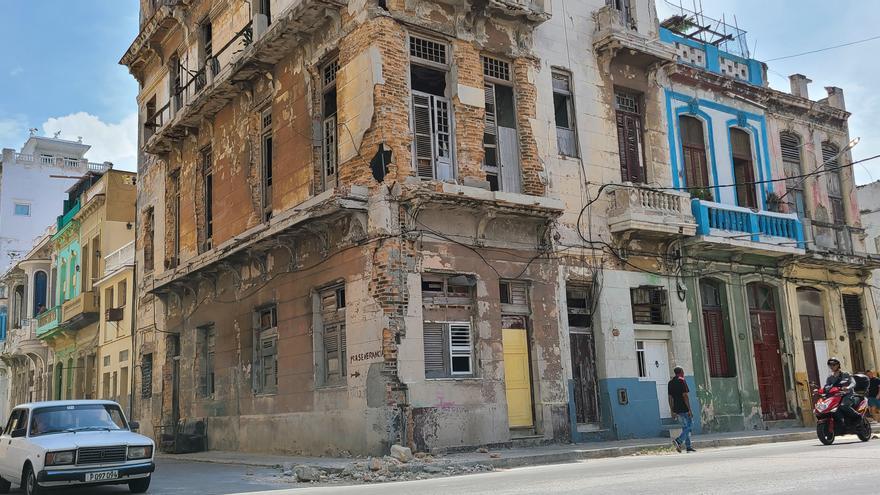
The house has deteriorated badly due to poor maintenance and salt air.

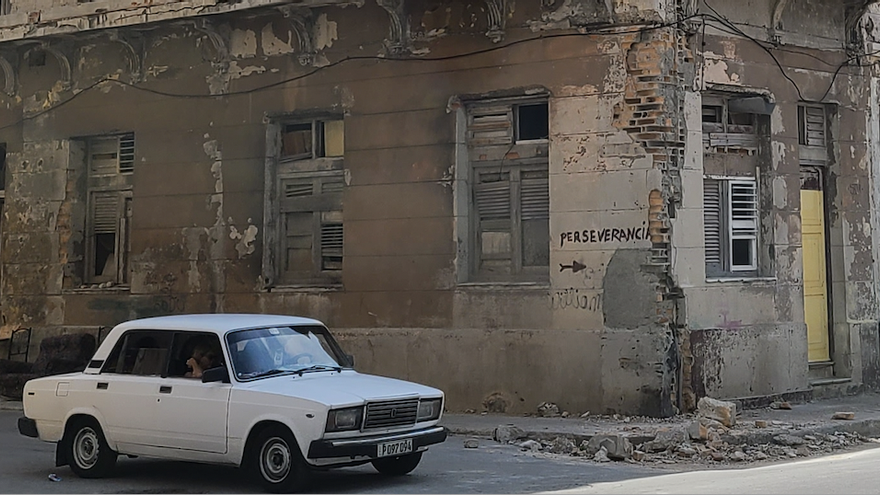
14ymedio bigger14ymedio, Nelson García, Havana, 28 August 2023 — Oscar sleeps “with one eye open and the other closed” in case the roof ends up collapsing on this 67-year-old Havana resident and his family in the middle of the night. The retiree, who lives at the corner of Perseverancia (Perserverance) and San Lazaro streets in Central Havana, has spent years complaining about the poor condition of the building, now a ruin due to poor maintenance and salt air.

Sitting in the doorway to his lower-floor apartment, Oscar describes in detail the anxieties he feels living amid bare brick walls, balconies that have fallen to pieces and exposed, rusty beams. “There is still a family up there on the roof,” he says, pointing to the upper floors that have no doors or windows.

The retiree fears “tragedy could occur” on any given day, that the building could collapse, taking with it the lives of its residents. “My wife and son live with me and we spend our days in total fear. When it rains or when a hurricane is approaching, we’re terrified,” he says as he shows passersby some avocados he has for sale.

The only signage identifying the name of the street is hand-painted on the side of a dilapidated building. (14ymedio)

“Every time we complain and demand officials come up with some solution, they tell us the shelters are at full capacity. We don’t have anywhere to go. We either stay in this building or live on the streets,” says Oscar. Guillermo, his 41-year-old son, looks through the window and confirms the story. “This piece here fell off two days ago,” he says, pointing to a hole in the wall. continue reading

Oscar and his family’s situation seems to repeat itself wherever you look. San Lazaro is one of the most important streets in the Cuban capital. It is also one of the thoroughfares with the most visible deterioration. Although the damage extends from the beginning of the Malecón to the grand outdoor staircase of the University of Havana, it is the section from Paseo del Prado to Belascoaín Street that is the most affected.

Almost fifty buildings have been either fully or partially lost along this stretch of San Lazaro Street. Proximity of the sea, governmental neglect and the poverty of the area’s residents have left the avenue looking like it was bombed. The holes in building facades, shattered cornices and collapsed balconies seem like relics from a city at war.

The scene repeats itself on the side streets. In spite of the extension of neighboring Lealtad Street and the importance of nearby Galiano Street, Perseverance is one of the most dilapidated routes in the city. Where once there was a butcher shop, there is now only a bricked-up door and a hole that used to be a window through which residents throw bags of garbage. Pedestrians must navigate around the sidewalks’ potholes, sewage and debris from falling balconies.

“You have to walk in the street. Even if you get hit by a car, it’s better than having a piece of the building fall on your head,” complains a young woman who has just come out of a boarding house. At the corner, she has to dodge a pile of trash that has been growing ever larger for weeks because there has been no garbage collection. As she approaches, dozens of flies take flight. They return a few seconds later, settling on the bags of waste.

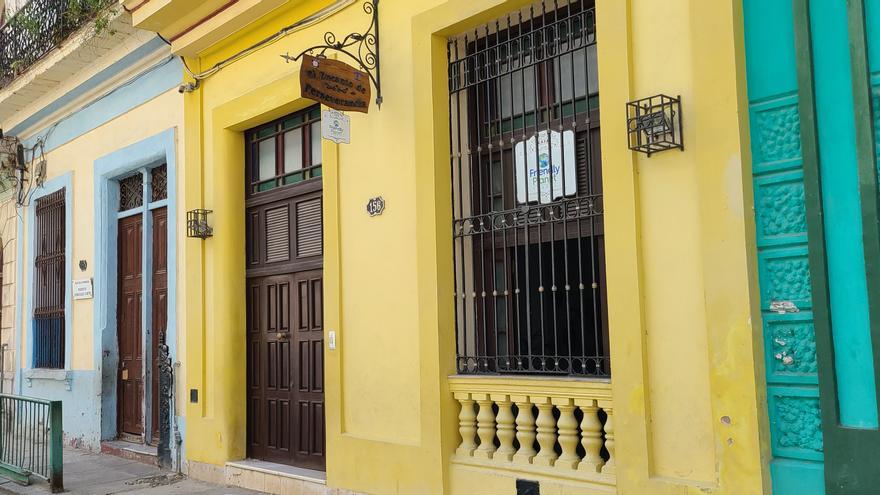
The townhouse, remodeled in 2013 as a high-end tourist hostel that charges as much as a hundred dollars a night, is an oddity amid the grime and destruction surrounding it. (14ymedio)

A produce vendor pushes a cart that bounces every time one of the wheels hits a pothole. When he reaches number 156, a woman inquires about the price of his lemons. She is leaning out of a window of a fully restored mansion that now serves as a tourist hostel. “The Charm of Perseverance” — with its bright yellow facade, elegant doors and spotless railings — looks like a shiny spaceship that has just landed amid of the grime and destruction.

Built in the early 20th century, the townhouse has a wide central courtyard, antique pendant lights hanging from its high ceilings, several rooms for rent and a 40-square-meter (430-square-foot) suite that in peak season can go for more than $100 per night. From the rooftop, guests can enjoy a view of the sea and escape the desolate landscape of the street below.

In June, seven people died, including two children, right in front of the house, at 159 Perseverance Street, when an electric scooter caught fire inside one of the dwellings. The tragedy has left deep wounds among the neighbors and added one more ruin to the street, where the only things that seem to persevere are destruction and hopelessness.

____________

COLLABORATE WITH OUR WORKThe 14ymedio team is committed to practicing serious journalism that reflects Cuba’s reality in all its depth. Thank you for joining us on this long journey. We invite you to continue supporting us by becoming a member of 14ymedio now. Together we can continue transforming journalism in Cuba.

Havana, As Seen Through Its Overflowing Garbage

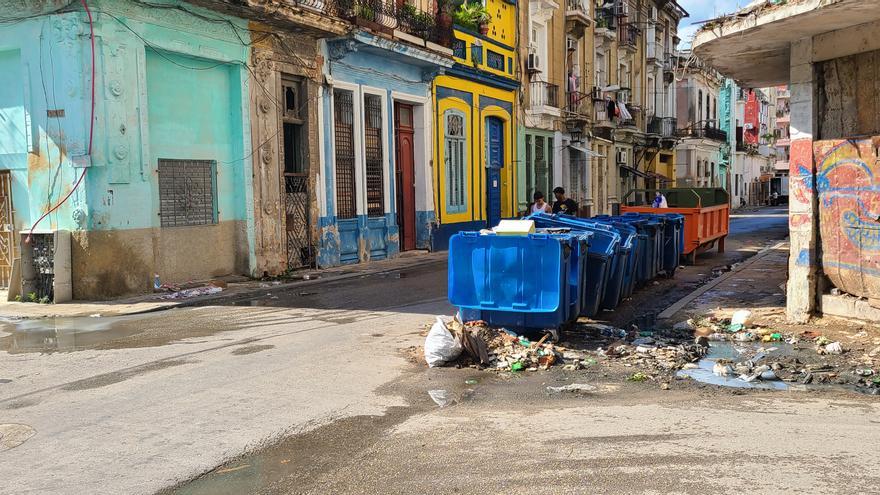
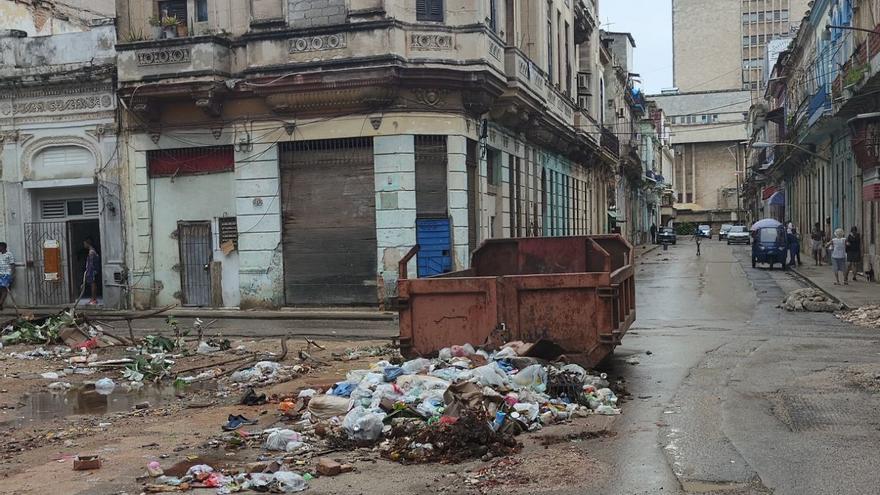
On the corner of Industria and Ánimas, in the neighborhood of Colón (Central Havana), the garbage containers are overflowing with waste and debris. (14ymedio)

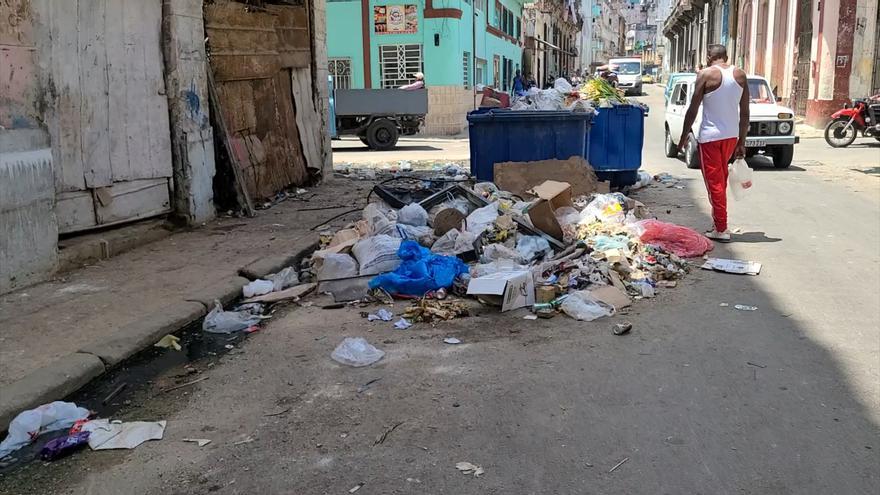
14ymedio bigger14ymedio, Nelson García, Havana, 31 August 2023 — Celia holds her breath every day when she passes by the corner of Industria y Ánimas, in the neighborhood of Colón (Centro Habana). The garbage containers are overflowing with waste and debris. The sidewalk stopped being passable some time ago, and pedestrians mix with the vehicles and taxi-bikes on the street. Rusty metal sheets cover the entrances to the building in front of which the mountain of waste grows.

“Before, when a hurricane was coming, the Communal companies picked up the garbage and cleaned the sewers, but with Idalia they didn’t even show up around here,” complained Celia, while pointing to the row of crammed-full garbage cans. Near them, a huge cargo container of a truck contains construction debris, parts of broken furniture and the garbage generated by a nearby business that sells animals for religious sacrifice.

Despite the ugliness of the scene and the bad smells, people who pass by react normally. Dirt has become so familiar in Havana that the surprising thing is those blocks where cleanliness, painted facades and order contrast with the rest of the city. People seem to have become accustomed to living with the filth due to the inability of the authorities to collect it in time.

Garbage is also the way for many to survive. The dumpster divers search the containers for raw materials to sell, empty perfume bottles to refill to scam some unsuspecting customer, food waste to feed the pigs, pieces of appliances that serve to repair others and even clothes that help protect them from the breeze and humidity during the early hours of the morning. Where some see rubbish, others find their means of sustenance. continue reading

Despite the ugliness of the scene and the bad smells, people who pass by react normally. (14ymedio)

Garbage in Havana is also one of the most obvious ways to measure the state of the economy of the Cuban capital. During the crisis of the 90s, garbage containers had only what could no longer be used for almost anything. Not even pieces of old wood were thrown into the cans, because people used them as firewood to cook. Finding leftover food among the waste was a miracle in what Fidel Castro named the Special Period.

Then, the garbage of Havana began to fill with plastic bags that until then had been considered a status symbol for those who bought in dollar stores. Little by little, with the opening to private businesses, the expansion of markets in convertible pesos and the arrival of more tourists, cans, plastic containers and boxes of electronic devices appeared on the streets.

“The garbage smelled different,” recalls Genaro, 68 years old and a resident a few meters from the corner of Industria and Ánimas. In those years, this habanero and his two sons had a small business collecting empty cans of beer and soda. “There wasn’t the poverty there is now.  You could get something from selling in the cans, but it’s not worth it anymore,” he tells 14ymedio. “Even the garbage is in crisis.”

Some stone faces peep out on the facade of the building on the corner in front of the containers. They wear curly wigs that mimic some European headdress, which are totally out of tune with the destroyed balconies, the thresholds without doors and a couple of bushes that have grown on the eaves of the semi-ruined building. From up there they look like the guardians of the waste, the watchmen of the city’s offal.

The dirt also affects entrepreneurs. Lourdes has seen the clientele of her cafeteria in the neighborhood of Colón languish to the same extent that the garbage pile in front of her place grows. “Who is going to want to have a milkshake or eat a pizza with this plague?” she asks. The journey of the neighbors to eradicate the huge garbage pile has taken them from the meetings with the Delegate of People’s Power to “writing letters to the Council of State,” the woman tells this newspaper.

“Who is going to want to have a milkshake or eat a pizza with this plague?” she asks

The result of the complaints has been null. Over the years, the sidewalk around the pile of garbage has disappeared, “because instead of picking it up with the right trucks they bring a bulldozer and scoop it up,” Lourdes says. Water accumulates in the hole left by the heavy machinery, and “a mosquito farm is formed that does not allow us to live.”

Hanging from the ceiling of the cafeteria, Lourdes has put some transparent plastic bags with water that, someone told her, “help to scare away the flies.” But the curious invention doesn’t seem to be working. This Wednesday several insects were perched on the bags and flew down on the food of the few customers who came to buy. The owner’s hand constantly waved a cardboard to ward off the flying intruders, which sometimes went from the waste thrown on the street to the meringue of some small sweets.

At noon, an impeccable white police patrol car passed in front of Lourdes’ house with a camera installed on the roof. With the windows closed and somewhat fogged, revealing the air conditioning inside the vehicle, the uniformed men roamed the streets of a neighborhood where poverty and discontent are the breeding grounds for complaint and protest. The wheels of the car passed over some garbage bags and continued on their way to the next block. And like that, four or five times a day.

Translated by Regina Anavy

____________

COLLABORATE WITH OUR WORKThe 14ymedio team is committed to practicing serious journalism that reflects Cuba’s reality in all its depth. Thank you for joining us on this long journey. We invite you to continue supporting us by becoming a member of 14ymedio now. Together we can continue transforming journalism in Cuba.
Despite the Political Prisoners, Cuba Is Running Again for the UN Human Rights Council

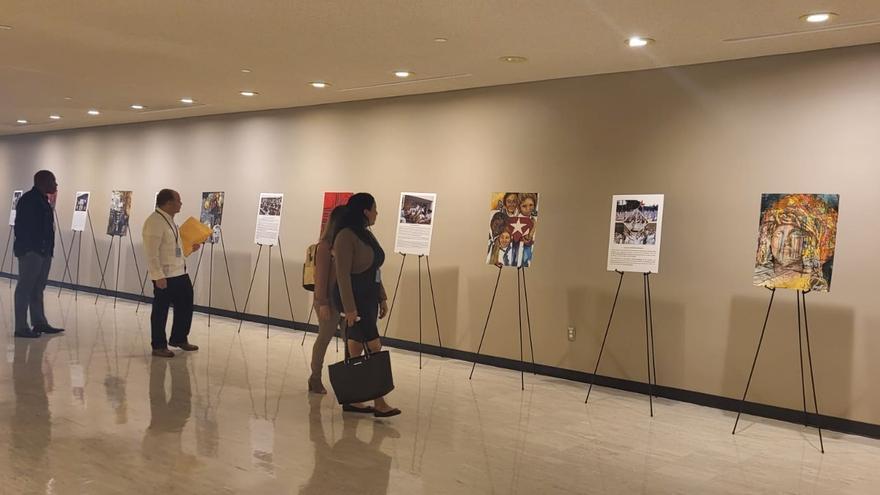
The exhibition was inaugurated this Tuesday at United Nations headquarters. (@GerardoPPortal)

14ymedio bigger14ymedio, Madrid, 30 August 2023 — Starting Tuesday, the main lobby of the United Nations headquarters in New York is hosting an exhibition with a disturbing title: “Cuba, a sustained commitment to human rights for all.” Paintings by the Cuban visual artist Yosvany Martínez alternate with works by other photographers from the Island in an exhibition organized to promote the re-election of Cuba as a member of the Human Rights Council, a mandate that expires on December 31.

“The Cuban people own their own destiny, exercise full power and control over the life of their country, and actively participate in an effective system of socialist democracy and social justice that they support and endorse,” reads the text of the exhibit’s presentation, signed by the Deputy Prime Minister of Foreign Affairs of Cuba and Permanent Representative to the UN, Gerardo Peñalver Portal.

The document aims to highlight the importance of “the protection of human rights and international cooperation” for Cuba’s policies. “With humility, but with an important track record of performance in this sphere, with tangible results enjoyed by our people and internationally recognized,” the message continues, which mentions, as expected, that everything has been achieved “despite a hard blockade of more than 60 years.”

The exhibition contains photographs of Cuban doctors on international missions at a time when the discredit is total

The text continues to gloss over those things that once functioned as promotional pillars of the regime but have now visibly deteriorated; namely, health, education, sports and science. continue reading

To illustrate this, the exhibition contains photographs of Cuban doctors on international missions at a time when the discredit is total and has been denounced by different organizations, including the one that hosts the exhibition, for the exploitation of professionals, who receive only 15% of the salaries that the host countries pay to the Cuban government for them. To this should be added the fact that their documentation is withdrawn to prevent them from traveling; they are forced to show their adherence to the Government, and they are prevented from interacting with the population of the destination countries.

Nor can anything better be said in the case of athletes, whose escapes are counted by several dozen annually; or of the teachers who left their jobs, causing a chronic shortage of teachers in recent years.

Another photograph claims that Cuba has produced three vaccines against COVID-19, although three years later they still haven’t received the endorsement of the World Health Organization for emergency use.

The authorities boast, as can be seen on their posters, of other alleged achievements. One of them is the fight against racism, despite the fact that official surveys systematically show that the black and mulatto populations have worse jobs, worse wages, higher poverty rates and lower institutional representation, among other adversities.

The authorities boast, as can be seen on their posters, of other alleged achievements. One of them is the fight against racism

There is also an apparent protection for people with disabilities that few would subscribe to.

The most striking thing, however, is the poster that proclaims the benefits of the Criminal Code, the Criminal Procedure Law and other reforms that “guarantee due process” in the field of the administration of justice, something difficult to believe about a country that, as a member of the Human Rights Council (the election is for three years and dates back to 2020) imprisoned more than a thousand people for the demonstrations of July 11, 2021, imposing sentences of tens of years on some of them for “sedition.” The illustration that accompanies the text is not far behind and shows a unanimous vote in the National Assembly.

The artists who gave life to the exhibition are “educated entirely by the Revolution, totally free, like all those born after 1959,” adds the presentation text, which continues: “This exhibition reflects our progress in economic, social and cultural rights, in the sphere of political and civil rights.”

Peñalver, who attended the inauguration on Tuesday with Yosvany Martínez, invited the permanent and rotating members of the Council to enjoy the exhibition. “I hope you enjoy it and understand the pride of being Cuban,” the text closes.

Cuba was elected a member of the Council in October 2020 amid the discomfort of many countries that were indignant about its entry, which took place along with that of China and Russia. The members are directly elected every three years by regional quotas – Latin America has eight seats – and they cannot repeat after two consecutive terms, so the Island is trying to win what would be its last short-term opportunity, for 2024-2026.

Translated by Regina Anavy

____________

COLLABORATE WITH OUR WORKThe 14ymedio team is committed to practicing serious journalism that reflects Cuba’s reality in all its depth. Thank you for joining us on this long journey. We invite you to continue supporting us by becoming a member of 14ymedio now. Together we can continue transforming journalism in Cuba.
Hurricane Idalia Leaves Power Cuts and Collapsed Buildings in Western Cuba

La Policía mantiene bajo vigilancia el edificio ubicado en Prado 352, cuyos habitantes han protestado en varias ocasiones, colocando sus objetos en el portal. (14ymedio)
Months ago the partial collapse of this building, whose door was blocked, could be foreseen. (14ymedio)

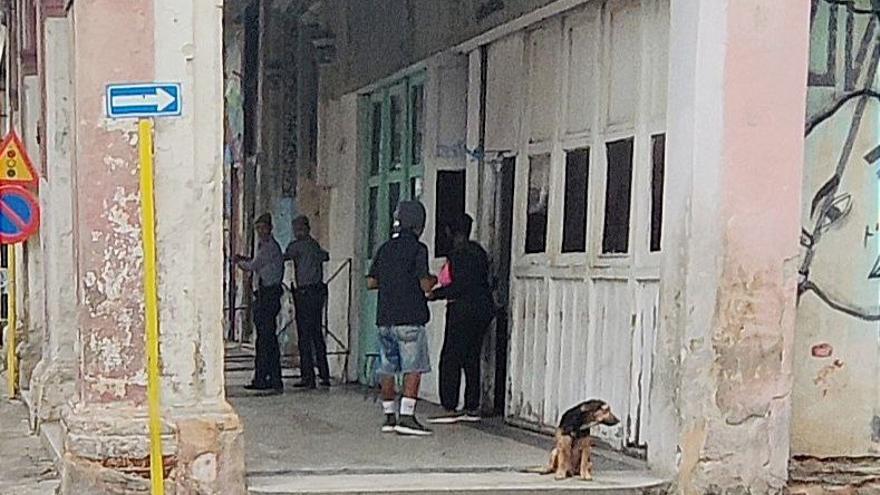
14ymedio bigger14ymedio, Juan Diego Rodríguez, Havana, 29 August 2023 — The two-story building located at number 352 Paseo Del Prado at Virtudes in Havana suffered a partial collapse on Tuesday after the rains caused by Hurricane Idalia. According to 14ymedio, the police have the property under surveillance. The inhabitants protested on several occasions, placing objects in the doorway and sitting there, aware of the precariousness of the building.

Although no deaths were reported and some neighbors were rescued by the Red Cross and firefighters, it has been months since the collapse of the building, whose door was blocked, could be foreseen. Idalia’s passage through western Cuba gave another blow to the battered architectural structures of the capital, in addition to causing power cuts to the electricity service and the Internet.

A collapse of a building was also reported on Esperanza Street, between Florida and Alambique, in the Jesús María neighborhood. A video published by journalist Mario J. Pentón shows how the property, which lost its second floor, was examined by the neighbors themselves, in the absence of the authorities.

The bad weather has left almost 48,000 habaneros without electricity, as reported by the province’s Electric Company, and has caused notable damage to 45 electric circuits. The document also pointed out that “numerous breakdowns” had been detected in the municipalities of Habana del Este, Arroyo Naranjo, Boyeros, Plaza de la Revolución and El Cerro. continue reading

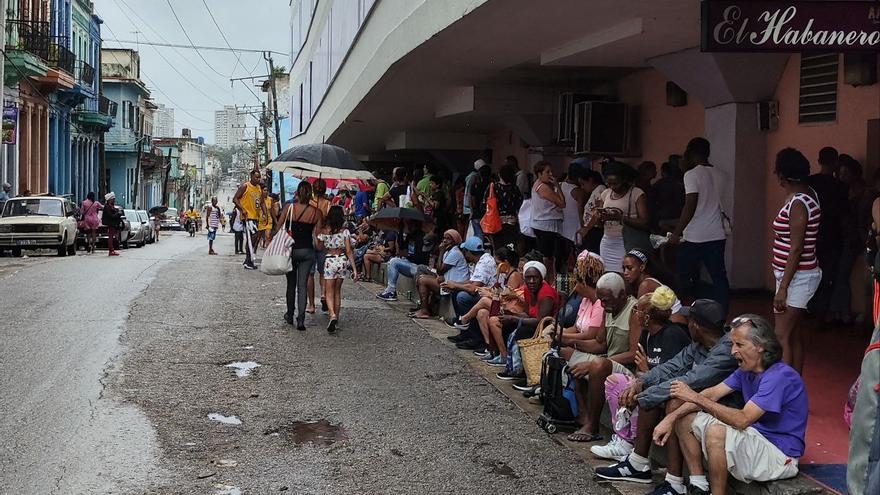
With umbrellas and dodging puddles and potholes, the goal of those who walked the streets was the same: to find food. (14ymedio)

At noon this Tuesday, residents left their homes as the rain subsided. With umbrellas and dodging puddles and potholes, the goal of those who walked the streets was the same: to find food. Although some stalls began to operate in spite of the rain, the shortage – caused by the proximity of Idalia – has led to a new increase in the price of products.

On the sidewalks and in doorways, some have begun to dry out their belongings. Many of the city’s rooftops couldn’t withstand the wind, and water seeped through leaks to damage the interiors of homes.

In addition to building collapses and power outages, the impact of the rains on the garbage dumps in Havana, which the authorities did not bother to clean up before Idalia arrived, has been considerable. “They didn’t pick up the garbage here,” complains a neighbor from Nuevo Vedado, in the Plaza de la Revolución municipality. Compared to other years, when the Communal Company cleaned sewers and evacuated waste from the streets,  each family is now in charge of doing what they can to protect their lives and property.

Each one took care of his little piece because no trucks or brigades came to help us. “We cleaned the roof because if it falls, the rain will come in on us,” another neighbor of a five-story building in the La Timba area tells this newspaper. “But each one took care of his little piece because no trucks or brigades came to help us,” she said. The winds damaged several light roofs of the neighborhood, which is close to the Council of State and with a very low-income population.

On the coast, images of the tidal waves were widely disseminated on social networks, although the concern of the day was the serious problems with the Internet connection throughout the western part of the Island. Despite the winds and rain, traffic on the Avenida del Malecón remained for a good part of the morning and until afternoon.

The impact of the rains on the Havana garbage dumps, which the authorities did not bother to clean up before Idalia arrived, has been considerable. (14ymedio)

In Pinar del Río, Idalia caused strong storms, with wind gusts of more than 56-59 miles per hour, although they have now dropped to 34-37 mph. The Cuyaguateje River, the main watershed of the province, has overflowed its banks.

“The greatest problems have been with electricity and the Internet connection,” Margot, a resident of the city of Pinar del Río, tells this newspaper. “There have been floods in the area of Mantua and La Coloma. We have found out through a WhatsApp group that we have with several lay people from the Church,” she says.

“The problem is that Idalia arrived at a time when there are still many people in those towns on the outskirts of the city who are still without a roof from Hurricane Ian,” Margot adds. They suffered “some leaks in their homes but nothing serious. The hardest thing has been getting food the last a day or two without having to go out on the street.”

Idalia entered the Island around 9 pm this Monday through Cabo de San Antonio, at the westernmost end of the Island, and although at 3 am this Tuesday the storm was already leaving Cuba, the rains have not stopped. The largest accumulations have occurred in San Juan y Martínez (3.5 inches) and Isabel Rubio (4.2 inches) between 2 and 5 in the morning, and people are holding their breath with the memory of Ian, in September of last year, still fresh.

Translated by Regina Anavy

____________

COLLABORATE WITH OUR WORKThe 14ymedio team is committed to practicing serious journalism that reflects Cuba’s reality in all its depth. Thank you for joining us on this long journey. We invite you to continue supporting us by becoming a member of 14ymedio now. Together we can continue transforming journalism in Cuba.
Cuba’s Political Prisoners and the People of Ukraine, Winners of the Pedro Luis Boitel 2023 Freedom Prize

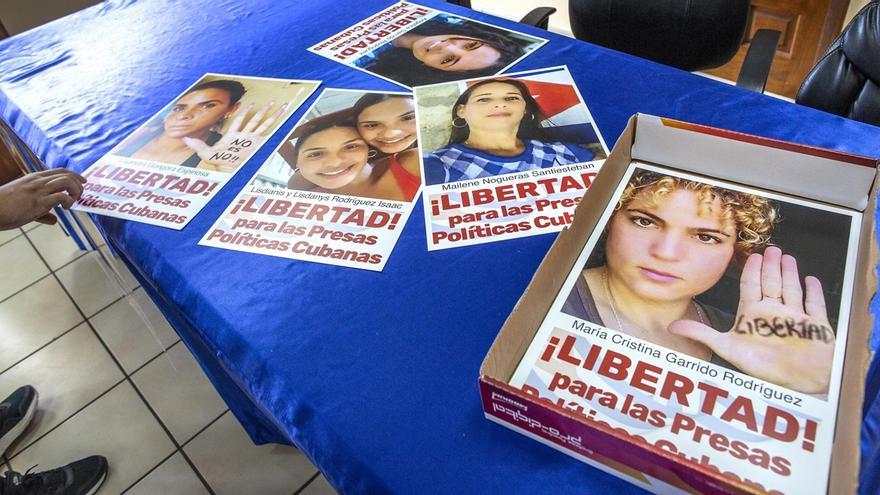
A person looks at banners with photos of Cuban prisoners during a press conference in Miami, Florida, on May 16, 2023. (EFE/EPA/CRISTOBAL HERRERA-ULASHKEVICH)

14ymedio biggerEFE (via 14ymedio), Miami, 29 August 2023 — The Assembly of the Cuban Resistance (ARC), which includes opposition organizations from inside and outside Cuba, announced this Tuesday that the Pedro Luis Boitel 2023 Freedom Prize was awarded to the 137 Cuban political prisoners and the Ukrainian people for defending their sovereignty against “Russian aggression.”

Established in 2001, the Boitel Prize is awarded every year by an international panel to an outstanding figure in the fight for freedom in Cuba or in the world.

The announcement of the winners was made in Kiev as part of the visit of a delegation from the Assembly of the Cuban Resistance and the Hemispheric Front for Freedom to express their solidarity with the cause of Ukrainian freedom and their rejection of “the participation of the Castroite Black Berets in the Russian aggression” against that country.

The award honors the memory of Pedro Luis Boitel, who fought against the military dictatorship of Fulgencio Batista and then against the regime of Fidel Castro and died in 1972 after a 53-day hunger strike in a Cuban jail.

According to a statement from ARC, Alexander Merezhko, Chairman of the Committee on Foreign Relations of the Ukrainian Parliament, and MP Maryan Zablotsky participated in the announcement of the Boitel Prize winners. continue reading

“We support political prisoners in Cuba, especially women political prisoners, and we are happy that this year the Boitel award goes to women political prisoners in Cuba. We admire your courage and demand your release,” said Merezhko.

Zablotsky said that Ukrainians know well that communism, “an ideology that should not have existed,” “only leads to repression” and regretted that it persists in Cuba and other countries.

“You should know that we share your pain and your values. And I am sure that freedom always wins over darkness,” added the deputy, according to an ARC statement.

Salvadoran congressman Ricardo Godoy and Orlando Gutiérrez Boronat, ARC coordinator, also addressed the announcement.

Gutiérrez recalled that in Kiev’s Maidan square “the recovery of sovereignty by the people of Ukraine began in the critical year of 2014,” with popular demonstrations and the action of the Armed Forces that prevented Russia from dominating Ukraine again and consolidated the democracy of the country.

“Maidan is a cry for freedom and a symbol of freedom for the entire world and it should also be for Cuba. It is in this alliance between the people and the patriotic Armed Forces that the hope for the liberation of Cuba lies,” he stressed.

____________

COLLABORATE WITH OUR WORKThe 14ymedio team is committed to practicing serious journalism that reflects Cuba’s reality in all its depth. Thank you for joining us on this long journey. We invite you to continue supporting us by becoming a member of 14ymedio now. Together we can continue transforming journalism in Cuba.