The Creative Cuisine of Cuban Grandmothers in the Face of General Scarcity

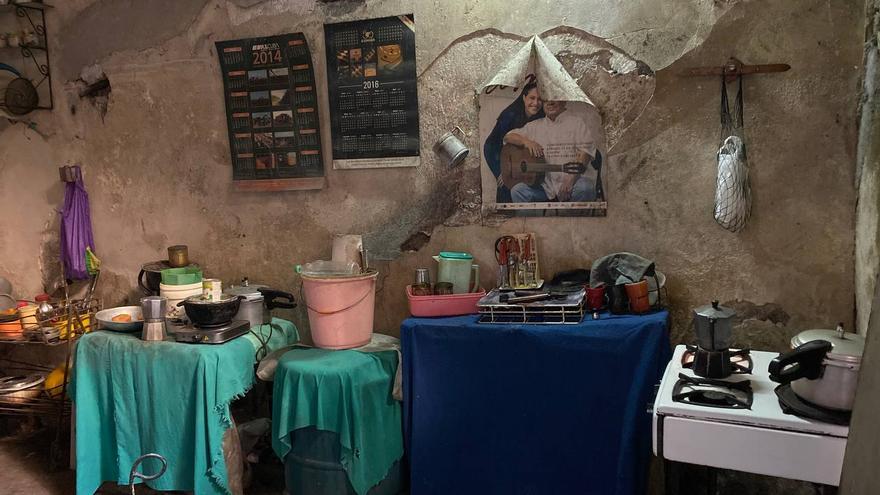
Cuban cuisine, opulent in other times, now functions with scarce food and improvised recipes. (14ymedio)

14ymedio bigger14ymedio, Juan Izquierdo, Havana, 29 August 2023 — The walls of Havana creak with the rain and Idalia’s breeze.  While the radio predicts that everything is in order, jets of water slip between the tiles and drip, relentless, coating the walls. However, what most worries Aurelia, 61 years old and fond of cooking, is what she is going to eat at home while the storm lasts.

In her building in Centro Habana, several retirees like her tried to equip themselves — with very little luck — so they wouldn’t have to go outside in the rain. The result of the hunt is lean: a pound of ground chicken, a bottle of El Cocinero oil, and rice.

 Neighbors trade small amounts of rice, flour or eggs to contribute to the completion of a whole meal

Pedro, one of Aurelia’s old friends, recalled that Cubadebate had a gastronomy section and that it might give them an idea to bite the bullet and invent a banquet. Sabor y Tradición, the column by gourmet cook Silvia Gómez Fariñas, has everyone taking offense against the “official Cuban recipe book”: sausage, guava jelly, beef burger, mango chutney, breaded chicken with peanuts, fried vegetables, etc., not to mention the wacky instructions for the hacked shark, the fish in green sauce and malarrabia.*

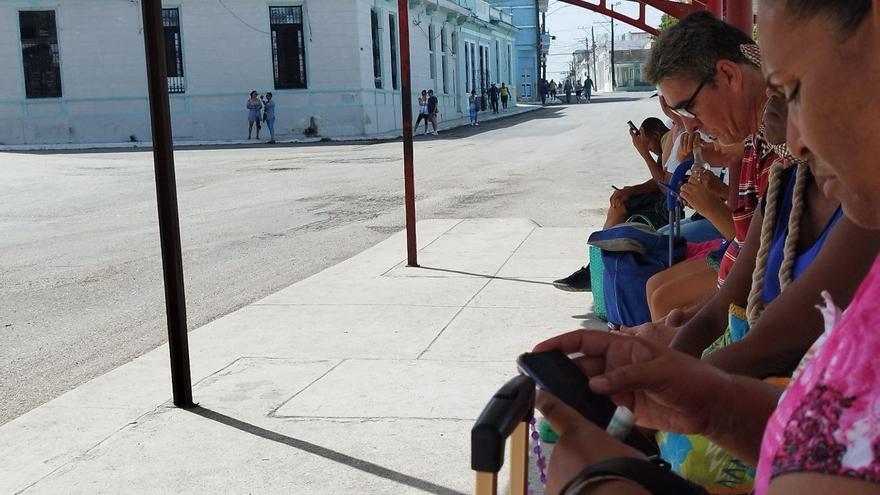
“We will have to make do with the creative cuisine of the revolutionary grandmothers,” Aurelia proposes ironically, among the insults of the others to the opulent menu of Cubadebate. Phone in hand, she starts calling other neighbors and “negotiating.” continue reading

Ernesto, who lives on the first floor, will lend her a few handfuls of powdered egg. “Let’s do the same deal as the other day,” Aurelia proposes, reminding him that, in exchange for the egg, he got some croquettes she had prepared. Using the same tactic, a call to her neighbor Sandra guarantees her a small bunch of chives and two or three spices.

The oil begins to get hot, Ernesto prepares a salad, someone else the rice, and Aurelia throws the picadillo into the pot

The kitchen counter begins to look less squalid, and Aurelia gets down to work. At the last minute, a packet of flour appears. “I sold the cigarettes from the bodega [the ration store] and got this a few days ago,” says Pedro. As if she were making an act of contrition, she confessed to her friends that she was saving the flour to make some sweets, but since the eggs are not available through the ration book, it’s better to use them and that’s it. “You only live once,” she concludes, while the downpour continues beating on the windows of the house.

The oil begins to get hot, Ernesto prepares a salad, someone else the rice, and Aurelia throws the picadillo into the pot. Disappointed, she notes the meat shrinking as it makes contact with the metal. Shortly after, already at the table, everyone devours Aurelia’s picadillo with white rice. “It won’t be Cubadebate’s hacked shark, but it is what it is,” she says.

The coffee – a bit watery – rounds off the meal. The weather begins to clear over Havana. Someone opens a window to let the fresh air in, but Aurelia asks that they close it: the neighborhood dump, located a few meters below her window, must be at its peak.  She is right, whoever looks out the window will see a horde of flies swarming over the garbage. “With so much trash, it’s best not to talk too much,” she warns. “If you’re not careful, flies will get into your mouth.”

*Translator’s note: Malarrabia (insanity or bad case of hydrophobia) is a typical Cuban dessert made with several fruits and vegetables and syrup.

Translated by Norma Whiting
_____________________________

COLLABORATE WITH OUR WORKThe 14ymedio team is committed to practicing serious journalism that reflects Cuba’s reality in all its depth. Thank you for joining us on this long journey. We invite you to continue supporting us by becoming a member of 14ymedio now. Together we can continue transforming journalism in Cuba.
Tens of Thousands of Cubans on Waiting List to Buy Dollars

The Cadeca branch at 23rd and J streets will allow only fifteen people a day to buy currency. (14ymedio)

14ymedio bigger14ymedio, Havana, 28 August 2023 — Cuba’s official currency exchange, Cadeca, indicated on Sunday that, after being out of commission for three days, the Ticket app will again be taking online reservations for people wanting to buy hard currency at its authorized branches. The waiting list at just one Havana location already exceeds 12,000 people. In other provinces the figure can exceed 23,000.

The platform, which handles a large number of services in Cuba (such as propane gas sales, notaries and civil registration), began having problems on Friday when customers tried to schedule a time to buy foreign currency but were unable to access the waiting list. The sale of foreign currency over those three days, however, continued uninterrupted.

This morning, employees allowed only fifteen people inside the Cadeca at 23rd and J streets in Havana’s Vedado district. From the outside, everything seemed to be in order. However, one of those present reported, “The problem is actually with Ticket.”

“There is a serious problem with the system, and it is that it doesn’t notify you when it’s almost your turn or if you’re in the next group to buy”

According to Reinaldo, more than 10,000 people are on a waiting list at each of the company’s five offices in Havana authorized to sell hard currency. “I signed up in April and I remember that I had to choose a day that I could theoretically go to Cadeca. I chose a date in mid-May, but it was just symbolic. It’s only now, in August, that my number finally got to the top of the list,” he says. continue reading

The long wait is not his only concern, however. For the last two weeks, Reinaldo has gone to the branch at 23rd and J streets, fearing he will miss his turn and have to wait several more months to get the $100 he is legally allowed to buy. “There is a serious problem with their system,” he says. “It doesn’t notify you when it’s almost your turn or if you’re in the next group of customers. You have to go to the Cadeca office and wait for them to announce the list for that day, which is never more than twenty people. If you aren’t on it, you have to come back the next day.”

On the sidewalk in front of the currency exchange office, another young man awaits his turn. He believes the branch has more currency than it is selling: “Even if they had 5,000 dollars or euros, they would only sell to fifteen or twenty people a day.

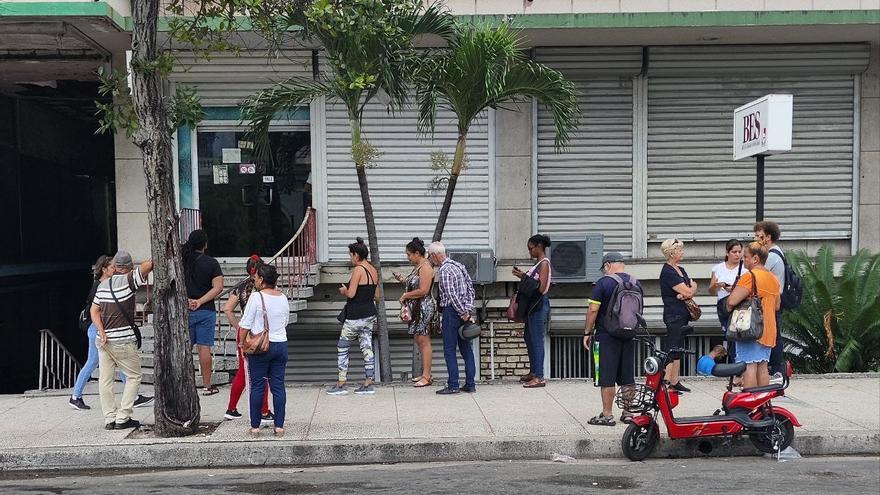
Cadeca’s website is filled with comments by customers with similar concerns about the company’s management. “This platform, which used to seem like a good solution for workers, barely moves. I signed up on May 12 and there are still 1,026 people ahead of me,” complains a woman who says she is on the waiting list at the Playa branch on 21st and 42nd streets. “If someone needs dollars, they have to turn to the black market because going this route will take five or six months.”

On Monday, the peso-to-dollar exchange rate, which as high as 250 to one last week, fell to 235

In Sancti Spíritus the situation is not much different from that of Havana. 14ymedio was able to confirm that there are more than 23,500 people on this city’s waiting list. A local woman reported that, since she added her name to the list last May, her place in line has barely budged. “Right now there are about 3,700 people ahead of me. At this rate I won’t be able to buy the euros I need until the end of the year. That’s why people end up going to the black market. Even if it’s much more expensive, at least you get things resolved quickly,” she confesses.

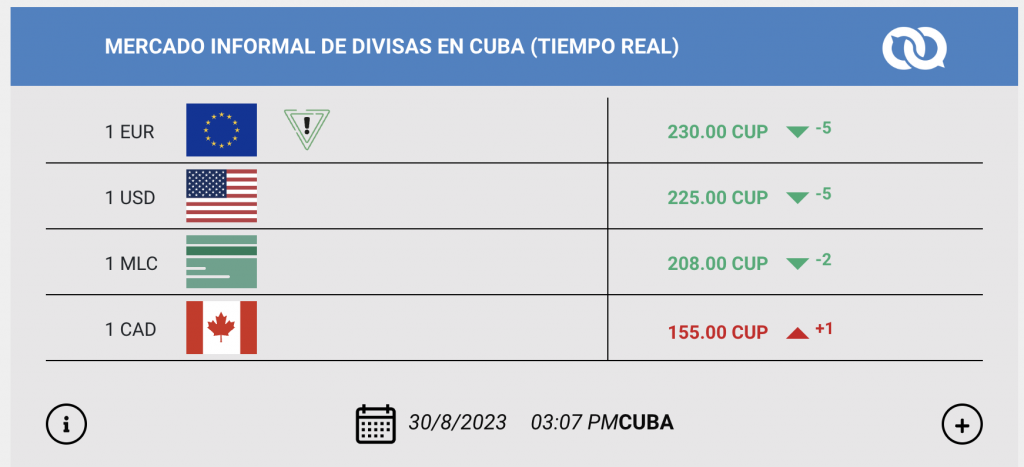
On Monday, the peso-to-dollar exchange rate, which as high as 250 to one last week, fell to 235. Meanwhile, the euro, the second most sought-after currency on the island, hovered at 240. This modest drop gave Cubans a modicum of relief, though it is still double the official rate of 120 pesos to the dollar.

The situation has contributed to the worsening financial insecurity of the public, which has been  subjected in recent years to constantly shifting economic policies, the devaluation of the currency, the loss of purchasing power and the inability of banks to protect their assets. The government still obsesses over the bancarización* — banking reform — of the country, even though it does not have the infrastructure necessary to support the kind of electronic payment system that the program requires, while ignoring the needs of its citizens, who must resort to the informal market to survive.

Recently, 14ymedio reported on the closure of a Cadeca currency exchange on Obispo Street in Old Havana whose premises are now rented out to a privately owned business. The store, whose windows used to display currency exchange rates, now sells children’s toys. The cause, once again, is the state’s lack of liquidity and the unprecedented collapse of the economy.

*Translator’s note: “Bancarización” is term used in Cuba and other Latin American countries that refers to government efforts to reduce the role of cash through a greater reliance on banks’ digital payment options. The term does not seem to have a counterpart in English so the Spanish term is used throughout this translation.

____________

COLLABORATE WITH OUR WORKThe 14ymedio team is committed to practicing serious journalism that reflects Cuba’s reality in all its depth. Thank you for joining us on this long journey. We invite you to continue supporting us by becoming a member of 14ymedio now. Together we can continue transforming journalism in Cuba.

In Addition to Deepening Energy Cooperation With Cuba, Russia Will Sell It Meat and Dairy Products

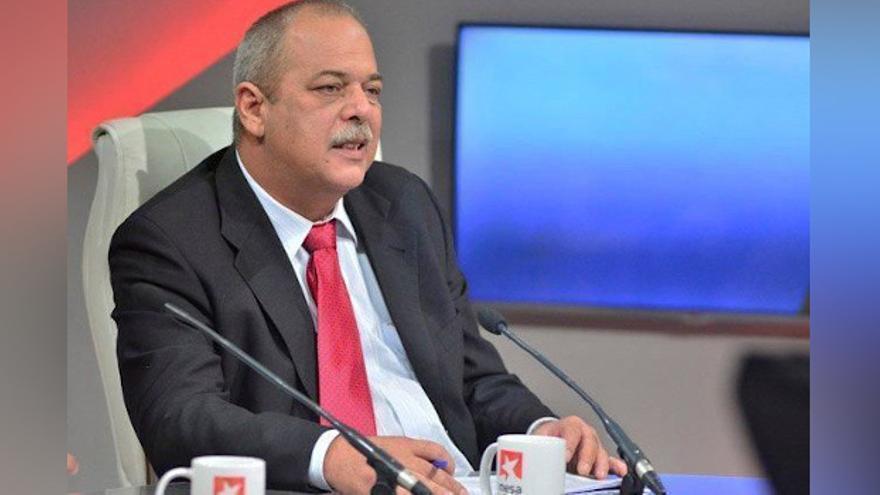
Vicente de la O Levy, Minister of Energy and Mines of Cuba. (September 5)

14ymedio bigger14ymedio/EFE, Moscow, 30 August 2023 — Russia and Cuba will deepen bilateral cooperation, especially in the field of energy, the Russian Foreign Ministry reported today after a meeting held between the Russian Deputy Foreign Minister, Sergey Riabkov, and the Minister of Energy and Mines of the Island, Vicente de la O Levy.

According to the statement released by the Russian Foreign Ministry, “during the meeting, which took place in an atmosphere of friendship and mutual understanding inherent in the Russian-Cuban dialogue, the strengthening of bilateral cooperation was addressed, particularly in the field of energy, in the spirit of establishing a strategic alliance.”

Moscow once again recognized Havana by confirming the “consistent position regarding the need for the immediate cessation of the commercial, economic and financial blockade of Cuba by the United States.”

The rest of the Russian industries that were already operating in the country were granted extensions for their operations

Last Tuesday, the Sputnik newscast agency announced the certification of nine Russian livestock companies, for a total of 23, that will be able to operate in Cuba. After inspection by the National Agricultural Health Center of the Island, three pork companies, two dairy and another four of meat products —  pork, poultry and beef — will be able to market their continue reading

products in the Cuban market. The rest of the Russian industries that were already operating in the country were granted extensions for their operations.

The traditional relations between Russia and Cuba received a new impetus last May, after both countries endorsed the desire to strengthen the Russian financial and business presence on the Island with exemption from tariffs, land concessions and ties between their banking systems.

One of the most controversial measures was the delivery in usufruct, for 30 years, of land to Russian businessmen who wish to exploit it. The president of the Cuba-Russia Business Council, Boris Titov, then explained that among the concessions were “both the long-term lease of land and the tax-free import of agricultural machinery, the granting of the right to transfer profits in foreign currency and much more.

A high percentage of state land, for example 90%, should be sold to the national private sector

The Cuban economist Pedro Monreal then published on his X account (formerly known as Twitter) a critique of the strategic meaning of the package of measures for the national economy. “If it is about promoting entrepreneurs, then the game should be leveled for nationals,” he said, explaining that national production and support for Cuban entrepreneurs should be favored over foreign investors.

“A high percentage of state land, for example 90%, should be sold to the national private sector — independent owners and companies. In this way, “the private sector would have the possibility of negotiating directly with foreign entrepreneurs about the management of those lands,” rather than the State.

Despite the close political ties, in 2022 the bilateral trade exchange between Moscow and Havana was only 451 million dollars, a figure that the Russians want to improve.

Translated by Regina Anavy

____________

COLLABORATE WITH OUR WORKThe 14ymedio team is committed to practicing serious journalism that reflects Cuba’s reality in all its depth. Thank you for joining us on this long journey. We invite you to continue supporting us by becoming a member of 14ymedio now. Together we can continue transforming journalism in Cuba.

While Florida Evacuates the Population in the Face of Idalia’s Threat, Cuba Evaluates the Damage

There are still 60,000 homes in Pinar del Río damaged by Hurricane Ian, and now the damage left yesterday by Idalia will have to be added. (Telepinar)

14ymedio bigger14ymedio, Havana, 30 August 2023 — Florida remains in suspense before the imminent arrival of Idalia, which will reach the coast of Big Bend as a category 4 hurricane, according to the forecasts of the National Hurricane Center (NHC) of the United States. Its fleeting passage through Cuba, even as a tropical storm, left hundreds of thousands of people without power. Cubans are now expecting the tail end of the hurricane, with floods and strong winds along the western coast.

“Now we have to work urgently on electric service, communications and agriculture and prepare safer conditions, because remember that we are still going to have one or two more days of rainfall,” Miguel Díaz-Canel said at a meeting of the Council of Ministers to evaluate the situation of the affected provinces.

The most affected was again Pinar del Río, where Idalia entered and left. Around 8 p.m., the electricity company warned that only 28% of its 235,000 customers had power. The linemen, some of them from other provinces such as Sancti Spíritus and Cienfuegos, planned to work during the night to recover power in the municipal capitals and, later, the distribution to smaller towns.

The director of Education pointed out that there are 24 damaged schools, and this is not the most serious thing, but there are 125 that have not yet recovered from Ian’s passage in September 2022

The school year should begin next Monday on the Island, but in Pinar del Río the worst is feared. The director of Education pointed out that there are 24 damaged schools, and this is not the most serious thing, but there are 125 that have not yet recovered from Ian’s passage in September 2022. continue reading

Ian was much larger, and there are still 60,000 homes affected in the province, to which must be added those left yesterday by Idalia. There were also 17,652 telephone services and 915 data connections out of service this Tuesday. The damage to agriculture is unknown, especially to tobacco, which, despite preventive measures, is expected to be damaged.

Yamilé Ramos Cordero, first secretary of the Provincial Party Committee in the province, said that the data will not be known until Wednesday, although 20,000 people were evacuated. “The biggest concern is the increased amount of water in the rivers and the forecast that we may have coastal flooding,” she added.

The power situation has been a big problem after the storm. In Artemisa, which did not suffer heavy rains, 80% of users lost electricity at some point, a total of 117,434. “The biggest effects occurred in the electrical service. There were 390 people evacuated, most of them to the homes of family and friends and 11 to the ESBU Guillermo Castillo, authorized for such purposes,” said Luis Felipe Azcuy Curbelo, president of the Municipal Defense Council.

The same thing happened in Havana, although the percentage has been less significant: 47,980 customers were left without power, of which 60% had recovered service around 5 p.m. This Thursday, 20 brigades of linemen from different provinces will arrive to join the 27 in the capital to normalize the situation, with Thursday as the deadline, with the exception of connections, meter counters and the input of current, which will be repaired on Friday.

Another big problem for Havana was the water supply linked to the supply systems, which are electric. There are 53,906 people who don’t have service, according to the assessment of the Provincial Defense Council, and 3,782 were left without water distributed by tanker trucks due to the adverse weather.

On the Isle of Youth there were 4,326 people who lost electricity, and part of the concern has been focused on protecting the poultry, livestock and fishing industries. The companies insist that there have been no problems with the poultry or leaks that have affected the feed, and the boats were covered, while the pigs and sheep were moved to higher ground.

53,906 people have no service, according to the assessment of the Provincial Defense Council, and 3,782 were left without water distributed by tanker trucks

For the next few hours, isolated showers and thunderstorms are expected throughout the Island, with winds of moderate intensity, while Idalia heads towards Florida. The NHC warned in its most recent report about a rapid intensification, which will leave “catastrophic tides and destructive winds” on the north coast of the state this Wednesday, when it will move inland.

“There is going to be a storm surge everywhere in the Big Bend  that will have a very important and significant impact on that region, whether the walls of the hurricane hit it or not,” Governor DeSantis warned the population from Tallahassee, the state capital.

The governor of the state (Republican) urged residents to go to  evacuation zones, especially if they are in low or coastal areas, or to seek refuge in shelters (up to 50 have been enabled), hotels or homes of friends located in higher and safer places.

“You have to leave now. If you don’t, tomorrow morning will be very unpleasant, and if you decide to stay, the rescuers will not be able to locate you until after the hurricane,” he insisted.

More than 1.6 million people have orders to evacuate their homes in Florida, where Idalia will advance and turn northeast and east-northeast, “approaching the coasts of Georgia, South Carolina and North Carolina on Wednesday and Thursday.”

Translated by Regina Anavy

____________

COLLABORATE WITH OUR WORKThe 14ymedio team is committed to practicing serious journalism that reflects Cuba’s reality in all its depth. Thank you for joining us on this long journey. We invite you to continue supporting us by becoming a member of 14ymedio now. Together we can continue transforming journalism in Cuba.

Three Cuban Players Receive Contracts and Bonuses for More Than $100,000 in the Major Leagues

Left-handed hitter Juan Álvarez was chosen in June by the Arizona Diamondbacks. (@francysromeroFR)

14ymedio bigger14ymedio, Havana, 29 August 2023 — The name of the Cuban hitter Juan Álvarez began to appear in June in the sports offices of the Diamondbacks of Arizona (USA). This young man, who left the Island in 2022, took advantage of the opportunity and, after a few calls, signed his contract on Monday. According to journalist Francys Romero, the 16-year-old baseball player received a $100,000 bonus.

Álvarez left the Island after finishing the Under-15 National Championship in 2020, where he got 19 assists at home (throwing the ball to a teammate to touch the base or the opposing player). Romero recalls that a scout of the United States Major League teams told Álvarez that he had a “special (fast) swing.”

He is a talented batter who can connect on both sides, the left-handed one being stronger,” Romero reported on his blog Baseball FR! “His physique is remarkable for players his age. He has power, speed and can play in the outfield,” he added.

A native of Isla de la Juventud, the young baseball player thus joins the Cubans Jairo Digón and Cristian López, who are already part of the Arizona Diamondbacks. In the 2022-2023 international period, there are now 28 athletes hired from both minor and major leagues.

The baseball player Juan Álvarez thus joins the Cubans Jairo Digón and Cristian López, who are already part of the Arizona Diamondbacks

Cuban players leave the Island in search of better training conditions and better salaries. The scale of payments dating back to 2020 for players in Cuba depends on their category. A member of the national pre-selection continue reading

who participates in the National Series receives 3,725 Cuban pesos per month (19 dollars); one from the Reserve of the National Pre-Selection and National Series receives 2,400 (12 dollars).

Like Álvarez, pitcher John Valle signed with the New York Mets last July. This 18-year-old, who left the Island in 2021, was chosen in the Draft (recruitment period) of the Major Leagues for amateur players. He can throw a fast ball at 95 mph, which he perfected during his stay at Jefferson High School. This athlete received a bonus of $150,000.

Christian Saéz is another Cuban who, after participating in the Under-12 World Cup (2019), where the representative of the Island got a third place, sought to leave the country, a goal that he achieved in 2021. He was chosen by the St. Louis Cardinals. The signing will be made official on January 15, 2024, during the new international period. The pre-agreement includes a bonus of $150,000.

The escape of Cuban players is constant; between July and August, so far,  there have been sixteen. Luis Mario Macías, Fernando Ramos, Jaider Miguel Suárez, Jaider Miguel Suárez, Julio César Pérez, Emmanuel Chapman, Alexander Valiente, Roger Bolaños, Marlon Vega, Yulian Quintana, Yunior Villavicencio, Kevin Arévalo, Alexei Ricardo, Javier Mirabal, Yotuel Ávila and Yasiel González are the names of those who fled.

Translated by Regina Anavy

____________

COLLABORATE WITH OUR WORKThe 14ymedio team is committed to practicing serious journalism that reflects Cuba’s reality in all its depth. Thank you for joining us on this long journey. We invite you to continue supporting us by becoming a member of 14ymedio now. Together we can continue transforming journalism in Cuba.

The Regime Brings Out the Heavy Artillery Against El Toque

Informal Market for Hard Currency in Cuba in Real Time (ElToque.com)

14ymedio bigger14ymedio, Elías Amor Bravo, Economist, 29 August 2023 — It was just what was missing. Faced with the bewilderment caused by a fall in the value of the Cuban peso with respect to all currencies, which pushes the economy into an abyss, the regime takes out of the hat in the state press a theory that explains that the current exchange rate for the peso is dictated by the United States, as a result of what they call “a cooked-up strategy” to strangle the economy of the Cuban family. And they blame the online site el Toque* for this situation. Reading these things in a mandatory way is one thing; believing them and giving them a hand is quite another.

The communists’ obsession with the neighbor of the North, whom they blame for all present, past and future evils, is known. Now making fools of themselves in an unprecedented way, they also blame the “new manipulation tool,” specifically el Toque, for decreasing the value of the Cuban peso. The reality could not be more absurd, but they even justify it by saying that this action takes place “because of the short-term limited availability of Cuban pesos in the country’s banks.” As for assuming their own responsibility, nothing.

Cuban communists can rest assured, there is no war of the enemy in this matter of the peso’s weakness. It’s the result of a series of economic policy errors that, when committed, are widely sanctioned by market forces, even in Stalinist-based economies like the Cuban one.

What mistakes are we talking about that have led us to this situation?

First of all, the Ordering Task.** That jumble of measures was going to be the salvation of the economy, favoring the monetary unification of the CUP [Cuban peso] with the CUC [Cuban convertible peso]. Nobody remembers, but the commitment to a fixed exchange rate system, without a prior continue reading

analysis of the fundamentals, for the peso, with an exchange of 1 CUC for 24 CUP was a serious mistake, because the Central Bank did not have enough reserves to support the national money.

The exchange barely lasted a month. The government closed operations in the Cadecas [currency exchanges], the banks and even in the airport offices. To meet the demand for dollars, offers appeared timidly for exchange in some informal markets that worked in real time, not only with dollars, but with the rest of the hard currencies. Informal markets did not obey, at least at their birth and then with definitive consolidation, a strategy “cooked-up in the United States to strangle the economy of the Cuban family.”

Not at all. They arose precisely for the opposite reason, to meet the population’s need for currency exchange at a time when the communist state was unable to assume this function. The informal market is not about any “new manipulation tool.” Its appearance, consolidation and development was obeyed because of the regime’s political incompetence and the short-term limitations of the availability of cash in the national money in the country’s banks. It was not possible, as was proven from the outset, to bet on a fixed exchange rate system for the newly integrated peso.

Then the informal market traded the peso downwards because it showed an evident weakness in relation to the different currencies as a result of the accelerated deterioration of the economy and the growing demand for hard currency for numerous activities that were developing in the foreign sector. So, in the summer, Minister Gil made a new move and opened an intermediate exchange, with a price of $1 to 120 CUP, also rationed and highly controlled, with physical limits on transactions that were immediately seen by Cubans as unattractive.

As a result, the peso continued to plummet, reaching its lowest price in history. And of course in the face of this scenario of errors, faults and manipulations, the regime uses its spokespersons to affirm that  exchanging in the informal market “spreads like a dangerous virus among the people, many of whom succumb to the unpunished and opportunistic offers found on social networks.” Readers of this blog can only imagine what the communists mean by “unpunished and opportunistic offers.”

Well, nothing, something as simple as “If you transfer 30,000 pesos, you can receive 25,000 in cash.” Someone should explain to the communist leaders that if these operations are offered and they have willing customers, it’s because there’s an uncovered need that must be met and for which they have to pay. The communists, unable to understand the rules of accumulation, consider that this “business” creates the kind of unscrupulous speculators who rub their palms together and boast about “making money off the needs of the people.”

And if such a statement is unreal and ridiculous because it does not correspond to objective facts, it’s a leap into the void to blame the citizens who carry out these operations “knowing that they play the game of the economic war financed by our ’concerned’ neighbor of the North.”

Not content with making fools of themselves by denying reality, the communist press, paid for by money from Cubans, charges against the initiative of el Toque, which has been offering daily and high quality information about the exchange rates for the Cuban peso in the informal market. This public service should be offered by the Central Bank of Cuba, which absurdly maintains absolute ignorance of these exchange rates.

Then they talk about evidence of manipulation, when the question is, Who manipulates whom? In reality, el Toque has achieved a remarkable appeal for analysts and the general public, who know that in order to have truthful and accurate information on the price of the peso, the boring articles in Cubadebate are useless. El Toque is the source of information even for the international press, without any need to capitalize on anything, manipulate or defend the interests of the United States in an unreal war that the communists so long for.

For them, el Toque carries out an opportunistic manipulation of the exchange values of the MLC, the dollar and the euro, against the real purchasing power of the family, by offering the real data daily. The heavy artillery against el Toque is alarming and causes fear when they say that “this page of falsehoods, speaking for everything that serves the counterrevolution, is the result of the media articulation ’perfected’ by order of the former president of the United States, Donald Trump, in February 2017, to act in Cuban cyberspace, through the creation of a Special Task Force.”

In discrediting the good work done by el Toque and the service it offers to Cubans, it’s necessary to understand who is the manipulator and opportunist in the matter. Throwing accusations against el Toque, which they falsely compare with another project of Venezuela, The Dollar Today, which has nothing to do with the Cuban initiative, only shows how ridiculous the official communist line is. They’re unable to understand what a successful civil society initiative means, and why el Toque has been gaining followers in increasing number and quality.

As if that were not enough, the regime attributes the weakness of the Cuban peso to “this war of the enemy that does not act head-on, but through its think tanks, pressure groups and financial lobbies, with the support of a well-articulated, well-paid media network affiliated with large media conglomerates and special services, to generate processes of economic destabilization operating from the shadows.”

I can assure you that this blog receives no payments, no rewards, no fees or any emolument. And its objective is not to destabilize anything, operating from the shadows, but to describe in the light of day the aberrations that the communists commit in terms of economic policy and the disaster to which they have led the nation, while we express our concern about what may happen to el Toque.

Translator’s notes:

* El Toque is an independent digital newspaper that provides daily  exchange rates for the Cuban peso in all markets, including that of cryptocurrency.

** The Ordering Task is a collection of measures that include eliminating the Cuban Convertible Peso (CUC), leaving the Cuban peso (CUP) as the only national currency, raising prices, raising salaries (but not as much as prices), opening stores that take payment only in hard currency, which must be in the form of specially issued pre-paid debit cards, and a broad range of other measures targeted to different elements of the Cuban economy. 

Translated by Regina Anavy

____________

COLLABORATE WITH OUR WORKThe 14ymedio team is committed to practicing serious journalism that reflects Cuba’s reality in all its depth. Thank you for joining us on this long journey. We invite you to continue supporting us by becoming a member of 14ymedio now. Together we can continue transforming journalism in Cuba.

Oil, a Hidden Issue on the Agenda of the Cuban President’s Visit to Namibia

Cuban President Díaz-Canel chose Namibia, with a promising potential as an oil exporter, for the last stop on his trip through several African countries. (Cubadebate)

14ymedio bigger14ymedio, Havana, 29 August 2023 — Miguel Díaz-Canel closes his visit to Namibia “with a flourish,” headlines the official Cuban press on Tuesday about the tour that the president has just made through several African countries. Cubadebate limits commentary to the symbolic aspect of the trip without mentioning a word about “the great hopes around Namibia’s oil and natural gas potential.”

This quote comes from an exchange between 14ymedio and Professor Jorge Piñón, an academic and specialist in the oil sector at the University of Texas. He believes that Havana has its eyes on the African country, which could soon become another Venezuela.

It was Díaz-Canel’s first visit as head of state to Windhoek, although exchanges between Cuba and Namibia have been constant since the Island contributed to the war in which it gained its independence from South Africa. Travel from one side of the Atlantic to the other has been common for Cuba’s leaders, including former presidents Fidel and Raúl Castro, and cooperation between the two nations has been extensive in health, education, agriculture, sports and, especially, fishing.

Namibia doesn’t plan to achieve oil production until 2029, but the infrastructure is already developing

The coast of Namibia, stretching almost 994 miles, has attracted the attention of several major multinationals. “Shell, Total, GALP, Qatar, Chevron and Exxon have invested heavily in exploration activities in the region and have already discovered reserves of at least 11 billion barrels of light oil and up to 13 billion cubic feet of natural gas in the Orange basin,” the professor adds. continue reading

The results are yet to come, since Namibia is not expected to achieve its first oil production until 2029, but the infrastructure is already developing and may represent a stellar opportunity for the country. According to data from its state hydrocarbon company, Namcor, the nation could be one of the top 15 oil exporters by 2035, and the gross domestic product (GDP) per capita could double in less than a decade.

In April 2021, Namibia and Venezuela held the first meeting about the oil field based on a cooperation agreement signed in 2020. Since then, Caracas has advised the African country in the exploitation of the enormous mass of wealth found in the depths off its coast, while contributing experience in mining.

“Cuba and Namibia have a long and deep political relationship of more than forty years as demonstrated by the recent State visit to Windhoek, the capital of Namibia, by Cuba’s president, Miguel Díaz-Canel,” Piñón says.

Havana has sent doctors on international missions to the country since 1990, a total of 1,194, according to a note from the Ministry of Public Health this Sunday. Currently in the country there is a group of 80 health workers who provide services in eleven of the fourteen Namibian regions and whom Díaz-Canel met during his visit.

According to Piñón, it is possible that Havana will decide to “increase the current number of medical aid workers in Namibia in exchange for oil, increasing a crucial supply for the Cuban economy,” a common practice of the regime, which uses its health personnel as currency, as it also does with its teachers, soldiers and engineers.

Before his passage through Namibia, Díaz-Canel was in Angola, one of the main oil powers of Sub-Saharan Africa

Before his passage through Namibia, Díaz-Canel was in Angola, one of the main oil powers of Sub-Saharan Africa (second on the continent and sixteenth worldwide).

The Cuban president stopped in Mozambique, on the border with South Africa, after attending the BRICS summit. “in his capacity as pro tempore president of the G-77 plus China.” Mozambique, for the moment, is one of the largest exporters of natural gas, especially to Europe, occupying the gap left by Russia after the invasion of Ukraine. But in recent years the world’s major oil companies have also set their sights on Mozambique and are trying to exploit some promising deposits found in the Rovuma basin.

Díaz-Canel already dedicated last winter to trying to solve his fuel problems in Algeria, Turkey, Russia and China, in addition to other economic issues. Now, he has once again spent another winter – the southern one – in the search for a new Venezuela in other latitudes. Upon his return, a tropical storm was waiting for him that was already beginning to leave entire municipalities of the Island without power.

Translated by Regina Anavy

____________

COLLABORATE WITH OUR WORKThe 14ymedio team is committed to practicing serious journalism that reflects Cuba’s reality in all its depth. Thank you for joining us on this long journey. We invite you to continue supporting us by becoming a member of 14ymedio now. Together we can continue transforming journalism in Cuba.

Idalia Causes Storms in Cuba and Becomes a Hurricane As It Approaches Florida

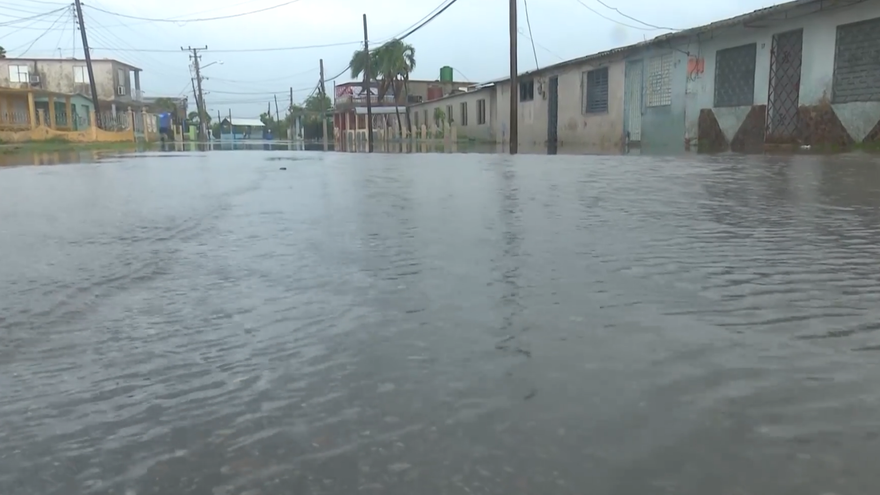
La Coloma, at the western end of Pinar del Río, this Monday. (Telepinar)
    • The United States foresees that, when Idalia hits land in Florida, it will be a “dangerously large hurricane.”

14ymedio bigger14ymedio, Havana, 29 August 2023 — Around 3 am this Tuesday, tropical storm Idalia was now far from Cabo de San Antonio, at the westernmost end of the Island, where it made landfall at 9 pm on Monday, shortly before becoming a hurricane on its path to Florida.

The meteorologist of the Institute of Meteorology (INSMET) José Rubiera explained that the drop in atmospheric pressure was increasing the wind speed and, consequently, intensifying the storm. The agency has recorded gusts of up to 73 miles per hour, where they predict that the eye of the hurricane will soon be formed.

In Pinar del Río, Idalia has caused very strong storms, with wind gusts of more than 56-59 mph per hour, although they have now dropped to 34-47 mph. Winds of between 31-40 mph have also been recorded in the coastal areas of Artemisa and Isla de la Juventud.

Although large accumulations of water have not been reported at the moment, the showers and thunderstorms are continuing and are not expected to stop in the next few hours.

Although large accumulations of water have not been reported at the moment, the showers and thunderstorms are continuing and are not expected to stop in the coming hours — even as Idalia moves away from Cuba — mainly in some towns in Pinar del Río and Artemisa provinces, although the storms could reach the central area of the Island. continue reading

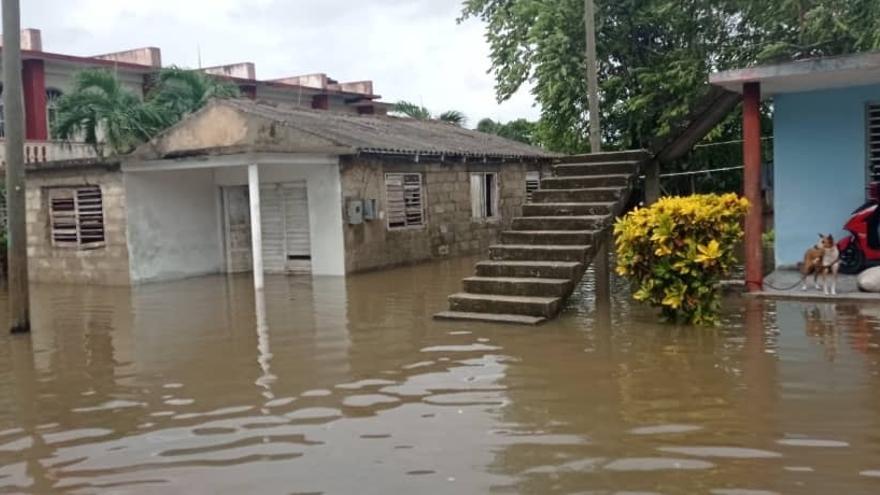
In the low-lying areas of the west and southwest coast, tidal waves have been recorded that caused coastal flooding in Isla de la Juventud, La Bajada (Pinar del Río) and the Surgidero de Batabanó (Mayabeque).

More than 8,000 people have been relocated, particularly in the areas of Bailén and Boca de Galafre (Pinar del Río).

In addition, about 537 tons of tobacco have been protected and another 45 tons collected in warehouses in the pinareño municipality of Minas de Matahambre, according to the Municipal Assembly.

In Havana, gusts of wind and heavy rain keep the municipalities of Guanabacoa and Cojimar without power at the moment.

Idalia, now moving over the southeastern Gulf of Mexico, is arriving when it has not even been a year since Ian crossed Pinar del Río in September 2022 as a category 3 hurricane.

Ian caused the death of five people and left considerable material damage to more than 100,000 homes, many of which have not yet been repaired, according to official figures.

It also damaged the supply of drinking water, severely affected agriculture, especially in tobacco cultivation, and led to the total collapse of an already extremely fragile National Electricity System, causing a general blackout on the Island that took days to repair.

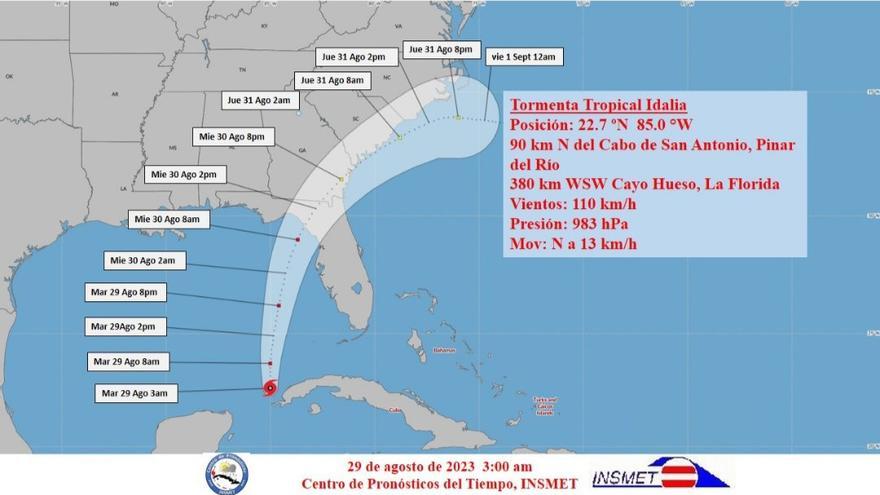
Forecast of Idalia’s trajectory in the coming hours. (INSMET)

The arrival of Idalia, now strengthened, is expected in Florida, which has been preparing for the event. Meteorologists from the National Hurricane Center (NHC) predict that in the early hours of Wednesday, Idalia will land as “a dangerously large hurricane,” somewhere on the west coast between Tampa Bay and Indian Pass.

Public schools in more than twenty counties will not open on Tuesday and Wednesday as a preventive measure, and the international airports of Tampa and St. Pete-Clearwater will shut down operations.

In the counties of Pasco, Hernando, Duval, Pinellas, Manatee, Taylor, Sarasota, Citrus and Levy, evacuation orders have been issued, and sandbags are being distributed to prevent water from entering homes and commercial premises.

In Tampa, in one of the sandbag distribution centers, an automatic machine was installed for residents to fill their own sacks, a novelty that is the result of the lessons left by Hurricane Ian last year. Authorities expect Idalia to be as strong as Ian, which left 156 dead in the United States.

Translated by Regina Anavy

____________

COLLABORATE WITH OUR WORKThe 14ymedio team is committed to practicing serious journalism that reflects Cuba’s reality in all its depth. Thank you for joining us on this long journey. We invite you to continue supporting us by becoming a member of 14ymedio now. Together we can continue transforming journalism in Cuba.

Cuba’s State Telecommunications Monopoly Etecsa Sabotages Internet to Force Customers to Pay for Long-Distance Calls

The company’s mismanagement has affected its workers, who complain they do not even have cables to make basic repairs. (14ymedio)
  • The monopoly’s revenues have plummeted from $807 million in 2020 to $128 million in 2022

14ymedio bigger14ymedio, Havana, 24 August 2023 — The poor quality of international telecommunication connections in Cuba is an ongoing source of customer frustration. What no one suspected until recently is that this is a deliberate strategy by the state telephone monopoly Etecsa to recoup the income it has lost to free internet calls.

Once seen as the hen that laid the golden egg, Etecsa is now on the verge of bankruptcy. According to the National Office of Statistics and Information (ONEI), telecommunications, transmission and information supply services generated just 128 million dollars in 2022, a spectacular drop compared to the 807 million it generated two years earlier.

To get out of the financial hole that the internet and currency unification — the so-called ’Ordering Task’* — has gotten it into, Etecsa wants to force its customers to pay up, says Raudel García Bringas, a telecommunications expert who spent three years in a Cuban jail for his professional activities. The problem, he claims, is that Etecsa is the result of a flawed state-centered economic model. “Charging for its services in a highly devalued currency, like the Cuban peso, when it must pay for everything it buys in hard currency is a road to disaster,” he explains.

If the company wants to return to profitability, he adds, it will have to “dollarize” its services

If the company wants to return to profitability, he adds, it will have to “dollarize” its services. “[But then] it will be stuck with the problem of billing customers in a currency in which they do not get paid and which makes life more expensive for a population with very little purchasing power.” continue reading

“To top it all off,” he continues, “selling data packages created a more serious, though unavoidable, problem.” Once platforms such as WhatsApp and Messenger began offering telecommunication services over the internet, the market for international calls dried up. In Cuba, where the cost of a one-minute international call is prohibitively expensive, these apps meant huge losses for Etecsa. “Those who thought mobile phone recharging fees would make up for lost income from international calls were wrong,” he says.

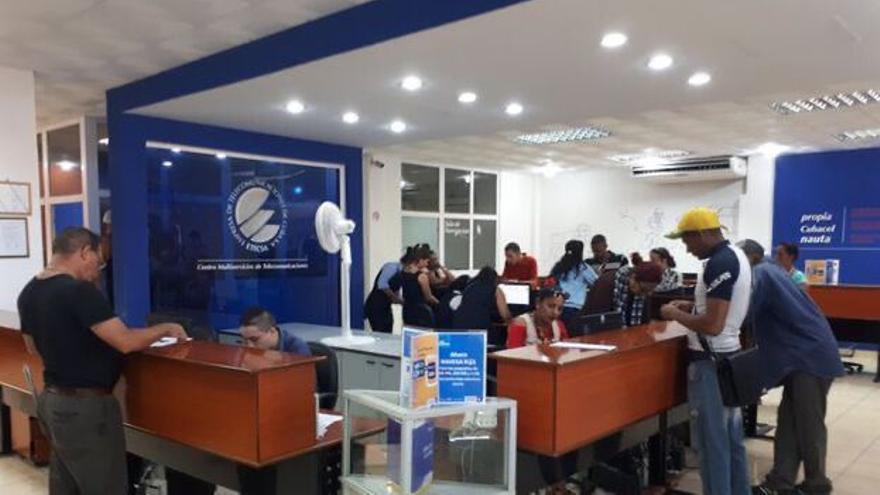
Customer complaints about internet connectivity problems continue to plague the company. (14ymedio)

As a kind of countermeasure, the company has tried to sabotage internet-based telecommunication by altering the quality of calls, García claims. “The inability to get online and constantly having to reconnect often makes communication difficult.”

“If Etecsa manages to restrict communication through channels such as WhatsApp and Messenger, or limits the use of VPNs (Virtual Private Networks — applications that alter the geolocation of a phone and allow access to blocked pages), then it will force people who have become accustomed to communicating daily with their relatives to switch to traditional long-distance telephone calls,” he says.

Customer complaints about poor internet connectivity continue to plague the company.  Katia, a 47-year-old Havana resident currently on a shopping trip to Panama, has been trying unsuccessfully for a week to communicate with her husband back home. “The problem is in Cuba. I have no trouble talking to to my sister in Miami from here or to my nieces who live in Spain. We can even have video conferences.” she says.

The company’s mismanagement and its falling earnings have also affected its workers. José Luis, an employee from Camagüey who has been with Etecsa for over a decade, recalls when he first started with the company: “It was a different place. The afternoon snacks were really good, there was air conditioning in all the offices and we had good computers to work with,” he says.

In addition to their salary, employees also receive an “incentive” of 4,000 to 7,000 pesos a month and a small package or two of coffee every three months

Liudmila, a resident of Villa Clara who has been with the company for twenty years, was also there during its golden age. “I remember them giving us a very good personal hygiene package. It had bath and laundry soap, shampoo, perfumes, deodorant, toilet paper, sanitary pads and detergent. At some point that all ended but, since the company was doing well, they began paying us bonuses of 10, 20, even 35 convertible pesos depending on your position in the company.”

In addition to their salary, employees also receive an “incentive” of 4,000 to 7,000 pesos a month and a small package or two of coffee every three months.

Both workers agree, however, that the company is no longer what it used to be. “Now we don’t even have the cables to make a repair when a landline customer calls to report a break,” says Jose Luis.

The mobile phone recharging fees emigrants pay to communicate with their relatives on the island have not been as lucrative as the company had anticipated. (14ymedio)

“Customers are also always coming to our branches very upset, of course, because they’ve bought data packages with extras but they can barely get online,” she explains. “We are not providing a good service, and the employees know it, but most people here just go along with the bosses until they can find something better or until their parole** arrives in the mail.”

Further aggravating Etecsa’s efforts to generate income is the number of people who have decided to emigrate. The mobile phone recharging fees emigrants pay to communicate with family members have not been as lucrative as the company had anticipated.  The island’s population has been in decline. And the fact that many of Etecsa’s customers are young people, who also happen to be the age group most likely to emigrate, means the size of its clientele has shrunk considerably.

Etecsa claims it has seven million mobile phone customers but it has never specified if this figure refers to the number of SIM cards it has sold or to actual active users.

“I use the Telegram app for messaging and it alerts me when a number I have in my contacts opens a social network account,” says Osmani. “Lately, I’ve had a lot of scares because I’ve been notified about people who I know don’t live in Cuba anymore or who died during Covid. Etecsa is obviously selling our phone numbers again.”

“Telephone companies all over the world do this,” he notes, “but what strikes me is the number of people who have left the country and that Telegram notifies me that their number is being used again. Rather than growing the size of its customer base, it’s filling the gaps left by those who’ve emigrated.”

Translator’s notes: 

*The “Ordering Task” [Tarea Ordenamiento] is a collection of measures that include eliminating the Cuban Convertible Peso (CUC), leaving the Cuban peso as the only national currency, raising prices, raising salaries (but not as much as prices), opening stores that take payment only in hard currency which must be in the form of specially issued pre-paid debit cards, and a broad range of other measures targeted to different elements of the Cuban economy. 

**The Cuban Family Reunification Parole Program allows certain eligible U.S. citizens and lawful permanent residents to apply for parole for their family members in Cuba. If granted parole, these family members may come to the United States without waiting for their immigrant visas to become available.

____________

COLLABORATE WITH OUR WORKThe 14ymedio team is committed to practicing serious journalism that reflects Cuba’s reality in all its depth. Thank you for joining us on this long journey. We invite you to continue supporting us by becoming a member of 14ymedio now. Together we can continue transforming journalism in Cuba.

Eternal Summer, Eternal Hell

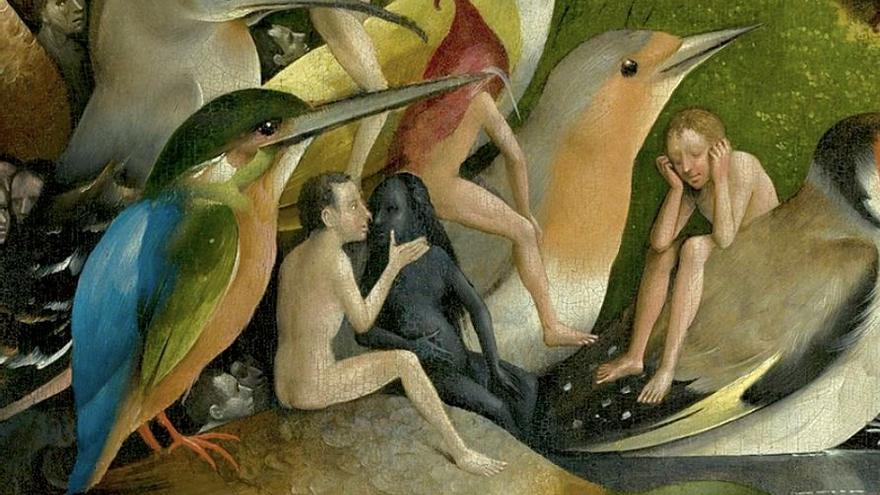
Detail from the central panel of the triptych ’The Garden of Delights’ (1500-1505), by the Dutch painter Hieronymus Bosch, ’The Woods’, Prado museum Madrid.

14ymedio bigger14ymedio, Xavier Carbonell, Salamanca, 27 August 2023 – It’s been a good year for Reinaldo Arenas. A few moths after re-publishing Antes que anochezca [Before Night Falls], Tusquets rescued El mundo alucinante [Hallucinations] and its to be hoped that more of his titles return to the bookshops during the celebrations for 80 years since his birth.

The indifference with which Cubans have come to the party says much about the country that we currently have. But nothing surprises. Arenas was published for the first and only time in Cuba in 1967. His books continue to enter the country secretively, and although false friends, resentful lovers and posthumous saviours continue to embalm him insolently, no censor is ready to give him absolution for the Tétrica Mofeta [When Skunk in a Funk].

He doesn’t need it, of course. Arenas is a religion unto himself, with cosmogony, martyrs and apocalypse. There isn’t anyone authorised to give him peace except himself or his doubles — Reinaldo, Gabriel and the skunk: three distinct mad beings but with one single essence. The workings of his world, as mystical as they are carnal, as private as they are rich in rumour, hitch themselves to two books which give the impression, only too accurate, of having been written by a dead man.

His ferocious autobiography and last novel, El color del verano The Colour of Summer], execute such a meticulous bombardment of Cuba and its foreign province of Miami, that the more than 300 people mentioned in it — being given the courtesy of their names ’deranged’, and at times not even that — must have cut his books into pieces on at least one occasion. Although his memories end up being deformed as fiction, in The Colour of Summer – subtitled New Garden of Delights, like the painting, The Woods – the language is as loose as the very devil’s. continue reading

In the final and most ardent sewer, we have the dictator Fifo, Raúl and his pets – including the Bloody Shark; in heaven, although exposed to shrapnel, there are Lezama, Casal, la Avellaneda, Heredia and Martí. In the queue for the guillotine and with names changed, are: Miguel Barniz, Tomasito la Goyesca, H. Puntilla, Karilda Olivar Lúbrico, Alejo Sholehov, Delfín Proust or the Queen of the Spiders, and – fanning himself there in Paris – Zebro Sardoya. Running around, wandering the streets hunting for recruits or hiding himself down in the drains, are the raving lunatics – although at any point remote, or on the edge: we are all crazy according to Arenas – the Duchess, the Super-satanic, the Queen, the clandestine Fortune teller, the Triple-ugly, Tedevoro, and finally the Funky Skunk.

The story – which begins with the escape of Avellaneda to Miami and ends when the Cubans, as a result of wearing away the island’s platform, remove it and sink into the sea – contains the most bitter declaration that any writer has ever made about his own country: “This is the story of an island where only the most servile and mediocre people have triumphed. An island subjected to an infinite summer, an infinite tyranny and the unanimous exit stampede of its inhabitants, who, whilst praising the island’s marvels, think only of how to escape from it. This is the story of an island that, whilst apparently covering itself in the glitter of official rhetoric, inside it is ripped apart and hopes only for the final explosion”.

The book would be perfect if Cabrera Infante didn’t exist. For the superstitious reader, The Colour of Summer has too many irritating similarities to Cabrera Infante’s Three Sad Tigers. Both are fragmented, godless, both replace and disrupt men, both are keen on lists and tongue twisters, both rewrite history and are obsessed with sex and with humour as a last refuge. Also, like all Cuban novels – from José Martí’s diary, to Paradiso [Paradise, by José Lezama Lima] and Los pasos perdidos [The Lost Steps, by Alejo Carpentier] – it aspires to serve as a general interpretation of the world. And of the Island.

Nevertheless, I read The Colour of Summer in one sitting – in Spain, in August, arid without let up – without allowing myself to be tormented by paranoia. In any case, if Arenas and Cabrera Infante achieved anything it was to give to certain moments in Cuban history a density resulting in something very vivid and traumatic. And – what is even more disconcerting, knowing both writers – neither of them takes a swipe at the other. In fact, Cabrera Infante wrote a moving obituary of Arenas, about “his life as a persecuted, beaten and caged dog, obliged once again to live forever as a fugitive”. I prefer to read his novels as reincarnations of the same mocking spirit that is only possible in that country. Short-sighted tiger or vengeful slut, Cain or Celestino, the summer or hell. Who knows whether in the end they aren’t the same thing.

Translated by Ricardo Recluso

____________

COLLABORATE WITH OUR WORKThe 14ymedio team is committed to practicing serious journalism that reflects Cuba’s reality in all its depth. Thank you for joining us on this long journey. We invite you to continue supporting us by becoming a member of 14ymedio now. Together we can continue transforming journalism in Cuba.

Diaz-Canel Ends His African Tour in Namibia With a Lot of Pomp and Few Agreements

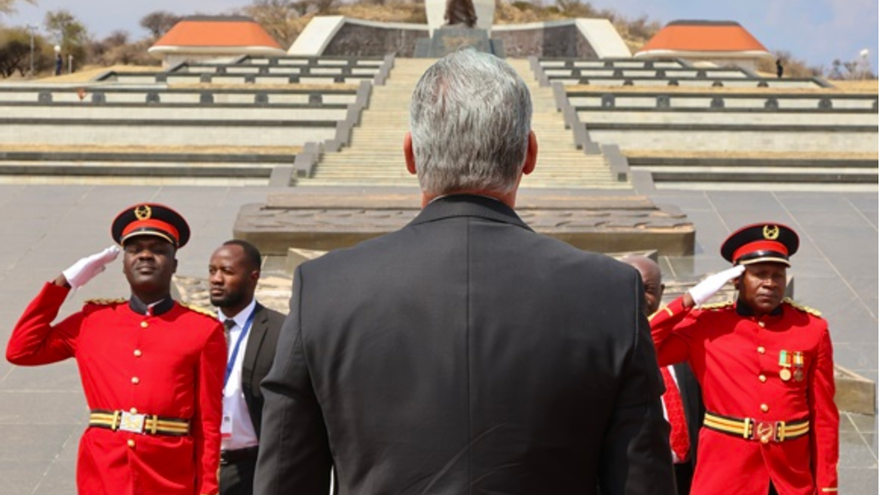
Cuban President Miguel Díaz-Canel with his counterpart Namibian President Hage Geingob at the festive events of Heroes’ Day. (Cubadebate)

14ymedio bigger14ymedio, 27 August 2023 — On the last stop of his tour of Africa, Cuban President Miguel Díaz-Canel arrived this Saturday in Namibia, where he participated in the festive events of Heroes’ Day in commemoration of Namibia’s war of independence. The pomp of the reception contrasted with the lack of information about any agreements signed by both parties.

Díaz-Canel landed at noon in Windhoek, the Namibian capital, with his wife, Lis Cuesta Peraza. At the State House he met with his counterpart, Namibian President Hage Geingob, who welcomed him with a military parade and talked about the friendly relations that exist between the Island and Namibia, according to the official press.

Cubadebate points out that the Cuban leader was the special guest at the commemoration, held at the Independence Stadium. Díaz-Canel and Geingob arrived at the scene in a convertible jeep and toured the facilities while greeting the attendees of the ceremony that commemorates the beginning of the war of independence on August 26, 1966.

During his speech, Díaz-Canel recalled that Cuban soldiers shared a “trench” with Namibians during the fight against the People’s Organization of South West Africa (SWAPO) in the “difficult days of the Angolan war.” “Cuba is honored to have supported them. There was no more honorable path to independence” from apartheid, he said.

The president pointed out that the Cubans who fought in the war along with Namibia can “feel satisfied,” because “their sacrifice contributed decisively to the independence of Angola, which gives its children pride, and Cuba forever won the respect and affection of an ally.” continue reading

Díaz-Canel, however, did not mention the Cubans killed in the war, a figure that the ruling party estimates at a little more than 2,000 soldiers killed in African territory.  Independent voices question this figure and point to a higher mortality among the more than 350,000 Cubans who participated in those conflicts.

In his speech, the Cuban ruler took the opportunity to refer to the “difficult socio-economic situation” suffered by the Island, derived, according to him, from the economic sanctions of the United States. He thus appreciated the support of the Government of Namibia in the resolutions before the United Nations (UN) against the U.S. blockade.

So far it has not been revealed in the official Cuban press whether Díaz-Canel’s visit resulted in the signing of an economic agreement. During his passage through Angola, Havana and Luanda, he signed an agreement that will allow the installation of Cuban pharmaceutical laboratories in that country, and Angolans will also be able to install one in the Mariel Special Development Zone.

Prensa Latina reported that the Cuban president ratified the “will” to strengthen cooperation and increase efforts in the areas of construction, sports, culture and computing (such as artificial intelligence and robotics). This will happen, the text points out, if Namibia “needs it.”

During the festivities, Díaz-Canel received the Order of the Ancient Welwitschia Mirabilis, the highest decoration of Namibia and the same one that in March 2008 was given to Fidel Castro for “his support for the African liberation struggles,” especially the uprising to achieve Namibia’s independence from South Africa.

Prior to his arrival in Windhoek, Díaz-Canel had visited Mozambique and Angola, after attending the summit of the BRICS group of emerging economies (Brazil, Russia, India, China and South Africa), held from August 22 to 24 in Johannesburg.

Translated by Regina Anavy

____________

COLLABORATE WITH OUR WORKThe 14ymedio team is committed to practicing serious journalism that reflects Cuba’s reality in all its depth. Thank you for joining us on this long journey. We invite you to continue supporting us by becoming a member of 14ymedio now. Together we can continue transforming journalism in Cuba.

Less Than 40 Percent of Havana’s Garbage Collection Teams Are Operational

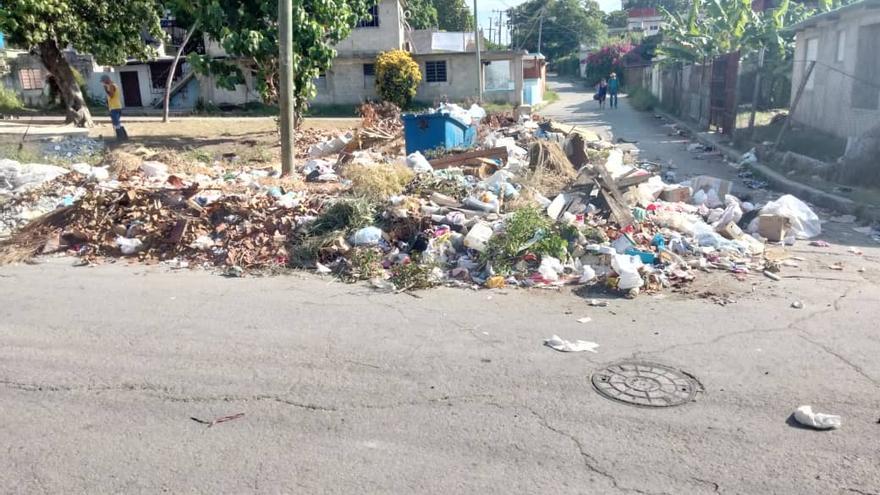
Photos of the Lawton neighborhood in Havana, a few meters from the 30 de Noviembre polyclinic. (Cortesía)

14ymedio biggerEFE (via 14ymedio), Havana, 23 August 2023 — Less than 40% of Havana’s garbage collection equipment is currently operational, the official Cuban newspaper Granma reported Wednesday, an issue that has been the subject of criticism in recent months.

The governor of Havana, Yanet Hernández Pérez, offered this and other data in a meeting with representatives of the Government, in which she explained that only 39% of the 440 community service teams “keep working,” and that their “technical availability” is reduced to 40% due to the lack of “tires, rims and batteries” for the garbage collection vehicles.

She also indicated that 11 of the 29 garbage trucks of the Provincial Community Services Company are currently paralyzed.

Cuban Prime Minister, Manuel Marrero, who chaired this meeting, urged the audience to “not leave Havana alone,” recalling its “complexity and magnitude” as the capital, and he asked “all municipalities” to “look for alternative solutions,” because in his opinion there is a lack of organizations, companies and economic actors to support these services.

According to Granma, Marrero insisted on “extreme organizational measures” for the collection of solid waste, because “in a city like Havana there has to be planning.”

The capital, with about two million inhabitants, generates around 23,814 cubic meters of waste daily, according to official data, of which more than two-thirds correspond to the activity of “home services and waste.” continue reading

The accumulation of garbage in the streets and the irregularity of the collection services have been reported on multiple occasions in recent months, mainly on social networks and in the independent media.

The frequency of collection has also been reduced, and sometimes, given the accumulated volume, it is carried out with excavators or cargo vehicles that allow waste to be dumped.

Cuba has been suffering a serious crisis for more than two years due to errors in national economic policy, which the State insists on attributing to the COVID-19 pandemic and the U.S. “blockade.”

Independent experts also point to bureaucratic problems, management failures, neglect and lack of human capital due to the heavy emigration experienced by the country.

Translated by Regina Anavy 

_________________

COLLABORATE WITH OUR WORKThe 14ymedio team is committed to practicing serious journalism that reflects Cuba’s reality in all its depth. Thank you for joining us on this long journey. We invite you to continue supporting us by becoming a member of 14ymedio now. Together we can continue transforming journalism in Cuba.

Humanitarian Parole for Cubans and Venezuelans Plummets While It Grows for Haitians

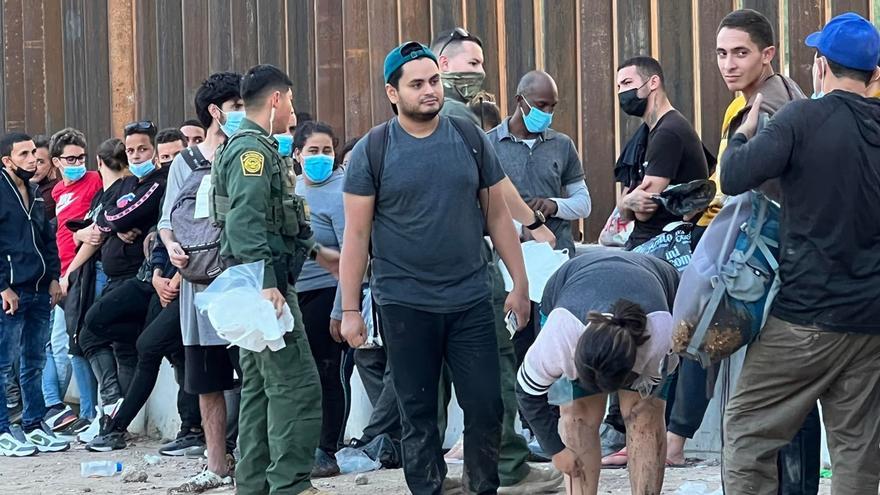
A group of migrants on the southern border of the United States. (Marlene Guzmán/Univision Network/Facebook)

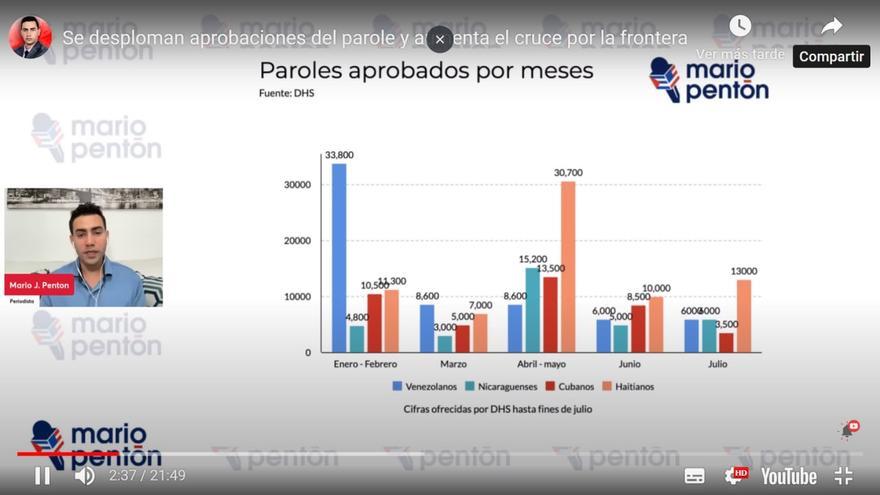
14ymedio bigger14ymedio, Madrid, 21 August 2023 — The number of Cubans benefited by the U.S. humanitarian parole program have plummeted from 8,500 in June to only 3,500 in July, well below Haitians (13,000). They also represent 30% less than in March (5,000), the worst month to date since this mechanism came into force for migrants from the Island, at the beginning of this year. In January and February there were 10,500 Cubans admitted, while in April and May they totaled 13,500.

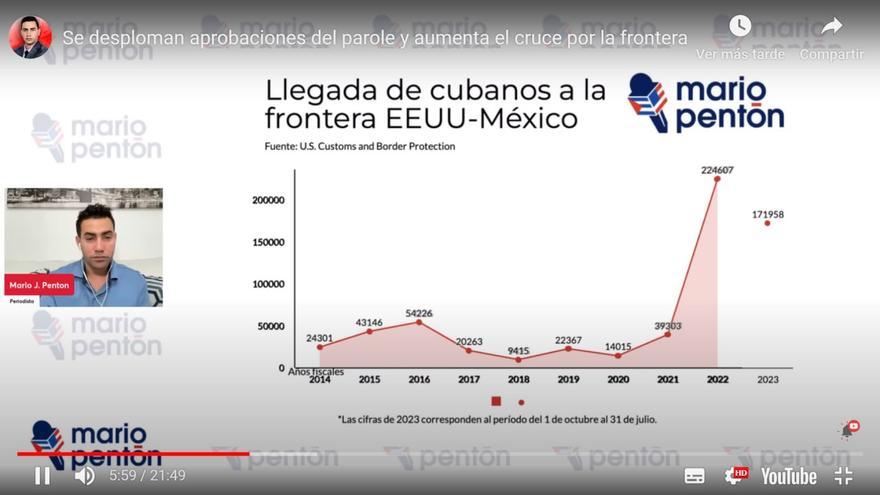
The figures were released this Sunday by Cuban journalist Mario J. Pentón in a video in which he expressed concern about the sharp increase in illegal arrivals of Cubans across the Mexican border From October 2021 to September 2022, records were broken, with 224,607 migrants from the Island. The current one is going the same way, since from October 1 to July 31 there were already 171,958 Cubans who followed this route.

Humanitarian parole concessions by month. (Mario J. Penton)

The humanitarian parole program is working, says Pentón, but the eagerness to reach the U.S. is stronger than the pace of approval of documentation, and desperation leads many to try to follow the illegal path. The journalist from América Tevé emphasized the importance of taking into account that this path is increasingly complicated, since it is not enough to justify “credible fear” as a reason for leaving Cuba.

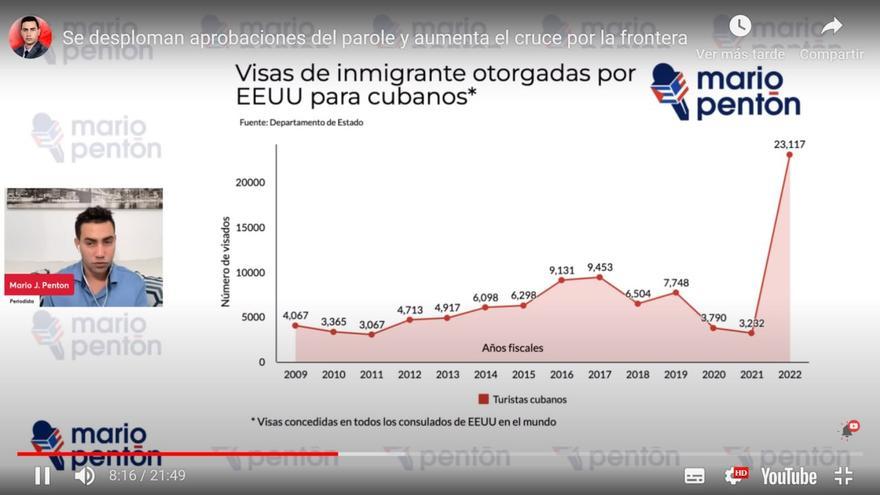
Pentón mentioned a Cuban who had recently contacted him to explain the case of his wife, pending trial after her request was rejected in the interview with officials of the U.S. Customs and Border Protection. At the meeting, the woman tried to demonstrate circumstances of persecution in Cuba, but the agent told her that he did not want to know why she left the Island but why she did it illegally. “It’s not that easy,” says Pentón, who also provided data on visas granted to Cubans in U.S. consulates around the world.

In that sense, 2022 was a year of spectacular growth, with 23,117 visas of this type approved, which represents a huge jump compared to the previous year (just 3,032) and much more than double the previous record, 9,453 in 2017. continue reading

Visas issued by the U.S. to Cubans. (Mario J. Penton)

Pentón also emphasizes that, by nationality, Cuba was the most affected in July. Venezuelans received 6,000 humanitarian paroles, the same number as Nicaraguans, while Haitians got 13,000 and now have accumulated four months of increases, with the period of April and May being the most voluminous. In those two months, Haitian natives obtained 30,700 approvals, compared to 15,200 Nicaraguans and 8,600 Venezuelans.

Penton maintains that the Department of Homeland Security has assured him on several occasions that the intention was to balance  the figures of the different beneficiary countries, but to date that still hasn’t happened.

In total, 41,000 Cubans, 34,000 Nicaraguans, 63,000 Venezuelans and 72,000 Haitians have benefited from the parole. The disproportion can be seen the most in the last two figures, since Venezuela has almost three times the population of Haiti.

Pentón insists that the program, in force since October 2022 for Venezuelans and since January 2023 for the other three nationalities, has defects, such as the order and pace of approval. However, it is currently the most appropriate way to reach the U.S. without problems, since the illegal crossing of the Mexican border entails many dangers, and, he repeats, it is not easy to successfully pass the interview with the motive of “credible fear.”

Arrivals of Cubans across the border between Mexico and the U.S. (Mario J. Penton)

Meanwhile, arrivals by sea do not stop either. This Sunday, the U.S, deported 12 Cubans who had “illegally left the country with support from abroad and were subsequently intercepted at sea by the U.S. Coast Guard Service,” according to a note from the Cuban Ministry of the Interior. The same text points out that, so far this year, the number of returns to Cuba from Washington by air and sea now amounts to 4,261.

Specifically, the deportees this Sunday had left the port of Orozco, in Artemisa. In the group were, according to the official version,  “two citizens on probation for compliance with criminal sanctions at the time of leaving the Island,” so “they will be made available to the corresponding courts for the revocation of said benefit.”

Since October 1, 2022, more than 6,800 Cubans have been intercepted by the U.S. Coast Guard on the maritime route.

Translated by Regina Anavy

____________

COLLABORATE WITH OUR WORKThe 14ymedio team is committed to practicing serious journalism that reflects Cuba’s reality in all its depth. Thank you for joining us on this long journey. We invite you to continue supporting us by becoming a member of 14ymedio now. Together we can continue transforming journalism in Cuba.

China Gives Solar Panels to BioCubaFarma and Will Donate Electric Vehicles

Even with the installation of thousands of solar panels and the use of renewable energies, Cuba is still dependent on oil to generate electricity. (OnCuba News)

14ymedio bigger14ymedio, Havana, 23 August 2023 — China will donate 9,259 solar panels to BioCubaFarma for the installation of a plant at the National Center for Scientific Research of Cuba, in Havana. The official newspaper Granma reported that the facility will have a generation capacity of five megawatts (MW), and an energy storage station will also be built.

The delivery of this technology is part of an agreement signed on Sunday between the president of BioCubaFarma, Eduardo Martínez Díaz, and Chen Erdong, senior consultant of the municipal government of Changzhi, located in the Chinese province of Shanxi.

Granma pointed out that this memorandum is the first step in a donation proposal from the Changzhi High-Tech Industrial Development Zone. The project contemplates the delivery of equipment and materials for the installation of a solar park, although, the press clarified, the operation of the storage batteries will depend on the results of the studies carried out by the Chinese  on the Island’s weather conditions.

One of the disadvantages of solar farms is that they depend on climatic conditions for power generation. The batteries allow the storage of the electricity captured and transformed by the photovoltaic system, which can then be dispatched to the grid. However, their operation depends on a dry environment, and exposing them to extreme heat accelerates their exhaustion. continue reading

The press pointed out that the Chinese promised to donate electric charging vehicles (minivan type), although the number of units was not specified. In addition, the construction of a charging station and integrated systems for a clean energy management network is included.

Granma reported that the memorandum also gives a way for the Cuban-Chinese mixed capital company Biotech Pharmaceutical to explore the possibility of creating a subsidiary in the Changzhi industrial zone. In response, the Government of Havana pledged to start a first stage of “technical exchanges” to install solar farms in one or two additional BioCubaFarma facilities.

Based on the results of this phase, the parties will evaluate the possibility of establishing a joint venture for the generation and distribution of energy on the Island. Zulaine Guerra Montané, director of the Office of Representation of BioCubaFarma in China, said that the donation is the result of “active cooperation in biotechnology matters.”

As part of the strengthening of relations between Cuba and China, the Asian country is positioned as one of the main technology providers to the Island, whose installed capacity is still far from the objectives announced nine years ago by the Cuban Government to alleviate the energy crisis.

In December 2022, the official press announced the installation of a solar park in Sancti Spíritus with a donation of equipment from China that would barely have a maximum generation capacity of 2.2 megawatts, 1.4% of the province’s daily demand.

That park is built on a plot of 45,000 square meters, with an assembly of 400 solar panels, two technological containers, a control house and a weather station.

Cuba’s generation matrix still depends heavily on power plants that use fossil fuel, and several of them often fail due to maintenance problems or breakdowns resulting from the age of the facilities.

Despite the fact that renewable production has much cheaper costs because it depends on natural resources, Cuba is advancing at a snail’s pace with the transformation of its installed capacity. In 2014, the Government pledged that by 2030 these technologies would represent 24% of the generation. However, the most recent figure suggests that by 2022 they barely reached 5%.

Translated by Regina Anavy

____________

COLLABORATE WITH OUR WORKThe 14ymedio team is committed to practicing serious journalism that reflects Cuba’s reality in all its depth. Thank you for joining us on this long journey. We invite you to continue supporting us by becoming a member of 14ymedio now. Together we can continue transforming journalism in Cuba.

In Addition to Being Expensive, Turkish ‘Patanas’ Are a Pollution Bomb in Cuba

Every day, the chimneys of the Suheyla Sultan spew toxins over the sky of Havana. (14ymedio)

14ymedio bigger14ymedio, Juan Izquierdo, Havana, 27 August 2023 — The formidable column of smoke that extends from the bay of Havana to the east is the most visible example of the environmental damage caused by the Turkish patanas, the floating power plants present on the Island since 2019. The chimneys of the Suheyla Sultan, generating 240 megawatts (MW) and connected to the Tallapiedra thermoelectric plant, throw considerable amounts of carbon monoxide (CO) and nitrogen oxide (NOx), two dangerous pollutants, into the atmosphere.

Despite the risk of toxicity, the authorities – who rent five of the same type from the company Karpowership for an estimated annual price of 31 million dollars – have installed the patanas in the ports of their two most populated cities, Santiago de Cuba and Havana, and in the Mariel Special Development Zone.

To gauge the damage in the absence of official reports, 14ymedio consulted the legal process faced by Karpowership in the Dominican Republic over two patanas in Pueblo Viejo de Azua, a protected coastal area. Despite the fact that the Dominican Ministry of the Environment granted the license to install two patanas (with a total of 180 MW, barely a third of the installed capacity in Cuba), the protests of activists, scientists, fishermen and inhabitants of the area remain red hot.

According to the government commission that approved the project, the patanas have chimneys that are 55 meters high and 1.8 meters in diameter, and emit into the atmosphere 100 milligrams of NOx per cubic meter and 290 of CO at a temperature of 45 ºC.

Given these values, Karpowership did not commit to anything, and the experts limited themselves to stating that “the emission of burning gases during the normal operation of the patanas is expected to have emissions of atmospheric pollutants such as CO and NOx. The emission levels of pollutants (carbon monoxide and nitrogen oxide) are expected to be below the maximum limits established” by the Dominican Environmental Technical Regulation. continue reading

However, the company had to pay a total of $5,275,000 to an “environmental adequacy” program that included a contingency plan, risk analysis, preventive measures against climate change and money for possible restorations.

Judging by the trace of hazy smoke that covers Havana, it is unlikely that Cuba, which, unlike the Dominican Republic, maintains total secrecy about the contract signed with the Turkish company, has taken similar measures to prevent these pollution levels. Another important difference between the two countries: while the Cuban population does not seem to worry about the cloud of pollution that covers Havana, protests continue in the Dominican Republic against the Karpowership patanas.

At the end of 2022, one of the plants, the Irem Sultan, had to temporarily leave the Dominican Republic after several riots led by residents in Azua, and it came to Havana. It could not return until the managers of Karpowership obtained the environmental license.

The formidable column of smoke extends from the bay of Havana to the east. (14ymedio)

Last May, after several statements by the Human Rights Commission of the Dominican Parliament, the Deputy Minister of Environmental Management, Indira de Jesús, had to present new arguments to justify the patanas, saying that they did not affect the protected area of Azua.

However, the newspaper Al Momento revealed that both power plants and support boats incur “permanent spills” of fuel, in addition to generating a coastal current that passes through the interior of the ships to cool their boilers, and that absorbs and burns, during suction, hundreds of fish and other species. The effect of this process is a remarkable warming of the water, which decreases its oxygen levels and damages the fauna of the coast.

Among the most affected animals has been the manatee, in danger of extinction; they feed on vegetation in mangroves located less than 100 meters from the patanas. The Academy of Sciences of the Dominican Republic also denounced the damage to the habitat of lobsters and crabs, which are very sensitive to water temperature.

The pollution is also affecting the inhabitants of the area, dependent on fishing, who have demanded a response from the authorities on multiple occasions for the findings of dead or poisoned fish on the coast.

In the Dominican Republic, “hope is placed in the justice system,” which can call to account the officials who authorized the installation of the patanas and the rulers who signed the permits, even though they are aware of the damage. However, in Cuba, where the courts respond to the regime and no expert has dared to denounce the environmental disaster caused by the patanas, the chimneys of the Suheyla Sultan will continue to throw toxins into the sky of Havana with impunity.

Translated by Regina Anavy 

____________

COLLABORATE WITH OUR WORKThe 14ymedio team is committed to practicing serious journalism that reflects Cuba’s reality in all its depth. Thank you for joining us on this long journey. We invite you to continue supporting us by becoming a member of 14ymedio now. Together we can continue transforming journalism in Cuba.