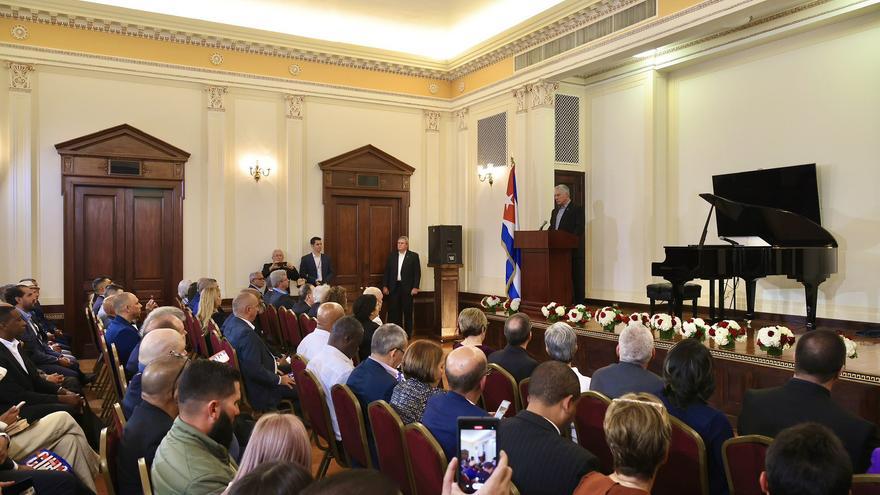
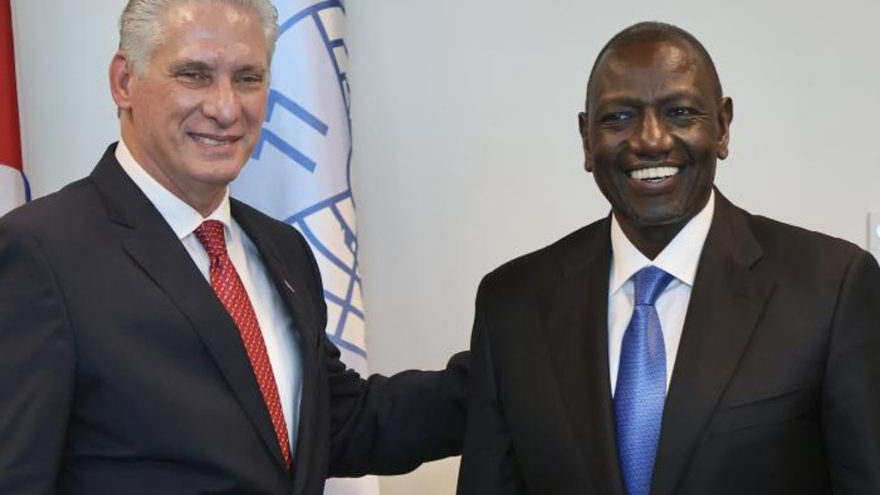
Cuban President Díaz-Canel and Kenyan President Ruto met this Tuesday at the United Nations. (Estudios Revolución)
EFE/14ymedio, Nairobi, 20 September 2023 — The Kenyan President, William Ruto, speaking to his Cuban counterpart, Miguel Díaz-Canel, during a meeting of the United Nations General Assembly, thanked him for Cuba’s “links” with his country, which have allowed Kenya to improve its development, “particularly in the health sector.”
“Our links with Cuba have greatly benefited our national development agenda, particularly in the health sector,” Ruto said last night on his social network X (Twitter) account, after meeting with Díaz-Canel in New York.
“We will continue to strengthen and expand these relationships to foster partnerships that will transform people’s lives,” the Kenyan president added.
For its part, Cuba “praised” Kenya for having agreed to lead an eventual international peacekeeping force in Haiti to “liberate” that country “from gang violence,” according to Ruto. continue reading
The agreement has raised hackles in different sectors of Kenyan society ranging from medical unions to the opposition to the Government
Kenya and Cuba began a program in 2017 that made it easier for Cuban doctors to occupy several vacant positions in Kenyan hospitals, as well as the transfer of Kenyan doctors to Cuba to receive specialized training. The agreement has raised hackles in different sectors of Kenyan society ranging from medical unions to the opposition to the Government.
They were joined this week by the Health Committee of the National Assembly, which asked the Government not to renew the contract to the 120 Cuban doctors in the country, arguing that the places for the Island’s health workers should be occupied by specialists in the country, “because their salaries are enough to employ at least three Kenyan doctors.”
For each physician, $4,257 is paid to the Island, of which $851 corresponds to the salary for the doctor and the remaining $3,406 is a contribution from the Kenyan Government.
Bhimji Atellah, general secretary of the Union of Physicians, Pharmacists and Dentists of Kenya, described the exchange program as a “waste of human resources” after denouncing that 50 Kenyan doctors live in “deplorable conditions” in Cuba.
It is unknown if Ruto and Díaz-Canel addressed the kidnapping on Tuesday, but four years later nothing is known despite the recurring statements of both Governments stating that they are making joint efforts to achieve their release
It is unknown if Ruto and Díaz-Canel addressed the matter on Tuesday, but nothing is known four years after the event and despite the recurring statements of both governments stating that they are making joint efforts to achieve their release.
“No one knows the current whereabouts of the two Cuban doctors. We also do not have up-to-date information on the current state of their well-being,” a source from the Somali National Intelligence and Security Agency told EFE last April.
“It is believed that they are still being held somewhere in an Al Shabab bastion since their kidnapping,” the source said. “We have no more details at the moment,” he insisted, “and nothing new has emerged in the last two years.”
Translated by Regina Anavy
____________
COLLABORATE WITH OUR WORK: The 14ymedio team is committed to practicing serious journalism that reflects Cuba’s reality in all its depth. Thank you for joining us on this long journey. We invite you to continue supporting us by becoming a member of 14ymedio now. Together we can continue transforming journalism in Cuba.
The owners of the small businesses (MSMEs) are, for the most part, “people who are ’reliable’ or close to the leaders and relatives of the Castro leadership.” (Cubadebate)
14ymedio, Havana, 21 September 2023 — The Christian Democratic Party of Cuba (PDC, for its initials in Spanish) warned the Administration of U.S. President Joe Biden on Wednesday that a lifting of economic restrictions on Cuban micro, small and medium-sized enterprises (MSMEs) will only serve to “give oxygen” to the Island’s regime. The measures, which will soon be made official according to several U.S. media, will benefit those who “have increased their fortune with the approval of the dictatorship,” the organization insists in a statement.
The document, signed by the PDC’s Secretariat of Economic Affairs, admits that private business development is one of the ways to get Cuba out of poverty and resolve the acute structural crisis it is facing. However, he emphasizes, the “flexibility” that the United States will allegedly implement – which would allow, among other things, Cuban businessmen to open bank accounts in that country – will not achieve its goal. The State will closely monitor each step of the process and prevent the benefits from reaching their true recipients, he says.
Opponents are clear about the impossibility of a “radical economic change,” since the regime has demonstrated “for decades” that it opposes the growth of the private sector.
Washington is not going in the “right direction” in its economic strategies with Havana, says the PDC. “Both the credits themselves and the possible opening of bank accounts in the United States are limited and would reach only a select group of people close to the layers of power,” they state. continue reading
The measure “arrives late,” because many Cuban businessmen have looked for a way to open accounts abroad
In addition, the measure “arrives late,” because many Cuban businessmen have looked for a way to open accounts abroad, which they manage directly or through a front man, to dodge the controls in Havana. However, they denounce, the owners of the current MSMEs are, for the most part, “’reliable’ people or close to the leaders and relatives of the Castro leadership.”
The model – as other organizations have also argued – is Russia. “The greatest threat that can exist for the sake of a democratic transition in Cuba is to apply the Russian recipe once again and move from a failed state to a patriarchal regime, where the leadership continues to benefit economically, take the repression to another level for economic improvement and also wash their hands of it in the United Nations and before the Democrats in the United States, who continue to make them flexible and keep them in power indefinitely,” the statement summarizes.
In this sense, the Christian Democrats define the current hierarchy that holds the reins of power on the Island: at the head, an 82-year-old Raúl Castro, who continues to rule over a group of generals and other high-ranking soldiers – his confidence men – followed by a network that ranges from Gaesa, the economic arm of the Armed Forces, to the business system and the Communist Party. In these groups, not exempt from rivalries and contradictions, are also the owners of the MSMEs, they point out.
A U.S. bank credit or an account opened in that country would belong to the “mass of front men and alleged businessmen” close to the regime’s upper elite, in addition to allowing them to “whitewash their behavior” before the world.
Another worrying factor of the “flexibilization” of the United States is that the Havana regime receives other signs of “validation” from the international community
Another worrying factor of the “flexibilization” of the United States is that the Havana regime receives other signs of “validation” from the international community. Hence, the Christian Democrats demand that the United Nations funds for Cuba “be made available for investments in the real economy, to motivate food production and stimulate labor productivity.”
Finally, the declaration suggests steps to prevent the country from continuing to move towards “authorized dollarization,” where the only beneficiaries are businessmen close to the State. First of all, it calls for “economic and political freedom” that can only be guaranteed by the rule of law, from which “strong institutions” and “a free market spirit” are derived.
It also advises working on the “consolidation of an adequate business system,” which promotes agriculture and industrialization. It is also necessary to suppress the “dependence” of Cubans on the State and the “minimum effort,” two characteristics that Christian Democrats define as the “great heritage of the regime.” In short, any economic improvement must bring with it a dismantling of the “anthropological damage” of which Cubans have been victims since 1959.
Translated by Regina Anavy
____________
COLLABORATE WITH OUR WORK: The 14ymedio team is committed to practicing serious journalism that reflects Cuba’s reality in all its depth. Thank you for joining us on this long journey. We invite you to continue supporting us by becoming a member of 14ymedio now. Together we can continue transforming journalism in Cuba.
Filmmakers accuse officials of trying to hinder their efforts to debate, question and hold meetings. (M.A. Rodriguez Yong/ Facebook)
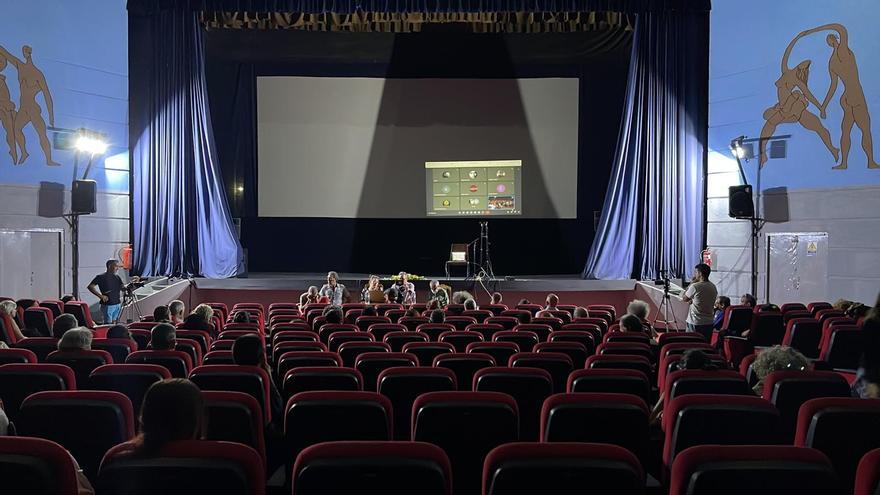
EFE/14ymedio, Havana, 22 September 2023 — The independent Assembly of Cuban Filmmakers (ACC) accused government officials on Thursday of cutting off internet access during its last meeting in which several members were participating remotely. In a statement posted on social media, the ACC said there were problems with the internet connection during the meeting, which took place at a Havana movie theater. Communication with participants from other provinces and countries was interrupted for several minutes.
“They suddenly blocked the internet connection for all participants in the theater, leaving those who had already connected from the provinces and other countries blind and deaf. Neither video nor sound,” said the ACC, which spoke of “a new episode of control and authoritarianism.”
It noted that connectivity problems recurred every few minutes throughout the Wednesday morning meeting. “Time and time again, meetings by a group of filmmakers are viewed with suspicion and must be silenced or, if possible, canceled,” the ACC stressed.
“There is an obsession on the part of the authorities with documentation. Only they are allowed to record, edit and reuse. They are bothered by cameras, testimonies, recordings, communication media and social networks. This is something we frequently observe,” the ACC stated.
Previous meetings between the ACC and government officials have been described as tense and officials did not allow them to be recorded
They rejected these “procedures” because they alleged that, since they began meeting a few weeks ago, they have always tried to “maintain a respectful and participatory dialogue with all those who have requested it,” more specifically, government agencies. continue reading
The government’s previous meetings with the ACC have been described as tense and officials did not allow them to be recorded. However, the filmmaker Miguel Coyula released fragments of audio and video footage in which officials can be heard demanding that he shut off his camera during one session.
The filmmakers also complained that a small group of film students who wanted to attend the meeting were warned by phone that they should ’think twice before getting involved.”
The ACC is an independent organization formed in June in response to a broadcast on Cuban state television of an unauthorized version of Juan Pin Vilar’s documentary La Habana de Fito, which had been censored without the director’s approval.
ACC expressed its “disagreement” with the actions Cuba’s cultural officials in an open letter signed by more than 600 film industry professionals including director Fernando Pérez and actor Jorge Perugorría. One of their recurring demands has been that the island’s cultural institutions recognize the work of Cuban emigré filmmakers and end all forms of censorship on artistic expression.
____________
COLLABORATE WITH OUR WORK: The 14ymedio team is committed to practicing serious journalism that reflects Cuba’s reality in all its depth. Thank you for joining us on this long journey. We invite you to continue supporting us by becoming a member of 14ymedio now. Together we can continue transforming journalism in Cuba.
Eusebio Leal believed Antonio Maceo’s chair to have a kind of miraculously irradiating power.
14ymedio, Xavier Carbonell, Salamanca, 24 September, 2023 — From a distance, it looks like a cork split in two. On closer inspection, it could be a piece of furniture found in some minimalist or ethnic furniture catalogue, a tribal artifact. In any case, nothing of value, nothing worth going to war over or making a fuss about. The Spanish – legalistic to the point of naivety – have done everything possible to ensure that the issue does not get out of hand. But how to convince Havana to return Antonio Maceo’s chair, which Cuba has had since 2018?
A couple of weeks ago the mayor of Palma de Mallorca, to whose municipal government the piece belongs, met with the Cuban consul-general in Barcelona to let him know that he had sent a letter to the Office of the Historian of Havana, reminding him that the deadline for returning the chair is November 16, Saint Christopher’s Day.
The mayor is not unaware that the last officeholder, Eusebio Leal, is dead and that his position has been vacant for several years. What he does not know, I am sure, is that Leal’s ghost still communicates with a group of spirit mediums, almost all of them women, who tend his grave and smoke out any undesirable candidates for his job. The regime finds it easier to deal with this coalition of midwives – Perla Rosales, Magda Resik* and company – than it did with the hyperactive Leal, whose presence remains problematic even in death.
Eusebio Leal’s ghost still communicates his wishes to a group of spirit mediums, almost all of them women
So when Palma’s mayor told the consul-general that he had sent a letter to a dead man, the Cuban diplomat must have smiled sardonically. He nevertheless posed for a blurry official photo and no doubt said, yes, he would see that the letter had gone to the correct address. Such is diplomacy Havana-style, so similar to that of the Vatican when the situation calls for it: political spiritualism mixed with affection, tobacco and indifference. continue reading
When Spanish prime minister Pedro Sanchez took Maceo’s chair to Cuba in 2018, he must have known from the look on Leal’s face that the item would not be going back to the Iberian Peninsula any time soon. Leal’s eyes gleamed – already the eyes of a dead man – when he touched the chair’s back, where the letters A and M, had been carved next to a star. Maceo was shot dead in 1898, during a battle at Punta Brava, shortly after jauntily declaring, “This is going well.” The victorious Spanish general, Valeriano Weyler, later made off with the chair. Back in Spain, the item remained in the possession of his family along with other objects from Cuba until 1931, when Weyler’s descendants gave it to the city of Palma.
It seems the chair that once belonged to Maceo — a leader known for his stammer, about whom Jose Martí once joked, “He doesn’t hesitate when you think he would, just when he’s talking about an issue he cares about or his man” — was kept discreetly, or secretly, out of sight until a journalist happened upon it and wrote an article. It must be one of the few pieces of furniture to have a biography written for it.
Judging from Spanish press accounts, officials believe the chair is safe, as Leal promised it would be, and on display in a special room. But because so few mementos remain of the mestizo leader, whom one Catalan newspaper renamed “Antoni” Maceo, the palm tree trunk is a “treasure of incalculable value in reinforcing the revolutionary message that lives on in the post-Castro era.”
Leal wrote the then-mayor of Palma, beseeching him to extend the loan, claiming the Cuban people needed the chair
It is not surprising that the Mallorcans are so concerned about the fate of the chair considering they believe it to have a kind of miraculously irradiating power. Shortly before his death, Leal wrote to the then-mayor of Palma beseeching him to extend the loan, claiming the Cuban people needed the chair because it housed “an important part of our country’s soul.” The mayor relented. After the extension, a friend of the Cuban regime in Mallorca, Gerardo Moyà, observed ironically that he had “little doubt” the chair would remain in Havana.
Then it was learned that Madrid was hoping to do a trade: the chair in exchange for something else (like Cortés’ stool perhaps, or a terracotta water jug from Avellaneda). If Havana is feeling generous, perhaps it could send over another famous chair: the “untouched throne” from the Palace of the Captains General, which has been waiting for centuries for a king of Spain to sit on it. It looked like that might happen in 1999 when Juan Carlos was visiting the island and Fidel Castro offered him the seat. More alert than the authoritarian Castro, the Spanish king declined: “All of Spain would have to sit on it,” he said, “and they wouldn’t fit.”
We will have to wait until St. Christopher’s Day to find find out what Leal dictates from his office in the underworld to the soothsayers at the Office of the Historian. As far as the mayor’s letter goes, it’s better not to push too hard. Madrid and Havana will find a way to forgive each other.
*Translator’s note: The deputy executive director and director of communication respectively for the Office of the Historian.
__________________
COLLABORATE WITH OUR WORK: The 14ymedio team is committed to practicing serious journalism that reflects Cuba’s reality in all its depth. Thank you for joining us on this long journey. We invite you to continue supporting us by becoming a member of 14ymedio now. Together we can continue transforming journalism in Cuba.
Cubans share and know the cartoons of graphic humorist Alen Lauzán well, and they have earned a privileged place in the independent press. (Blog of Alen Lauzán)
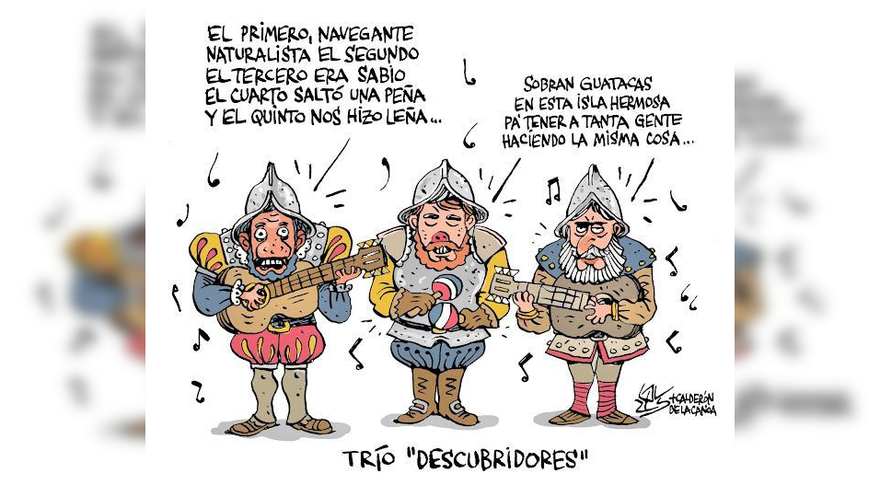
14ymedio, Xavier Carbonell, Salamanca, 24 September 2023 — When a group of hallucinating historians proposed to name Fidel Castro the “fifth discoverer of Cuba,” graphic humorist Alen Lauzán (Havana, 1974) sharpened his pencil. If, in his country, which he left in 2000 to go live in Chile, reality insists on being as absurd as possible, what can’t satire achieve? His cheeky and hilarious version of the Island’s history was not long in coming.
In his drawings, three new ships arrive on the tropical coast in 1492 – La Chiva, La Moringaand La Santa Federada – and when they see them, the indigenous-rafters flee in disarray. The conquerors leave the Granma yacht with arquebuses and mischievous faces; Colón repeats Fidel Castro’s gesture in Playa Girón and gets out of a war tank, and a peasant ensemble – with helmets and armor – sings an ode to the “discoverers”: “The first, navigator, / naturalist the second, / the third was wise, / the fourth jumped a rock, / the fifth made us firewood.”
No one is saved with Lauzán, whom the Island of mercenaries in Ukraine and the utopian ministers keep very busy. Cubans share and know his cartoons well, which have earned a privileged place in the independent press. Taking advantage of the fact that a work of his has just won a special prize at the World Gallery Of Cartoons (Macedonia), 14ymedio talks with the creator of the imaginary republic of Moscuba.
14ymedio. What is your working method? What media do you read to get inspired?
Lauzán. I have several methods, I don’t limit myself. They happen according to the pace, the amount of work and children at the time, the season of the year… Right now I read everything, listen a lot and watch a lot: news, music, movies, series or memes, whether to draw about Chile or Cuba. At the moment I am working on the Cuban issue more than ever, and I read all the Cuban independent media. I follow good political analysts, interesting Twitter users – or Xers? Everything inspires me: the truth, the deepest analysis, the most absurd lie, the stupidest comment on Facebook or the most sublime meme.
14ymedio. What topics do you prefer to address? What kind of humor would you do if you weren’t Cuban?
I like political humor, and today everything about Cuba is unbearably political. Tomorrow I don’t know, but today I don’t see myself doing just more humor without doing political satire
Lauzán. From time to time I do light, absurd or philosophical humor. If I didn’t work for Cuban-themed media, I would do it (as I did before) with Chilean-themes, which although I treat them eventually, the priority is Cuba. I like political humor, and today everything about Cuba is unbearably continue reading
political. Tomorrow I don’t know, but today I don’t see myself doing just more humor without doing political satire. If I did not deal with the political issue, whether Cuban, Chilean or universal, I would be painting natural subjects in forests, zoos, on beaches or cattle farms.
14ymedio. Who are your teachers? What is, so to speak, your “tradition”?
Lauzán. Several references, guides of my training, have paraded. The cartoonists Roland Topor, Tomi Ungerer, Rius, Saul Steinberg, Siné, Ronald Searle, Jean-Jacques Sempé and Antonio Prohías, in addition to the British magazine Punch, the Cubans Zig Zag and Dedeté – with the cartoonists Tomy, Ajubel and Manuel, of course; the French Charlie Hebdo and the Spanish HermanoLobo. Everyone and everything has created a tradition, that of satirical cartoons, whether political or social.
14ymedio. How do you rate the current state of graphic humor among the artists of the Cuban exile?
Lauzán. Several spaces are being opened; cartoonists are getting together; publications and social networks are being created. The best thing is that many independent media are valuing political humor cartoonists. You have to understand the importance of political humor in the press and give it the space it deserves, importance that comes from the first printed newspapers and remains until today. You can inform, educate and transform society from humor. Whether that humor is good or not is everyone’s decision. Hopefully spaces will continue to be born such as Matraca of El Toque, in which I participate, or Mazzantini, of the Foundation For Human Rights In Cuba, which I edit and is already in its fourth edition.
“Can you write and draw humor in the current conditions of Cuba? It must be very difficult to draw about something knowing that you don’t agree”
14ymedio. How do you think the cartoonists related to the regime are able to function? Is it possible to write and draw humor in the current conditions of Cuba?
Lauzán. They have to do the same as their editors, and in turn the directors of these and the leaders of the Cuban Union of Journalists: what the Ideological Department of the Communist Party directs them to do or lets them do. This is how it has always worked, and this will continue to be the case as long as there are laws against the independent press and zero creative freedom. In the end, the only thing we cartoonists want is just that, to draw and publish. Then you will see if each one wants more freedom or if he wants to continue believing in what he draws. It must be very difficult to draw something knowing that you don’t agree.
14ymedio. Which of your published books is your favorite? In which of them do you think your vision of the world is best synthesized?
Lauzán. It depends. I had a great time drawing MontañaBazofia, one of the two comics – the other is called Mburu – that I created for 31 Minutes, the Chilean puppet program. Both are hilarious. But Montaña Bazofia is hilariously delirious! As for the vision of the world, I think Insanos, which also is the first collected cartoons of my last five years in Cuba and my first five in Chile. But my vision of the world today is different, so that synthesizing book still hasn’t come out.
Now, if the question is from which one I learned the most, the one I fell in love with and represented a challenge – not only for the time of realization, but also for the level of research – is Emilia, from Darkness to Light (Anaya, 2021). It is a comic about the Spanish writer, first romantic, then naturalist, Emilia Pardo Bazán. A captivating life and an impressive work. Drawing it made me learn a lot about that time. I became addicted to drawing by researching and learning, and that is my synthesis for a better view of the world.
14ymedio. What is the value of critical humor in a society as unascustomed to democracy as that of Cuba? When Cuba is free, what role do you expect your drawings to play?
Lauzán. I don’t think about those things, or about a future free Cuba, much less about the role of my drawings. I think that the Cuba that touches me is already free because I see it from humor, and satirical cartoonists have already been playing that role for some time. The value of critical humor is just that: to draw the Cuba of the day after tomorrow, where you can create and publish without going to jail or going into exile. Antonio Prohías, for example, drew, in the 60s of the last century, today’s Cuba. Perhaps my drawings will really be understood and will have real value in 2080. We’ll see, if I reach the age of 106.
Translated by Regina Anavy
___________________
COLLABORATE WITH OUR WORK: The 14ymedio team is committed to practicing serious journalism that reflects Cuba’s reality in all its depth. Thank you for joining us on this long journey. We invite you to continue supporting us by becoming a member of 14ymedio now. Together we can continue transforming journalism in Cuba.
Kaliema Antomarchi left the Island legally on a flight to Serbia. (Jit)
14ymedio, Havana, 22 September 2023 — In less than three months, nine Cuban judokas have escaped. The most recent of these desertions has been that of Kaliema Antomarchi, bronze medalist in the Budapest Judo World Championship (2017). According to coach Daniel Gómez, the santiagueran decided to leave the Island legally and boarded a flight to Serbia, a route followed by many Cubans to access the European Union.
The coach revealed, without offering details, that the gold medalist in the past XXIV Central American and Caribbean Games of San Salvador and silver in the Pan American Judo Open in Lima (2023) in the 171-pound category, had “problems with the Cuban Judo Federation.”
Prior to her participation in San Salvador, the official press pointed to her as a favorite to win the gold medal, knowing that this event was Antomarchi’s first after not competing since the end of 2022 due to an injury. The head coach, Yordanis Arencibia, ventured to say that the athlete would win the first-place medal.
The judokas Samarys Gregorio, Odelin García and Yurisleydis Hernández escaped in Canada. (Facebook)
Before her injury, Kaliema Antomarchi achieved first place in the Panama Qualifying Tournament (2022). In 2019, she won the gold medal at the Judo Grand Slam in Brazil, and the silver medal at the Pan American Games and the Pan American Championship, both in Peru.
The departure of Kaliema Antomarchi coincided with the escape in Canada of the judokas Samarys Gregorio, Odelin García and Yurisleydis Hernández, who left the team that won second place in the Pan American and Oceania Judo Championship held in Calgary. continue reading
“It’s a shame that, to have a better life, you are forced to make radical decisions, such as leaving your country and your life behind, as well as living away from loved ones,” said María Celia Laborde Hernández, who now plays under the flag of the United States. The athlete highlighted the courage of the judokas who “left their lives behind to look for a better future.”
The escape of these athletes was announced on the Facebook page La Verdad del Judo [The Truth about Judo]. The post said that coach Ladiesky Leal also escaped.
The escape of four athletes accelerates the collapse of Cuban judo that already in the last week of May had suffered the escape of Vanesa Godinez, Mellisa Hurtado, Santa Virgen Romero, Blanca Elena Torres and Lutmary García from the team
In the competition, which was held in Calgary between September 15 and 16, 2023, Cuba left with the gold medal of Andy Granda (220.4 lbs), the silver medals of Orlando Polanco (145.5 lbs) and Idalys Ortiz (171.9 lbs), and the bronze medals of Jonathan Charón (132.2 lbs), Magdiel Estrada (160.9 lbs) and Maylín del Toro (138.8 lbs).
The escape of four athletes accelerates the collapse of Cuban judo that already, in the last week of May, had suffered the escape of Vanesa Godinez (105.8 lbs), Mellisa Hurtado (114.6 lbs), Santa Virgen Romero (171.9 lbs), Blanca Elena Torres (114.6 lbs) and Lutmary García (138.8 lbs) during their stay in France.
The coach of the Judo Academy in Havana, Yosvani Pérez Hernández, told CubaNet that this sport also faces a lack of investment. He regretted the loss of areas to train due to “the lack of maintenance.” Because of this, he said, “the health of judo is being lost.”
Athletes must buy their own training equipment, such as the judogui [traditional uniform] and finger tape, said a judoka.
Translated by Regina Anavy
____________
COLLABORATE WITH OUR WORK: The 14ymedio team is committed to practicing serious journalism that reflects Cuba’s reality in all its depth. Thank you for joining us on this long journey. We invite you to continue supporting us by becoming a member of 14ymedio now. Together we can continue transforming journalism in Cuba.
Daniela Águila’s project, her fifth personal exhibition on the Island, is the result of two years of work and research. (EFE)
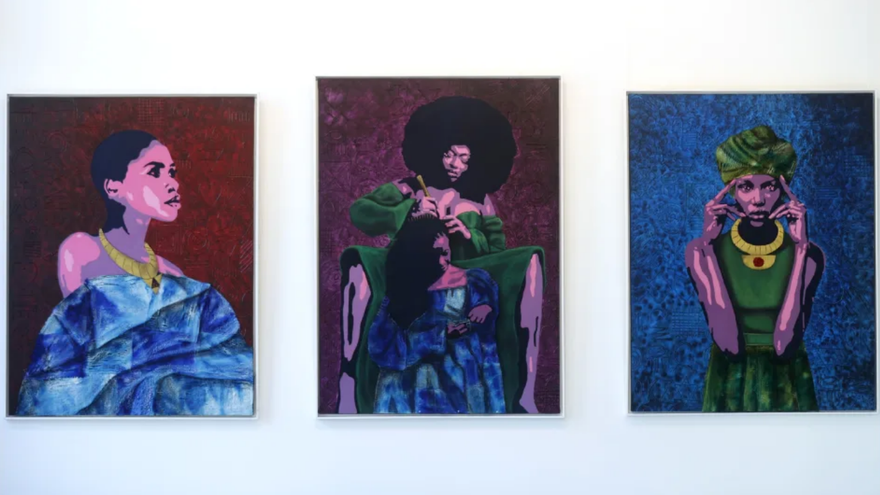
EFE (via 14ymedio), Juan Carlos Espinosa, Havana, 22 September 2023 — Making black women visible in their daily lives as a sign of empowerment. That is the proposal of the young Cuban artist Daniela Águila in her series Retratos Invisibles (Invisible Portraits), whose exhibition was inaugurated this Thursday in Havana.
Águila’s project – her fifth personal exhibition on the Island – is the result of two years of work and research, according to this 23-year-old woman in an interview with EFE, to reflect “Afro-Cubanity from the female perspective.” It is her “most ambitious project so far,” she says.
“Throughout history, I think there has been a void in the representation of the black woman. Especially if we talk about a non-sexualized representation”
“Throughout history, I think there has been a void in the representation of the black woman. Especially if we talk about a non-sexualized representation, which is based on the empowerment of women in every sense of the word,” she points out from the private gallery Máxima, in Old Havana.
Through nine pieces, with a palette reminiscent of pop art and reliefs that protrude from the fabric, Águila displays her vision of what she understands her generation can offer, often renounced by her elders as “fragile” and preferring the immediacy of TikTok and Instagram.
“Just because we are a generation of fast consumption does not mean that we create things of poor-quality,” she says. continue reading
Águila combines her work with classes at the University of the Arts (ISA). (EFE)
For her, the pejorative nickname of being part of the “crystal generation” refers to something positive: “(They should call us that) because of how transparent we are. We are not afraid to show things as they really are.”
Her premiere was in 2015, when she was still studying at the San Alejandro National Academy of Fine Arts. Now she continues to combine social life – “well, an attempt at social life (laughs)” – her work and her classes at the University of the Arts (ISA) of Cuba.
That juggling usually fails because her passion robs her of the most time in her routine. Between puffs of cigarettes and brushstrokes, she spends about eight hours in her studio, her second home since fourth grade.
“As a child I always wanted to try things. I studied guitar, I studied taekwondo, I studied tennis, I did a lot of things. But when I got to painting, I definitely said: ’This is my medium, this is what I want to do,’” she recalls.
“Yes, it’s true that there are many people who graduate, leave and project their future elsewhere, which I see as great. However, that doesn’t interest me, at least for the moment“
In the future she sees herself creating art in Cuba, something remarkable at a time when thousands have left the Island, which has been plunged in an intense economic crisis for more than two years.
In 2022 alone, around 3% of Cuba’s population emigrated just to the United States through the border with Mexico, according to figures from the U.S. government. Many of them were young people fresh out of university.
“Yes, it’s true that there are many people who graduate, leave and project their future elsewhere, which I see as great. However, that doesn’t interest me, at least for the moment. It seems to me that there is a lot to do here,” she tells EFE.
Her interest, she acknowledges, is in thinking “about the two series that will come after” the current one. Always in the future, but not as an obsession: “I prefer to say focused (instead of obsessive).”
Invisible Portraits will be on display until October 21 in Havana.
Translated by Regina Anavy
____________
COLLABORATE WITH OUR WORK: The 14ymedio team is committed to practicing serious journalism that reflects Cuba’s reality in all its depth. Thank you for joining us on this long journey. We invite you to continue supporting us by becoming a member of 14ymedio now. Together we can continue transforming journalism in Cuba.
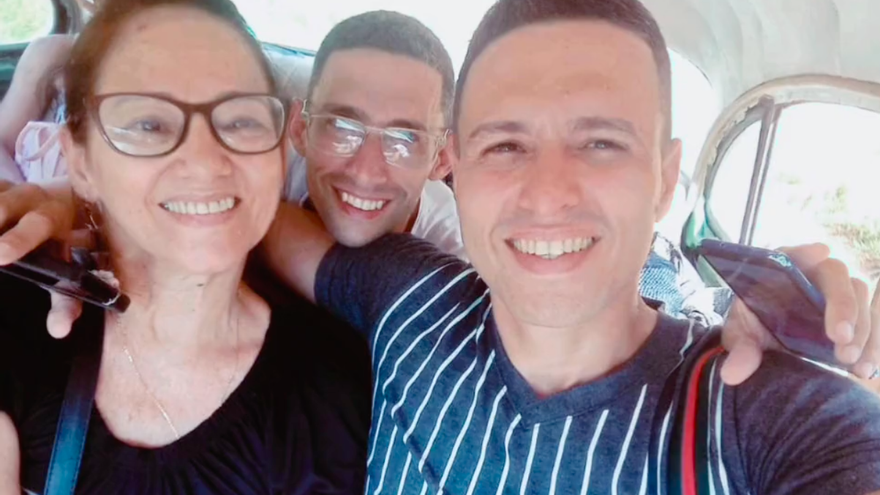
The brothers Nadir and Jorge Martín Perdomo, with their mother, Marta, in the vehicle in which they left the prison. (X/Betty Guerra)
14ymedio, Havana, 20 September 2023 — The brothers Nadir and Jorge Martín Perdomo, sentenced to six and eight years in prison after the anti-government protests of 11 July 2021 in San José de las Lajas (province of Mayabeque), received a pass this Tuesday after spending 794 days without leaving prison. Activist Betty Guerra Perdomo, cousin of the inmates, reported that they will be released for four days.
Guerra shared a message of support for the brothers on the social network X (Twitter), celebrating their brief release, along with an image of them in a vehicle with their mother, Martha Perdomo. “I don’t know how they can have those clean looks, those noble smiles and that high forehead that only the innocent can wear,” she wrote, assuring that Nadir and Jorge – arrested on July 17 – had gone out to demonstrate out of their “pure and sacred desire for freedom.”
She also alluded to the regime’s “darkness dressed as a homeland,” which she accused of “staining two authentic Cubans.” In addition, she demanded the permanent freedom of both brothers and the other political prisoners on the Island.
In April 2022, Nadir and Jorge’s lawyer, Reynel Brito, filed an appeal of the sentence before the Provincial Court of Mayabeque. After the appeal was dismissed, Brito criticized that the authorities behaved in a “severe” manner and without considering the “adequate records of prior conduct” presented by the defendants. continue reading
After the appeal was dismissed, Brito criticized that the authorities behaved in a “severe” manner
On February 8 of that same year, the brothers had been convicted of “attack, contempt and public disorder,” and sentenced to a number of years in prison that exceeded what the Prosecutor’s Office requested in both cases. For the Perdomo family, the sentence was an “aberration.”
Guerra then told 14ymedio that she considered the trial “a totally absurd, disrespectful and humiliating play… Everything that has happened with my cousins’ case from the beginning is an aberration up to this moment, I don’t want to say that it is the end because I cling to the hope that with strength and struggle we can change it.”
The sentence also highlighted that Jorge and Nadir decided to “circumvent” the health measures imposed by the Ministry of Public Health during the Covid-19 pandemic to join an “agglomeration of people” on 54th Street in San José de las Lajas.
According to the document, many others joined that march “at the call of the accused” and “holding pans, metal objects and the horns of motorcycles created enormous noises, which put the neighbors on alert” beginning the behaviors of “total disrespect,” such as chanting “with euphoria” “prosperous and vulgar” words such as “pinga [dick] police” and “Díaz-Canel singao [motherfucker]”, along with “Homeland and Life,” in addition to making “crude demands to the protective commissioners of the place” and snatching a Cuban flag for a moment from an agent who was participating in a government counter-demonstration.
After the trial, the brothers were held in different prisons: Nadir in Melena del Sur and Jorge in Quivicán
After the trial, the brothers were held in different prisons: Nadir in Melena del Sur and Jorge in Quivicán, each more than 30 kilometers from their home, which affected family visits.
“They separated my children from me telling a lie as huge as that Nadir had asked to be separated from his brother. I am going to complain to the head of the prisons to ask that they be together again because the economic situation is difficult and it is not easy to pay for cars to two different places,” the mother of the young men then denounced.
Since that moment, both Marta Perdomo and the rest of the family have carried out an incessant campaign for the release of her sons.
______________
COLLABORATE WITH OUR WORK: The 14ymedio team is committed to practicing serious journalism that reflects Cuba’s reality in all its depth. Thank you for joining us on this long journey. We invite you to continue supporting us by becoming a member of 14ymedio now. Together we can continue transforming journalism in Cuba.
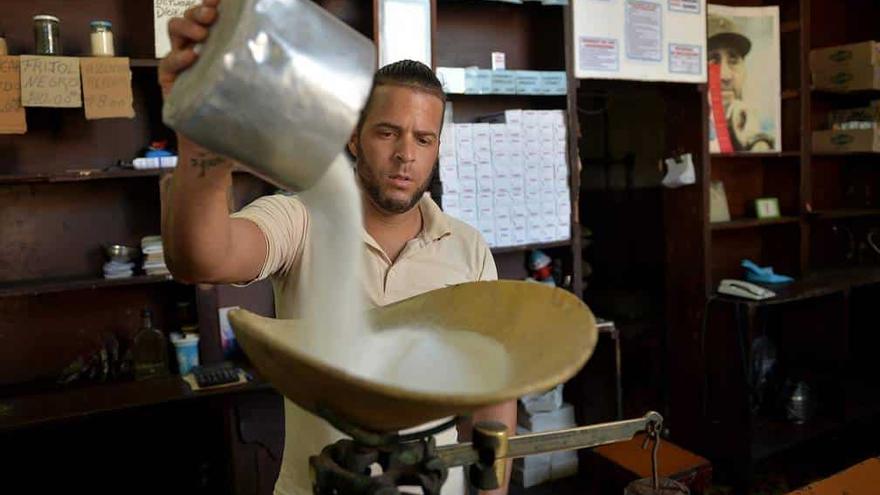
In September, in more than 200 Santiago ration stores, four pounds of standard sugar per consumer were delivered instead of three, due to the late arrival of the information. (ACN)
14ymedio, Madrid, 22 September 2023 — Nobody knows where the sugar is in Santiago de Cuba, although if you search on social networks, it appears. The provincial government conveyed to the population on Tuesday a message from the Ministry of Internal Trade trying to call for calm about the rumors that emerged in recent days that predicted the suppression of some products in the monthly family basket — sold through the ration stores — but they achieved the opposite.
The denial reported the delivery of the product and the delay in receiving it, taking the opportunity to remind Cubans that, as is being done throughout the country, the amount of standardized sugar has passed from four to three pounds per person per month. “Well, they eliminated a pound of sugar, don’t say that nothing has been eliminated. And, from what they say, in October they are also going to give three pounds. Until when?” a santiaguero reacted. “Now, less sugar. Don’t they understand that we can’t live on air?” cried another.
Those who were lucky enough to receive four pounds by mistake this month will get one less next month
By that time they still did not know what was going to arrive on Thursday, when the official newspaper of the province, Sierra Maestra, published a brief report with the title “Necessary clarification on the sugar of the standard family basket.” Those who were lucky enough to receive four pounds by mistake this month will have one less next month, announced Juan Carlos Rosell Zarrabeitía, coordinator of the Commerce programs.
“In the current month, in more than 200 ration stores in the Santiago territory, the four pounds of standard sugar were delivered as a result of the late arrival of information to the shops and, in other cases, by mistake of the shopkeepers,” it explains. “Consumers who received the complete product are informed that in October they will receive only two pounds of sugar, taking into account that for September and October it is only possible to give three pounds per consumer,” it says. continue reading
The report, published almost 24 hours ago, has not been disseminated by the local press on their networks, and it is foreseeable that many people from Santiago will not know that they will have to save sugar this month, because in the next one they will receive half as much as usual.
However, the “excess” received this month seems to have gone straight to the black market. One pound already exceeds 180 pesos, an amount that for the area is very high, and on social networks the request for the product now resembles a plea.
“Seeking sugar at any price,” a santiaguero posted early this Friday morning on a Facebook page. The post has almost 50 comments, and there are at least a dozen sellers willing to offer it for prices ranging from 170 to 300 pesos. Others do not even make the price public. “I have a bag at 300,” “I have ten pounds at 170,” “I have 30 pounds, anyone who wants can write to me privately.”
“I buy sugar,” reads a post on another page for buying and selling all kinds of products in Santiago de Cuba. “Me too,” one replies. “I’m also looking for it,” says another. And so on, up to eight of the 18 comments.
The authorities benefit from the “cannibalism” in which Cubans live, who speak of the urgent need to be in a constant state of “every man for himself”
“People like to criticize the Government, and rightly so,” says a santiaguero on another page for exchanges in the province. “But we are not left behind. A pound of sugar is 150 or 180 pesos… What we do to ourselves is abusive,” he regrets. The comment has generated an intense debate among those who consider that the authorities benefit from the “cannibalism” in which Cubans live, who speak of the urgent need to be in a constant state of “every man for himself.”
“Appealing to conscience in extreme situations is a utopia,” one refutes. “The one who kills the cow is guilty,” says the one who started the debate in relation to the Government, “as is the one who ties the legs (…) So are [the people] for enduring. And the one who sells at retail keeps quiet because it’s his time and he takes advantage of it, even if he is aware that it hurts others,” he adds.
The shortage in the market of a product that, in the imagination of the world, is still, along with rum and tobacco, the brand of Cuba, is such that the fight is now over brown sugar, considered on the Island as of worse quality than the white one. “Here in Camarioca I don’t remember the last time that white sugar came,” says a man. “Brown sugar, I’m looking urgently, call me,” announces another.
The forecasts by province point to a another poor sugar harvest, which seems to have no end. In 2022, the target was 911,000 tons, and barely 473,720 were obtained. By 2023, the authorities had scheduled the production of 455,198 tons of sugar, almost as much as what they usually export, but last year they were not able to meet their commitments.
Translated by Regina Anavy
____________
COLLABORATE WITH OUR WORK: The 14ymedio team is committed to practicing serious journalism that reflects Cuba’s reality in all its depth. Thank you for joining us on this long journey. We invite you to continue supporting us by becoming a member of 14ymedio now. Together we can continue transforming journalism in Cuba.
Díaz-Canel “was not prepared to discuss the regulations in detail” during the meeting. (@Miguel Díaz-Canel)
14ymedio, Havana, 23 September 2023 — Miguel Díaz-Canel met this Friday behind closed doors, in New York, with a group of U.S. businessmen, several of them Cuban Americans, to discuss the “new business opportunities” they may have in Cuba, thanks to several economic “transformations” prepared by Havana. Although the president did not offer other details about the exchange, several officials of his delegation informed the participants that the regime values allowing Cuban-Americans to own businesses on the Island.
Several of the attendees at the meeting with Díaz-Canel, at the facilities of Cuba’s diplomatic mission at the United Nations, revealed to El Nuevo Herald that Cuban officials claim to be “contemplating and working on legislation” to facilitate the investments of Cuban Americans and to let them own micro, small and medium-sized enterprises (MSMEs) registered in Cuba.
Present at the meeting, lawyer Ralph Patiño explained to the newspaper that before this happens, Havana must modify numerous laws and open the necessary channels so that foreigners are authorized to directly manage the MSMEs, which are increasingly successful in the business network of the Island.
However, Patiño alleges, it is a complex situation, given the tensions between the Government of Cuba and the United States. Promises of an economic opening always come to nothing, although, he added, for the leadership of the regime “it is the only way to basically maintain their country without something drastic happening.” continue reading
Given the tensions between the Government of Cuba and the United States, promises of an economic opening always come to nothing
In addition, Díaz-Canel “was not prepared to discuss the regulations in detail,” John Kavulich, president of the U.S.-Cuba Trade and Economic Council, told the newspaper. He was informed about the meeting, which he did not personally attend.
Kavulich considers that it was a “lost opportunity to make progress,” since the businessmen focused on the “repetition of complaints” about the obstacles imposed by both the regime and the U.S. Government, instead of “discussing in detail how to get more out of what they actually authorize.”
If they come to fruition, the new measures will be good news for Cuban-American businessmen who negotiate with the regime, several of them present at the exchange, such as Hugo Cancio, owner of the online store Katapulk and the digital newspaper OnCuba; Carlos Saladrigas, president of the Cuba Study Group; Mike Fernández, healthcare entrepreneur; Ariel Pereda, president of the Habana Group, which legally advises those who want to do business with the Island; and Patiño himself, who supported the thaw during the Barack Obama Administration.
The meeting with Díaz-Canel was also attended by members of the Western Union and Crowley companies, representatives of the U.S. Chamber of Commerce, and businessman Paul Johnson, president of the U.S. Agricultural Coalition.
El Nuevo Herald also reported that about 50 owners of MSMEs on the Island are expected to travel to Miami next week, to study business opportunities. No other details are known.
Joe Biden’s government is expected to soon announce a lifting of restrictions to help Cuban MSMEs
Joe Biden’s government is expected to soon announce a lifting of restrictions to help Cuban MSMEs, according to knowledgeable sources for several American media. They also indicated that these are “specific guidelines” so that U.S. financiers can grant loans to independent companies within the Island.
The new measures will include the opening of bank accounts in U.S. institutions by residents of Cuba, something prohibited until now. In addition, the prohibitions imposed by the Donald Trump Administration on transactions with third countries to send remittances to the Island will allegedly be overturned.
The possibility has raised a heated controversy among organizations opposed to the Havana regime. Washington is not going in the “right direction” in its economic strategies with Havana, the Christian Democratic Party of Cuba said on Wednesday. “Both the credits themselves and the possible opening of bank accounts in the United States are limited and would reach only a select group of people around the layers of power,” they said in a statement.
For its part, the organization Cuba Siglo 21 said that following the game of the regime, “or, even worse, supporting them financially, will only prolong the agony of the Cuban people.”
Translated by Regina Anavy
____________
COLLABORATE WITH OUR WORK: The 14ymedio team is committed to practicing serious journalism that reflects Cuba’s reality in all its depth. Thank you for joining us on this long journey. We invite you to continue supporting us by becoming a member of 14ymedio now. Together we can continue transforming journalism in Cuba.
Exile leaders and former Cuban political prisoners during a press conference in Miami, on February 15, 2023. (EFE)
14ymedio, Pedro Corzo, Miami, 23 September 2023 — The everlasting will of the Cuban exiles to overthrow totalitarianism is as proverbial as the solidarity shown by those same exiles with their relatives on the Island, despite the intense propaganda deployed by the Castro authorities and, in particular, by the Cuban Government’s fellow travelers residing abroad, who try to show that the opposition, in order to end the dictatorship, is willing to sink the country where they were born.
The Cuban exile has shown a very unique perseverance and dedication for his country. Just as inside Cuba there has never been a lack of freedom fighters, abroad there have also been men and women ready to take the risks required to participate in the return of citizens’ rights to the Island.
The darkest decades of the opposition in Cuba, I dare to say, was in the period from 1960 to 1980, illuminated by the resistance of political prisoners and the creation of the Comité Cubano Pro-Derechos Humanos [Cuban Committee for Human Rights], inspired by Ricardo Bofill.
It was also one of the periods in which the banishment was most active, as shown by the constitution, among others, of the Cuban Patriotic Junta, by Manuel Enrique de Varona, and the Cuban American National Foundation, by Jorge Mas Canosa, as well as by the constitution of Independent and Democratic Cuba, led by Commander Huber Matos and many other former political prisoners like Ángel de Fana and Reinaldo Aquit Manrique, whom prison hardened in their already firm convictions.
Signs of that tenacity and drive are not often found in History. I affirm that the opponents abroad are vibrant and as committed to overthrowing the dictatorship as they were when this struggle began more than 60 years ago.
“I affirm that the opponents abroad are vibrant and as committed to overthrowing the dictatorship as they were when this fight began more than 60 years ago”
This gives cause for us to feel proud, because the evidence of that resistance and dedication to a more-than-just cause exists in the young and old, as shown by the Assembly of the Cuban Resistance, founded in 2009. In my opinion, because of the efficient work it does, under the coordination of Orlando Gutiérrez, it has managed to motivate not only Cubans, but also numerous politicians from different countries who work hard to bring democracy to Castro’s hell.
It’s important to note that the commitment is still present in those who left Cuba to study in the so-called socialist countries, as shown by the intense activity they carry out in Europe against totalitarianism. There are groups such as Miscellaneous of Cuba, Cuban Observatory of Human Rights and Prisoners Defenders, in addition to personalities such as Zoé Valdés and Alejandro González Raga.
These former students are among the most tenacious and active enemies of the regime. There are groups in Europe that develop an intense activity in favor of democracy in Cuba, also in other regions of Latin America such as Puerto Rico, where there is a personality like Gerardo Morera, 88 years old, who does not stop promoting the fight for democracy in Cuba, while working intensively to preserve our traditions, supporting and managing the patriotic Casa Cuba de San Juan.
Of course, there are several states in the U.S. where the main foci of resistance are located, with South Florida, particularly Miami-Dade County, being the vital nucleus for most Cuban organizations. They use different strategies to fight Castroism. Some, such as Alpha 66, directed by Ernesto Rodríguez, have been doing so for more than six decades.
Those of us who are already approaching eight decades of life, or the 90s, such as Roberto Perdomo – 28 years in prison in Cuba, 23 of them in underpants for rejecting the common prisoner’s uniform – must be very proud, because young people born in the United States, such as Daniel Pedreira, have made a firm commitment to everything that has to do with democracy in Cuba. Others, such as the aforementioned Orlando Gutiérrez, who left Cuba before adolescence, are examples of dedication and sacrifice as were their elders, who were executed or served decades in Castro prisons.
Translated by Regina Anavy
____________
COLLABORATE WITH OUR WORK: The 14ymedio team is committed to practicing serious journalism that reflects Cuba’s reality in all its depth. Thank you for joining us on this long journey. We invite you to continue supporting us by becoming a member of 14ymedio now. Together we can continue transforming journalism in Cuba.
El Biky, located at 412 Infanta Street, between San Lazaro and Concordia, is part of a high-end chain of restaurants. (14ymedio)
14ymedio/Yucabyte, Havana, September 22, 2023 — What’s driving the Cuban government to adopt new banking measures in the midst of a nationwide cash shortage? Which restaurants in Havana are being secretly managed by the children and grandchildren of senior Armed Forces’s officials? What event will get so out of control that the island’s frustrated inhabitants will take to the streets in a new wave a protests? 14ymedio and Yucabyte took a look at the rumors making the rounds on social media in August. While they do not answer these questions, they do attest to how some Cubans interpret the country’s current situation and how they visualize its future.
Most of the rumors about new monetary regulations announced in early March — what the Central Bank of Cuba (BCC) is calling bancarización — center on the suspicion that the measures are not just about taming short-term inflation. There is fear that the real intention is to allow officials to keep closer tabs on small and medium-sized businesses (MSMEs). There is also the assumption that the reason these businesses are being required to pay their employees electronically is to stoke worker discontent and hinder their expansion.
There have also been rumors that several MSMEs have had to close due to the havoc caused by the new banking requirements. Several commenters claim that those that have managed to survive bancarización are now being monitored more closely than ever by the government.
The informal market has been severely impacted by the currency shortage which, according to rumors, has led to the emergence of a new service provider: the cash broker.
Cubans have spent the last several weeks in vain, lining up at ATMs. Dozens of commenters on social media complain the machines have no cash. One of them reported that this has led officials of several Havana boroughs such as Mariano to simply declare them out of service. continue reading
The informal market has been severely impacted by the currency shortage which, according to rumors, has led to the emergence of a new service provider — the cash broker — who makes money by charging a commission, generally 10% to 12% of the face value of peso banknotes. A statement by BCC vice-president Alberto Quiñones describing this activity as “illegal conduct” confirmed the existence of a market in which virtual money is exchanged for banknotes.
A few days later, official media outlets made an announcement that confirmed another widespread rumor, that the nation’s gasoline stations would no longer be accepting cash payments. This quickly led to other rumors such as the one that the electric utility company, Unión Eléctrica, would start charging its customers electronically.
The level of discontent on the island over economic instability and inflation is so high that, according to some on social media, it is even impacting certain segments of the Communist Party, the Armed Forces and the Interior Ministry. Some senior government officials, especially those involved in the management of government-run MSMEs, are unhappy with the new banking regulations due to the obstacles they present for their businesses.
Comments have also been made on social media about connections between the children and grandchildren of senior government leaders and the sight of of high-end cars on the streets of Havana.
Another spate of rumors has focused on the network of restaurants, bars and companies that the descendants of Cuba’s “old guard” now control. Some of those posting on social medio point out that El Biky — a restaurant rumored to be owned by the former president’s daughter, Mariela Castro — seems to have no problem importing products that it later sells.
The most persuasive evidence, they say, is the wide menu selection and the fact that the names of the restaurant’s four partners remain unknown, as 14ymedio has reported. This newspaper also noted that El Biky opened a new location a few weeks ago at the José Martí International Airport.
Comments have also been made on social media about connections between the children and grandchildren of senior government leaders and the sight of of high-end cars on the streets of Havana. Several commenters have shared photos of a Porsche with a Texas license plate parked along Havana’s seaside boulevard, the Malecón.
In contrast to all the focus on luxury, other rumors about police refusing to confront the wave of crime plaguing the island are becoming ever more common on social media. Some commenters have pointed out that police officers themselves have formed a network to stop vehicles at checkpoints in Havana and confiscate, without any legal basis for doing so, food that citizens are trying to transport from one province to another.
____________
COLLABORATE WITH OUR WORK: The 14ymedio team is committed to practicing serious journalism that reflects Cuba’s reality in all its depth. Thank you for joining us on this long journey. We invite you to continue supporting us by becoming a member of 14ymedio now. Together we can continue transforming journalism in Cuba.
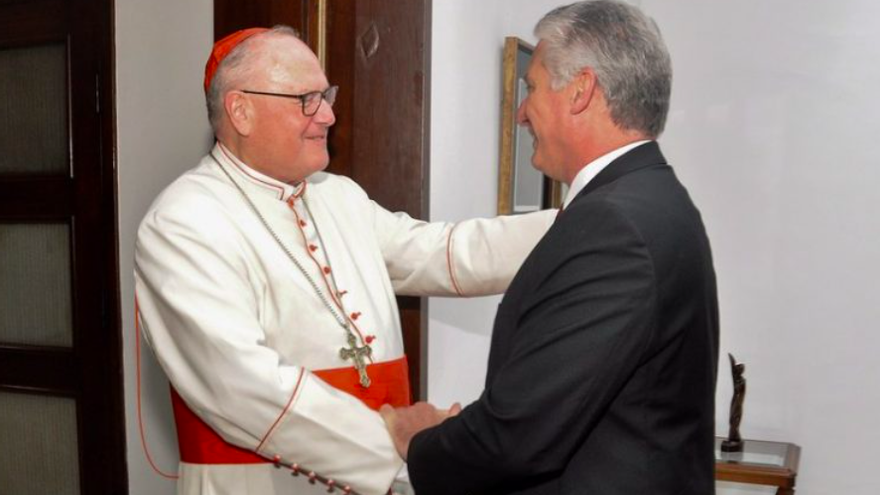
The event, approved by Cardinal Timothy Dolan, who visited Cuba in 2020, is by invitation only and will be covered by the ’National Catholic Register’. (Revolution Studies)
14ymedio, Frank Calzón, Miami, September 23, 2023 — President Miguel Díaz-Canel, after giving a speech before the United Nations General Assembly this week, will be at a celebration event this Saturday from five to six in the afternoon at the Church of the Transfiguration, located at 25 Mott Street in Chinatown, Manhattan, New York.
The theme of the event is the life of the Cuban patriot and priest Félix Varela.
The event, approved by Cardinal Timothy Dolan himself, is by invitation only and will be covered by the National Catholic Register, a major religious publication.
When the news leaked, Cuban exiles protested to the US authorities, pointing out the serious limitations on religious freedom perpetrated by the Office of Religious Affairs of the Communist Party. This office is in charge of supervising everything that has to do with the operations of the Church, from permits for processions to the purchase of materials to repair buildings, and passports for priests who wish to travel abroad.
Other Cuban exiles addressed Cardinal Dolan asking him to pray for the Cuban people, for peace and justice on the Island
Last year Cuban Cardinal Juan García tried to visit some dissidents in Central Havana but was intercepted by the police. Las Damas de Blanco [Ladies in White] who attempted to attend Sunday mass in the Cuban capital have frequently been beaten and detained. continue reading
Some twenty priests distributed a video in which, one after another, after identifying themselves and giving the name of their parish, they repeated a message: “Cuban, do not raise your hand against your brother.”
In addition, other Cuban exiles addressed Cardinal Dolan asking him to pray for the Cuban people, for peace and justice on the Island. In the letter that was released in New York a few hours ago they also asked him to ask Díaz- Canel to stop the harassment of priests, to allow the International Committee of the Red Cross to enter Cuban prisons and the release of all political prisoners on the Island.
____________
COLLABORATE WITH OUR WORK: The 14ymedio team is committed to practicing serious journalism that reflects Cuba’s reality in all its depth. Thank you for joining us on this long journey. We invite you to continue supporting us by becoming a member of 14ymedio now. Together we can continue transforming journalism in Cuba.
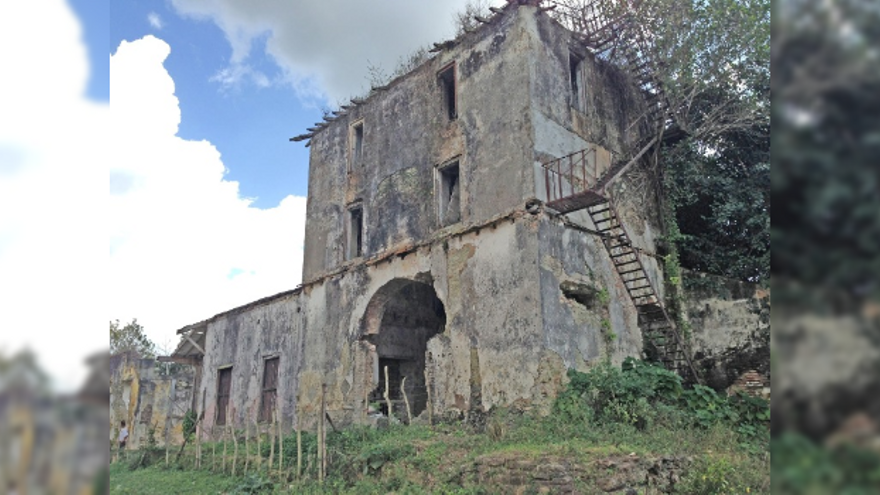
Ruins of the Carolina mill, founded in 1835 by the American William Hood Clemens. (5 de September)
14ymedio, Havana, 22 September 2023 — The Cuban authorities, who have witnessed the failure of one sugar harvest after another in recent years, have been convinced that the sugar mills in Cuba are more profitable being in ruins. This Friday, the official press announced that the Carolina mill, once the largest sugar mills in Cienfuegos and abandoned for decades, will be converted into a tourist complex.
According to the newspaper 5 de septiembre, several researchers from the University of Cienfuegos and the state company Tecnoazúcar created the Carolina project: Sugar, Tradition and Culture, an initiative that aims to turn the old factory and its neighboring communities into a “tourist and heritage destination,” in addition to “enriching the city tourism” of Cienfuegos. However, those who promote it have not said a word about a fundamental question: Where will the money come from to finance the plan?
For months, both institutions have been collaborating in the evaluation of the area and its development opportunities. Expectations are high: the construction of a heritage interpretation center, a “ranch-style-cafeteria” with a varied menu that includes gastronomic versions of the “dishes that the blacks prepared in the barracks,” walking and horseback riding trails, and the enabling of a boat route along the Damují River, “where the honey produced in that industry traveled.”
According to the academic, the population of Carolina “requires the intervention of the Government”
Norcaby Pérez, professor in the Department of History of the Cienfuegos University and part of the project team, explained to the press that the diagnostic stage is currently being completed. “We have made visits for the recognition of the values that exist on the site, and we need to return again to interview the neighbors of the community,” he said. continue reading
According to the academic, the population of Carolina “requires the intervention of the Government, especially in the barracks that still maintain the fortress, in order to improve people’s living conditions.” Until now, no government institution had been interested in giving life to the town of Cienfuegos, but with the proposals of the authorities to increase tourism, officials expect state funds to appear easily.
The situation of the Carolina “colossus,” founded in 1835 by the American William Hood Clemens to take advantage of the sugar glory of the Island during that century, was practically unknown in the province for its sugar-mill heritage until the project emerged.
Now, the authorities, who noticed the architectural and historical potential of the mill, intend to take advantage of even the remotest ruin to attract foreigners, but the residents of the area have viewed the government’s offer with suspicion.
Old colonial house belonging to the owners of the Carolina. (5 de Septembre)
“Today in Carolina, there are the remains of the period’s constructions and the machinery. Although not everything can be saved, the purpose is to rescue as many objects as possible and preserve them. We know that some things, even the belongings of the mill’s founder, are in the hands of the inhabitants of the settlement, who allege that they will only deliver them when they see a concrete transformation of the place where they live,” Pérez explained.
The conversion of abandoned sugar mills into tourist landscapes has been a common practice since the 1990s, when the fall of the Soviet Union and the end of its subsidies to Cuba led Cuba into a serious financial crisis, forcing the Island to close more than a hundred of the 176 active sugar mills. Since then, the debacle has worsened every year. During the 2023 spring harvest, barely 22 sugar mills joined the grinding.
The Patria sugar mill, located several miles from Morón (Ciego de Ávila), is another mill that was converted to attract tourists, who now enjoy “tradition and peasant gastronomy,” as well as a ride on a “train of the time.” The Valley of the Sugar Mills in Trinidad, where the large colonial mansions are still preserved, has suffered the same fate, as has the Hershey plant in Mayabeque, founded in 1916 by Milton S. Hershey, creator of the famous chocolate brand of the same name.
The American tycoon, who set out to exploit the sugar industry in Cuba with the purpose of growing his chocolate business, built one of the largest sugar planting and production complexes on the Island, going so far as to build a “city” for its workers with a social club, a cinema and a baseball stadium. The businessman also introduced in Cuba the first electric train with which he moved his sugar to the ports of Matanzas and Havana, and from there to Pennsylvania, where the famous chocolate factory was located. To this day, the vehicle is still the only electrically operated vehicle that exists on the Cuban railroads.
In addition to the sugar mills, other Cuban industries, once the most successful on the Island, have suffered a tourist metamorphosis. This is the case of the historic Angerona coffee plantation (province of Artemisa), which was the largest in Cuba, having an endowment of up to 450 slaves and 750,000 coffee plants.
Translated by Regina Anavy
____________
COLLABORATE WITH OUR WORK: The 14ymedio team is committed to practicing serious journalism that reflects Cuba’s reality in all its depth. Thank you for joining us on this long journey. We invite you to continue supporting us by becoming a member of 14ymedio now. Together we can continue transforming journalism in Cuba.
The destruction of the Zulueta 505 building is slow but still dramatic. (14ymedio)
14ymedio, Nelson García/Juan Izquierdo, Havana, September 21, 2023 — Due to the magnitude of the damage and the lack of effort of the authorities to mitigate it, many buildings in Havana agree with Carpentier.* The “city of the columns” is barely left, with structures in ruin, paint chipped by moisture and vines invading arches and pillars.
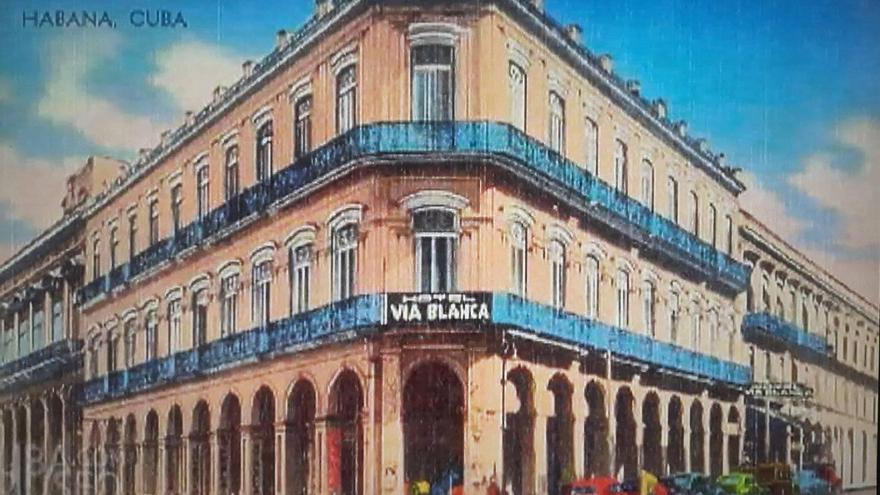
Such is the case of the old Vía Blanca hotel, located at 505 Zulueta Street, between Monte and Dragones, whose decadence the passers-by compare with that of a “haunted mansion” near which no one dares to walk anymore. In the postcards of the 1950s, however, the building was described as a residential gem with “large and ventilated rooms.”
The destruction of the Zulueta 505 building is slow but still dramatic. The Government has been promising for years a repair of which, today, there is only one sign: the gigantic scaffolding that underpins the facade and on which climbing plants and rust have been growing for a long time.
The Government has been promising for years a repair of which, today, there is only one sign: the gigantic scaffolding that underpins the facade
In 2020, the nine families who lived in the building, several of them with children, were relocated under the pretext of restoring it. “Until that moment they lived at risk of being buried by a collapse,” recalls Rogelio, a 71-year-old retiree who lives in the neighboring building.
In conversation with this newspaper, Rogelio describes the long ordeal of the neighbors since, in 1995, they received the notification that they would be transferred to better houses in zone 11 of Alamar-Habana del Este. He pointed to the Office of the Historian, whose director, Eusebio Leal, began to earn the trust of Fidel Castro and to get streams of foreign capital, indispensable after the fall of the Soviet Union.
The building during the 1950s, when it was occupied by the Vía Blanca hotel, on an old postcard. (Facebook)
“It was all a lie,” concludes the old man, who is amused that the policemen of the well-known Dragones station – located in front of the building – have to dodge the scaffolding and constantly look up, in case some “loose” stone is about to fall, by chance, near them. continue reading
Not infrequently, Rogelio recalls, the neighbors tried to go to the police unit for the help of those same agents, who ignored them. On the other hand, the station does not lack paint or maintenance. In fact, the Ministry of the Interior is building a fence around the neoclassical building, with its windows covered by powerful bars, behind which the Capitol stands out.
“Nor do they like to park their cars nearby, in case a collapse occurs,” he notes, pointing to the row of police vehicles”
“Nor do they like to park their cars nearby, in case a collapse occurs,” he notes, pointing to the row of police vehicles.
Nature and the Government’s laziness are not the only things that have wreaked havoc on Zulueta 505. Drunks, beggars and other nocturnal “guests” resort to the arcades to “do their deeds,” according to Rogelio’s euphemism. What used to be “ghostly,” he adds, is now barely sordid: garbage and debris complete the picture.
Despite its proximity to the police station, the building has also served as a kind of sanctuary for all kinds of thugs. In the darkness on Zulueta Street, those who seize a wallet or a cell phone with a knife have the ideal shelter behind the arcades and the barrier of scaffolding. “No one is going to risk going in there to look for the thief,” Rogelio says.
Police station on Dragones Street, Central Havana. (14ymedio)
Xiomara, a 45-year-old housewife, has spent most of her life contemplating the desolation of the corner of Zulueta and Dragones. For her, the only “solution” is collapse, helped by rain or a windstorm. The authorities have proven to be useless, and the only measure they have taken is to place some scrawny yellow tape on the scaffolding. Only those who approach closely can read it: “Danger of total collapse.” Xiomara doesn’t need the warning. A few days ago, when she came back from the line for buying chicken, a fragment of the wall of Zulueta 505 almost struck her.
Several decades of broken promises have cured her of fear. Now she only expects a “foreign firm” to buy the land “with ruins and everything.” “If that happens, they will not return the building to the families who lost it,” says Xiomara. “They will most likely build another hotel.”
*Translator’s note: Alejo Carpentier, a Cuban writer, called Havana “the city of columns.”
Translated by Regina Anavy
_______________________
COLLABORATE WITH OUR WORK: The 14ymedio team is committed to practicing serious journalism that reflects Cuba’s reality in all its depth. Thank you for joining us on this long journey. We invite you to continue supporting us by becoming a member of 14ymedio now. Together we can continue transforming journalism in Cuba.
 EFE/14ymedio, Nairobi, 20 September 2023 — The Kenyan President, William Ruto, speaking to his Cuban counterpart, Miguel Díaz-Canel, during a meeting of the United Nations General Assembly, thanked him for Cuba’s “links” with his country, which have allowed Kenya to improve its development, “particularly in the health sector.”