
In Cuba, Egg Subsidy Has Led to the Bankruptcy of Ciego de Avila’s Poultry Company

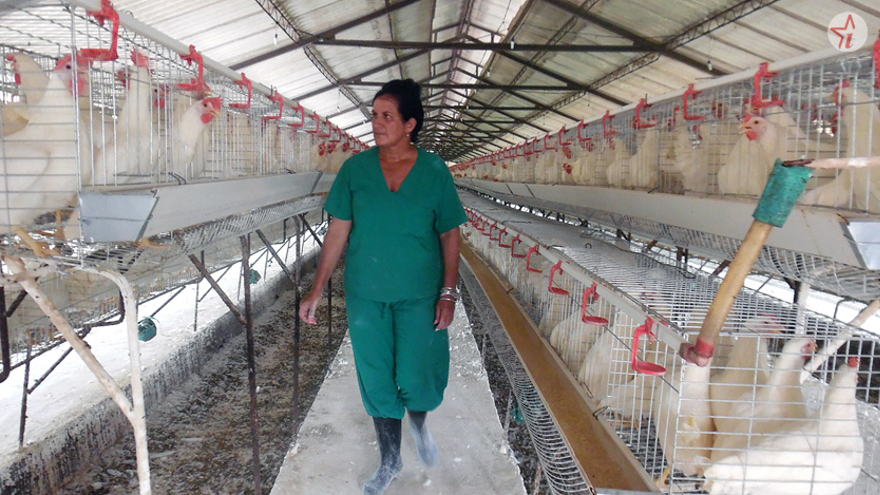
The debt of the Poultry Company of Ciego de Ávila amounts to tens of millions. (Invasor)

14ymedio bigger14ymedio, Havana, 6 November 2023 — A dozen state companies in Ciego de Ávila will end this year with their accounts in the red, Cuba’s official press reported on Monday. The authorities of the province, which have seen exports crumble by 66.6%, which translates into a debt of 85 million pesos, look with special alarm at the Poultry Company which, even before closing its fiscal year in 2022, already predicted that the next twelve months would bring only losses.

Despite the fact that both the authorities and the local press insist on pointing out that this year there are 11 fewer  companies with losses than in the previous period (21 losses), the complaints of managers who had to suffer “reprimands” focus on three fundamental issues: the shortage of fuel, raw materials and the lack of government financing. All are the responsibility of the State.

Leyda Martínez Arnáez, director of the Poultry Company, explained to Invasor that “the lack of feed and the subsidized price of eggs have led this entity to bankruptcy.” For several years it has been hard to “square” the accounts, and the debt amounts to tens of millions. continue reading

The new option to overcome the problem, she argues, is to ally with the micro, small and medium-sized enterprises (MSMEs) to help “reverse the state of affairs.” She stressed this to her superiors, who must approve the new project of “linking” with the private ones, since “the allocation of foreign currency centrally [by the Government] shows no signs of improvement,” she lamented.

They must approve the new project of “linking” with the private ones, since “the allocation of foreign exchange centrally [by the Government] shows no signs of improvement”

A similar option has been sought by La Cuba, an agricultural company that mostly plants bananas, which had been carrying a debt of 70 million pesos as of 2022, and still owes more than two million. According to the director, Ricardo Varona, the biggest problem is obtaining fertilizers that no longer arrive “through the channel,” and the company must get them on its own at a higher price.

At the moment, there is hope in the export of bananas and vegetables, but this creates a dilemma that the company cannot assume with its current income: if it buys fertilizers, it loses money and increases the debt; if it does not buy them, its production and the quality of planting decreases.

For months, the Ceballos Agroindustrial Company, known for its sweets and preserves, has also been in a “tense” situation. According to the entity’s officials, the delays in the export of the charcoal it produces, which is “worked” in the port of Mariel, has forced the company to pay for the prolonged stay of its containers, and its finances now show an overdraft of more than 200%.

This has forced Ceballos to lower the cost of the charcoal, also affected, in part, by the appearance of competitors with less expensive products that have diversified the market, the managers explain.

In addition, unlike other State entities that manage their currencies at the exchange rate of one dollar for 120 Cuban pesos, Ceballos continues with the obligation to use one for 24 pesos. “It is contradictory to say the least that the leading company of the Avileño export hub, with import and export capacity, cannot benefit from the exchange market that is approved for others,” Invasor claimed, joining the complaint of the managers.

The sugar companies Ecuador and Primero de Enero face this time, as in 2022, the scrutiny of the authorities for a combined loss of 164 million pesos

Together with the Company of Communal Services, Raw Materials and Industrial Fisheries, Ceballos falls into the category of entities that have not only reported losses but have also failed to meet the expected profits and the level of exports planned for the year.

The sugar companies Ecuador and Primero de Enero are facing this time, as in 2022, the scrutiny of the authorities for a combined loss of 164 million pesos “after a harvest of poor results and failure to meet the sugar plan.” Other indicators, such as gross sales and operations, have also deteriorated.

Similarly, the Renewable Energy Company Rensol owes about one million pesos, but its directors soon assigned responsibility for the lack of financing to the Aqueduct and Sewer Company of Ciego de Ávila, which, due to lack of fuel, stopped the installation of water pumping units with solar panels in which Rensol took part.

During the analysis of Aqueduct, the director pointed out that the company has begun to pay more than 100 new salaries and that the price of fuel has increased, all without the entity receiving the “central subsidy” allocated to it. The authorities, for their part, expect the company to “dig out [other] alternatives from the bottom of the earth.” “With the equipment and human resources you have, you have to go out and fight for more services and pay 100% of the (water) charge,” was the response of Communist Party officials.

Only the Cárnica Company, which plans to sell 200 tons of pork at the end of the year, “said for sure” that, by the end of 2023, they will have already recovered the million pesos of losses they have reported so far.

Translated by Regina Anavy

____________

COLLABORATE WITH OUR WORKThe 14ymedio team is committed to practicing serious journalism that reflects Cuba’s reality in all its depth. Thank you for joining us on this long journey. We invite you to continue supporting us by becoming a member of 14ymedio now. Together we can continue transforming journalism in Cuba.
Leaders Only Have Eyes for Russia at the Havana International Fair

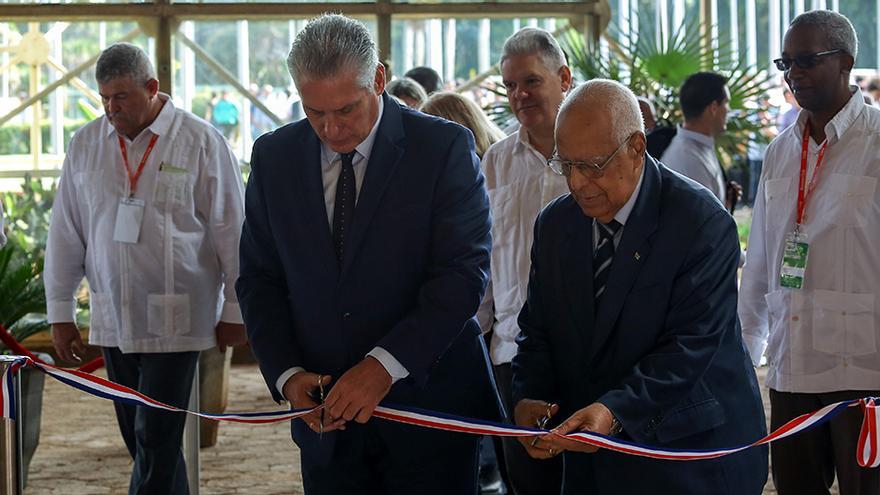
Cuban President Miguel Díaz-Canel cut the opening ribbon of this edition of the International Fair with Minister Ricardo Cabrisas. (Cubadebate)

14ymedio bigger14ymedio, Madrid, November 7, 2023 — With Prime Minister Manuel Marrero seeking support in China, Cuban President Miguel Díaz-Canel cut the ribbon this year for the 39th edition of the Havana International Fair (Fihav) with his Minister of Foreign Trade and Foreign Investment, Ricardo Cabrisas. The change was noticeable in the suit with tie, compared to the guayaberas of the last edition but, above all, in the prominence of Russia, one of the specialties of Cabrisas, who is also deputy prime minister.

Spain was once again the country with the most presence at the Fair, with 80 companies, and is the first investor in Cuba, Europe’s main trading partner and second in the world. However, the majority of praise went to Russia, with just 20 companies, mostly chemicals, food, logistics and energy. The country’s stand took center stage with the presence of Díaz-Canel at its inauguration and the praise went back and forth.

“It is another example of the growing interest of the Russian business community in the Cuban market as a result of the intergovernmental visits carried out between our presidents. We inaugurated the Antillana de Acero steel plant, the most modern of its kind in the country. We hope that it will continue reading

soon be put into operation. the rolling mill is underway,” said Víctor Koronelli, ambassador to the Island, who valued the Russian presence at Fihav as a fundamental step in relations. “Together we will win,” he snapped.

The presence of Russia ratifies their confidence in our economy. And not only for exchanges with our country, but as a bridge to the region

Ana Teresita Fraga, first vice minister of Foreign Trade and Foreign Investment, celebrated the way in which economic relations have increased, in correspondence with political ones, and insisted on the contribution that Cuba can make to Russia: “being a bridge with Latin America, a region that has a lot to offer the world.

“Our relationship, in addition to being strategic partners, is allies,” stressed the official, who was joined by Antonio Carricarte, president of the Cuban Chamber of Commerce, who also praised the government visits and participation in economic forums of both. parts. “The presence of Russia ratifies their confidence in our economy. And not only for exchanges with our country, but as a bridge to the region,” he added.

The two parties were convinced of the potential of Russian tourism in Cuba, which they believe will grow with the resumption of direct flights at the end of the year. “Next year we want to reach 200,000 Russian tourists,” said Koronelli, an ambitious goal if one takes into account that the best year ever (2019) saw 177,977 travelers from that country and, since then, the drop has been strong even discounting factors such as the pandemic and the lack of flights due to European sanctions after the invasion of Ukraine. As of October 2023, 120,065 Russian tourists visited Cuba this year.

In terms more real than symbolic, however, Spain once again demonstrated its power at Fihav, especially through the powerful Basque industry, which has more than 50 companies on the Island. Ana Teresita Fraga also had words about the “historical ties, characterized by close family, cultural and economic ties, which are reflected in joint work in various sectors such as tourism, logistics, construction and food production. However, she admitted that the balance is very unequal with the European country, to which it hardly exports anymore – with the exception of coffee, rum, fish and seafood – and said that this has to change. Those words were echoed by the ambassador, Ángel Martín Peccis, who maintained that what unites his country with the Island “is something very special. It is not limited only to an issue of an economic transaction.”

The third country that was the focus of much of the attention this Monday was Brazil, with 60 companies present at the event, and seeking to recover the ground lost in recent years

The third country that was the focus of much of the attention this Monday was Brazil, with 60 companies present at the event, and seeking to recover the ground lost in recent years. The ambassador, Christian Vargas, maintained that in 2022 the bilateral trade exchange was approximately 300 million dollars, 60% more than the previous year, but still far from the 600 million dollars of  ten years ago.

The Brazilian agri-food, construction materials, hygiene products, cleaning, agricultural machinery, cosmetics and fashion sectors are the most established in Cuba. “We want to participate in this important moment in Cuba’s economy, always with the objective of promoting its socioeconomic development. Brazil had a decisive participation in the construction of Mariel and we hope in the near future to have more Brazilian companies operating in that special area of development,” he said.

This year marks 10 years since the inauguration of the Mariel Special Development Zone (ZEDM), to which Cabrisas dedicated his second words, since the first were for Fidel Castro. “Our first thought in this edition of the fair is for Commander in Chief Fidel Castro Ruz. He conceived this space so that countries and companies around the world could exhibit their services and strengthen commercial ties,” he said. Only later did he speak of the “boost” that the ZEDM has given to Cuba’s attractiveness, despite the fact that it was expected to raise 2.5 billion dollars annually and has brought in only 3.5 billion over the course of a decade.

As for the national state industry, also present at the fair, the official press highlighted the joint company Suchel Camacho, which presented a men’s perfume – D Havana – and a complete line of vegan makeup – of Catalan origin but produced in Cuba, which has been “very well received by consumers, who value the option of ethical and environmentally friendly products.”

Also owned by the State is Ilimpex, the export and import company of the Light Industry Business Group (Gempil) with which Cuba aspires to trade in gloves, furniture, jute bags, floor cleaning cloths, fabrics, guayaberas, sanitary napkins, stockings, and charcoal derived from marabou. While the praise in the private sector went, on this first day, to Renova, a company from Camagüey that sells solar panels to more than 320 clients in the national territory.

Unlike the 2022 edition, the opening of Fihav did not have excessive nods to potential partners in the north, although there were some regulars, such as Crowley (maritime transport), whom Cabrisas called “consequential.” “Cuba does not discriminate against investors based on the origin of capital,” he stated.

____________

COLLABORATE WITH OUR WORKThe 14ymedio team is committed to practicing serious journalism that reflects Cuba’s reality in all its depth. Thank you for joining us on this long journey. We invite you to continue supporting us by becoming a member of 14ymedio now. Together we can continue transforming journalism in Cuba.
To Stop the Livestock Debacle in Ciego De Avila, There Will Be More Controls on Producers

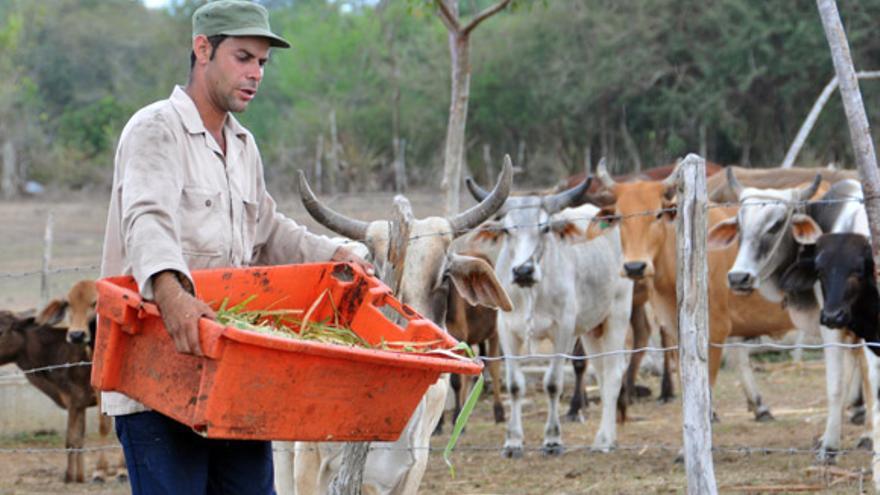
The authorities say that some farmers falsify the vaccine death certificates to keep the cattle. (Cubadebate)

14ymedio bigger14ymedio, Havana, 7 November 2023 — The authorities of Ciego de Ávila, overwhelmed by the low compliance of the entire agricultural sector which must report to the authorities, and have begun an active persecution against the farmers in charge of delivering milk and meat, two of the most demanded and disappeared products in the state market. At the end of September, the delivery of beef had barely been met 16.5% of the goals, and the province was short some 263,459 gallons of milk.

During the last session of the Provincial Council, the authorities scrutinized each of the agricultural and livestock sectors of the territory to verify what was already evident: the debacle in production has plunged the food industry into an increasingly serious crisis since 2018, the last year in which the numbers showed growth, and which is now the point of comparison for companies that are required to “multiply by two” their results.

Of the 43 branches of food production in the province, more than half (24) have not met their goals, the leaders admitted. The worst indicators are those of meat production, with 48,142 tons, 18,751 less than in 2022. continue reading

Meanwhile, rice production, with 264 tons, is 1,557 less than in the previous period, which translates into an 85% drop in production in just one year.

Of the 43 branches of food production in the province, more than half (24) have not met their goals, the leaders admitted

As for the most pressing issues – meat and milk – officials insist that part of the problem lies in the lack of control over producers and livestock, a “red mark” in the provincial indicators. The leaders stressed that it is important to pay attention to the falsification of vaccine death certificates and the disorder in the transfer of livestock, opportunities often taken advantage of by cattle rustlers and some farmers to subtract animals without suffering the consequences.

“In the livestock sector, 2024 will mean the return to practices that have weakened over the years; among them, the recovery of breeding and fattening pastures in state companies, with a view to guaranteeing greater deliveries of meat,” Leonardo Pérez, subdelegate of Livestock, promised. More attention will be paid to the municipalities with the greatest livestock potential: Chambas, Ciego de Ávila, Baraguá, Venezuela and Majagua.

As for the dairy industry, the numbers are not encouraging. So far this year, the province has produced 2.24 million gallons, a worrying figure compared to that of 2022, when 3.09 million were delivered.

To increase production, the authorities assured that by next February, when the next session of the Council is held, contracts with independent producers will have grown and artificial insemination will have been resumed in the province. An attempt will also be made to “support” the producers, they added, without specifying the type of assistance they will offer, to increase the current yield of .56 gallons of milk per cow per day.

For its part, the Dairy Products Company has no choice but to “diversify” its production

For its part, the Dairy Products Company has no choice but to “diversify” its production – with the little milk it has – in order to maintain profits without raising prices, said the officials of the entity without delving into the proposals for new products.

Another of the issues discussed in the Council, without the press giving it too much importance, was the budget designated to serve vulnerable families, and the fact that two months after the end of the year, barely 65% of it has been implemented.

The misuse of land and the lack of workers in all sectors of the food industry, including the managers’ commissions, were other  “weaknesses” discussed, which, according to the leaders, must be resolved urgently.

Like the rest of the provinces of the Island, Ciego de Ávila is going through a crisis that has especially affected the agricultural sector. This Monday, the official press reported that a dozen companies in the territory will close the year with losses. Of these, eight belong to this industry.

Translated by Regina Anavy

____________

COLLABORATE WITH OUR WORKThe 14ymedio team is committed to practicing serious journalism that reflects Cuba’s reality in all its depth. Thank you for joining us on this long journey. We invite you to continue supporting us by becoming a member of 14ymedio now. Together we can continue transforming journalism in Cuba.
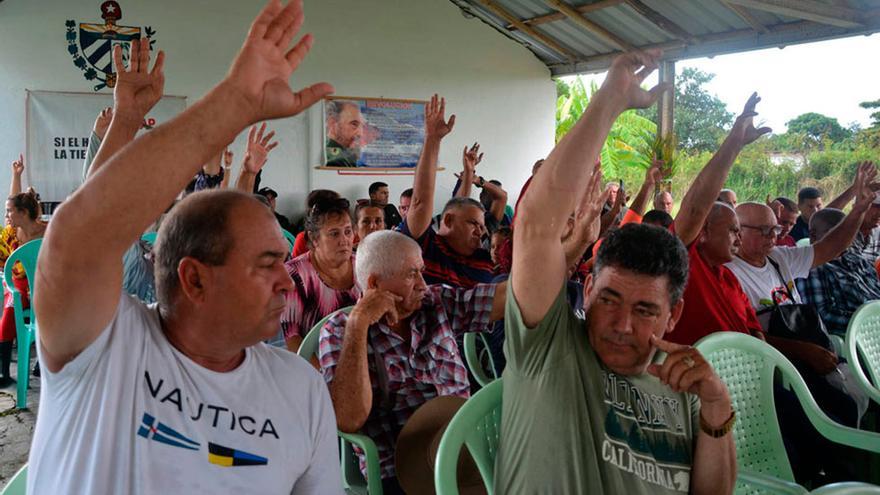
With Sad Faces, the Rice Growers of Villa Clara Give Up Their Share of the Basic Basket

The Villa Clara rice growers vote, unanimously, to give up their quota. (Vanguardia)

14ymedio bigger14ymedio, Havana, 7 November 2023 — The image of the rice growers of Villa Clara voting unanimously to give up the quota that corresponds to each of their families for the basic basket is not exactly that of happiness, but no one will be able to take away from them the praise they have earned from the regime, who thanked them for their “productive response.” The decision will allow 30 tons to go to a care center in the province, says the newspaper Vanguardia, thus guaranteeing that institution’s consumption for one year.

The generous donors belong to the Félix González Viego Political-Productive Movement, founded in May by 69 producers, 52 of whom were from Encrucijada and 13 of whom were from Sagua la Grande and Corralillo. This Sunday, the group held a meeting in the town of El Santo, reviewed the harvest and voted in favor of the donation, at a time when rice is scarce throughout the Island.

In Villa Clara there are 294,000 nuclear families registered, for each of which is planned, in addition to the regulated quota, an extra amount of five pounds at 90 pesos each. continue reading

The producers of the Félix González Viego Political-Productive Movement own almost 2,718 acres that have already produced 190 tons of rice

The producers of the Félix González Viego Political-Productive Movement own almost 2,718 acres that have already produced 190 tons of rice for sale through the libreta (ration book), according to the authorities of the Communist Party and the Government, present at the meeting. In addition, 425 tons have been harvested, and 1,159 more are expected by the end of the year, “a fact that contributes to the substitution for food imports and demonstrates the productive drive of the farmers,” the text states.

Generosity, however, does not cross borders, and other provinces will have to do what they can, since Alberto López Díaz, governor of Villa Clara, demanded that they “avoid rice flight” either “as a perk from machinery services or from unscrupulous hands that promote the speculative transfer of productions.”

Orlando Linares Morell, head of the Rice Technical Department at the Ministry of Agriculture, praised the optimal results being achieved in Villa Clara, despite the lack of funding. The situation could improve, however, if the land previously dedicated to the cultivation of sugar cane can be converted specifically for rice.

The official also asked that rice producers maintain the link with the government’s Azcuba centers dedicated to the production of biofertilizers and biopicides, and that they save water, which is essential for this crop. The greatest novelty came from the news that the transfer of state agricultural machinery to the growers is being studied, all this in order to separate themselves from the investments, according to the statements of Linares, who maintained that the growers “according to their income can import equipment from entities in the branch.”

For several years, families have been complaining that the amounts delivered to the bodegas (ration stores) are not enough to cover the month’s meals

At the meeting there were more calls to develop chemicals in the universities to allow improved yield, to increase planting areas and to achieve the self-sufficiency that the authorities announced for the province in 2020 and that is very far from being a reality.

The shortage of rice in Villa Clara, however, is nothing new. For several years, families have been complaining that the amount of rice delivered to the bodegas (ration stores) is not enough to cover the month’s meals, especially when it comes to the staple of any dish on the Island. According to the market prices documented by 14ymedio, the price for one pound of rice in the Mercado de Buen Viaje, in the center of Santa Clara, has reached 150 pesos.

The amount that the population is authorized buy there, however, is not available, so the largest informal sale is made through social media pages – at higher prices – such as Revolico, or by going to small illegal shops usually hidden in the slums of the city, such as El Condado, where the “fleeing” sacks that the authorities are in such great pursuit of end up.

Translated by Regina Anavy

____________

COLLABORATE WITH OUR WORKThe 14ymedio team is committed to practicing serious journalism that reflects Cuba’s reality in all its depth. Thank you for joining us on this long journey. We invite you to continue supporting us by becoming a member of 14ymedio now. Together we can continue transforming journalism in Cuba.

The Seven Cuban Athletes Who Escaped in Chile Will Be Able To Stay for up to 180 Days and Request Asylum

Six hockey players left the team in Chile. (Jit)

14ymedio bigger14ymedio, Havana, November 6, 2023 — The seven Cuban athletes who escaped in the Pan American Games have not yet gone to the Chilean authorities with any kind of request, but they are in the country legally. As the Undersecretary of the Interior, Manuel Monsalve, told La Tercera, both the hockey players Yunia Milanés, Jennifer Martínez, Yakira Guillén, Lismary González, Helec Carta and Geidy Morales and the hurdler Yoao Illas – who won a bronze medal – “have visas that allows them to be in Chile for 90 days.” Monsalve specified that the visas “can even be renewed for 90 more days” if the athletes require it, so deportation would be ruled out.

So far, none of the seven Cubans who left the delegation of the Island has approached the Chilean authorities, the Minister of Government spokesperson, Camila Vallejo, told the same media.

“None of these athletes has submitted any kind of request,” explained the official, who stressed that “if there is any request, it must be channeled through the relevant institutions, in this case, the National Migration Service”

Vallejo accepted that although there is concern in the case of escaped Cuban athletes, “it is not up to us to go over the procedures that are stipulated for this type of case.” continue reading

Meanwhile, the deputy of National Renewal, Diego Schalper, asked the Government of Gabriel Boric to grant them political asylum, which would show “a clear signal in defense of human rights and democracy,” in addition to the fact that Law 20,430 on refugees in Chile can be applied without any objection.

Yoao Illas won a bronze medal in the 400 meters with hurdles with a personal record of 49.74 seconds in the Pan American Games. (Jit)

The president of the Communist Party, Lautaro Carmona, blamed the US embargo for the abandonment of athletes on the Island. “Who creates those conditions, if not the economic blockade that is criminal with respect to health, education and has an effect on sports, in art, on dance?” he asked Bio Bio Chile.

Cuba won 30 gold, 21 silver and 17 bronze medals for a total of 68, which keeps them in fifth place, surpassed by Canada, Mexico, Brazil and the United States. However, it had a lower mark than that achieved four years ago, when it achieved 100 metals in the Pan American Games of Lima (2019) and 97 in Toronto (2015), where it already had its worst results in more than two decades, after reaching 265 in Havana (1991) and 238 in Mar del Plata (1995).

The departures of the hockey players and the hurdler only confirm the nightmare that weighs on Cuban sport. This decline is linked to the deep crisis in which the Island is immersed, which complicates the preparation of athletes. Journalist Francys Romero counted 61 athletes who have abandoned contracts or delegations during 2023.

Cuban baseball failed again. It reached the group stage for the second time in a row. The Island’s only victory was against Colombia, with a score of 4-3. It was followed by three consecutive games with defeats by Venezuela, Brazil and the Dominican Republic, causing an unexpected debacle.

The sport considered a cultural heritage has not won gold in the Pan American Games since Rio de Janeiro in 2007.

Translated by Regina Anavy

____________

COLLABORATE WITH OUR WORKThe 14ymedio team is committed to practicing serious journalism that reflects Cuba’s reality in all its depth. Thank you for joining us on this long journey. We invite you to continue supporting us by becoming a member of 14ymedio now. Together we can continue transforming journalism in Cuba.

Camaguey Takes the First Step Towards the Return of Private-Sector Cinemas in Cuba

The old Encanto Cinema, located on Camagüey’s Callejón de los Milagros, will be accepting development proposals until November 15. (Adelante)

14ymedio bigger14ymedio, Madrid, November 1, 2023 — A brief announcement in a provincial newspaper indicates a ten-year-old ban on privately run cinemas is being lifted. Makeshift theaters showing 3D movies and run by private individuals had been proliferating on the island when the government shut them down.

The only certainty leaves no room for doubt. The Provincial Cinema Center of Camagüey has solicited bids for the interior of the old Encanto Cinema, located at 410 Ignacio Agramonte Street, in the provincial capital. The news appeared in the official publication Adelante, which outlines the requirements.

“The institution invites artists living in the region and local developers to present proposals for socio-cultural entertainment projects with film screenings as their main focus,” notes the director, Yenisley Sáez de Flores. Interested parties must include an image of their proposed design and a continue reading

breakdown of estimated investment costs. They may visit the property prior to submitting their proposals. The submission deadline is November 15.

Repairs being made to Havana’s La Rampa Cinema in Havana in October. (14ymedio)

Sáez de Flores adds that the invitation represents “an opportunity to showcase a space in line with our public policy of greater citizen participation in the strategy of promoting audiovisual culture.” Though she does not mention it, the project comes with an array of potentially profitable storefronts and, ultimately, the chance to oversee programming.

There is no indication that any of the hundreds of Cuban cinemas that have closed or have struggled in recent decades have solicited similar bids. However, the news has raised hopes that similar policies will begin to be adopted throughout the country in order to revive, through private management, theaters that were once a window to the world for its citizens.

Paradoxically, however, that is not the case with the structure itself. Since late 2013, the Encanto theater has housed a self-managed, self-financed project known as El Circuito (The Circuit), which hosted several cultural events, most importantly the Camagüey International Video Arts Festival (FIVAC).

The Encanto opened on February 24, 1934 in a 19th century building that had housed everything from a grocery store to a photography studio to several other businesses. The Camagüey historian Marcos Tamames attributes this remodel to the architect Francisco Herrero Morató, and its later incarnation as the Cinematographic and Variety Hall to the theater entrepreneurs Castillo, Barillas and Cía. After years of success, the establishment was remodeled in 1955, doubling its capacity and placing a marquee on its façade that was considered, at that time, one of the most elegant in the country.

The Revolution brought decline, both to the property and its programming. Nevertheless, it  managed to survive for years, offering an entertainment venue to the people of Camagüey until its closure, which left large areas of the premises empty. In November 2023 the government of Raúl Castro ordered the cessation of film screenings “in any type of private-sector venue.” At the same time, a group of young people and artists were given permission to use the premises to host El Circuito, which has since been a refuge for alternative art in the city.

After years of success, the building was remodeled in 1955, doubling its capacity and adding to its facade what was then considered one of the most elegant marquees in the country

It was announced in August that the building was closing for repairs and staff vacations but that FIVAC, which celebrated its tenth anniversary in November, would go on. Last Tuesday, however, its director and founder, Diana Rosa Pérez, announced the end of El Circuito. In a Facebook post, she expressed both gratitude and regret in equal measure.

“We chose this image from the beginning, from when we took over the building, to develop our project because everything that happened after that was real magic and love. El Circuito is ending but we are also satisfied to have left here, in our city, a space with so many possiblities for the public, for other projects,” she wrote.

Pérez acknowledges that El Circuito, which does not receive state funding, could not continue operating under current conditions but adds that there is more than one answer to the question of why it is shutting down. “It’s like the other questions making the rounds in Cuba right now, which are more painful than this closure. Why are young people leaving? Why is leaving the only thing people talk about? Why is life so expensive and difficult? Why are we not allowed to talk about it? About pain and hunger? Why the blindness? Why… ?”

Among the dozens of posts lamenting the sudden closure, there was one asking about the possibility of renting the space. “We have no idea but it’s good that you ask,” they said. The response came just seven days later when the request for bids was announced.

Renovation work on the cafe of Havana’s Yara theater as of November 1. (14ymedio)

The question now is whether the practice of reviving other cinemas by turning to this alternative form of management will become widespread. In recent weeks, Havana’s Rampa Cinema in the Vedado district has been undergoing renovations. Scaffolding covers its façade and the roof over the entrance, which had been falling down, has been repaired.

The building has been closed for several months. Rumor has it that, when it reopens, it will be under private management, which would confirm that officials have opted for the new approach. This is a very different situation from that of the Yara (whose cafe is being remodeled), the Chaplin, and the 23 y 12 cinemas.

Due to the current energy crisis, these theaters have greatly reduced their schedules during the period leading up to the Havana Film Festival, which runs from December 8 to 17. Also endangered are such internationally popular events as the Fábrica de Arte Cubano (FAC), which refuses to comply with the energy conservation measures and will continue to rely on its generators and any light its attendees can provide.

Cinemas, by contrast, do have have the same characteristics. Until 1959 Havana was one of the world capitals of film, with more theaters than New York or Paris. Only Buenos Aires had more. In 1955 there were some 600 movie houses in the country, 147 for a populaion of under a million.

Dirty and aging venues, programming that — even when worthwhile — cannot be screened properly due to lack of resources, and pirated copies do little to lure back an audience that has developed new ways of consuming visual media and has lost the desire to do it in theaters. As long as they don’t offer you something better.

____________

COLLABORATE WITH OUR WORKThe 14ymedio team is committed to practicing serious journalism that reflects Cuba’s reality in all its depth. Thank you for joining us on this long journey. We invite you to continue supporting us by becoming a member of 14ymedio now. Together we can continue transforming journalism in Cuba.

‘A Sad Sunday for the Revolutionary Proletariat in Cuba’ With Blackouts of up to 12 Hours

Apagones en Cuba. (EFE)
Blackouts in Cuba (EFE)

14ymedio bigger14ymedio, Madrid, 6 November 2023 — The population has not yet felt the return of the Antonio Guiteras thermoelectric plant, located In Matanzas, which had a three-day break for scheduled maintenance after its last breakdown a month and a half ago and was synchronized again with the National Electricity System (SEN) this Sunday, after a new agonizing day of blackouts in most provinces, with a deficit of 900 MW.

The Electric Union (UNE) had announced for Saturday the lack of almost 400 MW in the peak hour that, finally, increased by more than 500 MW. For Sunday, 544 MW of deficit had been foreseen, so the official journalist Lázaro Manuel Alonso considered the reinstatement of the plant “in the midst of such a complex and annoying situation” as “good news.”

Alonso’s explanations for a Saturday in which the population reported a lack of electricity of up to 12 hours were “the problems with the fuel” that Cuba President Miguel Díaz-Canel had overcome a few days ago, “the departure of several units for maintenance and the incomplete continue reading

incorporation of the CTE Antonio Guiteras.” The Matanzas plant, the largest in the country and one of the oldest (1988), stopped on September 17, after suffering two breaks in the boiler in a week, just at the end of the G-77 plus China summit that was held in Havana. Since then it had been subjected to the umpteenth batch of repairs of the year.

On Saturday, an attempt was made to connect without success, since after 11 pm, said Radio Rebelde journalist José Miguel Solís, “a failure in the boiler,” again motivated its departure

On Saturday, an attempt was made to connect without success, since, after 11 pm, said Radio Rebelde journalist José Miguel Solís, “a failure in the boiler,” again motivated its departure. “They tell us that the pressure switch failed,” Solís reported, attributing the infernal Saturday to the seven plants that are outside the system “between breakdowns and maintenance, plus the distributed generation with little availability of fuel” (diesel and fuel oil).

Solís, who lives in Matanzas, celebrated on Sunday night when the Guiteras finally reached the 274 MW of generation that could alleviate the situation if it continues, but his triumphant tone was not shared by all his followers. “I would think very hard about your news. I’m sorry to see that on a Sunday the power cut off every three hours, after a dark week,” complained one user.

Some, on the other hand, celebrated the reinstatement of the plant, at least for a day, but not without making clear the exceptionality of the situation. “Bravo, it shows. My power didn’t go out tonight, a miracle,” one said ironically, with laughing emoticons. Another remarked, “This has been a very long Sunday. I woke up without power for four hours. At 1:00 in the afternoon they removed it until 7:30. Terrible. Other times Guiteras breaks and there is not as much impact. Are we out of oil again?” asked another.

Havana was one of the few provinces that was spared from the eternal blackouts this weekend, once again. In some provinces, such as Sancti Spíritus, the situation was unsustainable, with nine-hour cuts reported in Cabaiguán, while from Puerto Padre, Las Tunas, there was talk of five hours without power.

In the eastern area, the situation was worse. The 14ymedio correspondent in Holguín reported this Saturday about two cuts that totaled 12 hours. “Last night they shut off the power from 12 to 6 in the morning, and they shut it off again at 12 noon until 6 in the afternoon, that is, 12 hours today without power. To that, add that when the current goes, the [Internet] connection also drops,” he explained.

UNE’s social networks had no respite throughout the weekend, in the midst of a widespread loss of patience in the population. “Eight hours with light in 24 hours, good record,” one reproached. “The problem is that they remove it in the same place. Here last night it was from 10 pm to 3 am. You can imagine that I couldn’t sleep. Today I’m getting ready to wash and boom! It wasn’t even 9 am and they put it back on at 3:12 pm. What a life that’s not a life!” lamented a commentator from Cienfuegos.

Last week, Lázaro Guerra Hernández, technical director of the UNE, celebrated the respite experienced by the Cubans in October, but warned of the possibility of a more complicated November by “maintenance actions in important generating units,” at that time the Guiteras and then the Felton, in Holguín, which will be shut down for ten days.

“If they know that there is no fuel, the Guiteras is out and there are several thermoelectric plants under maintenance, how are they going to shut down more plants for maintenance with the situation as it is? Couldn’t they foresee this?

Guerra Hernández said that the Government obtained resources for maintenance and was very satisfied, since Energás and several units – in Mariel, Santa Cruz and Nuevitas – were properly going through the process. “We have managed to maintain thermal generation above 1,200 MW. We had difficulties with the supply of fuel at the beginning of October, but that situation improved in the second half. As for the distributed generation, it has had a positive performance considering the resources we have.”

The director added that the goal is to arrive at better conditions in December, but the first results of this weekend have made citizens see the flaws of the plan. “If they know that there is no fuel, the Guiteras is out and there are several thermoelectric plants under maintenance, how are they going to shut down more plants for maintenance with the situation as it is? Couldn’t they foresee this, and do those maintenance “deadlines” happen step by step? If they didn’t manage them before, why do they think they can do it now? The people are already at their wits’ end. Don’t you care about them? Or is this just another way to hide that the problem with fuel is even worse than before?” asked a user, fed up with the UNE.

In fewer words, another summed up the state of things on the Island. “What a sad Sunday for the revolutionary proletariat.”

Translated by Regina Anavy

____________

COLLABORATE WITH OUR WORKThe 14ymedio team is committed to practicing serious journalism that reflects Cuba’s reality in all its depth. Thank you for joining us on this long journey. We invite you to continue supporting us by becoming a member of 14ymedio now. Together we can continue transforming journalism in Cuba.

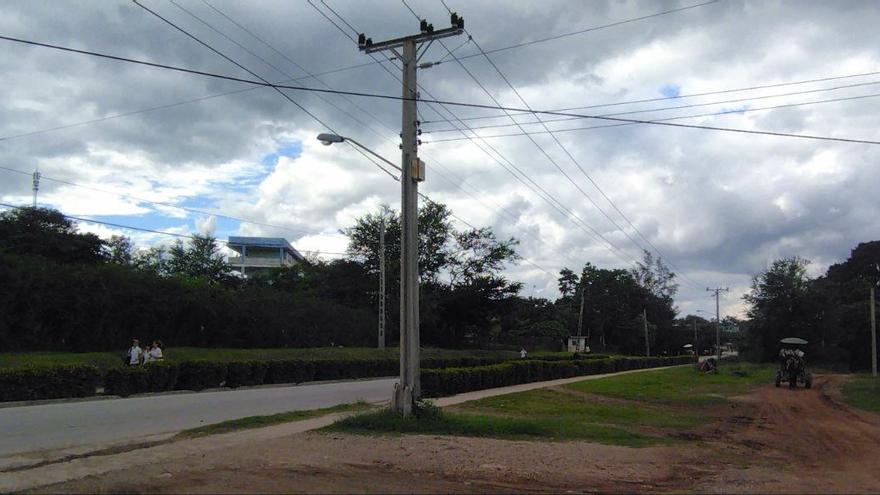
An Electricity Pole Miraculously Still Standing Threatens Drivers and Pedestrians in Holguin

The post has been left in disrepair for six years, despite the danger it poses. (14ymedio)

14ymedio bigger14ymedio, Miguel García, Holguín, 31 October 2023 – Six years ago, a wagon crashed into an electricity pole on the road the leads to Valle de Mayabe in Holguín. The base of the structure was fractured and the rest of it remained, and remains, in a precarious condition, held up only by luck, and by the cables above it. Countless reports to Unión Eléctrica (UNE) have prompted hardly any visits by technicians and the concrete and steel giant remains broken. There is a constant mortal danger posed to the vehicles and pedestrians which pass below.

The pole – which is only metres away from a bus stop where workers and even local schoolchildren congregate – is a target for residents’ complaints. “This has been the topic of discussion in many many meetings”, Niubis, a local resident told this newspaper. “On one occasion we did have a visit from an Electricity Company rep but all he said was that it didn’t pose any danger because the cables – which are High Voltage! – were stopping it from crashing down!”

The residents didn’t believe the official view. “How can they say it’s all ok? These poles aren’t designed to be supported from above, they need to have a continue reading

solid base”, says the woman. “Many people use this pathway to get to their appointments”, she says, in reference to patients of the nearby Holguín Clinical Surgery Hospital, and adds that there are also people on their way to the affiliated Arístides Estevez Infirmary.

“To watch them, they’re not really aware of the danger. But when someone gets close to it they realise that no part of it is actually fixed into the ground: it has no foundations”, explains Nuibis, and she blames this danger on the apathy of the authorities. “If it were leaning more, or broken higher up maybe our complaint would go further, but as everything around here is always just a question of cosmetics, of optics, the only thing that matters to them is that it looks ok should Díaz-Canel pass by”.

From a distance, the danger doesn’t seem as great as when it’s seen close up. (14ymedio)

“No sooner than another vehicle happens to to give it a nudge, or another cyclone arrives, it’ll come straight down to the ground”, says a local seller of juice and soft drinks. “They haven’t replaced it because they don’t want to. Hundreds of people pass through here every day and they’re risking their lives everytime they get near this pole”. The man believes they’ve deliberately conspired to blame their negligence on the current fuel shortage, which, so often, officials use as a justification for not carrying out necessary repairs.

UNE also alludes to problems in getting hold of new electricity poles, given that production of these items was halted for more than two years in parts of the country. A lack of specialist labour also contributed to the deterioration in maintenance carried out by the state electricity monopoly. The exodus of trained linesmen has grown in recent months – they earn less than 10,000 pesos a month, including the additional ’danger’ payments.

It’s got to a point where locals and regular passers by are just praying that there won’t be a cyclone to bring down the battered pole – or failing that, that some ’illustrious’ visitor is due to pass by, thus obliging them to replace it. For the time being though, it remains a simple question of survival by keeping a careful eye on it and avoiding it as much as possible when travelling on the road to Valle de Mayabe.

Translated by Ricardo Recluso

____________

COLLABORATE WITH OUR WORKThe 14ymedio team is committed to practicing serious journalism that reflects Cuba’s reality in all its depth. Thank you for joining us on this long journey. We invite you to continue supporting us by becoming a member of 14ymedio now. Together we can continue transforming journalism in Cuba.
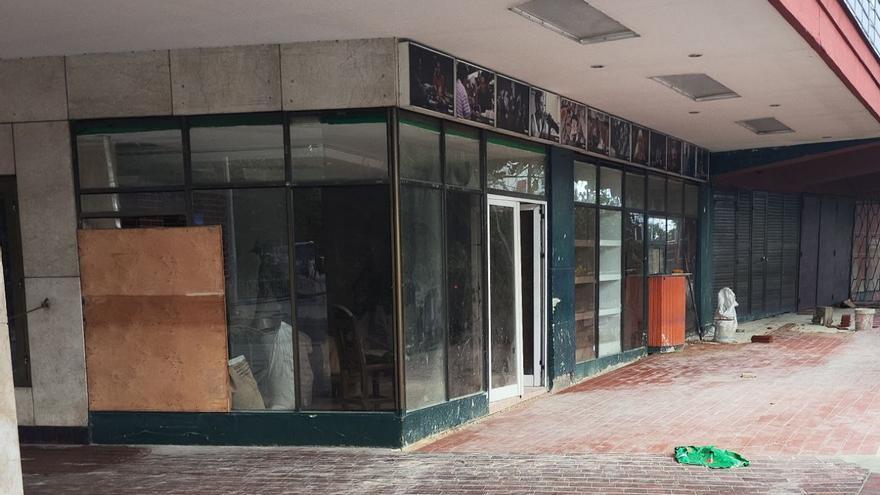
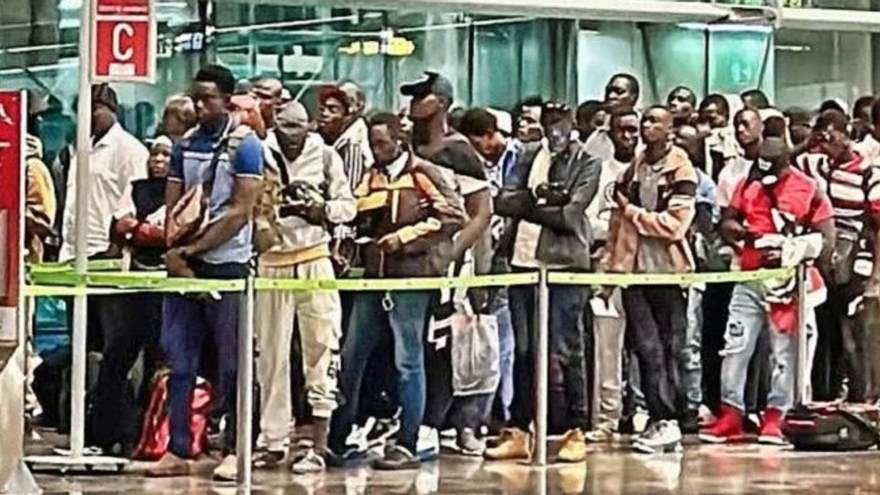
Nicaragua Facilitates the Passage of Thousands of Migrants From All Over the World as a Weapon Against the United States

Flights to Nicaragua have recently been saturated with Africans seeking to emigrate to the United States.

14ymedio bigger14ymedio, Madrid, 6 November 2023 —  There is no record of the passage of migrants through Nicaragua who continue to the United States, as published on Monday by the newspaper La Prensa, to which a source from the General Directorate of Migration and Aliens (DGME) affirms that passports are not being stamped at the airport so that, “when they arrive in the United States, they cannot see that they passed through Nicaragua.”

In exchange, they are charged a fee of between 150 and 200 dollars that, on an ordinary day, according to the same source, totals about 63,000 dollars. “The amount of money that is entering the regime in cash is astronomical, continue reading

and it is not for the Treasury of the Republic because it’s not given or received,” he says.

The Nicaraguan opposition media today provides more data on the management of the migratory movement, which Daniel Ortega’s regime has turned into a lucrative economic and political business, since it manages to make the United States uncomfortable by facilitating access to its borders for Latin American citizens and, also, Africans and Eastern European citizens. Washington is concerned, according to the report, about the possible arrival of people linked to terrorism from some of these countries.

They are charged between 150 and 200 dollars that, on an ordinary day, according to the same source, totals about 63,000 dollars

At the same time, it is not clear where the amount that is paid per migrant goes, which, according to La Prensa source, the Customs officials themselves charge at their discretion. “The corruption is unrestrained,” he says. According to his calculations, on commercial flights there are about 600 seats available per day, of which 70% (420 people) are migrants. “Plus charter flights, which we know have been up to 28 some days,” he says.

Migrants arrive mainly through Aruba, Haiti or the Dominican Republic, although there are other more unusual origins that are becoming frequent, such as Bulgaria, from where there were five flights last week suspected of bringing citizens of the former Asian republics of the USSR.

“Seventy or 80 percent of the people on each Avianca commercial flight with the San Salvador-Managua route are occupied by people from Africa,” adds the La Prensa source. Since last October 23, the Government of Nayib Bukele charges a fee of 1,000 dollars to migrants of 57 nationalities – African and Indian – who pass through the airport of the capital.

As a result of that excess demand, Avianca has even had to restrict routes from some parts of Latin America and Africa to Managua, as the company itself revealed on its social networks.

“Flights have filled quickly, leaving passengers from the Nicaraguan diaspora and tourists who make connections from Central America, Spain and South America without seat availability, especially those who use El Salvador airport as a connection point,” said Aviación de Nicaragua. The suspension is temporary and has been carried out in agreement with the International Air Transport Association (IATA).

The tourism sector says that the measure seeks to “protect regulars who travel in the high season at the end of the year; migration does not leave foreign exchange in Nicaragua, like tourism and the nostalgia market do

The tourism sector says that the measure seeks to “protect regulars who travel in the high season at the end of the year; migration does not leave foreign exchange in Nicaragua, like tourism and the nostalgia market do -above all, the intangible element of the family reunion.” Once these dates have passed, Avianca foresees the implementation of a rate similar to the Salvadoran one, which would affect, in the same way, specific countries. “That tax can be generated by profiling each passenger from those countries upon arrival, just as Panama has been doing for a month,” a businessman told the local press, asking for patience and calm.

The direct route to Miami is not among those affected, but the connections in San Salvador or Guatemala City are blocked. Avianca still maintains flights from San José (Costa Rica) and Panamá.

Haiti is also among the countries that have suspended charter flights to Nicaragua due to the huge migratory flow, and it is said in Port-au-Prince that it was at the request of the United States to stop the flow of migrants to its territory. “There are great concerns about security, comfort, logistics. There is a lot of disorder at the moment. The aviation sector and disorder don’t get along well. It can cause numerous accidents. We have to reorganize,” said Laurent Joseph Dumas, director of Civil Aviation, in an interview with the local press in Port-au-Prince.

Between August and October 2023 alone, 31,475 passengers arrived in Managua from Haiti on board 268 flights, said Manuel Orozco, director of the Migration, Remittances and Development program of the Inter-American Dialogue based in Washington, a few days ago. In his opinion, Ortega “is selling Managua airport as a bridge to Haitians en route to the United States.”

Other analysts maintain the same thesis on the use of migration as a weapon against Washington. “Do anything that affects the United States. It is definitely aimed at creating pressure or politicizing it against the United States because it is an extremely controversial and delicate issue for Americans,” argued Juan Sebastián Chamorro.

Eliseo Núñez, political analyst, recalls that the technique has also been used by Belarus on its border with Poland

Eliseo Núñez, political analyst, recalls that the technique has also been used by Belarus on its border with Poland. “While the United States was not messing with him, Ortega provided services to stop migration, drug trafficking and anything having to do with terrorism,” he says. The expert recalls the crisis of 2015, when almost 2,000 Cubans crossing the border were detained on the border with Costa Rica, causing one of the most serious crises of the last decade. The agglomeration reached approximately 8,000 people and required the coordinated response of several Central American countries to circumvent Nicaragua.

Things changed when, in 2017, after protests that began a repression was unleashed against protesters and the opposition, which led the United States to take measures against the regime, Ortega decided to resort to the migratory weapon.

La Prensa quotes a former diplomat who says, under anonymity, that Ortega takes advantage of the migrants’ needs to take money from them. “One hundred fifty dollars per migrant is a lot of money, and that is also charged to those who come from the south, from Costa Rica, and those who enter by land. It’s not just those at the airport,” he says.

Translated by Regina Anavy 

____________

COLLABORATE WITH OUR WORKThe 14ymedio team is committed to practicing serious journalism that reflects Cuba’s reality in all its depth. Thank you for joining us on this long journey. We invite you to continue supporting us by becoming a member of 14ymedio now. Together we can continue transforming journalism in Cuba.
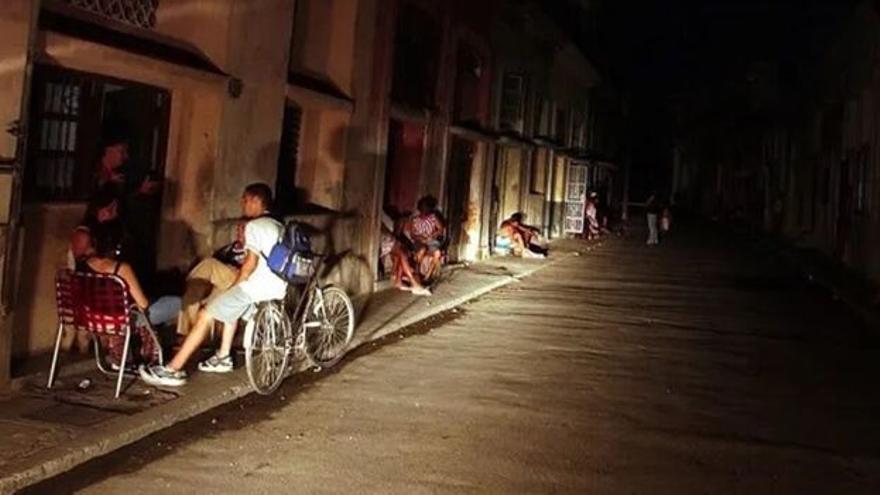
The Regime Is Determined To Fail With Foreign Investment

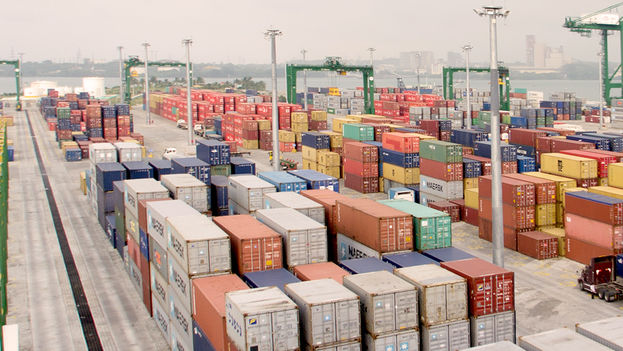
Container terminal at Mariel Special Development Zone. (Zedmariel.com)

14ymedio bigger 14ymedio, Elias Amor Bravo, Economist, November 5, 2023 — One of the main failures of Raúl’s reforms of the Cuban economy has been foreign investment. Unreservedly. Those plans that came with the infamous Law 118 that meant a controlled opening of the Cuban economy to international capital have been very far from the objectives initially set. Of the 3 billion dollars per year that the international capital regime intended to achieve to balance the commercial accounts with the foreign, what has really happened is that in almost a decade (which will end next year), less than those 3 billion has been achieved in cumulative terms. The landscape of the internationalization of the Cuban economy remains the same as it was before Law 118 in 2014.

However, the regime continues to try to attract foreign investment, and to that end, it organizes international fairs, such as the XXXIX International Fair of Havana that is happening now, to see if any business project will work, as if it were a raffle or a lottery in which they do not even buy the number.

In addition to the fanfare and the artistic touches, whose funds must be continue reading

difficult to mobilize given the budgetary tightness of the regime, the top leaders are committed and spare no expense for the event.

What is there to say, or not, about the event attended by Raúl Castro and Díaz-Canel to celebrate the tenth anniversary of the Mariel Special Development Zone? What is there to celebrate about this project, originally Brazilian and apparently abandoned to its fate?

It is a broken toy that no one wants, from which great business and opportunities were expected but which is still there without knowing why

The presence of the “retired” Raúl Castro at the event conveys a top-level political message, and in the presence of Díaz-Canel, along with a plethora
of party and government leaders, confirms what is already known. It is a broken toy that no one wants, from which great business and opportunities were expected but which is still there without knowing why.

So, to commemorate the ten years of validity of the Mariel project, the leaders organized a “political-cultural act” with no explanation about its relationship to foreign investment, which generally doesn’t pay attention to this type of thing, and if not, ask the Russians who continue to pressure the regime to give a push to that institutional economic framework that prevents the viability of businesses on the Island.

The Mariel ended up being a product of internal consumption of the regime, with a “a recognition for the work deployed by the entire collective of workers of the Mariel”: in total, 13 groups and 15 workers, representing the 1,161 founders who as of today continue to work in the Zone. Even Ulises Guilarte had his protagonist in the act, with the delivery to the Office of the Special Zone the 80th Anniversary Seal of the Workers’ Central Union of Cuba (CTC).

And then some economic data, as if they counted. Since the inauguration of the container terminal, which continues to be the main activity of Mariel, it was reported that 64 businesses have been achieved as of today, something like six per year. It’s not bad, if you think of the inefficient machinery that takes care of the viability of those projects and the complex conditions to pass the innumerable tests that the regime establishes.

It should be noted that there are only 64 projects in a decade with a very limited impact, practically zero

It should be noted that there are only 64 projects in a decade with a very limited impact, practically zero, on the strategic sectors of the national economy and its development. In other words, a counter-invoice analysis of the Mariel would allow us to conclude that in the absence of this pharaonic project in the area, the number of foreign investment projects that would arrive in Cuba would be more or less the same, or even more. The efficiency of spending leaves much to be desired, confirming that absolute failure of foreign investment policy in the Cuban communist system.

Highlight here, for example, that other communist countries, such as Vietnam, perfectly understood what had to be done to attract foreign capital to the country, which has been one of the factors of modernization after the Doi Moi reforms. And Vietnam, far from getting into trouble with “Mariels” and other communist nonsense, accepted the rules of the World Trade Organization and became part of the concert of nations of globalization. The Cuban communist regime is incapable of this type of strategic decision and continues to play cat and mouse with foreign businessmen.

Therefore, next week when the International Fair is inaugurated and with it the VI Foreign Investment Forum, the same thing will happen again as in previous editions, which is nothing other than those interested in investing in Cuba will return to their countries seeing that the company is unfeasible or has unaffordable costs. And someone will wonder about that direct rejection of the communist bureaucracy by foreign investors. The Russians have already said it on several occasions, but it’s good to remember why.

No businessperson, owner of their own money, who responds to a board of directors, likes that their project in Cuba has to be aligned or submitted or adapted to two instruments that are not understood, but that oblige and condition their activity, which are called the  “national plan for economic and social development until 2030,” and the “portfolio of foreign investment opportunities.” With these two instruments, the Cuban communist economy extends its tentacles towards the international investor. It is true that some accept it, and that’s how it goes; fortunately, most of them listen to the advice of international consultancies that warn of the risk of submitting themselves to the communist system.

At the fair they say that they will carry out theoretical activities, of little practical depth, such as the “panel on Cuban exports to be promoted with and from foreign investment,” in which “they will discuss exploration for potential investors; advice and workshops on access to the Japanese market, and support for the productive pole of Guantánamo.” It remains to be seen how many Japanese investors will stay in Cuba and, above all, how many private actors will participate in this type of agreement. At the moment, the foreign investment space in Cuba is open only to the state sector.

Another panel will refer to “industrial capacities with development potential with foreign participation” to promote business opportunities with foreign capital based on the installed industrial capacities, with reference to the portfolio of opportunities of the sectors of Industry, Food and Domestic trade.

What do you think will come out of all this political business bartering? The answer is nothing. Well, yes. The only thing that will remain is a hole in the public accounts of the regime because this type of pageantry has to be paid for by someone. And the bad thing is that Cuba is not ready for this. Cuba will continue to suffer by not receiving the necessary foreign capital that could help modernize the country and meet the needs of the population, but the regime’s strategy and its policy of parties and celebrations has not worked, nor will it. An average of six projects a year in the Mariel doesn’t justify any of this. They need to change and make a 180º turn.

Translated by Regina Anavy

____________

COLLABORATE WITH OUR WORKThe 14ymedio team is committed to practicing serious journalism that reflects Cuba’s reality in all its depth. Thank you for joining us on this long journey. We invite you to continue supporting us by becoming a member of 14ymedio now. Together we can continue transforming journalism in Cuba.
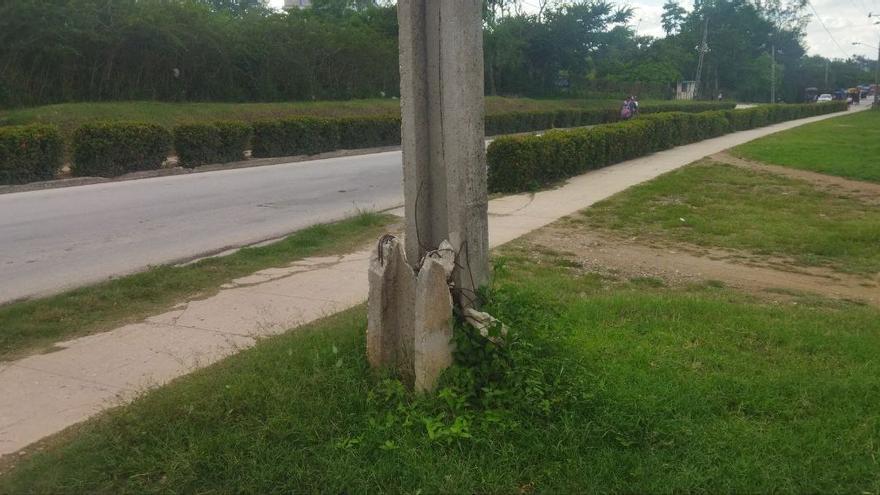
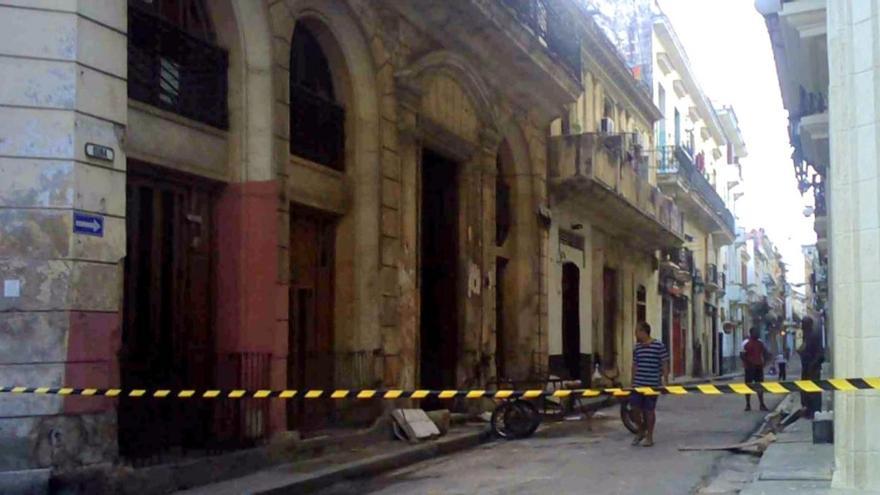
A Partial Collapse on Cuba Street Affects Dozens of Families in a Tenement in Havana

Yellow and black tape closed off the block where part of a tenement building collapsed. (14ymedio)

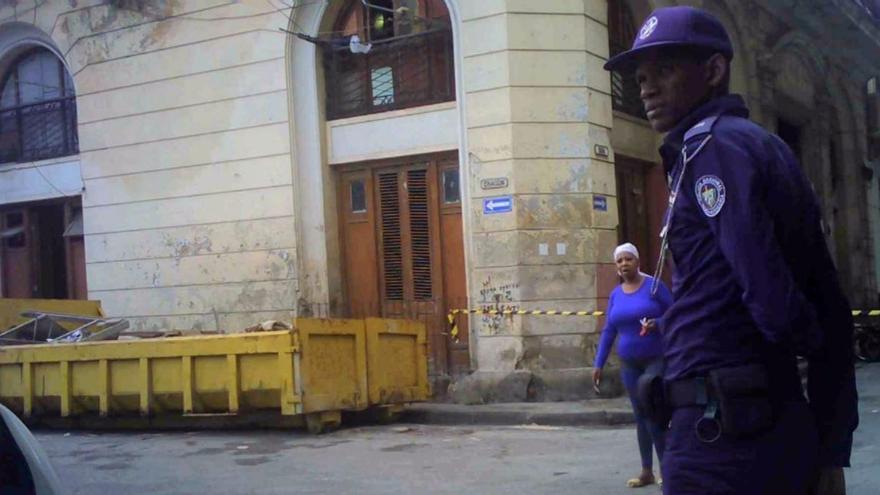
14ymedio bigger 14ymedio, Juan Diego Rodríguez, Havana, 5 November 2023 —  This Sunday morning, the damage caused by the partial collapse that affected the property at number 103 Cuba Street, between Tacón and Tejadillo, in Old Havana, was visible to all. Yellow and black tape closed off the block where the tenement building fell in without any loss of human life.

The quarters, with two floors and a large central patio, are inhabited by dozens of families who sought shelter outside the building due to fear of other possible collapses. In the area, visibly guarded by uniformed and plainclothes police, the dust and debris from the collapse mixed with the mud caused by the rains of recent days.

“When we saw that it was raining and raining, we feared the worst because when four drops fall in this city, everyone knows what happens,” said resident of the block where the partial collapse of the right wing of the building occurred, speaking to 14ymedio. “Although the side doesn’t look so bad, when you stand in front and look inside you realize that this place is uninhabitable, it is a danger to life.”

The side the resident is talking about faces directly on to the Police station at Cuba and Chacón streets, a castle-shaped construction that mimics colonial architecture. The area, widely visited by tourists, also has a large concentration of hostels, cafes and private restaurants aimed primarily at foreign pockets. continue reading

“When we saw that it was raining and raining we feared the worst because when four drops fall in this city everyone knows what happens”

In the midst of this image of prosperity and entrepreneurship, the partially collapsed tenement building on Cuba Street houses low-income families and over the decades it has suffered deterioration and internal transformations to optimize every square meter. So-called barbacoas [barbecues] — a kind of horizontal platform — are built to create extra ‘floor space’ between the floor and ceiling in some rooms; doors open onto a load-bearing wall; and boarded up windows are some of these changes.

The deterioration of the entire property, together with the humidity that has made the structure even more fragile these days, have been decisive for what happened this Saturday. On Sunday state brigade was trying to remove the debris accumulated inside and collapse the parts that represent the most danger. The families residing in the tenement do not yet know if they will all be able to return.

In the area, visibly guarded by uniformed and plainclothes police, the dust and debris from the collapse mixes with the mud caused by the rains of recent days. (14ymedio)

Two days before the collapse, a family that lives there had sent a video [see below] to journalist Mario Pentón to warn about the danger they were in due to the poor condition of the building. After the collapse, other residents sent the América TeVé reporter some materials where they recorded what they experienced. At one point one of the affected people is heard saying: “The delegate said that this was not going to fall and she sees how it is falling,” referring to the representative of the Popular Power who serves that area of ​​Old Havana.

The drama of these neighbors is repeated beyond that particular building. In June 2021, the Government approved the General Urban Planning Plan of Havana for 2030. The full text gave a detailed account of the pitiful situation of the capital, proposed a long list of solutions and actions, and finished with impossible budgets. Its status, two years and several collapses later, is alarming.

The document specifies, first of all, the state of Havana in all areas of urban planning, from green areas, sanitation, public transportation and, as a priority, housing. The section dedicated to Old Havana presents an overwhelming fact: more than 40% of the more than 20,000 homes identified in that area did not meet minimum habitability conditions.

The families residing in the block do not yet know if all of them will be able to return

Overall, the problem was summarized as follows: “High rate of collapses, mainly in the central areas of the city. Housed: 449 facilities, with 5,471 nuclear families (17,314 people). In critical condition: 946 properties, with 8,329 homes and 26,151 inhabitants. Tenements: 6,899 properties, with 60,170 nuclear families. 82 neighborhoods and 69 precarious centers, with 18,721 and 1,923 homes respectively, concentrated mostly in Boyeros, Guanabacoa, Arroyo Naranjo and San Miguel del Padrón. Changes of use for housing in “inadequate” premises.

To alleviate this situation, there were two main approaches: new construction for the outer ring areas, and comprehensive rehabilitation for the center, starting with Centro Habana, Cerro, Plaza and Old Havana, municipalities designated as degraded. From the first years, work had to continue in the area, including the recovery of 60% of the buildings in fair and poor technical condition, and prioritizing 12 blocks of the historic center (two of them in Old Havana).

The recommendations contained in that document were not put into practice. According to the 2022 Statistical Yearbook, the Government invested 3.226 billion pesos in hotels and 23.360 billion pesos in business and real estate services and rental (a section of diffuse content, which includes the construction of hotels). Meanwhile, 1.4% of the general state budget, 1.016 billion pesos, was allocated to housing construction. A minimal amount, which explains many of the tragedies that will continue to occur in Havana and other cities on the Island.

“Less than 48 hours ago a Cuban family sent me a video of the conditions in their building at #103 Cuba at Chacon and Tejadilla. Today, in the early hours the building collapsed. The neighbors tell me there are several injuries but thanks be to God there are no fatalities.”

____________

COLLABORATE WITH OUR WORKThe 14ymedio team is committed to practicing serious journalism that reflects Cuba’s reality in all its depth. Thank you for joining us on this long journey. We invite you to continue supporting us by becoming a member of 14ymedio now. Together we can continue transforming journalism in Cuba.
‘A Complete Skeleton for a Religious Ritual Costs Between 10,000 and 12,000 Cuban Pesos’

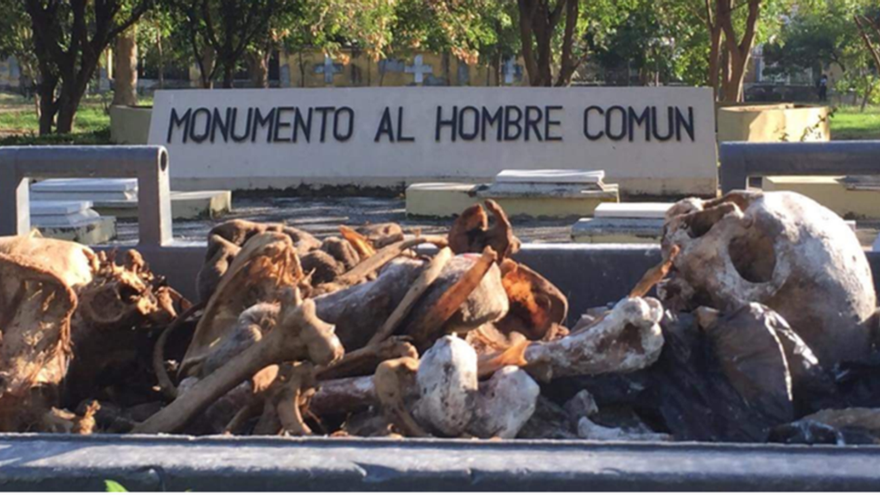
“Monument to the Common Man”: human remains in the Cementario de Colón in Havana. (Radio Television Martí/Archive)

14ymedio bigger14ymedio, Nelson García/Juan Izquierdo, Havana, 5 November 2023 — The Cuban police only respect one religion: Palo Monte. The hermetic world of its rituals, its sorcerers and cauldrons, its fragmentary language – the kikongo – with which they pronounce incantions and curses, have made it since colonial times the most feared of the Island, according to its own followers. There is only one aspect of the Palo Mayombe, as it is also known, that agents do not let pass: the desecration of tombs to obtain ritual bones.

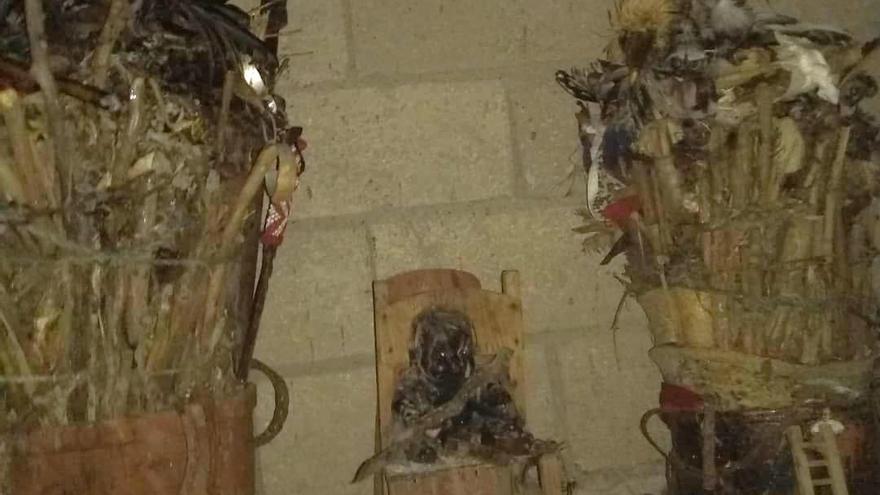
“The human bone is the center of the foundation,” Ta José, a 42-year-old habanero who has been practicing this cult from Central Africa for several decades, explains to 14ymedio. The foundation – also called garment or nganga, cauldron – is the most sacred object of the paleros. It consists of a container where pieces of wood, earth and endless objects are deposited that the palero [practitioner] should not reveal. It also contains human remains.

The importance of the foundation doubles if the bone belonged to someone prominent or a former member of the religion. Hence, to achieve it, a palero does not skimp on resources or think twice before entering a cemetery. As complicated as it is, “a way has always been sought to achieve it,” admits Ta José.

The most common way is to go to the cemetery and steal it. The other way is to find another palero that already has one

“The most common way is to go to the cemetery and steal it. The other way is to find another palero that already has one, because he went into the cemetery himself or bought it from the custodian,” he says. The business of buying and selling bones has caused the systematic dismissal of the cemetery’s custodians on the Island. The most well-known case of this year, last January, was that of the continuous desecration of the Matanzas cemetery, which provoked the intervention of the provincial Communist Party. continue reading

“Among us or with the help of friends we look for the key points,” describes the palero. “When someone needs, for example, a head (skull), he asks his contacts, even if they are from a different branch of palo monte, or he goes to the cemetery to ask the custodian. It’s always resolved. Of course, it’s quite expensive.”

“It depends on the type of work that is going to be done and what part of the body is going to be worked on,” he explains. “The smallest and cheapest piece you can get costs 1,000 pesos or its equivalent in dollars. A complete skeleton can cost between 10,000 and 12,000 pesos. The price may vary depending on the circumstances of the death, the illness that the deceased suffered. It also depends on the race: Chinese bones have more power for us and are sold at higher prices.”

The foundation – also called a garment or ‘nganga’, cauldron – is the most sacred object of the paleros. (14ymedio)

According to Ta José, there are people who are dedicated to going to the tombs and removing as many bones as they can. Then they find how to sell them on the black market, although no store of religious items – legal, such as self-employment – will announce it unless the person who asks can be trusted. “The police have always persecuted the desecrators,” he insists, but in general they “don’t mess” with the paleros.

Sometimes, of course, when they see someone wandering the streets “with a sack” late at night — as usually happens after a ceremony — the officers arrest the person and find that he is carrying a knife. The knives, he explains, are part of the foundation. When the person explains it to the police, they usually let him continue on his way.

There are families who provide the bones of their deceased, because they were practitioners and that motivates them to make the donation

“Bones are essential in palo monte,” emphasizes Ta José. For a palero, in the bones are “the foundations of power” and its material expression. If there is a spiritual foundation, which is “attended” with rum and tobacco smoke, the material cannot exist without the remains of some person. “There are families who provide the bones of their deceased, because they were practitioners and that motivates them to make the donation,” but it is not usual, he says.

All the “works” of the palero depend on the foundation, which Ta José synthesizes with an enumeration: “Consecrate, save, kill, solve problems and help the world.” According to the habanero, each cauldron is effective and achieves what its owner wants, sooner or later. “Some are stronger than others. It depends on the ceremony and the person’s knowledge,” he says, although he prefers not to say more: an important part of his religion is to keep secrets, which practitioners handle only after several initiations and tests. “I can’t say everything,” he admits.

Despite the difficulties and the mystery that has always surrounded palo monte, its impact on Cuban society has not stopped since religion arrived from Africa, he says. “There was always a certain discord between palo monte and santería, because each one wanted to be the strongest cult.” On the Island, studies say that santería is more widespread. However, Ta José insists, palo mayombe retains the reputation of being “the most effective, fastest and strongest.”

Translated by Regina Anavy

____________

COLLABORATE WITH OUR WORKThe 14ymedio team is committed to practicing serious journalism that reflects Cuba’s reality in all its depth. Thank you for joining us on this long journey. We invite you to continue supporting us by becoming a member of 14ymedio now. Together we can continue transforming journalism in Cuba.
Cuba: The Confusion of Interests

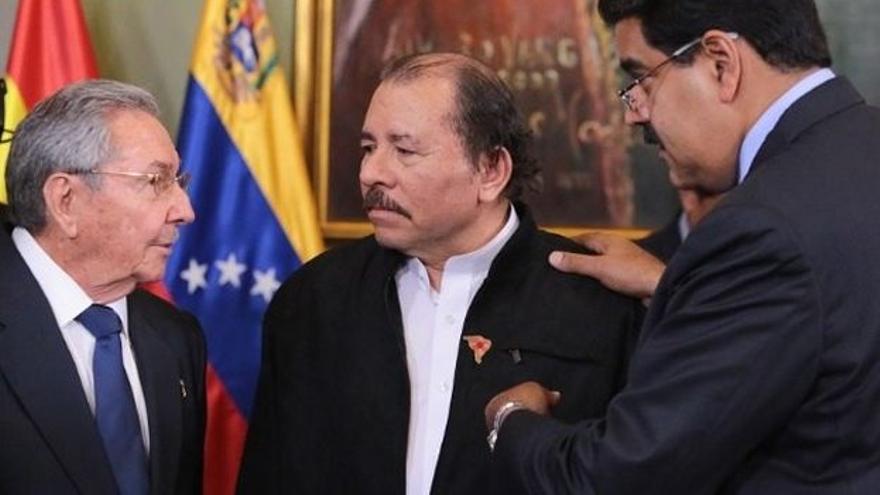
Raúl Castro(L), Daniel Ortega(C) and Nicolás Maduro (R). (Twitter)

14ymedio bigger14ymedio, Pedro Corzo, Miami, November 5, 2023 — Freedom is by far the greatest good of the human being; hence the commitment to defend it as appropriate, a reason that forces us to be alert and not believe in redeemers who promise the salvation of our prerogatives, if we follow them like rats do the flute player.

Behavior, which I fear, is being put into practice by many people in different parts of the world, when they arrange for individuals who are not subject to any control to decide about their lives, despite the fact that no one has the right to forget that “power corrupts and absolute power corrupts absolutely.”

What happens in countries like Cuba, with Castro-Díaz-Canel, in short, is 65 years of totalitarianism. The autocrats, Ortega-Murillo, in Nicaragua, 27 years of government in two periods. Hugo Chávez and Nicolas Maduro, 24 years of despotism between the two. Bolivia, with the phoney Evo Morales, 13 years in office with the aspiration of returning to government to perpetuate himself, which should be inadmissible to any honorable person who has self-respect.

These rulers achieved power thanks to the fact that to a large extent their peoples allowed it, either because they were confused by promises, well-spoken truths or the charm that can emanate from these subjects. continue reading

Frivolity is burying us, along with our lack of interest in accessing conflicting and balanced information, even if we have access to it

The will of the citizen majority folded to suggestive siren songs that promised, cunningly, to make the most paradoxical dreams come true, ceding, to achieve them, their citizens’ rights, in addition to practicing a criminal intolerance and plunging them into an aberrant indolence.

This reflection is the result of an experience, at a friend’s house, that left me dismayed, because I found intelligent people, with a great reputation for commitment to freedom and democracy, passionately defending Vladimir Putin, ignoring the persecution he executes against the opposition and the close relations he maintains with the Castro tyranny.

These friends and acquaintances, in my opinion very confused, justified the aggression against Ukraine. No one alluded to the presence of Cuban mercenaries there, nor to the fact that Putin, like the aforementioned autocrats, has been ruling Russia for 23 years, and that when he was not president he played at being prime minister.

All this demonstration was in a framework of severe criticism of President Joe Biden for his help to Ukraine. Needless to say, I do not sympathize with the president and his government, but I do believe that the support given to Ukraine is vital, just like the one offered to Israel and the one that can be given to Taiwan. They are countries that are in the first line of fire against predators who are a threat to everyone.

Of course, I couldn’t stay calm and entered the arena, with a friend who had already had that experience. They argued that the former KGB colonel was defending our values by attacking Ukraine. They repeated that fascism was a serious threat, as if the despots of any ideology were not, and that Putin was against the social currents that seek to replace the family, which may be true, but that does not justify a war of aggression like the one that the head of the Russian government sponsors, nor his alliance with Castroism.

It goes without saying that I do not sympathize with the president and his government, but I do believe that the support given to Ukraine is vital

It is difficult to neutralize this confusion that arises, in my opinion, in the laxity of many of us against those contrary to our rights and in allowing those same individuals to exercise them. Frivolty is burying us, along with our lack of interest in accessing conflicting and balanced information, even if we have access to it.

Those of us who have suffered regimes of force or imprisonment know that the power held by the army, regardless of the place they occupy in the chain of command, is destructive. Their ability to cause suffering is difficult to imagine, turning our desire to survive into an everyday odyssey.

I fervently believe in democracy with all its imperfections. Knowing that the authorities can be revoked, being able to get rid of the great man or the donkey that we wrongly chose. Being able to tell the subject who commands rifles and cannons that he is not in charge, that he was left without a job and it is time to leave, is a right that we are obliged to defend until the last breath.

Translated by Regina Anavy

____________

COLLABORATE WITH OUR WORKThe 14ymedio team is committed to practicing serious journalism that reflects Cuba’s reality in all its depth. Thank you for joining us on this long journey. We invite you to continue supporting us by becoming a member of 14ymedio now. Together we can continue transforming journalism in Cuba.
Mexico Deports 105 Irregular Migrants to Cuba

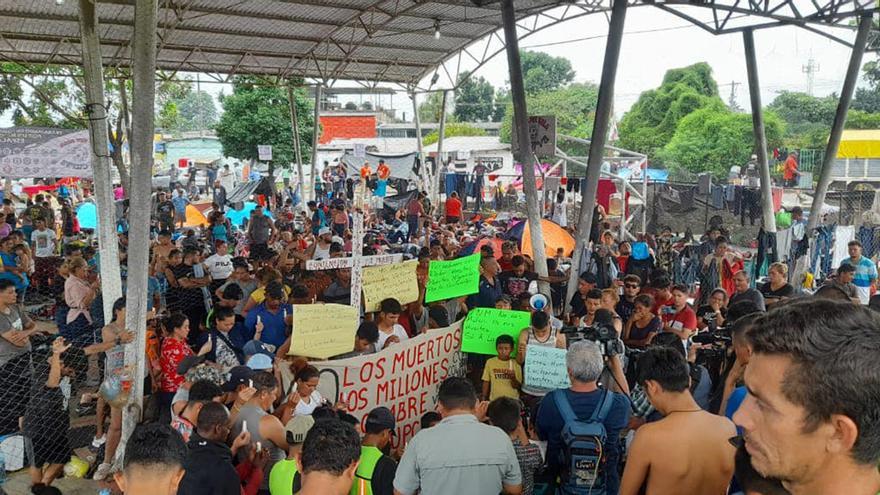
Around 100 Cubans are in the caravan that left Tapachula. (Facebook/Irineo Mujica)

14ymedio biggerEFE (via 14ymedio), Havana, 5 November 2023 — A group of 105 Cubans arrived this Saturday in Havana on a flight from Mexico as part of an agreement between the two nations to return irregular migrants to their country of origin, the Ministry of the Interior (Minint) reported. The Cubans (70 men and 35 women) “legally left Cuba and later became involved in irregular routes to try to reach Mexico’s border with the United States,” it added.

The Cuban authorities said that this is the ninth operation from that country in 2023, with 677 people in total.

It is estimated that in 2022, around 4% of the Cuban population left the country, and this year’s figures could be similar according to those accumulated to date

“In general, with this flight there have been 119 returns made this year, with 4,884 people returned from different nations in the region,” the Minint reported. continue reading

The migratory wave, unprecedented in the volume of migrants, is due to the serious economic crisis that the Island suffers, with a great shortage of basic products (food, medicines and fuel), galloping inflation, frequent blackouts and a partial dollarization of the economy.

It is estimated that in 2022, around 4% of the Cuban population left the country and this year’s figures could be similar according to those accumulated to date.

Translated by Regina Anavy

____________

COLLABORATE WITH OUR WORKThe 14ymedio team is committed to practicing serious journalism that reflects Cuba’s reality in all its depth. Thank you for joining us on this long journey. We invite you to continue supporting us by becoming a member of 14ymedio now. Together we can continue transforming journalism in Cuba.
Stampede of Cuban Athletes at the Pan American Games in Chile: Seven Escape in the Last Few Days

Six hockey players left the Cuban team after losing the fifth place game against Uruguay. (Facebook/Francys Romero)

14ymedio bigger14ymedio/EFE, Havana, 5 November 2023 —  The escapes this Saturday in Chile of the Cuban field hockey players Yunia Milanés, Jennifer Martínez, Yakira Guillén, Lismary González, Helec Carta and Geidy Morales, and the bronze medalist in the 400 meters hurdles, Yoao Illas, defeated the enthusiasm of the regime who proclaimed the achievement of 30 gold medals, one more than the sports authorities of the Island dared to predict in the Pan American Games.

Milanés, Martínez, Guillén, González, Carta and Morales, according to journalist Francys Romero, “left the group at noon on Saturday, after completing the game for fifth place that they lost against Uruguay (3-0)” in the Pan American Games, that end this Sunday.

Francys Romero also detailed that, with the escape of the six hockey players, 61 Cuban athletes have abandoned contracts or delegations during 2023.

Hockey is one of the disciplines hardest hit by the exodus on the Island due to the precarious conditions in which the athletes train, according to Daylin Suárez, Yadira Miclín Galban and Marianela López, who left the team last May because the Institute National Sports, Physical Education and Recreation (Inder) had them “starving and cooking with firewood.” They indicated that the salary was “a pittance,” in addition to the fact that they were “hungrier than a caged lion.” continue reading

The three athletes who escaped in Spain requested political asylum, but the immigration interview will not take place until February 2024. “The situation at the Antonio Maceo Field Hockey School in Havana is very sad. There is a lot of hunger” Daylin Suárez reiterated to 14ymedio. “We train in terrible conditions, without sports equipment, because the country says it does not have the resources to care for athletes.”

In that same month, Lázaro Tolón, Yuri Brown and Yordanqui Méndez left “a training camp in Chile.” The first of the hockey players escaped on the second day of their stay where the Pan American Games are held.

The day after the Toulon escape, Yuri Brown was reported missing. The Havana athlete did not appear at the roll call held by those responsible for the delegation. Meanwhile Yordanqui Méndez took the opportunity to leave the Cuban team after the euphoria due to the beating that Cuba gave, 11-0 goals, to the Manquehue club team.

Las velocistas Laura Moreira, Enis Pérez, Yarima García y Yunisleidy de la Caridad García conquistaron el oro en el relevo 4x100 metros. (Jit)
The sprinters Laura Moreira, Enis Pérez, Yarima García and Yunisleidy de la Caridad García won gold in the 4×100 meter relay. (Jit)

In another escape, the bronze medalist in the 400 meters hurdles, Yoao Illas, separated from the group after clocking 49.74 seconds and reaching the podium in Chile.

“The lack of attention from the authorities and the deep crisis that the country is going through, accompanied by the possibilities that open up in other latitudes, are the main causes of the abandonment of athletes,” summarized Swing Completo about Yoao Illas, who this year was champion in the Alba Games in Venezuela and the Cuba Cup in Havana.

The 382 Cubans who arrived in Santiago de Chile, with the burden of escapes in recent months, showed new faces. The authorities only dared to predict between 18 and 22 gold medals, 12 silver and more than 35 bronze medals.

This Sunday, the medal table shows that the Island has accumulated 30 gold medals, 21 silver and 17 bronze for a total of 68, which keeps them in fifth place, surpassed by Canada, Mexico, Brazil and the United States.

Judo gave the Island five individual medals and one for the team. The successes of experienced judokas, such as Idalis Ortiz (+78 kg), were combined with the revelations of rookies such as Idelannis Gómez, just 21 years old, who won gold by beating the Puerto Rican María Pérez in the 70 kg division. The president of the Cuban Judo Federation, Rafael Manso, attributed the winning of the medals to the “positive mind, work, and a lot of faith in victory.”

Athletics that had been suffering from abandonments, in the Pan American Games found an historic performance with the conquest of the gold medal in the 4×100 meter relay in the sprinters Laura Moreira, Enis Pérez, Yarima García and Yunisleidy de la Caridad García. The runners, belonging to a new generation of athletes, stopped the clocks at 43.72 seconds.

The surprise was even greater in the women’s 100 meter dash where Yunisleidy de la Caridad García rose to the top of the podium with surprising strength despite not being in the majority’s pools for the metals. The 24-year-old athlete achieved a medal for Cuba that had eluded the island for 32 years with a time of 11.36 seconds. “It wasn’t my best mark, but I gave it my all from the heart on that track. After running the semifinal I knew I could win,” she assured the official media outlet Jit.

Cuba sumó este sábado también cuatro medallas de oro en lucha grecorromana. (Jit)
This Saturday, Cuba also added four gold medals in Greco-Roman wrestling. (Jit)

This Saturday, Cuba also added four gold medals in Greco-Roman wrestling, finishing with eight gold medals at the Santiago 2023 Pan American Games, the most by country in this sport in these events. The winners were Daniel Gregorich (87 kilos), Gabriel Rosillo (97 kilos), Luis Orta (67 kilos) and Oscar Pino (130 kilos) in a competition held at the Olympic Training Center in the Chilean capital.

Gregorich beat Venezuelan Luis Avendaño 5-1, Rosillo beat Venezuelan Luillys Pérez 9-1, Luis Orta beat Colombian Julián Horta 10-1, and Pino beat American Cohlton Schultz 6-0.

In comparison, Cuba won 100 metals at the Pan American Games in Lima (2019) and 97 in Toronto (2015), where it achieved its worst results in more than two decades, after reaching 265 in Havana (1991) and the 238 in Mar de Plata (1995).

This decline is linked to the deep crisis in which the Island is immersed, which complicates the training of athletes. Furthermore, many athletes are leaving Cuba under these circumstances to try their luck as professionals in other countries.

____________

COLLABORATE WITH OUR WORKThe 14ymedio team is committed to practicing serious journalism that reflects Cuba’s reality in all its depth. Thank you for joining us on this long journey. We invite you to continue supporting us by becoming a member of 14ymedio now. Together we can continue transforming journalism in Cuba.