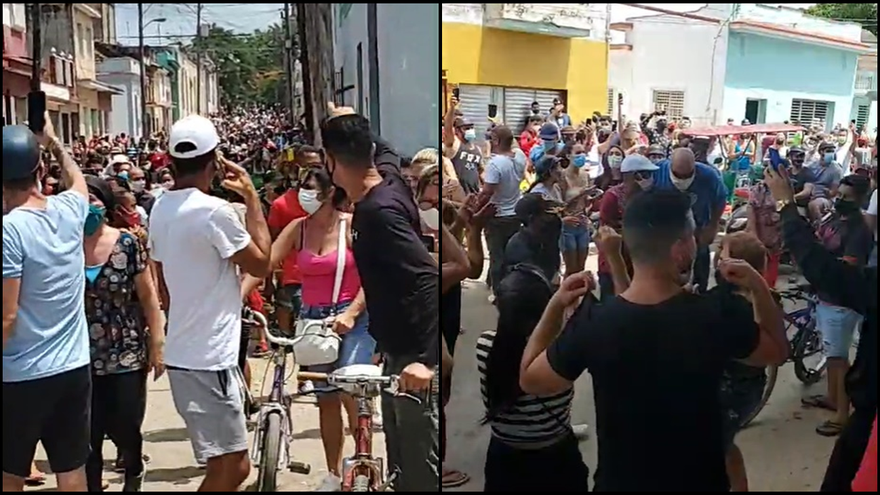
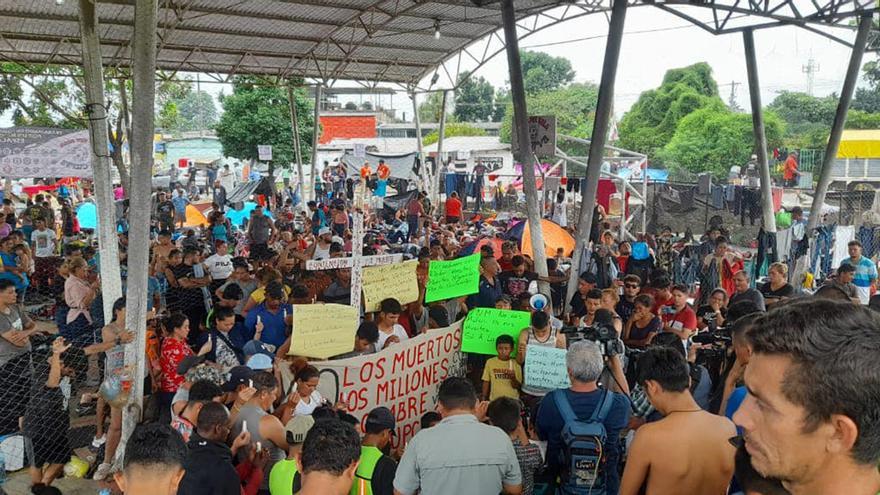
Around 100 Cubans are in the caravan that left Tapachula. (Facebook/Irineo Mujica)
EFE (via 14ymedio), Havana, 5 November 2023 — A group of 105 Cubans arrived this Saturday in Havana on a flight from Mexico as part of an agreement between the two nations to return irregular migrants to their country of origin, the Ministry of the Interior (Minint) reported. The Cubans (70 men and 35 women) “legally left Cuba and later became involved in irregular routes to try to reach Mexico’s border with the United States,” it added.
The Cuban authorities said that this is the ninth operation from that country in 2023, with 677 people in total.
It is estimated that in 2022, around 4% of the Cuban population left the country, and this year’s figures could be similar according to those accumulated to date
“In general, with this flight there have been 119 returns made this year, with 4,884 people returned from different nations in the region,” the Minint reported. continue reading
The migratory wave, unprecedented in the volume of migrants, is due to the serious economic crisis that the Island suffers, with a great shortage of basic products (food, medicines and fuel), galloping inflation, frequent blackouts and a partial dollarization of the economy.
It is estimated that in 2022, around 4% of the Cuban population left the country and this year’s figures could be similar according to those accumulated to date.
Translated by Regina Anavy
____________
COLLABORATE WITH OUR WORK: The 14ymedio team is committed to practicing serious journalism that reflects Cuba’s reality in all its depth. Thank you for joining us on this long journey. We invite you to continue supporting us by becoming a member of 14ymedio now. Together we can continue transforming journalism in Cuba.
Six hockey players left the Cuban team after losing the fifth place game against Uruguay. (Facebook/Francys Romero)
14ymedio/EFE, Havana, 5 November 2023 — The escapes this Saturday in Chile of the Cuban field hockey players Yunia Milanés, Jennifer Martínez, Yakira Guillén, Lismary González, Helec Carta and Geidy Morales, and the bronze medalist in the 400 meters hurdles, Yoao Illas, defeated the enthusiasm of the regime who proclaimed the achievement of 30 gold medals, one more than the sports authorities of the Island dared to predict in the Pan American Games.
Milanés, Martínez, Guillén, González, Carta and Morales, according to journalist Francys Romero, “left the group at noon on Saturday, after completing the game for fifth place that they lost against Uruguay (3-0)” in the Pan American Games, that end this Sunday.
Francys Romero also detailed that, with the escape of the six hockey players, 61 Cuban athletes have abandoned contracts or delegations during 2023.
Hockey is one of the disciplines hardest hit by the exodus on the Island due to the precarious conditions in which the athletes train, according to Daylin Suárez, Yadira Miclín Galban and Marianela López, who left the team last May because the Institute National Sports, Physical Education and Recreation (Inder) had them “starving and cooking with firewood.” They indicated that the salary was “a pittance,” in addition to the fact that they were “hungrier than a caged lion.” continue reading
The three athletes who escaped in Spain requested political asylum, but the immigration interview will not take place until February 2024. “The situation at the Antonio Maceo Field Hockey School in Havana is very sad. There is a lot of hunger” Daylin Suárez reiterated to 14ymedio. “We train in terrible conditions, without sports equipment, because the country says it does not have the resources to care for athletes.”
In that same month, Lázaro Tolón, Yuri Brown and Yordanqui Méndez left “a training camp in Chile.” The first of the hockey players escaped on the second day of their stay where the Pan American Games are held.
The day after the Toulon escape, Yuri Brown was reported missing. The Havana athlete did not appear at the roll call held by those responsible for the delegation. Meanwhile Yordanqui Méndez took the opportunity to leave the Cuban team after the euphoria due to the beating that Cuba gave, 11-0 goals, to the Manquehue club team.
The sprinters Laura Moreira, Enis Pérez, Yarima García and Yunisleidy de la Caridad García won gold in the 4×100 meter relay. (Jit)
In another escape, the bronze medalist in the 400 meters hurdles, Yoao Illas, separated from the group after clocking 49.74 seconds and reaching the podium in Chile.
“The lack of attention from the authorities and the deep crisis that the country is going through, accompanied by the possibilities that open up in other latitudes, are the main causes of the abandonment of athletes,” summarized Swing Completo about Yoao Illas, who this year was champion in the Alba Games in Venezuela and the Cuba Cup in Havana.
The 382 Cubans who arrived in Santiago de Chile, with the burden of escapes in recent months, showed new faces. The authorities only dared to predict between 18 and 22 gold medals, 12 silver and more than 35 bronze medals.
This Sunday, the medal table shows that the Island has accumulated 30 gold medals, 21 silver and 17 bronze for a total of 68, which keeps them in fifth place, surpassed by Canada, Mexico, Brazil and the United States.
Judo gave the Island five individual medals and one for the team. The successes of experienced judokas, such as Idalis Ortiz (+78 kg), were combined with the revelations of rookies such as Idelannis Gómez, just 21 years old, who won gold by beating the Puerto Rican María Pérez in the 70 kg division. The president of the Cuban Judo Federation, Rafael Manso, attributed the winning of the medals to the “positive mind, work, and a lot of faith in victory.”
Athletics that had been suffering from abandonments, in the Pan American Games found an historic performance with the conquest of the gold medal in the 4×100 meter relay in the sprinters Laura Moreira, Enis Pérez, Yarima García and Yunisleidy de la Caridad García. The runners, belonging to a new generation of athletes, stopped the clocks at 43.72 seconds.
The surprise was even greater in the women’s 100 meter dash where Yunisleidy de la Caridad García rose to the top of the podium with surprising strength despite not being in the majority’s pools for the metals. The 24-year-old athlete achieved a medal for Cuba that had eluded the island for 32 years with a time of 11.36 seconds. “It wasn’t my best mark, but I gave it my all from the heart on that track. After running the semifinal I knew I could win,” she assured the official media outlet Jit.
This Saturday, Cuba also added four gold medals in Greco-Roman wrestling. (Jit)
This Saturday, Cuba also added four gold medals in Greco-Roman wrestling, finishing with eight gold medals at the Santiago 2023 Pan American Games, the most by country in this sport in these events. The winners were Daniel Gregorich (87 kilos), Gabriel Rosillo (97 kilos), Luis Orta (67 kilos) and Oscar Pino (130 kilos) in a competition held at the Olympic Training Center in the Chilean capital.
Gregorich beat Venezuelan Luis Avendaño 5-1, Rosillo beat Venezuelan Luillys Pérez 9-1, Luis Orta beat Colombian Julián Horta 10-1, and Pino beat American Cohlton Schultz 6-0.
In comparison, Cuba won 100 metals at the Pan American Games in Lima (2019) and 97 in Toronto (2015), where it achieved its worst results in more than two decades, after reaching 265 in Havana (1991) and the 238 in Mar de Plata (1995).
This decline is linked to the deep crisis in which the Island is immersed, which complicates the training of athletes. Furthermore, many athletes are leaving Cuba under these circumstances to try their luck as professionals in other countries.
____________
COLLABORATE WITH OUR WORK: The 14ymedio team is committed to practicing serious journalism that reflects Cuba’s reality in all its depth. Thank you for joining us on this long journey. We invite you to continue supporting us by becoming a member of 14ymedio now. Together we can continue transforming journalism in Cuba.
A man connecting to a wifi hotspot at a park on the corner of Infanta and San Lázaro streets in central Havana. (14ymedio)
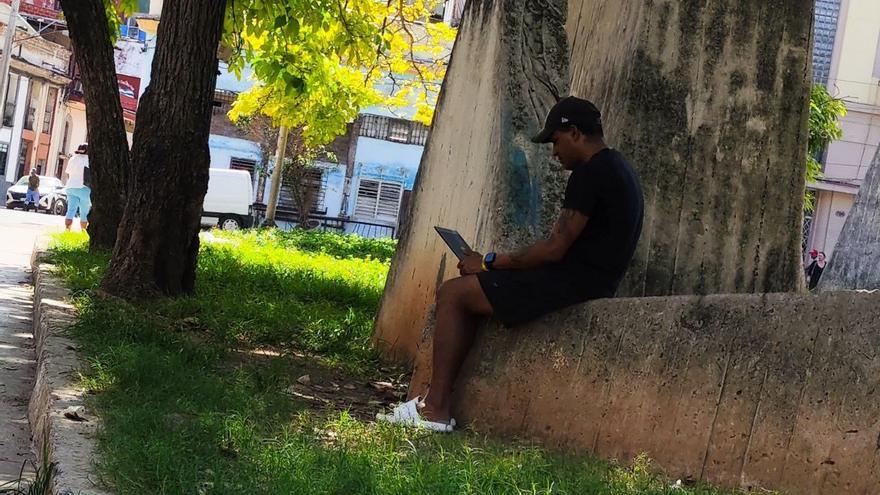
14ymedio, Natalia López Moya and Miguel García, Havana/Holguín, 25 October 2023 — It’s 11:00 AM and the only people to be seen in the park at the corner of Infanta and San Lázaro streets in central Havana are couple of people sitting on a bench and a man with his dog. The scene was very different a few years ago when, all day long, dozens of people were enthusiastically connecting to the wifi hotspot here. Now safety concerns, technical problems and the advent of web browsing on mobile phones has left the benches empty.
Forty-three-year-old Dunia was one of those who spent many hours sitting on a sidewalk curb or in the shadow of the park’s trees. In July 2015, when the first antennas were being installed and the public squares of the Cuban capital were becoming wifi hotspots, this sociology graduate felt like she could finally breathe. Now, she says, “it bears no resemblance” to what it was back then.
On Monday morning the connection speed in the park was barely 270 Kbps (kilobits per second). A little after 1:00 PM, two more people — a man and a woman — arrived and sat down to log on. “It’s no longer like it used to be,” says Dunia of the times when the park was full of people with their eyes glued to their screens.
On Monday morning the connection speed in the park was barely 270 Kbps
“At that point, I almost didn’t know what the internet was. I had only spent a few hours online at a hotel when my brother came to visit us from Madrid and he was staying at the Presidente,” she recalls. “It was all anyone in this neighborhood talked about. Even children in their mothers’ arms were glued to screens to see what they could see.” continue reading
Dunia made her first video call from this hotspot and saw the inside of the Madrid home where her emigré family lives. From here she reconnected via Facebook or Twitter with old friends scattered around the world. And from this corner she shared with her brother the sad news that their mother, who suffered from diabetes, had died.
“We used to spend hours and hours here but I don’t come anymore,” she admits. “Now that we have internet on our phones, I have more privacy and feel safer [connecting] at home. There have been incidents in this park where someone’s phone was snatched or their computer was grabbed while they were logging on.”
In the first year of widespread internet access, official media was filled with headlines praising the new hotspots. Initially, an hour of internet browsing cost 4.50 convertible pesos but Etecsa, the state telecommunications monopoly, kept reducing the price until it was as low as 1.50 pesos.
After years of pressure, Cuban officials finally allowed customers to access the internet from their mobile phones in December of 2018. With the demise of the country’s dual currency system, and along with it the convertible peso, the fee rose to 25 pesos. The technical problems, however, only increased. Since then, the web browsing service has been marked by ups and downs, outages when authorities get nervous about social media posts, deteriorating infrastructure and the exodus of tens of thousands of customers that have left a gaping hole in Etecsa’s balance sheet.
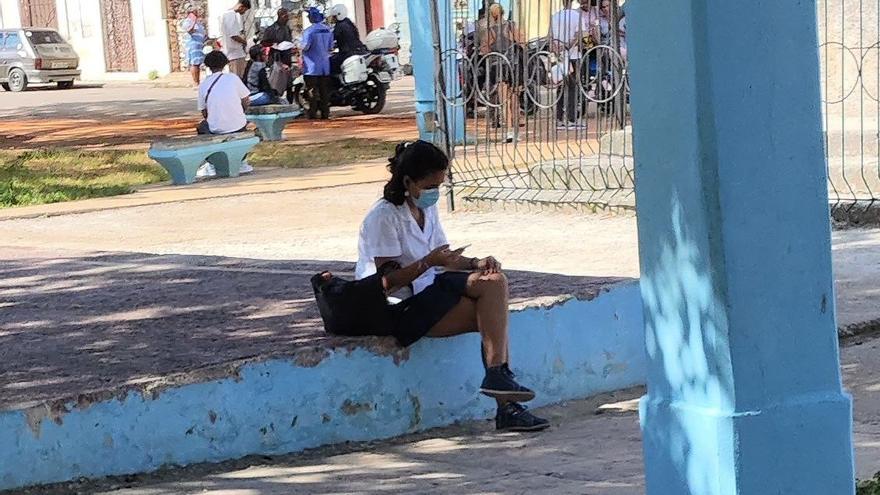
A student using the wifi at Trillo Park in Havana’s Cayo Hueso neighborhood. (14ymedio)
The wifi phenomenon filled Havana’s squares and parks with people, who captured the gaze of photographers, whose images filled the pages of dispatches from the island’s foreign press. Now it seems something is missing on strolls through La Rampa, the park at the interection of San Rafael and Galiano, large stretches of the Malecón, and areas surrounding hotels and important sites. The hundreds of people who once occupied these spaces are gone, a situation that is repeated throughout the country.
The surrounding area is full of MicroTik wireless routers that suck up the signal
“You can’t connect,” complains Julio, who lives near a park in central Holguín. “You get there, you see the network but you can’t log on because there’s no capacity even though there’s not a soul to be found,” he adds. “The surrounding area is full of MicroTiks [a brand of wireless routers] that suck up the signal.”
Savvy businesspeople have saturated the area near the park with these routers, which allows them capture to the signal, amplify it and charge residents for a service they can enjoy from their homes.
“For 500 pesos a month, I can provide you with home-based internet,” says Dany, a Holguín resident whose name has been changed for this article. “It’s much more convenient and less dangerous. But it’s true that, if you want to connect at the park, it’s going to be difficult because we have the signal. It’s rerouted through our equipment, which is more stable and more efficient that Etecsa’s.”
Dany manages a network made up of about twenty Nano and Mikrotik routers. A significant part the city of Holguín’s digital traffic relies on it. “We cannot create capacity where there isn’t any and some days are tough,” he admits. “Etecsa has not expanded the bandwidth of these wifi hotspots, so we have to work with what there is.”
In 2018 Etecsa was talking about more than a thousand wifi hotspots across the island, seeing them as a way to computerize all of Cuban society at twice the speed. Internet users, however, complained about the precariousness of these spaces, the inclement weather that affected the technology when used outdoors, and the threat of crime. They also complained, though less vociferously, that they wanted to be able to consume content that they could not enjoy in public.
When the power goes out, everything shuts down. The park’s antennas turn off and, without electricity, Etecsa’s telephone data towers go dead
With the country’s current energy crisis, blackouts are having a severe impact on Dany and her crew. “When the power goes out, everything shuts down. The park’s antennas turn off and, without electricity, Etecsa’s telephone data towers go dead. So whether you have a Mikrotik or not, you also get disconnected.”
Jessica, a young resident of Sancti Spíritus, notes that, though there is less enthusiasm for them, people still go online at the city’s public hotspots. “They’re downloading movies and TV programs to sell as video entertainment, or to use in their computer or cell phone repair businesses. It’s not crazy like it was before, when everyone was going to the park for wifi. There are those who still use it, not so much for personal reasons but to download big files.”
Jessica believes that the mass protests of 11 July 2021 (’11J’) were the kiss of death for these public hotspots. “They’re seen as threat because they have internet and people are physically congregating there.”
____________
COLLABORATE WITH OUR WORK: The 14ymedio team is committed to practicing serious journalism that reflects Cuba’s reality in all its depth. Thank you for joining us on this long journey. We invite you to continue supporting us by becoming a member of 14ymedio now. Together we can continue transforming journalism in Cuba.
The organization affirms that the decision has been made “given the seriousness of the event and the evidence of the cultural institution’s failure to foresee it.” (El Necio)
EFE (via 14ymedio), Havana, 4 November 2023 — Three officials from the state-run Cuban Rock Agency have been fired due to the controversy surrounding the award given in one of its premises to a young man dressed as a Nazi officer at a Halloween party.
The decision, announced this Friday in a statement from the Cuban Institute of Music, closes the controversy caused by these events, mainly among officialdom, both due to the ideology behind the costume and the celebration of a party considered by the regime as alien to local traditions.
After the analysis of the facts, the institution of the Ministry of Culture reported, the deputy director of the Cuban Rock Agency was “removed from his position” and the two specialists who coordinated the event were “separated from the institution.”
In addition, the director of the Cuban Rock Agency and three directors of the Cuban Institute of Music, in charge of “the approval, evaluation and control of cultural programming” have suffered “other disciplinary measures” not specified in the statement. continue reading
We emphasize the responsibility of the institutions with cultural promotion
“We emphasize the responsibility of the institutions with cultural promotion, always from inclusive and decolonizing budgets, consistent with the spirit of absolute respect for diversity and freedom that characterize the cultural policy of the Revolution,” wrote the Cuban Institute of Music.
The state center where this Halloween party took place, Maxim Rock, is a venue dedicated to the musical genre of the same name. It is scheduled to reopen this Saturday, after having been temporarily closed last Sunday, one day after the competition.
The images of the young man dressed as a Nazi officer quickly went viral on social networks. Several official media outlets criticized Maxim Rock and the Cuban Institute of Music for celebrating Halloween and rewarding a Nazi costume, speaking of “the dangers of cultural colonization.”
____________
COLLABORATE WITH OUR WORK: The 14ymedio team is committed to practicing serious journalism that reflects Cuba’s reality in all its depth. Thank you for joining us on this long journey. We invite you to continue supporting us by becoming a member of 14ymedio now. Together we can continue transforming journalism in Cuba.
14ymedio, Havana, November 4, 2023 — Activist Yasmany González Valdés is in a punishment cell in the Combinado del Este prison, in Havana, as confirmed to 14ymedio by his wife, Ilsa Ramos. The 31-year-old political prisoner is being accused of the alleged crime of “propaganda against government bodies” but the trial against him has not yet been scheduled.
González’s transfer to the punishment cell was due to a fight with another inmate who accused him of creating an opposition movement “within the prison,” explains Ramos, who this Friday attended the statutory visit, but the prison authorities didn’t let her see her husband.
The activist, also known as Libre Libre, was arrested on April 20 after a “violent search” of his home in Central Havana in which some 15 political police agents participated, and during which they confiscated a mechanic’s overalls, a paintbrush and his mobile phone, as part of the investigation into the graffiti that appeared in various central points of the capital against the Cuban regime.
After his arrest, González spent more than a month in Villa Marista, the headquarters of State Security in Havana, and in May of this year he was transferred to the Combinado del Este, the largest prison in Cuba. continue reading
A few days before his arrest, the activist had been summoned by the Police at the Zanja station, in Havana, where they linked him to the group that calls itself El Nuevo Directorio
A few days before his arrest , the activist had been summoned by the Police at the Zanja station, in Havana, where they linked him to the group that calls itself El Nuevo Directorio (END) [The New Directorate]. According to González’s testimony, on that occasion they performed handwriting tests on him and also tried to detain him for non-payment of fines that had already been paid.
The first graffiti signed by END with the motto “No to the PCC” [Cuban Communist Party] appeared on the walls of the Faculty of Physics of the University of Havana. The second appeared in the nearby Aguirre park, and a third was placed at the entrance of the university stadium, on Ronda street. But it was the fourth graffiti that bothered State Security the most, when it appeared on the morning of April 20 at number 7 Humboldt Street, in Central Havana.
The location of this last sign coincided with the place where four young people belonging to the Revolutionary Directorate were murdered in 1957, during the dictatorship of Fulgencio Batista. The poster, made on the same day as the anniversary of that repressive action, generated a strong police operation to cover the letters with paint, in addition to an “act of reparation.”
Previously, Yasmany González had denounced the harassment he suffered from State Security. In 2022, after four days detained in Villa Marista, the activist, who worked as a self-employed bricklayer, said that he would stop publishing on social networks. He had previously been fined for denouncing human rights violations and demanding the release of those detained in the protests of 11 July 2021 (’11J’). At the moment, according to the organization Justicia 11J, 787 political prisoners remain in Cuban prisons, of the 1,878 who have been arrested since the demonstrations.
____________
COLLABORATE WITH OUR WORK: The 14ymedio team is committed to practicing serious journalism that reflects Cuba’s reality in all its depth. Thank you for joining us on this long journey. We invite you to continue supporting us by becoming a member of 14ymedio now. Together we can continue transforming journalism in Cuba.
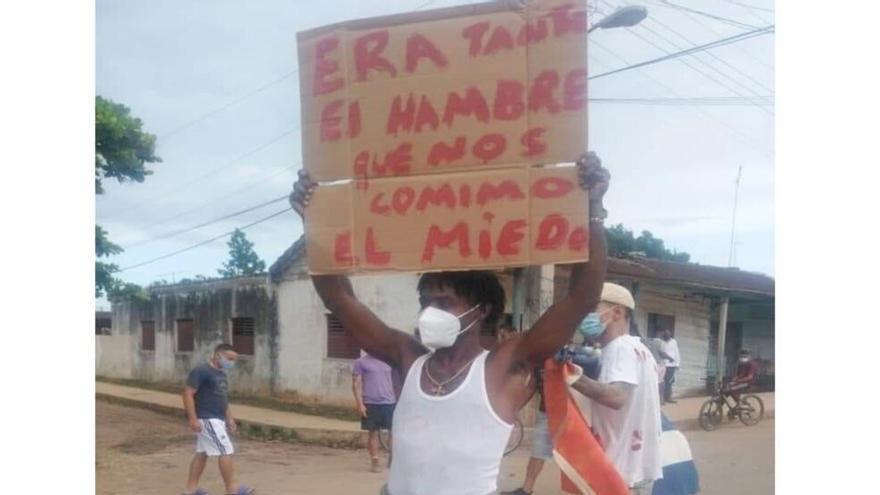
The image of Juan Enrique Pérez is one of the most iconic of the ’11J’ mass protests throughout Cuba on 11 July 2021.
14ymedio, Havana, 4 November 2023 — Dayana Aranda Batista, wife of Juan Enrique Pérez Sánchez, detained for participating in the protests of 11 July 2021 (’11J’), demands a proof of life for the political prisoner who was transferred, without prior notice, to the Melena del Sur prison in Mayabeque.
This Friday, Aranda traveled to the Melena II penitentiary center but the prison authorities did not allow her to see her 42-year-old husband. “They transferred him on Saturday, October 28, but I didn’t know it,” the woman tells 14ymedio. “I went on Monday to see him at the Quivicán prison where he was before and that was where I found out that they had changed the prison.”
“They didn’t give me any explanation,” says Aranda. “My husband has not called me so, until they let me see him, I consider Juan Enrique missing.” The woman remained for hours outside the prison, but in the end she was not able to enter and check if the political prisoner is in the penitentiary center. “They didn’t let me see him” she laments.
This newspaper learned of Pérez’s transfer to Melena II through Layda Yirkis Jacinto, mother of Aníbal Yasiel Palau Jacinto, sentenced to five years in prison for demonstrating on ’11J’ and who was also taken from Quivicán, last weekend, to Melena II. In a phone call, the 28-year-old confirmed that both were taken “handcuffed hands and feet” to the prison. continue reading
The transfer could be motivated by an attempt by the prison authorities to separate the 11J prisoners who, in the Quivicán prison, went on a hunger strike last July demanding their rights and denouncing the mistreatment to which the political prisoners are subjected.
Melena II prison facilities. (Courtesy)
Pérez himself, sentenced to eight years in prison for the crimes of attack, contempt and spread of epidemics, went on a hunger strike last year demanding his freedom. At that time he was held in the Melena II prison and, after beginning the fast, he was transferred to a punishment cell in Quivicán.
The image of Juan Enrique Pérez Sánchez, father of four children, holding a sign that said “The hunger was so great that we ate fear” is one of the most iconic of the popular protests of 11 July 2021 in Cuba. From that day, Aranda remembers that both of them demonstrated peacefully in the town of Vegas, in the Nueva Paz municipality of Mayabeque, and “a bus arrived with police dressed in civilian clothes.”
“They knocked us down, beat us very violently and arrested us along with other people who were also demonstrating,” the woman recalls. “They transferred us to a prison in San José de las Lajas, my husband was badly beaten and they even broke a rib that never healed properly and it still hurts.”
They knocked us down, beat us very violently and arrested us along with other people who were also demonstrating.
“They separated us and after 12 days they released me with a bail of 8,000 pesos. I came to know about my husband five months later when I received his first call from the Melena II prison,” she details. “At the trial they asked for 12 years, which in the end ended up being eight.”
“On 11 July of last year he demonstrated again inside the prison, the guards beat him and sent him to a punishment cell. His health is fragile, he is hypertensive and asthmatic,” Aranda lists. “He has not stopped protesting and demanding his rights,” she summarizes.
Before life went wrong and Juan Enrique Pérez Sánchez ended up in prison, the man “had a small carpentry shop at home and also a workshop where he fixed mobile phones and computers.” But those times of being surrounded by cables, saws and screwdrivers now seem like a distant past to has wife, a time that will not return.
____________
COLLABORATE WITH OUR WORK: The 14ymedio team is committed to practicing serious journalism that reflects Cuba’s reality in all its depth. Thank you for joining us on this long journey. We invite you to continue supporting us by becoming a member of 14ymedio now. Together we can continue transforming journalism in Cuba.
Miguel Díaz-Canel and the Cuban Journalists Union (Upec}, led by pro-government journalist Ricardo Ronquillo (right), have divergent ideas on the financial plan. (Cubadebate)
14ymedio, Havana, November 4, 2023 — On Friday, the second day of the Cuban Journalists Union (Upec) congress, the leitmotiv was the word ’crisis’. Crisis of the “socialist press model,” economic crisis of the media and, of course, the deep depression of salaries, the delegates enumerated. The solution to get out of the financial quagmire: “open the doors to advertising and sponsorship.”
If the first part of the event was supervised by Rogelio Polanco, head of the Ideological Department of the Communist Party, the second – where more delicate issues were debated – required the supervision of its first secretary — and the Island’s president– Miguel Díaz-Canel. The relationship of dependence between the political body and the official press has been emphasized, like a mantra, in all the meetings of the congress.
Ricardo Ronquillo – ratified this Friday as president of Upec – defined the problems that his organization will have to confront from now on, and the role it intends to assume in Cuban society. His plan is to “conceive the media as a control mechanism in the absence of the credibility that affects the sector” and launch “professional reorientation courses due to the exodus of human resources.” continue reading
Ronquillo promised Díaz-Canel that, in his search for financial oxygen, the “economic character and the symbolic character” of the press would not come into contradiction
In a context in which “the media lost their economic management,” Ronquillo promised Díaz-Canel that, in his search for financial oxygen, the “economic character and the symbolic character” of the press would not come into contradiction, that is, its loyalty to the regime and its fidelity to the vision of the world as directed from the Party.
The key to success, suggested Jorge Legañoa, vice president of Upec, is to bring local newspapers to the “multimedia scheme,” an idea that Randy Alonso had already raised this Friday, using as an example his own Multimedios Ideas project (which covers Cubadebate, Mesa Redonda [the ‘Roundtable’ TV program], Con Filo and other propaganda spaces).
Official journalism must be converted into a “content factory,” Legañoa stressed, in line with the Government’s policy and faithful to its function of “self-regulating” the country’s conscience, thus guaranteeing “popular control.”
However, the Upec plan will be an “experiment,” warned Ariel Terrero, another of its vice presidents, and will be above all an attempt at economic change, not an ideological opening. Hence, the motto of the event – ”changes yes, revolutionary changes” – is aimed, above all, at reassuring those who still “resist the change” in the organization, and maintain “persistent doubts about the scope of the transformation and the steps of the process.”
Before the Revolution it was very difficult for a Cuban to emigrate,” he added, in response to complaints about the exodus of journalists.
The official press is the great misfit in the “age of digital convergence.” Where all the newspapers in the world operate naturally on the Internet, in Cuba we still think “analogically” and slowly, lamented Ana Teresa Badía, from the International Institute of Journalism.
As expected, Díaz-Canel’s closing speech revolved around the formula that “with journalism we must make a revolution.” He was not too enthusiastic about the economic “experiment” of transmediality and reminded those present that Cuba is immersed in a “complex situation, from which journalists cannot escape.” “There are no magic solutions,” he concluded, insisting, of course, that “you have to work very hard.”
“Before the Revolution it was very difficult for a Cuban to emigrate,” he added, in response to complaints about the exodus of journalists, although, he said, he preferred to talk about those who “stay and conceive their life project in Cuba and continue to defend it.”
The essential question, before asking for initiatives to be generated, said the president, is “how to manage the means so that they contribute more,” and only then “increase salaries.” At the end of a speech that was emptier in content than usual, Díaz-Canel could only resort to one of his oldest slogans: “I trust in creative resistance.”
____________
COLLABORATE WITH OUR WORK: The 14ymedio team is committed to practicing serious journalism that reflects Cuba’s reality in all its depth. Thank you for joining us on this long journey. We invite you to continue supporting us by becoming a member of 14ymedio now. Together we can continue transforming journalism in Cuba.
The authorities insist that the new measure responds to the need to control what is sold in the province and to avoid illegalities. (14ymedio)
14ymedio, Havana, November 1, 2023 — On Wednesday, the provincial government of Cienfuegos decreed a cap on the prices of food sold in both state and private markets. It is expected that the measure, which does not take into account the abysmal difference between the real cost of the product and that imposed by the authorities, will cause friction between sellers, customers and inspectors, as has already happened in other provinces .
Alexandre Corona, provincial governor and signer of the resolution, assured that the decision was the result of consensus during a meeting with market administrators, producers and heads of market plazas. According to the official, before the agreement they tried to pay special attention to the farmers. “We talked to them and came to the conclusion that (the new prices) were affordable, since they were getting a 30% profit,” he said. About the opinion of private traders, or whether a round of consultations was also held with them, not a word was said.
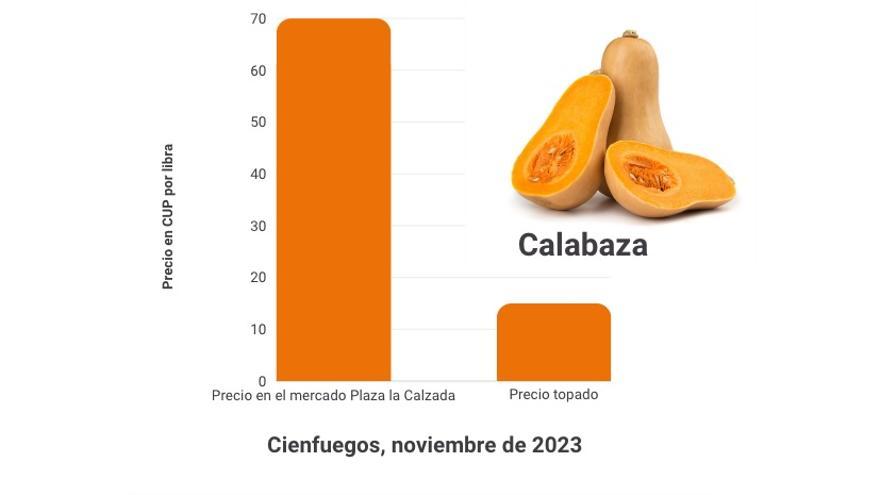
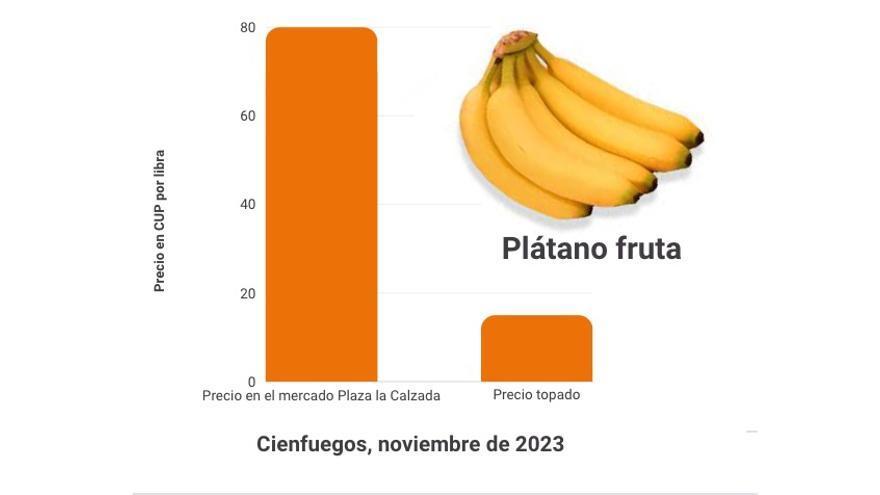
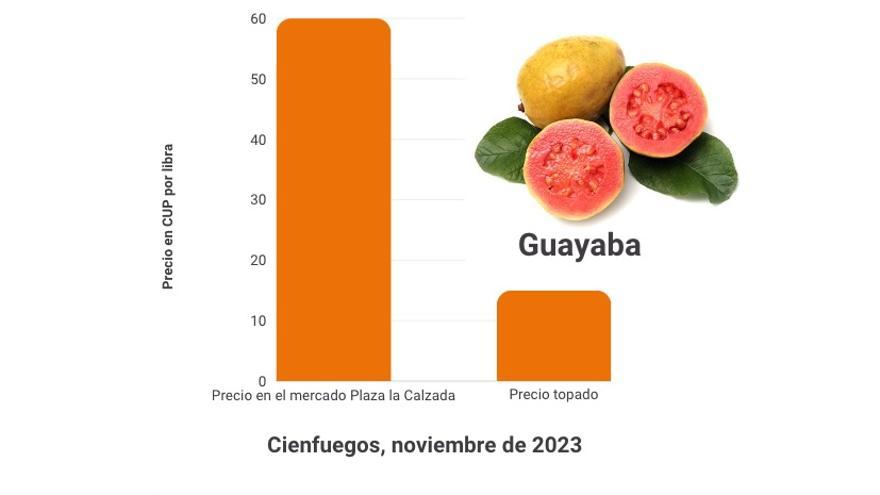
According to the authorities, the foods with modified prices will be sweet potatos, which will be sold at 15 pesos per pound, although currently in the Plaza La Calzada supply and demand market in the city of Cienfuegos they are offered for 90; cassava, previously 70 pesos a pound, will now be 15 pesos; bananas will drop from 80 pesos per pound to 15; pumpkin, previously at 70 pesos per pound will now sell for 15; and guava, with an informal price of 60 pesos per pound, will drop to 15. continue reading
Comparative prices for sweet potatoes in November and the controlled price. (14ymedio)
In the prices that this newspaper compiles weekly in the markets of several provinces, La Calzada square has stood out in recent months for having the highest prices, even for some products such as beans, and higher than in Havana. The cuts imposed by the authorities represent between 75% and 83% less than current prices.
The prices of bananas (20 pesos per pound), plantains (10), green papaya (6), rayona papaya (9), corn meal (30) and sweet corn at 10 pesos were also hit. However, the prices for a pound of rice (72), black beans (70) and red beans (75) will remain the same.
“Only products acquired in other provinces to be sold specifically in La Plaza del Mercado, in the main city, may be marketed for the value of the purchase price plus 40%,” stressed Corona, who added as one more exception for pushcart sellers (street vendors) that they will be able to sell their products for 30% more than their capped value.
Comparative prices for squash in November and the controlled price. (14ymedio)
Municipal administrations may also impose prices that they deem appropriate, as long as these fluctuate below the value assigned to food by the provincial government.
Although the authorities insist that the resolution was taken in full agreement with producers and merchants, suspicions that one party or another may try to “play head games” is a widespread concern. According to the local newspaper 5 de septiembre, Norjis Lázaro Estepa, owner of the local development project Finca La Muralla, fears that the “unfair competition” that exists from street vendors and some state companies will continue to affect his profits.
This is the case of Frutas Selectas, which “has managed to sell sweet potatoes for 45 pesos per pound and has contracted fields of food at prices that leave us at a total disadvantage. Sometimes they even earn more than the guajiros [farmers],” he denounced.
Comparative prices for bananas in November and the controlled price. (14ymedio)
For their part, the authorities insist that the announcement of the new measure responds to the need to control what is sold in the province and avoid illegalities. This function, however, carried out mostly by inspectors, is not without obstacles.
“Sometimes, the trucks that arrive on Saturday at La Calzada with sweet potatoes and cassava, for example, choose to leave as soon as they are flagged for some type of violation,” explained Paulino Díaz, head of the Comprehensive Supervision Directorate, who demanded more respect from the merchants for the “institutionality.”
According to the directors, between these behaviors and the “trafficking” in the fields — almost impossible to control — large quantities of essential foods, such as rice, ’escape’ to “unforeseen destinations.” For example in the case of cassava, they explain, it is known that it is hoarded by pig farmers, who use it as food for livestock, depriving a good part of the population of the product.
Comparative prices for guava in November and the controlled price. (14ymedio)
“The situation even led to surveillance at border points with neighboring provinces,” they say. What officials do not suspect, or have decided to ignore, is that the difference between the state prices and the informal prices will, in a short time and as has happened on other occasions, affect the consumer directly, who after buying at good prices for a few weeks , will have to look for those same foods in reseller markets for three, four, and even five times their value.
Something similar happened last July in Sancti Spíritus, when merchants refused to accept the price controls imposed by the authorities and ended up abandoning their stalls in the Market Square, in the center of the main city, and sold their merchandise ’on the left’ in the street.
____________
COLLABORATE WITH OUR WORK: The 14ymedio team is committed to practicing serious journalism that reflects Cuba’s reality in all its depth. Thank you for joining us on this long journey. We invite you to continue supporting us by becoming a member of 14ymedio now. Together we can continue transforming journalism in Cuba.
During the meeting, Vice President Salvador Valdés Mesa limited himself to giving orders. (Cubadebate)
14ymedio, Madrid, 3 November 3, 2023 — The authorities of Alquízar, in Artemisa, admitted what their inhabitants had been complaining about for months: the food sovereignty plan is a failure, and they so informed the vice president, Salvador Valdés Mesa, who attended a meeting where the production problems were enumerated.
Nor could newspaper El Artemiseño could not overlook the debacle of the local economy, and this Friday the headline asked the question that the officials did not want to ask themselves aloud during their meeting: How much is left for municipal and food sovereignty?
During the “sustained exchange,” Valdés Mesa limited himself to giving orders that will hardly be fulfilled in the province: more rice, corn and sunflowers must be planted to produce oil, raise livestock, replace imports, stimulate the farmers and lower prices.
Meanwhile, in the shops of the province a pound of black beans is already close to 550 pesos, even above the price in Havana. In state markets, beans have been missing for more than a year. continue reading
The officials, however, were not intimidated by the data and assure that everything is fine. Marisleydis Domínguez, vice president of the Agricultural Program, proudly announced that food outlets had increased from 16 to 40 in the territory but did not mention what she plans to offer in those premises, when food is barely produced in the fields.
Meanwhile, in the shops of the province a pound of black beans is already close to 550 pesos, even above the price in Havana
The same happened with the mini-industries, where “prices were agreed” — without clarifying whether the population will be able to pay them — but in this case the press itself put an end to the official’s words by saying that “such actions are not yet reflected on the table of the more than 30,000 alquizareños.”
Even so, and with the numbers against him, the governor of the municipality promised that, “for 2024, Alquízar will self-supply with food and vegetables.” How it will do it, in just two months, was not a matter of debate either.
Part of the “agricultural belt” that surrounds Havana, Alquízar has traditionally been a land of cultivation of vegetables and fruits and pig breeding. With its red soil and its flat fertile surface, several of the schools in the countryside that sought to unite teaching and agricultural production were located in the belt for decades. Today, most of those centers are abandoned or converted into improvised homes.
The deep structural crisis of the Island, which has worsened in recent years, has especially hit families who aspire, at least in the current conditions, to be able to pay for the standard products that arrive at the bodega [ration store], since the prices of food in the state and private markets exceed the purchasing capacity of the average salary.
In the particular case of Alquízar, the situation in which citizens live is even more worrying if one takes into account the wave of violence that plagues the municipality, which has forced neighbors to confine themselves to their homes during the night, for fear of being robbed or assaulted on the street.
The Police recently denied that Alquízar remained in a state of siege and curfew, although several residents insist that curfew is a “recommendation,” while the agents patrol the streets of the town.
Translated by Regina Anavy
____________
COLLABORATE WITH OUR WORK: The 14ymedio team is committed to practicing serious journalism that reflects Cuba’s reality in all its depth. Thank you for joining us on this long journey. We invite you to continue supporting us by becoming a member of 14ymedio now. Together we can continue transforming journalism in Cuba.
Hundreds of Cubans in San Antonio de los Baños went out to protest against the government on 11 July 2021. (Collage)
EFE (via 14ymedio), Miami, November 3, 2023 — The documentary Libres X Derecho [Free by Right], which includes “a brief account” of what has happened since the popular outbreak in Cuba on 11 July 2021 (’11J’), told from the perspective of 14 relatives of the detainees, is presented this Saturday in Miami before its tour through international festivals, according to its screenwriter, journalist and writer María Matienzo speaking to EFE.
Created by the organization Mesa de Diálogo de la Juventud Cubana (MDJC) [Cuban Youth Roundtable], which emerged in 2014 “with young people and for young people” to “transform today’s reality on the Island,” the documentary narrates in 27 minutes “how the events happened, how they were imprisoned, what they experienced in the prisons, who they were before 11J and, finally, the convictions,” explains Matienzo.
Libres X Derecho is the work of a team led by MDJC psychologist and coordinator Kirenia Yalit Núñez, who, according to the program, will be present at the screening in Miami.
Under the title #Exprésate: Libres por Derecho [Express Yourself: Free by Right], the event will take place at the Ruka Winewood, in the artistic neighborhood of Wynwood, and, in addition to the documentary, will exhibit 19 collages of urban artists who live in Cuba and have been inspired by the film. continue reading
Matienzo describes the script work as “hard.”
“It was hard to see the testimonies of these parents, because both Kirenia and I were founders of Justicia 11J, an organization that has been dedicated since 11J to locating relatives of the detainees, following up with them and providing them with help.”
Having to relive what we lived that year and seeing that those people continue to suffer has been a doubly heartbreaking process, reliving the months when I thought they were going to kick in my door
“Having to relive what we lived that year and seeing that those those people continue to suffer has been a doubly heartbreaking process, reliving the months in which I thought they were going to kick in my door, as they did to many people in those days and to many who gave their testimony,” adds the screenwriter.
The documentary contains images of the 11J demonstrations taken with mobile phones and interviews with relatives of detainees, including those in San Antonio de los Baños, where the protest began.
“Behind so much suffering and pain, joy has to come, it’s our right,” one of the interviewees says in the promotion trailer.
“All this is accompanied by the process of creating graffiti that are scattered throughout the cities of Havana and Villa Clara that try to translate the testimonies,” says the screenwriter.
The documentary was premiered in Geneva, Switzerland, on August 30 in the framework of the sessions of the Universal Periodic Review
The documentary was premiered in Geneva, Switzerland, on August 30 in the framework of the sessions of the Universal Periodic Review, to which Cuba will be submitted on November 15 by the UN.
According to the latest count of Prisoners Defenders, at the end of September there were 1,052 political prisoners in Cuba, mostly people convicted as a result of their participation in the protests of 11 July 2021, the largest in the country in decades.
Since that date, Justice 11J has registered 1,862 people detained for political reasons, of which 911 have been tried and, for the most part, convicted.
Translated by Regina Anavy
____________
COLLABORATE WITH OUR WORK: The 14ymedio team is committed to practicing serious journalism that reflects Cuba’s reality in all its depth. Thank you for joining us on this long journey. We invite you to continue supporting us by becoming a member of 14ymedio now. Together we can continue transforming journalism in Cuba.
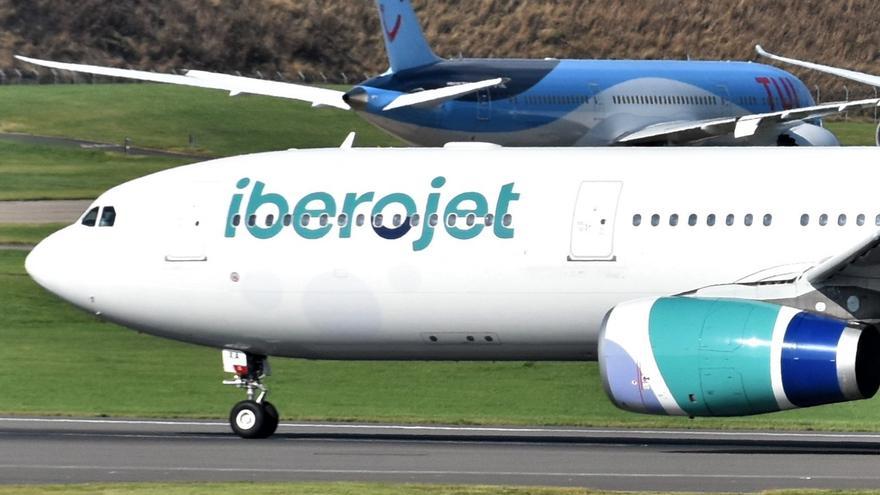
Iberojet had already canceled its Madrid-Santiago de Cuba route in September. (CC)
14ymedio, Madrid, 3 November 2023 — The Spanish company Iberojet will stop flying to Havana in 2024. As confirmed to 14ymedio by an employee of the company, the airline will have no connection with the Island from next January 15 and does not know when it will resume operations. But it will open two routes to Santa Clara, the same source explained, from Madrid and Lisbon, but “beginning next summer.”
Although the company has not issued any official statement, several travel agencies reported the news on their social networks, saying that January 10 is the last scheduled flight from Barajas airport to Havana’s José Martí airport.
“Attention travelers! Iberojet cancels its operation to Cuba and the last flight will be on January 10. If you have a flight booked with us, we recommend you call to verify your ticket and find the best solution for your trip,” it warned on its Viajes On Time Facebook wall.
The airline already canceled its Madrid-Santiago de Cuba route last September, just a year after inaugurating it, but this measure will take place in the middle of the high season and evidences the debacle of foreign tourism on the Island. continue reading
According to the latest official figures published, only 147,380 international travelers visited Cuba in September. It was the worst data so far this year – even worse than in June, when the figure reached 154,590 – and the worst month of September recorded other than during the pandemic.
Until now, Iberojet has had a weekly flight from Madrid to Havana, on Wednesdays, at a very attractive price, less than 600 euros
Until now, Iberojet has had a weekly flight from Madrid to Havana, on Wednesdays, at a very attractive price, less than 600 euros per person. In addition, it allows passengers to carry two 50-pound suitcases and a 22-pound carry-on free of charge.
Also , the Spanish airline Iberia, which reduced its weekly flights between Madrid and the Island from four to three last September, will continue with that frequency both in the Caribbean high season — from November to May — and next summer.
Last week, the American company Southwest reported that, from June 2024, it will move most of its international destinations from the Fort Lauderdale airport to Orlando, Florida, and the Island will not be among them.
However, the company responded by email to this newspaper saying that it will continue to provide services to Cuba with a daily flight from Tampa International Airport. To get to Tampa, the company offers direct flights twice a day from Fort Lauderdale.
Two other U.S. airlines, Delta and United, announced that they were waiting for authorization from the U.S. Department of Transportation for a temporary exemption from their routes to Cuba. As has JetBlue, both have reduced their flights to the Island since October 29.
In the case of Delta, the company has requested a suspension, until March 30, 2024, of the seven routes it has between Atlanta – where it has its headquarters – and Havana, in addition to a reduction by half of its flights between Miami and Havana, from 14 to seven. The airline alleged that the route is “depressed,” although it hoped that demand could be recovered to resume service.
Translated by Regina Anavy
____________
COLLABORATE WITH OUR WORK: The 14ymedio team is committed to practicing serious journalism that reflects Cuba’s reality in all its depth. Thank you for joining us on this long journey. We invite you to continue supporting us by becoming a member of 14ymedio now. Together we can continue transforming journalism in Cuba.
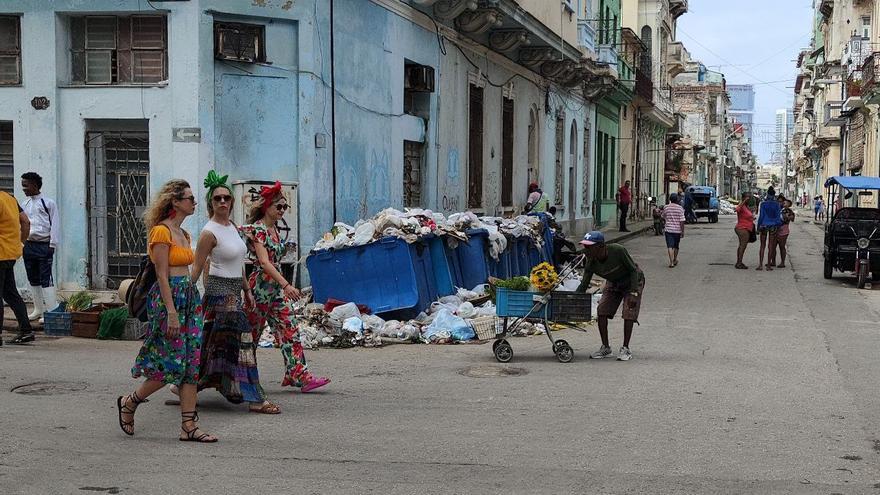
The huge garbage dump on the corner of Perseverancia and Laguna awaited the tourists, who stopped to take a couple of photos. (14ymedio)
14ymedio, Natalia López Moya, Havana, November 3, 2023 — “It’s still there, growing every day,” Clara complains while pointing out the mountain of waste on 30th Street at the corner of 37th Street, in the Havana municipality of Playa. The woman, who contacted 14ymedio last October to report the situation, once again asks for help due to the apathy of the Community Services Company.
“It’s like Doña Basura [Lady Trash], it’s everywhere,” Clara laments, alluding to the children’s series Fraggle Rock, a part of her adolescence. “What happens is that this ‘filth lady’ is not at all nice, she is horrible, she smells bad and she has brought a battalion of flies to this neighborhood.”
Clara’s block is not a central avenue, nor is it one of those roads where tourists or official delegations pass. Frequented only by residents in the areas and a few visitors, the street is not among those prioritized by the Government of Havana to collect waste.
Something different happens in the surroundings of the nearby Cira García international clinic, where tourists and diplomats are treated, and which look cleaner of waste. A panorama that is repeated in the also upcoming Miramar House of Music, where “people with hard currency go, not like us who are Cubans with national currency,” Clara says ironically. continue reading
Those who are not lucky enough to live near the clinic or the House of Music are experiencing a true ordeal. “On this street we have been left incommunicado because of the garbage,” denounces Yantiel, a 22-year-old young man living on 17th, between 66th and 68th, also in the Havana municipality of Playa.
The pile of garbage grew so much that it knocked over the box with the telephone wires and now, in addition to the flies, we have been left without landline telephone and without being able to use Nauta Hogar’s internet connection
“The pile of garbage grew so much that it knocked over the box with the telephone lines and now, in addition to the flies, we have been left without landline telephone and without being able to use Nauta Hogar’s internet connection. It is sad,” he adds. “It’s no longer just the flies and bad smells, now it has also brought me problems with my work because I am a designer and I do everything online.”
More than five kilometers from Yantiel and Clara’s houses, the scene repeats itself. A group of European women were walking this Friday morning near the corner of Campanario and Laguna, in Centro Habana, a few meters from a mountain of garbage. The women left the retouched tourist perimeter and entered one of the poorest and dirtiest areas of Havana.
A few meters ahead, the huge garbage dump on the corner of Perseverancia and Laguna awaited the tourists, who stopped to take a couple of photos of a deteriorated art deco-style building with cracked balconies and a faded façade. A flower seller reached out to them to offer them “Cuban and top quality” sunflowers and tobacco.
Doña Basura is one of the characters in the children’s series ’Fraggle Rock’, broadcast several times on Cuban Television. (Screen capture)
“Look, I’ve seen filth in this city but never like this,” says another neighbor from nearby Lealtad. “The current situation has never been experienced here. This entire Lagunas street is a garbage dump, you can’t walk on the sidewalks, you can’t stand at the door because the plague is like a blow to the face.”
At the end of last October, the program coordinator of the capital government, Orestes Llanes Mestres, described the crisis in garbage collection as “the main challenge for the city at the moment.” In a meeting with several Havana authorities, the official announced that waste collection actions were going to be intensified with the support of companies from the Ministry of Construction and state and non-state micro, small and medium-sized enterprises (MSMEs).
But the days go by and the collection efforts do not reach all the neighborhoods nor appease the spirits of the indignant Havana residents, harassed by a Doña Basura who reigns despotically, with her smells and her flies, everywhere.
____________
COLLABORATE WITH OUR WORK: The 14ymedio team is committed to practicing serious journalism that reflects Cuba’s reality in all its depth. Thank you for joining us on this long journey. We invite you to continue supporting us by becoming a member of 14ymedio now. Together we can continue transforming journalism in Cuba.
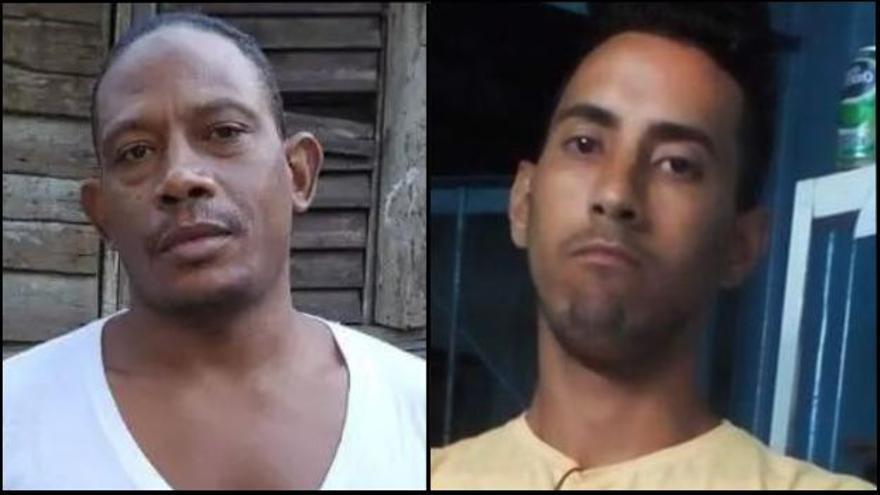
From left to right, Luis Andrés Domínguez and Jorge Luis Boada. (Collage)
14ymedio, Madrid, November 3, 2023 — The Provincial Court of Havana tried three Cubans this Thursday for crimes against State Security, which the Prosecutor’s Office asks to be punished with a total of 30 years in prison between them. Half of those years, for Jorge Luis Boada Valdés, 27 years old; to which is added the cases of Luis Andrés Domínguez Sardiñas, 47 – whose legal process has been known for months – and Yohan Carlos Terán Izquierdo, age 25.
According to the EFE agency, which had access to the document that the Prosecutor’s Office presented to the court, the respective sentences requested for Boada, Terán and Domínguez, are 15, 12 and 3 years, for the crimes of enemy propaganda and acts against the Security of the State. The sentences are expected to be known within 20 days.
Boada was arrested on February 25 after receiving a summons for writing signs with the slogan “Díaz-Canel, singao” [motherfucker] on three occasions in the Havana neighborhood of Lawton. According to the Spanish agency, the young man’s family has argued that he does not have “the mental capacity” to understand the acts he committed, in addition to the fact that he has suffered from epileptic seizures since he was a child, depends on constant medication, and was in a “special school.” His cognitive state, they say, makes him easily influenced.
The psychiatric examination carried out on the young man by the authorities indicated that he has criminal responsibility and he was denied a second analysis
However, the psychiatric examination carried out on the young man by the authorities indicated that he has criminal responsibility and he was denied a second medical analysis. Boada’s family has described to the independent press the harassment he suffers in prison – after being prohibited from awaiting trial in freedom – where he has continued to paint posters against the regime. continue reading
In a similar situation is Domínguez, imprisoned since February 2022, accused of crimes that include throwing stones at a store that takes payment only freely convertible currency (MLC), calling for demonstrations on social networks, and conspiring with people abroad.
The Prosecutor’s Office alleges that Domínguez intended to create “an environment of destabilization of the internal order and security of the country,” calling for popular protests after the demonstrations of 11 July 2021, commonly referred to as ’11J’. In addition, prosecutor Yanaisa Matos Legrá highlights, two “counterrevolutionary influencers”: residents abroad who promised – presumably to Boada and Domínguez – to send them “elastic bands” to make stone throwers, “alcohol to make incendiary devices,” spray to paint posters and carry out other “actions of civil disobedience.”
“However, the Prosecutor’s Office document does not indicate whether these transfers of money and material were made,” EFE concludes.
Domínguez, who belongs to the Orlando Zapata Tamayo Civic Action Front of Havana, has been imprisoned on several occasions
As for Terán, about whom fewer details have been revealed although the possibility of spending 12 years in prison weighs on him, his only known actions are calling on the population to protest after ’11J’ and making a direct transmission on his social networks while he wrote with a crayon, in the Lawton neighborhood, “Down with the dictatorship.” It has also been shown that he has friendly ties with Boada.
The holding of this cause brings to mind another case, that of Yasmany González Valdés, imprisoned since April in the Combinado del Este prison after counterintelligence assigned to him the authorship of the anti-government graffiti shared on social networks by a self-determined group, El Nuevo Directorio [The New Directory], from which there has been no further news.
The authorities have not commented on a possible trial of González, although the prosecutor’s sentencing request is six years, for authorship of the posters, which appeared on Humboldt Street, the Faculty of Physics of the University of Havana and in the university stadium.
Several posts on social networks by residents of the capital claim that during the trial several neighborhoods in Havana were militarized to prevent popular protests, including Santos Suárez and La Víbora. In addition to these, others like Luyanó had cuts in communications and internet service.
____________
COLLABORATE WITH OUR WORK: The 14ymedio team is committed to practicing serious journalism that reflects Cuba’s reality in all its depth. Thank you for joining us on this long journey. We invite you to continue supporting us by becoming a member of 14ymedio now. Together we can continue transforming journalism in Cuba.
Rogelio Polanco spoke to make it clear that the loyalty of the “revolutionary press model” to the regime that created it is “inalienable.” (Cubadebate)
14ymedio, Havana, 3 November 2023 — Under the watchful eye of Rogelio Polanco, ideological guardian of the Communist Party, Cuban journalists tried this Thursday to bell the cat without being too critical. The situation of the official press, however, is serious. The worst salaries in its history, “loss of credibility,” “bureaucratic language,” mediocre training of its staff and an increasingly impossible mission: “Support consensus and national unity around the Party and the Revolution.”
Some 275 delegates from all over the island attend the congress of the Union of Journalists of Cuba (Upec), held in Havana, to resolve, they say, the loss of “muscle” of the official press. The organization, which has 3,660 registered members in the country, faces another dilemma: the flight of “talented people, many who were considered a paradigm,” not only abroad, but also to other labor sectors.
“They are usurping our spaces,” was the phrase with which José Alejandro Rodríguez summarized – without directly alluding to it – the other thorn in Upec’s side: the independent press. Although all the delegates recognized that officialdom has lost its voice, talking about independent newspapers and platforms was the great taboo of the congress. continue reading
“This country no longer has a way to wall itself off and that’s good, because this scenario is challenging us and constantly putting us to the test,” Rodríguez said optimistically, although he insisted that the situation — “serious, complex” and “a crisis” – is depressing for the union.
“This country no longer has a way to wall itself off and that’s good, because this scenario is challenging us and constantly putting us to the test”
However, the real life of Cuban journalists lies elsewhere, far from the guarantees of the newly elected Upec board. “Five of us graduated and three are already outside the country,” a journalist who recently graduated from the Universidad de Oriente, in Santiago de Cuba, tells 14ymedio. “One of my classmates didn’t even go to graduation. As soon as she handed in her thesis, she took the ’volcano route’,” to the United States.
The university functions with such reluctance that there is a rumor that the diplomas will be delivered in digital format, so that those interested can print them on their own, he points out. The disenchantment with communication, he adds, is basic. “They have practically eliminated the requirements to study journalism, which was once so elusive.”
The once severe aptitude tests – a general knowledge questionnaire, a writing exam and an oral interview – are now “just a grind,” admits the young man interviewed by this newspaper.
While the training of professionals reaches its lowest point, Upec asks to “do a study” of the Cuban audience, where so much ground has been lost, to understand what interests them. To do this, they ask for more money, since the only platform that works well on the Island is Ideas Multimedios, the all-around propaganda of the regime led by Randy Alonso, which includes media such as Cubadebate, and television programs such as Mesa Redonda (Roundtable), Con Filo and Cuadrando la Caja (Squaring the Box).
Alonso stressed that his project does not operate with the “mediocrity, ignorance and burden” that affect other official platforms
Alonso stressed that his project does not operate with the “mediocrity, ignorance and burden” that affect other official platforms. Ideas Multimedios “began to be financed with the entity’s own resources,” he said without specifying the origin of those funds, and now constitutes a “global entity” that sets the pace of the official press, thanks to its “innovation committee.”
However, even the implacable Alonso conglomerate – which has come to dethrone the official State newspaper Granma in the regime’s front line of propaganda – faces difficulties. Every month, Ideas Multimedios launches a call to find workers, which is unsuccessful, judging by the insistence of the request. The salary, which barely exceeds 5,000 pesos ($20 in the parallel exchange market), is not enough to attract anyone to the most guarded newsroom in Cuba.
During the congress, attendees also showed their unanimous alignment with the Government’s international policy with a minute of silence for the Palestinian journalists killed during the conflict between Hamas and Israel. In addition, they assured that the official press needs “leaders, not directors,” since “it is not only a mechanism of political control but of popular control.”
It is necessary to make changes, on this all the delegates agree. “We need a transformation because we are losing audiences and we are not showing the truth with a comparison of sources and research,” warned the leader of Upec in Matanzas. However, the motto of the meeting clarifies, so that there is no confusion, that “changes, yes, revolutionary changes.”
Rogelio Polanco, who occupied the center of the main table of the event, intervened to make that last aspect clear: although there is “a lot to resolve,” the loyalty of the “revolutionary press model” to the regime that created it is “inalienable.”
____________
COLLABORATE WITH OUR WORK: The 14ymedio team is committed to practicing serious journalism that reflects Cuba’s reality in all its depth. Thank you for joining us on this long journey. We invite you to continue supporting us by becoming a member of 14ymedio now. Together we can continue transforming journalism in Cuba.
Nowhere in the new and exclusive complex can you read the old name by which Havana residents still know the place, el Varsovia (The Warsaw). (14ymedio)
14ymedio, Juan Diego Rodríguez, Havana, 2 November 2023 — Neither the gray sky nor the rain that fell at intervals on Havana this Thursday clouded the brand new figure of the old Varsovia [Warsaw] restaurant on the corner of 12th and 17th streets in Havana’s El Vedado district. With its freshly painted façade and shiny windows, the store has reopened, converted into a complex of private businesses with prices that, even in one of the most affluent neighborhoods of the Cuban capital, would scare anyone away.
The entrance on 17th Street introduces the customer to a bright environment. Blackboards written with chalk and a certain informal touch welcome buyers to the butcher shop area and warn them that they will have to pay 1,300 pesos for each pound of beef steak they wants to buy. If their desire is to sink their teeth into a steak again, then the price rises to 3,000, but they also finds out that there is no more brisket left and the steak is gone.
“I came in because I didn’t want to get wet,” a woman explains at the door, shaking her umbrella before completely crossing the threshold. “I can’t afford to pay for any of this but I have to say that the place turned out nice,” she points out, immediately adding: “It’s a shame that the exterior paint wasn’t enough for the entire building, because now it looks older and more destroyed, with the ground floor being so renovated.”
It’s a shame that the exterior paint wasn’t enough for the entire building, because now it looks older and more destroyed with the ground floor being so renovated.
On 12th Street there is another entrance to the complex, but this one leads to a small business that sells “household supplies.” A living room set with two armchairs costs a whopping 200,000 pesos, while an ornamental glass ball reaches 80,000. “I don’t think anything is sold here because I’ve never seen such high prices,” grumbled a young man who was exploring the establishment for the first time this morning. continue reading
Outside, a woman and her daughter pressed their faces to the window to see the interior of the store, but the windows, suitably dark, barely allowed the goods for sale to be distinguished from the sidewalk. After a few seconds, the two crossed the street and directed their steps towards a nearby bus stop, protecting themselves from the rain with a piece of cardboard from a box a TV came in.
The restaurant area of the new Varsovia, which is not yet operational, has six tables for four people each. This Thursday the employees were still cleaning that part and, a few meters away, the bakery, which only had bags of breadcrumbs, was already sending out deliveries. The market located in the building was well stocked with preserves, beers and soft drinks.
Sweets, chocolates and ice cream star in the new Varsovia complex. Candies, chocolates, fruit cakes and all types of jams, most of them imported, complete the syrupy offering in a country where diabetes rates are increasingly alarming and in a month in which sugar is the only product that has reached many of the ration stores.
“I can’t afford to pay for any of this but I have to say that the place turned out nice.” (14ymedio)
Nowhere in the new and exclusive complex can you read the old name by which Havana residents still know the place, but the reminder was not necessary for some of those who approached this morning to talk about “the new image of the Varsovia” or, as an old man declared: “Look what the Polish comrades have become!”
The former restaurant was baptized during the nominal fever that spread through Cuba when the Island’s alliance with the communist countries that made up the Council for Mutual Economic Assistance (CAME). In those years, restaurants with names of the capitals of the countries that orbited the Kremlin, such as Warsaw and Sofia, or named after the Soviet capital itself, such as Moscow, proliferated.
At the Varsovia, dishes allegorical to Poland were served but also Creole combinations accompanied by the emblematic fruit juices of Bulgaria, pears in syrup from Romania or sweets made from condensed milk imported from the German Democratic Republic. The spell of the world of the proletariat began to break in the late 1980s and by the 1990s the restaurant fell into a tailspin.
A woman and her daughter pressed their faces to the window to see the interior of the store, but the windows, suitably dark, barely allowed the merchandise to be distinguished from the sidewalk. (14ymedio)
“You couldn’t even come here, even at the time when they turned it into a restaurant [that took payment] in convertible pesos,” recalls Manolo, a resident of 12th Street. “It had red curtains that were never washed and cockroaches walked on the walls. The menu was very limited and state employees stole with both hands. There was a time when this was empty because they no longer had cooking supplies.”
Manolo says that the demise of Varsovia was accompanied by the crisis of the entire neighborhood. “This entire area is around what was the second most important corner in El Vedado after 23 and L. Here on 12 and 23 we had everything: cinema, pizzeria, a hamburger place, ice cream parlor, flower shops, bakery and stores.”
Now, some of the other establishments in the neighborhood are in decay, and others are under repair, the Varsovia shines with a particular light, that of the incandescent glow emitted by an 80,000 peso crystal ball.
____________
COLLABORATE WITH OUR WORK: The 14ymedio team is committed to practicing serious journalism that reflects Cuba’s reality in all its depth. Thank you for joining us on this long journey. We invite you to continue supporting us by becoming a member of 14ymedio now. Together we can continue transforming journalism in Cuba.
 EFE (via 14ymedio), Havana, 5 November 2023 — A group of 105 Cubans arrived this Saturday in Havana on a flight from Mexico as part of an agreement between the two nations to return irregular migrants to their country of origin, the Ministry of the Interior (Minint) reported. The Cubans (70 men and 35 women) “legally left Cuba and later became involved in irregular routes to try to reach Mexico’s border with the United States,” it added.