
Weyler, a Hitler in Cuba?

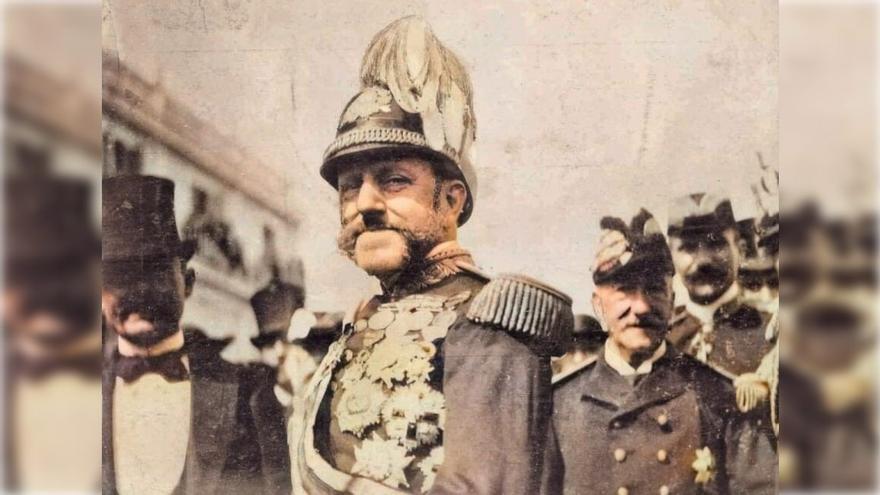
Valeriano Weyler, recognized as “the most sinister figure of the 19th century.” (Wikipedia)

14ymedio bigger14ymedio, Yunior García Aguilera, Madrid, 22 November 2023 — Cuban historiography recognizes Valeriano Weyler as one of the most nefarious characters in our history. And he certainly was. His “Reconcentration” policy caused the death of hundreds of thousands of civilians, especially children, women and the elderly. The “reconcentrated” were thrown together in the villages, surrounded by barbed wire. Families slept in doorways, streets and barracks, decimated by hunger and disease. American newspapers called him “the butcher,” “the most sinister figure of the 19th century.” And in the memory of Cubans he is recorded as a tropical Hitler.

For Spain, however, he was much more than an illustrious soldier. Not only did he participate in almost all the wars that the country fought in his time, but he was also captain general of Valencia, the Canary Islands, the Balearic Islands, the Philippines, Cuba, Catalonia, Burgos, Navarre and Vascongadas and Castilla la Nueva. He was recognized as a capable, hard and inflexible soldier, oblivious to conspiracies and political compromises. He was senator of the Kingdom for the Canary Islands, head of the Central General Staff, twice Minister of War and president of the Supreme Council of War and Navy. He received the titles of Marquis of Tenerife and Duke of Rubí, as well as Spanish nobility and the Golden Fleece.

Today there are some monuments in his honor. In Santa Cruz de Tenerife there is a square that bears his name. And on Madrid’s Marqués de Urquijo street, number 39, there is a commemorative plaque where you can read: “Valeriano Weyler, model of loyalty.” One might ask: how is it possible that, in our time, someone with war crimes has monuments in his name?

His defenders, who are not few, attribute the black legend of Weyler to a campaign of the American press at the time. It is true that the American yellow press sought to force the Government into conflict. It is also true that the enemies of Spanish Prime Minister Cánovas echoed those complaints in Spain. But that does not diminish Weyler’s responsibility in the genocide. continue reading

Arsenio Martínez-Campos, whom Weyler replaced, had admitted to feeling unable to implement those drastic measures, although perhaps inevitable, from a military point of view. Weyler defended himself from his critics by arguing: “You don’t fight a war with chocolates.” Was the Spanish general successful? To a certain extent. He managed to kill Antonio Maceo, the ’Bronze Titan’, and to “pacify” the western part of the Island. But at what price?

There are some monuments in his honor today. In Santa Cruz de Tenerife there is a square that bears his name

On the other hand, those who seek to clear Weyler’s name argue that the Reconcentration Policy was neither new nor was it practiced exclusively by Spain. They also defend the idea that the Weylerian measures sought to protect the peasants from the mambises [rebels] abuses. And here I take a break. It is obvious that not all Cubans sympathized with independence. It is true that many openly supported Spain, even with weapons. It is more than likely that some insurgents committed abuses against those who refused to help them or considered themselves traitors to the ideal of independence. It is undeniable that the incendiary torch, the widespread burning of the countryside,  practiced by the mambises contributed to the lack of food. However, the cruelty generated by Weyler’s policies was infinitely superior.

The images of the “reconcentrated”, with starving children and elderly, whose bones looked “like rings under a glove,” undoubtedly contributed to the decision of the United States to interfere. As some historians claim, it is possible that Weyler was winning on the battlefields, but he was definitely losing the battle of communication.

When the Mallorcan general was about to start the final offensive against the insurgents, an Italian anarchist murdered Anotnio Cánovas del Castillo in Spain. Spanish Prime Minister Mateo Sagasta, with whom he alternated in power for years, was among those looking for the path of negotiation. Weyler was leaving Cuba, taking as loot the watch, revolver and saddle of his archenemy Antonio Maceo. They say that a crowd went to the port of Havana to say goodbye to him as a hero. That’s how absurd and contradictory the real story is.

For millions of Cubans, there is only one character capable of accumulating more hatred and resentment than Weyler: Fidel Castro. For many, all of Cuba has been a huge concentration camp for more than six decades, where hunger has spread. The bearded man also has statues and monuments in various parts of the world. He also enjoyed a long life, like Weyler, who died at the age of 92.

No one who commits genocide should have statues, no matter how “heroic” some people think them.

Translated by Regina Anavy 

____________

COLLABORATE WITH OUR WORKThe 14ymedio team is committed to practicing serious journalism that reflects Cuba’s reality in all its depth. Thank you for joining us on this long journey. We invite you to continue supporting us by becoming a member of 14ymedio now. Together we can continue transforming journalism in Cuba.
In the Cuban Province of Holguin, a Town of Potters Lives Outside the Law

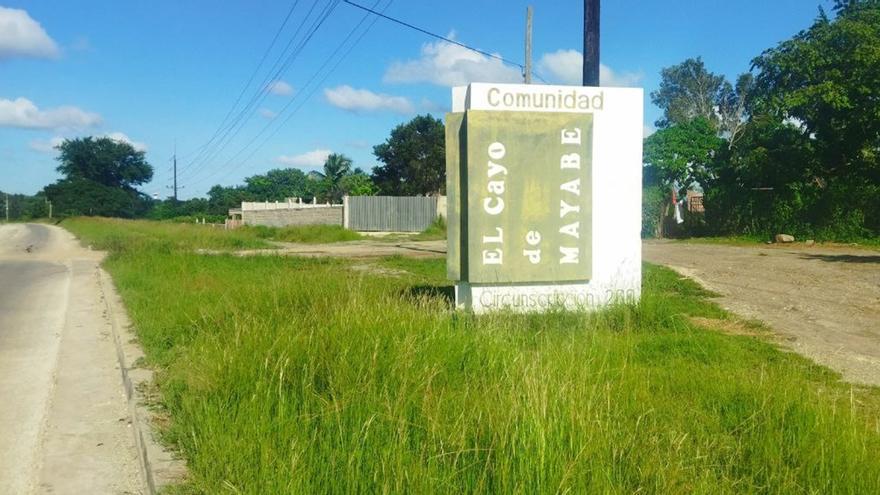
Entrance to the community of Cayo de Mayabe, a small town of potters in Holguín. (14ymedio)

14ymedio bigger14ymedio, Miguel García, Holguín, 12 November 2023 — The red earth is everywhere. Stuck to the soles of the shoes, tucked between the boards of the houses and also on the bricks that come out of the oven in the Cayo de Mayabe community, a small town of potters who work outside the law and supply most of the bricks for the city of Holguín.

“This is a hard job and living here is even harder,” says Anastasio, one of the first inhabitants of the neighborhood, which was set up at the end of the 1960s. In his family there are now three generations who work in the brick factories that dot the entire area. The reddish color of the terrain has gotten into the skin of his hands and under his nails after decades of work.

In the neighborhood, made up of very low-income people, services are scarce: an elementary school, a doctor’s office, a food point of sale and a bleak park that was only cleaned and painted when State officials visited it. Outside those areas, people can be found in the halls of two evangelical churches, one Pentecostal and one Methodist.

Earth and water are thrown onto the so-called ’step’  and then mixed to form the mass of the bricks. (14ymedio)

In Cayo de Mayabe there are also, currently, about twenty brick factories where potters, from the early hours of the morning, shape the artisanal bricks and bake them. As the day progresses, these places are empty; not a soul peeks out there. Only the tables, the oven and part of the bricks are left. Working very early is vital for avoiding the midday heat and the police.

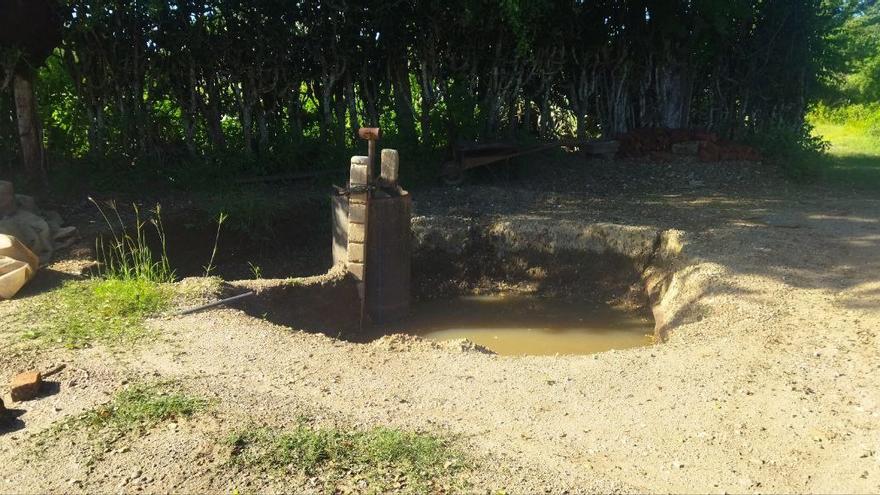
“They make our lives impossible,” Anastasio tells 14ymedio. “They don’t let us work but everyone knows that this city is built with the brick that comes from this little piece of land,” clarifies the man as he leans over the step, looking at the sinkhole into which the earth is thrown, the water added and the mixture prepared.

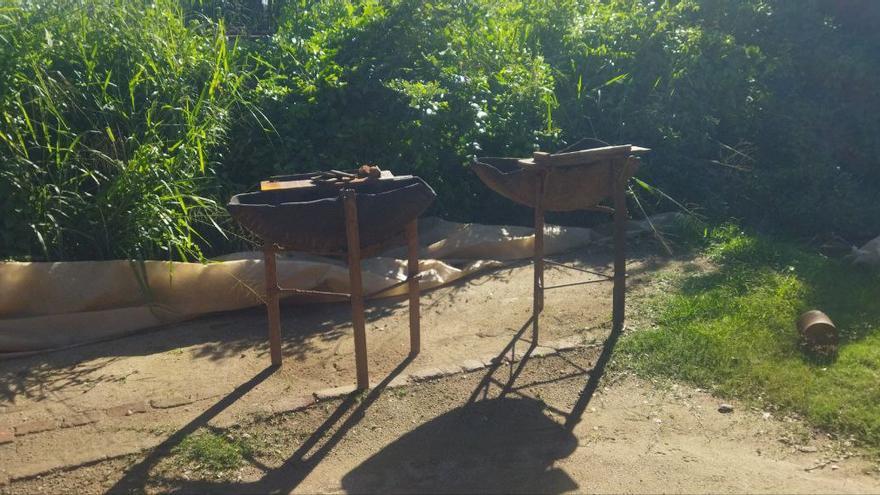
“This is a difficult part of the job ,and it takes a lot of effort because you have to grind the soil with a stick and keep it thin,” he explains. “Then you have to form the bricks on those potter’s tables,” he says, pointing to two raised metal vessels where “the hands and skills of the worker are what give quality to the shape and the compactness of the brick.”

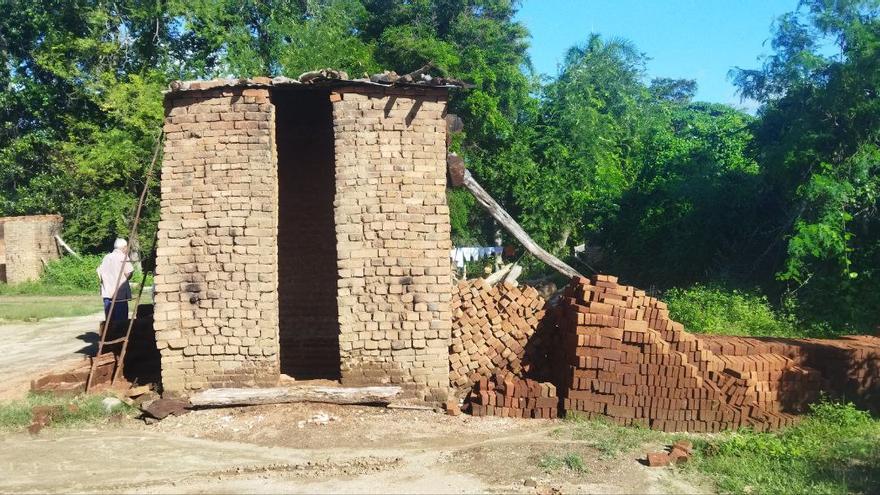
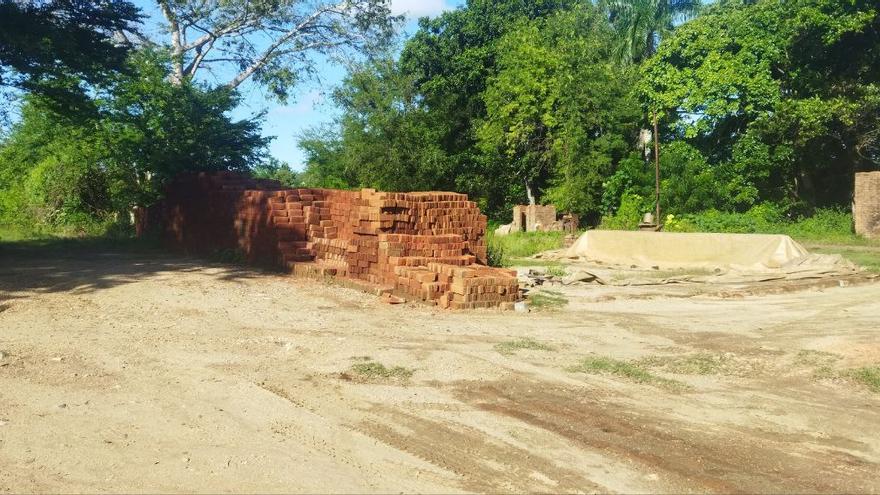
A few feet away, an oven that is taller than a man is the next step in this informal manufacture. Once the pieces are baked, they are placed in a pile and sold for 11 Cuban pesos each. “People come here to buy because the continue reading

State does not make or sell bricks anywhere in the city.”

Both Anastasio and Leonel are aware that the holes they dig to extract the soil they need for the bricks affect their environment. (14ymedio)

When the sun starts to rise, the potters slip away and leave the factories empty. “We can’t stay even if we know that they can steal our merchandise, since no one wants to be caught and fined,” the man explains. There are times when they have to leave for long days because there are operations in the area, and when they return, part of their production has been stolen.

The brick factories of Cayo de Mayabe are illegal in the eyes of the authorities because the potters of the community don’t have a self-employment license to carry out this work. A few years ago some of them decided to become official, but shortly after they went back into hiding.

“We had the license and had to pay for it every month, but they didn’t sell us the raw material or allow us to extract it,” says Leonel, a young man who has been working with his father and brother in the family’s business for more than five years. “After a while we gave back the rights, and we continue working under the radar.”

The main material of the artisanal brick is mud, made with the reddish earth of the area, rich in clay. But there is no official place to buy this product, and the authorities prohibit it from being extracted. After a few years of accepting registrations for the potter’s license in the area, the local government closed off that possibility.

The bricks are shaped on the potter’s table. (14ymedio)

“They tell us that they can’t give a license to someone who doesn’t show the legal documents for the earth extractions,” Leonel emphasizes. “But they themselves know that there is no such thing as having it because it is not legally sold anywhere; the only way is by digging and opening up holes.”

When the rights were given to practice the pottery profession in Cayo de Mayabe, self-employed people were prohibited from hiring staff; only members of the same family group could work in the factory. However, then and now, when the work has been absolutely immersed in illegality, those craft workshops are the main source of employment for the locals.

If Cayo de Mayabe was already considered an area of poor people, several groups have emerged in the community with people who migrated from more remote municipalities wearing only what they had on. Over the years and with the departure of the youngest to Havana or abroad, the town’s population has been aging.

“Some 2,500 people live here, and right now the work in the brick factories is getting complicated because there is a lack of young arms,” Leonel acknowledges. “My father is still working with us but he can no longer do the mixing or other hard parts of the process. He’s now in charge of taking care of the people who come to buy the bricks.”

The sale, however, is not going well. The economic crisis that the Island is going through, the lack of fuel to carry the merchandise and the slowdown in tourism have decreased demand. “Sometimes we spend weeks without selling a brick, and that’s very serious because here the brick is what feeds us.”

An oven to bake bricks in the community of potters of Cayo de Mayabe. (14ymedio)

Among the clients that Leonel’s family has, there are people who are renovating or building their home, entrepreneurs in the city who are expanding a private hostel, others who improve a paladar (private home restaurant) or who want to decorate an interior patio with the handmade, reddish pieces. A few non-agricultural cooperatives also bought them “occasionally.”

Both Anastasio and Leonel are aware that the holes they dig to extract the soil for their bricks affect their environment. They cause erosion of the soils, damage to vegetation and water that stagnates in the sinkholes, increasing the risk of the growth and emergence of Aedes aegypti mosquitoes, with the consequent danger of dengue fever.

“Where the plant layer of the earth is removed, there are rocks  where plants do not grow; nor can cows, goats and horses graze on those lands,” warns the young man. “But what are we going to do? This is what we know, this is how we feed our children. If they don’t sell us the land, we will have to steal it.”

By a rusty swing, in the only park in the community, a young woman threw an inflatable ball to her little son on Tuesday. “Here we lack everything; we don’t even have a bodega (ration store) to shop in.  We have to travel  two or three miles to get the little sugar and rice they sell us,” she explains to this newspaper.

After leaving the oven, the bricks are stacked for sale. (14ymedio)

The terrible condition of the roads around Cayo de Mayabe complicates the transfer. “The water they pump does not reach here, so we have to take the water from the wells that we have in our courtyards, but we already know that it is not good to drink.” The woman lists her demands: “a butcher shop, a bodega and a place to buy milk,” but clarifies that this is just “to begin with.”

“Here, a year ago, leaders came to visit and even brought some foreigners,” recalls the holguinera. “That’s when we were classified as a prioritized community of social complexity.” In 2022, with great fanfare, they built the park where a mother can go with her child. The weeds and rust go hand in hand where before the painting shone and the officials took photos for the official press.

As the ball goes up and down, a horse cart enters the neighborhood. “It comes to carry bricks,” the woman ventures. The red earth of the area sticks to the wheels, the same earth that feeds the potters of Cayo de Mayabe.

The community of Cayo de Mayabe was founded at the end of the 1960s. (14ymedio)

Translated by Regina Anavy 

____________

COLLABORATE WITH OUR WORKThe 14ymedio team is committed to practicing serious journalism that reflects Cuba’s reality in all its depth. Thank you for joining us on this long journey. We invite you to continue supporting us by becoming a member of 14ymedio now. Together we can continue transforming journalism in Cuba.
Havana’s 100-Year-Old Reina Street Church Restored with Funds of Unknown Origin

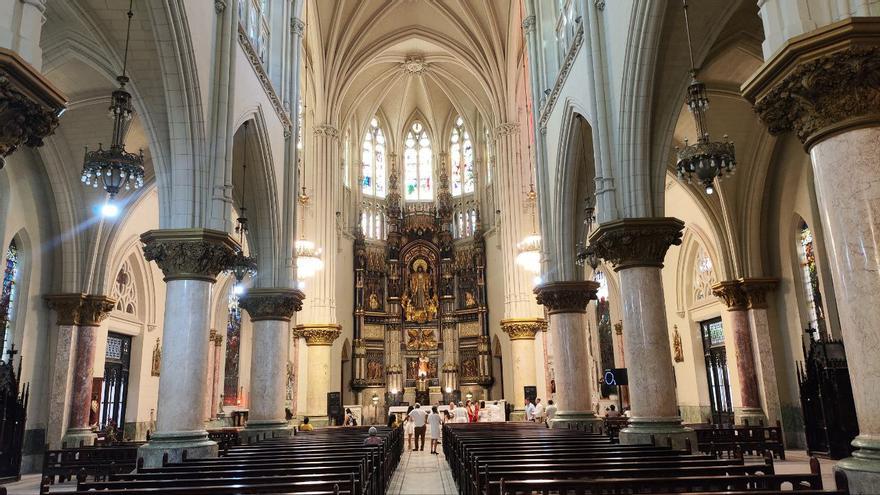
Built a century ago by the then all-powerful Jesuit order, the construction was made possible by contributions from important Cuban families. (14ymedio)

14ymedio bigger14ymedio, Juan Diego Rodriguez, Havana, 22 November 2023 –Dust-free altars, new paint and luminous stained glass. One of the most iconic buildings in Central Habana, Sacred Heart Church on Reina Street is celebrating its centenary after a major renovation. Though the scaffolding has been removed and the interior is spotless, questions remain. Who financed the project? How much did it cost? Given the friction between the two in recent years, did the government make the process difficult for Jesuits, who have been in charge of the building since its consecration in 1923?

Jorge Luis Rojas, the priest in charge of the renovation, is tight-lipped. When asked about the project, he declines to give details, saying he is not authorized to reveal who paid for it, or if Havana’s Office of the Historian provided technical advice or finanancing.

However, the quality and pace of construction — the project took three years from start to finish, in time for the centennial — suggest that it was the Catholic Church itself, through its financial associations, and the Jesuits who provided the necessary funds.

Two German organizations which routinely pay for construction costs in Cuba on behalf of the Catholic Church are Adveniat and Kirche In Not (Church in Need), which describe themselves as “donation-based continue reading

intermediary charitable institutions.” However, 14ymedio was unable to obtain confirmation from Jesuit sources in Havana that these organizations were involved in the project.

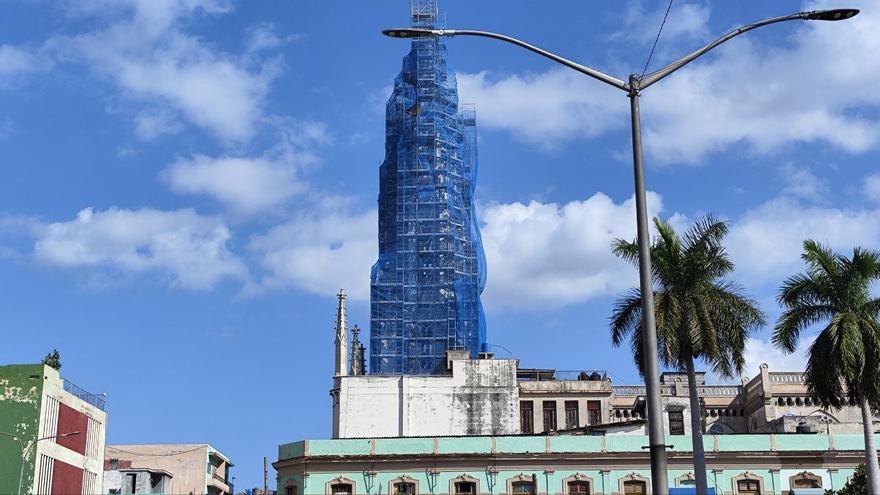
The iconic tower, one of the capital’s tallest structures, remains covered by scaffolding and protective mesh.

When asked about it, vendors selling prayer cards at the building entrance reply tersely, “It’s being done with church money.”

What is certain, however, is that the religious order needed government permission and resources to carry out a work of this caliber. The final phase of construction is now underway outside. The iconic tower, one of the tallest structures in the capital, remains covered by scaffolding and protective mesh.

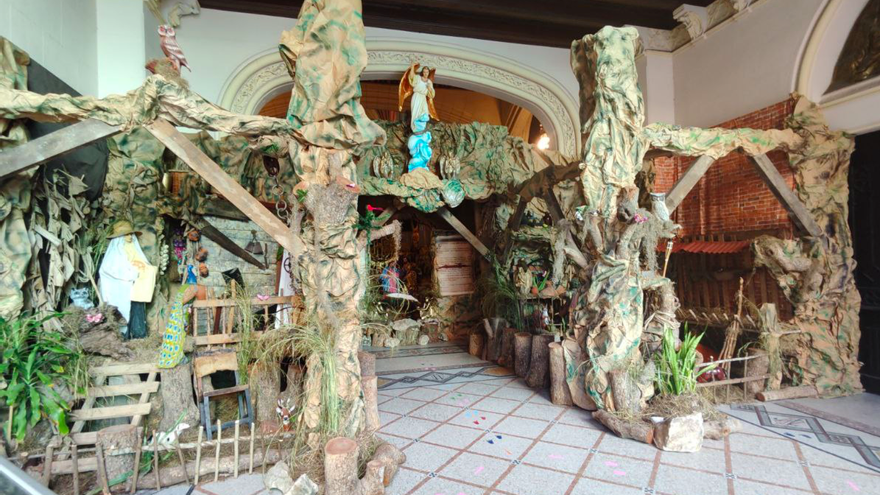
The Reina Street church, as it is known to locals, is not only one of the most sumptuous religious buildings in the city, it also dared to hang semi-public Christmas decorations during Cuba’s Special Period in the late 1990s.

Built a century ago by the then all-powerful Jesuit order, the construction was made possible by contributions from important Cuban families. Fr. Luis Gogorza and the architect Eugenio Dediot oversaw the project.

The Jesuits still mount a crèche, or Nativity scene, to celebrate Christ’s birth. (14ymedio)

Fidel Castro persecuted and later disbanded several organizations that met at the church both before and a few years after the Cuban revolution. One of them was the Catholic University Group, founded by a Jesuit priest, Fr. Felipe Rey de Castro, in 1927. It became a thorn in the side of Fulgencio Batista after publishing a survey on the deterioration of the country during his presidency. It later presented a problem for the Castro regime when many of its members arose in protest – taking up arms – in response to the island’s drift towards communism.

There is little to remind visitors of this past in the old neo-Gothic church. In the midst of a crisis that affects every aspect of daily life, Havana residents visit the church to be impressed by the stained glass windows and, perhaps, to forget that the rest of Havana, with the exception of a portion of its historic center, has no benefactor restoring it.

____________

COLLABORATE WITH OUR WORKThe 14ymedio team is committed to practicing serious journalism that reflects Cuba’s reality in all its depth. Thank you for joining us on this long journey. We invite you to continue supporting us by becoming a member of 14ymedio now. Together we can continue transforming journalism in Cuba.

The Opening of a Russian Store in Havana in 2024 Is Confirmed Without Clarifying What Currency Is Needed: Cuban Pesos or Foreign Currency

Cubans are annoyed because in most of the stocked stores you can only pay in foreign currency. (14ymedio)

14ymedio bigger14ymedio, Madrid, November 13, 2023 — The official press echoed this Sunday the announcement of the opening of a Russian products store in Havana, a project between the RusMarket brand and the state-owned Cimex that had already been advanced eight months ago but now has a tentative date: March 2024.

At that time, Evguéni Meytes, representative of the company, was hired during his visit to Havana on the occasion of the International Fair of Havana (FIHAV), which concluded this Saturday.

“We have very fraternal relations with the Island. The leadership of our country said last year that we had to strengthen mutual ties, and one of the expressions of that consolidation is the opening of this store. We are happy to show here high-quality products for the Cuban market,” he said at the time he announced to Sputnik the opening of the store, which will sell canned meats and vegetables, chocolates, and champagne from the firm Abrau. continue reading

To know this information, as well as the probable location of the store, which could be in Yumurí (corner Belascoaín and Carlos III) or in Cuatro Caminos, according to Meytes, you have to read the Moscow press. Cubadebate barely picks up the words of the general director of RusMarket, Alexander Belchikov.

To know this data, as well as the probable location of the store, which could be in Yumurí (corner Belascoaín and Carlos III) or in Cuatro Caminos, according to Meytes, you have to read the Moscow press

“The RusMarket project is intended for the long term and includes the opening of the first Russian product store on the Island, since most of the Cuban population remembers these goods, so we will create a joint venture that will begin to operate before the end of 2023,” he said.

The businessman spoke of a huge range of products that go beyond food, although that would be a second phase that would include spare parts for cars, machinery, construction equipment and materials, appliances, textiles and clothing.

“We want to introduce Russian products into the Cuban market and, in the same way, serve as a gateway to Russia for Cuban products. Our company aims to become a link between the two countries,” said Belchikov, who spoke of the intense relations between the Island and the Eurasian giant, both at the governmental and business level.

But the news lacks the most important thing, in the opinion of the readers, who have rushed to ask for information about the currency in which the products will be sold. “The news is incomplete, as usual. He left out the part about which currency ordinary Cubans will use to be able to purchase these necessary products. In my opinion, I don’t think it’s in CUP (Cuban pesos) but in dollars,” admitted a reader of Cubadebate.

The feeling that there is no other option permeates the dozens of comments, due to past experiences and the reasoning that most of them make about the uselessness of the national currency. “And what are the Russians going to do with the CUP collected? Go to Moscow to buy more merchandise with that money? I don’t think so,” one points out.

“It will have to be in MLC (freely convertible currency), since it is the only way for the supplier to collect their expenses and profits,” another reasoned. “But of course, it’s elementary. Why would RusMarket want to sell in CUP? What are they going to do with the CUP, to continue supplying that market?” asked another.

The rejection of that evidence is present in many other messages that welcome the initiative as long as it’s not in foreign currency, since, as another reader points out: “We are all in need, and we must think about protecting the entire population; otherwise we will not solve anything.” Doubts about whether the store will be a wholesaler or retailer and the indignation that every new opportunity is located in the capital also abound in the comments.

It will have to be in MLC (freely convertible currency), since it is the only way for the supplier to collect their expenses and profits

Russians, meanwhile, are focused on their own business. The event was also attended by Olga Sidorik, export manager of the Ladoga alcoholic beverage group, who highlighted Cuba’s potential as a recipient of those products, thinking about tourism.

“We have many years of friendship, and we believe that we can do good business here. We have not yet established anything, but there are several negotiations planned for this fair. Let’s wait for our return to achieve the realization of some, because there is a lot of potential for the sale of our products,” she told Sputnik.

Between January and October, about 146,305 Russian tourists traveled to Cuba, increasing by 3.5 times the number of travelers in the same period of 2022 according to the Association of Tour Operators of Cuba, which aspires to recover figures prior to the pandemic, such as the 178,000 received in 2019. However, already that year a shift of travelers to other destinations such as the Dominican Republic began to be noticed, with a similar offers but more benefits than the – increasingly – impoverished Island.

Translated by Regina Anavy

____________

COLLABORATE WITH OUR WORKThe 14ymedio team is committed to practicing serious journalism that reflects Cuba’s reality in all its depth. Thank you for joining us on this long journey. We invite you to continue supporting us by becoming a member of 14ymedio now. Together we can continue transforming journalism in Cuba.
Russia Defeats Cuba (8–0) in a Friendly Soccer Match in the Former Stalingrad Stadium

Calvo and Pinyaev fight for a ball during the match, played this Monday in Volgograd. (Ivan Rybalko)

14ymedio biggerEFE (via 14ymedio), Moscow, 21 November 2023 — The Russian national team overwhelmed Cuba (8-0) this Monday in an unprecedented friendly match played in the city of Volgograd.

The locals scored three goals in the first 45 minutes through Obliakov, Golovin and Antón Miranchuk. The weak Cuban team conceded another five goals in the second half, the work of Silianov, Sobolev, Prutsev, Krivtsov and Mostovói.

The Russian Piniaev missed a penalty in the 85th minute, a shot that was stopped by the Cuban goalkeeper.

The match, which was attended by more than 40,000 spectators, was played in the Volgograd arena, the stadium located on the banks of the Volga River, in ancient Stalingrad, the scene of one of the bloodiest battles in history.

The match, which was attended by more than 40,000 spectators, was played in the Volgograd arena, the stadium located on the banks of the Volga River

It was the biggest victory of the team led by Valeri Karpin since it was excluded from international competitions due to the war in Ukraine in February 2022.

The Cuban coach, Yunielys Castillo, started with the following eleven: Arozarena; Pérez, Díaz, Sánchez, Calvo; Torres, Morrejón, Espino, Gloor, Paradela and Delgado.

Russia had never faced the Cuban national team before. The only precedent was the match played between the Soviet Union and the Cuban national team at the 1980 Moscow Olympic Games, with the same result (8-0).

During the last two years, the Russians have had to face teams such as Cameroon, Kenya, Uzbekistan, Iran and Iraq due to the refusal of top-level teams to compete against the vilified Slavic team.

Translated by Regina Anavy

____________

COLLABORATE WITH OUR WORKThe 14ymedio team is committed to practicing serious journalism that reflects Cuba’s reality in all its depth. Thank you for joining us on this long journey. We invite you to continue supporting us by becoming a member of 14ymedio now. Together we can continue transforming journalism in Cuba.
At Least Twelve Ladies in White Were Arrested in Cuba This Sunday, Denounces Berta Soler

In January 2022, when the Ladies in White marched again after a pause due to the pandemic, Berta Soler herself was arrested. (Capture)

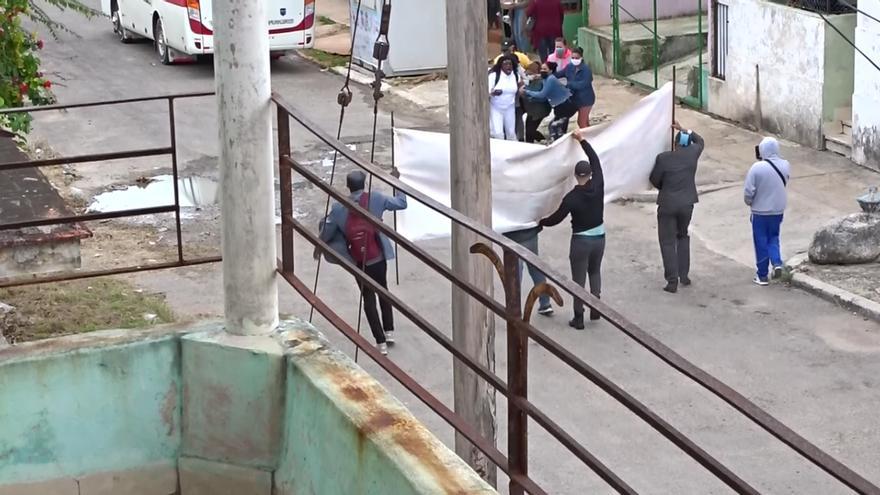
14ymedio biggerEFE (via 14ymedio), Havana, November 21, 2023 — The leader of the Cuban women’s opposition movement Damas de Blanco [Ladies in White], Berta Soler, denounced on Monday the arrest of at least 12 members of her group, a day before and in different parts of the country, to prevent their attendance at the religious service in Catholic temples.

Soler warned from her social networks that several of her colleagues were temporarily detained in police stations in the towns of Colón, Unión de Reues and Cárdenas, all in the province of Matanzas, and another n the Havana neighborhood of Calabazar, who was held for two hours inside a patrol car.

This was the 67th Sunday since, in 2022, the Ladies in White began to report acts of repression against them when they leave their homes with the intention of going to church.

Members of the organization have been arrested almost every Sunday since – in January 2022 – they decided to march again, after a pause due to the pandemic, to demand the release of those arrested in the protests of 11 July 2021 and other political prisoners. continue reading

The Ladies in White movement emerged in 2003 on the initiative of a group of women relatives of the 75 dissidents and independent journalists who were sentenced to lengthy prison sentences during the Black Spring.

In 2005, the Ladies in White received the Sakharov Prize for Freedom of Conscience from the European Parliament.

Translated by Regina Anavy

____________

COLLABORATE WITH OUR WORKThe 14ymedio team is committed to practicing serious journalism that reflects Cuba’s reality in all its depth. Thank you for joining us on this long journey. We invite you to continue supporting us by becoming a member of 14ymedio now. Together we can continue transforming journalism in Cuba.
The French Return to the Coffee Plantation They Founded in Cuba at the End of the 18th Century

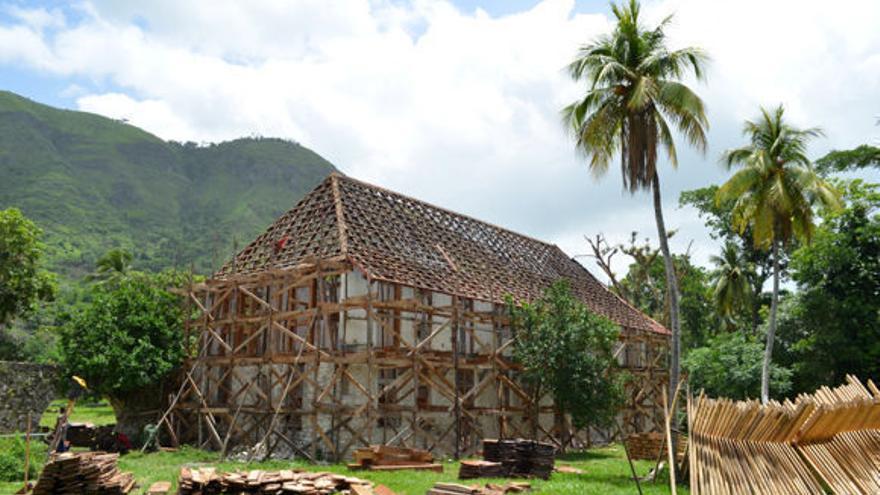
The house of the La Fraternidad estate, in the Santiago town of Ramón de Las Yaguas, in 2018. (Cubadebate)

14ymedio bigger14ymedio, Madrid, November 10, 2023 — The French company Malongo committed this Thursday with the state agroforestry company Gran Piedra Baconao, from Santiago de Cuba, to invest in coffee production on the Island. The agreement was signed on the National Day of France of the International Fair of Havana (Fihav), which concludes this Friday.

The project aims to develop the area of the Santiago town of Ramón de Las Yaguas, in the municipality of Songo la Maya, as Malongo’s own director, Jean Pierre Blanc, told state television, to increase coffee bean productivity.

The old coffee farm La Fraternidad is located in the same place and dates from the end of the 18th century.  Its ruins have been restored for years with money from the European Union and the Malongo firm itself.

It was precisely the French who founded the coffee plantation, in 1791, after fleeing the Revolution of Saint Domingue (1791-1804) and the “black Jacobins” in Haiti. The name of the estate refers to one of the elements of the French motto of 1789 (“liberté, egalité, fraternité”: freedom, equality, fraternity). continue reading

“It is a complete business project that requires foreign investment, training and technology transfer to raise the quality of the coffee that will be produced and that will then be marketed abroad,” explained the official Cuban News Agency. The product that will come out of these facilities, then, will not be for domestic consumption but for export, despite the shortage of coffee in the Cuban market.

It is a complete business project that requires foreign investment, training and technology transfer to raise the quality of coffee

Malongo promotes itself as a “specialist in organic and fair-trade coffees,” with a proposal for “top-end coffees, from the noblest terroirs, grown according to ancestral agricultural methods within small family plantations.”

Similarly, Lavazza, one of the most prestigious coffee brands in the world, presented in Spain last month a premium organic coffee from the Island, where the Italian group has, since 2018, “a sustainable development program” in collaboration with several institutions and local authorities to reactivate the cultivation of the bean.

Lavazza said in its presentation that its collaboration with Cuba “takes care of the farmers, promotes the role of women and young people, helps the environment in terms of conservation of forests and the exchange of good agricultural practices.” It has offered specific training to local producers “in the implementation of a controlled fermentation process in the harvest of robusta [a type of coffee].”

Also, within the framework of the Fihav, the French ambassador in Havana, Laurent Burin des Roziers, celebrated the commercial relations between Cuba and his country, and he highlighted the presence on the Island of companies such as SGC, Robertet, Stratégie Bois, Eximes Caribe S.L, Serfer Kinetrol, Becsol, Venus Enterprises and Cintra Logist S.L.

For her part, Ana Teresita González Fraga, Deputy Minister of Foreign Trade and Foreign Investment, recalled that France is “one of our main partners on the European continent and the fourth on a global scale, which shows the good state of diplomatic relations between the two peoples for 120 years.”

Translated by Regina Anavy 

____________

COLLABORATE WITH OUR WORKThe 14ymedio team is committed to practicing serious journalism that reflects Cuba’s reality in all its depth. Thank you for joining us on this long journey. We invite you to continue supporting us by becoming a member of 14ymedio now. Together we can continue transforming journalism in Cuba.
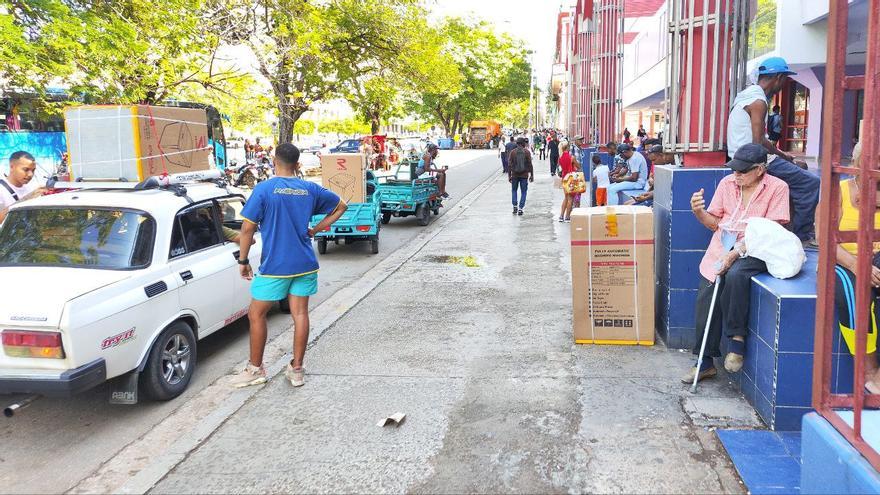
Washing Machines, from Havana’s Plaza de Carlos III Directly to the On-Line Shopping Site Revolico

The washing machines excited the customers of the Plaza de Carlos III, some of whom took several. (14ymedio)

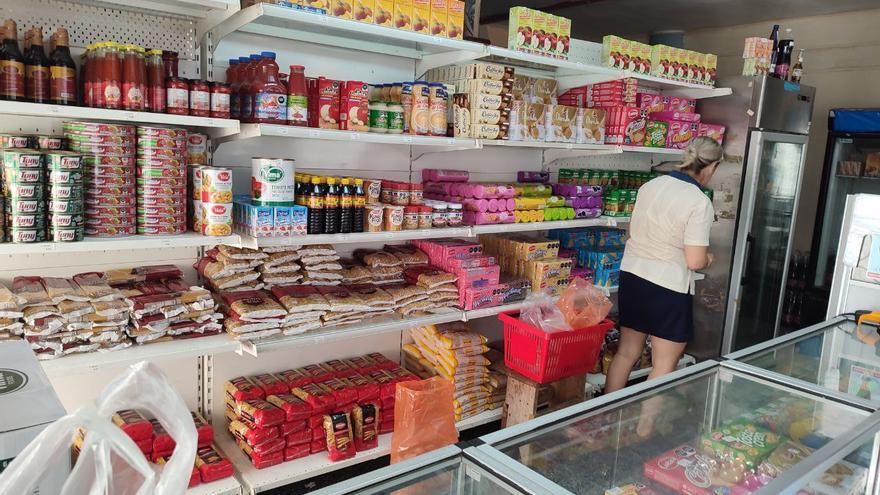
14ymedio bigger14ymedio, Juan Diego Rodríguez, Havana, November 20, 2023 — The longest line of the day in the Plaza de Carlos III had a reason this Monday: the store brought out automatic washing machines for 384 MLC (freely convertible currency, effectively $384 US). Several dozen people crowded the store, located in the part of the Centro Habana shopping center that accepts only foreign currency; the majority left with several washing machines.

At least three were bought, but in one case several men loaded six washing machines onto a single truck.

Although the price is equivalent to more than 92,000 pesos at the informal exchange rate, it was a golden opportunity: the same appliance, with similar characteristics, is sold for $480 on the online shopping site Revolico. continue reading

Everyone seems to win, but, as a side effect, in the network of hard currency markets there is a shortage of certain goods that are hoarded while waiting for a client to pay in foreign currency

Many digital shopping sites base their offers on devices purchased in the network of stores that only accept payment in MLC. The Cuban émigré pays for the product in dollars and the merchants guarantee delivery to their relative’s home on the Island. Everyone seems to win, but, as a side effect, in the network of foreign currency markets, certain merchandise is hoarded, waiting for a customer paying in foreign currency.

LED light bulbs, sandpaper, plumbing parts, microwave ovens and even pillows are among the offers that sell out quickly and immediately go to the informal network. Many times, the photo of the product that is posted in the online classified is from when it is still on display in the state store, with the original price covered of course.

The washing machines at Carlos III this Monday already belong entirely to the black market. The stores in MLC have become a direct route to supply these illegal trading networks.

____________

COLLABORATE WITH OUR WORKThe 14ymedio team is committed to practicing serious journalism that reflects Cuba’s reality in all its depth. Thank you for joining us on this long journey. We invite you to continue supporting us by becoming a member of 14ymedio now. Together we can continue transforming journalism in Cuba.
Blind Cuban Swimmer Yunerki Ortega Requests Legal Aid to Stay in Chile

Blind swimmer Yunerki Ortega left the Pan-American Villa in Chile in the early hours of Sunday. (Jit)

14ymedio bigger14ymedio, Havana, November 20, 2023 — The long list of athletes who left the Cuban delegation at the Pan American Games in Chile was joined this Sunday by blind swimmer Yunerki Ortega Ponce, who was part of the paralympic team. According to the T13 network, the “disappeared” Cuban contacted lawyer Mijail Bonito, who represents 13 other escapees in Chile.

The T13 reported that Ortega Ponce left the Pan-American Villa, where the athletes are staying, around 4:30 in the morning. “Passers-by helped him take a taxi to a service center near the National Stadium,” the network explained.

From the headquarters of the Parapan American Games, which end on November 26, Ortega Ponce went to a compatriot’s house and contacted the exiled Cuban lawyer Mijail Bonito to start his refugee process.

The lawyer told Ex Ante that he “could not refer to the case” of Yunerki Ortega Ponce, whom the police were looking for. The Cuban swimmer escaped hours after his participation in the 50-meter (165-feet) freestyle test in the S11 category, in which he finished in fifth place. continue reading

Ortega Ponce left the Villa Panamericana, where the athletes are staying, around 4:30 in the morning. “Passers-by helped him take a taxi to a service center near the National Stadium

Hours earlier, Yasmany Izquierdo Rojas, the Cuban swimmer’s friend, had been alerted of his absence and reported it to the managers of the Cuban delegation, who, after monitoring department 403, in Tower I of the Pan-American Villa, confirmed that Ortega Ponce had taken all his belongings.

Immediately the deputy head of the Cuban mission, Agustín Abril García, denounced the “disappearance” at the Cerrillos Police Station, located in the Villa, clarifying that they did not have “any record or proof of the swimmer’s departure” reported by the service guards during the night. The athlete, they stressed, didn’t answer their calls either.

The escape of Ortega Ponce joins that of the hockey players Yunia Milanés, Jennifer Martínez, Yakira Guillén, Lismary González, Helec Carta and Geidy Morales, and the bronze medalist in 400 meter (1300 foot) hurdles, Yoao Illas, just after his participation in the Pan American Games. Basketball players Betsy Guilarte Zamora and Lidier Vergara and three rowers, whose names have not been revealed, also escaped.

Despite the fact that the Communist Party has tried to discredit the arguments of the Cubans who have left to defend their reasons for leaving the delegation, they have already received temporary residence visas. The majority are training, and some have started a job search.

Last week, the Chamber of Deputies approved a request made by the Independent Democratic Union party asking President Gabriel Boric to “grant international protection and political asylum to the Cuban athletes” who decided to defect and remain in Chile.

Translated by Regina Anavy

____________

COLLABORATE WITH OUR WORKThe 14ymedio team is committed to practicing serious journalism that reflects Cuba’s reality in all its depth. Thank you for joining us on this long journey. We invite you to continue supporting us by becoming a member of 14ymedio now. Together we can continue transforming journalism in Cuba.
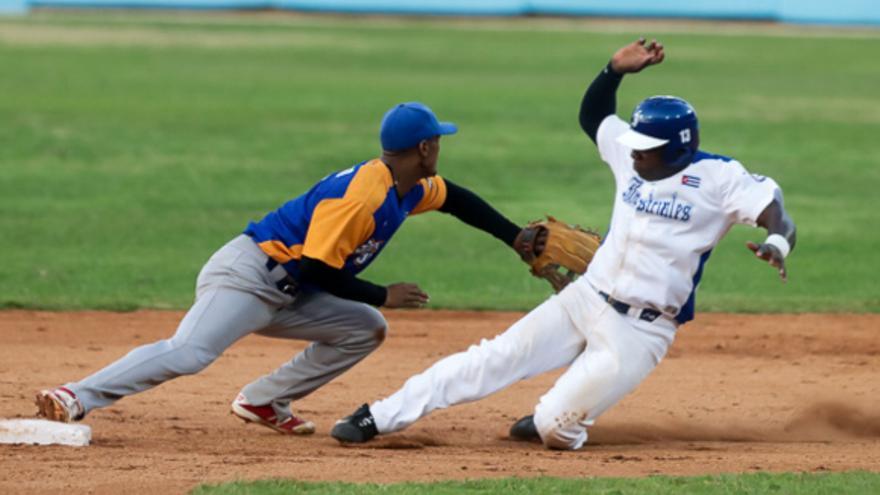
Illegal-Sized Bats, Defective Balls and Blackouts Harm Cuban Baseball

A game last Saturday between the Havana team, Industriales, and Los Gallos de Sancti Spíritus. (Cubadebate)

14ymedio bigger14ymedio, Havana, November 20, 2023 — Irregularities in the equipment of Cuban players, caused, among other reasons, by the lack of sports equipment on the Island, continue to hinder the development of the national game. This Saturday, habanero Yoasnier Emilio Pérez was expelled from the match between his team, Industriales, and Los Gallos de Sancti Spíritus for the use of an “illegal” bat during the Elite League.

The sports authorities, who issued a statement denouncing the fact, attributed it to Pérez’s personal indiscipline but did not clarify whether the decision to use an “ineligible” bat responded to the fact that the team did not have the equipment needed for a match of that level.

According to the National Baseball Commission, in the middle of the game the Sancti Spíritus team reported the irregularity, and it was determined that the bat used, in addition to not being registered as eligible, had a rubber grip of greater size than required by the regulations, which influenced the game, because a player could use it to gain a base and put the score in favor of Industriales. continue reading

The game, which ended three to two in favor of Industriales, is considered invalid, said the Commission, which also prohibited Pérez from playing in the rescheduled match with Sancti Spíritus and the following game, both to be held next Sunday

The game, which ended three to two in favor of Industriales, is considered invalid, said the Commission, which also prohibited Pérez from playing in the rescheduled match with Sancti Spíritus and the following game, both to be held next Sunday. The Industriales’ version of the facts, or that of the sanctioned player, is not known.

“Indisciplines” aside, the situation of sports on the Island is painful. Last Sunday, the official newspaper Escambray analyzed the impact on the performance of the baseball players during the daytime hours, a measure that has been decreed to save electricity and that exposes athletes to long hours of confrontation under the sun. Many of the night matches, the team complained, may end up being suspended due to blackouts.

The lack of bats, balls and uniforms has also been a cause of discomfort among the players, who saw the situation get out of control last May when, in a match between Los Elefantes de Cienfuegos and Los Gallos, the first team ran out of bats a few minutes after the start of the game. According to an article published in the official press, the cienfuegueros had previously warned of the lack of equipment, but there was no response from the authorities.

On the contrary, after the “incredible incident,” officials pointed out TeamMate as responsible, an Italian sportswear production company that has been in the news in Cuba for delivering defective balls, delaying deliveries and having links with Antonio Castro Soto Del Valle, son of Fidel Castro. For one ball, TeamMate charges almost twice the cost of the official balls of the Major Leagues of the United States, according to figures from the Cuban Baseball Federation, a price that the regime blames on the embargo.

The lack of bats, balls and uniforms has been a cause of discomfort among the players, who saw the situation get out of control last May in a match between Los Elefantes de Cienfuegos and Los Gallos

In other sports of lesser relevance on the Island, to which a smaller budget is dedicated, the crisis is even worse. This Saturday, Invasor gave an account of the difficulties suffered by basketball students in Ciego de Ávila and how neglect of the sport – which “is not as expensive as others” – affects the future of the game in the country.

The “anger” that coaches and athletes deal with, the media says, starts with not having at least one ball per player to optimize training time. According to Yunier Valdivia, director of the Sports Initiation School (EIDE) of the province, last year the center received thirty balls, but they were of poor quality.

The lack of footwear and ankle socks is another of the urgent needs of the school. Previously, footwear was guaranteed by the National Institute of Sports, Physical Education and Recreation (INDER), explains Valdivia. Now, he confesses, “You can only find shoes (…) exclusively in the informal market and for a price of at least 60 U.S. dollars.” The socks have also become the responsibility of the students who, when they find them, prefer to reserve them for competitions at the risk of suffering injuries during training.

The EIDE athletes, however, have had a major problem for decades: the school’s wooden court (tabloncillo) has “holes like it was continually jumped on,” says the director of the institution, Analiesses González.

The “angers” that coaches and athletes deal with, says the media, begin by not having at least one ball per player to optimize training time

At the moment, Gonzalez says, students train in the Giraldo Córdova Cardín Multipurpose Room, “the only one with the minimum conditions in the entire province,” or on concrete courts that increase the risk of injuries due to the lack of flexibility of the floor.

“It’s not just the tabloncilla [flooring], the complete situation of the institution is very complex,” acknowledged the official, who stressed that with the 70 million pesos dedicated to this year’s budget she could not even solve the critical problem of scholarships. The closure of one of the dormitory blocks due to the precarious condition of the bathrooms forces more than 300 students to live overcrowded in another building with the rest of the athletes and prevents the school from increasing its staff.

Repairs to the court and the gym have been included in the investment plan for 2024, but it is difficult to ensure that they will be carried out. Until the State and INDER decide to reinvest the profits of national tournaments and competitions in the sport, the EIDE basketball players and other Cuban athletes will remain in terrible conditions or will choose to leave the country.

Translated by Regina Anavy 

_________________

COLLABORATE WITH OUR WORKThe 14ymedio team is committed to practicing serious journalism that reflects Cuba’s reality in all its depth. Thank you for joining us on this long journey. We invite you to continue supporting us by becoming a member of 14ymedio now. Together we can continue transforming journalism in Cuba.
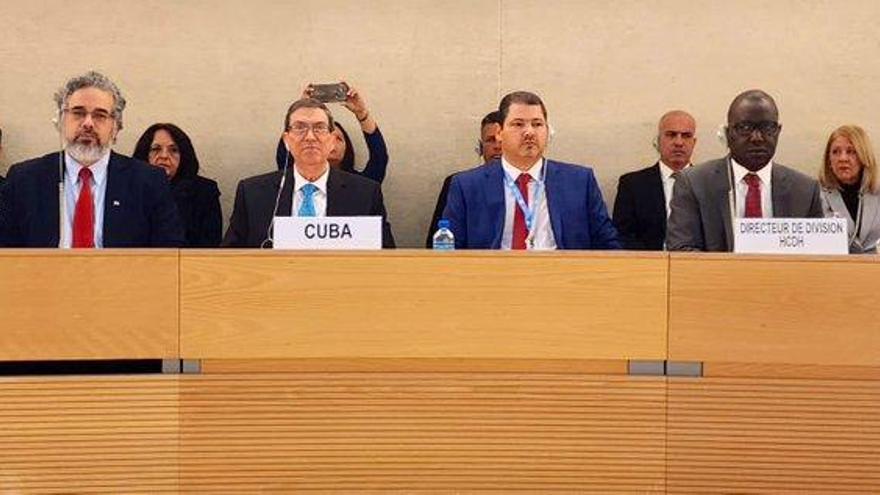
Three Officials Enter the List of Repressors for Defending the Cuban Regime in Geneva

Foreign Minister Bruno Rodríguez (second from left) headed the Cuban delegation in the Universal Periodic Review before the United Nations. (Cubadebate)

14ymedio bigger14ymedio, Madrid, 20 November 2023 — Since Monday, the three officials who defended the regime in the most recent Universal Periodic Review (UPR) before the Human Rights Council at the UN, on November 15, are on the list of Cuban repressors prepared by the Foundation for Human Rights in Cuba (FDHC). They are the jurist Yuri Pérez Martínez, the lieutenant colonel of the Ministry of the Interior Luis Emilio Cadaval San Martín and the doctor Carlos Alberto Martínez Blanco.

The three are classified as “exported repressors,” which are, according to the FDHC in a statement, “those agents of the regime sent abroad to organize, advise or even participate in repression in countries allied with the Government of Cuba, or in the subversion of order in democratic countries.” This includes “diplomats or other representatives of the Government who, from abroad, distort the harsh Cuban reality, spreading official propaganda instead.”

Thus, the organization, based in the United States, has opened a file on Yuri Pérez Martínez, a professor at the University of Havana, for stating in Geneva that the Cuban Constitution, approved in 2019, recognizes the freedoms of expression, assembly, demonstration and association, “without explaining that exercising them entails long prison sentences,” and for ensuring that on the Island the elections are free, democratic and transparent, ignoring that “independent candidates for municipal assemblies are blocked, threatened and repressed, and that the candidates for provincial and national assemblies are approved by a candidacy commission composed of members of organizations controlled by the Government.” continue reading

All three are classified as “exported repressors,” agents of the regime sent abroad

Emilio Cadaval San Martín, judicial advisor to the Department of State Security, for his part, “falsified the reality of the criminal procedure, assuring that arbitrary detentions are prohibited,” in addition to denying the existence of political prisoners in the country, suggesting that those in prison are common criminals who “committed offenses such as public disorder, failure to comply, contempt and sedition.”

Finally, Dr. Carlos Alberto Martínez Blanco, says the Foundation, “offered, based on official statistics, an idyllic picture of today’s dysfunctional public health system in Cuba, blaming the U.S. embargo for the shortcomings.” At the same time, the official “omitted information such as the enormous disproportion between investments in health and tourism, the dispossession and surveillance of which Cuban medical collaborators abroad are victims and the criminal policy of keeping the population defenseless against COVID-19 for almost a year while waiting for a Cuban vaccine to be ready.”

The three officials join the same register of repressors where, for example, two officers of the Border Guard Troops are found responsible for the sinking of a boat in Bahía Honda, Artemisa, where seven people died, including a two-year-old girl in 2022, as well as several officials in charge of the repression of peaceful protests and even Alberto González Casals, director of the International Press Center, in charge of foreign journalists.

Translated by Regina Anavy 

____________

COLLABORATE WITH OUR WORKThe 14ymedio team is committed to practicing serious journalism that reflects Cuba’s reality in all its depth. Thank you for joining us on this long journey. We invite you to continue supporting us by becoming a member of 14ymedio now. Together we can continue transforming journalism in Cuba.
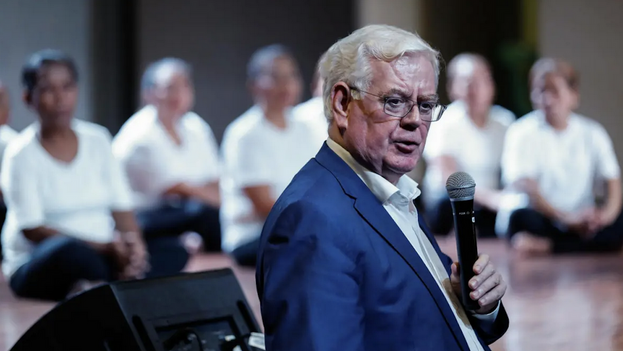
Eamon Gilmore and the Many Traps on His Trip to Cuba

Eamon Gilmore, special representative of the European Union for Human Rights, in Manila, Philippines, last March. (EFE/EPA/Rolex Dela Pena)

14ymedio bigger14ymedio, Yoani Sánchez, Generation Y, Havana, 20 November 2023 — This week, the visit of the special representative of the European Union (EU) for Human Rights, Eamon Gilmore, is expected in Cuba. The national context in which the official arrives could not be more adverse. In the midst of the most significant mass exodus in recent decades, with more than a thousand political prisoners and a deep economic crisis, the Island will give Josep Borrell’s envoy multiple headaches. The biggest challenge of his trip will be to avoid the daunting agenda that the Havana regime is preparing for him to prevent him from looking towards the most problematic and painful areas of Cuban reality.

Unlike other times, when information trickled out of the country, Gilmore has had at his disposal countless reports, testimonies and articles from the independent press that detail the magnitude of the repression we suffered. He has also been able to meet with exiles who have told him, first-hand, about the forced banishment, the travel ban that weighs on several dissidents, the threats against the families of those convicted of the popular protests of 11 July 2021, and the twist of censorship represented by the new Social Communication Law, already approved and which will soon come into force.

However, it is one thing to read all those alarming reports and listen to the stories of emigrants, and another, very different, to hear the voices of the victims within Cuba and include in the program contact with the most silenced and vulnerable part of our society.  On the Island, Gilmore will be another guest at the Plaza de la Revolución and will have to adhere to official protocol, which translates into the need to condemn the US embargo, praise public services — even if they only take him to schools and hospitals carefully ‘made up’ for the occasion — and to proclaim the “solid ties” of collaboration between the European Union and Havana. continue reading

Someone who protects Human Rights should go further, escape from the symbolic gestures and red carpets to delve into what ails and frightens a society

But someone who protects Human Rights should go further, escape from the symbolic gestures and red carpets to delve into what ails and frightens a society. If he follows a program in line with his position, Gilmore would not be able to avoid visiting at least one Cuban prison. Immersing himself in this underworld is vital to understanding the total absence of physical and legal guarantees that afflicts the prisoners. Speaking directly with political prisoners and their families would be vital to understanding what is happening on this island.

If the official also used the internet connection offered by the state telecommunications monopoly, Etecsa, during his stay, he could see for himself the dozens of blocked digital sites, especially those that offer national news without complying with the editorial guidelines of the Communist Party. A walk through the Cuban fields, not to the farms decorated for the eyes of international organizations, but to those of farmers who cannot even buy wire for their fences because agricultural inputs are sold only in foreign currency, would add nuances to his conclusions.

His could not miss on his trip the crowded airport hall where hundreds of men, most of them young and with light luggage, are preparing to board a plane to Managua to begin the migratory route. The failure of the model imposed more than six decades ago is summarized in those Cubans who leave seeking economic improvements and freedoms.

To the list of actions, Gilmore could add the surprise arrival at a ration market with its many flies and few products, in addition to the emergence of one of those businesses, which have appeared everywhere, where the price for thirty eggs is equivalent to one monthly salary. To top it off, a walk through a neighborhood on the outskirts of Havana is recommended, full of  people “illegal” in their own country, lacking drinking water service and opportunities.

All this and more would give the special representative of the European Union for Human Rights a complete and realistic vision of what we Cubans are experiencing. But between the traps of the official agenda and the timorous European diplomacy, it is possible to foresee that Gilmore’s visit will remain just one more, without ramifications for our citizens. After all, he is only in office for a brief period and the Cuban regime surpasses him with its 64 years of repressive experience.

________________________

Editor’s Note: This text was originally published in Deutsche Welle in Spanish.

____________

COLLABORATE WITH OUR WORKThe 14ymedio team is committed to practicing serious journalism that reflects Cuba’s reality in all its depth. Thank you for joining us on this long journey. We invite you to continue supporting us by becoming a member of 14ymedio now. Together we can continue transforming journalism in Cuba.

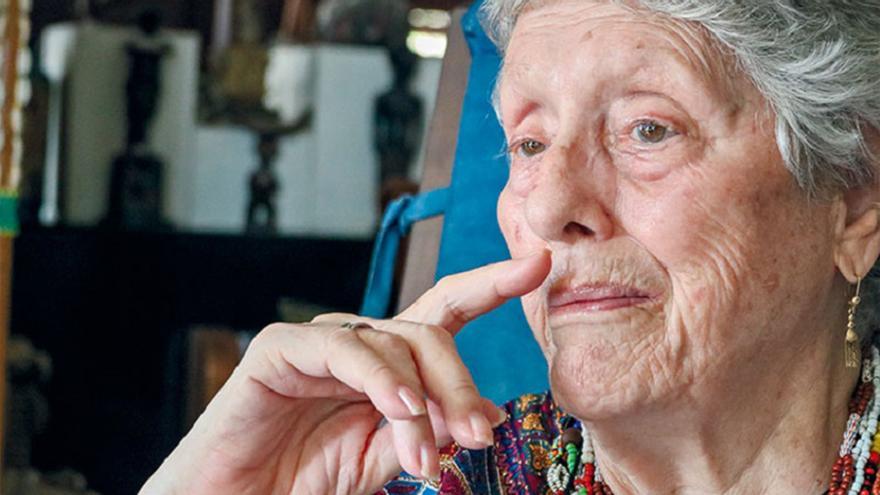
Cuban Ethnologist Natalia Bolivar Dies in Havana at the Age of 89

Researcher and essayist Natalia Bolívar studied African traditions and beliefs in Cuba as an anthropologist and ethnologist. (Prensa Latina)

14ymedio bigger14ymedio, Havana, 19 November 2023 — Cuban ethnologist, writer and painter Natalia Bolívar Aróstegui died this Sunday in Havana at the age of 89, according to the official press. The cause was not specified. With the death of the expert in Afro-Cuban religions, the Island loses one of the most versatile intellectuals of the twentieth century.

Born in the City of Havana on 16 September 1934, in a well-to-do family, she studied ballet as a child and was a swimming champion at the Biltmore Yacht Club. She studied at the American St. George School in the Cuban capital and then enrolled in the Sacred Heart Catholic center, where she graduated with a Bachelor of Science and Letters.

In the early 1950s, Bolívar took numerous courses in Havana and New York in Chinese, Spanish and Cuban art history. She began to feel attracted to anthropology and especially to Afro-Cuban culture, which she glimpsed very early thanks to her nanny, Isabel Cantero.

“She heard the stories of her mother, of Congo origin, and in those stories everything had life, and we went to sleep with those stories,” she recalled in an interview

“She heard the stories of her mother, of Congo origin, and in those stories everything had life, and we went to sleep with those stories,” she recalled in an interview. “I caught the bug of studying Afro-Cuban culture from her.” continue reading

Her passion led her to work at the National Museum of Fine Arts, as a guide and interpreter of English and French. Then she went to the Cuban Ethnology room of that institution, where she shared research with Lydia Cabrera. Hand in hand with the author of El Monte and the anthropologist Fernando Ortiz, she trained on topics such as research methodology, ethnography and Afro-Cuban ethnography.

Along with anthropology, Bolívar gained political awareness and at the end of the 1950s joined the Directorio Revolucionario to fight against the dictatorship of Fulgencia Batista. She was part of the organization when several of its members tried to assassinate the dictator in the Presidential Palace, an action that failed.

In July 1958 she was arrested and tortured in the dreaded Bureau of Investigation of Havana. After being released, she took shelter in the Brazilian Embassy but finally left and went underground.

In July 1958 she was arrested and tortured in the dreaded Bureau of Investigation of Havana. After being released, she took shelter in the Brazilian Embassy but finally left and went underground

In January 1959, with the coming to power of Fidel Castro, leader of the Movimiento 26 de julio, the figures linked to the Directorate took a back seat in the power networks. Bolívar was appointed director of what is now called the National Museum of Fine Arts, the Napoleonic Museum, the Decorative Arts and the Numismatic Museum.

From there she developed a frantic career that took her from advising films and plays, to giving lectures, publishing several anthropology books and organizing numerous exhibitions. However, her religiosity led her to experience difficult moments in the decades of greater atheism of Castroism.

Among her books, titles such as The Orishas in Cuba stand out, a volume that suffered censorship for years before reaching bookstores. Her works include Ituto: Death in Afro-Cuban Myths and Rituals; Opolopo Owó: the Divinatory Systems of the Rule of Ocha; Myths and Legends of Afro-Cuban Food and Holy Cuba.

In recent years, her criticism of the administration of the regime also rose in tone, and on several occasions she lamented the authoritarian drift of the Cuban leaders.

Translated by Regina Anavy

____________

COLLABORATE WITH OUR WORKThe 14ymedio team is committed to practicing serious journalism that reflects Cuba’s reality in all its depth. Thank you for joining us on this long journey. We invite you to continue supporting us by becoming a member of 14ymedio now. Together we can continue transforming journalism in Cuba.
To Sleep in Havana and Wake Up in Moscow

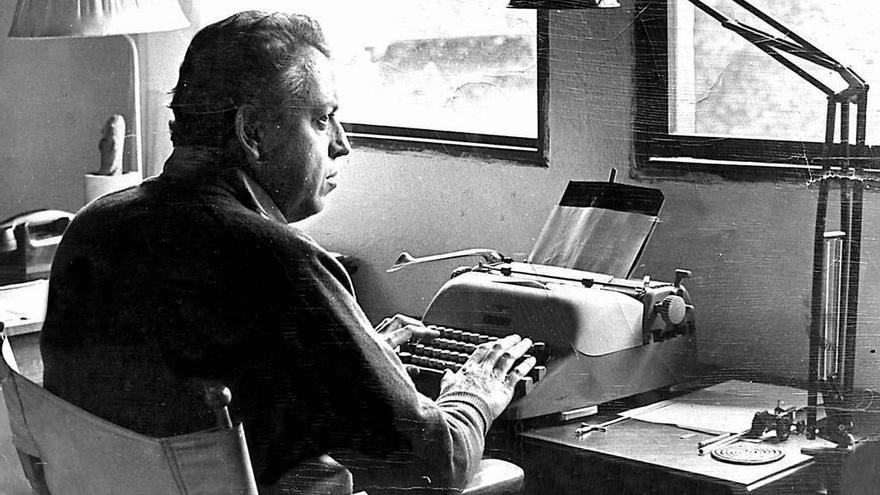
Ibargüengoitia was awarded, like so many promising young Latin Americans, by Casa de las Américas. (X/Casa Estudio One Hundred Years of Solitude)

14ymedio bigger14ymedio, Xavier Carbonell, Salamanca, 19 November 2023 — As with almost everything deep or interesting in Mexico, very few young readers in my country know Jorge Ibargüengoitia. Don’t panic: the cult of the writer with an arduous surname – which no one forgets to mention, and neither do I –  died along with 180 other people 40 years ago, when the plane in which he was traveling crashed near an implausible Madrid town, Mejorada del Campo, while the captain thundered “shut up, gringa!” against a robotic stewardess.

In 1963, Ibargüengoitia was awarded, like so many promising young Latin Americans, by that pretentious insane asylum that is Casa de las Américas. Thanks to the devastating chronicle he published after his visit, Cuba is perhaps the only country that forgot him on purpose and by ministerial decree, and not like the rest of the world, by carelessness.

As with so many things, I didn’t find a title of his again until I left the country of prohibitions

My first reading of Jorge Ibargüengoitia was Instrucciones para vivir en México [Instructions for Living in Mexico]. It was offered to me by a Mexican friend, at a time in life when I needed to be instructed, or at least initiated, in that complex profession. The planned trip never happened, but Ibargüengoitia remained in my memory. As with so many things, I didn’t find a title of his again until I left the country of prohibitions. It was Revolución en el jardín [Revolution in the Garden], in the edition of Reino de Redonda, whose prologue – by Juan Villoro – alludes to Ibargüengoitia as a man “with an astronaut’s haircut.” continue reading

That anthology contains the story of the problematic trip to Havana, where the writer arrived in 1964, to collect the prize for his novel Los relámpagos de agosto [The Lightning of August]. The previous year he had won the theater prize. He was named  and invited, caught a cold and returned to Mexico anesthetized by a bottle of Bacardí. He had spent fifteen days on the Island, with his passport confiscated by the cheerful jailers of Haydée Santamaría. The stench of Marxist optimism dissipated as soon as he saw his Latin American colleagues in the lobby of the Havana Libre, “discussing the future of humanity, trying to decide which cabaret they were going to.”

He soon understood that the former Hilton, converted into Fidel Castro’s burrow, was an allegory of the entire country. On the lower floors, the humble winners of the socialist emulation or the delegates to some plebeian congress; then, the Russians and the artists bewitched by the olive green utopia; and in the dome – “the Olympus” – select guests from capitalist countries, such as the English and German executives of Mercedes-Benz, in addition to the caudillo himself.

If the official State newspaper Granma interviewed him, it was not to ask him about his literary method, but to clarify that in Havana there was “a very important writer, who was called Jorge Ibargüengoitia and admired by the Cuban Revolution.” Then came an irritating expedition to Matanzas, Cienfuegos, Trinidad and Santa Clara. On that trip he met Samuel Feijóo, who told him that none of his students had ever touched a Historia del Arte [Art History]. (I, who knew several of those students fond of doodling, can confirm it.) He didn’t have to tell Ibargüengoitia twice, and the Mexican writer left Las Villas convinced that Feijóo was at the zenith of his career: “He had managed to gather a collection of quite complex shit.”

Revolution in the Garden’ diagnoses, with the perplexity that the Mexican never abandoned, everything that in 1971 Jorge Edwards detected in ’Persona non grata’

Revolution in the Garden diagnoses, with the perplexity that the Mexican never abandoned, everything that in 1971 Jorge Edwards detected in Persona non grata. And he did it first. No drama or bad feelings, no fear when Havana barked and bit and those who went to bed there suddenly woke up – after several magical passes of Castro – in Moscow. His fundamental lesson for literature is to write from lack of inhibition and wit, without the coarse humor that characterizes the Latin American, a level that was only achieved in Spanish – and not always – by Cabrera Infante, Eduardo Mendoza and two or three characters from Bolaño.

After several decades as a writer “for a select minority,” as he defined himself, the man with the cosmonaut’s haircut is finally getting his moment. From a cult author he has become a classic, but in the sense that he – too awake to fall into the trap – wished to interpret: “One who finishes off a tradition and renders it useless.”

Translated by Regina Anavy 

____________

COLLABORATE WITH OUR WORKThe 14ymedio team is committed to practicing serious journalism that reflects Cuba’s reality in all its depth. Thank you for joining us on this long journey. We invite you to continue supporting us by becoming a member of 14ymedio now. Together we can continue transforming journalism in Cuba.
Hamas and ‘Che’ Guevara, Icons of Western Progressives

The Committee of Solidarity with the Peoples and the Inter-Peoples Association in a demonstration of support for the Palestinian people. (EFE)

14ymedio bigger14ymedio, Clara Riveros, Bogota, 19 November 2023 — A lot of blood and ink have flowed in the Middle East since the terrorist attack on Israel, on October 7, by the Palestinian Islamist group Hamas, supported by Iran. Many images that are difficult to process and forget. Hundreds of civilians brutally murdered. Women kidnapped and raped; young people who were at a party surprised and sprayed by bullets; minors sleeping in their homes with their families, taken out of their beds, kidnapped, remain missing, many orphaned children, and parents killed.

All of them were civilians. What came next, with the civilian population in Gaza, at the mercy of all the fireworks, has been no less devastating and painful.

In the meantime, various demonstrations, celebrations and even claims of barbarism have taken place. They consider it another act of Palestinian resistance against Israel. It is naive to expect something different when entire generations have grown up indoctrinated in fanaticism and hatred, daydreaming of the annihilation of Israel. Hence the applause for the actions of the terrorists and the glorification of martyrdom and Islamist barbarism.

Palestinians and their supporters scattered around the world have resisted condemning such an abominable massacre and, instead, have shown themselves ready to give unsolicited lessons from an alleged moral superiority, embedded in religiosity no matter how progressive and atheist they say they are. continue reading

Meanwhile, various demonstrations, celebrations and even claims of barbarism have taken place. They consider it another act of Palestinian resistance against Israel

How to define and conceptualize the self-styled progressive left, feminism or LGBT groups that have been supporting, in the name of the Palestinian cause, a terrorist and fundamentalist group? Activists have participated in meetings and waved their flags, banners and symbols accompanied by slogans such as “Allah loves equality.” A pathetic but efficient postcard of reality and the world in which we live and that recalls the cult of Che Guevara by Western progressives.

The staging of Hamas is, without further ado, the crystallization of the thought and doctrine of the Argentine guerrilla leader and revolutionary – who served as a model and inspiration for Arabs, Africans, Asians and Latin Americans – whose ideology reads: “Hate as a factor of struggle, intransigent hatred of the enemy, which pushes beyond the natural limitations of the human being and turns him into an effective, violent, selective and cold killing machine.” Wasn’t the operation of the Hamas Islamists an implementation of that manual combined with their religious extremist mission that induces martyrdom and annihilation?

Everything goes for the cause, a cause that, increasingly, raises questions about its viability. Does the world need a new Islamist dictatorship? Hamas’ mission proves that it is not just a land conflict. It is a bet on all or nothing, via the combination of all forms of struggle. At the bottom is the religious conquest and destruction of Israel. Islamist obscurantism and its proven capacity for devastation are not only out of the question but are already felt all over the planet.

Islamist obscurantism and its proven capacity for devastation are not only out of the question but are already felt all over the planet

Anti-Semitism in the world today is more unveiled, without makeup, without nuances to confuse; on the contrary, it has more verve and power after the October 7 massacre. “Progressives” in Europe and the Americas have filled the streets endorsing the instrumental character of terrorism, naively calling it (or not) “resistance.”

These facts coincided with my reading of The Shipwreck of Civilizations, by the Lebanese writer and prolific thinker Amin Maalouf, who analyzes and explains different events that occurred during the twentieth century, on that side of the world. It’s a remarkable essay for understanding that the facts transcend his homeland, the Levant, and that the repercussions go beyond the Arab Islamic world. As he had already shown a few years ago in Identity Killers, the author is forceful in rejecting the community, identity and/or religious specificities that promote totalitarianism and destroy universal fundamental values that dignify humanity.

“In a world in which an identity hotbed prevails, we are all necessarily traitors to someone, and sometimes to all parties at the same time (…). Homogeneity is an expensive and cruel chimera. You pay a very expensive price to get to it; and in the event that it is ever reached, it is even more expensive (…). I will never stop opposing the idea that populations that have different languages or religions would do better to live apart from each other. I will never decide to admit that ethnicity, religion or race are legitimate foundations for building nations (…). How many regrettable failures, how many butchers and ’purifications’ will we have to witness before that barbaric approach to identity issues ceases to be considered normal, realistic and ’in accordance with human nature’?”

Hopelessness and the Arab option for self-destruction, says Maalouf, became evident in 1967: “It was on Monday, June 5, 1967, when Arab desperation was born

Maalouf recalls that the Arab world was not always what we see today; there was a time when countries such as Lebanon and Egypt were epicenters of cultural effervescence and liberal life. Sadly, these processes were truncated and failed over the years. Also there were heroes with feet of clay in the style of the Peronists and Chavistas, keeping the proportions of time and space. Contingency, personalism, leadership and populism allowed them to take power and a place in History, while other names were forgotten and relegated by their openness, moderation and vision of Western modernity, freedom and democracy.

Hopelessness and the Arab option for self-destruction, says Maalouf, became evident in 1967: “It was on Monday, June 5, 1967 when Arab desperation was born.” The Six-Day War, with the consequent Arab failure, marked the decadence and state of mind of both the victors and the vanquished. If the Arab power was liquidated and struck down in less than a week, the Israeli has not been able to manage and administer its victory properly and magnanimously, says the author. “A peace of the brave can only be agreed between adversaries who respect each other.” Consequently, “the road to peace, which was already narrow and very rugged, is now blocked.”

Translated by Regina Anavy

____________

COLLABORATE WITH OUR WORKThe 14ymedio team is committed to practicing serious journalism that reflects Cuba’s reality in all its depth. Thank you for joining us on this long journey. We invite you to continue supporting us by becoming a member of 14ymedio now. Together we can continue transforming journalism in Cuba.