Colombian Airline Avianca Resumes Its Flights to Cuba After Four Years of Absence

The company will offer six weekly flights between Bogotá and Havana and 2,100 weekly tickets


Avianca will operate six direct flights on Airbus A320 aircraft with capacity for 180 passengers between Bogotá and Havana / EFE

14ymedio bigger14ymedio, Havana, 3 May 2024 — The Colombian airline Avianca, whose aircraft had not flown to Cuba for four years, announced that beginning July 2, it will operate six direct weekly flights on Airbus A320 aircraft with capacity for 180 passengers, between El Dorado International Airport, in Bogotá, and José Martí, in Havana. According to a statement, it will sell 2,100 tickets a week. “We are happy to return to Cuba to provide our customers with an additional destination in the Caribbean and also to connect Cubans with 25 countries and 75 destinations that are part of our network,” said David Alemán, Avianca’s Sales Director for Colombia and Latin America.

Alemán highlighted that the airline has more than 70 flights and 10 routes that connect a network of destinations that include Aruba, Curaçao, Punta Cana, Santo Domingo, San Juan and now Havana. In addition, he specified that flights to the Island will be made on Tuesdays and Sundays.

With the increase in Avianca’s connections, another escape door is opened for Cubans who want to reach Managua to make the crossing to the United States

With the increase in Avianca connections, another escape door is opened for Cubans who want to reach Managua with the aim of making the crossing to the United States. The airline was widely used when there were fewer flights to Nicaragua during the COVID-19 pandemic. continue reading

Nationals of the Island would leave for Bogotá on a flight from Wingo, where they made a connection with Avianca to El Salvador with a final destination in Managua. The route, however, was impractical, since Colombia requires a transit visa for Cubans, and the procedure at that country’s consulate in Havana is slow.

The Colombian airline suspended its flights to Cuba on January 15, 2020. Avianca Holdings made the determination after, in October of the previous year, it had established a limited liability company in the United States to obtain a credit, making it subject to the regulations of that country.

The company suspended the sale of tickets to Cuba after the United States Government warned that it could sanction the airline for its operations on the Island, since initially the company did not request the corresponding permits.

The company suspended the sale of tickets to Cuba in 2020 after the U.S. Government warned that it could sanction the airline for its operations on the Island

Avianca admitted that its flights to and from Cuban territory could have “involuntarily” violated the regulations of the Office of Foreign Assets Control (OFAC) of the U.S. Treasury Department.

The return of Avianca comes a few days after the Venezuelan airline Conviasa announced the increase in flights, from May 5, with departures from Caracas (Venezuela) to Managua (Nicaragua), with a stopover in Havana. The transfers will take place on Tuesday and Sunday, and “the checked baggage allowance is 23 kilos [51 pounds].”

The connections, whose costs were not disclosed, are in addition to those that the Venezuelan airline already had marked on its calendar. There were transfers from Havana to Managua on Mondays, Wednesdays, Thursdays and Saturdays.

The Avianca and Conviasa flights take place at a time when the state airline Cubana de Aviación confirmed the suspension of its regular flights to Argentina under the argument of the “refusal” of the oil company Yacimientos Petrolíferos Fiscales (YPF) to supply fuel to its aircraft because of the U.S. embargo on Cuba.

Translated by Regina Anavy

____________

COLLABORATE WITH OUR WORKThe 14ymedio team is committed to practicing serious journalism that reflects Cuba’s reality in all its depth. Thank you for joining us on this long journey. We invite you to continue supporting us by becoming a member of 14ymedio now. Together we can continue transforming journalism in Cuba.

The Blackouts in Holguin, Cuba, Predict a Dark Future for the New Electric Tricycles

Holguín residents complain that the vehicles cover an unpopular route, instead of serving more central stops

Electric tricycles parked in a staging area in front of the Vocational school, in the city of Holguín / 14ymedio

14ymedio bigger14ymedio, Miguel García, Holguín, 4 May 2024 — Shining under the May sun, the 20 new electric tricycles that travel the streets of Holguín will began to provide service this Thursday. However, poor planning has already hindered the beginning of their journey in a city where public transport barely satisfies a tiny part of the demand for mobility.

With a capacity of six people and a price of ten pesos per customers, the vehicles right now only serve the route between Las Baleares terminal and the Vocational School. At the staging area, Edmundo, a Holguín resident of 62, climbed aboard one of the tricycles on May 2nd in front of the Vocational School, on its inaugural trip.

“They say they are still testing but they have chosen the route with the least problems, they should have started with the most congested routes,” the passenger told 14ymedio after concluding his journey. “People haven’t found out yet, that’s why I was able to feel comfortable without so much pressure because it wasn’t crowded.”

“They should have put these tricycles on the route between the three hospitals, the Surgical Clinic, the Pediatric Hospital and the Lenin Hospital,” says Edmundo. “Those are the sections where people need to move more and where right now the transportation situation is more complicated and the prices for horse-drawn carriages are higher. continue reading

“They should have put these tricycles on the route between the three hospitals, the Surgical Clinic, the Pediatric Hospital and the Lenin Hospital”

One of the drivers dressed in a yellow sweater with the Taxis Holguín logo responded to other passengers with similar questions. “Don’t worry, these are the first 20, another 30 will arrive in the next few days,” said the employee of Agency No. 2 belonging to that state company.

“These tricycles have a 60-volt, 200-ampere battery,” explained the driver to an audience more interested in knowing if the service will be maintained over time and if will increase its fleet of vehicles, than in the technical details. “That means it can travel up to 200 kilometers,” the man continued to explain.

Another Taxis Holguín worker explained to this newspaper that after completing their journey, of about 15 daily trips, the tricycles are stored in Agency No. 2 located on Peralta Street between 20 de Mayo and Independencia, in the Santiesteban District. “There they are also charged connected to the electrical grid,” he points out.

The electric tricycles that have arrived in the city of Holguín are not yet using solar energy to recharge their batteries. “With the blackouts that we are suffering in this city, we will see just two or three tricycles in the parking area because the others will not have been able to charge the batteries,” predicted another rider who made the trip to the Balearic Islands.

Electric tricycle traveling the Las Baleares-Vocacional route, in Holguín / 14ymedio

However, the director of the agency, Julio César Coré Garcel, assured the official press that the new means of transportation are part of a program of the Ministry of Transportation to move “progressively toward changing the energy matrix.”

“They can’t cope because they are small and for the volume of passengers that moves in this city they look like toys,” adds a woman. “I pay up to 100 pesos for a horse-drawn carriage when I have an emergency, but most of the time I don’t move in this part of the city.”

According to the woman, the driver of her vehicle assured her that they were only measuring demand and that possibly the vehicles that will arrive in the coming months will cover the so-called route of the three hospitals. But, distrustful, the people of Holguín prefer a bird in hand rather than the promise of several dozen in flight.

“We need 200 or 300 of these tricycles for this city to move again and for getting around to not be as agonizing as it is now,” the customer calculates. “But we also need large buses that transport more passengers at once because this, one little sip at a time, isn’t going to fix it,” the woman considers.

The same night, this Thursday, Holguín residents suffered a long blackout that lasted until dawn in numerous neighborhoods. Surely, as soon as the power supply was cut off, some of the first customers of the tricycles thought about the vehicles, connected, at the taxi agency, to a power outlet without power.

____________

COLLABORATE WITH OUR WORKThe 14ymedio team is committed to practicing serious journalism that reflects Cuba’s reality in all its depth. Thank you for joining us on this long journey. We invite you to continue supporting us by becoming a member of 14ymedio now. Together we can continue transforming journalism in Cuba.

The Cuban Government Promotes a ‘Tricycle Revolution’ in the Midst of the Energy Crisis

There are 200 vehicles in the assembly phase and another 300 “that should be received this year,” according to the Minister of Transportation

Opening an electric taxi base in Matanzas in January was one of the last public acts of the former secretary of the Communist Party Susely Morfa, aboard the tricycle / Girón

14ymedio bigger14ymedio, Havana, 24 April 2024 — The Cuban Government has made the circulation of electric tricycles on the Island a matter of State. Assembled in Cuba with imported parts, 183 vehicles of that class circulate in the country, according to the Minister of Transportation. However, in the many articles that it has dedicated to the subject, the official press avoids saying where they are brought from and who pays the 7,000 dollars that each one costs: the Chinese company Minghong and the United Nations Development Program (UNDP).

The association of both institutions with the Narciso López Roselló Equipment and Applications company – a branch of the Sidero Mecánica Industry group – has been active since 2018 and its results have been modest, but this year, its directors insist, manufacturing its own tricycles is a priority, although the conditions do not seem to have changed.

The State newspaper Granma, which interviewed the director of the company, Luis Madrigal, did not want to put its hands in the fire for Narciso López Roselló and titled its article with a hint of doubt: Electric tricycles, made in Cuba? The negative answer was given by the Minister of Transportation, Eduardo Rodríguez Dávila, who in Cuban President Miguel Díaz-Canel’s program assured that there were 200 vehicles in the assembly phase and another 300 “that should be received this year.”

Those 500 tricycles in the project, which Transportation intends to “distribute” throughout the provinces, will continue to be a product assembled in the country with foreign parts. Madrigal, however, assures that there is a “commitment” from the Government to the in-house manufacturing of “chassis, cabins and metal structures.” continue reading

However, the most important things are missing: the batteries, the electrical system and the motors

However, the most important things are missing: the batteries, the electrical system, and the motors, which will continue to depend on Minghong and the UNDP. The company is not even at its maximum capacity, admitted Madrigal, who said that in its good times Narciso López was able to assemble up to 1,000 vehicles. However, they do not have workers and it is affected by “the current conditions,” he lamented.

According to the manager, there are four models of electric tricycles that are assembled in Cuba, and which are covered in the factory plan: the Aries Power, which has been circulating on Cuban streets for five years; the Aries XL, cargo; the C1, smaller; and the vans, whose “box” – the space for passengers – is manufactured on the Island.

During the recent Transportation and Logistics Fair, the company “signed an extension of the contract with the supplier” to continue sending tricycles from China, says Granma. These are the 300 vehicles that the minister spoke about. The problem, the Communist Party newspaper clarifies, is that the provinces will receive them only “to the extent that financing is available for their assembly.”

In his conversation with Díaz-Canel, the Minister of Transportation also alluded to the possibility of circulating three electric buses. The “invention,” however, has not taken off for months, despite the fact that its design and management are under the Armed Forces in Sancti Spíritus.

The “dream” of electric buses and tricycles has an obvious defect that Díaz-Canel, Rodríguez Dávila and Madrigal did not allude to: the energy crisis

The “dream” of electric buses and tricycles has an obvious defect that Díaz-Canel, Rodríguez Dávila and Madrigal did not allude to: the energy crisis that Cuba has been experiencing for years, and whose worsening is becoming more and more frequent. For the difficulties when charging and maintaining vehicles in the midst of long blackouts, managers do not seem to have an answer. The situation is comparable to that of the “energy revolution” that Fidel Castro decreed in 2006, and which led to the frenetic importation of rice cookers, stoves, heaters and other electrical equipment that were then useless during the blackouts.

The enthusiasm with the “tricycle revolution” is not only similar to that of 2006, but also occurs in a crisis of the National Electrical System very similar to the one that, then, led to the wholesale import of electrical devices.

The proof is offered, this Wednesday, by the Electrical Union, whose part lists an inventory of difficulties and breakdowns. Five units out of action due to breaks in several thermoelectric plants, three in maintenance, and a season of blackouts that, according to the technical director of the state company, Lázaro Guerra, will see some relief in July.

____________

COLLABORATE WITH OUR WORKThe 14ymedio team is committed to practicing serious journalism that reflects Cuba’s reality in all its depth. Thank you for joining us on this long journey. We invite you to continue supporting us by becoming a member of 14ymedio now. Together we can continue transforming journalism in Cuba.

The Communist Party of Chile Is Annoyed With Boric for Requesting the Democratization of Cuba

Last week, the organization signed an agreement on the Island with the Cuban Communist Party (PCC)

Boric has been critical of the authoritarian governments of Latin America, which brought him insults from Ortega and Maduro // Gabrielboric

14ymedio bigger14ymedio, Madrid, 6 May 2024 — “I don’t know what the president is referring to; I don’t know what he sees that needs to be democratized in Cuba.” The phrase is from Boris Barrera, a deputy of the Communist Party (PC) of Chile, referring to President Gabriel Boric. Within the Government there are no tensions with the PC, says Minister Camila Vallejo, a member of that same party, but the leaders of the organization have not taken well to the president’s statements and have not hesitated to let him know.

The controversy broke out on May 3, World Press Freedom Day, when the Chilean president, meeting with the UN Secretary-General, Antonio Guterres, spoke about the Island. “The situation is serious in Cuba, where today there is hunger and where it is necessary once and for all to lift the unilateral blockade*, in addition to moving towards democratization within the same country.” Boric’s words would be considered lukewarm by a large part of the international community, but they have been enough to anger one of the parties of his government’s coalition.

“Each country has the political system that it wants and that it imposes on itself (…). Cubans have given themselves in a democratic and sovereign way the political system they have,” Barrero told the president. His opinion was joined by Luis Cuello, head of the caucus of the communist deputies, who added: “The people of Cuba have the right to determine their own political system.” continue reading

“Cubans have given themselves in a democratic and sovereign way the political system they have,” Barrero told the president

On the same Friday, in the Círculo de Periodistas de Santiago de Chile, Lautaro Carmona and Bárbara Figueroa, president and secretary general of the PC, respectively, told the party’s militants about their recent trip to Cuba during an event in which funds were collected “to support Cuba.” Carmona said that during his time on the Island he learned “first hand, the effects of the criminal blockade* imposed by the United States.”

But his trip had another purpose, the signing of an agreement of “exchange and cooperation” between the communist parties of both countries, signed on the Island by Roberto Morales, current secretary of the organization and policy of cadres of the central committee of the PCC. Carmona provided some details of its content, among which stands out the “bilateral cooperation in the field of digital political communication, especially the work on social networks with the purpose of disseminating objective and truthful information opposed to the adverse media campaigns developed by the media of imperialism and its allies.”

The exchange on “issues of common interest” is also planned to reinforce “friendship, cooperation, dialogue, mutual learning and political trust between both parties,” which includes youth, feminist and trade union groups as priorities.

In addition, the objective is to “tighten the consultation and coordination mechanism for mutual support for international events, where it is necessary to establish a position of common principles, especially the São Paulo forum**” and also “promoting bilateral cooperation in terms of political formation and cadres,” including the creation of “economic cooperation platforms.”

Thus, the parties pledged to respect “the specific realities of Chile and Cuba” and “non-interference in internal affairs”

Thus, the parties pledged to respect “the specific realities of Chile and Cuba” and “non-interference in internal affairs,” he added, given the opportunity to complain about Boric’s words. “We want our government to have a closer look. We were with the ambassador of Chile there. Of course, it’s not the same thing we would have said, without speaking ill of him, from a professional point of view. But let’s make this urgent, let’s persevere, let’s not falter. This is a political, revolutionary mission,” added the leader of the PC.

“If we do it, we will feel the healthy satisfaction not only of having fulfilled, but also of being involved in a greater cause. We have a lot of closeness (with Cuba), but we have to make this a mass movement,” he said.

Despite the fact that Boric, who has been harder in the past with both the president of Nicaragua Daniel Ortega and the Venezuelan president Nicolás Maduro – who has called him a “cowardly leftist” for his opinions – was reserved in his observations, his statements generated reactions from the entire parliamentary spectrum.

Among the opposition, the intervention of Guillermo Ramírez, of the right-wing Independent Democratic Union party, stands out, who said: “I am glad that the president talks about dictatorship when he talks about Cuba. In general, the left may have harsh words against Nicaragua and also against Venezuela, but it is very difficult for them to talk about Cuba; there is something romantic there that the left has not given up.”

“In general, the left can have harsh words against Nicaragua and also against Venezuela, but it is very difficult for them to talk about Cuba; there is something romantic there that the left has not given up”

Agustín Romero, of the opposition Republican Party, considered for his part that Boric “instead of looking outward, should worry about what is happening in Chile. Today, Chileans are being killed.”

The president’s position was generally supported by the government coalition, as the deputy of Social Convergence, Gonzalo Winter, made clear: “The situation of the embargo* is unacceptable, and the Cuban political model also moves completely away from what I understand by democracy.”

Maite Orsini, of the ruling Democratic Revolution, remarked that Cubans “are damaged both by their own government that prevents them from their civil and political rights and also by the blockade* that the United States has sustained for too many years.”

Vallejo herself, representative of the PC in the Government, said that the situation could go further and confirmed that the Executive supports Boric. “It is not something new, it is not something unknown to any ruling party, and it has been that conviction and that commitment to democracies, to human rights and to the integration of countries to be able to maintain that line and accept the consequence. Therefore, if it wasn’t a problem before, it wouldn’t have to be,” she said.

*Translator’s note: There is, in fact, no US ‘blockade’ on Cuba, but this continues to be the term the Cuban government prefers to apply to the ongoing US embargo. During the Cuban Missile Crisis the US ordered a Naval blockade (which it called a ‘quarantine’) on Cuba in 1962, between 22 October and 20 November of that year. The blockade was lifted when Russia agreed to remove its nuclear missiles from the Island. The embargo had been imposed earlier in the same year in February, and although modified from time to time, it is still in force.

Translated by Regina Anavy

____________

COLLABORATE WITH OUR WORKThe 14ymedio team is committed to practicing serious journalism that reflects Cuba’s reality in all its depth. Thank you for joining us on this long journey. We invite you to continue supporting us by becoming a member of 14ymedio now. Together we can continue transforming journalism in Cuba.

Opposition Candidate Xochitl Galvez Promises Not to Hire Cuban Doctors if She Wins the Presidency of Mexico

The opposition candidate accused the Cuban regime of keeping the profits of the health workers sent to Mexico

Gálvez leads a coalition of parties against the Government of López Obrador / 14ymedio/Courtesy

14ymedio bigger14ymedio, Adyr Corral, Mexico, 6 May 2024 — The main candidate of the opposition for the presidency of Mexico, Xóchitl Gálvez, said that if she wins, she will not hire more Cuban doctors, as the Government of Andrés Manuel López Obrador has been doing.

“We are not going to continue to bring Cuban doctors! In Mexico, we have enough capacity and talent!” she said on Monday during the presentation of her Health Plan 2024-2030, ahead of the elections on June 2

The standard-bearer of the Fuerza y Corazón [Strength and Heart] coalition for Mexico, which brings together the PAN, PRI and PRD parties, said that in recent years the hiring of doctors from the Island has been a screen to camouflage López Obrador’s support of the Cuban dictatorship.

On April 29, the Mexican Government confirmed the arrival of another 123 Cuban doctors, totaling just over 800 specialists, of the total of 1,200 that López Obrador promises to have before the end of his six-year term.

Gálvez complained that the Cuban doctors who have been imported are not well paid for their work in Mexico and that the Cuban regime itself receives most of the economic profit. continue reading

“Hiring the Cuban doctors has only served to finance an authoritarian regime, because they don’t pay them well; it’s the Cuban government that keeps the money,” she emphasized at an event held in Guanajuato, in the center of the country.

Instead of bringing more doctors of Cuban origin, the opposition candidate proposed the construction of a comprehensive health system in which public, social and private services are united.

Translated by Regina Anavy

____________

COLLABORATE WITH OUR WORKThe 14ymedio team is committed to practicing serious journalism that reflects Cuba’s reality in all its depth. Thank you for joining us on this long journey. We invite you to continue supporting us by becoming a member of 14ymedio now. Together we can continue transforming journalism in Cuba.

The ‘Youngest Soldier in Cuba’ Recollects Her Family Trauma in the Documentary ‘Seguridad’

Tamara Segura presented in Canada the film in which she reveals how the regime ended up destroying the life of her father and his relatives

Tamara Segura, designated by the regime as the youngest militiawoman in Cuba, experienced the ’honor’ as a heavy burden / EFE

14ymedio biggerEFE (via 14ymedio), Toronto, 6 May 2024 — When she was born on December 2, the anniversary of the arrival in Cuba of the yacht “Granma” on which Fidel Castro, Ernesto Che Guevara and others traveled to initiate the Revolution, Tamara Segura was named by the Cuban authorities as a soldier of the Revolution, which made her the youngest soldier in the country. Segura, who defined herself in an interview with EFE as a girl who was always very shy and “who didn’t want that kind of attention,” experienced the “honor” as a heavy burden.

The filmmaker discovered a violent encounter with a police officer, which earned her father a two-year prison sentence and plunged him into the alcoholism that would end up destroying him

Now, turned into a filmmaker based in Canada, Segura presented in Hot Docs – the most important documentary festival in North America and among the most prominent in the world – “Seguridad” (“Security”), a film in which she tells the story of her family and reveals how the regime destroyed it.

Her father’s alcoholism and violence caused her parents to divorce, and Segura distanced herself from him. When she moved to Canada in 2010, the rupture was total.

Four years later, the filmmaker tried to reconnect with her father and went to Cuba However, her father passed away a few days after her arrival in 2014, exactly 10 years ago, without them being able to speak.

Among his belongings was a box with old family photographs that showed him as a young, cheerful man, with no trace of the alcoholism and violence that would mark his life.

In the film, Segura reveals a secret that she had not known until that moment. Through conversations with her mother and her paternal grandmother, as well as documents, she discovered a violent encounter with a police officer, which earned her father a two-year prison sentence and plunged him into the alcoholism that would end up destroying him. continue reading

“My first instinct to make the movie was right after my father’s death, when I discovered that heritage of photos. And in those photos there is clearly a family story that was a blow to the gut,” Segura explained.

“The process took a long time, and I finally realized that it was something I wanted to do because it was a story that was going to haunt me for life if I didn’t tell it,” she added.

Segura describes the moment when she discovered the police brutality that condemned her father, and the impunity of the regime that sent a man who until then had been a model citizen to jail, as “a punch in the face.”

“You look back and it explains absolutely everything. That was something I couldn’t ignore,” she said. It was at that moment that she decided she had to make a documentary.

“I had no intention of talking about the economy, politics, ideological or sociocultural reality. I really wanted to talk about internal life and what that violence does to you psychologically

“I had no intention of talking about the economy, politics, ideological or sociocultural reality. I really wanted to talk about internal life and what that violence does to you psychologically,” she explained.

The filmmaker adds that knowing the role that the regime played in the destruction of her father was “like a reaffirmation of something that is already intuitively abstract. But of course it is very different to see it in its own flesh.”

“I had a lot of emotions, a lot of anger, a lot of pain, a lot of regret of having ended the relationship with him, without an apology, without really understanding who he was and without being able to say the things I wanted to say. Making the film has been a way to correct those mistakes,” she concluded.

Translated by Regina Anavy

____________

COLLABORATE WITH OUR WORKThe 14ymedio team is committed to practicing serious journalism that reflects Cuba’s reality in all its depth. Thank you for joining us on this long journey. We invite you to continue supporting us by becoming a member of 14ymedio now. Together we can continue transforming journalism in Cuba.

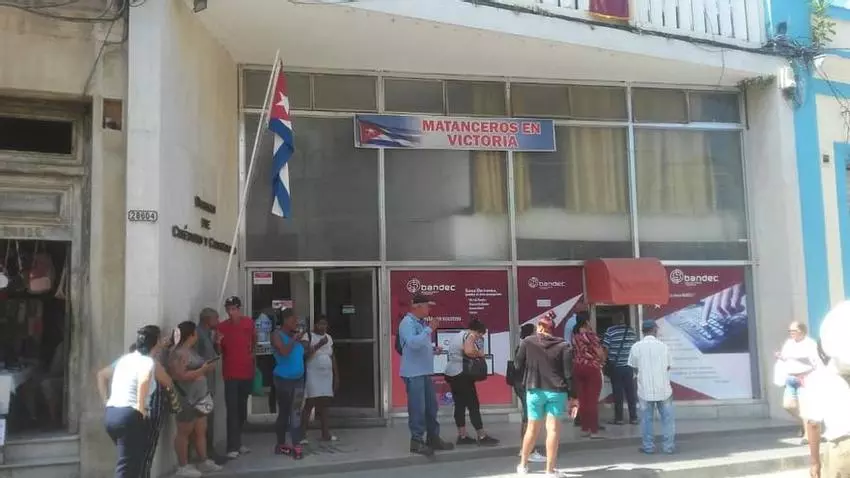
In Matanzas, Cuba, the ATMs Are Like People: Without Money

In addition to the limited availability of cash, customers complain about the long hours of waiting, not understanding the working hours, fatigue and hunger

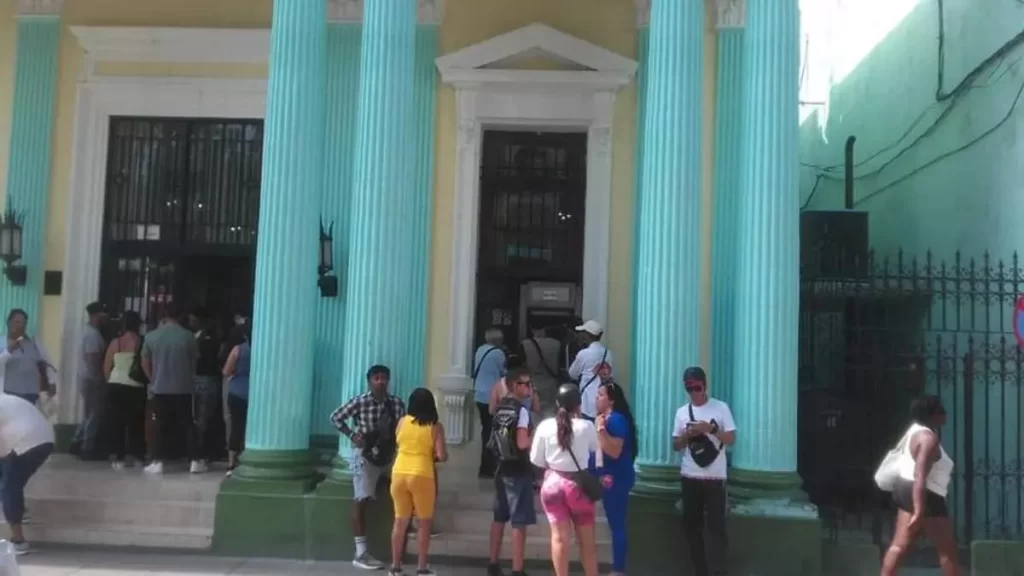
The ATM of the Banco Popular de Ahorro on Medio Street does not always have cash / 14ymedio

14ymedio bigger14ymedio, Julio César Contreras, Matanzas, May 5, 2024 — Getting up early in the morning, making a coffee and leaving for the Banco Popular de Ahorro on Calle Medio, in Matanzas, has become a routine that Magda repeats between three and four times a month. Before 5:00 am, the 47-year-old is already at the branch standing in line to withdraw money from the ATM. The entity, however, does not open its doors until three and a half hours later.

“When I have to come to withdraw money I always arrive very early, but it doesn’t matter when I get up, there are always people there: coleros* [people being paid to stand in line for someone else] or people who are willing to wait from earlier,” Magda tells 14ymedio. “I immediately sit on the stairs and wait.”

Magda lives near the bank, but customers from several miles away walk to that branch from, for example, Peñas Altas. As she explains, arriving early does not guarantee that she can withdraw what she wants. “When the bank opens, the coleros have already left and those who hired them arrive – sometimes more than one – and replace them. By the time you arrive, the number of people in front of you has doubled,” she says. “The other thing is that this bank doesn’t always have money and coming here is a game of chance.” continue reading

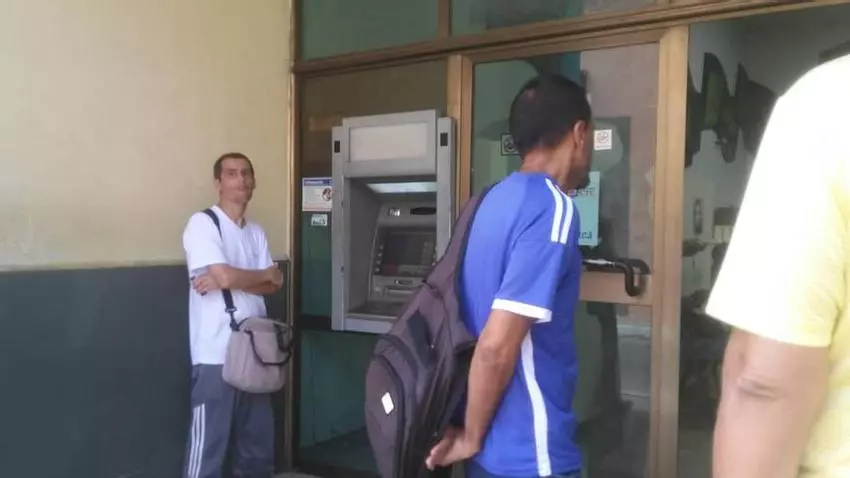
ATM located on Contreras Street, belonging to the Banco Popular de Ahorro. Sometimes, several days pass without it delivering cash / 14ymedio

At 8:30 am a branch worker opens the doors to the anxious crowd and repeats his speech of every morning: “Soon money will be put in the ATM; each customer will be able to extract only 10,000 pesos and insert a maximum of two cards. Keep the line organized,” he warns.

With the wait for the money, the discomfort begins. “None of those people were here at 7:00 am, when I arrived,” a woman complains. “Oh, daughter, don’t you realize that that man made a line for them? Everything here is fixed,” another replies.

In addition to the low availability of cash, customers complain about the long hours of waiting, the working hours, fatigue and hunger. “I already warned them at work that I was going to be late. The boss will scold me again, but there is no remedy. If they want us to be early, then don’t pay us by card,” grumbles a young office worker.

With the difficulty of the task, Cubans have devised several “tricks” to extract the money or do it faster. “That man there came early with his wife, and she went to another ATM in case the cash runs out here,” says Magda. Others, she says, have contacts in several banks and call to find out if they will have cash. “I myself have a friend at the ATM of El Naranjal, who told me that today there would be no cash there, nor in the ATMs of the funeral home and Contreras Street,” she says.

ATM located on Medio Street, belonging to the Banco de Crédito y Comercio / 14ymedio

“The problem is that, with inflation, anything you buy costs 1,000 pesos, and therefore you need to take large amounts out of the bank. That’s what they charge, for example, the coleros, but I can’t give them that pleasure. Anyway, at 10,000 pesos per head, there are times when the first five people clean out the cash,” she says.

The hours pass slowly and the line doesn’t seem to move forward. “Who is the last of the disabled?” asks a woman without any visible disability. Immediately, suspicion in the line skyrockets. “Right now two people from a private business passed by and took out a lot of large bills. Now you appear with a physical disability. When we get to the front of the line, the money is gone, and those of us who have been here since early morning are left without anything,” a man growls at the indifferent gaze of a woman, who inserts her card into the ATM.

The same employee who hours before gave instructions to the customers now leaves, looks at the line and enters the branch again without saying a word. “Is the money going to run out?” The question makes everyone’s hair stand on end. “It not even ten,” says an old man.

ATM belonging to the Banco de Crédito y Comercio, located on Milanés Street. In general, it only has money available from Monday to Saturday in the early hours of the morning, although sometimes it also has cash for one or two hours in the afternoon / 14ymedio

“There’s a lot of banking and everything, but nowhere do they accept payment by transfer. The other day I needed to urgently buy some medication and I had to go to Varadero to get money,” complains a young man.

“Who is the last one?”** asks a man who arrives by bicycle, but there is no answer. The young office employee, whose turn had now arrived and who was extracting cash, gives the bad news: “There’s no more money. I could only get 2,500.” Many of the clients get annoyed and begin to protest, but most, for whom that situation is routine, pick up their things and leave. It’s 10:30 in the morning.

The employees of the branch don’t say a word. Only the custodian of the bank clarifies the doubt – otherwise well known – to an old woman: “They won’t put in one more peso until tomorrow.”

Translator’s notes:

*A line or queue in Cuba is called a ‘cola’ (literally ‘tail’) and ‘coleros’ are people who others pay to hold their place in lines that can be hours, or even days, long.

**Each person who joins the line asks “who is last” and then they themselves become the new “last person” until the next arrival. In this way Cubans don’t have to stand strictly one-behind-the-other, and can still maintain their positions in the line.

Translated by Regina Anavy

____________

COLLABORATE WITH OUR WORKThe 14ymedio team is committed to practicing serious journalism that reflects Cuba’s reality in all its depth. Thank you for joining us on this long journey. We invite you to continue supporting us by becoming a member of 14ymedio now. Together we can continue transforming journalism in Cuba.
Migrant Women With Children Risk Rape and Robbery in the ‘Hell’ of the Darien Jungle

So far this year, 104,000 adults have crossed, of which 35% are women

A migrant with her child rests at a reception station after crossing the jungle / EFE

14ymedio biggerMoncho Torres/EFE, Bajo Chiquito (Panama), 4 May 2024 — Migration has long ceased to be something only for men. Women alone, with children or with their partners, leave their homes behind and cross through the “hell” of the Darién jungle, where they are victims of rape and robbery even while carrying their children. “¡Let’s go, we’re almost there!”

At the checkpoint of Bajo Chiquito, the first indigenous town that migrants come to after crossing the Darién, which is the jungle border between Panama and Colombia, the Panamanian authorities collect data from the hundreds of newcomers who, exhausted, are waiting patiently to take their turn. Behind the officials, apart, sits a girl. Suddenly, it seems that she has identified someone in the line.

“Do you know this girl?” the officer asks a woman. “Is she 12 years old?” she replies. They ask the girl and she nods. The officer then asks her if she knows where her mother is. “Yes, she’s coming further back.”

Venezuelan Karely Salazar, 31, travels with her 7-, 10- and 12-year-old daughters. They have gone to the village outpatient clinic. “The smallest one has a fever and a cold from spending two days in the river,” the woman explains to EFE, exhausted. “Their father is in Venezuela,” she adds. continue reading

 “The smallest one has a fever and a cold from spending two days in the river”

“Thank God we crossed the jungle, but it really wasn’t easy, very difficult for the children,” she says. “Did your eldest daughter get lost?” “Yes,” the mother nods, and her face changes. She says that on the second day of walking her leg hurt and she couldn’t move, and the little girl walked into the crowd and “lost her way.”

“Last night I cried and cried because I didn’t know where she was,” says the mother. Hundreds of migrants, or thousands, pass through that jungle every day.

According to data from the Panamanian authorities, after the historic record of more than 520,000 migrants who crossed the Darién in 2023, so far this year more than 130,000 have crossed. Of the 104,000 adults, about 35% are women, and of the more than 28,600 minors, 47% are girls.

The Panamanian authorities generally issue strong warnings against migration, since the Colombian side is controlled by the Gulf Clan, a criminal organization that in 2023 received 68 million dollars for the passage of migrants, in addition to other gangs that steal from and attack those who pass by.

The director of Migration of Panama, Samira Gozaine, goes further: “There are stories that some mothers leave their children to drown in the river because they are too heavy to carry; they abandon them to their fate,” she told EFE a year ago.

 “It’s a total hell,” says the young woman, but the crisis in Venezuela gave her no other option; working 12 hours a day in a supermarket gave her only 20 dollars a week

For the international lawyer and human rights activist Iván Chanis, these stories”dehumanize” the migrants and deny the reality, because, as he explains to EFE, “what mother wants to leave her daughter behind?”

Luisannys Mundaraín, 22 years old, carries her baby in her arms and breastfeeds him. She tells EFE that when she crossed one of the rough parts with the baby he slipped, but she was able to hold onto him at the last moment. To this were added the snakes, spiders, rivers, and “those thieves who rob and rape women.”

Mundaraín then recounts how her group was intercepted on a hill by a group of armed men wearing hoods, who asked them for “100 dollars for each person. Those who did not give them money had to hand over their phones, or if it was a woman she had to stay for you know what.”

Doctors Without Borders (MSF) reported, before the Panamanian authorities banned them from continuing to provide medical care in the country, that they treated more than 1,300 people for sexual violence in the Darién between April 2021 and January 2024.

“It’s a total hell,” says the young woman, but the crisis in Venezuela gave her no other option, with 12-hours of work in a supermarket for 20 dollars a week, when “a package of diapers cost 5 dollars and food was even more expensive.”

Thus, when in the middle of the electoral campaign some Panamanian politicians say that they are going to close the 165 miles of border in the Darién, the young woman sighs. “It’s impossible to close it, because even if there are thousands of dangers, migrants will always try to cross because of the poverty they suffer in their countries.”

Translated by Regina Anavy

____________

COLLABORATE WITH OUR WORKThe 14ymedio team is committed to practicing serious journalism that reflects Cuba’s reality in all its depth. Thank you for joining us on this long journey. We invite you to continue supporting us by becoming a member of 14ymedio now. Together we can continue transforming journalism in Cuba.
Why Are Cuba’s Provincial Governors Being Fired?

Though replacing provincial leaders is something that happens fairly regularly, the sheer number of party cadres who have been removed from office recently suggests that top military officials are concerned about something.

Susely Morfa, a diehard supporter of the regime, was removed as first-secretary of the Communist Party in Matanzas province in March / Radio Rebelde

14ymedio bigger14ymedio, Miguel Alejandro Hayes, Miami, May 2, 2024 — Something is going on up there. Over a dozen senior officials have been removed from office so far this year. Prominent on the list are party officials and governors in Havana, Santiago de Cuba, Matanzas, Holguín, Las Tunas and Cienfuegos.

The reason could be an issue common to each case that was of concern to the military leadership running the country. And considering that this elite group is motivated by money as well as the power to make even more money, one can surmise what interests the officials who were sacked may have been hindering.

The most important economic change that occurred in Cuba recently was the legalization of small businesses. Though these can be either private or state-owned, it is the former that predominate.

This change in the domestic economy has reduced economic centralization. Since they were legalized in 2021, small and medium-sized private businesses (MSMEs) have contracted with state agencies to purchase materials and resources, lease real estate, deliver goods and provide services. These formal business alliances come under the heading of Local Development Projects (PDLs). All of this is happening in a cooperative fashion, as public-private partnerships in which the “public” consists, to a large degree, of provincial governments and party officials. continue reading

MSMEs have gained greater economic importance and now play a larger strategic role in local life

Wealth creation, business financing and even foreign reserve earnings have been enhanced by the monetary flow between the private and public sectors. And it has happened without them necessarily having to rely on the country’s top leadership, much less on the military business community. As a result, MSMEs have gained greater economic importance and now play a larger strategic role in local life

That is why the creation of these new businesses, operating in conjunction with local power brokers, has led to a decentralization of decision-making authority in terms of state resources, creating new centers of power at the local level. In other words, economic decentralization.

The leaders of these new provincial fiefdoms are not about to change the system, however. And the cases of corruption that have come to light — the ones in Havana stand out due to the large number of them — are not an issue in and of themselves for a regime that promotes such practices as a means of individual survival.

The problem for the military elite is that the system only makes sense if they alone are in charge and do not feel threatened. Just because the private sector might be made up of trusted people, of people under their control, does not mean they will be allowed to get rich faster than the military business community itself. Party cadres will still be party cadres but they must not be allowed to become too important.

When it comes to power in Cuba, the thinking is that any form of decentralization is evil because it suggests a shift in the power dynamic, a relinquishing of decision-making to others, of allowing them to act unhindered by the establishment. And authoritarians always see self-autonomy as a threat.

That is why these actions by local officials suggest the beginnings of an economic counter-reformation. And though it is not an exact correlation, it so happens that the officials who were dismissed were from provinces where private-sector MSMEs and PDLs have had the greatest impact.

Unlike previous counter-reformations and purges that were purportedly aimed at rooting out corruption, this time the nation’s top leaders cannot afford to destroy the thing that is threatening them

In spite of everything, the private sector operates efficiently and effectively. In the domestic economy, it serves as a source of goods and services for consumers and provides something of a stimulus to the declining quality of life on the island.

Instead, the military can set limits on private MSMEs using the powers of the state. It can control them so that they do not shift the center of gravity yet take advantage of their results. To do this, they need the most trusted local officials, the ones who keep a low profile and do not have too many projects of their own. Officials with their own ambitions always pose a danger. That is why they are removed if they have to be removed.

____________

COLLABORATE WITH OUR WORKThe 14ymedio team is committed to practicing serious journalism that reflects Cuba’s reality in all its depth. Thank you for joining us on this long journey. We invite you to continue supporting us by becoming a member of 14ymedio now. Together we can continue transforming journalism in Cuba.
A Cuban Receives 30 Years in Prison for Murder in a Case of Illegal Departure to the United States

The official press confirmed that two subjects accused of the crime of receiving stolen goods were sentenced to minor penalties

The case began with the investigation of the death of a man in the capital municipality of Boyeros /Televisión Cubana/Capture/Archive

14ymedio biggerEFE (via 14ymedio), Havana, 5 May 2024 — A Cuban court sentenced a man to 30 years in prison for murdering a person in a case linked to an attempt at illegal exit to the United States by sea, official media reported on Saturday. In addition to the one convicted of murder, the Provincial Court of Havana punished four other people with sentences of between 10 and 13 years of deprivation of liberty for the crime of human trafficking, the Cuban state television reported.

The report confirmed that two subjects accused of the crime of receiving stolen goods were sentenced to minor penalties. The case began with the investigation of the death of a man in the capital municipality of Boyeros.

The investigation showed that he was killed with knives when he refused to hand over a car that would be used to transport four people to the point where they would illegally leave Cuba in a rustic boat. continue reading

In Cuba there are no public and periodic data on crime, especially with violence, although the state media publicly expose some cases

All those involved were arrested, even one who had fled by sea and was captured by the United States Coast Guard and handed over to the Cuban authorities. They all confessed to their participation in the events.

In Cuba there are no public and periodic data on crime, especially with violence, although the state media publicly expose some cases.

The independent media in Cuba, as well as social networks, have reported in recent months on different criminal acts such as robberies with violence. In the middle of last year, the newspaper Granma — the official organ of the Communist Party of Cuba — stressed that violent crimes in the country represent 8.5% of the total number of crimes recorded in the first six months of 2023.

However, the text did not specify the number of total crimes in 2023, did not contrast them with those of the same period in 2022 and did not specify whether the accusations ended in convictions.

Translated by Regina Anavy

____________

COLLABORATE WITH OUR WORKThe 14ymedio team is committed to practicing serious journalism that reflects Cuba’s reality in all its depth. Thank you for joining us on this long journey. We invite you to continue supporting us by becoming a member of 14ymedio now. Together we can continue transforming journalism in Cuba.

More Than Half the Fishing Boats in Las Tunas Are Docked For Lack of Spare Parts

Only 8 of the 23 boats Las Tunas counts on are in operation due to the lack of spare parts to start engines and batteries.

Las Tunas fishing fleet problems have resulted in the city’s shortage of seafood products / Radio Habana, Cuba

14ymedio bigger14ymedio, Havana, 4 May 2024 — Of the 23 boats that make up the fishing fleet in Las Tunas, only eight are currently working, that is, 65% of the available boats are out of service due to not having enough spare parts to start motors and batteries.

This was revealed by the investment specialist of the state company, Xiomara Concepción, in an interview with Periódico 26, where it explained that the lack of fisheries in the city has resulted, among other things, in a shortage of seafood in the local commercial network.

The shortage of fish in Las Tunas is a reality that, for some years, can be corroborated by the supply shortages of derived foods such as croquettes, sausages and minced meat. The situation has forced suppliers to obtain their fish from neighboring provinces such as Holguín and Camagüey, according reports.

Last March, the Government permanently eliminated the obligation to sign a contract with a company authorized for marketing, which was an obstacle for non-state fishermen to obtain a license.

However, in the little more than a year and a half since the resolution, which also does not consider lobster among its plans, no positive effects have been seen, and in places like Las Tunas the absence of boats adds to the deficit. continue reading

According to data from the Ministry of the Food Industry, fish consumption fell in Cuba from an annual average of 18 kilograms per person thirty years ago to around 3.8 kilograms in 2022. So far, the figures corresponding to 2023 have not been made public, but nothing indicates that they will be any better.

Fishermen from Las Tunas struggle to do their work due to lack of resources / Periódico 26

Faced with this panorama, Yordan Rueda Paz, technical director of Pescatun – the fish marketing company in the province – explained to the Cuban News Agency that an investment exceeding 16,370,000 pesos is already being prepared to strengthen the Las Tunas fishing industry, which is also working to obtain engines and other equipment for the fleet.

The project includes the creation and rehabilitation of centers for young fry, the ‘dynamization’ of the industry and obtaining resources for the capture during 2024 for the Empresa Pesquera de Las Tunas [Las Tunas Fishing Enterprise] , commonly referred to as Pescatun.

“During the next few days, we must complete the assembly of the electrical and hydraulic networks and the false ceiling”

According to the official media, this is not the only project to boost food production in the area. There are others linked to the agricultural sector that are being developed in the province of Las Tunas, and through these projects tractors, irrigation systems and other material resources have been received.

The digital newspaper also reports on the training of private and state producers to dedicate the acquired machinery to the most appropriate uses, and convert them into food, grains, fruits, vegetables, meats and other items destined for the population.

Diametrically opposed to the situation in Las Tunas are the results of the Santa Cruz del Sur Fishing Company, in Camagüey, which on November 6 was proud of having captured the 250 tons of lobster of its annual plan and is continuing in search of more seafood to exceed the plan targets.

To this industry, destined mostly for export and hotel food, the regime allocates the resources that it says it does not have when it comes to fishing for national consumption.

Translated by Norma Whiting

____________

COLLABORATE WITH OUR WORKThe 14ymedio team is committed to practicing serious journalism that reflects Cuba’s reality in all its depth. Thank you for joining us on this long journey. We invite you to continue supporting us by becoming a member of 14ymedio now. Together we can continue transforming journalism in Cuba.

The Decline of Alba

Last Wednesday, in Caracas, the XXIII Summit of Heads of State and the Government of Alba-TCP / Prense Latina

14ymedio bigger14ymedio, Yunior García Aguilera, Madrid, 27 April 2024 — Alba-TCP, the alliance created by Hugo Chávez and Fidel Castro, has reached 20 years with the vitality of an “almendrón,” a 1950s American car, without spare parts. The high price of oil during those founding years was the viagra that unleashed the social-imperialist fantasies of both leaders. But with the subsequent fall in crude oil prices, as well as the death of its ideologues, the organization experienced a stage of flaccidity that they are now trying to shake up with motivating speeches and new agendas.

Josefina Vidal leaked a few words to show the early detumescence of the Bolivarian Alliance. In an interview with Prensa Latina, the Deputy Minister of Foreign Affairs of Cuba talked about affectations, lack of economic resources, programs on a smaller scale, coercive measures and blockades. Of course, she did not refer to the political and economic crisis that Venezuela is experiencing, nor to the crisis of attractiveness suffered by the Cuban regime. Thus, without a pipe gushing petrodollars and charismatic leadership, Alba offers less light than a night without a moon.

The idea of this “alternative” emerged as a counterpart to Alca. Since the time of Bush senior in 1988, the United States had tried to create a free trade area that ran from Alaska to Tierra del Fuego, with 34 nations and a market of 800 million people. The asymmetry between the countries of the hemisphere aroused suspicions around the project, but many saw more benefit than danger in its concretization. In 1993, Bill Clinton signed the agreement, to take effect in 1994. However, when the IV Summit of the Americas arrived in 2005, Bush junior received a “No” in response, and Hugo Chávez mounted a parallel organization with a slogan that went viral: Alca, Alca, go to Hell!” continue reading

In 1994 Bill Clinton rounded out the idea a little more and planned to implement it in 2005

Fidel Castro, from his bunker in Havana, rubbed his hands and smiled sarcastically. His purpose was never for Latin America to win anything, but for the United States to lose. In addition, he was dying of nostalgia for those years of the Comecon where it was enough to stay in the nest with an open beak, chirping like an eagle in heat. That’s why the bearded man needed something like Alba. It would not be necessary to produce competitively, something in which he did not have the slightest experience or any enthusiasm. Its purpose was to establish a ritual of charitable exchanges, with a whole propagandistic and demagogic apparatus behind it. He was an expert at that. It was always an ideological alliance with subsidies, never a regional cooperation and development project. About the small Caribbean States and their role in this soap opera, we will have to write later.

Alba failed to reduce poverty or inequalities, despite its “mission” and its paraphernalia. On the contrary, both Cuba and Venezuela suffer worse rates of poverty today than in 2004. Nor was it an alternative for “the people,” since decisions have always been made from the hierarchies of these regimes, where civil society cannot even look out.

Last Wednesday, in Caracas, the XXIII Summit of Heads of State and the Government of Alba-TCP took place. Twenty-three summits in twenty years – that’s typical of our tireless bureaucrats! The host, Nicolás Maduro, for whom originality is an unknown concept, presented the Alba 2030 agenda. Don’t expect to find anything new, much less verify results within six years. It’s a diet of bombastic ideas like that of the Petro cryptocurrency*, which the dictator sold as the most solid and stable in the world. Now he sells us a septet of “great goals,” including the resurrection of Petrocaribe**, the University of the Peoples, a “fair” trade zone and other pretty things.

The host, Nicolás Maduro, for whom originality is an unknown concept, presented the Alba 2030 agenda

Díaz-Canel, the front man for the Castros, awkwardly read his flash cards. His dyslexia prevented him from distinguishing between “vecino” (neighbor) and “destino” (destiny), “precedent” and “president.” Which prankster thought of writing the word “consolidation” in his speech? At the conclusion, he made his characteristic grimace of dry swallowing, picking his nose and going from robotic seriousness to a childish smile, looking for a friendly face in the crowd, like a bad student after an uncomfortable oral presentation. Sympathizing with his ineptitude, Maduro released one of his pearls: “Together we are invincible. And together with the women, even more invincible.” That’s Alba, a group of idiots.

Alba, Alba, to the trash!

Translator’s notes:
*Petrocurrency was launched by President Maduro six years ago to sidestep US sanctions but was shut down in January, 2024, due to corruption.
**Petrocaribe was a 2005 agreement between Venezuela (under Hugo Chávez) and Caribbean nations for selling and buying oil.

Translated by Regina Anavy

____________

COLLABORATE WITH OUR WORKThe 14ymedio team is committed to practicing serious journalism that reflects Cuba’s reality in all its depth. Thank you for joining us on this long journey. We invite you to continue supporting us by becoming a member of 14ymedio now. Together we can continue transforming journalism in Cuba.

Cuba Establishes an Electronic Visa to Try to Revitalize Tourism that is Not Recovering

• In the first trimester of the year, only a quarter of the international travelers expected for 2024 arrived, far from the 32% needed to meet projections.

• The United States has denied 300,000 electronic visas to European citizens for having visited Cuba before.

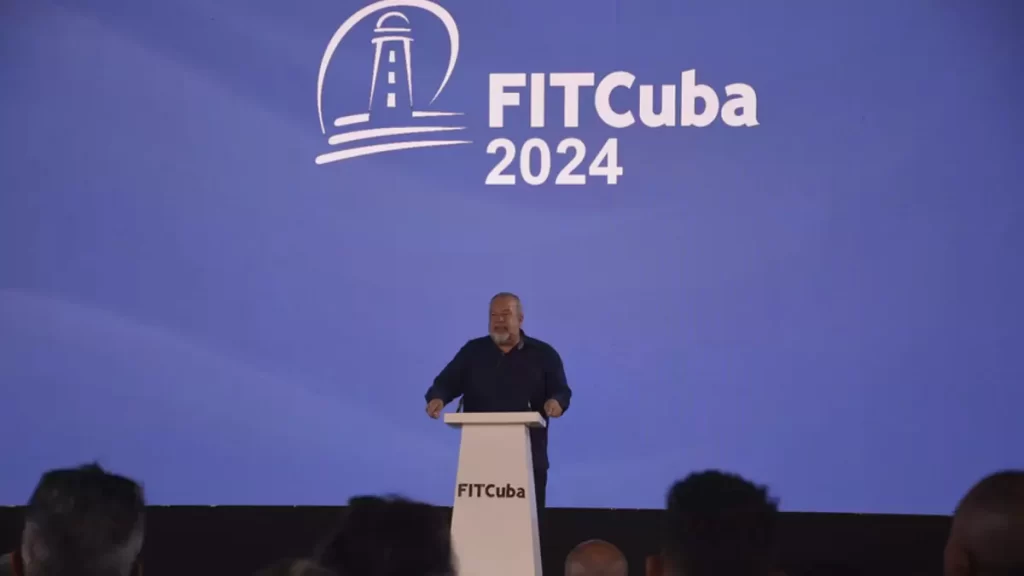
Marrero opened the FitCuba event, in which the Minister of Tourism, Juan Carlos García Granda, was also present / Invasor

14ymedio bigger14ymedio, Madrid, 3 May 2024 — Prime Minister Manuel Marrero announced the establishment of an electronic visa that will replace the traditional tourist card as of May 6. The document, whose purpose is to facilitate international visits to Cuba, is called E-visa and can be obtained on a website created by the Ministry of Foreign Affairs.

“With the electronic visa, tour operators and end users will be able to manage their application in a simplified way from any device connected to the Internet,” said the executive this Thursday at the inauguration of the International Tourism Fair, FitCuba 2024. Its 42nd edition is being celebrated in Jardines del Rey (Ciego de Ávila).

Marrero opened the event, at which the minister of the sector, Juan Carlos García Granda, was also present, as well as the governor of Ávila, Alfre Menéndez Pérez, and the regional director for the Americas of UN Tourism, Gustavo Santos, who offered the support of the organization for the consolidation of the sector’s recovery in Cuba, which has yet to be completed. continue reading

On April 19, the National Office of Statistics and Information (Onei) provided the official number of tourists who arrived in Cuba in the first quarter of the year. The number was 809,238 international travelers, just 56,807 more than the previous year during the same period. This figure threatens to wreck, once again, the authorities’ annual aspirations of 3,200,000 tourists this year, since the number represents only 25.2% of the objective. In 2023, as of April, 21.4% of the projected 3.5 million had been achieved and the final figure was only 2.4 million.

Cuban economist Pedro Monreal already warned at that time that Cuba needs to achieve around 32% of the forecasts in the first trimester if the goal is to be met

Cuban economist Pedro Monreal already warned at that time that Cuba needs to achieve around 32% of the forecasts in the first trimester if the goal is to be met.

This Thursday, Marrero did not hesitate to blame the United States for the debacle, to which he attributes a “subversive and diversionary policy, aimed at destroying our Revolution, which makes the management and conduct of recovery and development plans difficult.” Cuban authorities have made it their most recent objective to overturn the US rule that prevents tourists who have visited Cuba or any other country on the list of sponsors of terrorism from entering its territory with ESTA (an electronic document that exempts travelers from several countries from visa requirements).

“We are the only country in the world in which US citizens, the main issuing market to the Caribbean, are prohibited by law from traveling freely to Cuba as tourists. Also, as part of the extraterritorial application of the blockade, 300,000 electronic visas were denied to European citizens for having visited Cuba before”, claimed Marrero, citing data published this week by the American press. The measure does not prevent entry into the country, although it does require a tourist visa to be processed, which means more processing time and expenses for the applicant.

The prime minister also referred to the cancellation of the route to Buenos Aires due to the refusal of the Argentine company that supplied fuel to Cubana de Aviación to continue supplying it.

Marrero had, however, good news in store for that day. According to what he revealed, the Spanish Justice System definitively closed the case opened in Mallorca against Meliá Hotels Internacional, the Gaviota group and the Cuban State.

“We recently learned of the definitive victory in the lawsuit against the Meliá Hotel chain, the Gaviota tourism group and the Cuban State in Mallorca, Spain. “Justice triumphed!” wrote the leader on his X account.

“We recently learned of the definitive victory in the lawsuit against the Meliá Hotel chain, the Gaviota tourism group and the Cuban State in Mallorca, Spain. Justice triumphed!”

The lawsuit, which has been open since 2019 and has had countless twists and turns, was filed by the Sánchez Hill family, residing in the United States, who requested compensation of about 10 million euros for the lands located in the current province of Holguín, which were expropriated by Fidel Castro in 1960 and from which Meliá benefits by managing several hotels built there by the Cuban military.

The CEO of Meliá, Gabriel Escarrer – who has been banned from entering the US since 2020 due to the Helms-Burton law – told Cuban Television News this Thursday that he is proud that, for the third time, the Spanish justice system has granted them the point in the lawsuit. “Our commitment to Cuba is unconditional and we have been demonstrating it since 1989,” said the businessman.

Meliá, which manages almost 40 hotels in Cuba, announced a new investment: the Gran Marena Cayo Coco, which will open under the name Meliá Costa Rey and is owned by the Gran Caribe Hotel Group. The Balearic hotel company will manage this establishment, which was the last hotel that operated with a 5-star category under the Accor brand in Cuba, as Pullman Cayo Coco.

FitCuba 2024, which will receive more than 600 participants from airlines, tour operators, travel agencies, hoteliers, transporters and related professionals and will run starting from this Thursday until Sunday, May 5, awarded Meliá, Iberostar and Blue Diamond hotel chains for “their support for the development of the leisure industry.

Translated by Norma Whiting

____________

COLLABORATE WITH OUR WORKThe 14ymedio team is committed to practicing serious journalism that reflects Cuba’s reality in all its depth. Thank you for joining us on this long journey. We invite you to continue supporting us by becoming a member of 14ymedio now. Together we can continue transforming journalism in Cuba.

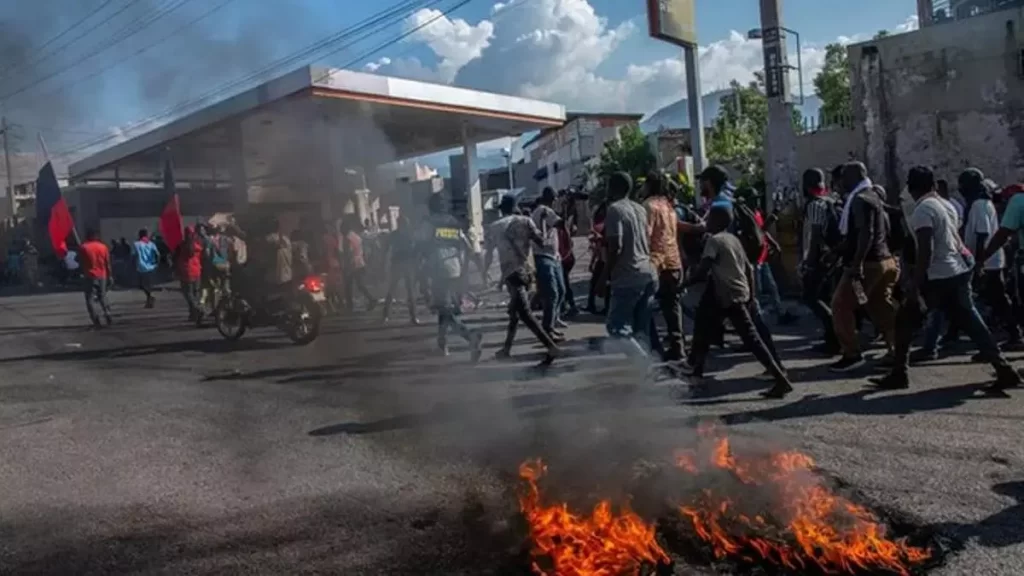
Haiti, Another Failure of Latin American Integration

The current situation in the small nation has revealed the limited effectiveness of the Community of Latin American and Caribbean States and other regional alliances.

Haitians cannot continue to wait for summits and photos of presidents who smile in front of the cameras / EFE

14ymedio bigger14ymedio, Yoani Sánchez, Havana, 31 March 2024 — Acronyms, meetings and official photos. International organizations seem more interested in demonstrating that they are operating through events and receptions than with actions or results. In Latin America it is a rare month in which there is not a summit, meeting or alliance that grabs the headlines and generates a new declaration signed by leaders and foreign ministers. However, where the effectiveness of these integration mechanisms is really measured is in reality, a level in which most lack tangible fruits.

The current situation in Haiti has revealed the limited effectiveness of the Community of Latin American and Caribbean States (Celac) and other regional alliances. Instead of accompanying and supporting the Haitian people in the difficult moment they are experiencing, the governments of this continent have chosen to look the other way or to dedicate themselves to distributing historical blame without managing to provide quick and practical help aimed at the population of a country ravaged by violence, the economic crisis and the collapse of political institutions.

Instead of accompanying and supporting the Haitian people in the difficult moment they are experiencing, the governments of this continent have chosen to look the other way

Celac and Latin American executives have failed Haitians because they have not even managed to protect them as refugees. On the dangerous route that crosses the Darién jungle and enters Central America and then crosses Mexican territory until reaching the southern border of the United States, nationals of the Caribbean country are among the migrants in the most vulnerable situation. Without speaking a word of Spanish, in many cases, lacking the resources to pay coyotes, and goaded by racism, they have become invisible beings that local administrations do not want to see, mention or support. continue reading

The lack of programs with residence facilities, access to work and coverage of basic services in many of the countries that make up the migratory journey of thousands of Haitians annually is striking. With more than 12 million inhabitants, the small island depends more and more on its diaspora and supporting these human beings in transit is also a way to save families who have been left waiting for their relatives to manage the trek, send them remittances and support them from the outside. The United Nations Refugee Agency (UNHCR) issued a series of recommendations for neighboring countries to guarantee these Haitians refuge and protection; but, as often happens, the exhortation has fallen on deaf ears.

In addition to specific facilities for these migrants, a joint response to the Haitian drama has been lacking in Latin America

In addition to specific facilities for these migrants, a joint response to the Haitian drama has been lacking in Latin America. The houses of Government are more focused on arguing among themselves over their ideological positions, creating a diplomatic fire based on the publications of a leader on the social network X, or making accusations against other governments, than in sitting down to agree on a plan of action.

During crises and humanitarian alerts, regional organizations are tested and those who represent us in this hemisphere have demonstrated their inability. Haitians can no longer wait for summits and photos of presidents smiling in front of the cameras. An aid program aimed at its injured population is urgently needed and must be as a whole as “the silver in the depth of the Andes.”*

*Translator’s note: The quote is from  José Martí’s 1891 essay “Nuestra America”: “The hour to muster and march in unison is upon us and our ranks must be as compact as the veins of silver in the depths of the Andes.”

The Cuban Regime Asks Hundreds of Young Foreigners To Spread ‘Cuba’s Truth’ About Palestine

Cuban President Miguel Díaz-Canel criticized the repression of student protests in several American universities

Wearing a Palestinian “keffiyeh” (traditional scarf) around his neck, Díaz-Canel said he felt like a “father” to all Palestinian students on the Island / Presidencia Cuba

14ymedio bigger14ymedio, Havana, May 3, 2024 — The Cuban regime is clear about its loyalties in the war in Gaza: Israel is an “occupying power” involved in a “brutal Zionist escalation”; Palestine, a “brother people,” which has sent “hundreds of students” to Cuba and with whom, since the time of Fidel Castro, the Island “has always stood in solidarity.”

These are the words of Cuban President Miguel Díaz-Canel this Thursday, during a speech in which any mention of the terrorist attack by Hamas on October 7 was omitted. The president, who has offered his unconditional support to the Palestinian side, appeared before more than 1,100 delegates in a “meeting of solidarity” for Cuba and Palestine, “against the imperialism” of the United States and Israel. The highest point of his speech has been, however, his criticism of the repression of student protests at several American universities. As hundreds of Cuban activists have reminded him, his Government applies at home the violence it attributes to other police forces.

Wearing a Palestinian “kiffeyeh” (traditional scarf) around his neck – which he has worn in public since last October – Díaz-Canel said he felt like a “father” to all Palestinian students on the Island and gave the floor to Fernando González Llort, one of the five Cuban spies imprisoned in the United States in 1998, currently the president of the Cuban Institute of Friendship with the Peoples.

Since 2017, González Llort has been the regime’s man when it comes to organizing the groups of foreigners who participate in the mass celebrations, such as the May Day parade. During his speech, he said that the delegates invited to the congress “will be able to convey the truth of Cuba to their communities” and condemned “in energetic terms” the “Israeli genocide against the Palestinian civilian population.” He did not allude to Hamas. continue reading

During the meeting, a declaration of support for Palestine was signed demanding that the United Nations recognize a Palestinian State “with the borders prior to 1967 and East Jerusalem as the capital.”

This Wednesday, Cubadebate put on its front page an extensive account of the student protests in the United States signed by the spokesman of the regime Randy Alonso. The journalist argues that this movement is similar to the one that, in the 1960s, demanded the end of the Vietnam War.

Alonso celebrates that, despite being “the main ‘foundations’ of the empire,” universities such as Columbia also host groups that disagree with Washington. These are the people who oppose the “Christian Zionists and fundamentalists” who support Israel, creating an “obscurantist atmosphere.” He also criticizes the fact that several organizations, such as the Wexner Foundation, have broken ties with several faculties that received their funding for the anti-Semitic acts that have taken place in them.

“Either Israel’s Yankee protectorate is defended or you can go to jail,” Alonso concludes, without realizing the irony of writing paragraphs in Cuba in which he lashes out at those who “beat young people, spray them with pepper spray and arrest them.” This Wednesday, in the same line of argument, Díaz-Canel published in his X profile a message of “solidarity with students in the United States who have taken the side of justice, have come out to support the cause of the Palestinian people and are brutally repressed.”

The flood of reactions was not long in coming, and they revolved around the fact that, a few days earlier, the sentence of up to 15 years in prison was announced for those who demonstrated peacefully in Nuevitas, Camagüey, in the summer of 2022.

In Cuban universities, on the other hand, students avoid giving a frank opinion about the conflict

In Cuban universities, on the other hand, students avoid giving a frank opinion about the conflict. On the Island there are no large Jewish communities – and those that exist have already spoken out about the war – but there are many Christian students, especially evangelicals, who feel linked in some way to Israel.

This is the case of Manuel, an evangelical pastor from Villa Clara who listens with concern to what several young university students in his community tell him. They feel “marginalized” for their support of Israel and their opinions about the war, although there has been no “persecution” against them. “The accusation that is repeated in the classrooms is that those who support Israel are religious fanatics, and they are discriminated against for their opinion,” he tells 14ymedio.

“Some time ago they took children and young people to the streets for a kind of act of repudiation against Israel.” The Cuban media does not present “both sides of the conflict; everything is a deception and the information is manipulated,” he adds. The most serious thing, Manuel emphasizes, is that for the Cuban media “there is no longer clarity about who started the conflict and the wave of violence.” In a word, he says, “it is as if Hamas didn’t exist.”

Translated by Regina Anavy

____________

COLLABORATE WITH OUR WORKThe 14ymedio team is committed to practicing serious journalism that reflects Cuba’s reality in all its depth. Thank you for joining us on this long journey. We invite you to continue supporting us by becoming a member of 14ymedio now. Together we can continue transforming journalism in Cuba.