Cuba’s Deputy Prime Minister Ramiro Valdés Visits Sancti Spíritus to ‘Put His Foot Down’ Against Illegalities

With the economy on the rocks and the usual voluntarism, nothing will stop the province from celebrating July 26 in style.


The “grandparents” of the municipality’s nursing home are, in many cases, the same age or younger than Valdés who is 92 / Sancti Spíritus Provincial Health Directorate

14ymedio bigger14ymedio, Havana, June 20, 2024 — A delegation of ministers and senior officials arrived in Sancti Spíritus this Wednesday to carry out a government visit that soon turned into a hunt for “illegal MSMEs” The star of the day was Ramiro Valdés, who handed out scoldings and invited people to “put their boots down” against “the reseller, the opportunist, the middleman and the supposedly ’clandestine’ store.”

The 92-year-old commander and deputy prime minister, who was in the municipality of Cabaiguán, reported that, in the construction sector alone – throughout the country – there are more than 8,000 MSMEs that declared a principal “object” but carry out “secondary activities,” as a real occupation. Furthermore, they have “altered templates, they sell at very high prices, they do not take cost sheets into account, and a high number of workers are not unionized,” he alleged.

Valdés, whom the official press describes as “entertaining, very interactive and pedagogical,” said that he was aware that there are economic “difficulties,” but that the Revolution has never thought “about what it has lacked,” but rather has “gone all in with what is has.” The leader himself, however, admitted that the bad data from the province has set off alarm bells in Havana. However, in the serious economic situation of the country, Sancti Spíritus achieved several results that earned it the venue of the official events for the 26th of July celebrations. continue reading

The best Acopio plan for the harvest and distribution of food in the province was that of Cabaiguán, he exemplified, which only fulfilled it by 87%

The best Acopio* plan for the harvest and distribution of good in the province was that of Cabaiguán, he exemplified, which only fulfilled it by 87%. And he does not even trust that number, he clarified, since “many times what is outlined or reported does not coincide with what is actually achieved, much less with what each place demands.”

His recipe for prosperity, which he already proposed in Santiago de Cuba, is to resurrect the microbrigades to promote construction – and with it the other economic aspects – an old “teaching of Fidel.” With this, however, there is a new problem and it is the lack of materials.

Deputy Prime Minister Jorge Luis Tapia Fonseca also put MSMEs in the crosshairs of his inspection. The leader believes that they must “talk” with the “illegal economic actors,” as he calls both those who work without a license and those who carry out activities for which they do not have permission.

“Why do the forklift drivers have more food than the State? They arrive first because we are not checking them. We have to know how much food the 42 cooperatives in the territory buy. We are not against the forklift drivers, but we want the State to sell more and cheaper food,” he argued. Tapia said that, as far as MSMEs are concerned, the Government works with “permanent dissatisfaction” with the current results.

“Why do the forklift drivers have more food than the State? They arrive first because we are not checking them”

Meanwhile, Valdés also traveled to the Sergio Soto refinery to “expedite solutions,” but the press was tight-lipped about the content of his visit to the place. The plant, apparently, has a “situation” with the extraction of asphalt liquid that “impacts its results,” about which they did not provide details.

Valdés asked the leaders for explanations for the “high prices” in all areas, which surprised him – reported the State newspaper Granma – and he also wanted to know the state of energy consumption. He cast a “particularly critical look” at housing officials, due to the situation of theft of materials and corruption. The projects, they let him know, “continue at very low execution rates and the figures for properties included in the plans, in many cases, are very low.”

Valdés shrugged his shoulders at the report: “If there are no materials,” he stated, “there can’t be housing either.” His visit ended at the Cabaiguán nursing home. The “grandparents” in the photos are, in many cases, of equal or younger age than the 92-year-old Valdés, but their physical deterioration cannot be compared with that of the soldier.

For the government visit, the usual express repairs were made. The most significant was that of a short section of the National Highway – towards Cabaiguán, where Valdés would pass – which “has been crying out for years” for a fix. The repair is “far from what the territory would like,” admits the official press, but at least it was carried out. “I wish there were conditions” for more, requested Granma, which reported the use of 290 tons of asphalt to cover the road, “despite the hot sun and if the electrical service allows it.”

The delegation of ministers, among whom were the heads of Culture, Public Health and Tourism, toured other municipalities and areas of the provincial capital. There was not much to congratulate the local officials for, judging by the minute by minute diary of the journey published by Escambray. There are difficulties with the water supply, tensions with producers, problems with food and a lot of crime.

With the economy on the rocks and the usual voluntarism, nothing will prevent Sancti Spíritus from celebrating the most important anniversary for the regime in style, with carnivals and political events. The people of Sancti Spiritus, however, believe that there is nothing to applaud.

“Even the ’integrated’ people are saying the same thing: with how bad everything is, how are they going to give the province the leading role on July 26,” Mirta, a housewife from the provincial capital, tells 14ymedio. Online the people of Sancti Spiritus have not stopped commenting on their discontent about the congratulations that the state entities offer for the “honor.” “Hunger and misery,” they point out, is the only thing the province excels at.

*Translator’s note: ACOPIO is Cuba’s State Procurement and Distribution Agency

____________

COLLABORATE WITH OUR WORKThe 14ymedio team is committed to practicing serious journalism that reflects Cuba’s reality in all its depth. Thank you for joining us on this long journey. We invite you to continue supporting us by becoming a member of 14ymedio now. Together we can continue transforming journalism in Cuba.

In Cuba, Rumors of the Collapse of the Regime: Purge of Ramiro Valdés, Lis Cuesta Detained, Soldiers Ask for a Discharge

The atmosphere of desperation and paralysis of life generated by blackouts has been the subject of multiple complaints

It is affirmed that Raúl Castro ordered the confiscation of Valdés’ properties, his removal from the companies he supervised from office, and the strengthening of the authority of the current leadership / Cubadebate

14ymedio bigger14ymedio/YucaByte, Havana, 19 June 2024 — Blackouts set the pace of life in Cuba, heating up tempers and triggering protests of a different caliber in a summer that is just beginning. With an increasingly unstable country on their hands, the higher-ups observe how the historical leadership is crumbling. The death of the last generals – such as Raúl Castro [age 93] or Ramiro Valdés [age 92] – will mark, according to the rumors that collaborators with 14ymedio and YucaBite have collected in May, the beginning of a bloody dispute for power.

The signs pointing to warring factions within Castroism are already visible, say many users, who see in President Miguel Díaz-Canel’s trip to Moscow an attempt to win Vladimir Putin as a “godfather,” in the absence of Raúl. However, rumors indicate that the Kremlin is not getting along with the hand-picked Cuban president and there is talk of a cut in aid to Havana.

The key arguments are that Putin no longer trusts that Díaz-Canel is capable of maintaining control of the social tension on the Island, along with the old age of the historical leaders and, above all, the very high level of corruption of the current leaders, the majority appointed or ratified by the current president.

It was also suggested that not even a high-ranking official like Valdés is exempt from a possible purge. If last month there was speculation about his death – false information, as it turned out – it is now stated that Raul Castro ordered his properties to be confiscated, and the companies he supervised to be removed from his office, such as the military corporation Cimex, and the authority of the current leadership to be reinforced.

There were also comments that Díaz-Canel’s wife, Lis Cuesta, had also been detained in a police operation similar to the one that brought down the continue reading

former Minister of Economy, Alejandro Gil, whose current situation is also unknown. Cuesta – according to rumors – is accused of organizing much of the business corruption in Havana.

Elián González, the “child star” of Fidel Castro’s propaganda, took advantage of his position in the Cuban Parliament to defenestrate Susely Morfa, according to a rumor

A series of minor rumors, about the corruption and stampede toward the United States of local leaders, includes the information that Elián González – the “child star” of Fidel Castro’s propaganda – took advantage of his position in the Cuban Parliament to defenestrate Susely Morfa, former first secretary of the Communist Party in Matanzas. A video also circulated that allegedly showed a group of officials and politicians at a party. In the middle of the celebration someone gives a warning: “Don’t record it so they don’t upload it to Facebook.”

In May, all kinds of rumors circulated about the exodus of prosecutors, police and State Security agents heading to the United States. The “volcano route” and the US Humanitarian Parole program, which Cubans have been resorting to for years to escape the system that these agents represent, is now the route that the former repressors choose to abandon ship. Several social media sites – often of victims – offer photos and testimonies from the journey of those who either beat or led summary legal proceedings in Cuba, and now aspire to seek asylum in the United States or other countries.

This is the case of Francisco Hernández Tejeda, who supposedly served as second chief of a Rapid Response Brigade in Sancti Spíritus, and who is said to have left the Island for Brazil, where his wife already lived, having “deserted” from a mission as a doctor. Another rumor claims that thousands of members of the Armed Forces and the Ministry of the Interior have requested discharge, but that their superiors refuse to give it to them so that they will not leave the country.

The atmosphere of desperation and paralysis of life generated by the blackouts has been the subject of multiple rumors and complaints. Among them, several photos of children stand out who, according to the descriptions of the images, sleep outdoors because they cannot stand being inside their homes during power outages. Some of the photographs show how other people travel with their mosquito nets to protect themselves from mosquitoes in the streets.

Information about alleged acts of sabotage, in addition to protests, have not been long in coming

Information about alleged acts of sabotage, as well as protests, have not been long in coming. A forest fire in Minas, Camagüey, was attributed by several users to the Clandestinos organization or some other opposition group, as a protest against electrical shortages and instability.

It was also rumored in May that special troops, police officers and Army personnel in the municipality of Palmira, in Cienfuegos, are “barracked” waiting for a social outbreak due to the blackouts. The increase in surveillance in several areas of Havana is attributed to the arrival of summer. Two patrols and a bus with special troops travel through El Vedado from time to time, says a social media commenter.

And like the rest of the months, there are recurring rumors about el químico (the chemical), the trendy drug in Cuba. It, or one of its variants, has also been called el papelito. What does not stop circulating are rumors, often confirmed by the independent press, about the escalation of violence in the country. A decomposed corpse found in the Versalles area, in Santiago de Cuba; the murder of a minor in Bayamo and the stabbing of another in Contramaestre; and the multiple murders in which violent action by the Police is suspected are arguments – at least in the digital imagination of Cubans – that the Island is an increasingly insecure country.

____________

COLLABORATE WITH OUR WORKThe 14ymedio team is committed to practicing serious journalism that reflects Cuba’s reality in all its depth. Thank you for joining us on this long journey. We invite you to continue supporting us by becoming a member of 14ymedio now. Together we can continue transforming journalism in Cuba.

The National Crisis Forces Cuban Children To Work Says the Official Press

The newspaper Sierra Maestra assures that the child labor cases are the childrens’ own exceptions to “the complexity of context”

Children and adolescents who work are treated in the article as the children’s own exceptions “to the complexity of context” / 14ymedio

14ymedio bigger14ymedio, Havana, 19 June 2024 — One of the pillars of social welfare that for years the Cuban regime has defended as one of its greatest conquests collapsed this Monday, when the official press recognized that in Santiago de Cuba – as in the rest of the Island – there are cases of child labor. Children and adolescents in this situation are treated in the article as the children’s own exceptions to “the complexity of context” – a new euphemism for the economic crisis – and, although on no occasion are figures or statistics mentioned, officialdom insists that there are few.

The Sierra Maestra newspaper begins by talking about Luis, a sixth grader (between 10 and 11 years old) who sells bread in the mornings to help his mother and is also in charge of his three-year-old brother. The international regulations and charters that speak of children’s rights, of which Cuba is a signatory, speak of categorically proscribing child employment, but the newspaper says that “currently there are some cases, typical of the complexity of the context, that deserve to be evaluated differently, as a preventive policy and effective action.”

The idea, however, is nothing more than a suggestion that does not delve further into the problem and remains half-baked.

The article, which addresses a problem that is often ignored by officialdom, also cuts through the debate with a string of documents and articles that regulate work at an early age. On the Island, in the case of adolescents who continue reading

finish compulsory education and want to start working, the State has rules and permits so that they can access jobs suitable for their age.

Among the most common jobs are the sale of bread, gardening work or remuneration for tasks such as throwing away garbage

Attention to employees between 15 and 18 years of age is strict, and it is always required that the work is not carried out in difficult or stressful environments. However, and although Sierra Maestra recognizes that these are ages in which social pressure begins to arise because the adolescent assumes certain responsibilities, the issue is still not addressed thoroughly.

The official press focused on the work of educational institutions and mass organizations – such as the Committee for the Defense of the Revolution – which, it says, often discover cases of child labor when children and adolescents begin to miss school. Among the most common jobs are the sale of bread, gardening work or remuneration for tasks such as throwing away garbage.

For those who hinder the development of minors, the penalties can range from fines to prison. Families were also identified as the main ones responsible for the care of minors.

However, some “educational” policies that parents and students have been complaining about for decades, such as the so-called Schools in the Countryside or early entry into Military Service, are not included in the report although many consider them forms of “exploitation.”

On the contrary, the article talks about less pressing issues, such as university students who work and study at the same time. Although having both responsibilities can take these students away from their studies, the situation is not seen as harmful by society or the laws.

In fact, the State itself often promotes the employment of higher education students to fill teacher positions or other occupations in key sectors that suffer the stampede of professionals, and it pays these substitute teachers less than the conventional salaries of the sector.

At the beginning of the 2023-2024 academic year, several newspapers on the Island announced the formation of “quotas” of students to fill empty places in schools throughout the country. Likewise, it is common that in times of “crisis” students of health-related careers are asked to carry out vector control – Hygiene and Epidemiology tasks – as part of their work practices.

Many students also manage their own job search and end up prioritizing employment that gives them economic independence over options would define a career. According to Israel Riverón Sánchez, provincial deputy director of Employment in Santiago de Cuba, at the end of May more than 400 university students were working, of which only 120 did so in the state sector.

Translated by Regina Anavy

____________

COLLABORATE WITH OUR WORKThe 14ymedio team is committed to practicing serious journalism that reflects Cuba’s reality in all its depth. Thank you for joining us on this long journey. We invite you to continue supporting us by becoming a member of 14ymedio now. Together we can continue transforming journalism in Cuba.

Cuba Receives a Donation From Spain as an Area Affected ‘By Natural Disasters and Conflicts’

 The project, financed by Unicef ​​and the Government of Extremadura, was also intended for Haiti and the Palestinian territories

Part of the donation to Cuba from Unicef and Aexcid were 21 incubators / Unicef Spain / Screen capture

14ymedio bigger14ymedio, Madrid, 19 June 2024 — Up to nine neonatal care units have been given to Cuba from a project of the United Nations Children’s Fund (UNICEF) in Spain and the Extremadura Agency for International Cooperation (AEXCID). These were also given to Haiti and Palestine (both Gaza and the West Bank).

The three territories, UNICEF said in a press release, are considered “debilitated” after the Covid-19 pandemic and are “areas affected by natural disasters and conflicts.”

The agreement, signed in July 2022 and finalized a few months ago, indicates that the total cost of the operation was 1,259,666 euros. Of these, 9,666 were contributed by UNICEF and the bulk, 1,250,000 euros, by the Junta de Extremadura, on which AEXCID and one of the poorest Autonomous Communities in Spain depends. The Island received one third, that is, 419,889 euros, the same as each of the parties.

UNICEF shared an inventory of what was donated to the provinces of Pinar del Río, Havana; Mayabeque, Ciego de Ávila; Holguín, Granma, and Santiago de Cuba. Among all the hospitals, such as the Abel Santamaría Cuadrado and the Pepe Portilla of Pinar del Río, and the Manuel Fajardo of Havana, 21 incubators, 8 neonatal cardiomonitors, 2 “non-invasive” ventilators continue reading

and 8 portable monitors of vital signs were distributed, as well as digital scales, thermal blankets, oximeters and antiseptic cloth. This is, the text says, something “critical for the care of the newborn at risk.”

Training workshops were also given to about 5,000 specialists

Training workshops were also given, explains UNICEF Spain, to about 5,000 specialists, on care for newborns in critical condition and nutritional follow-up “during the first thousand days of life, which contributes to raising the quality of health care for pregnant women, girls and boys from the early stages.”

Infant mortality is one of the health measures that has worsened most dramatically in recent years in Cuba, which for decades has boasted of being a medical power. From 2018 to 2021 it grew by no less than 91.77%, from 3.9 children per 1,000 live births to 7.6 dying by twelve months of age, according to official data. Although in 2023 there was a slight improvement, with 74 fewer babies dying than the previous year, the rate at the end of the year remained ominous: 7.1 deaths per 1,000 live births. (For many years, even before the triumph of the Revolution, it remained at a rate of 5 per 1,000).

According to an article published by Escambray, the “stability in infant mortality rates” was precisely one of the reasons to name Sancti Spíritus as the headquarters of the upcoming celebrations for 26 July. The province has a current rate of 3.8 deaths per 1,000 live births, slightly lower than that in 2023, of 4.7 per 1,000.

“Improvisation, which allows surprising results to be composed on the fly, has nothing in common with strategic Cuban Health services, such as neonatal care and other factors that directly affect the infant mortality rate,” says the official newspaper.

The article emphasizes that the “growing adversities” were “aggravated” by Covid-19, precisely the reason for the subsidized action of UNICEF and AEXCID. The pandemic, the organizations say in their joint statement, highlighted “the fragility of health systems in many countries, overwhelmed by a health crisis that was added to existing ones, such as humanitarian or natural disasters.” One of those countries is, officially and internationally, Cuba.

Earlier this month, UNICEF published its report on serious child poverty, in which it included the Island for the first time. The document pointed out that 9% of minors up to five years of age suffer from severe poverty; that is, that they have a maximum of only two of the eight foods considered necessary for a healthy life. In addition, it pointed out that 33% of children suffer from moderate poverty, which means they have between three and four of these eight foods available to them.

Translated by Regina Anavy

____________

COLLABORATE WITH OUR WORKThe 14ymedio team is committed to practicing serious journalism that reflects Cuba’s reality in all its depth. Thank you for joining us on this long journey. We invite you to continue supporting us by becoming a member of 14ymedio now. Together we can continue transforming journalism in Cuba.
A Woman Injured in a Building Collapse on the Lethal Stretch of a Street in Havana

The property seems abandoned, but more than a dozen families live inside.

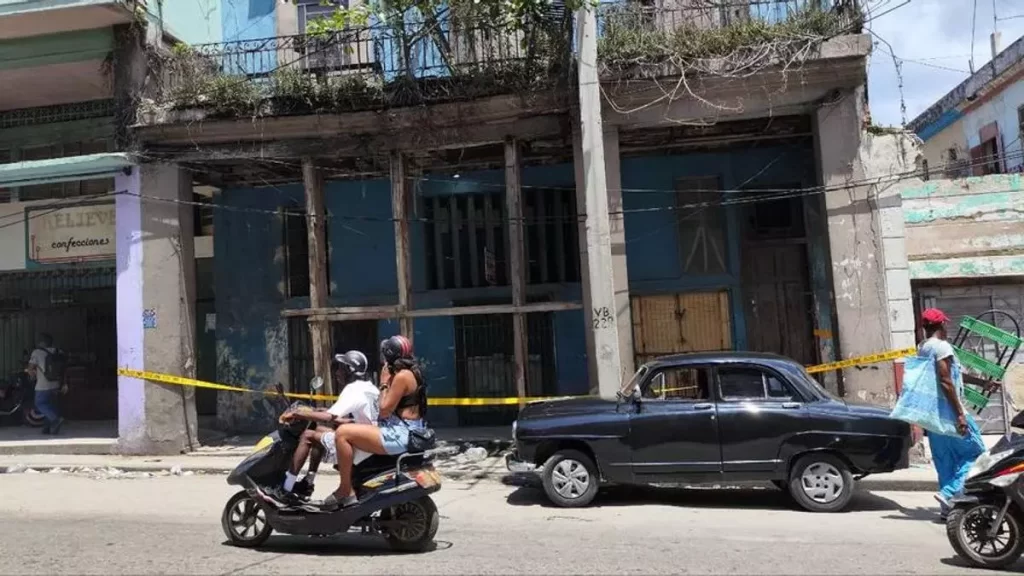
Number 425 of Monte Street, between Ángeles and Águila, in Old Havana, this Wednesday / 14ymedio]

14ymedio bigger14ymedio, Natalia López Moya, Havana, 19 June 2024 — At noon this Wednesday, a yellow tape blocked the passage to the entry of the building at 425 Monte Street, between Ángeles and Águila, in Old Havana, where last night a partial collapse left a young woman injured. The adjacent property at number 423 had claimed the life of a man three years ago, when one of its side walls collapsed.

“We can’t even sleep here, all of us who live on this piece of street are in danger,” a neighbor who went to the place to get information about the injured woman tells 14ymedio. “We don’t know anything; we have called the Emergency Hospital [General Freyre Andrade], but they say that they don’t treat patients in Old Havana and they don’t have a trauma ward either.”

This newspaper’s attempts to know the state of the young woman, through the information numbers of the Calixto García Clinical Surgical Hospital, were also unsuccessful. A video of the moment she was evacuated shows the woman passed out and being put into a police patrol in the absence of an ambulance for her transfer. This Wednesday, among the neighbors, her situation was still a question mark.

“It’s been raining for many days and tragedy could be smelled in the air”

With the door closed, the facade in a calamitous state and the roof of the entrance propped up with thick wooden beams, the building where the collapse occurred seems abandoned, but inside there are still more than a dozen families crammed into small apartments. For years, the residents have feared that a wall or one of the middle floors will collapse. This Tuesday, part of the nightmare became a reality. continue reading

“It’s been raining for many days and tragedy could be smelled in the air,” said an old man who lives on Ángeles Street. In December 2021, the residents in the surrounding area heard a roar and, when they looked out of their doors, they saw that the side wall of the first floor of number 423, which is on the corner, had fallen, filling the entire passage with debris. Under those bricks, the body of a passer-by who lost his life was recovered.

The section of Monte Street where both affected properties are located is a very busy area and one of the most important commercial routes in the Cuban capital. Despite the “Don’t Pass -PNR*” signage that surrounds the building where the most recent collapse happened and the images of the accident that have been circulating for hours on social networks, this afternoon vehicle traffic and pedestrian crossing on the avenue were maintained.

The balcony of the collapsed building is full of vegetation that has grown between the cracks

Above the heads of passersby, the balcony of the collapsed building is full of vegetation that has grown between the cracks and through the bars. The trunks of bushes and weeds extend throughout the terrace. On the facade of the ground floor a colorful sign announces “Cell phone repair,” and there is often a line of people waiting to access the service.

After the previous collapse, less than three years ago, the corner building, 423, has been left with only a flat floor where there is currently a small sale that exhibits its goods on a table at the door. Moisture stains rise on the walls and columns of all the buildings on the block, and in the air the most persistent smell is that of sewer water.

The neighbors of the area fear that the deterioration is now so advanced that repair is not an option for some properties, most of them from the first half of the twentieth century but showing decades of neglect, lack of resources to carry out restoration and the overpopulation of families of up to three generations, who have had to divide the space with improvised walls and lofts that have added weight to the structures. [A set of photos of the site is here.]

In December 2021, 14ymedio interviewed several neighbors of nearby buildings and talked to some of the inhabitants of numbers 425, 427 and 429 of Monte Street. Aramirta Castan then warned that the danger continued: “Here in my dining room pieces of the roof are falling, everything is shaking, it seems that we are in an earthquake,” complained the woman, then 77 years old. “That door out there is in the air, everything is falling.”

*Partido Nacional Revolucionario

Translated by Regina Anavy

____________

COLLABORATE WITH OUR WORKThe 14ymedio team is committed to practicing serious journalism that reflects Cuba’s reality in all its depth. Thank you for joining us on this long journey. We invite you to continue supporting us by becoming a member of 14ymedio now. Together we can continue transforming journalism in Cuba.

Cuban Political Prisoner Jorge Luis Rodríguez Valdés ‘Tangallo’ Denied Visits and Phone Calls

Casla Institute requests proof of life from Cuban musician and activist Maykel Castillo Osorbo

Facade of Kilo 5 y Medio prison, in Pinar del Río, Cuba / Instagram

14ymedio bigger14ymedio, Havana, June 19, 2024 — The prison authorities of the Kilo 5 y Medio prison, in Pinar del Río, Cuba, are making life impossible for political prisoners serving their sentences in this prison. According to Cubalex, Jorge Luis Rodríguez Valdés Tangallo was again denied the delivery of food, medicines and other essential items.

The legal NGO also said the activist has not been able to receive his regular visits for three months. Since Tangallo has no close relatives, Eduardo Díaz Fleitas, also an activist and former political prisoner of the Black Spring, attends these meetings, but he is repeatedly denied access to the prison.

The restriction on receiving external aid, even to cover basic needs, “shows the use of deprivation of liberty as a form of reprisal based on political motives,” Cubalex said, adding that the prisoner has even been restricted from receiving phone calls.

Since Tangallo has no close relatives, Eduardo Díaz Fleitas, also an activist and former Black Spring political prisoner, attends these meetings

Tangallo was sentenced in April 2022 to four years in prison for the crime of “contempt” and previously accused of “enemy propaganda” for painting the phrases “Díaz-Canel singao”(Díaz-Canel Motherfucker), “Abajo el continue reading

comunismo”(Down with Communism), “Abajo los Castro”(Down with the Castros) and “Viva el 27 de Enero”(Long Live January 27) on the train station walls in the town of Entronque de Herradura. In Kilo 5 y Medio prison, he also faces constant threats of being transferred to a punishment cell for denouncing the living conditions inside the prison.

Cuban musician and activist Maykel Castillo, known as Osorbo, is serving his sentence in the same prison. The Venezuelan Casla Institute, which monitors the state of democracy in Latin America, requested proof of life for him last Friday.

Through social media, its executive director, lawyer Tamara Suju, warned that the artist, a member of the San Isidro Movement, denounced that “they are trying to kill him in prison,” that “he is being punished and the dictatorship has him incommunicado.” On April 18, the rapper was assaulted by four ordinary inmates in complicity with the prison authorities.

The Observatory for Cultural Rights denounced last month physical and psychological aggressions against Osorbo, who receives “no or defective medical care” in the face of the multiple ailments he has presented. Likewise, they protested against the concealment of the medical records from his family. The rapper is confined to solitary confinement and visits have been cancelled as a punishment for sending messages or repeatedly refusing to be transferred to another prison. In addition, they accused him of planning “an uprising” inside the prison, so they even installed a security camera to monitor him.

The rapper is confined to solitary confinement and visits have been suspended as a punishment for sending messages or recurrently refusing to be transferred to another prison

Osorbo, one of the authors and performers of the song Patria y Vida, a winner of two Latin Grammys, was arrested two months before the historic protests of 11 July 2021 — known as ’11J’ — and sentenced to nine years in prison. He was accused of “attack,” “public disorder” and “prisoners or detainees’ escape,” although he was held in prison for a whole year without trial, until May 2022.

The musician was declared a prisoner of conscience by Amnesty International in August 2021 and earned the Freedom Award from Freedom House in May 2022.

Translated by LAR

____________

COLLABORATE WITH OUR WORKThe 14ymedio team is committed to practicing serious journalism that reflects Cuba’s reality in all its depth. Thank you for joining us on this long journey. We invite you to continue supporting us by becoming a member of 14ymedio now. Together we can continue transforming journalism in Cuba.

Nicaragua Bans Cuban Activist Bárbaro de Céspedes From Entering the Country

Cuban activist Bárbaro de Céspedes / Facebook

14ymedio bigger14ymedio, Mexico, June 17, 2024 — Daniel Ortega’s regime denied Cuban activist Bárbaro de Céspedes – known as “El Patriota”- entry into Nicaragua. “While on the bus to the [Havana] airport, they sent me a message saying that the Government of Nicaragua denied my entry into that country,” he denounced on social media in a live video.
The activist explained from Camagüey, where he resides, that he had managed to buy an expensive plane ticket with several stops for June 13th with the intention of emigrating.

“State Security has tried to make life impossible for me and my family in Cuba,” said De Céspedes, who spent two years in prison for demonstrating peacefully on 11 July 2021. “I made the hardest decision of my life, to emigrate from this country that I love and defend. It is not for fear of death – I no longer have a life – but for fear of being a nuisance to my family,” he added in a broken voice.

The Camagüey native denounced that his daughter, some time ago, was also denied entry into Nicaragua and that, on this occasion, the airline ticket manager sent him a similar message to the one she got: “We inform you that we have been notified by the Nicaraguan immigration authorities that they have not authorized your entry into the country, so you will not be able continue reading

to board your flight,” says the document that De Céspedes showed and where the logo of the Colombian airline Avianca can be seen.

“These people have punished me to life imprisonment on this island prison”

“The crying is not because of the refusal, the crying is because of the decision I have had to make. Everyone who knows me knows that my homeland is above everything, above my feelings. And these people [the Cuban regime] have punished me to live in prison for life on this island prison,” he said.

In April 2021, he was detained for several days after making a pilgrimage to the Nuestra Señora de la Merced church in Camagüey. De Céspedes was released with a precautionary measure of house arrest and a fine of 2,000 pesos for not wearing a mask.

The Camagüey activist arrived at the church on Good Friday carrying a huge cross that said 62 years of dictatorship, with his torso shirtless and painted with a Cuban flag. He was detained by uniformed officers when leaving the temple.

A few months earlier, the police also arrested him in the middle of a crowd when he was handing out leaflets in the historic center of the city of Camagüey printed with texts by José Martí. On that occasion, he managed to hand out dozens of flyers to passersby and sang the national anthem. He also shouted several times: “Viva Cuba libre”(Long live free Cuba).

This is not the first time Managua has denied Cuban activists entry. Before De Céspedes, journalists Héctor Luis Valdés Cocho and Esteban Rodriguez, members of the San Isidro Movement, and doctor Alexander Figueredo, for example, were prevented from entering.

Translated by LAR

____________

COLLABORATE WITH OUR WORKThe 14ymedio team is committed to practicing serious journalism that reflects Cuba’s reality in all its depth. Thank you for joining us on this long journey. We invite you to continue supporting us by becoming a member of 14ymedio now. Together we can continue transforming journalism in Cuba.
The Hidden History of the Trinidad, the Cigar That Fidel Castro Gave to Heads of State

A documentary by specialist Kirby Allison reveals details and curiosities of “the Commander’s favorite tobacco”

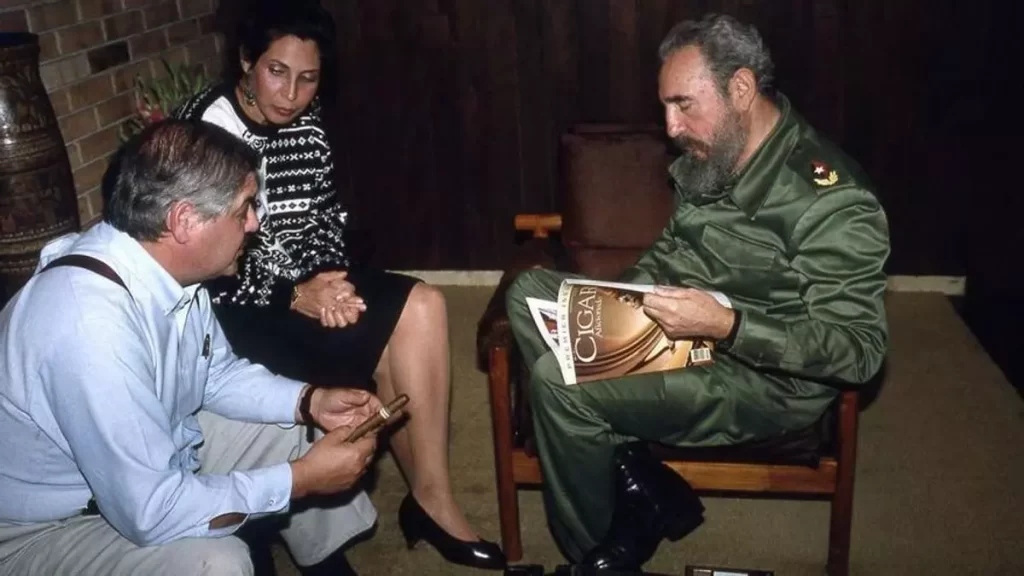
Marvin Shenken, editor of Cigar Aficionado, interviews Castro in 1994 / Cigar Aficionado

14ymedio bigger14ymedio, Juan Izquierdo, Havana, 18 June 2024 — In 1994, Fidel Castro gave an interview to the American Marvin Shenken, editor of the prestigious Cigar Aficionado magazine. “We know that there is a cigar called Trinidad and that it is only obtained in Cuba as a gift,” he said bluntly. According to rumors, the brand had been secretly manufactured since 1969 without a band, but Castro had denied its existence several times. With a smile, his answer was: “I don’t know what you’re talking about.”

That year, during the so-called Dinner of the Century – a luxurious banquet of millionaires held in Paris while Cubans went hungry in the Special Period – several boxes of Trinidad with the signature of Castro were officially auctioned, which were served after the meal with a 1982 Château Mouton Rothschild wine.

Born to dethrone the Cohiba, the story of how the “Commander’s favorite cigar” began to be sold was revealed by David Savona, current director of the magazine, to the specialist Kirby Allison during a miniseries about the brand that has just been uploaded to YouTube. In 1991, Shenken made a trip to Cuba on the trail of the Trinidad. He was about to publish the first issue of Cigar Aficionado magazine, and no one wanted to give him information about the “best kept secret” of the Island

“We were all a family. We thought the same thing: we all wanted to make a cigar for Fidel.”

He had to settle for a small article, which was enough to whet the appetite of the millionaires. When the terrain was prepared and everyone wanted to smoke a Trinidad, Castro admitted that the cigars existed and that they were for sale. continue reading

Ultimately, the Trinidad failed to dethrone the Cohiba, which is still the best-selling cigar on the Island. But the state corporation Habanos S.A. does not give up: Allison’s series is part of a promotion package, with new cigar bands and tools of the trade, in tribute to the 55th anniversary of the brand.

For Allison, if Cohiba is the flagship of Cuban cigars after 1959, Trinidad is the “special jewel in the crown” for its “unparalleled mystical aura.” The golden cigar with a blue band was given to diplomats and ordinary guests, but the triple T was reserved for very high officials, who were required not to disclose their consumption beyond the “corridors of diplomacy,” says the expert.

Trinidad, the Cuban city that the brand evokes, is for Allison the summary of everything the tourist seeks: colonial architecture, the convergence between Spaniards, Africans and “natives” and quality tobacco, whose cultivation method was perfected by Canarian immigrants in the central provinces of the Island.

The series points to the utmost secrecy in which Castro maintained the El Laguito factory since 1959, where the Trinidad and the Cohiba are manufactured. The president, he believes, “gave the diplomats the opportunity to show Cuban cultural wealth to the world.” Juana Ramos Guerra, one of the first cigar rollers of the factory, explained to Allison that all the employees entered the factory thanks to a family tie with the regime, since it was Celia Sánchez who was in charge of the selection process in 1972.

Before its launch, the Trinidad was marketed without a name or cigar band. Fidel Castro’s signature was on the very luxurious boxes / Screen Capture

“The cigar that was made here was the one made for Fidel,” Ramos adds. “We were all a family. We thought the same thing: we all wanted to make a cigar for Fidel.”

The greatest tribute that Ramos received from his bosses had to do with the Trinidad: the best cigars of the brand came out of his hands in 1998. The Trinidad, he recalls, “was the cigar that Fidel gave to presidents and important people who came to Cuba. It had no mark or bands, it was very simple but very tasty. Everyone wanted Fidel to give him one.”

The person who received the cigar found out from Castro what kind of cigar he was smoking, so that if the specimen left Cuba, no external sign would reveal it. “The Trinidad is our ambassador to the world,” says Ramos. By 2003, the brand had expanded to create new shapes and calibers: Founders, Colonials, Kings, Robusto Extra.

The worldwide relaunch of the brand took place in London that year, sponsored by Hunters & Frankau. Now, two decades later, Habanos has declared a “Trinidad tasting time,” with tastings in several places, so that millionaires can get excited again about cigars and their new brand, Cabildo, whose name evokes the relationship between tobacco and the “primary forms of government” of the colonial era. A link that recalls the principle formulated by Fernando Ortiz: “Whoever rules in Cuba, rules in cigars.”

Translated by Regina Anavy

____________

COLLABORATE WITH OUR WORKThe 14ymedio team is committed to practicing serious journalism that reflects Cuba’s reality in all its depth. Thank you for joining us on this long journey. We invite you to continue supporting us by becoming a member of 14ymedio now. Together we can continue transforming journalism in Cuba.

A River of Sewage Water Surrounds a Polyclinic in Havana

The place intended to preserve health is, paradoxically, a source of potential infections for neighbors

Down the slope, a dark river with greenish parts carries waste from the Public Health department / 14ymedio

14ymedio bigger14ymedio, Natalia López Moya, Havana, 18 June 2024 — Where there was hygiene, sewage remains. Those who walk in front of the Héroes del Moncada University Polyclinic on 23 Street, between A and B, in El Vedado, Havana, have been repeating the same ritual for days: go down the sidewalk, take risks among traffic on the avenue and avoid a spill through which flows waste from the health center’s bathrooms. The place intended to preserve health is, paradoxically, a source of potential infections for neighbors.

“At first, the stench didn’t let us live, but now I don’t even feel it,” admits a neighbor from A, where a dark river with greenish chunks drains downhill, carrying waste from the Public Health Department. “Children can no longer play on the sidewalk, and in many houses, people have had to put damp blankets with bleach by the door to clean their shoes before entering.” The grass in the nearest flowerbeds has grown “fed” by the sewage and a trash can seems about to float in the dark lake that has formed around it.

The disgusting current knows no limits or locks. It passes under the stately fence that surrounds the polyclinic, extends along the most important avenue of the modern center of Havana and sticks to the wheels of the shopping carts of those who await in line at the nearby rationed market warehouse. Everyone who passes by takes away something of its essence, be it part of the stench, some fragment of waste carried by the current, or the look of disgust on their face. continue reading

“At first the plague didn’t let us live, but now I don’t even feel it anymore” / 14ymedio

“In the mornings, people who come to get their blood drawn for some lab analysis line up right here”, says another resident nearby. “There are pregnant women, children, people with chronic illnesses and old people who can barely lift their feet to walk and they carry all of that stuff stuck to their shoes. Anyone who falls into those waters will come out with an infection, for sure.”

The property’s employees are also at risk. In the morning, they dodge the stinky puddles to get to their jobs and in the afternoons, they gain momentum again and jump so as not to take the detritus home.

On the bright green façade of the building, a sign warns that it is a University Polyclinic, a reference location for training new doctors in direct patient care. In addition to preparing them for clinical diagnoses, the place is designed to train them to practice the profession in the midst of hygienic and epidemiological chaos.

Translated by Norma Whiting

____________

COLLABORATE WITH OUR WORKThe 14ymedio team is committed to practicing serious journalism that reflects Cuba’s reality in all its depth. Thank you for joining us on this long journey. We invite you to continue supporting us by becoming a member of 14ymedio now. Together we can continue transforming journalism in Cuba.

A Bill Proposes To Abolish the 24-Month Limit for Cubans Abroad

Cubans will be able to renounce their nationality and enter the Island with their new passport. / EFE

14ymedio bigger14ymedio, Madrid, 18 June 18, 2024 — Cubans abroad will retain their rights to residence and will not lose their properties regardless of how long they have been out of the country, according to the new Migration Law, whose preliminary draft was published this Monday on the Parliament’s page along with that of the Aliens Law. The law also proposes another outstanding novelty: the possibility of renouncing Cuban nationality and entering the Island with a passport that accredits a new citizenship.

Currently, Cubans who leave the country and do not return in 24 months lose their status as residents and, with it, many inherent rights, from medical care to owning properties. However, they were obliged to enter the Island with their Cuban passport, one of the most expensive in the world, at a cost of 180 dollars per year.

With the new law, the category of effective migratory residence is created, “a condition that affects Cuban citizens and resident foreigners, when they spend most of their time in the national territory, or through a combination of a period of permanence and other material evidence that demonstrates roots in the country.” Those who obtain this category have the rights that the Cuban Constitution reserves for nationals. continue reading

As for residents, they are divided into two: residents in the national territory (which can be temporary or permanent) and residents abroad

As for the residents, they are divided into two: residents in the national territory (which can be temporary or permanent) and residents abroad. In the latter are those who live outside Cuba, who before this law were considered emigrants. They will be able to apply for their new status, as well as investors and businessman who participate in the Cuban economic model.

Article 56.1 addresses the situation of those who renounce Cuban citizenship, to whom the immigration law would apply once such a waiver is recognized. The text says that these people “cannot identify themselves in Cuba as Cuban citizens, and for the purposes of entry and exit to the country they are subject to the presentation of the corresponding foreign passport, visa requirement and travel documents.” In the case that they have more than one citizenship, “they must identify and leave the country with the passport they used at the time of entrance to the national territory.”

The law also regulates the conditions of entry and exit, as well as the limitations, among which there are still the reasons of security and national interest and some other reasons of a discretionary nature, as well as others usual in international laws that include reasons of a criminal nature.

In the case of entries into the country, the fact of having a criminal record for terrorism and other internationally prosecuted crimes also appears as limiting, a section that can be a nod to Washington, which keeps the Island on the list of State sponsors of terrorism precisely because of the protection it has given to some people involved in this type of serious crime.

The law also regulates the conditions of entry and exit, as well as the limitations, among which are still reasons of security and national interest

The 65-page regulation also establishes legal frameworks for crimes related to migrant smuggling and human trafficking, as well as sanctions for non-compliance. According to the press release of the National Assembly, which received the preliminary draft after years of study, the publication is made with “the objective of promoting citizen participation in this legislative process and contributing to the legal culture of the population.” To that end, several emails have been enabled to which citizens can send their impressions.

However, the regulation must be in an almost final version, according to its own preamble, which emphasizes that in March it was presented to the Council of Ministers “and some other entities” that asked questions and made observations now resolved, “so there are no discrepancies on the project,” from which it is inferred that the Assembly will make few or no modifications.

The Migration Law – “aimed at achieving a regular, orderly and safe flow” – will repeal the current one, of 1970, as well as the subsequent decrees that modified aspects such as travel regulations, among the most important. The change will radically break with the model in force until now, which entailed the loss of a huge amount of rights, in addition to the properties, that Cubans were rushing to bequeath to their relatives to manage them.

The regime has been trying for several years to approach Cubans living abroad in order for them to invest in Cuba

The regime has been trying for several years to approach Cubans living abroad in order for them to invest in Cuba, something that the law prevented emigrants in the United States from doing until now, although sometimes it ended up being carried out on the margins. With this modification, and thanks to the maintenance of Cuban nationality, this situation is put to an end in an emergency context for the Island.

However, U.S. experts warn of the instability to which this situation could lead. “If a person is applying for asylum in the United States and is suddenly receiving an inheritance or intends to return, this can definitely be alarming for the U.S. authorities, because it means that there was fraud in that asylum,” immigration lawyer Gladys Carrederguas told Telemundo Miami last night.

Translated by Regina Anavy

____________

COLLABORATE WITH OUR WORKThe 14ymedio team is committed to practicing serious journalism that reflects Cuba’s reality in all its depth. Thank you for joining us on this long journey. We invite you to continue supporting us by becoming a member of 14ymedio now. Together we can continue transforming journalism in Cuba.

Nicaragua Once Again Prevents the Entry of Another Cuban Activist

Ramón Fuentes Lemes was taken off the plane at the Bogotá airport, where he made a stopover, and returned to the Island

Immigration control at Terminal 3 of José Martí International Airport / 14ymedio

14ymedio bigger14ymedio, Havana, 18 June 2024 — Daniel Ortega’s regime added another Cuban this Sunday to its blacklist of people who cannot travel to Nicaragua: the opponent Ramón Fuentes Lemes. The activist, a member of the Pinero Autonomous Party, on the Isla de la Juventud, had traveled to Bogotá, Colombia, where the airport authorities prevented him from boarding the flight due to Managua’s refusal to let him enter the country.

Fuentes Lemes told CubaNet that his trip to Nicaragua, from where he planned to continue to the United States, included several stopovers. First he would travel to Colombia with Avianca, then to El Salvador and, finally, to Nicaragua. However, at the Bogotá airport, an official made him get off the plane and informed him of Managua’s decision not to let him in.

The opponent tried to ask for asylum at the airport but was denied, CubaNet says, and he was deported to the Island. “I know that it is the Cuban dictatorship that is behind all this, because the authorities of Nicaragua do not have to know me, or know who I am enough to deny me entry to the country as if I were a terrorist,” Fuentes Lemes told the media on Monday from Havana. continue reading

The opponent tried to ask for asylum at the airport but was denied, says CubaNet, and he was deported to the Island

“When I arrived in Havana I called the Nicaraguan Embassy but they told me that they had nothing to do with it,” said the opponent, who added that he has no savings left after selling his house to pay for tickets and other expenses to emigrate.

According to Fuentes Lemes, this is not the first time he has had problems leaving the country. On two other occasions, he says, they prevented him for being “counter-revolutionary.” “Now they let me out but then did this to me. I’m afraid of what might happen now in Cuba. My life is in danger; these henchmen are capable of doing anything,” he added.

“I stand firm, no one is going to change my way of thinking, nor am I going to collaborate with them [the political police]. I will always demonstrate against the dictatorship in Cuba and in favor of freedom for the Cuban people,” he concluded.

Days before, Nicaragua had also banned the entry of another Cuban dissident. Bárbaro de Céspedes, known as El Patriota, learned of the measure “while on the bus heading to the airport [of Havana]. They sent me a message saying that the Government of Nicaragua denied my entry into that country,” he reported on social networks.

The activist explained from Camagüey, where he resides, that he had managed an expensive passage with several stopovers for June 13 with the intention of emigrating. “State Security has tried to make life impossible in Cuba, for my family and me,” said De Céspedes, who spent two years in prison for demonstrating peacefully on 11 July 2021.

The activist explained from Camagüey, where he resides, that he had managed an expensive passage with several stops for June 13

These are not the only cases of Cubans who have not been able to enter Nicaragua due to regulations of the Ortega Government. Journalists Héctor Luis Valdés Cocho and Esteban Rodríguez, members of the San Isidro Movement, and doctor Alexander Figueredo, were also stopped by Managua.

Another case was that of Yailén Insúa Alarcón, former director of the Cuban Television News and the morning program Buenos Días, to whom Managua denied entry when the woman and her husband were at the Bogotá airport, ready to continue the journey to Nicaragua and then to the United States, as she recounted in an interview with 14ymedio.

Translated by Regina Anavy

____________

COLLABORATE WITH OUR WORKThe 14ymedio team is committed to practicing serious journalism that reflects Cuba’s reality in all its depth. Thank you for joining us on this long journey. We invite you to continue supporting us by becoming a member of 14ymedio now. Together we can continue transforming journalism in Cuba.
The Battle Between Bacardí and Cubaexport for the Rights to Havana Club Revives After a New Judicial Decision

A Virginia court revokes the dismissal of a complaint brought by Bacardí

A man prepares a drink with Havana Club rum. / EFE

14ymedio bigger14ymedio, Madrid, 18 June 2024 — The Bacardí company will be able to continue fighting for the registration and marketing rights for the Havana Club rum brand in the United States, which are currently in the hands of the Cuban Government through the state-owned Cubaexport. The Court of Appeals of the Fourth Circuit for East Virginia has revoked, Reuters reported, the previous decision of a district court by which the lawsuit of the rum maker, based in Bermuda, was dismissed for “lack of jurisdiction.” The legal battle for the right to use the name began when the Bacardí family, who produced the drink on the Island, decided to leave the country after Fidel Castro came to power in 1959. The company says that it bought the rights for Havana Club from the Arechabala family, which produced the rum until its distillery was confiscated by the Cuban Government.

Cubaexport owned the marketing rights in the United States since it registered the trademark in 1976 until, in 2006, it was denied a renewal in accordance with the embargo laws that prevented it from paying the license without first obtaining an authorization from the Office of Foreign Assets Control (OFAC) of the Department of the Treasury, which had not been granted.

Cubaexport owned the marketing rights in the United States since it registered the trademark in 1976 until, in 2006, it was denied a renewal in accordance with the laws of the embargo

Cubaexport challenged before the courts the denial of the permit, which it lost after a 2012 ruling. Later, in January 2016 and during the thaw that occurred with Barack Obama’s mandate, OFAC changed its decision and issued a specific license that authorized Cubaexport to “make all transactions” and make the payments “necessary to renew and maintain the registration of the Havana Club brand.”

Bacardí counterattacked and filed a lawsuit that sought to reverse the measure, contrary to its interests, through an appeal to the court of the continue reading

district of Columbia in which the company accused the United States Patent and Trademark Office (USPTO) of making a decision in a “fraudulent way.”

In the lawsuit, Bacardí accused the senior officials of USPTO, including its director, Kathi Vidal, of violating current legislation by renewing the registration of the disputed trademark ten years after its expiration.

The Court of Appeals has now admitted this complaint and revoked the previous judgment, reopening the battle for the rights to the rum.

The (Cuban) state is “confident that the renewal was valid and that the court will agree when it arrives at the substance of this dispute

The defense of Cubaexport, argued by David Bernstein of the firm Debevoise & Plimpton, said that the state-owned company is “confident that the renewal was valid and that the court will agree when it arrives at the substance of this dispute.”

For its part, Bacardí told Reuters that the company is satisfied with the decision, while USPTO declined to comment on the process.

In 1960 the distillery of the Arechabala family, which had produced rum since at least 1930, was confiscated by the Government of Fidel Castro along with some other assets, without receiving any kind of compensation.

Ramón Arechabala, the company’s sales manager, who spent some time in prison after the expropriation ordered by Castro, escaped from the country and arrived in Miami in 1966 with the secret recipe for Havana Club rum. After a few years, he sold the rights to the brand and the original recipe to the Bacardí family.

In 1974, Arechabala’s trademark registrations in the United States for Havana Club rum had expired, and that’s when Cubaexport registered the brand. The business has very juicy figures. In 2021, the company’s international marketing director, Sergio Valdés, said that the company sold more than 4.4 million cases of rum (with 12 bottles to a case) the previous year, 1.7 million of them in Cuba.

Translated by Regina Anavy

____________

COLLABORATE WITH OUR WORKThe 14ymedio team is committed to practicing serious journalism that reflects Cuba’s reality in all its depth. Thank you for joining us on this long journey. We invite you to continue supporting us by becoming a member of 14ymedio now. Together we can continue transforming journalism in Cuba.

Only Four Cuban Judocas Will Compete at the Olympic Games in Paris

The Judo Federation, a declining sport on the Island, expected at least seven of its athletes to qualify

Idalys Ortiz has won medals at the Olympic Games in Tokyo 2020, Rio 2016, London 2012 and Beijing 2008 / JIT

14ymedio bigger14ymedio, Havana, 18 June 2024 — Cuban judo is crumbling. Of the seven athletes that the president of the Cuban Federation of this sport, Rafael Manso, intended to qualify for the Paris 2024 Olympic Games, only Idalys Ortiz, in the 78-kilogram category, Maylín del Toro (63 kg), Andy Granda (100 kg) and Iván Silva (90 kg) got their tickets. The hope of success for the regime is focused on the four-time Olympic medalist Ortiz. The 34-year-old from Pinar del Río was in the nineteenth position of the Paris 2024, qualifying with 2,983 points.

Maylín del Toro will perform in Paris after an outstanding performance at the World Judo Championship, which took place last May in Abu Dhabi. However, her chances of a medal are reduced against competitors such as the French Clarisse Agbegnenou.

Cuban judo “is going through a worrying stage of decline,” said Play-Off Magazine. This discipline, which has awarded 37 Olympic medals to the Island throughout history – 6 gold, 15 silver and 16 bronze – has also been affected by departures.

This discipline has awarded 37 Olympic medals to the Island throughout history: 6 gold, 15 silver and 16 bronze

Pan American and Central American judo champion Magdiel Estrada, 29, fled the Cuban delegation in Brazil last April. With his leave, “judo and the Cuban sports movement lost a prominent figure less than three months away from the great appointment in the French capital. A phenomenon that doesn’t stop,” Play-Off Magazine warned that month. continue reading

Between July and September of last year, nine judocas ended their relationship with the Cuban sport.

The bronze medalist at the Budapest Judo World Championship (2017), Kaliema Antomarchi, boarded a flight to Serbia in September, a route followed by many Cubans to access the European Union. This athlete’s departure coincided with the escape in Canada of Samarys Gregorio, Odelin García and Yurisleydis Hernández, after winning second place in the Pan American and Oceania Championship held in Calgary.

Vanesa Godinez, Mellisa Hurtado, Santa Virgen Romero, Blanca Elena Torres and Lutmary García also left the Cuban team in May, during their training in France.

To the escapes is added the “inattention and lack of maintenance” denounced in an interview with Cubanet by the bronze medalist in Central American games and coach of the Judo Academy in Havana, Yosvani Pérez Hernández. “It’s obvious that they are not doing their job. The health of judo is being lost,” he said.

Translated by Regina Anavy

____________

COLLABORATE WITH OUR WORKThe 14ymedio team is committed to practicing serious journalism that reflects Cuba’s reality in all its depth. Thank you for joining us on this long journey. We invite you to continue supporting us by becoming a member of 14ymedio now. Together we can continue transforming journalism in Cuba.

Teacher Alina Bárbara López Arrested On Her Way to Havana and Charged With ‘Attack’ According to Her Daughter

The teacher was arrested along with her colleague Jenny Pantoja when they were on their way to Havana for a peaceful protest.

Jenny Pantoja Torres and Alina Bárbara López Hernández, in an image shared by the latter’s daughter / Facebook/Cecilia Borroto López

14ymedio bigger14ymedio, Madrid, 18 June 2024 — Historian and activist Alina Bárbara López Hernández “is being informed of charges of an attempted crime,” her daughter Cecilia Borroto López reported Tuesday on her social networks. The historian and a colleague, Jenny Pantoja Torres, have been in the hands of State Security for several hours, since they were detained this morning before reaching the Bacunayagua bridge, in Matanzas, when both were traveling to Havana, where they planned to demonstrate peacefully this Tuesday, as the Matanzas teacher does on the 18th of every month.

“We hope that both Alina’s and Jenny’s integrity will be respected, as every citizen deserves. We hope that this time they do not decide to beat them, since they have decided to violate once again the right of mobility,” Borroto had expressed.

Jenny Pantoja had reported on her social networks this Monday that she had received threats on her cell phone from the number +53 5 505 1333. “Since you arrived in Matanzas very well, I warn you this is the last time you will arrive in Matanzas,”,said the message, so full of spelling mistakes that it made the activist say: “The person who wrote should go back to the twelfth grade”.

Pantoja explained in her post that she was going to accompany López because she could not leave her alone “on a trip to Havana in which she could once again suffer police mistreatment.” She also warned: “I hold State Security, the Cuban government and its police forces responsible for continue reading

anything that happens to me from now on. I have not committed any crime, nor do I have any legal case against me. Only the spirit and the willingness to do the best for my suffering country.” According to what she also said, her house was under surveillance by the Political Police.

Alina Bárbara López had announced on Monday her intention to move her usual protest on the 18th of every month to the Cuban capital – since March 2023, which was the centenary of ‘The Protest of 13’ carried out by intellectuals against the then government of Alfredo Zayas. Her intention is “to be in the Park where the statue of Martí stands.” Her demands, the professor detailed in a long Facebook post, were the same as always: the democratic election of a National Assembly to draft a new Constitution, freedom for political prisoners “without sending them to compulsory exile,” cessation of harassment of citizens exercising freedom of expression and “that the State stops ignoring the critical situation of the elderly, retirees, pensioners and families living in extreme poverty.”

“I warn those who decide everything in this country: if you are going to arrest me, do it with an official arrest warrant”

“I warn those who decide everything in this country: if you are going to arrest me, do it with an official arrest warrant (which must be based on a complaint or well-founded suspicion of a crime, as you well know),” said López Hernández, who also blamed in advance “Counterintelligence” and the Government, “if anything should happen to me in those 100 kilometers that separate Matanzas from Havana: an accident, an assault, whatever.”

The teacher endured a similar detention on April 18, also on her way to Havana and also on the Bacunayagua bridge. López Hernández denounced before the Prosecutor’s Office the attack, which could constitute crimes of “injuries, illegal deprivation of freedom and the disclosure of private communications.”

Meanwhile, in Havana, Professor Jorge Fernandez Era, who regularly shows solidarity with his colleague from Matanzas, reported that his home was also under siege by a police operation on Tuesday. After learning of the arrest of his friend Alina Barbara and Jenny Pantoja, he went up to the rooftop and found that “since early in the morning, the usual fierce fighters, those who squander resources we don’t have in order to watch over a few citizens who think for themselves, have been on my doorstep.”

Art historian Miryorli García also denounced the harassment by State Security for her solidarity with the teacher from Matanzas. In a video broadcast on her social networks, an agent is seen not allowing her to leave her house. “I suppose you have a legal document to present to me to defend this measure of detention in my home, of prohibition to my right to enter and leave my house. If you don’t have it, stop making a fool of yourselves,” she said.

Translated by Hombre de Paz

____________

COLLABORATE WITH OUR WORKThe 14ymedio team is committed to practicing serious journalism that reflects Cuba’s reality in all its depth. Thank you for joining us on this long journey. We invite you to continue supporting us by becoming a member of 14ymedio now. Together we can continue transforming journalism in Cuba.

Cuba at the Crossroads of the Digital Economy: Employees or Independent Contractors

Hundreds of thousands of private-sector workers in Cuba are experiencing the system’s shortcomings

A “rider” (courier) delivering an order for the mobile app Mandao /EFE

14ymedio biggerEFE (via 14ymedio), Juan Carlos Espinosa, Havana, 9 June 2024 — Thirty-five-year-old Jorge takes his cell phone out of a yellow thermal backpack and pulls up an order he is delivering on his bicycle.

He is one of hundreds of thousands of “cuentapropistas” (independent contractors) who have emerged since self-employment was legalized fifteen years ago. His particular type of employment would not have been possible without the introduction of cell phones in 2018 or the legalization of small privately owned businesses (MSMEs*) in 2021.

These changes to the system, however, are not without their shortcomings. On paper, Jorge is free to take on multiple gigs or use his time as he sees fit. In practice, however, he works as an employee but without some of the benefits of being on the company’s payroll.

“It seems we in Cuba only import the bad stuff,” he complains.

The advent of this type of business in Cuba has brought with it the same problems that have vexed capitalist governments and labor unions

Jorge (a pseudonym) works for Mandao, a food delivery app similar to Glovo or Uber Eats. Of the 11,000 legally licensed MSMEs in Cuba, it is one of the most popular. continue reading

Nevertheless, the advent of this type of business in Cuba has brought with it the same problems that have vexed governments and labor unions in capitalist countries.

After being shown contracts the company has with three individuals, two experts both agreed that the workers — commonly known in Cuba as “riders” — are not actually independent contractors but rather salaried employees.

They had differing opinions, however, on just how illegal this might be. The practice is, in any case, problematic.

For example, in two of the three contracts, the company retains 10% of each delivery fee, charges the courier 100 pesos a week ($0.83 USD at the official exchange rate) for use of the backpack, and does not provide coverage in the event of an accident. Nor does the agreement explicitly state how or how much the courier is to be paid.

Laritza Diversent, director of the formerly Cuba-based but now US-based Cubalex legal information center, believes this is a clear violation of Cuban employment law.

Mandao explained to EFE that the rates are set separately and that it does not impose schedules but instead tries to organize shifts by taking into account fluctuations in demand. It also pointed out that, as an MSME, it is not allowed to hire more than a hundred employees. It also argued that, since the workers are self-employed, these are commercial rather than labor contracts.

Cuban economist Tamarys Bahamonde believes that, in this regard, the company is mistaken and that the problem is due to legal loopholes in an obsolete labor law.

She characterizes the document as a hybrid, a cross between a commercial contract and a labor contract.

In this sense, Diversent describes what she sees a clear example of “legal illiteracy.” She is critical of the contract’s prohibitions on couriers discussing its content, something she says prevents them from seeking legal advice.

According to Mandao, its couriers made a monthly net profit of between 8,900 and 17,700 pesos ($74.00 to $148.00 USD) in 2023. By contrast, the average monthly salary of a state employee was 4,648 pesos ($39.00).

Another contract that EFE analyzed was that of a porter who worked in a building owned by Caribe, a state real estate investment company. Though it stipulates the employee’s work schedule and how many days of vacation they get, it is written as though they were an independent contractor.

EFE reached out to Caribe for comment but has so far not received a response.

Cuban economist Tamarys Bahamonde characterizes the employment agreement as a hybrid, a cross between a commercial contract and a labor contract. “It shows a level of legal ignorance of both types,” she says

Bahamonde believes, the company’s contract demonstrates that job insecurity is reaching levels never before experienced in Cuba.”

“We assume it’s the state’s responsibility to protect workers. But if the state isn’t doing it, we can’t expect the private sector will do it,” she says.

When asked about this issue, the Ministry of Labor and the government-controlled Cuban Workers’ Union (CTC) both told EFE that, so far, they are not seeing these practices, at least not in a “statistically meaningful way,” as Leovanis Agora Góngora, a member of the CTC’s National Secretariat put it.

The Ministry of Labor said it anticipated updates to the law regulating Cuban MSMEs this year.

*Translator’s note: Literally, “Micro, Small, Medium Enterprises.” The expectation is that they are also privately managed, but in Cuba this may include owners/managers who are connected to the government.

________________

COLLABORATE WITH OUR WORKThe 14ymedio team is committed to practicing serious journalism that reflects Cuba’s reality in all its depth. Thank you for joining us on this long journey. We invite you to continue supporting us by becoming a member of 14ymedio now. Together we can continue transforming journalism in Cuba.