“The rent-seeking logic of the military elite in Cuba hinders the increase of national production,” says Food Monitor
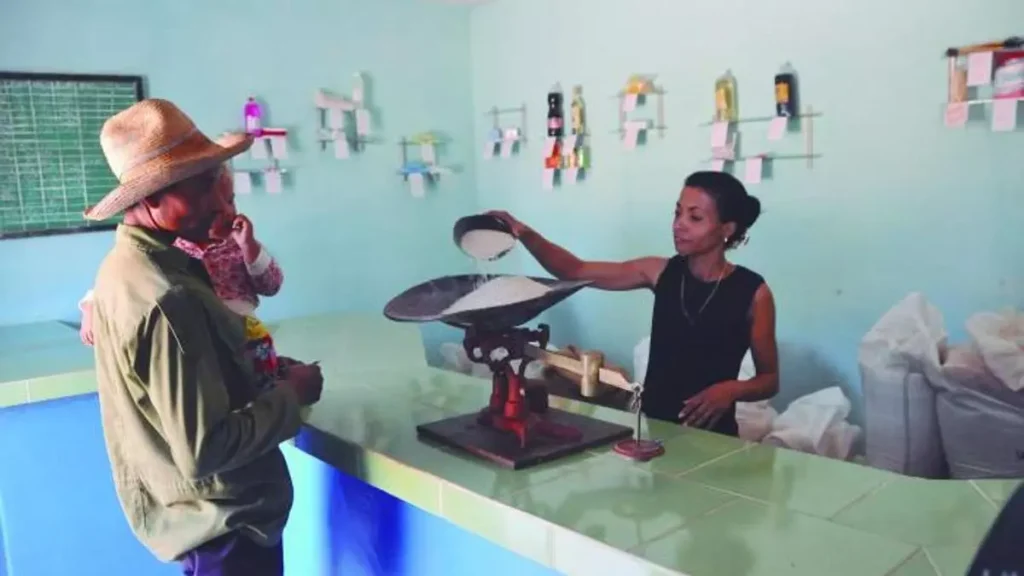
 14ymedio, Havana, May 27, 2026 — The NGO Food Monitor Program filed a complaint this Tuesday before the United Nations Special Rapporteur on the Right to Food against the all-powerful military conglomerate Business Administration Group (Gaesa) — recently sanctioned by the U.S. — for controlling the country’s food resources and limiting access to them.
The document, prepared in response to a UN call to report examples of “concentration of corporate power in global food systems,” states that Gaesa “significantly limits the autonomy and popular sovereignty of socioeconomic actors, reflected mainly in the food system, impacted by the monopoly over foreign currency, imports, and food distribution and commercialization chains,” which has turned access to food into a “mechanism for extracting foreign currency, using the Cuban diaspora as a market.”
It also stresses that “the rent-seeking logic of the military elite in Cuba hinders the increase of national production.” Food Monitor Program explains in its complaint that it has warned “about the government’s lack of interest in resolving the production deficit: 80% of food is imported, while national food production has fallen by 67% over the last five years in favor of food imports.”
Eighty percent of food is imported, while domestic production has fallen by 67%
This, it adds, “limits citizens’ access to basic products, especially when these are sold in foreign currencies inaccessible to many Cubans, and restricts the development of autonomous business and corporate initiatives, and the dynamism of the national economy, in favor of enriching the ruling elite.”
Furthermore, the complaint points out that companies under the control of military figures, such as Flora y Fauna S.A., directed by Commander Guillermo García Frías, “are evidence of the advance of administrative capitalism in the country. Companies under its leadership centralize and restrict popular access to natural food resources.”
Regarding this company, the report notes that “under the legal structure of heritage conservation, its units allow the exclusive economic control of species and products such as meats, seafood, and charcoal, which the same company exports in competitive markets.”
That monopoly has pushed independent Cuban producers out of the picture. In the complaint, they anonymously describe their exclusion from decisions about their own work: “It is not fair that we, the people who live on and work the land, do not have control over what we produce, how we do it, or to whom we sell it.”
“It is not fair that we, the people who live on and work the land, do not have control over what we produce”
As for the decision-making process within the sector, farmers state that “organizations have had their space in some agricultural policy discussions, but in the end, it seems that decisions come from above and we are only there to fill seats. Sometimes it feels like they only use us to legitimize what had already been decided.”
Small private entrepreneurs face price caps, tax increases, import restrictions, and provincial bureaucracy that blocks their development, the organization accuses.
The NGO also highlights that, despite “clear violations of the socioeconomic rights of producers in Cuba, including recorded acts of repression and intimidation based on ideological criteria, there are no lawsuits advancing through national legal channels, nor any rulings against the corporations mentioned in this document, which are strongly backed by the ruling leadership.”
There are “clear violations of the socioeconomic rights of producers in Cuba, including recorded acts of repression and intimidation”
In Cuba, Food Monitor recalls, there is no separation between the Executive and Legislative branches, “which means the latter functions as legal support and a legitimizing apparatus for official policies.”
The report warns that hunger is worsening in Cuba, stating “that 96% of the population has lost its purchasing power for food,” according to its 2024 survey, in a country where barely 29% manage to have two meals a day.
Translated by Regina Anavy
______________________
COLLABORATE WITH OUR WORK: The 14ymedio team is committed to practicing serious journalism that reflects Cuba’s reality in all its depth. Thank you for joining us on this long journey. We invite you to continue supporting us by becoming a member of 14ymedio now. Together we can continue transforming journalism in Cuba.