The drinking water system and transport have not ground to a complete halt thanks to probable fuel deliveries imported from Texas and Florida by private SMEs
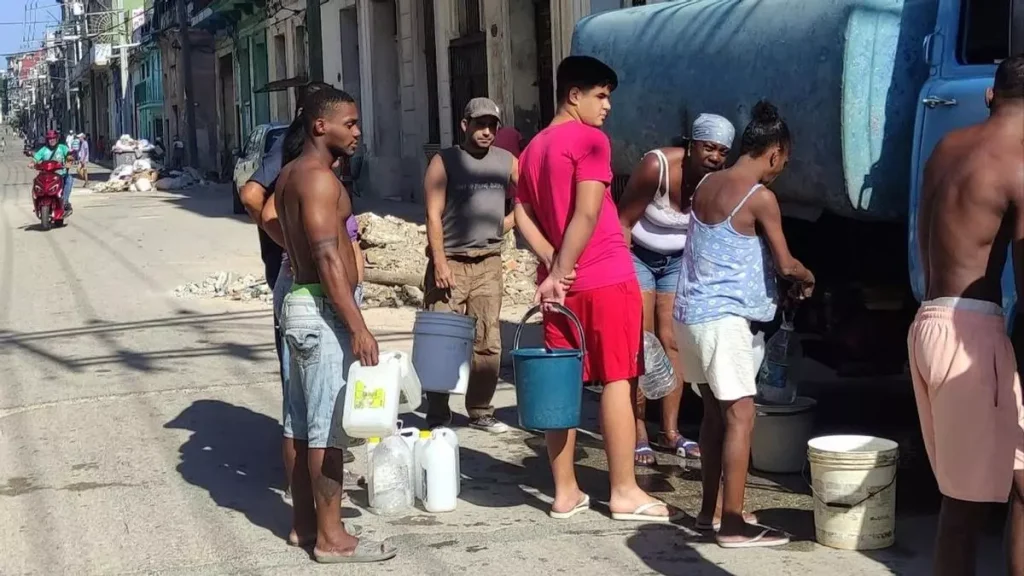
 14ymedio, Madrid, 28 May 2026 / As if the lack of electricity weren’t enough, the shortage of running water is emerging as the more serious problem for the Cuban population, with unpredictable consequences for public health. “It is one of the sectors hardest hit by the blockade, being among the country’s biggest energy consumers,” said Antonio Rodríguez Rodríguez, president of the National Institute of Hydraulic Resources (INRH), on Wednesday during the Mesa Redonda programme on Cuban Television. One of the most recent difficulties facing the institution is the lack of financing and suppliers’ fear of falling foul of the new sanctions, the official revealed.
Until recently, the state enterprise was making annual imports of close to 100 million dollars, but in the past year it managed to import only a tenth of that. “Today we have no operating credit,” he stated — a consequence of the sanctions imposed by the US on 1 May, compounded by the withdrawal of regular suppliers. “Others who still hold contracts are in a wait-and-see mode while they assess the legal implications of doing business with Cuba, as well as the banking obstacles to processing payments and the disruption of the maritime transport of supplies by international shipping companies,” he added.
Rodríguez said that everything possible is being directed towards recovering capacity, yet even so there are “around 2.7 million people affected on average by difficulties in the water supply” — not always the same territories or the same people. “They say they blockade the country because we supposedly violate human rights. And isn’t water a human right? Because every day their genocidal measures prevent that vital liquid from reaching Cuban homes,” the official protested.
Among the biggest technical problems arising from the fuel shortage are unblocking pipes and cleaning cesspits, the tanker-truck service, fixing leaks, and the logistics of chemicals for purifying water
Among the biggest technical problems arising from the fuel shortage, he said, are unblocking pipes and cleaning cesspits, the tanker-truck service, fixing leaks, and the logistics of chemicals for purifying water. The enterprise receives just over a third of the fuel it needs. “With that 37% we’ve been muddling through, looking for alternatives to minimise the impact,” he admitted, without explaining where those reserves come from — reserves which at this point can only be being drawn from private-sector imports, which the Government itself described just days ago as insufficient for industrial-scale use.
Moreover, he continued, the lack of electricity is fatal for pumping. Cuba has 3,331 pumping stations that need to operate between 18 and 24 hours a day, but some operate for only two — “almost as if the water only flows while filling the pipe.”
In big cities, any failure of a booster pump or re-pumping system due to lack of electricity immediately affects thousands of people. “If the Marianao booster doesn’t have water, a significant part of the city goes without; the same happens if the El Gato or Palatino pumps fail,” he said, referring to Havana.
Of the 480 most important pumping stations in the country, which supply between 70% and 80% of the population, only 145 are on circuits protected from blackouts, and 73 have generators that are today themselves suffering from the fuel shortage. To make matters worse, frequency and voltage fluctuations are increasing failures across the entire pipeline and equipment network.
Of the 480 most important pumping stations in the country, only 145 are on circuits protected from blackouts
In these circumstances, work has gone into repairing domestic equipment — 17 pumps were imported but 245 were repaired on the island — and switching the existing grid to solar. So far there are 841 solar-powered stations serving around 500,000 people, and negotiations are under way to add 446 more, which would represent 37% of the total. In addition, he said, the plan is to add a further 520, bringing the solar share to 52% overall. Rodríguez did not mention with whom these agreements are being made, though it seems likely that China will be the supplier — as the world leader in the sector and a country with which Cuba has struck energy deals beyond the current solar parks.
During his appearance, the INRH president was joined by the Minister of Transport, Eduardo Rodríguez Dávila, who returned to the drastic cuts announced just over a week ago. Supply is so scarce that, he warned, ticket sales are being suspended — both at agencies and via the APK Viajando app — until the authorities work out how to prioritise travel for medical or family emergencies. The official acknowledged the risks of corruption and arbitrary decision-making that this decision might bring, but concluded there is no other option at this point.
On the subject of air transport — which has been domestic only since February — Rodríguez Dávila referred to the cancellation of Cubana de Aviación’s contract with the Spanish airline Plus Ultra, whose aircraft had covered the Havana–Santiago de Cuba route. The rest are being kept going “with great effort,” he said, as are all airports and seaports. With the bare minimum of fuel available — which, again, can presumably only be coming from private-sector imports — the absolute priority, he said, will be transporting food from the main ports to prevent shortages, followed by healthcare services, haemodialysis, and special education.
Rodríguez Dávila referred to the cancellation of Cubana de Aviación’s contract with the Spanish airline Plus Ultra, which covered the Havana–Santiago de Cuba route
He also described local transport as “deeply deficient” and said there is no alternative but to promote the use of electric tricycles and begin a census to legalise and certify vehicles assembled from parts, in offices that will run on solar panels to avoid disruption from blackouts. He also announced a long-term strategy involving the foreign-currency fund created two years ago with revenue from the sale of petrol in dollars, which until now has been used to set up solar stations and procure electric vehicles — including the 200 that are due to come into service for haemodialysis patients.
The government’s Mesa Redonda TV program had opened with more familiar ground: a review of the current situation with Rubén Campos Olmo, Director-General of the Electrical Union (UNE), who described as “devastating” the impact of the sanctions decreed by the US on 29 January banning fuel deliveries to Cuba. There was little that Cubans don’t already know and live with every day. Distributed generation that is not available now accounts for more than 50% of the total, averaging some 1,400 megawatts. “When the sun goes down, the system is left with only the output from the thermal plants and gas: just over 1,100, sometimes 1,200 MW, depending on how many thermal units are out of service at any given moment,” he said.
Campos pointed out that the 100,000 tonnes of crude donated by Russia proved that when raw materials are available the situation improves, and lamented that access to components for the thermoelectric plants is becoming ever more complicated. “Unless these coercive measures are reversed, electricity generation in the country will remain in a delicate balance, dependent on domestic crude, gas, and renewable energy, well below what the population and the economy need,” he warned.
As the sole lifeline he cited China — also glossing over the fuel arriving via private importers — which last year extended a credit for metals and parts intended to improve units 5 and 6 at the Renté plant in Santiago de Cuba, and unit 5 at Mariel, as well as Nuevitas, in July. By that point they hope to have added 1,000 MW more to the grid. Insufficient, but not negligible — provided there is no certainty that another breakdown won’t occur at the same time.
Translated by GH
______________________
COLLABORATE WITH OUR WORK: The 14ymedio team is committed to practicing serious journalism that reflects Cuba’s reality in all its depth. Thank you for joining us on this long journey. We invite you to continue supporting us by becoming a member of 14ymedio now. Together we can continue transforming journalism in Cuba.