Cuba’s Electricity Deficit Reaches a New Record of 39 Percent of Consumption

The breakdowns in seven thermoelectric plants and the lack of fuel oil have brought back the blackouts of more than 12 hours


Two days ago, Cubans suffered blackouts of up to 19 hours / EFE

14ymedio bigger14ymedio, Havana, August 22, 2024 — If with a deficit of less than 500 megawatts (MW) two days ago Cubans suffered blackouts of up to 19 hours, for this Thursday they fear it will be worst. The Electric Union of Cuba (UNE) predicts in its daily report a deficit of 1,235 MW for peak hours and an impact – which will finally switch off – of 1,305 MW.

It is a record figure for the last three months, very close to the 1,400 megawatts reached on May 28, and it will affect 39% of the island’s consumption during Thursday afternoon and night.

The Island had not reached such a high deficit for weeks, but the lack of fuel and breakdowns in seven thermoelectric plants have brought back the blackouts of more than 12 hours. “It has not been possible to avoid the impacts,” the UNE excuses itself in its statement without further arguments.

On Tuesday, the the Felton ’Lidio Ramón Pérez’ thermal power plant (CTE) in Holguín broke down due to a “puncture in the boiler” that will have it offline until at least Sunday. This was followed by the exit from the system of the ’Diez de Octubre’ CTE in Nuevitas (Camagüey) on Wednesday, by a “critical route,” said the state company. The UNE determined that they need to clean the boiler in a process that will last at least 40 hours. In continue reading

addition, unit 5 of the ’Máximo Gómez’ CTE, in Mariel, units 1 and 3 in that of Santa Cruz del Norte (Mayabeque) and unit 4 of Carlos Manuel de Céspedes (Cienfuegos) are out of service due to breakdowns.

The Island had not reached such a high deficit for weeks, and it appears that the blackouts of more than 12 hours have returned

The residents of Avellaneda Street, in the city of Camagüey, are among the few who have electricity in Cuba. The reason is that they live near the headquarters of the Cuban Telecommunications Company (Etecsa), and the state monopoly does not have the fuel necessary to restart its own generators, so they never cut off the power. “They can’t take electricity away from the company because they don’t have a way to run their own plants,” explains Sury, 48, who lives a few meters from the premises.

“We were surprised when we saw that suddenly we no longer had blackouts although the whole city spends more than ten hours a day without power,” she tells this newspaper. “When we began to investigate, it turns out that the reason is that Etecsa has run out of oil and that office is prioritized. If the power is removed, most of Nauta’s mobile communications and services in Camagüey are dropped,” he explains. “We are a small group of people who are happy that there is no oil, a tremendous irony of life.”

For the rest of the Island, however, the situation borders on the unsustainable. In Thursday’s UNE report, a user identified as Orlando Perez Atencio shared some details of how the last hours of blackouts have been experienced in the Cuban East; to be more specific, in the city of Campechuela where he resides and where yesterday the lack of service was from 9:08 p.m. to 5:52 a.m.

For the rest of the Island, however, the situation borders on the unsustainable

He described it as “a sad spectacle” with children going hoarse from inconsolable crying caused by the heat and the mosquitoes. “The parents are powerless in the face of such a scene, and the grandparents are hopelessly moaning,” he said.

In the months of February, March and May, the lack of power – more than 40% — sent people to the street to protest in numerous places such as Sancti Spíritus, Baracoa and Cienfuegos. The regime’s response on those occasions was, as usual, repression. Units of red berets (Army Prevention Troops) made arrests and deterred the demonstrators.

Translated by Regina Anavy

____________

COLLABORATE WITH OUR WORKThe 14ymedio team is committed to practicing serious journalism that reflects Cuba’s reality in all its depth. Thank you for joining us on this long journey. We invite you to continue supporting us by becoming a member of 14ymedio now. Together we can continue transforming journalism in Cuba.

Marrero Left Iran Empty-Handed and With Few Promises of Economic Aid for Cuba

The Prime Minister hopes that, with the new Government, Tehran will invest more in the Island

Journalist Jaime Yoan Batista, a holguinero like Marrero and resident of Tehran, was a complacent interlocutor / HispanTV

14ymedio bigger14ymedio, Havana, 22 August 2024 — “To what extent is Cuba willing to change?” The key question of the HispanTV journalist who interviewed Manuel Marrero during his visit to Iran, at the beginning of the month, produced an uncomfortable silence in the prime minister. After a long detour, he summarized the immobility that his Cabinet – in conjunction with the Presidency headed by Miguel Díaz-Canel – represents: “Well, we will never give up the principles of the Revolution.”

In less than 30 minutes of conversation with an interlocutor who was not going to set traps for him – Jaime Yoan Batista, who came from Holguin as did Marrero and is now a resident of Tehran – the Prime Minister relayed the message that interested him: Iran’s economic aid could reach the Island faster, but there is reluctance.

The two countries are allied in their enmity toward the United States, he argued, and they recognize a “very strong” alliance between them. “We always coincide in different points of view” with Iran, because of the “cruel and unjust persecution” by “Washington and all its allies.” Both feel they are victims of the United States in the international arena. “We are two warrior peoples,” he said; hence, he does not understand why economic relations are going so slowly. continue reading

“We have identified all the fields in which we could cooperate, among them biotechnology, which is key, and important steps have already been taken,” he said

“We have identified all the fields in which we could cooperate, among them biotechnology, which is key, and important steps have already been taken,” he said. He alluded to the Soberana 02 vaccine for Covid, which Iran and Cuba jointly manufactured, and which the Persian country sold under the name of PastuCovac, which so far has not received the endorsement of the World Health Organization. “Western countries were not going to help us,” Marrero alleged, so they made a “technology transfer” to the Pasteur Institute of Iran, which was willing to finance the manufacture of the product.

“In the field of energy we have important negotiations that we need to continue consolidating,” he said, alleging Cuba’s “need for fuel” that Iran could alleviate.

“We need to move to another stage,” Marrero pressed. Batista asked if that advance was expected to happen at least in the medium term. The prime minister again diverted the question and said that he hoped that his presence at the inauguration of the new Iranian president, Masoud Pezeshkian, would mark “a before and after” in trade relations.

Marrero celebrated the “change in the direction of the Government,” which, he said, brings favorable signs for Cuba in economic terms. He soon realized that his comment implied that his relations with Ebrahim Raisí, the previous president – who died in a helicopter crash on May 19 – were not the best. “All our people felt his unfortunate death,” he said. “But well, they had new elections and there is a new direction.”

From Tehran, Marrero leaves with a promise from the Ayatollah regime: at the end of the year, an Iranian commission will visit Havana by order of Pezeshkian “to now update all the agreements and set dates for their implementation.” Just words, at least for the moment.

Marrero spoke of other points in common with Iran, in particular its position against Israel in favor of the Palestinians. “With the State of Israel, everyone knows that we don’t have any kind of diplomatic relationship,” he said. He “totally” endorsed Tehran’s position in the war and its military support for Hamas. “Israel is not sanctioned, but Iran, Venezuela and Cuba… I was missing Russia,” Batista agreed.

The prime minister stuck to common subject matter to extend his conversation, which only at the end dealt with the internal situation of Cuba

The prime minister stuck to common subject matter – the blockade, the isolation by the axis of “allies,” independence,” the “doctors in more than 50 countries when no one helped us in the pandemic” – to extend his conversation, which only at the end dealt with the internal situation of Cuba.

“What is the Government of Cuba doing to help alleviate what is happening from the economic point of view?” Batista asked, and it seemed that the tone of the interview was going to be raised. It was, of course, a false alarm. Marrero took advantage of the opportunity and appealed to other topics, such as that the country does everything it can with its own resources and that Cuba “lives from one day to the next with its current situation.”

“Even friendly banks tell us that they can’t give us credit because we can be sanctioned,” he lamented. “Times have changed; there are things and measures that we applied at the time that no longer make sense today, and they have to be corrected. We identified eight strategic objectives,” he said, although he alluded only to containing inflation, “intervening in the illegal foreign exchange market” and a “ferocious fight against illegalities.”

Asked about the new elections in the United States, he practically announced Donald Trump as the winner. “We already know it, and we have prepared a program for Trump’s second term,” he said. “But we are open to foreign investment, even to Cubans living abroad who want to invest in their country.”

“We are not afraid of change,” he insisted, and to prove it he gave an example that borders on science fiction: “Even if Artificial Intelligence is used for evil, we are preparing for that too.”

Translated by Regina Anavy

____________

COLLABORATE WITH OUR WORKThe 14ymedio team is committed to practicing serious journalism that reflects Cuba’s reality in all its depth. Thank you for joining us on this long journey. We invite you to continue supporting us by becoming a member of 14ymedio now. Together we can continue transforming journalism in Cuba.

A Private Company Is Hired in Havana To Collect Mountains of Accumulated Garbage

People must deposit solid waste in designated areas starting at 6:00 p.m.

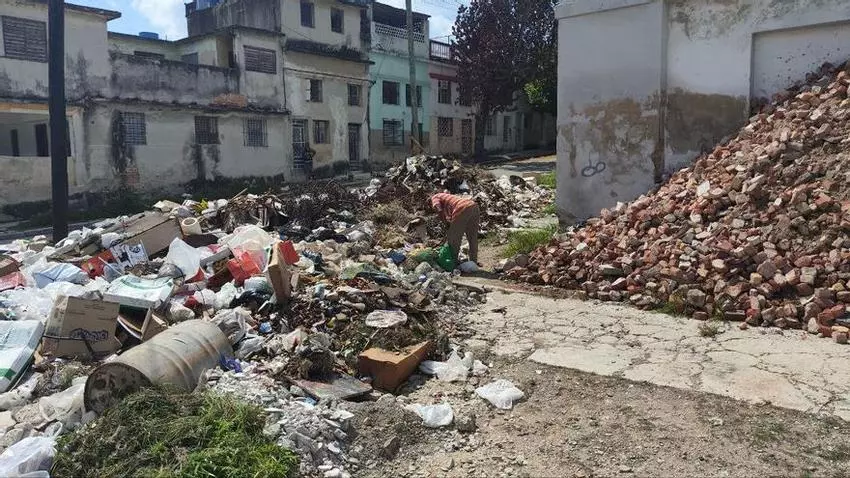
In the capital alone, between 20,000 and 25,000 tons of waste are produced daily / 14ymedio

14ymedio bigger14ymedio, Havana, 21 August 2024 — Havana’s municipality of Cerro has turned to a private company to collect the mountains of garbage that have accumulated for months in the streets. In the area, one of the most densely populated in the Cuban capital, Talleres Delis was hired “to improve communal hygiene,” the official media Canal Habana reported on Tuesday.

The company was founded by Delis Antonio Espinosa Hernández and, according to the Ministry of Economy and Planning’s list of micro, small and medium-sized enterprises ( MSMEs), is dedicated to the maintenance and repair of motor vehicles. At the end of last year, Espinosa Hernández himself announced, in an interview with Tribuna de La Habana, that he intended to “insert himself in the search for solutions to the problems of transportation and Communal Services.”

He explained that the repair work carried out by the company was a “quasi-rescue” and a “reconstruction” of vehicles of all kinds – including buses used for state transport – that arrived at his workshop “practically unusable.”

Less clear is the result obtained in the municipality of Diez de Octubre, where they also prepared “recovered trucks” to collect garbage, an action similar to the one that will now be carried out for Cerro. continue reading

This is not the first time a government entity has hired him. Others already did so, he said, during the Covid-19 pandemic, in Mayabeque and Artemisa.

Juan Alonso Street, in Diez de Octubre, still has mountains of garbage, despite the work of Talleres Delis / 14ymedio

The municipality’s authorities argue that they cannot cope with the collection of waste due to a lack of personnel, fuel and equipment. For this reason they made an “agreement” with the Espinosa Hernández MSME to improve the fleet of equipment destined for garbage collection “especially on the most important avenues in the area.”

Other measures taken by the authorities to alleviate the problem of waste, which is proliferating everywhere, are collection brigades that will work starting at 6:00 pm. They will make a tour of the Cerro road, from Boyeros Avenue to Monte, and also along the Ayestarán road.

Residents will only have to deposit their rubbish after that time, and fines will be imposed if they do so before then.

The “experiment,” as Canal Habana describes it , will last a month “to evaluate its results” and will be carried out alongside other actions, according to Johanna Despaigne, deputy mayor of Social Programs in that area, who, without giving further details, indicated that “health hearings” are being held with the population.

In Havana, waste flourishes on every corner, although it also happens in other places, as reported by 14ymedio, including Matanzas, Las Tunas, Santa Clara and Manzanillo.

In Havana, waste flourishes on every corner, although it also happens in other places, as reported by 14ymedio, including Matanzas, Las Tunas, Santa Clara or Manzanillo

In the capital alone, there are between 20,000 to 25,000 tons of waste created each day, which, combined with overcrowding in thousands of buildings, serious problems with the water supply and the poor sewage system, creates an unhealthy environment.

As one example: the water shortage has caused something that has not been seen since the Special Period: Havana residents relieve themselves in a plastic bag, which they then throw into the garbage dump in the open air.

This situation has contributed to the spread of diseases such as Oropouche, which, according to the Government, has led to only 400 cases in the country, although it is present in all provinces and there are hundreds of complaints on social media. In fact, the authorities hinted in July that 35,000 cases had been registered in the country during the first half of this year.

The same is true for dengue fever, which has had resulted in more than 3,000 cases each year since 2019 and has caused several deaths in the country; among the most recent is that of the journalist Magda Iris Chirolde López, editor-in-chief of Canal Caribe, who died at the age of 33 at the end of last month. This disease is “the main health problem in the region,” according to Dr. María Guadalupe Guzmán — head of the Research, Diagnosis and Reference Center of the Pedro Kourí Institute of Tropical Medicine (IPK) — speaking during the international course on dengue and other arboviruses that is being taught in Havana.

____________

COLLABORATE WITH OUR WORKThe 14ymedio team is committed to practicing serious journalism that reflects Cuba’s reality in all its depth. Thank you for joining us on this long journey. We invite you to continue supporting us by becoming a member of 14ymedio now. Together we can continue transforming journalism in Cuba.
Authorities in Ciego De Ávila, Cuba, Have Not Hired Teachers Despite Having the Budget

Cuba’s Minister of Education Naima Trujillo blamed the local cadres for not using the budget surplus and criticized their lack of “originality” / 14ymedio

14ymedio bigger14ymedio, Havana, August 21,2024 — It would take 1,161 teachers for the school year in Ciego de Ávila to get off on the right foot. The local authorities say that they have enough budget to hire the necessary staff, but prefer to return it to the state coffers at the end of the year rather than “relieve the pockets a little” of the teachers. The reason for this attitude is a mystery that the Minister of Education, Naima Trujillo, failed to clear up this Tuesday.

Meeting with teachers and leaders from Avila, Trujillo attributed the non-use of the budget surplus to the lack of originality of the local cadres. She alluded to the “mechanical thinking” when organizing the course, the lack of “flexibility and intelligence,” and stressed that everything seems to indicate that it will be a year “full of tensions.”

Trujillo asked the managers to be “honest” with the families in the face of the shortages that she foresees for the sector. “This year we will only be able to deliver two uniforms in preschool, one in each initial grade and one in the fifth grade. And we don’t want it to be like that, because the school uniform is a symbol of equity, which we can’t lose. But in the current economic situation we lack the raw materials to make more,” she said. continue reading

“This year we will only be able to deliver two uniforms in preschool, one in each initial grade and one in fifth grade”

In fact, the official press has been filled in the weeks prior to the school year with official “apologies” because the textile factories have not lived up to the demand for uniforms. Escambray reported on Tuesday, in a sarcastic tone, that the industry has a number of uniforms that are “unstitched,” in the neighboring province of Sancti Spíritus. One of the explanations for the lack of uniforms bordered on the hilarious: garments are missing because they are manufactured according to a “historic” record – if a child needs a preschool uniform in 2023, the following year he will have to buy a first grade one – and this year the calculation was not made correctly.

“There are no recipes” to make the school year successful, summarized Trujillo, who suggested a kind of personal formula: “in everything we implement, we must go from diagnosis to transformation and innovate incessantly,” because there will be multiple “limitations.”

But Cuban teaching does not depend only on uniforms: computers, indispensable for children to do their work according to the requirements of the Ministry, are missing in at least 65 schools in Avila, most of them rural primary schools. The data, provided by a local official, was answered with another slogan from Trujillo: “It is important to overcome the difficulties.”

The minister admitted a situation that has dozens of families complaining: the student meals, which are nothing more than rice and bread”

Another disturbing issue is the food for scholarship students, which is going through a critical moment. The minister admitted the situation that dozens of families have denounced: the kids “find at the time of the meal a tray with rice and bread, nothing else.”

Given these problems, Trujillo said, few want to dedicate themselves to careers linked to teaching. Only 67% of the planned students entered the Teaching program, and the managers are preparing for the classrooms to be decimated in the first months of the course. The center for higher studies is characterized, she said, by its “low retention” of students during the first year.

“Among the most affected specialties are Early Childhood, Special, Primary, Mathematics and Chemistry. Ciego de Ávila, Florencia and Ciro Redondo are the municipalities where fewer high school students opt for teaching,” she said.

In the midst of the shortcomings, Trujillo celebrated that they at least have textbooks. An “important” shipment of 29 titles – she did not say how many copies of each – are about to arrive in Cuba; she did not reveal which country had printed them. It was the only “good news” of the meeting, commented Invasor.

“There can’t be a single Avileño teacher who hasn’t received a knock on the door trying to convince him to return”

During the opening of the discussion, several leaders indicated to Trujillo their ideas and complaints about the beginning of the course. Alfredo Menéndez, governor of the province, said that the schools had to go out to “motivate” those who had abandoned teaching. “There can’t be a single Avila teacher who hasn’t received a knock on the door trying to convince them to return,” he said, without referring to the “unexecuted budget” that the minister attributed to her office.

On September 2, another school year begins, marked by shortages, the lack of materials and with few teachers, and the situation is expected to be even worse the following year. According to a report by the National Bureau of Statistics and Information, in the first half of 2024, the Island devoted 21% less of its budget to education, while it invested 112% more in the construction of hotels and restaurants. Despite the seriousness of the situation, the Ministry of Education has had no qualms about declaring on X that everything is “assured” for a return to the classrooms.

Translated by Regina Anavy

____________

COLLABORATE WITH OUR WORKThe 14ymedio team is committed to practicing serious journalism that reflects Cuba’s reality in all its depth. Thank you for joining us on this long journey. We invite you to continue supporting us by becoming a member of 14ymedio now. Together we can continue transforming journalism in Cuba.

Maduro’s Government Seeks To ‘Terrify’ Public Employees, Says María Corina Machado

“Much sooner than some believe, you will all be able to express yourselves freely,” said the Venezuelan opponent.

Political leaders and organizations have denounced unjustified dismissals of public employees / EFE

14ymedio biggerEFE (via 14ymedio), 22 August 2024, Caracas — Venezuelan opposition leader María Corina Machado said on Wednesday that the Government of Nicolás Maduro seeks to “terrify” public employees so that they do not express themselves against chavismo. “They have spied on your social networks, your privacy, checked your phone. This is monstrous, and what they are looking for, what they intend, is to terrify public employees, isolate them, paralyze them all,” said the former deputy, who defends the electoral triumph of her standard-bearer, Edmundo González Urrutia.

In a “message to public employees” disseminated on social networks, Machado urged these workers to “help each other,” despite the fact that “the regime wants to sow distrust” among them, in the midst of the political crisis that the country is going through, with post-election protests and police operations that resulted in 25 deaths and 2,400 detainees, according to state sources.

“Get ready, because change is inevitable. Much sooner than some believe, you will all be able to express yourselves freely,” said Machado, after political leaders and organizations denounced “unjustified dismissals” of public employees for allegedly supporting the opposition in the elections. continue reading

Machado urged these workers to “help each other,” despite the fact that “the regime wants to sow distrust” among them

“We understand the anguish you feel today when you cannot openly express and share with us your conviction that this regime that has brought much corruption and must come to an end. We understand your fears, because this regime is ruthless,” she added.

The coalition that backs González Urrutia, the Democratic United Platform (PUD), states that its candidate won the presidential elections by a wide margin. They also published 83% of the electoral results to reinforce this claim, which has been supported by several countries and national and international organizations.

However, the National Electoral Council (CNE) proclaimed Maduro the winner, without publishing the disaggregated results, something that was expected in the election schedule, and which has been demanded by a large part of the international community.

Translated by Regina Anavy

____________

COLLABORATE WITH OUR WORKThe 14ymedio team is committed to practicing serious journalism that reflects Cuba’s reality in all its depth. Thank you for joining us on this long journey. We invite you to continue supporting us by becoming a member of 14ymedio now. Together we can continue transforming journalism in Cuba.

The Oropouche Virus, An Unwanted Visitor in Thousands of Cuban Homes

Most people with Oropouche symptoms do not seek medical attention

Mountains of garbage grow on the streets due to the lack of fuel and trucks to collect them / 14ymedio

14ymedio bigger14ymedio, Yoani Sánchez, Generation Y, Havana, 22 August 2024 — A few months ago we didn’t even know how to pronounce its name, but the Oropouche virus has already become an uninvited guest in Cuban homes. In the neighborhood where I live, in Havana, every day we hear about a neighbor who has isolated themself because of high fevers and weakness. They are almost always elderly people who live alone, because their children and grandchildren have emigrated; they almost never go to hospitals for treatment.

After months of hiding the numbers, Cuban authorities have recently confirmed that, as of early August, more than 400 people have been infected with the Oropouche virus throughout the country. The official statement, however, does not mention the alert issued by the United States for those traveling to the island. The alert from the Centers for Disease Control and Prevention (CDC) asks visitors to take extreme precautions.

But beyond statistics and tourism, the Oropouche virus is becoming the final straw in an epidemiological situation that is deteriorating every day. While the mountains of garbage pile up in the streets, due to the lack of fuel and vehicles to transport it, there is no water due to the deterioration of the pumping equipment and the countless breaks in the distribution pipes. The lack of hygiene suits rodents as well as other vectors, such as the Culex mosquito, the main transmitter of the virus on the Island. An alarming sanitary storm has been underway for months. continue reading

Lack of hygiene suits both rodents and other vectors, such as the ‘Culex’ mosquito

Most people who start showing symptoms do not seek medical attention. The Cuban population is increasingly convinced that hospitals lack the necessary supplies to treat many illnesses, that they have fewer and fewer specialists due to the mass exodus the country is experiencing, and that their facilities suffer from such poor hygiene that it can lead to more infections. Many of the sick prefer to stay at home or resort to practices that have more to do with superstition than science

The most dramatic effect of this mixture of scarcity and suspicion is the deterioration of the quality of life, a possible increase in mortality and the increase in the consumption of drugs from the informal market that do not pass the controls of health entities. The belief is spreading that in matters of health each person must manage on their own. Relatives abroad pay out of their own pockets for everything from the suture thread for surgery to painkillers and antibiotics. The regime that boasted of having one of the best public health systems in the world can hardly rely on its propaganda campaigns and its high-sounding headlines to maintain the international image of medical power

A resident in my neighborhood has already recovered from the fever and malaise of the Oropouche, but now she has no water to bathe with or to wash her clothes. The virus of the crisis seems to last much longer

Editor’s note: This article originally appeared in DW and is reproduced under license from the author.

____________

COLLABORATE WITH OUR WORKThe 14ymedio team is committed to practicing serious journalism that reflects Cuba’s reality in all its depth. Thank you for joining us on this long journey. We invite you to continue supporting us by becoming a member of 14ymedio now. Together we can continue transforming journalism in Cuba.

The Cuban Regime Denies Its Involvement in Venezuela, Despite the Evidence Provided by the Opposition

The Cuban Foreign Ministry accused María Corina Machado of being a “promoter of lies” and of responding to the interests of the United States.

Machado said in an interview that Cuba is partly responsible for the repression in Venezuela / EFE

14ymedio biggerEFE (via 14ymedio), Havana, August 21, 2024 — The Cuban Government denied on Tuesday any involvement in the repression of the protests in Venezuela and criticized the opponent María Corina Machado, whom it described as a “promoter of lies” and a “person of the oligarchies” and “the interests” of the United States. In a statement, the Ministry of Foreign Affairs attacked the former deputy – without mentioning her by name – four days after the opposition leader said in an interview with Mexican journalist León Krauze that the Island “has had an impact” on “methods of repression, persecution, espionage and torture” in her country.

In this regard, the Ministry of Foreign Affairs pointed out that, “once again, invention and delirium come to life in the construction of a matrix of lies against Cuba.” It also added that Machado’s statements respond to “despair to hide the failure of the coup plans in Venezuela.”

“Cuba emphatically rejects the falsehoods that are fabricated to reinforce the policy of harassment,” the statement says. In the same way, it stressed that the Island does not “interfere – and never will – in the political and economic life of another country with sanctions, pressures and regime change plans.” continue reading

“Cuba emphatically rejects the falsehoods that are fabricated to reinforce the policy of harassment,” the statement says

The Cuban president, Miguel Díaz-Canel, applauded last Sunday the pro-government demonstrations that took place on Saturday in response to the opposition marches in Venezuela and in dozens of cities around the world that same day. “The people of Venezuela spoke again. In marches for peace and against fascism, it ratified the recognition of President Nicolás Maduro,” Díaz-Canel wrote, ignoring that the overwhelming majority of participants in those marches demonstrated in support of the opposition.

According to the Venezuelan Government, the post-election protests have left more than 2,400 detainees and 25 deaths in the numerous protests that have taken place after the elections of July 28, when Maduro declared himself the winner.

For its part, the largest opposition coalition assures that its standard-bearer, Edmundo González Urrutia, obtained the majority of the votes and exhibited the 83% of the tally sheets that they managed to collect, which validate his victory.

In this scenario, where the international community has recognized González Urrutia as the winner or, at least, has asked Maduro to prove his alleged victory with its voting records, Cuba has been one of the few countries, along with others such as Russia or Nicaragua, that insist on declaring Maduro as president-elect.

Translated by Regina Anavy

____________

COLLABORATE WITH OUR WORKThe 14ymedio team is committed to practicing serious journalism that reflects Cuba’s reality in all its depth. Thank you for joining us on this long journey. We invite you to continue supporting us by becoming a member of 14ymedio now. Together we can continue transforming journalism in Cuba.

The Debacle of Tourism in Cuba Continues, With a 14 Percent Decrease in July

Foreign tourists in Old Havana / 14ymedio

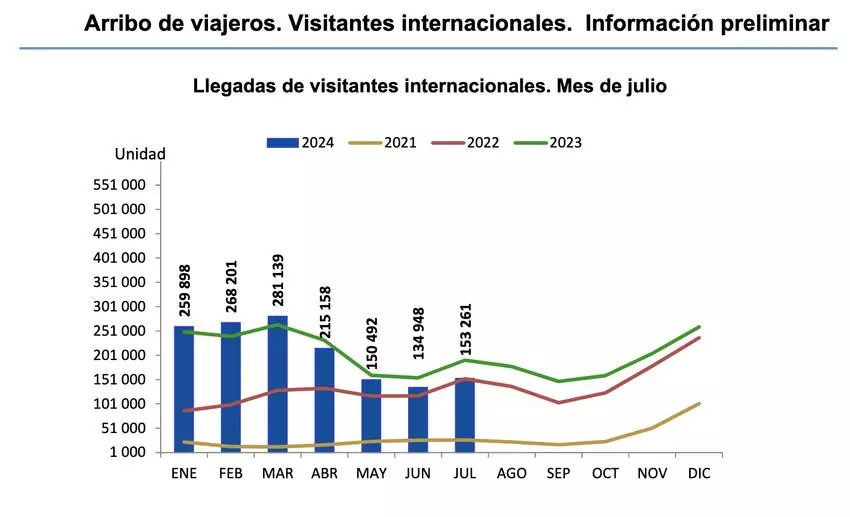
14ymedio bigger14ymedio/EFE, 20 August 2024 — Far from improving, or even maintaining, as happened with the June figures, tourism in Cuba continues to sink. In July, according to the report published on Tuesday by the National Office of Statistics and Information (ONEI), 153,261 travelers from abroad arrived in the country, a figure similar to that in the same month of 2022, but 13.56% lower than last year, when 177,306 tourists were received.

Between January and July, a total of 1,463,097 international travelers entered, 26,230 fewer – 1.8% – than in the same period of the previous year. Although the largest market is still Canada – with 613,227 people – the North American country registers a fall in its travelers to the Island, and the same happens with other European countries, such as Spain, Italy and France.

In July 2023, the United States measure eliminating Europeans from the ESTA rapid visa eligibility who have been in Cuba since January 12, 2021 – the date on which the U.S. Administration included the Island on the list of state sponsors of terrorism – came into force, a reason that may be behind the decrease in European tourists.

Visits by Cubans living abroad also decreased by 14.4%: in 2023 there were 210,026 such visitors between January and July, in the same period this year there were 179,746. continue reading

Year-on-year comparison of international travelers to Cuba / ONEI

On the other hand, visitors from Russia rose by 41%. With 123,358 travelers in the first seven months of 2024, it is still the second largest market, and with the bilateral agreements signed in the last two years, Russian tourism is expected to continue growing.

In any case, the Regime’s goal is to achieve 3.2 million international visitors in 2024, which was already a figure much lower than the data prior to the COVID-19 pandemic (4.2 million in 2019 and 4.6 million in 2018), and which contrasts dramatically with the Island’s direct Caribbean competitors – the Dominican Republic and Mexico – which have had historic high numbers of tourists in these post-COVID years.

The authorization, a few days ago, of the eVisa to facilitate the entry procedures into Cuba is also not expected to help much, taking into account the internet connection problems on the Island.

At the same time, and according to another report published on Tuesday by ONEI — Cuba’s National Office of Statistics — Cuba increased by 112% per year, more than double, its investment in hotels and restaurants in the first half of 2024. In absolute terms, it allocated 15,779.1 million pesos to the Tourism sector, 36.5% of the 43,12 billion pesos authorized in the first six months of the year.

For Pedro Monreal, these data confirm the “persistence of a very deformed investment structure”

If the investments are divided by segments, the Business Services, Real Estate and Rental Activities section – which includes the construction of hotels – accumulated 26.4% of the total investment. It is followed by the manufacturing industry, with 19.5%, and hotels and restaurants, with 11.4%.

Faced with this, public spending decreased by more than 20% in education, construction and public administration.

For the Cuban economist Pedro Monreal, these data confirm the “persistence of a very deformed investment structure in Cuba,” with almost 40% of spending concentrated on tourism-related activities. In a thread on X, the specialist highlights the growing investment in hotels and restaurants “despite the low occupancy rate of 28.4%.”

Similarly, he draws attention to the low agricultural investment, only 2.5% of total public spending (15 times less than what is allocated to tourism), which, in his opinion, indicates that the official “priority” “with respect to food security is no more than a slogan.”

Translated by Regina Anavy

____________

COLLABORATE WITH OUR WORKThe 14ymedio team is committed to practicing serious journalism that reflects Cuba’s reality in all its depth. Thank you for joining us on this long journey. We invite you to continue supporting us by becoming a member of 14ymedio now. Together we can continue transforming journalism in Cuba.

The OAS Considers Democracy in Venezuela To Have Collapsed

The president of Paraguay, Santiago Peña, expressed his concern about the resurgence of authoritarianism and populism in the region

The OAS Secretary General, Luis Almagro, sent a video message during the XVII Inter-American Meeting of Electoral Authorities  / Nina Osorio/EFE

14ymedio biggerEFE (via 14ymedio), Luque (Paraguay), August 20, 2024 — The lack of transparency in the July 28 elections in Venezuela shows that the democratic system of that country has collapsed, the Secretary for the Strengthening of Democracy of the Organization of American States (OAS), the Mexican Francisco Guerrero, declared on Tuesday.

“In what electoral process in the world do you wait three weeks to know the evidence that guarantees a result? Nowhere else in the world. What this confirms is that the democratic system in Venezuela has collapsed,” he told the EFE Guerrero agency, which is participating in the Paraguayan city of Luque of the XVII Inter-American Meeting of Electoral Authorities (RAE).

According to the official, the Venezuelans decided “on a direction that was opposite” to the results issued by the National Electoral Council (CNE), which formalized Maduro’s victory for a third six-year term in power, a result questioned by the opposition and by a large part of the international community. continue reading

The electoral authority has been characterized as ’being in the hands of the regime’

“In the case of Venezuela, in particular, I think it has been evident, it has been very clear, that people decided on a direction contrary to what the electoral authority says,” Guerrero said. In addition, he considered that the electoral authority “has been characterized as being in the hands of the regime of Nicolás Maduro.”

The Democratic United Platform (PUD), the largest Venezuelan opposition coalition, called the results announced by the CNE fraudulent and said that its standard-bearer, Edmundo González Urrutia, was the winner of the elections. Guerrero pointed out that the electoral “lack of independence” in Venezuela, as well as the “lack of political capacity” of the Maduro Government “to recognize what people have truly said at the polls, is what generated this crisis.”

In that context, the OAS delegate stressed the importance of “the electoral authorities being autonomous, being independent, not responding to the dictates of the powerful or to the interest groups.”

At the inauguration of the meeting, the Secretary General of the OAS, Luis Almagro, said, through a video, that they will continue to “fight for the return to democracy in Venezuela.” “The goal remains a democratic future, without political persecution, with full respect for fundamental rights,” said Almagro, who urged the electoral authorities to ensure that every voice and vote counts.

The OAS will continue to fight for the return to democracy in Venezuela, Almagro assured

During the opening of the meeting, which will conclude this Wednesday, the president of Paraguay, Santiago Peña, expressed his concern about the “slow resurgence of authoritarianism, populism and anti-democratic ideas” in the region.

He mentioned that many want to make people believe “that democracy is not up to the great challenges,” such as transnational crime, economic inequalities or insecurity.

To him, to them, I say today loud and clear: false prophets. On the contrary, I am convinced that the only way to fight against these dangers is not with authoritarianism or its first cousin, demagogic populism, but with democracy,” he concluded.

Peña also urged the representatives of the 27 countries participating in the meeting to ensure the validity of democracy and to give “clear answers” that guarantee citizen confidence.

“I hope that in these days when we hear voices of hopelessness that struggle for the return of authoritarian models, this meeting will constitute a true beacon of hope, of struggle for democracy, and that it is a light in the midst of darkness,” he said.

The crisis in Venezuela is not explicitly on the agenda

In Paraguay, the authorities of the 35 inter-American electoral bodies will analyze the impact and risks of artificial intelligence on democracy and the integrity of electoral processes.

Likewise, they will discuss multilateral efforts to preserve democracy, the health of the system and democratic institutions, and the promotion of secure information ecosystems in the electoral sphere.

Similarly, there will be a space for dialogue on the effects of political violence on the elections. The crisis in Venezuela is not explicitly on the agenda, although it will surely be one of the topics of debate.

Translated by Regina Anavy

____________

COLLABORATE WITH OUR WORKThe 14ymedio team is committed to practicing serious journalism that reflects Cuba’s reality in all its depth. Thank you for joining us on this long journey. We invite you to continue supporting us by becoming a member of 14ymedio now. Together we can continue transforming journalism in Cuba.
The Mystery of the Dominican Eggs at Half Price: They Arrived in Cuba and Disappeared

Sale of eggs in foreign currency in La Época on Saturday / 14ymedio

14ymedio bigger14ymedio, Natalia López Moya, 19 August 2024 — A candle with the number seven is all that Jean Carlos’ family has for the cake they need to celebrate his birthday this Tuesday. The shortage of eggs has caused a crisis in the private sweet shops that prepare the traditional cakes, made with brown sugar and meringue. On the black market in Havana, a carton of 30 eggs is close to 3,600 pesos, and “they don’t have them anywhere,” complains the child’s mother.

This Saturday, Jean Carlos’ grandmother paused all household chores after receiving a call: “They brought out eggs in La Época and people are taking them in quantities because they are 5.95 MLC (freely convertible currency) a carton,” a friend residing near the corner of Galiano and Neptuno streets in Central Havana alerted her. “Run and see if you can get any!”

Traditionally, when the product reaches the foreign exchange markets, a carton is sold above 10 MLC (equivalent to 2,750 pesos, according to the parallel exchange rate); hence the astonishment of the 69-year-old habanera. Between doubt and despair, she took her wallet and ran to Rancho Boyeros Avenue where, after waiting half an hour, she managed to find an almendrón. After paying 200 pesos, she arrived at the market, which was already surrounded by a crowd of people.

“By the time I arrived they had run out because people were buying cartons and cartons”

However, she had no luck. “By the time I arrived they had run out because people were buying cartons and cartons,” she says. Through the door of the foreign exchange store, customers loaded down with dozens of cartons were leaving, while the line to get in stretched along Neptuno Street, as verified by this newspaper. The frenzy of grabbing the product was such that, a couple of hours after the market opened, there weren’t any eggs left. continue reading

With a small red and yellow Endy label that revealed their origin in the Dominican Republic, the cartons looked somewhat dirty on the outside, as if they had been stored in a place with little hygiene. “They are very cheap; each egg comes out at less than 20 cents (from MLC), and I don’t know whether to get in line to buy them because they may not be fresh at all,” said a client who roamed around the store.

“The egg might contain a surprise, and that dirt on them makes me suspicious,” the woman added. Next to her, another potential buyer also expressed doubt: “At this price they must have been confiscated from some MSME, or maybe they’re in a hurry to get rid of them because they’ve been without refrigeration for days. I prefer not to risk it,” she said.

Others, more daring, chose to try their luck and take all the cartons they could carry and that their MLC cards allowed. The final destination of so much merchandise was not exactly the frying pans of their homes but resale. “Tomorrow we will see these eggs on San Rafael Street at 3,000 pesos per carton,” complained an employee of La Época. “But we haven’t been told to set a limit, so we have to sell all the cartons they ask for.”

The anxiety to acquire more and more was spurred on by the deficit of food sold in Cuban pesos on informal networks. The private businesses that sell sweets are the most affected by the shortage of the product, to the point that some have preferred to close until lower prices appear among the informal sellers.

In the neighborhood of Nuevo Vedado, an MSME dedicated to the preparation of cakes for weddings and birthdays has not been providing service for more than two weeks due to the lack of the essential ingredient. The place, next to Tulipán Street, has a loyal clientele among several neighbors in the area who can afford to pay the high prices of their sweets and cakes.

With a small red and yellow Endy label that reveals their origin in the Dominican Republic, the cartons looked somewhat dirty on the outside / 14ymedio

The owner of the candy store was excited about the sale at La Época, believing that the resellers were going to flood the market with new offers, but on Monday her frustration reached a higher level. “There’s nothing at all; it’s a mystery because everyone I’ve called keeps telling me that there aren’t any eggs left, that we have to wait. Where did all those cartons go?” she asks. Her hypothesis is that much of the product has already been sold directly to those who offer sweets through digital portals in foreign exchange.

“It gives them more business like this because there the prices are 25 dollars and up for a cake, and it is a quick way to get the product out without having to risk the eggs spoiling or having to offer them at retail on the street,” she says. One solution is to “buy egg powder to replace the fresh eggs, but it doesn’t work for all kinds of recipes,” she admits.

“We are not getting orders because we don’t have eggs,” the owner of the candy store warns several residents nearby who share a WhatsApp group. “We will let you know when we can make the cakes again, but at the moment we don’t have a reopening date,” said the entrepreneur, illustrating her message with the emoticon of a piece of cake.

The image of the appetizing sweet, like the candle with the number seven for Jean Carlos, is the closest thing to a birthday cake that those enrolled in the group – and a good part of the Cubans who suffer from the shortage of eggs – have seen in several days.

Translated by Regina Anavy

____________

COLLABORATE WITH OUR WORKThe 14ymedio team is committed to practicing serious journalism that reflects Cuba’s reality in all its depth. Thank you for joining us on this long journey. We invite you to continue supporting us by becoming a member of 14ymedio now. Together we can continue transforming journalism in Cuba.

In the Café of the Terry Theater in Cienfuegos, Business Is Done Behind the Bar

In the state cafeteria “everything is bought and sold, even what one cannot imagine”

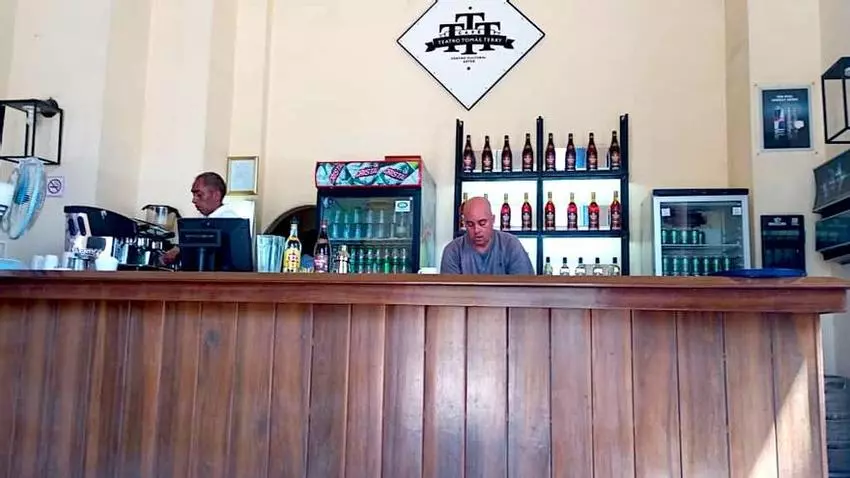
Located in front of José Martí Park, the Tomás Terry Theater cafeteria has a privileged location / 14ymedio

14ymedio bigger14ymedio, Julio Cesar Contreras, Cienfuegos, 20 August 2024 — At the cafe tables in the Tomás Terry Theater in Cienfuegos, all kinds of deals and business agreements take place, and the authorities turn a blind eye. From foreign currency and illicit substances to the body of a cienfueguera girl, in a place managed by the state-owned Artex, “everything is bought and sold on the premises, anything one can imagine,” whispers a bar customer.

Facing José Martí Park, a central area of the city, Terry’s cafe is not empty even when there is a blackout. Sitting at a table, tapping his foot impatiently, Adrián – who uses a false name so that he is not “booked” by the Police – waits for a foreigner who is looking to rent a room in a hostel. “This is my daily struggle: Getting tourists and hosting them in private homes, with a commission for me for each client I get,” the 26-year-old man tells 14ymedio.

Even when there are blackouts, Terry’s café always has customers / 14ymedio 

Those who, like him, travel around the city looking for potential customers are known as “managers,” a name that gives more prestige to their profession than it really has. “The owners of the hostels charge between 15 or 20 dollars a night, and I take a percentage of that,” he says. continue reading

For a few months – Adrián has only been in business for two years – the difficulty in attracting foreigners has increased, and tourists hardly arrive in the city or prefer to stay in state hotels. Because of this, the business of the young cienfueguero has been “low,” and the customers who do stay in private homes are now, for the most part, those who have a very specific interest: to be out of sight of the authorities.

“It’s not that you like this mess of prostitution, but sometimes the opportunity presents itself and you have to take advantage of it, because things are very hard wherever you turn, and that’s one way to hook tourists,” he explains. Normally, Adrián says, the cost for a night with a jinetera is around 100 dollars or euros, but “when things are tight” and there are almost no tourists, sometimes they accept 50. The woman is given part of the take depending on the deal, reveals the young man. He prefers to settle matters because the “question” brings its own risks.

From the outside, life in the Terry seems to be quiet, although, from the prices, anyone can deduce that those who come to have a coffee do not live on a worker’s salary

From the outside, life in the Terry seems to be quiet, although, from the prices, anyone can deduce that those who come to have a coffee do not live on a worker’s salary. With espressos at 60 pesos – a year ago one cost a third as much – cocktails between 150 and 300, or a beer at 280, the place still maintains a menu that is obviously State but also expensive. The tricks to keep the business afloat happen behind the bar.

Behind the bar is where the tricks that keep the business afloat happen / 14ymedio

“To maintain the service you have to stretch the coffee powder as much as possible, because the supply is very scarce and the demand is very high,” an employee tells this newspaper. At the cocktail bar is thrown “a lot of ice and a little alcohol,” and to “fatten” the salaries a little, which do not reach 3,000 pesos, some workers resell on the left “what appears.” As to what happens inside Terry’s doors, the workers prefer to turn a blind eye.”

Appearances are deceiving, and while the music goes on through Saturday night and into the next morning, there are also those who are selling, buying and negotiating anything,” explains Mercedes, another of the unique customers of the cafe. “Right now I bought 80 MLC (freely convertible currency) from a woman who has just left,” says the cienfueguera. She pretends to be surprised at the fact that the Government is persecuting the foreign exchange black market at the same time that it lets it happen on its own premises.

While the music goes on through Saturday night until the next morning, there are also those who are selling, buying and negotiating anything

If it were not for everything that is “offered” on the left in Terry’s cafe, the place, with an illuminated sign that, between blackouts and technical failures, never works – in addition to the 100 pesos that are requested to enter any event – would always be empty. “I shouldn’t say this, but sometimes certain drugs are even sold here,” says Mercedes, who has seen customers “pass pills” while hiding among the crowd and the music. “In the end everyone just minds their own business,” the woman alleges, for whom it is also a relief that – paraphrasing the famous Las Vegas saying – what happens in the Terry stays in the Terry.

Translated by Regina Anavy

____________

COLLABORATE WITH OUR WORKThe 14ymedio team is committed to practicing serious journalism that reflects Cuba’s reality in all its depth. Thank you for joining us on this long journey. We invite you to continue supporting us by becoming a member of 14ymedio now. Together we can continue transforming journalism in Cuba.

González Urrutia Demands That Maduro ‘Take the Step Now’ To Begin the Transition in Venezuela

Closed off in the Miraflores Palace, Maduro continues his campaign of discrediting the opposition and those who recognize its triumph

Maduro denounced an “increase in the cyber war against the country through bots” that he attributes to Argentina / EFE

14ymedio biggerEFE/14ymedio, Caracas, 20 August 2024 — The Venezuelan opposition leader Edmundo González Urrutia called on Nicolás Maduro on Monday to “take the step now” to begin “a peaceful transition,” through a political dialogue with the Democratic United Platform. The politician assured that citizens remain “firm” in their demand that “the decision” expressed in the July 28 elections be recognized.

In his opinion, every day that the authorities “hinder the democratic transition, Venezuelans suffer a country in crisis and without freedom,” and “clinging to power only exacerbates the suffering” of citizens. “The people are tired of so much abuse and corruption,” he said, and accused Maduro of being “responsible for so much poverty and pain.”

“It is our hour, the hour of millions of Venezuelans who want to give the best of our lives for the reconstruction of our homeland. All of Venezuela demands that we make the necessary efforts to ensure that popular sovereignty is respected. That’s why I am asking for a political dialogue to begin the definitive democratic transformation of our nation,” he added.

“It is our hour, the hour of millions of Venezuelans who want to give the best of our lives for the reconstruction of our homeland

Closed off in Miraflores, Maduro continues his campaign of discrediting the opposition and those who recognize its triumph. This Monday he attacked Argentine President Javier Milei – his nemesis in the international arena – whom he accused of spending more than 100 million dollars of Argentina’s budget on alleged bot attacks against chavista institutions. continue reading

Maduro denounced an “increase in cyber war against the country through bots” from Argentina, whose president has called the result of the National Electoral Council a “fraud” and a “scam.”

“What bot farms are attacking us from Argentina? The bot farms of Milei, of fascism, with money from the budget of the Argentine government, the more than 100 million dollars spent on the attacks of the last two weeks,” Maduro said, without showing any evidence, during his weekly program Con Maduro +, broadcast on the state channel VTV.

In addition, he said he had registered similar attacks from Spain, by the “ultra-right” of the European country, and from Mexico, without accusing anyone directly for these actions.

In his war against social networks as a ground of subversion against his regime, Maduro maintains his blockade of X

In his war against social networks as a ground of subversion against his regime, Maduro maintains his blockade of X, which he had suspended for 10 days. Although the authorities have not given explanations, it is impossible to access the application from Venezuela without using a virtual private network (VPN), which has become popular in the country – as happens in Cuba to read the independent press – as a method to bypass the blockades imposed by the state National Telecommunications Commission.

On Monday, Maduro and the president of Parliament, Jorge Rodríguez, spoke about the “damage” caused by social networks, but they did not directly allude to the suspension, ordered in principle due to the attempt attributed to this platform to “sow violence” in the country, as Maduro said at the time. This Monday, during his weekly television program, Maduro mentioned several times the owner of X, the South African tycoon Elon Musk, whom he accuses of promoting fascism and violence in Venezuela.

“Keep Elon Musk out of Latin America,” the president remarked without referring to the suspension, after saying that Musk “was wrong” and that he had “crashed” with Venezuela.

For many, Maduro’s aggressiveness is a sign that the regime’s days are numbered

For many, Maduro’s aggressiveness is a sign that the regime’s days are numbered. This is the opinion of former deputy Omar González, one of the six refugee opponents living in the official residence of the Embassy of Argentina in Caracas since March, under the protection of Brazil after the expulsion of Argentina’s diplomatic mission from Venezuela. On Monday, González pointed out that Maduro’s “weakness” “is increasing” as he approaches January 10, 2025, when the next presidential term begins.

“Many believe that time is Maduro’s ally, but they are wrong, because as we approach January, Maduro’s time will run out; he will become increasingly illegitimate, and his permanence in power will be increasingly illegal,” said the opponent, quoted in a press release from the Vente Venezuela party, led by the anti-chavista María Corina Machado.

In González’s opinion, the “fragility” of the Government “is obvious” and “is reflected in the emaciated, haggard and anguished image of a leader who can’t sleep or have peace of mind.” “Venezuelans have made it clear that we will not give up until Maduro and his accomplices leave power, using truth as our main weapon in this endless battle,” González added.

Translated by Regina Anavy

____________

COLLABORATE WITH OUR WORKThe 14ymedio team is committed to practicing serious journalism that reflects Cuba’s reality in all its depth. Thank you for joining us on this long journey. We invite you to continue supporting us by becoming a member of 14ymedio now. Together we can continue transforming journalism in Cuba.

‘Cleanliness Has Arrived’ or How Prison Language Has Crept Into the Lives of Cubans

This is what the modules with personal hygiene supplies look like / 14ymedio

14ymedio bigger14ymedio, Yoani Sánchez, Generation Y, Havana, 20 August 2024 — I approach the building where I live and see a Line outside the grocery store. Most of those waiting on Tuesday are elderly and have that long, almost expressionless face of someone who has not smiled for a long time or hoped for improvements in their life. I ask about the reason for the crowd and a retired woman answers categorically: “Cleaning supplies arrived.” Three words that are more eloquent for their meaning than for the number of products they contain.

Coming from the language of prisons and military barracks, the concept of “el aseo” (cleaning supplies) in Cuba defines a module with personal hygiene supplies that are reduced to soap, toothpaste and perhaps a little detergent to wash clothes. It is something that must fit in a small bag and is given to the prisoner or soldier so that at least the cell or shelter does not stink too much. The family of the detainees in the police stations must bring “el aseo” to the arrested person and to the pre-university student in the countryside, where I studied; my parents did everything possible to provide me with “el aseo”. Now, as prisoners in a larger prison, this is also the name given to the meager quota that arrives through the rationed market.

It comes down to soap, toothpaste and maybe a little laundry detergent.

“At least we’ll be able to bathe,” the same neighbour told me sarcastically. The phrase was quickly answered by a pensioner who was sitting in the shade: “That is, if they turn on the water.” Problems with the pumping equipment, power cuts and broken pipes have meant that in recent months continue reading

our neighborhood has had more days with dry pipes than days with some water coming out of the taps. People go through weeks in which they can barely wash, in which their homes lack the necessary cleaning, and hygiene is a possibility that only exists in the announcements on official television.

As in penitentiary centers throughout the island, today we receive “el aseo.” But also, as in Cuban prisons, a piece of soap and a tube of toothpaste barely alleviate the rigors of life behind bars.

____________

COLLABORATE WITH OUR WORKThe 14ymedio team is committed to practicing serious journalism that reflects Cuba’s reality in all its depth. Thank you for joining us on this long journey. We invite you to continue supporting us by becoming a member of 14ymedio now. Together we can continue transforming journalism in Cuba.
“I Deserted From the Cuban Team Because I Was Looking for a Better Future for Me and My Family”

The triple jumper Jordan Díaz, gold medalist at the Paris Olympic Games, says he is happy to be “part of the history of Spain”

Díaz poses next to his prize at his uncle’s restaurant in Zaragoza / EFE

14ymedio biggerEFE (via 14ymedio), Zaragoza, 19 August 2024 — The Olympic champion in triple jump, Jordan Díaz, who defected from the Cuban national team in 2021 to seek a “better future” for himself and his family, said that this decision and his subsequent result at the Olympic Games in Paris is proof that “every sacrifice done well has its reward.”

The gold-medal winner stopped in Zaragoza to visit his uncle, a well-known hotelier whose restaurant employees paid tribute to Díaz. Díaz shared in an interview with EFE that he is “very excited” for what he has accomplished and for “being able to be part of the history of Spain,” a course that was set when he decided to stay in that country.

Despite not being able to see his family since 2021, Díaz is aware that “life is short and you have to make the most of everything.” He chose to continue with his fight to be World Champion, to achieve the triple jump crown and to repeat it at the Olympic Games in Los Angeles in 2028. continue reading

’I was looking for a better future for my family and for me; that’s why I deserted the Cuban team,’ said the athlete

EFE: How do you feel after having been able to taste, a bit more, the triumph at the Olympic Games in Paris?

Díaz: I’m quite happy with the whole result, to be honest. Not only with Paris, which, of course, is a dream. I am also very excited about the season I have finished, because I wasn’t able to compete much due to pain and injuries. I won the European championship in Rome with 18.18 meters, which is the third best score in history. Right now I’m on vacation. I needed to rest both mentally and physically, and I wanted to visit my family.

EFE: How long were the seconds from when you jumped until you landed?

Díaz: Wow… It’s so difficult! You’re just thinking about the technique and how you’re going to fall. You don’t think about anything else, neither sports nor emotions. You’re focused, and although you know that a medal can change your life completely, you don’t think about it much. I’m very happy with the season I’ve done, although I haven’t been able to compete much due to injuries.

EFE: The moment you saw your score did you think you could win the gold medal?

Díaz: No, not at all. I had a score that the first five athletes could have beat. However, I understood that in the Olympics, the pressure, the level of competition and tension could have an influence. There were also a lot of people in the competition. I tried to do my best in the sequences. I think it was a good competition in terms of stability, and I am happy with the result.

’The road has been quite difficult. Starting with the fact that I left my family and my whole life in Cuba’

EFE: Before Paris there have been many struggles. If you look back, how has the path been and what was the key to getting here?

Díaz: The road has been quite difficult. Starting with the fact that I left my family and my whole life in Cuba. I was looking for a better future for my family and me; that’s why I deserted the Cuban delegation. That motivation and that impulse has made me do what I’m doing now. Every sacrifice done well has its reward.

EFE: Is it worth it, therefore, to have left everything behind?

Díaz: Yes, of course. Life is short and you have to make the most of everything. I am happy for everything I am achieving and for being part of the history of Spain. It’s the goal I set myself when I stayed in this country. The truth is that little by little it is being fulfilled, and yes, as people say, there is still a lot of work to be done.

EFE: Did you dream of these Olympic Games?

Díaz: It is the goal of any athlete. It’s the biggest thing you can get! Another goal may be to have the world record. I don’t have it, but it still remains for me to be the first world champion to access the triple crown.

EFE: What is your link with Zaragoza?

Díaz: My uncle lives here, so I wanted to come and visit him. He has helped me since the first day I decided to stay in Spain. I spent three months with him, so he also deserves the medal and to celebrate it together. Everything that is happening to me is, in part, thanks to his help.

EFE: Do you think that with this triumph and, in addition, being the standard-bearer of the Spanish team at the closing of the Olympic Games, athletics is given the space it deserves?

Díaz: It’s a prize for a job well done. María (Pérez) won gold and silver medals [for Spain] in mixed race walking, and I won gold. Highlighting it may make everything that is done in athletics be recognized beyond the recognition that soccer has. Being a standard-bearer at the closing with María is an award for a job well done; highlighting it may make everything that Spanish athletics does be recognized.

’From long before competing in the final, I already had received a lot of support in the stands and from the organization’

EFE: What was the feedback you received when you returned from Paris?

Díaz: I’m not much of a social networker, but, from the little I’ve seen, I think I’ve been quite supported. I am very grateful. From long before competing in the final, I already had received a lot of support in the stands and from the organization. Having support is the best. I like that they recognize the job and, of course, it’s always good for other competitions.

EFE: And how are you facing the future?

Díaz: I’ll try to find some other dream. My dream was this, to be an Olympic champion. There are still four years left for the next Olympic Games and I’m not going to become lost in that either. Now I have to think about other things.

Translated by Regina Anavy

____________

COLLABORATE WITH OUR WORKThe 14ymedio team is committed to practicing serious journalism that reflects Cuba’s reality in all its depth. Thank you for joining us on this long journey. We invite you to continue supporting us by becoming a member of 14ymedio now. Together we can continue transforming journalism in Cuba.
Leaked Documents From the UMAP Reveal Techniques To ‘Rub Out’ Homosexual Behaviors

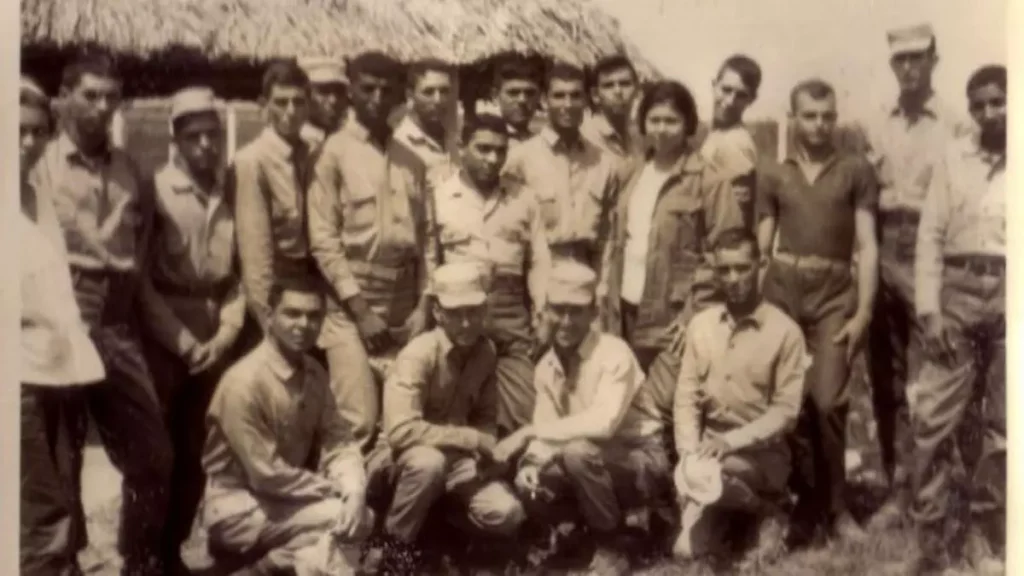
Image of young homosexuals and opponents in an UMAP, in 1967 / CC

14ymedio bigger14ymedio, Havana, August 12, 2024 — “Rub out all mannerisms and antisocial behavior” was the first commandment of the Military Units to Aid Production (UMAP), founded in Cuba in the 60s as forced labor camps for “homosexuals, the religious and the social lumpen.” The phrase is fixed, like a mantra, in several documents of the time rescued this Monday on social networks that expose the methods of indoctrination of those schools of “rehabilitation” in the time of Fidel Castro.

The documents – six in total – “were delivered by a source that asked for their publication and only had two conditions: anonymity and open access,” journalist José Raúl Gallego, a resident of Mexico, who disseminated the documents, said on Facebook.

The first two documents, dated in the mid-1960s, are perhaps the most shocking. First of all, they “study” the presence of homosexuals in the country and propose for their “reform” the creation of a Model Center, where military doctrine will lead them to become “useful” for the Revolution. However, not all the “deviants” would go to the camps. The revolutionary class, children of families committed to the process and those who had “real possibilities” of integrating into society would be separated.

These, the “privileged,” would become part of a group A. Groups B and C were the “counter-revolutionaries” who wanted to stay on the Island and those who wanted to leave, respectively. As for the latter, they were to be subjected to “very rigid” methods until they eventually left the country and the unit was dissolved. Or, which is the same, until the Revolution had shaken out the last “antisocial” element. continue reading

’Rub out all mannerisms of antisocial behavior’ was the mantra among the ranks of the UMAP

For company B, the objective was, if possible, more macabre: “Among counter-revolutionary homosexuals who for various reasons do not want to leave the country and are part of company B, the principle of detecting who among them can change political opinions and therefore opinions about their duties to society and rehabilitation will be followed. They will be gradually sent to company A and some of them later to the Model Center,” the document dictates.

For Groups A and B, the objectives changed: “to erase the mannerisms,” “anti-social behavior” and “any manifestation of hostility to the Revolution.”

The second document describes similar plans for those who – in the UMAP or the Compulsory Military Service – have presented homosexual behavior. “Prevention” is the key word here. It proposes the formation of Pre-Military Schools in which the boys lead the lifestyle of a recruit. It is accompanied by a Marxist psychological analysis of the ways of treating young people to achieve the desired result.

The proposal begins with a statement that, although it simulates an academic approach, would horrify any modern defender of human rights: “The scientific ignorance of the causes and remedies for homosexuality makes it impossible for us to find a definitive solution to this problem,” the report explains, but the “motivation” is enough to carry out the plan.

The segregation methods proposed in the document are similar to those in the first one. Recruits are to be separated by political affiliation and – here is the novelty – by the degree of exhibition of their sexuality. “We find homosexuals who, by their way of walking, dressing, speaking, etc., manifest themselves as such, and homosexuals without external manifestations. Among the former there are those who carry out a more fuller homosexual activity (they paint, let their nails grow, etc.) and at the same time are more undisciplined; and those who present effeminate external manifestations, but who accept discipline.

With this in mind, the report sets out the right method to deal with recruits: divide and conquer. “We will achieve our objectives” through the “group pressure on the individual,” as well as through “inflexible orientation and correction” of “inadequate” behaviors.

The “emulation,” as in a reward and punishment system, is the other side of the coin that relies on benefits such as granting passes and the possibility of accumulating departure days.

The report exposes the appropriate method to deal with recruits: divide and conquer

“The practice of sports and the realization of an adequate physical culture program are effective means to combat feminine gestures and poses,” is another of the conclusions of the report.

The rest of the documents contain an interview with one of the homosexuals sent to the UMAP and two reports on religions in Cuba. The first, which recalls the interviews of the KGB or the stories of Reinaldo Arenas – who described these units, without ambiguity, as “concentration camps” – is the summary of a meeting between an officer and a recruit who seems willing to do anything to “reinsert” himself despite his “bisexual” behavior. “He would like to take care of himself from a psychological point of view,” says the interviewer who several lines below, within his observations, diagnoses: “He is a skillful simulator and immoral.”

For those who practiced some religion – the list of churches and creeds is long and detailed – there was no consideration either. Catholicism, for example, is defined as “the most dangerous religion that operates in our homeland, and together with ideological diversionism, performs all kinds of counterrevolutionary activity and fundamental espionage. We can say without a doubt that in the religious formation in general and the Catholic in particular, it is a pit from which we ranks of the counterrevolution and enemy intelligence are nourished, not only in our country, but in all the countries that fight for their liberation in Latin America and other continents,” says the document.

The honeymoon between the Revolution and the Vatican had ended abruptly by that time, despite the apparent sympathy expressed for Castro by Pope John XXIII – mentioned in one of the texts – and his apostolic nuncio in Cuba. Several facts, such as the circulars critical of the Government issued by the Episcopal Conference of the Island – especially by Bishop Enrique Pérez-Serantes, who saved Castro from being executed in Santiago de Cuba – and the presence of priests and numerous young Catholics in the invasion of Playa Girón, determined the Church-State rupture.

In the report, which advances through different Protestant doctrines to the lodges – Masonic, Odd Fellows and Knights of the Light – religious beliefs are nothing more than an excuse to conspire and brainwash. In order to keep them in the spotlight, a detailed inventory of parishes, publications, activities and “attitudes to the Revolution” is made.

The report advances through different Protestant doctrines to some Masonic lodges

The presence of Catholic laity in the UMAP is not unknown, and although these archives in particular do not evoke their indoctrination, the treatment they received thanks to many Cubans who offered their testimony decades later is known. Cardinal Jaime Ortega, who died in 2019 and was known for being a skilled mediator between the Catholic Church and the Government – he helped release many political prisoners – spent part of his youth in the UMAP, although he was very discreet in his account of the experience.

Other figures were sent to the Cuban concentration camps, such as the musician Pablo Milanés, who, despite the injustice, never completely detached himself from the Regime. Important personalities of the regime were narrowly spared from being sent to the camps. This was the case of Eusebio Leal, on the list for his Catholic faith and “saved” by the intercession of Haydée Santamaría, as the historian himself once said.

In the UMAP, where several of the darkest pages in the Regime’s history were written, isolation and secrecy were two conditions for the experiment to work. In fact, the documents insist that the only contact with the outside world be with the parents of the recruits who were willing to help in the “rehabilitation,” the members of the Central Committee and “authorized foreigners.”

Without ever admitting the horrors committed in those camps, Fidel Castro referred to them very late, in 2010, with a brief phrase about the decision to create them: “If anyone was responsible, it was I.”

Translated by Regina Anavy

____________

COLLABORATE WITH OUR WORKThe 14ymedio team is committed to practicing serious journalism that reflects Cuba’s reality in all its depth. Thank you for joining us on this long journey. We invite you to continue supporting us by becoming a member of 14ymedio now. Together we can continue transforming journalism in Cuba.