
The US Congress Affirms That Cuba Uses Illegal Immigration To ‘Infiltrate Spies’ and ‘Export Dissent’

María Elvira Salazar, a Republican Congresswoman from Florida, has condemned the Cuban regime’s violations / EFE

14ymedio bigger14ymedio, Havana, 26 August 2024 — The US Congress assumes that the Havana regime uses illegal immigration “as a weapon to saturate the US border, benefit from international smuggling, export dissent, infiltrate spies and strengthen a black market economy.”

The statement is part of Resolution 1358, whose text was presented on July 11 by Republican Congresswoman María Elvira Salazar, who demanded that the Cuban Government “account” for the “serious human rights violations” it systematically commits.

With the text in hand, the US House of Representatives called on Joe Biden’s government to “use all diplomatic tools to persuade foreign governments and international organizations to join forces and coordinate activities to bring freedom and democracy to Cuba.”

The members of Congress point to the Island as a level 3 country, on a scale that defines “total non-compliance with minimum standards against human trafficking,” in addition to being a sponsor of this practice. Among these violations, they emphasize, is the sending of Cuban doctors to Mexico and other countries. continue reading

The Regime “pays the doctors between 10% and 25% of what the host country pays Cuba for their service and denies them their fundamental rights,” the document emphasizes. Against this background, it requested analyzing the issue within the framework of the Trade Treaty between Mexico, the United States and Canada (T-MEC), an instrument that will be reviewed next year.

Five days after resolution 1358 was made public, the Government of Mexico announced the hiring of another 2,700 Cuban doctors to serve rural areas of the country. Mexican President Andrés Manuel López Obrador has shown his support for Miguel Díaz-Canel by hiring 5,000 health workers. In addition, he has sent oil to Cuba, financed research and offered paid scholarships to medical students.

A group of 200 Cuban doctors at Mexico’s Felipe Ángeles International Airport / X/@MarcosRguezC

In February 2023, a specialist said Cuban health workers in Mexico receive only “a stipend for their needs;” that is, their “salary is in Cuba.” Of the amount paid by the López Obrador Administration, the Government of the Island keeps most of the salary. Organizations such as Prisoners Defenders have questioned the Government of Mexico for the hiring of Cuban professionals in “conditions of slavery.”

In December 2022, Prisoners Defenders launched a harsh criticism of the Governments of Mexico, Italy and Qatar for hiring Cuban professionals in “conditions of slavery.” The temporary migration program of health workers with “friendly countries” is no more than the main input of foreign exchange for the island’s regime.

The US Congress specified that “Cuba continues to be a source of regional instability” and referred to an independent investigation by the United Nations in 2002, which “found that the Island’s personnel were advising and instructing Venezuelan intelligence agencies that committed crimes against humanity.” This support “encourages the narco-terrorist dictator Nicolás Maduro to continue resisting free and fair elections,” and promotes illegal migration to the United States.

Congress referred to the June 2023 publication in which The Wall Street Journal denounced the Island for backing China’s plan to establish an electronic surveillance facility, which “would allow Chinese intelligence services to collect electronic communications throughout the southeastern United States, where many military bases are located, and to monitor American ship movements.”

Translated by Regina Anavy

____________

COLLABORATE WITH OUR WORKThe 14ymedio team is committed to practicing serious journalism that reflects Cuba’s reality in all its depth. Thank you for joining us on this long journey. We invite you to continue supporting us by becoming a member of 14ymedio now. Together we can continue transforming journalism in Cuba.

The ‘Water Thieves’, an Invention to Supply Havana Homes

In homes where water has not come in for days, residents have started using plastic bags when they need to go to the bathroom.

The pump sucks water from the pipes through a hose / 14ymedio

14ymedio biggerJuan Diego Rodríguez, Havana, 21 August 2024 — The trick is to insert a hose into the pipes that run through the streets and sidewalks in front of the houses. If the right place is found, in the artery through which the liquid runs, the water thief can begin the robbery. “When I hear the little noise the pumps make in the morning, I immediately know that the water has arrived. The problem is that it comes with so little force that it doesn’t manage to rise to the tanks or fill the cisterns,” says Dinorah, a resident of the Luyanó neighborhood in Diez de Octubre who spoke with 14ymedio.

On Rodríguez Street, near where the Havana woman lives, water comes infrequently and the residents have opted to “get those little gadgets” to make the most of the days when there is water. The problem says Dinorah, is that “the little water that comes in is no longer distributed equally, and while some manage to fill their reserves thanks to the turbine, others do not receive a drop,” she explains.

And to top it off, she adds, “in a country of the blind, the one-eyed man is king, so whoever has a pump that pulls the most gets the most water,” she says.

Dinorah is aware that water thieves are not a modern method. “This has always been done, but now everyone steals water, even if others don’t get it,” she explains. Now, she continues, they even sell the pumps in SMSEs. “The other day my husband went to a private hardware store and there was continue reading

a man at the counter asking if the turbine they were selling could be used as a water thief,” she recalls.

’Water thieves’ are not a modern method, but now even SMSEs sell them / 14ymedio

“People mistakenly believe that the water thief produces water. It has nothing to do with it. If there are a lot of people with these pumps in a position in front of your house, your cistern will not fill up. The result is a case of every man for himself,” she reflects.

The water shortage has caused the situation in some parts of the capital to become truly scatological. “I was lucky because I left the house for a few days and I still have water in the cistern, but at my sister’s house they abandoned the toilet bowl for a plastic basket,” says Clara, another resident of Diez de Octubre.

According to the neighbor, both her family in the municipality of Nuevo Vedado and those who live closer, in Luyanó, have begun to use the typical reserve of plastic bags in Cuban homes when “nature calls them.” “What else are they going to do, if they can’t flush the toilets? Well, they put the bag in a bucket, like a toilet, and then they tie it closed and throw it into the garbage dump,” she says with a certain modesty.

Clara invited her sister and nephews to bathe at her house and asked them to bring dirty clothes to wash. “The water they have has to be saved for cooking and drinking for now,” she says, “but when my reserve runs out, we will have to see where we can get water from,” she says.

Since the Havana resident read an article in Tribuna de La Habana that described how the supply to Luyanó and other neighborhoods in the municipality was interrupted, she decided to save every drop of water she could. Some neighbors, however, do not have cisterns or even large tanks that would allow them to store water for several days.

“Two blocks from here, some neighbors caused a scandal yesterday and the director of Aguas de La Habana came and brought a tanker truck. The neighbors carried a little water with their buckets, but everyone knows that this is temporary and that if the service is not restored, we will have a hard time,” Clara analyzes.

At the moment, the lack of hygiene is getting worse and the garbage dumps are getting bigger with the new invasion of “jabitas” [little bags] and their particular smell, while the people of Havana dig in the ditches and alleys looking for a pipe to connect to their thief, in a territory that looks more and more like a Western movie every day.

____________

COLLABORATE WITH OUR WORKThe 14ymedio team is committed to practicing serious journalism that reflects Cuba’s reality in all its depth. Thank you for joining us on this long journey. We invite you to continue supporting us by becoming a member of 14ymedio now. Together we can continue transforming journalism in Cuba.

Titivillus In culpa Est (It Was All Titivilo’s Fault!)

Most people who dedicate themselves to being an editor do it to earn a living and not as a vocation, but how could paranoia be a vocation anyway?

The devil with an ice cream cone, in Salamanca cathedral – an anachronistic figure added during the 1991 restauration / Xavier Carbonell

14ymedio bigger14ymedio, Xavier Carbonell, Salamanca, 30 June 2024 – Burgos, the city where El Cid and Miguelón are buried, is two and a half hours by train from Salamanca. It’s a cold place. To enjoy it well you should eat some hot beans in one of the taverns on Calle San Lorenzo, but not before devouring at top speed a couple of cojonudas – bread, sausage, peppers and quail’s eggs. Then, all prepared and wearing a scarf, one should head for the Museum of Human Evolution, where there are human remains more than 400,000 years old. It can change your life seeing the sharpened stone axe which they’ve named ’Excalibur’, or the ’pelvis Elvis’ (bones), both thousands of years old.

Having completed this part of the journey, one follows the course of the river Arlanzón as far as Las Huelgas monastery. There have been nuns living there since the eleventh century. Very powerful nuns actually, who used to own a large part of the land surrounding the convent. The king had to travel to one of their chapels, where a strange automaton that represented the apostle Saint James brandished a sword and declared him a knight.

To earn some income the nuns opened up part of the monastery to visitors. The floor is solid oak, the tombs are white and in one room hangs an enormous Muslim banner – supposedly used by the Arabs in the battle of the Tolosa flatlands in 1212. And in one of the galleries, under very dim light, hangs the picture of … the character I’m looking for. continue reading

You have to imagine Titivilo as a cat which prowls around the scriptorium, wets his paws in ink and climbs up onto the desk where the monks are working

Black and furry paws, tight pants, hunched, shirtless, a bundle of books on his back, he doesn’t have wings but he does still have his horns. He’s a bignose, he smiles – or grimaces. This is Titivilo, the patron demon of editors, writers, librarians and others whose business is in paper. Next to him is a devil with miniature wings attached to his arms, which gives him the airs of a reveller. Both are trying to torment the nuns and the royal family, protected by the Virgin’s cloak. It’s one of the few times that Titivilo, invisible lowlife bastard, has let himself be caught.

You have to imagine Titivilo as a cat which prowls around the scriptorium, wets his paws in ink and climbs up onto the desk where the monks are working. Today, the same mischievous animal trips over ballpoint pens and two-tone pencils – crucifixes against errors – and passes his tail over the keyboard, introducing malware into the autocorrect of the computer. ’Titivillus in culpa est!’ pleaded the monk when his manuscript contained errors. And the excuse has passed from generation to generation, right down to today’s editors.

One will never have enough indulgence in that profession. An editor is payed – almost always badly – to develop textual paranoia to pathological limits. Victims of professional deformation, they look for ’erratas’ in the TV’s scrolling-news summary, in the adverts, in the words of politicians – those producers of verbal inanity – and they can’t bear to be around when a child is speaking.

The Academy defines ’errata’ as ’material equivocation in the final print or in the manuscript’. Nothing more than that. An ’errata’, for the obsessive editor, is a mental sin whose echo goes on multiplying in the walls of the brain. ’Errata’ is the title of George Steiner’s wonderful autobiography, and also the name of an odd Spanish publisher. There are ’erratas’ that are notorious milestones among the editors of our language [Spanish] – ’el coño fruncido’ (the furrowed pussy – ’coño’ instead of ’ceño’, ie ’brow’), ’the fire behind’, ’the multiplication of penises and fish’ – traumatic erratas, erratas of ETA, bitch erratas, of burials, of thieves.

How does one learn to edit? There isn’t a school for it, although someone did charge for teaching the craft in my university faculty

How does one learn to edit? There isn’t a school for it, although someone did charge for teaching the craft in my university faculty. The classes turned into a delicious war against time, because there was no way to fill up the term time exhausting variations on one single theme: make sure the other guy writes well, be your brother’s guardian or they’ll punish you. The other, second patron demon of editors, after Titivilo, is the author himself.

There are so few authors who deliver their manuscript with even the minimum of honesty, that, for the reader, there will always remain some suspicion about who is the real, true person responsible for the book. Herralde or Bolaño? Divinski or Quino? De Maura or Kundera? ’Paradiso’ is famous for its linguistic bloopers (it actually starts with “Paradiso 1″ instead of “Chapter 1”!) and, in his copy, Cortázar noted: “Why so many errors, Lezama?” Critical editions usually print photographs of the original manuscript, in which the reader comes to realise with horror that the majority of novelists know nothing about punctuation, ignore accents (on letters), confuse meanings and mess up the rhythm. Not to mention bad handwriting or the celebrated joke made by García Márquez, who said “ditch the proper-spelling thing”.

There have been many chasers-down of bloopers among Cubans – from José Zacarías Tallet to Fernando Carr Parúas. Books about language, such as
’The Dart in the Word’ by Fernando Lázaro Carreter, or the most recent ’Measure The Words’ by the lovely Pedro Álvarez de Miranda, were the best preventative exorcism against Titivilo. Among the current members of the Cuban Language Academy there are few who have the capacity to write text at the level of their predecessors. I’ve just looked at the list and was only impressed by Margarita Mateo.

My ideas for a personal catalogue are so chaotic that they will never find any finance, unless I provide it myself.

Editing is a thankless business. The majority of those who do it, do so only to earn money and don’t do it as a vocation. But how could paranoia be a vocation anyway? Another thing – and this really is a profession that is becoming more and more rare – is ’editor as cultural thinker’, such as one who selects catalogues, or is advisor to an author and a craftsperson of books, whose presentation, obviously, he will have to look after, without this being the core of his work. I’ve known very few editors who were like that – four or five? – and I don’t even dare to say how many of them were Cubans.

For my part, I’m not an editor, although I do edit almost every day. My ideas for a personal catalogue are so chaotic that they will never find any finance, unless I provide it myself. I detest looking for funding, I prefer to produce it myself.

I’ve come to experience true depression when someone else’s text is badly written. It hurts to read a book rotting away with errors, but it hurts more if I’m the one who has to correct them. Life is cruel, we live under the implacable fire of Titivilo and we don’t always have some of those cojonudas to lift our spirits. As enemies of the literary devil, we are also poor devils ourselves.

Translated by Ricardo Recluso

____________

COLLABORATE WITH OUR WORKThe 14ymedio team is committed to practicing serious journalism that reflects Cuba’s reality in all its depth. Thank you for joining us on this long journey. We invite you to continue supporting us by becoming a member of 14ymedio now. Together we can continue transforming journalism in Cuba.

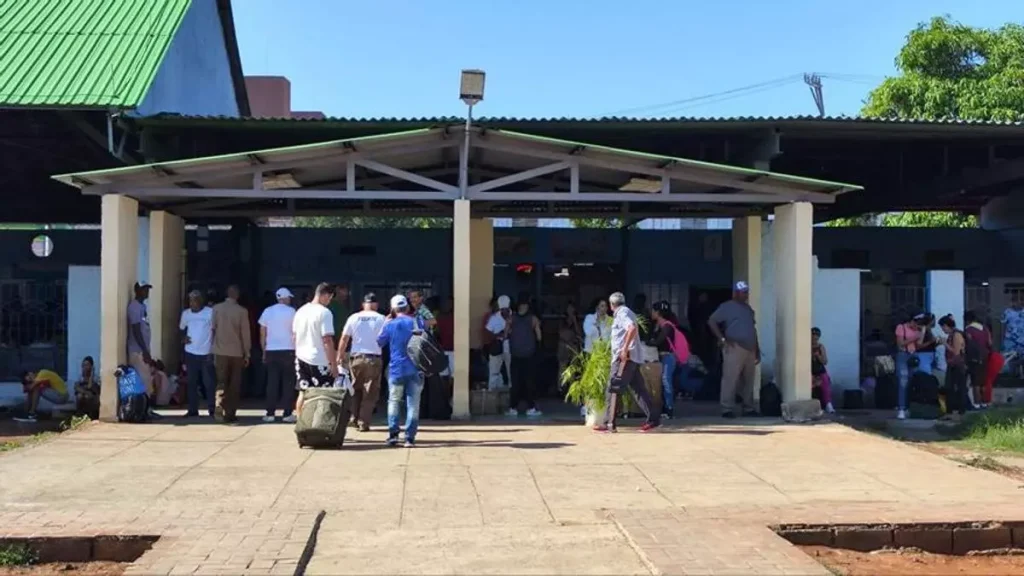
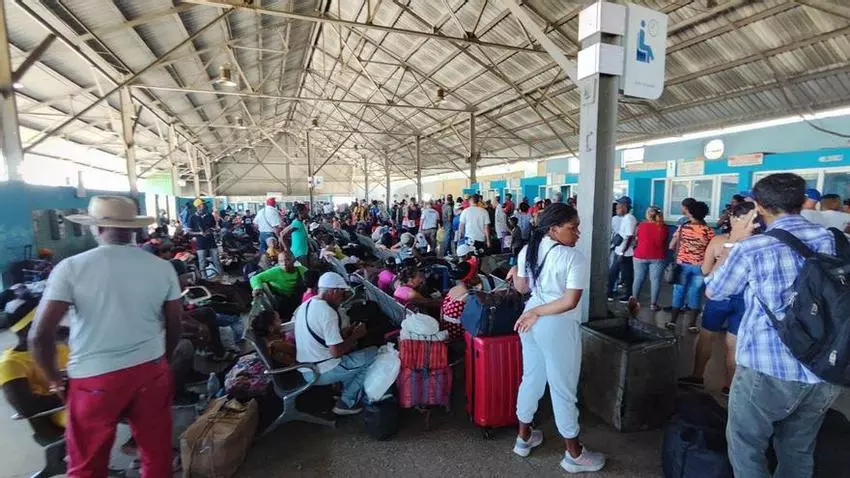
The ‘Buquenques’ Decide Who Travels at the Villanueva Terminal in Havana

They organize in a “network,” know when the police are coming and watch for whistleblowers, says the station boss

A ’pack’ of ’buquenques’ (scammers) hounds travelers as soon as they arrive in Villanueva / 14ymedio

14ymedio bigger14ymedio, Havana, August 24, 2024 — The director of the Villanueva bus terminal in Havana keeps his eye on the buquenques* — the scammers — the “ferocious wolves,” whose intervention makes it possible to have a privileged place on the waiting list. Agile and shady traders, they know the schedules and lack mercy when it comes to defrauding the desperate traveler. Yanniel Pantoja says he is hunting them down and warns that he has the police within reach by telephone.

However, he admits that the situation is beyond his control and cannot be resolved with a simple call. Not even with a fine. His interview given this Friday to Bohemia is a request for help to the authorities from “above” to intervene.

Faced with the helplessness of the travelers, Pantoja provides at least some clues to recognizing the scammers, who prefer to call themselves – not without a certain elegance – “travel managers,” although they aren’t licensed. The official talks about people who “have dedicated their lives” to earning their bread this way. He himself, since he took this job, has witnessed those “careers.”

Even if they have almost absolute power over the resale of tickets, they enjoy scamming people to get money for alcohol and drugs

In Pantoja’s experience, the scammers tend toward alcoholism, and although they have almost absolute power over the resale of tickets, they enjoy scamming people to get money for alcohol and drugs. The manager says that the “effects” of their actions – the scamming and the consequences of their addiction – damage the ambience of Villanueva, which remains tense “24 hours a day, 365 days a year.” continue reading

It is supposed to be forbidden for a scammer and a driver – state or private – to negotiate, but that law only works “inside the terminal area.” If the scammer is informed of the itineraries or receives privileged information from the drivers outside Villanueva, Pantoja can do nothing.

The scammers never set a rate; they work on an already established price, which they raise as much as they want depending on demand. “The amount exceeds 1,000, 1,500 or more pesos,” reports the official. “And if the passenger is careless, it is possible that they will take all his money.” They charge in cash and never accept transfers. “They don’t want to leave traces,” he concludes.

Pantoja points out some picturesque details of his antagonists, such as their quality of being “psychologists” – just seeing a passenger they know how much money they can get from him – or their clothing, “somewhat bizarre,” because they are often marginal people or alcoholics. Others, he describes, “wear better clothes and are the most deceptive. They try to be sociable, helpful, they adapt to circumstances; they are very understanding and considerate in order to attract the person interested in traveling: they are excessively friendly,” he says.

The transport system is in perpetual crisis, and travelers enter a jungle, not a terminal / 14ymedio

The scammers of Villanueva no longer act in isolation. As good “wolves,” they have organized a pack and “created a network.” The objective is not only economic but also a matter of survival: “They are informed about all operations, when there are buses in the terminal and our daily routine, because they study it and know it well. In addition, they compare notes when someone seems suspicious.”

Sometimes, however, they are clueless. When the journalist from Bohemia who interviewed Pantoja arrived at the terminal, he was perceived as a businessman. “The competition [to get to him] was so strong that they didn’t even notice the sign that identified the vehicle,” he says sarcastically.

Pantoja doesn’t know exactly how many there are, but he says that “they are a large group” with whom he has a little war. The situation with transport is already “tense,” he regrets, and the scammers know that people will blame the Government in the first place. That’s why they often use the names of the terminal officials – “they know us,” he says – or they refer clients to Pantoja himself if they have complaints.

The scammers aren’t even afraid of the police now, the official exclaims. “Operations have been carried out, but they always return. I think it’s time for something to happen, because I’ve dealt with the repeat offenders, with the new ones, and I’ve practically had to get down to their level and ask: how long will this continue?”

There are “ferocious wolves” in all the terminals of Cuba, and often their relationship with the managers is much less harsh than the one described by Pantoja

There are “ferocious wolves” in all the terminals of Cuba, and often their relationship with managers is much less harsh than the one described by Pantoja. Their business – without which travelers would not be able to move from one province to another – passes through the director’s office and is ignored by the police. In Villanueva, where the situation cannot be hidden, the real enemy of the scammers are their colleagues, who dispute the client with “strong competition.”

One of Pantoja’s interviewers says that they tried to charge him 4,500 pesos for a fake ticket to Sancti Spíritus, even when the terminal was buzzing with overwhelmed travelers. The speed of the process surprised him. “I had just thrown myself into the terrain of the criminal underworld,” was his conclusion when he saw the scammer moving through Villanueva at full speed. “I asked him where my bus would be; and he only answered: ’Look for your friends, I’ll take care of the rest.’”

When the reporter began to pretend that he could not find his supposed colleagues, the scammer – about 30 years old – got angry. There were 20 minutes of tension in which the false traveler thought that there would be more serious consequences, since his journalistic team did not even know his intentions.

At the end of its report, Bohemia reserves the worst insults for the scammers: “leeches,” “renowned parasites of society,” “people who shout and try to convince” – according to the dictionary – or “a plague.” However, the magazine does not wonder why these characters emerged and under what conditions they operate. The hustlers are the children of their circumstances in a country where the transport system is in perpetual crisis and travelers enter a jungle, not a terminal.

*Editor’s Note: ENJOY! (It’s got English subtitles)

Translated by Regina Anavy

____________

COLLABORATE WITH OUR WORKThe 14ymedio team is committed to practicing serious journalism that reflects Cuba’s reality in all its depth. Thank you for joining us on this long journey. We invite you to continue supporting us by becoming a member of 14ymedio now. Together we can continue transforming journalism in Cuba.
An Outbreak of Oropouche and Confirmed Deaths From This Virus Puts Latin America On Alert

In Cuba, 35,000 cases were recorded in the first half of the year throughout the 15 provinces of the Island

The growing mountains of garbage on the streets of the Island aggravate the epidemiological situation / 14ymedio

14ymedio bigger14ymedio, Havana, 25 August 2024 — Authorities in Cuba, Brazil and Colombia are concerned about the outbreak of the Oropouche virus, a disease that is transmitted by mosquitoes and that, for the first time, has caused two deaths in Brazil. In other countries in the region, where there are still no data on patients with the virus, actions are being taken to prevent its proliferation.

In Cuba, cases have increased “considerably” since the first positives were confirmed on May 27, in the province of Santiago de Cuba, according to the Ministry of Public Health (MINSAP). Reaching 35,000 cases in the first half of the year, as the authorities let slip during a television program last July.

Since then, according to the authorities, the cases have spread to the 15 provinces of the Island, and the sick already exceed 400, according to the officially recognized figures. The disease is present in all the provinces, and there are hundreds of complaints on social networks about people with symptoms. The Government describes the epidemiological situation as “complex” due to the simultaneous circulation of this pathogen with others, such as influenza and dengue fever. continue reading

The presence of the virus in the streets of Havana was revealed by 14ymedio, at the beginning of June, despite the silence of the authorities about the number of cases and the discomfort of the population. At the end of that same month, this newspaper reported the presence of Oropouche in 13 of the 15 provinces of the Island, which at that time contrasted with the Public Health data that officially counted only nine.

In Cuba, the Government describes the epidemiological situation as ‘complex’ and warns of the simultaneous circulation of this pathogen with others such as influenza and dengue fever

The sporadic torrential rains of the summer and the fuel crisis in Cuba, which makes fumigation impossible, have served as a breeding ground for the spread of the disease. To that are added the growing mountains of garbage on the streets – also due to lack of fuel and the vehicles to collect it – and the shortage of water.

In July 2024, the Pan American Health Organization issued an epidemiological alert over the increase in Oropouche virus in five Latin American countries: Bolivia, Peru, Cuba, Colombia and Brazil.

Brazil has recorded an unprecedented outbreak, with 7,767 cases of the disease this year, including the deaths of two women, aged 21 and 24, from the virus, with neither having comorbidities, according to health authorities.

Since 2023, the health authorities began to test for Oropouche by identifying numerous cases of people with symptoms similar to those of dengue, Zika and chikunguña, but who tested negative for these viruses. Most of the cases recorded in Brazil have been in the Amazon region and in Bahia.

In Colombia Oropouche is endemic in the Caribbean area, the Darién and the Amazon. Due to the constant surveillance for dengue, the country has been able to identify 87 positive samples so far in 2024, hidden in 1,279 samples of dengue febrile disease, according to data from the National Institute of Health (INS). The general director of the INS, Giovanny Rubiano García, said at the beginning of August that the measures for the prevention and control of the infection “remain active.”

Argentina, Mexico and Uruguay are increasing their controls against Oropouche

In Argentina, where no cases of the virus have been detected, epidemiological surveillance measures were reinforced in August, and the Health Department published a list of preventive indications.

These include the installation of “barrier methods” in homes, personal protection measures and a series of “good socio-environmental practices” such as the drainage of stagnant water.

So far In Mexico, no cases have been recorded, but on June 4, the Undersecretariat of Prevention and Health Promotion issued a preventive travel notice for Oropouche to people visiting Bolivia, Brazil, Colombia, Cuba and Peru.

The document specified that the level of risk was medium, so it asked travelers who were thinking of visiting any of those countries to find out about the situation and have all the vaccines, in addition to protecting themselves against mosquito bites, wearing insect repellent and appropriate clothing. It also asked travelers to seek medical attention in case of having any symptoms up to 12 days after returning home.

At the moment, the Ministry of Public Health of Uruguay has not given detailed information regarding the virus. However, in recent days, the local newspaper El Observador reported that the ministry sent a statement to different health providers to investigate travel history in case of finding a suspicious case.

Translated by Regina Anavy

____________

COLLABORATE WITH OUR WORKThe 14ymedio team is committed to practicing serious journalism that reflects Cuba’s reality in all its depth. Thank you for joining us on this long journey. We invite you to continue supporting us by becoming a member of 14ymedio now. Together we can continue transforming journalism in Cuba.
The Closure of Cuba’s ‘Chinese Costco’ for an Audit Strains the Spirits of Havanans

Customers say that the State took over the business after the independent media reported on the place

Dozens of Havanans wonder what has happened to the so-called “Chinese Costco” when they arrive at the place and discover it closed

14ymedio bigger14ymedio, Havana, August 24, 2024 — The saga of the China Import store continues this Saturday with dozens of Havanans who, given its closure “until further notice,” continue to come to the surroundings to ask what will become of the so-called “Chinese Costco” of Manglar and Oquendo. According to the information provided by a staff member of the building where it leased space, the business is being audited. At the fence in front of the establishment, both tension and uncertainty grow.

On Friday, the store, located in the municipality of Cerro, was closed, a day after 14ymedio dedicated a report to the promising establishment. Those who crowded together at China Import on Saturday were repeating that, after the publication, the State had taken over the business and forced its closure.

The version of the closure that circulates among those present is that the owner of China Import, from an Asian country, has his Cuban wife appear as the official owner of the store. “El Chino,” as a staff member calls him, “asked them to remove the phone number (from the entrance sign) because he wasn’t able to eat or sleep. What they’re doing now is an audit, and el Chino ordered everything to stop.” continue reading

The owner asked them to remove the phone number from the sign at the entrance yesterday, because ’he wasn’t able to eat or sleep’ / 14ymedio

“If you have a small business and they arrive (the inspectors) and tell you ‘give me the license,’ you show it and that’s that. But when it is something of this dimension, usually when the ’compañeros’ come they check it. Maybe Monday it’s not open, but maybe they will open on Tuesday or Wednesday. The owner said ’closed until we’re done’ because he can’t be in one place and then another. They have to understand.”

“The owner is a Cuban woman,” the man insisted, “although everyone is saying that it’s el Chino. He is also a Cuban citizen, although he was born in China.” The building, he said, houses the China Import warehouse. There are six other businesses that lease the old industrial building. “His private address is somewhere else.” Several of those present did not believe his explanation.

Between diatribes and gestures, several of those present cried out for the opening of the premises. Others criticized the functioning, in their opinion unstable, of the private sector and the MSMEs. Some insulted the “magazine,” an incorrect designation for the independent media that reported on the business this week. “Closing a store because of what a magazine said… The magazine will continue to say whatever it wants!” a customer shouted.

Between diatribes and gestures, several of those present cried out for the opening of the premises / 14ymedio

This Friday, when 14ymedio called the contact who was still available on a sheet of paper at the entrance of the perimeter fence – no longer under the word “Chino” but with the name “Melissa” – a person with an Asian accent reiterated that the store was closed and that they were waiting for “directions.”

From the front of the gigantic warehouse, until a few years ago part of the old Sabatés soap factory, they had removed the sign with the name of the business, leaving visible the unpainted letters of “Suchel Debon,” the state-owned company in whose hands it passed after the Revolution.

Some ventured that the closure might have something to do with the prices: “What happened is that they probably told “El Chino”: you can’t sell at this price, you have to sell at what we tell you.” In any case, the closure happened without prior notice. “I think they didn’t expect anything, because yesterday we came and they told us to come back tomorrow, and then the sign was there. Today they knocked it down,” said a young woman in the group that crowded around in the morning.

Some customers have ventured that the closure of the business may have had to do with the low prices it offered

China Import, which was offered as a store for wholesalers, housed endless rows of shelves with all kinds of goods – clothing, footwear, electronics and household items, perfumes – at prices between three and five times lower than in the informal market. As an employee explained to this newspaper on Wednesday, she accepted national currency, “at the change of the day” – as the signs under the products said, referring to the informal rate, currently at 320 pesos per dollar, both in cash and in bank transfer, but in no way in banknotes of less than 200 pesos.

The condition to acquire the merchandise, of course, was not easy for anyone: spend more than 50 dollars – equivalent to 16,000 pesos according to the current exchange rate – and carry the items yourself in huge packages.

The “Chinese Costco,” as a client sarcastically called it this week, has suffered the same fate as the so-called “Cuban Costco,” the Diplomarket. This supermarket, which sold in foreign currency, closed at the end of last June, and its owner, the Cuban-American Frank Cuspinera Medina, was arrested with his wife. His whereabouts are still unknown.

Translated by Regina Anavy

____________

COLLABORATE WITH OUR WORKThe 14ymedio team is committed to practicing serious journalism that reflects Cuba’s reality in all its depth. Thank you for joining us on this long journey. We invite you to continue supporting us by becoming a member of 14ymedio now. Together we can continue transforming journalism in Cuba.

The Government’s Raids on the ‘Boteros’ Annoy the Private Taxi Drivers of Havana

Planted in key points of the city, the inspectors seek to identify the drivers who transport passengers without a permit

The shortage of oil and state transport has favored the proliferation of undocumented taxi drivers / 14ymedio

14ymedio bigger14ymedio, Juan Diego Rodríguez, Havana, 22 August 2024 — In Havana, a game of hide-and-seek between private taxi drivers and inspectors has been unleashed in recent days. The former, for the most part without permission to transport passengers, flee from the authorities using all kinds of tricks. If they are stopped and don’t have a license or taxi signage, the fine can amount to 12,000 pesos; or even, in the worst case, their plate can be taken away.

Interviewed by 14ymedio, Rolando, the driver of an almendrón that operates as a taxi in the capital, says he is nervous despite the fact that he has his papers in order. “It’s incredible the number of inspectors and police officers there are, planted in any corner, waiting for an unfortunate person to pass without permission,” he says.

According to the 56-year-old Habanero, the routes that the boteros [taxi drivers] take to travel from La Víbora or La Palma to El Vedado have been among the most monitored this week, and the drivers, “who are not fools,” have been more careful. “On the corner of the Habana Libre, at 23 and L, where the taxi stand is located and where cars leave for La Víbora, the drivers are letting off passengers but not picking them up. The inspectors are hidden where they turn, on 23rd Street,” explains Rolando. The same thing happens, he says, at the other end of the route, at the Plaza Roja. continue reading

“The other day I took a car to go to El Vedado that had only one free seat. As soon as I got on, the driver turned off the avenue”

This is just one of the tricks that the boteros use to mock the authorities. “The other day I took a car to go to El Vedado that had only one free seat. As soon as I got on, the driver turned off the avenue and began to go through the back streets where no one was around. At first I thought, as sometimes happens, that the driver was running an errand, but he rejoined the route at Infanta and San Lázaro. Then I realized that he was running away from the police,” says Liudmila, a frequent passenger on this route.

“It seems that they are going after the boteros without papers, because something similar happened to my aunt on Tuesday. She was in a taxi when an officer stopped the car and began to question the driver, who said that everyone there was a relative. My aunt had a good scare, because they didn’t know what to answer, but they did know the name of the driver, who had told them beforehand precisely in case they stopped him,” she says.

Both Rolando and Liudmila agree that in recent years “many private cars have appeared that function as clandestine taxis.” According to Rolando, the poor condition of state transport, in a city as populated as Havana, gives the botero a very profitable business. “Diesel, which is what the buses use, is scarce and very expensive. Gasoline, on the other hand, is easier to get. I myself have gone around looking for it, and I always know what places are open and what time I have to go so I don’t have to wait in line,” he explains.

“As they know they don’t have much competition,” Liudmila reflects, “the drivers have raised prices, and to go from one municipality to another can cost from 2,000 or 2,500 to 3,000 pesos. It’s abusive, but if you don’t have your own car, you have to ride with them,” she complains.

Rolando also doesn’t like the boteros without papers being able to do the same job as him without having to pay taxes. “If they don’t do the paperwork, they earn more, because they don’t have to leave a slice for taxes or licenses. That’s why many prefer to operate like this, for free,” he says. However, he does not think the authorities “should be so hard on the taxi drivers,” because everyone is “trying to make a living in a country without fuel or resources to repair the cars. In the end they should be helping us rather than putting obstacles in our way, because we are the ones who are keeping people moving,” he emphasizes.

This is not the first time that the Havana authorities have begun raids against the boteros

This is not the first time that the Havana authorities have begun raids against the boteros. In the summer of 2023, the provincial government tried to cap the prices of the routes, to which the taxi drivers responded discreetly but effectively: they stopped transporting passengers.

On the other hand, the increase in vigilance is in line with the war waged by the regime against private entrepreneurs, whom it blames for inflation and, consequently, for much of the ongoing economic crisis. This same Tuesday, in Sancti Spíritus, the authorities dismantled – with a huge provincial operation – several private stalls in front of the Camilo Cienfuegos provincial hospital. According to the sellers’ posts on social networks, the premises had been authorized by the government.

This came one day after the Official Gazette published a whole battery of new laws on micro, small and medium-sized enterprises (MSMEs) that increase tax control over them. According to government figures, the tax evasion of private businesses amounts to some 50 billion pesos.

Translated by Regina Anavy

____________

COLLABORATE WITH OUR WORKThe 14ymedio team is committed to practicing serious journalism that reflects Cuba’s reality in all its depth. Thank you for joining us on this long journey. We invite you to continue supporting us by becoming a member of 14ymedio now. Together we can continue transforming journalism in Cuba.

A Former Officer of the Armed Forces Was Among the 41 Rafters Returned to Cuba by the United States

Roxanna Pérez, 27 years old and a first lieutenant at the time of her resignation, is detained in the prison at 100 and Aldabó

Pérez said she did not agree “with the attention or treatment given to the officers” nor with the treatment she received / Click-Cuba

14ymedio bigger14ymedio, Havana, 24 August 2024 — A former officer of the Cuban Armed Forces, Roxanna Pérez Rodríguez, is part of the group of 41 rafters intercepted by the U.S. Coast Guard Service and returned to the Island this Friday. The 27-year-old woman, who at the time of processing her resignation held the rank of first lieutenant, is detained in the prison at 100 and Aldabó, in Havana, and her family fears that she will be tried to serve as an example in a military court.

In a brief resignation note signed on June 6, addressed to the officer of Military Unit 2133 and published by the Click-Cuba media, Pérez claimed to be “disappointed” with the Armed Forces and alleged that she could not “perform correctly” in her duties. “My economic situation does not allow me to take care of my family and work at the same time,” she said.

Pérez said she did not agree “with the attention or treatment given to the officers,” nor with the treatment she received. She also revealed to her superiors that her sisters “left the country,” her mother would do it in the coming months and her emigrated family wanted to start the “claim” process so that the young woman, who has a child, could reside in the United States. continue reading

Pérez’s military identity document, issued in 2019 and valid until 2024 / Click-Cuba

According to Click-Cuba, the former first lieutenant had been sanctioned for 10 months with a movement limitation, which only allowed her only to go from home to work. The cause: maintaining a romantic relationship with a Cuban-American.

On August 15, Pérez boarded a raft with two people identified as Yariel Duarte Rodríguez and Yohandra Miranda. At three in the afternoon the following day they were intercepted and transferred to a ship of the Coast Guard Service.

According to the La Tijera profile, Pérez was able to communicate with her family after her forced return. Her relatives “were told that they could bring her toiletries because her process was going to take a long time,” the publication said.

In fact, a note from the Ministry of the Interior published after the return of the rafters alluded to a person who “was on parole” for criminal sanctions at the time of leaving the Island and points out that “it will be made available to the corresponding courts for the revocation of that benefit.” However, the note does not expressly identify Pérez.

In the group returned this Friday there are 31 men, eight women and two minors. They were handed over by the U.S. Coast Guard to the Cuban authorities in the port of Orozco, in Bahía Honda, province of Artemisa.

With the arrest of these 41 rafters, there are now 980 irregular migrants who have been returned to the Island from different countries in the region so far this year, official media reported.

The Governments of Cuba and the United States have a bilateral agreement that all migrants who arrive by sea in the United States will be returned to Cuba. Deportation flights resumed in April 2023, mainly for people considered “inadmissible” after being held at the border with Mexico.

With the arrest of these 41 rafters, there are now 980 irregular migrants who have been returned to the Island this year

According to a recent report by the Customs and Border Protection Office, in June, 17,563 Cubans arrived in the United States. According to the data, with that figure, 180,925 Cubans have entered the United States in the last nine months. If that pace is maintained, at the end of the fiscal year (September 2024), around 245,000 Cubans will have entered U.S. territory.

Since the beginning of the year, Cubans were also returned on commercial flights from the Cayman Islands, the Bahamas and the Dominican Republic. In the last three years, Cuba has recorded an unprecedented migratory exodus both for the volume of migrants and for its temporary extension, due to the serious economic crisis on the Island, with frequent and prolonged power outages, shortages of food, medicines and fuel, inflation and a partial dollarization of the economy.

Translated by Regina Anavy

____________

COLLABORATE WITH OUR WORKThe 14ymedio team is committed to practicing serious journalism that reflects Cuba’s reality in all its depth. Thank you for joining us on this long journey. We invite you to continue supporting us by becoming a member of 14ymedio now. Together we can continue transforming journalism in Cuba.

Deterioration of the Esplanade in Cienfuegos – Another Sign of this Magnificent Town’s Decay

The holes that are now expanding aggressively across the bay’s promenade are not just a problem for pedestrians, they’re a symbol of the city’s decay.

On Calle 37, opposite the radio station, lies one of the most dangerous holes / 14ymedio

14ymedio bigger14ymedio, Julio César Contreras, Ciénfuegos, 26 July 2024 – The collision of the sea against the Ciénfuegos esplanade, along with too many years of neglect, has resulted in the continuing appearance of new holes in the surface of the promenade, as confirmed by 14ymedio this Thursday. The official press informed of this with alarm on Wednesday, by explaining that the sea has begun to “take back” its territory in Jagua Bay.

Built in the nineteenth century and based on the Havana Malecón model, the Ciénfuegos malecón (esplanade/promenade) lived through the town’s magnificent years which advanced with gigantic economical steps and Ciénfuegos was on the point of becoming one of the most beautiful and cosmopolitan cities in Cuba – if it hadn’t been for the sudden emergency stop that came about in the middle of the twentieth century, with the triumph of the Revolution.

The holes that are now expanding aggressively across the bay’s promenade are not just a problem for pedestrians, they’re a symbol of the city’s decay, and this is the manner in which the residents experience it – residents who have witnessed how, with the discontinuance of pavement-repairs, the potholes have begun to fill up with soft-drink and beer cans, along with other rubbish.

The holes in the pavement get filled with soft-drink and beer cans thrown away by pedestrians / 5 Septiembre

“This stretch of the esplanade has deteriorated a lot. People have complained to the government many times but they haven’t solved the problem, which gets worse over time and with the moisture and the rubbish which accumulates”, explains Orlando to 14ymedio – a health worker who passes this deteriorated part of Calle 37 opposite Radio Ciudad del Mar twice every day on his route to and from work.

“Those holes are dangerous, especially at night-time during the weekend when the promenade is full of youngsters. The street lighting isn’t good and continue reading

anyone could trip up or fall into one of the cracks”. The official press agrees with Orlando and recognises that the night-time lighting is “rather precarious at present”.

“Even the candy sellers that pass by have their own rechargeable lamps, it’s so dark round here”, says the Cienfuegero. The drainage in the area, which gets constant impact from the sea, as well as downpours and storms, even that isn’t in the best condition. “If we get just a couple of drops of rain here, everything is flooded”, he says.

Despite the fact that “the location isn’t for parties”, says Orlando, when school term ended the promenade regained a bit of life and the kids of the city got together to listen to music or have a drink – despite the prices – in the nearby cafés, such as La Criollita, La Sureñita, or El Rápido.

The esplanade has lost some of its social life in recent years and what’s on offer in local bars has gone up in price / 14ymedio

“That’s why it’s so sad that the footpath on the promenade is in this condition because the majority of city life revolves around it”, adds Orlando, though he accepts that the solution is not a simple one. “It’s normal for the sea and salt to deteriorate structures, that’s why they need to have constant maintenance. However, it’s many years since there was even the smallest amount of maintenance work carried out, so now, if they’re going to do anything they’ll have to do it properly, because if they don’t, in a few months it will be just the same or even worse than it is now”, he concludes.

The promenade has not only lost bits of its actual structure, but also its life. Nancy, another Cienfuegera and a housewife, remembers the days when the fishermen, who were an emblematic image of life in the bay, would sit and wait for a fish to take the bait on their lines. “Not only is the water really dirty but the poor anglers have had to leave this area because of the new fishing regulations. Many have moved to other parts to avoid the fines and the inspectors”, she grumbles.

Also, the increased price of refreshments in local establishments has made them inaccessible. “You need to be carrying at least a thousand pesos to be able to sit in a bar and have a drink, or spend some time with your partner”, she says.

For Nancy, to watch how this area is dying – an area which so many Cienfuegeros have passed through, which has been for generations a place of meeting and of celebration, where years ago she herself had her first date – it’s to watch a part of her own memory disappear. “Every crack in the esplanade is a crack in the very identity of the Cienfuegeros themselves”.

Translated by Ricardo Recluso

____________

COLLABORATE WITH OUR WORKThe 14ymedio team is committed to practicing serious journalism that reflects Cuba’s reality in all its depth. Thank you for joining us on this long journey. We invite you to continue supporting us by becoming a member of 14ymedio now. Together we can continue transforming journalism in Cuba.

La Gran Via, Once the Best Confectionary Store in Cuba, now Converted into a Clandestine Refuge

The calamitous state of the building has been pointed out many times by local residents.

Everything would indicate that it’s been empty for a long time, but the neighbours hint at something distinctly different happening / 14ymedio

14ymedio bigger14ymedio, Juan Diego Rodríguez / Olea Gallardo, 18 August 2024 – From outside, La Gran Via, the once dazzling confectionary outlet owned by Santos Suárez, in Havana’s Diez de Octubre district, appears to be just as abandoned as it’s been for years. The front of the building with its peeling red columns and the faded blue lettering on its signage, no longer even sports the brightly lit “Sylvain For You” sign which inducated the name of the national chain which was its last owner. On the other side of the glass everything appears dark and still, although you can see a line of chairs facing inwards right next to the large window, and you can just make out a few empty tin cans.

Everything would indicate that it’s been empty for a long time, but the neighbours hint at something distinctly different happening: “They’re using it for accommodation, there’s a whole bunch of people in there”. That there could be a considerable number of people occupying the place wouldn’t be surprising, considering the huge size of all of its rooms.

Some Habaneros can still remember the time when the venue sold its famous cream cakes at 3.50 pesos each. “Oh! And with chocolate and everything! Exquisite!” – one resident recalls, almost licking her lips as she lists all the different types of sweet that were to be found in the place: guava tarts, señoritas, montecristos, capitolios, torrejitas, and, of course freshly baked breads. “My grandma was crazy about their cream cakes – I remember how my mum often used to buy one for her birthday, though we kids didn’t like them much because we found them a bit salty”, explains Luisa, from El Vedado, with nostalgia. continue reading

That there could be a considerable number of people occupying the place wouldn’t be surprising, considering the huge size of all of its rooms.

Those times are not so long ago. “Even during the Special Period we used to buy cream cakes”, recalls María, a woman in her forties from the centre of Havana. In spite of the suffering of the terrible 90’s – after the fall of the Berlin Wall and the end of Soviet subsidies – La Gran Via still conserved some traces of its former splendour.

María also recounts how one of their employees helped her family to survive the food shortages of that time: “An elderly black skinny guy, who’d previously worked for a funeral car company, kept for us the offcuts of the panetelas and cakes that were made at Gran Via. They toasted them in the ovens and gave them to us in distinct little sizes that looked a lot like espondrus (’sponge rusk’). Those irregular shaped little pieces, discarded during the making of cakes and other confectionary, helped us a lot to get by from day to day”.

Bartolo making a cake / 14ymedio
They baked all kinds of sweets: guava cakes, señoritas, montecristos, capitolios, torrejitas and, of course, fresh bread / 14ymedio

If La Gran Via was the best confectioners in Havana during Cuba’s worst economic crisis, you can imagine what it must have been like in its best years. Defined as “real pride for Cuban industry”, in the illustrated encyclopaedia ’Book of Cuba’ in 1953, it had been founded in Güines by three Spaniards from Toledo (a city celebrated for its almond-based sweets, such as marzipan). These were the three brothers, José, Valentín y Pedro García Moyano.

Their business and their fame prospered and in the nineteen forties they made the leap over to Havana, to where the same Santos Suárez ruin remains today. According to a former employee, Bartolo Roque, speaking to Maite Rico and Bertrand de la Grange in a report published in 2009 in the Mexican magazine Letras Libres, the confectioners eventually employed 120 people.

In the good times the confectioner employed 120 people

Here is how the reporters described the black and white photos that Roque showed them (he was 78 at the time, but only an adolescent when he was originally hired by La Gran Via): “A dazzling new confectioners. The kitchens and the ovens. Five elegant young ladies busy taking telephone orders. A fleet of delivery vehicles with their uniformed drivers. Bartolo making a cake. And in another photo, 37 workers and assistants all wearing long aprons and white caps pose in front of innumerable cream cakes”.

A group of telephone operators took orders which were then dispatched to customers / 14ymedio
A fleet of delivery vehicles with their uniformed drivers.

The old man also spoke of how “they brought milk in pitchers to make the cream” for the cakes that were the house speciality.

All that began to change after the Revolution’s triumph, when the business, like all private businesses on the island, was seized. The García Moyano brothers fled into exile – in their case to Puerto Rico – and with them a number of master cake makers; but those that stayed, like Bartolo Roque, helped the company’s legacy to avoid disappearing entirely. “We can’t do what we want to do because we lack the raw materials”, said the elderly confectioner in 2009, blaming the “embargo” and praising the spirit which guided the company: “Whether a cake cost 1.5 pesos or 500, they were all of the finest quality. The same quality went to the houses of the rich and high society folks as went to the more modest and humble”.

All that began to change after the Revolution’s triumph, when the business, like all private businesses on the island, was seized

It’s unlikely that Roque is still alive today. One could have said the same thing for years about La Gran Via. Its sorry state has been flagged up by locals on many occasions via photos on social media.

On 29 June, Yoel Tamayo Valdés posted on Facebook a denunciation of “the current total abandonment by the authorities and by its owner Sylvain” of what “was once the best and the most technically advanced and equipped confectioners around”. He said that enormous efforts had been made by private individuals to rent out the property and exploit it, but no one took any notice. “I know an excellent cake-maker friend who had lined up an investor with over a million pesos, about two years ago, but after kicking the idea around, and with the director of Sylvain not even showing his face to offer any information or start up any negotiations, it was never given any proper attention so obviously the opportunity ended up being lost”, said Tamayo Valdés.

After the fall of the Berlin Wall and the end of Soviet subsidies, La Gran Via still conserved some traces of its former splendour

Valdés also expressed his disgust at the fact that the place had become occupied by squatters. “How is it possible that they’ve never bothered to find a solution for La Gran Via, but then along comes a family, breaks down the door and starts living there with total impunity?”. And his diatribe continues: “Why don’t they put an end to this kind of piracy?!”

However, any evidence that there is actually anyone living inside La Gran Via is no more than just words. The glass doors are locked, the air-con unit outside is switched off. “There are also two wooden doors, perhaps for the offices, or the stores”, said one passer-by who was selling small birds. Asked for more details, he didn’t want to talk anymore and continued on his way, with his birdcage on his back.

Translated by Ricardo Recluso

____________

COLLABORATE WITH OUR WORKThe 14ymedio team is committed to practicing serious journalism that reflects Cuba’s reality in all its depth. Thank you for joining us on this long journey. We invite you to continue supporting us by becoming a member of 14ymedio now. Together we can continue transforming journalism in Cuba.

Alina Bárbara López and Jorge Fernández Arrested for ‘Challenging’ Home Confinement

Neither of them received a formal charge before being released / Jorge Fernández Era/Facebook

14ymedio bigger14ymedio, 20 August 2024 — The historian Alina Bárbara López Hernández and the journalist Jorge Fernández Era were detained this Sunday, once again, by State Security after having “challenged” the home confinement measures that have been arbitrarily imposed on them. The arrests of the Cuban intellectuals were carried out separately as reported by themselves and their relatives on social networks. The journalist was intercepted in the morning as he left his home in Havana. As every 18th of each month, his intention was to protest peacefully for a series of political demands that are part of a list of demands addressed to the Government that he has been defending with López since April 2023.

“Aware that I would not be allowed to go anywhere, I decided to get out and that was enough for them to handcuff me, put me in the car and we moved ‘to Guanabo’, according to information provided to my wife,” he said Monday on his social networks, where he recounted some details of his arrest. Contrary to what was reported to his relatives, he was taken to the Santiago de las Vegas station, where he was forced to remain for eleven hours before being released, which is why he denounces that he was “technically missing” during that period.

Fernández was detained for eleven hours at Santiago de las Vegas station

López was arrested in Matanzas, a few hours later, when she left her home to protest, as she does every 18th of each month just like Fernández, to demand, among other things, freedom for political prisoners and an end to the harassment against people exercising their freedom of expression.

After her release, López took to her social media to give more details of her arrest. She explained that, after her arrest, she was taken to the La Playa station where she was given “a warning for ignoring the precautionary measure of house arrest.” However, she clarified that at no time did she sign the warning by State Security, as she considers the proceedings against her to be “illegitimate.”

López considers the proceedings against her to be illegitimate

In recent months, the repression against both intellectuals has extended to their closest circle, including family and friends. For example, at the end of July, it was known that anthropologist and activist Jenny Pantoja Torres was dismissed from the Miguel Enriquez Faculty at the University of Medical Sciences in Havana for being close to the historian. In April last year, Fernandez accused the regime of retaliating against his son who is serving a sentence for a robbery with violence perpetrated in March 2021.

Translated by LAR

____________

COLLABORATE WITH OUR WORKThe 14ymedio team is committed to practicing serious journalism that reflects Cuba’s reality in all its depth. Thank you for joining us on this long journey. We invite you to continue supporting us by becoming a member of 14ymedio now. Together we can continue transforming journalism in Cuba.

They Confront Us So That We Do Not Confront them

Reinaldo’s cell phone rings: someone is stuck in the elevator during the power cut this Thursday

The elevator stopped due to power outage, in the building of the editorial office of ’14ymedio’. / 14ymedio

14ymedio bigger14ymedio, Yoani Sánchez, Havana, 22 August 2024 — There is a sudden silence. It is daytime, so the signs of the blackout do not appear through a lack of lighting but through the absence of sound. A deep emptiness that we all know what it means: the power has gone out. Reinaldo’s cell phone rings. Someone is stuck in the elevator with the power cut this Thursday, when the energy deficit in Cuba reaches 39% of consumption. I see him walking down the hall, with his 77 years on his back, and his enthusiasm of a 20-year-old.

On the Facebook account of the Cuban Electric Union, messages are posted in a cascade. People complain that they cannot sleep because of the heat and the mosquitoes, they tell of towns plunged into darkness and faces with large dark circles under their eyes who can barely perform at work. Along with these complaints, another is repeated: Havana is privileged and does not suffer from the same power cuts as the rest of the country. Regional hatred is stoked and divisions are emerging, even though the person responsible for our disaster is the same one.

It suggests that the residents of the Cuban capital are enjoying the darkness of others, while we enjoy our own illumination. Nothing could be further from the truth. Weeks with scarce water supplies and mountains of garbage with their constant flow of flies and rats have made life in this city an ordeal. The tall buildings, converted into prisons for the elderly, because they cannot bring supplies up or down, add to the deterioration of the entire city infrastructure. What we are experiencing is not a privilege, it is a trap. continue reading

Railing against the people of Havana for the supposed regional “privileges” that we enjoy only benefits those who have plunged us into this situation.

Railing against the people of Havana for the supposed regional “privileges” that we enjoy only benefits those who have plunged us into this situation. Those who, incapable of managing a country, distribute cuts at their convenience in order to also stir up internal conflict, make us lose our bearings over responsibilities and confront us in a fratricidal struggle without end. No, it is not about here or there, about El Vedado or Piedrecitas, it is about “them.” Setting us up to fight each other is a strategy that has been effective in the past. They threw us into a fight by region, by political colors and by economic levels to prevent us from facing up to them from a civil perspective.

They confront us so that we do not confront them.

Lunch is served, but it is getting cold. It is better that way. It is hard to put hot food into your mouth in the heat. Rei comes back and washes his hands, covered in the thick grease that comes from equipment with bearings. The whole apartment is filled with that rough, industrial smell. I see that he has a bleeding wound on his leg, small but deep. It is the bruises of those who try to rescue those who get stuck in a metal box when the power goes out. They are a brotherhood in retreat.

Some are old, others are sick, and most of those who once helped rescue those “stuck” in the elevator have died. Rei is one of the few vestiges left of that mixture of altruism and technical knowledge. The gusano — the ‘worm’ — on the 14th floor, the independent journalist about whom so many have made reports to the political police or have distanced themselves from, is the only salvation when they are stuck between those four metal walls, with no supply of fresh air. There is no ideology there: “Get Macho,” even the reddest ones whine . And there he goes to save them. A big heart is like that, and I hope that the future Cuba is full of those wide and generous auricles.

Then he comes back with his hands covered in grease and his wounds. “It’s nothing,” he says, because heroes don’t strut. But I see that the cut on his leg is a deep, dark color and he puts his foot up on a chair so that it doesn’t drain any more. What will happen when the “counterrevolutionary” from the 14th floor can no longer get everyone out of the elevator? I ask him to provoke him. Are they going to tear each other apart or will they work together to get the shaft moving again, raise the cabin, lower the counterweight, open the doors and get the prisoners out?

____________

COLLABORATE WITH OUR WORKThe 14ymedio team is committed to practicing serious journalism that reflects Cuba’s reality in all its depth. Thank you for joining us on this long journey. We invite you to continue supporting us by becoming a member of 14ymedio now. Together we can continue transforming journalism in Cuba.

Chile and Guatemala, Governed by the Left, Denounce the ‘Electoral Fraud’ in Venezuela

The Cuban Foreign Minister insists on “the victory of the Bolivarian and Chavista Revolution and the re-election of Maduro”

Gabriel Boric, president of Chile, accused chavismo of being “a dictatorship that falsifies elections” / EFE

14ymedio biggerEFE (via 14ymedio), Caracas, 23 August 2024 — The governments of Chile, Uruguay, Paraguay and Guatemala described as “fraud” the ruling of the Supreme Court of Justice (TSJ) of Venezuela, which attributed the election victory to Nicolás Maduro, while the leaders of Colombia, Brazil and Mexico, who tried to mediate in the post-election crisis, have not yet pronounced themselves.

The sentence of the Supreme Court, with which the review of the elections concludes in an “unambiguous and unrestricted” way, comes 22 days after Maduro himself requested this process, through an amparo appeal that was never known and for which the ten former presidential candidates were summoned to the Supreme Court.

“The verdict consolidates the fraud,” said the Chilean president, Gabriel Boric, on social networks. “The Maduro regime obviously enthusiastically welcomes this verdict that will be marked by infamy. There is no doubt that we are facing a dictatorship that falsifies elections, represses people who think differently and doesn’t care about the largest exile in the world, only comparable to that of Syria as a result of a war.” continue reading

Luis Lacalle Pou said that “Maduro’s regime confirms what the international community has been denouncing: fraud

In the same vein, the head of state of Uruguay, Luis Lacalle Pou, said that “the Maduro regime confirms what the international community has been denouncing: fraud. It’s a dictatorship that closes all doors to an institutional and democratic life of its people.”

The president of Paraguay, Santiago Peña, also considered the decision of the Supreme Court “unacceptable,” without an “exhaustive and independent” review of the votes. He “deeply regretted the decision of the Government of Venezuela to advance in the ratification of electoral results that do not reflect the will of the Venezuelan people.”

Bernardo Arévalo de León, for his part, insisted that Guatemala does not accept the electoral “fraud” perpetrated by Nicolás Maduro’s regime. “The crisis in Venezuela is indisputable, and we have already said that the recent elections only demonstrate that the Maduro regime is not democratic, and we do not recognize his fraud,” said the president in a message on social network X.

The opposition leader of Venezuela, María Corina Machado, thanked Boric and Lacalle Pou, respectively, on Thursday, for their positions on the ruling of the Supreme Court of Justice. “President Lacalle, we are deeply grateful for your solidarity and support to the Venezuelan people,” wrote Machado in a message in response to the Uruguayan president on X. The former deputy said that Venezuelans will move forward with “strength and conviction,” to ensure that “popular sovereignty” is respected.

She also applauded the position of the Chilean president, who said, “We will respect the will of Venezuelans. We are counting on you.”

Other political figures in the region have also denounced the TSJ’s biased ruling. Former Colombian President Juan Manuel Santos, 2016 Nobel Peace Prize winner, called the decision an “obstruction.” Iván Duque, who led a “diplomatic siege” against the Maduro government between 2018 and 2022, said that the ruling was “a blow to the Venezuelan people. The ruling of the Supreme Court of Venezuela is a hoax. Colombia cannot, nor should it, endorse the ruling, as we told Chancellor (Luis Gilberto) Murillo yesterday in the Advisory Commission on Foreign Relations,” said Santos, who ruled the Andean country between 2010 and 2018, in a message published on X.

For his part, Duque stated that “what the dictator hopes now is that, based on that opinion, which has no sustenance or support but validates the National Electoral Council, which helped him steal the elections, several sympathizing countries in the international community will come out to recognize him as the legitimate president.”

Likewise, the opposition Nicaraguan Democratic Concertación (CDN-Monteverde) rejected “the attempt of Nicolás Maduro’s regime to legitimize electoral fraud, through a resolution of the Electoral Chamber of the TSJ of Venezuela, which also aims to legalize the coup d’état against the popular sovereignty of the people that was expressed at the polls on July 28, with a majority in favor of Edmundo González Urrutia.”

At the moment, the Governments of Brazil, Colombia and Mexico, close to Maduro, have not spoken out

At the moment, the Governments of Brazil, Colombia and Mexico, close to Maduro, have not spoken out. They have offered to mediate to find a peaceful way out of the crisis. Last week, the president of Brazil, Luiz Inácio Lula da Silva, hardened his speech and proposed two solutions: the formation of a coalition government that integrates members of chavismo and the opposition, or the holding of new elections, which were rejected by both parties. The president of Colombia, Gustavo Petro, suggested a “national front” as a “transitory” step towards a “definitive solution” to the crisis.

On the other hand, there were two countries that celebrated: Nicaragua and Cuba. Daniel Ortega congratulated his ally and said that it was a “historic day in Venezuela, because today the victory of the people of (Simón) Bolívar, the people of (Hugo) Chávez, the people of Nicolás Maduro has been confirmed.”

The Government of Cuba also described the TSJ’s decision as a “victory” on Thursday. “The ruling of the Supreme Court of Justice of Venezuela confirmed the victory of the Bolivarian and Chavista Revolution and the re-election of Nicolás Maduro as president,” the Cuban Minister of Foreign Affairs, Bruno Rodríguez, wrote on X. “The decisions of Venezuelan institutions must be respected, and interference in Venezuela must cease,” he stressed.

The ruling, with which the review of the elections concludes in an “unequivocal and unrestricted” way, according to the text, comes 22 days after Maduro himself requested the process, through an appeal for “amparo” (a protection order) that never became known and for which the 10 former presidential candidates were summoned to the TSJ.

Cuba, Venezuela’s political ally, was one of the first countries to recognize Maduro’s triumph decreed by the CNE, despite protests against this result.

Translated by Regina Anavy

____________

COLLABORATE WITH OUR WORKThe 14ymedio team is committed to practicing serious journalism that reflects Cuba’s reality in all its depth. Thank you for joining us on this long journey. We invite you to continue supporting us by becoming a member of 14ymedio now. Together we can continue transforming journalism in Cuba.

A ‘Sophisticated Gang’ of Cubans Is Prosecuted in the United States for Trafficking Migrants by Land and Sea

The group of traffickers was discovered after 20 migrants from Ecuador and China landed in Florida / X/@USBPChiefMIP

14ymedio bigger14ymedio, Havana, 22 August 2024 — Accused of illegally trafficking 20 Ecuadorian and Chinese migrants to Florida by land and sea, Dianelys Pérez Escourido, Omar Liván Ripoll Pérez, Humberto Tamayo and Víctor Febles Gualpa will be prosecuted in the United States. The Cubans are in the Cayo Hueso prison, along with a fifth person involved, Joel Gil Egued, whose nationality was not specified.

According to Rick Ramsay, Sheriff of Monroe County, the detainees are part of a “sophisticated gang” that charged $20,000 to each Ecuadorian to reach the United States (no details were given about the payments required from Chinese migrants).

The officer explained to the Miami WPLG television station that each migrant deposited “$4,000 to leave Ecuador, another $3,000 in the Bahamas, in addition to $1,000 to the operator of the vehicle that would transfer them when they made landfall in the United States.” Another $12,000 had to be paid to reach the final destination: New York or New Jersey.

Dianelys Pérez Escourido with her partner, both accused of migrant smuggling / Facebook/Dianelys Perez

The migrants, intercepted after disembarking near County Road, offered details of the group’s modus operandi, which used speedboats and SUV-type vans, in which they transported the undocumented migrants. continue reading

Ramsay did not specify the immigration status of the detained Cubans, but he did reveal that they are originally from Havana and Camagüey. Also, according to local television Channel 12 News, bail for each person involved was set “at $100,000.”

Dianelys Pérez Escourido, 44 years old, has a discreet profile in Miami, where the Camagüeyans Omar Liván Ripoll Pérez (28) and Humberto Tamayo (48) were also arrested. The investigators located the Havanan Victor Victor Febles Gualpa (38) in West Palm Beach, and Joel Gil Egued (48) was found in Cabo Coral.

The sheriff said that the local prosecutor’s office decided to take the case after officials from the Federal Prosecutor’s Office decided not to file charges. “The Sheriff’s Office and the State Prosecutor’s Office do not tolerate criminal behavior and will always work to hold those who violate the law accountable,” he stressed.

Victor Victor Febles is originally from Havana, according to investigators / Facebook/Victor Victor Febles

Cases of people from the Island involved in crimes of migrant smuggling are not new. On Monday, Cuban Enrique Nerey Valdivia was found guilty of smuggling migrants in the state of Texas. Judge David S. Morales, who presided over the trial, set sentencing for November 6.

Two other Cubans, Diojany Carrillo Rodríguez and Dariel Ibáñez Hernández, were also arrested in July and face charges of human trafficking. According to Texas State Security spokesman Chris Olivarez, the Maverick County Police caught them on Highway 277 while they were transporting two Mexican migrants and handed them over to the U.S. Border Patrol.

Carrillo Rodríguez, who was driving a Chevy Malibu vehicle, acknowledged that he picked up the undocumented Mexican at an Eagle Pass point and that he had a GPS location for an address in the city of Houston. As for Ibáñez Hernández, a source confirmed to 14ymedio that his situation is yet to be defined, although he was informed that once the sentence is known, he will be deported to the Island.

Meanwhile, Cubans Rainel Lázaro Silies and Lima Gálvez González were arrested in April 2023 for the crime of migrant smuggling in U.S. County Kinney (Texas). The couple’s arrest took place in the town of Brackettville, when five undocumented people were transported in a vehicle with a license plate from the state of Kentucky.

Translated by Regina Anavy

____________

COLLABORATE WITH OUR WORKThe 14ymedio team is committed to practicing serious journalism that reflects Cuba’s reality in all its depth. Thank you for joining us on this long journey. We invite you to continue supporting us by becoming a member of 14ymedio now. Together we can continue transforming journalism in Cuba.

The Cuban Regime Brags About its ‘Exemplary’ Trials in Santiago de Cuba

Police officers during a meeting with judges at the Municipal Court of Santiago de Cuba / Tribunal Municipal de Santiago de Cuba

14ymedio bigger14ymedio, Havana, 21 August 2024 — No official media published details about the four trials that were held this week in the municipal court of Songo-La Maya against two people accused of theft, slaughter and trafficking of livestock, and two others for attacking law enforcement officers. The important thing – and the Communist Party newspaper in Santiago de Cuba dedicated a whole article to explain it – was to emphasize the “exemplary” character of the trial, which was attended by a “representation of the people” and Cuban Television´s cameras.

In one of the cases of attack, according to Sierra Maestra, the assaulted person was a police station chief who “went to carry out prophylactic work with a suspect.” The accused was arrested and taken to the police station, where he was given an official warning.

However – the newspaper ambiguously says – something provoked the detainee again, who “once they were inside the office, the accused stood up violently and assaulted the police officer, even tearing the shirt of the military uniform he was wearing.” Several police officers immobilized the man, they add, “to avoid more violent physical aggressions.” continue reading

“When we carry out exemplary trials, we enhance communication so that the message we want to convey reaches specific recipients”

Regarding another case linked to illegal slaughter, Sierra Maestra limited itself to saying that the accused had incurred “very repeatedly” in meat trafficking. “It is about a defendant who was caught by the police authorities on the public road in a public transport at the time he was transporting a certain amount of beef,” they explain. There was no information on the other two prosecutions

“When we carry out exemplary trials, we enhance communication so that the message we want to convey reaches certain recipients,” said Geovanis Mestre, one of the judges of the provincial court of Santiago, interviewed by Sierra Maestra. It is essential, he argued, that criminals know that the authorities are targeting illegal cattle slaughtering and that the punishments will be severe.

These trials were not chosen “at random,” said Mestre, but due to the “recurrence” of cattle theft and slaughter in Santiago, a moment that has been “drawing the attention” of the Police, the court decided to make it a “priority behavior in the criminal legal confrontation.”

Mestre invoked Article 29, paragraph 1, of the Criminal Code, which allows for trials guaranteeing “public participation,” as an exercise of “control” over jurisdictions where the crime is repeated. He stated that the ruling is issued “in the name of the Cuban people” so that the authorities can have the population attend the proceedings. It is not a matter of informing – he stressed – but of giving the trial a “preventive” character.

The judge was interested in emphasizing that Justice did not exaggerate the severity of the sentences and that his colleagues acted following the law. The defendants, he said, had “every opportunity to present the evidence they wanted and to make statements on several occasions.” These were ordinary proceedings, whose sentence has not yet been published.

The judge was interested in emphasizing that Justice did not exaggerate the severity of the sentences and that his colleagues acted following the law

From the massive criminal show trials of 1959, at the time of the Revolution – not infrequently resulting in capital punishment – to the famous case of Arnaldo Ochoa in 1989, the practice of the exemplary trial has not lost its validity in Cuba. As Mestre admits, the target of this kind of proceeding is clear: the offender and the entire population as well. That is why many international organizations and Cuban activists, such as Dagoberto Valdés, have harshly criticized the method.

“This is not exemplary because it is not educational, because instead of educating so that the courts exercise their function, they miseducate by using television and networks to take justice into their own hands,” explains Valdés, the founder of the Centro Convivencia, who – contrary to Mestre’s argument – claims that it is not legal, since it goes against human dignity, which, in theory, is guaranteed by the Constitution. “Can there be a decree, a discrete disposition of some entity that can publicly and repeatedly contradict the Law of Laws?”

Although the cattle situation has recently fallen into this category, it is in the opposition to the Government – and the crimes, such as contempt or attempt, attributed to it – where the exemplary trial has enjoyed stellar moments on Cuban Television. Programs such as Hacemos Cuba (We Make Cuba), led by the regime’s spokesman Humberto López, are presented as the media channel of Justice.

During the coronavirus pandemic, the Government also held more than a few exemplary trials. According to the Cuban Observatory for Human Rights, in June 2020 the police carried out “at least 67 arbitrary arrests,” mainly in the provinces of Havana, Santiago de Cuba and Villa Clara, and 74 “repressive actions of other types,” in particular, harassment through police subpoenas.

These arrests were followed by a “wave of exemplary trials” to “intimidate the population affected by the country’s poor economic situation.” “Several of these trials have been broadcast by the official media so that citizens can see how ruthless the system can be,” the Spain-based organization denounced at the time.

Translated by LAR

____________

COLLABORATE WITH OUR WORKThe 14ymedio team is committed to practicing serious journalism that reflects Cuba’s reality in all its depth. Thank you for joining us on this long journey. We invite you to continue supporting us by becoming a member of 14ymedio now. Together we can continue transforming journalism in Cuba.