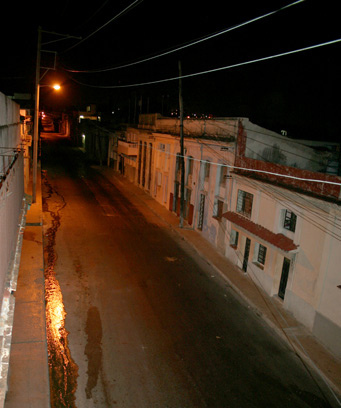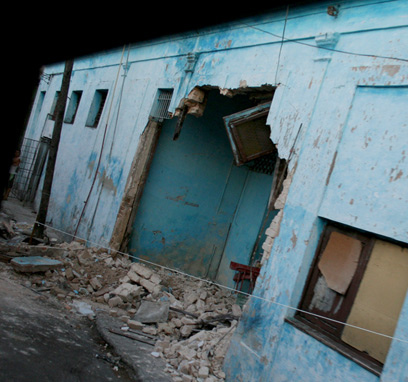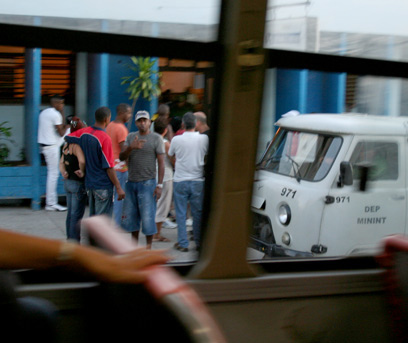
The Power of Small Things / Iván García

Of all the independent journalists and bloggers, perhaps there are no more than 150 across the entire island.  Yet many of us should polish our style.  Sometimes we think well, but rhyme poorly.  On occasion, the words drown us.  And the majority lack resources to engage in active journalism or maintain a blog on the web.

The political prisoner and unofficial communicator, Pablo Pacheco, free in Spain since July 13, thanks to the dialogue between President Raúl Castro, Cardinal Jaime Ortega, and the Spanish Foreign Minister Miguel Ángel Moratinos, would update his blog from a prison 400 kilometers from Havana, recording his posts via telephone.  Pacheco never even had a computer.  Now he has one, in Málaga, where he lives with his wife and son.

With the difficulties which Pacheco wrote, many continue to write within Cuba.  On the reverse side of pages with official letterheads, recycling sheets that have some blank space.  Typewriters are still essential for residents outside of the capital.  In the agencies of Eastern Cuba, they peck away at typewriters made in East Germany.

Cuban independent journalism is worthy of commendation.  The lapses in information content and journalistic skill that we might have as free correspondents, are the very same as for the majority of official reporters.

With the difference being that official journalism is more boring than independent journalism.  Working for a State medium tends to burden creativity; and one is closer to being a tamer than a journalist.  Certain sensitive subjects are “guided” via phone by a government censor from his office.

Cuban independent journalism was born in the mid 90s.  With women and men dedicated to changing the established rules of the game, such as Indamiro Restano, Raúl Rivero, Rafael Solano, Rolando Cartaya, Ana Luisa López Baeza, Tania Quintero, Iria González Rodiles, Reinaldo Escobar and Jorge Olivera, among others who broke with the official media.  In spite of the risk of going to prison, they thought it was worth it to describe the reality of their country.

They could have been cynics and opportunists, like certain colleagues in the governmental press.  Some had official recognition.  But they didn’t want to have a car granted them by the State, nor travel to the events and social forums of the worked-up global Left.

Had they continued being followers of the regime, today they would be rubbing elbows with Fidel Castro and have to tolerate, while standing firm, the lecturing on about the unstoppable atomic war that according to Castro is upon us.

They freed themselves from having to listen in silence and chose to be free men and women.  They paid for that choice with jail time, arbitrary detentions, public acts of repudiation, and exile.

The new bunch of independent journalists, save for some exceptions, has no professional training.  Nor do they bring with them that fear in their bodies suffered by those who work in the State media.  Some of them are brilliant, like Luis Cino, Víctor E. Sánchez, Evelyn Ramos, Luis Felipe Rojas and Laritza Diversent.

Since 2007, there’s been an explosion of bloggers.  Many have an intellectual education.  It’s no longer just Yoani Sánchez.  Youth like Claudia Cadelo and Orlando Luis Pardo have very widely read blogs.

Some possess academic resumes that extend over 50 years, like Miriam Celaya and Dimas Castellanos who, in my opinion, have the best political analysis blogs written on the island.

Under all kinds of difficulties, free journalists as well as alternative bloggers, have struck an important goal.  They opened a breach in the iron wall of monopolized news that the Party and Cuban government once held.

Now their opinions and analyses count when it comes to the study of the Cuba issue.  Small things sometimes bring with them winds of hurricane force.  If you doubt it, ask one of the Castro brothers.  They’ve waged plenty of war over it.

Iván García

Translated by: Yoyi el Monaguillo

August 22, 2010

Amnesia, Spells, and Survival / Luis Felipe Rojas

Photo / Luis Felipe Rojas

I have to admit that the kids of this current generation really manage to try to live with the pulse of the times.

Increasingly, I run into more and more people on their way to the babalao* or tarot card reader; there are those who at night go into downtown Holguín to take courses in Positive Energy.  I have two friends that are introducing Buddhism to Moa, the City of Nickel.

It’s been a long time now since I’ve been to a bembé** or saint’s feast.  Before, I used to go and have fun all night eating and dancing or watching the acrobatics and spasms of those who say they’re “mounted by the dead,” but I’ve known that many people who go also want to leave the country, to meet an American, to get a doctorate, want their boss to break a leg or that chick to finally get kicked out of the union “because she’s a real snitch.”

They ask for everything.  They bring everything that the priest asks for the spell and sometimes it’s as expensive as the trip itself or the miracle they wish to accomplish.

I don’t know if they ask for the police and the worst elements of the army to be abolished once and for all; for an official decree sending state inspectors to cut sugar cane at 12:00 noon; or for the unattainable merchandise in the foreign currency stores to be finally marked down.

I started asking some neighborhood pals, if they went to Yiyí the Santería priestess, what they would ask for, and these were the most common requests:

– For the economy to improve (but nothing about Economic Freedom).

– For all to able to travel without having to ask permission (but nothing about the Freedom of Mobility).

– That there be (said two or three, almost in a row) many TV channels and that the Internet be free (but they didn’t even mention Freedom of Expression).

It’s astonishing: there are people who don’t know that in the Spanish lexicon the word LIBERTAD (Freedom / Liberty) is one of the most beautiful and luminous.

Translator’s notes:
* Babalao: Yoruba term used in Cuba for a priest of the Santería religion.
** Bembé: A ritual party thrown in honor of the Santería dieties, wherein they are exhorted to descend and join by way of channeling through, or “mounting,” the gathered priest/ or priestess/mediums.

Translated by: Yoyi el Monaguillo

August 21, 2010

IF YOU WANT TO COMMENT, PLEASE READ THIS POST / Regina Coyula

After many days without being able to access my blog, I was dismayed to see what it had turned into. When I opened this space, I believed it would be for exchanging ideas, opinions, that it would help to develop a debate among people who only had to agree on one thing: the good of Cuba. And what did I find? An escalation among the commentators, some wasting testosterone and others trying to annoy those who took seriously some jokes in order to make a succulent inventory of insults. I wonder how could I have brought all this about, and the feeling of failure is inevitable.

I claimed that I didn’t want to use moderation, assuming the naive and tricky concept of democracy as absolute freedom. This is not true. Every social organisation has its rules, its laws. Even at home one sets out things in a proper order. I attempted to prevent these “lunatics” with a banner but it didn’t work and it had no effect at all. So some of you come to my space, take off your shirts, putting your feet on the chairs and don’t even ask permission to use the toilet. I don’t know… am I too old fashioned? Is this relaxed attitude normal on the Internet or is it that these commentators are not really ready to argue with someone who has a different opinion? It will also be a failure if I do not succeed in giving my readers the perception that this national debate, so necessary, must be carried out with respect. A member of the government speaking about the Big Bad Wolf, seems equally unserious to me as an opponent talking about Coma-andante (thus, substituting “walking coma” for “Commander”). Please, think about this.

Many of the readers don’t know that nowadays you don’t need to have an internet connection to publish. It simply takes a friend who has access to e-mail so he can send a text to a certain address for me and this becomes a new post, with photos if you want to include them; platforms like WordPress or Blogspot are very smart.

I invite the most suspicious among you to ask yourselves why I didn’t rise in MININT (The Ministry of Interior Affairs) or another institution at my convenience. I didn’t lack the intelligence and the contacts to profit in any ministry or foreign firm. Contrary to those who firmly believe or merely pretend to believe, I asked for my discharge in the same year as the fall of the Berlin Wall and the Cause I, by my account twenty years, and not those of Gardel.

My life is very simple, and if you have any doubts you can come visit me. You have nothing to lose. I live at #693 24th Street, between 35th and 37th, in the small garage under the Royal Poinciana tree, near the Acapulco cinema. Since I don’t have a telephone, it will be a surprise, a cup of coffee and we’ll be able to talk. I’ll make the coffee.

Translated by David Bonnano

August 20, 2010

August 13 / Orlando Luis Pardo Lazo

THE BLUEST CORNER OF THE FIRST WORLD

Orlando Luis Pardo Lazo

For August 13, the first ten years without my dad.

Since I was a child I’ve lived in a neighborhood on the outskirts called Lawton. I am the “only child of older parents,” the reason why we barely went to the city center.

In the ’70s Cuba held the First Communist Party Congress (it was already obvious that Fidel Castro would be an eternal entity), and, despite what they say now about that decadent and institutionalized decade, the truth is that I lived in a domestic paradise of two workers as poor as they were in love: María del Carmen y Dionisio Manuel, the best parents in the world.

I never thanked them for giving me the illusion of a childhood.

One day in 1978, they decided to take me to meet the rest of reality. We took several interminable buses and disembarked in our best “going out clothes,” right in the heart of El Vedado: the start of the culmination of La Rampa, 23rd Avenue and L Street (perhaps the L was for Luxury).

It was my father then, who prounounced it, while my mother held my shoulders, as overprotective then as she is today at 74: “Look up, Landy…”

And indeed, there it was. The mass. A needle to tickle the proletarian belly of heaven. A geometric design (distorted by my excitement) that, even to my 7 years, was the perfect metaphor of modernity: a new world, a new tone, a future ignored from our little wood house in far off Lawton.

It was the building with the bluest aura on the planet, whose only difference from the Hilton hotel chain of the ’50s was the sign that I read for myself on its snowy peak: Habana Libre — Free Havana.

We went in.

The doors opened by themselves. Under our orthopedic shoes, we caressed a pasture of carpets (I had to ask what these fabrics were called). The ceiling of the lobby rose in a dome miles above our heads. The light was nice, but nothing national. The voices of the Cubans also (no gestures or shouting). One breathed in the immaculate peace of this phenomenon always lacking, called air conditioning. The bathrooms were bigger than my house. My father bought a newspaper in English also called Granma and promised to teach me to read the exotic argot of the First World.

In 1978 I was suddenly happy in a hotel inherited by Real Socialism.

From 1978 I was also more and more unhappy, exiled in my own land in the hunt for the Unreal Capitalism of that close contact molded in my memory.

Architecture is, first of all, ideology.

When my father died, that tedious August 13, 2000, I wanted to leave him alone for a while in the ugly Luyano Funeral Home (a former site of the Socialist People’s Party) and visit our hotel for the last time. I wanted to cremate his body (even this was impossible in Cuba) and throw his ashes from the roof of the Habana Libre above the empty vision of a prisoner Havana. I wanted to jump myself over the city after my first 29 years of unlikely life (Fidel Castro was then the age my mother is now: 74).

I was left behind without having told Dionisio Manuel “I’m sorry” for many things, but, more than my indolence and his pain, I was left behind without having thanked him for the discovery of the blue at the corner of 23rd Avenue and L Street (perhaps the L of Liberty): a monument where the breeze of the future of the First World sneaks into Cuba.

August 13, 2010

Will the Prisons be Filled Again? / Iván García

It is a likely probability.  It is known that the Castros are unpredictable.  At times, they attempt to behave like brothers respectful of international norms.  The truth is the rules of democracy and human rights agreements are instruments against which the government in Havana holds grudges.

The three-way negotiations between General Raul Castro with the Cuban Catholic Church, Spanish Foreign Minister Miguel Ángel Moratinos and a left-wing branch of Barack Obama’s administration, which culminated in the agreement to release the 52 prisoners of conscience from la primavera negra del 2003 (the black Spring of 2003) and promises to reach out to more political prisoners on the island, could become a sterile gesture.

Since Castro II’s speech on the 1st of August, alarms were set off in the Cuban Secret Services.  The General did a 360 degree turn on the alleged easing of tensions and sent a return message to the disidencia del patio (courtyard dissidents).

He said it clearly.  Do not confuse tolerance with impunity. The street belongs to the revolutionaries.  We know what that means.  Beatings by the “pueblo indignado” (incensed citizens), acts of repudiation and thorough verbal lynchings to those who oppose the regime.

State Security took note and began work to gather the necessary pieces in the best way it knows how: repression. On the 5th of August, a date on which the sixteenth anniversary of the maleconazo* is commemorated, the political police conducted an extensive operation against dissidents and independent journalists who that day went to the United States Interests Section to surf the Internet.

Dozens of opponents where detained for up to 12 hours.  All detainees were warned that there would be no impunity.  As part of the strategy, citations and warnings have been issued to independent journalists in different provinces.

Reina Luisa Tamayo suffers fierce harassment at her home in Banes, Holguín, 700 kilometers (approximately 435 miles) from Havana.  They were not satisfied that Reina had lost her son, Orlando Zapata Tamayo, after an 86 day hunger strike, last February 23rd.

She is the Lady in White who has been treated most rudely by the political police.  They have not respected her pain as a mother nor have they allowed her to mourn as she is entitled to do.

The question that many ask today is what was the reason to unleash such a raid.  It could be that the government expects more from the European Union and from the United States.  Or, that the release of a handful of prisoners was only a measure to obtain political breathing room and some international credibility.

I have no doubt that there are factions in power with different opinions.  At this moment different springs are moving within the status quo.  He who manages to impose himself will dictate the rules of the game.

If the ‘talibanes’ (Taliban) succeed, the historic hard-line revolutionaries, we will return to the past.  Beware of economic measures and of the iron fist with dissidents.  We will have to wait.

Yet something is certain.  The hasty negotiations of Castro II, the church and Moratinos, left behind some rough edges.  What is important, without a doubt, was the promise to release 52 political prisoners who should have never been in jail.

But apparently neither Cardinal Ortega nor the Spanish Foreign Minister could get General Raul to promise to never again incarcerate someone because of their opinion.  Also not on the agenda, was the abolition of the dark Law 88, which continues to float around the air of the Republic.  With the strike of a gavel, it allows any prosecutor to put a dissident behind bars for 20 years or more.

The Castros may have decided to start playing hard and without gloves again.  A sector of the opposition knows it.  It asks itself if there will be new black summers, winters, autumns or springs.

In 51 years of revolution, prisons have always been full of political prisoners.  They are valuable bargaining chips.  If the regime wants, they could empty them.  Also if it wants, it could fill them once again.

Iván García

*Translator’s note: The Malaconazo was a riot that broke out on the Malecon, Havana’s seawall and waterfront arterial.

Translated by: Antonio Trujillo

August 22, 2010

Tropical Cancer / Ernesto Morales Licea

From the moment you push the door open, you notice something is not right. By now you should be feeling a change in the atmosphere, the change of temperature to give your skin, so mistreated by the sun, a breather. You should feel the air conditioner running at a place where you pay with the coin of higher value in your country.

Nevertheless, inside awaits a heat as intense as the one outside.  Maybe hotter.

The salesclerk, a skinny mulatto, is wearing his button-down shirt as required by the rules.  At his armpits, the blue color from the shirt gets darker: the sweat runs all the way down his ribs, it forces him to pull the shirt away from his body over and over again during his shift.

You ask him for a soda, and you lay the convertible peso that equals two days of work on the counter.  You know you can’t allow yourself to spend that type of money frequently, but the climate is maddening and at moments you feel forced.

When you reach for the can, you think there has been a mistake:

–  It’s not cold, my friend, can you change it for me?

His answer, a little indifferent, is the answer of someone who has had to repeat it on countless occasions:

– They’re all like that.  The rules about saving force us to set the fridge at the highest temperature, that is why they can’t get as cold as they should.

You’re still holding the can in your hand.  You know that it is not what your lips are waiting for to mitigate your thirst.  You know you’ll regret having spent two days worth of your salary for a drink you won’t enjoy.  But you sense the same thing will happen in every store you go to.

Just out of curiosity you ask him:

– Is it the same everywhere? I mean, is it an orientation given to all the units?

– Not only to the units that sell in convertible pesos –he assures me – but to all the places with a refrigeration system, whatever they are.  Here, for example, out of the twelve hours that we work, we can only use the air conditioning for four, and the fridges should be on the highest temperatures.

You look around: you don’t see even a window.  There isn’t a single hole from where a light breeze can come in to alleviate the drowsiness.  You think of your office, which never had air conditioning, but at least had a window as consolation from where you could look out and, from time to time, cool your forehead.

You thank him, keep the can and rush out of that café so similar to a crematory.  You finish the soda with no desire, almost out of obligation to the money spent.

You walk the streets with not much to do, but now you start noticing all of your surroundings.  A Banco Popular, for example.  Designed like a concrete fort for obvious reasons, with hardly any windows for natural ventilation.  Inside, the consoles are covered with spider webs.  You don’t know this because you don’t get to ask, but they also prohibit the use of air conditioning here, for good.

Hundreds of people wait for their turn to be called.  Hundreds of workers spend their eight or ten hours in there, receiving and giving out money.  The heat multiplies itself due to the agglomeration of so many bodies.

You push another door open: another store for convertible pesos only.  This time you are not surprised by the suffocating atmosphere, but a nauseating smell of concentrated air fresheners, along with the humidity from all the sweat in general, makes you leave immediately in search of oxygen.

You remember when, a few years back, the national authorities announced that the energy crisis in Cuba had come to an end.  They mobilized the entire country; they got the streets in party mode.

They took away the improvised fans from everybody, their fridges, their TV’s.  Under the “change” euphemism, they sold them brand new equipment, imported from China.  They sold them electric burners and rice makers.   It is true that beforehand they had raised electricity rates noticeably, however, it seemed like we were moving forward.  You remember feeling a vague illusion of prosperity.

A name was dedicated to the year the initiative started.  2006 was called “The Year of the Energy Revolution.”

And every Cuban, you included, thought the era of endless power outages, implacable savings, as part of the past.   A past to which seemed, we were never going back.

Today, every spot is gripped by savings.  Offices crowded by computers and equipment in need of air conditioning.  Cafeterias with perishable products.  Workplaces where it is an inhumane practice if working hours are not reduced.

So, what happened this time? What failed once again?

You know you won’t have the answers to these questions.  If you asked somebody, you would hear all sorts of justifications – the criminal imperialist blockade, the world crisis, the adjustments in our economy – that you could recite to yourself beforehand.

That is why you’ll get home very soon, to your own heat bubble and exhaustion.  You, just like many others, have lost all hope for progress.

You know that tomorrow, maybe the energy subject will be stirred up any unthinkable way, but then, the tires will stop and this country’s busses will be paralyzed, or salt will vanish from all the markets and you will be forced to cook while adapting the taste buds to the emergency.

Too many years in training to be that naïve.

As you come back to listening to your own steps you notice that the soda you paid for didn’t take your thirst away.  You also notice you weren’t able to find any other insignificant things you were looking for in the stores.  And that you’ll get home with your skin a little more scorched from the sun.

The only thing you ask for is, for nobody, absolutely nobody to cross your path with an offensive phrase, any type of rudeness, a subject of discussion.  Not even your family or friends.

You don’t know this, you think that the discouragement you have inside is not important.  But at this very moment you believe you are sick from a tropical cancer, a loaded gun in search of a reason to pull the trigger.

Translator: Angelica Betancourt

August 19, 2010

Aldeano’s Codes / Ernesto Morales Licea

I think that in my subconscious, I felt something more than professional interest when I visited them. Something like personally knowing the two rappers whose music and political positions greatly influenced my decision to confront, with the written word, the lies that embitter my beloved country.

I still remember with pleasure my “punisher” using that article (Revolution in the Village) where I spoke of them as two daring youth and as the best of my generation, as tangible proof of my unacceptable rebelliousness.

Los Aldeanos (The Villagers) have become a secret code. In a subversive way they assimilate reality. I remember an amusing incident: A friend introduced me to his girlfriend. As I walked toward them, I had headphones on my ears. After a conversation in which we exchanged some words about my job, and about my particular thoughts, she said, in a way of summarizing: Well, you look like you listen to Los Aldeanos.

I couldn’t avoid a good laugh. I, faithful follower of heavy metal, was indeed listening to Los Aldeanos.

In the seven years that they have performed together, this young duo has starred in a story as beautiful as it is unique in the Cuba of the twenty-first century.

Due to the sincerity in their lyrics, many sleepless nights over what occurs in our country, they have climbed to reach an admirable position in the conscience of a society that, although some deny it, listens to them with the respect inspired by those with (to say in blunt Cuban speech) well-placed balls.

What I am now transcribing is just a small fragment of the interview with Aldo Rodríguez Baquero, El Aldeano (The Villager) who has given over his alias to name the duo. A 27-year-old native of Havana, with a 9th-grade level of schooling and an incredible talent for the polemic and brilliant universe that is Cuban Hip-Hop.

-Aldo, what are the aspects of Cuban reality that you would most like to be able to change?

I can only mention one to you, that I think would make me very happy if I achieved it. And it is that Cubans go back to being human beings. That we go back to being good people. That Cubans go back to smiling without having a dirty mind.

And when I speak to you of going back to being human beings this means that the whole world here would feel the desire to love, to not rat on each other, to not resent someone because they bought a refrigerator, to not be involved in other people’s’ lives. When I say “the whole world” I am including, as one and the same, the President, the bus driver, and the trash collector.

Because to tell you that it’s necessary to improve transportation or the nutrition of Cubans, this is evident, but I think that all of this can be solved with a little more love, and less mistreatment of each other.

-Are you conscious of what you currently represent for the Cuban youth? Up to what point does the music of Los Aldeanos have the intention of becoming the symbol of a generation?

Look, we never planned anything specific for ourselves. But yes, many people come up to me in the street and thank me because they have changed their lives, and they have encountered a little courage or happiness in some song of ours.

Whether we are a symbol or not, until now I wouldn’t have dared to tell you. Now, I know that many people support us because we support the people, you know? Because we talk about the problems of the people. It is like a marriage that we have with the people.

In fact I have to take a course to be an artist because I don’t have a car nor a palace, I don’t have a way to hide myself from anyone. And also sometimes I can’t go to see someone singing because I don’t have money and I have to eat like everyone else. Imagine what a strange kind of artist I am…

-In many of your songs I have listened to, referring to yourself in relation to other rappers, you say things like “we are those who show our faces,” “we say what you don’t dare to say.” For Los Aldeanos, is it an inherent function of rap to be critics as you are with respect to politics?

Here each has their own distinct point of view, but for me this is what rap is. It is social denunciation, an abundance of style, it is to say things in the most clever way possible. It is floating. But I can’t stop seeing the rapper as the mambí of today. It is above the bullets.

And for this I’ve gotten into a lot of trouble and my mom has to go through it all with me. But for me there’s no other way to look at it. For me, rap should always bring its courage, we have to remember that those of us who have this music are here and they can’t shut us up.

Also, man, how can such a strong rhythm in a such a fucked up society talk about other things?

– What’s it like for you day by day carrying the little sign on your backs that says “counterrevolutionary”?

It’s not easy, you know… State Security does not call me. They don’t talk to me. But they call my friends. And they suffocate them, threaten then in a thousand ways.

And yet, so you can see the hypocrisy, when we are in the street with our friends, quiet, sharing a bottle of rum, the police come and arrest us for reasons they invent, they take us to the station and there other cops ask for our autographs. And to top it off, it’s the same State Security that gets us out of there, as if they’re saying, “Leave these boys alone.”

A little while ago we gave a concert in Holguin and when we went through Camaguey we were arrested. Because we embody a (police) goal, we argue and we end up in jail. And we always know that, at bottom, it’s about the music we make.

Other time we gave a concert in Pinar del Rio, and at the end a guy came and said to us, “You are counterrevolutionaries,” and again, we were in jail. That time we had a huge argument with them at the station, because they made us strip and all because they filmed us and we wanted to get the tape from them…

Some time ago the Sector Chief came with seven cops and took the computers in my house, on the pretext that I was selling movies. They’d already taken them and I had to call Silvito’s dad (Silvio Rodriguez) and say he had given them to me, and then they returned them to me, although I had to go get them, they didn’t bring them back to the house. The two computers, mine and my sister’s.

That time they argued a lot with me, you know. Because it’s not easy for me to come to your house and take your cap… your cap, that I didn’t buy you, and it cost you enough sacrifice. And without a warrant or anything: “I’m taking this,” and that’s it.

And still, as you can see, there are many people out there who say nothing happens to us because we are State Security… I don’t pick fights with them. I’m trying to get them to fight for themselves, and they respond to us like that. I can’t think about it because I get more depressed.

– After hearing songs like They Crushed Us, which is so upsetting for young people, one has to ask: Do Los Aldeanos have a pessimistic vision of our generation?

Chico, it’s that life gives back to people what they live, and makes them think that way.

When you’ve had friends, and those friends have betrayed you and abandoned you at your most difficult times, when they’ve exchanged ten years of friendship for two hundred pesos, when you feel people all around you but at the same time feel alone, it’s hard not to have a pessimistic vision.

And I wouldn’t even call it pessimism… I would call it realism. It’s what I see so much around me.

Right now you go out on the streets and find a whole bunch of thugs who want to stab you just because you stepped on them, but they change their tune when they see an officer.

Guys who don’t have the capacity to confront the authorities and tell them they don’t feel good about the way they are treated. So how can I not take a pessimistic view of my surroundings?

For me, today Cuba is a paradise of injustice, because for so many parts of the world it’s seen as a “happy face,” but here, inside, there are thousands of fakeries and lies and sad things. And I think the greatest part of the fault for that is our own because we allow it.

Then a young man takes out his frustration in the street, with violence. He acts all tough with me, sticks a knife in me… Hey dude! I eat the same eggs as you, ride the same bus as you, your mama cries when the power goes out just like mine does.

I can’t understand that this is happening with our youth. And that a girl has to give it up for foreigners, old farts. I could understand if she did it to feed her child, but not to dress better, not to have a cell phone in her pocket.

I believe that as long as these things are happening in Cuba without anyone stepping on the brake, while I see so many ugly things every day, I will continue to have a pessimistic vision of what I see around me. And I will continue rapping.

August 4, 2010

Essay from Voices 1 by Dimas Castellanos / Posted in: Orlando Luis Pardo Lazo

The Limits of Immobility
By Dimas Castellanos

The multiple factors that made possible the paralysis of our history in recent decades, while interacting on a different stage, have placed the limits of immobility on the daily agenda.  The attempts to convert citizens by the masses, to ignore the vital function of rights and liberties, and to determine from above when and how every single thing needs to be done, ultimately killed personal interest, generated stagnation and lead to a profound structural crisis with immeasurable material and spiritual damages. It is a publicly recognized fact, by way of the country’s authorities themselves posing the need to cambiar todo lo que sea necesario (change everything necessary); even though they did not manifest the corresponding political will to face said changes.

Like I have expressed during other opportunities, the coincidence between the exhaustion of the model, the unhappy citizen, the stagnation of the nation, the deterioration of the exterior image, external pressures and the citizen’ consensus for change, has shaped a scene that summarizes that los de abajo no quieren y los de arriba no pueden seguir como hasta entonces(those below don’t want to and those above can’t until then).  In that context, it interrupted a chain of events in the year 2010, among them: the prohibition of entry into Cuban territory of the Socialist MEP (Member of the European Parliament), Luis Yánez, the death of political prisoner Orlando Zapata Tamayo during a prolonged hunger strike, Guillermo Fariñas’ hunger strike, the repression against independent journalists, bloggers, Damas de Blanco and other opponents, during a time in which, thanks to information technology, power began to loose its monopoly over information.

Immersed in the complex social framework, the Government announced in the congresses of the Unión de Jóvenes Comunistas or Communist Youth Union (October 2009) and the Asociación Nacional de Agricultores Pequeños or National Association of Small Farmers (May 2010), the “actualización del modelo” (updated model), an impossible proposition without first replacing the foreign policy of confrontation with the acceptance of critical dialogue, whose first and most basic requirement is the release of political prisoners, a fact which created a shift in the Cuban authorities, whose main event was to call on the Catholic Church to mediate before the Damas de Blanco and Fariñas’ strike, and initiate a process of gradual release of those incarcerated in the spring of 2003. Something to which they had refused for seven long years. Although that shift is not synonymous with the political will for democratization, it expresses at least an awareness that without changes their own proposals are unthinkable, equivalent to the failure of immobility.

If in the new conditions, the intention of the Government is to liberate prisoners to change the image and accept plans for cooperation and sources of funding, it is on the path to flat-out failure; since the release of the first prisoners, regardless of the form or pace at which it is occurring, will become, like it or not, a prelude to other urgent demands from Cuban society. Not ignoring the grave dangers that new stagnancy would represent, the liberalizations will lead, sooner than later, to other changes.  Stopping on this point, it is important to note that since 1902, when it the Republic was established, Cuba has changed many times only to return to the starting point again, a reality that forces one to take into account the causes of the regressions when faced with evident prospects for change.

Among them, these cases highlight the weakness of civil society, independent and legally recognized in the first half of the twentieth century, and then its disappearance between 1959 and 1968, without whose existence it’s not possible to advance personally or socially toward modernity. In the absence of civil society and civil and political rights, the concept of the citizen was eclipsed until it came to be considered a pejorative term. This means that at the time that Cuba is approaching changes, it lacks the essential tools and spaces to realize them. A reality that constitutes the most complex challenge for the many transformations that don’t leave to a return to the point of departure. Everything depends on the capacity of the pro-change forces, of intelligence in the form of action, and also of the hidden forces that oppose this process.

In the next installment I will discuss various figures of the Republic emerging from the revolutionary movement who opposed the extension of Gerardo Machado’s powers, who, from the Army or the student population, were characterized by the use of physical and/or verbal violence, and by personalizing public affairs; these are phenomena closely related to the current situation, so this analysis may give rise to valuable lessons for the present. In this article I will concern myself with a man who was essentially characterized by the fight against corruption.

Rene Eduardo Chibas y Rivas (1907-1951), journalist and politician, exalted character, talkative, bold and eccentric, joined the Student Directorate Against the Extension of Powers in 1927. He was highlighted in the Student Directory of 1930, was arrested, imprisoned and exiled on several occasions: in 1925 for his participation in the rally demanding the release of Julio Antonio Mella; in 1929 accused of wanting to kill Machado; in 1931 imprisoned in the Castle of Prince and the Island Prison Pinos; in March 1935, he spent six months back in the Castillo del Principe; and in 1950 her served six months in prison handed down by the Emergency Court.

A member of the Cuban Revolutionary Party, founded in February 1934, in 1939 he was elected delegate to the Constituent Assembly, and sat in the House in 1940 and in the Senate in 1944. In 1947, the result of an internal split in the Authentic Party, founded together with other leaders of the Party of the Cuban People (Orthodox), he ran for the presidency of the republic. From March 1928, he published his first statement in El Mundo, and he made intense and repeated use of the freedom of the press. As early as 1934, the Silver Anniversary edition of the magazine Bohemia, he appeared among its collaborators. In addition to The Crucible and other media of the printed press, he used the radio station CMW Voice of the West Indies, the CMQ, and from 1946  the COCO. His denunciations and controversy formed a new style in Cuban politics, based on the use of the media to stay in the limelight of public interest. He defined himself, in this work, as leader of the Moral Revolution.

He was essentially controversial and contradictory, constantly going from defense to aggression. Some examples: In September 1933, when it was agreed to dissolve the government known as the Pentarchy, he proposed Grau San Martín for president; then, in January 1946, praised the work of President Grau with the following words: In the educational order, we have cash, for the first time in the history  of Cuba, which was a dream of Martí and a desire Estrada Palma: that the republic would have more teachers than soldiers. However, in June 1948 he accused Grau of: emulating the Borgia, the greatest pretender that has been given to the world since the time of Caligula, at whose side I have sacrificed twenty years of my life, without asking or accepting anything.

Consummate anti-communist, he presented at the Constitutional Convention a motion of solidarity with Finland on its invasion by the Soviet Army and among other things said: Stalin has betrayed the teachings of Lenin by transforming himself into an imperialist despot in the style of Ivan the Terrible. And in July 1940, during the signing ceremony of the Constitution, he denounced “that it already is being violated in spirit in favor of some who signed it.”

He employed the accusations, mainly corruption, in a systematically way. In May 1939 he accused Blas Roca of treason; in 1942 the chief of police of overstepping his boundaries; in 1943 he filed two motions in the House against Batista and against Congress; in July 1945 he accused Carlos Miguel de Céspedes of the sale of a piece of Paseo; and in January 1947, in a letter read on the radio, he challenged Grau for alleging intending to be reelected; in 1950 he accused President Prio of the assault on a correctional court, and stealing the documents of a charge of embezzling hundreds of thousands of pesos; in 1951 he accused Rolando Masferrer of a placing a bomb in the house of Roberto Agramonte, and so on.

His behavior earned him friends and enemies. Considered crazy, he replied: I’d rather be a mad person with shame than a shameless thief. When Carlos Prio won the 1948 election, he said: Chibas has been a fraud all his life. Not exactly crazy, but abnormal. Chibas doesn’t know where his heart is and is not aware of the existence of truth. With others, Chibas dueled with swords, guns and fists. The defense of what he considered useful at any time led him to make critical assessments.

In February 1946, he established a distinction between a revolutionary attack and simple terrorism. He said: The use of the bomb can be explained when it is used as a crack of rebellion against a regime of terror … but never when used against a government which is the product of national will.

Death was in his work and in his speech. In November 1939, on the eve of the election of delegates to the Constituent Assembly, he was wounded and when asked who had been the aggressors, he said: Do not worry about finding out, I die for the revolution, vote for Grau San Martín; but the popularity from having been shot gave him second in the voting.

In January 1948, at a meeting of the party, he jumped on the head table and began to shout, Throw out your heart! Orthodoxy needs a martyr! In May of that year, during a campaign tour in the East, he said: The day that Chibas is thinking about warning of an extinction or a decline in the civil love, part of a shot to the heart, not for cowardice before the failure, his sacrifice will lead to the victory of his disciples. In 1951, unable to prove the charge against Aureliano Sánchez Arango, he shot himself on August 5, from which he died on the 16th of same month.

In The Crucible of August 7, 1944, setting forth the reasons for authenticism, he said that it only needed a group of Cubans ashamed of the government of the State to break the circle that is suffocating the Republic, and condemning us to the status of outcasts in our own land. Then, to create  the Orthodox Party, which was considered the only political force that provides the people of Cuba  a new perspective, one that opens new avenues into the country. As a result of his work and his style, in a survey conducted in June 1950, Chibas was the strongest candidate for the presidency, which was confirmed with another held on May 20, 1951, which gave him 29.70% of the vote against 19.03% for Fulgencio Batista.

The idea of administrative honesty was the essence of the political movement that started from the Authentic Party and continued from the initiation of the Orthodox Party: The bad politicians, he said, steal from the rich people, all domestic political struggles are rooted in lack of honesty, it is essential therefore to put the reins of the Republic in clean hands. Chibas reduced the moral — a cultural component responsible for regulating human behavior in social relationships — to administrative honesty. The simplification of the concept allowed him to use it as a weapon against his enemies in elections, but it was unusable as an instrument of profound changes in the political class and the people. It had a purpose: to draw attention to administrative corruption at a time when the disease was becoming a public menace. The slogan Shame against Money!, served perfectly to achieve power as an immediate objective, but not to build the nation honored with social justice that he himself professed.

The program of his party had three main directions: economic independence, political freedom and social justice, but in those times, as in the present, Cuba needed a change capable of breaking both the elitist monopoly of the economy as a policy to access social justice. Because it was necessary to strengthen existing civil society. Chiba devised a perfect paradise to be imposed on a complex reality, mentally constructed from his imagination: expel the thieves of power and put in place an honest man, servant of the nation. That man had to be his own person, who did not desire nor need the national patrimony, and thus the changes advocated had to be realized from the damaging pattern of focusing on personality and warlordism, two of the negative cultural phenomena rooted in our political history.

The concept of immediacy, characteristic of the revolutionary changes, did not allow the drafting of a policy to respond to the existing conditions and  social psychology of Cuba. On one occasion he said: Our people are reporting the theft of the rulers with the same calmness that they read the pages of color comics or listen to radio programs. So he called desperately to the public conscience of the indifferent Cuban citizens: People of Cuba, wake up, not realizing that the changes within people do not respond to revolutionary emergencies. So, quite rightly, someone said at his death: Chibas was a man imbued with messianic ideas about history, morality and politics. He dedicated no time to thinking of the new order, because ultimately, the new order was himself, a chronic disease that we still suffer from.

Chibas is a paradigmatic example of the impossibility of social change if it is not accompanied by a corresponding civic culture and arises from a strong civil society, as a condition of participation. That’s one of the main lessons that comes to us from this martyr to cleaning up society. An experience that tells us now that the release of political prisoners can not be more than the starting point for other rights and freedoms, without which Cubans remain marginalized in the decisions of the nation. These include: the right to freely leave and enter the country, whose absence explains the continuing mass exodus by any means; free Internet access, without which superior technical and professional qualifications are devalued in the knowledge era; and freedom of expression, the foundation of all other freedoms.

Translated by: Antonio Trujillo

August 16, 2010
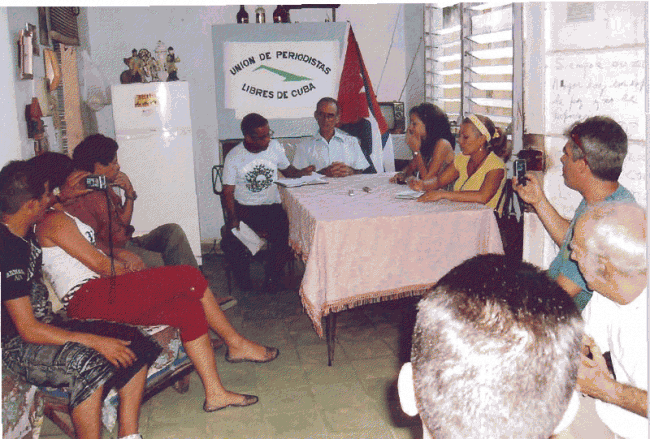
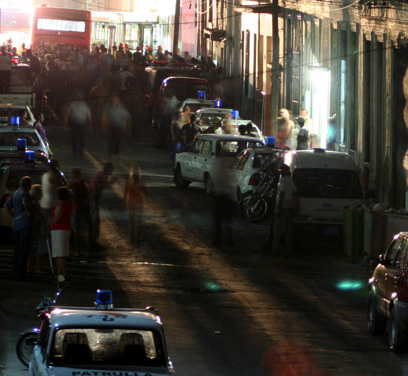
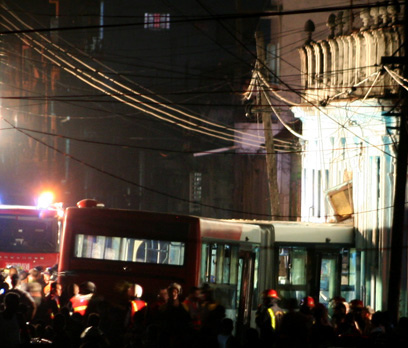
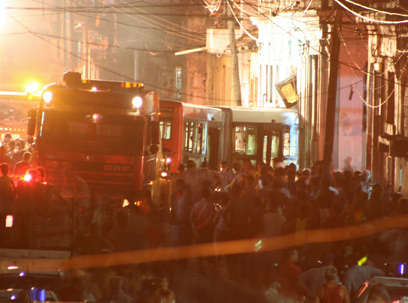
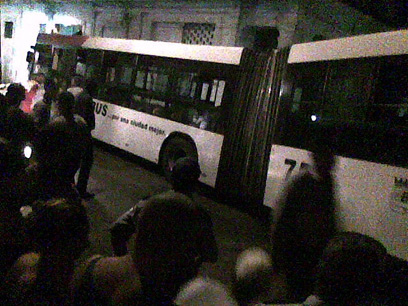
ROUTE P7 BUS ACCIDENT AT FABRICA AND LUYANO STREETS / Orlando Luis Pardo Lazo

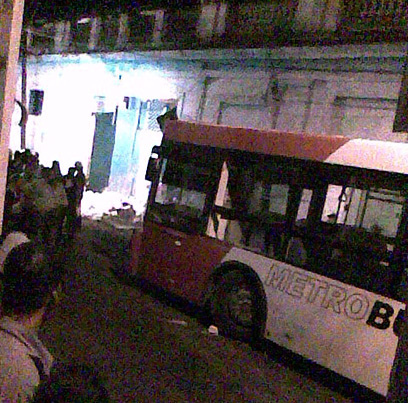
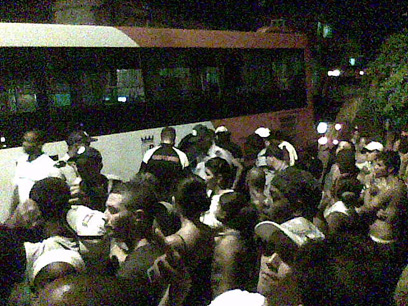
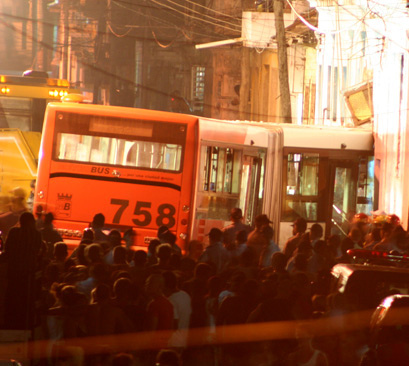
Claudia Cadelo uploaded, very early, her photo of the accident at Fabrica and Lyuano streets at:http://a.imageshack.us/img826/4273/accidente.jpg.  In recent days in August several accidents in Havana involved these large articulated buses.

[Translator’s note: This blog post is a reprint of a series or “tweets” from Twitter — which are combined here into a single text, slightly edited to be less “choppy.”]

It’s dangerous to have so much traffic, especially where the children and grandparents of Luyano live, a poor area where people live at street level next to the hot asphalt. Factory Street is very narrow and doesn’t accommodate so many large vehicles and the drivers go too fast for the area.

Hopefully the injured will recover as soon as possible. The causes of this disaster need to be clarified as soon as possible.

It’s been a black day for Havana and Cuba. Victims taken to the Calixto Garcia Hospital, according to what I heard.

The bystanders started to gossip and even joke, and talk about the black market, life resumes as soon as possible after the tragedy.

In the end the children of Luyano were hanging out the windows to see what was happening inside the bus; the police chased them off without much enthusiasm.

I heard the driver survived the impact but I don’t know where he was taken afterward.

Already the traffic is running on Fabrica and Luyano again, although I haven’t seen any P7 buses go by, perhaps it’s that it’s already early morning and the P7 only runs until midnight.

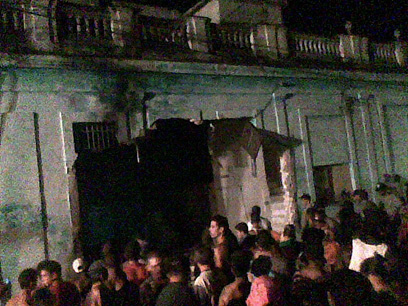
I also took some pictures, the bus left a terrible hole in the wall of the bakery that could easily collapse now.

In the end the State Security agents disappeared leaving only the police, and people began to film and take photos with their cell phones.

Relatives of the victims were severely affected, some going into shock or even fainting at the scene hours later.

There were apparently victims standing in line at the bakery, or standing nearby, thus the terrible confusion in the neighborhood.

The P7 apparently hit or was deflected by a truck and then was embedded in the wall of the bakery.  Even after midnight people remained in suspense about the tragedy which involved fatalities to neighbors.

With the situation under control people are finally returning to their homes, with the news traveling from balcony to balcony. Sadness and misfortune.

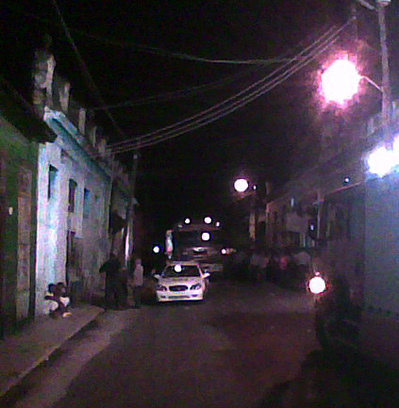
It’s dark, the streetlight failed. They quickly brought in artificial lights.  They are using a saw and a crane to remove the bus.

My photos are only from a single perspective and don’t capture the human drama, the victims, firefighters, police.

A Security Agent came and we talked and he almost took me away, but I eluded him, and continued watching from several yards from the tragedy. I went up to the balcony to avoid him. He asked for my identity card and didn’t read it. I asked him how I could help.

Then a young one came up and asked me for my license to be a photographer as if the street was the private territory of the rescue workers. The neighbors are in the street.  Talking about the events. My immediate source of information. How to help in this tragedy? I tried to take photos. I see the stretcher bearers running in. Police are parting the bystanders to open to the street but it’s not happening quickly. Officers on motorcycles. Military in green. Police in blue. Civil Security. Two hours later the operating is slowing down. The majority of the wounded are in the hospital.

There are many corners taken over by police around the Enna Reforma Rodrigues Municipal factory and beyond. They won’t let you take photos. There is no press.

The neighbors are taking about mutilated bodies. Heads, arms, organs. Very difficult even for the specialized personnel. Families are desperate. Initial victims taken to Miguel Enriquez Hospital and others in Havana. Critical cases. The rescue operation is huge. They also have to avoid incidents and vandalism and disturbances among the people.

Later the Ministry of the Interior activates some kind of special system to help in disasters. They come with young civil defense people, and even high level people.

The neighbors are gathering around, chilling screams, crying, hysteria, panic. The first call was to police, fire and ambulance by phone. There was an impasse at the beginning because the magnitude of the accident was too much for the poor people, but then they were very supportive.

About 8:10 or 8:15, then it was on the TV news. Then they noted that the bus was completely embedded in the facade of the shop and also a family home.

In the shock there were those who heard the frightening crash and ran in all directions thinking it was an explosion in some factory.

The P7 doesn’t normally run on Fabrica Street but rather on Calzada and Luyano, but for some weeks its been detoured while Calzada is being repaired.

Terrible bus accident with the articulated P7 (number 758) at Fabrica and Luyano streets, almost 2 hours ago, situation continues difficult.

Corners of Luyano taken over by police and State Security. Neighbors gathering, talking of deaths. No photos close up. No signs of the press. Two hours later they haven’t taken away all the bodies.


Today, Saturday, August 21, 2010, barely 12 hours after a terrible crash of a bus into bakery, the Luyano Mortuary is full of the grieving families and neighbors in the area, as well as abundant military personnel.

August 21, 2010

Beating a Prisoner / Voices Behind The Bars, Pedro Argüelles Morán

Ciego de Avila. The inmate Pento Ariel Garcia received a beating, August 16, 2010, by the two heads of internal order, subordinates of the Minister of the Interior Roberto Mesías y Rigoberto, who is better known as El Indio. Both have stood out for beating prisoners while they are handcuffed. Pento García, 34, resides at No 7612 Ave 105, between 76th and 78th streets in Güines, Havana Province, and has been beaten by officers on several occasions and confined in solitary confinement even though he suffers from psychiatric disorders.

Report: Pedro Argüelles Morán, from the group of 75, from Canaleta provincial prison in Ciego de Avila.

August 18, 2010

Lion Prophet / Voices Behind the Bars, Pedro Argüelles Morán

“Confusion Painting” by Keenya Woods

After nearly 200 years since humanity has known a prophet, the earth has one, his name is: Fidel Castro Ruz. This aged prophet is trying to write an epilogue to the Apocalypse, although much more catastrophic. To do this he called an extraordinary session, on August 7, of the one-party National Assembly, of the so-called People’s Power, and met with four Venezuelan journalists the following day. This allowed the official communist organ, the newspaper Granma, in its August 10 edition, to devote seven pages to the interview.

At the same time, said organ of the State press has been publishing for some months the so-called “Reflections of Comrade Fidel.” Here he analyzes the problems of the entire world, expect the urgent — problems of every kind — the Cuban ones.

Also this neo-prophet tries to present himself as a champion of peace, but he forgets that in the early years of the decade of the sixties of the last century, during the October Missile Crisis, he then asked the Soviet leader Nikita Khrushchev to launch a first strike nuclear attack against the United States of America. That during the sixties, seventies and eighties of the same century, he tried to export the socialist revolution to different cardinal points, sending Cubans into guerrilla wars or training guerrillas here in Cuba, and providing them medical care. He also sent regular troops to the Republic of Angola and to Ethiopia in Africa, just to cite two examples. Perhaps now the prophet Castro would like to get another Nobel Prize, this time for peace, along with the Nobel Prize in Chemistry he got years ago for turning the entire country into scrap metal.

Pedro Argüelles Morán, from the group of 75, from Canaleta provincial prison in Ciego de Avila.

August 18, 2010

Unknown City / Claudia Cadelo

From so much looking out the same window, seeing the same street, talking with the same people and living in the same city, you end up thinking you know everything. If someone had told me I would not have believed it, now that I know it’s true I’m full of questions. The streets of Havana still hold many surprises for me, fortunately.

Lethal August. I arrive gasping at 23rd and 12th and find, scattered on the ground, various papers as in the photo: FREE IRAN. My God, what’s this? I grab one and look around, I would say I’m the least surprised of those around me. A guy who looks like State Security gets caught in the act of putting one in his pocket and makes a gesture of disgust with amazement. I don’t think he likes it. I couldn’t say if FREE IRAN falls within “Enemy Propaganda,” but apparently it’s not “Friend Propaganda.”

At 23rd and G there are more. Many more. Most have been trampled. Who could have thought up such a brilliant idea? I have no doubt that this is related to the fixed ideas that have gripped the hallucinatory mind of Fidel Castro. How would Compañero Fidel take it if if instead of the Third World War what came to pass was the end of the Iranian dictatorship?

August 20, 2010

Prison Diary (2) (La Cabaña Prison)

Photo: Alina Sardiñas

At first I thought I was isolated, that there were no other prisoners in the other cells; sometimes I heard some door that would open slowly and quietly, as if trying not to strain its hinges; with time and so much silence my ears became fine-tuned, they began to warn of a certain scraping, then something dragging, later I discovered it was the sad steps of someone carrying the world on his shoulders, trembling legs bent in panic, but I didn’t care, the joy of knowing you’re not alone overcomes you, that you aren’t the only unfortunate, your eyes tear up, you want to beat on the door, to see through the iron and the walls, eager to embrace, to be hugged, to hear a word, a whisper, but just let it be a human being; later I preferred no noise, to say not a word, or I didn’t have the courage, I would just huddle in front of the door, knowing the guards would trace it back to me immediately, and in reprisal they would send me to the hole, the punishment cell, and possibly deny me family visits.

I had a little cry against the cold stone. I would have loved to feel the warmth of another human being; I tried pressing my body to the floor, staying that way a few minutes until I could feel the sweat on my back, and with an agile movement I flipped over and rushed to press my face to the still hot place that had been covered by my skin; I thought I might materialize another person this way, preferably a woman, who would stay beside me; the movement barely took two seconds, I practiced it so many times I could do it in one second, but every time I pressed myself to the floor I was overwhelmed by the coldness, the same as in the eyes of the soldiers when they interrogated me, or as flowed from the walls and the doors, emanated from the food and the air; I also blew my breath into my hands, trying to catch it in my fingers and smell it, seeking the sensation of having someone close, accompanying me.

Finally I came to the conclusion that all this effort was useless, I felt that the place was designed to make us feel like a piece of meat in the slaughterhouse.

August 20, 2010