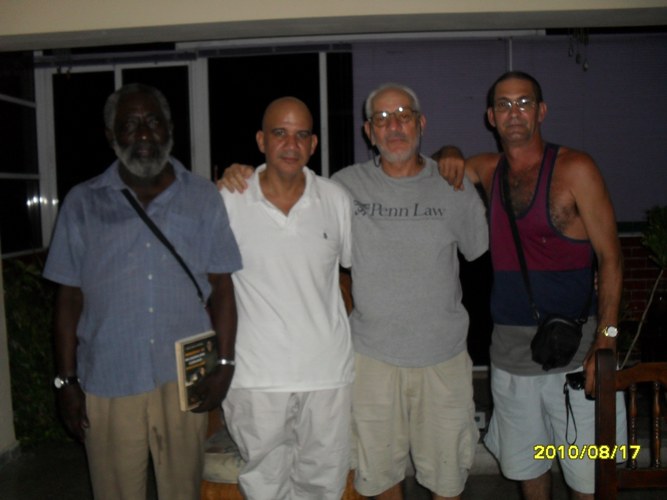
A suspicious incident has provided me with writing material this time. As a sample of a rare will for controversy and democratic confrontation, the site Kaos en la Red, which promotes itself as the champion of intellectual reflection, has just censured a post originally published on this blog, which some reader decided to post on that portal.
The text My Own Vindication of Cuba appeared on that site under the free publication section and soon after went to the main pages of the section named Cuba. After reaching a considerable amount of readings, and after being commented on by many readers, it disappeared without leaving a trace.
The interesting thing is that, according to some comments I had access to via e-mail, a few feverish readers uttered howls of indignation before such opprobrium towards the progressive Kaos en la Red. The opprobrium was the appearance of my text there, not its later censorship, even requested by many of them.
How is it possible – they asked themselves – that our site, the trench of the united leftists allows the enemy to infiltrate in such way? How is it possible that we offer tribune here to an author (me) who admits on his Facebook page that he reads with dedication Mario Vargas Llosa and Carlos Alberto Montaner?
Soon after, Kaos en la Red retired my inglorious article.
I must confess: I have enjoyed the anecdote. At some point they announced to Sigmund Freud that the Nazis burned his books. The response of the wise psychoanalyst was a sarcasm without equal: “Humanity has progressed so much!” he said, “in the Middle Ages they would’ve burnt me.”
In no way does my ego want to think itself dangerous to the orthodox leftists, just as it seemed the work of Freud was to the retrograde fascists. But this thought seduces me: it had to have something, right? Otherwise my simple article would still be there.
Neither do I think I can discover any truth by affirming that Kaos en la Red represents a faction increasingly impoverished and discredited precisely for their lack of plurality, for the panic that divergent voices inspire in them; I wouldn’t expect anything else.
Even more analyzable is the scream “Enemy in sight!” coming, perhaps, from any of the trained boys from the University of Information Sciences (UCI), or from any other group with similar occupations, whose brains possess a delicate programming in binary coding: zeros-ones / friends-enemies.
As for me, I propose each day to fill myself with more doubts with respect to these frontiers. To undergo a general skepticism that can make me doubt how good of a friend the ones who call themselves my friends really are, and how much of an enemy are the ones that introduce themselves as such…
I’ll explain.
One of my best friends is a militant of the Communist Party. He’s 38-years-old and was previously a part of the Communist Youth. I have argued with very few people in my life as much as I do with him. In between beers and beers we have come, in certain moments, to whip ourselves up in an intellectual duel which (good Cubans that we are) resembles a violent dispute rather than a confrontation of ideas.
Later, having finished our drinks, we each go our own way onto our chores, and continue to miss each other for the rest of the day.
This friend possesses a vast universal culture, and a humanistic formation that with unusual frequency, allows him to disagree with the party he is a member of. Why does he confront its directives and arbitrariness, and yet keep sympathizing with the process? If I had those answers, maybe I wouldn’t argue with him so much.
But a man who loves women and Martí as much as I do, who would never betray nor condemn anybody for thinking differently from him, and who seeks out his own path for the well-being and progress of his country, can’t be my enemy, even when some of his ideological positions seem incompatible with his intelligence.
A little while ago, during my ephemeral link the official Cuban journalism, I met a radio broadcaster who had a certain prestige in my city. He would announce himself every day before the microphones, at six in the morning, and conduct an informative program lasting two hours which, in my Socialist Cuba, was strictly compliant with the establishment.
That man wouldn’t poke even a toe out of the box which his militant conscience established as just and necessary for his country. He felt proud of his politically committed broadcasting but, luckily, in his conscience of what is just and necessary, he would publicly whip incapable managers, demand attention to the handicapped elderly, and face, from his microphone, the prevailing local violence.
I rarely agreed with him in his visions about the Government, or on infinite topics surrounding Cuban politics, but in my particular Republic I would include a broadcaster who believes in what he says, whether he agrees with me or not, and who knows when to be on the side of the weak people if that is what his conscience dictates.
Now, the conflict occurs when this way of understanding divergence is not reciprocated. I have to admit it is necessary to be cold-blooded, to have a Tibetan superiority, in order to not harbor hostility against those whose beliefs we respect, but who are not capable of returning the favor.
Those who call us “the enemy,” and in their infinite array of vicious euphemisms, use terms such as “worms,” “scum,” and “deserters” to define all those who do not agree with their ways of understanding a social process.
I believe that a good exercise for all, liberals, leftists, humanists, republicans, ecologists, would be to copy the phrase from Voltaire on a piece of paper and stick it on the most visible spot of their home: “ I detest what you say, but I would die to defend your right to say it.”
After incorporating such message, it is very hard to censor articles, denigrate opponents, and consider as enemies all those who express, out loud and without hypocrisy or opportunism, what they really think, either about an ideological or religious doctrine, or about any sexual conduct.
My definitions of friend-enemy rarely pass through a political sieve. Above all, I am interested in human rights, and I celebrate that many great people I know don’t share my postures. When you are a democrat, when you have pluralistic thoughts, you are radically unable to accept intolerance and exclusion.
August 16, 2010
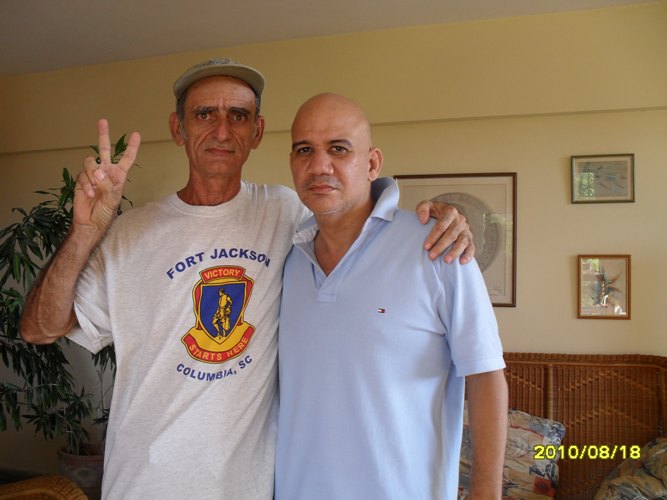 Today I was overcome by a horrific fatigue, my vision is blurred, and I fell while bathing; my sister and my friend Tomás helped me into bed.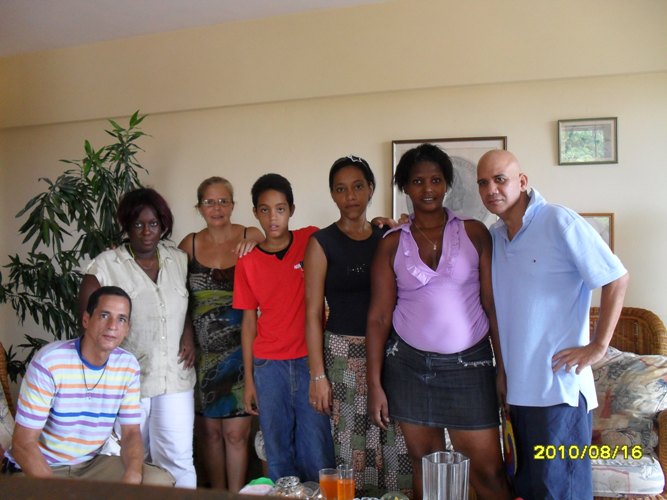
 “That was before,” answered the girl who was ahead of me, when I mentioned the old slogan. “Now it’s more like Save Yourself If You Can.” Though still very young, she spoke as if we had known each other our entire lives. Looking through the windows of the store, awaiting the doorman to authorize our entry with the well known little phrase que pasen tres (three may pass), we kept busy watching the cashier struggle, due to the exaggerated length of her fake fingernails, as she input codes and prices. My attention was drawn to the ring she exhibited on her ring finger. It was round, flat and huge; just like a bull-fighting arena. This, together with the noise caused by her plastic fingernails as they crashed against the calculator, made me think that she too was haciendo el papeleo (processing her paperwork) to become a cubañola (a Spanish citizen who would still pass as Cuban) and was simply, already trying to fit into her environment. Well, it sounded almost like castanets playing.
 From the silence, the impunity, and with the same contempt for the activists who promote human rights in Cuba, the political police triggered the arrests and threats in Havana and other cities in the country, between July 10 and August 12, which coincides with the resumption of activities by ex-president Fidel Castro and the official celebration of his birthday, on Thursday, August 13.
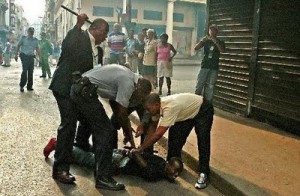 Ricardo Medina, a theologian and representative of the Liberal Catholic Church was arrested on August 4 together with the activist Hugo Damián at the Pinar del Rio bus station, where he was to greet the layman Dagoberto Valdés. He was taken by an official from State Security with Ricardo’s dossier, and freed two days later.
 As a teenager I imagined that writers were wise, sensible, creative, focused and responsible people. For me, a poet was a chosen of God in communion with men, capable to singing to the moon, describing encounters with the stars, and shouting the word freedom before the rifles of the tyrant. With the passage of time I met several literary types and discovered the human profile of some poets and writers.


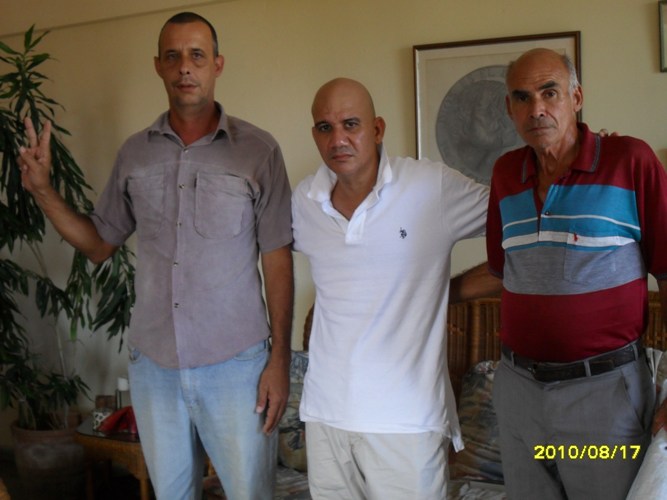 Sixty-four days of hunger strike I feel a decline in vision, nausea, cramps, malaise; talking tires me quite a bit and ideas get lost in my head.