Throwing More Fuel On the Fire / Rebeca Monzo

While reading the document Restructuring the Workforce, and once again going over the list of self-employment trades to be authorized, I could not stop thinking about two fundamental things. First, how is it possible to dismiss more than five hundred thousand people of working age, and to tell them, as if they were simpletons, they can join the private sector. What private sector would that be? The document does not make this clear. Would not it be more reasonable to first create a real and strong private sector, properly legislated, without falling into these almost insurmountable traps, which is what these exorbitant taxes are? On the other hand, when I read, one by one, the trades reflected in the paper, I felt indignation and embarrassment. Even in the Middle Ages no self-respecting government would be able to develop such a list such as that.

This, as I already expressed earlier, will bring many social problems. Most likely well be a possible increase in crime: assault, robbery, blackmail, to name a few, directly related to the economy; not to mention the possible increase in the suicide rate which, although the numbers are handled in the strictest confidence, is already among the highest in Latin America. This, as I read recently in a great article that came to me in the mail, is putting the cart before the horse.

In my humble opinion, I think that once again they are trying to entertain people and sweeten the plight ahead somewhat. We already did something similar, at earlier times when popular discontent manifested itself. The result of this restructuring without creating the preconditions for it is something very like throwing more fuel on the fire.

September 22, 2010

A Lackluster Birthday / Rebeca Monzo

Tomorrow, Sunday, we will be celebrating the sixtieth anniversary of our TV on my planet. We came after the United States of America, the first country to have this technology.

One of the pioneers of this new communication medium was Gaspar Pumarejo, who introduced it into our country and into the family home, turning it into a large studio for the presentation of programs. He was undoubtedly the pioneer and the one who most contributed to its development along with the Mestre brothers.

In the fifties, our TV had reached a high level and had the most advanced technology of the time. There were many programs which established the standard. The subsequent increase in advertising and design are inextricably linked to television. They pulled off some stunts, like broadcasting major league baseball live and direct (using a plane flying over our skies to catch the signal), to the delight of a people who, for the most part, love this sport.

Today, the television in our planet is not even a shadow of what it once was. Tedious, boring, vulgar, politicized to the maximum. Messages and slogans abound between program and program, which causes many like me to use it primarily to watch rented movies. When you manage to an interesting, well executed program they repeat it over and over because of a lack of financial resources to constantly come up with new things to show us.

As José Saramago used to say, “It’s time to howl, because if we get let ourselves be carried away by the powers that govern us, and we do nothing to counter them, we can say we deserve what we get.”

Congratulations to the pioneers of our television, and all those who delivered it to is with much love, wherever they are now.

October 23, 2010

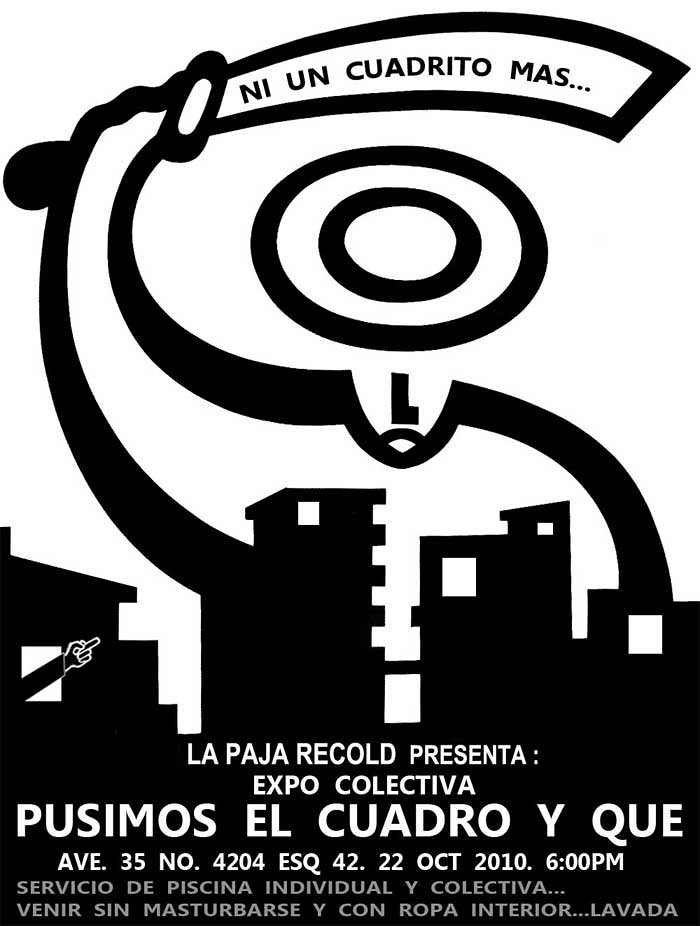
Collective Exposition at Gorki Águila’s House / Claudia Cadelo

NOT ONE MORE BLOCK
LA PAJA RECOLD [Recording Studio] PRESENTS:
COLLECTIVE EXPO
Individual and collective pool service…
Come without masturbating and with underwear… washed
1- heriberto manero / drunks
2- guillermo portieles / cops with walkie-talkies
3- ricardo orta / uncorker
4- claudio fuentes / el yogultsaldo de soyaldo
satélites / untitled
5- luis trápaga / me, no…
6- incap-ass / say no to superstition
/ the skateboarder died, long live the skateboarder
7- arturo cuenca / we don’t know the title
8- noel morera / this model doesn’t even work in Cuba (Fidel)
/the zebra still sees the lion zebra stays / cuba bremen musicians
9- gorki aguila / historic dates
10-hebert domínguez / ciro I love you
/the photos you shot with the camera and the rest
11-papín / murals painter
12-fernando ruiz / slander column
/ mirror shell
13-rubén cruces / visualization no.23
14-claudia cadelo / my dolls – girlfriend
15-jorge luis marrero /
16-renay / drink only (reading only)
22.mm y tnk / stencil intervention
Translator’s Note: An announcement for a “studio warming” party to celebrate Gorki Aguila’s new recording studio: La Paja Recold

The Real Embargo / Iván García


The “blockade,” as the Cuban government calls it, is real. It’s a trade embargo by the United States declared in 1960 and implemented rigorously since 1962. It caused the machinery from American to become scrap metal.

Later, the damages were minor. The former Soviet Union connected a pipeline and oil and rubles flowed from Moscow to Havana. The cold Eurasian country supplied the tropics everything from trucks and tractors up anti-aircraft missiles and MIG-29 aircraft.

All this was paid for by sugar cane, candy and marble. Or, without paying a penny, in the case of weapons. Knowing that the northern neighbor had imposed on us a “criminal blockade,” in the words of Fidel Castro, the logical thing would have been to try to streamline the flow of money and resources that came from the Kremlin by decree and to try to design a profitable industry and an efficient infrastructure. But that went.

In the period from 1975 to 1989, when the island survived on resources from Eastern Europe, the effects of the embargo were hardly noticeable. Then the Berlin Wall fell. And Cuba had not invested in development. We knew only how to spend and spend.

Then in 1990 came the inevitable economic crisis. The euphemistically named “Special Period.” A war without deaths by bullets, but with the same consequences. Hunger, blackouts of 12 hours a day and an economy returning to the primitive.

That was when Castro started speaking again about condemning the embargo. The entire world bears witness to the injustice, in its annual votes in the United Nations. But if Cuba had efficient agriculture and industry and coffers filled with money, the U.S. embargo would have been a useless tool.

But blaming all the ills of the Cuban economy on the embargo is not fair. We are lethally ineffective because a structural problem in the system. The “blockade” is also a sieve. Stores in Havana are selling products Made in USA, such as Coca Cola, Del Monte juice and Dell computers in foreign currency.

Since 1959, America has been and still is, the number one enemy of Fidel Castro. That has not stopped the country from selling more food to the island in recent years.

The real embargo, but three times more violent, is the one the regime has implemented against its own citizens.

No free-flowing information; the Internet is a luxury to be paid for in foreign exchange; to leave and return to your own country you must wait patiently for the government’s permission; and you can end up behind bars if write your opinions or start a political party.

Not to mention the obstacles placed on the flow of parcels from the outside. Following the three hurricanes that hit the island in 2008, it was permitted to send up to 11 pounds of medicines and other items. The first thing the Cuban Post Office did was to raise the import fee from 20 to 70 pesos, half of the pension for many retirees.

They take advantage of an unfair measure, such as the embargo, to put their citizens’ necks in the wringer. People are tired of the embargo, but also of their ancient government.

Fifty Years After the Beginning of the Embargo, Obama Has the Key / Iván García

Half a century ago, on October 19, 1960, Eisenhower ordered the seizure of goods to the island to begin. Just two months later, on January 3, 1961, Cuba and the United States broke off diplomatic relations. A year later, on February 3, 1962, Kennedy signed the document that formalized and extended the trade and economic embargo against Cuba.

It is the chronological summary of two countries which, in the first 59 years of the twentieth century, had maintained good relations, always with a strong American presence in all spheres of national life.

Fifty years later, from a Cuba ruled by two authoritarian elders who have never adapted to the end of the Cold War, you can not expect miracles.

By their own initiative, the Castros will never make profound political and economic reform. They have become a pair of dinosaurs, and in the words democracy, internet and globalization they see an imperialist monster.

As for any who oppose them, they accuse them of being paid in gold by Washington. Breaking the inertia and creating a climate of dialogue and trust with their government is not easy. They are textbook paranoids.

But we must try. The fragmented internal opposition, as well as having their hands tied by the regime, is more about making noise, gossiping and undertaking extravagant projects, than presenting worthy ideas.

If the U.S. think tanks are salivating over the idea that in Cuba people will be thrown into the streets by the harsh economic measures, they may be disappointed.

It will hardly happen. What could happen, with the intensifying the domestic situation, is that in a massive and disorganized way, thousands of Cubans may throw themselves in the sea on top of anything that floats, heading towards the coasts of Florida.

A stampede the Americans don’t want. So, other alternatives to release pressure and keep the pot from blowing its lid have been tried. Madrid has tried, through its Foreign Minister Moratinos, to look for a gap in the Castros’ wall of mistrust and fear. To date, he succeeded in getting the release of 52 political prisoners. That is no small thing.

But it’s the United States that the brothers want as a partner of dialogue. For reasons of historical, geographical and political reality. Obama continues playing deaf.

Beaten down by a severe crisis that has gripped the pockets of consumers, an economy that does not recover, a number of unemployed that remains in the red, November elections in which Democrats are fighting hard, and a wayward and dangerous Middle East, it’s natural that the American president pays no attention to the conversational desires of former guerrillas.

The tenant of the White House barely cares about the problem of Cuba. But he should pay attention. It is a much simpler case than the other conflicts on his agenda. All he has to do is pick up the phone to chat with them. He can do nothing. But only through consideration of lifting the embargo and repealing the Cuban Adjustment Act can he initiate the beginning of the end of the olive-green dictatorship.

The embargo, for the simple reason that it is the hackneyed excuse of the Castro regime to justify its poor economic performance and pass on the responsibility for everything that doesn’t work in the entire country to the old “blockade.”

To abolish the Cuban Adjustment Act, which grants automatic residence to Cubans who touch U.S. soil, would be a strategic move to prevent a mass exodus.

When America ceases to be the “enemy,” then the regime will have two choices: open and urgently needed changes, or drop the mask and continue its personal rule, without freedom, without concessions to the opposition, without presidential elections.

At times, politics is easier than it looks. Between the two countries there is no secular hatred, nor have there been any major wars. Only imperial cravings from the 19th century to the 20th, and a clumsy and almost always outlandish diplomacy.

The White House has in its hands the potential to stimulate a package of political and economic reforms in Cuba. For now, the key is still in a drawer in the Oval Office. For now, Obama prefers to leave it there.

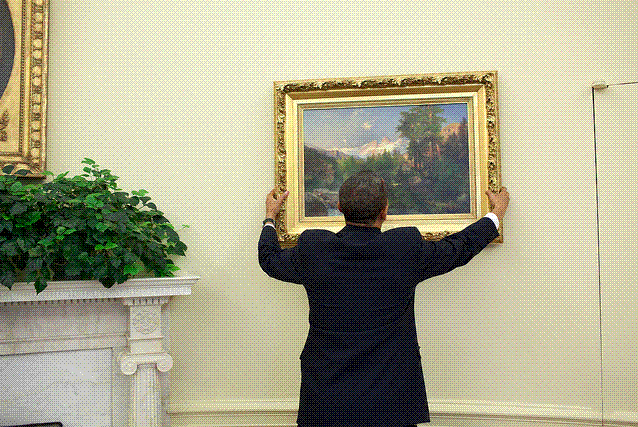
Photo: Pete Souza, official photographer of the White House. Obama straightens a picture in the Oval Office on May 10, 2010. Taken from The White House’s Photostream on Flickr.

October 23, 2010
PAÁFATA, THIS IS A BAT FOR THE FACE…! / Orlando Luis Pardo Lazo

OUTS BY RULE
Orlando Luis Pardo Lazo

Of course, there are players. They are high performance soldiers. Who pays the piper calls the tune. For these are the country’s professionals.

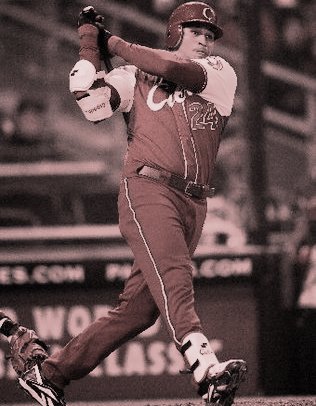
And there they go, to an Intercontinental Cup on the other side of the world. In indignant single file. Without their captain, Frederich Cepeda (or the veteran pitcher Pedro Luis Lazo). There to fight for the coveted medals on Cuban Television News (the gold always dedicated by discipline to el Comandante). And there they stay together in a kind of concentration hotel. Under they eye of a certain doctor* who monitors everything.

Champion compañeros: they go to bed early, like good kids in uniform (Plan pajama** for ball players). Zero solitary walks. Zero late arrivals. Zero making love to a female enemy of the Revolution (not to mention a man). You already know, in the distance the monitoring must be almost vile.

In fact, it’s really vile what Cuba’s leadership is doing to the stars of Cuba.

They all leave. Sports policy practically expels them (there is a poverty of intelligence in The Cuban Institute of Sports, Physical Education and Recreation, INDER). There is no option left for those who know the future is not exhausted by our National Baseball Series. And to top it off the bosses are so small-minded that the players are treated as “traitors” and nobody on the island (nor on the Cuba baseball team) jumps to defend the athletes from the stupidity of those bureaucratic — more than ideological — idiots (it’s known today that the “Pineapple” might well be called mafia).

I can’t stop feeling sorry for these players. For Pedro Luis Lazo, victimizer and later victim of the Industriales, the team of my soul. For Frederich Cepeda***, who has made indecent declarations of “Sorry, nothing happened here.” For the rest of the Cuban team that travels beheaded and in panic to Taiwan, instead of standing at 3 and 2 to finish the democratization of our supposedly amateur league (or failing that, shutting it down). They risk ridicule to play under pressure and other times they’ve lost concentration and lost like apprentices (the hatred follows you from the podium).

I never follow international championships. It’s obscene to look at the bench and see so many faces so far from the nobel spirit of baseball. So many cops with mobile phones with roaming direct to the Head of State in Havana. So many flags and banners in the stands. So much secrecy among the speakers who don’t say a single word (and not even they know whether it is a cautious accomplice or a criminal asshole).

I’m sorry. The sport is so not worth it (for this nothing they lose the pleasure of life: and this is the most totalitarian triumph our State). Please, finish reading this column… or go out and bat some garbage for the next blog…

Translator’s notes:

*One of Fidel Castro’s sons, Antonio Castro Soto del Valle, an orthopedic surgeon, is the team physician for Cuba’s baseball team.
** “Plan pajama” is Cuban slang that refers to someone once in power now demoted to a low level job.
*** Why Cepeda was “benched” at home and not allowed to go to Taiwan with the team remains a mystery.

October 22, 2010

Updating the Model Versus Comprehensive Changes / Dimas Castellanos

(Originally published on Monday, October 10, 2010 on the site www.diariodecuba.com)

In updating the model — a euphemism used to describe the changes that are taking place in the Cuban economy —  what is happening is the same thing that happened with Spanish colonialism in the late nineteenth century. Spain took so long to grant autonomy to the island that when it did, in 1898, the war for independence was about to exhaust its every last drop of blood and even its last penny, as required by the motto of the stubborn president, Antonio Canovas del Castillo.

Although the declared ideological underpinning of Cuba’s totalitarian system is Marxism, its leaders ignored that the foundation of the materialist conception of history is the law of correspondence between productive forces and the relations of production, which, in his Contribution to the of Critique Political Economy, Karl Marx summed up something like this: “The totality of these relations of production constitute the economic structure of society, the real foundation, on which arises a legal and political superstructure and to which correspond definite forms of social consciousness. The mode of production of material life conditions the general process of social, political and intellectual life.”

When you reach a certain stage of development productive forces come into contradiction with the relations of production, that is with the property relations within which they have operated hitherto. From this point forward, the relations of production, ways of development of the productive forces become its fetters, opening a time of social revolution.

In absolute inconsistency with its ideological framework, the Cuban government replaced the Marxist thesis by voluntarism and, in parallel, accommodated itself to support from overseas, which prevented the formation of a national business structure. After the removal of foreign companies and large national enterprises it proceeded to liquidate small and medium enterprises, the climax of which endeavor came with the Revolutionary Offensive of March 1968, when more than 50,000 manufacturing establishments and services were closed or taken over by the government.

With this “triumph” the Government delayed the necessary reforms to put property relations in correspondence with productive forces. The results were immediate: a poor economy, lack of labor discipline, lack of workers for a successful outcome, morals molded to the survival, hopelessness, disbelief, apathy and mass exodus, which was reflected in a long chain of failures, some thunderous as that of the sugar harvest of 1970, demonstrating the unfeasibility of a “model” based on absolute state ownership.

If, before the current disaster, it had been still possible to make limited changes to the productive sphere, after the damage caused — from economics to the spirituality of Cubans — it is now impossible to introduce reforms in the material base without simultaneously (following Marx’s thesis) making changes in the legal and political superstructure. Currently, any governmental action aimed at increasing production and productivity, delivered from the totalitarian mentality is doomed to failure, again.

If an expansion of self-employment is aimed at providing employment for the million and a half workers to be laid off, and at generating outputs and services that the state is unable to create, then the list of 178 activities permitted will need to be annulled and replaced with a list of only the few things that are not permitted. The rest will be taken care of by citizens’ initiatives which have given ample proof of their potential, much more so in a country like Cuba with such a high level of education.

To stimulate the growth of this sector, instead of trying to avoid the formation of a national business, we should add a policy characterized by low taxes and bank credits, creation of wholesale trade, implementation of the rights of association and free access to information, which involve the implementation of human rights, the basis of human dignity.

Only in this way can Cubans come to have an interest in the changes. However, despite the statements about changing whatever is necessary to change, the ideological bonds and the responsibilities and interest incurred for more than half a century act as an impediment to the Government with regards to the political will necessary to make the structural changes that our reality demands.

This limitation of the Government did not make light of the attempt to update the model, as the measures being implemented generate a scenario more promising than the stagnation that has prevailed until now. Ultimately, the process of democratization has to be brought forward with the reforms. The limitations of the proposed measures themselves reveal the absence of a genuine willingness to change, and are generating new contradictions, at a time when changes inside and outside the country prevent any going back, as has happened in the past.

The update of the model must come, on the one hand, from self-employment rather than the revival of small and medium enterprises; on the other hand, the process requires a variety of forms of ownership and management that would enable real participation of workers through service cooperatives, self-management and private property, which in turn implies the putting in place the rights and freedoms for citizens’ civic participation.

This is about a process, although the initial impetus may be the preservation of power, the evolution of limited changes could lead to real democratization for Cuba. It is a challenge for the Cubans, especially those for whom the nation is greater than ideologies and political parties. Therefore, the problem is not to oppose the updating of the model, but to turn it into a step toward comprehensive change and the democratization of Cuba.

Tropical Sakharov / Yoani Sánchez

Guillermo Fariñas with a few of the Ladies in White

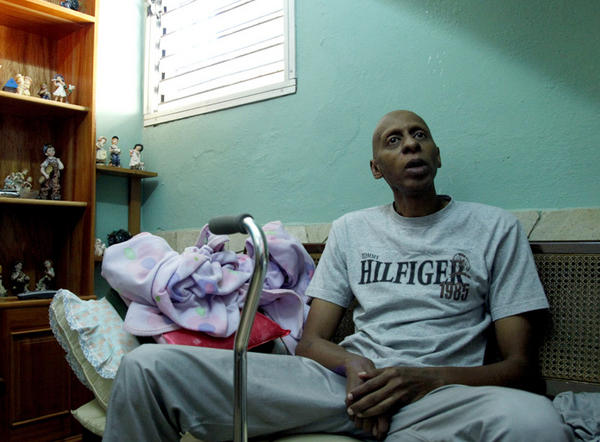
It’s difficult to imagine that inside the frail body of Guillermo Fariñas, behind his face without eyebrows, is a willingness to confront discouragement. It is also surprising that at the times when his health was most critical, he never stopped caring about the problems and difficulties of those around him. Even now, with his gallbladder removed and painful surgical stitches crossing his abdomen, whenever I call him he always asks about my family, my health, and my son’s school. Such a way this man has of living for others! It is no wonder that he closed his mouth to food so that 52 political prisoners — among whom he personally knew very few — would be released.

There are prizes that impart prestige to a person, that shine a light on the value of someone who, until recently, was unknown. But there are also names that add luster to an award, and this is the case with the Sakharov Prize for Freedom of Thought awarded to Fariñas. After this October, the next recipients of this highest laurel of the European Parliament will have one more reason to be proud. Because now the Prize has a higher profile, thanks to its having been awarded to this man from Villa Clara, an ex-soldier who renounced arms to throw himself into the peaceful struggle.

Who better than he, who undertook an immense challenge and accomplished it, who has given us all a lesson in integrity, who has subjected his body to pains and privations that will affect the rest of his life? There is no name more appropriate than that of this journalist and psychologist whose main characteristic is humility, to be included in a list where we find Nelson Mandela, Aung San Suu Kyi and Cuba’s Ladies in White. A straightforward man whom neither the microphones, nor all the journalists who have interviewed him, nor the cameras’ flashes of recent days have managed to change. With a modesty so admired by his friends, Coco — because even his nickname is humble — has made the Sakharov Prize seem much more important.

October 22, 2010

Fidel’s Words Continue to Echo… Bitterly / Yoani Sánchez

A relic of crumbling Soviet era architecture along the Malecon, Havana’s waterfront boulevard and seawall

Originally published in The Huffington Post

Rarely does a person interviewed complain that a journalist has interpreted their statements to the letter; more frequently the opposite occurs, when, whether from negligence or malicious intent, a clear statement is ignored, mutilated or misinterpreted. So even though Fidel Castro has accustomed us to think of him as different from common mortals, we were surprised when he said he meant the exact opposite of what he said when he told Jeffrey Goldberg from The Atlantic magazine that, “The Cuban model doesn’t even work for us anymore.”

As if they were mutually exclusive arguments incapable of sharing space in the same brain, the once great rhetorician rejects the journalist’s interpretation of his words, arguing that, “My idea, as the whole world knows, is that the capitalist system doesn’t work for the United States, nor for the world (…) how could such a system serve for a socialist country like Cuba?” Those of us who read Goldberg’s report of the interview, and then heard the verbal juggling from the Maximum Leader as he spoke at the great hall of the University, were left very confused.

If someone wants to get an idea of the uncertainty such declarations have generated in Cuba, imagine for a moment that after 50 years of marriage, a husband learns that his wife has told her best friend that their marriage doesn’t work. When asked to explain her indiscreet comments she responds, “What I think is that the marriage of the couple across the street doesn’t work… Who could possibly think that I’d now like to marry my neighbor’s husband?”

I don’t know who is best able to analyze this issue. A philosopher to dismantle its sophistry? A linguist to better organize the words? Or a psychotherapist to explore the Freudian slip hidden behind the declarations of el Comanadante. For those of us who were born and came of age under the social experiment he tried to shape in his image and likeness, to hear such self-criticism leaves a bitter taste that feels very much like betrayal.

I recall that when I first heard his words I wrote a little message and immediately published it on my Twitter account: “Fidel Castro joins the opposition.” A friend who read my brief opinion called me urgently at home to confess that, “If he has joined the dissidence, then I’m moving over to the government.” We Cubans have spent the past week living with jokes of this type, along with expressions of surprise, not to mention quite corrosive opinions about the mental health of the persistent orator. Even the worry about the economic problems, and the imminent layoffs of nearly 25 percent of the country’s workforce, fade in importance. No one has been able to remain indifferent to such a monumental slip of the tongue.

Since he dropped his official responsibilities because of ill health, Fidel Castro has barely spoken of our country and its problems. He frequently publishes Reflections on environmental matters and the threat of nuclear war. Now, since his recent “resurrection” he again appears in public wielding the microphone, his favorite instrument of the last half century. In the four years he has been out of power, he hasn’t addressed a single word to the way his brother Raul has performed for the country; and now, this ambiguous allusion, referring to the functionality of the Cuban model, is the first we have heard, after so much time avoiding the subject.

Nowhere in the interview did Goldberg interpret his words to mean that Fidel Castro is recommending American capitalism for Cuba; rather he simply respectfully transcribed the controversial phrase which the ex-president himself acknowledges having said, “without bitterness or concern.” And where do these enigmatic four words come from? Could it be that the bitterness and concern within the heart of the Maximum Leader are captured in that idea — which he assures us he wanted to express — that capitalism no longer works for anyone?

The bitterness is felt today: by the families of the internationalist who died trying to bring the Cuban model to so many countries in the world; by those who renounced the pleasures of youth, sacrificing the best years of their lives to make the model work; by the sincere members of the Party, expelled from the organization for much less severe criticisms; by those who lost their jobs for an inappropriate comment; by those who ended up behind bars for opposing the model; in short, by those who had the insight to see that things were no turning out as expected, who said so in good faith, and who received, in return, only disproportionate punishment. They all have the right to feel frustrated and above all fooled by the irresponsible man who assumed the post of wise clairvoyant marching in the vanguard along a path that led nowhere, and who now fears that alternative paths lead to dead ends or, even worse, back to the starting point of — oh! horror! — the capitalist past.

The concern that all of us who inhabit this Island share is that we will find we are a nation bereft; a nation where the programs, and the euphemisms of “to perfect” or “to actualize” the system, cannot explain clearly where we are going, although everyone knows by heart the meticulous description of the Utopia that we could never reach.

October 22, 2010

The Story of the Aboriginals / Fernando Dámaso

  1. Over the last years, “Indigenism” has taken center stage in Latin America. Indigenous leaders, whether real or virtual, demand the re-establishment of ancestral rights. They consider themselves, by right of seniority, as owners of the lands and bodies of water, and all the riches that these may have. Also, they’ve become defenders of the flora and fauna and, in tune with the times, ecological crusaders. Everything would be fine, and it would even merit applause, if it weren’t for the immobility it represents, and the obscurity to which they relegate the various protagonists of the growth of the nations they live in.
  2. Taking for granted they really were the original people of the various regions they inhabit (which is very questionable, given that we could ask, since when?, as before them there were others, and others, and others, until the time of the dinosaurs and stone age men, the only ones who are truly original), the current nations didn’t just come to be as a result of their pure and unique way of life and worldview, but of the mix of diverse peoples and races, who have, through time, contributed their virtues and defects, and also different levels of social and technological progress.
  3. To accept that indigenous peoples should govern the nations, just because they are the original inhabitants, excluding all the other citizens of such nations, is as racist and prejudiced as the historical injustice that is supposed to be healed. It’s an outdated remake of the old theory of the noble savage, which has been firmly discredited. Following that road will lead to societies fragmented by absurd rights, moving away from unity, inside the individual diversity that we need so much.
  4. It should be a well established fact that the wealth of the nation is not the property of any original group or people, but of all the citizens of each nation, and what is decided about it and its exploitation involves the representatives of the whole society (indigenous and non-indigenous). To try adopting extreme and violent positions to obtain some gain, is a stance that shouldn’t be supported by anyone on his right mind, nor allowed, nor permitted, by any responsible government.
  5. The immobility that some indigenous groups support, with respect to the natural resources found in their so-called original settlements, ties the hands of the nation to the interests of a minority which, during the course of history has not shown, for one reason or another, their capacity to grow, remaining in a primitive state and blaming everyone else for their situation.
  6. It’s OK to support the aboriginals, but not so they can become independent entities, but to integrate into the citizenry of their nations with all the rights, but also with all the duties, that entails. That is the only way to achieve growth and prosperity.

Translated by: Xavier Noguer

October 3, 2010

The Victim’s Fault / Rebeca Monzo

A very young friend, who recently graduated as a doctor, was traveling by bus with her boyfriend, also a doctor. They both were going to their respective workplaces, when all of a sudden she felt a burning in her neck. The shock of the assault paralyzed her, but not her boyfriend, who threw himself off the bus and ran after the thief. He was joined in the chase by two more young men and between the three of them they managed to capture the criminal. Hearing the screams, a policeman showed up, handcuffed the thief and returned the gold chain to the victim.
Days later the young doctor was summoned to the police station closest to these events, where she was asked to withdraw the charge. They had investigated the thief and found him to have no previous charges and to come from a good family. She told them she wanted to proceed with the complaint so that the situation would not be repeated. Then the prosecutor came to talk with her to try to get her to forget all about it, telling her she was partially at fault for being well dressed and wearing a gold chain, which aroused the greed of young people who didn’t have the means to dress as she did, and that was why she was robbed.

My doctor friend, very serious and offended, answered them, “So if a woman is raped or abused, she is also at fault for being beautiful and sexy? Does that mean the victim is the guilty one?” So things go on my planet; imagine for yourself when half a million people — forgive me, I mean victims — are unemployed.

October 20, 2010

Choosing the “Suitable” People Who Will Keep Their Jobs / Laritza Diversent

Photo: State watchman, by Orlando Luis Pardo

The meetings have started between the leaders of State institutions and their workers, to report on the process for reducing the payrolls, which is expected to be completed in the first trimester of the coming year.

The directors of the State agencies have announced to the workers that advisory committees are being created, charged with the selection of the qualified personnel who will keep their jobs. In the week just ended, the Ministry of Labor and Social Security (MTSS) in Arroya Naranjo, the poorest municipality in the capital, declared there to be 1,300 excess workers in the area of Culture.

The “Income Committees,” named such in the labor legislation, are composed of workers assigned by management, the union, the Cuban Communist Party, and the Young Communist Union.

The President of the Councils of State and of Ministers, General Raul Castro, warned in the last session of the National Assembly, that there would be strict “observance of the principle of demonstrated suitability when it comes time to decide who has the greatest right to occupy a position.”

According to the Labor Code, the state government may terminate the employment contract for, among other causes, ineptitude, lack of suitability, or a declaration of lack of need for the position. Resolution No. 8, “General Regulation on Labor Relations,” issued in May 2005 by the Ministry of Labor and Social Security, governs the treatment of wages in these cases.

Trade unions and governments, by mutual agreement, decide on techniques and procedures used to determine the permanence of workers in their employment. The commission recommended, and the Chief of the entity confirmed, the loss of “Demonstrated Suitability.”

When a worker is declared unsuitable, the administration of the entity will facilitate their relocation and guarantee them a fixed salary for two months from the date they cease working at their job.

So far the relocations have been in agriculture and construction, sectors with a chronic shortage of workers and where the majority of Cubans refuse to work. If the worker doesn’t accept the offer, the labor relationship is terminated, without the right to receive any salary payments.

Workers are feeling insecure. Many say that the state salary, although insufficient, is the only source of income they have to pay their share of the costs of subsidized food and electricity.

Most families, some with debts to the bank over 10 years old, are paying a percentage of their salary in monthly installments for the appliances they received in the “energy revolution.”

Expected Prize / Iván García

It had already been leaked to Cuban dissidents that the journalist and psychologist Guillermo Fariñas enjoyed a big lead in the voting for the 2010 Sakharov Prize. Among the local opposition the distinction has received more applause than criticism.

Still, ‘Coco’ — as we call him — was surprised and the phone in his house in the La Chirusa slum, 150 miles east of Havana in Santa Clara, Villa Clara province hasn’t stopped ringing.

Fariñas told me that when the phone rang in the middle of the night he thought the worst. Usually when the phone rings at that unusual hour it’s for bad news. But this time it was not.

The Cuban poet and journalist Raúl Rivero, exiled in Madrid, was the first to congratulate him. Then pandemonium broke out. His cell phone didn’t stop ringing. From Australia, Prague, Moscow, Miami, Santiago de Chile, Reykjavik and even Greenland. While his friends started to invade the house.

People in the neighborhood, where ‘Coco’ is very popular, seeing the flood of people thought the worst. When Fariñas himself announced the good news,they erupted in celebration with a bottle of rum that some late night kids brought him from one of the discotheques in the city.

By nine o’clock the house was  already swarming with journalists, dissidents, friends and family. When we called from Havana, Coco interrupted the improvised celebration to say a few words.

“This award is for all those who have opposed, in one way or another the government of Fidel Castro. To the citizen rebellion. I’m thinking now of the opposition in the early years of the Revolution, they saw what we took time to understand. To the many anonymous people who do not bow to the will of a regime. ”

In his appreciation, ‘Coco’ did not forget Pedro Luis Boitel, a Cuban political prisoner who died in 1972 after a long hunger strike, and all his fellow independent and opposition journalists.

“To all of them, this award is dedicated. To the brave Ladies in White, who were granted the distinction five years ago. But most especially, I tell you frankly, this is a prize for Orlando Zapata and that giant among women, Reina Luisa Tamayo, his mother. Zapata is and will be a precursor. When, in the future, Cuba has a democracy, we will always remember his attitude and the path that was opened by Orlando,” he said, visibly moved.

Fariñas is the third Cuban to receive the Sakharov Prize. Oswaldo Paya Sardinas, founder of the Varela Project, won in 2002. And in 2005, the Ladies in White.

“I hope to go to Havana to celebrate the prize with my brothers in the opposition who live in the capital. There are only a few days left for the government to meet the deadline it gave for releasing all the prisoners. As I have already announced, if on November 7 the 12 prisoners from the Black Spring of 2003 have not been released, I will begin another hunger strike the following day,” Guillermo Fariñas Hernández, the psychologist and independent journalist warned.

Friends and family hope that another strike will not be necessary.

October 21, 2010

Fariñas and Sakharov: The Totalitarians Cannot Be Reformed / IntraMuros

Cuba dawned today in the monotony typical of these systems. But a text message broke into my room at 5 am: Farinas won the Sakharov Prize. The morning dawned differently for me and for many other Cubans who began to send from heart to heart — that is from cellphone to cellphone — the good news. The third Cuban had received this prestigious prize from the European Parliament. In 2002 it had been Oswaldo Paya and in 2005 the Ladies in White.

Farinas and Sakharov: What relationship could be found between these two men? Having wanted to be the person, in a system whose anthropological damage is precisely the blockade of freedom and of personal and social independence. They are men who breached their respective walls. Who, with their lives at death’s door, were a window for the light of freedom. Cuba is a blue-green island. Her soul is still free and supported when the world recognizes the value of men like Farinas who, with their solidarity, offer their lives for the freedom and rights of others.

Today official Cuba dawned as gray as ever, but the real Cuba is freer and happier with the Sakharov Prize for Santa Clara’s psychologist and journalist. As I was talking to Coco, as we call him, and asking him to say something for the magazine Convivencia (Coexistence), he said to me: Say that it is a prize for all the people of Cuba and that I dedicate it to Orlando Zapata Tamayo and to Pedro Luis Boitel.

We call on all other Cubans to ask ourselves, what can we do with our lives to make us worthy of men and women like Boitel, Zapata, Farinas and the Ladies in White, and all the others who continue, into the breach, peacefully, to bring on that day when this kind of sacrifice, and the prize given to those who offer themselves for others, are only a grateful memory of a sovereign nation.

Dagoberto Valdes

October 21, 2010