Cuban Artist and Activist Luis Manuel Otero Alcántara is Awarded a Norwegian Human Rights Prize

The Rafto Foundation has awarded prizes to defenders of democracy, including four people who later received the Nobel Peace Prize


Luis Manuel Otero Alcántara has been imprisoned for more than three years in the Guanajay prison in Artemisa. / (Facebook/Luis Manuel Otero Alcántara)

14ymedio biggerEFE (via 14ymedio), Copenhagen, 19 September 2024 — Cuban artist and activist Luis Manuel Otero Alcántara was awarded the Rafto Human Rights Prize in Norway on Thursday “For his fearless resistance against an authoritarian regime through art.”

The award citation notes that Otero Alcántara, 36 and currently in prison, “has been arrested countless times for his activism” and that his works are “strongly critical of restrictions on freedom of expression.”

Otero Alcántara leads the San Isidro Movement, founded in 2018, which brings together artists, musicians, journalists and academics “who promote freedom of expression” and oppose the so-called Decree 349, which requires creators to be registered with Cuba’s Ministry of Culture, from which they must request permission to perform and exhibit their work.

“The 2024 Rafto Prize aims to highlight the importance of the work of Luis Manuel Otero Alcántara and other artists in challenging power structures and defending democracy and human rights in Cuba and around the world,” said the jury, which urged the Cuban government to release the activist, along with all “political prisoners” and repeal Decree 349. continue reading

“The Rafto 2024 award aims to highlight the importance of the work of Luis Manuel Otero Alcántara and other artists in challenging power structures”

Co-founder of the so-called Museum of Dissidence, he also participated in the music video for the hip-hop song Patria y Vida , which played an important role in the anti-government protests of 11 July 2021, known as ’11J’.

“Since 2016, he has been subjected to interrogations, political persecution and has been arrested countless times. In addition, his works of art have been confiscated and destroyed by state security agents,” the citation said.

Otero Alcántara was sentenced in 2022 for contempt, public disorder and insulting national symbols and is currently serving a five-year sentence in the maximum security prison in Guanajay.

Since 1987, the Rafto Foundation has been awarding prizes to human rights and democracy activists every year. Among them are four people who later received the Nobel Peace Prize: Burmese Aung San Suu Kyi, East Timorese José Ramos-Horta, South Korean Kim Dae-jung and Iranian Shirin Ebadi.

The prize, worth $20,000, is named after Professor Thorolf Rafto, who dedicated his life to defending democracy and human rights.

____________

COLLABORATE WITH OUR WORKThe 14ymedio team is committed to practicing serious journalism that reflects Cuba’s reality in all its depth. Thank you for joining us on this long journey. We invite you to continue supporting us by becoming a member of 14ymedio now. Together we can continue transforming journalism in Cuba.

Ten Years in Prison for a Ration Store Administrator in Sancti Spíritus, Cuba, for Embezzling 200,000 Pesos

The official appropriated 24 beverage and food products, in addition to 6,000 liters of kerosene

It is not the first case published of a lower-ranking official convicted of corruption / 14ymedio

14ymedio bigger14ymedio, Madrid, 27 September 2024 –The newspaper Escambray has again reported a conviction for embezzlement of a low-ranking official. The administrator of the La Riviera ration store in Sancti Spíritus was sentenced to 10 years in prison for appropriating of 24 products and 6,000 liters of kerosene worth more than 200,000 pesos.

The convicted, about whom only his age is known (35 years old), was found with rice from the rationed family basket, raw and processed sugar, black beans, salt, powdered milk, toiletries and the aforementioned fuel. In addition, he appropriated drinks with and without alcohol, including beer and soft drinks, and cigarettes from the rationed market.

The total amount of what was stolen is 174,882 pesos, corresponding to the wholesale price. However, for the retail price, the loss is 200,127 pesos, which must be repaid to the Municipal Trade Company of Sancti Spíritus as part of the sentence. continue reading

The total amount of what was stolen is 174,882 pesos, corresponding to the wholesale price. However, for the retail price the loss is 200,127 pesos

The case, tried in the First Criminal Chamber of the Popular Provincial Court of Sancti Spíritus, is dated 2023, which shows that it has taken a year to clarify the responsibilities, although there are no details about the dates on which the events occurred or how the administrator was able to store the products.

The sentence can be appealed, and although it is unlikely that he would win, there could be some variation in a sentence that is even greater than the one announced last May for Alexis Fuentes de La Cruz. Fuentes de La Cruz was the director of the provincial Municipal Trade Company between May 2022 and July 2023, and was sentenced to eight years in prison for a corruption case that included irregularities in hiring and document falsification to prevent the crime from being detected.

The case was, like this one, reported in the official newspaper of the province, and, although the penalty was less, the moral reproach was extensive. Escambray delved into the hypocrisy of the cadres and officials of the Regime who “have sunk up to their necks in the mud of corruption.” The report also made direct mention of the former Minister of Economy and Planning himself, Alejandro Gil Fernández, dismissed for “serious mistakes” committed under his mandate. Nothing has been known about him since he was allegedly arrested in March of this year.

Translated by Regina Anavy

____________

COLLABORATE WITH OUR WORKThe 14ymedio team is committed to practicing serious journalism that reflects Cuba’s reality in all its depth. Thank you for joining us on this long journey. We invite you to continue supporting us by becoming a member of 14ymedio now. Together we can continue transforming journalism in Cuba.

In Havana’s Accountability Assemblies, the Blackouts Arrive on Time

Most of the residents are over 60 years old, and apathy reigns

The energy debacle has been the worst enemy of the Committees for the Defense of the Revolution / Trabajadores

14ymedio bigger14ymedio, Havana, 27 September 2024 — While the notes of an untuned violin mistreated the Bayamo anthem, a dirty lightbulb illuminated the flag, some papers and a desk in the middle of the street. It was the first accountability assembly in a neighborhood of Cojímar and the premiere of a nervous Francisco Rodríguez Cruz – a journalist in the personal circle of President Miguel Díaz-Canel and First Lady Lis Cuesta – as the delegate. What was intended to be a manifestation of revolutionary stoicism ended up having pathetic overtones.

Known as Paquito de Cuba, the gay activist who defines himself as “troubled but happy” was the laughing stock of his own neighbors, who recorded and published a scene that has been repeated dozens of times this week: that of the leader who, in the midst of a dense blackout, tries to “comply” with the “orientation” of holding the assembly.

The energy debacle has been the worst enemy of the Committees for the Defense of the Revolution (CDR), determined to demonstrate their usefulness by organizing accountability assemblies in each neighborhood of the Island. The other has been the shortages. In a country where “donating a head of garlic is now like giving part of your liver” – in the words of a resident of Luyanó – the future will be black for the traditional stews, every year more meager and watered-down, for the celebration of CDR day, September 28.

“Yesterday we peeked out in the middle of the blackout and saw a group of people gathered under a lightbulb,” a woman tells 14ymedio. “We hadn’t even heard about the assembly. There was a flag on the door of a house, and people say that they will be collecting money in the neighborhood. But here no one is going to pay anything, and the person who comes asking will be made to feel like a fool.” continue reading

“Yesterday we peeked out in the middle of the blackout and saw a group of people gathered under a lightbulb,” says a woman

Things have changed, she adds, and apathy is widespread. “There is no movement of anything anywhere. Before, every September 27th, people started from 6:00 pm to prepare the firewood for the stew, if only for the food and the party. That’s over.”

The official press has been projecting a panorama of enthusiasm and kindness in the neighborhoods for days. They allude to the CDR as an institution that “comforts and commits,” and describe the environment of the neighborhoods – increasingly violent, hit by the increase in drugs and police inaction – as a place where “your best brother is the closest neighbor.”

In Nuevo Vedado, Havana, the accountability assemblies have also taken place with little attendance and many complaints. In one of the tall buildings that characterize the neighborhood, on Wednesday night a handful of neighbors, mostly over 60 years old, met to listen to the long report of the constituency’s delegate, who read a litany of complaints and problems suffered by the neighborhood.

The attendees’ participation focused mainly on inflation and the loss of purchasing power that families have suffered. “With my pension I can barely get by; if it weren’t for the fact that my children are still here, I don’t know what would become of me,” lamented a 90-year-old, who had participated in the construction of the building through the system of microbrigades.

Others complained that on the outskirts of the premises managed by the Youth Labor Army (EJT) on nearby Tulipán Street, a “Carthaginian market” has been created where everything is sold, but “it is not controlled and does not sell at the capped prices,” argued a resident. “There are now more goods being sold from the door outside the EJT than on the shelves inside.”

Outside the well-known market, for years there has been a network of informal merchants, who offer everything from cigarettes to strings of onion. “They are not the problem, but the result of the problem, because if you want to buy garlic, detergent, toothpaste or a bag to carry the food they sell inside, you have to end up going to those sellers,” explained another of the participants in the assembly.

One of the residents questioned the State investments that have been made nearby

One of the residents questioned the State investments that have been made nearby, which have not borne fruit or begun operating despite all the resources used. The man pointed to a new bank office, with two ATMs, which was going to be located on Estancia and Conill streets and which, after weeks of work by the builders, has been paralyzed.

In a similar situation, the attendee argued, “there is the Cadeca (Exchange House) that they started building on Tulipán Street, even with a bathroom for the employees. Today the ATMs work when they have money, but nothing else. The Youth Club at Estancia and Santa Ana received special mention, subject to a remodeling a few years ago and converted into a place that barely provides service due to the deterioration of its computers. A woman added that the Youth Club was in the process of “becoming a market for a private enterprise.”

The meeting was finalized by the sector chief of the National Revolutionary Police (PNR) of the area who was categorical: “I’m the only police officer working in this neighborhood where there should be eight of us.” The uniformed man said that “most of the crimes of robbery and theft committed in this area are carried out by people who reside in Cerro,” a poorer neighborhood barely separated from Nuevo Vedado by Rancho Boyeros Avenue.

A little later, under a a burned-out light bulb, the delegate said his final words, and the participants returned to their apartments. Most had not even opened their mouths during the minutes that the accountability assembly lasted.

Translated by Regina Anavy

____________

COLLABORATE WITH OUR WORKThe 14ymedio team is committed to practicing serious journalism that reflects Cuba’s reality in all its depth. Thank you for joining us on this long journey. We invite you to continue supporting us by becoming a member of 14ymedio now. Together we can continue transforming journalism in Cuba.
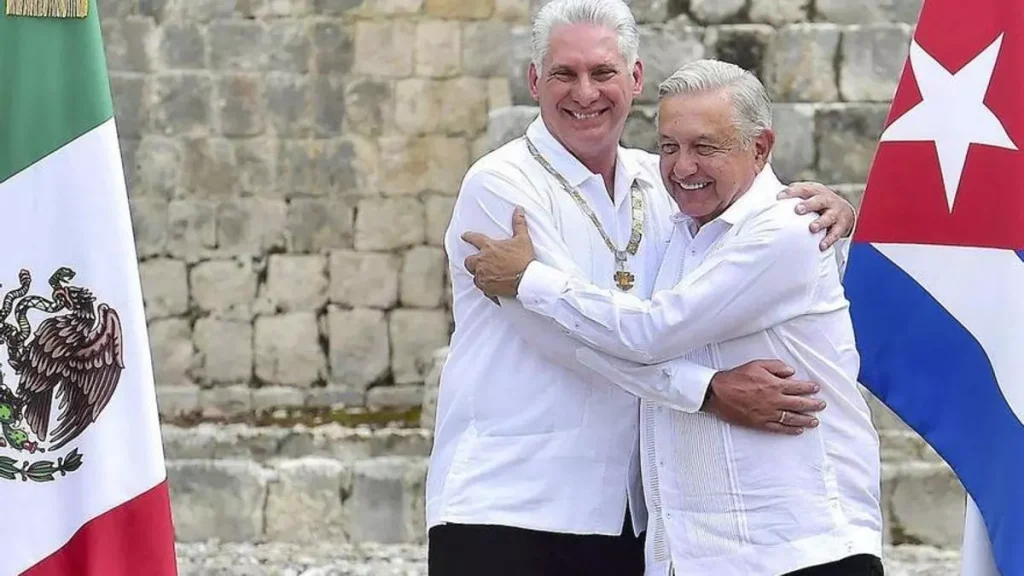
As Claudia Sheinbaum Is Inaugurated as President of Mexico: A Missing King and an Excess Dictator

When Díaz-Canel is among the guests at the ceremony, it will be like a stinger piercing the pain of our migrants and political prisoners

López Obrador shared the podium with Díaz-Canel during the celebration of Independence Day / EFE

14ymedio bigger14ymedio, Yoani Sánchez, Generation Y, Havana, 27 September 2024 —  The incendiary controversy that has been unleashed between Mexico and Spain upon learning that King Felipe VI has not been invited to Claudia Sheinbaum’s inauguration has overshadowed the names of the leaders who have been invited to the October 1st ceremony. In the official list that has been released among the press, the name of Cuban leader Miguel Díaz-Canel stands out, a figure frequently entertained in recent years by outgoing President Andrés Manuel López Obrador.

Raúl Castro’s successor has been a frequent guest at official ceremonies and public events in the neighboring country during this six-year term. In September 2021, a few weeks after the historic popular protests that shook the island on July 11 of that year, López Obrador not only hosted Díaz-Canel for several days but also shared the stage with him during the celebration of Independence Day in Mexico, the famous “Grito de Dolores.”

The rapprochement, which has served as a diplomatic buttress for the Havana regime, has also included economic support through large shipments of oil. In 2023, the Mexican state-owned company Pemex sent crude oil to Cuba worth close to 400 million dollars. López Obrador has also contributed to calming the criticisms from foreign ministries and governments in Latin America after the repression of the demonstrations that, shouting Freedom! and Homeland and Life!, swept through the Cuban streets more than three years ago. The Mexican leader has played an active role in diluting the accusations against Castroism for the more than a thousand political prisoners it holds in its prisons, the suffocation of independent journalism and for forcing so many activists and opponents into exile. continue reading

Mexican authorities have not even expressed their concern to the island for the thousands of Cubans forced to cross its territory.

Now, when the presidential replacement knocks on the door of the founder of the Morena party, Sheinbaum’s assumption of power seems to be marked by the same imprint of the elderly leader towards the authoritarianism imposed in Cuba more than six decades ago. The winks between both governments, the complacency in the face of the excesses of the Palace of the Revolution in Havana and the complicit silence in the face of the misdeeds of the Castro regime will continue to be the tone that will mark the relationship between both countries. In this diplomacy of complicity, the Mexican authorities have not even conveyed their concern to the Island’s Ministry of Foreign Affairs for the thousands of Cubans forced to cross their territory escaping from their country due to the lack of freedoms and the chronic crisis that grips their lives.

Next Tuesday, when Miguel Díaz-Canel appears among the faces of the guests at the official ceremony that will open Claudia Sheinbaum’s term, it will be like a stinger piercing the pain of our migrants, political prisoners and victims of official intolerance. Will the Mexican president ever apologize for this offense? Will she be willing to change the course of a bilateral relationship that only enthrones authoritarianism? Does she think that time will make us forget the names of those who supported the dictator who muzzles us?

________________________

Editor’s note:  This article  was originally published  on  DW  and is reproduced under license from the author.

____________

COLLABORATE WITH OUR WORKThe 14ymedio team is committed to practicing serious journalism that reflects Cuba’s reality in all its depth. Thank you for joining us on this long journey. We invite you to continue supporting us by becoming a member of 14ymedio now. Together we can continue transforming journalism in Cuba.

Borrell, Latin America and the European Union

Members of civil society in Cuba have requested that the EU subsidy to the Havana regime be eliminated

Borrell was a senior official in the Administration of one of Fidel’s strongest allies, former Spanish president Felipe González / EFE

14ymedio bigger14ymedio, Pedro Corzo, Miami, September 22, 2024 — The conclusion is not edifying, but it agrees with reality.

Everything seems to indicate that many institutions act more in accordance with the opinions of their officials than according to the values on which they claim to sustain themselves, as is the case of the European Union, an entity institutionally committed to democracy and the enjoyment of citizens’ rights, which incurs incomprehensible contradictions.

The Assembly of Cuban Resistance, an organization linked to the overthrow of the dictatorship of the largest island of the Antilles, which, in addition, shows great concern about the dangers to democracy in the hemisphere, has been denouncing, practically since its constitution, the indulgence of the European Union toward the totalitarian Cuban regime.

These accusations, despite their constancy, have not been successful, because one of the most important officials of that entity, Joseph Borrell, High Representative of the European Union for Foreign Affairs, apparently feels sympathy for Castroism and its heirs.

Which leads me once again to agree with the writers Jose Antonio Albertini and Alexis Ortiz, who claim that many personalities born or trained under the management of the Cuban Revolution and Fidel Castro have not been able to get rid of those influences. Borrell was trained and was a senior official in the Administration of one of Fidel’s strongest allies, Felipe continue reading

González, the former head of the Spanish Government, today very rightly opposing the autocracy of Nicolas Maduro.

However, González has never admitted that what Venezuela is currently suffering is a metastasis conceived by his former ally Fidel Castro.

Members of civil society in Cuba and the Assembly of Cuban Resistance have addressed Borrell requesting that the EU subsidy to the Havana regime be eliminated, and they have demanded compliance with a resolution approved by a large majority of the members of the European Parliament demanding the end of support for the Cuban tyranny.

The request states that “human rights abuses and violations have increased”

The request states that “human rights abuses and violations systematically perpetrated by the Cuban regime against demonstrators, political dissidents, religious leaders, human rights activists and independent artists, among other people, have increased,” while demanding “the activation of the human rights clause of the Political Dialogue and Cooperation Agreement with Cuba.”

While Borrell and other officials grimace about Cuban totalitarianism, the number of political prisoners has grown considerably, and their living conditions have seriously deteriorated, as have those of the rest of the citizens.

The call emphasizes that the “number of political prisoners has multiplied by more than eight since 2018, which makes Cuba the largest prison of political activists and dissidents in Latin America,” a shameful position it has occupied since 1959.

On the other hand, I must write with extreme satisfaction that this same Borrell said that the Government of Nicolás Maduro “is a dictatorial and authoritarian regime,” a statement which should encompass the regimes of Cuba, Nicaragua and Bolivia, four Governments that deny their citizens the enjoyment of the most elementary rights.

The failures of Cuban totalitarianism are repeated in Venezuela, Nicaragua and Bolivia, countries that are experiencing precarious conditions on all fronts. Their leaders intend only to perpetuate themselves in power, and, to achieve that goal, they sacrifice the integral well-being of their people.

Castrochavism has turned out to be a tremendous fiasco in each and every one of the countries where it imposes itself and is a certain threat to other nations, among which Colombia and Mexico stand out, where historical supporters of the statements of Fidel Castro and Hugo Chávez govern.

Latin America has never ceased to be a volcano on the verge of eruption, but right now the danger is much greater than in the past. The enemies of democracy are many, and they have more resources and experience. One doesn’t have to be a prophet to realize this.

Translated by Regina Anavy

____________

COLLABORATE WITH OUR WORKThe 14ymedio team is committed to practicing serious journalism that reflects Cuba’s reality in all its depth. Thank you for joining us on this long journey. We invite you to continue supporting us by becoming a member of 14ymedio now. Together we can continue transforming journalism in Cuba.

The Family of Reporter Yeris Curbelo Says That His Trial Was “Rigged” by Cuban State Security

The journalist was sentenced this Tuesday to two years in prison for the crime of “minor injuries”

Yeris Curbelo collaborates with the Palenque Visión agency / Facebook

14ymedio bigger14ymedio, Havana, 25 September 2024 — This Tuesday the Municipal Court of Niceto Pérez, in Guantánamo, sentenced the independent reporter Yeris Curbelo Aguilera to two years in prison for the crime of “minor injuries.” According to the Center for a Free Cuba, which reported the sentence, the case was orchestrated by State Security in retaliation for his political activism.

In a summary of Curbelo’s version published by the organization, the reporter says that on April 14 four individuals – all 21 years old, whom he identifies as Miguel Mosqueda, Douglas Ismark Mazar Góngora and Mariano Reyes – assaulted his 16-year-old son Jessy. According to Curbelo, the authorities only fined the aggressors, despite the fact that the teenager ended up in the Guantánamo pediatric hospital with several injuries.

Months later, on June 16, the four attackers, plus another identified as Adrián Fuentes, assaulted Curbelo himself in the same place where the beating of his son had occurred. Fuentes, 41 years old, even gripped a machete, which, the reporter says, caused injuries to his right hand.

Curbelo sees in both episodes the hand of State Security, because when the police arrived at the scene and stopped the fight, they led him alone to the Guantánamo station, from where he left on bail two days later, accused of causing “minor injuries” to the others. continue reading

Curbelo believes that they want to fabricate a common crime to punish his work of activism and for having spread the protests in the Guantánamo town of Caimanera

The Center for a Free Cuba also interviewed Curbelo’s wife, Odalis Legrá, who says that this Tuesday’s trial was “rigged.” For two hours, she said, the journalist’s lawyer claimed that it was Curbelo who had suffered injuries and that the sentence was a contradiction. “In the trial there was no talk of any of that,” explained Legrá, who also narrated how in the middle of the deliberation a State Security agent entered the premises where the sentence was discussed.

Upon returning, Curbelo was convicted according to the request of the Prosecutor’s Office, but Fuentes – judged in the same process – was acquitted. The other aggressors were taken away as witnesses.

The hypothesis that the attack was orchestrated by the political police has been repeated on several occasions by Curbelo, who believes that they want to fabricate “a common crime” to punish his work of activism and for having denounced, after the protests in the town of Caimanera in 2023, the situation of several prisoners.

The journalist was intimidated by State Security while trying to report the protests

When the demonstrators were tried last May, in the same court where Curbelo was sentenced on Tuesday, the journalist was intimidated by State Security while trying to report the protests. The agents asked him to withdraw immediately, but he had time to spread – through an audio – a brief chronicle of the trial. At that time, according to his complaint, he was also assaulted by the police.

“It is a really immoral and arbitrary condemnation as is the situation suffered by Yeris and his family. It is good to remember that Yeris Curbelo Aguilera has carried out outstanding activism and has a remarkable leadership in his community, the town of Caimanera, a place complicated by the presence of the Guantánamo Naval Base,” said Legrá on Tuesday. She says her husband “has suffered political imprisonment several times, and their son has been psychologically affected and has had to receive psychological treatment from professionals.”

Curbelo collaborates with Palenque Visión, an “independent audiovisual agency” founded in 2012 in the eastern provinces of the Island.

Translated by Regina Anavy

____________

COLLABORATE WITH OUR WORKThe 14ymedio team is committed to practicing serious journalism that reflects Cuba’s reality in all its depth. Thank you for joining us on this long journey. We invite you to continue supporting us by becoming a member of 14ymedio now. Together we can continue transforming journalism in Cuba.

Expensive and Exotic, the Quimbombó No Longer Features on Cuban Tables

The food that once produced a catchy chorus of traditional music is hardly consumed among young Cubans

Not only has the product gone up in price, but the rest of the ingredients that accompany it also cost a fortune / 14ymedio]

14ymedio bigger14ymedio, Natalia López Moya, Havana, 22 September 2024 — Preparing a dish of quimbombó (okra) is one of those popular pieces of wisdom that has been lost with decades of mass migrations, State agricultural plans and a very limited basket for the rationed market. Younger Cubans barely know how to cook this fiber-rich food, which also has little favor among children and that one day slipped forever into a catchy chorus of traditional music.

Quimbombó que resbala pá la yuca seca” [“okra that slides together with dry yucca”] is the song that, among others, was popularized by the Chappottín Ensemble and that has become an inescapable theme with the wiggling of hips and a lot of alcohol. But beyond the festivities, the fruit, which is used in kitchens as a vegetable, has not escaped the Island’s inflation that raised traditional recipes to the level of gourmet food, suitable for very few pockets.

In September of last year, a pound of okra cost 100 pesos in the market at 19th and B, in El Vedado. Twelve months later the food is quoted there at 150 after experiencing an increase at the beginning of 2024 that took it to 200. But those oscillations do not give the measure of how unattainable it has become for many families, because the other ingredients needed for cooking it have skyrocketed even more: meat, spices, garlic, onion and tomato, among others.

In September of last year the pound of okra cost 100 pesos, and twelve months later it is quoted at 150 / 14ymedio

“The first thing you have to do is get rid of the slime,” explains Zenaida, a retiree from Central Havana who declares herself “frustrated” because she continue reading

can only enjoy it by herself at home. “My grandchildren don’t like it. My daughter says it disgusts her, and everyone prefers to eat the picadillo that the butcher sells, even though no one knows what’s in it,” she complains.

Zenaida, a mulata who for decades has been a Santería godmother for dozens of residents in her neighborhood of Pueblo Nuevo, inherited the taste for quimbombó from her mother, the granddaughter of slaves, who ended up marrying a blue-eyed man from the Canary Islands who arrived in Cuba in the 1920s. Of their three children, only the old woman remains on the Island: “My older brother went to a better life and is in the Colón cemetery, and my younger sister also went to a better life and is in Miami.”

In the family, the recipe to make the quimbombó was one of the first that was taught to girls as soon as they began to get into the pots and pans: “First, you soak the quimbombó in water with a little vinegar or lemon to remove the slime,” she explains to this newspaper, in reference to the substance that is seen when eaten boiled, which is slightly reminiscent of gelatin.

“Then you boil it until it softens and in the meantime prepare a good sauce,” she explains. “I like it with meat, preferably beef, but pork also goes very well with it. My mother also threw in chicharrones,” Zenaida recalls. The quimbombó, also know as okra, is highly valued in the kitchens of many African countries and the Caribbean.

“These days they are a little small,” warned a cart peddler who this Saturday offered quimbombó on Carlos III Avenue. “But there are people who prefer it that way because they say it softens more easily.” In the small El Vedado grocery store, a pound of the fruit was offered at 80 pesos, but the presentation was far from the clean bag with larger specimens on offer at 19th and B.

“These days they are a little small,” warned a cart peddler who this Saturday offered quimbombó on Carlos III Avenue

“Most of those who buy quimbombó from me are older people, because the younger ones don’t even know how to cook it,” the merchant explained to this newspaper. “A lot of pizza, a lot of croquettes, a lot of hot dogs: young people here no longer eat real food,” he lamented. “The problem is that quimbombó doesn’t taste good without meat, and meat is harder to find than electricity,” he joked.

“Also, it seems that the farmers have realized that it doesn’t sell very well in the market, so they don’t harvest it as much as before,” the man added. “When I was young there was plenty; you could go to any small shop, and next to the malangas and the squash was the quimbombó, but today people don’t even know how to select it. They cannot distinguish between one that is good quality and one that stays hard.”

A few feet from the wheelbarrow, a retiree, with his empty bag hanging from his shoulder, complained about the price of the product. “I like it but can no longer pay that price, and also in my family, no one eats it but me,” he said. “Just for the tomato and the garlic cloves you need for the seasoning, half of my pension is gone.”

Today, the rise in the cost of living and the loss of culinary traditions have had one of its most notorious victims in the quimbombó. The lyrics of that contagious song are indecipherable for most Cubans born with the ration book and the five-year agricultural plans.

Translated by Regina Anavy

____________

COLLABORATE WITH OUR WORKThe 14ymedio team is committed to practicing serious journalism that reflects Cuba’s reality in all its depth. Thank you for joining us on this long journey. We invite you to continue supporting us by becoming a member of 14ymedio now. Together we can continue transforming journalism in Cuba.

Cuba Withdraws Its Doctors From a Town in Sinaloa, Mexico, Due to Clashes Between Drug Traffickers

A group of Cuban doctors in Badiraguato, Sinaloa / Facebook/José Paz López

14ymedio bigger14ymedio, Mexico City, 26 September 2024 — “If they die, you die.” This was the threat a group of hitmen made to several Mexican doctors at a hospital of the Mexican Social Security Institute (IMSS), located in Villa Unión, Sinaloa. The doctors were forced on September 15 to treat drug traffickers with gunshot wounds after a confrontation.

The wave of violence that has plunged the state into a security crisis for more than 20 days, with 79 deaths, kidnappings and clashes, led the Cuban Embassy in Mexico to order the withdrawal of Cuban specialists who were in the town of Concordia, in the municipality of El Palmito.

Sinaloa Senator Paloma Sánchez Ramos, of the opposition Institutional Revolutionary Party (PRI), denounced on Monday that after 15 days of fighting, the state has recorded 79 murders, 70 missing persons, the theft of 98 vehicles and losses of more than 5 billion pesos (almost 250 million dollars).

“They are not used to stress like this. The Cuban Embassy asked us to protect them and we had to do it that way,” said state Health Secretary Cuitláhuac González Galindo on Wednesday, in an interview with Espejo magazine. continue reading

Soldiers of the National Guard in Concordia, Sinaloa / Periódico Mercurio

The Cubans are part of a group of 32 specialists – 16 general practitioners and 16 surgeons, anesthesiologists and pediatricians – who had been sent to rural communities in El Valle del Carrizo, Choix, El Fuerte, Badiraguato, and Concordia.

González Galindo stressed that the Cuban doctors “were there (in El Palmito) and were among the last to leave the area.” The region, located in the mountainous area, became a ghost town due to insecurity. Last week, more than 50 families abandoned their homes and moved to Mazatlán.

The Department of Welfare and Social Development of the Mazatlán City Council confirmed to 14ymedio that 26 family units were located in Villa Unión and another 28 in Mazatlán, but the groups asked for “discretion” in light of the threats they have received from factions of the Sinaloa Cartel – Los Chapitos, made up of the sons of the famous drug trafficker Joaquín El Chapo Guzmán Loera, sentenced to life imprisonment in the US – and others, close to Ismael El Mayo Zambada, who are fighting for control of the state.

The medical centers in El Palmito and Integral had to close. However, those located in Villa Unión, Civil and General remain open.

Confrontations between Mexico’s armed forces and drug cartel hitmen have marked the final phase of the administration of outgoing President Andrés Manuel López Obrador.

The spiral of violence linked to organized crime has left more than 450,000 murders and some 100,000 missing in Mexico since 2006, according to official figures.

In Sinaloa state, where the cartel of the same name is based – one of the most powerful and violent in the country – internal disputes within the criminal gang have resulted in dozens of deaths.

López Obrador, who is leaving office next week, has promoted a controversial campaign, with the slogan “hugs, not bullets,” that supposedly seeks to address the roots of the problem, such as poverty, rather than war.

On Thursday, nine bodies were found with bullet wounds at the exit of the tunnel known as Sinaloense, on the Mazatlán-Durango highway, in the municipality of Concordia. The state Public Security Secretariat also confirmed the blockage of the toll booths in Coscomate and Mesillas.

On the other hand, the agency reported the discovery of a clandestine grave in Culiacán, the state capital, where there were three men “whose identity is unknown.”

____________

COLLABORATE WITH OUR WORKThe 14ymedio team is committed to practicing serious journalism that reflects Cuba’s reality in all its depth. Thank you for joining us on this long journey. We invite you to continue supporting us by becoming a member of 14ymedio now. Together we can continue transforming journalism in Cuba.

Two and a Half Years in Prison Requested for Opposition Leader José Manuel Barreiro for Sharing Memes About Cuban President Díaz-Canel Memes

His innocence was proven “to the point of exhaustion,” his relatives accuse

José Manuel Barreiro Rouco, member of the Citizen Movement for Reflection and Reconciliation / Facebook

14ymedio bigger14ymedio, Havana, 19 September 2024 — Opposition leader José Manuel Barreiro Rouco, arrested in June last year, was finally tried last Monday in the Cienfuegos Provincial Court. The prosecution requested a sentence of two and a half years in prison for the crimes of contempt, and illegal possession and sale of dollars.

The first charge, according to the final petition dated May 22 and released by family members last Saturday, is based on the fact of sharing memes considered offensive and affecting “the honor and integrity of relevant figures of the Cuban Revolution,” including President Miguel Díaz-Canel.

According to the indictment, Barreiro Rouco published in a WhatsApp group called Familly, with 11 people close to him, “images in which degrading epithets were attributed” to Díaz-Canel, Raúl and Fidel Castro. The accusation says that “he also wrote messages in which he declared ‘Homeland and Life’ and ‘Down with Communism’.” Similarly, “he is associated with people who oppose the Cuban revolutionary system, both in the physical and virtual arena, supporting publications on the Facebook page known as Aguada Informar.” continue reading

 The prosecution says that he also wrote messages in which he declared ’Homeland and Life’ and ’Down with Communism’.

Regarding the illegal possession and sale of dollars, the legal document indicates, briefly, that the activist, “in the first half of June 2023, without being able to establish the exact date,” sold 1,000 dollars and obtained profits of 200,000 pesos, “outside the legally established channels in the country for that activity.”

Jam Pérez, the activist’s nephew, posted on Facebook that Barreiro Rouco, a member of the Citizen Movement for Reflection and Reconciliation, was initially “accused of belonging to a group dedicated to subverting the constitutional order in Cuba.” He added that his “innocence was proven to the point of exhaustion,” so “they tried to fabricate other crimes against him that were also not upheld.”

In the post , he explained that, “already under house arrest, he was notified that he was accused of contempt and currency trafficking,” both accusations, he said, “without any kind of support.” He added that the family was in charge of showing all the elements to prosecutors, lawyers and members of the courts, and “they reached a consensus that none of the accusations are supported.”

Regarding the messages, he added that “while it is true that in the Familly group we shared content that was not in line with the system, it would be worth clarifying that the group, as its name suggests, is strictly family-oriented and nothing and no one is authorized to violate the privacy and intimacy of a family.”

 Only someone with all the bad intentions in the world would dare to accuse him of such a thing.

“I don’t believe that my uncle, one of the most intelligent, kind and loving men I have ever met, would have encouraged his family to do such a thing. Only someone with all the bad intentions in the world would dare to accuse him of such a thing,” she said.

Barreiro, 54, a resident of the Aguada de Pasajeros municipality in Cienfuegos, was arrested on June 15 of last year “ without explanation as to why he was detained.” He was held in preventive detention for 90 days, “under investigation” for – it was said at the time – a post he made on Facebook the previous morning, where he denounced that a former State Security agent was entering the United States legally.

After six months in prison – without any request from the prosecutor, trial or case number – “his sentence was changed to house arrest” on December 30, his nephew said.

As of August, the number of political prisoners in Cuba has risen to 1,105, according to the latest monthly report by Prisoners Defenders (PD). In its statement published on Monday, PD emphasized “the horrendous situation that prisoners live in, starving, sick, without medical attention and tortured” and denounced “the lack of food, the lack of medical attention and the denial of medicines.”

____________

COLLABORATE WITH OUR WORKThe 14ymedio team is committed to practicing serious journalism that reflects Cuba’s reality in all its depth. Thank you for joining us on this long journey. We invite you to continue supporting us by becoming a member of 14ymedio now. Together we can continue transforming journalism in Cuba.

Cuban Soldier Accused of Exiling Opponents Dies From Complications of Oropouche Fever

Two Cuban Foreign Ministry officials reported the death of Lázaro Delgado Chaple on social media

In the center, Lázaro Delgado Chaple, second in command of the Directorate of Identification, Immigration and Foreigners of the Ministry of the Interior / Facebook/Orestes Hernández Hernández

14ymedio bigger14ymedio, Havana, 24 September 2024 — Until last week, the death toll from Oropouche Fever in Cuba, according to Cuban Public Health authorities, was zero. However, the death of Colonel Lázaro Delgado Chaple, reported at the same time by several Cuban officials – and not by the official press – casts doubt on the declared figures and highlights the silence of the health authorities, who have been opaque about the total number of cases on the Island so far.

Delgado Chaple, second in command of the Identification, Immigration and Foreign Affairs Directorate of the Ministry of the Interior, died from “complications resulting from Oropouche,” Orestes Hernández Hernández, a Foreign Ministry official who said he knew the soldier, posted on Facebook last Thursday. According to the post – which was removed from the official’s profile – the two worked together in the “securing” of the José Martí international airport in Havana during Barack Obama’s visit and then Delgado Chaple went on to occupy the position of head of Remodeling of the Museo de la Denuncia, in the municipality of Playa.

The Cuban consul in Mexico City also lamented the death of the soldier, saying he had lost a “comrade” and “brother in the fight.” This Tuesday, the comment, recorded by CubaNet , also did not appear on the official’s profile. continue reading

The Cuban consul in Mexico City also lamented the death of the soldier, saying he had lost a “comrade.”

In February 2022, Delgado Chaple was included on a list of repressors by the Foundation for Human Rights in Cuba, which pointed to the military officer as one of those responsible for the expatriation and forced exile of activists, journalists and artists opposed to the regime.

So far, the island’s Hygiene and Epidemiology authorities have assured that the Oropouche virus is a disease with mild symptoms that rarely ends in death. In fact, in the latest report that Public Health made public on social media, attention is focused on dengue, an arbovirus with similar symptoms but higher risk, which can coexist in the same patient with Oropouche Fever.

Unlike dengue, which has not reached Artemisa and Granma, according to the statement, the Oropouche infection has spread throughout the island, although the number of infections or deaths is not specified. As of the end of August, only 506 cases have been confirmed since May, when the first cases were reported in Santiago de Cuba. Due to the lack of means in hospitals to identify the disease, the figures could be much higher.

Many Cubans have even stated that, after going to hospitals, as recommended by Public Health if symptoms appear, the health workers themselves claimed not to have the means to identify whether it was Oropouche, dengue or another disease, and sent them back home with a “standard” treatment.

The presence of the virus on the streets of Havana was revealed by ’14ymedio’, at the beginning of June, despite the silence of the authorities

The presence of the virus on the streets of Havana was revealed by 14ymedio at the beginning of June, despite the silence of the authorities in the face of the accumulating cases and the discontent of the residents with the situation. By the end of that same month, this newspaper reported the presence of the Oropouche in 13 of the 15 provinces of the Island, which at that time contrasted with the data from Public Health that only officially counted nine.

Public Health has been criticised on numerous occasions for allegedly hiding or partially providing data on infections. The most emblematic case was during the Covid-19 pandemic when, even with hospitals overwhelmed, Hygiene and Epidemiology offered relatively moderate daily figures of sick people. Even the treatment given to those who died from the virus was dubious. Not only was death declared due to “complications associated with the coronavirus” – a euphemism to avoid adding more deaths to the death toll from the disease – but many corpses were buried in mass graves.

As described in this newspaper, in the San Francisco batey [sugar workers’ town], several kilometers from Manzanillo, up to 200 people who were victims of Covid were buried in mass graves every day.

____________

COLLABORATE WITH OUR WORKThe 14ymedio team is committed to practicing serious journalism that reflects Cuba’s reality in all its depth. Thank you for joining us on this long journey. We invite you to continue supporting us by becoming a member of 14ymedio now. Together we can continue transforming journalism in Cuba.

The Regime Shuts Down the Turkish ‘Patanas’ for the Day To Conserve Fuel

The Cuban authorities keep the few oil reserves to support the nighttime power deficit

View of the Bay of Havana this Tuesday, September 24, without the smoke of the patanas that the Government has decided to shut down during the day / 14ymedio

14ymedio bigger14ymedio, Havana, 24 September 2024 — “For the first time in a long time the landscape is not stained with the smoke of the patanas. Now things have become critical,” exclaimed a resident of Nuevo Vedado on Tuesday. Until about 7 in the morning, the smoke from the three floating power plants in Havana Bay was visible from the 14ymedio newsroom, but not even an hour had passed when the sky began to clear.

The explanation was offered by the Unión Eléctrica de Cuba (UNE) in its first morning newscast: the generation will stop during the day to be able to use all the capacity at night, since there is no fuel.

“The National Load Dispatch Center estimates that by noon there will be a loss of 750 megawatts (MW), because the floating and distributed generation plants are being preserved to operate at night and early morning,” says the communication, which also begins with a devastating sentence: “High demand and lack of imported fuel are causing high deficits in generation capacity.” continue reading

Late on Thursday, the Cuban Government was able to pay for and unload one of the four oil tankers that were waiting in the ports of the Island, but the Minister of Energy and Mines had already warned: “In Cuba, 3,000 tons of hydrocarbons are consumed daily. A 20,000-ton boatload lasts for a week. Two or three boats are needed for seven days to supply diesel, gasoline, liquefied gas, fuel oil and turbofuel.”

The figure is, however, an estimate, judging by what happened this Monday, when 950 MW had been predicted, which, finally, became 1,081

Minister of Energy and Mines Vicente de la O Levy must be anxiously awaiting the arrival, scheduled for tomorrow, of the Ocean Mariner, which was loaded and left the port of Tampico, Mexico, heading towards Havana. Since it is not known with certainty whether the fuel is paid for to Pemex or given to Cuba, it is not possible to determine if the arrival on the Island is a guarantee of immediate access to oil, but relief is on the way. In addition, the Ocean Integrity is in the port of Cienfuegos, and this Monday the Primula left Mariel after being in Pastelillo (Camagüey).

In this situation, the UNE authorities predict a maximum demand of 3200 MW for this Tuesday, which represents a deficit of 995 MW at peak hour. The figure is, however, an estimate, judging by what happened this Monday, when 950 MW had been planned, which finally became 1,081.

“They should suppress the morning interview of the UNE. The information provided has no practical use. It creates bewilderment and uncertainty. No possible solution or attenuation is projected,” complains a network user. Many other commentators agree with this argument and accuse Bernardo Espinosa, a Canal Caribe journalist in charge of the report, of “looking like an Energy and Mines worker” for never asking relevant questions; such as, what are the real causes of a deficit that this year has not retreated and has now advanced?

“There are many questions for the journalist,” he said in the brainstorming. For example, why is there so much delay in the solution of the Felton 2 boiler? Why was the burned unit in Mariel not recovered with the Russian credit? Why did they close two inefficient units in Cienfuegos of Czech manufacture but not replace them? Like these there are many, which Bernardo knows very well,” says a user.

The entry of unit 6 of the Nuevitas thermoelectric plant is scheduled for today with 95 MW, but the five of Renté are still being repaired, and the one of Santa Cruz del Norte in Mayabeque is still under maintenance.

Translated by Regina Anavy

____________

COLLABORATE WITH OUR WORKThe 14ymedio team is committed to practicing serious journalism that reflects Cuba’s reality in all its depth. Thank you for joining us on this long journey. We invite you to continue supporting us by becoming a member of 14ymedio now. Together we can continue transforming journalism in Cuba.

Four Major League Players Resign From the Official Cuban Team

  • Julio Robaina, Omar Estévez, Narbe Cruz and Erisbel Arruebarrena were among the 11 participants who emigrated
  • The Cuban representation in the Little League World Series was left out of the competition
The integration of Cuban players with experience in the Major Leagues is in doubt for the Premier 12 tournament / Jit

14ymedio bigger14ymedio/Swing Completo, Havana, 21 August 2024 — Of the 11 exiled players who had agreed to play for the Cuban Baseball Federation (FCB) in the international Premier 12 competition, four recently “declined” despite the fact that they had committed to the Island team. The refusal of Julio Robaina, Omar Estévez, Narbe Cruz and Erisbel Arruebarrena complicates the plan of the Federation, which last January announced that it would form a competitive squad with Cuban members from teams of the United States Major Leagues.

Initially, the institution contacted emigrated players who compete in 40 teams but barely convinced a dozen, among them the habanero Narbe Yadán Cruz. The athlete left the Island in 2019 and a year later got a contract with the Houston Astros for 218,000 dollars. He is currently part of the Asheville Minor Leagues team, and, despite committing to the Cuban national team, his interest is focused on returning to the major league circuit rather than representing the Island.

Estévez, for his part, faces a bad streak in the sport. His performance has been declining since his contract with the Los Angeles Dodgers ended in 2022. The matancero [player from Matanzas Cuba] barely added seven games since then – five of them with the Mexican team of the Tomateros de Culiacán and two with the Puerto Rican club Leones de Ponce. continue reading

The Santa Clara U-12 team was eliminated from the Little League World Series / Jit

Robaina is also going through a difficult time after suffering an injury that has kept him away from the game, in addition to the fact that this year his contract with the Houston team ends, which will allow him to re-sign or look for another team to play with. This could be the reason why he gave up defending Cuba in the Premier 12, an event that brings together a dozen of the best national teams of the World Baseball and Softball Confederation, said Pelota Cubana. His future could be in the Venezuelan Professional Baseball League, but nothing has been finalized yet, the same media added.

Finally, Arruebarrena is in full recovery from an obligatory surgery due to a knee injury, so he was taken out. This athlete from Cienfuegos played for the FCB as part of Team Asere in the 2023 World Classic, where the Cubans lost.

The obstacles to forming a national team do not end there. The national baseball commissioner Juan Reinaldo Pérez Pardo admitted on Tuesday that the participation of the Major League players “is not entirely safe” and will depend on “the authorization of the clubs, if they declare them in extreme fatigue due to the number of games played during the season. It will also depend on the medical insurance that is not covered on this occasion by the World Confederation of Baseball and Softball,” according to Juventud Rebelde.

Also among the dubious participants is the baseball player Elián Leyva, who may not attend the contest due to his contract with the Leones del Escogido (Dominican Republic) for the winter. “It’s most likely that he won’t be able to participate,” Pelota Cubana said.

On September 10 Cuba must deliver a list of 60 players from among whom it will choose those who make up the national team to present themselves in the Premier 12. The emigrated players, however, seem insufficient. The FCB’s list also includes Alexei Ramírez, Yoan López, Yadir Drake, Roberto Baldoquín, Lázaro Armenteros, and Darién Núñez. According to the sports authorities, the name of Yusnier Padrón is also mentioned.

In other international competitions, the Island has not managed to achieve a good status either. Represented by the Santa Clara team, Cuba was eliminated this Monday by Mexico 6 to 4 in the Little League World Series, held in the American city of Williamsport (Pennsylvania) . “The relay pitching could not hold out,” said the official media Jit.

The Cuban team was invited by the organizers to play the tournament this year; however, next year it will have to compete with other representatives to be able to participate in the event.

This Tuesday the World Baseball and Softball Confederation announced the qualifying groups for the upcoming World Classic of 2026, which will take place in the United States, Japan and Puerto Rico. Cuba is part of Group A, where Puerto Rico – the venue for this group – Canada, Panama and another team to be defined are also included.

Group B was left with the United States, Mexico, Italy, Great Britain and another team to be defined. They will play at the Minute Maid Park stadium in Houston, Texas. Group C, for its part, is made up of Japan, Australia, Korea, Czech Republic and another country, while D is made up of Venezuela, the Dominican Republic, Israel, the Netherlands and one last participant.

Translated by Regina Anavy

____________

COLLABORATE WITH OUR WORKThe 14ymedio team is committed to practicing serious journalism that reflects Cuba’s reality in all its depth. Thank you for joining us on this long journey. We invite you to continue supporting us by becoming a member of 14ymedio now. Together we can continue transforming journalism in Cuba.
August Rumors in Cuba: ‘Black Berets’ in Venezuela, President Díaz-Canel’s Broken Arm

A strange helicopter incident with the president’s grandchildren

Cuban President Miguel Díaz-Canel last week at the renewable energy fair / Presidency of Cuba

14ymedio biggerYucaByte/14ymedio, Havana, September 23, 2024 — What Havana orders is fulfilled in Caracas. In all the rumors collected in August by 14ymedio and YucaByte, the suspicion is repeated that the Cuban regime designed the strategy to keep Nicolás Maduro in power, manipulate the election results and dismantle the opposition. It is a logical deduction from the fact that both governments have given numerous indications of what is at stake in Venezuela and its growing interdependence.

The approach has been, above all, several users speculate, in the military and counterintelligence sphere. The massive presence of agents from the Island in the electoral process, their advice to the Venezuelan police and the sending of detachments of Cuban special troops – the so-called “black berets” – appear in a large part of the complaints on social networks, although both regimes have denied any type of interference. The Cuban Foreign Ministry insisted that it “maintained the normal and planned flow of movements of the members of Cuban cooperation in Venezuela.”

Several social media profiles of aeronautics fans detected alleged irregular flights between both capitals in planes of the state-owned Conviasa and Cubana de Aviación. They contained soldiers and diplomats from the Island, alleged many users. The truth is that Havana had already planted, months before the elections, numerous agents, such as the journalist Pedro Jorge Velázquez, known as El Necio, who now lives in Caracas.

Several social media profiles of aeronautics fans detected alleged irregular flights between both capitals in planes of the state-owned Conviasa and Cubana de Aviación

In addition, a photo published by Cuban Foreign Minister Bruno Rodríguez Parrilla – and deleted shortly after – attested to the presence of agents of the Ministry of Foreign Affairs and other entities of the Island in Caracas. Maduro himself was educated in Havana in 1987, as a student at Ñico López, the Communist Party School, a fact that many dusted off to show how long Venezuela has been in the sights of the Cuban regime.

Faced with the victory of the opposition – which Maduro did not recognize, unleashing a political crisis in the country – it was also a rumor that Havana considered Venezuela lost and that it had begun to withdraw its troops. Another hypothesis announced that Cuban troops were ready to act against the Venezuelan military if they decided to give their support to the continue reading

opposition and turn their backs on Chavismo. Finally, the rumors reached the extreme of saying that Cuba had one last trick up its sleeve: to capture Maduro and hand him over to the U.S. Department of Justice, which offers a reward of 15 million dollars for him.

On the other side of the Caribbean Sea, rumors continue to circulate about the corruption of leaders and their rush to leave the island to live out their “retirement” in the United States or Europe. Those who stay – say the rumors – have found a new source of corruption in the private enterprises. Through deals under the table, the inspectors take a slice of the profits of these businesses.

The families of the upper elite have also offered something to talk about this month, after the report of a forced landing in Holguín of a helicopter from the State-owned Gaviota was reported. According to rumors, two of Raúl Castro’s grandchildren were on board.

On the other hand, Raúl Guillermo Rodríguez Castro, known as El Cangrejo — The Crab — and also Castro’s grandson, is rumored to have assaulted Miguel Díaz-Canel  and dislocated his right arm. At least this was the explanation that many gave to the sling that the president has been wearing for several weeks and which he did not explain.

Raúl Guillermo Rodríguez Castro, known as El Cangrejo — The Crab — and also Castro’s grandson, is rumored to have assaulted Miguel Díaz-Canel and dislocated his right arm

A fired former high-ranking official, Foreign Minister Felipe Pérez Roque, appeared in a photo that circulated for several days. Dismissed in 2009 along with then Vice President Carlos Lage, and absent from public life, Pérez Roque continues to pull strings within the Ministry of Foreign Affairs, according to the rumor, and has contacts with important private entrepreneurs. The photo, however, showed him on foot and in humble clothes in a corner of Havana.

The terrible state of Public Health continues to be the subject of multiple rumors. This month there was talk of the sale in pharmacies of expired medicines, which are also used in hospitals. Some users report that many of these drugs were available in the warehouses at least since 2021, judging by the expiration dates.

Rumors about the burning of garbage dumps – a new sign of protest against the inaction of the Communal Services – are also recurrent; the acts of violence, such as the discovery of the mutilated body of a 20-year-old; and the beatings, silenced by the regime, that its agents give to members of their relatives and acquaintances. It was the case of the Havana judge Josué Mayo, of whom photos circulated with the information that he had assaulted his secretary. For few users it was a surprise that his own court acquitted him.

Translated by Regina Anavy

____________

COLLABORATE WITH OUR WORKThe 14ymedio team is committed to practicing serious journalism that reflects Cuba’s reality in all its depth. Thank you for joining us on this long journey. We invite you to continue supporting us by becoming a member of 14ymedio now. Together we can continue transforming journalism in Cuba.

A Boar Hunting Giant African Snails Passes Through Havana

The boar has managed to break the shell and already chews on the foot, mucosa and tentacles / 14ymedio

14ymedio bigger14ymedio, Juan Diego Rodríguez, Havana, 28 August 2024 — The boar moves freely through the streets of Luyanó, in Havana. As if he knew that this December 31 his life has been spared – he still has many pigs to fertilize and piglets to see grow – he calmly sniffs the grass on the sidewalks and ignores his owner, who takes him for a walk as if he were a pet.

The scene is almost bucolic – the little terrier runs next to him, the owner greets those he meets – if it weren’t for the pig’s appetite: if he finds a bug he eats it. The problem is when its teeth find a hard shell and a gelatinous mass: it is the Giant African Snail, which has met the most unlikely predator.

The owner doesn’t seem to care. The boar has managed to break the shell and already chews the foot, mucosa and tentacles. On the palate of the strange hunter, the prey is a delicacy and in a few minutes there is no trace of the dangerous mollusk or its beautiful spiral shell. continue reading

What the boar has just had for breakfast is a highly toxic animal, capable of devouring – if its victim does not move, of course – anything / 14ymedio

The dog, perhaps with a sixth sense that tells him what is good for the stomach and what is not, does not interfere. What the boar has just had for breakfast is a highly toxic animal, capable of devouring – if its victim does not move, of course – anything. Its slow invasion of Cuban streets began a decade ago and has only increased. Once circumscribed to rural spaces, they are now the owners of the street.

It is a plague. Cubans dodge them and sometimes destroy their shell, when they are rushing and don’t observe the sidewalk well. However, it is rare that they find a nemesis, as happened this Wednesday with the unfortunate Luyanó snail. In his life, which can reach six years, he collects bacteria, parasites and excrement. The trail left by his slime is far from being harmless.

Without the slightest hint of concern, exhibiting its testicles to the slight Havana breeze, the pig continues on its way. He does not suspect – although his owner should know – that what he has just ingested is practically poison, and that his work as a male to guarantee the continuity of the domestic pigsty is in danger. Maybe, in fact, he doesn’t even face December 31st alive. And not for the usual reasons.

Translated by Regina Anavy

____________

COLLABORATE WITH OUR WORKThe 14ymedio team is committed to practicing serious journalism that reflects Cuba’s reality in all its depth. Thank you for joining us on this long journey. We invite you to continue supporting us by becoming a member of 14ymedio now. Together we can continue transforming journalism in Cuba.

Cuban Students Spent Three Weeks in a ‘School in the Countryside’ Without Leaving the City and Without Books

“They made them clean and do other jobs where they don’t have people to do them”

The teachers threatened the students whose parents didn’t want them to work despite the fact that they had informed them that it was “voluntary” / 14ymedio

14ymedio bigger14ymedio, Juan Diego Rodríguez, Havana, 23 September 2024 — The educational authorities of Cuba had announced that the new “school in the countryside,” with which several grades began the 2024-2025 school year on September 2, would last only 15 days, but a week before the end of September, there are still many students who are obliged to participate in the project, sold by the regime as a “link between study and work.” This is the case of Lucía, who is in eighth grade at a school in Luyanó (Havana) and who, after spending several weeks employed in different tasks, has to prepare a report in writing and present it orally, explaining everything that they did.

One of the questions she has to answer is “what is a school garden and why is it important?” despite the fact that they weren’t sent to any garden at any time. “I don’t know what there is to explain, if all they did was go to a childcare center to entertain the little kids with their cell phones,” explains Marian, Lucía’s mother. At first, she says, they made them go get lunch and snacks for the children, “but an inspector came and told them that they couldn’t do that.”

“What I think is that they rotated them where they don’t have people, to make them work,” Marian says. “That’s a way to exploit young people.” In the end, she says, “what are they going to put in the report? Lies, nothing more.” continue reading

“What are they going to put in the report? Lies, nothing else”

Micaela, a resident of the Havana neighborhood of Ayestarán, also in eighth grade, was not taken out of school “because there was no transportation or position,” says her father, Luis. Instead, she spent last week, along with her classmates, going to school at regular hours to do “cleaning and beautification work.”

Other reports collected by 14ymedio said that some students were sent to wash bottles in a private company.

Although they presented it with fanfare in the official press, the authorities did not really fully explain why they resurrected a project of such infamous memory for the Cubans who grew up in the 70s and 80s, a project whose eradication was one of the most applauded measures when Raúl Castro came to power.

The families’ presumption was the lack of school supplies. Children forced to do these “alternative” tasks have not received the books they need, three weeks after the start of the school year. On the other hand, teachers have threatened students whose parents have refused to subject them to what they consider a “vexation” and something “inappropriate for their age,” despite the fact that they had been informed that it was “voluntary.” “They tell them that it will have an impact on their grades, that they won’t look good in the ranking, and why? They themselves are the ones who have not fulfilled their obligation and have not given the children school materials.”

Translated by Regina Anavy

____________

COLLABORATE WITH OUR WORKThe 14ymedio team is committed to practicing serious journalism that reflects Cuba’s reality in all its depth. Thank you for joining us on this long journey. We invite you to continue supporting us by becoming a member of 14ymedio now. Together we can continue transforming journalism in Cuba.