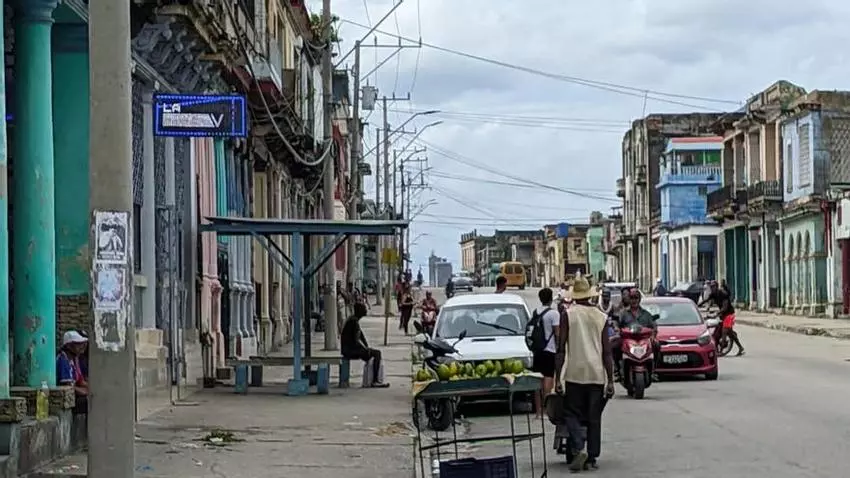
“At Least Until Wednesday, There Will Be No Electricty in Sancti Spíritus”

  • In Holguín, hospitals are in the dark, and anguish is growing before the arrival of Hurricane Oscar
  • There are mile-long lines to buy propane to cook food before it rots in the refrigerators
The situation has escaped the hands of the authorities / 14ymedio

14ymedio bigger14ymedio, Mercedes García/Miguel García, Sancti Spíritus/Holguín, 20 October 2024 — When Olimpia saw last Friday that her entire neighborhood in Sancti Spíritus was in a blackout, she thought that the episode was just one more of the many they have been having for weeks, when the daily deficit of the Electric Union did not fall below 1,000 megawatts. It was not until a neighbor uttered the words “total disconnection” that her concern skyrocketed. In the last two days, her block only recovered service once, this Sunday morning, only to lose it again soon after.

“The whole night all of Sancti Spíritus was in the dark,” explains the woman, who has seen the city transform into a ghost town in a few hours. “People only go out to buy food, but there is not even that. Many have lost all the food they had because without a refrigerator it begins to rot. The bread that is mainly supplied by private bakeries also suddenly disappeared,” she says.

Olimpia explains that the bread from the bodega (ration store) continues to arrive, but – she highlights – those places have not been spared from the consequences of the general blackout. “Since there is no current, they are selling all the rationed chicken that came in for the ration quota until it runs out in all the bodegas. It’s one small piece of chicken thigh, but people buy it even if they have to cook it right away so it doesn’t spoil.”

Olimpia, like other Cubans, saw her parents and grandparents “resolve” with what they could to overcome any situation. The inventiveness she received by inheritance, however, did not prepare her for a situation like the present one, she says. “People are going crazy watching what they eat, how they cook. Gas lines have become impossible. They suspended the tickets in the on-line application because, since there is no connection, there is no way to know if it was your turn. Only the physical line works. I signed up and have a number close to 700,” she says. continue reading

The bodegas have started selling the rationed chicken to prevent it from spoiling / 14ymedio

The alternatives in these days of uncertainty, she says, are few: “In several places they sold some broth for eight pesos.” In practice, Cubans have had to manage as they can. “This morning I was able to charge my generator and am using it only for the fridge, so that my meat doesn’t spoil. Otherwise, I stay in the dark,” she states.

Olimpia has been able to communicate very little with her family, which she finds – as she explains – as uninformed as she is. “The radio works occasionally. This morning I was able to listen to it for three or four hours, but the news gave little information, and the only useful thing they said is that in this area, at least until Wednesday, there will be no electricty.” The internet connection, she continues, has also been “terrible” these days. “The cell phone continues to show 3G or 4G, but in reality you can’t send messages or make calls. The information that people have is what they hear from the neighbor, who in turn heard it from someone else.”

The movement of the authorities also does not give any indication that there will be changes soon. “There is an orientation for workplaces that they cannot turn on the generators, and those who turn them on out of necessity cannot turn on air conditioners or computers. Only the essentials. The transport is not working either. There is only one bus going around in the mornings, but there are almost no people on the streets.”

One thing, however, has caught Olympia’s attention these last few days: “The military is running around like crazy ants.” “There are policemen and agents everywhere, especially those in green uniforms that say Operational Guard. I don’t know what they are doing, but they are mobilized,” explains the woman, who saw an army vehicle pick up two neighbors from her block. “The wife of one of them told me that she has not yet heard from him,” she adds.

In Holguín, Manuel has seen the same symptoms of the crisis. Refrigerators full of spoiled meals, the stench of garbage accumulated for days, the scarcity of water that begins to hit families and, to top it off, the arrival of Hurricane Oscar this Sunday that keeps the people distressed by the scarce resources they have and the little information they receive.

Many people have spent up to 12 hours in line to buy something / 14ymedio

“I had to go out to a field on the outskirts of the city to be able to contact my family. I got as close as I could to an antenna, and although the connection was bad, I was able to call. However, all the numbers I dialed were off or out of the coverage area,” Manuel explains .

The situation in the provincial capital, he summarizes, is “as everywhere”: dark. “I talked to my 70-year-old grandmother, who lives in the San Rafael neighborhood, and she told me that she had to cook with wood,” says Manuel, who explains that in recent hours the residents in the city have bought out the propane tanks to stock up before the effects of Oscar are felt in the province. “The lines are miles-long, with hundreds of customers waiting to buy. There are people who got in line at two or three in the morning, and after 12 hours they are still there,” he says.

A visit with his sick mother in the Lucía Iñiguez Surgical Clinical Hospital allowed him to see a side of the crisis that he would never have imagined. “Everywhere they say that electricity has been prioritized to hospitals, but when I entered all the doctors were giving consultations in the dark,” he recalls.

The tension, he explains, could be felt in the corridors, where even the doctors and nurses openly expressed their discontent. “I passed by a consultation and listened to a doctor, very frustrated because there is no staff even to perform operations. At the moment they are only attending to emergencies, but the situation worsens as the cases accumulate,” says Manuel, who heard the health worker complain about the lack of resources. “He said that he recently had to give a patient a list of everything he had to get to have an operation, from syringes and catheters to antibiotics and topical anesthesia,” he adds.

I also heard two nurses complain that Public Health does not give them time off because many people have left. There is a lack of staff in the internal pharmacy, in the operating rooms, in the specialist consultations,” he lists, saying that, at first glance, you can see that “the hospital is almost empty.”

The situation has escaped the hands of the authorities, who do not even efficiently reach the population to explain the collapse of the SEN or the arrival of Hurricane Oscar. And the confluence of the two worries Cubans. “Since they reported this disaster at the national level, people are very upset,” reflects Olimpia, who soon abandons the theme and returns to reality: “What are we going to do? Where are we going to go?”

Translated by Regina Anavy

____________

COLLABORATE WITH OUR WORKThe 14ymedio team is committed to practicing serious journalism that reflects Cuba’s reality in all its depth. Thank you for joining us on this long journey. We invite you to continue supporting us by becoming a member of 14ymedio now. Together we can continue transforming journalism in Cuba.

“Anyone Who Depends on the ‘Basic Family Basket’ in Cienfuegos Cannot Bathe”

Deodorant, toothpaste and other basic necessities are available only in private stores and shops that take foreign currency

Sellers increase their prices and “take advantage of the problem” with toiletries / 14ymedio

14ymedio bigger14ymedio, Julio César Contreras, Cienfuegos, 19 October 2024 — Anyone who wishes to purchase personal hygiene products in Cienfuegos at a reasonable price will have to travel the whole city without the guarantee of obtaining what they are looking for. Deodorant, toothpaste and other basic necessities have disappeared from state establishments. When they are found, they are displayed on private business tables and shelves at prices unattainable for the majority of the population. Wearing perfume, therefore, has become a luxury that few allow themselves.

“Buying a deodorant in a store in MLC (freely convertible currency) is simply impossible,” complains Irene, a Cienfueguera in her 40s. “The few times they put it out, it’s quickly monopolized by merchants who then resell it at a minimum price of 800 pesos.” This Monday morning, she says, she walked all over the Paseo del Prado and saw them priced at up to 2,500 pesos. “In my house there are four people, and between my husband and me we earn only 7,000 pesos per month. I get like the Cockroach Martina,* with the difference that with that money we can’t buy anything,” she adds.

According to this mother – she has two sons – the shortage of this type of article is more pressing in rural areas. There, she says, private merchants raise prices more and “take advantage of the problem. While in the city of Cienfuegos a common soap costs 160 pesos, in Palmira it can be worth 200 or 250, depending on the seller. The saddest thing is that this is our only option. Whoever depends on the ’basic family basket’ [from the rationing system] in Cienfuegos cannot bathe.”

Michel, owner of a restaurant, says that he allocates no less than 5,000 pesos a month just for toiletries

For his part, Michel, owner of a restaurant, says that he allocates no less than 5,000 pesos a month just for toiletries. “I’ve always liked to put on cologne after bathing. Touring the points of sale on the boulevard, the cheapest price is around 1,500 pesos, and in the Eureka store, for example, continue reading

the most affordable is 7 MLC,” he says. “I wonder how people who don’t receive financial aid from abroad and those who receive the miserable salary that the Cuban government pays to its workers can buy these things.”

This self-employed person says, however, that some time ago it was relatively easy to buy soap and detergent at private businesses, to name just two products. However, with the most recent government measures, these items have also been lost from these establishments. “Along the Calzada de Dolores you could find what was necessary, and there was even variety. Today it is a tremendous headache to get the essentials to keep the house clean and, in my case, also the business,” emphasizes Michel.

In the private shops on San Carlos Street, toothpaste costs between 1,300 and 2,000 pesos / 14ymedio

In the private shops that are located along San Carlos Street, toothpaste can be found for a price between 1,300 and 2,000 pesos, depending on the brand and the quality of the product. “I don’t buy a tube of toothpaste every month, but the mere purchase is almost a family sacrifice,” says Annia, who just bought the item in a private store. “There is no alternative but to save as much as possible, because it is not an optional product: it directly affects health.”

This Cienfuguera confesses that she must juggle to keep her clothes well washed, and having shampoo and hair conditioner is practically a whim: “We have been plunged into horrifying misery. People, in addition to being hungry, are neglected and dirty, experiencing extreme needs that threaten the quality of life and existence itself. Misery has even crept into our skin, and it will be very difficult to eliminate it.”

*Translator’s note: A story told to children about a cockroach that finds a penny and doesn’t know where to spend it.

Translated by Regina Anavy

____________

COLLABORATE WITH OUR WORKThe 14ymedio team is committed to practicing serious journalism that reflects Cuba’s reality in all its depth. Thank you for joining us on this long journey. We invite you to continue supporting us by becoming a member of 14ymedio now. Together we can continue transforming journalism in Cuba.

José Daniel Ferrer and Félix Navarro, Heroes of the Homeland in Cuba

Today, both symbolize the commitment to freedom.

Ferrer (left) and Navarro (right), were imprisoned during Cuba’s Black Spring in 2003. / 14ymedio

14ymedio bigger14ymedio, Peter Corzo, Miami, 20 October 2024 — The prison systems of the Castro-Chavez regimes are particularly cruel and merciless. They establish such miserable conditions of survival that people subsist thanks to unbending moral values ​​and the unbreakable brotherhood generated by perpetually lurking death.

Food is precarious, medical care is non-existent and, even worse, selective. The sick are treated based on instructions given by an official who is governed by political patrons, not by the health of the patient. Overcrowding is the rule, never the exception, and family visits are subject to the whims of a henchman, who arbitrarily suspends them, in addition to the innumerable difficulties for the family to provide goods or visit the inmate.

In these countries there are prisons that epitomize the extreme evil of the regime, without the rest of the dungeons being five-star hotels.

Food is precarious, medical care is non-existent and, even worse, selective

In Nicaragua, the Chipote fortress is by far the most frightening; in Venezuela this miserable honor corresponds to the Helicoide; Bolivia is not far behind with colonial prisons; and in Cuba there continue reading

are many incarceration centers that can be considered antechambers of hell, in addition to being perhaps the country with the most prisons and political prisoners in the world, relative to its size and population.

In the prisons of each and every one of these countries there are prisoners who symbolize the cause that brought them to prison. People of absolute dedication and unfading courage, always ready for extreme sacrifice, like Armando Sosa Fortuny, who died in prison after having served 43 years in two stages, a death that looms over other patriots like Ernesto Borges, who served 26 years in prison last July, and Miguel Diaz Bouza, who completed his 30-year prison sentence on October 15 and remains behind bars.

In these 65 years of Castroism, more than half a million prisoners have passed through Cuban prisons, and have been behind bars for between one day and 30 years. In addition, many prisons have been distinguished as the most cruel and sadistic, among them the Castillo de San Severino, La Cabaña, Puerto Boniato, Guanajay, the National Prison on the Isle of Pines, Siete y Medio and Kilo Siete, while some prisoners have been examples of resistance and capacity for sacrifice, among others, Cari Roque, Pedro Luis Boitel, Mario Chanes de Armas, Roberto Martin Pérez and Amado Rodríguez.

There are currently at least two political prisoners, among a host of men and women in prison, who in my opinion symbolize everyone’s commitment to freedom and civil rights.

In Cuba, there are many prisons that can be considered antechambers of hell

José Daniel Ferrer and Félix Navarro, two opponents of totalitarianism who were imprisoned during the Cuban Black Spring in 2003 and released in 2011, refused to go into exile, despite being aware that they would return to prison because they would never give up on their efforts to free Cuba and Cubans from totalitarianism.

Ferrer, who was last arrested on 11 July 2021, tried to take part in the civic protests that took place across the island, and has since suffered continued ill-treatment by the regime. His family denounces the abuses he suffers, in particular the extreme isolation to which he is systematically subjected as part of Raúl Castro and Miguel Diaz-Canel’s plan to “bury him alive.” Again, in recent days, his wife was prevented from visiting him with their children.

Félix Navarro is in the gloomy prison of Agüica, in the province of Matanzas, a prison that has had a very bad reputation since the 1970s, due to the abusive henchmen and the diabolical conditions of its facilities.

Navarro, leader of the Pedro Luis Boitel Party for Democracy and vice president of the Council for Democratic Transition in Cuba, was also sentenced to nine years in prison for the 2021 national protests. Since last June, he has not received medication for the chronic illness he suffers from, a common practice of Castro’s henchmen working in the prison system.

Navarro and Ferrer should not be forgotten. To paraphrase a song by Albita Rodríguez: “They have the honor of having been born in Cuba and loving the freedom crushed by the Castros and their hitmen.”

____________

COLLABORATE WITH OUR WORKThe 14ymedio team is committed to practicing serious journalism that reflects Cuba’s reality in all its depth. Thank you for joining us on this long journey. We invite you to continue supporting us by becoming a member of 14ymedio now. Together we can continue transforming journalism in Cuba.

In the Face of the Total Blackout, Wood Fires Are Lit Throughout Cuba To Save the Food

Despair is growing after almost 30 hours without electricity, which could last much longer

A truck parked this Saturday morning in front of the Miguel Enríquez hospital, in Havana, sells candles and cookies at exorbitant prices / 14ymedio

14ymedio bigger14ymedio, Juan Izquierdo, Havana, 19 October 2024 — The prelude to the total blackout was, for Magaly, very similar to a horror movie. The TV screen lost intensity, the fans began to move the blades in slow motion, and the refrigerator’s surge protector – whose red light turns on the alarm of any Cuban home – went off. The woman, retired in Santa Clara and a veteran of the Special Period, launched her “protocol” to save food.

Months of intense blackouts have prepared her for any scenario. Without wasting time, she took half a dozen bottles – real “blocks” of ice – from the freezer and placed them in the main compartment. “This keeps the cold in a little, but even if the door isn’t opened, the food will eventually spoil,” she explains.

The first to succumb are the vegetables and fruits. The meat lasts a little longer, but after several days it follows the same path. Cooked beans and stews do not survive very well. “I lost a papaya, in addition to a couple of jars of beans and cucumbers pickled in vinegar. Now I have to start sorting and throwing things away,” she says.

Classifying means arranging food in chronological order, according to its expiration date

Classifying means arranging the food in chronological order, according to its expiration date. Throwing it away means losing resources and money in a country where food, in itself expensive, borders on the prohibitive in times of disaster. And, for Magaly, the “total disconnection” announced this Friday by the Ministry of Energy and Mines is a national catastrophe, like a hurricane.

In fact, the atmosphere on the streets of the city is similar to when a hurricane is expected: a swarm of people in front of each food stall, huge lines in front of stores, prices that go up as the hours go by. “The bag of cookies that cost you 250 pesos yesterday costs 270 today,” says a woman. “Not everyone can afford it. In the private stores that sell food, this Friday, because of the blackout, neither ham nor croquettes could be delivered. There is a lack of supply for everything and a lot of demand.” continue reading

The WhatsApp groups for the bodegas (ration stores) have become fashionable, where the administrator alerts people when “two little pounds of rice” or “anything” has arrived.” At midnight a message appeared in the chat: “Please, the milk for children has just arrived. Be considerate.” Magalys translates: the bodega wants them to go as quickly as possible because the milk was about to spoil. At two in the morning, other bodegas in Santa Clara sent similar messages to their customers.

The early morning was hard. Children were crying in every neighborhood; telephones – the only source of escape for many – couldn’t be charged; and flashlights ran out of battery. “It’s hopeless,” says Magaly. “At least the night was cool.”

“People who have a freezer with food are trying not to open it to see if it can keep cold”

With almost 30 hours of blackout in the municipality of Colón, Jorge, a teacher at a local high school, sees that the food in his refrigerator is on its last legs. “We had to cook everything,” he says. “We lit a charcoal burner in the doorway – it’s raining on the patio – and we threw on a piece of liver. It was the only thing left and it wasn’t going to last much longer.” In the absence of gas and electricity, the old wood stoves have shown that, unfortunately, they are not objects of the past.

Jorge has not had electricity since Friday morning; Susana, a resident of Remedios, Villa Clara, has been in a blackout since Thursday night. “People who have a freezer with food are trying not to open it to see if it can keep cold,” he says, “but those of us who only have a refrigerator already had to eat what we had left.”

This Friday, Susana and her family dismantled a package of chicken whose “shelf life” they planned to extend for a longer time. They took the pieces and cooked them on charcoal. “We invited the neighbors next door, who also had to finish off some tamales. They do spoil very quickly.”

In Camajuaní, a few kilometers from Remedios, Carmen, a housewife, could not save the milk or the little rice she had reserved. “Everything I had frozen was lost a while ago. Anything with bones – like chicken – I made yesterday; I’ll cook the rest today. At this rate, everything will have to be cooked.”

Wood fires are flaring up throughout Cuba, not only to save food but to have some light and a place to crowd around and talk. Without phones or radios to inform themselves, people are feeling uncomfortable and given to venting. An increasingly accentuated anger has filled the place. This Friday, Magalys was afraid that “something big” could happen.

The Government has announced some measures so that people “have food and some vital products”

The Government has announced some measures so that people “have food and some vital products.” In Cienfuegos, says the State newspaper Granma, a “comprehensive agricultural fair” is being prepared for all municipalities.

Meanwhile, in Havana, a truck parked this Saturday morning in front of the Miguel Enríquez hospital. The line did not take long to form, but the “reinforcements” to weather the storm are minimal: cookies at 1,300 pesos and a package of candles – made in Cuba – at 750. A woman’s reaction to the anti-blackout kit says it all: “Is this what they send us? What am I going to pay for it with?”

Checking the local news pages, such as the CMHW in Villa Clara or the bulletins of the Electric Union itself, provides a good inventory of curses to hurl at the regime. The complaints range from personal insults to Cuban President Miguel Díaz-Canel and requests for his resignation to jokes: “We should send a letter to the Space Station,” says a reader, “explaining to them that they are not going to see Cuba at night in the next few days.”

Translated by Regina Anavy

____________

COLLABORATE WITH OUR WORKThe 14ymedio team is committed to practicing serious journalism that reflects Cuba’s reality in all its depth. Thank you for joining us on this long journey. We invite you to continue supporting us by becoming a member of 14ymedio now. Together we can continue transforming journalism in Cuba.
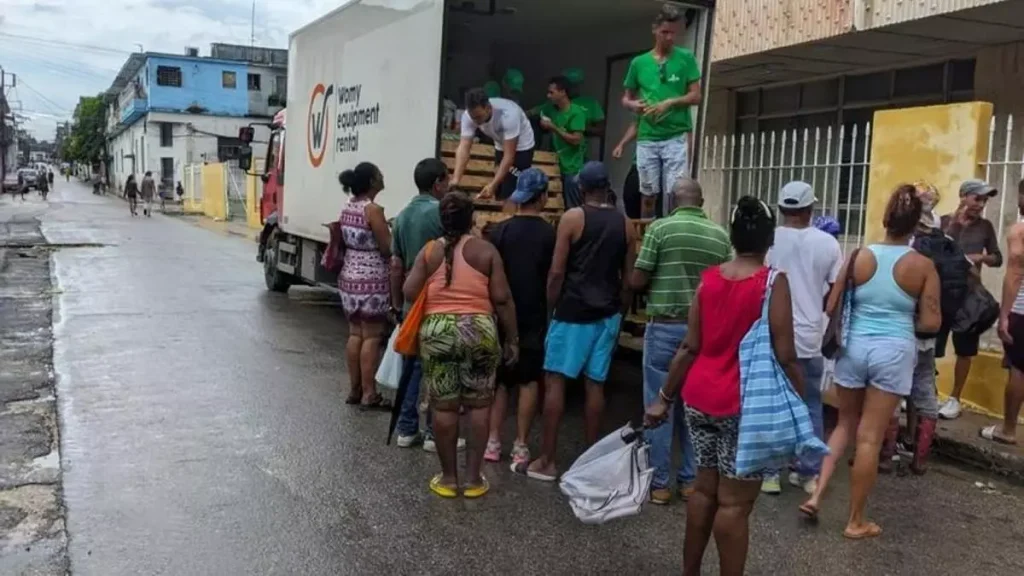
Cuba: The Governor of Las Tunas Who Described His Province As ‘Ungovernable’ is Dismissed From His Position

’Cubadebate’ mentions without further details the “mistakes made” by Jaime Ernesto Chiang

In the center, Chiang Vega, and on the right, Cruz Reyes, in a photo with Manuel Pérez Gallego, member of the Central Committee / Trabajadores

14ymedio bigger14ymedio, Havana, October 19, 2024 — Jaime Ernesto Chiang Vega, the man who told Parliament in 2023 that Las Tunas – the province under his command – was “ungovernable,” was dismissed this Saturday by Cuban President Miguel Díaz-Canel, in the middle of the energy debacle. With him went his deputy governor, Ernesto Cruz, who sent the president a “resignation request” after “incurring violations in the exercise of his responsibilities.”

While the whole country suffers a second day without electricity, Cubadebate reserved a place on its front page to report that Díaz-Canel, “making use of the powers conferred on him,” dismissed both politicians and informed the Provincial Council.

The statement alludes to the “mistakes made” by Chiang that caused his removal, but Cubadebate does not say a word about the failures attributed to him. In the case of his deputy governor, the “process of revocation of office” came “from above.” Chiang is replaced by Eduardo Walter Cuelí, current coordinator of Programs and Objectives of the provincial government, the next on the promotion ladder in Las Tunas.

The lack of transparency and the strange circumstances in which both dismissals occurred have been noticed by users on Cubadebate’s Facebook page – not just on its website. “Why did they replace him? Where’s the Communication Law that says you have to tell the truth about everything and not censor?” complained user Rogelio Loyola. continue reading

“We are still waiting to hear about the mistakes of the Minister of Economy”

Another, knowing that the Government rarely gives information about the “mistakes” of its officials, said: “We are still waiting to hear about the mistakes of the Minister of Economy,” referring to Alejandro Gil, whose whereabouts are still unknown.

Last April, the governor of Cienfuegos, Alexandre Corona, also “resigned” from his position after “recognizing mistakes” committed during his four years of administration. These exits are added to the unusual number of changes of political figures in Cuba, both at the regional level within the Communist Party and in several ministries of the country.

A year ago, all the governors were voted in for five-year terms, but for various reasons these provinces have had to seek replacements in advance. In these cases, the delegates vote on the governors proposed made by the country’s president, and so far there have only been majority ratifications. Thus, the so-called “movements of the cadres” accumulate on the Island, ranging from the dismissal of the first provincial secretaries of the Party to ministers.

In December 2023, Chiang appeared before the National Assembly to account for the situation in Las Tunas, one of the provinces that had done the worst that year. His speech, which he delivered with a serious face and a thick report in his hand, ended up summarizing the “situation of ungovernability and disobedience in the population,” which he attributed to the “enemies of the Revolution.”

Chiang intended to exonerate his administration from the alarming figures that he himself provided: 34 entities that did not comply with their plans due to “lack of demand, rigor and responsibility on the part of some cadres”; 1,481 million pesos missing from his total net sales plan; “deficient collection management”; “chains of nonpayments”; “insufficient economic and financial administration”; and, in short, an expenditure of 185 million pesos more than the state budget allowed, 3.511 billion.

“Between El Chino and El Gallego they went from bad to worse for the working people”

Their solution to obtain money was to use force. Their “confronting crime” campaign, which resulted in some 8,488 “control actions” to collect overdue fines and detect irregularities, gave the State 15,531 million pesos. Judging by this Saturday’s announcement, it was not enough.

Among the people of Las Tunas, neither Chiang nor his deputy governor – nicknamed El Gallego (the Spaniard) and El Millonario (the Millionaire) – had a good reputation. A resident of the provincial capital tells this newspaper that both politicians ignored government management and concentrated on protecting several owners of private businesses that had “monopolized the sale of food.” “Chiang is just a scapegoat,” he adds, “but it’s true that between El Chino and El Gallego they went from bad to worse for the working people.”

Translated by Regina Anavy

____________

COLLABORATE WITH OUR WORKThe 14ymedio team is committed to practicing serious journalism that reflects Cuba’s reality in all its depth. Thank you for joining us on this long journey. We invite you to continue supporting us by becoming a member of 14ymedio now. Together we can continue transforming journalism in Cuba.

María Corina Machado Denies Maduro’s Statement and Declares ‘I’m Here With the Venezuelans’

The opponent thus denied the statement of the Government of Nicolás Maduro, who had said shortly before that the former deputy “fled the country to Spain”

Venezuela’s opposition leader, María Corina Machado / Facebook

14ymedio biggerEFE (14ymedio), Caracas, 17 October 2024 — María Corina Machado denied the statements of the President of Venezuela, Nicolás Maduro, who said on Wednesday that the opposition leader had fled the country to Spain. “Venezuelans know that I’m here in Venezuela. The people know it and Nicolás Maduro also knows it. Maduro’s government is desperate to know where I am, and I’m not going to give them that pleasure,” the opponent said in an interview with the EVTV channel.

The Venezuelan government had said that Machado “fled the country to Spain,” where the standard-bearer of the opposition coalition, Edmundo González Urrutia, considered the winner of the last presidential elections on July 28 by the Spanish Congress of Deputies, is exiled.

In a televised event, Maduro – proclaimed re-elected by the Venezuelan National Electoral Council – said that “la sayona” – as he usually refers in a derogatory way to Machado – “also left” the country and “fled” to “a very good bar in Spain.”

“I’m here with the Venezuelans, here, obviously protecting myself and taking care of myself because I’m not going to give them the pleasure of knowing where I am,” Machado told EVTV without specifying if she was guarded in a diplomatic headquarters within the country. continue reading

Although Nicolás Maduro did not mention the name of the opponent in his statements, the Minister of Communication, Freddy Ñáñez, said on Telegram that, according to the president, “María Corina Machado fled the country to Spain.”

Specifically, Maduro said: “I have a secret for you, but I don’t know, do you know how to keep a secret? (…) Who likes gossip? (…) It turns out that the old man [in reference to González Urrutia] left a month ago, (…) and the “La Sayona” also left, fled, fled, (…) finally left, to a very good bar there in Spain, (…) she went there. Please don’t tell this to anyone.”

“I’m here with the Venezuelans, here, obviously protecting myself and taking care of myself because I’m not going to give them the pleasure of knowing where I am”

La Sayona is a woman who, according to Venezuelan legend, appears in the form of a ghost and punishes unfaithful men.

Last Monday, Maduro, without giving names or direct references, said that “she” had left the country, despite the fact that she has been banned from leaving the national territory since June 2014.

“Don’t tell anyone, she left the country, my sources tell me that she fled (…) they are cowards, they are good at sending messages of hatred and intolerance, but she left, she took her Gucci suitcases and left,” he said again, without pronouncing her name.

González Urrutia, leader of the main opposition coalition, the Democratic United Platform, arrived in Madrid on September 8, after requesting asylum due to the political and judicial “persecution” that he suffered in his country after the elections.

After the opponent’s departure, Machado, who claims to be in “hiding” for fear of her “life” and “freedom,” reiterated that she will continue to fight from Venezuela, while González Urrutia will do so “from outside.”

Also, on September 30, the former deputy, in her speech of thanks by videoconference after having won the Václav Havel Human Rights Award, reiterated that she will “continue to fight alongside the Venezuelan people.”

The vice president of Venezuela, Delcy Rodríguez, called Machado a “fraud” and a “whore” for requesting sanctions from Venezuela’s enemies and at the same time speaking in favor of wage increases for workers, who have been, according to Rodríguez, “severely affected” by foreign sanctions.

Machado expressed her “deep admiration and affection” for the educators, who, despite “hunger wages,” have “remained at the forefront of this struggle, with an infinite dedication

“Who has asked for the blockade against Venezuela? Leopoldo López, Julio Borges, Juan Guaidó and María Corina Machado, who causes tremendous damage to Venezuela and asks for still more sanctions … She then, every day, makes videos (saying): ’Dear workers, I am with you, and now we are going to fight for Venezuela and improve your working conditions,’” Rodríguez said.

She insisted that Machado, “whoring for the United States Government, calls for sanctions and a blockade against Venezuela.” The also Minister of Oil called the former deputy and other opponents “tremendous fakes.”

Rodríguez also said that the workers have been in the “vanguard” of the “active resistance against the criminal blockade imposed by Washington with the support of Western countries” and “the call made by the extremists and fascists in Venezuela,” referring to anti-Chavista leaders.

The vice president charged against Machado a few days after the opponent expressed her “deep admiration and affection” for the educators, who, despite “hunger wages,” have “remained at the forefront of this struggle, with an infinite dedication,” according to the former deputy.

Translated by Regina Anavy

____________

COLLABORATE WITH OUR WORKThe 14ymedio team is committed to practicing serious journalism that reflects Cuba’s reality in all its depth. Thank you for joining us on this long journey. We invite you to continue supporting us by becoming a member of 14ymedio now. Together we can continue transforming journalism in Cuba.

Colombian President Gustavo Petro and His Officials Have Traveled More Than 70 Times to Venezuela and Cuba in Two Years

The data was released by Congressman Hernán Cadavid in a report denouncing the “toxic leadership” of the president

The President of Colombia, Gustavo Petro / Europa Press

14ymedio bigger14ymedio, Madrid, October 16, 2024 — The Colombian Government of Gustavo Petro has made more than 70 trips to Cuba and Venezuela in two years without revealing, in many of those cases, the reasons. The data was released by congressman Hernán Cadavid, of the Democratic Center opposition party, in a report on his social networks, in which he denounces the president’s “toxic leadership.”

In his report, Cadavid points out the “governability crisis” and “instability” within the Executive, through which “more than 124 deputy ministers have passed since August 7.” This is one of the causes of “the very low budget execution and the very high inefficiency” of the current Administration in Colombia.

Cadavid also states that the highest officials of the Executive have traveled abroad more than 855 times, including 50 trips to Venezuela and 21 to Cuba. “What is their purpose with those dictatorships?” the politician wonders in a video on X. He also says that he made 123 formal requests in order access the information; even so, the reasons for many of those trips are unknown.

Cadavid points out the “governability crisis” and the “instability” within the Executive, through which “more than 124 deputy ministers have passed since August 7”

Most of them have been carried out by the Colombian president himself, by the vice president, Francia Márquez, by members of the Ministry of Commerce and the Office of the High Commissioner for Peace. continue reading

Petro’s trips to Cuba have been known because of the peace talks with the guerrillas of the National Liberation Army (ELN), in which Havana acts as a mediator. This is also one of the reasons, according to Blu Radio, why the Colombian president has traveled to Venezuela; for example, in January and November of last year.

Recently, in addition, Colombia reached an agreement with Cuba to provide eggs, one of the most expensive and scarce foods on the Island.

On the other hand, Petro has tried to mediate in the crisis in Venezuela after the presidential elections, in which Nicolás Maduro proclaimed himself a winner and which have been denounced as fraud by the opposition and much of the international community. Last month, the Colombian president said that neither his country nor Brazil would recognize Maduro’s victory if the detailed polling place results of the July 28 elections are not presented.

Translated by Regina Anavy

____________

COLLABORATE WITH OUR WORKThe 14ymedio team is committed to practicing serious journalism that reflects Cuba’s reality in all its depth. Thank you for joining us on this long journey. We invite you to continue supporting us by becoming a member of 14ymedio now. Together we can continue transforming journalism in Cuba.

The IAPA Denounces the Increased ‘Offensive’ Against Independent Journalism in Cuba

The report points to the case of Mayelín Rodríguez, who was sentenced in May to 15 years in prison for “interviewing and broadcasting videos about two girls beaten by agents of the Ministry of the Interior.”

The document points out that “the dictatorship tries to manipulate civil society, especially the limited and battered independent journalism” / 14ymedio

14ymedio bigger EFE (via 14ymedio), Córdoba (Argentina), 18 October 2024 — A report presented at the 80th General Assembly of the Inter-American Press Association (IAPA), still pending approval, denounces the recent increase in the “offensive” against unofficial journalism in Cuba through “psychological harassment,” arrests of journalists and summons from State Security.

“The umpteenth offensive against independent journalism (in Cuba) has been unleashed in September in the form of summons, preceded by different measures of psychological harassment by the authorities,” says the report presented at the meeting that is taking place these days in Córdoba (Argentina).

The document points out that “as before every new election in the United States, the dictatorship tries to hobble civil society, especially the limited and battered independent journalism.”

It denounces the case of Mayelín Rodríguez, who was sentenced in May to 15 years in prison for “interviewing and transmitting videos about two girls beaten by agents of the Ministry of the Interior” during a protest against the blackouts in Nuevitas. continue reading

The IAPA, founded in 1943, also mentions in its report that the Cuban digital media El Toque, based in Florida, was the subject of a “discredit campaign by the government propaganda apparatus” that blames it for being behind the depreciation of the Cuban peso against the dollar and the euro in the informal market.

El Toque reports daily on the value of the Cuban currency based on the buying and selling offers published on social networks.

“The umpteenth offensive against independent journalism has been unleashed in September in the form of summons, preceded by different measures of psychological harassment by the authorities”

While the dollar is currently listed at 325 Cuban pesos according to this media, which has become a benchmark for the street and economists, the official exchange rate is still fixed at one dollar for 24 pesos (for legal entities) and one dollar for 120 pesos (for individuals).

The document also denounces the arrests, assaults and interrogations of unofficial journalists such as Camila Acosta, José Luis Tan and Julio Aleaga, as well as the closure of the digital music magazine Magazine Am/Pm due to “harassment by State Security.”

The IAPA report on Cuba also criticizes the Social Communication Law, which came into force in early October, because it “strengthens the repression of press freedom.”

The aforementioned regulation, the first of its kind in Cuba in 70 years, ignores the unofficial press, allows commercial advertising for the first time since the triumph of the revolution, sanctions the political alignment of authorized media and regulates digital phenomena (including influencers), among other issues.

The law has been harshly criticized by NGOs and media outside the State orbit, who argue that it censors content contrary to the official narrative and leaves independent digital newspapers adrift.

Translated by Regina Anavy

____________

COLLABORATE WITH OUR WORKThe 14ymedio team is committed to practicing serious journalism that reflects Cuba’s reality in all its depth. Thank you for joining us on this long journey. We invite you to continue supporting us by becoming a member of 14ymedio now. Together we can continue transforming journalism in Cuba.

The Private Sector in Cuba Up Against the Wall / Iván García

A private business in Havana. Taken from El Toque.

Iván García, 26 August 2024 — Three years ago, in the summer of 2021, just a month after thousands of Cubans took to the streets to shout for freedom, the grey-haired ruler Miguel Díaz-Canel, handpicked by dictator Raúl Castro to run the country, authorised the opening of small and medium-sized businesses on the island. It was a measure that had been “studied” for ten years with the typical eagerness of communist regimes, where urgency is an unknown concept.

Yoel, 56, was not taken by surprise by the ’new regulations for economic actors’ announced on 19 August and due to come into force a month later, on 19 September. He always knew that a private entrepreneur is a presumed criminal in the eyes of the government. “Those of us who live in Cuba learned to negotiate to survive in the midst of scarcity,” he says, driving a second-hand Toyota Corola.

“From when I was a child in my house, people used to buy food and clothes on the black market. It was the most normal thing in the world. Hands up anyone who didn’t buy a cheap pair of jeans, a litre of oil or five pounds of beef “under the counter”. When there wasn’t a shortage of bread, there was a shortage of butter. People learned to live by their wits’. Nobody asks where what they are buying came from. They guess. And from a State Security officer to the neighbourhood informer, they are forced to resort to illegalities in order to survive. There are thousands of laws to prohibit and control offences. But nobody takes any notice of them. It’s an unwritten understanding between government and society. They let you do it until they think you’ve crossed the line. Then media campaigns are unleashed against illegalities and police raids and summary prosecutions of those operating in the private sector begin.

“In these 65 years we have been humiliated with various labels: outlaws, hucksters, or leaches on the backs of poor people. Some of these traders have been imprisoned, others have emigrated or have taken a step back until the dust settles. It’s a merry-go-round that repeats itself over and over again”. In his opinion, there is a revolving door on the island where people move from legality to the underground with astonishing ease. He gives an example. “When I was 17, I used to buy dollars, which was illegal and if you were caught you could be sentenced to four years in prison. With those ’illegal dollars’, an Angolan partner bought me clothes in shops for continue reading

foreign technicians, which I then resold on the street.

“I have collected money for the bolita (illegal lottery) and sold beer and bread and steak. Like many Cubans, I have done everything, trying to live as well as possible. When in 1993 they authorised self-employment, I had some money saved up thanks to those little tricks. There is a myth that most of the businesses that emerged in the country were opened with dollars sent by family members living in the United States. In some cases this was true, in others it was not. Many ’bisnes’ in the depths of rural Cuba have been financed with money earned from the sale of food, clothes or construction materials on the black market.

According to Yoel, “these attacks on MSMEs and the self-employed were to be expected. You would have to be very naïve to believe that a government that is anti-capitalist is going to let private businesses prosper. They allow them because the system has broken down. Private business is an umbrella under which these scoundrels protect themselves. They accept us, but with the boot on our backs, a lot of regulations, very high taxes, an army of inspectors who inspect you and when they feel like it, they put you in jail”.

“Opening a business allows you to earn money and live without the crumbs from the state. Most of us are double bookkeepers and under-declare when paying taxes. It’s a war. They screw you with decrees, threats and lies. And we pretend to comply, but then we do whatever we want. When they order businesses to stop, people know what to do. Either they get out of Cuba or they continue to do the same thing informally. Since the emergence of self-employment in 1993, everything has been a government bluff. The private sector is designed for survival, not to make lots of money. These openings serve as international propaganda to sell themselves as reformers.

“We are labelled as entrepreneurs out there. But almost none of us have studied business administration or marketing techniques. In my case, I was a go-getter who worked my way up to owning several businesses. If I see that things are getting hot, I will know that it is time to get on the plane. But behind me, other ’entrepreneurs’ will emerge. Until the system, which is incapable of generating wealth, changes, that will be the the way it goes,” says Yoel.

The owner of two small stores in the old part of Havana, a guy who knows his way around the sewers of the corrupt local bureaucracy, thinks that “it is likely that the government will try to clamp down on MSMEs. This campaign is aimed primarily at autonomous private businesses, which compete against MSMEs run by front men for high-ranking government officials or retired military officers. The reason is simple: they are more efficient and have developed a network of suppliers that works.

“The state, used to receiving dollars from exports, tourism, sales in foreign currency shops and the banking system, thought that we would not be a problem, not least because we could not access foreign currency. But we have been creative. The sales cycles are faster. We have accounts in foreign banks. And to replenish our supplies, we buy dollars on the street at the informal market price. The state-owned companies can’t compete with us even on a tilted playing field” says the entrepreneur.

Dunia, a hairdresser, agrees that “the new regulations are a declaration of war on the private sector. Some will leave the country or shut up shop. Others will start working under the counter. Every Cuban knows that to live in any comfort we have to fend for ourselves. The state can’t even guarantee the seven pounds of rice it provides through the ration card. The government should concern itself with dealing with poverty, not fighting the people who create wealth.

An official of the ONAT, the institution that governs private labour, revealed to Diario Las Américas that the regime’s intention “in addition to more rigorous supervision of the non-state sector, is to recover the two billion that the banking system has stopped receiving. From now on, priority will be given to the opening of state-owned MSMEs. (Micro, Small, and Medium-sized Enterprises). Especially in the commerce sector and in companies that are at a standstill or generate losses for the state. There is the intention that political and mass organisations, such as CDR (Committees for the Defense of the Revolution) and FMC (Federation of Cuban Women), can open MIPYMES that allow them to finance themselves with small shops in the neighbourhood, as well as private stores, where they can sell food and confectionery at lower prices.

Gustavo, an economist, considers that “these new measures show that the government is living in a surreal world. This interference in private property, the idea that MSMEs should be chained to bankrupt state-owned companies and the earmarking of a voluntary reserve to finance vulnerable sectors is a crazy project. And it will fail. No entrepreneur is going to allow the authorities to use his or her capital to finance Cuba’s failed economic model. For entrepreneurs to use the inefficient national banking system for their purchases abroad is nonsense. For the state to implement MSMEs is absurd. It doesn’t exist anywhere in the world.

The government is well aware of this. Its strategy is to supplant autonomous MSMEs with entities under the control of relatives and government officials. It was already happening. Now the mask has definitely come off.

Translated by GH

In the Midst of a Nationwide Power Outage, Havana is Inundated After Several Days of Rain

The storm did not stop the Havana residents who, driven by necessity, went out in search of food and medicine.

Puddles of rainwater have made some streets impassable. / 14ymedio

14ymedio bigger14ymedio, Juan Diego Rodríguez, Havana, 18 October 2024 — It has been raining almost continuously in Havana for three days. Several neighborhoods have seen flooding and, with the failure of the country’s entire electric grid on Friday, the situation is becoming increasingly uncertain. Officials have issued several orders in the last twenty-four hours to clean up the city and prevent water from accumulating. Havana residents have taken to the streets out of necessity to buy food and medicine without paying much attention to the storm.

According to the latest report from the Meteorological Institute, the island was hit with a stationary cold front from the west on Wednesday. This, along with the formation of a tropical wave south of Cuba that could become a cyclone in the next forty-eight hours, means the island is looking at a high probability of storms and showers. So far, rain gauges indicate the heaviest rainfall has been in Caibarién (in Villa Clara province), with 6.5 inches; Bainoa (in Mayabeque province), with 5.3 inches; and Bahía Honda, (in Artemisa province), with 3.7 inches.

Havana is not on the list of cities with the heaviest rainfall but there have been ongoing reports of strong storms in the capital for the last three days, weakening walls and columns. A social media post on Friday contained images of the collapse of a colonial-era house on the corner of Muralla and Aguilar streets in Old Havana. Photos show a tree close to the building that had fallen due to strong wind and rains, destroying part of the exterior. continue reading

Havana residents waiting in line to buy medicine. / 14ymedio

Another report from “Escambray,” the official state media outlet of Sancti Spíritus province, contained photos taken by local residents on Thursday in numerous areas of the provincial capital, including the Bay Tunnel, where authorities can be seen walking through ankle-deep water.

Measures announced on the same day by Havana’s local government, however, were of little use. People and vehicles continue to ply the flooded streets while storm drains, which were scheduled to be cleaned, were mostly clogged with trash that the rain washed away from the many piles of garbage to be found throughout the city.

During a tour through Havana’s Tenth of October district on Thursday, 14ymedio visited Concha Street, where the Miguel Enríquez Hospital (known by local residents as “La Benéfica”) is located. A day earlier the area had been completely inundated. Water levels there reached a considerable height, entering the homes of local residents.

Debris carried down the street by rainwaters settles on street posts and clogs storm drains. / 14ymedio

There were signs of the heavy rains in the district, where water ran down the street leaving plastic bags and tree branches caught along posts and street curbs. Puddles could be seen in most of the streets, making some impassable. Good Samaritans removed the garbage that was blocking some drains, which were slow to digest the accumulated water.

Though Cubans have always feared storms, along with the resulting wind and rain, they fear hunger and illness even more.

On Friday, when the energy situation finally could not get any worse, authorities announced the power grid had failed and ordered the cessation of all non-essential activities. Yet the rain continues to fall in Havana and Cubans don’t know what to do.

____________

COLLABORATE WITH OUR WORKThe 14ymedio team is committed to practicing serious journalism that reflects Cuba’s reality in all its depth. Thank you for joining us on this long journey. We invite you to continue supporting us by becoming a member of 14ymedio now. Together we can continue transforming journalism in Cuba.
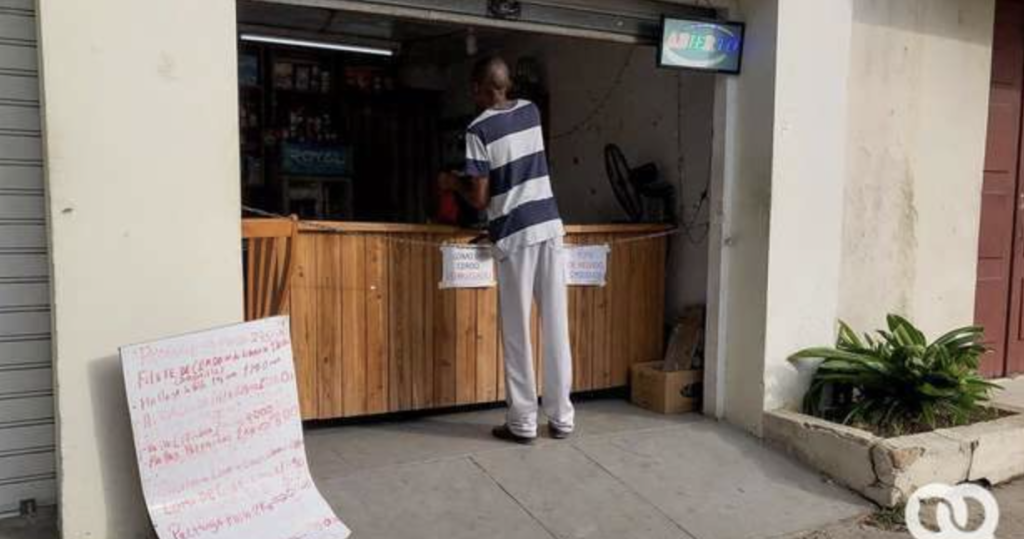
Cuba Will Remain Without Electricity at Least Until Saturday

  • UNE announced the “total disconnection” of the Electrical System
  • The Antonio Guiteras power plant had scheduled maintenance, but it did not last until the scheduled date
  • With the country in darkness and the economy paralyzed, Marrero says that Cuba “is not yet in a bottomless abyss”
Cubans are out on the streets waiting for electricity to be restored across the country. / 14ymedio

14ymedio bigger14ymedio, Havana, 18 October 2024 — The Cuban Ministry of Energy and Mines announced on Friday the “total disconnection” of the National Electric System (SEN), which occurred at 11:07 am after the “unexpected” shutdown of the Antonio Guiteras power plant. In a brief note, as the country’s circuits were progressively shutting down, the authorities only added that they were “working” to get power back to the country. Hours later, the Cuban Electric Union (UNE) reported that the first local microsystems were already starting to be connected and, although it avoided offering an estimate of the time it will take to reestablish electricity, it stated that “the restoration of the SEN is at very early point.” The message for Cubans is loud and clear: the power will not arrive today.

The day before the disaster, the Cuban Electric Union (UNE) warned that, after remaining on all summer, the largest thermoelectric plant on the island needed to be shut down for maintenance, but everything indicates that the plant did not last until the scheduled date.

“From the country’s leadership, we are devoting absolute priority to addressing and solving this energy contingency of high sensitivity for the nation,” Miguel Díaz-Canel said on X, minutes after the announcement, with his habitual voluntarism.

According to a UNE source contacted by 14ymedio, “this time it is not a simple  and we do not expect to have electricity for another two days.” Private ice cream vendors have been the first to take measures to save their businesses and have gone out into the streets to try to sell their products as soon as possible. State transportation has almost completely stopped. Only a few privileged paladares [private restaurants], such as La Parada VIP, continue to provide services with their own power plants. Customers arrive to take the last cold beers available along the entire Luyanó road or sit down to enjoy a meal, unconcerned by the serious situation facing the Island.

Only near the Etecsa (State telecommunications company) offices do Cubans manage to connect to the Internet. Those who do not have phones and are still unaware of the situation sit in doorways to get some fresh air or wait in banks for the ATMs to come back to life.

In Sancti Spíritus, the massive blackout not only caused inconvenience to the population, but also caused a lot of electrical equipment to burn. continue reading

“Around 11:00 am, when the manipulation of the equipment began, there was a power surge in a large part of the city, especially in circuit 112,” says Rolando, a resident of this area. “The equipment that was connected began to smoke and then the power went out throughout the city. The mobile connection also went down,” he adds

Only a few paladares, such as the private La Parada VIP, continue to provide services with their own generating plants. / 14ymedio

Authorities have avoided giving information beyond the announcement of the SEN disconnection. In a report on Midday News broadcast in which Lázaro Guerra, director general of electricity at the Ministry of Energy and Mines, was interviewed, the official explained that, although he does not know how long it will take to reestablish the electrical grid, the Energás Puerto Escondido and Energás Boca de Jaruco plants – both belonging to a joint venture with Cubapetróleo, UNE and the Canadian mining company Sherritt – were able to start up, supplying power to Varadero and part of the capital, and with which they will try to revive unit 1 of the Santa Cruz del Norte plant in Mayabeque.

In addition, he added that, “with great effort,” fuel was obtained to power the Mariel and Santiago de Cuba patanas [Turkish floating power plants], which are expected to activate the Mariel and Renté thermoelectric plants respectively. The fuel from Mariel, added the official, “is already sailing and should arrive at the port between 7:00 and 8:00 p.m.”

Guerra reiterated that “there will be hours without (electrical) service, the restoration will be gradual and will be carried out in compliance with the protocols to do so safely.”

The official indicated that the strategy they are following is to try to provide energy to the available terrestrial thermal power plants (CTE) through distributed generation and to reconnect them to the national electricity grid, after the “total” collapse of the electrical system.

In September 2022, a similar situation of “zero production” of energy occurred after Hurricane Ian passed through the western provinces of the Island. This caused a serious imbalance and left the entire country in the dark.

In an interview with journalist Mario Pentón, University of Texas researcher Jorge Piñón offered an overview of what, in his opinion, is keeping the SEN in the current crisis. On the one hand, the Soviet thermoelectric plants – only the Guiteras is of French design – have been in operation for more than 40 years, and have received little maintenance on a small scale that is not enough to keep them fully operational. In addition, they burn Cuban crude oil, with high levels of sulfur and metals that deteriorate the plants at a faster rate. The generator sets, “created by Fidel Castro” – Piñón continues – are also not efficient in terms of logistics, since they must be constantly supplied with diesel, an expensive fuel.

Finally, the Turkish floating power plants, which, as the expert notes, the authorities announced as the solution to all the island’s energy problems, have been shut down for weeks.

All of this, concludes Piñón, has a common denominator. As 14ymedio had already noted in several recent articles, Piñón highlights that the crisis worsened after shipments of Venezuelan crude oil to Cuba began to decrease. “I know, from my sources, that Venezuela told Cuba that it would prioritize oil shipments to (the Spanish company) Repsol and (the American company) Chevron, who pay in cash and that is what they need. […] They told Cuba to get in line,” he explains. As for aid from Russia and Mexico to Havana, the first has not materialized and the second has decreased, Piñón concludes.

This Thursday, the announced special television appearance by Cuban Prime Minister Manuel Marrero to report on the “energy emergency situation” took place almost an hour and a half late. At 8:30 pm, when it was scheduled, they explained that there were “technical problems” that prevented the videoconference connection between Havana – where Alfredo López Valdés, director of UNE, and Edrey Rocha González, director of Unión Cuba Petróleo (Cupet) were – and Santiago de Cuba, where the Prime Minister is on an official visit.

Finally, shortly after 9:45 p.m., the broadcast began, with a choppy voice and image. In his speech, which lasted less than an hour, Marrero did not reveal much new information. “We have had to paralyze the economy in order to guarantee a minimum of electricity service,” he acknowledged.

The Cuban Electric Union announced in a statement on Thursday night that it was suspending “non-vital services that generate energy costs.” These include teaching activities, i.e. classes, from Friday to Sunday at all levels of education. In addition, cultural activities, discos, recreation centers and “other activities that generate high concentrations of people” are being halted, both in the state and non-state sectors.

UNE announced the suspension of classes from Friday to Sunday at all levels of education

Only “vital centres, such as hospitals and food processing centres” will remain in service, and “indispensable” personnel will return to their jobs.

In this worsening energy crisis, the prime minister said that the most significant factor is “the lack of fuel.” Although the impact yesterday was expected to be 1,678 megawatts (MW), it was ultimately 1,800 MW. The shortage of oil was what caused the Turkish floating power plants to go out of service and the generator sets to stop working.

According to the director of Cupet, a ship loaded with fuel oil, “which the country paid for with extraordinary effort, arrived on the 9th [of October], but it coincided with the arrival of bad weather and we were not able to dock it in Matanzas until the 14th.” The official did not mention the name of the ship, but it is the Equality, which travels under the flag of Tanzania and is one of those that the Island uses for coasting between ports, in this case with a load of fuel.

It is expected to arrive in Moa on Thursday night, but due to bad weather it will not arrive until today to supply the Mariel and Havana plants. The cargo is 2,000 tons of fuel, said Rocha González.

Although the authorities did not mention it either, the Liberian-flagged Ocean Mariner is scheduled to dock in Santiago de Cuba from Mexico.

The UNE director announced the upcoming decommissioning of the Felton and Guiteras thermoelectric plants, two of the largest in the country.

“Within the residential sector, the form of non-state management has grown, as they are large consumers and are paying these subsidized rates without any control”

Marrero also attributed the problems to the “increase in demand” from the population, especially from the private sector. “We are not going to limit the population from improving their quality of life,” said the Prime Minister trying to calm the situation, but they claim to have analyzed that “within the residential sector, the form of non-state management has grown, they are large consumers and they are paying those subsidized rates without any control.”

He announced that For private entrepreneurs, before the end of the year, a new electricity rate will be established, different from the residential rate and higher, because “they are generating wealth.”

“The private sector will have a plan and it will be controlled effectively,” López Valdés responded. For example, the temperature will be at 24 or 25 degrees, no less, or the rooms will be hermetically sealed for greater efficiency.

From the point of view of consumption, the UNE director stressed, “exceptional measures must be taken.” One of them, Marrero pointed out, is “to eliminate our dependence on fossil fuels.” Thus, he announced that the purchase of “a solar photovoltaic system instead of a generator” will be encouraged, so that more people “become independent” of the national energy system. “Everyone who makes an investment must have their own photovoltaic system and this must be required,” said the authorities.

The Prime Minister lashed out at the “enemy’s opinion matrix” which insists “that this is going to get worse, that it is not going to be resolved.”

In the midst of the disastrous panorama that they were acknowledging, López Valdés took the opportunity to remind that the Government is building 31 photovoltaic parks with a capacity of 21 MW each. “That is not for tomorrow, but well, let’s say for next summer, we are going to have 30 parks of 20 megawatts, that is 600 megawatts that we will have for next summer.”

The Cuban people are unlikely to have that much patience, as they are venting their anger against the regime in comments on social media. Protests were also reported in the streets of Báguanos, Holguín and Sancti Spíritus.

The Prime Minister also took the opportunity to attack the “enemy’s opinion matrix,” which claims “that this is going to get worse, that it will not be resolved.” Marrero asserted: “With all the objectivity and transparency that it brings, we are not yet in a bottomless abyss.”

Before the special live broadcast, national television presenters announced that they would re-air it in the Morning Magazine and in the two o’clock news on Friday. At the time Marrero spoke, more than half of the island was without electricity.

____________

COLLABORATE WITH OUR WORKThe 14ymedio team is committed to practicing serious journalism that reflects Cuba’s reality in all its depth. Thank you for joining us on this long journey. We invite you to continue supporting us by becoming a member of 14ymedio now. Together we can continue transforming journalism in Cuba.

The Galiano Pine Tree, a Symbol of the Christmas that Awaits the Cubans

The tree doesn’t even have any pine needles left, and its emaciated trunk is underpinned and is all patched up

It bears little resemblance to the tree full of lights which was intended to cheer up the capital’s citizens during the 2022 Christmas period. / 14ymedio

14ymedio bigger14ymedio, Juan Diego Rodríguez, Havana, 14 October 2024 – The pine tree installed for Christmas 2022 on Calle Galiano in central Havana remains in its place. It bears little resemblance, however, to the tree full of lights which was intended to cheer up the capital’s citizens during that Christmas period.

Never very bushy even when it was a young tree, it didn’t even live for very long either. Tree months after being installed, the pine, the first public Christmas decoration that Cubans had seen in six decades, already had branches that were turning brown due to its being a perennial variety. Now it doesn’t even have any needles left at all, and its emaciated trunk is underpinned and all patched up.

The tree formed part – they said at the time – of an “encompassing initiative” of the Avenida Italia project in which the European country intended to show its gratitude for the presence of Cuban doctors in a number of their cities during the pandemic. continue reading

“Look at it, you can barely see it at all, it’s as skinny as we are”, commented an elderly lady sarcastically

It wasn’t, then, a Christmas symbol after all, but a very socialist “Tree of Friendship”, as it was rechristened in the Cuban press.

Just like in the lyrics of the Spanish song La Puerta de Alcalá, which was popular in Cuba, the tree sees the time pass, but, unlike the Victor Manuel and Ana Belén version, it does so all for the worse.

“Look at it, you can barely see it at all, it’s as skinny as we are”, an elderly lady commented with sarcasm on Monday as she sat in the Fe del Valle park. “I don’t know why they don’t remove it. I look at it and I think about the Christmas that awaits us all. The earth here is poisoned”.

Translated by Ricardo Recluso

____________

COLLABORATE WITH OUR WORKThe 14ymedio team is committed to practicing serious journalism that reflects Cuba’s reality in all its depth. Thank you for joining us on this long journey. We invite you to continue supporting us by becoming a member of 14ymedio now. Together we can continue transforming journalism in Cuba.

A US Report Illustrates the Magnitude of the Economic and Social Crisis in Cuba

Hunger is not only due to the country’s inability to buy food, but also to its own productive inefficiency / 14ymedio

14ymedio bigger14ymedio, Havana, October 18, 2024 — The origin of the current economic crisis in Cuba has its roots in 2016, and the country received a mortar blow in 2019, the prelude to the pandemic. This year it has bottomed out. The Economic Research Service of the US Department of Agriculture has written a report that expresses, with numbers and data from the last decade, the accelerated deterioration of the Island in production, import capacity, tourism, quality of life and food security.

The text arrives at an appropriate time if it is about understanding the multiplicity of factors that have led Cuba to the “bottomless pit” that the Government denies, despite the paralysis of schools, cultural activities and much of the services decreed this Thursday. The collapse was seen coming and is felt more intensely – in addition to the energy situation – at the level of food. The drastic reduction in imports in 2023 led, according to the report, to 1.4 million Cubans lacking the 2,100 daily calories essential for a correct diet.

Development of Cuba’s Gross Domestic Product in recent decades / Economic Research Service of the US Department of Agriculture

The number – which represents 12.8% of the Cuban population – is trivial if compared to the number of Cubans who suffer from food insecurity. The document, despite the difficulties in collecting data and making estimates, says that there are 4.2 million, 37.8% of Cubans, who are going hungry. Hunger is due not only to the country’s inability to buy food, but also to its own productive inefficiency. The balance between imports and production has been broken for years, and the consequences for the state coffers have been disastrous.

The report takes into account Washington’s embargo on the regime but keeps a detailed record of the increase in Cuba’s dependence, since it has received more and more inputs from the United States for three consecutive years. However, it warns, Havana has concentrated its purchases on a single product: chicken, the protein that – after the almost total extinction of pork and beef – has become an emblem of the crisis. continue reading

Export of various US products (chicken, soy, corn, wheat and others) to Cuba since 2001 / Economic Research Service of the US Department of Agriculture

The fall in crops, of which the independent press has been warning for years – 14ymedio is, in fact, one of the sources cited by the report – also presents alarming numbers. Hit by hurricanes and floods, corn production decreased from 404,000 metric tons in 2016 to 250,000 last year. Wheat fell from 335,000 metric tons to 140,000 in those years, and sugar – former coat of arms of the Cuban economy – fell to 110,000 metric tons from the 1.1 million that were exported in the past.

With no products to export, the country ran out of money to import. The price has been paid by Cuban households, whose purchasing power has diminished considerably, due to inflation and the increase in the cost of living.

On the international stage, the loss of financial prestige by Cuba, a country accustomed to debts and non-payments, has also skyrocketed. Between 2017 and 2022, the Island frantically imported what it needed from the European Union, the United States and Brazil, while exporting a modest amount of products to Europe, China and Switzerland. In 2023, Russia – which gave its Caribbean partner about 25,000 metric tons of wheat – rose to the top of the list. The rapprochement was not without political overtones, but business with Moscow has not been running smoothly either.

Countries which have exported agricultural products to Cuba since 2001 / Economic Research Service of the US Department of Agriculture

The United States, a key partner for the country’s survival, in 2020 sent products to Cuba worth $157 million. From that year on, the amount increased: 299 million in 2021, 319 million in 2022 and 337 million in 2023. Of these shipments, 89% were chicken, which the report considered a “moderate” increase.

The United Nations World Food Program has also sent food to the Island, and in 2022 provided 3,142 tons of food to Cuban schools, benefiting 510,000 people. The aid came after Hurricane Ian, which wreaked havoc that the Government continues to invoke to justify food shortages. Last February, in addition, Havana asked for unprecedented help from the UN to guarantee the consumption of powdered milk to children under seven years of age.

The Department of Agriculture insists that in order to comprehensively calibrate the Cuban “multidimensional” debacle, it would be necessary to have data from important allies of the Island – Russia, Venezuela and Vietnam – traditionally hermetic when it comes to providing them. Cuba is not the only communist economy monopolized by the oldest state in the region, but its central planning has led to numerous “distortions” that the regime intends to correct, with strategies hitherto ineffective.

Countries that have exported products to Cuba since 2002 / Economic Research Service of the US Department of Agriculture

Havana’s administrative inability – obsessed with a tourism sector that has not taken off and with the export of medical services – has also led to the waste of key resources such as nickel and zinc, whose mines have been overexploited by companies such as the Canadian Sherritt International and the Australian Antilles Gold, to whom Cuba also owes millions of dollars.

The document also makes a kind of “history of rationing” on the Island, from the appearance of the “libretas” (ration books) in 1962 to the successive cuts during the mandate of Miguel Díaz-Canel. While in 2010 these “subsidized” products cost the State – according to official figures – about 14.1 billion pesos, in 2020 that figure had dropped to 8.9 billion, almost half. Since then, the report regrets, the official discourse does not stop talking about “late deliveries” or “delays in imports.”

There is ample evidence that tourism, another sector in which the Government quantifies its chances of acquiring foreign currency, does not contribute enough to stabilize the country’s pocketbook. In 2019, US restrictions affected – discreetly, because tourism continued to represent 10.4% of Gross Domestic Product – the flow of visitors. But it was during the pandemic that the debacle reached its critical point, falling from the 4.3 million visitors reported in 2019 to the 1.1 million received in 2020, and only 356,000 the following year. The recovery has been slow: last year only 2.4 million tourists were received.

The Cuban tourism industry since 2001, when the decrease in visitors after the pandemic was remarkable / Economic Research Service of the US Department of Agriculture

The use of “mules” and the tendency to personally bring foreign currency to the country in cash, says the report, complicate the study of remittance behavior. As of 2019, according to researcher Emilio Morales, the figure experienced a radical drop of 45%. Only 9.18 billion dollars arrived in the country that year, which is interpreted as a change of the diaspora’s intention: if before emigrants tried to help their relatives on the Island, now their main objective is to get them out of the country.

Indeed, according to the report, 1.3 million Cubans live in the United States, and the number, since 2020, has increased dramatically. If we add the Cubans who entered the country between 2022 and 2023 – about 435,000 – and those who have requested asylum in Mexico between January 2022 and November 2023 – about 36,000 – there are arguments to affirm that Cuba has lost approximately 4% of its population, although independent studies suggest that the percentage is even higher.

Although the relationship – at the migratory, family and economic level – between Cuba and the United States has continued to get closer after the vicissitudes of recent years, there has been no total rapprochement between the two countries. Complicated neighbors throughout history, a greater link would seem “logical,” the report concludes. However, the stagnation of a regime that seems to enter its final phase every day distances the country from wellbeing and precipitates it towards almost irreparable levels of misery.

Translated by Regina Anavy

____________

COLLABORATE WITH OUR WORKThe 14ymedio team is committed to practicing serious journalism that reflects Cuba’s reality in all its depth. Thank you for joining us on this long journey. We invite you to continue supporting us by becoming a member of 14ymedio now. Together we can continue transforming journalism in Cuba.

Baseball Player Raúl González Breaks With the Cuban Federation and Asks for Asylum in the United States

The 37-year-old athlete is being processed by US immigration authorities

The infielder played this year with the Kitchener Panthers in Canada / Facebook

14ymedio bigger14ymedio, Havana, October 16, 2024 — Cuban baseball player Raúl González is the most recent of the Island’s athletes to flee to the United States. According to sports reporter Yasel Porto, he has asked for asylum in the US, after being excluded from the national team about to compete in the Premier 12 tournament.

“Sources close to González confirm that the outstanding baseball player decided to break with Cuban baseball and look for a new country of residence,” the journalist said, adding that “Raúl surrendered on the border of Canada with the United States.” According to Porto, the 37-year-old athlete is being processed by US immigration authorities.

The player from Ciego de Ávila had a visa to enter Canada, since he played in the main league of that country with the Kitchener Panthers under the auspices of the Cuban Baseball Federation.

The Intercondados Baseball League (IBL) brings together former professional major league players and leading college athletes. It is made up continue reading

of nine teams: Kitchener, Barrie, Chatham, Brantford, London, Toronto, Guelph, Welland and Hamilton.

The player from Ciego de Ávila had a visa to enter Canada, because he played in the main league of that country with the Kitchener Panthers

González has had a prominent career in Cuban baseball, where he participated in 19 National Series, with an average of .299 and 1,395 hits, as well as 244 doubles, 117 home runs and 802 runs scored. Although the infielder was one of the best players in the last campaign with his team in Canada, his performance was not enough for him to earn a place in the team that will compete for the Island in the Premier 12 tournament, in which the best baseball teams from around the world participate every four years and whose next edition will be played from November 9 to 24 in Mexico, Taiwan and Japan.

The performance of the Cuban team in the last two editions was painful. In 2015 it lost in the quarterfinals to South Korea, despite having one of the last great generations of Cuban players, with, among others, Yulieski Gurriel, Yennier Cano, Lourdes Gurriel Jr., Alfredo Despaigne and Yurisbel Gracial. Four years later, the Island could not even pass the first phase and finished in third-from-last place, only above the Netherlands and Puerto Rico.

The poor results of the King of Sports in Cuba at the international level had its most recent illustration in Catalan Baseball Week

The poor results of the King of Sports in Cuba at the international level had its most recent illustration in Catalan Baseball Week, a small tournament in Spain, where the passion for baseball is almost non-existent and the Island presented itself as the big star. The Crocodiles of Matanzas, current champions of the second Elite League on the Island, suffered two defeats in three games and the early elimination of the team. The problems on the tour began before and off the field. The visas were not managed on time; the players could not train for days; they were not provided with bats or uniforms; and when the team was preparing to return to the country, the infielder Yoisnel Camejo escaped.

In January 2022, the official weekly Trabajadores counted the abandonment of 862 athletes in a decade, of which 635 were baseball players (it is estimated that there are almost 1,100 in total, so far). The exile, which also includes coaches, has exacerbated a general sports crisis on the Island, which had its worst performance in the Olympic Games in 52 years, after winning just nine medals in Paris 2024.

Translated by Regina Anavy

____________

COLLABORATE WITH OUR WORKThe 14ymedio team is committed to practicing serious journalism that reflects Cuba’s reality in all its depth. Thank you for joining us on this long journey. We invite you to continue supporting us by becoming a member of 14ymedio now. Together we can continue transforming journalism in Cuba.
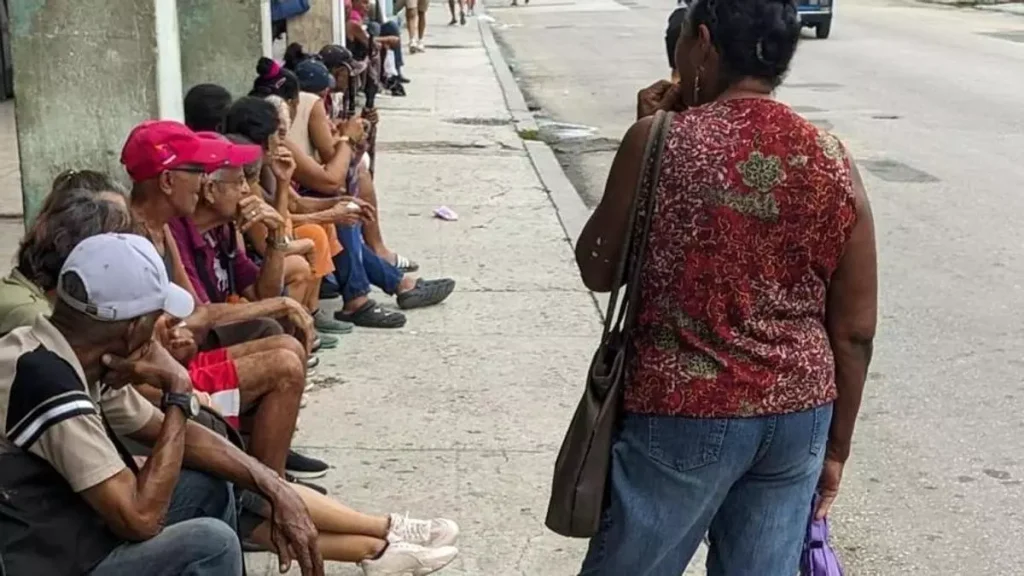
Dengue Patients Die in Cuba While Honduras Now Has a Vaccine

A woman with dengue died in La Benéfica in Havana “for lack of medical care”

Miguel Enríquez Surgical Clinical Hospital, known as La Benéfica, in the Havana neighborhood of Luyanó, where Days María Jiménez died / 14ymedio

14ymedio bigger14ymedio, Madrid, 18 October 2024 — The case of Days María Jiménez, who died last Monday at the Miguel Enríquez Surgical Clinical Hospital, known as La Benéfica, in the Havana neighborhood of Luyanó, gives the measure of the dengue situation on the Island. The woman, her son Yasmanis said on social networks, “was not treated by a doctor or a nurse” since the time she arrived at 10:30 pm on Sunday at La Benéfica, by ambulance from a polyclinic in Guanabacoa, until she died the next day, at 5:30 am.

As Raysa Juan Delgado, a friend of the victim, emphasized on Facebook, Jiménez died “for lack of medical attention”: “She was taken twice by the neighbors to the nearest polyclinic. Even vomiting blood, with fever, without tasting food and with many headaches, they return her to the house, because they told her there is no medication. Upon arrival she lost her balance and fell to the ground, hitting her head. When they took her [to La Benéfica hospital] there were no nurses or doctors to take care of her, and by the time her neighbor arrived, she was already dead.”

Jiménez’s son, who was on Isla de la Juventud and immediately purchased a ticket to go to Havana, says that his mother’s neighbor informed him of the death and that no doctor would answer his call. “I wanted to die on the boat. I arrived at the terminal at almost three in the afternoon and from there I went to the hospital, and they didn’t let me see her until the forensic examiner arrived. At eight o’clock at night I was finally able to see her on a bare iron stretcher, without sheets or anything.” continue reading

“My mom has been dead for 38 hours, and these sons of bitches want money to process my mom because they say there are no cars

From there, they sent him to a precarious funeral home in Guanabacoa. Despite the fact that at six in the morning he was told that she was cremated at 12 noon, at seven in the evening they had not yet picked up the body. “My mom has been dead for 38 hours, and these sons of bitches want money to process my mom because they say there are no cars [hearses],” he said angrily, begging for help and asking for justice.

Although on Wednesday the Government declared, through the national director of Epidemiology, Francisco Durán, that 17,000 admissions for dengue had been registered on the Island, including 3,400 hospitalized and a number (not mentioned) in intensive care, experts estimate a considerably higher figure.

This is confirmed by several Cuban doctors cited by Martí Noticias. “There are hundreds of thousands of cases, and the health infrastructure is extremely disadvantaged, to say the least,” Eduardo Cardet said from Velasco, in Holguín. “They advise people to isolate at home, and conditions at home are even more difficult, and the lack of medication is critical.” For this doctor, both the dengue and Oropouche viruses are “out of control,” and “the authorities and the health system do not have a contingency plan to reduce such a terrible impact.”

Roberto Serrano, a doctor in Santiago de Cuba, also thinks that the official figures fall short: “There are countless numbers of people who do not even take the trouble to go to hospitals, and for those who do go there is nothing; nor are there reagents to do a test, so they simply send them home.

Miguel Ángel López Herrera, from Guantánamo, told Martí Noticias that “only the most serious cases are being admitted, with danger to life.”

TAK-003 vaccines, developed in Japan, will begin being applied in Honduras next week

Guantánamo, Santiago de Cuba and Camagüey are precisely the provinces most affected by the disease, according to Francisco Durán. The epidemiologist insisted on the importance of going to the doctor when you think you have the disease, although he implicitly admitted that it may not be determined with an analysis. “It’s not that they do an analysis and tell you it’s this or that [but] it’s good to go and have them do a clinical assessment, especially for children,” he urged.

Asked about the reasons that make the assessment for minors more necessary, the doctor said that it is an arbovirus that worsens at great speed at those ages. “We all have to go, but children, generally, need to be admitted even if they are not serious, because their cases get complicated much faster. Dengue has the particularity that, at a certain moment you are well, the warning signs begin and, if at that moment you are not hydrated – which is the medicine, the hydration – unfortunately you die,” he said.

This is what happened, for example, in the case of journalist Magda Iris Chirolde López, editor-in-chief of Canal Caribe, who died at only 33 years of age from dengue complications, while waiting to be treated in a hospital in Havana.

In contrast, and in the meantime, Honduras, governed by Xiomara Castro, an ally of Havana, received this Thursday a batch of 52,000 vaccines that will allow it to mitigate the onslaught of the same arbovirus, which has left at least 194 dead in that Central American country so far this year.

The TAK-003 vaccines, developed in Japan, will begin to be administered in Honduras starting next week in educational centers with higher rates of dengue incidence. Health authorities reported in a meeting with journalists that they plan to immunize at least 25,000 minors between the ages of 5 and 16 years old.

Honduras’s Deputy Minister of Health, Nerza Paz, explained that her agency has invested around 25 million lempiras (one million dollars) in the purchase of these vaccines, about which there is no news, for the moment, in Cuba.

Translated by Regina Anavy

____________

COLLABORATE WITH OUR WORKThe 14ymedio team is committed to practicing serious journalism that reflects Cuba’s reality in all its depth. Thank you for joining us on this long journey. We invite you to continue supporting us by becoming a member of 14ymedio now. Together we can continue transforming journalism in Cuba.