At Least a Thousand Cubans Are Among the Migrants Stranded in Tapachula Due to Delays in Procedures

Migrants of various nationalities in the Miguel Hidalgo Central Park in Tapachula, Chiapas / Facebook/Escenario Noticias

14ymedio bigger14ymedio, Ángel Salinas, Mexico City, 9 October 2024 — The delay in the response to appointments through the CBP One application keeps Cubans Alexander Mori and Bárbara García stranded since August in Tapachula, Chiapas. “Several Venezuelans received the answer in four days, but I, who carried out the procedure two months ago, have not had an answer,” Mori tells 14ymedio. The migrant defense lawyer for José Luis Pérez tells this newspaper that there are at least a thousand Cubans in the same situation.

This 27-year-old from Havana says that he has carried out the procedure up to three times; the last one was on Thursday, September 26. “We are desperate, people come and go, but we are still here, without moving.”

Pérez says that Mori, like other migrants, made a mistake: they have to wait for a response after making the appointment. “Every attempt starts from scratch; they must be patient,” he urges.

During his stay in Tapachula, Mori met Bárbara García in the Miguel Hidalgo Central Park. Originally from Matanzas and 29 years old, she was arrested in a raid by Immigration agents on September 2 and admitted to the Siglo XXI migratory station. The Matancera was traveling with her father and a nephew, but while she was detained they received a response to her CBP One appointment and moved her to the International Guardhouse in San Ysidro, Tijuana. continue reading

The parish priest Heyman Vázquez attributes the increase in the migratory flow to the “delay” in the procedures / EFE

“My family is already in Texas, they have managed to fulfill the dream, but I’m still here, waiting for an answer to the appointment,” he says. García spent 20 days locked up, “threatened with a deportation if she did not pay 1,000 dollars.” Her nephew was able to visit her after the National Institute of Migration (INM) granted him the multiple migratory form, a 20-day conditional stay permit that allowed him to travel to the border.

“One day the agents arrived, gave us a list and released us. I immediately completed the procedure and I am waiting for an answer,” he says.

The director of the Center for Human Dignity, Luis García Villagrán, told Diario del Sur that there are currently 45,000 migrants, most of them from Venezuela, Nicaragua, Guatemala and Cuba, stranded in Tapachula. The common denominator of these groups is “political and religious persecution, xenophobia, violence, insecurity, poverty and lack of opportunities.”

The parish priest of the municipality of Suchiate, Heyman Vázquez, attributes the increase in the migratory flow to the “delay” in the procedures. The religious leader denounced the lack of attention by the INM, which caused people to be exposed to gang violence.

“The State ignored the situation of violence in the region, as well as its obligation to investigate and sanction human rights violations,” says the parish priest. The “crimes of public agents” and Migration are widespread, both for “omissions and in collusion with criminal groups.”

Translated by Regina Anavy

____________

COLLABORATE WITH OUR WORKThe 14ymedio team is committed to practicing serious journalism that reflects Cuba’s reality in all its depth. Thank you for joining us on this long journey. We invite you to continue supporting us by becoming a member of 14ymedio now. Together we can continue transforming journalism in Cuba.

Cuba’s Official Press Presents El Taiger as a ‘Victim of the Violence’ Prevailing in the US

Despite its aversion to reggaeton, the Cuban regime allows rallies of support for El Taiger

Both in Miami and on the Island, Cubans have held several events in honor of the musician. / Instagram

14ymedio bigger14ymedio, Havana, 6 Oct0ber 2024 — In an unusual gesture, the Cuban official press covered the news this weekend of the attempted murder of the singer José Manuel Carbajal Zaldívar, known as El Taiger, last Thursday in Miami. The unusual interest of the state media comes despite the fact that the music of reggaeton singers is frequently censored and demonized on television and radio on the island.

Carbajal Zaldívar was found on Thursday shot in the head and lying in the back compartment of a black Mercedes Benz van, which was abandoned two blocks from Jackson Memorial Hospital in Miami. Paramedics had to remove him from the vehicle through the trunk and, according to local press, they also found two gallons of gasoline that they suspect could have been used to set the car on fire.

Since then, the reggaeton singer has been fighting between life and death at the Ryder Trauma Center of the same hospital, where he remains hospitalized in intensive care. The medical prognosis remains reserved due to the severity of his injuries, which forced him to undergo emergency surgery.

This Saturday, Cubadebate was quick to portray the singer as a “victim of a society as violent as the American one” and, with a marked ideological tone, emphasized that there was never a veto on the part of the Government to speak about the case. In the comments provided at the bottom of the article, some readers took continue reading

advantage of the space to wish the singer a speedy recovery and applauded the fact that the official newspaper addressed the issue.

In its Sunday edition, the also official ‘Vanguardia’ dedicated a space to talk about the musician

In its Sunday edition, the also official Vanguardia dedicated a space to talk about the musician regarding the incident, which is being investigated as an attempted murder. Through a column signed by Francisnet Díaz Rondón, the official newspaper highlighted the popularity of the artist’s songs among the public on the Island and recounted some little-known episodes of “altruism with the most needy and sick” carried out by the reggaeton singer “through sincere and authentic actions.”

Similarly, the regime was also unusually permissive in the face of a series of public displays of support by El Taiger’s followers on the island, who took to the streets on Friday and Saturday to show their affection for the singer and to pray for his speedy recovery.

In Havana, hundreds of people gathered at La Cascada on 23rd and Malecon carrying candles and praying for the singer’s health. Other Cuban reggaeton singers such as Mawell and Charly & Johayron were also present at the event. Similar scenes occurred in Santiago de Cuba and Guantanamo, where the musician’s followers walked and sang his songs in the streets. In Miami, another vigil took place outside the hospital where the reggaeton singer remains hospitalized.

Miami Police Chief Manuel Morales revealed during a press conference held on Friday that a man linked to the music industry and close to the reggaeton singer is the main suspect in the attack. He is Damian Valdés, better known as El Narra. According to preliminary reports from the authorities, the musician was one of the last people with whom the singer had contact before being attacked.

According to the motel registry where the victim stayed the night before the incident, it was Valdés who made the payment for the service. He has not been formally charged yet, but was declared a “person of interest.”

Miami Police informed the media that they know the identity of the owner of the car where Carbajal Zaldívar was found injured.

Miami Police informed the media that they know the identity of the owner of the car where Carbajal Zaldívar was found injured, but did not reveal more details to avoid compromising the progress of the case. “Our officers are investigating because we think this did not happen in the city of Miami. We are sure that it did not happen on that corner where the car was found. This happened somewhere else, someone took him there, left him and left on foot,” local police spokesman Mike Vega told Telemundo.

Miami-based lawyer Miguel Inda-Romero, who specializes in immigration issues, announced that he will process a humanitarian visa so that the reggaeton singer’s daughter, who lives in Cuba, can travel to the United States and be with her father. According to Telemundo, Inda-Romero emphasized that, despite not agreeing with some of the artist’s decisions in the past, she believes that “the girl is not to blame for anything, and it is our duty to help her.”

Before the attack, the artist led an ostentatious lifestyle and did not hesitate to boast about his money and his weapons on social media. He also bragged about his cocaine use and was involved in episodes of violence against other artists. In recent years, the singer was often featured in Cuban media based in Miami for his constant trips to and from prison, after facing charges for various crimes such as drug possession, armed robbery and assault.

Carbajal Zaldívar, who was part of the duo Los Desiguales with another artist nicknamed Damián, was especially popular in Cuba between 2014 and 2019. Back then, his stage name was El Príncipe. His music, mainly of the urban genre, was played at school parties and spaces for teenagers and young people.

____________

COLLABORATE WITH OUR WORKThe 14ymedio team is committed to practicing serious journalism that reflects Cuba’s reality in all its depth. Thank you for joining us on this long journey. We invite you to continue supporting us by becoming a member of 14ymedio now. Together we can continue transforming journalism in Cuba.

Three Garbage Dumps in Havana ‘Collapsed’ After Exceeding ‘Authorized Height Levels’

  • Tires, batteries and spare parts are lacking for the 28 garbage trucks donated by Japan
  • Due to the shortage of personnel, prisoners have been ordered to perform these tasks
  • The La Güinera market is closed for a month due to the poor sanitary conditions
Garbage accumulates in the streets of Havana, as the independent press has been denouncing for more than a year / 14ymedio

14ymedio bigger14ymedio, Madrid, 7 October 2024 — After rebuffing the insistent reports from the independent press for more than a year about the disastrous situation of garbage collection in Cuba – more specifically in Havana – the State media have begun to pay attention. This Monday they published their third consecutive analysis of the issue, which has become alarming, according to them. All three landfills in Havana, without exception, “collapsed,” admits Roberto Cárdenas Santos, technical deputy director of the Provincial Company of Communal Hygiene, who also confirms that they exceeded “the authorized height levels.”

His boss, Alberto Ernesto Rodríguez García, maintains that the main problem affecting the capital is “the technical coefficient of the collection equipment, mostly stopped due to lack of tires, batteries and spare parts that have been deteriorating.” The official told Cubadebate that an expenditure of seven million pesos has been approved to acquire between 300 and 400 tires and 126 batteries. “With these, all the equipment that is working in the city could be repaired, and we would have a better sanitation situation,” he says. In addition, a container of parts has been imported for the Narciso López Roselló Equipment and Applications Company, where specialized equipment and other trucks are repaired and maintained.

Nothing allows us to ensure that this is the end of the problem. The managers of Comunales maintain that fuel is not an inconvenience in this case, since the company has a guaranteed allocation. Trucks have an average of 1 or 1.2 liters of gasoline reserved for each cubic meter collected, which is no small thing taking into account the widespread shortage for most industries and homes. continue reading

Trucks have reserved an average of 1 or 1.2 liters of gasoline for each cubic meter collected

However, the 28 trucks that were donated from Japan in 2019 suffer pressing needs. “There is a significant deficit of parts to support this equipment. Although maintenance was done on time, several trucks began to fail, and those that were left had to replace the others and were overexploited,” adds Rodríguez García.

In addition, waste collection suffers from one of the great evils that weighs on the already impoverished national economy: the shortage of personnel. This Monday’s report in Cubadebate speaks of a “labor fluctuation,” as they have decided to designate this new euphemism for the lack of workers caused by the massive emigration of the last two years, especially among people of working age. Thus, “the court has given them the ability to hire prison inmates, the main workforce today that takes care of garbage collection activity,” reveals the newspaper.

There are two other difficult jobs that the prisoners must assume: the collection of charcoal made from the marabou plant and the cutting of sugar cane. The Cuban regime resorts to these prison workers to cover vacant positions, a fact that has been denounced by organizations such as Prisoner Defenders. Tomoya Obokata, special rapporteur on the UN’s Contemporary Forms of Slavery, deplored this method.

Although the Government approved new labor laws at the end of 2023 to regulate the working conditions of prisoners and guarantee them new rights, sentencing prisoners to “correctional” work – included in the Criminal Code – is prohibited in most Western countries.

Workers are not the only deficiency facing the Government. There is one that is even more worrisome: a lack of the faithful. “We are being affected by the deficit of professional staff for the management of communal services. Cerro, Centro Habana and Plaza are without directors. Arroyo Naranjo and Boyeros also have problems. With a lack of central personnel, the control structure crumbles. The rules are there for a reason, because you don’t collect just to collect; there is a mechanism for providing quality service,” says Rodríguez García.

“With a lack of central personnel, the control structure crumbles. The rules are there for a reason, because you don’t collect just to collect; there is a mechanism for providing quality service”

This absence, he insisted, affects the organization and the awareness of citizens, whom he also urged to do their part to maintain hygiene.

Among the most affected municipalities, Cubadebate deals specifically with Diez de Octubre, where this Friday Cuban President Miguel Díaz-Canel went in person to supervise the mountains of garbage. Arroyo Naranjo is also mentioned, among others, where the Municipal Administration Council has been forced to make an unprecedented decision: to close the La Güinera market for one month due to the sanitation conditions, although they also mention the importance of “individual activity.”

“During this period, actions will be carried out by the different entities involved in the repair of dumpsters, pipe leaks and roads in the area,” the government of Havana announced on social networks. Merchants have regretted the suddenness of the situation, which forces them to store merchandise that can be damaged during this time, although most users have applauded a decision that improves the precarious health situation in the area and ask that it be generalized throughout the capital.

This Monday’s report clarifies the seriousness of the situation when Cubadebate does not mince words to describe it: Stench, mountains of solid waste, rodents, diseases and garbage that “springs from the city like one more limb.” “It is an issue that concerns everyone,” it continues, “and if everyone, authorities and citizens, don’t add a grain of sand, Havana cannot be that marvelous city that it aspires to be.”

Translated by Regina Anavy

____________

COLLABORATE WITH OUR WORKThe 14ymedio team is committed to practicing serious journalism that reflects Cuba’s reality in all its depth. Thank you for joining us on this long journey. We invite you to continue supporting us by becoming a member of 14ymedio now. Together we can continue transforming journalism in Cuba.

‘Get Out, Before the People Rise Up With Uncontrollable Fury,’ Warns a Cuban Priest

Priest Alberto Reyes accuses the regime of committing “a silent genocide”

The parish priest enumerated the insecurities of life in Cuba / 14ymedio

14ymedio bigger14ymedio, Havana, 6 October 2024 — The columns published by the Camagüey priest Alberto Reyes every Sunday have made him the spokesperson for Cubans who do not dare to speak publicly. “My words are not a cry of violence; they are not an aggressive outburst,” says Reyes in his text. “I have been thinking” – the title he uses – “that this week I will ask the leadership of the regime to leave.”

The priest, whose open demands to the Government have cost him reprimands from both the Church and State Security, did not hesitate this Sunday to address, not Cubans – as he always does – but the rulers of the Island. “Get out, take all you want and leave this country forever,” Reyes wrote and urged them to do so “before, somehow, things change and you can be tried and accused of crimes against humanity, because what you have done and are doing to the Cuban people is a silent genocide.”

“You are not going to revive this country; you are not going to remedy the lack of fuel nor the instability of the thermoelectric plants; nor are you going to give us back a life without continuous blackouts,” said the priest, who continued to lengthen the list of insecurities that Cubans experience.

Inflation, hunger, shortage of medicines, deplorable medical care, lack of basic supplies, educational damage, agricultural debacle, galloping emigration, accelerated aging of the population and the lack of “a national project” were the reasons the priest gave as the prelude to a social explosion. “Get out, before these people reach the end of their endurance, rise up with uncontrollable fury and carry out the demise of this system by destroying everything they find in their path with blood and fire,” he warned. continue reading

The priest has his ministry in Esmeralda, a town of Camagüey with 30,000 inhabitants

“Every day without light, without water, without food; every day with food for the children spoiled, with the omnipresent scarcity and the desire for freedom. This is what you do with blind and excessive violence,” Reyes stressed.

The priest has his ministry in Esmeralda, a town of Camagüey with 30,000 inhabitants. From his parish, where he was sent for his “problematic” positions, Reyes has denounced the situation of Cubans and the helplessness to which the regime has subjected them. Every anti-government demonstration or protest that has been unleashed in recent years has found in the priest a voice of support.

Last May, the parish priest began to ring the bells of his church 30 times whenever there was a blackout in the town. This newspaper managed to record the bells, which represented the “agonizing death of our freedom and our rights, the suffocation and sinking of our lives.” A short time later, because of a warning from State Security, his superiors forbade him to ring the bells again.

Reyes has not ceased, however, to ask for a change in Cuba, and this Sunday his claim has been forceful: “Live where you want and can do it, so that we too may live.”

Translated by Regina Anavy

____________

COLLABORATE WITH OUR WORKThe 14ymedio team is committed to practicing serious journalism that reflects Cuba’s reality in all its depth. Thank you for joining us on this long journey. We invite you to continue supporting us by becoming a member of 14ymedio now. Together we can continue transforming journalism in Cuba.

In Cienfuegos, Cuba, They Take Advantage of the Work Day To Stand in Line

Line at a Pan-American store, in Cienfuegos / 14ymedio

14ymedio bigger14ymedio, Julio César Contreras, Cienfuegos, 7 October 2024 — Surviving in Cuba is a matter of strategy, money and a lot of time to dedicate to hunting for food and basic necessities. Cienfuegos is no exception. And, if at noon there is nothing left to buy in the shops, the normal thing is that during working hours, especially in the mornings, workers run out in search of food, and State companies are left without a soul.

The counterpart of empty institutions are the crowded lines that form in the portals of stores and premises of all kinds. Bakeries, ATMs and agricultural markets have the longest ones.

“The only thing I’ve done at work today is sign the entry card. I left thinking I would solve things quickly, and here I am, waiting to see if I can pick up the bank card I ordered three months ago,” says Tamara, irritated. Although she is at the branch of the Banco Popular de Ahorro, on San Carlos Street, she already has her eye on another line at the La Princesa market to buy cookies for her children’s school snacks. “It’s impossible to do two things at the same time, and when it comes to choosing, I give priority to mine,” she says. continue reading

Tamara has managed to buy the cookies at the market, but the line at the bank is still stalled / 14ymedio

The lines do not originate just from the demand for sought-after products. It also results from the slowness of the salesclerks and officials, who take “all the time in the world” to attend to people. According to Tamara, excessive delays to serve the public are a common denominator, and it’s the same at the box office of the Terry Theater, on the waiting list of the bus terminal, or in the pizzeria of El Prado. “The place may vary. What does not change, in any case, is the terrible customer service.”

Standing in line in the city begins long before eight in the morning. Juan Carlos knows this very well; for some months, he has been saving places in the line outside the Cadeca (Currency Exchange) for those who are willing to pay the price of his time. “I take advantage of the fact that I work as a custodian near here. If I have to spend the early morning awake anyway, there’s nothing better than looking for some extra pesos by helping others,” he explains. He gets no less than 4,000 pesos every time he spends the night awake.

Juan Carlos is dedicated to saving places in the line outside the Cadeca / 14ymedio

Juan Carlos recognizes that, during the day, it is inevitable to be trapped in a purchase or procedure that seems endless. “I leave the Cadeca with a little money in my pocket, but then I arrive, for example, in the post office line to collect my mother’s retirement, or I stand in a very long line to have five or six scoops of ice cream at Coppelia, and the day goes on like that,” he says.

For her part, Tamara has managed to buy the cookies at the market, but the line at the bank is still stalled. “Several people arrived here after me and resolved it quickly with friends who work there. Then you realize that many people sneak in front of you claiming pregnancies, physical impediments, surgeries and all kinds of excuses, and to hell with the rest of us who have been waiting for hours.” Tamara looks at her watch with concern. “My boss doesn’t know that I left, and I’ve been here for a long time,” she explains.

“You come to realize that many people sneak in front of you claiming pregnancies, physical impediments, surgeries and all kinds of excuses” / 14ymedio

When the sun beats down on people who are tired of waiting, a custodian leaves the bank with an announcement that everyone can guess. In other nearby places, the lines are also gradually dissolving, disintegrating from the pressure to return to work or because the products ran out and the shops and markets are closing. “It was to be expected that they would cut the power at any moment. I have lost three hours, and now I will have to come back another day,” says Tamara, resigned. “I should go back to my job, but there won’t be power there either. So, the best thing I can do is go home and take care of things there. Tomorrow will be another day.”

Translated by Regina Anavy

____________

COLLABORATE WITH OUR WORKThe 14ymedio team is committed to practicing serious journalism that reflects Cuba’s reality in all its depth. Thank you for joining us on this long journey. We invite you to continue supporting us by becoming a member of 14ymedio now. Together we can continue transforming journalism in Cuba.

For the Cuban Mind, Terse Questions

’Still life with a pig’s head’, painted in 1968 by Fernando Botero / CC

14ymedio bigger14ymedio, Xavier Carbonell, Salamanca, 6 October 2024 — Yes, I also got carried away by nostalgia and went to a Cuban restaurant in Madrid. I’m not going to say which one, because the life of an emigrant is hard, and setting up a business – a pitiful one, but I’m getting ahead of myself – is already quite indigestible. But a fish dies by its mouth and so did I. In general, since I arrived in this country I have led a fairly private life. I have gotten together with few Cubans, more out of my unfriendliness than my lack of patriotism, because abroad there is a taste for the national junk that I fight against like hell.

I will never forget that waiter who, idiotic and melancholic, wanted me to give him a box of Ramón Allones cigars that I had brought from the Island. They were limited edition cigars, in green cedar packaging, a farewell gift – I would never have been able to pay for those jewels – the last one of which I burned down a few weeks ago. But look, the lad didn’t want to smoke. He didn’t tolerate the taste or smell, but he inhaled the butt. He wanted the box, the ark of the alliance, to deposit the remains of his Cubanness. I promised him that I would send it to him as soon as I had a chance.

Everyone knows that Madrid is the new Miami. The lycras and flip-flops, the despicable “asere qué bolá” (whasup, dude?) that any Cuban offers as a password of origin, the watering hole and the gossip, have taken possession of Chamberí, Puerta del Sol and Barajas. In the clueless Spanish imagination, Cuba was at first a land of promise, then a communist paradise and now – as in Dian Fossey’s famous book – a good place to have a mojito among gorillas. My newly arrived compatriots fervently cultivate their image of the noble savage, or at least the savage part. They change country, but not what’s inside their heads. continue reading

I paid the price of being waited on in my accent and enjoyed tiny portions: socialist, regulated by the ration book

It is not illogical, therefore, that if someone opens a Cuban restaurant in Madrid, they proceed to recreate our misery on a gastronomic scale. I was – unpleasant journey in time and space – in a Havana restaurant, in an inn with peeling walls, Cuban bric-a-brac, photos of the Capitolio and el Morro. I paid the price of being waited on in my accent, I waited in vain for a glass for the beer – Crystal, packaged in Holguín! – and I enjoyed tiny portions: socialist, regulated by the ration book.

Of course I deserved it. A few blocks away there were two Asturian restaurants where I would have felt at home. Not because Asturias is for me a gastronomic homeland – which it almost is – but because a well-made stew of beans, pork and other ingredients will always remind a Cuban of his origins; a slice of quince with cheese or a rice pudding, grandma’s desserts; a grape liqueur with a cigar, the perfect ending to a lunch.

There was something sumptuous and generous in the Creole, something that the Regime castrated and that the exile should have preserved. Why do Cubans travel to Spain asking for hamburgers and Coca-Cola? Why have they been saving to buy a car the first year when there is so little need here? Why the rush to forget the best of the country and cultivate the most rude, the vulgarity inherent in Castroism, the impudencence of the “New Man“?

I was looking for an experience that would bring me closer to my past, and they made the present bitter

That Madrid restaurant was a perfect summary of all that. Dishes, the basics: tasteless stews, steak, tostones, dry congrí. I was looking for an experience that would bring me closer to my past, and they made the present bitter. It’s useless to ask for explanations or hit the table – plastic, of course, no stools – with your fists. There it was the Government’s fault; whose is it here? To the “lacón,*” laconic questions, Lezama would say.

Where can Cuba find itself? For a long time I thought it was in books, but looking for a country in the library, without a real experience, is an exercise in archaeology. A bolero is heard and forgotten; a cigar is smoked; a language is used; a son lives not on the Island that his parents abandoned but on another continent, under its flag.

I don’t think the Cuban, in his usual light-heartedness, will notice that this gentleness now means very little. Does anyone care? Not me; now you know. Over time one finds grace for oneself if not elsewhere. If I went back, I would be a stranger. If I stay here, there will always be an air of provisionality wherever I am. Almost an act of cheap magic, a snap of the fingers, and I left, as I vanished from that Cuban restaurant in Madrid. Wasn’t that what Martí was referring to before pronouncing, in the swamp, his best spell? “I know how to disappear.” And he did.

*Translator’s note: A “lacón” is a pig’s head; hence, the play on words.

Translated by Regina Anavy

____________

COLLABORATE WITH OUR WORKThe 14ymedio team is committed to practicing serious journalism that reflects Cuba’s reality in all its depth. Thank you for joining us on this long journey. We invite you to continue supporting us by becoming a member of 14ymedio now. Together we can continue transforming journalism in Cuba.

We Denounce the Increasing Repression of Independent Journalists in Cuba / Cubalex

Photo taken from nuevarevista.net site

Cubalex, 4 October 2024 — Cubalex denounces the increasing repression by Cuban State Security against independent journalists on the island. In recent weeks, attacks on freedom of the press and expression have increased in a worrying manner, constituting a systematic attempt to silence critical voices and limit the right of citizens to receive free and impartial information.

The authorities have resorted to tactics that include arbitrary detention, prolonged interrogation under duress, threats of lengthy prison sentences, and psychological torture. In addition, in these interrogations journalists have been forced to be filmed without their consent, violating their rights to privacy and dignity. In many cases, working equipment and money have also been confiscated, affecting both their ability to practice journalism and their economic stability.

These actions are clearly aimed at intimidating and forcing journalists to abandon their work. They constitute a direct violation of fundamental rights protected by international human rights instruments, such as the Universal Declaration of Human Rights and the International Covenant on Civil and Political Rights, commitments that Cuba should respect.

Cubalex, urgently calls on the international community, human rights organisations and all those committed to justice and truth, to demand an end to the repression against journalists in Cuba. To defend freedom of the press and freedom of expression is to defend the right of every person to know the truth about what is happening in their country.

Cubalex will continue to monitor the situation and offer support to journalists who have been affected, reaffirming our commitment to fight for the respect and protection of human rights in Cuba.

Translated by GH

Decimated by Robberies and Blackouts, There Is ‘Not a Soul’ in the Cienfuegos Library

“The place to which I dedicated most of my life is today the tomb of Cienfuegos culture”

Located between Prado and Santa Cruz streets, the building is an emblematic element of the architectural landscape of Cienfuegos / 5 de Septiembre

14ymedio bigger14ymedio, Julio César Contreras, Cienfuegos, 5 October 2024 — At least since the pandemic, Hilda feels that her workplace, the beautiful eclectic-style library of Cienfuegos, is a mansion that only she and her colleagues inhabit, for eight hours a day. Not only are fewer and fewer readers and students visiting, but hardly any efforts are made to make the institution part of the cultural life of the city again. “There are times when I walk through the corridors and the reading rooms and I don’t find a soul. Neither students who come to do homework nor researchers who are looking for manuscripts, and much less readers who want to borrow a book,” the cienfueguera, who after her retirement was again hired by the Roberto García Valdés library, tells 14ymedio.

Located between Prado and Santa Cruz streets, in the historic center, the building is an emblematic element of the architectural landscape of Cienfuegos. “It is a pity that this heritage jewel is being lost among the dust of old books, which in most cases no one consults due to their deterioration and obsolescence. To that must be added the continuous loss of valuable bibliographic funds,” laments the woman, who states that many volumes, considered valuable, have been lost due to theft or carelessness.

Most of her colleagues, who spend their days as bored as Hilda, have even lost interest in their work. “Many of today’s librarians don’t even know the history of the place where they work. To top it off, when a reader arrives, he usually can’t find what he wants because the librarians don’t know the catalog very well or do not pay attention to what the visitor wants,” she reflects. continue reading

Most of her colleagues spend their days as bored as Hilda / 14ymedio

Martha, a younger worker, agrees with Hilda that the work of the library is deficient but attributes the loss of public interest in part to other issues. “Nowadays Google search engines have an answer for almost anything. So the users decide not to waste their time with employees who show apathy and a noticeable ignorance of their work,” she says.

The employee believes that not only the budget but also the difficult economic situation and the frequent blackouts affect the visitors. “It is easier to access the Internet than to go to our lounges that, as if that were not enough, have few comforts. We have fallen far behind in terms of new technologies. We have not been able to offer attractive alternatives,” she says.

The discouragement of workers is also a sensitive issue. “The low salary offers little incentive, and professional motivation is scarce. Library Science is a very nice career, but to exercise it requires indispensable means. While everything in the world is digitized, we are still looking for pieces of cardboard to replace the torn files. The demotivation begins in here and has a negative impact on visitors,” says Martha, who confesses that even the working day has been reduced by half, because the library is dead in the afternoon.

“Our impact on the population is decreasing significantly. If we convene a book club or social gathering in the library, there will be only two or three attendees. We have had to organize directed visits of students, but even so, the statistics do not favor us,” adds the worker, who predicts that the disuse will accelerate the deterioration of the building, which is more than 100 years old.

The reading rooms remain empty all day / 14ymedio

Inaugurated on December 31, 1921, the building was originally the headquarters of the Society of Instruction and Recreation, Liceo de Cienfuegos. It was not until 1962 that it became the provincial library, nourished with the funds of the city’s old house of books. The building was even named a Cultural Heritage of Humanity Site.

“We never talk about the Republican stage (1902-1959), and it turns out that even the buildings where the institutions are located are works made by capitalism. It was nice to see the collection of books that existed in the early 60s. Everything was so well taken care of that it is impossible to compare it with the state in which it is today,” says Hilda, who could see in her beginnings as a librarian something of the former splendor of the Roberto García Valdés library.

“We no longer have the old book sections for Adults, Art, Music and Youth. Even Extensions, which was in charge of taking the reading material to the most diverse places, ceased to exist,” the woman recalls. “Regrettably, the place to which I dedicated most of my life is today the tomb of Cienfuegos culture.”

Translated by Regina Anavy

____________

COLLABORATE WITH OUR WORKThe 14ymedio team is committed to practicing serious journalism that reflects Cuba’s reality in all its depth. Thank you for joining us on this long journey. We invite you to continue supporting us by becoming a member of 14ymedio now. Together we can continue transforming journalism in Cuba.

Mexico Pays More Than 5,000 Dollars Monthly for Each of the 3,100 Doctors Hired From Cuba

A group of Cuban specialists being received in the state of Hidalgo (Mexico) / Facebook/Coordination IMSS Bienestar Hidalgo

14ymedio bigger14ymedio, Mexico City, 6 October 2024 — The Government of Mexico pays $5,188 per month for each of the 3,101 doctors it hired from Cuba to offer services in rural areas. The expenditure amounts to a total of 16,087,988 dollars each month. A large part of the money is used to cover transport services, food and lodging for doctors, the newspaper Reforma reported this Sunday.

Of that monthly payment, most of it – 4,015 dollars – is intended for food, lodging and transportation for the health workers, which represents an annual delivery of 149,406,180 dollars to cover only the per diem allowances of the Cubans. The media does not mention whether similar amounts will be paid for the 5,000 doctors that Mexico plans to hire.

The figures offered by Reforma, however, only add data to a well-known and criticized reality in the Mexican medical union: the Government prefers to pay foreigners rather than its national doctors.

In 2022, Mexican nurse Ricardo Rivas said that, for the 60 Cuban specialists who had arrived in the state of Nayarit, they were guaranteeing “accommodation, food and transportation,” in addition to meals, while for national residents they had eliminated “the food service” in hospitals. continue reading

Later, in February of last year, the Mexican Social Security Institute (IMSS) was called out for granting 43 Cuban specialists, sent to Michoacán, lodging in a double room that included “breakfast and buffet lunches,” in addition to “a la carte” dinners. The gift generated controversy among Mexican doctors and residents, who lack these free services.

Two Cuban doctors are located in the town of Mitepec, in the Mexican state of Puebla / Facebook/Dr. Olga Rosas Parra – Official

The same newspaper reported that the Andrés Manuel López Obrador Administration, which ended on October 1, favored four companies with contracts “for the logistics required by the doctors.” The company Pigudi Gastronómico, specialized in banquets, was the main beneficiary.

The last week of September, three other contracts were unveiled – if effect between July 2022 and 2023 – for which Mexico paid 23,227,156 euros for 610 specialists on the Island.

An official of the Institute of Health for Welfare (INSABI) – created by the López Obrador government to provide health assistance and free medication – told 14ymedio in 2022 that the Mexican government paid the Cuban government 2,042 dollars per specialist and 1,722 dollars per general practitioner.

Comercializadora de Servicios Médicos Cubanos S.A. de C.V., a Cuban company internationally accused of human trafficking, was in charge of concluding the contracts for the Cuban doctors.

Months later, it was specified that the person in charge of the logistics of the Island’s doctors in Mexico is Neuronic Mexicana, a subsidiary of Neuronic S.A Cuba. This company has been, since 2018, the representative for the products and services of the biotechnology and pharmaceutical industry of the Island and is under the presidency of Tania Guerra.

Translated by Regina Anavy

____________

COLLABORATE WITH OUR WORKThe 14ymedio team is committed to practicing serious journalism that reflects Cuba’s reality in all its depth. Thank you for joining us on this long journey. We invite you to continue supporting us by becoming a member of 14ymedio now. Together we can continue transforming journalism in Cuba.

Despite the Evidence, the Government Denies That a Russian Tanker Has Arrived in Cuba

“In no other country in the world is energy information given daily to the people,” said Cuba’s Minister of Energy and Mines

The PVT Clara, which sails under the flag of Panama, set sail from Russia on September 14 / Vesselfinder

14ymedio bigger14ymedio, Havana, 5 October 2024 — “No Russian ship with fuel is arriving in the country.” With that categorical statement, Cuba’s Minister of Energy and Mines, Vicente de la O Levy, denied this Friday that the PVT Clara tanker, coming from the port of Kaliningrad, had docked in Havana. The statement is surprising, since the ship – as indicated by maritime tracking applications – arrived on the Island on October 2, and this Saturday, now leaving, it had just passed through Cuban territorial waters.

The official press waited for the ship to leave Havana Bay to publish a special “podcast” on the energy situation, because – they pointed out – the “concerns of the population” have increased. The PVT Clara, which sails under the flag of Panama, set sail from Russia on September 14 and arrived on the Island last Wednesday. Its capacity is 20,831 tons.

In his speech, the minister assured that he is aware of “everything that is published and the comments” on social networks and in “national and official media.” “We even argue,” he added. “There are many comments that sometimes we can answer, and there are others that are very sensitive; we delay because we have to do a good analysis. Let’s remember that we have an enemy,” he said.

The ship arrived on the Island on October 2 and on Saturday had just passed through Cuban territorial waters / Vesselfinder

De la O Levy spent several minutes criticizing the “enemy” that “analyzes word for word” all the official statements to “provoke the population.” “They make that kind of insinuation to wait for an answer,” he said, continue reading

clarifying that he would not say anything unless it was a question from an “official” media. “And always analyzing what can be said,” he warned, knowing that the Social Communication Law, in force since this week, obliges leaders to offer the information requested by the official press.

“The Electric Energy System is a strategic issue, both for electricity and fuel, and that’s why it is very sensitive,” the official continued. He explained that he spends a lot of time reading “the opinions, the comments, the things that are written – the vast majority very correct and with concerns, some with suggestions, others looking to see what the future will be like.”

The daily report that the Electric Union offers on Cuban Television, said the minister, reports “what happened and what is going to happen, that is “its goal.” “It is a program of moments of crisis,” he admitted, praising his own initiative, because “in no other country in the world is energy information given daily to the people.”

“The situation is so tense that anything that happens during the day now varies the prognosis”]

But the program does not satisfy Cubans either, the minister complained, because “many people” think that the announced electricity deficit does not correspond to the severity that is experienced day to day. “It’s just a forecast,” he justified. “The situation is so tense that anything that happens during the day now varies the prognosis.”

Next, he listed the factors that can fail: from a component of a thermoelectric plant to the patanas – the recent fire in one of them caused the death of two Turkish workers in Havana. Everything depends on “the ships, railways, road transport of fuel, lubricants, spare parts and almost all the organizations involved in the country’s economy.”

But De la O Levy went further: “When you don’t have fuel reserves, any small detail counts: a ship that is delayed or a swell that prevents the docking of a ship causes fuel unavailability. That happens to us very often because we don’t have back-ups for our tanks. That’s why deviations from the morning forecast occur with respect to what really happens.”

Cuba is experiencing one of the many peaks of the energy crisis so far this year. The same day that the PVT Clara arrived in Cuba, the Reuters agency revealed the collapse of oil shipments from Venezuela, Havana’s main energy partner. Caracas sent 22,000 barrels of oil per day (bpd) to Cuba in September, a considerable drop compared to 33,700 bpd in June, the last month recorded.

This is a long way from the 56,000 barrels per day that Venezuela sent in 2023, thanks to the agreement signed in 2000 by Hugo Chávez and Fidel Castro. To compensate for this reduction, but without reaching the levels necessary to remain stable, the Island has increasingly resorted to the help of Russia and Mexico. The result: long blackouts that, for months, have not given the Cuban people respite.

Translated by Regina Anavy

____________

COLLABORATE WITH OUR WORKThe 14ymedio team is committed to practicing serious journalism that reflects Cuba’s reality in all its depth. Thank you for joining us on this long journey. We invite you to continue supporting us by becoming a member of 14ymedio now. Together we can continue transforming journalism in Cuba.

Cuban President Díaz-Canel Admits That the US ‘Blockade’ Is Not Responsible for All the Problems

 The ’politics of the cadres’ is ’the Achilles heel’ of the Party, and food production is ’the stone in our shoe’

The image of Miguel Díaz-Canel’s visit to Plaza de la Revolución that illustrates the cover of the State newspaper ’Granma’ this Sunday. / Granma

14ymedio bigger14ymedio, Madrid, 6 October 2024 — On Wednesday he was in Las Tunas, on Thursday in the Havana municipality of Diez de Octubre, on Friday in Santa Clara, and on Saturday back in Havana in the Plaza de la Revolución district. Cuban President Miguel Díaz-Canel has had a hectic schedule since returning from Mexico, where he attended Claudia Sheinbaum’s inauguration on Tuesday.

It is not unusual for the hand-picked president to make this type of tour of different corners of the Island, especially if something has happened in the place, such as after the passage of Hurricane Ian or the fire at the Supertanker Base in Matanzas. His speeches, both during these visits and at Party meetings, are usually marked by voluntarism and the usual reassignment of responsibilities: the United States blockade* is to blame.

However, his tone has changed slightly this week, in what seems to be a tour to calm the spirits of Cubans. “No one will give to us what we can do for ourselves,” he declared on Wednesday in Las Tunas, where he again called for “confronting the distortions that we have in the economy in the relations between the state and non-state sectors.” The “vices” that have appeared in “those necessary links,” he said, “require a clean-up and the establishment of responsibilities.” continue reading

There are 14,000 fiscal accounts in that province that have zero balance or little movement of funds.

There are 14,000 fiscal accounts in that province, he said as an example, that have zero balance or little movement of funds, which is a “window for tax evasion.” “2025 has to start with a more orderly scenario in that sense,” he stated, this time without mentioning any external enemy: “The moment is difficult, but it is not insurmountable; overcoming it depends on ourselves.”

The outlook he painted on Friday in Santa Clara was just as bleak, despite his usual stubborn tone: “We will get through this, and we will do so stronger, but we have to work hard.” In his hometown, Díaz-Canel had an “intense work agenda” that included meetings with provincial authorities and a pilgrimage to schools, recreational parks and state institutions. For the president, the “politics of the cadres” is “the Achilles heel” of the Party, and food production, especially of milk, “the stone in our shoe.”

This Saturday, in the Plaza de la Revolución, he was more forceful: “Things done badly are not contemplated, they must be faced with rigor.” This is the phrase chosen by the State newspaper Granma for its cover, although the photo that accompanies the headline is not the most fortunate, with the authorities contemplating an enormous hole in the middle of the street, apparently made by Aguas de La Habana (the Havana Water company), one of the state entities with the worst reputation among the residents in the capital.

One of the main missions in this Havana municipality – the most “central” of the capital, according to the official newspaper, with 141,000 inhabitants plus 30,000 in “floating population” and the oldest in Cuba, with almost 60,000 people over 60 years old – was the same as on Thursday in Diez de Octubre: to confront the proliferation of garbage dumps on the corners.

Díaz-Canel promised a “different moment in waste management”

As he proposed in Diez de Octubre, the hand-picked president “advocated for greater participation of the population in the sanitation work,” although he clarified that “this method will not be sustainable over time” and is only “the first response to the crisis situation that was generated in the capital with the issue of garbage collection.”

In this respect, Díaz-Canel promised a “different moment in waste management,” with “decisions that are being analyzed, including new foreign investment projects,” he said without providing details.

The leader also urged people to explain their problems “frankly.” “When we are insensitive, when we do not care about people, when there is apathy, when a complicated situation has been going on for a long time and no one comes to explain, to do something, people have to feel bad,” he said, without referring specifically to possible protests that, as on other occasions, may take place due to the unsustainable shortage of food, water, electricity and fuel.

And he acknowledged: “Many things have nothing to do with the blockade or with resources. They have to do with the way we organize ourselves, the way we take up the fight and say: we have to resolve this, we can deal with this.”

Translator’s note: There is, in fact, no US ‘blockade’ on Cuba, but this continues to be the term the Cuban government prefers to apply to the ongoing US embargo. During the Cuban Missile Crisis the US ordered a Naval blockade (which it called a ‘quarantine’) on Cuba in 1962, between 22 October and 20 November of that year. The blockade was lifted when Russia agreed to remove its nuclear missiles from the Island. The embargo had been imposed earlier in February of the same year, and although modified from time to time, it is still in force.

__________________

COLLABORATE WITH OUR WORKThe 14ymedio team is committed to practicing serious journalism that reflects Cuba’s reality in all its depth. Thank you for joining us on this long journey. We invite you to continue supporting us by becoming a member of 14ymedio now. Together we can continue transforming journalism in Cuba.

One of the Most Emblematic Sections of Havana’s Malecon Forced to Close Due to ‘Structural Damages’

The authorities did not report a date for the reopening of the section that goes from B to C street.

This morning, according to ’14ymedio’, several traffic police were guarding the forbidden area, but no significant damage was noted in the visible structure of the Malecón / 14ymedio

14ymedio bigger14ymedio, Juan Diego Rodriguez, Havana, 29 September 2024 — With several barriers to divert traffic, a section of Havana’s iconic Malecón has been closed since Saturday. According to a post on social media from the capital’s government, the sea intrusion caused by Hurricane Helene “caused structural damage to the road,” leaving the section from B to C street in need to repairs.

The area that poses a “danger to vehicle traffic” and where “total closure measures” have been applied is located in El Vedado, in the municipality of Plaza de la Revolución. The authorities did not offer a date for the reopening of the section and declared that it will be closed “until the work is completed.”

This morning, according to 14ymedio, several traffic police were guarding the forbidden area, but no significant damage was visible to the Malecón structure. Aside from a crack in the sidewalk that borders it, the wall seemed to be in the same state as always, eaten away by the sea and salt. continue reading

Beyond a crack in the sidewalk that borders it, the wall seemed to be in the same state as always, eaten away by the sea and saltpeter / 14ymedio

Located opposite the luxurious Grand Aston hotel, the closed section belongs to one of the most tourist-centric areas of the capital, where old and refurbished Chevrolets drive around. The area is, curiously, one of those that suffers the most flooding and sea intrusion every time there is a storm.

Nearby is the Girón building, a grey mass built in 1967 whose stairs are now a real danger for residents. The cement slabs intended to prevent people from falling have gradually come loose and the residents themselves have replaced them with pieces of railings or sheets of zinc.

In recent decades, the Malecón has undergone several repairs. One of a major nature was carried out at the beginning of the century by the government with the help of Spain, in which 14 blocks of the seafront were restored and the project even received an award at the 2nd Havana Architecture Biennial in 1999. Later, other works were carried out in 2016, 2020 and 2021, but humidity and the sea cause the area to deteriorate rapidly without the authorities being able to keep up with the maintenance.

The passage of Hurricane Helene also caused the closure of the road that goes from La Cabaña to the city, through the tunnel under Havana Bay. According to Minister of Transport Eduardo Rodríguez Dávila, the rains flooded the road and the drainage system, due to a blockage, was not working.

Earlier this year, the tunnel remained closed for several days after authorities announced that maintenance work would be carried out. However, the repairs did not last long and Rodríguez Dávila soon explained that they had finished 48 hours earlier. During a tour of the road, 14ymedio confirmed that the promised repairs had been nothing more than a little cement and paint on the most damaged sections of one side of the tunnel.

The minister then explained that work would soon begin on the opposite lane, but just five months later, drivers in the capital have to detour again due to problems on the road.

____________

COLLABORATE WITH OUR WORKThe 14ymedio team is committed to practicing serious journalism that reflects Cuba’s reality in all its depth. Thank you for joining us on this long journey. We invite you to continue supporting us by becoming a member of 14ymedio now. Together we can continue transforming journalism in Cuba.

Soup and Bread With Mayonnaise, the ‘Balanced Diet’ That Cuba Guarantees to the Poor

 The official press defends the work of the Family Care System, but the food is far from being the least bit healthy

The Family Care System offers meals for about 1,118 residents of Ciego de Avila. / Invasor

14ymedio bigger14ymedio, Havana, 1 October 2024 — If a balanced diet were made up of soup and bread with pasta, the State would not have to use so many resources to justify its precarious attention to “vulnerable people” and “social cases.” An article published this Tuesday in Invasor attempts to defend the social attention of the regime, which claims to “offer food guarantees, no matter how difficult the situation is,” but the reality the article depicts is different.

In Ciego de Ávila, the business group of Commerce, Gastronomy and Services manages 58 food distribution establishments which, however, accommodate only 1,118 diners from the Family Care System (SAF). The diet, according to the official newspaper, includes “rice, proteins, soups or stews, meats, salads and desserts” but, taking into account that “practically one hundred percent of what they offer is self-managed” and that they cannot charge more than 13 pesos per dish, it would be difficult to find two of these foods together in the same meal.

Amid the alarming State shortages, the provincial governments are forced to resort to all kinds of entities and companies that can provide them with a meal – regardless of its quality – to feed the “vulnerable.” continue reading

In a country that, after decades of scarcity, has lost all notion of gastronomy – and even its own cooking culture – meals are far from making up a nutritious dish.

In a country that, after decades of scarcity, has lost all notion of gastronomy – and even its own cooking culture – meals are far from being a nutritious plate. “Different types of bread with prices between 40 and 70 pesos, such as bread with pasta, with mayonnaise or with croquettes, as well as other more expensive ones, with Viking ham and sausage roll” is what is offered in “both in the Gastronomy cafeterias and outside of them, in districts, vulnerable neighborhoods and schools.”

To the cocktail of fats and sausages, are added chemical-based soft drinks, “Coral and canned drinks,” which are sold not only to the poor, but also in state hostels, “at municipal fairs and fairgrounds that exist in the main city, districts and Committees for the Defense of the Revolution.”

In the entire collection, there is no mention of foods that really form part of a healthy diet, such as fruits and vegetables, fish, nuts, cheeses, milk and natural drinks or shakes. Among the soups, peas – the legume of the poor – are the main ingredient on the tables of schools and hospitals, along with broth. Both, generally, are devoid of seasoning or substance.

“Sale of soups and pea stew at prices between 15 and 30 pesos per serving, white rice at 40 pesos,” lists the state offering that rarely includes any cuts of meat because, if it did, it would be impossible for the authorities to maintain low prices.

Some 15 companies from Ciego de Ávila are also responsible for providing food to the poor. “The Arnaldo Ramírez agricultural company sells in the towns of Ognara and Trucutú, La Cuba does so in Pesquería, the Agroindustrial Ceballos in the neighboring town, Ruta Invasora in Jicotea, Acopio in the neighborhoods of the city of Ciego de Ávila and the Turiguanó livestock company in the town of the same name,” says the newspaper. The mystery, however, lies in what foods they offer – if they depend on their own preparations – and what their cost is.

“Sale of soups and pea stew at prices between 15 and 30 pesos per serving, white rice at 40 pesos”

Only the information from the State company Acopio includes some data. “They deliver around 800 servings of soup a week. In addition, from Tuesday to Friday they hold fairs in places that are difficult to access to bring the products to families and in order to benefit teachers and health personnel, they go to universities, schools, hospitals and homes for children who lack parental care.”

According to the article, the authorities are not sitting around with their arms crossed. But in a country where the average monthly salary is equivalent to the price of a carton of 30 eggs, and shortages have driven many foodstuffs off the market, it is hard to believe that those with fewer resources can afford something resembling a “balanced diet.”

In an article published in February, 14ymedio reported on the situation of the Family Care System facilities in Holguín. “Sometimes there is no protein, although in the canteen where I work the workers are quite combative and they fight with the people from the municipality to get supplies, but it seems that it is becoming more difficult for them to get them,” said Tomás, an 81-year-old man, speaking to this newspaper. At that time, some 76,175 Cubans were registered with the Family Care System and attended the 445 canteens of this type on the Island.

____________

COLLABORATE WITH OUR WORKThe 14ymedio team is committed to practicing serious journalism that reflects Cuba’s reality in all its depth. Thank you for joining us on this long journey. We invite you to continue supporting us by becoming a member of 14ymedio now. Together we can continue transforming journalism in Cuba.

The Farmers of Sancti Spíritus, Cuba, Refuse To Sell Milk to the State After Four Months Without Being Paid

The reason for this strike is the lack of cash in the banks

The widespread opinion among provincial farmers is that the problem of non-payments will get worse / Escambray

14ymedio bigger14ymedio, Mercedes García, Sancti Spíritus, 5 October 2024 — Although the udders of the cows continue to give milk in Sancti Spíritus, the farmers of the province refuse to continue selling their production to the State. The reason for this is the lack of cash in the banks, which prevents them from receiving payment for the product. Without paper money, the farmers refuse to fulfill their commitments to the official companies.

“They are making fun of us apparently. On the one hand they tell us that we must comply with the rule of delivery, that this is a strategic sector for the country, and on the other they don’t give us our money,” a member of a dairy cooperative with more than a dozen farms located on the outskirts of the capital tells 14ymedio. “You can’t do that,” says the farmer, who prefers anonymity, with annoyance.

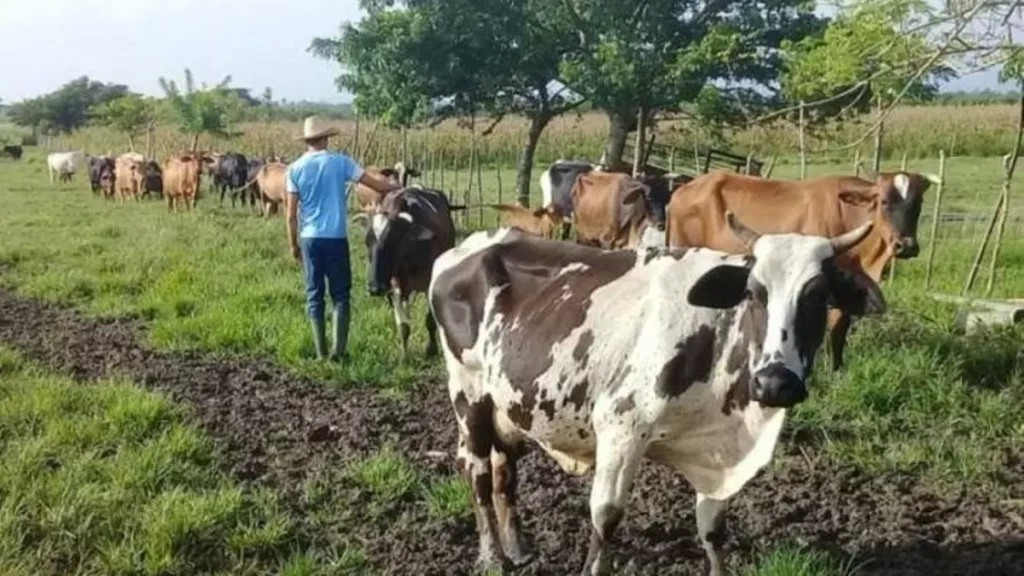
Each producer has a mandatory amount of milk that they must sell to the State company Combinado Lácteo Río Zaza, according to the number of animals they have and the average yield they have shown in recent years. Each liter of milk within that rule is paid at 75 pesos, and for each one that exceeds the assigned amount, the farmer will receive 38 pesos.

At the time of paying its debts, the Combinado deposits in the bank, either physically or electronically, the amount allocated to each cooperative. That money must be withdrawn from the bank branch by the administration of the cooperative, which will be responsible for distributing the income among its members according to what is contributed by each one. But “the umbrella gets jammed when it comes to releasing the money,” complains the farmer from Sancti Spíritus. continue reading

Being outside the official umbrella is also very complicated. Throughout the province there are 32 agricultural cooperatives that encompass most of the producers of meats, vegetables, fruits and milk. In the case of the cow owners, the pressures to join the cooperative system, the constant controls of the inspectors and the recent census of their animals make it almost impossible for them to exist outside the mechanism of State deliveries.

For the owners of cows, it is almost impossible to exist outside the mechanism of milk deliveries to the State

Last July, the Governor of the province, Alexis Llorente, said on the local radio that the “contracting of milk” with the farmers had been completed and exceeded 6 million liters. The official pointed out the indisciplines of the producers as one of the problems they had to overcome to comply with the annual plans but did not allude at any time to the situation of payments to farmers who were already in crisis at that time.

“The bank has been empty for months. It doesn’t have cash to give to the cooperative, and people don’t want electronic money because you have to pay for everything here with a wad of bills in your hand,” adds the farmer. “From the pound of rice that I have to buy to feed my family, to the salary of my employees, the money has to be tangible, not numbers on a mobile screen.”

After four months of delays and in view of the fact that the banking situation does not seem to be resolved in the short term, producers such as Mario, his name changed for this report, resident in the municipality of Jatibonico, has also joined the work halt. “I’ve been selling milk on my own for a couple of weeks; anyway, I don’t do business to sell it to the State because the payment is bad. That same liter of milk that I deliver after fulfilling my commitment, which they only pay me at 38 pesos, I sell on the street at 120,” he says.

It doesn’t seem that the banking situation will be resolved in the short term

The People’s Power delegate of the area “called a meeting to scold the farmers,” says the man. “He told us that we could not continue selling milk on the outside, but it fell on deaf ears because we live from what we manage to sell, and if the State does not pay us what are we going to do? Starve to death?”

Most of the milk that the State buys is distributed through the rationed market, for children under 7 years of age and people with specific medical diets who have the product allocated to them. The rest is sent to nursing homes and children’s daycare centers, where the food supply has suffered multiple oscillations in recent years.

Now, the most widespread opinion among provincial producers is that the problem of non-payments will get worse. “There is often no money even to pay doctors and teachers, who have to go to the bank several times to see if they can get their salary. Imagine what’s going to be left for us. Everyone wants to drink a glass of milk but that takes effort and expense; you don’t get milk from a cow by whispering in her ear and telling her that she has to fulfill the plan.”

Translated by Regina Anavy

____________

COLLABORATE WITH OUR WORKThe 14ymedio team is committed to practicing serious journalism that reflects Cuba’s reality in all its depth. Thank you for joining us on this long journey. We invite you to continue supporting us by becoming a member of 14ymedio now. Together we can continue transforming journalism in Cuba.

‘Cubanet’ Denounces a ‘Wave of Harassment’ Against Its Collaborators by the Cuban Regime

The online news source did not reveal the identity of any of those affected “to avoid further reprisals”

In recent months, several ’Cubanet’ collaborators have suffered outright harassment by State Security / 14ymedio

14ymedio bigger14ymedio, Havana, 4 October 2024 — A group of journalists and Cubanet collaborators has suffered “threats, intimidation, arrests and confiscation of work assets and money in recent days.” This was announced by the online news source in an alert published this Thursday, warning about the Regime’s “repressive escalation” after the new Social Communication Law went into effect this week.

Cubanet did not reveal the identity of those affected, “to avoid further reprisals,” but it reports that they were threatened with ” prison sentences” and consequences for their families. They have also been filmed by agents for hours – something they describe as “psychological torture” – and had their electronic devices and money taken away from them.

Although it admits that this is a “common tactic” of State Security, Cubanet draws attention to the “increasing wave of harassment,” not only against independent journalists but also against opponents who publicly denounce the country’s crisis.

The objective of the political police – “to suppress critical voices and avoid the dissemination of information not controlled by the State” – remains the same, but with the entry into force of the law the State has one more legal tool to repress, Cubanet points out. It is a “new instrument of the Cuban authorities to limit freedom of expression and access to information,” which has been condemned by several international organizations, such as the Inter-American Press Society. continue reading

The objective of the political police is to “suppress critical voices and avoid the dissemination of information not controlled by the State”

The truth is that, despite the law’s entry into force, the situation of the independent press remains as vulnerable and dangerous as that of the previous day. The exercise of non-state journalism was already punishable by the Constitution, the Criminal Code and Decree Law 370.

Responses cannot be demanded from leaders – a right reserved for State reporters – and any critical information provided is considered an act of “communicational aggression that takes place against the country” or an instigation to “terrorism and war in any of its forms and manifestations, including cyberwar.” Nor does the law provide new penalties, since it does not mention possible sanctions for those who break the law and refers to other documents to resolve each case.

Despite this, several independent journalists have already published statements on their social networks that imply that they have been intimidated and forced to resign from their work. This was the case of Yennys Hernández and Annery Rivera – collaborators of several media such as Periodismo de Barrio and Cuba Próxima – who said this Thursday that they would not “collaborate and/or participate in any media or project of an independent nature and/or considered subversive or contrary to the interests of the Cuban government.”

The situation is similar to that which occurred in September 2022, when at least 16 members of the El Toque team living in Cuba were forced to resign from their work on the newspaper. At that time, its managers denounced the “sick insistence” of the Cuban political police to obtain “confessions” on video from the journalists, which they then manipulated and broadcast on Cuban Television.

In recent months, several Cubanet collaborators have suffered outright harassment by State Security. This was the case of the Camagüeyan journalist José Luis Tan Estrada, who on Thursday held State Security responsible for “anything” that happened to him after the Regime’s “repressive escalation.” On the eve of the anniversary of the 11 July 2021 protests, Tan Estrada was arrested and interrogated. He was forbidden at that time to attend public places under the threat of going to prison for disobedience and contempt, or to publish statements about the date on his social networks.

However, Tan Estrada told the story of his arrest on his Facebook page. While connecting to the Internet in the Agramonte park in the city of Camagüey, he was approached by a political police officer who arbitrarily arrested him. He was transferred in a patrol car to the Third Monte Carlos Unit of the National Revolutionary Police where he was intimidated. “They gave me a warning letter, which I didn’t sign,” he said.

Journalist Camila Acosta and her partner, the writer Ángel Santiesteban, have also been harassed on several occasions for denouncing the involvement of State Security in the crisis that for nine months shook the leadership of Cuban Freemasonry. Acosta is responsible for the first reports on the theft, last January, of 19,000 dollars from the office of Grand Master Mario Urquía Carreño.

Acosta’s coverage of several meetings of the Freemasons put her in the crosshairs of the offensive that several Regime spokesmen, such as the so-called Cuban Warrior, carried out against the independent press. The Cuban Warrior not only tried to discredit Acosta’s work but also her personal life, spreading rumors and false information.

Acosta’s coverage of several meetings of the Masons put her in the crosshairs of an offensive from several of the Regime’s spokesmen

Santiesteban, for his part, was briefly arrested in July and accused by the official YouTuber of “revealing Masonic matters to the profane,” that is, to those not initiated in the order. Acosta denounced the arrest as “a direct affront to Freemasonry” and accused the police of giving the protest of July 23 – in which the Freemasons demanded explanations for the robbery – “a political connotation” to justify the arrest of several Freemasons critical of the Regime, such as Santiesteban.

The Cuban Warrior also launched the now usual accusation against Acosta and Santiesteban: that every independent journalist is an undercover agent of the CIA.

Translated by Regina Anavy

____________

COLLABORATE WITH OUR WORKThe 14ymedio team is committed to practicing serious journalism that reflects Cuba’s reality in all its depth. Thank you for joining us on this long journey. We invite you to continue supporting us by becoming a member of 14ymedio now. Together we can continue transforming journalism in Cuba.