Eyeglasses, Another Problem Cubans ‘Resolve’ Thanks to ‘Families in the Exterior’

In Cienfuegos you can only find material of dubious quality or at impossible prices in the private shops


In the optical shop on the boulevard the shelves are empty / 14ymedio

14ymedio bigger14ymedio, Julio César Contreras, Cienfuegos, 7 November 2024 — In Cienfuegos, optometrists are as scarce as the eyeglasses themselves. Plastic frames of poor quality from a dollar store in Miami is the most that those who are condemned to solve their vision problems within the Island can aspire to. For those who have relatives abroad, the answer is easier. A doctor is found to test the eyes, and the prescription travels to the United States or Europe, where relatives will assume the payment.

The shortage of specialists is not the only thing that affects ophthalmology in Cuba. It is a challenge to find eye drops for vision tests, and the measuring devices often don’t work. Therefore, it is not uncommon that in the Pediatric Hospital of the city, where the equipment is more or less better preserved than in other centers and some supplies still arrive, there are several adults waiting to be treated – alleging friendship or offering “gifts” – by an optometrist.

Maritza is one of them. She managed, through the friend of a friend, to have the doctor see her after months of suffering from headaches because her glasses no longer worked for her. With prescription in hand, the Cienfueguera prepared to go to the optician, but on the rickety shelves there was not a single frame that she could wear. continue reading

It is not uncommon that in the Pediatric Hospital, where the equipment is more or less better preserved, there are several adults waiting to be treated

“The first thing that surprised me was to see that the optical shop itself has rented a space to private cell phone repairers. I immediately knew that the other people and I were not there for the same thing,” the woman tells 14ymedio. Maritza approached the counter and handed the prescription to the clerk. “The lady, almost of retirement age, said that they only had small graduations available, and that I should return in a week to see if there was anything new.”

According to Maritza, for years she has seen that the shelves of the optical shop, located on the boulevard, are practically empty, with a few dull frames that don’t please the tastes of the needy. But she always thought that at least there would be some options, even if they weren’t better quality or in good taste.

On other occasions, Maritza also found it difficult to get glasses, but now she has no choice but to go to the informal market. “It’s a lot of work because I have different prescriptions for each eye. Sometimes it has taken more than six months for the manufacturing. For me it’s a very big economic sacrifice to pay for the service, but I have no choice but to do it,” she laments.

The premises of Ópticas Miramar is located two blocks from the store. Except that the payment must be made in hard currency, the attention to the public and the offers do not differ that much from the establishments that sell frames in pesos. “Supposedly the work will be finished in one or two days, but, in practice, it takes weeks to be able to pick up the glasses. Nor is there a variety of frames to choose from, so not even by paying dearly can you buy what you want,” says Idalmis, a retiree who left the shop disappointed.

At Ópticas Miramar there are more options, but the payment is in hard currency / 14ymedio

The client hoped to order some progressive lenses, but Ópticas Miramar has not been manufacturing them for months. “Street vendors often go around offering all kinds of stuff, but since I don’t know where they come from, I prefer to go to places where I can have a minimum of guarantees. In addition, they are usually poor quality and break easily, and the lenses look like plastic,” she says.

Finally, Idalmis found the glasses she was looking for in the home of some private sellers who are dedicated exclusively to eye products. “The glasses cost me 6 MLC [freely convertible currency] and can cost up to 20, depending on the type. It’s not that I have plenty of money, but since this is a necessity for me, I try to find something of quality because, undoubtedly, cheap becomes expensive,” she explains.

Some private businesses have also emerged in the city that manufacture graduated prescription glasses. “I went to a private optician in front of the Provincial Hospital. If I bring the frames, it costs me 5,000 pesos, and if I buy them there, it costs twice as much. With those prices it’s better to continue with my old frames, which are now missing an arm,” complains Tomás, who, for more irony, worked years ago in an optics store in Cienfuegos.

When I worked there, most of the frames and lenses didn’t reach the people”

“When I worked there, most of the frames and lenses didn’t reach the people, because the technicians kept the raw materials themselves for their private jobs,” confesses Tomás.

In the small stalls and houses that serve as improvised stores, graduated lenses cost between 800 and 1,200 pesos. Those specialized for serious vision problems, different measurements in each eye or other particularities cannot even be found or are extremely expensive. “If I calculate based on my salary, my wife and I would have to devote three entire monthly salaries to buying the glasses we need,” Tomás reflects. “Seeing or eating? That is the question.”

Translated by Regina Anavy

____________

COLLABORATE WITH OUR WORKThe 14ymedio team is committed to practicing serious journalism that reflects Cuba’s reality in all its depth. Thank you for joining us on this long journey. We invite you to continue supporting us by becoming a member of 14ymedio now. Together we can continue transforming journalism in Cuba.

Luis Tiant, the Cuban ‘Fred Astaire’, Nominated for the Baseball Hall of Fame

Also called ‘El Tiante’, the baseball player considered it “an injustice” not to have been included in the Hall of Fame

Luis Tiant is nominated to the second time to the Baseball Hall of Fame / Instagram/@realeltiante

14ymedio bigger14ymedio, Havana, 6 November 2024 — The legend of Cuban pitching, Luis Tiant ‘El ‘Tiante’, appears on the ballot of the Classical Era Committee that will meet on December 8 in Dallas to vote for the new inclusions in the Baseball Hall of Fame. For the pitcher from Havana, born in Marianao, to receive his commemorative plaque in Cooperstown, he needs 75% of the votes of the committee members.

If elected, Tiant would add his name to those of his compatriots Tany Pérez, Orestes Minnie Miñoso, Tony Oliva, Cristóbal Torriente, Martín Dihigo and José Méndez.

The name of El Tiante appears on the ballot alongside Dick Allen, Ken Boyer, John Donaldson, Steve Garvey, Vic Harris, Tommy John and Dave Parker, all with outstanding careers in the United States Major Leagues before 1980. “We will see if El Tiante enters the temple of the immortals,” journalist Francys Romero said on his social networks. “Although [the inclusion in the Hall] did not happen while he was alive, better late than never,” he stressed.

Tiant died at the age of 83 on October 8, and in life reiterated on several occasions his displeasure at not being included in the Hall of Fame. He even “asked his family not to attend any induction ceremony if it happened after his death,” said Pelota Cubana USA. continue reading

Tiant’s feelings for what he considered an injustice was recalled by ESPN in a publication on the day of his death. “I should have been in the Hall of Fame 21 years ago,” the legendary baseball player told the sports network in 2016. “The only thing [I want] is that they don’t put me on after I die. When you are alive you can enjoy it with your family, your children, your friends. But dead – you’re not going to enjoy it dead. That’s not good,” he said then.

Tiant recalled that a similar situation occurred with baseball player Ron Santos: “If they knew they were going to honor him, why did they wait for the man to die? At least give him the honor, that satisfaction, in life. It doesn’t matter if you die the next day.”

David Ortiz and Luis Tiant in a golf cart / Instagram / @realeltiante

In 1988, the Cuban pitcher was nominated for the Hall of Fame but got only 30.9% of the votes. Other efforts to include him were also unsuccessful, such as Tony Oliva’s demand for his inclusion in July 2022.

According to the Cuban right-hander, who deployed a rotating wind-up in his throws that confused his rivals, his father always reminded him that he could not return to Cuba because Fidel Castro “did not want him” on the Island, “so you stay here” in the Major Leagues. Tiant left the Island in 1959 to play with the Mexico City Tigers, where he was discovered by the Cleveland Guardians, who bought his contract for $35,000.

The Cuban later became an emblem of the Boston Red Sox (1971-1978), the team that introduced him into their Hall of Fame. In the Major Leagues he has a record of 229 wins and 172 defeats in his 19 active seasons, in which he also played for the New York Yankees, Minnesota Twins, Pittsburgh Pirates and Anaheim Angels.

Throughout his career he won 20 or more games in four seasons (21 in 1968, 20 in 1963, 22 in 1974 and 21 in 1976), in addition to the effectiveness title in the 1968 campaigns (1.60) and in 1972 (191). He also participated in three editions of the All-Star Games (1968, 1974 and 1976).

Tiant finished three times among the top six in the votes for the Cy Young award, which distinguishes the best pitcher of the season in the American League, and on two other occasions he was among the first eight contenders for the Most Valuable Player award.

Translated by Regina Anavy

____________

COLLABORATE WITH OUR WORKThe 14ymedio team is committed to practicing serious journalism that reflects Cuba’s reality in all its depth. Thank you for joining us on this long journey. We invite you to continue supporting us by becoming a member of 14ymedio now. Together we can continue transforming journalism in Cuba.

Mexican and Colombian Companies Do Business With the Cuban Private Sector

Some recognize that the situation forces them to maneuver more, but they plan to continue on the Island in the long term

Exhibition from Colombia at Fihav 2024 / EFE

14ymedio biggerEFE (via 14ymedio), Havana, 6 November 2024 — Latin American businessmen with a presence in Cuba said on Tuesday that, despite the deep crisis in which the Island is immersed, their commitment to the country remains long-term.

In a tour made by EFE at the Havana International Fair (Fihav), the main business event in the country, four representatives of companies from different countries in the region said that their firms will continue to look at the long term, although some did recognize that the situation has forced them to maneuver more.

Others stressed that the rise of private businesses has helped them maintain an acceptable level of sales.

Others stressed that the rise of private businesses has helped them maintain an acceptable level of sales

“If we didn’t have the private sector, we wouldn’t be exporting the amount we are exporting to Cuba today,” Ariel Morales, from the Mexican company Hidrogenadora Yucateca, dedicated to exporting edible oils and fats, tells EFE.

However, he clarifies that the volume of purchases made by the private sector does not yet reach the State levels.

That is not the case for the Colombian Avícola Santa Elena. Since July, it has exported 10 shipping containers of eggs to the Island and expects that this will be the monthly average in the future.

The product is scarce on the Island, and the cost for a carton of 30 eggs in private stores can cost more than 3,500 Cuban pesos. The average monthly State salary is 4,500 pesos. continue reading

In the case of Avícola Santa Elena, its manager, Alejandro Cabrera, hopes that they can soon become a much more important provider.

“It has been a very good experience that has opened the market to all Colombian poultry farming,” he told EFE.

The Fihav – with more than 700 participants from 63 countries, according to the organizers – opened its doors on Monday with a call from the Cuban Government for foreign investment, key to the country’s economic recovery. In addition to Spain, the presence of Russia, China, Vietnam and Mexico stands out.

“It’s always a challenge when you do business with another country. For us from Brazil, Cuba is no different.”

The country suffers from prolonged daily blackouts, inflation that has tripled formal market prices in the last four years and a public deficit of more than double digits, which has generated an unprecedented migratory wave.

Despite that scenario, Leonardo Ferreira of the Brazilian Interunion, dedicated to exporting equipment for the sugar industry – once the economic engine of the Island and in decline in recent decades – told EFE that the crisis has not been a factor when doing business.

“It’s always a challenge when you do business with another country. For us from Brazil, Cuba is no different. There are always difficulties working with other countries, but we manage very well,” he told EFE.

In the 19,000 square meters of the ExpoCuba fairgrounds, on the outskirts of Havana, Cuban companies predominate, both State and private. Among the foreign ones, the Chinese, Russian, Vietnamese, Mexican and Spanish stand out. Spain, with 63 companies, is the country with the highest representation.

Translated by Regina Anavy

____________

COLLABORATE WITH OUR WORKThe 14ymedio team is committed to practicing serious journalism that reflects Cuba’s reality in all its depth. Thank you for joining us on this long journey. We invite you to continue supporting us by becoming a member of 14ymedio now. Together we can continue transforming journalism in Cuba.

Academics, Engineers and Retirees Sell Their Goods in a Second-Hand Market in Havana

“Everyone is doing it, selling the belongings of family members who have emigrated”

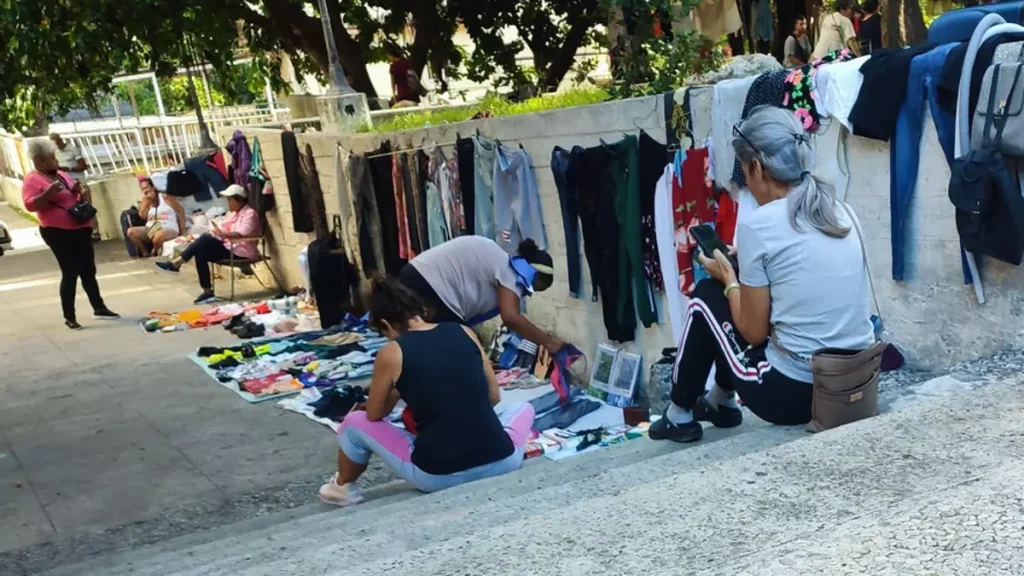
This Saturday, the improvised market was full of vendors and stalls / 14ymedio

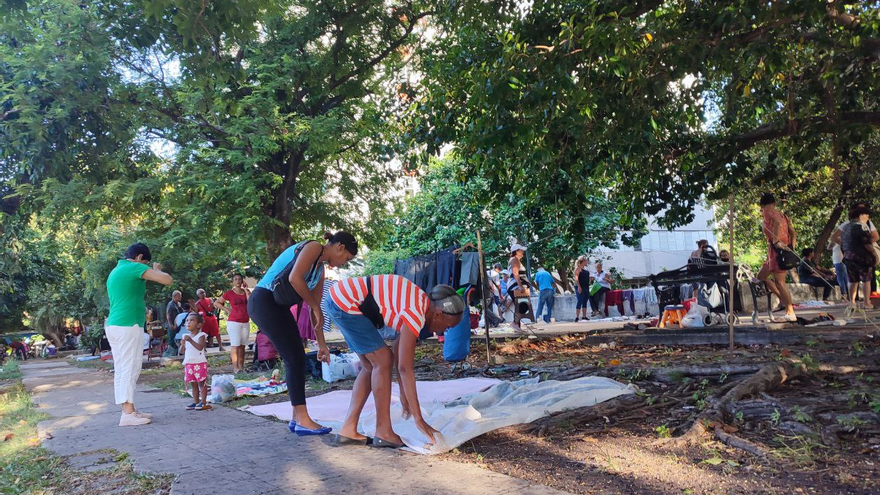
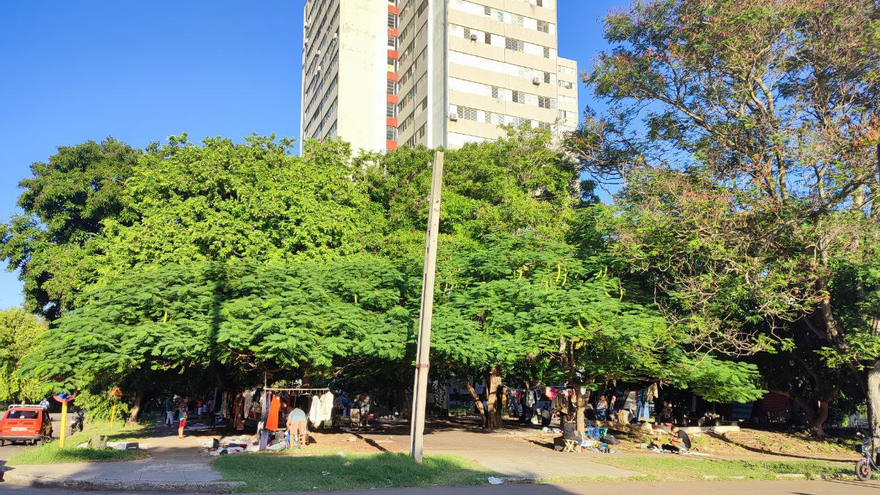
14ymedio bigger14ymedio, Natalia López Moya, Havana, 3 November 2024 — They arrive early; some spread a blanket but others simply used the stairs of a building to spread their goods. The flea market on the corner of Loma and Tulipán, in Nuevo Vedado, brings together dozens of residents every weekend. They are eager to make some money from the sale of used clothes and other belongings, mostly left behind by those who emigrated.

“I have baby and women’s shoes, plates, cutlery and some ornaments for the house,” offers Mirta, 75, a former radio worker currently retired with a pension of 1,600 pesos per month. “They are things that belonged to my daughter and my grandson who left in June,” she explains to 14ymedio. “But I haven’t sold much in the three Saturdays I’ve been coming,” she acknowledges

After ten in the morning, you can barely take a step on the access stairs to the park in front of two concrete blocks, 20 floors each. The buildings were built at a time when the Soviet subsidy allowed the rise of the microbrigade movement that left a permanent mark in Nuevo Vedado. But from those times only the huge buildings that are increasingly deteriorated remain.

I live right here, so I just have to walk a little, and as I arrive early, I choose a place where my products have more visibility from the sidewalk,” says Mirta. “What sells the most right now are suitcases, backpacks, coats and well-made sneakers. Everything that can be used to travel the route of the volcanoes (between Nicaragua and Mexico, to get to the United States) or go somewhere else is in demand, but the other things do not sell very much.”

The merchants start arriving at half past eight in the morning, every Saturday. “There are those who have more patience and stay until two or three in the afternoon, but others lose hope, and if they don’t sell much they leave at noon,” the woman explains. “It also depends on whether rain is coming or if there is a blackout, because on days when there is no electricity many people come down from the buildings because of the heat, and that increases the clientele.” continue reading

“At first you had to ask for a credential to sell, but now everything is more flexible. Anyone who comes can ask a neighbor, a school teacher, who is responsible for organizing this, to get assigned a space to put things down. There are even people who arrive and simply look for an empty space and put their goods down right there. No one objects,” adds Mirta.

The credential, a piece of handwritten cardboard, only has the name of the merchant, and in the time that Mirta has been bringing her products to the park “no one has come to check it,”or to see if she has it. “It’s a pure formality because everyone knows that those of us who sell here are not going to get rich; this is for daily survival, to eat.”

Near Mirta’s improvised point of sale, Manuel, 77 years old, has unfolded a colorful carpet from the time when, through his work in a cultural entity, he visited Peru with an official delegation. The carpet, in which diamonds, triangles and lines of different tones alternate, “is also for sale,” he says, but he retains his state employment. “From Monday to Friday I go to work and on weekends I’m here.”

Manuel’s goods are very diverse. Some wooden hookahs from when he still smoked, before a prostate cancer put him almost on the verge of death and convinced him to quit “certain bad habits,” he tells this newspaper. He also has many books of the boom period in Latin American literature that he has accumulated for more than half a century. “There are some first editions. If you buy more than one we can come to an arrangement,” he explains to a young man who approaches.

Gabriel García Márquez, Julio Cortázar, Alejo Carpentier and Juan Gelman are some of the names on the volumes. Right next to them, a sequence of used office supplies underlines the fact that Manuel’s is the sale of an intellectual. “The university degree, the academic publications and the official events have been of little use to me because here I am,” he says.

The flea market is full, without room for one more piece of merchandise / 14ymedio

Manuel has a daughter in Mexico but prefers not to ask her for “even a penny.” The young woman, newly married and with a small child, “already has her own problems. She can’t blame herself for not being able to support, in addition, an old man in Cuba.” So he is selling everything that once had some professional or personal value in his life: “That lighter was a gift from Nicolás Guillén; he used this frame with glass for his university diploma, and that bookmark was given to me in the National Library for a Day of the Librarian.”

Every little thing on Manuel’s carpet has a story, but he prefers to think about what he could buy if he manages to sell them. “I almost have enough for a carton of eggs, which is now more than 3,000 pesos, so if I manage to sell these boots, some rings of my wife that are quite beautiful and this frying pan, that’s enough for me.” But after two hours, he has barely managed to sell some kitchen handles and a doorbell button.

Now it’s almost noon, and on the steps and walls there’s no room for one more piece of merchandise on display. In the crowded flea market there are dresses, jeans, baby shoes, flip-flops, women’s bags, radios, hair dryers, headphones, casserole dishes, ornaments and trinkets. “Everything is washed and clean,” says an old woman who sees a couple showing interest in some children’s pants.

“They were from my grandson who took great care of things,” adds the woman who hurries to say that “he now lives in Seville, with his parents. Everything they left me here is of very good quality, imported clothing, well-made.” Most people who approach just look. “Today sales are bad because word of this place has now spread, and there are more and more people selling. It’s already saturated with products,” she sighs.

In the past, the neighborhood was the residential area of ​​officials, military personnel and highly-positioned professionals. / 14ymedio

To pass the time, two nearby vendors share a little coffee they have brought in a thermos, another tells a woman selling children’s toys and sewing accessories to look after her wares because she has to go to the bathroom. Tied between two trees, a newly hung rope serves as a hanger for another vendor who has men’s shirts and some girls’ robes. “Come on, I’m already clearing up because I’m leaving, take two for the price of one,” she shouts, without much success.

In the neighborhood, which was once the residence area of officials, military personnel and highly-positioned professionals, a few years ago such a scandal was unthinkable . “If the people of Nuevo Vedado are like this, asking for water by signs and selling off even their underwear, what is left for those of La Timba or Pogolotti,” says the woman who finally manages to sell a couple of soccer jerseys “used but almost new.”

Others have not had any luck and by almost two in the afternoon they start to pack up. Mirta puts everything in a shopping cart that her daughter sent her. “I’m coming back next Saturday but I’m going to have to lower the prices a little because I see that everyone is doing the same thing, selling the things of those who left.”

Translated by Regina Anavy

____________

COLLABORATE WITH OUR WORKThe 14ymedio team is committed to practicing serious journalism that reflects Cuba’s reality in all its depth. Thank you for joining us on this long journey. We invite you to continue supporting us by becoming a member of 14ymedio now. Together we can continue transforming journalism in Cuba.
Ferry Service Between Havana and Regla Was Suspended Due to the Waves

The interruption coincides with the paralysis of a journey that, according to rumors, occurred due to lack of fuel

The Government asks citizens to travel by bus, but that option is not working well either / Provincial Transport Company of Havana

14ymedio bigger14ymedio, Havana, 4 November 2024 — The ferry service, which crosses the Bay of Havana between central Havana and Regla, was suspended this weekend, and it is unknown when it will resume. The provincial transport company of Havana announced the decision for the first time on Saturday, and although the boat circulated again the next day, at 6 pm, coinciding with the decision to put the entire west and center of Cuba on alert because of the proximity of a tropical depression that could become a storm, the measure was announced again this Sunday.

“Taking into account the situation existing at this minute in the Bay of Havana, due to the force of the winds that offer danger to navigation, it was decided to suspend the service of the Regla ferry on its last lap, in order to protect the lives of passengers and the environment. It will be restored as soon as possible, weather permitting,” the company announced on Facebook, urging passengers to travel by bus and apologizing “for the inconvenience caused.”

The message was almost identical to the one the day before: “Taking into account the deterioration of the existing weather conditions and their impact on navigation at the moment in the Bay of Havana, it was decided to stop the transportation service by the Regla ferry from 5:40 pm on November 2, 2024, until the weather allows it to be restored,” the company announced. It also urged people to opt for road transport but hours later warned that the road was not very clear either.

Also on that occasion it urged people to opt for road transport but hours later warned that the road was not very clear either

“Due to the non-availability of fuel at the supply points of some bus terminals, the means of transport have had to move to other bases that have enough fuel. It was advised that buses run on the routes that link these terminals, and once they are refueled, they will be incorporated into their continue reading

usual routes to continue providing services to the town,” it added, questioning the option of being able to choose any public transport.

The shutdown of the service coincided with a video of the ferry stopping before reaching its final destination, which went viral. Internet users have shared the video countless times. Its recording date is unknown, although it could have been taken on Friday when the sea was calm, something that didn’t happen during the weekend.

The rumor circulating on social networks is that the boat must have stopped when it ran out of fuel before completing the journey, running aground far from its pier at the Muelle de Luz. Although the video clearly shows the ferry stopping, it has not been possible to confirm what happened, how the passengers were informed or how they were rescued.

The Regla ferry is one of the transports with the most ups and downs in Havana. Its countless breakdowns constantly force the suspension of service, with the peak in July 2023, when service was suspended at the pier because all six boats were broken.

This May, one of the last serious incidents occurred, when according to a statement from the Provincial Transport Company, the propeller of the engine “came loose” and was lost in the water, forcing divers to try to locate it and increasing the uncertainty of those who use the connection daily to get to their work in the coastal town across the bay from Havana.

Since the Rafter Crisis in the summer of 1994, the authorities decided to limit the fuel supply of the vessel

Since the Rafter Crisis in the summer of 1994, the authorities decided to limit the fuel supply of the vessel to only the amount it needs for each trip, a way to prevent the boat from being stolen by people desperate to emigrate, who seek to take it out of the bay and direct it towards the coast of the United States. Every time the boat docks at the pier of Old Havana, it must be refueled.

In April 2003, the Regla ferry was hijacked by a group of migrants shortly after starting its journey and ran out of fuel in a short time. Ten people were arrested in the incident. Most were sentenced to prison, while Lorenzo Copello, Bárbaro Sevilla and Jorge Martínez were sentenced to death and shot nine days later. That incident was denounced by the international community.

Translated by Regina Anavy

____________

COLLABORATE WITH OUR WORKThe 14ymedio team is committed to practicing serious journalism that reflects Cuba’s reality in all its depth. Thank you for joining us on this long journey. We invite you to continue supporting us by becoming a member of 14ymedio now. Together we can continue transforming journalism in Cuba.
With Only One Company Registered in Mariel, Russians Resist Investing in Cuba

At the Havana International Fair, Brazilians and Iranians also offer their products and services

Tatiana Mashkova, president of the National Committee of Russia for Cooperation with Latin America / Prensa Latina

14ymedio bigger14ymedio, Madrid, November 5, 2024 — Behind the scenes of the Havana International Fair, which began this Monday at Expocuba, the Cuban authorities try to convince the Russia-Cuba Business Forum to get more involved in Cuba’s economy.

The official press said that the strong presence of Russian companies at the Fair “evidences the mutual commitment to strengthen commercial and logistical relations between Russia and Cuba, opening up new opportunities for collaboration in various areas.” But beyond the words, what was evident was exactly the opposite.

Tatiana Mashkova, director of the Committee for Economic Cooperation with Latin American Countries and Vice President of the Russia-Cuba Business Council, admitted that there is only one Russian company registered in the Mariel Special Development Zone. “This is a challenge and a request to Russian companies: think about the possibilities offered by Mariel,” she invited.

Mashkova cited companies from Russia that collaborate with those of the Island: Polar Trans, Artis Logistics, Nordline Logistics and Unigroup

The grandiloquence about the potential of the port of Mariel to become “a logistics hub” for the entire continent contrasts with the facts. However, Mashkova cited companies from her country that collaborate with those of the Island: Polar Trans, Artis Logistics, Nordline Logistics and Unigroup.

“Although today we aren’t solving all the problems, it is crucial that we work on these issues,” she said, with the idea of promoting businesses that for now are largely limited to tourism. “There are direct flights between Cuba and Russia, as well as routes that connect with Venezuela, but continue reading

maritime transport, especially through Istanbul, is not always convenient,” she added.

Therefore, she clarified that “a great effort is being made together with the Ministry of Industry and Commerce of Russia to develop a subsidy system that facilitates the transport of cargo to Latin America and Africa. “Cuba could play a key role,” she added, regarding the importance of organizing subsidized maritime lines between the Island and Russia.

Mashkova welcomed the fact that Cuba has joined the BRICS group as an associate member, “where the use of electronic money in transactions is discussed.” She called for the creation of a binational bank, which would join the Russian Novikombank. This entity, which belongs to the Russian state corporation Rostec, opened its first branch in Havana this June with the idea of supporting Russian companies on the Island, one of the biggest milestones in the financial cooperation of the two partners, along with the implementation of the MIR card.

The logistics of payments in national currency, rubles to Cuban pesos, was also a topic of discussion

The official also talked about tourism, one of the areas of greatest interest to the Island, but one which is not going well in general terms. The logistics of payments in national currency, rubles to Cuban pesos, was also a topic of discussion. “We are seeing an increase in the tourist flow to Cuba, which is fundamental. This generates a large sum of rubles on the Island,” she said.

According to the most recent data, from January 1 to September 30, 141,615 travelers from Russia arrived in Cuba, 11.9% more than in the same period of the previous year, being one of the few countries bringing a growing number of tourists (ahead of Mexico, 5.4%; and Argentina, 1.4%).

Cuba’s sales to Russia are not going smoothly either. “Recently, we have received the first batches of Cuban avocados and mangos through a private company, the first in 35 years, and we can say that the Cuban avocado is the best in the world,” she said, encouraging the increase in collaboration between MSMEs of both countries, “an area in which there is still much progress to be made.”

However, everything points to the fact that the aforementioned “private company” is Cítricos Arimao, a State-owned business in Cienfuegos – created in 1967 by order of Fidel Castro – which two years ago began to announce the export to Russia of several products, including fresh mango, avocado, cassava and dehydrated pineapple pulp.

On the 8th, the Vice President of the Government of the Russian Federation, Dimitri Chernyshenko, will visit the exhibition

On the 8th, the vice president of the Government of the Russian Federation, Dimitri Chernyshenko, will visit the exhibition. He is expected to announce other cooperation agreements, although in everything outlined this Monday by the ambassador, Victor V. Koronelli, there were many words but few specifics.

Something similar happened during Miguel Díaz-Canel’s walk through the Iranian pavilion, where Seyed Sattar Hashemi, Minister of Communication and Information Technology of Iran, said he felt “at home” and brought the leader a “warm greeting” on behalf of his president.

The senior official came from Venezuela, where this Sunday he talked with his counterpart in Caracas, Gabriela Jiménez, about “new agendas of scientific and technological cooperation in telecommunications, digital transformation and AI (artificial intelligence).” The visit coincided with the signing of the Iranian company MDC to begin “adaptation work” to install a fiber optics factory in the state of La Guaira.

Its manager, Marcos Meléndez, explained that “the work of architecture, engineering and adaptation is beginning,” and that, by the middle of next year, the country is expected to have “a new technological company with an export vocation,” from which Cuba could benefit, as Cuba and Venezuela are both allies.

Brazil is another important ally, in this case in agriculture and, therefore, in food. Ydael Pérez Brito, Minister of Agriculture, talked with Ambassador Christian Varga at the exhibition and asked him to promote collaboration in this area.

Pérez Brito assured that the regime is focused on “guaranteeing the energy and food security of the people”

“We open our doors to the new Brazilian entrepreneurs who have joined and give our deepest gratitude to those with whom we have consolidated business relationships,” he said.

Pérez Brito assured that the regime is focused on “guaranteeing the energy and food security of the people, evaluating solutions that help reduce the negative effect of the unilateral measures imposed by the United States.”

Vargas, for his part, explained that Brazil has made “humanitarian donations, food, medicines and solar panels” in recent weeks and added that it is the intention of his Government to continue helping the Island. “We are aware of the importance of supporting the Cuban economy, which has not yet managed to recover dynamism in its tourism sector, due to the rise in international food and energy prices caused by the unilateral sanctions, which in turn harms the trade relationship between Cuba and Brazil,” he said.

Translated by Regina Anavy

____________

COLLABORATE WITH OUR WORKThe 14ymedio team is committed to practicing serious journalism that reflects Cuba’s reality in all its depth. Thank you for joining us on this long journey. We invite you to continue supporting us by becoming a member of 14ymedio now. Together we can continue transforming journalism in Cuba.
‘Hunger Strikes Were the Only Way I Could Make a Demand’

Opposition leader Pedro Albert, released from prison after eleven days of protest, talks to ’14ymedio’

Image of Albert taken after his release. / 14ymedio

14ymedio bigger14ymedio, Havana, 5 November 2024 — Activist Pedro Albert Sánchez was released last Thursday from prison 1580, in San Miguel del Padrón, Havana, after spending eleven days on hunger strike. The dissident must appear before the Guanabacoa Prosecutor’s Office this Tuesday to find out his legal situation, but the hurricane alert could postpone the process. Before the meeting, he spoke with 14ymedio about his time in prison and his most immediate plans.

“Hunger strikes were the only resource they left me to protest,” says Albert Sánchez about the successive hunger strikes he has undertaken over the years and specifically about the one he began on October 20 while he was in prison. “It is the only tool that State Security has left me and with it I have defended my right to exist.”

After more than ten days without eating, the opposition activist was released on October 31 without the prison authorities informing him of his current situation. This Tuesday, the activist should know more details about the status of his five-year prison sentence for participating in the popular protests of 11 July 2021 (’11J’). If the meeting takes place, amid the weather conditions due to the proximity of Hurricane Rafael, State Security agents (SE) could be waiting for him at the site. continue reading

 “I have never agreed to any kind of interrogation” with the political police, the professor clarifies

“I have never agreed to any kind of interrogation” with the political police, clarifies the professor, who nevertheless acknowledges his willingness to talk “with anyone about the situation Cuba is going through” and possible solutions for the future. “As for threats, warnings or promises,” he knows that many times these offers from the SE agents are “loaded with poison.”

His time in prison, initially for a year in Valle Grande Prison and later for eleven months in Prison 1580, both in Havana, has been “a real school for getting to know Cuba, better than if he watched television or read the newspapers every day.” Contact with the inmates, some of whom were imprisoned for political reasons and most for common crimes, has shaped Albert Sánchez’s view of the island.

“I spent a year in Valle Grande and I saw my country from prison. I had already seen it from the classroom as a student, as a teacher, as the father of my children and as a teaching staff,” he describes. “From Prison 1580 I have seen Cuba from an incredibly informative place. Kids from all houses come there and I was in the admission area where the prisoners enter and spend ten days or more until they are taken to the galleys or the camps.”

“I have shared with the best and the worst of each house,” says Albert. / 14ymedio

“I have shared with embezzlers, pickpockets, beach bums, people who specialize in stealing on the beach, and others who steal motorcycles. I have shared with the best and the worst of each house,” he explained. “I have seen the total collapse of this regime from the galleys, I have lived in the country and I have felt the change in the country from contact with the prisoners. I have attended a sociology seminar there.”

In December of last year, Albert Sánchez was returned to prison after the Havana Enforcement Court revoked his limited freedom sentence that allowed him to serve his five-year prison sentence for protesting on 11 June outside a penitentiary.

The opposition figure, a prostate cancer patient, had been arrested in November 2023 in Havana when he was trying to deliver a letter addressed to Eamon Gilmore, High Representative for Human Rights of the European Union (EU), who was visiting Cuba at the time. After his arrest, he was transferred to the Detention Center known as the Vivac de Calabazar.

The activist’s clashes with the Cuban regime go back a long way. In October 2022, after leaving Valle Grande prison, he described part of his journey: “Since 2007 I have been concerned about the closed circle, analogous to a vicious circle, where the economy declines, discontent and protests grow, repression grows. As repression grows, the logistical infrastructure to implement it and justify it has to grow. This implies that it has to feed off that economy, and the cycle repeats itself.”

____________

COLLABORATE WITH OUR WORKThe 14ymedio team is committed to practicing serious journalism that reflects Cuba’s reality in all its depth. Thank you for joining us on this long journey. We invite you to continue supporting us by becoming a member of 14ymedio now. Together we can continue transforming journalism in Cuba.

Castrochavismo is Anti-Semitic

Governments similar to those of Cuba, Nicaragua, Venezuela and Bolivia are bitter enemies of Israel

Miguel Díaz-Canel and other members of Cuba’s Government march in support of Palestine / Vanguardia

14ymedio bigger14ymedio, Pedro Corzo, Miami, 3 November 2024 — The leaders of that cocktail of repression and inefficiency that we know as Castrochavismo are by nature anti-Semitic. They feel repulsion towards the Jewish state and its citizens, and are complicit with terrorist groups like Hamas and Hezbollah, maintaining a close relationship with their godfather, Iran.

The Jewish nation is a promoter of democracy and the rule of law and a defender of civil and religious freedoms, which directly clashes with the proposals of Governments associated with Castrochavism.

Israel, without being a perfect state, is a socio-political heresy for the mentality of the faithful, especially if compared to the State of Iran.

Perhaps the most conspicuous of these leaders in their attacks against the Jews was Hugo Chávez, who on the eve of Christmas 2006 declared: “The world has enough for everyone, but it turns out that some minorities, the descendants of those who crucified Christ, took possession of the riches of the world.” This was largely ratified by his successor, Nicolas Maduro, who declared that “the Zionists control the world” and that Jews were behind the opposition protests.

Perhaps the most conspicuous of these leaders in their attacks against the Jews was Hugo Chávez

The governments of Cuba, Nicaragua, Venezuela and Bolivia are the bitter enemies of Israel on the continent, in addition to Gustavo Petro’s Colombia, which broke off relations with Tel Aviv over the attacks on Gaza without continue reading

condemning the abominations of Hamas on October 7, 2023. The president of Chile, Gabriel Boric, also broke off relations and condemned Israel’s offensive in Gaza but not the crimes committed by Palestinian terrorists.

Although Fidel Castro invented Castrochavismo, he never confessed to being anti-Semitic. However, the hatred mixed with envy he felt towards the United States and his deep rejection of democracy led him to act against the State of Israel by developing close alliances with Arab nations.

In 1973, in Algeria, during a summit of the Non-Aligned Movement, Castro announced that Cuba would break diplomatic relations with Israel. In October of that year, he helped Egypt and Syria in the Yom Kippur war, and sent troops and equipment to Syria. Israel, since 1992, has voted in favor of the U.S. embargo against Cuba but abstained in 2016, as did Barack Obama.

The Cuban dictator was the first to receive the Iranian despots as saviors. During one of his presidencies of the Non-Aligned Countries, in 1979, Castro invited the leaders of the Islamic revolution to join the entity by participating in the summit in Havana. Thus began a long friendship between both governments that would have an impact on the satellite regimes of Venezuela, Nicaragua and Bolivia, laying the foundations for the presence of fundamentalist terrorist groups in those countries.

Castro was not a theorist but a talented and dedicated practitioner of taking and holding onto totalitarian authority

Fidel concluded alliances with countries, personalities and proposals that coincided with his interests. He allied himself with the Soviet Union and wrapped himself in atheistic Marxism, but this did not hinder his alliance with the most uncompromising Islamic leaders, such as the Iranian theocracy.

Castro, as a fundamentalist of power, was not a theorist but a talented and dedicated practitioner of taking and holding onto totalitarian authority. In Cuba, he forged a network of faithful who are unable to survive without him. Neither the accumulated failures nor the collapse of the Cuban economy has broken the regime that Castro inaugurated more than 65 years ago.

Forty-nine years of absolute power allowed the Caribbean pharaoh to create a framework of officials within Cuba that he could replicate in numerous Latin American countries, by providing material, logistics and advice to any aspiring leader who shared his grudges. Many of the democratic leaders of the hemisphere should recognize that their stupidity and tolerance for Castroism has forced them into exile, and their Cuban peers are also responsible.

Translated by Regina Anavy

____________

COLLABORATE WITH OUR WORKThe 14ymedio team is committed to practicing serious journalism that reflects Cuba’s reality in all its depth. Thank you for joining us on this long journey. We invite you to continue supporting us by becoming a member of 14ymedio now. Together we can continue transforming journalism in Cuba.

A Cuban Journalist and His Family Request Asylum in Peru To Avoid Deportation to the Island

Enrique Díaz planned to make a stopover in El Salvador, but Nicaragua, his final destination, denied him entry

The asylum application in Peru for the Cuban journalist and his family is being processed / Cubanet

14ymedio bigger14ymedio, Havana, 3 November 2024 — Cuban journalist Enrique Díaz Rodríguez and his family, who were stranded on November 1 at Lima airport (Peru) after Nicaragua denied them entry, “will not be returned to Cuba.” According to the Press and Society Institute (IPYS), on Saturday, the reporter formalized the asylum request, which is already “in process.”

The CubaNet collaborator said that Migraciones de Lima told him that it had no responsibility for his case and, given Nicaragua’s refusal, “he had to coordinate with the LATAM airline, which brought him to Peru, for his return to Cuba.” However, IPYS later clarified that it was “the airline that transported them and not Migration that indicated that they should return to the Island.”

Díaz Rodríguez and his family boarded a flight that would make a stopover in Peru, then head to El Salvador and Nicaragua. From that point, they would cross by land through Honduras and Guatemala, enter Mexico through Chiapas and reach the southern border of the United States.

The Peruvian National Superintendence of Migration specified that the journalist was not assisted by its staff because “being a connecting flight to El Salvador, it is not up to Migration to carry out immigration control, since this procedure is carried out only for those who enter our country.” continue reading

Journalist Enrique Díaz Rodríguez in Havana / La Tijera

According to the agency, “upon arriving at Jorge Chávez International Airport, the journalist went to the boarding area for his Avianca connecting flight, and at that moment the airline informed him that he could not board.”

Díaz Rodríguez’s departure was “conditioned” by “intimidation of State Security,” which knew that the reporter had purchased plane tickets. “He was cited and pressured with the situation of his 18-year-old son for failing to comply with Military Service,” Cubalex reported on its social networks.

The regime warned the journalist that “they would lift his immigration restriction and exempt his son from military service” as long as he did not return to Cuba, emphasizing that “they hoped he had no intention of returning.”

Díaz Rodríguez left Havana last Friday after receiving the ultimatum. “In Cuba they told me that either I go or I stay and face the consequences,” he told the newspaper El Tiempo.

The journalist is accompanied by his wife, the Lady in White Lismeirys Quintana Ávila; his children Melanie Ly and Pedro Enrique; his son-in-law Yoxiet Dariel Rizo Almas; and his grandson Iván Daniel Rizo Díaz, barely three years old.

Translated by Regina Anavy

____________

COLLABORATE WITH OUR WORKThe 14ymedio team is committed to practicing serious journalism that reflects Cuba’s reality in all its depth. Thank you for joining us on this long journey. We invite you to continue supporting us by becoming a member of 14ymedio now. Together we can continue transforming journalism in Cuba.

Specialized Media See Cuban Baseball As ‘A Showcase of Isolated Players’

The Cuban national team trains at the Taichung Intercontinental Stadium / JIT

14ymedio bigger14ymedio/Swing Completo, Havana, 4 November 2024 — The absence of players like Guillermo Avilés and Yasmany Tomás has generated suspicions about the offensive and pitching capacity of the Cuban national team. At the gates of the Premier 12 tournament, which will be held between November 13 and 18 in Japan, Taiwan and Mexico, coach Armando Johnson has had to go out to defend the exclusion of Avilés and the stay of Yadir Drake and Ariel Martínez.

“The squad looks slow, desperately slow, and the long-range batters stand out for their absence,” said the specialized media Pelota Cubana USA. The same space described the pitching as “implausible,” upon registering throws below 90 miles per hour.

“In modern baseball where breaking-ball pitches exceed that speed, the Cuban team presents itself, ironically, with a straight that in another time would have been worthy of a young pitcher,” warned journalist Yordano Carmona.

Despite the criticism of specialized media, Johnson gives a vote of confidence to Rafael Viñales and reaffirms the decision to leave out Guillermo Avilés, the left-hander who hit above .400 in the preparation stops in Ulsan, South Korea. In addition, Avilés had presented an acceptable level with the Alazanes team in the National Series. continue reading

“At first we talked about 14 pitchers, but what we have seen in the course of these stops is that Viñales was very good, as was Guillermo Avilés,” argued the national coach. “Viñales is more versatile than Avilés, and that’s why we decided on him,” he added.

Raidel Martínez with the national team before the Premier12 tournament / Jit

In the midst of the controversy, the arrival of the best closer of Japanese professional baseball, Raidel Martínez, to the national team has brought hope to Armando Johnson.

Another questioned absence is that of Yasmany Tomás. The Facebook space of DPorto Sports LLC commented that this baseball player, with experience in the Major Leagues of the United States, one of those “discarded” by the Cuban Baseball Federation, is “the top trailer pitcher in the Pacific League of Mexico.”

The absence of Tomás, according to the same space, “is due more to a personal issue with someone in management than to sports questions.”

For Pelota Cubana USA, baseball on the Island “has gone from being a spectacle of great figures to a showcase of isolated players who desperately seek to leave the country before getting lost in mediocrity.”
italic pelota

Cuba’s expectations in the Premier 12 are reserved. The team of coaches shaped by Armando Johnson and Pedro Luis Lazo said in Seoul that the goal is to “advance to the Super Round, and then try to reach the podium.”

Yordano Carmona says that “the decline of Cuban baseball is not an isolated phenomenon; it is a reflection of the blow that Cuban society has suffered in the last 10-15 years.” The journalist regrets that the National Series became “a survival tournament,” in which “talented young people escape in search of contracts abroad, and veterans without professional options fill the teams.”

Translated by Regina Anavy

____________

COLLABORATE WITH OUR WORKThe 14ymedio team is committed to practicing serious journalism that reflects Cuba’s reality in all its depth. Thank you for joining us on this long journey. We invite you to continue supporting us by becoming a member of 14ymedio now. Together we can continue transforming journalism in Cuba.

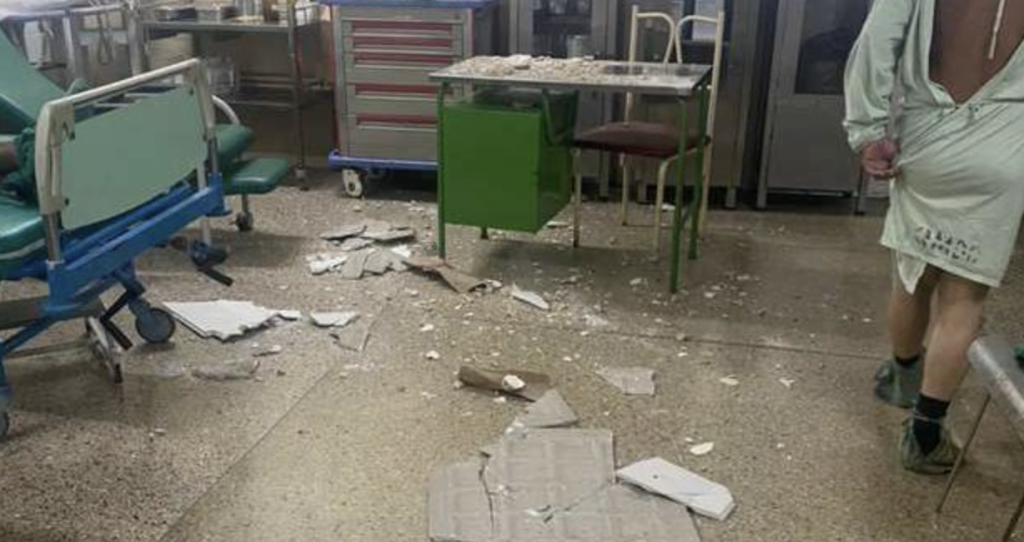
Public Health Collapses in Cuba / Iván García

“Today is the second time that pieces of the ceiling have fallen in the postoperative room of the Calixto García hospital in Havana. Slabs fell from the false ceiling. The first time, three weeks ago, some debris fell on a doctor and a patient” / X

Iván García, 12 September 2024 — After midday, Dr. Geiser, 28, arrives sweating at the ramshackle doctor’s office in the neighborhood of Santos Suarez, in the municipality of Diez de Octubre, south of Havana. Before putting on her white coat and attending to patients, she keeps a bag of soft bread, two avocados and five pounds of pork ribs she bought at a farmer’s market on her way to work.

The family doctor’s office is supposed to open at nine o’clock. But the shortage of supplies and medicines is one of the reasons why Ismary, the nurse, sleeps until eleven o’clock in the morning and, after eating a snack, walks the two kilometers between her home and the office. When she arrives, six patients are waiting in the anteroom. The place is in a dilapidated state. The floor is dirty, most of the plastic chairs in the foyer are broken, and a white light bulb hanging at an angle from the ceiling threatens to fall.

There is no lighting in the nursing room. There is only iodine and mercurochrome on the medicine shelf. A small piece of equipment for sterilising needles and aerosol nozzles, donated to them, has long since broken. In the lobby hangs an outdated poster showing public health statistics in 2003. “It seems like a century ago. The health service in the last twenty years is a disaster when you compare those numbers with today,” says a man with a burn on his right arm. continue reading

In 2003, according to the poster, Cuba’s public health institutions had 286 hospitals, of which 83 were general, 34 clinical-surgical, 26 paediatric, 18 gynaecobstetric, 18 maternal and child, 64 rural and 43 specialised. In addition, there were six cardiocentres, 289 maternity homes and 1,961 well-stocked pharmacies. The infant mortality rate was 4.8 per 1,000 live births and life expectancy for both genders was 77.79 years, while for women alone the number exceeded 80 years of age. Some 99.1 per cent of the population was served by the family doctor’s offices, which were part of the primary health care structure.

A lot of water has flowed under the bridge since then, says a MINSAP (Ministry of Health) official, “infant mortality is over nine per thousand live births and in many provinces it rises as high as twelve or thirteen percent. More than a third of the hospitals have been closed or do not provide the services for which they were designed. Sixty percent of the family doctor’s offices are no longer functioning. The number of doctors, nurses and health technicians has fallen by more than 75,000 compared to 2003.”

As an example, “Between 2022 and 2023 alone there are 46,000 fewer health workers. Out of that number, 12,000 are doctors. Fifteen years ago, community polyclinics had weekly consultations with medical specialists. Today, patients have to travel, even from one province to another, to be seen, and consultations are usually every two months. Stomatology clinics are either closed or run informally as private entities. Life expectancy has fallen to 73 years for men and 76 for women. Food and medicine shortages contribute to this decline. Only emergency surgery is being performed. Hospitals are short of everything from disposable needles to adhesive tape. It’s an absolute disaster,” he says.

Dr. Geiser tries to do her job with hardly any medical supplies. “We can carry out some treatments thanks to the help of neighbors who have donated a little cotton and gauze. When people come for injections, they bring their own disposable needles. Most of the treatments I prescribe are based on green medicine. It’s very painful to treat the child of a low-income family or an old person who gets a pension of 1,500 pesos and who can’t buy the antibiotics for treatment in private businesses because they don’t have the money.

On a piece of paper from a school notebook, Dr. Geiser writes down the medicines to be taken and the treatment to be given. The pens are given to her by her patients. “We keep things going thru sheer willpower. My salary of 6,000 pesos is equivalent to 20 dollars. The nurse’s salary is 4,000 pesos. We open the clinic two or three times a week. The rest of the days we have to go out on the streets, to get food for our homes. Although it’s wrong, most doctors and health workers earn extra money by treating patients on the side. It’s the only way to avoid starving. The other way is to find work abroad.”

“Although the government keeps 80 percent of the salary in foreign currency that they pay you, you can at least get between 7,000 and 10,000 dollars, depending on the length of your stay and the country you go to. The best destinations are Italy, South Africa, Qatar, Mexico. The worst are Haiti and Venezuela. If you want to get a good posting, you have to pay two or three thousand dollars under the table”, explains the doctor.

Although medical service exports managed by the government bring in billions of dollars annually, most of the hospitals serving the population in Cuba are in fair or poor condition. Hygiene leaves much to be desired, as does medical care. Patients admitted to medical facilities must bring sheets, towels, a fan, drinking water and a bucket for washing, among other things.

According to the MINSAP official, “between 2008 and 2015, between 7 and 11 billion dollars were earned every year from export of medical services. Enough money to maintain the quality of the health system on the island. But GAESA (a military-run conglomerate) uses that money to build hotels and other businesses.”

According to figures for the first six months of 2024 published by the state-run National Statistics and Information Office (ONEI), the leisure and tourism sector received a budget fifteen times higher than agriculture, livestock and forestry. And 17 times more money than Public Health and Social Assistance, which received 769 million pesos. Although there were 46,000 fewer health workers in 2023 than in 2022, the regime has more than 22,400 Cuban health workers in 59 countries. And it is negotiating new contracts with other countries.

The shortage of medicines, poor diet, and the ageing population, with nearly 25 percent of the population is over 60 years of age, all contribute to the progressive deterioration of the health of the population. For over ten years, more people have been dying in Cuba than being born.

Dania, a psychologist with two decades of professional experience, says that “suicides and suicidal behaviour have increased by 23% in the last four years in the Diez de Octubre municipality, the most populated in Havana and the third most populated in the country after the municipalities of Santiago de Cuba and Holguín. A worrying fact: if a decade ago most of those who took their own lives, or attempted to do so, were elderly people, mainly men who lived alone, in recent years the suicide rate among young people and adolescents between the ages of 12 and 35 has skyrocketed.”

“Historically, suicide in Cuba is among the first ten causes of death. The rate per hundred thousand inhabitants has remained above 12 and 15 percent. But since 1972, the level has grown to be among the highest in the world and the fourth highest in Latin America. In 1982, a grim record was reached when suicides increased to 23.2 percent. We do not have updated figures now. But I see many cases of patients who have made an attempt on their lives due to frustration and lack of future”, the psychologist points out.

For the Castro regime it is more important to build hotels than to buy medicines.

 Translated by GH

Alarm in Sancti Spíritus, Cuba, Over the High Number of Teenage Pregnancies and Abortions

In Cuba 20% of pregnant women are under 19 years old and are not ready to be mothers

The official press does not mention the lack of access to contraceptives as a cause of the increase in premature pregnancies. / IPS

14ymedio bigger14ymedio, Havana, 3 November 2024 — Mental and physical maturity are the minimum requirements that, according to Escambray — the official newspaper of Sancti Spiritus — a woman who wants to be a mother must have. But the 56 teenagers from Sancti Spíritus who are currently expecting a baby lack both of these things. The figure , which has caused alarm among the authorities, has skyrocketed since last year by 3.5% and, in 2024, one in five pregnant women in the province is under 19 years old.

In total, 227 teenagers have given birth in the province since January. Among the municipalities with the most worrying figures are Jatibonico, where 29.3% of pregnant women are minors; La Sierpe, with 25.8%; and Taguasco, 25.4%.

The general reaction, the local newspaper admits, is fear of the response of parents, partners, friends, of being deprived of help and not knowing what they are up against. Over time, if the family environment is good – says Escambray, citing some cases – the teenager ends up accepting motherhood and even being happy about it. But – here the newspaper does not dare to collect testimonies – relatives are not always understanding, nor do they have the economic means to support a child. continue reading

“This happens, mostly, because the teenager does not visit the Family Doctor’s Office”

The opinions of several secondary school students from a school in Sancti Spiritus illustrate the general idea that teenagers have about premature pregnancies: “At this age I would never have a child.” “Without giving it a thought I would try to have an abortion.” “I leave school and work to support it.” “If my girlfriend tells me she is pregnant, I leave her, I never see her again.” In the opinion of the young people, “drawing attention” and “not protecting themselves” are the two main reasons why a girl their age could become pregnant.

On the subject, Lisandra Martín Rodríguez, advisor to the Municipal Department of the Maternal and Child Assistance Program (Pami), believes that the problem is one of “preconception risk.” “This occurs, in its majority, because the adolescent does not visit the Family Doctor’s Office, either due to a lack of knowledge about where to go or who her doctor is, denial or underestimation of the problems by the patient,” she says, although she recognizes that the inflexible hours of the consultations and the “failures in the appointment process” also make it difficult “to analyze the young women at this stage and leads to late detection of pregnancy.”

Escambray also lists the consequences for adolescents of early pregnancy: interruption of natural growth of the body, birth of low-weight babies, anemia, malformations in the fetus, interruption of studies in many cases, social isolation of the mother and even depression and anxiety. The response, when the decision is made to not continue with the pregnancy, is always abortion. According to data from Pami, in the province there were “361 voluntary terminations of pregnancies at these ages, whether by surgical methods, medication or menstrual regulation.”

“What is happening in today’s society when one of the biggest social problems becomes an everyday occurrence?”

“I found out four days ago that I was pregnant. It was a late detection of pregnancy, at 20 weeks. When I found out, without thinking, the first thing I did was go to the curettage clinic to have an abortion. With so much time passed, I felt obliged to have the baby. At that moment I had many mixed emotions, but I have accepted it and this will be my baby no matter what happens,” an 18-year-old girl told Escambray, whom the media describes as “disengaged from studies and the work sector.”

The official media even asks, “What is happening in today’s society when one of the biggest social problems becomes an everyday occurrence?” But its answers completely evade problems that have been worsening on the Island for years: access to contraceptive methods, to efficient sexual education and to consultations with specialists in health centers that have the technology and conditions to provide quality services.

____________

COLLABORATE WITH OUR WORKThe 14ymedio team is committed to practicing serious journalism that reflects Cuba’s reality in all its depth. Thank you for joining us on this long journey. We invite you to continue supporting us by becoming a member of 14ymedio now. Together we can continue transforming journalism in Cuba.

To Reassure Russian Tourists, Cuba Assures That Damage From Blackouts Was ‘Minimal’

During the general blackout, the regime supplied the hotels with water for their tanks and fuel for their generators.

The number of Russian travelers has increased in recent years. / 14ymedio

14ymedio bigger14ymedio, Havana, 29 October 2024 — The fact that last week’s news of the blackout was published in the world’s leading newspapers did not do the Cuban regime any favors, as it fears losing the few tourists that continue to arrive on the island. On Monday, the commercial director of the Cuban Ministry of Tourism, Gihana Galindo Enríquez, tried to dispel the bad opinions about Cuba as a vacation destination for Russians, a market that has shown growth in recent years. “The impact of this situation on the country’s tourism sector was minimal,” she assured the Tass agency.

Galindo does not deny the crisis, but treats it as a temporary inconvenience, despite the fact that the country has been suffering for several years from fuel shortages and breakdowns in thermoelectric plants, which have plunged Cubans into long days of blackouts. The official, however, presents it as a solved problem: “We were able to confront this crisis and take corrective measures.” This Tuesday, the Electric Union announced an energy deficit of 1,318 megawatts.

She also defended the actions of the island’s authorities, who did everything possible to ensure that travelers remained unaffected by the difficulties caused by the total blackout. “When this situation made it difficult to serve customers, they were transferred to other hotels where they were provided with complete recreational facilities,” she explained, which helped to ensure that no tourist itinerary was cancelled. continue reading

Authorities did everything possible to ensure that travelers remained oblivious to the difficulties caused by the total blackout

For the high season, which coincides with winter on the Island, Galindo said that the hotels have backup generators – the same ones that kept all the tourist establishments operating while Cuba was completely shut down for more than three days – which “guarantees the maintenance of the viability of tourist services.”

Galino also referred to the particular concerns of Russian tourists, such as the ability to pay in rubles through Mir cards. “We have not had any imbalance in transactions with the Russian market and with the markets of other countries,” she said.

As if the official’s words were not enough, the Russian agency also interviewed Konstantin Dudkin, head of the Varadero department of the Moscow-based travel company Pegas Touristik. The manager’s response did not disappoint the official line: “Based on some of the global problems that Cuba has experienced in the past, the Administration, the Government and the Ministry of Tourism have taken the necessary measures to provide everything required in a time of extreme uncertainty and to keep the tourism sector afloat.”

Dudkin added that the regime guaranteed hotel services by filling water tanks, refueling generators and transporting tourists to other facilities – all tasks that involve the use of fuel that the state had always told the population it did not possess.

The director of the tourist agency even defended the island’s government by speaking about the United States embargo

The director of the tourist agency even defended the island’s government, speaking about the US embargo and the unwillingness of some countries to assist Cuba. “We must bear in mind that we are not on the continent, where borders are open and these problems can be quickly resolved,” she explained, adding: “It is clear how difficult it is for them to do certain things, unlike other countries. I think everything was done at the right level. In my opinion, they tried to resolve all the problems that arose. It worked exceptionally well. Our company’s operations were not affected by this situation,” she concluded.

“As Artur Muradyan, vice-president of the Association of Tour Operators of Russia (Ator) for international tourism and general director of the Space Travel tour operator, told TASS earlier, the situation with the power outage in Cuba had virtually no impact on Russian tourists. Ator also reported that there were no mass cancellations of tours to Cuba due to a large-scale power outage there,” the news agency concluded.

In an interview with Tass a few days earlier, Galindo said that the Russian market was on the rise and that the number of travelers from that destination who had arrived on the Island in 2024 was 8% higher than in 2023. The official even estimated that “if there are enough planes that can fly such long distances, then in the last two months of the year” there could be more than 200,000 Russian travelers.

The overall numbers do not match the regime’s expectations of reaching 3.2 million travelers this year

While it is true that Russia has positioned itself as the country that sends the third most tourists to the Island, the overall numbers do not match the Cuban regime’s expectations of reaching 3.2 million travelers this year. As of September 1, 1,608,078 foreigners had arrived, 58,920 fewer than the same period in 2023, and expectations could not be worse, especially for a regime that has invested everything in this sector. Cuba’s main source of tourists, Canada, fell in August, with a cumulative total of 665,871, 1.5% less than the same month of the previous year.

With destinations that are better equipped and cheaper in the region, such as the Dominican Republic, Cuba is becoming an increasingly unattractive option for travelers. François Laramée, a Quebec travel agent who was in Varadero during the blackout, gave an interview to the LCN network where he could not have been more blunt. “It was pathetic,” he said, and concluded: “Even in a five-star hotel, it was catastrophic.”

____________

COLLABORATE WITH OUR WORKThe 14ymedio team is committed to practicing serious journalism that reflects Cuba’s reality in all its depth. Thank you for joining us on this long journey. We invite you to continue supporting us by becoming a member of 14ymedio now. Together we can continue transforming journalism in Cuba.

The Sentence Condemns the Spanish Journalist to 10,000 Euros for ‘Moral Damages’

Cuban Doctor Lucio Enriquez Wins Defamation Suit Against Castro Activist Ana Hurtado

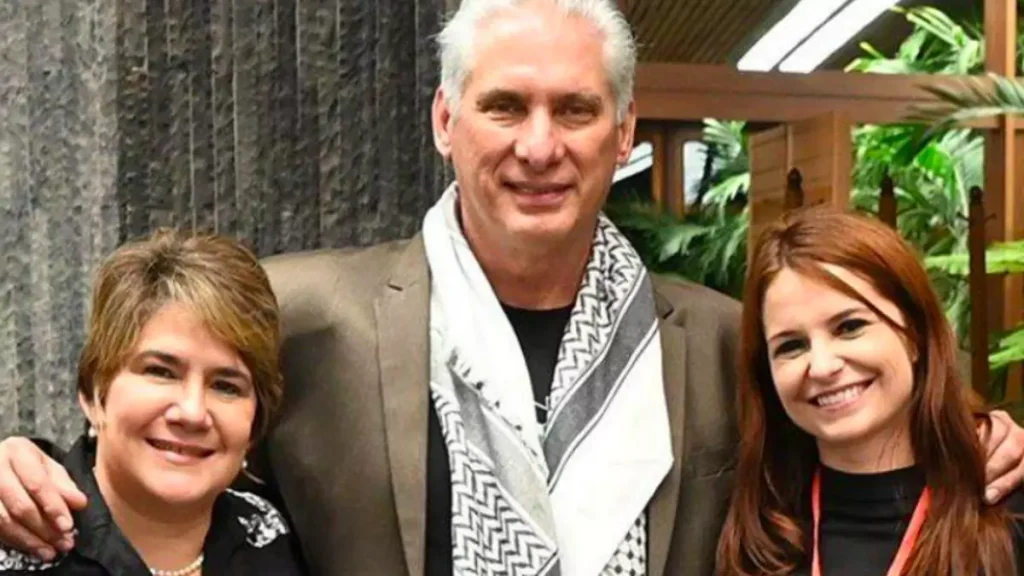
Hurtado, on the right, with Miguel Díaz-Canel and Lis Cuesta, during a political event of the regime. / Ana Hurtado/X

14ymedio bigger14ymedio, Havana, 31 October 2024 — The Spanish courts ruled on Wednesday in favor of Cuban doctor Lucio Enríquez Nodarse in a defamation suit against Spanish journalist Ana Hurtado Martínez, a staunch supporter of the Cuban regime. The court — according to the ruling that the activist exiled in Spain also sent to 14ymedio — states that Hurtado “has committed an illegitimate interference in the right to honor” of Enríquez.

Hurtado will have to publish, “in the same media where the offensive expressions against Enríquez were published,” the content of the sentence, which – the court warned – is not yet “final” and can be appealed in the next 20 working days. The journalist will also have to pay 10,000 euros “in moral damages” as compensation to her accuser, whose legal costs will have to be covered by the defendant.

The ruling notes the statements of the plaintiff, who points out Hurtado’s “staunch defense of the Cuban communist regime” on her social media, and her history of “harassment” of activists exiled from the island.

One of the episodes mentioned in the document occurred after a peaceful protest that Enríquez and activist Avana de la Torre held in 2022 in front of the house where Ángel Castro, Fidel Castro’s father, was born. On that occasion, the journalist insulted the doctor on her social media and accused him of “serious irregularities” committed in the practice of medicine, without providing evidence. “The little drug-dealing doctor” was one of the terms she used along with “criminal, terrorist, scum, marginalized people,” and added that he could “get 3 to 6 years (in prison) for being a criminal.” continue reading

“The little drug-dealing doctor” was one of the terms she used along with “delinquent, terrorist, scum, marginalized people”

In August 2022, her accusations became more serious. “I am unmasking the drug-dealing doctor,” Hurtado wrote, “and it seems that, according to gossip, it is said and commented, that the doctor, and there is the digital footprint in the services, in the Spanish health system, is leaking clinical records, of what medication the patients take, he is leaking clinical records, oh doctor, you are a very delinquent.”

The ruling clarifies that Enríquez, who has no criminal record, was acquitted by a court following this accusation. The document also stresses that there is no accusation against the doctor for leaking medical records.

Enríquez sued Hurtado – who did not appear at the hearing – in May 2023 for these acts of defamation and insult. At the bottom of a short video that accompanied the fragment of the sentence, published on X, dozens of people celebrated the result, and Enríquez thanked them.

She also said that if Hurtado did not comply with the sentence or appeal it, he would be guilty of contempt, “and then things would get much more complicated,” she said. For the moment, the accused – who writes a column in Cubadebate and participates, albeit very discreetly, in Havana’s political life – has not commented on the outcome.

After Enríquez announced the news, Hurtado posted a tweet stating that she was “giving a presentation at the José Martí memorial” in the Havana municipality of Plaza de la Revolución, as part of a symposium dedicated to the history of the regime. “Those who doubt our permanence and victory should wait for events to unfold. They will continue to watch from a cedar box. Long live Fidel!” she said, in what could be a veiled allusion to Enríquez’s message.

The doctor and activist has a notable history of denouncing the regime’s spokesmen abroad. He has also suffered harassment and physical violence. In June 2023, the Cuban pro-government group Buena Fe said it would take legal action in Spain against those who dedicated themselves to “damaging, harming and hurting” its image. They alluded to alleged “campaigns of harassment and hate” through social networks to boycott his tour of several Spanish cities.

At that time, Enríquez Nodarse, along with fellow doctor Emilio Arteaga Pérez, claimed to have been attacked on May 11, 2023 at the Buena Fe concert in Madrid by alleged agents of the Cuban political police posing as security guards.

____________

COLLABORATE WITH OUR WORKThe 14ymedio team is committed to practicing serious journalism that reflects Cuba’s reality in all its depth. Thank you for joining us on this long journey. We invite you to continue supporting us by becoming a member of 14ymedio now. Together we can continue transforming journalism in Cuba.

A Young Woman Was Murdered in Holguín, Cuba, by Her Ex-Husband, Who Was Blackmailing Her

Yoannia Hernandez had a four-year-old daughter from a new relationship and wanted to move abroad

Yoannia Hernández had been an art instructor and was the mother of a girl, who was orphaned at the age of four. / Facebook

14ymedio bigger 14ymedio, Miguel García, Holguín, 31 October 2024 — Yoannia Hernández was murdered by her ex-husband early Thursday morning in the 26 de Julio neighborhood of the city of Holguín. According to a resident of the area who spoke to 14ymedio , the attacker had a history of violence. “A few years ago he stabbed a neighbor of mine,” said the same source, who knew the victim well.

The 32-year-old woman, known to her family and friends as Yuyi, had been an art instructor and had a daughter with a foreign man, who has now been orphaned at the age of four. Although she lived in Holguín, this neighbor explains, Hernández frequently traveled outside the island. Meanwhile, her relatives say, the alleged murderer harassed her.

“He blackmailed her and asked her for money for his vices and his habits,” said another neighbor. “He killed her in front of a group of people, it was not in private. Several people said she said ‘I told you no, I won’t give you any more’, and then he grabbed her by the arm, stood up and stabbed her.” continue reading

With this femicide, there are 41 sexist crimes in Cuba so far this year, according to the ’14ymedio’ registry

They also say that the young woman had previously sought legal advice to take her daughter out of Cuba to a European country, which the sources cannot specify, and where the girl’s father resides.

With this femicide, there are now 41 such crimes in Cuba so far this year, according to 14ymedio’s records. The most recent known murder was that of Tamara Carreras Martínez, 57 years old and a resident of Santiago de Cuba, last Thursday. Her partner and alleged aggressor was later attacked by local residents.

Before her, also in Santiago de Cuba, the femicide of Yucleidis Morales was confirmed.

The murder of Yoannia Hernández in the early hours of Thursday morning took place two days after the UN Committee on the Elimination of Discrimination against Women (Cedaw) issued its observations on the island, which included a section dedicated to gender violence.

In this regard, the organization asked the government to incorporate the crime of “femicide” in the Penal Code, to “raise awareness and public recognition,” “strengthen measures to prevent, prosecute and punish perpetrators of cases of gender violence against women,” and establish shelters throughout the State, “including in collaboration with civil society organizations.”

____________

COLLABORATE WITH OUR WORKThe 14ymedio team is committed to practicing serious journalism that reflects Cuba’s reality in all its depth. Thank you for joining us on this long journey. We invite you to continue supporting us by becoming a member of 14ymedio now. Together we can continue transforming journalism in Cuba.