Residents in the Diez de Octubre neighborhood protests again while in Luyanó there are residents who have been without water for 30 days.
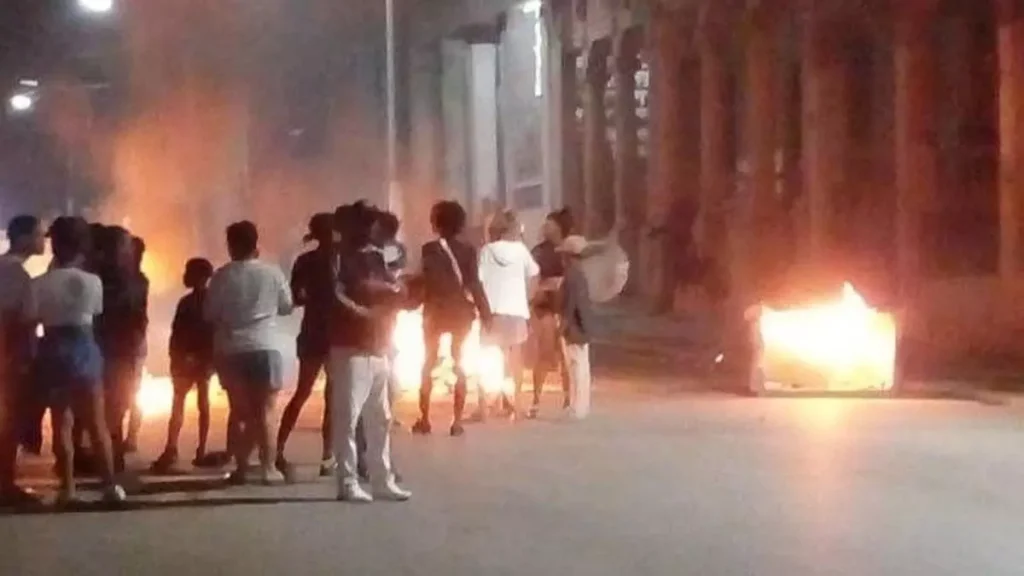
 14ymedio, Juan Diego Rodríguez, March 20, 2026 – Havana / The protests, which in recent weeks have moved from social media to the streets, were very loud this Thursday in Havana. At the intersection of Santa Irene and Diez de Octubre Avenue, several bonfires were lit and barricades were built demanding electricity, images that have gone halfway around the world through social media. It was the most striking focal point of last night’s demonstrations, but in Alamar shouts of “Freedom” and “Down with the dictatorship” were also heard, banged out on pots and pans, mixed with demands for electricity.
“Here, every little while the pots are banging,” says María, a resident of Diez de Octubre, “but they have no shame anymore, they don’t care about the protests. And I don’t go outside because, where exactly are they banging? I hear them, and from my house I bang mine, I don’t care. The problem is that if I go out and the young guys come running…,” adds this retiree, who fears joining a protest and being injured in a bad fall that could land her in a precarious hospital.
According to her experience, after several days of hearing pot-banging protests, public lighting turns on quickly when there is a demonstration, but only in the streets and not in homes. “To sum it up: we are like in Peru, when there’s no water or electricity. And now we’re worse, because when there’s no water there’s no electricity, no gas, nothing. Not even shame in this country,” she complains. continue reading
“To sum it up: we are like in Peru, when there’s no water or electricity. And now we’re worse, because when there’s no water there’s no electricity, no gas, nothing. Not even shame in this country”
In Santos Suárez, Lawton and Víbora Park, where the protest caught on in a big way, they are more fortunate than in Luyanó, residents of this latter neighborhood believe, where in addition to problems with electricity there are also issues with water supply. Pedro, a resident of this area, tells 14ymedio that his cousin has been without water for a month. “Yesterday he spent the whole day holding back from going to the bathroom, until a bucket showed up that a neighbor gave him and he was able to go,” he complains.
The poor supply situation is not new for Pedro, but things have worsened in recent times, and small and medium private businesses have a lot to do with it, in his opinion. “Here where I live we are all elderly, physically disabled. There is a community cistern that supplies about eight or ten apartments. So we have requested a water truck, but they say they have a very long list. But water trucks are never lacking for the two or three most famous private businesses around here,” he says.
Pedro states that few have the possibility of paying the 26,000 pesos that the water truck driver demands, under the table. “I can’t. First of all, either I eat or I drink water.” The residents have the option, he says, of getting a bottle at a church “sponsored by some Canadians” that purifies it with a special filter, but there are “huge lines.”
Reality thus clashes, once again, with the epic narrative of the official press. The report that the State newspaper Granma dedicates to the return of unit 4 of the Carlos Manuel de Céspedes thermoelectric plant, in Cienfuegos, and the 158 megawatts – the same as block 3 – that were added to the system on Wednesday are completely overshadowed by deficits that continue hovering around obscene levels. The 316 megawatts (MW) now in the system corresponding to the entire plant have been of no use: for this Friday, the expected deficit is 1,864 MW. Little difference from the 1,960 MW on Monday, before the most recent addition.
Pedro states that few have the possibility of paying the 26,000 pesos that the water truck driver demands, under the table
On Tuesday the 17th, in the middle of the collapse of the national electric system (SEN), unit 4 synchronized with the rest of the grid after a year and four months of repairs. It still had a scare this Wednesday the 18th, when a failure in the feed pump ruined the triumphant debut, but it recovered a few hours later and the Electric Union was able to celebrate the return.
The population’s indifference was total: “So what? How does that benefit us? Circuit 1 of Palma Soriano was supposed to have power restored from 4 in the afternoon to 7 at night and they didn’t do it. According to information from a colleague at the electrical dispatch, there was no availability at that time, so we have to continue in blackout until they feel like it. Today it has rained all day, imagine cooking with charcoal or firewood under heavy downpours,” complained one user.
The day is expected to be hard again, since during peak hours it is forecast that only 60% of the electricity the country demands will be generated, 1,834 MW compared to the 3,050 needed. The UNE no longer has distributed generation due to the lack of diesel, and thermal generation has limitations of 437 MW, with units 6 of Mariel and 5 of Nuevitas under maintenance and units 5 and 6 of Mariel, 3 of Santa Cruz del Norte, 2 of Felton and 3 and 6 of Antonio Maceo out of service.
Photovoltaic parks, the Government’s great hope, are contributing more and more: 236 MW as the maximum power delivered yesterday Thursday. But when night falls, darkness returns to the Island.
Translated by Regina Anavy
______________________
COLLABORATE WITH OUR WORK: The 14ymedio team is committed to practicing serious journalism that reflects Cuba’s reality in all its depth. Thank you for joining us on this long journey. We invite you to continue supporting us by becoming a member of 14ymedio now. Together we can continue transforming journalism in Cuba.