Chic Places for Foreigners and Cubans in Search of Status Are Multiplying in Havana

“Every time we go there, with my husband and my daughter, the bill comes to 18,000 pesos”


A special feature of these restaurants is their cocktails and signature cuisine. / 14ymedio

14ymedio bigger14ymedio, José Lassa. Havana, 26 January 2025 —  Garbán, Sfornabontà, Malecón 663, ChaChaChá, Ecléctico, Fangio, Yarini, Antojo, VistaMar are some of the new luxurious and expensive places in Havana where a plate of food costs the equivalent of a Cuban worker’s monthly salary. The proliferation of these establishments, each one more expensive than the last, occurs while the country is going through its worst socioeconomic crisis in history.

Sfornabontà by Amalfi opened its doors just a month ago. The owners, Italians, emphasize that they are the first store selling products from this country in Cuba. Several white-painted wooden tables are occupied almost entirely by older foreigners smoking thin cigarettes or cigars. Located in Miramar on 1st Street, between 44th and 42nd, in front of the Copacabana Hotel, the place offers pizza, pasta and ice cream, as well as sweets and drinks rarely seen before in Cuba.

“The first time I went I just ordered takeout because it was packed. I ordered a cornetto, filled with Iberian ham and cheese, super delicious, and it wasn’t that expensive, 500 pesos. The second time I went, two weeks later, they had raised the price to 750 pesos,” says Amalia Rodríguez, who says she finds out about these places almost always through Instagram, where she and her friends share their visits to chic establishments. “I liked the place, but both times I went they had problems with the electronic payment transfer. Too much coincidence. I don’t think they accept it.” Although the law doesn’t allow it, many of these businesses prefer cash in dollars.

Parked in front of the premises are modern cars and the occasional electric motorbike, as the prices are not for everyone, with pizzas or main dishes ranging from 1,800 to 6,000 pesos.

Sfornabontà by Amalfi opened its doors just a month ago. / 14ymedio

Just one block further along, on the same 1st street, is what YouTubers Javi and Zami have called “the most expensive restaurant in Cuba,” Garbán. The cheapest thing is the soft drinks at 990 pesos, and a bottle of water or a portion of rice can cost up to 2,000 pesos, a portion of continue reading

five croquettes is close to 4,000 pesos, and main dishes are between 4,000 and 9,200 pesos.

Garbán is located just above Gelato, an ice cream shop and confectionery established more than 10 years ago. Both belong to the same owners, Cuban Yanetsi Azahares and her Italian husband.

A special feature of these restaurants is their cocktails and signature cuisine, along with the originality of their decor. Some may be modernist, others minimalist, classic and bohemian or more contemporary, as in the case of Malecón 663, owned by Frenchwoman Sandra Expósito.

“The decor is original. All the chairs are different at the same table, things from the menu are written on the wall. The employees are dressed strangely, with colorful shorts and bare feet,” says Analay Cuello, who, together with her husband, owns a small business selling motorcycles. “Despite it being a strange place, I had a good time.”

Modern and expensive cars are parked in front of these premises. / 14ymedio

“The food is also strange. The pork tenderloins had chocolate sauce. I told him to put the sauce on the side just in case. We didn’t like it. All the dishes had something distinctive about them. The names of the rooms were Gozando en La Habana [Enjoying in Havana], El cuarto de Tula [Tula’s Room], each with a different decor.”

Analay and her husband rented a room, as the Malecón 663 is not only a bar-restaurant but also a boutique hotel. The price per night is $110, with a bottle of cider and breakfast included.

“I didn’t think it was expensive. I’ve been to places that were much more expensive than that, like Chucha’s Tapas Bar, for example. The bills, with my husband and my daughter, every time we go there for her to play, since it has an amusement park, are 18,000 pesos, and what we eat is a dish and a starter for each of us, with a drink, no dessert or anything, and thank goodness we don’t drink alcohol. A lemonade at Chucha’s costs you 1,200 pesos.”

“When I arrived, all I saw were foreigners,” Analay continues. “The manager told us that, indeed, only foreigners or young bohemian Cubans came to listen to jazz and have a few drinks. People like us rarely went.”

Most of these sites have a good presence on social media like Instagram, due to strategies that include collaborations with fashion influencers and artists.

Going to these places is a sign of status. / 14ymedio

Las Noches de Fangio is a well-known weekly event held at the Fangio Havana restaurant, where artists such as Alaín Pérez, Ernán and Ruy López Nussa, Raúl Paz, Frank Delgado, the Abreu Brothers, among others, have performed. Most of these artists could fill a theater, but playing in these places brings them more economic benefits, since 1,000 pesos is the minimum cover charge . Other places that have this duality of restaurant/concert are Yarini, owned by Cuban actor Jorge Perugorría, and Ecléctico, to mention a few.

Going to these places is a sign of status. Posting on social media that you are going to places where the Havana showbiz and foreigners go, who are not the ones who go to all-inclusives, but who stay in luxury hotels and eat lunch and dinner in places where they spend 100 dollars per meal.

One thing is obvious: almost all of the owners of these sites are foreigners or Cubans directly linked to a foreigner.

“It’s something I’ve seen in almost all the places we go to,” Analay continues. “The owners are foreigners. They have their trusted people, the managers, as they call them, and they take care of their business when they are not there, which is most of the time.” “They are all the same. Cubans can’t go anywhere anymore, because they are all expensive. New ones open and they are more expensive,” she concludes.

There are more examples. Color Café, owned by Loypa Izaguirre, a Cuban married to a Frenchman; Plan H, a Cuban owner married to a German; Hotel Boutique Tribe Caribe, owned by two foreigners, one of them the Venezuelan producer Andrés Levin and the other, a mysterious Anglo-Saxon investor, although the shadow of Raúl Castro’s daughter, Mariela, is persistently pointed out.

Most of these sites were recently reviewed by Montreal’s ‘La Presse’ newspaper. / 14ymedio

Most of these sites were recently profiled by Montreal’s La Presse in a series of three surprisingly dithyrambic articles entitled La Havane chic. The author, Canadian photographer Martin Chamberland, describes a new facet of Havana, “more upmarket, even more nutritious for the taste buds and more dazzling for the eyes.”

One of the “experts” he interviewed is Canadian photographer Heidi Hollinger, who says that “this city has the assets to become one of the most outstanding places on the planet and a first-rate gastronomic capital.”

Beyond the stupor provoked by the description of this parallel reality, many questions arise: Did they only see that Havana where foreigners and that very small sector of Cubans with resources congregate? When they moved from one chic place to another, did they not see the other one, invaded by garbage, with buildings in ruins and widespread poverty?

“Cuba is increasingly out of reach for the Cuban people,” says one user in the comments to one of the videos by YouTubers Javi and Zami. Cubans are the last to learn that Havana has become “a gastronomic capital.”

In addition to being a bar-restaurant, the Malecón 663 is also a boutique hotel. / 14ymedio

The Art of Organizing Gas Station Lines in Cuba

There are cars that come with three tanks in the trunk, because they know the pump attendant , and they fill up to 300 liters to resell later.

A long line was waiting for a great spectacle: buying fuel in Cuba. / 14ymedio

14ymedio bigger14ymedio, José Lassa, Havana, 11 December 2024 — The nearby Riviera movie theater, in the middle of the Havana Film Festival, was deserted on Tuesday. The real buzz in that area of El Vedado was not to see a movie premiere or to meet a famous actor. It was at the gas station on the corner of G Street and 25th Street, where a long line was waiting for a great spectacle: buying fuel in Cuba. It is enough to get close to feel the tension.

The vehicles occupy the paths closest to the sidewalk in the vicinity of the gas station. There are people crowded at the entrance of the state-owned company Cuba Petróleo (Cupet) and the drivers gesticulate, shout and get annoyed at the slow progress of the line and the possibility that some profiteers might slip in. The biggest fear: that gasoline will run out before it is their turn.

“There’s been nothing here for three days and there are people who have been sleeping in line all that time. Today, at noon, a tanker came, a small one,” a young man tells 14ymedio, sitting in the driver’s seat of a silver-gray Geely, fanning himself while keeping an eye on what was happening at the fuel pumps. “My brother brought me something for lunch but I think he’s going to have to bring tomorrow’s food and breakfast as well because this isn’t going anywhere.” continue reading

The delay is not only down to the days without supply but also to the fact that four queues have converged on the premises

The delay is not only down to the days without supply but also to the fact that four queues have converged on the premises. “Nothing has arrived yet at El Tángana, nor the Cupet at L and 17 -which, only between the two, totaled one thousand tickets-, nor to the one at 23 and Malecón”, adds the young man, pointing out that “drivers have come here from those places”.

Most of them are waiting for their virtual turn, from the lists kept by a handful of reliable officials through the Telegram app., who warned, before dawn, of the arrival of 26,000 liters of gasoline. Customers at 25 and G, El Tángana and L and 17, who had signed up on the virtual list the day before, were summoned from 7 a.m. at the last two. For the less early risers, from 2 o’clock the service moved to 25 and G.

The mechanism put into practice this Tuesday is nothing short of bizarre. “Since 12:00 pm they began to pump gas. They alternate one from each queue. Now it’s 4:00 pm and it has hardly moved,” a customer waiting his turn told 14ymedio. To take in all the lines, an equally complex mechanism has been implemented.

“The two pumps that are working are now divided and so are the queues, so that in one of them they are supplying people who were in the queue of El Tángana and in this other one those who were in L and 17, alternating with those of 23 and with those of us who are registered in this Cupet”. The merging is slow: “This is going to take a long time, this is going to take a long time”, admits a man whose forearms are already reddened by the December sun, although not as strong as in other months of the year.

They all have similar tired faces, dry mouths due to lack of water, although you can see some whose family gives them something to drink or takes turns with them in the queue.

“The drivers who are in line have already been summoned by the organised virtual list” says another driver.

All gasoline is limited to 40 liters maximum for cars and motorcycles according to their capacity. / 14ymedio

“With this system they want to put an end to the fuel resellers, they even ask for ID cards to prevent the resellers from getting in, but in a troubled river the fishermen profit. Look how many are there managing, this sucks,” complains the man referring to the system in place at the gas station where there are only two pumps working.

In addition to organizing the queue by Telegram for those who were in line yesterday, they were given their tickets to buy today. “I have number 34,” said a customer who arrived at the gas station in an old dark blue Lada and who four and a half hours after the start of the sale was playing with his son quietly in park G. “With each customer the employees take forever, you have to check the data, check them against what appears on the Telegram list, swipe the magnetic card that sometimes produces an error and you have to do it several times,” he explains.

“Look at how many people there are managing over there, not many working and lots of bosses, so completely inefficient,” he adds. The man doesn’t hold out much hope. “I don’t think this gas will last beyond 7 o’clock tonight, or maybe a little longer” he thinks. But he intends to stay put nevertheless.

“The lines are endless. I’ve been here since Monday night at 11,” said a man standing in line at the Cupet in Acapulco. Special gasoline costs 156 pesos a liter, regular, 132; and motor gasoline, 114, all limited to 40 liters maximum for cars and motorcycles according to their capacity. “Some have 15 liters, mine for example has 5,” the customer points out. “Obviously, people carry their hidden containers to refill them. There are cars that sneak in and come with three tanks in the trunk because they know the assistant, and they fill up to 300 liters to resell later. Gasoline runs out quickly,” he complains.

“They collect the cards, but the pump attendants themselves let people in by “the back door” plus the people who try to sneak in. The people in charge don’t say anything, and the queue doesn’t move until the fuel runs out. I myself filmed a Moskvitch getting between 300 and 400 litres”.

The Acapulco queue started at 26th Avenue, went all the way up Kohly, reached the divider and turned around, and ended back at 26th. “Outside, the litre is 550 or 600. “In the queue they told us that people were coming from Mayabeque, because there they get it for between 900 and 1,500 a litre”.

“In the queue they told us that people were coming from Mayabeque, because there they get it for between 900 and 1,500 a litre”.
On both sidewalks on 25th Street, from F to H, there is no room for another car either. The queues criss-cross at various points, go down G, and at a certain point you simply lose track of them.

Every three or four cars there are groups of tense drivers, watching with their eyes for each new car that approaches: “Here they have caught a few coleros [people others pay to wait in line for them] and they are taking them to Zapata [police station]. Not just anyone can turn up either. The other day they asked for the car’s licence and registration”, says a customer at the 25 and G queue.

On Telegram, the groups are still buzzing. They announce the arrival of a pump for 17 and L in the early hours of Wednesday morning and officials explain that “due to Cimex guidelines” it is not possible to arrange things for the morning and the petrol will be dispatched as soon as it arrives. Numbers 1 to 457 of 25 and G started to be dispatched from 9pm, the last 50 were scheduled to be dispatched at 5am on Wednesday. Meanwhile, the messages keep coming in: “Those who asked for special petrol are kept pending until it arrives at one of the service centres”, “tomorrow 11.12.24 at 9 a.m., we will open the group to sign up” or “if you try to use the same car plate more than once, the system will invalidate it”.

A pointy-hatted Father Christmas seems to watch the scene from the sidewalk in front of the gas station, safely behind the perimeter wall of a luxurious private restaurant. Some passing tourists notice the people waiting and ask what is going on, but the drivers don’t even feel like answering.

Translated by GH

____________

COLLABORATE WITH OUR WORK: The 14ymedio team is committed to practicing serious journalism that reflects Cuba’s reality in all its depth. Thank you for joining us on this long journey. We invite you to continue supporting us by becoming a member of 14ymedio now. Together we can continue transforming journalism in Cuba.

The US Decision To Freeze International Aid Affects Independent Cuban Organizations

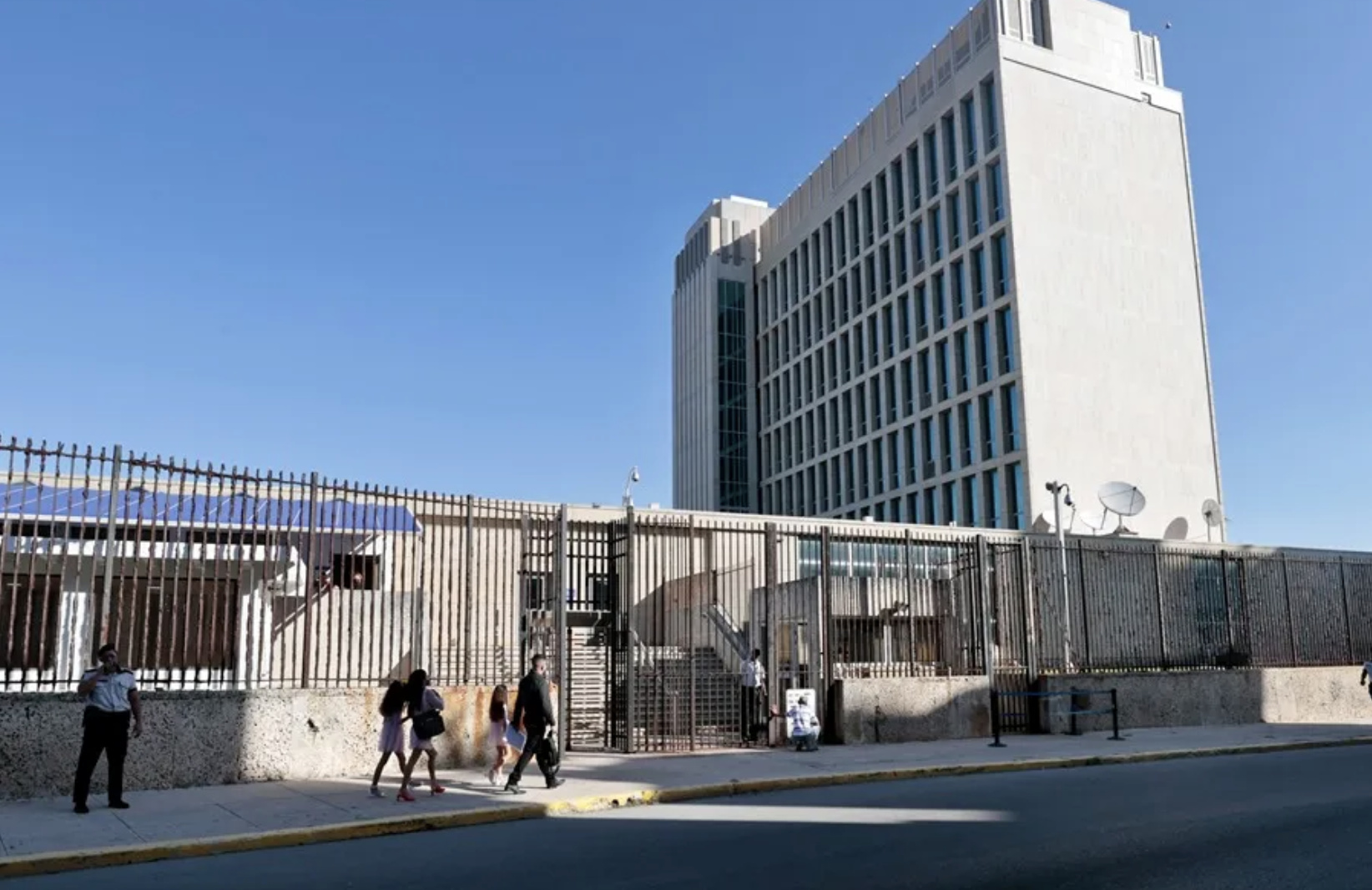
The US Embassy on the Island provides several programs and scholarships to train Cubans / EFE

14ymedio bigger14ymedio, Havana, 25 January 2025 — The United States Department of State froze almost all funds for aid programs abroad, with immediate effect and as a result of an executive order signed by President Donald Trump. According to several US media, the Secretary of State, Marco Rubio, sent a memorandum to all embassies and diplomatic offices ordering the suspension of the delivery of funds and the granting of new aid.

In Cuba, many independent organizations that benefited from these funds could suddenly be deprived of the aid granted by the US government in favor of human rights, free enterprise and freedom of expression.

In principle, the order puts the brakes on all projects financed by the Office of Democracy, Human Rights and Labor (DRL); the Office of International Affairs for Narcotics and Law Enforcement (INL); the International Development Agency (USAID) and the Office of Humanitarian Aid (BHA), as confirmed to 14ymedio by a European employee of an organization that supports several groups in Cuba.

The US Embassy on the Island organizes several programs and scholarships to train Cubans in human rights, diplomacy and languages, which could also stop.

The measure puts at risk the projects that depend on the millions of dollars given by the State Department and USAID

The measure also puts at risk international projects that depend on the millions of dollars given by the State Department and USAID, although it makes an exception for emergency food assistance and military financing in favor of Israel and Egypt. continue reading

The memo was sent after Trump signed an executive order on Monday that freezes those contributions for a period of 90 days, because the “foreign aid and bureaucracy of the United States are not aligned with US interests and, in many cases, are the antithesis” of US values.

CNN quotes statements from an unidentified government official who acknowledged that, although they foresaw some cuts, they did not expect such a “wide and immediate” pause. The official said that humanitarian needs around the world are acute, and freezing assistance from the United States, which is the world’s largest humanitarian donor, “could be harmful.”

“The Trump Administration is threatening the lives and future of communities in crisis and abandoning the United States’ long-standing bipartisan approach to foreign assistance, which supports people according to their needs, regardless of politics,” said Abby Maxman, president of Oxfam, an organization that fights against inequality and poverty.

According to the news source Politico, the suspension of foreign aid could also deprive Ukraine of military and financial aid

According to the news source Politico, the suspension of foreign aid could also deprive Ukraine of military and financial aid. However, among the exceptions provided for in the order are military assistance for Egypt and Israel, which allows emergency food aid, and “legitimate expenses incurred before the date of this” guidance” in accordance with existing awards.”

Another State Department official, in addition to two former officials of the Biden Administration, said that the pause also seems to affect Jordan and Taiwan.

In addition, Politico adds, “the guide could expose the United States government to civil liability, since lawsuits could be filed for unfulfilled contracts if it is considered that the terms have been violated.”

Translated by Regina Anavy

____________

COLLABORATE WITH OUR WORK: The 14ymedio team is committed to practicing serious journalism that reflects Cuba’s reality in all its depth. Thank you for joining us on this long journey. We invite you to continue supporting us by becoming a member of 14ymedio now. Together we can continue transforming journalism in Cuba.

Migrants in Mexico Search for a Plan B Now That Humanitarian Parole Has Been Cancelled

Migrants remain stranded in the border town of El Chaparral, in Tijuana / EFE

14ymedio bigger14ymedio, Sergio Castro Bibriesca, Mexico City, 21 January 2025 — “It was heartbreaking to hear that he fulfilled the threat,” says Gabriela Hernández, director of Casa Tochan, a shelter for migrants in Mexico City, about the cancellation this Monday of the CBP One mobile application, which allowed migrants of any nationality to enter the United States through Mexican “ports of entry.” In that same executive order, President Donald Trump cancelled the Humanitarian Parole Program, which allowed the arrival in the United States of 531,690 immigrants, including 110,240 Cubans in two years.

The cancellation disrupts the plans of thousands of applicants, who have been stranded in different Mexican states, mainly at border points, waiting for a new plan to continue their journey. For the migrants in Mexico City, “the first thing they had to do was cancel their flights to the border. They had planned to leave this week for their appointments,” says Hernández.

For the migrants in Mexico City, the first thing they had to do was cancel their flights

However, the hardest thing for those who hoped to enter US territory legally is to see their life plan change in the blink of an eye. “We tell the kids to stay calm. They lost a battle, but not the war. There were tears. It’s very sad to see a child cry, but it was more shocking to see adult men cry. You cry and then move on,” adds the director of the shelter, which has space for only 50 people but today serves more than 150, because, “thanks to the solidarity of many people,” they managed to rent three nearby apartments to accommodate more migrants. continue reading

This scene is replicated in the north, in Tijuana, on the border with San Diego: the shelters are full. There are 3,500 people stranded who would have requested the CBP One, and 10% already had an appointment to apply for asylum in the United States. This was reported on Monday by José Luis Pérez Canchola, who was head of the Municipal Directorate of Migrant Attention until Tuesday morning. He was dismissed, he said, for demanding effective coordination of the three levels of government (federal, state and municipal) to address the migration crisis.

At the international crossing of El Chaparral, about 200 migrants who already had an appointment were transferred to a shelter, although this Tuesday some returned to the crossing with more hope than certainty. Aylin, a Venezuelan migrant, tells 14ymedio that the announcement took her by surprise. “We didn’t think that by the time we got here the appointments would be eliminated.” When she arrived at the Tijuana airport, the authorities asked her to show that she had an appointment. “They saw the application and it was working, but by the time we got here the appointments had already been cancelled.”

“They saw the application and it was working, but by the time we got here the appointments had already been canceled”

She arrived in Mexico from Maracaibo, on a trip that was quite an odyssey. First she went through Colombia. From there she left with a coyote and crossed the Darién jungle with her five-year-old daughter. After five days she reached Central America, but when she arrived in Guatemala, the authorities took all her money. Then she went to the Mexican border city of Tapachula and walked north with a caravan.

In Chiapas, the news fell like a bucket of cold water, although the migrants who remained in the area knew that the cancellation of the application was inevitable once Trump came to power. “We had been giving up CBP One for dead for weeks, but we were hoping that they would keep the appointments of those who were already registered since last year,” says Emilio, a 48-year-old Cuban from Alquízar, in Artemisa.

On Monday, the Mexican authorities alerted the migrants in Tapachula about the end of the program. According to the EFE agency, a federal agent announced with a megaphone that they would only attend to those who had appointments until January 30.

On Monday, the Mexican authorities alerted the migrants in Tapachula about the end of the program

“As you know, as of today (Monday) we still do not have enough reliable and truthful information to be able to attend to future dates. If the program continues, you will be informed through the National Institute of Migration,” explained the official.

For Emilio, the cancellation of that migratory path opens the door to new questions, but he recognizes that “something will come out of this. What we are clear about is that there is no return to Cuba.”

Although he is the only one in his family who undertook the migratory route through Central America to Tapachula, in the Mexican town he has woven new bonds of friendship and collaboration. “There are eight of us who watch each other’s backs and help each other, and we have rented an apartment together,” he explains.

Emilio has been in Mexico for more than a year and has found a job as a welder, an occupation he learned in a Cuban company where he worked for a couple of years. “In Alquízar, the welding gave me some pesos and was my main source of income,” he recalls. Now his skills as a welder in a vehicle workshop allow him to “pay the rent, build a pigsty, and eat and send something to my family,” who suffered great damage to their home with the passage of Hurricane Rafael last November. “There is no more life there. I can’t go back, not even to take a break,” he says.

“I think this will improve things for those of us in Mexico. Maybe they will give us credit “

Despite the cancellation of the CBP One, through which he had an appointment for the end of January, Emilio is hopeful. “I think this will improve things for those of us in Mexico. Maybe they will give us credit to start our own business, facilities to settle here and some financial aid to bring part of our family,” he speculates.

The end of the CBP One application has left about 270,000 people stranded, according to an estimate by the American network CBS.

Launched by the Joe Biden Government, the application started working in January 2023 and has helped more than 930,000 people to submit their cases.

Mexico faces two complex scenarios. On one hand, there are the thousands who have remained at the borders, many of them without resources, and on the other, there will also be those who will be deported by the new Trump Administration. On Tuesday, Mexican President Claudia Sheinbaum promised, at a press conference, that Mexico will provide “humanitarian care” to migrants from other countries, although we will seek to return them to their places of origin.”

“If possible, repatriation to their countries will be sought and, if not, reintegration into Mexico”

“If possible, repatriation to their countries will be sought and, if not, reintegration into Mexico, but there are fewer cases,” she said. “If these people are on Mexican territory, we will take care of them for humanitarian reasons, but being foreigners, we will seek their return, within the framework of our migration policy,” she stressed.

At the press conference, Sheinbaum was asked who would pay for those trips. To this question the president replied: “That’s what we’re going to talk about with the United States Government.”

Regarding the support for the population to stay in Mexico, the president, however, did not give further details. In this regard, the director of Casa Tochan questioned that there was talk of support for migrants, because there is a lack of resources, “especially when sometimes the Government itself does not even give a letter to asylum seekers because there is no paper.”

Translated by Regina Anavy

____________

COLLABORATE WITH OUR WORK: The 14ymedio team is committed to practicing serious journalism that reflects Cuba’s reality in all its depth. Thank you for joining us on this long journey. We invite you to continue supporting us by becoming a member of 14ymedio now. Together we can continue transforming journalism in Cuba.

Cuban Yaquelin Domínguez-Nieves Pleads Guilty to the Death of 16 Rafters in 2022

The US Coast Guard rescues an overcrowded boat near Cayo Rodríguez /(EFE/USCG Southeast)

14ymedio bigger14ymedio, Havana, 24 January 2025 — A Cuban woman, Domínguez-Nieves, pled guilty to the crime of “conspiring to smuggle immigrants” to the United States. The woman, living in Sebring, Florida, will be sentenced in the federal court of Miami on April 11, where she could receive five years to life in a federal prison, according to the WPLG Local 10 station.

Domínguez-Nieves, 26, was arrested in 2024 and accused of causing the death in 2022 of at least 16 rafters; four bodies were recovered on the high seas. There were 10 charges against her related to illegal immigration, detailed by the Key West Coast Guard, the U.S. Border Patrol, the Monroe County Medical Office of the Coroner and the Highlands County Sheriff’s Office.

The US authorities specified that Domínguez-Nieves charged the families of the victims 11,500 dollars and promised to bring them from Cuba to the United States. According to the investigations, the accused sent the money to an unidentified accomplice in Havana, who was in charge of organizing the trip.

US authorities specified that Domínguez-Nieves charged the families of the victims 11,500 dollars and promised to bring them from Cuba to the United States

On November 16, 2022, the boat sank 30 miles from Cuba. In the reconstruction of the facts, it was confirmed that 18 migrants were crossing in the fishing boat, which had a capacity of eight people. In addition, according to a survivor, “many of the victims were children between 9 months and 7 years of age and two 16-year-olds.” continue reading

The autopsies performed on the four recovered bodies determined that the cause of their death was “drowning.” Arturo Verdecia, father of one of the rafters, told Telemundo last June that Domínguez-Nieves asked him for “6,000 dollars to contribute to the fuel.”

Verdecia said that his son boarded the boat named El Alba and set sail from Playa Jaimanitas, but “not with six people, as he had been told.” Three days after the shipwreck, investigators told him they had found his son’s body.

In his story he identified the survivor as Alexander Piloto, who was rescued by a second boat. According to the Coast Guard, the survivors reported having seen four people “drown immediately.”

The lifeless bodies were transferred to the Monroe County medical examiner’s office in the Florida keys. Another five bodies were later found by the U.S. Coast Guard. The survivor, Alexander Piloto, was returned to Cuba.

Translated by Regina Anavy

____________

COLLABORATE WITH OUR WORK: The 14ymedio team is committed to practicing serious journalism that reflects Cuba’s reality in all its depth. Thank you for joining us on this long journey. We invite you to continue supporting us by becoming a member of 14ymedio now. Together we can continue transforming journalism in Cuba.

Another Building Collapse, This Time of the Exterior of the Dilapidated Higher Institute of Design in Havana

Much of the exterior wall of the building, in Centro Habana, collapsed towards San Carlos Street

Partial collapse of the ISDi, this Friday in Havana / Facebook / Yosvelito Danielito

14ymedio bigger14ymedio, Havana, 24 January 2025 — The building of the Higher Institute of Design (ISDi) in Central Havana suffered another collapse this Friday, this time of the exterior. The news was posted on Facebook by Yosvelito Danielito, a neighbor, who published images of the accident, which occurred shortly after two in the afternoon. Subsequently, it was picked up by the official journalist Lázaro Manuel Alonso.

Although “no victims are reported,” Alonso says that “a 78-year-old lady” had to be evacuated. In addition, he specified that four families do not have access to their homes after the collapse. “Construction companies are working on site to remove approximately 800 cubic meters of debris,” he posted.

In the images shared on social networks, much of the exterior wall of the building can be seen falling toward San Carlos Street, in addition to Belascoaín, Maloja and Enrique Barnet Streets. That road had been closed to vehicles for some time precisely because of the bad state of the ISDi, not only interrupting the traffic but also affecting the families, who had to walk through a narrow passage to get to the sidewalk.

Likewise, in videos shared on social networks, one can see how the debris expands to the building across the street, so that its residents now cannot leave their homes.

This collapse is added to others that the building had already suffered before, in the back area and inside. The latter happened last July. Then, with a few days to go to finish the ISDi classes, the authorities suspended them and informed that from now on they would be given at a distance. continue reading

Since mid-2022, an area of the center’s headquarters was propped up and closed, but this Tuesday it couldn’t take it anymore. Access to the building was prohibited “until further notice.”

In March 2022, the institution explained in a statement the problems that existed with the headquarters. “The property has a complicated architectural fault. Teaching activities have been developed in other spaces of the UH (University of Havana) momentarily. The training of Cuban designers has not stopped,” he said.

“Uncertainty is overshadowing trust. The Revolution founded the universities and always stood by them. The country’s management maintains its commitment and recognition for our ISDi, the design school in Cuba that gives and contributes so much. We must fight and trust. The lack of a physical place should not overshadow our creative will,” said the statement issued then, in which it was announced that classrooms would reopen in “solidarity spaces of different faculties of the University of Havana.”

Among the comments to that announcement stood out the extensive text left by the architect Lourdes Martí, who was, together with Iván Espín, the creator of the ISDi and its rector until mid-1989. In it, he told how the center was founded in a house in Miramar and a year later, in 1985, he moved to the current building, in Belascoaín between Estrella and Maloja. “A remodeling was started in the area where the workshops would be located on the first floor, and a general repair. Although it was not really in such bad condition, its completion took a long time,” he said, while regretting the lack of interest of the authorities.

“What happened during those last 33 years? Was it never been maintained again? What architectural flaw is there that does not allow the recovery of the building or part of the building? Do you want to destroy the building and eliminate the training of Industrial and Information Designers? Are we witnessing the end of the country’s industrial development?” he asked.

A user then thanked the school’s clarification with a simple: “Thank you, maybe it will end up as a hotel.” The ISDi itself responded by stating that they were trying to “recover that great building,” but the truth is that, according to the students, only a few areas were open, and they were prohibited from entering most of them.

The area where the building is located, far from the historic center of the Cuban capital, which has more tourists, and the modern neighborhood of El Vedado, with hotels and ministries, is suffering a profound process of deterioration in its buildings. Decades of lack of maintenance and erosion, a product of the proximity of the sea, hurricanes and overcrowding, have turned that area into a sequence of broken balconies, cracked columns and collapsed old buildings. Walking through the neighborhood has become a danger for pedestrians.

Translated by Regina Anavy

____________

COLLABORATE WITH OUR WORK: The 14ymedio team is committed to practicing serious journalism that reflects Cuba’s reality in all its depth. Thank you for joining us on this long journey. We invite you to continue supporting us by becoming a member of 14ymedio now. Together we can continue transforming journalism in Cuba.

Cuban Police Profiles on Social Networks Warn of the Increase in Arrests for Trafficking the ‘Chemical’

The Prosecutor’s Office asked for a 20-year prison sentence for a citizen convicted of selling marijuana, synthetic cannabinoid and hashish / Tribuna de La Habana

14ymedio bigger14ymedio, Havana, 24 January 2025 — “Tolerance for you? No.” These were the words of Cazador Cazado [Hunter Hunted], a profile related to the Ministry of the Interior, in the site’s report on the arrest of a man who carried “85 cigarettes with a type of químico [chemical].” The arrest, reported last Wednesday, occurred on Tuesday night, in the town of Pueblo Nuevo, in Holguín.

According to the report – which did not spare morals and scolding – Osmany González Medel “was traveling without remorse on public roads” when he was intercepted by patrolmen. This is the only thing that the profile, which has no qualms about publishing photos and identities, was willing to reveal about the case.

It added that the police are involved in “a constant battle against the trafficking of illicit substances” and that “preventing this type of behavior from proliferating is everyone’s task.” They also recognize that there is an “escalation” of concern about drug trafficking on the Island.

It was reported that two women were arrested in Havana and accused of selling drugs

On January 17, it was reported that two women were arrested in Havana accused of selling drugs in the town of Punta Brava, in the municipality of La Lisa. The official journalist Frank Enrique reported in a post – headlined “zero tolerance for drugs” – that the arrest was made possible by an operation carried out two days earlier.

In his message, the journalist offered more details: “They had more than 20 pieces of paper with the químico and methamphetamine, as well as a lot of money for these women, who do not work and were dedicated to enriching themselves through drug contamination among adolescents.” continue reading

Another example was given last December in Tribuna de La Habana, in a text entitled “Zero Impunity.” A drug trial against Osleyvis Alexey Tejeda González showed no tolerance. In the oral hearing, whose date was not specified, the Prosecutor’s Office asked for a 20-year prison sentence for selling marijuana, synthetic cannabinoid and hashish.

According to the media, the man was carrying “a capsule” with 24 marijuana cigarettes 

According to the media, the man was carrying “a capsule” with 24 marijuana cigarettes and 0.20 grams of ADB-Butinaca, a synthetic cannabinoid that – although the report does not say this – is the basis for the químico/chemical, a drug that has gained notoriety in Cuba due to its low price and its growing consumption among young people.

“The químico first gives them a lot of euphoria; they become hyperactive and even dangerous. Then comes a phase in which they are still, like stones,” Moraima, a 67-year-old woman, a resident of the neighborhood of La Rosita in Havana, told this newspaper.

The composition of the most popular drug on the streets of the capital can vary significantly, but the basis is synthetic marijuana mixed with drugs, something intended for the treatment of epilepsy, and some tranquilizer or any anesthetic. A dose can cost between 300 and 500 pesos, depending on the concentration and quality of its ingredients.

Drug trafficking is a topic in vogue and affects Cubans more and more. The officials can no longer hide it, and the official press attests to it. In Las Tunas, for example, the Ist Provincial Addictions Workshop was held this Thursday. In the forum, several specialists pointed out that the main substances consumed in the country are the chemical, marijuana, cocaine and some medicines.

One of the biggest challenges they face from the medical side – they pointed out – is in prevention. “Any approach to drugs and abuse is insufficient, because patients have lost the notion of danger.”

Another issue is awareness of the consequences of consumption, such as schizophrenic disorders and geno-embryotoxic effects

Another issue is awareness of the consequences of consumption, such as schizophrenic disorders, geno-embryotoxic effects during fertile ages, neurological alterations of the baby, ectopic pregnancies and neurodegenerative diseases.

According to Dr. Alejandro García Galcerán, director of the Mental Health Center of Centro Habana, in an article published by the official newspaper Granma last April, there is a “high rate of young women and pregnant women who consume drugs.”

In the interview, he added that “the use of substances is becoming, to some extent, a lifestyle in population groups. What is happening is that you start consuming earlier and earlier. The first experiences are between 13 and 14 years old; from 17 and 20 they can become addicted, and at 25 years there is an increase.” He also remarked that adolescents and young people represent “the most vulnerable group.”

Translated by Regina Anavy

____________

COLLABORATE WITH OUR WORK: The 14ymedio team is committed to practicing serious journalism that reflects Cuba’s reality in all its depth. Thank you for joining us on this long journey. We invite you to continue supporting us by becoming a member of 14ymedio now. Together we can continue transforming journalism in Cuba.

Etecsa Will Start Charging for Some Services in Dollars Inside Cuba

The state communications monopoly has millions of pesos in cash but needs foreign currency to modernize

Etecsa has been fined for not using its whole 2024 budget of Cuban pesos

14ymedio bigger14ymedio, Natalia López Moya, Havana, 14 January 2025 — The Cuban Telecommunications Company (Etecsa) is trapped in a paradox. While it lacks foreign currency to invest in its deteriorated infrastructure, the monopoly has been fined for not using its entire budget in Cuban pesos allocated by the State for 2024. The national currency abounds in its coffers but is not good for buying antennas, cables or fuel.

“We were fined because last year’s accounting showed we had millions of unspent pesos,” Moisés, an Etecsa administrative officer at its headquarters in Old Havana, with his name changed for this report, told 14ymedio. “The problem is that there was no way to use them, because you can’t buy anything with pesos that you need to make repairs or new installations.”

Etecsa’s accounting department had already warned management that “there was a surplus with no time to spend it before the end of December,” the worker adds. “But there was no way to do anything with those millions of pesos, because no foreign company based in Cuba wants to accept them to buy equipment or pay for services. It’s money that is very difficult to get rid of.”

“The way they got rid of that money was to distribute it, as profit, among some of the employees”

“So we were fined, and the managers had to come up with something,” says Jorge. “The way they got rid of that money was to distribute it, as profit, among some of the employees. In other words, they spent the national currency not on investments but as wage incentives.” To prevent the scenario from being repeated this year, Etecsa is preparing new payment methods for its services to collect as much hard currency as it can. continue reading

“Several scenarios have been evaluated, and so far the one that seems the best is to limit the number of recharges in national currency for the same customer. When he gets down to a certain monthly amount, he will have to recharge in dollars,” clarifies the administrator. “Together with the recharges from abroad, the purchase in Cuba will be enabled, directly in dollars or with a Classic card.”

“What happens now is that mobile phone customers sometimes have thousands of pesos left and can buy as many navigation packages as they want. They can even make transfers of that money so that others can buy a connection package. It will remain limited, because there’s not much Etecsa can do with that Cuban money. It’s worthless for investments and purchasing infrastructure.”

“We are just now restructuring everything, and that is one of the reasons why we are removing some monthly offers of recharges with a bonus, because there are many customers whose relatives abroad buy the recharge for them, which includes a balance and a recharge package, but then they resell it to others who pay them in Cuban pesos, and these in turn buy new navigation packages. We even know that many relatives send them dollars, and they change them on the black market and buy the packages in national currency. So Etecsa doesn’t earn foreign exchange and can’t go on like this because this is a telecommunications company and has to earn a lot of money.”

“Etecsa doesn’t earn foreign exchange and can’t go on like this because this is a telecommunications company and has to earn a lot of money”

Etecsa has not updated the exchange rate between foreign exchange and the Cuban peso – as the state exchange houses did almost three years ago – and continues to be governed by the obsolete rate of 1 dollar for 24 pesos. “For example, a standard recharge from the United States costs the emigrant between 20 and 23 dollars, and their relatives in Cuba receive about 500 pesos of fixed balance, plus the bonuses that Etecsa promotes at the time,” he explains.

“But that same amount of money paid in Cuba to a telecommunications agent or in an office is now equivalent to 6,000 pesos, enough to obtain up to 12 packages of 500 pesos each, and they can buy anything from telephone minutes to gigabytes of web browsing. That distortion cannot continue; no telephone company in the world can balance the books with the contradiction between the currency it charges and the one it really needs.”

The sudden increase in money in employee accounts, due to the hasty liquidation of last year’s budget, has not brought much joy to the workers, who have run into a new problem.

“I have to pay much of the money they gave me in personal income taxes,” explains Tatiana, an employee, also from the administrative area of Etecsa, but from the municipality of Playa in Havana. In addition to taxing wages, there is tax on the profits and incentives that state workers receive.

“People are upset because they know that this is not a prize nor something they gave us in recognition of so much sacrifice, but a last-minute trick,” the woman laments. “On the one hand they have given us that money, and on the other the working conditions are getting worse. At this time of year we are saved because temperatures have dropped, but in my office we have to bring our own fan to cool off because the air conditioning cannot be turned on.”

“There are no land lines to replace, we lack the boxes for home installation, and there are also many problems with supplying cables”

Etecsa’s financial limitations are not felt only in the work environment. In October 2022, this newspaper collected the testimonies of several workers who reported the lack of resources to undertake basic repairs in the fixed telephone network or replace the batteries of the telecommunications towers that, most of them obsolete, stop providing service when a power cut affects the area where they are located.

“We are tying pieces of cables together to repair the breaks,” explained José Ángel, a worker of the state monopoly. He said that the company was going through “the worst crisis since its creation.” The list of what was missing was long, and over the years it has continued to grow: “There are no fixed telephone devices to replace, we lack the boxes for home installations, and there are also many problems with the supply of cables. Even our mobility is affected by the lack of fuel.”

Most of the currencies they receive for top-ups from abroad are not invested in telecommunications infrastructure. “About 90% of what Etecsa collects comes out of the company in a large item with an ’undefined’ concept,” another employee linked to the accounting area and who preferred to remain anonymous told 14ymedio. “With the rest of what remains it is very difficult to maintain a quality service because you can hardly make large investments.”

The lack of liquidity has been taking its toll on Etecsa for years, especially with its foreign investors. In 2022, for the first time in 15 years, the company could not fulfill its financial commitment to Nokia, the Finnish company that has worked on the Island implementing the data service for mobile telephony.

For the 2025 budget, the Minister of Finance and Prices, Vladimir Regueiro Ale, has warned that a “special tax on telecommunications services” will be implemented. According to the owner, “this will generate a tax in addition to the invoices from the Cuban Telecommunications Company of more than 13 billion pesos,” a sea of national currency for some dollar-thirsty coffers.

Translated by Regina Anavy

____________

COLLABORATE WITH OUR WORK: The 14ymedio team is committed to practicing serious journalism that reflects Cuba’s reality in all its depth. Thank you for joining us on this long journey. We invite you to continue supporting us by becoming a member of 14ymedio now. Together we can continue transforming journalism in Cuba.

Officials in Washington Deny a Plan to Prohibit Remittances and Travel to Cuba

Journalist Mario J. Pentón asks people to remain calm until the new Administration makes any plan official

Dozens of visa applicants demand information from the US embassy in Havana. / 14ymedio

14ymedio bigger14ymedio, Madrid, 23 January 2025 — Sources from the Department of Homeland Security on Wednesday denied a fake news story that spread like wildfire in a few hours on social media in a large part of the Cuban community. The publication contained the main lines of a plan – allegedly on the desk of the president of the United States, Donald Trump – to “accelerate the end of the Cuban dictatorship.”

“Don’t be fooled by rumors. Always verify information using official sources from the United States government,” a senior official told independent media outlet Café Fuerte — founded by veteran Cuban journalist Wilfredo Cancio Isla — on Wednesday night. The denial note also states that “no Trump administration official or member of federal agencies had been contacted to confirm the legitimacy of the pamphlet.” This Thursday, the U.S. embassy in Cuba itself posted a message along the same lines on its Facebook account.

The text originally came from the also reputable Miami-based journalist Mario Vallejo, who stressed on his Facebook account [see below] that the content was not official and had reached him through a “well-informed” source. The alleged measures are part, he said, of a draft that could be – always with the use of the conditional – approved as such or with modifications. The measures’ entry into force would be announced on January 30, a very short period if it were still being studied, although the new Administration has not exactly been characterized in its first hours of life by its delay.

The measures’ entry into force would be announced on January 30, a very short period if it were still being studied.

There are five points in the message: the total suspension of remittances, the suspension of direct commercial flights, the return of Cubans with deportation orders or criminal convictions, as well as people linked to the regime and, finally, the most controversial, the restrictions on exiles who have received political asylum or continue reading

Humanitarian Parole who return to the Island and who, according to rumor, would not be able to return to the US if they had made such a trip.

Finally, the post concludes by stating that the Department of Homeland Security “will monitor the implementation of these policies to ensure compliance and effectiveness.”

The message has received at least 3,500 comments and has been shared some 3,400 times. In turn, hundreds or even thousands of accounts have re-spread it, exponentially multiplying the dissemination of alleged measures that, for now, are nothing more than mere speculation. Donald Trump’s first administration limited remittance shipments and commercial flights to Cuba, so it is not unreasonable to think that similar measures could be repeated.

The deportation of those sanctioned by law or those who already have an expulsion order also seems consistent with the White House’s plans, and involve some 42,000 people from the island at this time, according to official sources. In addition, the former Cuban officials who arrived in the US with the Humanitarian Parole Program already had their cases, mostly, under judicial review, since they failed to comply with their obligation to declare it.

More confusing is the measure that involves preventing the return of those who travel to the Island. More specifically, the journalist Mario J. Pentón – former editor of 14ymedio and currently with Martí Noticias – has spoken out against the rumor, saying he is disgusted with the circulation of this fake news.

“It deeply bothers me that they do this kind of thing to people, precisely because they are taking advantage of people who are afraid, people who are in a vulnerable situation,” he said. The reporter posted a video on his social networks analyzing the rumor which, according to his sources, is completely false, and asks for patience to see what measures are officially decided in Washington.

“It deeply bothers me that they do this kind of thing to people, precisely because they are taking advantage of people who are afraid, people who are in a vulnerable situation.”

Pentón fiercely defends Vallejo, although he attributes the “leaked document” to Cuban State Security, which would call into question the “journalistic flair” of his namesake. The seniority of both is beyond doubt, although their versions differ completely.

Whatever happens, “you will find out exactly when the US government announces it,” Penton argues. Although he also suspects that most of the alleged announcements may turn out to be true in the future, he is against divulging information without confirming it up to two or three times, a journalistic maxim beyond any doubt in any democratic country, where checking through more or less official sources is possible through several phone calls.

This does not happen in places like Cuba, where information is controlled and verification is impossible through official channels and very complex for unofficial sources, who sometimes fear for their personal safety when reporting something. This context has led to the proliferation on the island – through social networks – of rumors, which sometimes end up becoming reality, but often do not. With the risks that this entails.

In democratic countries, disinformation is usually a response to political interests – internal or external – or mainly economic interests, but the press, which has verification mechanisms, is obliged to monitor this information. Pentón, therefore, rejects the “atrocities” that appear in the “draft,” since in his opinion they attribute to the Department of National Security issues that are the responsibility of the Treasury or Justice Departments.

Pentón, therefore, rejects the “atrocities” that appear in the “draft,” since in his opinion they attribute to the Department of National Security issues that are the responsibility of the Treasury or Justice Departments.

The reporter, very concerned about the fear that some Cubans who were planning to go to the Island may feel, calls for a distinction to be made between those who entered through the Humanitarian Parole Program – who only have one entry into the US and must remain there before taking advantage of the Cuban Adjustment Act – and those who have political asylum, whose trip would be an indication that they lied before a judge, since they do not fear returning to their country.

Pentón calls for calm until such time as the measures are known, and for no unjustified fear to be instilled in the population, although he does express concern about what may happen with visas, which Congress can block for citizens of countries that do not accept deportations, something that will likely end up happening in Cuba.

*Translator’s Note: Because of the importance of understanding the context, we are re-posting Mario Vallejo’s entire Facebook message here:

AND IT TURNED OUT TO BE FAKE NEWS. Here is the original post…

This news has not yet been made official, sources sending it to me tell me it’s a draft that would be in President Trump’s office. Now we just have to wait and see if they publish it like this or will there be any modifications!!!
New Measures to Accelerate the End of the Cuban Dictatorship
Starting January 30, 2025, at 24:00 Eastern, the following measures will be implemented:
1. Suspension of Shipment to Cuba:
The US government will suspend all transfers of remittances to Cuba. These funds have historically been exploited by the regime to sustain its repressive apparatus and enrich its elite. America cannot continue to indirectly fund a system that oppresses its own people.
2. Direct Commercial Flights to Cuba Suspension:
All direct commercial flights from American territory to any airport in Cuba are suspended. The measure seeks to disrupt the regime’s access to foreign currencies and limit its ability to benefit economically from the flow of travelers between the two countries.
3. Restrictions for Cubans Exiles Returning to Cuba:
Exiled Cubans who have received political asylum or humanitarian parole in the United States will not be able to return to American territory if they decide to travel back to Cuba. The US government claims that those who fled as political refugees have no justification to return to the regime they sought protection from.
4. Deportation of Cubans with Deportation Orders or Criminal Convictions:
All Cuban citizens in the United States with valid deportation orders or criminal convictions will be deported to Cuba. The United States will not be a haven for those who violate its laws.
5. Deportation of Persons Linked to the Cuban Regime:
All Cuban citizens who are in the territory of the United States will be deported and it will be shown that they had links with the Cuban regime. This includes those who have formed part of military or paramilitary organizations, held relevant government positions, or have been members of the Communist Party of Cuba (PCC).
These measures reaffirm the United States’ unwavering commitment to the Cuban people in their fight against tyranny. The U.S. government believes these actions will disrupt the regime’s financial and operational lines while empowering the Cuban people to regain their rights and freedoms.
The Department of Homeland Security will oversee the implementation of these policies to ensure their compliance and effectiveness.
I would sign this order
Department of National Security
United States of America

____________

COLLABORATE WITH OUR WORK: The 14ymedio team is committed to practicing serious journalism that reflects Cuba’s reality in all its depth. Thank you for joining us on this long journey. We invite you to continue supporting us by becoming a member of 14ymedio now. Together we can continue transforming journalism in Cuba.

‘It’s a Little Crazy To Think That the Ordinary Cuban Can Buy One of These Cars’

 Mercedes-Benz in Havana sells its own models and many Chinese ones

MCV Comercial, a joint company between the Cuban State and Mercedes-Benz, is not new to the car import business /14ymedio

14ymedio bigger14ymedio, José Lassa, Havana, 10 January 2025 — In black suits and shiny shoes, the agents of MCV Comercial, a vehicle importing company, presented to customers this Thursday their most recent acquisition: seven newly arrived cars on the Island parked at the intersection between Vía Blanca and Vía Monumental, in Havana. Except for the Mercedes-Benz, which the company acquired on its own and which can cost between 50,000 and 60,000 dollars, the vehicles had something in common: they have all had owners for months.

“The Chinese ones we had in the square are already sold. Customer demand is brutal. People have come from Villa Clara, Pinar del Río and other places,” one of the sellers proudly told a customer while listing the brands in stock: the Chinese Foton, SkyWell, Faw Bestune and DFSK, the Korean Kia or, its specialty, the brand new Mercedes. “We are accepting orders, and a second batch is arriving in February,” he said.

MCV Comercial, a joint company between the Cuban State and Mercedes-Benz, is not new to the car import business. For years, the company has been dealing, almost exclusively, with everything that has to do with the German manufacturer, whether they are donations of ambulances, passenger cars or imports authorized by the Government. With the entry into force on January 1 of a decree that facilitates the purchase of vehicles abroad for individuals, the company has opened its horizons. It was one of the nine companies selected to manage the importing of vehicles. continue reading

Customers’ eyes shine while trying the interior of a Bestune T55, “the best seller by far”

Eight days later, MCV organized the showroom where several customers came in to try the interior of a Bestune T55, “the best seller by far.” The price of the vehicle, even if it is Chinese-made, has made it one of the most demanded by wealthy Cubans. Its final value, including the payment of taxes and customs fees, is about 26,846 dollars, although it can go up to 30,000, “a bargain.”

It is enough to take a look at the event to notice that several requirements must be met to negotiate with the company. Exclusivity is, after all, a guarantee of MCV. “The best or nothing,” promises its catalog, and its agents have no qualms about confirming it. “It’s a bit crazy to think that the ordinary Cuban can buy one of these cars,” admitted the sales agent, answering the question of a curious person.

Payment is accepted from abroad through international cards, in addition to the Classic prepaid card, which is recharged with dollars, from Cuba. Cash or prepaid cards such as Bandec and Metropolitano are not accepted.

Despite the Government’s tax cut, vehicles are still impossible for the pockets of employees on the Island, and the difference between those who have the economic power to acquire one and those who cannot even afford to look at them is evident in the event itself. All the visitors wore elegant clothes and arrived by car. MSMEs, traders, relatives of big-shots and, thanks to the new law, Cuban professionals who have completed more than two years of missions abroad, make up the usual clientele of the importers.

“We have a small stock of those Mercedes, about 20 or 25 vehicles of the two models that are there. They cost between 45,000 and 55,000” / 14ymedio

MCV doesn’t worry about whether the products it offers are affordable, because it has plenty of customers with money. “Don’t worry. They are going to call you, and at that moment if you do not want the vehicle or want another one, you can change it,” explains the agent to an annoyed buyer because, of the cars on display, none is free to buy at the moment. “And how long does it take to arrive?” the man asks: “Two to four months. That depends on the shipping companies and the ships, but the car comes with a pin number, identifying that it is yours. Once you sign the contract and pay, even if it takes 140 days, it’s yours,” he said.

“And those?” the buyer inquired, without being satisfied yet. “We have a small stock of those Mercedes, about 20 or 25 vehicles of the two models that are there. They cost between 45,000 and 55,000.”

On the other side of the exhibition, a lady insisted to one of the sellers that she wanted a T55. “Go to the counter and give your details. The sales clerk will write up the contract, and you can specify the color you want and schedule an appointment. The day it arrives you can buy that vehicle and any others you want. Although there is a special tax for those who buy more than three,” he explained.

A man arrives in the parking lot driving a newly acquired Bestune, the same one the woman wants. She doesn’t hesitate to approach him to ask his opinion. The answer is what she expects: the process of buying it is a pain, but “it turns out well. The problem is gasoline. You have to buy the ’special’ fuel in the gas stations, which is hard to find.”

Translated by Regina Anavy
____________

COLLABORATE WITH OUR WORK: The 14ymedio team is committed to practicing serious journalism that reflects Cuba’s reality in all its depth. Thank you for joining us on this long journey. We invite you to continue supporting us by becoming a member of 14ymedio now. Together we can continue transforming journalism in Cuba.

To Prevent Desertions, Russian Authorities Keep the Passports of the Cuban Mercenaries

They have been given Russian citizenship, but they are not given the document

Photo of a group of Cuban soldiers in Ukraine /Mario Vallejo/Facebook

14ymedio bigger14ymedio, Madrid, 18 January 2025 / Seduced by a salary of 2,000 dollars per month, a flight from the Island and other benefits, many Cubans did not see the deadly trap that the Russian nationality promised by Vladimir Putin would become to foreigners who signed a contract to fight with his Army against Ukraine. The contract was initially for one year, and the Russian passport has made them citizens with all the rights but also all the obligations, which now means going to war.

“Now they tell us that, as we are Russian citizens, we have to continue fighting until the end of the war,” said Jorge, a pseudonym for a Cuban interviewed by the European edition of Politico. The media, which in September 2023 already published a report with the testimonies of several young Cubans who were hired as fighters for the invasion of Ukraine, has contacted some of them again. All have been stripped of their Cuban passports, and although some do not even have proof of having Russian nationality, the obligation is still there.

“They are using citizenship to capture us. It’s blackmail,” says another who is called “David.” Although his contract ended in July, since October 2023 he has not seen his Cuban passport, which is “safeguarded” by his superiors. He doesn’t have his Russian passport either, also held by his bosses with the argument that it was safer not to carry it with him when he was in Ukraine. At least he knows that it exists. Other Cubans have never seen the promised document, which from the Island seemed like a dream and now implies – in the words of the journalist – “a status that few native Russians would envy.” continue reading

Other Cubans have never seen the promised document, which from the Island seemed like a dream.

“They don’t want to let us go,” adds Manuel, who was one of the first Cubans to enlist and a year and a half later still has not seen his passport. To identify himself, he only has a military document.

“They don’t have any documents,” Ivan Chuviliayev, an activist who helps Russians desert from the front, explains to Politico. “The passports are in the possession of the Ministry of Defense. So they can’t just flee and appeal to their country’s embassy,” he says.

Dara Massicot, defense analyst at the Carnegie Endowment for International Peace and also consulted for the report, agrees. “Foreign fighters should know that if they sign a contract with the Russian Army or accept a passport from them, they are signing up to fight indefinitely in Ukraine until the Kremlin declares the end of the operation, or they die or are seriously injured,” she says.

Both also doubt that alerting Havana will help. The report considers two options: that the regime is aware of these recruitments and does nothing to prevent them (or even actively cooperates), or that it is against the sending of mercenaries, based on the arrest of 17 people in September 2023, about whose situation, by the way, nothing else has come out. In either of the two cases, they believe that the Cuban Government would not lift a finger for its compatriots, since it would mean confronting an ally essential for its survival.

Cubans are not the only ones who have taken Putin’s bait

Cubans are not the only ones who have taken Putin’s bait. Although there are no figures, Politico highlights that there are numerous fighters from different countries, including Nepal, Ghana, Syria, Sri Lanka and India. They say that India has pressured Russia to “recover” its citizens, while Cuba remains silent.

The media says that this serves Moscow’s geopolitical ambitions and admits that the Cubans interviewed alluded to economic reasons to explain their “free and voluntary” hiring. In addition, everyone believed that they would have low-skilled jobs that would not involve direct participation in the war. “In Cuba, they said they had struggled to make a living as teachers, carpenters, waiters and construction workers. A year of military service, they hoped, would allow them to acquire a new nationality and, with it, a new life.”

“If only I could have dug trenches,” David laments, his voice breaking. “Last year I did what I said I would never do, but it was killing or dying and I have four children to take care of.” The Cuban, in tears, told Politico that the extension of the time he had planned to spend in the Army is what is most undermining his morale. “I made a covenant with God for a year, and He protected me. But not for two or three years. I don’t wish anyone to wake up in the morning facing the choice between suicide or murder.”

Some recruits have been assigned to positions more in the rear guard than others, but all those interviewed by the media have been injured, fortunately not seriously. One of them – also diagnosed with post-traumatic stress disorder – has reported that when the wounds in his right hand were barely healed, his commander told him that he should learn to shoot with his left.

The report also dedicates a paragraph to those who do not return, because although the cases barely are mentioned on social networks or in independent media, they occur, and it is difficult to bring their remains back.

“In at least some cases, Cuban recruits simply seem to vanish into thin air “

“In at least some cases, Cuban recruits simply seem to vanish into thin air. Since neither Havana nor Moscow shows much interest in their fate, and they are off the radar of the human rights groups that help the mobilized Russians, Cuban relatives thousands of kilometers away are often forced to draw their own conclusions.” The article recalls the case of Denis Frank Pacheco Rubio, a recruit from Santa Clara, who possibly died in June, in Siversk (Donetsk), without his family having news.

“Cubans like me fear both Cuba and Russia,” admits David, who managed to flee months ago and lives in a secret place, without documents, waiting to be able to leave the country.

Deserters are exposed to serious sanctions, including death, and the text mentions the case of a recruit who spent six days in a well without food in retaliation, after a colleague escaped. Once the punishment was fulfilled, they let him go, but without a passport. Several days later, he stopped responding to messages. That was in mid-April, and the family hasn’t heard from him again.

Three of the four recruits interviewed by Politico, whose one-year contracts have ended, plan to remain where they are. “All I can do is wait,” one admitted, “and pray to God that one day they will allow me to leave this place. Like a free man.”

Translated by Regina Anavy

____________

COLLABORATE WITH OUR WORK: The 14ymedio team is committed to practicing serious journalism that reflects Cuba’s reality in all its depth. Thank you for joining us on this long journey. We invite you to continue supporting us by becoming a member of 14ymedio now. Together we can continue transforming journalism in Cuba.

Trump Cancels the Travel of Refugees Already Approved To Enter the United States

File photo of a protest at San Francisco International Airport following the temporary ban on entry of citizens from several Muslim-majority countries decreed by US President Donald Trump. / EFE / Peter Dasilva

14ymedio biggerEFE (via 14ymedio), Washington, 22 January 2025 — The Trump administration has cancelled the flights of some 10,000 refugees who had already been approved to travel to the United States after a process that can take years, according to a State Department memo obtained by CNN.

Around 10,000 refugees in different parts of the world have been stranded, according to a source cited by the network.On Monday, Trump signed an executive order deeming the U.S. refugee admissions program “detrimental to the interests” of the country and ordering its suspension effective January 27. However, the deadlines appear to have been moved up, although it is unclear what prompted the change.According to the memo obtained by CNN, the agency in charge of the processing and arrival of refugees notified those affected and those involved in resettlement that the program had been suspended until further notice.

Among those affected are more than 1,600 Afghan refugees who had been approved to seek asylum in the US.

“All previously scheduled refugee travel to the United States is being cancelled, and no new bookings will be made. Resettlement Support Centers (RSCs) should not request travel for new refugee cases at this time,” the document states.

Among those affected are more than 1,600 Afghan refugees who had been approved to seek asylum in the US, as part of a program established by the Joe Biden administration following the withdrawal of US troops from Afghanistan in 2021. continue reading

This group includes those who served alongside American soldiers during the war, as well as family members of active-duty military personnel.

During his first term (2017-2021), Trump adopted several executive orders known as the “Muslim ban,” which sought to ban citizens from Muslim-majority countries from entering the United States. These measures sparked large protests at the country’s airports and faced legal challenges.

On that occasion, chaos ensued within the United States, with multiple people detained at airports after landing, while others were prevented from boarding flights abroad.

This time, Trump’s order has directly prevented refugees from boarding the planes, avoiding images of chaos on US soil.

____________

COLLABORATE WITH OUR WORK: The 14ymedio team is committed to practicing serious journalism that reflects Cuba’s reality in all its depth. Thank you for joining us on this long journey. We invite you to continue supporting us by becoming a member of 14ymedio now. Together we can continue transforming journalism in Cuba.

Options Are Sought To Get Cubans With I-220A Status Out of Legal Limbo

Cuban migrants protested in front of the White House in May 2024 / 14ymedio

14ymedio bigger14ymedio, Havana, 22 January 2025 — Cubans who entered the United States irregularly and received I-220A status have not, for the moment, been mentioned by Donald Trump in his crusade against migration, which includes the cancellation of the CBP One Mobile App and the suspension of Humanitarian Parole. Although they have not yet had their status legalized, they have hope.

Republican congresswoman María Elvira Salazar promised last Friday to work with the new Administration to get the 500,000 migrants with I-220A status, according to her figures, to legally reside in the United States.”I have not forgotten those with the I-220A,” she said on X, emphasizing that she will work with the Trump Administration “to achieve a parole-in-place status,” an immigration permit that so far allows certain undocumented immigrants to stay in the United States temporarily.

“Nothing happened in President Biden’s Administration, even though we appealed to (then) secretary (Alejandro) Mayorkas”

In her message, the congresswoman reproached former President Joe Biden for not having resolved the legal situation for the thousands of people in that situation. “Nothing happened in President Biden’s Administration, even though we appealed to (then) Secretary (Alejandro) Mayorkas.” In the attached video she also calls for “a big demonstration” in Miami to call on the Government and expose the need to regularize this group in the country. continue reading

Form I-220A is a “provisional release order” by the United States Government for people who were released by immigration authorities, after they were arrested upon entering the country illegally. It requires those involved to attend hearings in an immigration court and maintain good behavior until their status is resolved.

However, the process can be long and does not guarantee that those involved will have a favorable judgment. This is the case of Jesús Espinosa, a Cuban who, on March 1, will have been in the country for three years. He was arrested upon his arrival and eight days later was released, “unfortunately with the I-220A.”

In an interview with 14ymedio, he says that he submitted his application for political asylum in April 2022, and, “to this day, I continue to wait for an available court date.”

The process can be long and does not guarantee that those involved will have a favorable ruling

Jesus hopes that the procedure will not take long, “so that I can become a resident and claim my children, who are still in Cuba”

Escaping was not easy, but he had to leave the country after the repression that came after 11 July 2021 and because of the “economic disaster in the country, which makes it impossible to live.” Like him, most Cubans with I-220 A are people who fled the Island after the massive anti-government protests of 2021, in what was one of the biggest stampedes, by the “volcano route” through Nicaragua.

After passing through Central America, thousands of Cubans crossed the border between Mexico and the U.S., the vast majority seeking to reach Florida. Many sold their properties on the Island, homes and vehicles, to finance the trip and pay the coyotes.

Jesus hopes that the procedure will not take long, “so that I can become a resident and claim my children, who are still in Cuba”

A little more than a year later, in the face of the unstoppable exodus, the Biden government established Humanitarian Parole and, with it, the possibility of traveling to the United States legally and without the risks of traveling by land through Central America and Mexico. But the I-220A no longer got this grace.

In September 2023, the U.S. Superior Board of Immigration Appeals rejected the possibility that migrants who entered the country with form I-220A could resort to the Cuban Adjustment Act (CAA) to apply for residency, which forced people to process their political asylum in an ordinary court.

The White House then considered that the only option to benefit from the CAA was humanitarian parole and not the I-220A. With this, the thousands of Cubans who aspired to apply for residence one year and one day after their arrival in the United States, as established by law, were left in a legal limbo.

Translated by Regina Anavy

____________

COLLABORATE WITH OUR WORK: The 14ymedio team is committed to practicing serious journalism that reflects Cuba’s reality in all its depth. Thank you for joining us on this long journey. We invite you to continue supporting us by becoming a member of 14ymedio now. Together we can continue transforming journalism in Cuba.

Canada’s Sherritt and the Cuban Regime Manage Their Business Through a Discreet Partnership in Barbados

This Caribbean island offers the discretion they need to protect themselves from Helms-Burton

Energas facilities in Boca de Jaruco / Cubadebate

14ymedio bigger14ymedio, Havana, 23 January 2025 — To sustain business with the Cuban regime, the Canadian mining giant Sherritt International uses multiple ways to evade Washington’s sanctions. With real business acrobatics performed from Switzerland to the Cayman Islands, the company protects itself from the Helms-Burton Law, the U.S. tool of choice to hinder Havana’s financial movements.

Registered in Barbados, the subsidiary company known under the acronym Sicog (Sherritt International Cuba Oil & Gases Limited) is one of the tools used by both parties to preserve the secrecy of their transactions, as businessman William Pitt explains to 14ymedio. Pitt is an observer of the regime’s mining businesses, whose family was expropriated multiple properties of oil value in 1960.

The Official Gazette published on October 25, 2023, referred to Sicog as a “Barbadian company.” Sherritt’s name is omitted in all the articles of the section, which renewed the authorization for the company to remain registered in the National Registry of Foreign Commercial Representations.

The text also defined – with great ambiguity – Sicog’s competencies: “the commercialization and exploitation of oil in Cuba, as well as the management of investments in the areas of oil, nickel, tourism, agriculture, sugar and financing, practically all the areas that bring hard currency to Cuba, except the commercialization of medical services. continue reading

The regime does not allow Sicog to “import and export directly on a commercial basis…”

The regime does not allow Sicog to “import and export directly on a commercial basis, nor to distribute and transport goods within the national territory.”

Although Sherritt is not mentioned in the section dedicated to Sicog, in the same Gazette authorization is granted to another subsidiary of the Canadian company: Sherritt International Investments Limited, also based in Barbados.

According to the Gazette, Sherritt International Investments Limited has similar powers to those of Sicog: “to attend to investments in Cuba in the areas of oil, nickel and electricity.” However, it is prohibited from importing and exporting, as well as “issuing commercial invoices.”

“Barbados is a tax haven,” notes Pitt, although the country has recently amended its legislation with the creation of a corporate tax – very low, with a maximum of 5.5% – seeking its exclusion from the tax haven blacklist. “In that country, there are no requirements for an annual general meeting, no reporting, accounting or auditing requirements for companies. All that is required is a shareholder and a director who don’t even have to be residents. In fact, they can be the same person or entity.”

Although Sherritt is obliged – by Canadian stock exchange regulations – to report certain data, companies like Sicog contribute to the mining giant limiting its public disclosures and operating with little transparency.

The advantageous discreetness offered by Barbados to the regime and Sherritt is unparalleled. “All private information, such as the register of directors and offices, or the register of shareholders, is kept away from the public. Corporate documents related to the company can be stored anywhere in the world,” adds the businessman.

Sicog has only one shareholder, which, according to Pitt, entitled the company “not to conduct any work or annual meetings.

Sicog has only one shareholder, which Pitt says entitled the company “not to conduct work or annual meetings. It can also easily change its name, another mechanism to avoid sanctions, without consulting other parties.

Sherritt is interested in three types of business with Cuba: energy, oil and gas, and mining, Pitt lists. The company has been withdrawing from other sectors in which it used to have interest, such as hotels and other tourist centers. The island has millions in debt to the Canadian giant that is paid through the so-called “cobalt swap” of 2022, which allows it to exploit this mineral in its plants in Moa (Holguín).

Sherritt built the Varadero, Boca de Jaruco and Puerto Escondido power plants – three jewels in the energy crown in western Cuba – in which it has a 33% share in partnership with state-owned Energas.

In Varadero, Pitt explains, Sherritt and Energas operate a plant connected to an electricity substation with a capacity of 173 megawatts (MW). “The plant has two mutually integrated facilities that process gas obtained from oil wells near the plant into clean, dry gas that is used to fuel the turbines.”

Puerto Escondido, on the other hand, consists of “two crude gas processing plants, a gas turbine, and electric generator with a power capacity of 20 MW.” Finally, Boca de Jaruco, 50 kilometers from Havana, is the largest of the three facilities and the plant that produces the fifth most electricity in Cuba. Its structure is similar to Varadero’s and its capacity is 313 MW. “This plant sends natural gas produced by the wells through pipelines to Havana to supply the natural gas used as fuel for cooking by more than 280,000 families and restaurants in the Cuban capital”.

Puerto Escondido, on the other hand, consists of “two crude gas processing plants, gas turbine, and electric generator.

Despite Sherritt’s efforts to keep its interests afloat in Cuba, the island has proven to be a difficult and fruitless project.

With two hurricanes and a comprehensive crisis that affected the entire industry, 2024 was a catastrophic year for the facilities operated by the Canadian giant in Cuba. With constant outages already happening since the beginning of the year – the expected deficit for this Wednesday was 1,270 MW – it does not look like 2025 is going to be much different.

Translated by LAR

____________

COLLABORATE WITH OUR WORK: The 14ymedio team is committed to practicing serious journalism that reflects Cuba’s reality in all its depth. Thank you for joining us on this long journey. We invite you to continue supporting us by becoming a member of 14ymedio now. Together we can continue transforming journalism in Cuba.

The Havana Regime Swallows Hard Before the New Winds Blowing in Washington

The resentment of the the US State Department’s new leader towards Nicolás Maduro will also have repercussions on the Island. / EFE

14ymedio bigger14ymedio, Yoani Sánchez, Generation Y, Havana, 23 January 2025 — Cuba had been removed from the United States’ list of countries sponsoring terrorism for just six days. This Monday, after Donald Trump took office, the island’s regime was once again on a list that carries serious diplomatic and financial restrictions. Havana has barely had time to react to a see-saw that, in less than a week, has caused official spokespeople to go from declaring victory to cursing Washington.

Every time a new president arrives at the Oval Office, speculation about his role in the downfall of Castroism is high. In Trump’s case, there is a fairly unanimous consensus that his four years in office will be a real time in the wilderness for Miguel Díaz-Canel. In the midst of the greatest economic crisis of this century, the dictatorship finds itself in a state of extreme material fragility. The presence of Marco Rubio, son of Cuban exiles, as Secretary of State will be one of the most bitter pills that the Plaza de la Revolución will have to swallow.

With an absolutely unequivocal stance against the regime that has controlled the Island for 66 years, Rubio will be a tough obstacle on the international stage.

With an absolutely unequivocal stance against the regime that has controlled the island for 66 years, Rubio will be a tough obstacle on the international stage, where Havana has long experience in manipulation, buying loyalties or silence based on diplomatic favors, and presenting itself as a victimized David in the face of the disproportionate force of the Goliath of the North. The resentment of the new leader of the US State Department towards Nicolás Maduro will also have repercussions on the island, which is dependent not only on Venezuelan oil but also on the political support provided by the Miraflores Palace. continue reading

In a region where attempts at unity have been marked more by ideology than by the search for the well-being of its residents, a US administration more focused on Latin America could shake up the continent’s alliances and loyalties to a very large extent. The process of Havana’s loss of influence in this hemisphere, which has been ongoing for years, could accelerate starting this January. It is not surprising that some current allies of the Cuban regime prefer to rush to have their photo taken with Trump rather than to continue courting a failed and bankrupt system tied to the designs of the nonagenarian Raúl Castro.

The haste with which Trump cancelled Joe Biden’s decision to remove Cuba from the list of nations sponsoring terrorism seems to indicate that new penalties may rain down in the coming weeks. Within the Island, ordinary people are debating how to position themselves in the face of the pressure that is coming. The oldest remember that the dictatorship has shown signs of closing ranks and becoming more dangerous when cornered. Among those who are not yet graying, however, there is the illusion that the erosion of the model is so great that a push is enough to make it fall like a house of cards.

Nobody knows what will happen, but there is a new deck of cards on the table. More specifically, the cards on one side of the political battle are now different, while on the side of official Cuba they are the same worn-out scraps as always: repression, voluntarism and diplomatic hullabaloo.

________________________

Editor’s note: This article was originally  published in Deutsche Welle  in Spanish.

____________

COLLABORATE WITH OUR WORKThe 14ymedio team is committed to practicing serious journalism that reflects Cuba’s reality in all its depth. Thank you for joining us on this long journey. We invite you to continue supporting us by becoming a member of 14ymedio now. Together we can continue transforming journalism in Cuba.