“Every time we go there, with my husband and my daughter, the bill comes to 18,000 pesos”

 14ymedio, José Lassa. Havana, 26 January 2025 — Garbán, Sfornabontà, Malecón 663, ChaChaChá, Ecléctico, Fangio, Yarini, Antojo, VistaMar are some of the new luxurious and expensive places in Havana where a plate of food costs the equivalent of a Cuban worker’s monthly salary. The proliferation of these establishments, each one more expensive than the last, occurs while the country is going through its worst socioeconomic crisis in history.
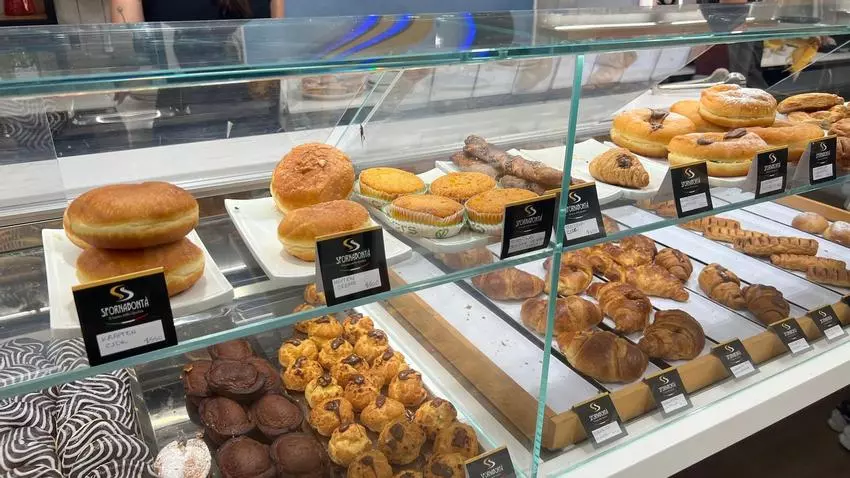
Sfornabontà by Amalfi opened its doors just a month ago. The owners, Italians, emphasize that they are the first store selling products from this country in Cuba. Several white-painted wooden tables are occupied almost entirely by older foreigners smoking thin cigarettes or cigars. Located in Miramar on 1st Street, between 44th and 42nd, in front of the Copacabana Hotel, the place offers pizza, pasta and ice cream, as well as sweets and drinks rarely seen before in Cuba.
“The first time I went I just ordered takeout because it was packed. I ordered a cornetto, filled with Iberian ham and cheese, super delicious, and it wasn’t that expensive, 500 pesos. The second time I went, two weeks later, they had raised the price to 750 pesos,” says Amalia Rodríguez, who says she finds out about these places almost always through Instagram, where she and her friends share their visits to chic establishments. “I liked the place, but both times I went they had problems with the electronic payment transfer. Too much coincidence. I don’t think they accept it.” Although the law doesn’t allow it, many of these businesses prefer cash in dollars.
Parked in front of the premises are modern cars and the occasional electric motorbike, as the prices are not for everyone, with pizzas or main dishes ranging from 1,800 to 6,000 pesos.
Just one block further along, on the same 1st street, is what YouTubers Javi and Zami have called “the most expensive restaurant in Cuba,” Garbán. The cheapest thing is the soft drinks at 990 pesos, and a bottle of water or a portion of rice can cost up to 2,000 pesos, a portion of
five croquettes is close to 4,000 pesos, and main dishes are between 4,000 and 9,200 pesos.
Garbán is located just above Gelato, an ice cream shop and confectionery established more than 10 years ago. Both belong to the same owners, Cuban Yanetsi Azahares and her Italian husband.
A special feature of these restaurants is their cocktails and signature cuisine, along with the originality of their decor. Some may be modernist, others minimalist, classic and bohemian or more contemporary, as in the case of Malecón 663, owned by Frenchwoman Sandra Expósito.
“The decor is original. All the chairs are different at the same table, things from the menu are written on the wall. The employees are dressed strangely, with colorful shorts and bare feet,” says Analay Cuello, who, together with her husband, owns a small business selling motorcycles. “Despite it being a strange place, I had a good time.”

“The food is also strange. The pork tenderloins had chocolate sauce. I told him to put the sauce on the side just in case. We didn’t like it. All the dishes had something distinctive about them. The names of the rooms were Gozando en La Habana [Enjoying in Havana], El cuarto de Tula [Tula’s Room], each with a different decor.”
Analay and her husband rented a room, as the Malecón 663 is not only a bar-restaurant but also a boutique hotel. The price per night is $110, with a bottle of cider and breakfast included.
“I didn’t think it was expensive. I’ve been to places that were much more expensive than that, like Chucha’s Tapas Bar, for example. The bills, with my husband and my daughter, every time we go there for her to play, since it has an amusement park, are 18,000 pesos, and what we eat is a dish and a starter for each of us, with a drink, no dessert or anything, and thank goodness we don’t drink alcohol. A lemonade at Chucha’s costs you 1,200 pesos.”
“When I arrived, all I saw were foreigners,” Analay continues. “The manager told us that, indeed, only foreigners or young bohemian Cubans came to listen to jazz and have a few drinks. People like us rarely went.”
Most of these sites have a good presence on social media like Instagram, due to strategies that include collaborations with fashion influencers and artists.

Las Noches de Fangio is a well-known weekly event held at the Fangio Havana restaurant, where artists such as Alaín Pérez, Ernán and Ruy López Nussa, Raúl Paz, Frank Delgado, the Abreu Brothers, among others, have performed. Most of these artists could fill a theater, but playing in these places brings them more economic benefits, since 1,000 pesos is the minimum cover charge . Other places that have this duality of restaurant/concert are Yarini, owned by Cuban actor Jorge Perugorría, and Ecléctico, to mention a few.
Going to these places is a sign of status. Posting on social media that you are going to places where the Havana showbiz and foreigners go, who are not the ones who go to all-inclusives, but who stay in luxury hotels and eat lunch and dinner in places where they spend 100 dollars per meal.
One thing is obvious: almost all of the owners of these sites are foreigners or Cubans directly linked to a foreigner.
“It’s something I’ve seen in almost all the places we go to,” Analay continues. “The owners are foreigners. They have their trusted people, the managers, as they call them, and they take care of their business when they are not there, which is most of the time.” “They are all the same. Cubans can’t go anywhere anymore, because they are all expensive. New ones open and they are more expensive,” she concludes.
There are more examples. Color Café, owned by Loypa Izaguirre, a Cuban married to a Frenchman; Plan H, a Cuban owner married to a German; Hotel Boutique Tribe Caribe, owned by two foreigners, one of them the Venezuelan producer Andrés Levin and the other, a mysterious Anglo-Saxon investor, although the shadow of Raúl Castro’s daughter, Mariela, is persistently pointed out.

Most of these sites were recently profiled by Montreal’s La Presse in a series of three surprisingly dithyrambic articles entitled La Havane chic. The author, Canadian photographer Martin Chamberland, describes a new facet of Havana, “more upmarket, even more nutritious for the taste buds and more dazzling for the eyes.”
One of the “experts” he interviewed is Canadian photographer Heidi Hollinger, who says that “this city has the assets to become one of the most outstanding places on the planet and a first-rate gastronomic capital.”
Beyond the stupor provoked by the description of this parallel reality, many questions arise: Did they only see that Havana where foreigners and that very small sector of Cubans with resources congregate? When they moved from one chic place to another, did they not see the other one, invaded by garbage, with buildings in ruins and widespread poverty?
“Cuba is increasingly out of reach for the Cuban people,” says one user in the comments to one of the videos by YouTubers Javi and Zami. Cubans are the last to learn that Havana has become “a gastronomic capital.”
