Cuba’s Minister of Health Is Concerned About the ‘Political and Ideological’ Situation of Doctors in Villa Clara

During the Health Minister’s visit, the “illegal sale of services, medicines and resources” was discussed


During Cuban Health Minister José Ángel Portal Miranda’ visit, the “illegal sale of services, medicines and resources” was discussed

14ymedio bigger14ymedio, Havana, 1 February 2025 — On Friday, Cuban Health Minister José Ángel Portal Miranda, speaking in Villa Clara, criticized the failures in the “compliance with medical ethics,” a euphemism that describes the corruption of medical services in the province. His delegation also detected “unsuitable results” in the state of the facilities, the production of medicines, the training of personnel and the “political and ideological” situation of health workers.

Villa Clara can only boast about its zero maternal mortality rate – for the last two years – and the decrease in the number of low birth weight children, the lowest in the country. The infant mortality rate is 7.1 per 1,000 live births and the number of children under five who have died has increased, but it was not stated by how much. These figures, which local leaders consider positive, are the only ones reported by the local media.

Vanguardia, the official provincial press, one of the most orthodox and uncritical in the country, did not know how to describe the minister’s diatribe. Directly supervised by the Communist Party, to local newspaper was content to publish an opinion piece that indirectly alluded to Portal Miranda’s words, which put “the dots on the i’s.”

The CMHW radio station’s website, for its part, reduced the scolding to a “fruitful exchange” with the official.

The CMHW radio station’s website, for its part, reduced the scolding to a “fruitful exchange” with the official. Only the Telecubanacán website – little read by Villa Clara residents – noted the minister’s “critical view,” which “reviewed the achievements and deficiencies of the sector.” Reference was made, above all, to “aging population, low birth rates, epidemics, drugs and the sustainability of services.” continue reading

In a comment on the meeting, pro-government journalist Ricardo González agreed with the minister and offered more details: in Villa Clara there is “illegal sale of services, medicines and resources.” In addition, there is “favoritism in consultations,” especially for “performing a surgery or reaching a diagnosis.” Care depends on “a gift or a perk” to the staff.

“We know who they are and yet nothing happens,” concluded González, who attributed this “behavior of profit and survival” to the lack of medical resources. The journalist also referred to “those who mistreat” in hospitals and “spoil the work.”

On the other hand, some 200 medical offices in the province – including the residences of medical and nursing staff – are in a terrible state of construction, according to the report from the local leaders to Portal Miranda. This is one of the factors that affect the “stability and permanence of doctors,” they added, who are stampeding “towards other sectors of the economy with higher remuneration and towards emigration.”

The minister did not hesitate to blame the Washington embargo for the shortcomings that depend on the Government

The minister did not hesitate to blame the Washington embargo for the shortcomings that depend on the Government and not on the provincial administration. If there is one thing that all the media in Villa Clara agree on, it is that Portal Miranda repeated the slogan that has become popular among the regime’s cadres: “the blockade* is real.”

Together with local leaders of the Communist Party, Portal Miranda also called for a complete reorganization of medical services. After the criticism, the bulk of the meeting was devoted to awarding government distinctions to doctors with a “selfless record of service” not only to Healthcare, but also to the regime.

*Translator’s note: A reference to the US embargo, which the Cuban government refers to as a blockade.

____________

COLLABORATE WITH OUR WORK: The 14ymedio team is committed to practicing serious journalism that reflects Cuba’s reality in all its depth. Thank you for joining us on this long journey. We invite you to continue supporting us by becoming a member of 14ymedio now. Together we can continue transforming journalism in Cuba.

‘50 Stories of Cuba in Exile’ and an Essay on Sugar Among the January Books

Last month, Azúcar, an essay that compares the history of sugar with that of civilization, arrived in bookstores.

The Ácana mill, in Matanzas, drawn in 1857 by Eduardo Laplante as part of his “collection of views” of colonial sugar mills / Project Gutenberg

14ymedio bigger14ymedio, Xavier Carbonell, Salamanca, 2 February 2025 – “Azúcar!” It was for decades the battle cry of Celia Cruz, sung in vibrant and honeyed syllables. “Without sugar there is no country” was the mantra of the Republican landowners, which in the light of the current sugarcane debacle sounds like a spiteful prophecy against Fidel Castro. In fact, Cuba owes its opulent nineteenth century – railways, cities, mills – and also its sickly attachment to slavery, abolished late, to sugar.

Manuel Moreno Fraginals, in the prologue to his controversial study on the sugarcane industry on the Island, described like no other the ferocity with which sugar shaped the history of Cuba. The author of El ingenio [The Sugar Mill]- who ended up disgusted and going into exile in Miami, where he died in 2001 – traced “the footprints that start in sugar and manifest themselves in the establishment of a university chair, or in a decree on tithes, or in the characteristic form of the Cuban architectural complex, or in the terrible effects of the razing of forests and the erosion on the soils.”

Azúcar [Sugar] (publisher Ariel) arrived in bookstores this January, an essay of almost 500 pages signed by the Dutch researcher Ulbe Bosma, which equates the history of sugar with that of civilization. For the text, where it is not difficult to find the imprint of Moreno Fraginals, “the rise of sugar speaks to us of progress, but also of a much darker history of human exploitation, racism, obesity and environmental destruction.” continue reading

In an interview, Bosma illustrated the political and economic importance of the so-called Creole saccharocracy

In an interview offered in Barcelona to the newspaper La Vanguardia, Bosma illustrated the political and economic importance of the so-called Creole saccharocracy during the 19th century and the first half of the 20th. If today it is the technology tycoons Elon Musk and Jeff Bezos who pull the strings of world politics, he said, at that time the influence of the big sugar surnames – Fanjul, for example – was decisive in the United States and Europe.

For Bosma, social networks are just as addictive as sugar, and the key to dealing with both is moderation. He says that he adds sugar to his coffee, but only “a teaspoon.” “Despite everything I’ve found out,” he says, “I’ve gotten used to its flavor and don’t want to lose it.”

Independent Cuban publishers have had a modest production during the first month of the year. One highlight is Como el ave fénix [Like the Phoenix] (Rialta Magazine), 50 interviews published by Cuban journalist William Navarrete in recent months on CubaNet. They are, for its author, “stories of Cuba in exile.” They narrate, according to the life experiences of those involved, the last 100 years of the Cuban nation.

“For years, William Navarrete has had the sense of smell and sagacity to locate many of the protagonists of the politics and culture of the Island of the twentieth century and get them talking about the lost city, the political prison, the purges, the labor camps, the exile or the great names and events of their life stories,” say its editors, who qualify the book as “one of the most powerful collective testimonies” after 1959.

Rialta also publishes, in its ’Files’ section, a recount of Antonio José Ponte’s career in ’La Gaceta de Cuba’

Rialta also publishes, in its Expedientes [Files] section, an account of the career of Antonio José Ponte in La Gaceta de Cuba. What was published by the poet and essayist in one of the most disgusting magazines of official culture gives the measure of how his critical caliber was gestating. This dossier is also a sample of the work of Ponte in Cuba, the attempts at “civic extermination” to which the regime subjected him and his emergence as one of the indisputable voices of his generation.

Ediciones Memoria, a small publishing house in Camagüey dedicated to the rescue of Cuban civic thought, publishes Las conferencias de Shoreham, by Manuel Márquez Sterling. “His prose is a long and subtle examination of both his own and the national conscience. There is no lack of irony, even mockery, but above all, in the sometimes light ease of speech, there is always the seriousness of the duty to be,” explains his editor, Alenmichel Aguiló.

The anthology of poems by the Russian Nobel Prize winner Joseph Brodsky, who died in 1996, translated by Ernesto Hernández Busto for the Siruela publishing house, is already in bookstores. Devoted to the writer exiled from the Soviet Union, the Cuban has written: “With Joseph Brodsky I am always tempted to make different versions, perhaps because in his poetry there is also an effort to communicate a certain universality, a certain transcendence.”

Translated by Regina Anavy

____________

COLLABORATE WITH OUR WORK: The 14ymedio team is committed to practicing serious journalism that reflects Cuba’s reality in all its depth. Thank you for joining us on this long journey. We invite you to continue supporting us by becoming a member of 14ymedio now. Together we can continue transforming journalism in Cuba.

Shortages, Inflation and Bureaucracy Bring Private Cafeterias to the Brink of Bankruptcy in Cienfuegos

Some entrepreneurs are experiencing “the most difficult times in business”

“I try by all means to keep prices accessible to most people, but if the suppliers’ charges increase, I have no choice but to charge a little more myself” / 14ymedio

14ymedio bigger14ymedio, Julio César Contreras, Cienfuegos, 27 January 2025 — With bruises and problems, which he prefers to describe as “challenges for 2025,” Abelardo has decided that his cafeteria will remain open against all odds. With 57 years behind him, he has no doubt that he is living “the most difficult times of the business,” which he opened in 2019 on Santa Cruz Street, in Cienfuegos.

Like other self-employed people in Cuba, the rise in prices and the product shortage are two realities that are threatening the neck of his business. The instability in his price list has been inevitable and the customers, he tells 14ymedio, are not the only ones who suffer from the disarray of the national economy. “I started with two employees who were in charge of preparing food and serving customers, while I guaranteed the supply of the cafeteria,” he explains. “I paid them 500 pesos a day, and it worked for me, even with the taxes to the Onat (National Tax Administration Office) and hiring a manager who kept the business’s accounts.”

The turning point – as for thousands of business owners on the Island – was the Coronavirus pandemic and the implementation of the Ordering Task in January 2021. He had to fire one of his employees. continue reading

“I paid them 500 pesos a day, and it worked for me, even with the taxes to the Onat”

The cafeteria began its decline, fueled by the economic measures that the Government has implemented in recent years.  According to the merchant himself, multiple factors have influenced the decline of his establishment, among which inflation, lack of merchandise and the low purchasing power of the population stand out.

“I try by all means to keep prices accessible for most people, but if the suppliers charges increase, I have no choice but to charge a little more myself.  A cup of coffee that I used to sell for 20 pesos, I have had to increase it by an additional 30 pesos. If I don’t do it like this, I go straight to bankruptcy,” says Abelardo.

The situation is even more complicated for those owners who have to pay rent for the premises. It is increasingly common to find a small shop or a cell phone workshop, where until some time ago there was a bar that offered light products. Those who once opted to sell food are now evaluating the possibility of an exodus.

“My cafeteria’s location is privileged,” admits Rafael, who, like Abelardo, has decided to keep it open because it is across from the national bus terminal.

The flow of customers to his premises is “acceptable” during the day. Consumption is based mainly on products that do not exceed 150 pesos. “When you calculate the cost and the payments that must be made, the profit is so little that in some cases I have had to withdraw some offerings because they cause losses.”

Like Abelardo, Rafael also had to fire an employee: she even earned more money than he did.

“Many people are losing their jobs, because we business owners are being hindered from all sides.  From government inspectors who fine us for anything, to the huge shortages that prevent us from moving forward. My wife and I are trying to continue in this area of gastronomy, but the fight is tough”, explains Rafael.

In addition to the economic problems, there is the sluggishness with which the Ministry of Labor manages licenses to practice self-employment, and this hinders hiring.

“It is inconceivable that the documentation to employ a person takes up to six months,” laments Eladio, who also runs a cafeteria.  “I needed a saleswoman. Taking a risk, I put her to work while they processed her license. After five months, the papers were still not there, and she did not want to continue. I had to start the process again with someone else.”

In Cienfuegos, more and more establishments are closing their doors in the early afternoon. There is no money to pay the employees for the full day and, besides, it does not make sense if there are no customers. “I open when I can and how I can,” is Eladio’s mantra, “I don’t have partners in the MSMEs or godfathers in the Government.”

Translated by Norma Whiting

____________

COLLABORATE WITH OUR WORK: The 14ymedio team is committed to practicing serious journalism that reflects Cuba’s reality in all its depth. Thank you for joining us on this long journey. We invite you to continue supporting us by becoming a member of 14ymedio now. Together we can continue transforming journalism in Cuba.

The Whole Truth About the Case of Former Cuban Minister Alejandro Gil

Or how the lack of transparency gives us the right to speculate

Alejandro Gil, former Minister of Economy and Planning, was dismissed in February 2024 / Cubadebate

14ymedio bigger14ymedio, Reinaldo Escobar, Havana, 1 February 2025 — Those who rule in Cuba, from the powers that emanate from their positions, promised that there would be transparency in the trial of Alejandro Gil, former deputy prime minister and former minister of Economy. But instead of transparency, opacity has prevailed, not to say the darkest secrecy.

After that “Official Note of the First Secretary of the Central Committee of the Party and President of the Republic” published in the official newspaper Granma on March 7, 2024, the only comment that has been heard from an official source was that of the Comptroller of the Republic, Gladys Bejerano, who, in an interview with the EFE agency on May 21, 2024, said that what happened with Gil felt “like a betrayal.” Two months later she was removed from her position as part of the “process of normal renewal of the cadres.”

The Comptroller of the Republic said that what happened with Gil felt “like a betrayal”

Exercising the right to speculation (without abusing it) granted by government secrecy for a whole year, I dare to launch these hypotheses:

Alejandro Gil is innocent of the charges attributed to him, and to the surprise of his kind interrogators he has resisted all pressure to accept guilt.

Alejandro Gil is partially or totally guilty of the charges against him, but he has threatened to say everything he knows about those who are hierarchically above his old position, which has prevented or delayed their indispensable public presentation.

The charges that are imputed to him could be related to acts of corruption, such as appropriating funds intended for social use or declaring money as representing expenses that he later pocketed; nepotism, by taking advantage of his position to benefit private businesses of family or friends; adulterating in his reports the real data of the economy for the purpose of pretending to be successful in his management. Furthermore, salacious data about his personal morality could be included, and even worse, accusations of passing information to the enemy or that he intended to promote measures aimed at demolishing the socialist system.

And one last hypothesis: We will never find out what really happened.

Translated by Regina Anavy

____________

COLLABORATE WITH OUR WORK: The 14ymedio team is committed to practicing serious journalism that reflects Cuba’s reality in all its depth. Thank you for joining us on this long journey. We invite you to continue supporting us by becoming a member of 14ymedio now. Together we can continue transforming journalism in Cuba.

Cuba’s Foreign Minister Protests Against the US Restricted List of Companies Under Military Control

According to Bruno Rodríguez, Trump’s measures “will lead to greater shortages, separation and increased emigration”

For Rodríguez, the announcement is “gratuitous abuse” and a “criminal measure” / Cubadebate

14ymedio biggerEFE/14ymedio, Havana, February 1, 2025 — The Cuban Foreign Ministry described this Friday as a “provocative act” Washington’s decision to reinstate and expand the Restricted List of Cuba, which bans transactions with companies linked to the regime. The head of Cuban diplomacy, Bruno Rodríguez, said that Donald Trump’s government promotes “irresponsible scenarios of confrontation” with Havana.

Regarding the decisions announced by the US Secretary of State, Marco Rubio, Rodríguez said that they are “deceptive pretexts with which he intends to justify the unjustifiable,” alluding to the increase in sanctions against the regime.

Rubio approved this Friday the reinstatement of the “black list” that bans commercial exchanges with companies under the control of the Cuban Armed Forces, State Security or other military or counterintelligence organizations. For Rodríguez, the announcement is “gratuitous abuse” and a “criminal measure,” which “will cause greater shortages, increased emigration and separation.” continue reading

Rubio explained that he is re-issuing the list “to deny resources to the same branches of the regime that directly oppress and monitor the Cuban people

For his part, Rubio explained in his statement that he is re-issuing the list “to deny resources to the same branches of the Cuban regime that directly oppress and monitor the Cuban people while controlling large sectors of the country’s economy.”

He stressed that in addition to putting back the companies that were already on that list until the last week of the Biden Administration, he has added Orbit, “a remittance processing company that operates for or on behalf of the Cuban military.”

“The State Department holds the Cuban regime responsible for oppressing its people and rejects Cuba’s evil interference in the Americas and around the world,” he said. Rubio also recalled that on January 20, in the first hours of Donald Trump’s second term, the latter revoked the decision of his predecessor to remove Cuba from the US list of states promoting terrorism.

Miguel Díaz-Canel also reacted to Washington’s announcements about its policy towards the regime

Miguel Díaz-Canel also reacted to Washington’s announcements about its upcoming policy towards the regime. This Friday, he defined Trump’s decision to use the US naval base in Guantánamo to detain 30,000 undocumented immigrants as an “infamy.” He attributed to the Republicans “fascist ideas,” which are the “fruits of capitalism.”

Trump said that he would send thousands of undocumented immigrants to Guantánamo, an act – in the words of Díaz-Canel – of absolute “brutality,” since for Havana the territory of the base is “illegally occupied” by the US Army.

In his demands to the Cuban regime, Rubio once again put on the table the issue of the dozens of terrorists for whom Havana has provided refuge. Such is the case of the American of Puerto Rican origin William Morales, who put a bomb in the Fraunces Tavern in New York and was given asylum by Fidel Castro in 1988. In an act of tribute to the victims, Rubio demanded that the Cuban government return Morales – who still lives in the Cuban capital – to be held for trial in the United States.

Emphatic about Washington’s justification for including Cuba in the list of countries sponsoring terrorism, Rubio recalled that “to this day,” the regime protects those responsible, in addition to other “fugitives and terrorists” sought by the United States.

Translated by Regina Anavy

____________

COLLABORATE WITH OUR WORK: The 14ymedio team is committed to practicing serious journalism that reflects Cuba’s reality in all its depth. Thank you for joining us on this long journey. We invite you to continue supporting us by becoming a member of 14ymedio now. Together we can continue transforming journalism in Cuba.

The US Reinstates and Expands the Restricted List of Cuba for Certain Business Transactions

Trump Administration Adds Orbit, “a Remittance Processing Company Operating for or on Behalf of the Cuban Military” to the list

Orbit handles remittances through companies such as Western Union, VaCuba or Cubamax. / 14ymedio

14ymedio biggerEFE/14ymedio, Washington/Havana/ 1 February 2025 — The new US Secretary of State, Marco Rubio, approved this Friday the reinstatement of the Restricted List of Cuba, a “black list” that bans certain transactions with companies under the control of or acting on behalf of the Cuban military, intelligence or security services personnel.

Rubio stated that he is reinstating that list “to deny resources to the same branches of the Cuban regime that directly oppress and monitor the Cuban people while controlling large sectors of the country’s economy.”

Rubio stressed that, in addition to putting back the companies that were already on that list until the last week of the Biden Administration, he is adding Orbit, “a remittance processing company that operates for or on behalf of the Cuban military.”

“The State Department holds the Cuban regime responsible for oppressing its people and rejects Cuba’s evil interference in the Americas and around the world,” he said. continue reading

“The State Department holds the Cuban regime responsible for oppressing its people and rejects the evil interference of Cuba in the Americas and around the world.”

Republican congressman Mario Díaz-Balart, of Cuban origin, said on X that with the reinstatement and expansion of the list, Rubio fulfills “his promise to support the freedom of the Cuban people, denying resources to its oppressors while promoting the national security of the United States.”

Rubio’s message also expressed Washington’s support for “human rights and fundamental freedoms for the Cuban people” and demanded “the release of all unjustly detained political prisoners.”

“Our embassy in Havana is meeting with relatives of those unjustly detained, as well as dissidents, so that they know the United States supports them unconditionally. We are firm in our commitment to the Cuban people, and we hold the Cuban regime responsible for its actions,” he said.

Rubio recalled that on January 20, in the first hours of Donald Trump’s second term, the President revoked the decision of his predecessor to remove Cuba from the US list of countries promoting terrorism.

Rubio’s message also expressed Washington’s support for “human rights and fundamental freedoms for the Cuban people

“The Cuban regime has long supported acts of international terrorism. We demand that it end its support for terrorism and stop providing food, housing and medical care to murderers, bomb makers and foreign kidnappers, while Cubans go hungry and lack access to basic medicines,” Rubio said.

The Trump Administration added that it is also committed to US citizens “having the ability to take private action related to their properties that were confiscated and trafficked by the Cuban regime.”

The Office for Latin America of the State Department in turn welcomed the revocation of the last-minute, ill-advised policies of the previous administration in regard to Cuba.

In 2022, the Central Bank of Cuba (BCC) licensed the non-bank financial institution Orbit S.A. to manage remittances on the Island. The company, established in Havana in February 2020, was authorized to process international transfers from abroad and to provide payment services from abroad through its infrastructure, for duly authorized goods and services, according to current legislation.

“The Cuban regime has long supported acts of international terrorism”

Orbit manages remittances from the United States through entities such as Western Union, VaCuba or Cubamax and is backed by Financiera Cimex (Fincimex), belonging to Cuba’s powerful military conglomerate Gaesa (Grupo de Administración Empresarial S.A.). In an extensive report published last December, The Miami Herald confirmed Gaesa’s ties with the Cuban military.

Orbit’s data, the newspaper points out, appear alongside those of Fincimex on remittances in the reports prepared by the latter for its meetings with the executive president of Gaesa, Ania Lastres Moreras.

According to the Herald, Orbit has been managed by Fincimex executives since its creation. Currently, its president is Diana Rosa Rodríguez Pérez, appointed this year by the president of Gaesa; she previously served as vice president of Cimex.

Translated by Regina Anavy

____________

COLLABORATE WITH OUR WORK: The 14ymedio team is committed to practicing serious journalism that reflects Cuba’s reality in all its depth. Thank you for joining us on this long journey. We invite you to continue supporting us by becoming a member of 14ymedio now. Together we can continue transforming journalism in Cuba.

Two Cuban Fishermen Survive Seven Days on the High Seas by Eating Raw Fish

Carlos Francisco Rodríguez González and Yusuan Fundora Massaguet were swept away by the current and rescued near the Bahamas

Carlos Francisco Rodríguez González, in an image published by the official press / Girón

14ymedio bigger14ymedio, Mexico, 30 January 2025 — “How did we survive? Nature is great.” Fisherman Carlos Francisco Rodríguez González, 55, tells how he was shipwrecked and set adrift with Yusuan Fundora Massaguet, only 15 years old, for seven days, until they were rescued near the Bahamas. “I, who am neither Catholic nor a Christian, prayed to all the virgins, everyone,” he said in an interview with the newspaper Girón. What he thought would be a “quick fishing trip, got complicated.”

At midnight last Thursday, January 16, Rodriguez left his home in Cerro (Havana) alone, planning to return at nine in the morning. After fishing in Havana Bay, however, he wanted to go to Chivo Beach, “but my legs were giving out on me,” he said. A young man he knew on another raft tried to help him, but the wind pushed them both out to sea.

“The current was taking us east and toward the sea, and nothing was there, not even a boat to give us a hand. The boy didn’t have experience either. We were overcome by the current and fatigue,” said the fisherman.

At nightfall, Rodríguez’s polyfoam cork boat broke up completely, so he got onto the boy’s raft, and “that’s how we both were stranded for a week, without eating or drinking water.” continue reading

“The boy at some point even told me that he wanted to just jump in the water, that he couldn’t go on any more. But I didn’t let him give up.”

With barely three years of fishing experience, he said that when he usually goes out, he carries a gallon of water or a bottle of soda. On this occasion he didn’t bother. After the first day on the high seas, Carlos Francisco threw in a hook and caught a goldfish. “We took out the bones with a knife, laid it down on the cork to dry a little and ate it raw. The boy even ate the egg sac, which disgusted me. He also drank some salt water.”

The fisherman said there were many sharks. “You saw the big ones jumping and fins in the water.” Rodríguez says that he is not afraid of sharks. “If there is no injured fish around that is bleeding, there is no need to be afraid. I was more afraid of dying from dehydration than from being bitten by a shark.”

As the days passed, despair took hold of the fishermen: “The boy at some point even told me that he wanted to jump in the water, that he couldn’t go on. But I didn’t let him give up.”

Rodríguez says he was reborn when the current took them in sight of a ship. “On unsteady legs, one of us kept rowing and the other steering towards the center of the boat,” he said. “Then we started screaming at the top of our lungs: ’Help! Help!’ Someone appeared and called the captain. And that rope they threw to us was a life-saver.”

Carlos Francisco Rodríguez González was admitted to the Faustino de Pérez provincial hospital, while the youngest fisherman was taken to the pediatric Eliseo Noel Caamaño. “After this I told everyone: ’I’m done’. But I’m not going to die of hunger either; if I have to go back (to fish), I will. And I’ll have to respect the sea.”

Translated by Regina Anavy

____________

COLLABORATE WITH OUR WORK: The 14ymedio team is committed to practicing serious journalism that reflects Cuba’s reality in all its depth. Thank you for joining us on this long journey. We invite you to continue supporting us by becoming a member of 14ymedio now. Together we can continue transforming journalism in Cuba.

Discontent in Pyongyang Over the Relationship Between Cuba and South Korea, Which Sends Its First Ambassador

Lee Ho-yul is officially appointed amid a rapprochement that, judging by recent actions, has not gone down well in the North

Acting President Choi Sang-mok (left) poses with Cuban Ambassador Lee Ho-yul

14ymedio bigger14ymedio/EFE, Seoul, 31 January 2025 — On Friday, South Korean authorities officially appointed diplomat Lee Ho-yul as the first ambassador to Cuba. Relations between the two counties were re-established a year ago.

Lee, who until now had been a minister in the South Korean embassy in Mexico, is, according to local media, an expert in commercial matters. In addition to being a career diplomat, he also served as general director of the Office of International Cooperation of the Ministry of Health and Welfare.

He will be the first ambassador that South Korea has on the Island after the historic re-establishment of diplomatic ties that took place between the two countries in February 2024.

He will be the first ambassador that South Korea has on the Island after the historic re-establishment of diplomatic ties that took place between the two countries in February 2024

It is believed that the relationship established between Seoul and Havana may be angering Pyongyang, given its traditional friendship with Cuba, supported by similar ideological positions.

In fact, the North Korean media have reflected that apparent discontent since the re-establishment of relations a year ago, barely publishing content that refers to Cuba.

For example, the state news agency KCNA reported very briefly on the New Year’s message sent by North Korean leader Kim Jong-un to Cuban President Miguel Díaz-Canel and also omitted the usual references to the “brother people” of Cuba. continue reading

For his part, the Cuban ambassador to South Korea, Claudio Monzón, has already presented his credentials to the interim president of South Korea, Choi Sang-mok, on January 7, and Cuba is expected to open its first embassy in South Korea before July 1.

The rapprochement between the two countries began in February 2024, when both parties announced that they were re-establishing relations that were broken in 1959, when, with the triumph of the Revolution, a historic, political and ideological alliance was forged between Cuba and North Korea.

In May 2016, in the midst of the thaw with the United States, the chambers of commerce of both countries signed a memorandum of understanding to share business information, carry out exchanges between their delegations and organize joint forums.

South Korea expressed interest in Cuba in energy matters, in addition to considering it “a potential market for medical and tourism businesses on the American continent

South Korea expressed an interest in Cuba in energy matters, in addition to considering it “a potential market for medical and tourism businesses on the American continent.” Trade between the two countries began to flow, and in 2022 South Korea exported goods to Cuba worth 14 million dollars and imported goods worth 7 million.

Although many Cubans were surprised by the announcement of the opening of embassies a year ago, Seoul argued that, among other things, every year about 14,000 South Korean citizens traveled to the Island – before the pandemic – and 1,100 descendants of Koreans who migrated during the Japanese occupation (1910-1945) resided in Cuba. All of them need “systematic consular assistance,” they said.

The romance between both nations has even reached the streets. At the beginning of this year, Havana opened the K-Mart, the first market with South Korean products in Cuba. Located on 27 th and J, in El Vedado, the private business sells everything from ramen, soju, tea and instant coffee to juices and energy drinks.

Translated by Regina Anavy

____________

COLLABORATE WITH OUR WORK: The 14ymedio team is committed to practicing serious journalism that reflects Cuba’s reality in all its depth. Thank you for joining us on this long journey. We invite you to continue supporting us by becoming a member of 14ymedio now. Together we can continue transforming journalism in Cuba.

The United States Deports 12 Cuban Rafters and Reiterates That Anyone Who Enters Illegally Will Suffer the Same Fate

A Honduran tells the newspaper ‘La Nación’ that migrants from Florida have stopped going to work for fear of being detained

The U.S. Coast Guard has increased its presence in the Florida Straits, the Windward Pass and the Mona Pass / X/@USCGSoutheast

14ymedio bigger14ymedio, Havana, 30 January 2025 — The United States Coast Guard deported 12 Cuban rafters on the Isaac Mayo ship on Wednesday, who were prosecuted after the interception of two boats. “Anyone who tries to enter the United States illegally by sea will be repatriated,” the agency stressed in a statement.

The US authorities specified that on January 19, a group of five Cubans on a foreign raft was detected 21 miles from Kayo Largo, during the overflight of an aircraft belonging to the Customs and Maritime Air and Maritime Operations team. The migrants were intercepted by the coast guard cutter Charles David, which after providing medical care handed them over to the Border Patrol for deportation.

A second contingent of seven Cubans on a “damaged boat” was located 50 miles southwest of Cuba, in the Yucatan Pass. The rafters were assisted by the crew of the Coast Guard ship Reliance.

Lieutenant Commander John Beal said that the Coast Guard “has increased its presence in the Florida Straits, the Windward Pass and the Mona Pass to prevent attempts at illegal maritime migration before they reach our coasts.” continue reading

Lieutenant Commander John Beal said that the Coast Guard “has increased its presence in the Florida Straits

Beal added that as part of the operations, sailors and recreational boat users have been asked to “inform the authorities about illicit maritime activity” through the VHF marine radio on Channel 16. The purpose of the mission is to protect the United States by securing the borders.

Meanwhile, several anti-immigrant operations have been carried out in Florida. According to figures from the Immigration and Customs Control Service (ICE), 5,537 people were arrested after raids that occurred between January 23 and 28. In addition, another 4,433 foreigners were transferred to other institutions, including prisons.

“Many people are afraid,” Honduran Eduardo Mature, owner of a property construction and remodeling company, told the Argentine newspaper La Nación. “I have 12 undocumented people working for me, and this week eight of them did not show up. One of the contractors I know in Miami told me that out of his entire work team of 10 people, only the driver came to work.”

Mature said that “before, they made them pay a fine, but now they are afraid that they will be handed over to immigration authorities. The construction project is very, very affected.”

Translated by Regina Anavy

____________

COLLABORATE WITH OUR WORK: The 14ymedio team is committed to practicing serious journalism that reflects Cuba’s reality in all its depth. Thank you for joining us on this long journey. We invite you to continue supporting us by becoming a member of 14ymedio now. Together we can continue transforming journalism in Cuba.

Cuban Pitcher Raidel Martínez Gets Star Treatment in Japan

Raidel Martínez, with the Cuban national team / Facebook

14ymedio bigger14ymedio/Swing Completo, Havana, 16 January 2025 — Almost a month after Cuban pitcher Raidel Martínez signed a historic contract with the Japanese Professional Baseball League (NPB), his new team, the Yomiuri Giants, will include him in the so-called Group S, a selection of the most important players on the squad, who get to decide their own training regimen.

The decision, reported this Wednesday by the official newspaper Jit, means that the players who make up the group will be responsible for their own practices and will decide what kinds of exercises they will do to get in shape, without planning by the club’s management.

“Normally, in the demanding world of Japanese baseball, both the team’s director and coaches determine the players’ work schedule during practice, including the exercises they do,” the media outlet explained.

This initiative, according to the newspaper report, “reveals enormous confidence and respect for the club’s most veteran players, a space that Raidel has earned on his own merit.” For the outlet Swing Completo (Full Swing), it is also “a recognition of the awards that the closer achieved and his quality in the box.” continue reading

This initiative, according to the newspaper report, “reveals enormous confidence and respect for the club’s most veteran players

Martínez is one of the best closers in the Japanese league. In his last season with the Chunichi Dragons he had a dream campaign. He set a personal record of 43 saved games, which was also the best mark in the entire league. He competed in a total of 60 games, in which he completed 58.0 innings while allowing only seven earned runs, for an ERA of 1.09. The Pinar del Río native also had 59 strikeouts, gave up 12 walks, and had a WHIP of 0.81. Finally, he allowed only 35 hits, including one home run.

All total, in seven seasons with his former team, he recorded 166 saves, with an ERA of 1.71, in addition to 353 strikeouts in 310.2 innings pitched.

In seven seasons with his former team, he recorded 166 saves, with an ERA of 1.71

The new contract that the closer signed with the Yomiuri Giants for 32.5 million dollars for four seasons is also one of the most lucrative for the Cuban Baseball Federation (FCB), which will pocket 20% of the amount, some 6.5 million dollars, more than 1.6 million dollars per season.

Although Raidel Martínez’s contract is “a historic agreement,” according to journalist Francys Romero, as it surpassed the $26 million received by Mexican Roberto Osuna or Cuban Liván Moinelo, the expert opines that the closer from Pinar del Río “would have obtained offers of between $50 and $70 million if he had entered the Major League market” in the United States.

In addition to Martínez and Moinelo, other Cubans with deals in the Japanese league are Carlos Monier, Frank Abel Álvarez, Cristian Rodríguez, Darío Sarduy and Ariel Martínez. There are also two other players with such contracts in Mexico, six in Italy, and four more in Canada.

Translated by Tomás A.

____________

COLLABORATE WITH OUR WORK: The 14ymedio team is committed to practicing serious journalism that reflects Cuba’s reality in all its depth. Thank you for joining us on this long journey. We invite you to continue supporting us by becoming a member of 14ymedio now. Together we can continue transforming journalism in Cuba.

Cuba’s Official Press Calls Las Tunas ‘Bad News for Cuban Baseball’ in the Series of the Americas

Curazao showed the weakness of the Las Tunas team / Jit

14ymedio bigger14ymedio/Swing Completo, Havana, 27 January 2025 — Curaçao won by 15-2 over the Leñadores de Las Tunas, who represent Cuba in the Baseball Series of the Americas, based in Nicaragua. Faced with the catastrophic result, the official media Granma reported that the Island’s team “had their hands tied” (was immobilized in the sport), and that their performance was “bad news for Cuban baseball, whatever the competition.”

Those led by Abeysi Pantoja, according to the same media, succumbed to players who had already turned the corner of stardom. The Curaçao team “has the wisdom and the craft” for their participation in teams of the US Major Leagues, in addition to the fact that some currently play in the Minor Leagues.

Cuban baseball is in crisis, and Cubadebate also recognized that nothing worked for the Cubans against Curaçao. The offensive line barely achieved three hits, and the Las Tunas pitchers allowed 16 runs. “You can’t win that way in baseball,” the same report emphasized.

“The pitchers allowed 15 uncatchable hits, and, to top it off, the defense also failed, not only because of the two errors, but also because there was no solution for throws that did not commit,” Granma summarized.

Sports analyst Juan Carlos Guerra Alonso “JuanK” in Por la Goma, reiterated that this bad moment of Cuban baseball “has a lot to do with the suffocating and obsolete policy of those who direct and pull the strings of the sport: those at the top, those in the middle and those “phantoms” who make decisions from behind a desk.” continue reading

JuanK specified that “you can’t have a good performance without playing baseball. You can’t live on Saturn, wanting to compete on Earth.” He recalled that the Cuban players have not played for a winter, and in the face of results like those against Curaçao, “we are losing the credibility and respect that our history gave us.”

Cuba’s first defeat against Nicaragua left doubts in some fans and accusations in others. “The Island did Managua a favor, they were clever,” José Pablo, a regular at the stadiums of the Central American country, told 14ymedio. “I have no doubt; those drunken pigs that make up the team (of Nicaragua) could never beat the Cubans for good, no matter how many desertions they have had and not even if they’re tied up and blindfolded.”

Baseball in Nicaragua is also in “decline.” According to a report in La Prensa, despite the investment of 4 billion córdobas for the “construction of 13 stadiums and the remodeling of another 24 sports facilities,” the fans have been absent from the games.

According to sports journalist Pablo Fletes, one of the causes is the local “quality of competition” caused by a championship that brings together 20 teams. The “saturation” has generated the disinterest of fans. Meanwhile, sports reporter Edgard Tijerino commented that national baseball has fallen behind in the international context, so “it has been left out of events such as the World Classic and the Premier 12.

Curazao has three wins and leads the Baseball Series of the Americas. Nicaragua and Águilas Metropolitanas follow, both tied with two games won and one lost. Cuba and Club Daom are equal in fourth and fifth place with one victory and two defeats. In the background is Caimanes de Barranquilla (Colombia) with three consecutive stumbles.

Translated by Regina Anavy

____________

COLLABORATE WITH OUR WORK: The 14ymedio team is committed to practicing serious journalism that reflects Cuba’s reality in all its depth. Thank you for joining us on this long journey. We invite you to continue supporting us by becoming a member of 14ymedio now. Together we can continue transforming journalism in Cuba.

Cimex and Caribe Will Open Dollar Stores in All Cuban Provinces

Instead of coins, customers who pay with cash must accept their change in the form of candies or ‘other products available by the cash registers’

According to the authorities, up to 7 % of Cimex and Tiendas Caribe supermarkets will follow the business model of 3rd and 70th supermarket in Havana / 14ymedio

14ymedio bigger14ymedio, Madrid, 30 January 2025 — The military conglomerate Gaesa plans to progressively expand trade in dollars to a large number of establishments in its network through Tiendas Caribe and Cimex, starting with the capitals of each of the 15 Cuban provinces. The decision was made as a result of the good results obtained by the recently opened 3rd and 70th supermarket, on the ground floor of the luxury hotel Gran Muthu Havana, which accepts payment only in dollars, both by card and in cash.

The spread of sales in US currency was the main idea transmitted to the population this Wednesday in State TV’s Round Table program, which brought together Mildrey Granadillo de la Torre, first deputy minister of Economy and Planning, along with several senior officials of the Central Bank of Cuba (BCC) and the two retail companies of Gaesa involved in the titanic task of raising dollars quickly, an objective declared by the participants in the talk.

According to Yamilé Álvarez Tejo, head of the commercial department of Tiendas Caribe, sales at the 3rd and 70th supermarket are going smoothly. “The revenues have been significant, with good acceptance of the variety of products, from the cheapest to the highest-end. The customers even appreciate the fact that the prices are favorable with respect to nearby markets and other markets in Cuba.” The director said they hope to attract staff – 90 workers to serve 3,000 people a day. “Per capita consumption is also quite high,” although customers showed less satisfaction with the method of payment.

“The revenues have been significant, with good acceptance of the variety of products, from the cheapest to the highest-end”

“They have not behaved as we would like,” she said, explaining that customers continue to show a preference for cash. “This creates operational stress and makes certain processes in cash control mechanisms and cash validation more complex. At certain times there is a lack of dynamism in the cash registers, since the 100-dollar bills must be validated, and there are a lot of them,” she added. continue reading

In any case, the intention is to progressively continue along this path. Granadillo recalled that in March 2024 the payment of fuel in dollars began to be allowed – sometimes almost forced, since these gas stations are the only ones stocked. Since June, this has spread to other products, mostly linked to the tourism sector, such as the Casas del Habano, and international pharmacies and opticians.

They were “the first steps we took based on the partial dollarization,” stressed the minister, who insisted that the measure was temporary and that “during the year this new network of stores should not exceed 7% of all the Cimex and Tiendas Caribe stores.” In addition, the BCC official assured, despite the evidence to the contrary, the peso will continue to be “the center of the Cuban financial system.”

They also guaranteed that the freely convertible currency (MLC) will be maintained, about whose disappearance there has been much speculation. Those accounts denominated in MLC and the commitment of banks to the obligations with their customers are maintained, based on the funds they have represented or the funds they may have in the future,” said Alberto Javier Quiñones Betancourt, vice president of the BCC, who added that the cards associated with those accounts will continue to work “in the network designed for them to operate.” The issue has generated perplexity among Cubadebate readers, who insistently ask why payment in MLC is not allowed in those stores if it is backed by foreign currency.

They also guaranteed that the freely convertible currency (MLC) will be maintained, about whose disappearance there has been much speculation

Another fundamental axis of yesterday’s intervention was to insist that dollarization is the previous step to de-dollarization. “We have evaluated international experiences that show that a forced de-dollarization, without the creation of previous conditions, could lead to more negative effects for the Cuban economy than those it is currently facing. Faced with the currency deficit, we assessed that a short-term, transitory measure with a gradual implementation was necessary to partially dollarize the economy,” Granadillo said.

You don’t need to have the memory of an elephant to remember that a month ago the Prime Minister, Manuel Marrero, said in Parliament that to de-dollarize “you have to go down this previous path.” Also, the then Deputy Prime Minister and head of Economy, Alejandro Gil Fernández – now arrested for an alleged corruption case – said the same in 2020, when referring to the stores in MLC, which had begun a year ago to sell appliances and months earlier to offer food products.

The official said that these “undesirable but necessary and transitory” measures “subsidized” “social justice.” The idea was – as now – “to do something because the currencies are escaping” and replenish them to “guarantee a minimum supply in national currency,” practically the same words used yesterday by the officials participating in Randy Alonso’s TV program to defend the expansion of dollar stores. The move is the same, and we will have to see if the result will be the same.

The deputy minister welcomed the reduction of the fiscal deficit by “more than 39%” but admitted that this is insufficient and that “a group of services and activities that can also raise cash is being evaluated.” She specifically mentioned the remittances and the scarce exports that exist, since, she said, “Cuba is an open economy, highly dependent on imports.”

The vice president of the BCC explained that they have decided to accept dollars in cash respecting the principle that the customer can choose the payment method, although it was clear that a key element was the greater willingness of Cubans to pay in paper money. “It was analyzed, studied and the possibility was seen, as we are also talking about a faster capture of the currency,” he said. However, electronic payment is preferred, and for this the financial products of this type have multiplied, which also solves the problem of returning change to the customer.

The matter of returning change after an overpayment was mocked when it was learned that candies were given to customers to compensate for the lack of coins, specifically referring to the director of Tiendas Caribe

This matter of refunding overpayment was mocked when it was learned that candies were given to customers to compensate for the lack of coins. of Tiendas Caribe. “When paying dollars in cash, when it is necessary to return change, there is no availability of fractional currency, because it is a foreign currency that the bank does not have. This is an inconvenience. Before, with the CUC [Cuban Convertible Peso, no longer in circulation], there was no such problem, because it was a national currency. Therefore, we clarify to customers that, as long as they do not require change, the use of electronic payment channels is preferable,” she said.

After stating, annoyed, that this matter was a source of ridicule, she explained: “We don’t only give change in candy; there are other products available by the cash register to offer to customers, according to what they are owed.”

The director also referred to the supplying of stores. She said that last year, they began financing nine suppliers “who had the installed capacity and were ready to produce. But this year we are adding another ten. We will continue to increase suppliers, and we will also achieve this in other ways, from establishing formal sales relationships to true productive chains.”

In addition, she talked about other businesses resulting from “partnerships with foreign investors who are suppliers,” who will also charge in foreign currency, because “in this type of business you have to quickly achieve a return on your investments.”

Translated by Regina Anavy

____________

COLLABORATE WITH OUR WORK: The 14ymedio team is committed to practicing serious journalism that reflects Cuba’s reality in all its depth. Thank you for joining us on this long journey. We invite you to continue supporting us by becoming a member of 14ymedio now. Together we can continue transforming journalism in Cuba.
Otto Ortiz, ‘ESEN’ That is There

Ortiz was one of the founders of the group Los Hepáticos in 1987. / Jorge Fernández Era/14ymedio

14ymedio bigger14ymedio, Jorge Fernández Era, Havana, 25 January 2025 — If any beginning of a comedy show can be considered a classic of stage humor, it is what happened more than thirty years ago when Otto Ortiz and Omar Franco walked through the audience at the Carlos Marx in what seems to be a violent argument between the two characters.

Both have become legends, in Otto’s case for more than one reason. That the National State-owned Insurance Company (ESEN in Spanish) owes a car is not news, but that the affected person roasting them about it on social media, is. And that Otto Lugar (Otto’s Place) is not the name of one of his shows, but the name of a pizza place, is also news. So, I go in, sit down and ask the waitress to call the manager immediately.

14ymedio/Jorge Fernández Era. In 1987 you were the founder of the group Los Hepáticos. (The Livers). Thirty-eight years later, how’s that bile?

Otto Ortiz. That bile, as you say, is at its best, more critical and elaborated. I started in the group Los Hepáticos doing very basic humor. With time, with knowledge, with the internet and access to humorists from different countries, we humorists have been looking for our own space, our own way of saying and doing things.

In the beginning, we worked together with Nos y Otros (Us and Others). We didn’t understand their humor much, but today we have followed their line

In the beginning, we worked together with Nos y Otros (Us and Others). We didn’t understand their humor, but today, I guess because of our maturity, we have followed their line.

I don’t just use stage humor. Three decades ago we were terrified of cabarets and nightclubs. Not now, and we have even ventured into social media, with a distant but active audience.

Cuban humor has always enjoyed good health. What is lacking, if anything, is humorists, we have been losing them. continue reading

14ymedio/Jorge Fernández Era. Let’s say ESEN gives you a tourism cab, broken-down and worn-out like you. Would you leave the pizzeria and become a cab driver?

Otto Ortiz. The National State-owned Insurance Company has been a part of my life for five years. I have five children: four real ones, and ESEN, which should be my mother, my father, but it is like a child to whom I allow everything until one day it does something good. I don’t know if he will give me an old and bad car like me, but as long as it fulfills its social role I will be happy. After that, I don’t know what I will do with the car.

I don’t think I’d leave the pizzeria. People know me for three things. The third one is as a humorist. The second one is for ESEN. The first one is for my pizzas. Those are three things that mark who I am. The public Otto is a mix of a pizzeria, state-owned insurance and humor. When ESEN gives me the car, I’ll put in a good word for them. People will say, “Look at this scoundrel.” But I’ve grown fond of them.

14ymedio/Jorge Fernández Era. It seems that your obsession with ESEN is a way to erase the bad memory of the baseball fuel shortage you had in the nineties to defeat Nos y Otros.

Otto Ortiz. Between 1988 and 1990, with Los Hepáticos, I did several seasons at the Carlos Marx, directed by Virulo. Nos y Otros were there too. We organized a four-team tournament. They say they won, we say the opposite, the dispute is still going on. Six top intellectuals like Nos y Otros can’t beat four or five pure “costumbristas” who were Los Hepáticos. I don’t believe that arts can prevail over people from Marianao, Mantilla, La Palma… Edit it however you want to, the paper can stand it.

14ymedio/Jorge Fernández Era. Tell me about Malas Compañías (Bad Company), the ones on the web and the ones you’ve had in your life.

Otto Ortiz. Malas Compañías is a YouTube series that I have the honor of sharing with the people of Punto y Coma (Semicolon), Visti Cárdenas and Iván Salgado. It has to do with relationships between individuals with different sexual orientations: acceptance, acknowledgement, and respect. El Nene (The Baby) who is me, is an old macho and homophobic man who for some reason lives with a gay man. We are already sixteen episodes in, we have addressed different topics, always from a humorous point of view. Behind an apparently simple script, there are messages, especially stories that you laugh about and enjoy. At this point it is very difficult for things not to have a meaning, to “say something.” We try to make people think, to make them grow.

Personally, bad company is left behind. I don’t have many friends and I don’t bother the ones I have. When I love someone I don’t bother him, neither does he, but we are there for each other. We don’t have to say what we are or draw attention to ourselves. The key is to be there at the right time.

I must also talk about good company. I have very few, but the good ones fill the gap in my chest. You and I, for example, have had a working relationship for years, and I have been there for you too, in a relationship of great respect, of love. The simple fact of supporting you (a comment, a timely visit…) speaks of our friendship.

The bad company I discard, the good company I take care of.

14ymedio/Jorge Fernández Era. It is remarkable your insistence on keeping a deep, analytical and critical humor. Aren’t you afraid that the censorship will try to “fry” you in a different kettle of fish… at Otto’s Place?

Otto Ortiz. My humor is more analytical than critical, more analytical than deep. When you go too deep, you can go too far. The subject of ESEN has helped me to criticize from a joking point of view, but without reaching the point of excessive mockery. It’s a good way to joke, but always rubbing salt in the wound with. As Martí puts it: bells on the end, but with a whip.

I have not had the pressure of censorship. I’m not from the media, which is where there can be more fear

I have not had the pressure of censorship. I am not from the media, which is where there can be more fear, because people are officially working and with many criteria. On social media, I do more critical humor, with a certain dose of sarcasm, and people like it. I’ve been lucky with that, without a Torquemada or censor. That’s good, isn’t it?

I joke a lot with the current situation, I try not to miss anything. We live in a society that changes daily, you can’t wait until tomorrow for a joke, because it’s gone. I try to give it a humorous twist while still criticizing, but at the same time I try not to stop suggesting, sometimes just for fun, but it’s there.

I just made a joke about how they were giving candies instead of coins for change (in the store) on the corner of 3rd and 70th. Those kinds of clips don’t last a minute, people consume them well. I also do a repertoire that goes beyond criticism, with the theme of Cubanism, father-son, husband-wife relationships. But criticism must always be present in humor. If we criticized more, it would be better for us, for the country, for society. That’s why I’ll be there, even if I am “fried” in a different kettle of fish… or “baked” at Otto’s Place.

Translated by LAR

___________

COLLABORATE WITH OUR WORK: The 14ymedio team is committed to practicing serious journalism that reflects Cuba’s reality in all its depth. Thank you for joining us on this long journey. We invite you to continue supporting us by becoming a member of 14ymedio now. Together we can continue transforming journalism in Cuba.
Cuba’s Minister of Transport Acknowledges the ‘Accumulated Deterioration’ of Cuba’s Roads

Rodríguez Dávila suggests that this could be the reason for the massive accidents this January

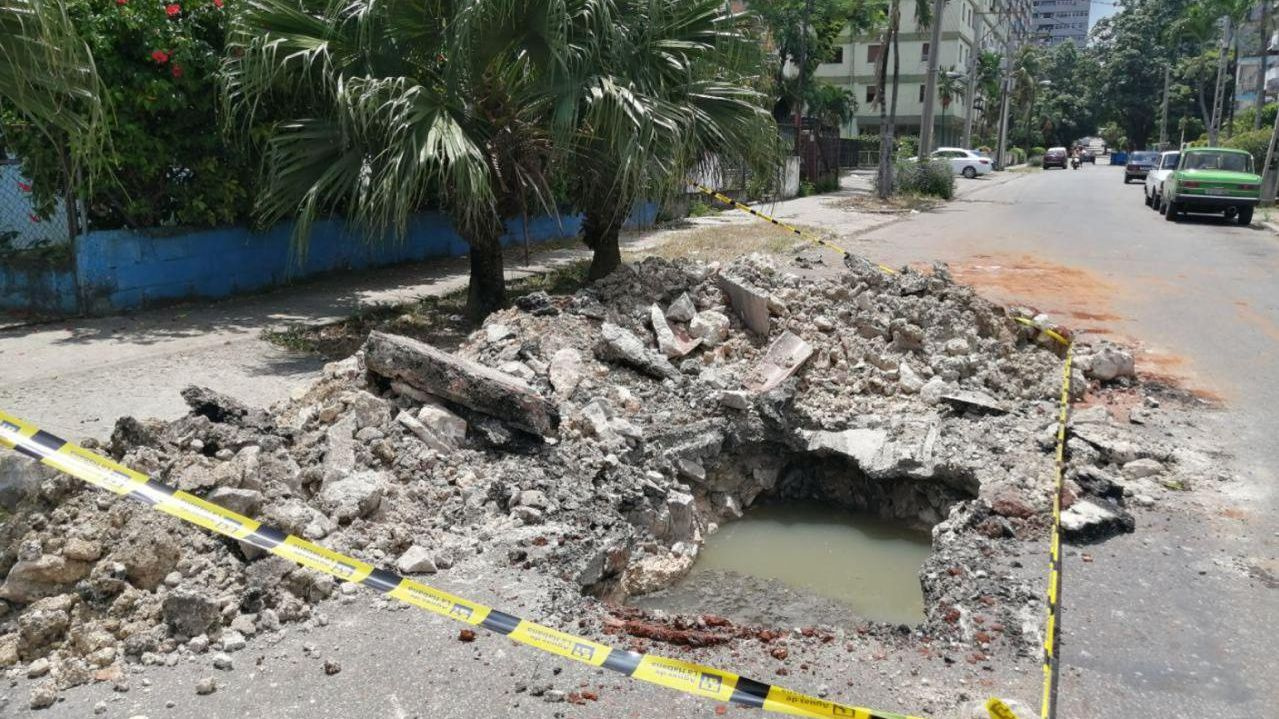
The lack of qualified personnel, fuel and other resources limits the repair of roads / 14ymedio

14ymedio bigger14ymedio, Havana, 28 January 2025 — Cuba’s Minister of Transport, Eduardo Rodríguez Dávila, has acknowledged that, although the accident data in 2024 were better than those of the previous year, “deterioration is accumulating” for roads and vehicles. His recognition may indicate an improvement, and he has become popular among those who follow his reports. In fact, he points out the massive accidents that have occurred this January as a worrying sign of that deterioration.

“The repeated news about accidents in Cuba in recent days have hurt, and they have to shake up those of us who have some responsibility in this matter,” the minister said on his social networks on Tuesday. However, he does not stop criticizing the publication of that news in the independent press: “Some headlines intend to generate the idea that we blame the drivers and do not analyze the causes in their complexity. And it’s not like that.”

Dávila maintains that the human factor is the main cause of traffic accidents on the Island, but he recognizes that the state of the roads – a parameter that accident reports do not include – “is directly related to accidents and the deterioration of vehicles.”

“It is difficult to know precisely the impact of roads in poor condition on the number and severity of accidents”

The minister claims that “it is difficult to know precisely the impact of roads in poor condition on the number and severity of accidents. Even some recent accidents with fatal consequences have occurred on roads in better condition.” However, he admits that this is a pending task of his portfolio, and that for the time being, there is little hope of effectively and quickly combating the debacle. continue reading

“In recent years, the road conservation program has not advanced as we hoped for material reasons, mainly the fuel deficit suffered by the country. In addition, the lack of a specialized work force, the lack of equipment and the obsolescence of existing equipment, among other reasons, are also determining factors,” he explains.

According to the official, the situation is worse for minor roads and side streets, which do not receive as many resources as the “roads of national interest” – highways and main thoroughfares – where there is more traffic.

There is not much more that his portfolio can do – in addition to the little he already achieves – due to his limited resources, explains the minister, who even assures that he spent “some time” driving a taxi to “understand the complexity of certain issues and to be able to better contribute to the formulation of public policies in our sector.”

In 2024, Cuba recorded a total of 7,507 traffic accidents, 12% fewer than those reported in 2023 (8,556). Deaths also decreased by 13% (634), and the number of injured people was 6,613, 4% less. The year was, it is worth adding, a period weighed down by low mobility due to lack of fuel.

Among the main causes of accidents on Cuban roads, the authorities have cited the lack of attention to control of the vehicle – in 30% of cases – not granting the right of way (29.9%), speeding, driving under the influence of alcoholic beverages and technical defects in the vehicles.

The first four causes are related, as Dávila explains, to the behavior of drivers: “It is often said that in Cuba there is no road courtesy, but when the consequences are fatal, the education of drivers cannot be optional, especially when it comes to the professionals.”

Translated by Regina Anavy

____________

COLLABORATE WITH OUR WORK: The 14ymedio team is committed to practicing serious journalism that reflects Cuba’s reality in all its depth. Thank you for joining us on this long journey. We invite you to continue supporting us by becoming a member of 14ymedio now. Together we can continue transforming journalism in Cuba.

The Sugar Harvest Begins in Granma Province, Cuba, but the Machinery Breaks Down After Two Hours

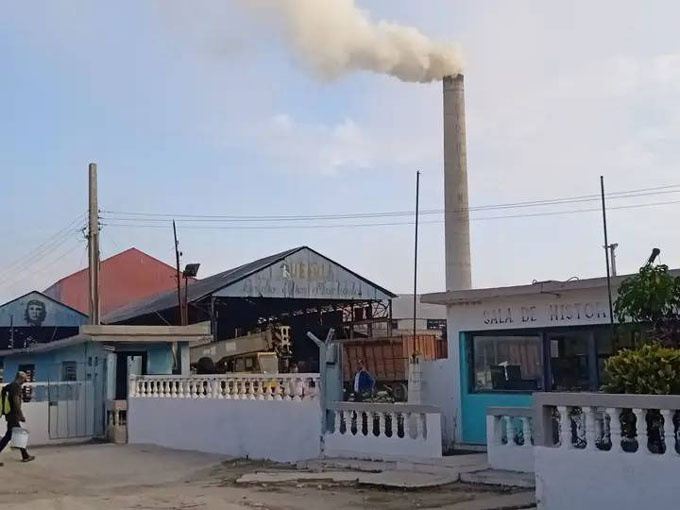
The Enidio Díaz Machado sugar mill in Granma / La Demajagua

14ymedio bigger14ymedio, Havana, 28 January 2025 — Almost two months later than planned, the province of Granma “officially” celebrated the launch this Monday of the 2024-2025 sugar harvest, although the jubilation lasted just two hours because “technical problems stopped the machines from grinding.” This was reported on Tuesday by the newspaper La Demajagua, which assured that the problem was resolved after “several lost hours and enormous effort” by the workers.

The article describes a litany of blunders. The harvest, the text reports, was supposed to begin last December, but it could not start due to a “lack of lubricants and fuel” for the machinery. After several weeks of trying to solve the “technical failures and inconveniences,” the Enidio Díaz Machado mill, located in Ceiba Hueca, Campechuela, began to grind the cane, but only from 5:00 am to 7:00 am and at barely 70% of its capacity.

After the official start this Monday, says the provincial newspaper in an apocalyptic tone, brigades of macheteros worked with the cutting, transport, lifting and pulling teams, “imposing themselves on the shortcomings that the brutal American blockade imposes on the Island.”

The harvest was supposed to begin last December, but it could not start due to a “lack of lubricants and fuel” for the machinery

The sugar workers of Granma must work with care to achieve a “harvest that exceeds 19,000 tons, and thus compensate for the forecasts of the previous harvest.” However, the Enidio Díaz Machado is running against the clock, since 17 weeks are planned for grinding. To achieve the goal, the media says, it will require “greater effort and commitment of everyone involved in the campaign.” continue reading

The sugar industry, once the Island’s economic engine, is in free fall, and the few mills that work have countless ailments: only six of the 14 planned for this campaign began production on time.

As a result, by the first week of January, barely 25% of what was planned had been ground, and “sugar production was at an insufficient 21%,” according to Dionis Pérez Pérez, director of Informatics, Communication and Analysis of the Azcuba Sugar Group. In an article published in Granma on January 9, the official added that “this scenario is aggravated by the late start-up and the non-incorporation of eight sugar mills, which represent 75% of the producers in the sector.”

Pérez Pérez explained that the electro-energy situation has also delayed the repair work in the mills, as well as in the cleaning centers and mechanization workshops. “This includes national factories, which provide essential parts and pieces for the operation of the sugar industry,” he said.

Pérez Pérez explained that the electro-energy situation has also delayed the repair work in the mills, as well as in the cleaning centers and mechanization workshops

In addition, he added, the lack of fuel availability has limited operational capacity and complicated the logistics needed to meet demand. According to the official, only 10% of the minimum financing required to carry out the harvest has been secured, which puts the sustainability of the production process at risk.

The condition of the mills is one of the reasons why grinding is minimal. It should be remembered that, in 1959, Cuba had 161 mills in private hands that produced 5.6 million tons of sugar that year. The mills remained in good condition during the decades of the Soviet subsidy, with the best sugar production data between the 70s and 80s – more than 8.5 million tons – without reaching, however, the Fidelist utopia of “ten million.”

The symbol of the harvest in recent years has been the debacle. For the 2022-2023 campaign, only 350,000 tons of sugar were achieved, the worst harvest since 1898, and well below the more than half a million tons of national consumption, not to mention the more than 400,000 tons that were exported.

Translated by Regina Anavy

____________

COLLABORATE WITH OUR WORK: The 14ymedio team is committed to practicing serious journalism that reflects Cuba’s reality in all its depth. Thank you for joining us on this long journey. We invite you to continue supporting us by becoming a member of 14ymedio now. Together we can continue transforming journalism in Cuba.