The Council for Democratic Transition argued that the Havana regime sells “an image and narrative of modernization, without assuming real commitments to political openness or the improvement of human rights.”
The High Representative for Foreign Affairs of the European Union, Josep Borrell, during a visit to Havana in May 2023 / @JosepBorrellF/Twitter
EFE (via 14ymedio), Havana, 4 February 2025 — On Tuesday, the Council for the Democratic Transition in Cuba (CTDC), one of the main opposition groups in Cuba, urged the European Union (EU) to “temporarily suspend” its Political Dialogue and Cooperation Agreement (ADPC) with Cuba.
The group argued in a statement that the Cuban Government “has instrumentalized this agreement to obtain economic benefits and sell an image and narrative of modernization, without assuming real commitments to political openness or to the improvement of human rights.”
Therefore, the CTDC – which already made a similar request last September – urged the EU to “re-evaluate and temporarily suspend the ADPC until there is “concrete progress in the field of human rights and democracy” on the Island (…) and compliance with “democratic and economic” standards. continue reading
“Only with a clear and coordinated response from western democracies will it be possible to achieve respect for human rights and a peaceful change to democracy in Cuba”
It also asked the organization to “guarantee the participation of Cuban civil society in the negotiations and dialogues on the possible revision of the agreement” and to support the CTDC’s proposal for a law of amnesty and decriminalization of dissent in the country.
“Only with a clear and coordinated response from western democracies will it be possible to achieve respect for human rights and a peaceful change to democracy in Cuba,” the group argued in its statement.
The organization indicated that one of the main reasons for its request is the deterioration of human rights in Cuba, and it denounced the “systematic persecution and repression” of opponents, the “flagrant violation” of constitutional rights, the escalation of arbitrary detentions and a lack of collaboration with international organizations.
Secondly, it alleged the “failure” of Cuba’s economic model, with the “monopoly” exercised by Gaesa, “a military conglomerate that controls the country’s resources, represses the private sector” and does not pay its foreign debt.
Finally, it highlighted Cuba’s “opaque strategic alliances” with Russia, Belarus, North Korea, China and Iran, and its “logistic and military” support to countries such as Nicaragua and Venezuela, “factors in regional destabilization.
It highlighted Cuba’s “opaque strategic alliances” with Russia, Belarus, North Korea, China and Iran, and its “logistical and military” support to countries such as Nicaragua and Venezuela
The agreement that currently governs bilateral relations between Cuba and the EU was signed in 2016 and includes a clause of respect for human rights, whose violation allows it to be suspended.
The ADPC, not exempt from controversy within the EU (it has not been ratified by Lithuania and is criticized by conservative political parties), replaced the so-called “common position” of the EU towards Cuba, which the bloc had maintained since 1996, and which linked any progress in the bilateral relationship to progress in democratization and human rights on the Island.
The agreement promotes cooperation in favor of sustainable development, democracy and human rights, as well as the possibility of finding shared solutions to global challenges through joint actions in multilateral forums.
Translated by Regina Anavy
____________
COLLABORATE WITH OUR WORK: The 14ymedio team is committed to practicing serious journalism that reflects Cuba’s reality in all its depth. Thank you for joining us on this long journey. We invite you to continue supporting us by becoming a member of 14ymedio now. Together we can continue transforming journalism in Cuba.
According to the US Secretary of State, Managua, Caracas and Havana have generated a massive wave of migrants to the US “because they are countries where their system does not work”
Díaz-Canel speaking at the ALBA* extraordinary summit on February 3, 2025, in Havana / @DiazCanelB / X
EFE (via 14ymedio), Havana, 4 February 2025 — The President of Cuba, Miguel Díaz-Canel, came out swinging on Tuesday against the US Secretary of State, Marco Rubio, and said that “humanity is in danger” from the “neo-fascism” of the United States, in response to recent statements by the politician of Cuban descent.
“The shamelessness once again taking over the cynical politicians of the United States. It is proven that the migratory exodus in Cuba is proportional to the tightening of the blockade, which deprives our people of essential goods. Humanity is in danger because of your neo-fascism,” the president wrote on social networks.
Díaz-Canel said that “the Empire, with its expansionist appetite” is the true “enemy of humanity.”
Díaz-Canel referred to Rubio’s statements on Tuesday during a press conference in San José, Costa Rica, in which he accused Cuba, Nicaragua and Venezuela of being “enemies of humanity” and of having “created a migration crisis.” continue reading
Rubio assured that he had “no intention” of traveling to Cuba as Secretary of State, “except to discuss when those who govern that country will leave”
According to Rubio, Cuba, Nicaragua and Venezuela have generated a massive wave of migration to the US, “because they are countries where their system [of government] does not work.”
These are not the only statements made by Rubio about Cuba recently.
Previously, in an interview with the American television channel Fox News, Rubio assured that he had “no intention” of traveling to Cuba as Secretary of State, “except to discuss when those who govern that country will leave.”
In this regard, the Cuban Foreign Minister, Bruno Rodríguez, stressed on Tuesday that Rubio “was not invited” to the Island.
“The US Secretary of State wants to visit Havana, but first change our Government. His desire will remain unfulfilled. He will not be able to visit Cuba, a country of which he knows absolutely nothing. He was not invited,” the Foreign Minister wrote on his social networks.
*Translator’s note: ALBA is the Bolivarian Alliance for the Peoples of Our America , created by Fidel Castro and Hugo Chávez in 2004.
Translated by Regina Anavy
____________
COLLABORATE WITH OUR WORK: The 14ymedio team is committed to practicing serious journalism that reflects Cuba’s reality in all its depth. Thank you for joining us on this long journey. We invite you to continue supporting us by becoming a member of 14ymedio now. Together we can continue transforming journalism in Cuba.
Martha Beatriz Roque, en una imagen de 2016. / 14ymedio
14ymedio, Madrid, 4 February 2025 — The Head of Mission of the United States Embassy in Cuba, Mike Hammer, visited Cuban opponent Martha Beatriz Roque on Monday at the Manuel Fajardo hospital in Havana, where she has been hospitalized since last Saturday. According to CubaNet, Hammer transmitted to the activist a message from Secretary of State Marco Rubio, who wished her a speedy recovery and hoped to be able to see her soon.
After the diplomat’s visit, it was revealed that Roque had been “transferred” to the Hermanos Ameijeiras Hospital, which the leader of the Ladies in White, Berta Soler, who announced the transfer, described as “temporary.”
“The director of the Fajardo hospital, Dr. Mirtha, told us at 2.30 pm that they decided to transfer Martha Beatriz Roque to the Nephrology Department of the Hermanos Ameijeiras hospital. The transfer will be carried out by the Integrated Medical Emergencies System, and in the company of two trusted friends, said Berta Soler, the current leader of the Ladies in White.
Roque, spokesman for the Cuban Center for Human Rights, arrived at the Manuel Fajardo intensive care unit in critical condition, with very low blood pressure, dehydration and hyperglycemia, coming from the Miguel Enríquez hospital, known as La Benéfica. As Soler and her husband, Ángel Moya, reported last Wednesday, Roque had been taken to La Benéfica due to the worsening state of her health. Roque has diabetes and is also suffering from a kidney infection. continue reading
Since then, the activists have continued to report on her medical condition, specifying that Roque had “trusted friends” by her side.
The activists have continued to report on her medical condition, specifying that Roque had “trusted friends” by her side
These days, the opponent has been improving, and this Monday she went from a “critically unstable” condition to “serious but stable.” According to a publication by Soler this Tuesday, Roque is “conscious but disoriented in time and space.”
Roque was the only woman who was part of the Group of 75 Cubans who suffered imprisonment during the so-called Black Spring of 2003. Founder of the Cuban Institute of Independent Economists, in 1997 she started the Internal Dissent Working Group. The document La patria es de todos – (The Country Belongs to Everyone) – signed with Félix Bonne Carcassés, René Gómez Manzano and Vladimiro Roca – pointed out the management errors of the Communist Party during the Special Period in the 1990s, and it dates from those years.
Roque was one of the Faces of 2024 chosen by 14ymedio, which also celebrated the delivery of the Woman of Courage award, which the US Government gives to those who “have demonstrated exceptional courage, strength and leadership in defending peace, justice and human rights.” Roque, however, could not go to Washington to receive the award because she is “regulated,” that is, banned from leaving the national territory.
At that time, she told 14ymedio something that gives the measure of her work in favor of democracy in the last 35 years, and its impact on the regime: “The hatred they have for me is terrible.”
Translated by Regina Anavy
____________
COLLABORATE WITH OUR WORK: The 14ymedio team is committed to practicing serious journalism that reflects Cuba’s reality in all its depth. Thank you for joining us on this long journey. We invite you to continue supporting us by becoming a member of 14ymedio now. Together we can continue transforming journalism in Cuba.
Four of the 32 arrested had committed a minor crime
Irregular migrants arrested in Florida at the end of January /ICE
14ymedio/EFE, Miami, 4 February 2024 — A total of 32 undocumented immigrants were arrested in Florida in several operations by the Immigration and Customs Control Service (ICE) and other federal agencies, on January 27 and 28. Among those arrested in the raids, carried out in Palm Beach County, there is an unspecified number of nationals of Cuba, Guatemala, Haiti, Mexico, Honduras, El Salvador, Venezuela, Colombia, Brazil and Nicaragua.
In a statement from the immigration authorities, detailed data are given about four detainees who committed a crime, including a 24-year-old Cuban convicted of fraud, failure to appear, theft and violation of probation.
In addition, there are cases of a 30-year-old Venezuelan with crimes of resistance to authority, drug possession and theft; a 44-year-old Haitian convicted of assault, drug possession and prostitution; and a 25-year-old Guatemalan convicted of illegal re-entry, possession of cocaine and driving under the influence of alcohol.
The four are awaiting deportation, while the remaining 28 are waiting continue reading
for a hearing before an immigration judge, who will decide if they will also be returned to their countries of origin.
The four are awaiting deportation, while the remaining 28 are waiting for a hearing before an immigration judge, who will decide if they will also be returned
In addition, the Florida Highway Patrol (FHP) said on Monday that, in a joint operation with federal agents carried out in Tallahassee, it arrested “alleged members of the Tren de Aragua” – a transnational gang of Venezuelan origin – for alleged conspiracy to smuggle weapons, criminal gang affiliations and illegal entry into the United States.
Different security forces are participating in the migration operations, as the governor of Florida, Ron DeSantis, had already warned. This Monday, on social networks, ICE boasted about the cooperation achieved for these arrests by the FHP, the Office of Homeland Security Investigations (HSI), the Office of Enforcement and Removal Operations (ERO), the Department of Homeland Security (DHS) and the Drug Control Administration (DEA).
On January 31, the Argentine newspaper La Naciónpublished an article in which relatives of several migrants detained in Delray Beach (Palm Beach) on the 27th denounced “deception” by ICE agents. “They took them by surprise and for no reason,” said a relative of one of the detainees. Some of those arrests occurred, according to testimonies, when those affected went to a routine appointment at the immigration supervision office.
The cousin of one of the detainees told Telemundo that her relative was summoned at 8 in the morning for a routine visit and had not returned. “He has a license, he has a social security card, he was given the appropriate documentation. All he had to do was register with immigration weekly, through a phone call, and continue complying. Today was a normal check-in,” she told the media.
“He has a license, he has a social security card, he was given the appropriate documentation. All he had to do was register with immigration weekly.”
The interviewee said that, hours later, after losing contact with him, she went to the office to look for him and found out that he was detained. “Without any reason. My cousin is not a criminal, he has never been in jail, he is not doing anything wrong,” she said.
The mother of a Venezuelan who was allegedly arrested in similar circumstances said she feared deportation, because they no longer have family in the country. “They told him to come at 2 pm because they needed to fix something on his phone for the application and supervise it. And yes, that was a lie.” The 30-year-old arrested man had been in the United States since he was six.
The report relates the cases of several other people who were apparently summoned for the usual check-ins and ended up detained.
Garrett Ripa, interim deputy director of the Office of Detention and Deportation in Miami, defended himself from the criticism and said that the work currently carried out by the agents is the same as always, “with the difference that they work together with more federal agencies.” In addition, he categorically stated that “they only arrest people with a final deportation order.”
Translated by Regina Anavy
____________
COLLABORATE WITH OUR WORK: The 14ymedio team is committed to practicing serious journalism that reflects Cuba’s reality in all its depth. Thank you for joining us on this long journey. We invite you to continue supporting us by becoming a member of 14ymedio now. Together we can continue transforming journalism in Cuba.
Darkness reigns on Calle Martí. In the background, three blocks away and impossible to appreciate is Céspedes Park / 14ymedio
14ymedio, Carlos A. Rodríguez, Manzanillo (Granma Province), 4 February 2025 — “It seems like we’ve gotten used to the blackouts. Now people get up to cook at four in the morning to take advantage of the current, or they buy coal that is scarce and goes up in price due to demand,” Eneida says as she selects some battered bananas in the market.
“Before six they had already turned off the power, so I had to start a fire to make coffee and cook peas. But life at home is not just about cooking. You have to wash and iron clothes and even watch a telenovela. Everything can’t be work, I’ve already done enough,” says the retiree.
Businesses that can afford it are illuminated with generators sent or acquired abroad / 14ymedio
Yordanki faces the same difficulties in his daily life, although he must also worry about his family. “Everything has become a problem,” he says. “In the house and on the street we walk like zombies, thinking about what to cook, and with what. This is an abuse. Even if my boys start their homework early, they don’t have daylight for long, even less so for the period of exams. They study with rechargeable lightbulbs and even with cell phones, but in the morning they go to school already tired. And so day after day passes, with no prospects for improvement.”
The blackouts have long ceased to be an event and now are one of the most important daily problems for the Cuban people. The consequences are catastrophic for industry and the economy, whose growth is unfeasible without energy; also for families, the most fragile link in continue reading
society.
“It’s no longer about whether it’s the Felton or the Guiteras [power plant]. Just yesterday we were without electricity from eight in the morning until dawn today. It’s too much,” Mariela protests. The Matanzas thermoelectric plant, the largest-capacity unit on the Island, left the National Electric System on Sunday morning in an “unforeseen” way. It was synchronized again on Monday night, but before 8 pm, it had suffered another breakdown. “You don’t recover from the shock. My daughter lives in the United States, and my fear is that when there is a blackout, landlines, cell phones and the internet don’t work, so you can’t even communicate with your relatives. What’s
more, the television signals go down and even Radio Granma, so there’s nowhere to find out about anything.”
At 8:30 at night, darkness hangs over the streets, and neighbors prefer to stay in their homes for fear of being victims of violence or crime / 14ymedio
“Manzanillo is unrecognizable,” says the night watchman of a company. “The city is completely dark. You only see a few public light bulbs at the beginning of the boardwalk and a few others on some streets. That, and in a couple of private businesses. People don’t go out anymore. They hardly even sit on their front steps for fear of being assaulted or having stones thrown at them. You see me here because they still have music in El Castillito, but I’m going to pick myself up just in case. And you should do the same,” he suggests frankly.
Except for a few who can relieve their nights with generators provided by relatives abroad, the people live like they’re back in the Stone Age. In the shadows, February promises to be a long month, too long, although 2025 is not a leap year.
Translated by Regina Anavy
____________
COLLABORATE WITH OUR WORK: The 14ymedio team is committed to practicing serious journalism that reflects Cuba’s reality in all its depth. Thank you for joining us on this long journey. We invite you to continue supporting us by becoming a member of 14ymedio now. Together we can continue transforming journalism in Cuba.
The very rare ‘Californian Album’, a jewel of colonial lithography, was published in the Havana workshops of Louis Marquier
The illustration, ’A good carriage ride’, shows gold prospectors on board the emblematic Cuban buggy. / Zoila Lapique
14ymedio, Xavier Carbonell, Salamanca, 1 February 2025 – On the 24th of January 1848 General John Sutter – christened Johann August in his native Switzerland and don Juan Sutter in his adoptive Mexico – found some gold nuggets in the river running through his land. He tried to keep the find a secret. Two months later a newspaper published a headline, which we would imagine to be in huge black letters, like those which John Wayne used to read in the Westerns: “Gold Mine Found!”
The news was, in actual fact, presented in just one paragraph, and in a modest font. Three or four rather frenzied sentences which promised seams of gold “in almost every part of the country” and “great chances for scientific capitalists”. And so began gold fever in California, a magnet for all types of treasure hunters and bandits. Very soon the very President of the United States had to admit that on the other side of the continent – there are more than 4,000 km between New York and San Francisco – there were people who were about to get very rich indeed.
For gold seekers, who arrived in California with a pick, a spade, buckets and divining rods, it was the journey of their lives. John, or Johann, or Juan Sutter was eventually ruined by the flood of migrants who arrived on his land (and on the rest of the American east coast) over the following decades, without asking permission. (One of these migrants was, for certain, a German hairdresser named Frederick Trump, who ran away to the United States in 1885 to escape military service. Cured of fever in remote Alaska, he dedicated himself to hotels and real estate… and a president for a grandson… Finally wealthy, he returned to his native village in Bavaria. And was deported). continue reading
For gold seekers, who arrived in California with a pick, a spade, buckets and divining rods, it was the journey of their lives.
One usually arrived in California by boat, via Panama and the Pacific. Other adventurers arrived in Mexico, reaching Sutter’s property overland. In 1850, in Cuba’s golden age, Havana was an obligatory stopover.
The treasure seekers arrived on the island en masse, just as many on their way home as on their way out. It’s undeniable that some of them, more seduced by the mulata women, the tabacco and the climate (coming, as they did, from colder countries, just like Herr Trump) forgot all about their original mission. They crowded into the port and the city squares, the taverns and the walkways, each one having the appearance of a long-bearded beggar, and it’s not hard to imagine their stuttering attempts to beg for a drink, some food or a smoke.
Witness to that invasion were two artists – Ferrán and Baturone (who for me resemble Hernández and Fernández, from Tintin), ubiquitous, with their sketchbooks in hand – who dedicated themselves to record, in a published book, these “types” and their customs, in twelve printed plates. It’s the extremely rare publication, the ’California Album’, an absolute jewel of Cuban lithography, born in the Havana workshops of the French printer Louis Marquier.
The ’California Album’ was sold in instalments, some of them exquisitely coloured and others in black and white. Ferrán and Baturone were not only skilled at creating their drawings, but they were also ingenious at titling them. The titles were translated into English, perhaps to make them marketable to the gold prospectors as a souvenir of their stay in Havana.
The ’California Album’ was sold in instalments, some of them exquisitely coloured and others in black and white
‘A Fortune Made’ – of which there is no version in colour – is the title of one picture which shows a typical prospector, posing formally, standing upright like a biblical patriarch, with a sombrero, a three-quarter length jacket and a beard reaching down to his chest. In another, the same character, along with two colleagues who are clearly hungover, now swigs from a bottle of moonshine, all three now posing in more ’comfortable’ positions. They drink, more and more, as though they didn’t have to leave soon for a new destination – a destination which would be in a place of temperance.
Wearing a neckscarf, and with his shirt open, the traveller goes into the street looking for conquest. He looks like a vagabond, but he has money. He’s in good spirits – like a ’patron of the arts’ -and he doesn’t hesitate to sit himself down in Havana’s Alameda de Paula to peel an orange with a knife, surrounded by habanera women who entertain him with tambourines and a barrel organ. He meets up with other prospectors, all of them just as drunk as he is, and they hire a seven-seater buggy and pay for a good ride.
Gold prospectors are – as the rascally Ferrán and Baturone observe – in favour of letting things just drift along: they are calm, pleasure-seeking, always drunk and never changing. If José Antonio Saco had not already written, in 1830, a report on vagrancy in Cuba, then one would have said that it was these guys who were the first to establish such a thing.
But not everything is rosy for those who have found a little gold. It’s with some discomfort that we observe a pair of friends almost levitating through the effects of cheap and rough alcohol. Two others, perhaps through having lost a bet, or having lost their last gold nuggets, wildly gesticulate their predicament. And there, next to a cannon, his gaze lost somewhere out in the bay, a melancholic prospector with a broken shoe attempts to soothe the corns on his feet.
It would seem that habaneros were not oblivious to these Californian gold nuggets, and it’s likely that these were the root cause of numerous disagreements
It would seem that habaneros were not oblivious to these Californian gold nuggets, and it’s likely that these were the root cause of numerous disagreements. In the engraving, ’Realization’, three prospectors are quarrelling with a jeweller, or a valuer. To settle the dispute, the islander lifts up a pair of weighing scales.
My favourite image from the ’California Album’ continues – naturally – to be: ’What Great Tabacco!’ You can smell it and you can taste it. One miner’s delight with his cigar caddy, and another’s delight in a whole box of them – with its official seal – seems to sum up their fantastical lives: smoke, dreams, frenzy … and ash.
California Dreamin’. / Xavier Carbonell
Translated by Ricardo Recluso
____________
COLLABORATE WITH OUR WORK: The 14ymedio team is committed to practicing serious journalism that reflects Cuba’s reality in all its depth. Thank you for joining us on this long journey. We invite you to continue supporting us by becoming a member of 14ymedio now. Together we can continue transforming journalism in Cuba.
Prisoners Defenders denounces that the released prisoners were banned from giving interviews or contacting human rights NGOs
Mailene Noguera Santiesteban and Yessica Cohimbra Noriega after being released from prison / José Díaz Silva/Facebook
14ymedio, Havana, 4 February 2025 — Prisoners Defenders (PD) confirmed on Tuesday a total of 200 political prisoners among the 553 released by the Cuban government through an alleged agreement with the Vatican. Of these, the organization said that at least 94% already had the right to parole, to an open regimen or even to immediate freedom. All this then, says PD, has been nothing more than “a macabre game of the regime.”
In a statement published on Tuesday, when the NGO counted 198 political prisoners released from prison, they said that 31 (15.66%) of the 198 “had already served their sentences but were still imprisoned”; two others (1.01%) would complete their sentences in four months or less, and 57 (28.79%) still had between six and 18 months left to serve. Another 67 (33.84%) had between 18 and 42 months left.
“Only 12 of the total number of political prisoners released in Cuba (6.06%) had sentences of up to 15 years, and their release can be considered a ’measure of grace’,” said the organization. continue reading
Those released, in most cases, “are obliged to perform forced labor assigned by State Security.”
Therefore, Prisoners Defenders stressed, the releases are not a real liberation. The prisoners are now in “home detention,” under draconian conditions. These restrictions include “the prohibition of leaving their city of residence, expressing themselves on social networks, giving interviews or contacting human rights organizations.”
Those released, in most cases, “are obliged to perform forced labor assigned by State Security.” The objective is to keep opponents in a state of constant surveillance and fear, preventing them from resuming their political activity or denouncing human rights violations.
The NGO also criticized the lack of transparency in the process, since many families of the inmates were not informed in advance. On the other hand, the figure of 553 released prisoners that the Government of Cuba publicized includes common criminals, without their proportion having been clarified.
As part of this “fraud,” PD adds, the regime leaked names of people who were never in prison, with no other intention than to confuse public opinion and divert attention.
It was Javier Larrondo himself, president of Prisoners Defenders, who told this newspaper on Tuesday that they had reached the figure of 200 confirmed political prisoners. It was the number he had already estimated for 14ymedio on January 23, when he emphasized that the total number of released prisoners that the regime had given was “very symbolic,” because it was the same one given by both his organization and included the imprisoned demonstrators from the Island-wide 11 July 2021 protests. “What they have done is, subliminally, let us deceive ourselves into thinking that they are all 11J prisoners.”
Translated by Regina Anavy
____________
COLLABORATE WITH OUR WORK: The 14ymedio team is committed to practicing serious journalism that reflects Cuba’s reality in all its depth. Thank you for joining us on this long journey. We invite you to continue supporting us by becoming a member of 14ymedio now. Together we can continue transforming journalism in Cuba.
While some congratulate him for his courage and clarity, others go so far as to call him a “traitor.”
José Daniel Ferrer during his interview with “El Toque” on January 24th /El Toque
14ymedio, Madrid, 3 February 2025 — Controversy has reached José Daniel Ferrer more than a week after an interview with the independent media El Toque, when he spoke out in favor of a process of reconciliation with the Cuban regime, if it decided to initiate it. “The question is to resolve, in a non-violent way, as soon as possible, the serious suffering of an entire nation,” argues the leader of the Patriotic Union of Cuba (Unpacu), released from prison on January 16.
The opposition leader, one of the most significant members of the Cuban dissidence, imprisoned many times in recent years, talks for an hour and a half with Eloy Viera about his last imprisonment, the harsh living conditions in Mar Verde, the Santiago de Cuba prison where he was isolated for much of the last few years and where visits are prohibited. But he also devotes many minutes to addressing the political situation on the island and possible solutions.
Ferrer, who cites his beliefs numerous times when referring to forgiveness, admits at one point that he would be willing to personally renounce the prosecution of some people who have harmed him if that means agreeing to a peaceful transition, as long as it is the regime that takes the initiative. continue reading
“If they decide, even though they’re coming to it late, to begin a rapid transition process here in Cuba, then I would agree that this process should begin”
“If they decide, even though they’re coming to it late, to begin a rapid transition process here in Cuba, then I would agree that this process should begin, and we should reconcile and move Cuba forward. And I am going to forget about the guy who kicked me, and that those who criticize me and attack me possibly did not spend 12 years in prison under these conditions,” the dissident advises, aware that his words will not be liked by a large sector of the population who, in his opinion, speak from the comfort of not having experienced deprivation of liberty, physical abuse, and attacks on their relatives.
Ferrer continues comparing this eventual process with that of other countries in which dialogue was necessary with the hierarchy of a dictatorship, and cites Poland and Chile among them.
“Didn’t Lech Walesa negotiate with Jaruzelski, the man who declared martial law, brought tanks onto the streets, and was responsible for the deaths of peaceful protesters and workers in Poland? Didn’t they end up agreeing on an entire process? Didn’t Solidarity come to power with the
support of the people? Why aren’t we going to choose that path in Cuba?” he asks. Ferrer recalls that many of those who oppose dialogue lack the strength of a mass of followers supporting them, and insists that the dissidents must remain strong and united.
“The only way to get to that point is for us to unite, to understand each other, to implement truly useful strategies and tactics to achieve the political strength necessary to have a movement like the one Gandhi had in India, which led the English to grant them independence, or like the one Solidarity had in Poland, which led the Poles to abandon communism, or like the one that occurred in Chile, which led Pinochet to the plebiscite that he lost, even though by a narrow margin, he lost. There was a risk that he would win and follow on with his regime but he lost,” he continues, in the most controversial minute and a half of the interview.
“Whatever is ethical and moral in order to solve the problem of Cuba. The unworthy, the most unworthy thing in all of this is to cling to the idea that I want to tear them down, that I hate them and that I want them dead, which is not Christian, it is not healthy, it is not characteristic of someone who has good mental and moral health to be hating, even those who are the most criminal, the most abusive, those who have done me the most harm,” he concludes.
“Whatever is ethical and moral in order to solve the problem of Cuba. The unworthy, the most unworthy thing in all of this is to cling to the idea that I want to tear them down, that I hate them”
The interview was broadcast on the 24th live from the Facebook page of El Toque, at which time it received the approval of a great majority of those who followed it. Many even pointed out his moral strength because, in the midst of the suffering that he has endured over the years, he is capable of forgiving and putting the interests of the nation before personal interests.
But on Saturday, a doctor exiled in Spain, Lucio Enriquez Nodarse, published on his social media an excerpt of the interview in which Ferrer indicated his willingness to accept a dialogue if the regime asks for it. “And what is this? Reconciliation with murderers? We don’t want them to be killed! We want them to be tried!”
His post has received a flood of comments, from those who believe that he has been “brainwashed, given substances that create confusion, and is just reiterating whatever he has been hearing,” to those who insinuate that he has already made some kind of deal with the authorities. “Do you believe he really went somewhere where what they have said actually happened? The truth is, he would have to have very good genes to come out so physically vigorous. I have seen them come out exhausted, you can see quite a difference between one and the other,” says another user.
Requests for military intervention flood the comments on that post, where friends of Dr. Enriquez have exchanged accusations with those who have asked for respect for such a long-standing opponent of the regime. “I think Ferrer has more clarity than all of us put together . . . What a shame Lucio, that far from understanding a person who has suffered much more than most under that dictatorship, you are now labeling it betrayal. My take is the opposite — admiration for a man who has recently spent more years in prison than out of it, who has been beaten on many occasions yet has room for forgiveness, and who has complete clarity, whose objective is to end once and for all the suffering of the people and not cling to hatred,” says an exile in Canada, who also received numerous criticisms.
José Daniel Ferrer is one of the prisoners of the Black Spring of 2003, when he received a death sentence commuted to 25 years in prison. Eight years later he was released thanks to the efforts of the Vatican and the mediation of Spain. Since then, he has remained at the head of Unpacu, which has caused him countless problems with State Security. On 11 July 2021, he was arrested before being able to join the massive demonstrations of that day and he remained there until January 16, subjected to all kinds of mistreatment and harassment. He is considered a prisoner of conscience by Amnesty International, which has claimed him as a symbol of many others punished for their opposition to the regime.
Translated by Tomás A.
____________
COLLABORATE WITH OUR WORK: The 14ymedio team is committed to practicing serious journalism that reflects Cuba’s reality in all its depth. Thank you for joining us on this long journey. We invite you to continue supporting us by becoming a member of 14ymedio now. Together we can continue transforming journalism in Cuba.
Aliana Laborde Díaz, the mother of a child, was murdered in the early hours of this Monday
The woman worked at the Cupet located on the road that goes to the municipality of Gibara. / Facebook
14ymedio, Havana, 4 February 2025 — Aliana Laborde Díaz, the mother of a child, was murdered by her ex-partner in the early hours of this Monday at her workplace, a gas station in the city of Holguín, according to the Facebook page La Tijera and confirmed by people close to the victim.
The man’s identity is unknown at this time but some neighbors point to him as her ex-partner. He stabbed Laborde Díaz at her workplace, a Cupet located in the city of Holguín, on the road that goes to the municipality of Gibara. The shift manager “who came to the aid” of the woman was also injured in the altercation. The perpetrator “showed up at the scene and entered the offices of the service center with a knife,” the publication states.
Internet users who knew the victim confirmed on the same social network that the killer died shortly after attacking Laborde Díaz. The man fled the gas station on a motorcycle and shortly after crashed into the facade of a house. It is not known at this time if it was an accident or suicide.
A user who claims to know Laborde Díaz, commented that the woman “had an intermittent relationship with the perpetrator,” who was not the father of her child. “Sadly I knew her, she was my neighbor and my child played with hers,” she wrote.
The femicide of Laborde Díaz follows, this year, that of Elizabeth Ramírez continue reading
Fernández, which was confirmed in early January by the independent platforms Alas Tensas and Yo Sí Te Creo. The woman, aged around 30, was also attacked by her ex-partner but in her home, in the town of Cacocum, in the province of Holguín.
Regarding the case of Ramírez Fernández, the activists stated that the woman had formally reported her ex-partner to the police for assault at the end of December. In light of this situation, they expressed their “repudiation” of the police “for their negligent actions” in response to the complaint filed by the victim, whose death could have been avoided, even with their “current limited procedures and lack of a gender focus.”
The year 2024 ended with a significant reduction in deaths due to gender-based violence. Independent observatories counted 55 cases, 32 fewer than in 2023, an inventory that presents some differences with respect to the list prepared by 14ymedio for the same period, which includes 54 cases (33 fewer than a year earlier).
____________
COLLABORATE WITH OUR WORK: The 14ymedio team is committed to practicing serious journalism that reflects Cuba’s reality in all its depth. Thank you for joining us on this long journey. We invite you to continue supporting us by becoming a member of 14ymedio now. Together we can continue transforming journalism in Cuba.
“Don’t even think about having a Cuban girlfriend, because she’ll leave you speechless and cackling.”
Renting a room or apartment to foreigners with temporary residence ranges from 250 to 500 dollars a month. / EFE
14ymedio, Natalia López Moya, Havana, 1 February 2025 — From a balcony in El Vedado, Joao Henrique, a 28-year-old Brazilian native from San Salvador de Bahía, points to the building where he should be staying every night. “My scholarship is there, but the conditions are not good, so my parents helped me rent this place.” The house where he lives while pursuing a postgraduate degree in a medical specialty is more comfortable and safe than the state shelter, but it has strict rules.
For 300 dollars a month, the Brazilian student has a room to sleep in, a well-equipped kitchen, a bathroom, a balcony, and a living room. The small apartment is the result of the division of a larger house, so the owners live on the other side of the wall. “I can’t receive visitors, much less have parties,” he explains. “It’s a safe place, but the owners have warned me not to bring Cuban friends over, because then they can’t guarantee that things won’t get lost,” he explains to 14ymedio.
Tourism, which has fallen by almost 50% since the start of the pandemic, has pushed some homeowners to rent their spaces long-term to foreign students. Unlike nightly rates, which can exceed $30, renting a room or apartment to foreigners with temporary residence ranges from $250 to $500 per month, depending on the conditions and location of the home.
The most attractive spaces combine comfort, security, and proximity to the hospitals
The most attractive spaces combine comfort, security, and proximity to the hospitals where students do their internships, or to the facilities where they take classes. Foreign scholarship students are more highly valued than Cuban tenants, because they can pay more and do not accumulate any “right” over the property. But foreign students are often unaware of the characteristics of certain neighborhoods, and have a harder time reading the warning signs of a possible scam or danger. continue reading
From rooms inside a house where they share their daily life with the family, to comfortable independent apartments that include hot water and air conditioning, the variety of options fits everyone’s budget. “This place is close to the hospital where I do my internship, and is also quite central, so though I pay a little more, it’s very practical for me,” explains Joao Henrique.
As part of an agreement with Havana, Brasilia has financed the transfer to the Island of students who are paid for their plane tickets, classes in each specialty, and accommodations. The Brazilian was placed in the Comandante Ramón Paz Borroto Student Residence on the corner of 25th Street and G Street, in Havana’s Vedado. But Joao Henrique only spent the first month there after arriving on the island. “There are many problems with the water supply, and I was robbed twice in my room,” he explains.
“This apartment has better conditions, but it saddens me that my friends can’t visit me. I would like the owners to be less present in my life, and to have a little more privacy,” he admits. “Cubans have a very bad opinion of each other. The lady of the house warns me every week not to even think about having a Cuban girlfriend because she will leave me ’featherless and cackling,’” he says, imitating a Havana accent.
The owners of Joao Henrique’s apartment have a license to rent rooms to foreigners, something that many owners who do the same thing don’t have. “I was in a house where they told me I couldn’t greet the neighbors so they wouldn’t notice I wasn’t Cuban,” he recalls. “That place was cheaper, but one day the owner told me I had to leave because they had fined her thousands of pesos for renting without a license.”
The owners of Joao Henrique’s apartment have a license to rent rooms to foreigners
Others, far from home, prefer to live more closely with a local family. This is the case with Claudia, a German geography student who came from Bremen desiring to “get to know Cuban life.” The young woman took a break from her university and enrolled for a semester at La Colina. There she met a Havana student who offered to rent her a room in her house.
For 250 dollars a month, Claudia got a room in Centro Habana, about a ten-minute walk from her classroom. “I learn a lot by living with a family, but sometimes everything is very complicated. The house only has one bathroom, the kitchen is small, and when I go to the market and buy food there is only one refrigerator to store it in, so it runs out very quickly,” she says.
“I can’t bring visitors, but the girl who rents me a room and I go out a lot together. She has shown me many parts of Havana and introduced me to her friends.” What she misses most about her life in Bremen is “being able to eat vegetables more often, and having more privacy in my room, which has a door that I can’t even close from the inside.” She sums up her experience as “a crash course in Cuban life.” She says she hasn’t been able to learn much geography: “The teachers are absent a lot and sometimes classes are cancelled without explanation.”
The European Claudia and the Brazilian Joao Henrique don’t confront the roadblocks facing African students, who have to deal with prejudices and racism on the Island. For them, the rules can be much stricter.
Manuel, from Angola, and Nicolas Suminwa, from South Africa, have had to learn (by stumbling) to avoid these obstacles. Both have been living in Havana for a couple of years while studying medicine. “They give me a stipend to finance my transportation, my accommodation, and the food I need,” explains the South African, originally from Pretoria. “What I can afford is the cheap spaces, because here in Cuba life is very expensive.”
For 200 dollars a month, Suminwa rented a room with a bathroom in a large house in the El Cerro neighborhood
For 200 dollars a month, Suminwa rented a room with a bathroom in a large house in the El Cerro neighborhood that other compatriots recommended to him. “It’s quite safe, but in one room, which is not very big, I have to have everything: an electric pot for cooking, a table to study on, the bed, and my belongings.” When he returns from his next vacation he will have to rent something bigger. “It’s not going to be easy because when I read an ad, I call, and they tell me that the apartment is vacant, but when I go to see it they tell me that it’s already occupied.”
Suminwa believes that there are many prejudices against African students. “They put more restrictions on us than on others. I’ve spoken with Mexican, Colombian, and colleagues from other countries who are also studying medicine here, and this does not happen to them as much as it does to me.” The South African has experienced things that would be comical if they were not so lacerating to human dignity. “One day the owner of the house unlocked the door to my room because he heard laughter and thought I had sneaked in a secret guest, but it was something I was watching on television.”
Manuel, a 27-year-old Angolan who claims to have earned “a diploma in understanding Cubans,” has experienced similar stories. Now, after many bad moments, he has been able to rent a two-bedroom apartment in Nuevo Vedado for 300 dollars, together with his girlfriend, who is from Luanda like him. The house, owned by a family that recently emigrated to the United States through the Humanitarian Parole Program, is well-equipped and affords privacy.
“The owner’s mother comes by all the time to check if everything is okay,” says Manuel. “We have a washing machine, there is sometimes a lack of water but there is a tank to store it in, and the building is quiet enough.” But the list of prohibitions contains some things that the Angolan knows very well: “no loud music, no parties, and no Cuban visitors.”
Translated by Tomás A.
____________
COLLABORATE WITH OUR WORK: The 14ymedio team is committed to practicing serious journalism that reflects Cuba’s reality in all its depth. Thank you for joining us on this long journey. We invite you to continue supporting us by becoming a member of 14ymedio now. Together we can continue transforming journalism in Cuba.
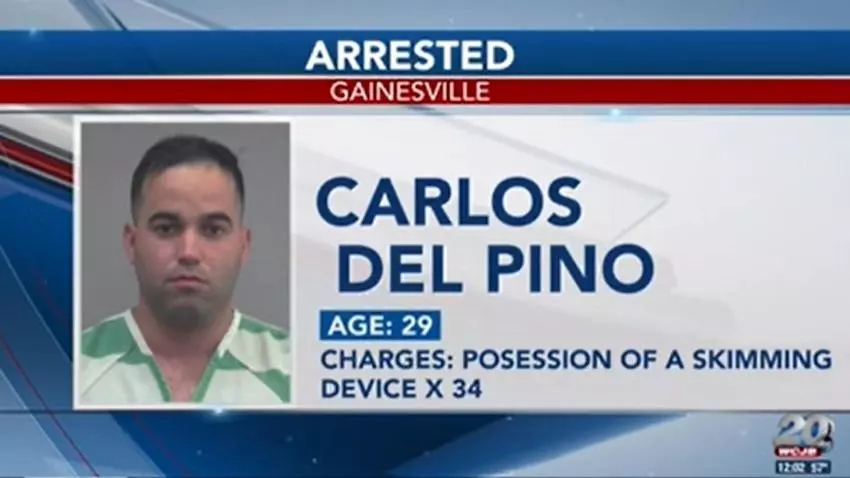
Carlos del Pino and Yandi Valdes Rodriguez were taken to the Sumter County Jail and face 113 criminal charges
Carlos del Pino and Yandi Valdés Rodríguez were found with 20 fake cards / Florida Highway Patrol
14ymedio, Havana, 31 January 2025 — Cubans Carlos del Pino, 34, and Yandi Valdés Rodríguez, 35, face 113 charges in Tampa, Florida, for crimes related to credit card forgery. The couple was arrested last Wednesday for various traffic violations on Interstate 75 (I-75) in Sumter County, and the Highway Patrol found cloning devices, 20 fake cards and dollars inside the vehicle.
Since the detainees were both of Cuban origin, the presence of the Border Patrol was requested when they were arrested to verify their immigration status. Since last Sunday, the Office of the Department of Homeland Security (HSI) and the Immigration and Customs Enforcement Service (ICE) have been carrying out anti-immigrant raids in the state.
The immigration agency specified that Del Pino “had an active deportation order in force since 2019” but was “on probation.”
The data obtained by the Sumter authorities showed that the 2019 Range Rover truck driven by Del Pino had multiple infractions. The migrant also has a criminal record related to the falsification of credit cards.
Del Pino and Valdés were arrested and taken to the Sumter County jail while the investigation is being carried out. continue reading
Cuban Carlos del Pino was also arrested in 2019 for the same crime of cloning cards. / Capture/WCJB
Last Wednesday, the President of the United States, Donald Trump, promulgated the Laken Riley Act, which empowers federal authorities to deport migrants who are in the country illegally and who have been accused of crimes.
“It is a law that authorizes the Department of Homeland Security to arrest and deport people who are accused of crimes,” said Mario J. Pentón, speaking to a lawyer from the Gallardo law firm. “The interesting thing about this rule is that they can arrest people who have not even been convicted,” and it is enough for them to have a case in process in a Federal Court.
The lawyer trusts that this new legislation will generate a debate for being “a violation” of the Constitution. Pentón said that in the Migration Courts, “when you request bail, you have not been convicted of any crime.”
However, he acknowledged that there are criminal charges such as “murder, terrorist acts and actions that are considered aggravated crimes” that make you inadmissible in the United States. “These people will be deported and will be subject to this law,” he stressed.
The new rule has been extended to minor crimes such as “theft and assault.” However, the lawyer specifies that the Migration Law establishes that “a store robbery is considered an exception when considered a case of “moral turpitude,” an act that violates community standards, and the courts can limit the rule for its final application.
Donald Trump said on Wednesday that he would send the “worst foreign criminals” to a detention center at the Guantánamo Naval Base in Cuba. “Some of them are so bad that we don’t even trust their own countries to keep them. We don’t want them to come back, so we’re going to send them to Guantánamo,” he said.
Translated by Regina Anavy
____________
COLLABORATE WITH OUR WORK: The 14ymedio team is committed to practicing serious journalism that reflects Cuba’s reality in all its depth. Thank you for joining us on this long journey. We invite you to continue supporting us by becoming a member of 14ymedio now. Together we can continue transforming journalism in Cuba.
The University of San Luis Potosí has been forced to negotiate with hospitals to obtain new positions for Mexican graduates
Ismael Francisco Herrera Benavente said that Cuban doctors are displacing Mexican doctors in San Luis Potosí / Video capture/@Potosinoticia01
14ymedio, Mexico City, 3 February 2025 — The president of the Faculty of Medicine of the University of San Luis Potosí in Mexico said that Cuban doctors hired by Mexico lack the necessary “certifications” to practice. According to Ismael Francisco Herrera Benavente, the training of Cuban health workers is not only doubtful, but their arrival has also begun to “displace” university graduates, especially in the internships they must do as part of their social service.
“We have to pass several accreditations (studies), validations, evaluations and exams for medical residency,” Herrera Benavente told local media, and he doubts that the Cubans are as well trained as their own students. The doctor’s complaint adds to the discontent shown last September by the College of the Medical Profession. “Cubans do not have a professional ID and cannot issue prescriptions,” stressed the president of the Antonio Chalita Manzur institution.
The lack of places for internships, which have been filled with Cuban health workers, has forced the union to arrange more internships with hospitals, so that the teaching of Mexicans is not truncated.
The program of hiring Cuban doctors in Mexico, initially designed to cover rural and remote areas, has left more disappointment than relief for the national medical union. continue reading
A Cuban doctor in the community of San Juan de las Vegas in San Luis Potosí / Facebook/Cuban Medical Brigade San Luis Potosí, Mexico
The governor of San Luis Potosí, Ricardo Gallardo Cardona, who promised – like the former president of Mexico Andrés Manuel López Obrador (2018-2024) – to have a medical service like that of Denmark, said that 80 Cuban doctors work in San Luis Potosí.
According to official data, Mexico has 669 hospitals in different states, 11,935 clinics and 274,977 doctors, nurses and administrative workers. The director of the Mexican Social Security Institute, Zoé Robledo, confirmed last December the arrival of 3,100 Cuban specialists to reinforce López Obrador’s health project in rural areas. For 610 of these doctors, the Government disbursed 23,227,156 euros according to three contracts concluded between July 2022 and 2023.
The program promoted by the López Obrador Administration is continuing with his successor, Claudia Sheinbaun. “We continue with the hiring,” she said on Sunday. The president argued that the lack of specialists was because “during the entire neoliberal period, medical specialists stopped training. It was thought that restricting admission would lead to greater excellence in training, but, in reality, what happened was that they stopped training medical specialists.”
Sheinbaum said that due to this lack of doctors, there was “a need to hire other nationalities to help and support us in the care of the population.” In addition, she said she was not hiring foreign health workers over Mexicans.
Translated by Regina Anavy
____________
COLLABORATE WITH OUR WORK: The 14ymedio team is committed to practicing serious journalism that reflects Cuba’s reality in all its depth. Thank you for joining us on this long journey. We invite you to continue supporting us by becoming a member of 14ymedio now. Together we can continue transforming journalism in Cuba.
Cuban authorities also recovered a unit from the Antonio Maceo thermoelectric plant in Santiago de Cuba, but admit that the shortage is high in the country
The Guiteras, at the time of its disconnection, provided 250 MW / Antonio Guiteras Thermoelectric Power Plant/Facebook
14ymedio, Havana, 2 February 2025 — The anxiety of living from blackout to blackout has no end for Cubans who, in recent days, have once again suffered a deficit of more than 1,500 megawatts (MW). This Sunday, the Antonio Guiteras thermoelectric plant in Matanzas unexpectedly dropped again from the National Electric System (SEN) around 8:15 in the morning “for a cause not yet identified,” the official press said.
With a generation capacity of 330 MW, the largest plant in the country had disconnected from the SEN in the middle of last month after a technological failure in the boiler. The problem lasted nine days, after which the thermoelectric power plant managed to synchronize without any setbacks on January 27, but only for a week.
“The origin of the problem is being investigated,” and should no damage be reported that entails a repair, the plant “could begin the start-up in the next few hours,” the Cuban News Agency reported, quoting Rubén Campos Olmo, general director of the plant. continue reading
“The origin of the problem is being investigated,” and should no damage be reported that entails a repair, the plant “could begin the start -up in the next few hours”
At the time of its disconnection, the Guiteras was contributing 250 MW to the SEN. In this morning’s report, the SEN predicted a deficit of 1,525 MW with a possible affectation of 1,595 MW. When the power went out, the government recalculated the lack, and it is now expected to be 2,595 MW during peak hours.
Work is currently being done on breakdowns in the Renté (Santiago de Cuba), Felton (Holguín), Guevara (Mayabeque) and Diez de Octubre (Camagüey) thermoelectric plants. Work is also being done at the Cienfuegos plant, the National Electric Union (UNE) reported.
The country has been immersed in an energy crisis for years due to the lack of fuel; e.g., the lack of foreign exchange to import it, and the frequent breakdowns in its obsolete thermoelectric plants, with decades of operation and a chronic investment deficit. The situation has worsened since the end of August, and at the beginning of 2025, despite low temperatures, the deficit has remained above 1,000 MW.
Translated by Regina Anavy
____________
COLLABORATE WITH OUR WORK: The 14ymedio team is committed to practicing serious journalism that reflects Cuba’s reality in all its depth. Thank you for joining us on this long journey. We invite you to continue supporting us by becoming a member of 14ymedio now. Together we can continue transforming journalism in Cuba.
The athlete has another establishment in Havana, Bar 2.45, which has been closed since last year.
Sotomayor and his brother opened a pizzeria at the Matanzas airport in 2024. / D’Soto/Facebook
14ymedio, Havana, 2 February 2025 — The fall into disgrace of the D’Soto MSME* private company, run by the brother of Cuban athlete Javier Sotomayor in Matanzas, has aroused all kinds of opinions in social networks among those who are surprised by the penalization of a “protected” business. The company, which advertises itself as a pizzeria with home deliveries, was recently audited by the National Tax Administration Office (ONAT), which determined that D’Soto owes 8,632,820.88 pesos to the State.
The debt is for “damages caused to public funds. The same public funds that were benefited by more than 10,000,000 with the payment of all taxes, with the efforts of a work group,” says a text posted on Facebook by Dariel Sotomayor Rivero, brother of the sports laureate, in which he expressed his annoyance at the resolution of the ONAT.
However, the MSME’s manager avoids pointing fingers at a state agency. “We talk all the time about the blockade, Trump and the problems of humanity, and never about the crap we do internally. The harm we are doing ourselves: more laws and less work, more problems and less dignity,” denounced the young entrepreneur in the post before concluding: “Neither [is guilty] the system, nor the Government. The issue is the people and, above all, oneself, who decides what to do and where he wants to be.” There was no mention of a fine or other sanction imposed on D’Soto or its administrators other than paying the millions owed to ONAT. continue reading
There was no mention of a fine or other sanction imposed on D’Soto or its administrators
Users were quick to respond to the post with both supportive and denouncing comments. “That has only one solution. Leave that country. When you get to know how the world works outside that bubble you will realize that they have been deceiving you for 37 years,” recommended an Internet user with a practical approach, to which another replied: ”He is the brother of one of Cuba’s millionaires. Why is he going to leave? Here they live and enjoy the system’s delicacies.”
D’Soto is a pizzeria founded in 2022, presumably under the ownership of high jump world record holder Javier Sotomayor. Although it started with the sale and delivery of pizzas, the MSME has been incorporating services such as an online marketplace in foreign currency – and which can accept payments from abroad – where it sells everything from pork legs, vegetable oil and beer, to vehicle maintenance items.
Among its suppliers are other private businesses in Matanzas province and the flow of capital even allowed D’Soto to offer a remittance service to Cuba.
In 2023 they were able to obtain a lease from Cimex for the property where El Bodegón, a location belonging to the state-owned El Rápido chain in downtown Matanzas, was situated. After remodeling the store, D’Soto Pizzas opened in February 2024.
In 2023 they were able to obtain a lease from Cimex for the property where El Bodegón, a location belonging to the state-owned El Rápido chain in downtown Matanzas, was situated.
In May of that same year, the MSME obtained permission to open another location at the Juan Gualberto Gómez International Airport. “Our young group, led by Dariel Sotomayor Rivero, offers a wide range of products with the principle of providing a service at your level. With the support of Javier Sotomayor, high jump world record holder, the inauguration of this space, located in the cab parking area, took place,” celebrated a company publication at the time.
The athlete owns another famed venue in Havana, Bar 2.45, named after his world record in the high jump and located on 5th Avenue, in Miramar. In 2024, in a cryptic publication on social media in which neither causes nor reasons were mentioned, the administration announced that the place had suffered a temporary closure that rumors soon associated with drug use and prostitution.
To date, the place has not reopened, but its reputation as an exclusive place for the elite remains.
*MSME: “Micro, Small, Medium Enterprise” (mipyme in Cuba). The expectation is that it is also privately managed, but in Cuba this may include owners/managers who are connected to the government.
Translated by LAR
____________
COLLABORATE WITH OUR WORK: The 14ymedio team is committed to practicing serious journalism that reflects Cuba’s reality in all its depth. Thank you for joining us on this long journey. We invite you to continue supporting us by becoming a member of 14ymedio now. Together we can continue transforming journalism in Cuba.
Municipal authorities acknowledge that the problem has no solution at the moment and express their concern about the coming months of drought
Two neighbors from the Jesús María neighborhood, in Sancti Spíritus, attach a hose to capture water from a leak. / Capture/Escambray
14ymedio, Olea Gallardo, Havana, 31 January 2025 – Several streets in the Jesús María neighborhood of Sancti Spíritus have been without water for three years. This time the complaint is not being made, as is usual in Cuba, by anonymous users on social networks or independent media, but by the official newspaper Escambray. Last Friday on its video newscast, VisionEs, it showed one of its reporters, Elsa Ramos, visiting the place she had gone six months earlier, and found that the situation was the same: still no water service.
One of the neighbors interviewed explained to the journalist the strategies they use to get water. “We’re going to put the pump in now, we put in the cables and the hose and a man there lends us a little tube, and we connect the pump there and get the water,” he said. “Because here on this block, from this corner to La Gloria, nobody has gotten even a drop of water for three or four years.”
Another resident confirmed: “It’s been more than three years since the water came in here, without any explanation offered. It’s impossible that this pipe here has water, that one over there has water, all the pipes in the block have water, and that this little section here does not have water. I don’t know how that is, it doesn’t make sense.”
A third resident hedged: “Since the construction of Reparto 26, the area around this neighborhood has been greatly affected.” There is water at her doorstep – “It’s a small stream, with little force, but with luck, there is no shortage,” the reporter noted. But this caused other neighbors to point out that it took from “early morning until all hours” to fill containers.
In her report, Elsa Ramos confronted “the government’s representation,” Ariel Muñoz Hidalgo, deputy mayor of Transportation and Energy for Sancti Spíritus, and Yusmeiky Mendoza Muro, director of the state Aquaduct and Sewage Company for the same city.
Asked about the reason why some parts of the neighborhood have water and others do not, Muñoz Hidalgo pointed to the “continuous increase in illegal connections to the hydraulic networks.” The reporter pointed out: “There are illegal connections because they don’t have water.” The official agreed and added, “because they don’t have water or because they have made new constructions.” continue reading
Thus, she attributed a good part of the problem to the increase in the population “without a projection, without an increase in the hydraulic systems as well.” The deputy mayor assured that they have a pumping system “with new pumps, with good water distribution capacities,” but that it could not be used “one hundred percent” because, he explained again, about the leaks, which prevent good pressure in all places.
Tank leaking water on the roof next to a house in Jesús María that does not have the service. / Capture/Escambray
The reporter persisted in asking why one segment in the heart of Jesús María does not have water while the surrounding streets do. The official replied that the street she referred to, Guillermón Moncada, is “very old.” But he didn’t go into detail about the reasons, and in fact, blamed the residents who get water by their own means: “We say it is illegal because it is not approved to do so, but people do it in search of the benefit of the resource.”
When the journalist asked Yusmeiky Mendoza Muro if Aquaduct has a solution and within what time frame, the company manager admitted: “No.” He and the deputy mayor enumerated numerous problems: a shortage of hoses, materials, fuel, and personnel. “We have almost no plumbers,” Mendoza Muro added.
Sealing the leaks and repairing the tanks on the houses are the next solutions that Muñoz Hidalgo promised, but at the same time, he warned that the situation will worsen in the coming months. “At this stage we do have to say that it is much more complex for us because we are already entering the dry season,” the official said, explaining that there are areas that are supplied by the Yayabo River, “which is losing all its capacity.”
“From early February,” he continued, “they will activate the groups to confront the drought and will draw up a calendar for the distribution of water in tanker trucks.” Then Elsa Ramos scolded him that, according to the residents, the tanker trucks don’t comply with the delivery schedules.
“That will always depend on the amount of fuel we have, the availability of tanker trucks we have, the neighborhoods that are growing,” answered Muñoz Hidalgo.
“In order not to create false expectations, will this segment of Jesús Mar continue to be thirsty?” the journalist pressed. Despite all the disasters previously enumerated, the director of the Aqueduct responded emphatically: “No, no, no.” Ramos asked again: “When will we be able to quench this thirst? Are we talking about months, years, centuries?” “No, no, months,” the official answered. The reporter replied that she would return in a while to check on the progress.
Just then, from the roof of a house, a woman didn’t miss the opportunity to point out “the contradiction” that the water tank on a neighboring roof was leaking drinking water. The official responded in a lowered voice: “That’s because of indiscipline.”
Translated by Tomás A.
____________
COLLABORATE WITH OUR WORK: The 14ymedio team is committed to practicing serious journalism that reflects Cuba’s reality in all its depth. Thank you for joining us on this long journey. We invite you to continue supporting us by becoming a member of 14ymedio now. Together we can continue transforming journalism in Cuba.