All Noble Causes Are Personal / Angel Santiesteban

The old man Alfredo

The police fail to understand how he appears at every protest against the government.

Like a magician with his best trick, they threaten and laugh at him as they consider him to be a joke. They have still not imprisoned him because they fear that he will die in a dungeon, well, this does not bother him.

To him, all worthwhile causes are personal. The latest strategy of the officials is to torment him. They have done a lot but when it comes to Alfredo, it doesn’t work on him.

The put him in a patrol car that then takes him as far away as possible from the place where protest is being held. Old Alfredo remains unperturbed and lets them carry out their outrageous act. He simply reminds them on the journey that they are just henchmen and thugs and he tells them what they are worth.

They leave him abandoned in some place far from any link with civilization. And yet, he does not complain.

He rents a taxi which has been assigned for tourism. Once in the taxi, he directs the driver to Routes 41 and 124, right on the corner of the Military Hospital. Sometimes the driver checks the rearview mirror. The driver tries to get conversation going because, due to his experience as a driver, something smells fishy. But Alfredo only returns a gentle smile.

They arrive at the hospital half an hour later. Alfredo leans over to tell the driver of the exact address where he should stop, right at Section 21, the headquarters of Counterintelligence, who were responsible for abandoning him in that inhospitable place. Upon getting out of the taxi, officials run over to eject him. The taxi driver who has understood, lowers his head worriedly. Alfredo, however, presents himself to them.

“They will pay you for the fare”, he says as he walks away, shouting “thugs” at them.

Translated by Shane J. Cassidy

Russian Athletes Pose in Support of their LGBT Teammates / Wendy Iriepa and Ignacio Estrada

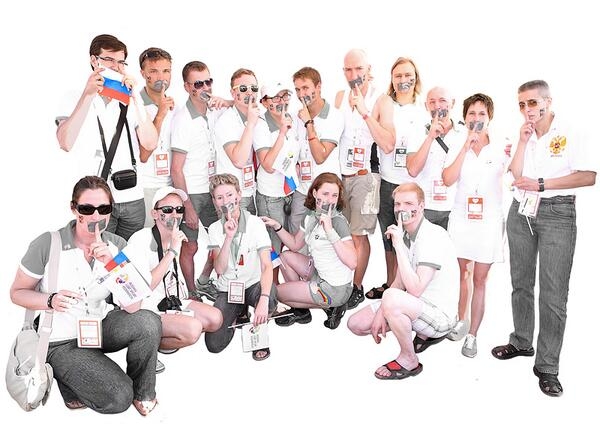
During the Out Games, considered the Olympic Games of the LGBT community, the Russian team posed for Adam Bouska’s NOH8 campaign against discrimination, in support of the LGBT community in their country.

In this way, the Olympic team showed their support to the silent LGBT community in Russia. Neither after the Olympic Games in London nor after the World Athletics Championships in Moscow did any Russian athlete come out in support of the community.

The NOH8 (No Hate) Campaign is a silent photographic protest against the world’s anti-gay laws and propositions. The campaign is composed of photographs of people dressed in white t-shirts in front of a white background with their mouths taped shut and “NOH8” printed on one cheek. The campaign was created on 10 February 2009 by the famous photographer Adam Bouska and his partner Jeff Parshley as a direct response to California’s Proposition 8, which tried to eliminate the right to marriage of same-sex couples in the state.

Every day there are more demonstrations of support for the Russian LGBT community on the national and international level, even amid persecution and the continued violation of their human rights.

Since Vladimir Putin approved several anti-gay measures, the protests have extended throughout the world, especially leading up to the next Winter Olympic Games, which will be held in Sochi (Russia) in 2014.

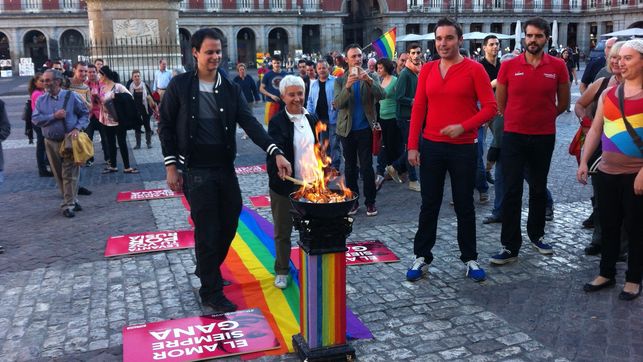
Without travelling very far, the FELGTB (National Federation of Lesbians, Gays, Transsexuals, and Bisexuals) symbolically lit an Olympic torch this past Monday in Madrid with the aim of denouncing homophobic policies in Russia.

Some of the attendants—among whom were found the president of the FELGTB Boti García, representatives of the PSOE (Spanish Workers Socialist Party), such as Pedro Zerolo and Carla Antonelli, and the Equo, such as Juan López de Uralde—participated in a symbolic relay race that ended with the lighting of the multi-color ceremonial flame installed in Plaza Mayor.

The basic aim, according to the manifest read by García and Rubén López, board member of the FELGTB international area and spokesperson for the Acrópoli University Association, was to show their “solidarity” with the Russian LGBT community and athletes that will participate in the Olympic Games in Sochi, who will see “their dignity reduced”.

Along these lines, they demanded that the Spanish Olympic Community and the Spanish Sports Council take a step forward to defend the rights of Spanish athletes, who “are surely not all heterosexuals”. They denounced the “inaction of the authorities”, who have succumbed to the “shame of keeping quiet”, López explained.

In recent months, Russia has approved laws such as those that prevent same-sex couples from adopting children, or the one known as the “law of homosexual propaganda”, which carries a marked homophobic tone according to LGBT associations. This law, such as they those from the Federation that they denounce, has led to a series of declarations in recent days on behalf of certain Russian politicians.

The manifest reports two in particular. First, the words of the Russian Sports Ministry, whom they accuse of ensuring that “during the Olympic Games, athletes may not show signs of affection with people of the same sex because they may be detained”. Second, those of the Vice Minister in charge of the Sochi Games, who ensures that “in compliance with this law, if people of traditional sexual orientation spread propaganda about non-traditional sex to children, they will be held responsible”.

The approval of these laws by part of the Duma, along with homophobic attacks that have come to light in recent months, has lead some associations to call for boycotting the Sochi Olympic Games, the first Winter Games to take place in the country.

It has also sparked demonstrations and protests in different countries, such as the celebrated one in front of the Russian Embassy in Spain last August, or in front of the Foreign Ministry coinciding with the G-20 summit.

Translated by: M. Ouellette

14 October 2013

The Stinking Havana that Silences Eusebio Leal* / Lilianne Ruiz

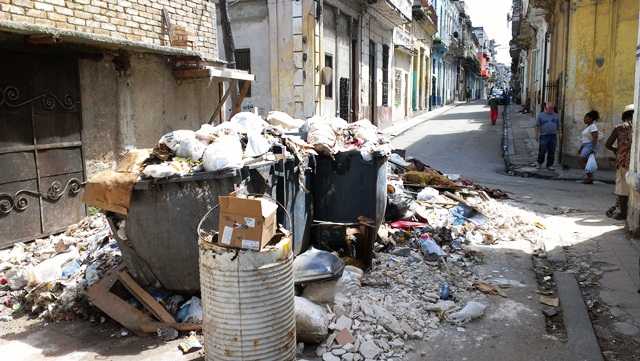
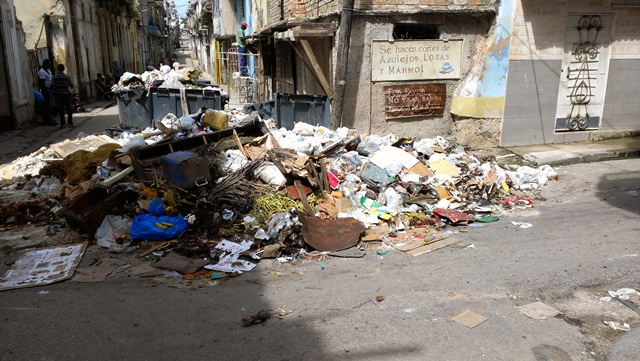
HAVANA, Cuba, October 11, 2013, www.cubanet.org.- The residents on Maloja Street at the corner of St. Nicholas in the Los Sitios neighborhood (Central Havana ), face the serious problem of the accumulation of garbage in front the doors of their houses.

“We have written to the government and to our delegate to the People’s Power. What they tell us is that they know that this is a mini-garbage-dump, but they have nowhere to put it,” said one of the residents of the place who declined to give his name, fearing reprisals.

The garbage truck takes up to 20 days to collect the trash. The residents of the surrounding streets throw their trash in the containers and on the ground. “This here is a phenomenon. I open the door of my house and I have to jump over the trash to get by. My house is full of worms and cockroaches,” says one of the outraged residents.

When the garbage piles up in front of the containers, the garbage truck passes it by. The workers explain that they have to wait for the brigade that collects the garbage from the ground with shovels. But the production of garbage continues.

The sidewalk and the wall of the house immediately facing the dump were broken when they picked up the trash with a backhoe, when the mound of garbage had grown huge. The owner of the house says, “I accused them. It took them more than a month to tell me they were going to fix the sidewalk and the wall. But they didn’t come and they told me, “You build the formwork and we’ll pour the concrete.” I got two or three men on the block to build the formwork and they still didn’t come. It all got broken up and I lost the money I’d given to people to help me.”

Besides breeding worms, the smell of putrefaction is unbearable. When the situation becomes most critical, the residents leave their house and go elsewhere so they can breath.

The fumigations fail to scare off the mosquitoes, flies, worms, cockroaches and rats swarming down the block.

There is a bodega in the area that the sells sugar, rice and beans that the State assigns to each inhabitant, upon presentation of the ration book, euphemistically called “the supply.”

The animals and insects infest the bodega. The shopkeeper tries to exterminate them, but the plague becomes uncontrollable. “In the bodega are the goods for all the people. Everything gets in there. Ask the shopkeeper,” says one of the neighbors .

At the counter, the shopkeeper smiles resignedly. But he won’t give an interview. All his energy goes into killing the bugs.

Over several days, the only ones who poke through the hill of waste are people looking for things in the trash. In Cuba we call them “divers.” Some old garments taken. Others through a piece of bread or some spoiled foot in a sack. People explain that they are collecting a “stew” to feed the pigs being raised in backyards and on rooftops.

But they don’t look like pig farmers, or people trying to make a living, but rather like people who have fallen into the depths of poverty.

Others come to collect empty cans, which they then take to the “raw material” office. The state pays 8 pesos in national currency for 1 kilogram of aluminum cans (75 cans). And the bottlers pay 1 Cuban peso (about 4¢ US) for a clean glass bottle or 50 centavos for a dirty one.

The hill of garbage in the corner of Maloja and St. Nicholas, growing, leaves the residents to get used to breathing infected air and the sight of the filth as a recurring image.

Lilianne Ruiz

Translator’s Note: Eusebio Leal is the Havana Historian.

From Cubanet

14 October 2013

Marvels of Poland / Luzbely Escobar

Recently a person who just arrived from a trip to Poland told me about a technique he learned in a workshop there. According to her, the teacher said you could use the lens of a camera in front of a mobile phone to make photographs that aren’t usually possible with the camera on a cellphone. I got home and tried it with some old lenses I had, one a Zenith and the other a Canon. It didn’t work like I thought but still the result was beautiful.

IMG_4287

IMG_4289

My husband had the idea that we could do the same but with the lens mounted on the camera. Then we took out the tripods and put the two old cameras on them. The Canon with a 50 mm lens and the Zenith with 2.8-135mm. When looking through the cellphone camera through the viewfinder the result was wonderful, magical. Like watching an old movie live and in real time. Like a trip back in time. It was a wonder that came from Poland and landed in Havana. It was a wish fulfilled.

IMG_4296IMG_4307IMG_4315IMG_4328

14 October 2013

Continued Wave of Kidnapping Regime Opponents From Their Homes / Veizant Boloy

Agent Camilo, photo from Lilianne Ruiz

HAVANA, Cuba, October 12, 2013, Veizant Boloy / www.cubanet.org.- In the early morning hours of today at 5:00 am, the agents of the State Security forcibly entered the house of Regla Ríos Casado, Lady in White, to conduct a search. They simply mentioned that they had a search warrant but they did not show it to her.

They handcuffed Regla Ríos Casado, who was forcibly removed, along with Rolando Blanco Casado, Regla’s son, and Andrés Pérez Suárez, who are still being detained.

The whereabouts of Ríos Casado are still unknown.

In the kidnapping, they seized a still camera, a video camera, documents and El Nuevo Herald newspapers.

Raicel Rodríguez, Juan Bautista, Mario Moraga, all members of the Commission for Assistance to Political Prisoners (CAPPF), remain detained and unaccounted for. Their arrests were reported yesterday in this media release.

The most visible head of these arbitrary operations of the Cuban political police is called Officer Camilo. This Camilo is chief of the teams of repressors who act every Sunday against the Ladies in White.

What is becoming most common now is the kidnapping of peaceful opponents — especially women — and taking them to areas far from the provincial capitals, where they are dropped off abused and without shoes.

Veizant Boloy

From Cubanet 12 October 2013

Remembering Laura Pollan on the 2nd Anniversary of Her Death / Jorge Luis Piloto, Amaury Gutierrez and Translating Cuba Bloggers

Lyrics by Jorge Luís Piloto; sung by Amaury Gutiérrez
(English translation follows)

Laura, Dama de Blanco,
te quisieron silenciar y hoy tu voz
suena más alto
por las calles de la Habana tu energía
acompaña a tus hermanas, tu familia
esas bravas heroínas
con gladiolos en las manos
defendiendo los derechos del cubano…

Laura, Dama Maestra
demostraste con tu ejemplo que el amor
es más fuerte que las rejas
la maldad de tu verdugo te hizo eterna
y la patria te agradece y te venera
hoy el mundo está mirando
y los complices callados
se avergüenzan y tu nombre lo respetan…

Laura Pollán,
llegaremos al dia y al final de este martirio
y en La Habana una marcha de gladiolos será un río
y llorando de rabia por los héroes que perdimos
Cuba entera caminará contigo…

======

Laura, Lady in White
they wanted to silence you and now your voice
rings out the loudest
through the streets of Havana your energy
accompanies your sisters,your family
these brave heroines
with gladioli in their hands
defending the rights of Cubans…

Laura, Lady Teacher
you showed with your example that love
is stronger than the prison bars
the evil of your executioner made you immortal
and the country thanks you and venerates you
today the world is watching
and the silent accomplices
are ashamed of themselves and respect your name…

Laura Pollán,
we will come to the day at the end of this martyrdom
and in Havana the march of the gladioli will be a river
and weeping with rage at the heroes we lost
all of Cuba will walk with you…

Reposted from October 2012

Laura Pollán Remembered by Translating Cuba Bloggers:
Yoani Sanchez: First Anniversary of the Death of Laura Pollán. The Legacy of Laura Pollán. Laura is gone, Laura is No More. Laura Pollán, you are still with us. In Laura Pollán’s House.
Reinaldo Escobar: A Special Day for the Ladies in White. What I have left of Laura.
Miguel Iturria Savon: The Final Odyssey of Laura Pollán
Ivan Garcia: Laura Pollán Risked Her Neck to Demonstrate Her Truths. How can the persecutors of Laura Pollán sleep peacefully?
Rosa María Rodríguez: Laura And Courage in White
Miriam Celaya: Laura and the Rebellion of the Gladioli
Regina Coyula: Laura and the Mob
Angel Santiesteban: Laura Pollán Has Died
Orlando Luis Pardo Lazo: Photos

From Today

Act of repudiation against Ladies in White commemorating the 2nd anniversary of Laura Pollán's death. Already 21 have been arrested.
Act of repudiation against Ladies in White commemorating the 2nd anniversary of Laura Pollán’s death. Already 21 have been arrested.

I am down on my knees pleading with you with cries of hope for Sonia Garro and Ramon Munoz / Angel Santiesteban

One year before being cast into the darkness, Sonia Garro and her husband Ramón Muñoz were already suffering the characteristic calamities of Cuban prisons.

Starting from twelve months earlier, their daughter crying for her parents, and her waking up — in the early hours, on hearing a random whisper and thinking it was her parents returning — became common, only to tear up on the embrace of her aunt and so back to sleep. Three hundred and sixty-five days of  the constant questions, from the reasoning of her adolescence, without them being able to explain, to give her a sensible answer as to why she didn’t have them by her side.

The faces of Sonia Garro and her husband Ramón Muñoz, filled spaces in Facebook, and social pressure seemed to be endless, because we knew that the courage they showed made us better people, they taught us to give that little bit that sometimes, out of fear or the simple and natural reflex of safeguarding lives, made us selfish and we therefore did not deliver all the necessary courage; but after their lessons of courage, on March 18 last year, something changed us. A definition disrupted our personalities, and then we were no longer the same, a lightbulb turned on within us and it was the shadow of those two great fighters who, with their example, gave the best lesson of Cubans worthy of their time and their country, giving up their lives, and giving them to a cause in which every child of this island, should be immersed, and they joined their spirits and values to our souls.

Sonia and Ramón who have a child to raise, educate, pamper, kiss, now have to settle for memories of when she was small and they took her to school with her little hand getting lost in theirs. Like almost all other people, they want to share a wedding, a house and dreams.They were not prepared to risk their lives, the emotional stability of the family, to not have other urgent missions or diverse utopias to which they could dedicate themselves. Only they thought firstly of their duty to their country, even though to many people this seems ridiculous, archaic even resembling stories from books which describe a bygone era.

Some months ago, the Paris-based Cuban writer Zoe Valdés, with her wise, sometimes hurtful but always intelligent style was calling for attention, with good reason, for the people who sacrificed for us, to try to give us a country that we do not have to flee, politically or economically, and therefore they are now suffering for their daring, lost between Coca-Cola and the complete triviality of our times, they were beginning to fall into oblivion and she mentioned those whose names were almost forgotten by time. It came to me as a wake up call to our consciences.

Some days after, I was moved by a letter from the Cuban writer Félix Luis Viera, living in Mexico, about the total indifference of Cubans to events on our island (and how well Don Jorge Manach knows how to explain this in his essay of the Joking Cuban), and the lack of solidarity and character with those who have done more and therefore suffer humiliations at the hands of the totalitarian regime.

Sonia and Ramón will soon mark one and a half years of unjust incarceration.

I ask the best Cubans, who have been born on this tumultuous archipelago, not to silence their voices so that the world may see the government abuse, without the smallest of the judicial guarantees which they have suffered and are suffering.

I urge every citizen to not cease in their cry for the freedom of this couple, among the many prisoners of conscience, suffering the punishment of being denied their independence, and the asking themselves the classic question: how long will I be imprisoned? What can be my contribution to reach a decent and uplifting future in my country?

Without you, those who are scattered around the world in more secluded spots, the insiders keep us silenced. God put you there to be an echo, the action of the pain those who can’t do it from within the country. That is your responsibility, your way of acting, and we ask for your cooperation, from one sentence to the action of a finger on your computer.

I urge my artist friends (what Cuban isn’t an artist?!), creators, human rights activists, bloggers, journalists, to join this humble but intense call for a just and noble cause. How can one sleep knowing what is happening there? I have no doubt that as long as we remain silent then we are complicit with the dictatorship. As for those who hide behind the word “apolitical”, know that silence is also a way of practising politics.

Modestly, I want to dedicate the novel which I am currently working on about the 19th Century, starting at the end of the year 1807, to Sonia and Ramón and in as much as I can capture, in tribute, the pain which blacks suffered, like them, under a slave regime similar to our own today.

And if those words were not sufficient for Cuban internet users, I’m kneeling before anyone who has possession of reason and feeling to plead with them for their cry of hope for Sonia Garro and Ramón Muñoz.

Ángel Santiesteban-Prats

Lawton prison settlement. September 2013.

Translated by Shane J. Cassidy

10 September 2013

Facebook: Unknown to Most Cubans / Jorge Olivera Castillo

facemierdHAVANA, Cuba , October, www.cubanet.org – In the program “Passage to the Unknown” — Sunday nights on Cubavision — they aired a documentary that showed that young Cubans are last in line in the digital world.

Among surprised and crazy faces, the segment showed a young woman on the street gathering opinions about Facebook, a topic addressed in the program by the journalist Reinaldo Taladrid, and “specialists,” among whom appeared the defender of official censorship: Iroel Sánchez.

To the question: Do you know what Facebook is? The few successes came from tourists and foreign students studying on the island.

In my neighborhood, he threw out the the question: What is Twitter?

For Alexander, a young high school student, Facebook could be a character in an adventure film. Rolando, however, a forest engineer with 20 years experience, is convinced that it is something related to auto racing.

What a horror! It makes you want to cry, or something worse.With the delay in using such a tool as essential as Facebook, who’s going to believe in the development of Cuba.

That young Cubans don’t know the social network that brings together a billion people, in 70 languages, shows the digital and technological backwardness of our country.

Emerging countries such as Brazil, India, Indonesia and Mexico are among the biggest users of Facebook, which forces us to recognize that we are lagging behind the digital world. We are at the back of the line of modernity.

We are an island frozen in time! Meanwhile the government remains committed to the internal blockade to maintain its absolute power.

The regime is not only leaving us as its legacy a country in ruins. In addition to the collapse of ethical and moral values, they are leaving us mired in digital illiteracy, with the goal of keeping themselves in power.

Jorge Olivera Castillo

From Cubanet 10 October 2013

Starting This Month, Thousands More Will be Unemployed / Osmar Laffita Rojas

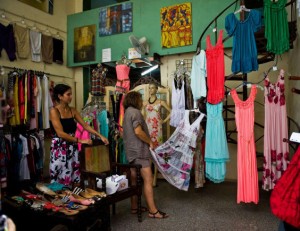
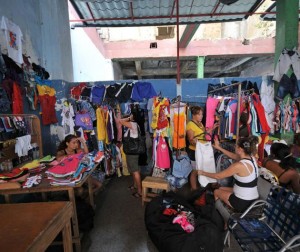
Privately run clothing store.

HAVANA, Cuba , October, www.cubanet.org – Of the 436,342 Cubans reported, as of the end of June, to have licenses to practice in the private sector (with the greatest presence in Havana, Matanzas  Villa Clara, Camaguey, Holguin and Santiago de Cuba), the number of contract workers accounts for18%. This is evidence that in the past two years small private businesses have been the main source of employment for men and women, mostly young, at a time when the State sector reported excess payrolls, with a million workers who will have to be dismissed.

Among that 18% of contract workers, are those who work as clerks in the thousands of stores that sell imported clothes — a very great number — after those working in small restaurants, pizzerias and cafes, and drivers of cars and trucks rented for the transport of passengers and goods.

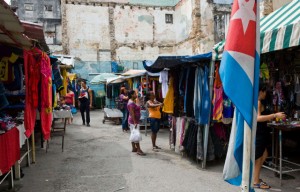
For residents of the major cities of Cuba has become normal to see in the doorways of many houses and premises areas adapted for the sale of factory-made clothing brought from abroad, which is very popular with the public, given that the clothes are more attractive than those found in the State’s Foreign Exchange Recovery Shops (TRD) — which is the formal name for hard currency stories.

The owners of these establishments, who are licensed as seamstresses or tailors, have paid their taxes monthly and submitted the affidavits of their sales, in which they state the number of employees hired.

yXu5r.St_.84-300x192In general, business was good, until Marino Murillo Jorge, vice president of the Council of Ministers, at meetings of the National Assembly of People’s Power held on July 6 and 7, expressed alarm that the private sector, according to his remarks, “Is demonstrating indiscipline, among many of them, as is the case for those who have a license for one activity and undertake another.” He gave the example of dressmakers and tailors, who are involved in selling imported clothes. He said that this can not continue, “It will have to be rectified with a new legal standard that fixes the scope of each activity.”

On the first of September, without waiting for tResolution 42 to go into effect, the Administrative Councils of the provinces of Pinar del Río, Sancti Spiritus and Cienfuegos banned the sale of imported clothing in all their municipalities.

And most recently, on the 26th of the same month, in a special edition, No. 27, of the Official Gazette of the Republic of Cuba published Resolution No. 353/2013 from the Ministry of Finance and Prices, referring to the rules for the taxation of persons engaged in private activity and monthly minimum tax account payments. Resolution No. 42/2013 from the Ministry of Labour and Social Security (MTSS) was also published, setting out the rules for the authorizations of private businesses.

DEC1D69F-C375-4618-9612-67A7660B81E3_mw1024_n_s-300x252The MTSS Resolution clears up any doubts about activities that have been engaged in for a long time but that, according to Murilla, were never authorized by the license. It clarifies that the owners of seamstress and tailor licenses may engage in, “Making, fixing, and transforming clothes, performing simple and complex tailoring and sewing to measure, and this does not include trading in industrially manufactured or imported clothing.”

But this issue, as it is raised, causes a huge problem: Of those who have a license to engage in private activity in Cuba, 68% had no State employment, and 32% were retired State workers, which makes clear the negative effect the prohibition of sale of imported clothing will have.

Starting this month, thousands of people will join the ranks of the unemployed and their families will be plunged into poverty.

All indications are that the enforcement of the above Resolution is the result of pressure exerted by the colonels and generals who control retail trade in dollars. Looking at the balance of sales for the first semester set off alarms about the low “recovery of dollars” in the State stores. The  precipitous drop in sales in the majority of TRDs is attributed to small private businesses engaged in selling imported clothes, which had won — fair and square — more than 85% of the clientele.

Osmar Laffita Rojas, ramsetgandhi@yahoo.com

From Cubanet, 11 October 2013

Angel Santiesteban Attends the Berlin International Literature Festival / Angel Santiesteban

Ángel remains imprisoned in Cuba, make no mistake about it. He continues to hope that his case will be reviewed. However his jailers could not prevent his presence crossing the Atlantic in order to walk freely through the streets, squares, parks and cultural institutions of Berlin.

This Friday the 13th, a date which many consider to be a bad omen, Berlin played host to a true act of literary justice. To the intention of the dictatorship to silence the voice of Cuban writer Ángel Santiesteban, the dictatorship received a devastating response: from Thursday afternoon and all day Friday, in different cultural centers of the city where activities were carried out as part of the International Festival of Literature, hundreds of copies of the document, “Short history of injustice”, were distributed, where it explains Ángel’s case to the invited writers, the international media and to the thousands and thousands of Germans and foreigners who attended what is considered the most important Literary Festival in recent years.

Thus at 7.30 pm, the main room of the Cervantes Institute was packed with the general public, most of whom were German although the presence of numerous Latin Americans was also noted, all interested in knowing the version of the events which would be offered by the Cuban writers José Manuel Prieto, Jorge Luis Arzola and Amir Valle, moderated by the prestigious German editor Michi Strausfeld.

The short introductory words of the Spaniard Francesc Puértolas, Head of Cultural Activities at the Cervantes Institute, made clear reference to the position of this institution to be a plural space where freedom of opinion is respected, regardless of the ideology that that opinion represented.

His words were a very brief response to another disrespectful Cuban government maneuver, through the “useful idiots” who are used outside Cuba to try to stop the campaigns denouncing the rottenness of the dictatorship. In this case, the German foundation “Netzwerk Cuba“, which brings together various associations which support the Cuban dictators, wrote an open letter in which it accused the Cervantes Institute of hosting a promotion of culture which was biased in favor of those who were serving the United States in their attacks on Cuba. In one of the paragraphs in the document, where a few historical truths are mixed with a lot of lies, they resorted to the hackneyed accusation that figures like Yoani Sánchez and Amir Valle were following agendas which had been formulated by the U.S. government in their plans against the island.

After the editor Michi Strausfeld explained to those present the personal and professional reasons why she had decided to get involved in the defense of Angel, she gave the floor to the writer Amir Valle to explain, in detail, the infamous trial for which Angel is now jailed. Valle began by apologizing to the Cervantes Institute on behalf of himself and his colleagues, because he considered the unfair letter of “Netzwerk Cuba” as offensive and disrespectful; a letter which was blatantly lying by stating that the Institute offered a partial image in favor of the enemies of the “Cuban Revolution” because earlier this year it served as a venue to meet in Berlin with the blogger Yoani Sánchez and now they hosted activity to talk about violations against freedom of expression in Cuba.

Valle said that this accusation was contradicted by the simple fact that the Cervantes Institute, on numerous occasions, had hosted Cuban writers and intellectuals who had spoken in favour of the regime, among whom he mentioned the president of  UNEAC (Cuban Writers and Artist Union), Miguel Barnet and the recent Cuban National Literature Prize winner, Leonardo Padura. In the heated discussions in the audience at the end of the activity, those present would learn that among others, Cuban writer Nancy Morejon, filmmaker Fernando Perez and artist Arturo Montoto, who have all been praised by the regime, just to mention some of the prominent guests, had been at the Cervantes Institute in recent times.

Afterwards, Valle commented that he was there as a colleague, brother and legal and literary representative of Ángel and, step by step, he described the infernal trap in which the political police hounded the writer after which he decided to go public with his criticism of the system prevailing in Cuba through his blog “The Children Nobody Wanted,” and he reminded those present that the document circulated at the Festival could interest them in discovering all the evidence of the wicked deed.

Michi Strausfeld later read fragments of a letter sent from Cuba by Ángel and gave the floor to the writer Jorge Luis Arzola, who recounted his personal experience with the Cuban political police and he referenced cases similar to Ánge’s, although much less traumatic, such as what happened to the narrator and poet Francis Sánchez when he also decided to open his own blog, receiving so much pressure and threats against him personally and his family that he decided to give up.

Once again, Michi Strasfeld read another letter which allowed the public to know what a day in the life of Ángel as a prisoner of the regime was like. The images described by Ángel, with the same naturalness and visual power which is present in his stories, touched all that were present as they informed Strausfeld, Prieto, Arzola and Valle of such at the end of the activity.

José Manuel Prieto later offered his personal vision of his experience as a writer who can travel to the island (something which neither Arzola nor Valle can do, because the regime has already prohibited their entry) and he concentrated his exhibition on the slow changes which were occurring in the aforementioned rigid and monolithic social and governmental structure, among which, the permissibility which the government was demonstrating towards the emergence of alternative spaces for citizen reflection was unthinkable in years gone by and it also ruled in favour of Ángel’s case being reviewed with true justice.

To close the evenings events, Valle presented a beautiful edition of the book “The Summer When God Was Sleeping”, with which Ángel Santiesteban recently won the Franz Kafka Novel Competition. Valle, to clarify for those who see any project to support those who oppose the regime as CIA-funded, stressed that this was purely a literary award, organized by an information platform (inCUBAtor) that is supported by the Czech NGO ’Libri Prohibiti’, a civic organization that, among other merits of cultural work, has the largest Samizdat library in Europe.

The interest aroused in the audience only further manifested itself just as the activity came to an end: many people approached the writers to ask more about the specific case of Angel and about the situation of freedom of expression in Cuba. “One of the participants approached me with a group of documents we distributed, about twenty of them, and asked me to sign them and told me: ’I will pass these out to several of my colleagues that go to Cuba on vacation and always come telling me about how beautiful the beaches are. I want them to know that there is a much tougher life away from the beach, the sun and Cuban rum’”, Valle recounted to a journalist. Another German, a well-known bookseller, approached the writers and told them “When we were listening to you speak, we commented amongst ourselves that we felt that Mr Santiesteban was up there sitting next to those were at the activity.”

Thus it was like this that Ángel Santiesteban was there, to infuriate his jailers, smiling, with that tranquility of someone who knows that they walk the right path: one of dignity and the defence of his thoughts. Later, while shadows fell over Berlin and the city started its fabulous cultural and social nightlife, he decided take a walk through the streets and walked talking, laughing, remembering the days when they were young and happy and naive, hugging his friends, then and always: Amir Valle and Jorge Luis Arzola. Michi Strausfeld was also laughing at seeing them together, another time, after almost ten years since their last meeting in Cuba.

The Editor

Translated by Shane J. Cassidy

14 September 2013
Eusebio Leal and Esteban Lazo Visit the Capitol Building / Luzbely Escobar

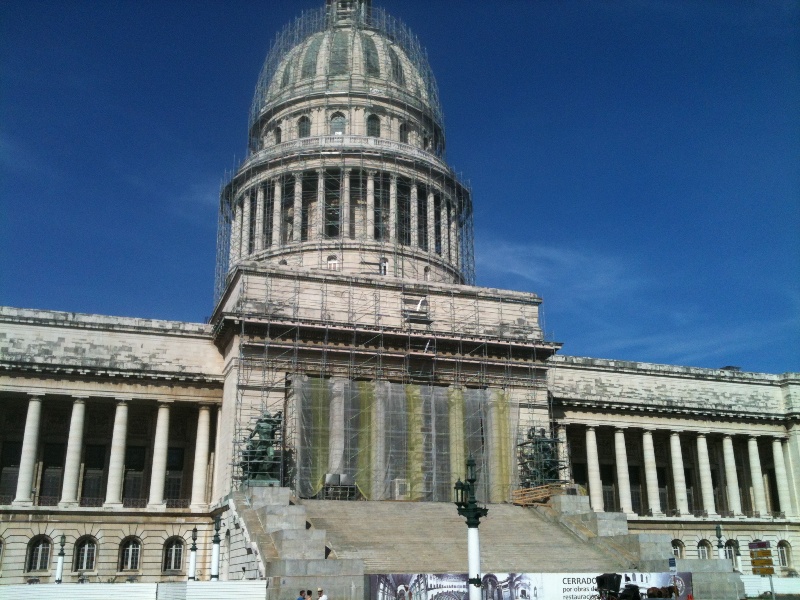
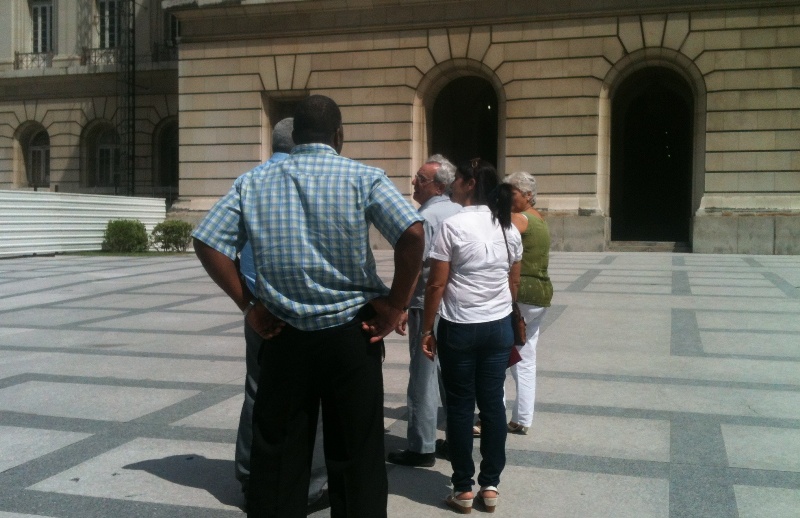
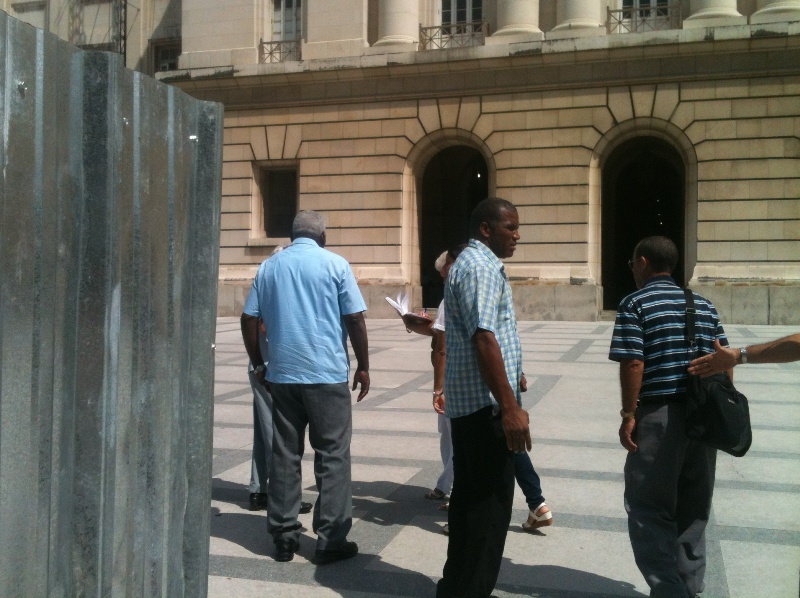
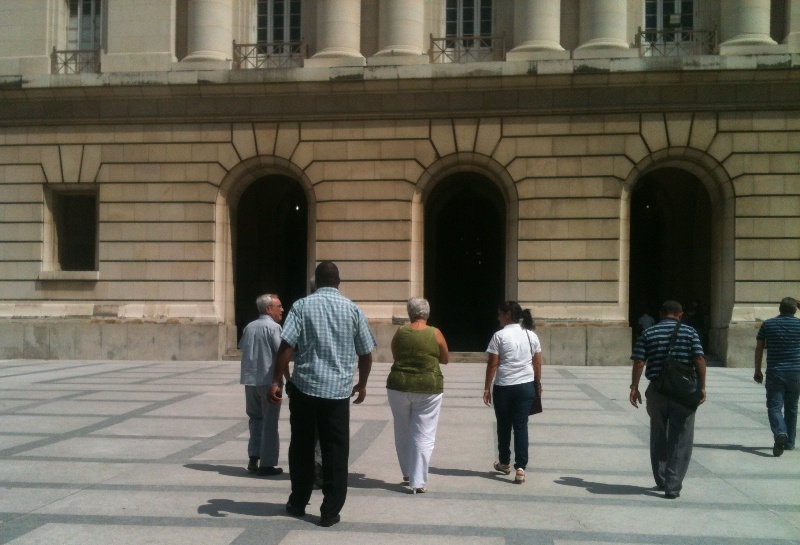
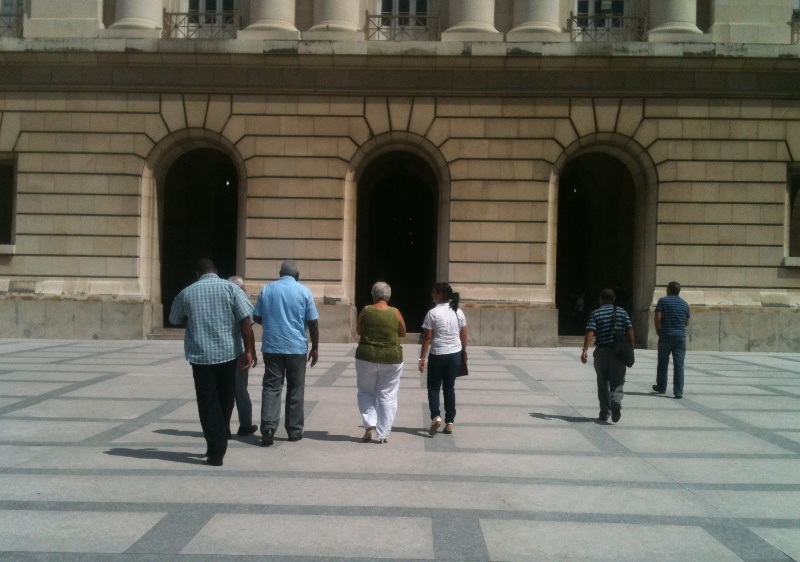
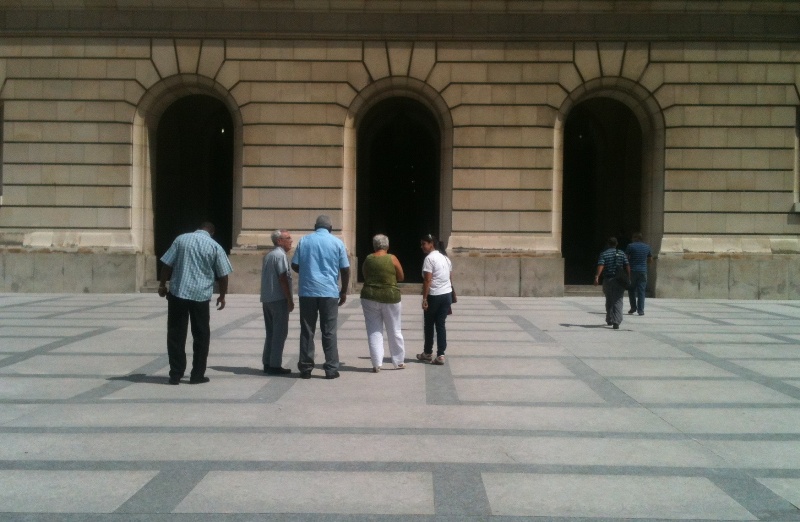
This Tuesday afternoon, passing in back of the Capitol, I ran into Esteban Lazo and Eusebio Leal entering through a small door in the tin fence that has been erected around the site. Some experts were showing them the restoration work taking place and, I suppose, talking as well about the results. Sadly, they did not let me pass and I had to settle for taking photos from the entryway.

It’s been said that Eusebio Leal’s time is “over” these days, but those of us who work in Old Havana have the impression that he is still at the forefront of many things.

IMG_4060IMG_4231.jpg1IMG_4232.jpg2IMG_4236.jpg4IMG_4237.jpg5IMG_4238.jpg6

11 October 2013


I Plead with the UNEAC’s Defence Committee / Angel Santiesteban

Prison Diary VIII. Shameful silence

I heard the terrible news that a Lady in White, Iris Perez Aguilera, was savagely beaten. Despite these recurrent allegations of abuse against these women, we will never be able to get used to it, nor have we with that we have seen.

These women from the opposition who struggle against the regime like true 21st Century Mambises* are disrespected and abused by those who defend the totalitarian system, particularly national security. As if the beating given to her wasn’t enough, she was then denied hospital access.

At the end of last year I also saw, with my own eyes, 15-year-old Berenice Héctor González, who was slashed all over her body and face simply for being related to a Lady in White. She was mercilessly attacked by the daughter of a police officer in the province of Cienfuegos for calling for respect for her aunt who is in opposition to the government.

As always, some pro-government bloggers have tried to spin the story that the criminal attack was the result of “blind passion”.

Recently, at the beginning of the year, Elsa Rubio Fernández, the daughter of another Woman in White, Mercedes Fernández Fonseca, was assassinated. Elsa did not receive police protection despite the five complaints lodged and the fact that the murderer shouted “that he was killing her and he he wouldn’t have to pay for it because her family were opponents”.

I sincerely appeal to the honesty of those eight women** who have raised their voices in defence of women so that they have the decency to show solidarity with these victims of real abuse.

Hopefully silence will not be the response of these intellectuals who must now demonstrate their own grandeur and ethics.

Ángel Santiesteban-Prats

La Lima prison. March 2013.

Translator’s notes:
*Mambises is a term used to refer to independent guerrillas who, during the 19th Century in Cuba and Philippines, fought in the independence wars for Cuba and the Philippines. 
** Ángel is referring to eight women, members of UNEAC (Cuban Writers and Artists Union), who signed a letter condemning him for violence against his ex-wife — the trumped up charge for which he was sent to prison.

Translated by Shane J. Cassidy

1 April 2013

The Diana Buses Are Already Broken Down / Roberto Quinones Haces

Diana bus assembled in Cuba. Photo from internet

GUANTANAMO, Cuba, October 7, 2013, Roberto Quiñones Haces/ www.cubanet.org – I’ve seen them circulating and and I remember that on a news broadcast on National Television they talked about them. They are called “Diana” and from last September, eight of them have to been to Guantanamo to improve public transport.

The new buses bear a lot of resemblance to those mid-sized “Girón” buses, which were also assembled in the Evelio Prieto plant in Havana, and dedicated primarily to student and intercity transport. According to a report from the journalist Raciel Sayú Font on the weekly “Venceremos” (We Shall Overcome) broadcast, put on by the provincial committee of the only Party, the vehicles have a capacity of 42 passengers, 28 seated and 12 standing, although the reader will see that this adds up to 40, not 42 as stated by the journalist.

The vehicle body is Brazilian, the diesel engine is Chinese, and the rest of the components come from Russia. The journalist said that Rodolfo Labadies Limedux, a transportation specialist at the Transport Agency, said that the vehicles passed technical reviews and met the quality and safety standards, but that they were out of service due to breakdowns, according to the report.

The information could not be published earlier because provincial and municipal transportation officials refused to provide details to this newspaper. The journalist is careful in mentioning names, but beyond identifying those responsible, it is obvious that the event shows although hundreds of Cuban Journalist Union (UPEC) congresses have called for an end to secrecy, those who have the last say are not exactly the journalists.

At least, as long as the buses in good condition keep circulating, Guantanamo’s residents will have two routes that have been reestablished after having been out of service for fifteen years. The route crosses the city from south to north and vice versa, but now it costs a peso each way, instead of the usual twenty centavos.

These buses represent a transportation alternative to the horse-drawn carriages, a private service that has helped people a lot in recent years but that dirties the city contaminates it. To completely remove the horses, the coachmen and all they leave behind, with the displeasure and dangers this service carries with it, Guantanamo needs a great many more Diana buses and, above all, for them not to breakdown prematurely.

Roberto Jesús Quiñones Haces

From Cubanet, 8 October 2013

Spanish post
10 October 2013