Retired Cubans, the Agony of Collecting a Pension / Gladys Linares

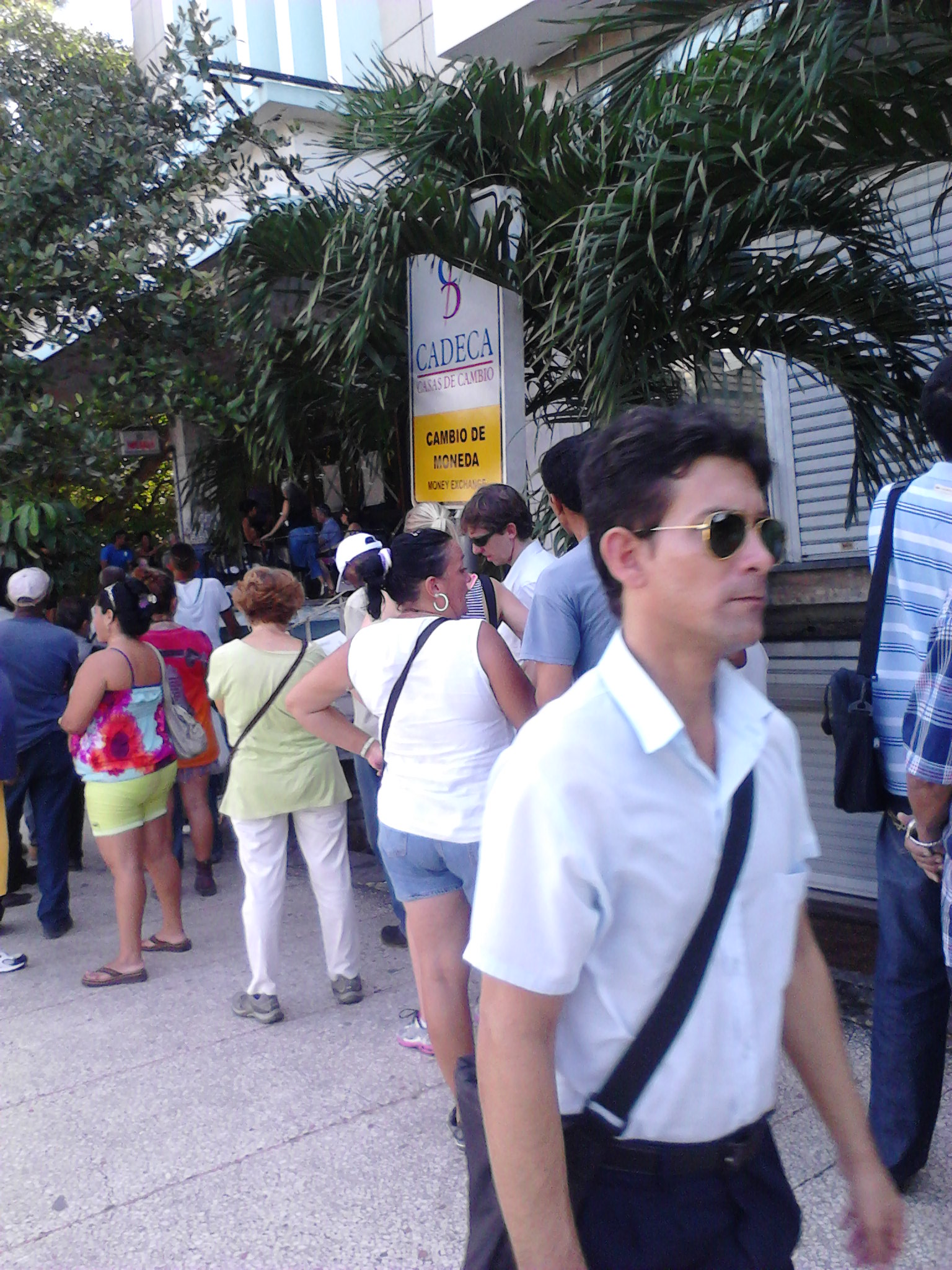
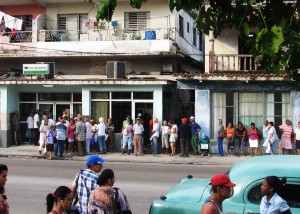
Retirees line up to collect in Virgen del Camino. Photo Gladys Linares

HAVANA, Cuba , November, www.cubanet.org – As we have said on other occasions, the daily life of the elderly in Cuba is a great challenge. Confronting every day the lack of money, scarcity of food, difficulties in receiving medical care, and bureaucratic obstacles imposed by the Government, among other problems, make the last years of our existence difficult.

Our archipelago is among the fifty countries of the world with the highest proportion of people over sixty, which represents 17% of our population. Most are retirees or pensioners; despite this, the State is not about to assume a truly effective policy to improve the lives of citizens in the “third and fourth age.”

For pensioners, the monthly pension is an agony rather than cause for jubilation. In Cuba, your pension can be collected in banks, the post office, the CADECA currency exchanges, or through magnetic cards on a designated day of the month.

The magnetic card often becomes a problem. Many times the ATMs are not working, or there aren’t bills of all the denominations needed, or the cards are locked.

anciano-cubanoTo Ramon, a resident who collects his pension from this system, once had his card locked at an ATM at Dolores Metropolitan Bank between 18 and 19 in Lawton. He says he will never forget that hard time, because he had to wait 12 days for someone to help him draw it out, as the sign said on the door.

Some, like Hilario, collect their pension at the post office. According to him, they allow the check cashing there. Some time ago they had a courier to bring the pension to the house. He asked, but they didn’t have any personnel then and never has been.

But Jorge is not among those who can collect it at the post office, and as the bank is too far, he almost always goes to the CADECA, where the line is faster.  There, however, the downside is that sometimes there is not enough cash. Last month, for example, after two hours of waiting, he had to leave because the money ran out.

At the CADECA at Dolores and 13th, in Lawton, there are generally two separate lines, one to collect pensions and one to change money. However, a few days ago there was a single, immense and slow line, because they were only paying at one window. Until a man passed by on a motorcycle and made a sign very significant in Cuba which consists of touching your shoulder with two fingers (it was a warming that a boss or some important official was coming). Not three minutes had passed when they started working three windows.

ancianos-Cola-Jub-Banco-Víbora-300x214In the bank, on the other hand, although there should be no risk of running out of money, the line becomes slow for this same issue of management. For this reason, those who seek to collect their retirement must spend long hours in the street, on their feet, in the sun or rain. Sometimes an elderly person faints; it’s not uncommon for them to have had nothing more than a sip of coffee.

Panchito is one of those who collects at the bank. Yesterday he was soaked because it was raining and he didn’t find any shelter. And, like very month, he complained the pension isn’t even enough to eat, and says that’s why he plays the lottery.

Felipe, 84, waits in line all night to be the first to collect. He pays his installment payment on his fridge at the bank, then he pays the electricity, and runs his errands for the month. And the pension is gone. He confesses that he survives the rest of the month doing a little carpentry.

La China, a good-natured neighbor, adds that collecting her pension is difficult, but it’s harder to see how it flows out of her hands almost before she even begins.

Gladys Linares

Cubanet, 7 November 2013

Wrong Careers / Fernando Damaso

Tomb to which the Animal Arrived

The existence in Latin America and the Caribbean of presidents closer to comic theater than politics is not an exclusive, since they have also existed and do exist in other regions of the terrestrial globe.

What happens around here is that these characters like to interpret their roles with an elevated dose of overacting: Mariano Melgarejo between 1864 and 1871 in Bolivia; Porfirio Diaz between 1876 and 1911 in Mexico; Juan Vicente Gomez between 1908 and 1935 and Marcos Perez Jimenez between 1952 and 1958 in Venezuela; Rafael Leonidas Trujillo between 1930 and 1961 in the Dominican Republic; Francois Duvalier between 1957 and 1971 in Haiti, and some others constitute the important historical benchmarks.

In the 21st century, in order not to break the tradition, there have emerged others, among those that stand out are Evo Morales in Bolivia and Hugo Chavez and his successor, Nicolas Maduro, in Venezuela.

As Chaves, now physically disappeared, for his characteristic histrionic and inimitable nature, deserves an individual study, I will only point out in passing that Morales, the native Aymaran, more fiction than reality, is capable of saying the greatest simplicities without the least blush, as if he were expressing transcendental truths (the one about chicken meat and homosexuality is priceless).

But I will stop on Maduro, who has exceeded them all, who himself converses with a Chavez converted into a bird (maybe the one from Twitter?), a bird that gives him instructions and tells him how to govern, which appears to him in the streets or on the wall of a Caracas Metro tunnel under construction.

Some days ago he created the government position of Vice Minister of Love and Supreme Wellbeing, and now we have the Day of Loyalty and Love for Chavez.  It seems that, besides suffering from hallucinations and visions from beyond, he has a fixation on the word love.  He seems to me to be re-reading 1984, the magnificent and terrifying novel by George Orwell, only now become reality.  Closer to a psychiatric hospital than the Miraflores Palace, this true bull in a china shop, like all good comic theater actors, always appears with something new to make us laugh, very superior to all that came before.

Without a doubt, all these presidents and others that I do not mention, chose the wrong careers: with magnificent conditions for the stage, they erroneously decided on politics, unfortunately for our nations.

Translated by mlk

7 November 2013

Osbelgi, A Story to Tell / Alexis Piloto Cabrero, Cuban Law Association

Lic. Alexis Piloto Cabrero

Osbelgi Fábregas Ramos deposited the sum of $90,000 CUP (Cuban currency) in a Popular Savings Bank in Havana in 2001, finding out days after the transaction, in Camaguey, where he currently lives, the money was not in the bank.

Desperate after what had taken place and with the proof he had, among which was a bank slip showing a recent withdrawal, where the evidence of the credit coincided with his bankbook, he went back again to the capital and decided to report the events.

Not the plot of a movie, it was extremely real; the documents handed over which constituted the material proof of the crime were lost by the judges themselves in Havana and all he was left with was a receipt for the date where it happily shows he provided the documents for the legal process.

Up to that point, by his own accounts, the complaint sat on the desk of the Chief Prosecutor in Havana, who after more than 12 years a certain end awaits her, despite that according to Osbelgi through the letters that he presented to the Cuban Law Association (AJC), neither Francisco Soberon, ex president of the Bank of Cuba, nor the Attorney General of the Republic nor the Council of State and Ministers have given him an answer to his problem.  We’ll see what happens from now on, he has asked the Cuban Law Association for an answer from those who should provide one, and have forgotten to do so.

We’ll comment on the path of this story through the mazes which the law provides.

Translated by LYD

4 November 2013

Swan Song / Regina Coyula

On Thursday the Adrenaline 3D finished installing a colorful marquee like the old movie theaters; two days later they found out from the newspaper that they couldn’t remain open, not even until that weekend.  But Adrenaline’s owners decided to open that Friday night.  Like Scarlett O’Hara they will think about tomorrow.

By phone they confirmed that only they and one other 3D movie room, in Alamar, would offer events after the prohibition expressed in the newspaper notice. The one in Alamar is disposed to wait until the authorities close them down. A couple in Lawton was desperate because they planned the opening of their 3D movie room precisely the Friday of the closing and they would not recover even the smallest portion of their investment.

The measure was a war foreseen.  The reason, ignoring the convenient absence a permit to transact in such activity, is the political culture of the Revolution, which should educate and cultivate our people with shows that elevate their sensibility and cultural heritage, etc, etc, etc.

Said like that, it doesn’t sound so terrible, but it is suspicious that State television — the only one in existence — offers “products” which make you wonder who approves certain scripts and budgets for programs unforgettable because they are so hideous.

That same television keeps us up to date on the wonders “Made in Bollywood” and there is every kind of canned show; I remember a South Korean one that pretended to be a comedy; it must be that our humor has nothing to do with theirs, which explains why I find the news cast from the North Korean television hilarious; clearly, the political culture of the Revolution has different units of measure.

Many people, with the appearance of these private movie theaters, saw the possibility to recover the pleasure of going to watch a movie, beyond the home screen.  Except for Chaplin, the Cinematheque and perhaps one or another theater on 23rd Street, the now surviving movie theaters show the national debacle with their broken chairs (careful with the vermin), deficient air conditioning (if they still have it), projection equipment and audio in bad shape; all that makes a visit to the movie theater very far from a pleasant experience.  And so, the return of pleasure will have to wait.

Saving the pearl for the end: a conversation among neighbors, with regards to seeing the crestfallen, now without the adrenaline to sing, taking down their marquee.

One said to the other, “You know what happens in places like those, they have been showing pornography to kids.”

The other woman nodded, impressed, as the younger one, who ruled the roost, spoke with great conviction. And as if that weren’t enough, she said, referring confidently to the network of videogame rooms (also being shut down), “I heard from good sources that the psychiatric hospitals are full of crazy kids that used to play those things.”

So much condensed nonsense tried my patience, and very politely I interjected not to repeat those things without foundation, that it sounded like a government argument to accuse these places of being an unhealthy environment.

The woman gestured with her hands and shook her head no and hurried to say: “No, no… Me?  Government? What government? I just registered again for the third time for the visa lottery [to emigrate to the United States]?”

Translated by LYD

4 November 2013

Never Backwards, Not Even to Gain Momentum / Rebeca Monzo

Once again this phrase, so often repeated for more than five decades now, came to my mind when I found out about another step backward, instigated by those who handed down this maxim like a precept at the dawn of the 1960s.

We now have another great setback, this time well into the 21st century and within the framework of the famous “Raul reforms.” Privately-run, home-based 3D cinemas have been closed and self-employed vendors of imported clothing have been given a deadline of December 31 to cease operations. All this has generated a lot of discontent, but that’s as far as it goes. All those affected are trying to figure out how to sell off part of their inventory and recuperate some of their sizable investments. This is especially true of 3D cinemas, which imported equipment and furniture, for the most part from Panama. Everyone is “racking his brains” but no one is going to confront the state, as it knows all too well.

It seems poor nutrition over many decades has adversely affected that part of people’s brains having to do with memory. They do not recall “Operation Bird on a Wire,” when craftspeople in Cathedral Square — from whom everyone bought, including government officials, because of the quality, originality and variety of the goods these artisans produced — were persecuted. Many ended up in prison while others went into exile in search of freedom and new opportunities. And so overnight a little marketplace — one that gave life to the city, supplied goods unavailable in state stores and provided a livelihood for many — simply vanished.

Later on, in the 1990s, came a new offensive — “Operation Potted Plant*” — that abolished the Free Farmers’ Market, which at the time was alleviating the problem of significant food shortages but whose suppliers the government accused of “illegal profiteering.” Many of these suppliers were arrested and had their assets confiscated, just as had happened years earlier to the artisans.

Let us also not forget that other great crusade at the end of the 1990s against the first paladares — home-based private restaurants which were limited to twelve seats — of which only the strongest or most “fortunate” were able to survive.

So we can see, the lack of memory of our citizens, or the desperate attempts to come out of the economic stagnation, has been what has made some take risks now and again, those “optimist” people who finally do not realize that is hard to “play capitalism”, inside a dictatorial regime with more than half of century installed in power.

Therefore, and so there are no mistakes, the government undertakes these types of “operations” cyclically so nobody forgets “who’s in charge”.  Only in a future free and democratic country, is where security will exist for those who want to start their own business.  Then, and only then, is when the private initiatives will flourish.  Perhaps in a future not too far off, we’ll give another connotation to that sadly known phrase of:  “never backwards, not even to gain momentum”, because evidently no one will want to repeat those mistakes.

*Translator’s note: In Cuban slang the term maceta, or potted plant, refers to someone with newly acquired wealth.

6 November 2013

Cuba Shaken by Rumors of Currency Unification / Orlando Freire Santana

HAVANA, Cuba, October, www.cubanet.org — The official announcement in the newspaper Granma this Tuesday, October 2, with its timeline for instituting the changes regarding currency unification, unleashed a torrent of rumors, which some say circulate faster that news from the Communist Party.

But there wasn’t much to it. There was no change of any importance in the value of the two currencies. Stressed-out Cubans, who must rely on an average monthly salary of some 445 CUP (or Cuban pesos), will still have a “rope around their necks,” worrying about how to pay for goods priced in CUC (or convertible pesos) at the fixed exchange rate of 1 CUC to 25 CUP. Given the sensitive nature of this topic, however, it was inevitable that contradictory analyses would start cropping up first thing Tuesday morning.

Almost everyone believed that there would be a gradual strengthening of the Cuban peso until the two currencies reached parity and the CUC was finally phased out. In the opinion of some, the rate of exchange could be around 1 CUC to 20 CUP within a few months.

A neighbor in my building, who subscribes to this line of reasoning, noted that this could create pressure on the currency exchange bureaus (CADECAS) if people tried to gradually get rid of their CUCs, especially now that the rate of exchange is still at 1 CUC to 25 CUP.

A diametrically opposite point of view was expressed by a self-employed worker as he was preparing to begin his day. He believed it might be a trap by the government to collect the money in circulation and deal a fatal blow to the new “potted plants.*” According to this worker, a third currency would be created and this would be the one to survive. All Cuban pesos and CUCs would have to be exchanged for it but there would be a maximum amount that could be exchanged. Anything exceeding that figure would represent a loss to its owners. It would be a kind of punishment for those who sold their homes at astronomic prices in hopes of leaving the country.

Twenty-four hours after the release of the official announcement I decided, one way or another, to gauge the public mood by visiting various CADECAS around the capital. There seemed to be a prevailing calm and the lines of customers were no longer than usual at the entrances to currency exchanges in the Focsa building — located at 23rd street in front of Copelia — and at the National Bus Terminal. I joined a line of customers at the latter to exchange some money so that I could make inquiries with the cashiers.

The  two or three people with whom I was able to speak did not completely understand the announcement which appeared in Granma, though I did detect a certain level of anxiety about what could happen. One of the people in line with me, an older gentleman, did not hide his mistrust of the authorities and recalled what happened with the currency change in the 1960s when people lost a substantial part of their savings. For her part, the cashier who waited on me acknowledged that on Tuesday morning people were asking for Cuban pesos with some insistence. However, by Wednesday — the day of my visit — demand was back to normal.

After chatting with some of my colleagues, an interesting point of view emerged. It was felt that this could be a public relations maneuver on the part of the government to calm the many gullible people who believe that, with the end of the dual currency system, the country’s economic problems will be solved. The Party Guidelines indicate that officials contemplated currency unification but they now know neither when nor how to properly pull it off. At least the published timeline shows they are giving themselves a little more time.

Orlando Freire Santana

*Translator’s note: Cuban slang for the nouveau riche.

 Cubanet, October 25, 2013

Mariel, Another Cloud in the Olive Green Paradise / Miriam Celaya

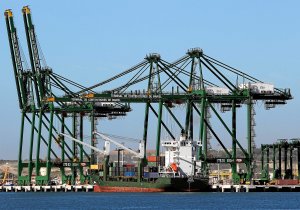
Aerial view of the new port of Mariel

HAVANA, Cuba, November www.cubanet.org — They say that socialism is the long way between capitalism and capitalism. Now the official press itself informs us that there is a shortcut: “Mariel, the Shortest Path” (Juventud Rebelde, Sunday, November 3rd, 2013, pages 4 and 5) is a lengthy article by writer René León Tamayo, who — with the attached comparative charts and a map of the region — lays out the benefits of the first large-scale capitalist work undertaken in Cuba by the “Revolutionary” government, which combines the capitals of Brazil, of the Cuban military oligarchy and of a million-dollar Chinese company, or, to put it more accurately, the company of a Chinese millionaire.

Perhaps a previous commitment of comparable magnitude was building the thermonuclear plant in Juraguá, province of Cienfuegos, in the era of Castro I during the affair with the former USSR, the largest of the hare-brained shipwrecks of the grandiose lunatic, truncated in April of 1986 after the Chernobyl disaster — whose cooling system was the same as would be installed at the one in Juraguá — resulting in the International Atomic Energy Agency (IAEA) not approving the launching of “our” brand-new nuclear power plant, thus saving the Island and Cubans here from the danger of disappearing by an (accidental or not) explosion. However, the Cienfuegos nuclear plant was still part of a distinctly socialist project in a program of “solidarity” among communist regimes. In the 80’s, talk of capital in Cuba was total heresy.

Mariel, on the other hand, is, in the words of General-President, “a creation for the present and for the future”, a capitalist project of these times when the official press talks openly about capital investment, including the previously contagious and dirty foreign capital. However, the numbers earmarked are still undisclosed. Some of the questions that were left unwritten by the journalist and his bosses are: how much will Cuban investment amount to, what its source is, how much of the also undisclosed “national budget” is destined to the projects at the Special Zone for the Development of Mariel (ZEDM), what specific benefits the Cuban population will get from this investment, and when.

But some things don’t change, as in the case of ambiguous language and cryptic messages; a journalistic style for generating optimism in an impoverished population that desperately needs good news, but to whom it’s advisable not to disclose too much information. As for domestic and foreign investors, “Mariel opens up a unique opportunity: a niche which offers the advantages that characterize these locations anywhere, but with the added value of being in a country that will be strategically situated in maritime shipping and global commerce when the Panama Canal expansion is completed in 2015.”

The article does not seem to say much, but it explains, between the lines, the reason for the Cuban authorities’ growing offensive against the US embargo, a topic which gained prominence in the government discourse only since 1992, after the end of Soviet-socialist protectorate. Elements are sketched for the likely emergence of a new stage in the regional geopolitical map in the medium term in which relations between investor countries, particularly those of Cuba and the U.S., might define the pattern and intensity of trade via maritime channels, among other issues.

So now it turns out that Cuba is not dangerously close to the enemy, as they have repeated to us for decades, but — on the contrary — Cuba enjoys a “geographical blessing” that seems to give it natural advantages over other nations, the same blessing that between the XVI and XVIII centuries drove the fleet of the Spanish crown to cluster in Havana before sailing to the metropolis.

The 465 square kilometers [180 square miles, more or less] from six municipalities in the province of Artemisa, with the possibility that the Council of Ministers might incorporate other areas, “provided they contribute to best achieve the objectives” is in the vanguard of future Special Zones that will be undertaken in other areas of the Island, which is already being heralded by the cymbals and trumpets of the official press. The benefits we will receive remain as inaccessible as the financial secrets of the work. Everything indicates that the ZEDM is the baptismal name that the promising capitalist enterprise of the “communist” cupola has been given, another cloud in the Castros’ fiscal paradise.

Translated by Norma Whiting

Cubanet, 5 November 2013

Cuba Rock Agency Director Dismissed / Camilo Ernesto Olivera

Maxim Rock, last Saturday. Photo: Camilo Ernesto Olivera

HAVANA, Cuba, November 6, 2013, Camilo Ernesto Olivera / www.cubanet.org.- On Saturday, 2 November, Blanca Record was dismissed as director of the Cuban Rock Agency. This was the surprising and unusual response to a protest expressed through “official channel.”

Blanca Recode took office last June. Her appointment was signed by Orlando Vistel, Vice President of the Cuban Institute of Music (ICM).

For more than a week, a good share of the musicians belonging to the Cuban Rock Agency (ACR) joined together to demand the dismissal of this functionary. They drafted a letter where they explained the situation of the groups, the despotic manifesto of this director, and her threats of shutting them down and firing them.

On Monday, musicians and technicians addressed different levels of the Ministry of Culture and also the Council of State. One group managed to deliver, personally, a copy of their protest letter to the Vice Minister for Music, Orlando Vistel. He scheduled a meeting on the 31st with various of those making the demands.

As a result, the Vice Minister guaranteed a response to the demands of the musicians and the workers of the Agency in a short time. The promise was fulfilled in just under 48 hours.

During the weekend, events seemed to rush toward the firing last Saturday. On Monday, the 4th, they decided not to keep the lawyer and economist at the Agency. Other changes are expected in the coming days. Meanwhile, the Agency and Maxim Theater continue operating and the programmed concerts will go on.

This weekend, two groups from Colombia and Switzerland shared the stage with Cuban groups.

According to reliable sources who asked not to be named, the Deputy Minister Orlando Vistel accepted the rockers’ proposal to name María Gattorno as Agency director.

Between 1988 and 2003, Gattorno managed to sustain, against all odds, the well-remembered “Patio de Maria” in a small house of culture. She is is much loved and respected among musicians and the Cuban rocker and metalhead audience.

During the time the Rock Agency was created in 2007, Gattorno decided not to accept the leadership of this organization for personal reasons. At that time, the appointment of Max Yuri Avila to the office was approved, who at that time already had experience in the work of artistic production and entertainment. Now the challenge is much greater.

The official dismissed arrived last June emphatically stating that “the Agency is going to be closed.”  Reversing this is a challenge that lies ahead for the two generations of rock and heavy metal musicians who survive as a part of this State entity.

Certainly , the genre has survived in much worse circumstances. But keep in mind that winning a battle is not winning the war. More than five decades of eventful history of rock on the island testify to this.

Camilo Ernesto Olivera

Cubanet, 6 November 2013

The Magic Lantern Is Switched Off / Yoani Sanchez

6a01676596f70a970b019b00b5de57970c-550wiRobert is closing down his 3D movie business. He has put a price on the projector, the glasses, and even the popcorn machine. He was only three months into the business knows he can’t recover his investment. A briefing note in the official Cuban press ended his entrepreneurial plans. He was forces to close the same week he had planned to start showing children’s movies in his air-conditioned room with cushy armchairs.

Of the more than 442,000 self-employed workers in this country, a good share of them have been affected in recent weeks by new legal restrictions. The Granma newspaper announced the immediate closing of the private movie and videogame rooms, suggesting that these had never been permitted.

Certainly the list of the more than 201 private licenses don’t include film projection, nor computer rooms devoted to entertainment. However, entrepreneurs have taken advantage of a small crack in the law, to operate. In a short time, these “neighborhood theaters” began to appear all over the country, some luxuriously appointed, some very modest.

Perhaps something that annoyed the State is that the three-dimensional projectors were introduced to the country by private hands. Or that the once powerful Cuban Institute of Cinematographic Art and Industry (ICAIC) saw that some small businesses got ahead of them on implementing such a new technology. The State apparatus sees itself threatened with losing the monopoly over the broadcast of audiovisual and places where it happens.

On the other hand, the private 3D rooms brought a lot of people back to the idea of neighborhood movie theaters. For example, in mid-20th century Havana, including the municipalities of Regla, Guanabacoa and Marianao, was host to 134 movie theaters. Some of them with between 1,000 and 2,500 seats, including lower level and balcony. The main ones came to have even as many 5,000 seats, like the Payret, the Radio Central (currently the Yara), the Metropolitan, the Blanquita (today the Karl Marx).

Of these, only 12 theaters remain active, largely in the most central parts of the city. The concept of nearby and intimate space, where you could go most Sundays, is unknown to Cubans under 30. So this opening of movie rooms by the self-employed, awakened memories in some and surprised others.

The programming of these new spaces, was based primarily on action, horror and animated movies. Halloween night, 48 hours before the ban that would close them, the 3D film rooms showed a wide range of “nightmare” movies. It was an advance premonition to what their owners would experience two days later. Spiderman, Avatar and Jack and the Giants were some of the productions that paraded across the private screens. Entertaining movies with no major artistic flights, but very popular among Cuban youth and children.

At the last congress of the government-sponsored Hermanos Saíz Assocation — an organization of young artists — one of the most striking approaches was their coming out against movies promoted by the private cinemas that are “frivolous, banal and consumerists.” We must “return to the principles of the cultural policy of the Revolution,” some cries. It was only a matter of time before the government ban would fall in the private theaters. Because it was known that the Cuban government, given a choice between extending the limits of the current legality, or maintaining it despite the reality, I would opt for the second.

Fear of independent dissemination of information, a political strenght-testing gesture, a backward step in the economic reforms. All this and more is hidden behind the new restrictions against 3D movies and videogames. However, it’s difficult to control a phenomenon that has gained so much popularity and whose technological infrastructure is already in the hands of so many Cubans.

Many, unlike Roberto who is unloading his equipment, plan to continue underground. The magic lantern will shine again behind closed doors, more discreetly, without neon signs, and without the aroma of popcorn escaping from the room.

6 November 2013

Kokuba / Regina Coyula

Image from ElPais.com

Kakebo notebooks. Image from El Pais.com

The kakebo comes from Japan and is a hybrid between a calendar and an accounts book.  It is said that Tomoko Hina, the first Japanese woman journalist, was the one who at the beginning of the 20th century developed the first kakebo in order to arrange and record household expenditures.  Housewives adopted it in order to organize the family economy and optimally administer resources.  Now its application has extended and there are kakebos of all kinds and all varieties and models, for big families to singles.  And for the first time here the year 2014 will feature Kakebo, book of accounts for household savings, published by Blackie Books (17.9 Euros).

With this news*, I eat breakfast with which, for years, my family’s economy has passed through a Kakebo.  A school notebook with the grid paper that they hand out freely, have been our expense control.  The page, divided in the middle to reflect the Cuban pesos on one side and the convertibles on the other.  Before, we had tried to manage our accounts by dividing our money into four parts corresponding to the money for the month destined for food each week, only to invariably violate the envelopes before the immediacy of an unexpected expense.

We resigned ourselves then to record expenses until the day on which we open the drawer and now there is no money; for a brief stage, with variable success, pockets, wallets and old ashtrays are checked, today often earmarked. Now it is known that it is time to eat the pseudo-bread of the notebook, I cannot buy coffee and the oil must be stretched.  Extravagances like beer, beef (including hash), or butter, a short while ago became harmful options, and not precisely to one’s health.  Must-have luxuries?  Coffee and hair dye.  That of bars, tobacco and meals out is a misplaced concern.

I’m dying to know what kind of welcome the sale of these Japanese philosophy notebooks will have in Spain.  I don’t know about the rest, but I can’t get it out of my head that whoever has to keep accounts, does not spend eighteen Euros on some other consumer object. For my part, I am about to abandon the daily notes, because I have arrived at the conclusion that everything has come to everyone in Cuba: on the topic of expenses and income, this film is backwards.

*Translator’s note: The link is to an article in El Pais about Kakebo notebooks

Translated by mlk

6 November 2013

Slippery Slope / Fernando Damaso

Photo: Rebeca

The closing, on 1 November, of the 3D movie rooms, and the ban, after 30 December, of private shops, deals a hard blow to self-employment. The authorities, once again (we remember “Operation Bird on a Wire,” “Operation Flowerpot,” and the liquidation of Free Farmers Markets in earlier years — all crackdowns on private enterprise), demonstrate their inability to compete with private property, even if it is nascent and must exist within absurd straitjackets, and the falsity of the so-called updates and changes to the economic model. Where there’s smoke there’s fire, and it wouldn’t be unusual for them to apply other or similar measures in the coming weeks. Time will tell.

Anchored in the past, dogmatic to the core, Marxism-Leninism and socialism fanatics, despite their more-than-proven failures, they are trying to survive (at least as long as they have a physical existence) in the closed feudal system they’ve turned the country into, light years away from the real world. The sad thing is that many citizens peacefully accept this arbitrariness, most often committed against their own neighbors, and they may even declare their support for them in some of the so-called “Public Opinion Polls,” which we are getting used to in the official press.

Forgetting the more then 54 years of failed improvisations and failed inventions, some who see a little hope in what was happening slowly, have received a real bucket of cold water. If the government intends, with the application of these measures, which respond only to the desire to demonstrate force and show who’s boss, it will gain followers and organize the country’s legal system, in which disorder is the greatest element, they are wrong again.

Once again, illegal activities and the black market will proliferate throughout the country, like before, simply because no one can force the citizens to starve to death and live in misery. Our young people, their life plans blocked by demonstrably incompetent authorities, choose exodus, like so many professionals, athletes and artists in Cuba; and as the lyrics of an old tango said, it will continue sliding down the slippery slope.

4 November 2013