State Security has been charged with coercing the opposition on the Island, prohibiting their entry to the capital, which these days, to paraphrase the slogan, “It will not be for all Cubans*” as long as it’s being visited by the leaders belonging to CELAC (Community of Latin American and Caribbean States).
The political police have warned them that on this date, starting as of 20 January, if they move around Havana they will be detained in jails until the meeting of the presidents is over.
For the dictatorship, it’s common to impose its totalitarian laws, but it leaves much to be desired for those heads of state, serving as a pretext for the Castro brothers, because once again they commit their abuses and impose their regime of terror on the people of Cuba, especially against those who raise their voices demanding democracy. continue reading
As always, the opposition will fulfill its role and occupy the cells offered; also they will bear the beatings and humiliations to demand the right of all Cubans to decide the fate of our country. The rest of Cubans, also as always, bear in silence the prohibition on their rights to decide, question, demand, identify themselves as a thinking part of our society, and the violation of the rights of those who protest being denied participation and the right to have opinions on the political, economic and social management of Cuba.
Hopefully, the awareness of their rights will continue to grow among Cubans, and we will have what we need to do that and to change the system in any way possible.
Ángel Santiesteban-Prats
Prison settlement in Lawton. January 2014.
*Translator’s note: The regime calls Havana “the capital of all Cubans.”
Since General Raul Castro formally occupied the throne of Cuban power February 24, 2008, he publicly promised to clear a series of obstacles and assured in a highly theatrical ceremony the creation of a kind of hospital where the infirmities of a worn out country that has been sold egalitarianism could be healed and where for more than half a century the human beings belonging to whatever gender, age, ethnicity or religion have not managed to become equal.
Alfred Adler, the Austrian founder of individual psychology, said that the superiority complex that accompanies the supposedly distinguished social classes is simply an effort to compensate for true, hidden feelings of inferiority.
So, as was expected, such an illusory path towards national progress, rather than advances, brought a significant regression in the social reality and needs of a people.
Our country is sick and in a terminal state. The palliative medicine called political reforms is nothing more than a tendentious manipulation that failed with the emergence of a class, or better said a claque; and with it, an unchecked increase of stale inequalities that already were abysmal. continue reading
Obviously, it is not my idea in this article to criticize those so vilified rich, because I have already said many times that, new or old, it seems to me very fine, and I don’t see anything bad or arrogant or offensive in the fact of having money or quantifying wealth.
I refer to those other characters that have launched a paladar — a small private restaurant — or made a hostel of their houses. A new group of entrepreneurs who on earning with their businesses, as if by magic they inherit a certain governmental arrogance and believe themselves deserving of it.
There is something that we all believe but on certain occasions we do not want to hear. The satisfaction of our material needs only finds fulfillment provided that they are repaid with educational and cultural growth.
In Cuba we are living in a curious, vertiginous and singular period of change in social relations. A new paragon, a new structure, where this group of people who through boredom, imitation or because of the illusion of uncertainty, adopt the old customs of institutional mistreatment and bet on an archetype of entrepreneurial behavior worthy of dead magnates, in which democracy is reduced to a facade, or a ridiculous and incongruent word-of-the-day incapable of convincing the whole of society.
The abuse, unacceptable from any point of view, cannot nor should it treat people as property; the worst is that as a dark metaphor that encloses an open ending, the Cuban workers, members of an uprooted population, with low self-esteem and victims of oppression, turn these injustices into the order of the day and accept denigrating rules of work with long days, miserable wages, intellectual debasement and sub-human conditions, as if it were about a model of neo-slavery.
Site manager’s note: We have been receiving news of a large protest in Holguin since yesterday but this video from CID (Independent and Democratic Cuba) is the first direct visual evidence we have seen.
Following is a translation of the notations as they appear on the video.
0:00 Self-employed workers in Holguin march from their businesses to the government offices.
0:21 – “… we want to work… we want to work.” The protest was organized by the workers themselves.
0:31 – Finally they gathered in front of the local government where they were repressed.
0:43 – In the early hours the independent workers were already gathered in front of the government offices.
0:57 – The police started to beat the leaders of the protest who defended themselves.
1:13 – Minutes later the strongest nucleus of the protest continued defending the Cuban flag they were carrying.
1:29 – They included the members of the CID who were recording the protests.
1:35 – With more than 500 self-employed people members of G2 (State Security) in plainclothes asked for reinforcements.
2:00 – Plainclothes police tried to grab the camera from members of CID who were recording the events…
2:14 – “… the people want justice, that is what you get… you’re defending this for 3 pesos… and a little bag [a sack of “goodies”such as shampoo, soap, etc.]…”
2:32 – Osmel Cespedez Artigas. CID member who recorded the videos.
2:44 – MININT (Ministry of the Interior) official approaches to grab the camera but is overcome, tries to back off.
2:59 – “Look, the people here are watching, you’re going to beat me? Who are you?”
Pro-democracy activist Martha Beatriz Roque Cabello went to the Provincial Court of Havana today in order to have the state of siege she is subjected to daily lifted, but got no response from the authorities and was placed under arrest for three hours.
State Security took charge of the former prisoner of the so-called Group of 75 (those arrested in 2003 Black Spring), taking her to the Zanja Street police station in Central Havana. There, Roque Cabello was guarded by three policewomen who stripped her of her personal belongings, including her cellphone.
After three hours Major Mario from the political police appeared, and indicated what measures the repressive bodies would continue to take with her.
In the words of Major Mario, neighbors of the activist will continue to beat her physically and harass her in a general way. In addition, she will not be allowed to have visitors, nor may she leave her home, they told her.
In a phone conversation with Cubanet, Roque Cabello stressed the lack of competence of the courts in Cuba, given, she said, that they are subordinate to the political police.
At the time of this writing, the building where Roque Cabello lives was surrounded by the police and her collaborators from the Cuban Community Communicators Network, an independent group led by former prisoner of conscience, were not allowed to visit her.
Cubans have been fighting against the dictatorship for more than half a century and this should be a source of pride, not shame. We have never given up, year after year, generation after generation many brave Cubans have refused to capitulate. Whoever says we’ve done nothing is wrong, we have done a great deal and continue doing it.
And all that has been done has been done against a regime that has had the support of much of the free world. Cubans have fought against dictatorship and against the Soviet empire that backed it until its end in 1989. We have also struggled against the indifference of democratic governments, against their indifference and in many cases against their complicity.
We have resisted for decades against the disinformation of the majority of the newspapers and journalists in the democratic world who have supported or been apologists for Castro. And despite this struggle against much of the world we have not let ourselves be beaten. It is not true that we’ve accomplished nothing, we’ve accomplished a great deal. All the sacrifice of a generation has made the following generation, or at least a part of it, to continue taking up the flag and defending freedom, respect for human rights and democracy.
Those who say we have not accomplished anything are ignoring that it has been the resistance of thousands and the sacrifices of thousands that have maintained the torch of freedom, lighting the path and the future. continue reading
Those who say that we have not done anything should reconsider their fatalism. They must understand that fear in Cuba and pessimism in the exile are the best weapons the enemy Castro regime has against the struggle for democracy. The dictatorship wants a fearful people and a pessimistic exile morally defeated. They want fear in Cuba and fatalism abroad because they fear the people on the island the people in exile.
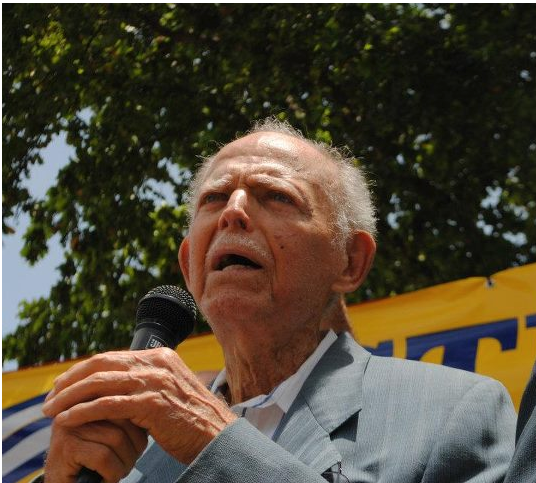
For this, my compatriots, I speak as a man of 95 years who spent two decades in prison. Now is not the time to back off, it is the time to find in our souls and our hearts all the strength and all the optimism we need to bury the Castro regime. When someone tells you that we have done nothing and we can’t do anything, tell them that this is what the dictatorship wants us to think.
That the dictatorship wants fear on the island and defeatism abroad. Because they know that the day when the exile has faith and supports those who struggle, is the day the fear on the island will be lost the quickest. The dictatorship knows that to the extent that the people on the island lose their fear, in the exile negativity, fatalism and paralysis weaken. We can not ask the people to rise up if those of us living in freedom do not rebel against our lack of faith, against our passivity.
My fellow Cubans, we remember a Roman poet who centuries ago stated a great truth:
“Whoever loses their faith has nothing more to lose.”
19 January 2014
HAVANA, Cuba – As of 1959, Cubans renounced the custom of publicly expressing their opinions, particularly political ones, as if the question of who and how they are governed was not something that affects all of society. The legally recognized press became a government artifact, responsible for giving shape to the collective conscience; to guarantee, for the rapture or the terror, obedience. To separate the capacity to inform from the interests of the Revolution (which by definition can’t be democratic), is an imperative of the journalistic vocation.
It was also the original sin of Reinaldo Escobar — independent journalist, author of the blog Desde aquí (From Here) — who today comments on aspects relating to the phenomenon of press freedom in the country today.
Lilianne Ruiz: What do independent journalists in Cuba do to access sources of information? Is it possible to access the institutions?
Reinaldo Escobar: The main source of information for a journalist is the area of reality susceptible to turning itself into news. A media professional usually has his own network of contacts in the area of that reality he specializes in, be it boxing, fashion, concerts or palace intrigues. In a country like Cuba, where institutions monopolize official information as a source of power and control, access to sensitive documentation is only given within a complex framework of permissions.
As a general rule, it’s not the official media journalists who searche the archives, nor are they the ones who investigate the revealing data. Quite the contrary, it is the institutions who show the authorized journalists what they are “directed” to publish, from the highest level. So the independent journalist has to behave basically as a spy to find out, for example, the failure of the latest sugar crop, or how much money tourists bring in. The information area that the independent Cuban journalist has greatest access to, is restricted to the activities of the opposition and the consequent repression that this entails. Even so, it is not feasible to go to the police stations and ask questions about those arrested, or to attend a trial or visit the prisoners.
Lilianne Ruiz: How can there be a free press without economic freedom?
Reinaldo Escobar: Like any other right, the right to freedom of expression has a material base that facilitates or restricts its realization. In the conditions in Cuba, those who aspire to a free press independent of the government know they will never have access to the radio microphones, the TV cameras, or the newspaper presses. continue reading
The options that are left are to collaborate with the already established media outside the country, and to try something from within. If you intend to print a magazine, a bulletin, or something similar, you will have to confront the costs of paper and supplies and the type of printer available, so it will be very difficult, for example, to distribute a thousand copies of a twenty-page weekly edition. Those who choose audiovisual, once they have a set of cameras and good microphones, plus a computer to do the necessary editing, face the challenge of multiplying their product, through disks or flash memory.
It turns out it’s not advisable to wait to enjoy economic freedom to acquire the material base of our right of freedom of expression. The Internet allows us to have cost-free spaces where we can post texts, photos, videos, with the advantage of it being an interactive medium.
Lilianne Ruiz: How does public opinion get expressed with such low connectivity in Cuba?
Reinaldo Escobar: The concept of “public opinion” originated in societies where the rights of freedom of information and freedom of expression exist. No one’s ever made reference to how public opinion reacted in Hitler’s Germany or in Stalin’s Soviet Union. Would it occur to anyone to reference public opinion in North Korea?
I believe that the realizable goal is to reach at least the opinion leaders: artists, entrepreneurs, civil society activists; those people who are heard by many others. The attempt to reach all the people ends up being paralyzing. Under current conditions of Cuba, only the Communist Party, handling the media as a privately owned monopoly, can accomplish that and we can’t compete with it.
PHOTO: Reinaldo Escobar is the husband of the well-known blogger Yoani Sánchez. Photo: EFE
If we put the negative results of low connectivity on one side of the balance, and on the other side we put the real reach allowed by the Internet, we will have a favorable balance. There is also the option to remain silent, but it doesn’t lead anywhere.
Lilianne Ruiz: What are the risks of independent journalism in 2014?
Reinaldo Escobar: There is a tendency to identify independent journalism with controversial journalism. Someone could be a freelance correspondent to report on the passage of migratory birds and there probably wouldn’t be any problem with that, but we must not discount that one day they will knock on the door to “talk with him.”
If we look at it in retrospect, after the Black Spring of 2003 (when many independent journalists were sentenced to long prison terms) the reprisals have been limited to brief detentions, defamatory campaigns, the siezure of some media and other occasional physical abuse. The true risk is the potential and, above all, the randomness. This creates a real atmosphere of terror hanging over independent journalists who, to the eyes of the observers, are either irresponsible lunatics or courageous heroes.
Lilianne Ruiz: Are there laws or institutions that protect independent journalists?
Reinaldo Escobar: In the exterior there are the Inter-American Press Association, Amnesty International, Reporters Without Borders, the Center to Protect Journalists in New York, and other institutions in Europe and Latin America. Within the country you can count on the support of the legal group Cubalex or the Cuban Law Association, the Commission on Human Rights and National Reconciliation, among other independent groups, who have advised many in situations where State Security has seized their tools of the trade without proper legal procedures. But there is not a single law, nor anything in the Constitution, nor any formalized institutional protection to serve these knights errant of the news.
Lilianne Ruiz: In such circumstances, what makes these journalists persist in their work ?
Reinaldo Escobar: The same reasons that led so many missionaries to spread the Gospel in areas inhabited by cannibals.
Lilianne Ruiz: Is independent journalism in Cuba a form of activism for human rights, including a force of political opposition?
Reinaldo Escobar: Perhaps the most effective way to fight for a right is to exercise it at any price, or at least at a reasonable price. As a person very close to me often says, in Cuba, reality is deeply oppositional. If independent journalists strive to show it in the most efficient way, that does not make them opponents in the strict sense of the term. The doctor who diagnoses a disease, the engineer who detects a structural defect, the accountant who discovers embezzlement, like the journalist who reports on what happens with objectivity, are all professionals doing their jobs. The repressive organs, enemies of freedom of information and freedom of expression, are the ones who catalog professional journalists as opponents, mercenaries, enemies of the country and other epithets.
Personally, I try to escape definitions that end up functioning like a straitjacket. Bloggers, twitterers and other communicators who practice citizen journalism, do their own thing regardless of the word used to catalog them and they all deserve the respect they have earned, not just for doing something dangerous, but also for trying to satisfy a social need.
Much is written and spoken in the official media about the upcoming 20th Congress of the Cuban Workers Center (CTC) and its importance to the workers. Nothing is further from the truth, considering that the CTC is a government organization designed for total control of the union movement in the interest of the Party and the State.
For many years, practically since the disappearance of Lázaro Peña as an authentic labor leader and Secretary General of this organization, it was converted into one of the many governmental tentacles to control the citizenry, in this case the workers.
Its conversion was being prepared from before, by the Aclaraciones [Clarifications] section of the newspaper Hoy [Today], organ of the Communists, written by its director Blas Roca (author also, in 1943, of the pseudo-scientific pamphlet “The Fundamentals of Socialism in Cuba” in which he tried to fit Cuban history within the dogmas of Marxism-Leninism and Stalinism), where he delineated and established a kind of Revolutionary Code about how the workers should behave in the new society: no restoring to strikes, following the Party’s and government’s orders, and prioritizing duties in detriment to rights.
Thus, they repealed by decree the independent employers and a unique and infallible employer: the State, whose strong and unconditional ally was the CTC.
This role, totally detached from the interests of the workers, was later sanctioned with laws and decrees, and with the designation from top to bottom of prefabricated union leaders, with no real influence over its representatives, ready to exercise its role as guardians of the flock, and prevent the appearance of true leaders.
Now, with the appearance of self-employed workers, one of the great preoccupations of the CTC is how to integrate the flock of the established syndicates, and not allowing them any affiliation or, even worse, creating their own unions rather than the existing and sanctified ones.
The CTC and its unions, who in all their years have responded to the Party and the government and never defended the rights of the workers, lack the credit to define themselves as their maximum representatives, and try to adapt themselves to the so-called “updating of the model” to be in tune with the moment, but without giving an inch on any of its prerogatives. A very difficult task before an ever more disbelieving population, tired of so many stories and storytellers.
If you have some years like I do, you will remember that some time ago, trendsetters, while they publicly occupied radically conflicting positions on the big billboards of the ideological scene, coexisted embraced in the comfort of the only and non-proletarian star of Mercedes-Benz. Beautiful symbol that still today represents a kind of category for those who are anchored to the era of the World War and “the Cold War.”
In Cuba, the hunger to buy a status symbol doesn’t mean the brand of the Teutonic giant, but any car with the flavor of liberty and air conditioning. The gentlemen “upstairs” well know that under the publicized slogan of “updating the model,” more than achieving the dreams of a sacrificed people, is to make money off them.
The Cuban government eliminated the uncomfortable restriction that demanded an official permit to acquire a vehicle, but in exchange, the prices are astronomical. Before this new measure, the privilege of having a modern and private car was only within the reach of a certain number of workers, a limited group of high officials (this includes friends, girlfriends, lovers, brown nosers, relatives), famous artists and elite athletes. continue reading
Prices might infuriate, but not scandalize. Experience has shown me that there is nothing easier in our archipelago than to die facing the sun, or to live with eyes closed. Cuba is a captive market without second options. As the days pass, Cubans will accustom themselves to this new level of “anti-life.” Did something happen in the afternoon in which without warning they raised the prices of milk, electricity, water, soap, beer, and gasoline?
The wheeling and dealing in used cars, whether of second or seventh hand, will continue functioning and hybrids will be imposed. Permit me to clarify that the Cuban hybrid car is not conceived in that classic conceptual format that you know, which combines a combustion engine with an electric one.
It is a work of art, a colossus of the industrial gothic; which to achieve, primarily you have to acquire a circulation permit for a non-existent or hopeless car; then resolve by any means possible an authorization to buy a rebuilt motor for this supposed automobile that only appears on paper. With that paper, the motor and some indulgent gratification, known as a bribe, which never hurts, get another authorization to buy a body in the path of what one day were rental cars for tourists; and finally, with everything in order and a magician, this Frankenstein is assembled that, simply said, broadly speaking, sounds ugly but is beautiful.
The new cars, without doubt, will be sold, including the Peugeot 508 for 262,000 dollars. Someone has to show off, and for that there is everything; presumptuous officials, artists, athletes, new style self-employed, repressed with dollars under the mattress, and of course, the kings of the dawn. In short, the speculation of Havana.
I do not believe that any businessman, nor the buzzards of “Cuban-American merchandising” that are now taking their baby steps of sending cars (stolen, new or used) from Miami to some nearby port, in order to then locate them in Havana, inspired in this apparently anarchist measure, and excited about the car show, might be able to travel and sell cars on the island to everyone who wants to buy.
In the emerging car business of Cuba it is not the market but the State who will dictate guidelines. An old government tactic called plunder with iniquity.
It may be legal to buy a car in Cuba, but who will be able to afford one? In Cuba, this 2013 Mercedes Benz A-Class will retail for five times its price in the rest of the world. Photo: Wikimedia Commons.On January 10, 2014, the Cuban state liberalized car sales. For the first time in over five decades of Revolution, it will no longer be necessary to obtain permission from the Ministry of Transport to buy a car in Cuba. But in a country where the highest salaries barely reach $40 a month, having enough money to afford the cost of a new automobile is something of a surreal dream.
Most vehicles cost hundreds of thousands of CUCs (Cuban convertible peso). By the island’s official exchange rate, this equals several million Cuban pesos.
A 2013 Peugeot 4008, for example, costs 239,250 CUC. In Spain, its price is around €32,000 (about 44,000 CUC). It’s more or less the same case for China’s Geely vehicles, as well as Mercedes Benz, and BMW: Compared to the rest of the world, prices are five times higher, or more, in Cuba.
To make things worse, buyers won’t find any offers for credit.
The message is very clear: It may now be legal to buy a car, but no Cuban will be able to justify such an enormous expense, which totals far more than their lifetime earnings.
Only state-run companies (and you won’t find any other kind of company in Cuba) will be allowed to import these cars. The government justifies all this by claiming that the massive tax imposed upon the vehicles will be invested in developing public transport.
Cuban protest groups and the international press have torn into the Cuban government since it announced these prices, but it came as no surprise to me. Without a free market economy, we live in an empire where the wishes of those who cling to power are out of reach of both law and common sense.
And so the Raulist reforms will last as long as their mastermind, Raúl Castro, is still alive. After him will come not just the deluge, but the delirium, whose symptoms have been announced today in the hundreds of thousands.
Today, although motivated by shaking the walls with the scoop in the competitive world of information, knowing that six Cuban citizens are bogged down in Bogota facing the possibility of being returned to Cuba moves me.
Angel Barrios Cabrera (33), Eudardo Roldán López (39), Greysi Padrón Basulto (27), Yoanker Paradela (30), Brian Betancourt (41) and Nayip Mayo Horta (31), without pursuing the fate of Icarus, in order to escape from the island and from Minos, decided to jump and fly on a sea of uncertainty to Ecuador, a county that even with all documentation in order, did not permit them to enter.
It is true that at any border, immigration officials have the last word to permit us access or not to the territory on arrival; but it is noteworthy that this pattern of behavior with regards to the return of Cubans is becoming habitual. continue reading
So habitual that it now raises suspicion and even smells of the existence of a prosperous but incipient business destined to finance the updating of the new Cuban economic model. I cannot guarantee it; but the lack of evidence and the obvious increase of the flow of returned Cubans is food for thought, and a lot.
Rejected in Quito, and taking advantage of the return trip to Havana, they decided to stay in Colombia and after days stranded in the El Dorado international airport, this Saturday, January 11, Bogota extends them a safe conduct permit to enter the country for 10 days, valid starting this Monday, so that they can go out, move through the city and reside temporarily in one of the refugee centers of the ACNUR, an agency of the UN.
Here it should be noted that when I spoke to one of them, whose name I do not say because as my grandfather used to say, “A deal is a deal, and respecting it is gentlemanly,” he told me that a good Samaritan Cuban had gotten them toiletries, clothes and food. Bogota is a very cold city inhabited by warm and supportive people.
He also told me that this immigration waiver will allow them this week to prepare and present the refugee claim before the Colombian Chancellery, and in this way get an extension of the document that will permit them to stay in that country for a period of two or three months.
I believe it’s quite clear that the fact that the Colombian authorities have granted this kind of safeguard is only a step which, of course, is thoroughly appreciated, but it does not mean that they have granted them refugee status.
In my personal opinion, it is a simple political measure by Bogota, with the clear intention of not affecting relations between the governments of Colombia and Cuba, besides not obstructing the peace process that curiously and opportunely just resumed in Havana after a recess taken by the negotiating parties and the good reason of the December holidays.
On ending my long and often interrupted telephone conversation with one of the six Cubans, he asked him to please call his mother in Cuba, and so I did. After conveying the good news and all the rest, I was surprised by the reply of a woman who with incredible strength answered, “You tell him. . . that I will miss him like crazy; but not to give up and to fight, only in this way are dreams achieved.”
In the early hours of Sunday, 12 January, at 6:30 AM, Angel Santiestebian-Prats was the victim of a surprise search by Officer Joaquin, deputy chief of prisons in Havana province. We do not know what they were looking for, but clearly they weren’t satisfied with what they found although they took everything: the Declaration of Human Rights — hopefully they took the trouble to read it — statutes of Amnesty International, an Encuentro magazine, a Cuban Hispanic magazine and a story.
The harassment of Angel is constant and constantly growing. The regime continues violating his rights and those of all the prisoners — political and common — under the complacent gaze of the concert of free nations of the world, and now shamelessly before the United Nations Human Rights Council, which has rewarded it for “safeguarding” the human rights of the entire world.
Angel is still imprisoned for crimes he didn’t commit and that they have never been able to prove precisely because he did not commit them. The judicial farce that the political police mounted should have been denounced by the same Human Rights Council that now “honors” the regime.
On 28 February Angel will have been unjustly imprisoned for a year, without the Prosecutor having responded to the “Motion for Review” presented by his attorney, Amelia Rodriguez Cala on 4 July last year. continue reading
We already denounced last 18 December that Angel had begun to be harassed and provoked by his jailers, in what we consider a clear strategy to push him to commit some disciplinary infraction that would justify a new transfer to a severe-regime prison or that would allow his accusers to demonstrate his supposed violent character in the review of the trial which, if the Cuban legal system worked, they are obliged to hold.
Nor has Angel’s right to a pass every sixty days been respected; he and his companions were deprived of this right at the end of November. But on 3 January, his nineteen companions in the prison left for their six-day pass, which was compensation for the pass they’d taken from them. Angel continues not to receive this benefit and only receives harassment and provocations.
Dictator Raul Castro continues to demonstrate to the world how in the Island Prison you violate all the rights and freedoms with his archaic but deadly mortal reign of terror, who also continues his efforts to bringing it to the rest of the continent with the complicity of the United Nations Human Rights Council.
You and the whole army of minions at your service are absolutely responsible for the life and safety of Angel Santiestebian-Prats. And remember that while the world is watching in horror as you send paramilitary mobs to beat peaceful Ladies in White carrying gladioli as the only weapon; as you arrest stops mothers with their children; as you use children as shields in acts of repudiation against those who think differently and also serve as witnesses for horrific scenes of physical violence. And this same world is recognizing the talent of Angel, rewarding him, as happened in September when he was awarded the Franz Kafka International Novel from the Drawer Prize, and the tribute he received in November in Montreal.
Raul Castro, with the world as a witness, we hold you directly responsible for whatever happens to Ángel Santiestebian-Prats.
With infinite pleasure I received the text of the intellectual Francis Sanchez “Smoke Signal for freedom.” With concern, because we are not naive, we are aware that this text of his, with his point of view, will be considered by the culture officials and the political police, as another sign of his incorrigible rebellion, “another stripe for the Tiger” as our beloved, and physically gone, writer Guillermo Vidal said.
Bravely, Francis has exposed his reasons for distrusting my prosecution and trial and the entire campaign undertaken against me. Hardly aware of what happened, Francis has come to the logical conclusions from the most biased knowledge of the events, except that Francis has displayed his boldness and put his finger on the sore spot.
He begins the text with a Hemingway-like sentence: “Today is Angel Santiesteban.” That they have violated my due process, my most elemental legal rights, in an arbitrary and insolent way, before the eyes of the rest of the artists, accepting their silence, is the worst thing that could do against themselves. Tomorrow there will be others, perhaps some of those who signed the letter “against violence” to climb the ladder, ingratiating themselves with power, cowards, and so many other negative reasons, and then they will see their lives consumed under the silence of many and the opposition of few, where I will find myself, of course, defending their rights. And I will do it for them and for myself. continue reading
I will repeat once again that no conclusive evidence was offered against me, except my handwritten copy of a government newspaper and according to the graphologist, as shown by “the height and tilt of my letter: I am guilty.” And a friend of my ex-wife — whom I’d been separated from emotionally and physically for more than two and a half years — as was reported at the trial, what he knew with respect to what he’d heard from her, which makes him an “ear-witness,” (that is, it’s hearsay) which is the same as nothing. However, for my part I presented five authentic compelling witnesses, who were rejected after the hearing. All of the investigative file, the appeal, the review, plus the video of the false witness, are found on the Internet so that everyone can draw their own conclusions.
However, many chose not to look, because anyway what are they going to do? Not to support the government but to put themselves in a good position and to continue to receive the gifts of power, and on the other hand, not to exacerbate their fears of the fury of the regime and the hardships involved.
I greatly appreciate that another writer raises his voice for Justice, regardless of whether it is in my favor, we are gaining in civic conscience and that is what’s important. I will wait for others to be honest and lose their fear, that’s the reason, the real demand for which I am imprisoned, because I lost the fear of suffering. There is an intangible quote that grips us when we say what we feel, and that is much greater and more gratifying that the suffering, when it is overcome.
Surely, the times of freedom are coming. The sleeping elephants wake up and discover their memory, are ashamed of their past and present, begin to live for the future and their honesty.
Given that there are only a few days left before the Summit of the Community of Latin American and Caribbean States (CELAC) is going to be held in Havana, as is usual in these cases, they are rounding up the indigents.
The sites where the largest concentrations of homeless people spend the night in the capital are in the areas near the waiting room of the interprovincial bus terminal, located on the Avenida del Puerto, opposite La Coubre pier (formerly the Calvary pier), and behind the segment of the wall at Egido and Leonor Pérez Streets, adjacent to the main railway terminal.
Luis Alberto Blanco, 49, a resident of Henequén Viejo neighborhood, in the municipality of Mariel in Artemisa province, said that from the beginning of the year they had an orientation for the municipal Communist Party for the appropriate agencies for the “evacuation” of the destitute before 28 January, given that it is expected that the leaders participating in the summit area with visit the port development zone that the Government is building on the bay.
According to testimony from the victims themselves, for the nights they are forced to board a bus known as “The Colony,” a nickname derived from the name of the property to which they are transferred, located in the municipality of Boyeros, 15 kilometers south of the capital.
They say that is they resist the transfer, the repressors turn off the lights in the bus and beat them.
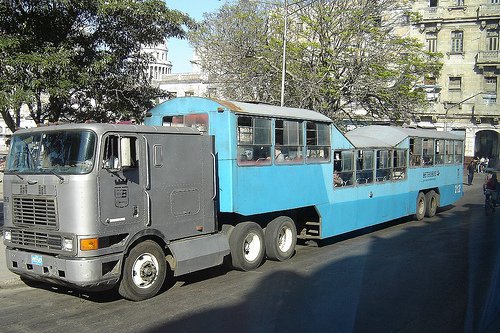
The bus is identifiable by body structure, similar to the old “camels” that circulated during the so-called Special Period, although a little smaller.
“The Colony is the terror of the homeless,” said one of the victims in an interview months ago.
The Summit of CELAC’s, an organization currently chair by Raúl Castro, will be held on 28 and 29 January.