Faced with a 990-Peso Price Cap, Cuban Shop Owners Opt Not to Sell Cooking Oil

Imported from Mexico, Spain, the United States and even faraway Ukraine, the product is disappearing in Holguín.


Vegetable oil sets the price of a meal in Cuba, hence the concern over the rise in product prices in recent weeks. / Escambray

14ymedio bigger14ymedio, Miguel García, Holguín, 12 March 2025 — Cooking oil is a dominating presence in the nation’s culinary scene. If there is a lot left in the home cook’s bottle, all is good. But if it’s only a smidgen, things get tense. Vegetable oil is the key determinant of the cost of a meal in Cuba, hence the concern over the rising price in recent weeks despite the government’s attempts to control the it.

Given the heavy emphasis on meat and fried foods in Cuban cuisine, cooking oil represents a significant expense for Cuban families. Prices for the most common cooking oils— soy, sunflower and canola — at privately owned small and medium sized businesses (MSMEs) have risen nearly 20% since the beginning of the year. This dramatic price increase is being felt, with slight variations, throughout the country.

From January till today, the price of a liter of oil has risen from 820 pesos to 980 pesos at privately owned shops in the city of Holguín. Meanwhile, cooking oil is notably absent at government-run ration stores.

Outside the privately owned Dos Hermanos (Two Brothers) store here in Holguín, the hot topic on Tuesday was the rising price for a food item imported largely from Mexico, Spain, the United States and even faraway Ukraine.

In my house we have to buy at least three bottles every month, so I end up spending all my pension just on that”

“At this rate, it’ll cost 1,000 pesos by Spring break [in April],” predicted one customer, who fears that the vacation period will lead to a higher continue reading

consumption of fried foods by school children and teens. “In my house we have to buy at least three bottles every month, so I end up spending all my pension just on that.” Pork fat could be an alternative but it is not an option for her. A pound of unprocessed pork lard costs about 500 pesos in the provincial capital.

Looking for ways to reduce consumption, some people mill around outside the MSME, exchanging recipes that require less cooking oil. “My daughter bought me an air fryer that makes food crispy while using almost no oil but the problem is the blackouts,” said one elderly man. “I got some nice potatoes yesterday but they’re the kind that are very absorbent and soak up a lot of oil.”

In July the government lifted import tariffs on six basic products — chicken, powdered milk, cooking oil, sausages, pasta, and powdered detergent — while also imposing price caps on them. The price of a liter of oil was capped at 990 pesos. (Olive oil was exempted.) Subsequently, the price began to fall until December, when it reached 750 pesos at Holguín’s privately owned markets.

From January till today, the price of a liter of oil has risen from 820 pesos to 980 pesos at privately owned shops in the city of Holguín. Meanwhile, cooking oil is notably absent at government-run ration stores. / 14ymedio

No sooner had the year started, however, than the price of oil began to rise. The reasons for this are hard to pinpoint in a country where the economic crisis has impacted every aspect of daily life, especially food costs. “We used to buy it wholesale from a private distributor which imported it by the container-load, says a Holguín vendor who has a stall in the city’s downtown. The man, who prefers to remain anonymous, claims that, since government measures to “reorganize” the private sector took effect in August, the variety and quantity of merchandise his suppliers provide has declined.

The regulations include restrictions on private wholesale transactions, the phase-out of tax exemptions and higher taxes. “Two MSMEs that used to sell us oil have stopped importing it because they now have to go through government channels. They say it’s not profitable, not only because of the price but because it now takes longer to get it from the ports to them. By then, it’s too late,” he explaims.

I can’t risk losing my license because a lot of my family’s money is invested in this little store”

“Right now our profit margin on cooking oil is very low. Customers complain that the price has gone up but it has gotten more expensive for us too. What we do now is suggest vegetable shortening as an alternative but it’s not as popular because it’s not suitable for every kind of food. Plus, it’s expensive and doesn’t last as long.” He predicts that, given how close its price is to the government’s 990-peso per liter limit, “it [too] will become less available.”

The owner of another store attributes the rise in cooking oil prices to the current dollar exchange rate on the informal market. Trading at 345 Cuban pesos as of Wednesday, the US currency is essential for purchasing products on the international market. “Right now, a liter of oil — once it is delivered to Cuba — is costing us $2.50 a bottle based on the small quantities we buy. That is more than 860 pesos at the current exchange rate, ” she explains. “On top of that, there are transportation costs and other expenses to get it here.”

Rather than violate the 990-peso price cap, the owner of a small shop opts not to sell it at all. “I can’t risk losing my license because I have a lot of my family’s money invested in this little store,” she explains. If the supply of vegetable oil decreases, Cuban kitchens will be turning out a lot fewer French fries, malanga fritters, and “tostones” than they once did.

____________

COLLABORATE WITH OUR WORK: The 14ymedio team is committed to practicing serious journalism that reflects Cuba’s reality in all its depth. Thank you for joining us on this long journey. We invite you to continue supporting us by becoming a member of 14ymedio now. Together we can continue transforming journalism in Cuba.

‘Because of Various Distortions’ It Is More Expensive To Produce Food in Cuba Than To Import It

Without offering solutions to this situation, Prime Minister Manuel Marrero calls on the agricultural sector to produce more.

A dollar store in Galerías Paseo, in Havana / 14ymedio

14ymedio bigger14ymedio, Havana, March 14, 2025 — “We need food and, above all, proteins,” insisted Prime Minister Manuel Marrero, before recognizing that, of the nine products in the ’family basket’, eight come from imports. Quite a novelty, since not even a month ago he said that 100% were bought abroad.

He reported this at a meeting of the Ministry of Food Industry, in the presence of his boss, President Miguel Díaz-Canel, and called on the agricultural sector to produce more. “The safest food comes from national production,” said the prime minister, who recognized, in the words of the State newspap Granma, “that its cost of preparation in the country is high, due to several distortions.”

Just 24 hours later, the provincial newspaper of Sancti Spíritus, Escambray, published an article dedicated to one of the great exceptions of the Cuban industry: shrimp, which along with lobster is the only fish product that does well in Cuba.

“The safest food comes from national production”

Despite the fact that, according to the data of the last five years, there is a decrease of 82% (from 7,200 tons in 2018 to 1,200 in 2023), the production of shrimp gives good results, but it is far from becoming that national continue reading

protein sought by Marrero: it goes to the tables of foreigners or to Cubans with access to dollars.

“In the first months of the year, there is expected to be about 300 tons for export and internal sales in foreign currency,” says Escambray’s text. The newspaper spoke with Romny González Álvarez, director of Industry in the Fishery and Industrial Company of the province, located in Tunas de Zaza. He explained how the workers “get involved” in their “rigorous” work, which requires “strict quality standards so that it classifies as an exportable product within the international market, mainly destined for Europe and Asia.”

The manager says that on February 25, the crustacean began to be processed, from Júcaro, in Ciego de Ávila, and on the 28th, the batch from the Cienfuegos fleet arrived. All of them are raised through intensive cultivation on farms and give up to eight sizes, the smallest being 20 grams.

“Cienfuegos asks that its product report 92.5% for each ton of shrimp it sends, and here we achieve 95% or 96%, while Júcaro demands 94.1% but reaches 97%. In summary, we exceed what both suppliers demand from us and what is reinvested into economic results for our entity,” he explains, talking about how the seafood is used once received. All this, he boasts, is despite the fact that the machines have been failing, a problem solved thanks to the preparation of the workers.

The last liberalization of the sector occurred in March 2014, when the Government allowed private fishermen to agree on sales without State contracts

While shrimp workers clean the product, destined for the exterior, Marrero “called for the removal of obstacles to fishing activity and highlighted the role of municipal governments in the search for agreements with fishermen,” says Granma. The last liberalization of the sector occurred in March 2014, when the Government allowed private fishermen to agree on sales without State contracts.

However, he specifically left out lobster and pink shrimp, which provide a considerable amount of foreign currency. The last year with available data is 2023, when the State received 62 million dollars for these foods. It’s not a huge amount, but it is for the meager amount of product it managed to achieve: 2,380 tons.

Marrero, in his regret for the lack of national production, reported precisely the large amount of money that the State must invest in buying mackerel because of the embargo: 3,000 tons of the fish “facilitated by an African country” had to travel 75 days “with very high costs.” To these hardships, Marrero added the problems of the Bucanero Brewery, which “could not open accounts abroad due to the delay in bank procedures, under pressure from the imperial power. In addition, Havana Club suffered losses of more than 40 million dollars.”

The president of the Business Group of the Fishing Industry, Osmani Barreiro Consuegra, mentioned the reduction of catches by 50%, without specifying the year and what amount was achieved. He regretted that the export plan remained at only 67%.

The Meat Company of Sancti Spíritus said it plans to increase in 2025 “the delivery of 17.4 kilograms per month to each consumer, although it is still insufficient”

The Meat Company of Sancti Spíritus said it plans to increase in 2025 “the delivery of 17.4 kilograms per month to each consumer, although it is still insufficient.” It did not explain the basis for the optimistic calculation in the midst of a galloping crisis, nor did the Canning company of Ciego de Ávila, which “plans to rescue the productive poles.” On the other hand, the launch of a brand of soft drinks gave no details but reported that they will “try to conquer the Russian market.”

In the midst of such an ominous outlook, the ministerial authorities were optimistic, although it is not known what accounts they have made to present a perspective that is not bleak. The minister, Alberto López Díaz, said – in a confusing way – that a “growth of one-tenth in profits, 26% in the contribution to the State, and twice the production of the cooperatives” is expected. In addition, he proposed “nine collection products, with potential for more than 74,000 tons, and a reduction of the fiscal deficit by two-fifths.”

Meanwhile, the Island will continue to import a generous amount from the United States. According to the report published by Cuba Trade, in 2024 Havana spent 586.5 million dollars on its purchases from the United States, of which 433.8 million (74%) corresponded to food and basic necessities, chicken for the most part.

Translated by Regina Anavy

____________

COLLABORATE WITH OUR WORK: The 14ymedio team is committed to practicing serious journalism that reflects Cuba’s reality in all its depth. Thank you for joining us on this long journey. We invite you to continue supporting us by becoming a member of 14ymedio now. Together we can continue transforming journalism in Cuba.

March 8 in Cuba: When Dignity and Obedience Are Confused

The Federation of Cuban Women said it was celebrating, not Women’s Day, but the right that the Revolution gave them to be “dignified.”

March 8th commemoration in the presence of Cuban President Miguel Díaz-Canel. / Cubadebate

14ymedio bigger14ymedio, Yunior García Aguilera, Havana, 10 March 2025 — This past March 8th, the Cuban regime’s institution responsible for monitoring and controlling women put out a weak, shaky, and contradictory statement. The FMC (Federation of Cuban Women) announced in their pamphlet that they were celebrating not International Women’s Day, but rather the right the Revolution gave them to be “dignified.” They claimed to uphold the principles — not of their own female leaders (if they even have any) — but of a macho man who presided over all their congresses and always insisted on having the final say. It’s pretty clear the statement was a throwback to recent events in Río Cauto.

The population of this Granma municipality sank into darkness and misery each year, like the rest of the country, but the local press only spoke of fictitious achievements and a supposed revolutionary euphoria. Río Cauto had been proclaimed “Vanguard Municipality” in the celebration of July 26th in 2023. That same year, it had earned the distinction of hosting the provincial event commemorating the 65th Anniversary of the Triumph of the Revolution.

But the most striking event occurred in February 2024, when the town experienced a collective ’bristling’ following the visit of the appointed dictator, Miguel Díaz-Canel. Its three key officials — Sadia Pérez Nápoles (first secretary of the municipal PCC), Dailín Cox Pajaró (president of the Municipal Assembly), and Yaniel Yero Nápoles (mayor) — had already amassed a significant collection of diplomas and were sharpening their claws to be promoted, without a doubt, to provincial positions.

The population of this Granma municipality sank into darkness and misery each year, like the rest of the country, but the local press only spoke of fictitious achievements and a supposed revolutionary euphoria.

But just a year later, an unexpected turn of events once again put Río Cauto in the spotlight, and not for its usual submissiveness.  All Cubans saw on social media a humble woman protesting against hunger and misery. We also witnessed two mastodontic goons violently dragging her away in front continue reading

of her children. We read the statement from Río Cauto’s authorities  branding her ungrateful and throwing in her face the four planks and zinc roof that the Government, in its boundless generosity, had provided her. At the climax of this chronicle, we all closely followed how her neighbors took to the streets in the most resounding protest of the year so far across the country, demanding her release and voicing their collective exasperation.

The Caribbean Countries Claim That They ‘Do Not Exploit’ Cuban Doctors

The Caribbean countries claim that they “do not exploit” Cuban doctors

Prime Minister of Trinidad and Tobago, Keith Rowley / EFE

14ymedio biggerEFE (via 14ymedio), Havana, 14 March 2025 — Numerous leaders of countries of the Caribbean Community (Caricom) have criticized the restrictions announced by the United States against Cuba’s medical missions, fundamental for the subsistence of the region’s health systems. As an important part of the staff of its health centers, Caricom members are loyal to Havana’s views on the Washington embargo and strongly thank Cuba for its medical “support.”

In recent days, leaders of Caricom, an organization made up of 15 countries, have denied that hiring Cuban doctors is an exploitation of labor, as Washington claims, and have warned that their health systems would collapse without these doctors. The United States announced at the end of February that it is extending the current visa restriction imposed on those who benefit from the “labor exploitation” of Cuban workers abroad to apply also to foreign government officials who are believed to be responsible for or who are involved in this program.

Mia Mottley, President of Caricom, said that she is prepared to lose her US visa

The last to speak was the Prime Minister of Barbados, Mia Mottley, president of Caricom, who said that she is prepared, like other leaders in the region, to lose her US visa if “a sensible agreement” is not reached on this matter, since “principles matter.” In the same vein, her counterparts from Antigua and Barbuda, Gaston Browne; Saint Vincent and the Grenadines, Ralph Gonsalves; and Trinidad and Tobago, Keith Rowley, promised to protect their own sovereignty. continue reading

“I have just returned from California and, if I never return there in my life, I will ensure that the sovereignty of Trinidad and Tobago is respected by all,” Rowley said this week. All Caricom leaders also agreed in rejecting that benefiting from Cuba’s medical missions is a form of human trafficking. “We pay them the same as the Barbadians.* We repudiate and reject the idea, spread not only by this US government but by the previous one, that we were involved in human trafficking,” Mottley stressed.

“Suddenly they are calling us human traffickers, and we are accused of participating in a program in which people are exploited,” Rowley replied. In this regard, the Prime Minister of the Bahamas, Philip Davis, said on Wednesday that the laws and the Constitution of the country prohibit involvement in human trafficking and that his government “will never use forced labor. It goes against our laws, and we are a country of law. We don’t think we did it; we’re not doing it, but we’ll review our situation,” he added.

“Suddenly they are calling us human traffickers, and we are accused of participating in a program in which people are exploited”

The controversial medical missions have been operating for more than 60 years. According to official data, more than 605,000 professionals have been sent to 165 countries, mainly in the Caribbean and Latin America. The criticisms of the missions, which Havana defends as a legitimate initiative of “internationalist solidarity,” focus on the commission that the Cuban government keeps from the salaries paid to doctors in host countries, as well as on the withdrawal of their passports during the missions and the lack of freedom and transparency, among others.

“We depend heavily on the health care specialists we have obtained mainly from Cuba over the decades,” acknowledged the Prime Minister of Trinidad and Tobago. Likewise, Browne said that the US should treat the Caribbean with respect: “If they take punitive measures due to the presence of Cuban medical personnel in our health systems, they would practically dismantle these systems throughout the region.”

For her part, Mottley indicated that Barbados does not currently have Cuban medical personnel, but the country “could not have overcome the pandemic” without the help of these doctors. “I look forward to joining my Caricom brothers to make sure we explain that what Cubans have done for us, far from resembling human trafficking, has been to save the lives of many Caribbean people,” she said.

Caricom, composed of Antigua and Barbuda, Barbados, Bahamas, Belize, Dominica, Grenada, Guyana, Haiti, Jamaica, Montserrat, Saint Kitts and Nevis, Saint Lucia, Saint Vincent and the Grenadines, Suriname and Trinidad and Tobago, decided at its last summit to request a dialogue with US President Donald Trump to discuss the issue.

*Translator’s note:  The payment for Cuban doctors goes to the Cuban government, not to the individual doctors. They receive a stipend to cover living costs, and the rest of their salary is kept in a bank account for them, which they can access when they return from the mission.

Translated by Regina Anavy

____________

COLLABORATE WITH OUR WORK: The 14ymedio team is committed to practicing serious journalism that reflects Cuba’s reality in all its depth. Thank you for joining us on this long journey. We invite you to continue supporting us by becoming a member of 14ymedio now. Together we can continue transforming journalism in Cuba.

Surveillance Is Tightened on Migrants Who Received the I-220A Form When Entering the United States

Verifications could include visits to the migrant’s residence and calls to check on their status.

Demonstration of Cubans with I-220A asking for the normalization of their immigration status / 14ymedio

14ymedio bigger14ymedio, Havana, 14 March 2025 — The United States Department of Immigration and Customs Control (ICE) has increased the use of the Intensive Appearance Monitoring Program (ISAP) – a migration control mechanism – for those who have received the I-220A form upon arrival in the country. The measure, which has been in place for two decades as an alternative to detention, seeks to maintain strict surveillance on this group while their asylum requests are being resolved.

According to CaféFuerte, migrants with I-220A were informed this week that they will be subjected to a rigorous verification process during their immigration process. After attending a control appointment with ICE, some have even been temporarily “detained” and then released. This was the case of Laura de la Caridad González Sánchez, arrested on Monday at the agency’s office in Miramar, Miami. She was released shortly after, but her arrest prompted a demonstration of Cubans with the same status, next to the young woman’s lawyer’s office. More than a hundred beneficiaries of the I-220A were processed in recent days in those offices, the report indicates.

ISAP allows those who have applied for asylum or have been detained by ICE to wait for a judicial hearing in freedom, provided that they comply with the surveillance regime established by Customs Control. The program may require the use of ankle bracelets or applications that allow the authorities to know at all times the location of the migrant and even monitor, through continue reading

periodic calls, their situation.

Form I-220A is a “provisional release order” for parole offered by the Government to migrants who were arrested when entering illegally

In the case of those with the I-220A who have been notified about the measure, CaféFuerte says that the surveillance system includes the use of an application with a calendar of appointments at fixed times, once a week, during which they can be contacted by the authorities by phone or even video call. Others, it found out, were informed that the verifications could include visits to the migrant’s residence.

Form I-220A is a “provisional release order” of parole – a conditional permit – offered by the United States Government to people who were arrested while illegally entering the country. It requires those involved to attend hearings in an immigration court and comply with a series of rules while their immigration status is resolved.

However, the process can be long and does not guarantee that those involved will receive a favorable judgment. This, along with the series of radical measures against the migratory flow implemented by the Trump Administration, keeps many undocumented people in the uncertainty of whether they will be arrested or deported.

Added to this is this Friday’s announcement by the President that he will invoke an old law of 1798, the Foreign Enemies Act, which would allow him to deport migrants without the need for a hearing.

Trump had already mentioned that measure during his election campaign and did so again in his keynote speech on January 20: “By invoking the Foreign Enemies Act of 1798 I will order our Government to use the full and immense power of federal and state law enforcement to eliminate the presence of all foreign gangs and criminal networks that bring devastating crimes to American soil.”

The Foreign Enemies Act has not been invoked since World War II, when it was used to arrest Americans of Japanese origin.

The Foreign Enemies Act has not been invoked since World War II, when it was used to arrest Americans of Japanese origin

At the beginning of March, the Department of Homeland Security (DHS) and the Citizenship and Immigration Service (USCIS) also announced the implementation – after an evaluation of 60 days from March 5 – of a regulation that will force migrants who request visas for privileges already granted in national territory to deliver to the authorities information from their social networks.

As they explained then, migrants who will be affected are those who apply for the Naturalization form in the United States, known as N-400 (about 909,700 people, they calculate), and the Permanent Residence Registration form I-485 (1,060,585 people). These are two of the benefits most requested by Cubans, especially the latter which is essential to benefit from the Cuban Adjustment Law.

According to both institutions – which opened the proposal to a debate that will last two months – USCIS “identified the need to collect social media identifiers,” such as user profiles and other similar elements, with a view to verifying the identity of the applicants and whether they represent a potential danger to the United States.

Other measures taken by the Trump Administration, which particularly affected Cubans, were the suspension of the CBP One application – with which asylum appointments were requested from Mexico – and
the humanitarian parole, which benefited thousands of Cuban immigrants.

In the case of the first, this week National Security announced the launch of the CBP Home, so that irregular immigrants can leave the U.S. with the promise of being able to return through legal ways in the future.

“Self-deportation is the safest option for undocumented immigrants,” the DHS said on Monday. “It is not only safer but also saves money for U.S. taxpayers and allows the valuable resources of the Customs and Border Protection Office and the Immigration and Customs Enforcement Service to focus on dangerous criminal immigrants.”

Translated by Regina Anavy

____________

COLLABORATE WITH OUR WORK: The 14ymedio team is committed to practicing serious journalism that reflects Cuba’s reality in all its depth. Thank you for joining us on this long journey. We invite you to continue supporting us by becoming a member of 14ymedio now. Together we can continue transforming journalism in Cuba.

The Dangerous Art of Avoiding the Lumps of Stone which Fall Off the Bazar A&M Building in Havana

Four days after the incident happened, the heavy pieces of stone remained in the middle of the street. / 14ymedio

14ymedio bigger14ymedio, Juan Diego Rodríguez, 14 March 2025 – Finding heavy bits of building spread about at the foot of 909 Calle Infanta, on the corner with Carlos III, in Havana’s centre, doesn’t surprise anybody. The building – especially the top floors which are still inhabited – has been in a ruined state for years. The only surprise is that there hasn’t been a more serious accident: in the ground floor of the building the new branch of Bazar A&M attracts hundreds of people every day.

This Friday, four days after the incident happened, caused by the recent cold weather front, the heavy pieces of stone remained in the middle of the street, hardly even cordoned off properly by a police tape. The shop not only remained open, it was heaving with people.

Customers were indeed in two minds about entering. “Oof, how terrible it looks!” was what the majority said when they looked up and saw the big hole in the top storey and the eaves destroyed, and with the wall ready to continue collapsing. “That’s very precarious, something disastrous is going to happen here at any moment”, said one woman who decided not to take the risk of entering the shop.

The Las Avenidas building, has been in a ruined state for years, especially the top storeys, which are still inhabited. / 14ymedio

Since it first opened its doors last November where the state-run cafe Las Avenidas used to be, which lent its name to the building, the store has become one of the busiest in the area. “Yes, it’s quite expensive but it’s well stocked and has all the right departments: ironmongery, food, sweet shop, continue reading

toiletries, everything”, one customer explained. “Nothing like other shops like La Época, where you go in and it’s like a deserted graveyard”.

The store is Bazar A&M’s third branch. The firm already had two stores in the same district of Havana, one on Neptuno/Lealdad and the other – a market – on Neptuno/Gervasio. A WhatsApp group run by someone calling themselves Valentina Vale announces its latest offers and prices.

The actual owners continue to be a mystery. Unlike other small/medium sized private businesses, Bazar A&M doesn’t have a website, and, although they sell a whole range of produce, they are registered at the Ministery of Planning and Economy with “Paper and Cardboard production” listed as being their main activity.

Bazar A&M not only remained open, it was heaving with people. / 14ymedio

All three of the firm’s stores used to be state-run outlets, and, as has been seen repeatedly in recent years, they all opened without public tender or prior notice. For example, the “mixed” bazar Neptuno, which opened in 2023, occupies a space which used to be a clothing store that was falling into ruin.

Whoever the owners are, they don’t appear to be concerned about the condition of the building on Infanta/Carlos III. An elderly gentleman summed it up like this: “When you look up and see that part of the building is about to fall off, you say, ’Dear God, is there no one with the common sense to realize that a shop with such a large number of people shouldn’t be situated here!’ You can see that there are other bits of the wall that are going to fall off at any time. Certainly when the next rain comes. Hopefully they won’t fall on top of anyone”.

Translated by Ricardo Recluso

____________

COLLABORATE WITH OUR WORK: The 14ymedio team is committed to practicing serious journalism that reflects Cuba’s reality in all its depth. Thank you for joining us on this long journey. We invite you to continue supporting us by becoming a member of 14ymedio now. Together we can continue transforming journalism in Cuba.

New Total Blackout in Cuba Due to “High Fluctuations in the National Electricity System”

This is the first outage of this magnitude so far this year and comes after weeks in which the generation deficit exceeded 1,200 MW.

The ’14ymedio’ newsroom is aware of the magnitude of the power outage affecting the entire city of Havana. / 14ymedio

14ymedio bigger14ymedio, Havana, 15 March 2025 — Cuba’s National Electric Power System (SEN) suffered a power outage this Friday night around 8:15 p.m., plunging the country once again into total darkness. According to the official press, the blackout was caused “by a high fluctuation in the system” and “the causes and magnitude of the incident are being investigated.”

Before the SEN went down, numerous users reported power fluctuations in several Havana municipalities. After a few seconds of flickering lights, the city plunged into darkness, except for some state-owned buildings that have backup batteries to guarantee a power supply.

“A breakdown at the Diezmero substation caused a significant loss of generation in western Cuba and, consequently, the National Electric System (SEN) went down. The recovery process is already underway,” the Ministry of Energy and Mines added shortly afterward on its social media. continue reading

The spread of the blackout throughout the island has also been confirmed from different Cuban provinces and municipalities.

The 14ymedio newsroom notes the magnitude of the citywide power outage. Various Cuban provinces and municipalities have also confirmed the extent of the blackout across the island. This is the first outage of this magnitude this year and comes after weeks in which the power generation deficit has far exceeded 1,200 MW.

This Friday, the Electricity Union estimated an availability of 1,940 MW and a peak demand of 3,250 MW, resulting in a deficit of 1,310 MW. If expected conditions persist, the state monopoly estimated a 1,380 MW impact during peak hours. Ultimately, the battered national energy system could not hold up and has collapsed.

At the end of last year, the SEN suffered three such power outages in less than two months, plunging the country into total darkness. The most recent, on December 4, was caused by an “automatic trip” at the Antonio Guiteras thermoelectric plant, the country’s main power plant, which caused the outage, a very similar incident to the one that occurred last October 18.

____________

COLLABORATE WITH OUR WORK: The 14ymedio team is committed to practicing serious journalism that reflects Cuba’s reality in all its depth. Thank you for joining us on this long journey. We invite you to continue supporting us by becoming a member of 14ymedio now. Together we can continue transforming journalism in Cuba.

Black Market Butchers Arrested Selling Beef Near Santa Clara, Cuba

The detainees, in the same place where a few days ago they dismantled a camp of clandestine gold seekers, were seized with 300 pounds of beef.

The slaughterers operated on the Ring Road and the National Highway, two points surrounded by vegetation where it is easy to sneak through. / ACN

14ymedio bigger14ymedio, Havana, 13 March 2025 — The police have been very busy in Villa Clara, and, after dismantling a camp of clandestine gold prospectors, this week they captured members of a gang of slaughterers. Three people operating on the outskirts of the city were arrested and 300 lbs of beef were seized.

Henry Omar Pérez, the journalist who reported the arrest – which has not been reported in the Vanguardia newspaper or on Santa Clara radio stations – welcomed the fact that the police are very active on the outskirts of Santa Clara and not just inside the city. In fact, the slaughterers sold meat in areas close to the Ring Road and the National Highway, two points surrounded by vegetation through which it is easy to sneak and hide any type of merchandise.

Pérez mentions the strategic importance of both positions, which connect Santa Clara with the neighboring municipalities of Camajuaní and Placetas. The police keep an eye on these points, and in fact it was on one of them – the Maleza road – where the mining camp was located.

According to the report, the slaughterers were part of a “dangerous criminal chain” that reportedly had contacts in the province’s countryside continue reading

and in the livestock sector, which they had “hit hard.” They themselves were involved in the sale of the meat, taking advantage of the “accessibility” of the roads.

The spokesman stressed that the capture was possible thanks to help from local people.

Lieutenant Colonel Héctor de la Fe, Pérez’s main source, explained that the gang worked in a “structured” way and attributed the success of the operation to “the expertise of our forces.” The officer also stressed that the capture was possible thanks to “help” from local people. The police have in recent years encouraged Cubans to report things.

“This is an example of how partnership between the police and the community can achieve great results in the fight against crime,” said De la Fe. Once the locations were known, the operation was launched and the slaughterers found.

Perez urged people in Guajira to share all the information they can about this type of crime, to avoid “destabilizing livestock production” in a province that in 2022 topped the list of provinces with the most crimes of this type. At that time, 12,234 illegally slaughtered animals were registered in Villa Clara.

The number was significantly higher than Holguín, with 9,825, and Matanzas, with 8,150 cattle butchered in 2022. After ten months of inspections and raids, the Ministry of Agriculture last month gave an update on the number of cows left in Cuba: only 2,914,009, when ten years ago it was near to four million and, before 1959 – with a population of six million – there was almost one cow per person.

The fight against cattle rustlers became a state issue in 2024 and this year the problem shows no signs of being resolved in the short term. With several provinces unchecked, the number of registered illegalities amounted to 181,854.

The photos with multiple plastic bags, backpacks and sacks loaded with beef that Pérez published on Thursday show that, when it comes to cattle, slaughterers try to process and sell as much as possible as quickly as possible. On several occasions, criminals have also resorted to armed violence.

Pérez – who describes himself as a “communicator for the Onei (National Office of Statistics and Information)”, as well as a “follower of Martí and Fidel” – has emerged on the pro-government media scene in recent months after reporting on events involving the province’s agents. Through his description of the events, documented with photos and testimonies of officers, he has become a privileged spokesman for the Ministry of the Interior.

This “informative” function and apologist for the Ministry was carried out, until now, by the anonymous profile Fuerza del Pueblo, who has not published anything on its networks since last January.

Translated by GH

____________

COLLABORATE WITH OUR WORK: The 14ymedio team is committed to practicing serious journalism that reflects Cuba’s reality in all its depth. Thank you for joining us on this long journey. We invite you to continue supporting us by becoming a member of 14ymedio now. Together we can continue transforming journalism in Cuba.

More Than a Million People, Including 300,000 Cubans, Apply for Spanish Nationality

They are joined by another 200,000 who have already been issued passports under the Democratic Memory Law.

Line at the Spanish Consulate in Havana / 14ymedio

14ymedio bigger14ymedio, Madrid, 13 March 2025 — About 300,000 Cubans are currently processing an application for Spanish nationality based on the Democratic Memory Law — also called ’The Law of Grandchildren’ — whose submission deadline ends October 21. The number was released this Thursday by Juan Manuel de Hoz, spokesman for the United Spanish Descendants Center (CeDEU), in statements to the regional newspaper La Voz de Galicia.

The association explained that, according to its current data, there are 200,000 passports already delivered to descendants of those who were forced into exile for political reasons during the time of Franco, although it does not have figures disaggregated by nationality of origin.

To these must be added more than a million people who are in the process. The 300,000 Cubans pale next to the more than the 790,000 Argentines who are distributed among the consulates of Buenos Aires, Mendoza and Rosario.

“The figures are impressive, and at the end of the process we will have between a million and a half and two million new Spaniards,” De Hoz tells continue reading

the Galician media. “It is a very generous law, comparable to that of Portugal and even broader than that of Italy,” he added.

“The figures are impressive, and at the end of the process we will have between a million and a half and two million new Spaniards”

The law, says the activist “gives the right to obtain [Spanish] nationality to all the grandchildren of the emigrants, absolutely to all and, in addition, to their children. Their descendants will be able to continue to do so later, as long as they ratify at the age of 18 that they want to maintain the Spanish nationality inherited from one of their parents.”

De la Hoz indicates that Cubans, the second nationality in number of applications – Mexico, Venezuela and France are also among the countries with the most applications – have had an extra difficulty, since the country is not a signatory of the 1961 Hague Convention.

In Cuba, the difficulty of not adhering to the Hague Apostille Convention is added. This mechanism simplifies the validation process of official documents for international law but requires the country to be a signatory of the agreement. Cuba, therefore, has its own stamp for the documentation that is required, which implies more time. De la Hoz, however, is optimistic about the changes in the digitization of records and believes that it will alleviate the problems of applicants on the Island.

The CeDEU spokesman has taken the opportunity to highlight the relevance of good advice when it comes to simplifying procedures, something that is “exemplary” in Argentine embassies. “The important thing is to educate yourself in the time remaining before the deadline so that everyone knows what steps to take. This process is proving exemplary in the consulates of Rosario and Buenos Aires through its civil registry officer and his team,” he emphasizes.

To obtain nationality through this channel, you must register as a user at the consulate and get an appointment for the procedure. The actual birth certificate of the emigrated relative and the documentation proving exile is required if it occurred in or after 1956, something that is not required for descendants of those who left between 1936 and 1955 and are considered exiles by default.

There are also other necessary papers – marriage certificates – for descendants of women who lost Spanish nationality by marrying a foreigner before the Constitution (1978) was approved. In the case – very frequent in Cuba – of the children of those who got the nationality with the ’Grandchildren Law’ of 2007, the certification of that fact is required.

The actual birth certificate of the emigrated family member and the documentation proving exile are required if it occurred in or after 1956

The CeDEU is one of the associations that actively promoted a reform of the Historical Memory Law – known in Cuba as the Grandchildren Law – to cover others affected who had been left out of that regulation. This is the case of those born outside Spain of originally Spanish fathers, mothers, grandfathers or grandmothers who lost their nationality for political or ideological reasons, beliefs or sexual orientation and identity when they went into exile during the civil war under Franco, as well as children born to mothers who lost it by a Franco regulation that forced a woman to acquire the nationality of her husband if he was a foreigner.

According to the latest update from the Ministry of Territorial Policy and Democratic Memory, a total of 36,117 applications for nationality had reached the Consulate of Spain in Havana up to January 31, 2024, of which 24,087 had been approved and 358 denied.

Translated by Regina Anavy

____________

COLLABORATE WITH OUR WORK: The 14ymedio team is committed to practicing serious journalism that reflects Cuba’s reality in all its depth. Thank you for joining us on this long journey. We invite you to continue supporting us by becoming a member of 14ymedio now. Together we can continue transforming journalism in Cuba.

For About 230 Dollars a Month, Mexico Hires Cubans and Other Migrants To Fumigate Against Dengue Fever

The Chiapas government includes them in the “junk and vector removal” program.

The migrants were trained to fumigate in priority areas / Chiapas Ministry of Health

14ymedio bigger14ymedio, Ángel Salinas, Mexico City, 13 March 2025 — The state of Chiapas, in Mexico, hired 390 migrants from Cuba, Venezuela, Colombia, Honduras and Haiti as fumigators to stop the spread of diseases that increased last year, such as dengue, malaria, Zika and chikungunya, all transmitted by mosquitoes. “The pay will help me support myself while I’m in Tapachula,” 26-year-old Venezuelan Jaiver Urdaneta told 14ymedio.

The government of the state of Chiapas added migrants to the “unloading and vectors” program, in charge of removing garbage and abandoned objects from the streets. “Migrants join the brigades specialized in vector control and zoonoses,” said a source from the Ministry of Health.

At the end of January, state health authorities reinforced surveillance on the border. According to official data, last year the cases of dengue increased by 34% and those of malaria by 84%, both transmitted by mosquitoes.

In the first two months of the year, 600 cases of malaria in migrants were found. “It is a risk because it can spread,” the Secretary of State Health, Omar Gómez Cruz, told local media. “Fortunately we controlled it and treated all the people, who were from Venezuela, Central America and Panama.”

Jaiver Urdaneta told this newspaper that he is guaranteed three months with a salary of just over 2,300 pesos per fortnight in the border state with Guatemala. The payment is less than the average of 3,350 that a worker receives, and in addition they do not have medical services or other benefits continue reading

stipulated in the Federal Labor Law such as the payment of utilities, savings fund, pantry vouchers and food.

At the end of January, state health authorities strengthened surveillance along the border. / Cacahoatán City Council

“A friend told me about the job; I didn’t have any money. Now I can pay for a room, buy food and Migration has stopped threatening me.” Urdaneta says that the officers have a list with the names and photos of those who make up the program.

Yaniel, a Cuban who is in the same group as Jaiver, says he has been in Tapachula for three months. “I am doing the paper work with the Mexican Commission for Refugee Aid (Comar), and I have an appointment in May. I trust that they will give me refuge, because if it is not in Mexico, I will look in Guatemala, but I’m not returning to Cuba,” he states.

The 28-year-old from Havana explains that he was excluded in February from the group of migrants who were hired to sweep streets, collect garbage and paint public spaces, but the Comar told him that another project was going to be opened. The young man regrets that the remuneration for the salary is low, but at least “it is secure.”

For her part, the Secretary for the Development of the Southern Border, María Amalia Toriello Elorza, indicated that they have detected, without specifying nationality, doctors among the migrant groups. “We want to take advantage of their knowledge and give them the opportunity to contribute to the public health of Chiapas,” she said. “This will not only benefit the population but will also allow the practitioners to continue practicing their profession in a legal and dignified manner.”

Toriello Elorza assured that they are working on the requirements to be met so that migrant specialists can practice in the state under the corresponding legal framework. According to their profile, they will be assigned to the areas in which their knowledge can be used, she clarified.

Translated by Regina Anavy

____________

COLLABORATE WITH OUR WORK: The 14ymedio team is committed to practicing serious journalism that reflects Cuba’s reality in all its depth. Thank you for joining us on this long journey. We invite you to continue supporting us by becoming a member of 14ymedio now. Together we can continue transforming journalism in Cuba.

Prisoners Defenders Registers 1,150 Political Prisoners in Cuba at the End of February

The organization explained that seven new names were added to its list and the same number were released from prison

Prisoners Defenders reported that its registry includes 222 people accused of sedition, when in most cases they participated in peaceful protests. / Wilber Aguilera Bravo/Facebook

14ymedio biggerEFE (via 14ymedio), Madrid, March 13, 2025 — The NGO Prisoners Defenders (PD) reported this Thursday that at the end of February, it had registered 1,150 political prisoners in Cuba, the same number as its previous monthly report.

The Madrid-based organization explained that seven new names had entered its list and the same number had been released from prison after fully serving the sentence or measure imposed.

PD, one of the main sources of information on the registry of political prisoners in Cuba, still maintains 230 individuals on its list who were released between January and February, arguing that their sentences have not been served, but rather that they are on conditional release. continue reading

These individuals were released following the Cuban government’s decision to release 553 inmates convicted of “various crimes” after Washington removed Havana from the list of countries that promote terrorism.

There are 715 individuals “with serious medical conditions and 61 prisoners with serious mental health disorders, all of them without adequate medical or psychiatric treatment”

The Cuban government, which never publicly linked the list and the releases, announced two days ago that it had concluded the process “successfully.”

The measure was described as a “fraud” by Prisoners Defenders and criticized by several human rights NGOs, including Amnesty International, Human Rights Watch, Justicia 11J, Cubalex, and the Cuban Observatory of Human Rights (OCDH).

The monthly report by PD indicates that its registry includes 715 people “with serious medical conditions and 61 prisoners with serious mental health disorders, all of whom lack adequate medical or psychiatric treatment.”

It explained that 33 minors remain on the list, of whom 29 are serving sentences and four are being prosecuted “with precautionary measures without any judicial protection.” The minimum age for imprisonment in Cuba is 16.

Prisoners Defenders reported that its registry includes 222 people accused of sedition, when in most cases they participated in peaceful protests. It added that 219 “have already been sentenced to an average of ten years of imprisonment each” (including 15 minors).

The NGO also highlighted the treatment suffered by the 121 women included on its list.

“Cuba has had a total of 1,813 political prisoners in its jails” since July 2021, when the largest anti-government protests in decades were recorded on the island, according to the NGO statement.

Translated by Tomás A.

____________

COLLABORATE WITH OUR WORK: The 14ymedio team is committed to practicing serious journalism that reflects Cuba’s reality in all its depth. Thank you for joining us on this long journey. We invite you to continue supporting us by becoming a member of 14ymedio now. Together we can continue transforming journalism in Cuba.

Cuba’s Foreign Ministry Says It Is Willing To ‘Assimilate’ the Cubans Deported by Trump

In the last four years, more than 860,000 Cuban migrants entered the United States, the largest migration in the Island’s recent history.

The increase in deportations from US territory occurs in a context of greater immigration controls / US Embassy in Cuba / Facebook

14ymedio bigger14ymedio/EFE, Havana, 13 March 2025 — The Cuban government “is open to assimilating the return” of its citizens in the United States irregularly, but “within the agreed terms” in bilateral migration matters, official media reported on Thursday.

“It seems absurd and unfair to us that the United States threatens to massively deport this large number of Cubans, especially when there are migration agreements that have worked well in the past,” said Deputy Minister of Foreign Affairs, Carlos Fernández de Cossío, in statements to state television collected by the state media Cubadebate.

Both countries maintain immigration agreements that include the commitment by the US to issue a minimum of 20,000 visas per year for Cubans and to return Cubans intercepted at sea.

In November 2023, they agreed to resume deportation flights for “inadmissible” Cuban migrants detained at the border with Mexico. continue reading

“It seems absurd and unfair to us that the United States threatens to massively deport this large number of Cubans”

The increase in deportations from US territory occurs in a context of greater migration controls and a stricter policy by Washington, in an attempt to stop the flow of migrants arriving at the southern border.

At the end of February, the United States Government resumed deportation flights to Cuba, in an operation that was the second of its kind since the arrival of Republican Donald Trump to the presidency this January. In total, 104 irregular migrants, 84 men, 19 women and a minor were repatriated.

According to data from the Office of Customs and Border Protection (CBP), during the fiscal year 2024, which ended on September 30, a total of 217,615 Cubans entered the United States.

In October 2024, the first month of fiscal year 2025, US border authorities registered the arrival of 8,261 Cubans. In the last four years, more than 860,000 Cuban migrants entered the United States, the largest migration in the Island’s recent history.

Translated by Regina Anavy

____________

COLLABORATE WITH OUR WORK: The 14ymedio team is committed to practicing serious journalism that reflects Cuba’s reality in all its depth. Thank you for joining us on this long journey. We invite you to continue supporting us by becoming a member of 14ymedio now. Together we can continue transforming journalism in Cuba.

The Cuban Army Holds Talks To Recruit ‘Little Girls’ for Military Service

It is about promoting “the inclusion of women in national defense” in exchange for “benefits”

The official media published scenes of the bastion in Sancti Spíritus, Las Tunas and Villa Clara / CMHW

14ymedio bigger14ymedio, Havana, March 12, 2025 — With weapons, drones and banners, Cuban Army officers have invaded the pre-university plazas throughout the Island with a declared objective: to “excite” teenagers with a custom-designed “bastion” – an exercise that has already been done at the national and university level – and convince women of the benefits they will obtain if they enroll in military service.

Voluntary except for girls studying Journalism and International Relations – and mandatory for young people – female military service is rare in Cuba. A group of officers went to the schools of Villa Clara, in the context of the bastion, to try to “capture females” in the classrooms.

Major Orlando Juvier Santos, head of the Military Committee in Corralillo and Quemado de Güines (Villa Clara), has done “interviews with the whole universe of little girls.” Whether or not he has had luck in his search, the officer does not say. Nor does he provide the number of women recruited or the number of educational entities that his entourage has visited.

Major Orlando Juvier Santos has done “interviews with the whole universe of little girls”

He states, however, that he has explained to the students “the benefits they will obtain when joining the military service, such as the possibility of changing careers if they are not satisfied with the one obtained in the pre-university, as well as opting for a new career after having fulfilled their time continue reading

of service in our units.”

In case of acceptance, and with the approval of the Federation of Cuban Women, which also does recruitment and selection work, the Armed Forces carry out the medical check-up of the candidate and send her to preliminary training.

It is about fulfilling an old slogan, says Juvier Santos: “the inclusion of women in national defense,” which implies encouraging the entry of women in “all areas,” including the military and from an early age.

Since this Tuesday, Sancti Spíritus has been the national headquarters of the bastion, whose characteristics have been similar to those of the university, held in February. “It is an ideological bastion,” stressed the national leader of the Federation of Middle School Students (FEEM), which groups together pre-university students as well as those of polytechnics and other secondary education centers. According to Lanier Gómez, they are preparing for “any aggression” by the United States.

The official media published scenes of the development of the bastion in Sancti Spíritus, Las Tunas and Villa Clara, provinces where the exercise – in the words of the Caribbean Channel – has been met with greater “enthusiasm.”

Among the “attractions” of the Army, maneuvers with drones were the most recorded by Cuban Television cameras

Among the “attractions” of the Army, the maneuvers with drones – ordinary ones, of Chinese technology and without any type of weapon, but suitable for surveillance – were the most recorded by the cameras of Cuban Television. Exercises were also carried out with war tanks, armaments and hand-to-hand combat.

“We will be going to military units, and even the women will have conversations with our girls to encourage them to do military service,” said the president of the FEEM in Las Tunas, Marcos Flores.

In Santa Clara, the military arrived at Osvaldo Herrera pre-university – in the middle of Vidal Park – to propose studying for military careers to young people. They were accompanied by the camilitos, students who have embraced military training since the seventh grade in the Camilo Cienfuegos schools of the Armed Forces.

Lieutenant Colonel Rigoberto Hernández Machado, head of the Preparation and Advance Section of the Central Army, said that they impart “vocational information” for several careers: Combative Security, Communications, Radioelectronics and Military Intelligence. He did not say if his “campaign” had been successful.

In a year that began with the explosion of an arsenal in Melones, Holguín, in which 13 soldiers died – nine of them military service recruits – the Armed Forces have not stopped making public affirmations of principles. This, the third bastion celebrated at the national level this year, will end on March 15.

Translated by Regina Anavy

____________

COLLABORATE WITH OUR WORK: The 14ymedio team is committed to practicing serious journalism that reflects Cuba’s reality in all its depth. Thank you for joining us on this long journey. We invite you to continue supporting us by becoming a member of 14ymedio now. Together we can continue transforming journalism in Cuba.
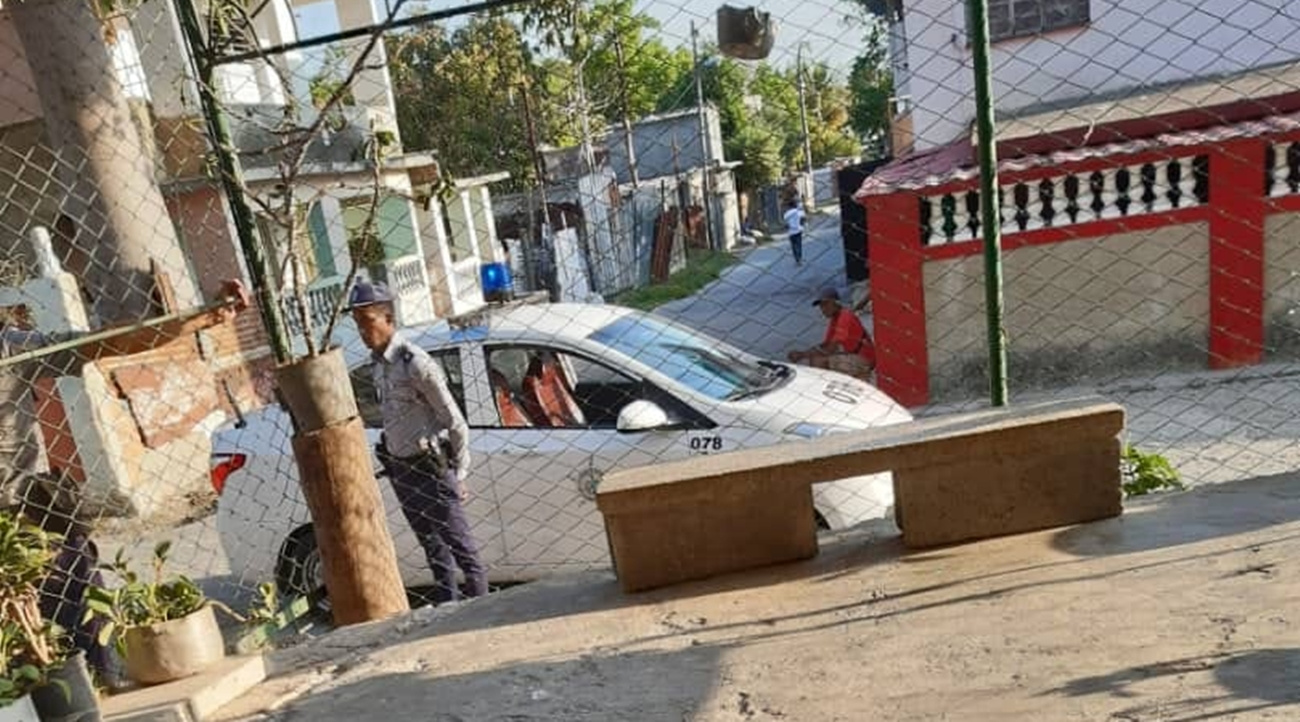
Former Cuban Agent Arrested in the United States for Fraudulently Obtaining Residence

The identity of the former official has not yet been revealed, but it is known that his arrest is administrative, not criminal.

Image of the arrest of the former Cuban official released by US authorities / HSI

14ymedio bigger14ymedio, Madrid, 13 March 2025 –The US authorities arrested on Wednesday a former Cuban intelligence agent who allegedly obtained his residence (green card) in the United States fraudulently, according to the delegation in Miami of the Department of Homeland Security Investigations (HSI). The name of the detainee has not been provided, although an image has been released in which he is seen from behind at the time of the arrest.

“This morning, ICE, HSI and the FBI made an administrative arrest on a former member of Cuban intelligence for fraudulently obtaining his legal permanent resident status,” the institution said through its account in X.

“HSI and its partners will continue their efforts to identify and arrest people who represent a threat to our national security”

“HSI and its partners will continue their efforts to identify and arrest people who pose a threat to our national security,” the text concludes.

The arrest took place in Broward County, in a neighborhood near Weston, sources from the United States Immigration and Customs Enforcement (ICE) told the independent Cuban media CaféFuerte. According to this testimony, the identity of the detainee will be revealed this Thursday. continue reading

“It is important to note that this is an administrative arrest and that the arrested person will be subjected to a legal process to determine if there were irregularities in his case,” the source added. This individual resided with a green card allegedly obtained illegally, but there are no other charges against him.

Among the hundreds of reactions to the HSI post, that of the Republican Congressman of Cuban origin Carlos Giménez stands out, who applauded the measure. “There are hundreds of agents of the murderous Castro dictatorship who now live in our community of victims and survivors who fled the regime. These thugs must be arrested and deported for violating our laws!” he said, and thanked the US security forces for spreading the news and not letting it go unnoticed.

Many other comments were from Cubans and migrants from other countries such as Venezuela or Nicaragua who provided images, names and data of possible repressors who reside in the United States.

Many other comments were from Cubans and migrants from other countries such as Venezuela or Nicaragua who provided images, names and data of possible repressors residing in the United States

During the past year, the independent press and the Foundation for Human Rights in Cuba reported numerous cases of former regime officials who arrived in the United States in 2024 or earlier. Among them is
was Judge Melody González Pedraza, who arrived at Tampa Airport with a Humanitarian Parole Order, although in this case the airport authorities immediately denied her entry into the country, at which time she decided to request political asylum. The official, who is on the Foundation’s “list of repressors,” is now detained, pending a decision by the US authorities.

Other cases include former prosecutor Rosabel Roca Sampedro, who pronounced sentences against demonstrators on 11 July 2021; the president of the Municipal Assembly of Popular Power on the Island of Youth between 2019 and 2022, Liván Fuentes Álvarez, to whom the immigration authorities denied entry by revoking the Humanitarian Parole that was granted to him; and Manuel Menéndez Castellanos, former first secretary of the Communist Party in Cienfuegos, formerly part of the “Coordination and Support Team of Commander-in-Chief Fidel Castro.”

Translated by Regina Anavy

____________

COLLABORATE WITH OUR WORK: The 14ymedio team is committed to practicing serious journalism that reflects Cuba’s reality in all its depth. Thank you for joining us on this long journey. We invite you to continue supporting us by becoming a member of 14ymedio now. Together we can continue transforming journalism in Cuba.

After ‘Destabilizing Several African Countries’ Mike Hammer Seeks To Do the Same in Cuba

Official websites accuse the head of the US Embassy of “organizing subversive activity” in his meetings with the opposition and religious leaders.

Mike Hammer during his visit to the Virgin of Charity of El Cobre last February / Capture / X

14ymedio bigger14ymedio, Madrid, 12 March 2025 — When Mike Hammer, the US envoy in Cuba, replaced Benjamin Ziff in November 2024, the official press ignored the news. Career diplomat, with more than 35 years of experience in Africa and Latin America, his instructions were to be cautious. That arrangement blew up in December, when Washington’s top representative on the Island began a round of visits to opponents. That was the first collision, and the second one came this week.

On that occasion, an article in Razones de Cuba, taken up by Cubadebate, regretted Hammer’s meeting with opponents Berta Soler and Martha Beatriz Roque, described as “two worn out figures of the Cuban counterrevolution.” The report mentioned other previous meetings of US politicians with dissidents to plan the regime’s “overthrow.” “The new United States representative has gone down the wrong path, because nothing good can come from that threat,” it warned.

Far from stopping, Hammer’s agenda has continued, and the regime has played hardball again. This Tuesday, Cubadebate once again echoed another text from Razones de Cuba entitled “Weaving the Anti-Cuban network: Hammer’s Agenda.” It now says that Hammer’s hyperactive agenda is “a shameless step back to the time when counterrevolutionary groups were promoted from the United States.” continue reading

Hammer’s hyperactive agenda is “a shameless step back to the time when counterrevolutionary groups were promoted from the United States”

The text reviews the trajectory of the diplomat, saying he was very active in Africa, among other reasons for having facilitated the end of the conflict in Ethiopia and attempting to pacify Sudan. From the regime’s point of view, his interventions have served to destabilize the continent, and it accuses him of hiding crimes against humanity and promoting the start of the Sudanese civil war.

As for his presence in Cuba, the media criticizes Hammer for having his first meeting with the ambassador of the Czech Republic on the Island, a country they consider a promoter of actions against Cuba from the European Union (EU). Other meetings that have bothered the regime are Hammer’s meeting with the head of the US Southern Command, which “confirms the activation of a much more active and visible big-stick policy,” and the visit to the offices of Radio and TV Martí, financed by the Government it represents.

The three meetings, the article underlines, indicate the three axes of interest to Washington: “political parties,” including the religious element, support for “regime-change operatives from civil society movements” and “the alternative press media.”

In the field of the divine, the regime has another reproach: Hammer’s visit to the Basilica of the Virgin of Charity of El Cobre “for the symbolism that she entails.” There is no reason, they insist, that Cuba should be on the US list of countries that violate religious freedom, and the proof is that the institutions themselves reject it. There is no lack of reason here in the argument: religion is free as long as it is subject to the Revolution.

The list of Hammer’s meetings that bother the regime is very extensive. The diplomat has engaged in an intense activity, promoted on social networks with the open intention of showing his support. Not a single one seems to save him from the criticisms. There is José Daniel Ferrer, whom he met at his home in Santiago de Cuba two weeks after his release from prison, and whose organization, the Patriotic Union of Cuba, is “discredited within Cuban society,” but surviving “thanks to those direct financings” to make believe that there is “organized and active opposition.”

Félix Navarro and Oscar Elías Biscet are others who are wronged by the official media and, by extension, the group of the 75 of the Black Spring, whom the text describes as “mercenaries who were denounced and prosecuted in 2003 for maintaining collaboration with the US secret services and terrorist groups based in Miami.”

The group of 75 of the Black Spring are described as “mercenaries who were denounced and prosecuted in 2003 for maintaining collaboration with the US secret services and terrorist groups based in Miami”

The same treatment is dispensed to the Ladies in White, who are labeled a movement that tries to emulate the Mothers of the Plaza de Mayo [in Argentina] “when in Cuba they are neither tortured nor murdered.” It is particularly annoying – judging by the article – that they wear a color “associated with peace and purity,” as became clear when Sonia Álvarez, wife of Félix Navarro and mother of the political prisoner Sayli, was forbidden to visit her daughter in prison dressed in white. The article continues with particular cynicism about the group of women: “When they are prepared [to march], they say ’Cameras, action!’ and, coincidentally, CNN, EFE and other ’free media’ are there.”

Finally, the article dedicates a large section to the exiles installed in Madrid, “another of his favorites.” Hammer, who visited the Spanish capital in mid-February, had a meeting in which there were, among others, Yanelis Núñez, from the feminist platform Alas Tensas; Iliana Hernández and Luz Escobar, independent journalists; and Angélica Garrido, former political prisoner.

For all of them, another unfriendly definition is used: “new generation of ’change operatives’.” In addition, the text takes advantage of the recent cut in funds from the Agency for International Development (Usaid) and the National Foundation for Democracy (NED) that has put many of these projects in check, and it rejoices in calling them “’freely dependent’ on US government subsidies.”

Magdiel Jorge Castro, “expelled from Bolivia for violating the laws of the Andean country due to subversive activities” is also on the list, as are Amelia Calzadilla, “a media figure who intended to represent the alleged struggle of a Cuban mother and shortly after posting went to pieces,” and Anet Hernández, “activist of the intellectuals,” all of them supposedly led by Carolina Barrero, who has no qualifiers.

“Mike Hammer advances with his agenda under the spotlight of American diplomacy, as if the script of the Cold War had found a new protagonist,” the article continues, “but he will not manage to twist the course assumed by a people who, despite the pressures, continue to resist, immersed in the construction of a socialist project and a sovereign society.”

Translated by Regina Anavy

____________

COLLABORATE WITH OUR WORK: The 14ymedio team is committed to practicing serious journalism that reflects Cuba’s reality in all its depth. Thank you for joining us on this long journey. We invite you to continue supporting us by becoming a member of 14ymedio now. Together we can continue transforming journalism in Cuba.