File 444: New Proof of My Innocence / Angel Santiesteban

Cuban police, according to the TV series “Patrol 444.”

The accusations against me began a few months after I opened my blog, The Children Nobody Wanted. And when the National Union of Writers and Artists of Cuba (UNEAC) informed State Security that they were handling an invitation for me to attend the Festival of the Word in Puerto Rico, I was immediately summoned to the police station to impose on me a bond of 1,000 pesos, to prevent me from participating in that cultural activity. I remember that while I refused to make the payment, a Major who casually answered to the name Kenia — like my accuser — picked up the telephone to call Miguel Barnet, the President of UNEAC, so he would help convince me to pay, and make me give way before my defiant attitude of preferring to be in prison.

I had been accompanied by a writer friend, a brother, one of those whom life presents and who suffers for you more or as much as those who were born from the uterus of my mother. With the best intention, he pleaded that I accept payment of the bond before the threat of being sent to the cell. Finally I accepted that bond months after the accusations, and the file was archived for being considered insufficient, corroborating the constant contradictions of the prosecutor, who was changing statements, enlarging them, taking them away, and lying openly, because that was the way to silence the possibility of being denounced from abroad.

Years later, precisely during those days of the Festival of the Book in Havana, I approached the bank to collect the bond, placed by the one who paid it while I was detained in the police station: The bank denied the payment and sent it to the police station and from there to the prosecution, to discover – as if there weren’t sufficient proofs presented of my innocence – that the ones who imposed the bond, and so took possession of the bureaucratic paperwork, was State Security.

My writer friend had called me alarmed, impressed by the scarce decency and the rough methods used against me. I was punished as a common prisoner, my friend told me, but in the main chamber of State Security’s Provincial Tribunal, in the special venue for distinguished cases of Carmen and Juan Delgado. Now he confirms that the bond was imposed by the “political police”; he said he was impressed. I learned that my case was numbered “444″ like a television serial that is shown these days. My friend is sad. I laugh at such ridicule, such cowardice, and I imagine the day when the truth will come out into the light and unmask the cunning politics. What would they think, those people who support the government or stay silent in order avoid prosecution?

Time and patience, my mother counsels me. Today I oblige her.

Ángel Santiesteban-Prats

Lawton Prison Settlement. February 2014.

 Translated by Regina Anavy

24 February 2014

The Dysfunction of the Racketeering Government / Juan Juan Almeida

Consular services suspended until further notice

If there is something that terrifies me about the Cuban political class, it is the colossal ability they have to manipulate events and invent crises without the slightest decorum, like the pain of separated families, and to employ it as a shield against the United States.

The new show is regrettable, or disguises secondary intentions, through a press note where it’s reported, that the Cuban Interest Section in Washington is obliged to suspend consular services.

With Dantesque ease, agonizing creativity, impressive tranquility and more desires  of common sense, the note refers to the statement published 9 December 2013, which reported on the new deadline given by “M & T Bank” for the conclusion of banking services to the Section and the Cuban Permanent Mission to the United Nations. It fixed 1 March 2014 as the deadline for the closure of the accounts, and the February 14 as the deadline for deposits.

Understandably, following the protocol, the State Department assists the Cuban Interests section to find a new bank to resume their functions, but it is outrageous to learn that the island government rejected the options and with shameless impudence, like someone going for a walk, and they hung a sign on their webpage saying “Consular services are suspended until further notice.”

It may be that, although these banking problems have nothing to do with the half-century dispute, nor with the embargo (or blockade, call it what you like), starting now it stimulates the conflict that besides being premeditated, arouses a kind of structured social alarm for Cuban bigwigs wanting to make into a main priority the fact of feeding these disagreeable inconveniences that this new situation causes Cuban citizens, travelers, users of consular services such as renewing or issuing passports, certifying documents, etc. As well as cultural, scientific, academic, sports and every other kind of exchange between Cuba and the United States.

Clearly it’s annoying, the racketeering government creates law and liberty, and continues making us dance to whatever tune they decide to play; but a bank hold can’t paralyze the consular services of a huge mass of Cuban exiles and immigrants who live in the United States, we need — forgive the repetition — consular services that aren’t only centered in the consulate in Havana or Washington DC.

We live in the era of the Internet, in a globalized world. This Cuban community doesn’t depend on this consulate, it is it and all the officials who depend on us. We should not longer fall into the sophistry of ignoring that Cuba has consulate representatives in Ottawa, Montreal, Toronto, Mexico, Veracruz, Monterrey and around almost the entire planet.

There is not a single reason, then, that obliges me to support the sovereignty of a government that proves it wants to use the Cuban family drama for its own convenience, trying to say it’s politics; far from political, it’s a simple banking breakdown. This text shows my absolute disagreement.

23 February 2014

Castro Logic? Covering up an Injustice by Making it Worse / Angel Santiesteban

Neither the righteous nor the sinners

The settlement where I find myself detained is a fine example of the slave labor that exists in the Castro brothers’ dictatorship.

The prisoners are up at five in the morning, and they keep them going almost until midnight, or perhaps longer, according to the immediate work needed. The food, in addition to being scare, is poorly prepared and sometimes rotten: acid picadillo, raw undercooked chicken and, countless times, stale bread. Eggs, rice and a tasteless, colorless soup is the constant menu.

These prisoners endure the long march because it offers them the possibility of visiting their family every 27 days for 72 hours. They go from one pass to another, moreover enduring bad treatment and the usual blackmail that can make them lose the pass if they don’t complete their work in the time demanded.

In my case, as I don’t collaborate with the reeducation program, my regulation pass for my punishment is for every 70 days. State Security suspended my last passes. They don’t want me immersed in civil society; I represent a great danger. It wasn’t just for the fun of doing it that they constructed my crime.

Really, as I made known to Major Cobas and the rest of the repressors who accompanied him, “You will not be able hurt my ideas in any way.” When I preferred to be taken prisoner rather than emigrate on a boat to Miami, it was because I felt fortified for the experience that awaited me. The worst thing about hired assassins is that their injustice is without limits, and to justify my not leaving, they have withheld the pass from these ruined hands that remain captive, without carrying about the extreme submission, that they accept full-time.

To cover up the injustice committed against me, they have made it greater. I would have to decipher the true intention they pursue; perhaps it’s to provoke criticism of me by those prisoners and at some moment generate some retaliation upon seeing me at fault for their punishments. I remain alone awaiting their reactions. The dictatorship observes. They are interested only in maintaining power for the dynastic clan of the Castro brothers. What’s certain is that nothing provokes me to break. Their abuses redouble my resolve.

Ángel Santiesteban-Prats

Lawton Prison Settlement, February 2014

Please follow the link to sign the petition to have Angel Santiesteban declared a prisoner of conscience by Amnesty International.

Translated by Regina Anavy

7 February 2014

“Intellectuals in Defense of Humanity” Annoy Families of Cubans Working in Venezuela / Luis Felip Rojas

As the world shouts itself hoarse over what’s happening in Venezuela, the Cuban Network of Intellectuals, Artists and Social Movements in Defense of Humanity assures us that this is nothing more than a ruse of the “fascist right” and they’ve launched a tirade in very bad taste from the site “Segunda cita” (Second Quote), belonging to singer-songwriter Silvio Rodríguez (the worst taste yet).

Making it all worse is that this Network (hopefully not of the Wasps*) totally ignores mothers, daughters, sisters, loved ones, gossipy neighbors and relatives of another ilk who are in suspense for their loved ones in Venezuela. The brave and harmless Cuban workers (for example doctors or the sports instructors of the “Blas Roca” contingent) are trapped in the midst of violence and despair because they’ve been momentarily caught in their flip-flops between Caracaibo and Corralillo, or in the flow of laptop parts between the state of Lara and the town of Majibacoa, in Las Tunas. Their families in Cuban are screaming blue murder and now these intellectuals have come to “fuck it all up,” as a young Guantanameran has written to her boyfriend working as a nurse in Caracas.

“Finally, we call on international solidarity to squelch any attempt to impose violence in a country which is advancing firmly toward a society of justice, equality and peace,” concludes this letter from the “professionals of simulation**”, among whom are poets fighting for their literary event, historians praying to God not to take away their European fellowships, and musicians who aspire to give a concert in the hills of Caracas to put a sound track to the fists of the National Guard and the truncheons wielded by the brave boys of the Bolivarian National Intelligence Service (SEBIN).

Translator’s notes:
*A reference to the Wasp Network of Cuban spies stationed in the United States.
** A sarcastic reference to those who “simulate”… or pretend to believe… so as not to lose their perks.

22 February 2014

The Day Fidel Castro Eliminated Private Businesses / Baldomero Vasquez Soto

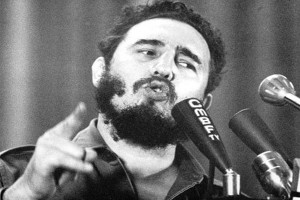
On 13 March 1968, on the steps of the University of Havana, Fidel Castro delivered a speech where he announced the so-called “Revolutionary Offensive” stage, a speech that we consider — from the ideological point of view — as the most important among his countless speeches.

In retrospect, that date represented the final lift-off of the tragic journey, with no return tickets. which would lead the Cuban people to socialist totalitarianism, toward the hell of misery and repression in which we are still living today. For decades, until today, we would also feel the catastrophic consequences on the Cuban economy of the measures announced and implemented by Castro, which swept away the productive fabric of the small urban businesses of the country.

The Commander in Chief announced, to the leaders of the Communist Party, of the Committees for the Defense of the Revolution, student leaders, the unions, and the Women’s Federation, that the time had come: “this moment is one for embarking on an all-out, powerful, Revolutionary Offensive.” continue reading

Leaving aside the previous manipulations and deceits, where he swore he wasn’t a Communist, he knew he could reveal the intentions that always his between his bushy beard because he already controlled, the press, radio, television, unions, universities and all the other institutions of the country, aside from the Armed Forces.

The objective of the Offensive was to built socialism, communism in Cuba; and to do this, he said, “Capitalism his to be uprooted.”

What the dictator had in mind, he said without mincing words: “It must be said that there will be no future in this nation for private business, the self-employed, private industry, or anything.”

What he proposed, then, was to remove the entire small private commercial sector left on the island, since the large and medium enterprises had always been expropriated. He would confiscate all the small urban businesses and they would become state property, and he would turn the business owners into state employees, or his, which is all the same.

To discredit the office of the small businesses, and expropriate them, Castro classified commercial activity as unproductive and parasitical. He said:

“There still remains among us a real scum of privileged persons, who live on the work of the others and who live considerably better then the rest. They are drones in perfect physical condition who put up a stand or open a small place and earn 50 pesos per day…if people were to ask what kind of revolution is this that allows these groups of parasites.”

The Revolution against the bars

Posing as a moralist, as a good Communist, Fidel Castro justified the guillotine that he applied to small businesses, based on surveys of the Communist Party about the bars of Havana and about small businesses in general.

We quote verbatim for the unbelievers:

“We see incredible things … there still remain in Havana… 955 private bars making money hand over fist and selling everything.”

And the figure is stressed with the histrionics that he always performed: “Nine hundred and fifty-five bars!”

The “investigation” of the bars inquired about data such as gross revenues and profits (55% had insignificant earnings of 25 pesos a day), Revolutionary attitude (72% didn’t support the Revolution, hence Castro’s interest in ruining them) and the type of clientele that frequented these businesses (which was classified derisively as antisocials). Based on this information, the study recommended that “the bars should be operated or closed.”

The Revolution against all businesses

The survey of the Communist Party of the small businesses in Havana yielded data about the legality and hygienic conditions of the businesses, but also about their owners: how many asked permission to leave the country and how many ran their companies directly.

The data did not support the savage expropriation carried out against all businesses: 72% were legally constituted, 50% had good hygienic conditions, only 5.8% of the owners had asked for permission to leave the country and 88% of the owners worked in their businesses. But, none of this mattered because Cuba’s owner made his decision. He expressed it with the following phrase:

Gentlemen, we did not make a revolution here to establish the right to do business! … When will they completely understand that this is the revolution of the socialists? That this is the revolution of the communists?

The fatal “Cuban March” of ’68

So, to do away with the “privileged,” “parasites” and “lazy,” in March of 1968 Castro attacked small private businesses, to confiscate them all:

“There were 55,636 small businesses, many operated by one or two people. Among them 11,878 grocery stores (bodegas), 3,130 butchers, 3,198 bars, 8,101 food establishments (restaurants, friterías, cafeterias, etc), 6,653 laundries, 3,643 barbers, 1,188 shoe repairs, 4,544 auto mechanics, 1,598 artisans, 3,345 carpenters.” [Source]

This commercial raid has been the principal cause of the impoverishment that Cuban people are suffering even today, and not the embargo by the American imperialists, as the Castro propaganda manipulated in his complaint the UN since 1992, and which had echoed through the Left throughout the world.

Cuban Script in Venezuela: War on private companies

Agnes Heller reminds us that “history, for good or ill, is a learning process.” We learn from the ill-starred experience of Cuban socialism and recognize the importance of the private sector to generate employment, income, goods and services that improve the standard of living of the population. We don’t cultivate our anti-merchant prejudices, product of nationalized oil, because we play the socialist government’s game of war against the businesses. We must openly defend private enterprise to stop Venezuela from being turned into a socialist hell like that the bearded dinosaur established in Cuba.

Heller suffered Communism in Hungary. Given our circumstances, I conclude with some guiding words of this author:

“When the majority of the population choose these strategic options (like socialism) they have not had any personal experience with them, and later they no longer have the slightest possibility of changing their mind.”

Cubanet, 19 February 2014,

Opponents’ Attorney Can’t Practice / Lilianne Ruiz

Abogada-Amelia-Rodríguez-Cala_foto-Jorge-Ignacio-Pérez-300x200
Attorney Amelia Rodríguez Cala in Miami, July 2013, photo by Jorge Ignacio Pérez

HAVANA, Cuba – The attorney Amelia Rodríguez Cala, hired by Gorki Águila to conduct his defense — in a trial against him still unscheduled since it was postponed on 11 February — has been suddenly sanctioned to six months without the ability to practice her profession in court. For this reason, the singer of the punk band Porno para Ricardo will have to find another attorney to represent him.

Although Cubanet could not obtain statements from Rodríguez Cala, this information was provided first by Marta Beatriz Roque Cabello and confirmed by Gorki Águila and Berta Soler, leader of the Ladies in White, who told this paper she had hired Rodríguez Cala on 27 January to represent her before the courts of the Department of State Security, responsible for looking that organization’s headquarters on 3 January, a judicial action without precedent since 1959, according to Soler.

She also said that her attorney had taken her investigation to the Picota police station where they had taken the various items stolen from the headquarters that day at 5:30 in the morning, but there they told her everything was in the hands of Villa Marista, main interrogation headquarters of the Cuban political police. continue reading

The labor sanction against Rodríguez Cala also left incomplete the process initiated by Marta Beatriz Roque Cabello to ask the court to revoke her parole or immediately cease the physical and psychological attacks, the siege and the police cordon that surrounds her own house and that flares up every Wednesday to prevent her meeting with Network of Community Communicators, over which Roque Cabello presides. The answer of the Court, so far, as been that it “has no evidence” to proceed.

Roque Cabello says that the attorney Rodríguez Cala has defended her since 1997, and she especially remembers the time before the trial began that would once again send her to prison in March of 2003, when the attorney for the defense hugged her, visibly moved, to tell her that they hadn’t even allowed her to see the file against her.

During the 3 days that the so-called Black Spring trial lasted, Rodríguez Cala defended 25 of the 75 accused. In total, she has defended 150 dissidents in her career.

Gorki Águila, meanwhile, faces a trial still without a date and now without an attorney, where he would submit the complete documentation stamped by the Notary Registry of the Mexican Department of the Interior and the Cuban Consulate in that country, which proves that he takes the two Tradea pills that the police found in his backpack on prescription.

The prosecutor — because of the police complaint — seeks to try Águila for “production, sale, demand, trafficking, distribution, having illegal drugs, narcotics, psychotropics and other similar effects.”

In Section 191, subsection C, under which they want to condemn him, reads: “The mere possession of narcotic drugs, psychotropic substances and other similar effects without due authorization or prescription, is punished: -C) with privation of liberty of three months to a year, or a fine of one hundred to three hundred shares* (…)”

According to Águila, Rodríguez Cala showed she was sure of being able to free him from prison, thanks to the documents proving his innocence.

Gorki Águila shows his documents. Photo by author.

Because of the summary nature of the trial against Águila doesn’t allow the defense to produce proofs until the moment of the trial. Numerous of the singer’s friends on the social networks remain alert and have opened the website: La Libertad de Gorki es la de tod@s! [Gorki’s freedom is everyone’s].

Finally, Rodríguez Cala also was the writer of Review Appeal document for Angel Santiesteban. The award-winning Cuban writer being held at military forced-labor center in Havana. On 28 February he will have been in prison for a year. The document intends to demonstrate that his trial was spurious, without due process, in which the defendant was defenseless.

The Minister of Justice has not responded regarding whether he will order the promotion of the Review Appeal initiated by Cala Rodríguez

As of now and for six months, the attorney has been demoted, with a much lower salary than she had as a professional, to a technical position (which in practice is carried out by an associate), fetching and carrying papers for other attorneys, in a Legal Collective in La Lisa Municipality.

*Translator’s note: The Cuban legal system establishes fines as “shares” so that the actual amounts can be administratively adjusted over time without having to change the underlying laws.

22 February 2014

The Internet Isn’t Eaten, But it Feeds / Agusto Cesar San Martin

HAVANA, Cuba – In the first half of the year the ironic character of the restoration of some of the people’s rights will be perfected with Internet for cellphones. Cubans will have access to the network from our cells, in proportions equal to the costs of unattainable hotels, real estate and cars.

The government announcedthat the cost of activating the service will cost 5.40 CUC. The cost exceeds the 4.50 CUC Cubans have topay for the same concept to connect to the Internet in one of the navigation rooms.

In its 54th edition of 11 November 2013, the Official Gazette of the Republic of Cuba established official service prices. Every Kb downloaded will cost 0.0005 CUC, which is 5,000 CUC (125,000 Cuban pesos, more than $5,000 USD) per gigabyte.

El servicio que ofrecerá la única Empresa de Telecomunicaciones de Cuba (ETECSA), no solo inspira en los cubanos la crítica negativa de los precios. Existen dudas sobre la afirmación oficial de que el servicio multiplicara el ancho de banda y alcanzara velocidades semejantes al resto del mundo. La desconfianza de un servicio óptimo se sustenta en la tecnología GPRS instalada en el país que ajusta la capacidad hasta 2 Mb.Un ex funcionario de ETECSA, que solicitó omitir su nombre y profesión, explicó al

The service offered by Cuba’s only Telecommunications Company (ETECSA), not only inspires negative critiques of the prices. There are doubts about the official statement that the bandwidth and speeds will match those of the rest of the world. The lack of confidence in an optimal service is based on the GPRS technology installed in the country that adjusts the capacity up to 2 Mb.

An ex ETECSA officia, who asked me not to mention his name explained, “If you have 2 Mb in optimal conditions (which he clarified there never are) and three people connect with you to the GPRS, and you divide 2 MB by 4, you have 500 Kb.  A low bandwidth because what the towers permit is very limited.”

“You have a 4G phone in Cuba and the most you can get is 2 Mb because the cellphone transmission system is GPRS,” he adds. To the specialist, the service announced is not only limited, it’s one more highway robbery of the user.

“In Italy the LTE norm of 100 Mb costs a flat fee of 30 euros. At that price you can download whatever you want simultaneously,” and he added. “To install LTE in Cuba, they have to change the antennas, the base radio, the central…”

Terrifying prices

To inquire about rated we talked to ETECSA’s office of commercial information. The official identified as Lucia alleged she had no information about it. For her, the topic is an unknown.

“… We have no information for the user about what is going to happen in the future, nor when it could be (the Internet) for cellphones… Martha, Lucia’s supervisor, explained that there is still no “guidance” to explain to the users about the information offered by the Official Gazette and the Round Table on television.”

ETECSA sources unofficially revealed that the prices announced by the government could be open to discussion. For Cubans to download a page of 1 Mb could cost 5.12 CUC, perhaps a few cents less if it’s HTML, just text. A modest volume of downloads of 10 Mb a month would cost 51.20 CUC (1,280 Cuban pesos).

Robbing the poor

The disinterest and ignorance of people about a service that they can’t afford makes it hard to talk to them about it on the street. In a four of the so-called cellphone clinics visited, those present were unaware of the details published about our new service.

Raul, a sports teacher, referring to the prices announced for cellular Internet, said, “They remove the prohibitions from the legal point of view and establish them from the economic side.”

A Chinese tourist named Kwang, said that in his country there were plans for contracting Internet service on a cellphone. He added that he pays 7 dollars (42 yuan) a month for the service. “I never focus on the kilobytes I download, I just have it,” said the foreigner.

Josvany, 24, who sells TV antennas in the street, explained his interpretation of the prices based on what people are saying in the street. “You put 25 CUC into an account, and in four months you have to recharge it even though you haven’t spent it.” According to the young man the recharges are made from abroad.

With prices so far from people’s reality, the government returns services that have been prohibited for years. The right of Cubans to stay at hotels on the island, to have a cellphone, to sell their property (houses and cars), and the Internet, to mention a few.

In this respect, Osvaldo, an unemployed restaurant worker, summarized in his opinion, that of the people. “They can’t eat cars or the Internet. They have to start lowering the price of food… They (the government) want to fill their pockets with the poverty of the people.”

Cubanet, 20 February 2014 | 

Bureaucratic Absurdities / Fernando Damaso

Photo: Rebeca

Government bureaucrats like to complicate things and, in turn, the lives of citizens. From their privileged positions of power, they do and undo at whim.

With the matter of cooperatives, the form of work preferred by the State for the self-employed, they have formed a terrible entanglement: they began with the so-called agricultural cooperatives of different types, and when they decided to leave the rural framework, they found no better name for the new ones than non-agricultural cooperatives.  They even now have their abbreviation: CNoA. Why not call them simply cooperatives?

Another spawn is the first denominated Wholesale Market of Agricultural Supply Products the Wheat Field, located somewhat distant from the center of the city, with the inconveniences that that entails. In reality it is no more than a simple Hub Market since its structure lacks the adequate spatial arrangement for buying and selling, besides which supply and demand do not work there: you pay the same per pound if you buy 20 or if you buy 200.

Before the Chinese merchants sold cheaper than the Spanish and Cuban grocers, because they formed a group and bought in bulk at lower prices, which permitted them to give discounts to their clients. The advantage of a wholesale market is precisely that of offering a variety of products at lower prices than in the retail market, depending on the volume of the purchase.

This is what permits the retail merchants, after deducting their expenses, from not having to raise their prices for the consumer in order to earn profits.  A question: Why not equip the old central Mercado Unico on Cristina Street, today in a state of abandon, as the Wholesale Market?

Another: Why in the state businesses, given beneficially to individuals, is all the attention of the supervisors from the Integral Management Oversight (DIS) centered in each territory? When they were state-run, in spite of their poor functionality, they were never controlled with regards to comfort, the presence of workers, hygiene, quality of services and their offers, as well as other aspects.

Now, like inquisitors, they fall on the individuals, handing out fines right and left, with fees of 1200, 700 and 200 pesos, and, if they think there is a recurrence, withdrawing the license. No one suggests that they not control and ensure compliance with established regulations, although these are exaggerated and sometimes even absurd, but it has to be the same for everyone, both individual as well as state businesses. Or is it that the state businesses enjoy carte blanche?

If you want the updating, although slow and limited, to introduce some small improvement in the difficult lives of the citizens, you have to, at least, eliminate the bureaucratic absurdities.

Translated by mlk.

22 February 2014

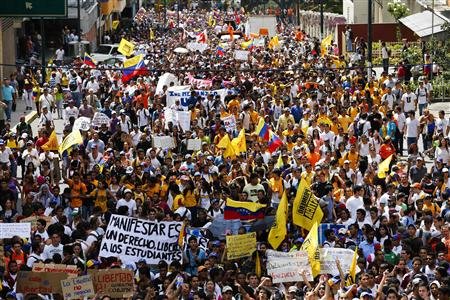
Opposition Protests in Venezuela Worry Not A Few Ordinary Cubans / Ivan Garcia

Source: uknews.yahoo.com
Protests in Venezuela.Source: uknews.yahoo.com

One way or another, the street protests taking place recently in Venezuela are being noticed in Cuba.  The most nervous are the olive green autocrats.

According to a low-ranking party official, since the death of Hugo Chavez, the regime has had several contingency plans in its drawer, in case the situation in Venezuela were not favorable to the interests of the Island.

“If Maduro falls there exists a plan B.  In the corridors, at least at the level where I work, it was assumed that Maduro might be a president with a fleeting career. Although the PSUV (United Socialist Party of Venezuela) has controlled a large number of the threads of power, there are divergent opinions among the Chavez followers themselves about the relationship of their country with Cuba.  This kind of socialism, with democratic streaks, is not reliable.  Maduro might lose power either by a recall referendum or within six years.  In meetings of our nucleus it is commented that Maduro’s term in office only serves to buy time,” the official notes.

The earthquake of marches, barricades and opposition protests shocks different regions of Venezuela, but the epicenter shakes the corridors of power in Cuba.

The Castro brothers risk a lot in Caracas.  Just in case, Raul Castro opened a window to Brazil in the new Mariel Port and Special Development Zone with a different jurisdiction.

And he almost begs the United States, his number one enemy, to sit down and negotiate.  Meanwhile, the Castro diplomacy travels Florida, trying to seduce the wealthiest businessmen of Cuban origin.  Although sensible businessmen would keep thinking.  When they look at the recent past, they only see shady dealings and a cryptic partner who at the first exchange transforms the rules of the game. Therefore, the Caribbean autocracy is going to have to fight dog-faced and with gritted teeth its strategic position in Venezuela.

The key, you know, is oil.  100 thousand barrels daily acquired at a bargain price so that Cubans do not suffer outages 12 hours a day.  When the paratrooper of Barinas (Hugo Chavez) arrived at Miraflores in 1998, Fidel Castro understood that after nine years of crossing through the desert, with finances in the red and exotic illnesses devastating the country, the hour of his resurrection had arrived.

Cuba entered the light phase of the Special Period.  After the fall of the Berlin Wall, the country continued in a fixed economic crisis, but the loyal Bolivarian shared his strongbox.  And it was an important piece of the anti-imperialist project that so excited the commander.

The death of Chavez was the beginning of the end of the honeymoon.  Maduro is loyal and is allowed to drive.  But he does not have charisma.  And after 14 years of foolish economics in pursuit of gaining followers among the most disadvantaged, the debts, violence and inflation have exploded in the face of the PSUV.

Maduro, stubborn and awkward, instead of releasing the uncomfortable and parasitic ballast of Cuba, to govern for all and look more to Lula and Dilma than to the Castros, moved his pieces incorrectly.

He tried to continue the Joropo and the booze party of comrade Chavez.  He designed a simple strategy: he shouldered his comrade’s coffin and tries to govern in his name.

And it is failing. In Cuba, because of selfishness or a short term mentality, the ordinary people, tired from 55 years of disasters, cross their fingers and hope that the Venezuelan crisis does not close the oil spigot opened by PDVSA (Venezuela’s state-owned oil and gas company).

In a park in the Havana neighborhood of Vibora, several retired people opine about the situation in Venezuela.  “If that is screwed, what happens to us is going to be huge.  The blackouts will return, industry will be paralyzed again and we will return to a phase the same as or worse than the beginning of the Special Period in 1990,” says a man of about 70 years of age.

Others are less pessimistic. “It’s true, it will be hard. Since the revolution triuimphed we have been accustomed to living at the expense of foreign sweat. Before it was the USSR, now Venezuela.  If the worst happens there, here reforms will accelerate.  Although this is already capitalism, but with low salaries,” points out a woman who identifies herself as a housewife.

A university student adds to the conversation. “Seeing the marches or strikes on television is something that I envy. That freedom of protesting in front of the governmental institutions, as in Ukraine or Venezuela, we need it in Cuba.” And he adds that “in the meetings of the FEU (Federated University Students), the situation in Venezuela is a top priority topic, but I have heard rumors that in some Party cores the alarm is greater.”

In this warm February, in spite of the news that arrives from Caracas, the ordinary people continue on their own. Standing in long lines to buy potatoes that have disappeared. Going to farmer’s markets in search of other tubers, vegetables and fruits. Or sitting down at the neighborhood corner to talk about movies, fashion, soccer or baseball.

And so it is that for many on the Island, Venezuela is not on their agenda.

Diario de Cuba, 23 February 2014, Ivan Garcia, Havana

Translated by mlk.

“No One Treats Me Like a Prostitute” / Lilianne Ruiz

From the series “Outside the hotel,” Photo by Luz Escobar

HAVANA, Cuba – Yazmín doesn’t do the street. Nor does she acknowledge exercising the oldest profession in the world. She navigates the Internet for 10 CUC an hour, in some Havana hotel with this service. She visits websites to find a partner: cibercupido.com, mejoramor.com, and,among others, the Cuban website revolico.com, in the Jobs section.

The first step was to fill out her profile in those sites and describe it for the gentlemen who seek, on those sites, their desires. Nothing profound. She has added photos, which I am not showing here for reasons of safety; in one she is portrayed semi-crouched, from the back, leaning forward and turning her face to the camera the expression of a naive girl. She says she’s had good luck with this.  In the year she received several “friends,” from different countries of residence or origin. They stay together some fifteen days, to get to know each other and be intimate. All of them send her remittances. She has learned to say “I love you” in several languages.

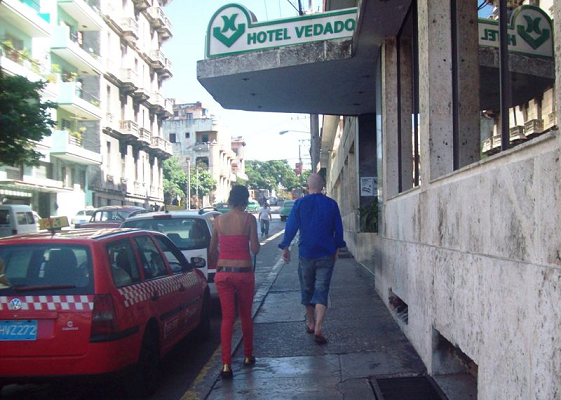
A friend gave her the idea. Before this she wandered El Vedado, Old Havana, and the Playas del Este, indanger of ending up in jail for “besieging tourism” (a crime created to punish behavior like hers).

This new modality feels more agreeable. There’s no mention of money, but everyone knows their role.

Before, for 50 CUC a night, she rented herself out to have safe sex in some variant of the island Kama Sutra. She admits that she was tired and didn’t see the profits. Now, she has a kind of monthly salary and, especially, no one treats her like a hooker. Except when she plays at surprising her companions in the role of streetwalker. Then she feels like an artist. continue reading

After the searches on each site offer candidates with the characteristics she’s asked for, they start conversations through chat. When the man travels to Cuba she prefers to take him to a hotel: because there is no “commission” there.

Yazmín explains that the rental houses cost 25 or 35 CUC (daily), and anyone who brings a foreigner pays 5 CUC, also for each day. If they go to a restaurant the same thing happens. The watchword is to ask the waiter if there’s a commission. (Discretely, so the foreigner is not tipped off.) Then, the waiter offers another menu, a different menu. For every dish they order she gets between 2 and 8 CUC. The seafood is the most expensive. Sometimes she can get 32 CUC just for accepting an invitation to dinner. It’s sure to make everyone happy.

From the series Outside the Hotel 2, photo by Luz Escobar

She still recalls the fate of one of her old colleagues, who she left at a site called “Don Pepe”; a restaurant located in a shack on the beach of Santa Maria del Mar, where she spent the nights. The presence of the girls served to attract clients. All of them are very young. If they manage to catch the attention of a foreigner at a neighboring table, they go to a hotel.

Although Cubans are now allowed to stay in hotels, most of them have to bribe the doormen. They have a criminal record, having been picked up making the rounds of tourist places. If the police repeatedly arrest them without their managing to “clear it up” — paying in cash or “merchandise” — they can end up on a Rehabilitation Farm, or in prison. Yazmín feels sorry for them and seems to have climbed to another level of life.

I ask her if she is saving money to invest in some business for herself, something like a snack bar or beauty salon. She laughs and asks, “Girl, what country are you living in? I don’t get more than enough to live on: buying oil, soap, and eating a little better.”

She wants to know other countries, for sure. And if she could made a good marriage it would be like having a song in her heart. She longer likes Cuban men, because they would want to live with her or there would be “little jealous scenes.” Also, they can’t resolve her problems, she says.

When she brings boyfriends home, they focus on their needs. Also, this tactic gives them confidence. Her parents serve as an alibi, for not seeing her go out at night like she did before. The neighbors don’t reproach her. On the contrary, everyone understands that times are hard.

“What do the yumas [foreigners] look for in Cuban woman? I don’t know. They say we’re hotter. Some have haven’t tried a black girl before,” she says, with a sly grin.

Yasmín didn’t give up her work as a receptionist at a polyclinic. This way she gets rid of the “bad letter” and maintains the coherence of the preconceived script that she has been converted. Also she gets free condoms; this is a custom she’s never given up since having been given a sexually transmitted disease, curable but very embarrassing she says.

After telling me her story, she asks me to change her name. I want to call her Yazmín not to ruin things for her. Also because, at age 32, she hasn’t given up the idea of being a mother some day. But she doesn’t want her children born in Cuban. That reluctance to have kids in her native country isn’t, she says, because she’s not content with her life. Nor is she interested in politics. It’s something, she says, she doesn’t know how to explain.

Cubanet, 11 February 2014, Lilianne Ruiz

On the Need for Censorship in Cuba / Orlando Luis Pardo Lazo

Independent launch of Orlando's book Boring Home
Independent launch of Orlando’s censored book Boring Home

Within Cuba, contrary to what one might think from outside, one comes to miss the presence of censorship. And this isn’t irony, but a strategy of liberation. In more than one sense, censorship doesn’t exist in a tangible way in Cuba. It’s ubiquitous, but unreachable, unaccounted for. It leaves no spaces for anyone or anything, but at the same time it never stops shifting.

Censorship in 21st century post-totalitarian Cuba has learned to morph itself, mutate and resist being recognized as such. Perhaps because of this we must know how to name it and above all to give it shape. If possible, to institutionalize it, take it out of the closet where the Castro regime without Castros has hidden it, the regime that is already announced as state capitalism.

In a country hijacked by the despotism of a single party — the Communists — where since the beginning of the Revolution the press has been the private property of a military elite, in a context where there’s not much left to do that is logical, and where a first step of the absurd might well surprise the authorities. continue reading

It’s about demanding, in this case, public censorship in Cuba, preferably constitutional, To try to at least make censorship visible, in the midst of the secrecy that kills our society: to return censorship to its colonial candor, its republican rigor, its Francoism freshness, its Stalinist stamina, it’s almost more skilled than malicious McCarthyism, reinstating thus the lost prestige of the national functionary who collects a salary for professional exercising the full-time work of censor.

Perhaps it’s the lack of censors who currently maintain our civil society in its sterile state of intellectual indigence.

My experience as a writer censored in Cuba, for example, is already phantasmagoric. Leaving no fingerprints that would be credible to the next generation. My children will have more evidence to call me “coward” or “Castro supporter” than to believe in my three illegal arrests or the censorship of Boring Home, my book of stories taken out of print by the Letras Cubanas publisher in 2009.

And out descendent will be right in the imminent future, because none of my torturers will ever identify me. Like no editor will confront me to censor a single line nor give me an explanation nor written statement of why I was expelled from the Cuban literary field.

No one signed the orders to entirely remove my books from the editorial catalog, and not to allow me to present my books to my colleagues in any cultural institution. Most likely, in fact, is that no one gave such orders. In the absolute order there are no longer any orders nor intentions, just inertia and discipline.

In practice, my denunciations in this respect are already those of an autistic more than those of an artist. The lack of censorship cut my career as a Cuban writer in Cuba off at the roots, however, in exile — this preview of the future — there is no persecuted writer’s grant that fits the ridiculousness of my civic curriculum. Hence, the moral urgency of restoring the concrete role of censor in the Castro regime, at least until we dare to overthrow through other non-verbal violence all of the repressive apparatus.

On the island there is no single Department of Censorship. The official press — the only legal one — still publishes systematic critiques of the Revolution, but there is no one to demand from it such intellectual silence. It’s possible that such critiques don’t reach their editorial offices and that there is, in those offices, a rather Adamic environment.

There are not even bureaucratic rules that define what can or can’t be published on each topic — whether political or pornographic — to be able to give authors the interpretive legal battle. While it is true that in communism it’s not certain that the author exists, long before Barthes and Foucault. But it is precisely this amorphous condition that allow maximum impunity, because now every author is, in principle, the censor of the rest — fractal Fidelism — including self-censorship with which everyone humiliates himself to avoid being humiliated by the collective.

There is no rational exit from the endless mazes, where repression is mimicked at times with a political crime with global repercussions, and others with a local literary prize. Hope is then reduced to absurdity, pure folly. So, to attract bit by bit freedom of expression to the territory of totalitarianism, perhaps they could start by introducing the censorship mechanisms of the democracies themselves. Create blacklists in Cuban as a measure of restraint against the despotic power. Publish our first Index Liborium Prohibitorum — banned book listin the selection of names and topics for which the Catholic hierarchy and the Castro regime could huddle together in other shared trenches.

Afterward, the struggle would be much simpler for free Cubans: reduce to the minimum those civic spaces conceded to censorship — pornography and politics — and gradually enrich the atmosphere that today makes even breathing on the island blackmail.

Diario de Cuba, 16 February 2014, Orlando Luis Pardo Lazo

#FreeGorki – The Gorki Aguila Case / Lia Villares

Gorki Águila. (CLAUDIO FUENTES)

The trial schedules for this Tuesday against Gorki Águila, leader of the punk rock band Porno para Ricardo, was postponed because of the health problems of his defense attorney, according to the musician himself on his Facebook page. Gorki spoke about the background of his case with Diario de Cuba.

 Gorki, what are they accusing you of?

The formal citation they gave me said the crimes of pre-criminal social dangerousness and illegal drug possession, with many points suspended.

Were you carrying drugs?

When they stopped me on the street and searched me and found two Tradea pills — methylphenidate — for which I have the appropriate prescription, signed and sealed, which are strong proof that they were bought legally. The police investigation has no evidence beyond those two pills.

Why are they accusing you?

The classic recourse of the government is to tie the “uncomfortable” individual to some prefabricated crime. In my case they didn’t ahve much more and I thought it unlikely that they’d convict me, if it was a free trial, for the (completely legal) possession of two tables of a medication that I need, according to a doctor’s prescription.

What’s your impression of this new trial and now the suspension of it?

It has the same characteristics of the 2008 trial, the same intentions, because a despotic government like ours never renounces the idea of silencing protestors like me by constant threats of prison, whether we are artists, activists, journalists or simply citizens. continue reading

On the morning of the day before yesterday I learned that the trial had been postponed because of my attorney’s health. It was to have been held on Tuesday, the 11th, but was delayed approximately a week. I thought this surprise, without any definitive date, could be dangerous because State Security could use it as a strategy and take advantage of less media coverage so I’d have a silent trial with weaker visibility.

Meanwhile, the government could create a parallel campaign to discredit me on the social networks, which seems like a recurring error on their part, because the exaggeration of creating false situations against each and everyone who dares to denounce them or express an opinion contrary to its purposes becomes suspect.

Castro never could admit that his opponents could be dignified enemies and have a body of more elevated moral principles; his attitude has always been not to recognize opponents and so to underestimate them, but taking care that they are never respected, rather defamed and in extreme cases imprisoned and even assassinated.

What are your expectations for the trial? Why summary?

I understand that these trials are held in very few countries and almost always in times of war, as an immediate lesson. The summary trials in Cuba are produced serially, with little documentation, that is, they can hold several trials on the same day, at the same time, with the ruling made in advance, where the political police has everything to gain. In this sense the regime takes great advantage of them against the peaceful opponents.

Gorki Águila. (CLAUDIO FUENTES)

In these trials, mostly rigged by State Security — it’s expected that the ruling will go against the accused. So I think it’s extremely important to maintain solidarity among everyone because, as demonstrated in the previous trial in 2008, the more public opinion was moved and the more visibility the case got at the international level, it was possible with everyone to change a decision already decided by the anti-revolutionary injustice, on the  retrograde sense of the Cuban government.

Your case is not isolate…

The government finds in these moments in the practice meant to “neutralize” the various opponents, one of their bad so-called “revolutionary offenses.” This is the case with my friend Manuel Cuesta Morúa, who finds himself under police investigation with absurd charges like “the spread of false news that threatens international peace.”

It’s incredible that someone who threatened the total destruction of the planet earth, could say that a simple opinion or the exercise of free expression could threaten international peace. It’s something as cynical as his persona, someone who dedicated his whole life to launching the false image of “revolutionary and ecologist.”

There was also the case of the independent journalist Calixto Ramón Martínez, who spent long months in prison simply for exposing the spread of the cholera epidemic in the country, work that should have been the job of the national press, which has never mentioned, with sincerity, news that is alarming to the population.

Tell me how it was in 2008…

I was in the dungeon without knowing anything that was going on outside. At a specific time a cop came with the file and told me what I was charged with would be changed. Then the treatment inside the jail mutated tremendously. When they reduced the charges, some official even said that all those who were there were criminals while I was just there for being “anti-Castro.”

That is, they changed the crime of social dangerousness to the crime of disobedience and from then is where I can corroborate the rapid collapse of the armed farce.  When they substituted the charge of one crime for another following no procedures at all, completely lacking in rigor: what’s missing is the Rule of Law. This leaves the usual arbitrariness of the Cuban judicial system completely exposed, where terms like “legal certainty” or “res judicata” are alien to is citizens, frequently defenseless before such procedures.

Then I knew I had a strong international solidarity campaign and within the country all my friends and activists supported me making sure everyone knew about my situation and the false charges I was accused of.

I’m convinced that the only way to transform these previous designs of the tyranny is to realize that uniting in the demand against injustice we can multiply the message that we all need right now, that of freedom for civil Cuban society, in short, freedom for Cuba.

I would like to thank all the people sensitive to my situation who have signed the petition and who are continuing to pay attention to what could happen with respect to this inadmissible case.

Thank you so much! Hopefully this is the year that yes, it falls!

Diario de Cuba, 12 February 2014, Lia Villares