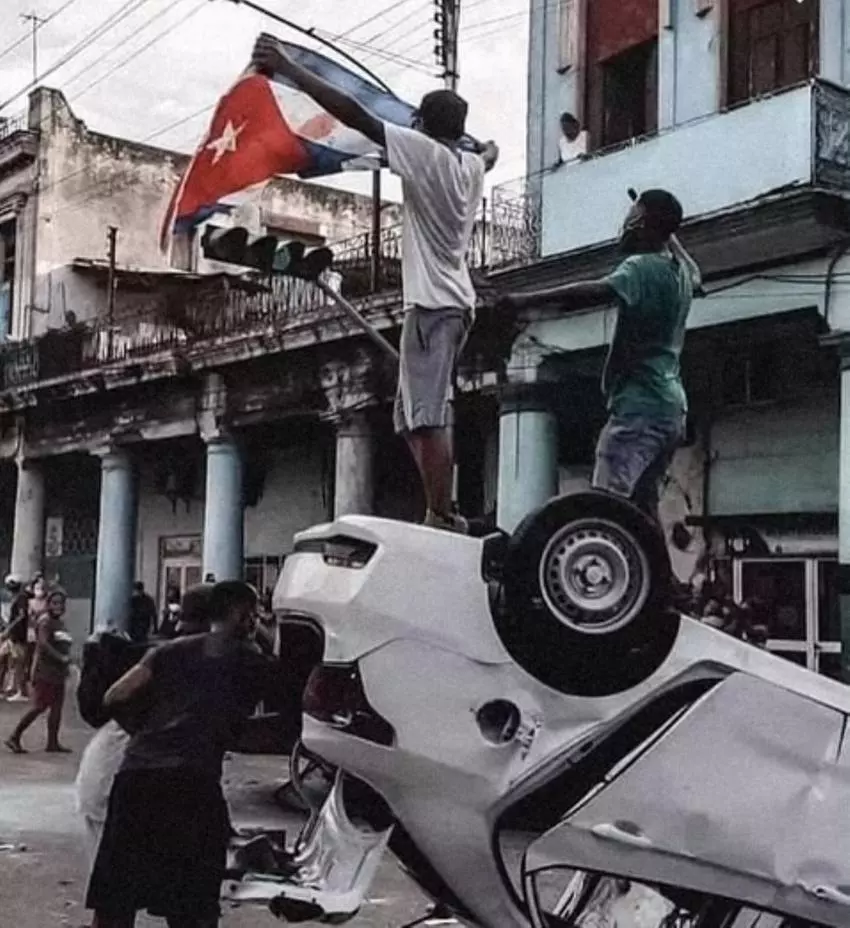
Elías recounts how, at age 16, he came to wave the national flag at the corner of Toyo, standing atop an overturned police patrol car
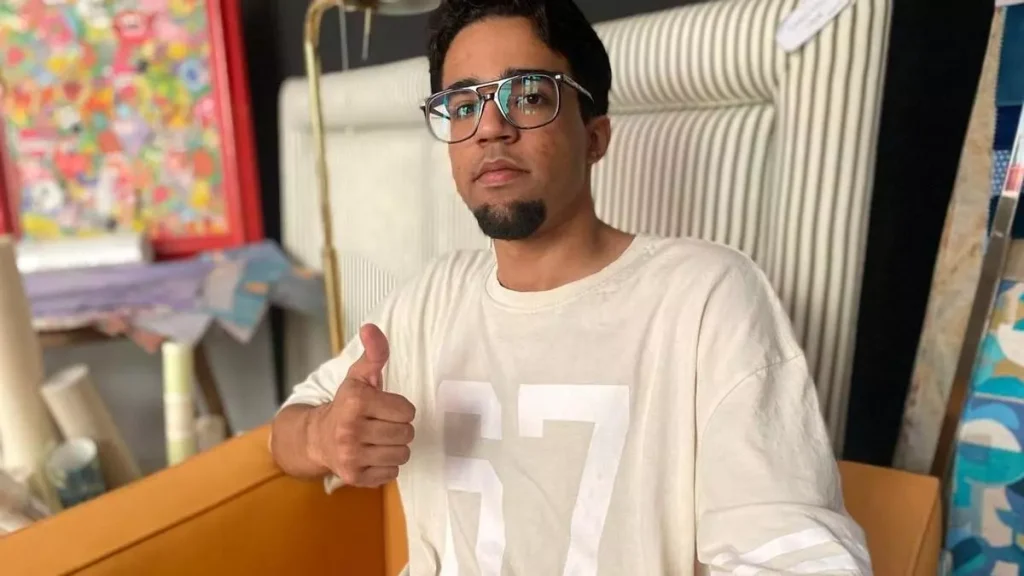
 14ymedio, Luz Escobar, Madrid, July 16, 2026 / Elías Rizo León was just 16 years old on 11 July 2021, but his image -holding the Cuban flag as he stood atop a police patrol car that the crowd had overturned, amid the protest at the corner of Toyo, on Calzada de 10 de Octubre – became one of the most iconic images of that historic day of protest. Five years after that social outburst, and following a clandestine flight that took him through Russia, Serbia, and Greece, Elías now lives in Alicante, awaiting a ruling on his application for international protection. Visiting Madrid to mark the fifth anniversary of July 11, we spoke with him about memory, exile, forced maturity, and the certainty that Cuba’s path to freedom is one with no turning back.
Question: Let’s go back to the day before the outburst. Who were you then? How old were you, what were you doing, and what interested you on July 10?
Answer: The day before July 11 I was just an ordinary kid. I was enjoying my adolescence with my friends, listening to music, going out, meeting up with my friends. I had just turned 16; I had celebrated my birthday only a month and four days earlier, on June 7.
Q: By then you already had a phone with internet access. How did that shape the way you saw the reality of the island?
A: Yes, I already had social media. I got my information through independent Cuban outlets, and once the internet started reaching us, I began researching on my own on websites. I started watching underground documentaries about the erased chapters of Cuban history: the executions, the life of Pedro Luis Boitel, or that of Rolando Cubela, who had been a commander in the Rebel Army. Going through that history, you realized the Revolution had betrayed itself from within. There were Cubans who were patriots, nationalists, and anti-communists, but they were all lumped together under the 26th of July Movement, which in the end turned out to be a lie. That access to information opened my eyes.
Q: Were you aware of the digital campaign that preceded the outburst, the movement under the hashtag #SOSCuba?
A: Yes, I saw it all. The international community and artists began making that hashtag go viral on Twitter to denounce the Covid-19 crisis, the humanitarian collapse, and the repression. What came up most was the collapse of the healthcare system. Seeing popular artists join in was one of the biggest drivers, because ordinary Cubans felt backed up. We thought: “Damn, if these artists are saying it, it’s because something big is happening here.”
Seeing popular artists join in was one of the biggest drivers, because ordinary Cubans felt backed up
Q: On July 11 you decide to go out into the street. What was your initial plan, and where did you end up protesting?
A: My mother showed me the first news of what was happening and I decided to go out. My initial goal was to head to the Malecón or the Plaza de la Revolución, because that’s where the core of Castroist power sits: the Central Committee, the Politburo, the Council of State and of Ministers, and the Ministries of the Interior and of Communications. But when I went out and reached Calzada de 10 de Octubre, I ran into the people in the street and decided to stay there. Thank goodness I did, because I believe Toyo was, of all Cuba, the place where the hand-to-hand confrontation and the repression were most intense. The Cuban people there were genuinely rising up and reclaiming their rights. If I had gone to the Plaza or the Malecón, where there were far more agents, I would have been captured immediately.
Q: In the images from that day you’re seen holding a Cuban flag. Where did that flag come from, and what did it mean to carry it?
A: At protests all over the world, citizens come out with their flag. In Cuba, people manipulated by propaganda believe the flag is a
symbol of the Communist Party, an icon of obedience to the dictatorship, but that’s not so: the flag belongs to all Cubans. I was one of the few civilian protesters carrying one. When the Party cadres showed up to stage the counter-demonstration, they also brought out Cuban flags. That made me furious. But there was a fundamental difference between us: ours had the blood of the wounded protesters on it, and theirs was clean.
But there was a fundamental difference between us: ours had the blood of the wounded protesters on it, and theirs was clean
I had that flag at home, hanging in my room. I had taken it two years earlier from my secondary school. I took advantage of a day when the staff left the entrance desk unattended and made off with it; it was the one used for the morning assembly and the national anthem. When my mother showed me the protests on 11 July, I took it down and hid it under my T-shirt. She was terribly afraid something would happen to me and asked me not to “mark myself,” but in the end I took it with me anyway.
Q: Do you still have that flag?
A: It’s in Cuba. What is no longer preserved is the blood; my mother washed it out of fear and for safety’s sake. I wanted it to keep the blood from that moment so that, in a free Cuba, it could be donated to a museum. Even so, it retains immense historical value.
Q: Many of those who were out in the streets describe a feeling of euphoria, as if the regime had already fallen. Did you feel the same way?
A: We all felt exactly the same thing. We thought it was going to end that very day. Before the outburst, people tended to be very guarded out of fear of informants and State Security; there was a lot of self-censorship. But that day I saw every sector of the population — children, women, men, the elderly — united, demanding one single thing: freedom and an end to the tyranny. It was a single voice, one single voice reverberating. That is true unity, the kind that is born around freedom, not the obedience the Party demands.
It was a single voice, one single voice reverberating. That is true unity, the kind that is born around freedom, not the obedience the Party demands
Q: At what point did you realize you were in real danger?
A: I realized it when we were behind a column on Calzada de 10 de Octubre, near the intersection with Vía Blanca. There the dictatorship set up a repressive cordon with officers from the National Special Brigade (the “black wasps”) and the National Police. They marched against us, set the dogs on us, and started shooting. They fired into the air, but also toward the front. State Security confiscated almost everyone’s phones and deleted the videos of the shooting, but they used the fragments that had already been uploaded online, along with facial recognition, to identify us. Even though I was wearing a cap, a mask, and glasses, they recognized me. Three days later they were already at my house.
Q: What was it like returning home that day, and how did your family manage the fear?
A: On the way back, the people fleeing with me were already scattering. I got home and was completely honest with my parents; I told them everything I had done. I have always believed that with your parents you have to be upfront, because if you stay silent out of fear and the dictatorship comes for you, they won’t have the information they need to respond to the repression.
Things turned very ugly just a few hours after the demonstration. Miguel Díaz-Canel gave the “combat order” at four in the afternoon. We held our ground in the street until six or seven at night, but the protest dissolved as massive repressive forces began to surround us. They were coordinated by radio and walkie-talkies; we only had word of mouth, and they had already cut off our internet. From that first moment, I knew I was marked.
Q: Your mother played a crucial role in deceiving State Security and buying you time to escape. How did she manage it?
A: When the authorities came to my house to question her, I was already hiding somewhere else. They asked her where I was and she told them I had gone outside Havana, to Santiago de Cuba. They wanted her to give them the exact address so they could summon me there, but my mother stood firm and told them: “I’m not giving you any address, because he is 16 years old, he’s a minor, and he needs the legal representation of his guardian.”
She used that same apparent trust the repressive apparatus tries to instill in you to win the agents over. She let them believe she would cooperate and would turn me in as soon as I came back, but it was all a strategy to buy time. On the very day I was supposedly due to report to the police station, I was boarding a plane bound for Russia.
If it hadn’t been for the coordination of the people who supported us inside and outside the island, my story today would be very different
Q: You spent more than a month in hiding inside Cuba before flying out. How do you remember that period?
A: It was a month or so in hiding, living like a fugitive. I even shaved my head to change my appearance; in my passport photo I’m completely bald. At that time I didn’t even have a passport, only my mother did. We had to pay for and rush paperwork at the last minute, in the middle of the bureaucratic paralysis caused by Covid. We had tremendous luck. If it hadn’t been for the coordination of the people who supported us inside and outside the island, my story today would be very different: I would be serving a sentence of somewhere between 15 and 30 years in prison, like so many other young people my age. I would have lost my life in prison for the simple act of asking for freedom.
Q: Your initial destination was Russia, where Cubans didn’t need a visa in 2021. What was the journey like from there to Spain?
A: We flew out of Varadero airport on August 25, 2021. We spent five months in Russia (with his mother, father, and sister). I kept close track of the news and warned my mother: “Russia is going to invade Ukraine, we need to leave before the war breaks out.” She worked her contacts, and in January 2022 we managed to leave for Serbia. From Serbia we crossed into Greece, where we spent two months. Since Greece is part of the Schengen area, we were able to take a direct flight to Madrid. At the airport they just checked our photo to confirm our identity. Once in Madrid, we went to an office and formally applied for political asylum, presenting press clippings, photos, and evidence of the persecution. That’s how we obtained the red asylum card for all four members of the family.
Q: What has it been like interacting with young people your age here in Spain? Do they understand what you went through?
A: Spanish young people my age are stunned when I tell them the reality of Cuba. Many of them, even if they’re not left-wing, have a romanticized or distorted view of the island; they think there are bad things, but that “at least you can get by.” When I explain what happened to me, they put themselves in my shoes, show empathy, and understand the real context, because I’m not speaking to them from ideological theory but from the human and moral suffering of what it means to struggle and be persecuted. Thanks to that, a lot of young people who didn’t used to care about politics now stand up for our cause.
The day I left my country I cried a great deal. I wanted to build my life there; my wish was to live and die in a free Cuba
Q: It’s often said that the great aspiration of Cuban youth today is to emigrate. Was that your goal before July 11?
A: No, I never wanted to leave Cuba. The day I left my country I cried a great deal. I wanted to build my life there; my wish was to live and die in a free Cuba. Forced exile is a banishment that tears away part of your soul, your culture, and your experiences. Activists and rebellious young people are put in a noose by the dictatorship, forcing us out. I know I had to leave to protect my life, but it wasn’t by choice. That’s why exile isn’t surrender, it’s transformation. Out here, you study, you educate yourself, you acquire tools for political communication, and you prepare yourself with greater strength for when the moment comes to return and rebuild the country.
Q: How do you assess the protests and pot-banging demonstrations, smaller but constant, that are happening on the island today?
A: That never used to happen. The dictatorship has driven the people to such an extreme and precarious situation that people already know protesting is the only way to at least get the power turned on or the water restored. Even so, we can’t limit ourselves to demanding basic resources. Those pot-banging protests are sparks of legitimate resistance. The dictatorship is very clever and manipulates language; it asks the people to “endure” the misery, but true political resistance is the kind used to confront and overthrow a totalitarian regime, like the French or Italian Resistance in the Second World War. The ultimate goal has to be the end of the Communist Party’s monopoly on power.
Q: What role does the exile community play at this stage of the struggle?
A: The best way to support Cubans inside the country is to expose the repression to multilateral bodies, to speak with human rights rapporteurs, and to demand the release of political prisoners through diplomatic channels. We also have to fight the media battle. The dictatorship accuses us of waging “cognitive warfare” or “information warfare,” but all we do is expose the truth, backed by evidence, against the Castro-regime propaganda that they fund throughout Europe and Latin America to silence the opposition.
Q: If the situation changes and Cuba becomes a democracy, under what conditions would you return?
A: I would go back, but only if the enforcers, the henchmen, and the senior communist officials are tried before the courts as they should be. I am not going back to negotiate with the enemy. We need to set up truth commissions and preserve official reports and evidence so that no one can hide behind the classic “I was just following orders.” A person of principle cannot be coerced into repressing their own people. The dictatorship must be surrounded and dismantled with the truth, since they survive on lies -because no legend can withstand the truth.
Translated by GH.
______________________
COLLABORATE WITH OUR WORK: The 14ymedio team is committed to practicing serious journalism that reflects Cuba’s reality in all its depth. Thank you for joining us on this long journey. We invite you to continue supporting us by becoming a member of 14ymedio now. Together we can continue transforming journalism in Cuba.