Cubans are expressing skepticism about the new “offensive against illegal activities,” which is contributing to worsening the shortage of basic necessities.
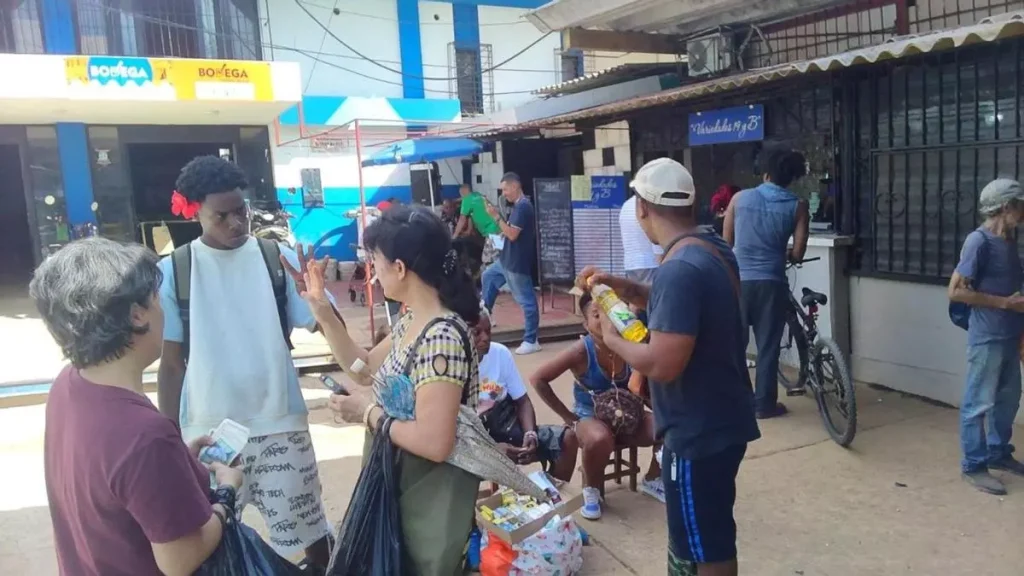
 14ymedio, Havana, August 13, 2026 / The Cuban government’s proposal to eliminate price caps “generally” as part of measures to liberalize the country’s exhausted economy has lasted less than two months. Faced with galloping inflation, the authorities in several provinces have decided to reintroduce controls, in addition to multiplying inspections and fines. Artemisa, Matanzas, and Holguín have gone a step further by imposing a 30% profit margin, as the central government had previously done.
In Artemisa, this latest measure came into effect this Wednesday, the day after a statement was published in the provincial press. The resolution, adopted according to the official statement “in response to the need to strengthen the mechanisms of price controls and contain speculative practices for the benefit of the population,” establishes a “mandatory” 30% profit margin for both wholesalers and retailers.
That percentage, authorities emphasize, “will be applied only once to the total cost of the product.” And they reiterate: “The resolution expressly specifies that no additional profit margin may be added at later stages of the supply chain, in order to eliminate the intermediary network that drives up the final price for the consumer.”
The “exercise,” the official newspaper says, aims to “influence the decrease of speculative prices, promote the use of digital payment channels and the use of any currency denomination in the sales process.”
In Matanzas, not only have restrictions been imposed on the benefits, but since Monday, when an operation began throughout the province, 60 fines have already been imposed for violations of the measure, in addition to the closure of seven establishments. “Among the principal illegalities detected were the lack of certification of scales used for selling products; the absence of contracts with workers; errors on information boards; and non-compliance with reference prices,” the newspaper Girón reported.
The “exercise,” the official newspaper says, aims to “influence the decrease in speculative prices, promote the use of digital payment channels, and the use of any currency denomination in the sales process.” Noel Sánchez Roque, an official in the Matanzas provincial government, even considers the 30% profit margin cap too generous. “It doesn’t correspond to the international scenario, where these margins don’t exceed 15%, but we have to respect what the country has approved,” he said.
A similar resolution has been established in Holguín, where the provincial government justifies the measure as necessary to “curb speculation and protect Holguín families.” In its statement, published on social media on Tuesday, it also listed a long list of food and products “subject to price controls”: meat (chicken, sausages, ground meat, and cold cuts), eggs, powdered milk, imported rice, pasta, imported beans, imported sugar, oil, soap, and detergent.
The statement also announced the creation of “working groups” to monitor “the correct application of the wholesale and retail pricing policy.” “It is not about price caps!” the statement exclaimed in capital letters. “It is about ensuring the correct application of the profit margin!” the text insisted. The explanation: “The working group does not set a single selling price. What it does is guarantee that the profit margin for essential goods does not exceed 30%. Any attempt to speculate above that limit will be considered a violation of the pricing policy and will be punished to the full extent of the law.”
“There are two variants: either super expensive things appear or they disappear.”
Holguín residents, exhausted, have received the news with skepticism, and among them, the impression has spread that only self-employed workers in small communities or remote neighborhoods are being inspected, and not larger private companies. The reason, José tells 14ymedio, “is that it’s said that the vast majority of micro, small, and medium-sized enterprises (MSMEs) in Holguín are fronts for government officials.”
Furthermore, José acknowledges that the issue of prices in his province “is chaotic.” And he says, “There are two possibilities: either things appear extremely expensive, or they disappear.” He gives two examples: a carton of eggs at 5,000 pesos—which, being imported, often arrive rotten—and cooking oil, which “has vanished.”
The riot that erupted in Havana on Tuesday, in front of a store that was offering a bottle of sunflower oil for $2.40 – about 1,600 pesos at the current exchange rate, when it can be found for up to 6,000 pesos on the informal market – highlights a situation that is widespread throughout the country.
In the capital, an “offensive against illegal activities” has also been launched. The newspaper Tribuna de La Habana lists the names of the businesses inspected: Santi,at 26th and 41st; Home Deli, on 12th Street; Fress, in Plaza de Carlos III; El Esquinazo,at Zapata and 4th; Las Duras, on 23rd Street; and “a micro, small, and medium-sized enterprise located at the corner of 21st and Crecherie.”
The operation uncovered “essential goods being sold at inflated prices,” restrictions on “electronic payment channels,” and “the sale of expired or soon-to-expire merchandise, including items intended for children.” As a result, the report concludes, “fines were issued, forced sales were ordered, and operations were halted in the most serious cases.”
“Price caps, in practice, failed to contain inflation: they often provoked the disappearance of products, a shift towards illegality, and higher prices.”
The warning about the inspections has scared businesses in every neighborhood. A resident of Luyanó reports: “All the small and medium-sized businesses in the neighborhood are out of basic supplies. People say they’ve hidden things because the inspectors have been here since yesterday.”
Last June, as part of economic liberalization reforms, the government eliminated price caps on oil, chicken, powdered milk, and other products, after acknowledging that the controls had failed to achieve their objectives. President Miguel Díaz-Canel himself declared in a public address: “In practice, price caps failed to contain inflation: they often provoked the disappearance of products, a shift towards illegality, and higher prices, lower tax revenue, and an impossible race between real prices and administrative decisions that were always too late.”
However, according to regulations, the Municipal Administration Councils (CAM) retain the legal authority to approve or maintain price ceilings within their territories, based on the municipal autonomy granted to them by the Constitution and the legislation of the Ministry of Finance and Prices. It is this authority that provincial territories have used to reverse the Cuban state’s own liberalization measures.
The result of these restrictions will predictably be the same as in the past: null and counterproductive. The price increase cannot be explained solely by the elimination of the price cap two months ago. Cuba depends almost entirely on imports for certain products, but has increasingly less capacity to pay for them.
Adding to the lack of foreign currency are the difficulties in bringing goods into the Island: in May, the shipping companies Hapag-Lloyd and CMA CGM suspended deliveries to Cuba after the United States executive order that tightened restrictions on maritime transport to the Island, even going so far as to sanction the Mariel cargo terminal.
______________________
COLLABORATE WITH OUR WORK: The 14ymedio team is committed to practicing serious journalism that reflects Cuba’s reality in all its depth. Thank you for joining us on this long journey. We invite you to continue supporting us by becoming a member of 14ymedio now. Together we can continue transforming journalism in Cuba.